




Abstract
Pro-environmental behaviors (PEBs) are crucial to reducing environmental degradations, and much research has focused on two key psychological antecedents: pro-environmental attitudes and efficacy beliefs. Yet, the evidence of their direct and interactive relationships are mixed. Further, few studies investigate how these key relationships vary across different countries and contexts. Using data from a large international survey (N = 11,000) in 11 countries, we examine relationships among environmental attitudes, efficacy, and PEBs. Overall environmental attitudes are a strong predictor of PEBs, while efficacy has a small direct and a non-significant moderation effect. Within countries, both direct and moderation relationships involving efficacy are tiny. The relative dominance of environmental attitudes as a predictor raises questions about the unique importance of efficacy in explaining PEBs separate from attitudes (and covariates). The nuanced connections between these variables within individual countries highlight the importance of more diverse global environmental research.
Introduction
Environmental degradation is one of the most prominent public and political issues facing current generations (Hansen, 2011; McNeill, 2000). Pollution, unsustainable consumption of resources, overpopulation, climate change, and mass extinction of animals and plants are just a few among many “wicked” environmental issues that result from a “lack of awareness of or concern about the consequences of consumption, inattention to human dependence on ecological realities, and the exceeding of planetary capacities” (Intergovernmental Panel on Climate Change [IPCC], 2021; Lehtonen et al., 2018, p. 860; United States Environmental Protection Agency [EPA], 2020). Although the consequences of our unsustainable lifestyles are becoming more evident (IPCC, 2021), many people do not take actions to reduce or improve their environmental impacts (Halpenny, 2010), even those concerned about the environment (Poortinga et al., 2004).
As people have grown more aware of human-caused environmental degradation, copious research has examined the relationship between pro-environmental attitudes and pro-environmental behaviors. Attitudes reflect a person’s cognitive and affective evaluation of a given object, behavior, or situation, and partially guide behavior (Axelrod & Lehman, 1993; Bozorgparvar, 2018; Kim et al., 2013; Pratkanis & Greenwald, 1989). Kollmuss and Agyeman (2002) define pro-environmental behaviors as “behavior that consciously seeks to minimize the negative impact of one’s actions on the natural and built world (e.g., minimize resource and energy consumption, use of non-toxic substances, reduce waste production”; p. 240). Many environmental scholars view attitudes as a crucial antecedent to relevant behaviors (McDonald, 2014). Across ages, behavior types, and cultures, research indicates that people’s pro-environmental attitudes can influence their intentions and behaviors (e.g., Axelrod & Lehman, 1993; Bozorgparvar, 2018; Hines et al., 1987; Kim et al., 2013; Lee et al., 2014; Meinhold & Malkus, 2005; Oreg & Katz-Gerro, 2006; Wang, 2017).
Although many studies find positive associations of environmental attitudes with or influence on pro-environmental behaviors, other studies show non-significant, weak, or inconsistent relationships (Axelrod & Lehman, 1993; Heeren et al., 2016; Wu & Mweemba, 2010). One reason is that even if individuals hold positive environmental attitudes, they cannot engage in pro-environmental behaviors if they do not feel they have the abilities, opportunities, or resources to do so, or if there are social, cultural, and national forces, values, policies, or infrastructure hindering those behaviors (Ajzen, 1991; Cheung et al., 1999; Kollmuss & Agyeman, 2002). In such situations, individuals likely do not have a sense of sufficient environmental efficacy (discussed below).
Thus our first focus is on specified relationships among environmental attitudes, efficacy, and behaviors. Further, international or cross-country research in this area is relatively rare. Such relationships are likely to be heterogeneous across countries (Bryan et al., 2021). Thus our second focus is whether the above primary relationships are replicated across diverse countries and thus more broadly generalizable.
Environmental Attitudes
Environmental attitudes can be defined as “a psychological tendency expressed by evaluating the natural environment with some degree of favour or disfavour” (Milfont & Duckitt, 2010, p. 80). Although ambiguity and different perspectives has generated a diverse set of EA measures (Milfont & Duckitt, 2010), two central components are values and concern. In general, much research (Gifford, 2014; values-attitude-behavior theory [Stern, 2000]) considers environmental values as preceding beliefs, attitudes, and behaviors, with studies reporting significant associations between environmental values and attitudes (Dietz et al., 2005; Liu & Chen, 2020; St. John et al., 2019). Some, though, have included values as an attitudinal component (Banerjee & McKeage, 1994; Stern, 2000, p. 146). Thus values are primarily a foundation of the concern attitude but may also be considered an aspect of attitude, which is how it is treated here.
Valuing Nature
The Model of Ecological Values examines environmental values in two dimensions: an individual’s Preservation and Utilization values (Bogner & Wiseman, 1999). Milfont and Duckitt (2010) relate preservation values to deep values and symbolic attitudes, and utilization values to self-interest and utilitarian concerns. Similarly, Kaiser and Scheuthle (2003) measure moral/altruistic and utilitarian values as associated with attitudes toward environmental behavior. Others group environmental values into instrumental, intrinsic, and relational values (such as Chan et al.’s 2016, Moral Conviction & Values Scale; Neuteleers, 2020).
Environmental Concern
Early research often used “environmental attitudes” and “environmental concern” interchangeably and relied on measures of environmental concern to evaluate environmental attitudes (Fransson & Gärling, 1999; Milfont, 2007; Weigel & Weigel, 1978). More recently, however, scholars have argued that environmental concern is only one, though major, component of environmental attitudes (Milfont, 2007). For instance, Bamberg (2003) concluded that environmental concern seems to be part of a person’s general attitude toward the environment, and Schultz and colleagues (Schultz et al., 2004, 2005) have referred to environmental concern as the affect associated with an environmental attitude, or people’s personal concerns about environmental issues. Fransson and Gärling (1999) provide such an integrated definition: “Environmental concern has been treated as an evaluation of, or an attitude towards facts, one’s own behaviour, or others’ behaviour with consequences for the environment” (p. 370).
Pro-Environmental Behaviors
Many environmental problems arise from the fact that individuals, organizations, industries, and countries typically pursue individual and short-term benefits (e.g., convenience, energy, economic growth), but generate collective and long-term environmental costs (e.g., pollution, degradation of ecosystems, declining health, etc.). These negative externalities are not reflected in market prices of goods and services. Therefore, performing PEBs often requires individuals to reprioritize the long-term collective health of the planet over their own individual interests. Environmentally friendly actions such as recycling or taking alternative modes of transportation often result in immediate personal costs to the individual in the forms of time, expense, or inconvenience, while the environmental benefits of these actions are rarely perceived by those individuals (Culiberg, 2014; McCarty & Shrum, 2001; Thøgersen & Grønhoj, 2010), even if societal benefits eventually accrue.
Thus some ambiguity exists about whether to examine environmental behaviors at an individual and/or societal level. Many studies use measures that combine different aspects of PEBs (e.g., Abraham et al., 2015; Axelrod & Lehmen, 1993; Berger & Corbin, 1992; Chen, 2015; Heeren et al., 2016; Homburg & Stolberg, 2006; Huang, 2016; Lee & Holden, 1999; Lee et al., 2014; Oh et al., 2020; Oreg & Katz-Gerro, 2006; Rice et al., 1996; Wu & Mweemba, 2010). For example, some distinguish between activist and non-activist behaviors (Chen, 2015; Homburg & Stolberg, 2006; Piyapong, 2020) as PEBs. Others, however, differentiate between private sphere and public sphere environmental behaviors. Behaviors in the private sphere can be completed by individuals themselves to benefit the environment (e.g., recycling, finding alternative modes of transportation), while behaviors in the public sphere require group organization to benefit the environment (e.g., signing a petition for an environmental cause, participating in an environmental demonstration; Gan & Gal, 2018; Piyapong, 2020; Stern, 2000).
Environmental Efficacy
One partial explanation for the varying relationships between environmental attitudes and pro-environmental behaviors is that actors may have or perceive different levels of efficacy. Drawing on protection motivation theory, the cognitive theory of stress, and the theory of planned behavior (TPB), scholars have pointed to the role of efficacy in enabling or motivating individuals to translate attitudes into concrete action and behaviors (McDonald, 2014). Efficacy, or the belief that one has capabilities to “organize and execute the courses of action required to produce given attainments,” allows individuals to feel that their actions are worthwhile (Bandura, 1997, p. 3). There are two main types of efficacy, corresponding with beliefs about one’s own capability to produce a solution (self-efficacy), and about a group’s capabilities to achieve a solution (collective efficacy).
Self-Efficacy
Individual self-efficacy typically consists of two components: whether the person believes that (a) they can perform a given action, and (b) the given action will have the intended effect (Bandura, 1997; Becheur & Das, 2018; Tabernero & Hernández, 2011). Although some scholars isolate the second component of self-efficacy as “response efficacy” and include only the first component in their conceptualization of self-efficacy, a majority of self-efficacy measures draw from Bandura’s conceptualization and include both components (e.g., Hamann & Reese, 2020; Tabernero & Hernández, 2011). Self-efficacy also includes the ability to overcome some barriers in performing a behavior (Kim et al., 2013), and is conceptually similar to perceived behavioral control in the TPB (Ajzen, 1991; Gould et al., 2018; Kim et al., 2013). Generally considered domain-specific (Bandura, 1997), self-efficacy strengthens motivation and behavioral intentions (Abraham et al., 2015; Huang, 2016; Tabernero & Hernández, 2011). The combined two components of self-efficacy should influence relevant environmental behavior (Doherty & Webler, 2016; Gould et al., 2018).
Collective Efficacy
Bandura (1997) conceptualized collective efficacy as “a group’s shared belief in its conjoint capabilities to organize and execute the courses of action required to produce given levels of attainments” (p. 477). Collective efficacy also includes two components similar to those of self-efficacy: whether a group believes that (a) they collectively can perform a certain behavior, and (b) the behavior has the desired effect (collective response efficacy). Barth et al. (2016) explain that perceptions of collective efficacy “should foster individuals’ actions towards collective goals by increasing their perception that their personal behavior is a movement towards collective change” (p. 66). Therefore, perceived collective efficacy can allow individuals to believe that group efforts may matter even though individual efforts are insufficient (Barth et al., 2016; a related approach is the social identity model of collective action; see Rees & Bamberg, 2014). However, the belief that one, personally, is capable of performing actions to achieve a goal is a stronger motivator of individual action than is the belief that one’s group can make a difference. Further, individual self-efficacy may be somewhat necessary for perceived collective efficacy to influence individual behavior intentions, especially in large-scale environmental contexts (Jugert et al., 2016). Hanss and Böhm (2010) include the ability to encourage others to engage in sustainable development efforts as a type of self-efficacy, a mixture of self and collective environmental efficacy.
Relationships of Environmental Efficacy With Pro-Environmental Behaviors
In addition to the above primary associations between environmental attitudes and pro-environmental behaviors, this section summarizes the most commonly theorized roles of efficacy: direct, moderation, and mediation.
Direct
Most of the research on the influence of efficacy on pro-environmental behaviors focuses on direct effects. Researchers typically find that higher levels of efficacy are associated with more engagement in a wide range of such behaviors (e.g., Abraham et al., 2015; Chen, 2015; Hamann & Reese, 2020; Jugert et al., 2016). The theoretical basis for this direct effect is grounded in the TPB (Cheung et al., 1999), social cognitive theory (SCT; Doherty & Webler, 2016), and protection motivation theory (PMT; Kim et al., 2013). These theories argue that self-efficacy focuses attention (Kanfer et al., 1996), affects perception of goal difficulty and goal commitment (Locke & Latham, 2002), helps assign resources to the goal (Vancouver et al., 2008), and fosters searching for better strategies (Tabernero & Wood, 1999; as summarized by Tabernero & Hernández, 2011, p. 611).
Moderation
There are far fewer studies testing a moderation effect of efficacy, and some of those do not find a moderating role of self-efficacy on the relationship between attitudes and pro-social or pro-environmental behaviors (Anker et al., 2010; Bozorgparvar, 2018; Kim, 2011; Meinhold & Malkus, 2005; Thøgersen & Grønhøj, 2010).
Nonetheless, there is reasonable theoretical justification for this role. Attitudes can be seen as performance expectancies weighted by their valences (Fishbein & Ajzen, 1975). In that perspective, efficacy can influence performance expectancies, and thus moderate the attitude-behavior relationship (e.g., environmentally responsible behaviors in Berger & Corbin, 1992). Furthermore, the original protection motivation theory (PMT) suggested that threat and coping appraisals would interact to affect individuals’ responses to fear appeals (Rogers, 1975). Although later tests of these hypotheses failed to find an interaction, leading to a reformulation of the PMT (Maddux & Rogers, 1983), Marceron and Rohrbeck (2019) suggest that this failure might have been due to an absence in the sample of individuals with low levels of self-efficacy in the authors’ samples, rather than an error with the initial theory. Indeed, in their examination of emergency preparedness behaviors among individuals with physical disabilities, Marceron and Rohrbeck (2019) found a moderating role of self-efficacy on the relationship between perceived threat and emergency preparedness behaviors, and that the relationship between perceived threat and preparedness in the absence of perceived self-efficacy was minimal.
Indeed, some environmental studies have shown significant moderation effects of self-efficacy on the attitude-behavior relationship. In a study of consumers’ willingness to act on their environmental attitudes in their purchasing behaviors, Berger and Corbin (1992) demonstrated that both individuals’ own perceived consumer effectiveness and their faith in the efficacy of others (thus, to some extent, both self- and collective-efficacy) moderated the relationship between participants’ attitudes and behaviors. In Oh et al.’s (2020) study, environmental self-efficacy significantly moderated the relationship between viewing a 360-degree video (as opposed to a unidirectional video) on their intentions to protect the environment.
Mediation
An additional approach could examine efficacy as a mediator between environmental attitudes and pro-environmental behaviors (e.g., Morton et al., 2011; Walton & Austin, 2011). However, the generally weak support for this role, the cross-sectional nature of our data, and limitations of mediation analyses (Fiedler et al., 2011; Fiedler et al., 2018; Green et al., 2010; Montgomery et al., 2018) make it difficult to clearly test that relationship. Thus, this study does not pursue this role.
Covariates
Research has identified a variety of factors that are associated with environmental attitudes and behaviors. Among others, these include age, gender, geographic location (rural-urban), socio-economic status, education, and social norms (Eden, 1993; Kim et al., 2013; Lam, 2006; McDonald, 2014; Piyapong, 2020; Williams & Moore, 1991). For instance, perceptions of environmental problems vary across the rural-urban continuum (Williams & Moore, 1991), and even those differences vary by issue salience, type of location (e.g., farm vs. non-farm rural), economics, occupation, access to resources, rural culture, and norms. As another example, Bergquist et al.’s (2019) meta-analysis found an overall moderate effect size (d = .32) of social norms on pro-environmental behaviors, and Farrow et al.’s (2017) review concluded that social norms are significant influences on environmental intentions and behaviors. Thus, we control for these variables.
A Multi-Country Perspective
There are many reasons why levels of and relationships among environmental attitudes, environmental efficacy, and pro-environmental behaviors could vary across countries. Countries have diverse cultural, social, and political contexts, which can differentially influence people’s attitudes toward the environment, their sense of efficacy within their unique political and physical context, and the ease and relevance of performing various PEBs. For example, general individualist and collectivist values may affect people’s understanding of their personal role in environmental degradation (Chwialkowska et al., 2020).
There are numerous studies of these relationships conducted outside of the United States, with many involving samples from one or two countries (e.g., Homburg & Stolberg, 2006; Huang, 2016; Reese & Junge, 2017). For instance, in a comparison of Korean and American participants, Kim et al. (2013) reported that self-efficacy was a stronger predictor of pro-environmental behaviors among the American rather than Korean participants. In the few studies that do make comparisons across more than a few countries, it is common to find that the strength of the attitude-behavior connection varies. In an analysis of environmental attitudes and sustainable consumption behaviors in 31 countries, Wang (2017) showed that in low-income countries, individual environmental attitudes were positively associated with sustainable behaviors, especially under high levels of environmental governance. Oreg and Katz-Gerro (2006) examined a multilevel model of a sample of 31,042 participants in 27 countries, concluding that country-level postmaterialism values were associated with participants’ level of environmental attitudes, which then predicted their environmental behaviors. A Pew survey (Bell et al., 2021) of over 16,000 adults in 17 advanced economy countries showed that about from 60% to 90% are concerned or very concerned about the personal effects of climate change (and this has increased sharply since 2015), with approximately 70% of respondents (except in one country) indicating they would be open to making some or a lot of changes in their behavior (though that varies by country, declines with age, and is greater for women).
Countries also differ in their prioritization of environmental issues. For example, in Brazil and Australia, deep histories of environmentalism have led voters to emphasize the environment as a central political issue, while in Indonesia, the multi-billion-dollar palm oil industry has led to incentivized deforestation in what some call a “modern-day gold rush” (Hochstetler & Keck, 2007; Vijay et al., 2016). There is wide variation across countries in concerns about given environmental issues, such as climate change (Fagan & Huang, 2019; ranging from 90% in Greece to 38% in Israel seeing global change as a major threat), along with changing salience of environmentalism over time within countries (e.g., South Korea; Kern, 2010). These diverse physical and climate environments, as well as heterogeneous infrastructure, policies, assumptions, and economic availability regarding environmental issues, can all influence individuals’ environmental attitudes, environmental efficacy, and salient and feasible pro-environmental behaviors.
Thus, in addition to the central goal of testing relationships between environmental attitudes, efficacy and behaviors overall, it is important to test these models across a range of countries if we are to develop a generalizable, valid, and nuanced understanding of this web of relationships.
Models, Hypotheses, and Research Questions
Relationships Overall
We propose a direct effects model, a moderation effect model, and a research question.
Relationships Within Countries
We consider the above Hs and the RQ separately within each country.
Method
Sample
The survey was designed by the National Geographic Society (NGS), and measured a wide range of beliefs about nature and environmental issues, as well as pro-environmental behaviors. Ipsos conducted the sampling, recruitment, and administration of the survey in January of 2019. Ipsos rejected participant surveys based on rapid completion, straightlining, inspection of open-ended comments, or non-completion, until reaching their goal of 1,000 per country. This initial sample size was chosen by National Geographic so that descriptive analyses of public opinion would have a small margin of error overall (±2%) while also having reasonable margin of error (±5%) at the country level and when broken out by levels of demographic variables (e.g., gender, age, education, income). For an effect size of .10, the overall sample size guarantees statistical power of 1.00, and the country sizes guarantee statistical power of .95.
The data (N = 11,000) consist of survey responses from 1,000 adults 18 years or older in each of 11 countries: Australia, Brazil, China, Indonesia, Kenya, Mexico, South Africa, South Korea, United Arab Emirates, United Kingdom, and United States. The countries reflected National Geographic’s initiatives at the time, which were focused on reducing humans’ environmental footprint. The countries also represent diverse cultural, economic, and environmental contexts.
The survey data were collected in January and February 2019 by Ipsos for the National Geographic Society. The survey randomized items within each question. All surveys were conducted online, except in Kenya, in which responses were obtained via computer-aided face-to-face interviews. For most countries with high Internet penetration (United States [89%], United Kingdom [95%], South Korea [90%], Australia [88%], UAE [91%]), the sample is representative of the adult population (18+). However, for those with online surveys but low Internet use (Mexico [60%], Brazil [60%], South Africa [54%], China [53%], Indonesia [53%]) the sample is representative only of online users. Age and gender quotas were applied by Ipsos during data collection to reflect relevant census data, so the data are not weighted. Also, the covariates used in the analyses below control for common digitial divide influences. Interviews were conducted in English and/or the native language (Mexico, Spanish; Brazil, Portuguese; China, simplified Chinese; Indonesia, Bahasa; South Korean, Korean; UAE, Arabic), or, in South Africa and Kenya, English and multiple relevant languages (Afrikaans, Zulu, and Xhosa; and Swahili, respectively). All participants were compensated by Ipsos, varying by country. Most online survey participants were compensated via a program in which they earn points by completing surveys and then can redeem those points for rewards such as vouchers, airmiles, Paypal transfers, and charitable donations. Participants recruited for face-to-face participation typically were compensated with gift cards.
Measures
After the surveys were completed, the authors were invited by NGS to analyze and report on the data. We emphasize that the survey items were developed and selected by the National Geographic Society and Ipsos for their purposes. We used only a small set of items from the full survey that were relevant to this study. We assessed and used the available items in the survey to construct the measures to test the hypotheses and explore the research questions. Table C in the Online Appendix provides item wordings. Thus they are not generally standard and comprehensive measures of environmental attitudes, efficacy and behaviors, though some were based on prior scales and most items reflect measures used in the literature, as noted. Thus, our study is a secondary and opportunistic analysis, involving typical strengths and weaknesses of measures and data from a prior project not designed for our purposes. We return to some of those issues in the limitations and future research sections.
Environmental attitudes
Valuing nature
The degree to which participants value nature was assessed through five items from the Moral Conviction & Values Scale (Chan et al., 2016), including “Nature is important to me, to who I am as a person,” and “Nature has its own value, independent of its value to people,” with response options ranging from 1 (strongly disagree) to 5 (strongly agree) (Cronbach’s α = .85).
Current environmental concerns
Participants’ current environmental concern was measured by asking participants to indicate their level of concern about six global issues including “habitat loss,” and “air pollution,” with response options ranging from 1 (not at all concerned) to 5 (very concerned) (Cronbach’s α = .87).
Combined environmental attitudes
EA was created by first calculating the mean value of the items for valuing nature and the mean value of the items for current environmental concern, and then taking the mean of those two averages (because of the unequal number of items in each) (Cronbach’s α for all 11 items = .90; for just the two means, .73).
Efficacy
Self-efficacy
Participants’ level of self-efficacy was measured by asking participants to “Please rate how confident you are that YOU AS AN INDIVIDUAL can attain the following goals in the next 10 years,” with four items including “protect habitats” and “save animals at risk of extinction,” and response options ranging from 0 (cannot do at all), 50 (moderately can do), to 100 (highly certain can do) (Cronbach’s α = .85).
Collective efficacy
Participants’ levels of collective efficacy were measured by asking participants the same four items with the same response choices but with respect to “YOUR COUNTRY can collectively attain . . .” (Cronbach’s α = .89) .
Combined efficacy
EFF was created by taking the mean of participants’ scores on the eight self-efficacy and collective efficacy measures (Cronbach’s α = .89).
Pro-environmental behavior
Participants’ pro-environmental behavior was assessed through two measures, both of which included items that assess both public and private PEBs. These items were subsets adapted from Feldman and Hart (2016) and Hart (2010), generalized to more individually feasible environmental issues instead of more general and long-term behaviors related to carbon footprints and climate activism.
Frequency of PEBs
Participants were asked to indicate how frequently they personally engaged in any of six PEBs over the past 12 months, such as “recycle” or “use your own reusable shopping bags,” with response options ranging from 1 (never) to 5 (all the time) (Cronbach’s α = 74).
Completion of discrete PEBs
Participants indicated whether they had engaged in any of five PEBs over the past 12 months, such as “donated money to an environmental cause” and “signed a petition to support an environmental cause” by selecting options of 0 (no) or 1 (yes). The total number of PEBs that participants had engaged in was summed, but because of low frequency of totals of 4 (5.2%) and 5 (2.1%), those were recoded into the value of 3, so the recoded range was then more evenly distributed, with 0 (25.4%), 1 (29.2%), 2 (23.9%), and 3 (21.4%) (as this is a count, reliability is not relevant, but the Cronbach’s α was .48).
Combined PEBs
The overall α of the 11 items was .74. However, to create a combined measure of PEBs that captured both the frequency and discrete count of participants’ PEBs, because they were measured using different metrics (i.e., one to five frequency of engagement in six activities, and sum of five discrete behaviors), first each of the two mean measures was converted into Z-scores, using the overall sample. PEBs was the mean of these two Z-scores. (We only do this to be able to combine the two subscales, so the PEB value computed overall was used for within-country analyses too.) Although Cronbach’s α of the two mean scales was .60, a lower α for instruments designed to measure multifaceted constructs is often expected, especially when limited to a low number of question items (Taber, 2018). Because of this relationship, Taber argues that more focus should be placed on the interpretation of measures of multifaceted constructs, such as PEBs, which can still be highly useful with a low α.
Control variables
We include the following relevant covariates in all analyses.
Age
Participants’ age was measured in years. Gender. Gender was measured as 0 (male) or 1 (female). Residential Location. To measure residential location, participants were asked to indicate whether they currently live in a 1 (rural), 2 (suburban), or 3 (urban) area, treated as an underlying continuous variable from low to high urban.
Socio-economic ladder
To assess participants’ socioeconomic status, participants were asked to respond to an item adapted from the MacArthur Scale of Subjective Social Status (University of California, San Francisco, 2008). This item included a picture of a 10-rung ladder ranging from 1 (at bottom) to 10 (at top) and asked respondents to place themselves relative to others in their country.
Education
Participants’ level of education was assessed by asking participants, “Which of the following comes closest to the last level of education you completed?” with various response choices appropriate to the country (for example, the UK survey provided 7 choices, from primary to NVQ5 or post-graduate diploma, while Brazil offered 12, from no formal education to doctor’s degree). Because of the quite different response choices, Education was converted to a within-country Z-score.
Environmental descriptive social norms
Participants’ perception of environmental social norms was assessed by asking, “What percentage of people do you think engage in environmentally friendly behaviors, such as buying recycled, organic, or biodegradable products or saving energy in your country?” and allowing participants to enter a percentage from 0 to 100.
Results Overall
Methodological Notes
All interaction terms for moderation analyses used the product of centered versions of the respective scales, either overall or within each specific country, as relevant.
Because the overall sample includes countries, which may represent cluster effects, the Methodological Notes and Table A in the Online Appendix provide details on issues and tests concerning heteroscedasticity, heterogeneity of variances across countries, intracluster coefficients, standard errors with cluster effects, and cluster-corrected robust errors. Based on that discussion, for the overall analyses, we used one of the “common model” approaches discussed by Bryan and Jenkins (2016). This approach is a general linear model with country as a fixed factor, which separately tests for the mean response level for each country, and then controls for that to assess the effect of each individual explanatory variable and covariate. Table B in the Online Appendix provides results from two other approaches for comparison.
Descriptives
Table 1 presents overall descriptive statistics.
Overall Descriptives.
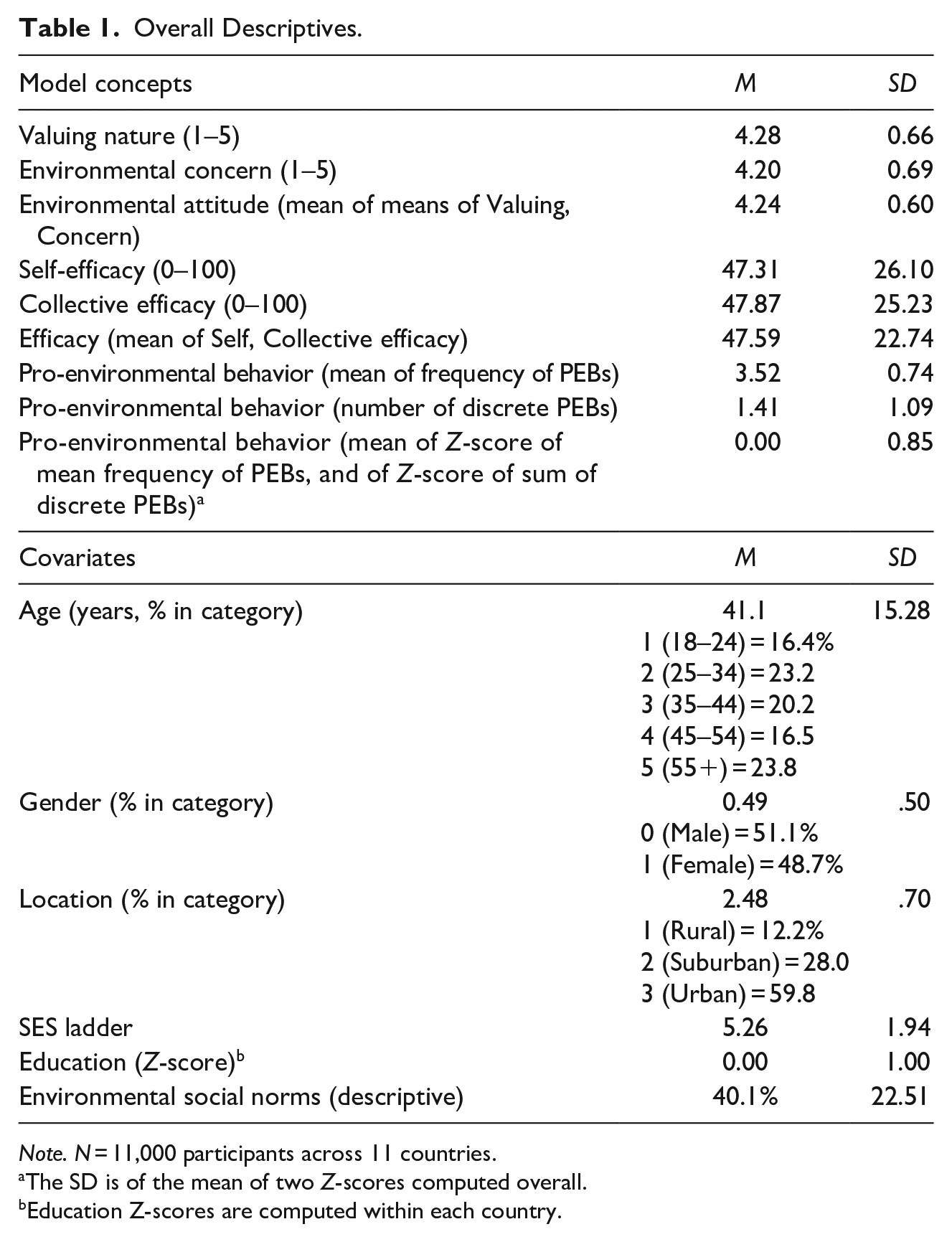
Note. N = 11,000 participants across 11 countries.
The SD is of the mean of two Z-scores computed overall.
Education Z-scores are computed within each country.
Direct and Moderation Models, With Covariates
Table 2 shows results for the overall significant corrected model (i.e., the test of the model as a whole) (F = 288.89, p < .001) with direct, moderation, and covariate effects explaining 33% of the variance. EA was significant (supporting H1; ηp2 = .157), and EA was significant though much weaker (supporting H2; ηp2 = .016), while the interaction of EA and EFF was not (rejecting H3; ηp2 = .00). Of the covariates, slightly less age, more urban location, lower SES ladder, more education (Z-score within country), and more supportive environmental (descriptive) norms were significantly associated with the PEBs outcome measure, while only gender was not (informing RQ1).
Explaining Pro-Environmental Behaviors Overall.
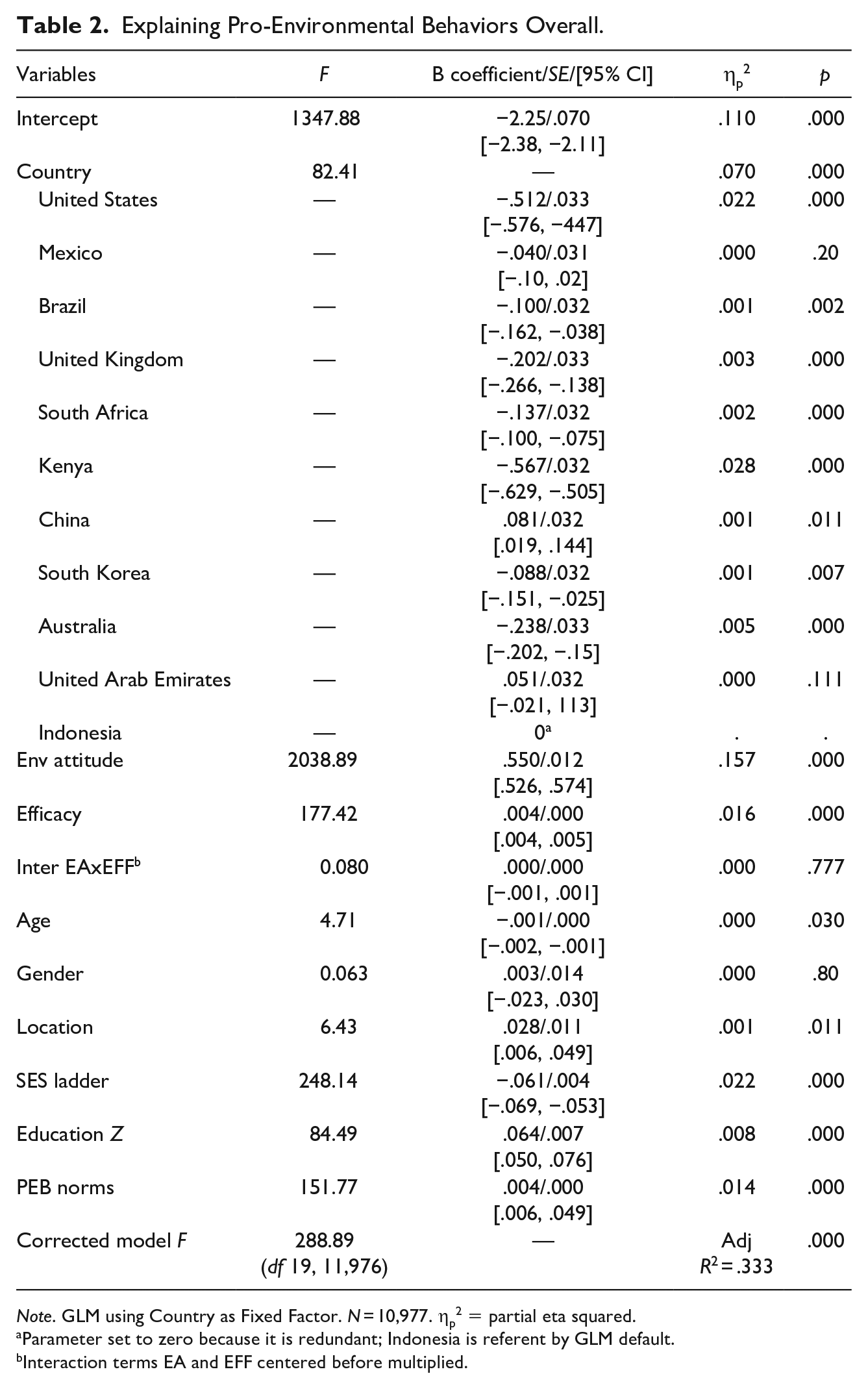
Note. GLM using Country as Fixed Factor. N = 10,977. ηp2 = partial eta squared.
Parameter set to zero because it is redundant; Indonesia is referent by GLM default.
Interaction terms EA and EFF centered before multiplied.
The countries (as factors in the overall sample) display some variation in their association with PEBs (relative to the referent country Indonesia, using the GLM default of last category). For example, the strongest associations appear in Kenya (B = −.567, ηp2 = .028) and the United States (B = −.512, ηp2 = .022), while the lowest appear in Mexico (B = −.040) and the United Arab Emirates (B = .051), both with ηp2 = .00, the two non-significant country effects. However, overall, the country factor had a total ηp2 of only .070.
Results by Country
Descriptives and Mean Differences
As Table 3 shows, significant differences emerged across countries for each of the main model variables (EA, EFF, and PEBs), with ηp2 of .09, .04, and .11, respectively). Participants in Mexico had the highest levels of pro-environmental attitudes, while respondents in the United States and South Korea had the lowest levels. Participants reported the highest levels of EFF in Mexico and Indonesia while those in the United Kingdom reported the lowest. Respondents reported the highest frequency of PEBs in Mexico and China, while individuals in the United States reported the lowest. In addition, PEBs were done least frequently in the United States, while the most discrete PEBs were performed in Indonesia, followed by Mexico and the United Arab Emirates. Table 3 also shows that significant differences emerged across countries for each of the covariates (with ηp2 from .02 for gender to .13 for SES ladder).
Descriptive Statistics and ANOVA Test of Mean Differences Across Countries.
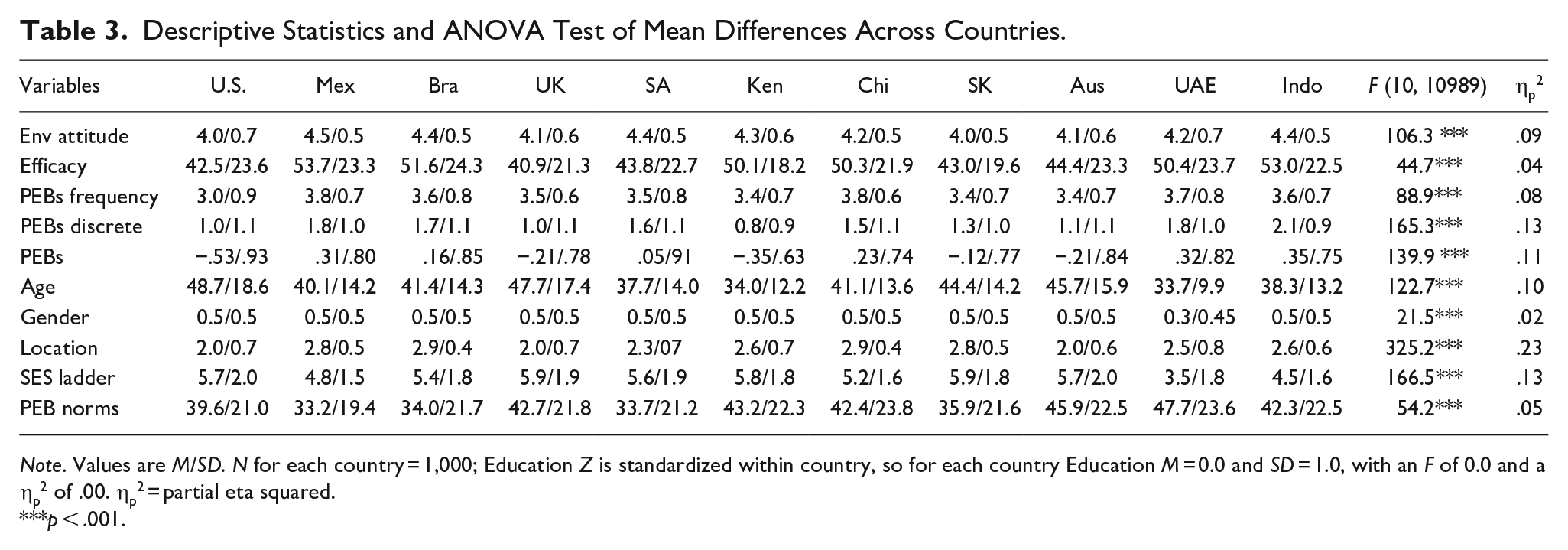
Note. Values are M/SD. N for each country = 1,000; Education Z is standardized within country, so for each country Education M = 0.0 and SD = 1.0, with an F of 0.0 and a ηp2 of .00. ηp2 = partial eta squared.
p < .001.
Direct and Moderation Effects, With Covariates
We applied a Hayes Process moderation model for each country, with HC3 correction for heteroscedasticity (one of the model approaches described by Bryan & Jenkins, 2016). Process automatically uses centered values for the two direct effect variables and computes the interaction term using the product of those two centered terms.
Table 4 presents the results of the Process model testing for direct and moderation effects, with covariates (informing RQ2). Models for all countries were significant, with adjusted R2 ranging from .10 (Kenya) to .38 (United States).
Summary Results for Process Model Within Each Country.
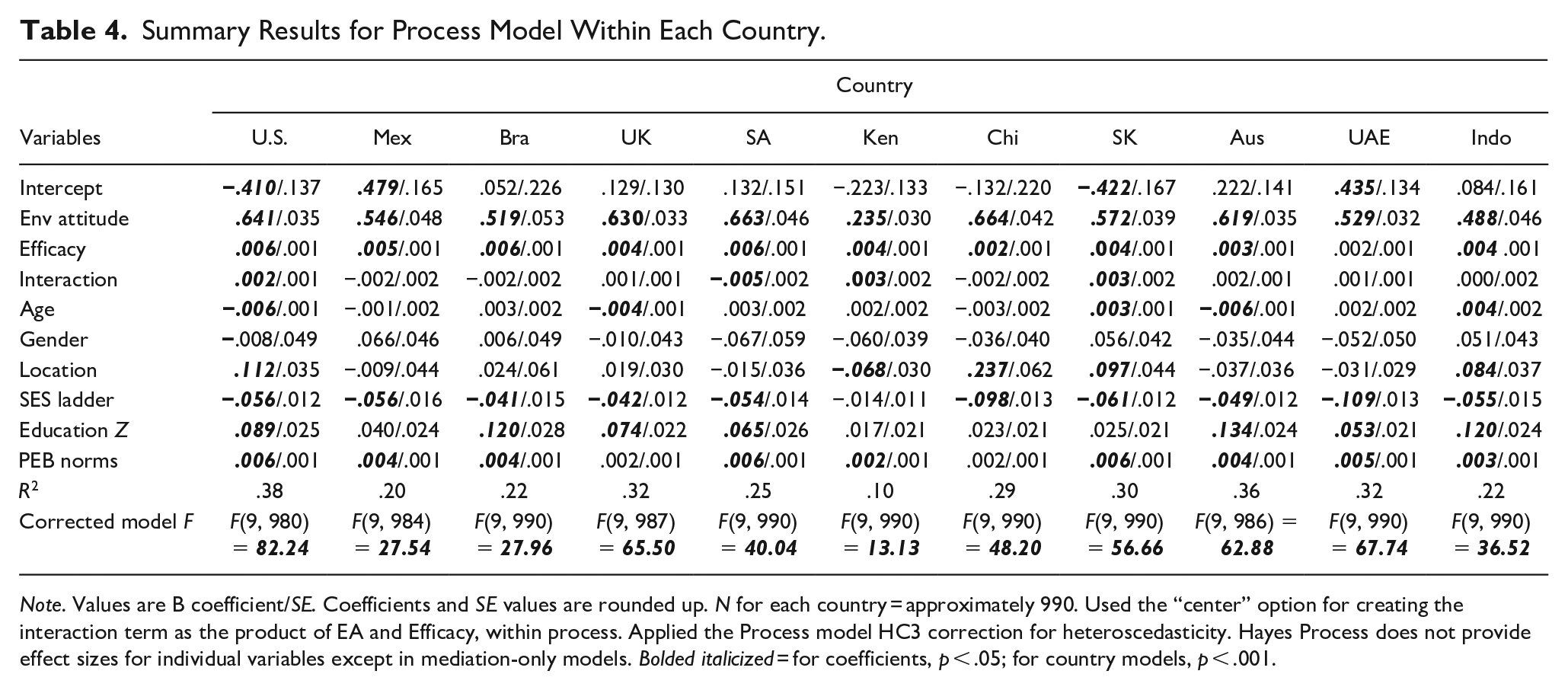
Note. Values are B coefficient/SE. Coefficients and SE values are rounded up. N for each country = approximately 990. Used the “center” option for creating the interaction term as the product of EA and Efficacy, within process. Applied the Process model HC3 correction for heteroscedasticity. Hayes Process does not provide effect sizes for individual variables except in mediation-only models. Bolded italicized = for coefficients, p < .05; for country models, p < .001.
EA was significantly associated with PEBs in each of the 11 countries, with the strongest in China (B = .664) and South Africa (.663), and the weakest in Kenya (.235). EFF was significantly positively associated with PEBs in every country except for the UAE, with the other coefficients in a tight range between .002 and .006. EFF exhibited a significant (though vanishingly small) interaction with EA in four countries: the United States, South Africa (surprisingly, negatively so), Kenya, and South Korea. Figure 1 displays the small variations in moderation effects across the 11 countries.
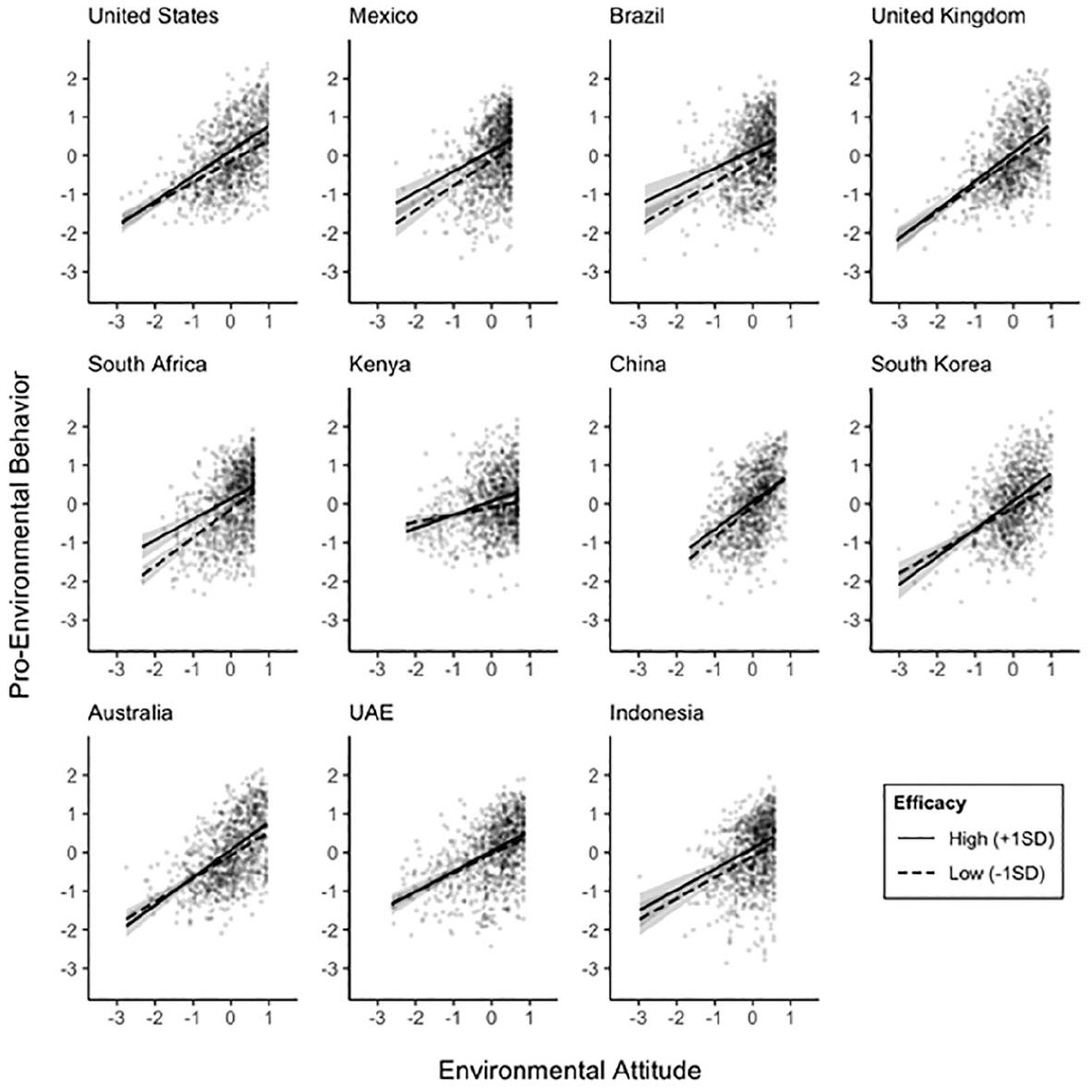
Moderation slopes by country.
Table 4 also shows how covariates were somewhat differentially significantly associated with PEBs in each country (informing RQ3). Age was significantly associated with PEBs in five of the countries (three negatively, two positively); gender was not associated with PEBs in any country; the effect of location along the rural-urban range was significantly positively associated with PEBs in four of the countries (with by far the strongest relationship in China) but negatively in Kenya; SES ladder was significantly negatively related for each country besides Kenya; education was significantly positively associated in seven countries; and environmental norms was positively and significantly associated in all countries except the United Kingdom and Kenya.
Discussion
Summary
As expected, EA was significantly associated with PEBs both overall and in all of the individual countries, with small to moderate effect sizes. These findings are consistent with attitude-behavior models such as the theory of planned behavior and the large body of literature indicating a small to moderate relationship between environmental attitude and pro-environmental behaviors (Ajzen, 1991; Axelrod & Lehman, 1993; Bozorgparvar, 2018; Hines et al., 1987; Kim et al., 2013; Lee et al., 2014; Meinhold & Malkus, 2005; Oreg & Katz-Gerro, 2006; Wang, 2017).
Also as hypothesized, overall the direct relationship between EFF and PEBs was significant, but with a very small effect size. The positive significant relationship persisted in all but one country, though with extremely small coefficients. The moderation analyses revealed a different pattern, with the interaction between EA and EFF being non-significant in the overall analysis, though significant (but with tiny effect sizes) in four of the countries. We thus see that EFF (whether directly or via moderation) does not matter much. Rather, it is largely overwhelmed by EA. A person might feel they can perform a pro-environmental behavior, but that is not going to affect their behavior nearly as much as having a positive attitude toward engaging the object of their behavior—the environment. Our findings would constitute a note of caution to researchers and public-facing communicators who assume that efficacy is a primary influential direct or moderating lever in motivating behavior.
One contributor to the small EFF effect sizes could be the way this specific study measured efficacy. The measure referred to global environmental issues and long-term (10 years) outcomes rather than to one’s ability to complete a specific type of PEBs in one’s daily life. It is likely that individuals’ sense of efficacy in their ability to perform a small-scale, short-term pro-environmental task such as recycling in the coming week would have a stronger relationship with their eventual engagement in that behavior, but their belief about their ability to help solve global environmental issues in the long term (as phrased in the measures of both self- and collective efficacy in this study) would play a smaller role in their everyday decisions to behave as responsible stewards of the planet. As such, a mismatch in the scale or scope of efficacy and behavior could influence the strength of the efficacy-behavior relationship. This idea certainly merits further investigation. Another possible explanation for the lack of a direct effect of EFF on PEBs would be that EA and EFF are highly correlated, so that the presence of EA in the model removes much of the effect of efficacy. However, EFF is weakly correlated with both EA (.21) and PEBs (.26), while EA has a stronger relationship (r = .44) with PEBs (all one-tailed p < .001). Further, perhaps the overall effect averages out differential country influences on EFF; however, the ICC value for efficacy across countries is only .04 (see Table A in the Online Appendix), and the ηp2 for the country factor explaining PEBs was only .070, indicating little country-level influence.
Most of the covariates were significantly associated with PEBs (more urban, lower on the SES ladder, more education, greater subjective descriptive norms) overall, but again with tiny effect sizes. When considered separately by country, the results indicate that some associations with PEBs (EA and EFF) are relatively consistent across countries. However, different covariates played significant roles in different countries (younger in four countries, urban in three countries, lower SES ladder in all but one country, and more education in seven countries). This suggests that the role of some of these influences on PEBs may be country-dependent, so that policies or communication efforts concerning environmental attitudes, environmental efficacy, or pro-environmental behaviors should be tailored accordingly.
It is important to note that, except for EA, the effect sizes for all of these relationships were very small. Such findings are not unexpected because in any given moment, the behaviors that an individual chooses to perform depend on myriad contextual factors, only some of which are possible to measure, accurately remember, or account for. However, overall, our models (main constructs and covariates) explain a third of the variance in PEBs, so combinations of even small influences might be associated with substantial aggregate effects. Further, we must emphasize that these correlational relationships do not necessarily represent causal effects, although the PEBs measure asked about specific actions taken within the last 12 months. Therefore, it is unclear whether targeting any of these constructs individually would yield the behavioral changes sought in large-scale environmental communication campaigns.
Limitations
Our findings are also subject to the limitations associated with using secondary data. Although the measures provided by the National Geographic Society were developed based on prior research, some measures were limited in the degree to which they represent the precise nature, number of items, and breadth of the construct used in the present research. For example, other measures of environmental attitudes or PEBs may be more appropriate or insightful. Two widely used measures are the New Environmental Paradigm (Dunlap et al., 2000), which represents general ecocentric systems of beliefs without reference to any specific topic (Best & Mayerl, 2013), and the Environmental Attitude Inventory (Milfont & Duckitt, 2010), which refers to general perceptions about and effects on ecology. We also note that the means of the particular EA items we analyzed were generally high, around 4.2 on a 1–5 scale, although they do vary significantly across countries, and had somewhat restricted SDs, though that is expected with such large sample sizes. We might expect that the high means could limit overall explained variance, and not reflect influences of those with less positive attitudes.
Additionally, while PEBs was measured with 11 items across two questions, this list is not exhaustive and also is not equally applicable for every respondent or country. Different countries and contexts may foster or obstruct some of these 11 PEBs in different ways, and there are other kinds of PEBs in which individuals may have been participating. Further, respondents typically perceive and thus report themselves as engaging in more pro-environmental behaviors than average others (for both abstract and specific comparisons; Bergquist, 2020).
However, these secondary data contributed to one of the study’s main strengths: the ability to compare predictors of PEBs across a large, high-quality sample overall, and from 11 different countries around the world. The preliminary tests, the appropriate statistical analyses, and the ability to control for some known covariates of PEBs also contributed to the rigor of this study.
Future Research and Implications
This study demonstrates the consistency and/or variability of the central predictors of PEBs across a wide range of countries and their contexts. Although these findings advance our understanding of theory and provide international insights regarding commonly discussed relationships, more research is needed to accurately understand the common and contextual influences on PEBs.
As briefly reviewed, extant research and theoretical work have demonstrated that results are generally stronger when PEBs and its influences are matched on their level of specificity (Kollmuss & Agyeman, 2002). While some scholars argue for taking a general approach to measurement (e.g., Kaiser et al., 1999) as we have done here (by making sure to include the two main distinctions in the literature in each of the three main constructs), others have noted that stronger relationships occur when measures of both behavior and its antecedents are specific (e.g., Ajzen, 1991; Kim, 2011). Thus subsequent research could consider whether a) each of the two distinctions has different effects, and b) whether combination of matches or mismatches among these two distinctions show different results. Another distinction might be the perceived social status of specific PEBs, affected by how costly, effortful, and visible they are (Uren et al., 2021). It is probable that making these distinctions in the relevant measures, as reflected in the summary review sections, will shed more light on the ways in which these relationships vary by concept and context.
Prior research shows that a range of other covariates are also associated with PEBs, such as political ideology (Feygina et al., 2010) and religious affiliation (Morrison et al., 2015), which would be important to consider in future research. Further, there are, of course, many motivations for engaging in PEBs other than instrumental improvement or protection of the environment. These include positive emotions (Schneider et al., 2021), signaling one’s positive moral values and environmentally-friendly orientation which can foster a more positive self-image (Venhoeven et al., 2016), and an improved sense of well-being (especially if the behaviors are specific and reflect meaning; Zawadzki et al., 2020). Also, future research on PEBs and its antecedents across a sufficient number of countries for multi-level modeling can provide insight into the country-level contexts (e.g., press freedom, development index, internet penetration, etc.) that affect the relationships between environmental attitudes, efficacy, and behaviors. While the results here support the attitude-behavior link (esp. as proposed in the theory of planned behavior), the weak and variable explanatory significance of efficacy raises questions about its, well, efficacy, in engaging in pro-environmental behaviors.
Conclusion
As increasingly dire reports demonstrate the consequences of human action on the environment (IPCC, 2021), there is an urgent need to promote global engagement in PEBs. Understanding the psychological underpinnings of PEBs is an important foundation that informs experimental research and strategic interventions. Understanding how the relationships between environmental attitudes, environmental efficacy, and pro-environmental behaviors vary or remain consistent around the world adds important nuance to our theoretical and practical knowledge base. Our study finds that environmental attitudes are a far stronger predictor of pro-environmental behaviors than efficacy overall and in all countries studied, and that there is little or no moderation effect of environmental efficacy.
Supplemental Material
sj-docx-1-eab-10.1177_00139165221131002 – Supplemental material for Relationships Among Environmental Attitudes, Environmental Efficacy, and Pro-Environmental Behaviors Across and Within 11 Countries
Supplemental material, sj-docx-1-eab-10.1177_00139165221131002 for Relationships Among Environmental Attitudes, Environmental Efficacy, and Pro-Environmental Behaviors Across and Within 11 Countries by Lindsay B. Miller, Ronald E. Rice, Abel Gustafson and Matthew H. Goldberg in Environment and Behavior
Footnotes
Declaration of Conflicting Interests
The author(s) declared no potential conflicts of interest with respect to the research, authorship, and/or publication of this article.
Funding
The authors disclosed receipt of the following financial support for the research, authorship, and/or publication of this article: The second author acknowledges the ongoing support as the Arthur N. Rupe Professor in the Social Effects of Mass Communication.

Supplemental Material
Supplemental material for this article is available online.
Author Biographies
References
Supplementary Material
Please find the following supplemental material available below.
For Open Access articles published under a Creative Commons License, all supplemental material carries the same license as the article it is associated with.
For non-Open Access articles published, all supplemental material carries a non-exclusive license, and permission requests for re-use of supplemental material or any part of supplemental material shall be sent directly to the copyright owner as specified in the copyright notice associated with the article.
