




Abstract
Keywords
This research began with the premise that we need to improve city schools. Decades of reform have led to incremental improvements, but urban school districts continue to underserve their communities and need systemic change and innovation (Cohen et al., 2018; Hopkins et al., 2014; Oakes, 1987; Tyack, 1974). The latest reauthorization of the Elementary and Secondary Education Act, Every Student Succeeds Act of 2015, deferred power to states and local authorities to develop standards and accountability systems and design supports and interventions for low-performing schools (Egalite et al., 2017). The policy gave flexibility to education organizations to creatively develop ways to improve schooling and sparked growing interest in district innovation.
This study looked at how one school district, Oakland Unified School District (OUSD), innovated during a period of rapid change. Three concurrent events in the external environment affected the actions and behaviors of actors in Oakland in 2020 and 2021: the global coronavirus pandemic, greater calls for racial justice, and an increased need to address climate change; and each led to cocreated policy innovations designed by community members, students, and the governing board of the district. The research presented here tells the story of how actors at Oakland Unified discussed innovative ideas to address issues of equity and contributes to our shared understanding of how to improve urban school districts.
Study Overview
Oakland, California has a long history of calling on school district leaders to address issues of racial and social justice through their education system and schools (Ansell et al., 2009; Kirp, 1979; Kissell, 2022; Murch, 2010; Noguera, 2003; Self, 2003; Trujillo et al., 2014). Over the last decade, the city experienced rapid gentrification that increased diversity (Hwang et al., 2021), budget constraints that reduced resources (McBride, 2022), leadership and educator turnover that created instability (Fensterwald, 2022), and school closures, mergers, and transfers that led activists to question to what extent were policies benefiting some while harming others (Mukherjee, 2023). Though district leaders, community activists, and students agree that all children should be treated fairly, they disagree considerably in their approaches to achieving greater equity in the city that they share.
This study aimed to both better understand how the school district discussed and developed new education policies, and to inform theories and research on change, reform, and innovation in education systems. Three broad questions guided this research:
How do education leaders and stakeholders articulate their perspectives during the policymaking process? Whose ideas are privileged in the design of new policies? How does the case study advance our understanding about change, reform, and innovation in urban school districts?
The study hypothesized that innovative ideas would be explored during school board meetings and investigated how district actors interacted in this space. To develop methods, it consulted three bodies of scholarly work: theoretical literature on innovation in social fields; empirical work on the field of urban education; and methodological considerations in critical social analysis techniques.
Innovation in Social Fields
Innovations are new ideas or practices that change the way we think and act (Fagerberg et al., 2004; Rogers, 2003; Torfing & Triantafillou, 2016). They emerge in the search for ways to break from the conventional wisdom to benefit specific individuals, groups, organizations, or society (Fagerberg et al., 2011). Innovations are different from inventions in that inventions are a conceptualization of an idea, whereas an innovation also adds value toward achieving set goals in more effective and efficient ways. Literature on innovations may categorize them into typologies (such as product, service, policy, or process innovations) (Garcia, 2015; Torfing & Ansell, 2017), and they describe them by the magnitude of its change to an organization (incremental, slightly changing practices, or radical, initiating more risky departures from norms) (Ettlie et al., 1984). A policy innovation is a type of innovation that responds to complex social problems and creates a new policy agenda by redefining problems, goals, and priorities, developing new strategies, and using new tools to advance ideas (Torfing & Ansell, 2017).
This study draws on ideas about innovation from theory of social fields because of its consideration of past scholarly work and its generalizability. The theory of fields outlines a broad sociological theory defining social fields as collectives of actors with a stake in a collective issue or situation (Fligstein & McAdam, 2012). Building on ideas put forth by new intuitionalists, economists, and social movement theorists, the theory views the social world as consisting of linked and embedded social fields in which actors with varying degrees of power compete for advantage as they engage in collective action. Actors in shared social fields work together to make meaning and to develop consensus around what is occurring, who has power, and rules of action.
The emergence, maintenance, and transformation of fields occur when groups of actors use social skill to advance their needs, perspectives, and ideas. Critiquing social and institutional theory, field theorists argue earlier theories neglect to fully theorize how fields change and transform over time. To address this concern, a theory of fields offers a different conception of actors, stating they can be categorized as either incumbents or challengers based on their motivation for action. Incumbents use dominant logics to retain status quo and maintain stability. Challengers, on the other hand, want change and seek opportunities to articulate alternate ways of shaping their shared social fields. Internal governance oversees compliance to rules and help sustain dominant incumbent interests. According to the theory, fields are heavily influenced by the broader environment, and the emergence of new orders and transformation of existing ones often takes place when faced with situations of crises.
The phenomena of two groups with competing views on change in shared social fields is conceptualized in other disciplines in similar ways. In social psychology, the term minority influence is used to illustrate how actors are influenced by either pressure toward innovation (the minority) or pressure toward conformity (the majority) (Moscovici, 1976). Minorities act as agents of innovation by creating conflict, deviating from established rules and norms, proposing alternatives and original ideas for social change, and consistently influencing the thinking, attitudes, and behaviors of the majority group (Gardikiotis, 2011; Moscovici, 1994). In organizational theory and management studies, scholars argue organizations should simultaneously create spaces for exploitation, or maintain current effective practices, and exploration, or develop new ways of addressing existing problems (Duncan, 1976; March, 1991; Raisch & Birkinshaw, 2008; Tushman & O’Reilly, 1996); and argue organizational ambidexterity, or generating balance between exploitation and exploration, is vital to the performance of organizations (March, 1991; Tushman & O’Reilly, 1996). This study draws on these theories to look at competing views on change in a specific type of social field, the field of urban education.
The Field of Urban Education
Urban education systems are complex social fields with multiple actors holding different views on how to organize schooling and achieve collective goals of excellence and equity. Modern structures and practices of urban education systems began to take shape during the early twentieth century when school districts created centralized management offices of hierarchically positioned administrators to set agendas, perform tasks, and organize schools in what they imagined to be one best system (Tyack, 1974). In this system, the primary role of citizens was to democratically elect a school board that oversaw district decisions. Since midcentury, with the passage of federal desegregation, civil rights, and immigration policies, cities and schools grew in diversity, and community activists, advocacy groups, and local organizations began to push district administrators and school boards to consider their interests in education policymaking (Cohen et al., 2018; Tyack, 1974).
While education systems developed new programs to address new needs during this time, reports of poor academic performance, fragmentation in instructional offerings, and increasing inequalities led many to lose confidence in urban schooling systems (Cohen et al., 2018; Hopkins et al., 2014); and by the end of the century, urban school districts began to experiment with school choice initiatives, site-based management such as charter schools, and accountability policies (Fuller, 2000; Lubienski & Weitzel, 2010; Scott, 2005). Advocates for these reforms argued that schooling systems would improve by allowing communities to create autonomous schools, empowering families to choose schools, and letting market forces and accountability mechanisms decide which schools are worth maintaining (Chubb & Moe, 1990).
Subsequent research, however, raises several concerns. Studies show that market-based reforms pull public funding toward private interests, shifting power and control of schooling away from a public system serving a public good and toward those who have the most resources to endorse their own particular interests and perspectives (Bulkley et al., 2010; Lubienski, 2013; Scott et al., 2017). Research also shows that large national and international philanthropic organizations and networks of organizations established elevated influence over public schools by using resources to shape public opinion, impact school board elections, and promote initiatives aligned with own views (DeBray et al., 2020; Quinn et al., 2016; Reckhow et al., 2017). And case studies explain urban schooling systems continue to be segregated and inequitable (Ellison & Aloe, 2019; Lubienski & Weitzel, 2010; Marshall, 2017; Scott, 2005). In spite of concerns, school choice advocates point to evidence that charter schools often provide opportunities for underserved students and are beginning to outperform similar traditional public schools in several states; and the use of market-based reforms have gradually expanded in many urban school districts (Raymond et al., 2023).
Recent research highlights new approaches to study and address issues of excellence and equity in urban schooling. Urban education scholars call for more research on: how local actors and communities use assets, dreams, perspectives, and tactics to identify and dismantle inequities in their schools and districts (Freire, 1985; Green, 2015; Kelley, 2002; Sampson & Horsford, 2017); how research and evidence can better be utilized to inform policy and practice (Bransford et al., 2009; Coburn & Penuel, 2016; Coburn & Stein, 2010; Lubienski et al., 2014); how resources matter and ways to improve school finance and funding (Baker, 2018; Green III et al., 2021; Kozol, 1991; Lafortune et al., 2018); and how growing diversity impacts multiculturalism, intersectionality, integration, racially-conscious policies, and views on race and racism (Carter, 2005; Conchas et al., 2021; Crenshaw, 1989; Ewing & Green, 2022; Gist & Bristol, 2022; Horsford, 2017; Johnson & Nazaryan, 2019; López & Burciaga, 2014; Mahiri, 2017; Noguera & Syeed, 2020; Quinn et al., 2017). This study builds on this body of work to look at how issues at urban schooling systems can be explored through critical analysis of policy discourse, and it draws study design ideas from critical social analysis methodologies.
Critical Policy Analysis + Critical Discourse Analysis
Critical social analysis methodologies stem from the belief that “changing the world for the better depends upon being able to explain how it has come to be the way it is” (Fairclough, 2013a, p. 10). Critical research does not just describe social phenomena, but also evaluates the extent to which they align with collective values and explains how they are influenced by institutional and structural forces (Fairclough, 2013b; Ozga, 2021; Wodak, 2014). It investigates power relations and complex social problems and aims to uncover findings that may influence social change (Diem et al., 2014; Van Dijk, 2015; Wodak, 2014). Critical techniques study the processes that reinforce and reproduce dominant cultures as well as the resistance and movements that lead to change (Apple, 2019; Diem et al., 2014; Wodak, 2014). They question the function of power, privilege, and dominance in societies, and focus attention on studying the causes of inequities, injustices, oppression, marginalization, and suffering (Apple, 2019; Diem et al., 2014; Van Dijk, 1993; Wodak, 2014). While both critical policy analysis and critical discourse analysis are rooted in critical social analysis, critical policy analysis draws also from policy studies and policy analysis techniques (Diem et al., 2014), and critical discourse analysis adds elements from language studies and discourse analysis (Fairclough, 2013b).
Critical policy analysis deviates from traditional forms of policy analysis in arguing that policymaking is not a sequential and deliberate process enacted by skilled rational policy actors, but rather a complex social practice in which policy rhetoric does not always match practiced realities (Ball, 2021; Diem et al., 2014). Critical policy scholars explore the complexity of policy problems and look at how policy actors define social issues and describe solutions through policymaking (Diem et al., 2014; Ozga, 2021). They recognize that policies and policy actors are embedded in contexts and question in what ways are they influenced by environmental forces, and how do they intend to influence their specific social fields (Diem et al., 2014; Ozga, 2021). Research in critical policy analysis examines the policy process, looks at how policies emerge and change over time, and studies whether and how policy ideas reinforce or change dominant cultures (Diem et al., 2014).
Critical discourse analysis is a form of discourse analysis that critically examines social phenomena through study of language and texts (Fairclough, 2013a; Fairclough, 2013b; Taylor, 1997; Van Dijk, 2015; Van Dijk, 1993; Wodak, 2014; Wodak & Meyer, 2009). It differs from other forms of discourse analysis in that it focuses less on linguistic characteristics of discourse, and more on the social, cultural, and political implications of discourse (Fairclough, 2013b). Discourse, in this sense, can be defined as the use of language to convey a way of construing aspects of the world, and language can be both written and spoken texts as well as visual images and body language (Fairclough, 2013b; Wodak, 2014). Discourse is a representation of an ideology, and can promote a certain set of ideas, interests, goals, and values that benefit a particular group of people (Fairclough, 2013b; Riedy, 2020). Critical discourse analysis scholars point out that the way discourse is used to communicate perspectives can have major effects on society (Fairclough, 2013b; Wodak, 2014).
Pulling ideas from both critical policy analysis and critical discourse analysis, this study looks at policy discourse, and examines how policy actors at school board meetings express ideologies on ways to address critical policy issues in urban education, assuming some actors will strive for stability while others will push for innovative change.
Methods
To investigate how education leaders and stakeholders articulate perspectives during the policymaking process, whose ideas are privileged in the design of new policies, and how urban school districts can be more innovative, this research uses an embedded case study design and multiple qualitative data collection and analysis techniques. The case study method is a useful empirical strategy to examine research questions about contemporary issues in their real-world context, and it allows researchers to study behavioral events over which they have little or no control (Yin, 2018). An embedded single-case study design looks at units of analysis at more than one level, placing attention on both a single case as well as subunits within the case to focus data collection and analysis (Yin, 2018).
This study looks at OUSD school board meetings during 2020–2021 as the focal case, and discourse on multiple policy innovations as subunits of analysis. It focuses on school board meetings because in urban education systems they are the space where policy actors get together to share ideas, debate issues, and engage in dialogue. At board meetings, citizens voice concerns, make recommendations, and build coalitions, and though elected officials often disagree with constituents, they may be persuaded by comments, demands, and recommendations at public hearings (Adams, 2004; Collins, 2021; Howell, 2005). Because board meetings cover a range of topics, this study selected a sample of new and innovative policies to examine in depth. Here, it focuses on the policy ideation process, or how actors framed policy alternatives to critical issues (Beland, 2005), and the innovation-decision process, or how actors shared attitudes toward new policy innovations before deciding to adopt and implement (Rogers, 2003). It hypothesized that groups of actors would coalesce around shared socially constructed perspectives (Hajer, 1993; Riedy, 2020), and aimed to uncover how these discourse coalitions make meaning of social problems and use language to justify views.
Operationalizing Key Concepts
Case study research uses literature to identify terminology previously applied to phenomena of interest, as well as to operationalize new terms (Yin, 2018). This study draws from reviewed literature to synthesize and define four concepts to study innovation in policymaking discourse, and each are used to develop theoretical propositions and a research design:
Critical policy issue: a complex social problem with varying perspectives on the role of power, privilege, and dominance on inequities, injustices, oppression, marginalization, and suffering within a social field Policy innovation: a new policy idea or practice that aims to address a critical policy issue through redefining complex social problems and developing new strategies and tools to address them Incumbent discourse coalition: a group of actors that convey an ideology that is focused on maintaining stability and retaining dominant culture Challenger discourse coalition: a group of actors that convey an ideology that is focused on designing innovative ways to reshape dominant culture
Theoretical Propositions
In case studies, theoretical propositions point to theoretical issues to examine through data collection and analysis, provide guidance on how to craft a research design, and offer insights on how to expand and generalize theories (Yin, 2018). Drawing on literature, this study identifies and builds on the following theoretical propositions about the focal case: policy actors will discuss ways to address critical policy issues; policy actors will propose policy innovations that either directly or indirectly address critical policy issues; and, during policy debates, some actors, incumbents, will convey an ideology focused on maintaining stability, while others, challengers, will push for more radical change. Based on theory, this study predicts that while the school board and district leaders will largely be motivated to maintain stability, unexpected crises may inspire new ideas and policies to emerge. This study assumes that the ideology of policy actors will remain the same across policy innovations when new ideas about a critical policy issue are discussed around the same time in the same context. And this study argues that better understanding how ideas are debated during policymaking could shed light on new ways to attain collective goals of excellence and equity in urban education systems.
Research Design
Case study research designs outline a clear methodological path that shows how data will be collected and analyzed to investigate research questions and test theoretical propositions (Yin, 2018). This study collected and analyzed data in three overlapping and iterative phases to understand the case, analyze evidence, and highlight main findings (see Figure 1). Data collection began in January 2020. During the first two months, data was collected in person and online; however, when the coronavirus pandemic forced meetings to take place through videoconferencing, data collection continued online for the duration of the study.
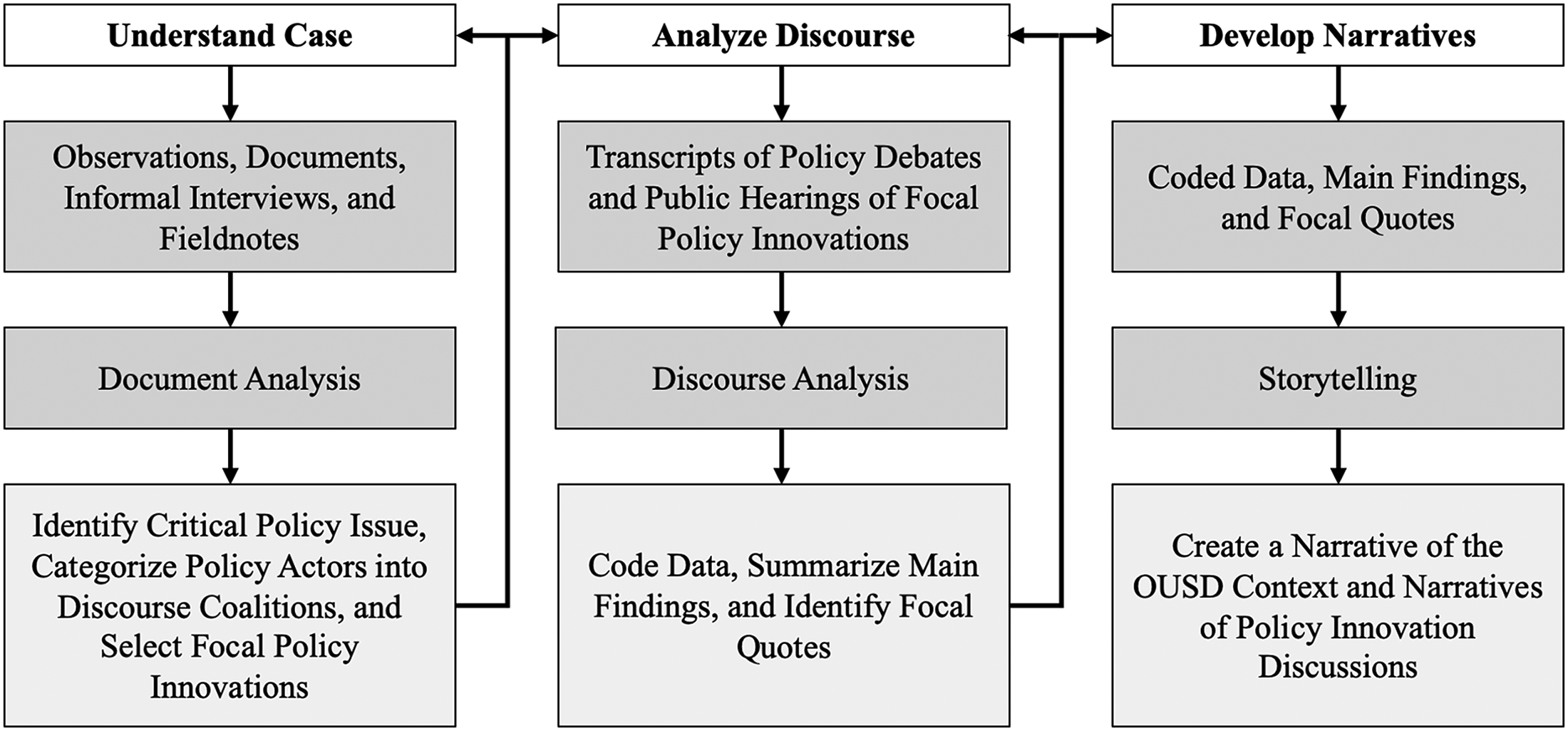
Data collection and analysis phases and techniques.
First, it used observations, documents, informal interviews, and fieldnotes to understand the case (Creswell, 2014; Miles et al., 2020). Through non-participant observations of school board meetings, detailed fieldnotes were developed outlining main discussion points and themes in policy debates and public hearings; and documents, including those shared at school board meetings, information collected from websites and newspapers, and academic publications about the school district were collected. Focus was placed on identifying a critical policy issue that the district was addressing as well as collective goals and strategies that actors were endorsing. It looked for instances in which actors at school board meetings questioned dominant practices and discussed inequities and injustices. In this analysis, actors and fields were preliminarily categorized into discourse coalitions, and policy innovations were selected as focal initiatives to study. Resolutions were selected based on whether they aimed to develop new and innovative strategies to address the critical policy issue, and attention was placed on identifying policies that were garnering growing interest in urban school districts across the country. Informal interviews with activists, principals, teachers, and students during this stage helped corroborate and triangulate initial findings.
Second, it used transcripts of policy debates and public hearings of focal policy innovations to analyze discourse (Johnstone, 2018). All discussions on the identified focal policy initiatives were transcribed, including public debates among board members as well as comments made by community members during public hearings. Quotes were coded by descriptive characteristics including speaker, policy innovation, and date and time of when the quote was spoken. Transcriptions were then used to analyze discourse, coding for mentions of the focal critical policy issue, as well as whether the quote reflected an incumbent or challenger ideology. All data and analyses were then reviewed to confirm the grouping of actors and fields into coalitions and to identify main themes in district discourse.
Third, it used coded data, main findings, and focal quotes to develop narratives (Polletta et al., 2011). It first created a narrative about the historical, political, and cultural context of OUSD and an overview of their school board meetings in 2020–2021. Then it created narratives describing board discussions about focal policy innovations, using quotes to illustrate incumbent and challenger ideologies. Narratives aimed to highlight through storytelling two different perspectives about equity in the district—the way they frame problems, articulate needs, and brainstorm and offer solutions. Whenever possible, personal identity characteristics are removed to maintain attention on the perspectives of the focal groups in this research. Narratives are followed by a discussion on policy ideas, theoretical propositions, and future directions.
Reflexivity and Subjectivity
Conducting good qualitative social research requires that researchers maintain awareness of their reflexivity (Bourdieu & Wacquant, 1992; Giddens, 1990) and manage subjectivity (Peshkin, 1988; Yin, 2018) throughout the research process. To minimize bias, improve rigor, and increase validity, this study used theory to operationalize generalizable concepts and create a logical research design, and it collects and analyzes multiple sources of evidence to triangulate findings. To ensure replicability and increase reliability, this study relies heavily on publicly available data sources and public information. And while it focuses attention on policy discourse at one urban education system, it aims for analytical generalizability, and continuously reflects on and considers how analysis from the case may be generalized to examine other cases as well.
Oakland Unified School District
Oakland Unified School District (OUSD) is a midsize urban school district serving a multicultural population of students, including those with families who have lived in the city for generations as well as immigrant families from all over the world. The demographics of the city rapidly changed over time, shifting from nearly an all-White student population until the late 1930s, to 50% nonwhite (Black, Mexican, and Asian) by the early 1960s, to 80% nonwhite by the late 1970s (Kirp, 1979), and to 90% Black, Indigenous, and Persons Of Color (BIPOC) by 2020 (CDE DataQuest, 2020). The city and its residents have a deep collective culture of activism, and the school district has a long history of centering discussions on how best to serve its diverse population of students.
A Brief Overview of the Historical, Political, and Cultural Climate of OUSD
Several notable historical events shaped the political and cultural climate of school board meetings at the start of the study. In a case study of education in Oakland, Kirp (1979) traced issues of race and schooling from the 1950s to the 1970s as the school district faced national and local pressures from the movement for desegregation. Pointing to changing demographics, competing Black ideologies, different perspectives on racial justice, and political and economic forces, the research illustrates why the city did not desegregate schools. Much of the decision had to do with no longer feeling a need to with shifting racial demographics, and much of it had to do with factionalism within the community around whether it was something that they wanted.
In 1957, as the city gradually became more diverse, the school district established its own police force, a move that many community members felt was in reaction to changing demographics. Around the city, activists started movements that questioned the role of police in society and advanced the ideology of Black empowerment and self-determination around the world (Murch, 2010; Spencer, 2016). Recalling their own experiences in Oakland at this time, Black Panther Party founders commented: During those long years in the Oakland public schools, I did not have one teacher who taught me anything relevant to my own life or experience. Not one instructor even awoke in me a desire to learn more or question or explore the worlds of literature, science, and history. All they did was try to rob me of the sense of my own uniqueness and worth, and in the process they nearly killed my urge to inquire (Newton, 1973, p. 20).
In the mid-1960s, Oakland schools remained segregated with schools in the wealthier hills receiving better resources and quality education than those in Black-majority schools in the flatlands (Kirp, 1979; Murch, 2010). Concerned with these inequities, activists began pushing for a radical transformation of schools and greater participation of minority groups in district policymaking. Around the city they organized to push demands and negotiate with the school board on district policy, and when unable to sway decisions, activists started looking for leadership more responsive to their needs. The appointment of the district's first Black superintendent in 1970, Marcus Foster, brought stability to the fragmented district and the superintendent focused attention on meeting with advocacy groups, proposing resolutions to community conflicts, hiring minority staff and teachers, and allocating funding to under-resourced neighborhoods (Kirp, 1979). In 1973, he was assassinated by a far-left domestic terrorist group, leaving the community grieving, and derailing many equity-focused initiatives. New leadership brought new focus to educational achievement, and advocacy groups expressed disapproval of the pace and scope of improvement in the district.
Since the 1970s, a rise in immigration brought East Asian, Pacific Island, Southeast Asian, South Asian, Middle Eastern, European, African, Caribbean, and Latinx immigrants to the city, altering racial demographics of schools, and bringing new cultural and linguistic needs and diverse perspectives to school district politics. In the 1980s and 1990s, inequities in resources and outcomes persisted between schools (Noguera, 2003), and by the late 1990s, concerns over academic performance motivated community activists, local organizations, and philanthropic foundations to channel resources toward reforms aligned with own interests (Ansell et al., 2009; Noguera, 2003; Trujillo et al., 2014). Advocacy efforts attracted attention of both community groups and external organizations and led to the creation of many small autonomous schools around the city, which many activists later critiqued as creating logistical and financial problems in the district (Trujillo et al., 2014).
In 2003, the state of California took control of the school district when the district reported a deficit of more than $37 million. After bailing the district out with a $100 million loan, the state enacted several changes before returning control to the district six years later with an increased debt of $89 million (Trujillo et al., 2014). The district has since struggled to attain solvency and is required to have the state review budgetary decisions until the loan is fully repaid. When the deficit was uncovered in 2003 the superintendent was fired. The school district was subsequently headed by a succession of eight superintendents until the ninth, an Oakland native supported by the greater Oakland community, was appointed in July 2017, and dedicated to bringing stability to the role (Freedberg & Harrington, 2017).
The state takeover also led to an increase in the number of charter schools around the city and the percentage of students attending them as the state felt it to be the best approach to address budget concerns (Kissell, 2022). The district opened its first charter school in 1993 in response to concerns that schools were failing to address the needs of the rising Latino immigrant population and Black students (Fuller, 2000). At the time, charter school advocates, unable to convince the school board to approve the charter, were able to get county approval and began operations. Though the school faced numerous difficulties, often seeking financial, technical, and research support from external organizations (Fuller, 2000); the charter school movement grew in the district with another 16 charter schools opening by the time the state took over in 2003 (OUSD, 2024). Between 2003 and 2009, an additional 17 charter schools were opened. By 2015 the number of operating charter schools in the district grew to 45 (OUSD, 2024) and served 27% of district students by 2020 (CDE DataQuest, 2020).
In 2011, citing equity concerns, district administration and community members committed to developing more district-run child-centered community schools in underserved neighborhoods (Kissell, 2022; Trujillo et al., 2014). Community activists have since been fighting to hold the district accountable to those promises as charter school expansion and school closures/mergers, including schools with deep personal and cultural significance to long-time community members, continued to be the dominant approach to addressing district problems. During the decade that followed, a steady increase in immigration, gentrification, and diversity continued to shift district discourse around issues of equity as school district policy actors continued to work together to identify ways to improve the quality of schooling for all.
OUSD School Board Meetings 2020–2021
These events highlight a long and complicated history of race and racial relations in Oakland, and they tell a story of decades of change and reform in the education system. Whether discussing desegregation, school police, district finances, academic performance, school choice, etc., OUSD school district leaders are forced to tackle issues of racial justice and equity as their city's racial demographics rapidly shift over time, shifting with it the cultural, social, and political climate of the city. As such, this study identified the push to advance racial equity and justice through the district schooling system as a critical policy issue to better understand through research.
At the start of the study in 2020, the district served a total of about 48,700 students in 127 schools, 42 of which were self-managed charter schools, governed by their own board, and sometimes run by nonprofit charter management organizations (CDE DataQuest, 2020). There were also 36 private schools operating in the city, serving about 6,400 students (CDE DataQuest, 2020), about 50% of whom identifying as BIPOC (Private School Review, 2024). The school district is governed by a school board of seven elected board members, each representing a geographical area of the city. The superintendent and two student board members sit with the school board and take part in conversations about new policies and programs, but their votes are not counted in final district decisions.
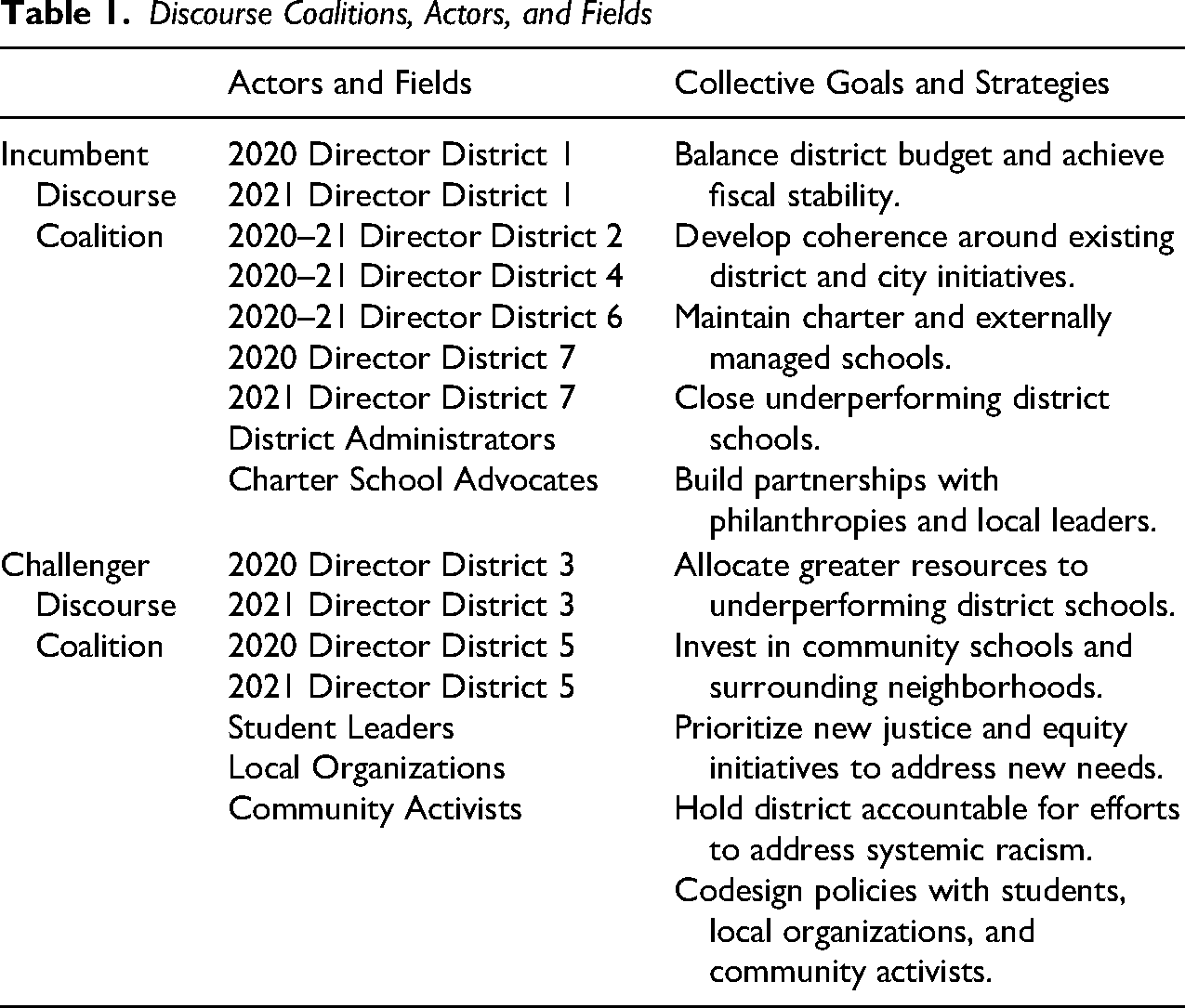
Actors in the school district held either an incumbent or challenger ideology on how to address district problems. Incumbents included school board members, both those who had served for years, and those who were newly elected but shared incumbent views on how to manage the school district. They focused on organizational and fiscal stability through balancing the budget, developing coherence around existing initiatives, and relinquishing control of schools to charter school management. Challengers also included veteran and new school board members, as well as student leaders, community activists, and local organizations who all questioned dominant practices and collectively pushed for policies to address issues most negatively affecting marginalized students. They advocated for reforming underperforming schools, supporting communities around schools, and developing new and innovative approaches to advance justice and equity.
Both groups shared a common collective goal to provide excellent and equitable education to students in the city. All were a mix of many cultures, reflective of the diversity in Oakland, and represented schools from across the town. Table 1 summarizes the key actors and collective goals and strategies of these two groups.
Discourse Coalitions, Actors, and Fields
During 2020 and 2021, the district, like other urban school districts across the country, was faced with three unexpected events that changed schooling and organizational practices. First, the global coronavirus pandemic forced schools to lockdown and educators had to develop strategies to deliver instruction remotely. Second, greater calls for racial justice led districts to debate how students should be taught about race, racism, and their impacts on society. And third, an increased need to address climate change sparked by wildfires, tornadoes, and hurricanes inspired many to question how districts should consider the environment and environmental justice in the design of education policies. These unexpected events inspired education leaders and stakeholders in Oakland to introduce, debate, and pass new resolutions to address new concerns.
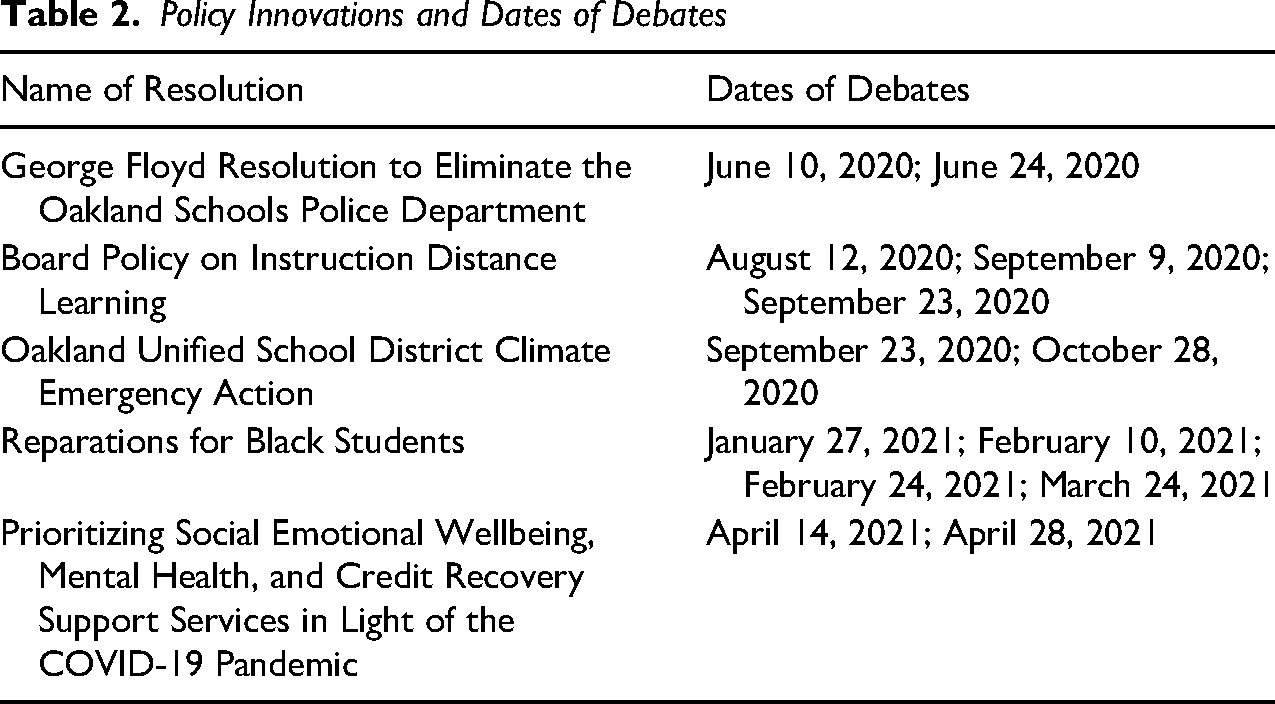
Five innovative policies were identified as focal initiatives for this study: school safety, remote learning, and climate change which were all debated and discussed during the fall of 2020, and Black reparations and mental health which were introduced by new board members and students at the beginning of 2021. Table 2 lists the focal resolutions (policy innovations) and dates of debates.
Policy Innovations and Dates of Debates
School Board Meeting Discourse on Policy Innovations
During debates of focal policy innovations incumbents and challengers shared their ideas on how to meet collective district goals. This section tells the story of these discussions chronologically and in the words of the policy actors examined in this study.
School Safety
Issues of school safety were long debated in Oakland and intensified after the death of a young Black man who was shot by a school police officer while parked outside of a district school in 2011. In the years that followed, community members and activists called for the elimination of school police and new safety policies, and they joined the Black Organizing Project (BOP), formed in 2009 after the death of Oscar Grant by Bay Area Rapid Transit Police, to advance their cause. During this time, the incumbent perspective on the issue was to budget money annually to maintain the school district police force. Prior to the pandemic, challengers spent months protesting and shutting down school board meetings, but their efforts did not lead to change until the murder of George Floyd on May 25, 2020 sparked widespread outrage around the country and around the world.
June 10, 2020
The resolution to eliminate school police was first developed by BOP and challenger community activists who advocated for new safety measures and allocation of more funding toward restorative justice (RJ) and social and emotional health programs. Over the years, they collected evidence, shared views with district leaders, and drafted a policy outlining demands. A challenger school board member introduced the BOP policy: We're looking at massive cuts or changes to our budget because of covid-19. This is a way to reimagine how we educate children without harming them with constant contacts with police. And this isn't to say that police officers in OUSD are bad people. But we have a history, and there was an investigation when our own sergeant shot and killed that young man, Raheim Brown, while he waited in a car across the street from Skyline for someone to leave a dance… and the lawsuits, and the millions that were paid. This isn't about renegotiating because this is about a department being eliminated. Let's think about why police were created historically. And why we as a school district with such limited resources… let's think about how we spend every dollar. A budget is a value statement, and our budget right now is a value statement. That includes budgeting for police and that's not okay with me. I appreciate BOP and their work lifting this up for a decade. Our family was really lucky to go through the restorative justice process instead of the criminal process. I felt a restorative justice process was enormously human, not just for myself and my family, but also for the other families that were at the table. I'm a teacher and member of OEA [Oakland Education Association]. OEA has stood and continues to stand strongly behind BOP's campaign to eliminate OUSD police. OEA believes strongly in safe and secure schools. A true safe school is one with caring adults from the community, not with police. Teachers have demonstrated their knowledge of the history of police terror of the Black and Brown communities, and they have taken a clear stance against police. Research and history have shown that OUSD has a long record of disproportionate suspending, expelling, and voluntary transferring, and arresting Black students in the name of safety. Many students are currently criminalized at school because of mental health needs, behavioral health needs, or disabilities that are too costly for schools to take on. Instead of funding these needs, OUSD spends more than six million dollars a year employing school police and security officers. Over policing is a costly expenditure that diminishes student success and fails to guarantee safety in schools. OSPD [Oakland School Police Department] sworn officers see themselves as a valuable part of the safety and security system in place at OUSD. When creating the OUSD safety and security plan, the most effective outcome of this harsh tragic critical moment is going to be a product created by all invested parties having insight. Meet us at the table, we have a vision of a hybrid future.
June 24, 2020
After the first meeting challengers from across the city continued to organize and advocate support for the resolution. At the second meeting, incumbents expressed to the community that they fully shifted their views and sided with challengers. The board president at the time, who previously criticized protestors for advocating against police, noted that they received over a thousand emails in support of the policy and changed their view: This is a historic moment. The question of how we ensure safety in our communities and our schools is influenced by institutional racism, as recent events and longstanding history demonstrate. We recognize the need to reimagine school safety in our community. It will require an ongoing commitment of all OUSD educators, certificated staff, classified staff, both at school sites and the central office, working hand-in-hand and in partnership with our students and families to change practices and to transform our organizational mindset and behavior towards Black and Brown students and families. We didn't get here this far by being naive. We understand that the issue of having law enforcement in schools is a deeper-rooted issue. We understand that there would be resistance. Because just like any system, we are attached to it even when it hurts us. We understand that our ancestors had to fight hard to let go of a segregation system. And sometimes even folks that claim to be progressive had a hard time letting go. We are still fighting to understand what true freedom in this country looks like.
Challenger board members proposed the resolution further detail ways the district could advance racial equity, but most board members, both challengers and incumbents, argued they preferred to keep the policy as BOP and students originally advocated, and instead committed to continuing conversations about racial justice when developing new policies. At the end of the debate, a student board member, gathered alongside dozens of fellow students summarized the student perspective: We've been standing in solidarity with the community and with BOP, marching for this and fighting for this with them, and showing them what the power of the youth looks like. I'm very optimistic and hoping that the board stands on the right side of history tonight. We do not believe that policing is a worthy investment of OUSD funds. For the last twelve years, our youth, All City Council and other youth organizers have advocated for investment in restorative justice and other necessary resources that Oakland students need to succeed. Our campus police make our Black and Brown students feel unsafe, and without safety, students are not able to learn. We, your primary and largest constituents urge you to vote ‘yes’ to the George Floyd Resolution to Eliminate the Oakland School Police Department. Let's do this for our ancestors, y'all, and the generations to come.
Remote Learning
On May 14, 2020, shortly after the school district switched to remote learning due to concerns about the pandemic, the superintendent and city officials launched a $12.5 million fundraiser, OaklandUndivided, to purchase required technology with the expectation that it would take years to attain. After the district raised about $2 million, a technology entrepreneur and former resident of Oakland donated $10 million, and another entrepreneur donated $700,000. By May 15, the district had the funding required to close its digital divide. Over the next several months, the school board was tasked to decide how to use the new funds.
August 12, 2020
The board decided to start the 2020–21 school year using remote learning, and both an incumbent and a challenger board member introduced the resolution over the summer. The incumbent board member explained its purpose, “This gives us the additional authority to not just authorize distance learning, but to leverage distance learning. It also sets forth that the superintendent set up a distance learning master plan.” In response, challenger community activists questioned the intention of the policy, wondering whether it could become an alternate form of schooling at the district: “This leaves the opportunity for any of our courses to be switched to digital learning in the future, and this is a highly controversial thing.” The challenger board member who introduced the policy explained their view on its purpose: I've talked to people who were in the thick of this work in March and April to figure out what to do and what it'd look like. The state didn't necessarily know. The feds are clearly not helpful to us. And so my community is a group of intelligent, wise people. Our role and our responsibility is to try to set a vision and a space for it. A computer will never replace the value of an educator, but the distance learning policy is about a new way of thinking. This is the work of the nation right now, and this work is vital to children that look like me. Because they didn't have the opportunity for a policy to actually support the teachers, support the superintendent. To actually call on them to think about what happens when these things shift and change. So the policies should be connected to the people. And I think we can add more and I'm okay with doing that.
September 9, 2020
At the second meeting, incumbents expressed they understood challenger concerns about the long-term goals of the resolution: This policy calls on us to build on the necessary infrastructure to equitably and effectively support and educate all OUSD students through distant learning practices, particularly our students in greatest need. And it absolutely cannot replace in-person interaction. We've been living in a world where it's been okay for what seems like sixty percent of our students to not have a device or internet connectivity at home. And that's been okay until this pandemic comes. And now students can't receive an education because we haven't made it as a city, as a school district, to make sure they're connected… when we know every student of affluence across this city has connectivity. It's a digital divide that we've sat silent on. One suggestion would be that the superintendent or designee, maybe that master planning group, will provide an equity audit of all the technology providers, all of the technology assistance that's being done. My concern is very much grounded in being a part of a pandemic where we've been talking about Black Lives Matter and the need to uplift Black lives, Black voices. But also many folks of color that are left out of economic opportunity. So we should recognize that someone can gift the organization ten million dollars and we go out and buy devices and buy hotspots. But we're doing it without a lens of equity in my mind… to circulate that dollar back into community. Or back into smaller businesses or local businesses. If we put meaning behind Black Lives Matter or Brown lives matter. Or we're going to interrupt racism and institutional racism, then these policies have got to get a little bit cleaner. And our auditing of our behavior has got to get much better. If you make this a requirement, just like you have to provide a textbook for every kid, if you have a social studies curriculum, then there has to be requirement that you're providing the technology to every family. And that has to be irrespective of whether the family can afford it or not. Right now we have through OaklandUndivided, we have a program for free technology. But are we going to provide free technology like we would a textbook to every student or is there some kind of bifurcation of that? It's a free educational process. If distance learning is the technology like a textbook, it seems to me we are required to budget for technology for every student, just like we do a textbook.
September 23, 2020
On September 23, 2020, the resolution passed unanimously. Incumbents agreed to add a component about prioritizing collaborations with small businesses and local providers as challengers had requested, so long as it did not hinder access to technologies or add additional costs. And challengers convinced incumbents to ensure that digital learning would not replace traditional district schools.
Climate Change
Student leaders and community activists regularly raised concerns about environmental justice, both due to increased concerns over climate change, as well as experiencing negative consequences from neglected district buildings. During the first several months of 2020, students from a district school were temporarily displaced when hazardous chemicals were found on their grounds, leading many in the community to question why district students were being harmed while students at nearby charter schools were not. On September 9, 2020, smoke from wildfires obstructed the sunrise over the Bay Area and turned the sky orange. The event refueled conversations about the environment and climate change, and shortly after, two incumbent school board members introduced a climate change resolution.
September 23, 2020
The policy called on district administrators to develop a plan to address climate change, as an incumbent explained: We have a lot of work going on in different parts of the organization, but they're not cohesive, particularly around sustainability. And also, we are in a climate emergency, right? All you have to do is live here for the past month and you see that. This establishes an interdepartmental task force to bring together stakeholders to draft a climate and sustainability policy. This is not something that's going to necessarily cost a lot. This is an opportunity to reduce waste and potentially generate revenue, capture savings, and hopefully redirect those savings to the classroom.
Challengers appreciated that incumbents planned to address issues of racial equity, and pushed the district to consider new ways of thinking about what equity would look like at the district: Student board members showed the report of the trees being planted around an East Oakland school that's actually surrounded by a freeway. My neighborhood in West Oakland is surrounded by four freeways. Equity can be really, really hard, and it's not necessarily going to look fair. It's one thing to ask me my opinion and have me sitting at the table. But it's going to be another thing when this board makes decisions about where they put their resources. And which communities they put in the resources. And whether or not somebody is going to come along and say that's too much for that community. Or you don't have enough kids. Attached to the report tonight is a map. I just want to reiterate, this map shows the census tracks in the city of Oakland that the state of California defines as being disproportionately impacted by pollution, by environmental pollution. And mapped on top of that is the student population. I think this map could actually provide a very decent roadmap to look at implementation of this policy. Actually the state program is designed so that you have to spend money in those communities.
Though it was incumbents who introduced the policy, challengers from across the district expressed support for the resolution, pointed to ways a new climate change policy has the potential to address racial and environmental injustices, and thanked students for their advocacy work. During public comments, a community activist pointed out, “I want to emphasize the importance of this resolution to a lot of youth. At Oakland Tech, for the AP Environmental Science class, we've actually created a climate emergency action resolution project… creating art, videos hopefully, resolutions, and ideas.” A challenger parent shared: As an OUSD mom and a daughter of an immigrant, I am moved that the solutions we propose center on equity and generational and racial justice. Young people and low-income Black and people of color are disproportionately harmed by climate change. Youth stakeholders have identified clean energy solutions and climate literacy as urgent priorities. They understand a livable future for them hinges on their own ability to identify swift and sweeping solutions. If this passes you will be joining forces with some other cutting-edge folks around the country. Los Angeles passed a hundred percent clean energy resolution last December. Salt Lake City, a student-led team passed a resolution similar to the one proposed here just a few months ago under covid. And Seattle is talking about one. So Oakland has always been on the cutting-edge of social change and leadership and innovation and equity and racial justice. Your leadership in this moment will ripple all over the country.
October 28, 2020
At the second meeting, incumbents reiterated their commitment and shared they felt it would be an easy policy to implement financially: We're going to establish a goal for the district that within ten years, 100% of our energy will be clean electricity. And that'll be pretty easy to do with the fact that we take energy from the East Bay community energy, and it has a 100% green option. We've had a lot of initiatives going on in the district in different departments, but they haven't been coordinated. So let's pull all that work together, let's take advantage of it. I'd like to highlight and underscore a specific comment. That equity can be really hard and it's not necessarily going to look fair. In other words, equity is by definition not equality. And that addressing equity, in large part, depends on resource allocation decisions by elected representatives of this very board. It will be imperative that the task force, the advisory council, and the board work closely with the district's Office of Equity to help us all navigate the complexity of effectively focusing this work through an equity lens. As someone who does live in an environment that has a lot of challenges, this is important. And sometimes people feel like Black folks don't pay attention or care about it, yet we are the ones mostly highly impacted. We know that this movement doesn't always reflect us very well. So I hope the superintendent will develop this out with the community. The people most impacted have to be at that table. And the students who are living with the asthma rates in West Oakland or East Oakland. The students who are living with the trash being dumped and the dangerous conditions that that creates. That they walk past dumping… I'm worried about this project, this proposal or policy being very narrowly executed. And not bringing to the table people who speak different languages. That is going to be challenging because they're not speaking English or they're not as comfortable with English. Maybe that's going to be the push on us to do real true racial justice and environmental justice. There's just so many things that can be done and can be done well for an overall impact. Or they can be done in silos. When I got on the board eight years ago, I met with staff in all departments. They'd come from other districts, and they'd never seen such silos like they've seen at OUSD. So I hope that this is more diverse and that the goal is to push on who's at the table and not just some online survey because not a lot of people are just going to go on an online survey. You've got to be more creative than that.
On October 28, 2020, the resolution passed unanimously. Incumbents clarified they understood community concerns about equity during debates of the climate change policy, and recognized students for inspiring them to change. Throughout the board debate and public hearings, challengers maintained attention on the relationship between climate change and racial justice and reiterated the importance of not just including challengers in conversations, but also incorporating their ideas into policies.
Black Reparations
At the end of 2020, four school board members, two incumbents and two challengers, stepped down from their positions. Of the four newly elected board members, two aligned with the incumbent perspective, while two aligned with challengers. The new challenger board members, in collaboration with community activists, created a resolution that called for Black reparations. They included in it a call to stop school closures and approaches to address the needs of Black families in Oakland, who they argued have been disproportionately negatively impacted by past district policies.
January 27, 2021
At the last board meeting in January, challenger board members introduced the policy and explained its purpose: We have failed our responsibility to our Black students. We have a segregated school district. And OUSD has a responsibility to protect Black students from systematic racism. So we need to actually act on this as a community. Support the families. We need a solution that matches the scale of the problem. OUSD can create some solutions that center on our kids, like Black thriving, giving students a sense of belonging, giving an identity affirmed. This is opportunity for us to really stand up and say if you're feeling social justice, if you're feeling there really needs to be some sense of support here, then we're going to have to rise to the occasion. We really have to do better as a people, and we can't just keep looking to Biden and Harris to fix our problems. We're really going to have to take it up ourselves. And we can't use excuses like our budget is too big or we don't have enough money. It's really about prioritizing. The thing about it is that there wouldn't be no democracy if Black folks didn't fight for democracy. For all the immigrant families that come here today… somebody fought for them to make this happen. And the bloodshed and every single war. The call of the civil rights legislation. The amendments… the fourteenth, fifteenth amendments. We have been fighting to have some equal say, some sense of respect. Especially in a city like Oakland, and a school district like Oakland. We're really going to have to ask ourselves some serious questions.
At the first meeting on the resolution, incumbents stated that they needed more time to think it through, “I wanted to see how it would fiscally impact our district.” When they suggested that they wanted to continue the conversation in March, a challenger board member argued that it seemed like incumbents were delaying discussions of the new policy: As a lifelong resident of Oakland, California, whose parents met while working at a Freedom School in Mississippi, whose great-great-great grandfather was born in slavery and fought for his freedom in the Civil War… this is something that is long overdue. We've worked hard to engage the Black community here in Oakland, including Black students, Black parents, Black teachers, Black educators, Black everyone. And what we heard very loud and clear is a need to feel prioritized, to feel the board take a stand and call for a coordinated plan of action. The community needs to hear that this board is committed to addressing the issues that are hitting our Black students disproportionately.
February 10, 2021
The board decided to honor the request of challengers to discuss the policy in February, and challenger board members and community activists again reiterated the purpose of the resolution. They argued that district values of providing opportunities, advancing equity and excellence, and being culturally responsive have not always been felt by Black students. Incumbent board members shared that while they supported the resolution, they were concerned about the budget: First of all, I want to say I did sign on to the reparations in order for us to have a discussion. I just want everyone to know that. And it's also because I strongly believe that we have to really address the needs of our Black students in the district. However, I want to bring up something that I talk about. Number one, fiscally, I think we have to know where our resources are actually going to come from. Because we have to make certain that our district stays afloat. Then number two, improving the schools. For sure, I absolutely am committed to supporting schools where Black students are thriving. But we need a strategy to turnaround schools that are not serving our Black students. Why the language was included about school closures and colocations is because when we look historically over the last twenty years at what schools have been subjected to closure and what schools have been subjected to colocations… a high percentage of those schools, a very high percentage of those schools, have been Black majority schools. So the reason why that language is in there is to address the disparate impact that school closures and colocations have had on the Black community. There's a lot in here that I think resonates with what a lot of other groups are saying. I want to just stress that just because the board is addressing the issue of African American students in this way, that in no way takes away resources from other groups. Whether it's Latino/Latina students, Southeast Asian students, or Pacific Islanders. This is just recognizing the historic nature of how our education system has treated Black students. And in fact, as I think some of the community members said, this work provides a template for how we can address these issues with other groups. There is a lot of language there that has some financial implications. And I don't necessarily philosophically agree with all of the strategies, even though many of them I do. I just wonder about… if it's more of a philosophical statement, is there a way to pull back some of the ideas. And refer that to the working group table to be able to talk about some of the details. I agree with that. The intention is that this is the starting point. But we're starting with all this data that we collected already. The other thing that's important in this conversation is we're talking about cost. Nobody has mentioned the cost to our Black families and students historically under this system. If we're going to talk about a cost-benefit, we really need to address the historical cost that Black families have paid in Oakland. That's also the intent of reparations… is to correct that, and to begin to repair that damage. It is primarily our Black and Brown students that are unhoused and foster youth. So we need to be thinking about what do we need to do different. I think most of the concepts are right on, but the aim is where are we going to focus for the next three years. We cannot do everything all at once. We can do critical pieces in a lot of these different areas, whether we're talking about changing the mindset of staff, the right curriculum that folks need. The other support that folks need in schools is to make sure that they're not leaving any kid behind and they have the resources to support individual students, and individual families. I ask the board to think about the power of it being connected to the strategic plan. That is the purpose of a strategic plan. You're setting direction on how you want to spend your funds over three to four years. We have to understand what we're try to get at and why. Because we have a lot of investments for African American students. Maybe they're not working, but what is the evidence or thinking around why some of these initiatives will be better than what we're already doing and will get better outcomes than we're already getting for students. Which are not satisfactory for the most part. I just want to really highlight the fact that our plan included solutions for addressing low-achieving students and closing the achievement gap. I haven't heard one from the district yet… I look forward to having those conversations. But sometimes I think we get stuck with the sense of how everything is going to cost which limits the creative thinking to come up with solutions for it.
February 24, 2021
Two weeks later, challengers began the conversation stating that that they hoped to keep the policy as originally drafted, noting that the community expected board members to advance racial equity, “You were elected to bring a racial justice and equity lens to district leadership. This is your chance to show that is more than a campaign promise and actually follow through.” Incumbents, however, again raised concerns about the financial implications of ideas in the policy and proposed amendments to empower district administrators, “I'm just taking out a few things. The main change is making sure the superintendent has some say in who will work on this, instead of us deciding something and just saying implement this.” The superintendent also shared their vision for the policy: I think the spirit of the policy is we want to go for systemwide acceleration and really think about all the elements that continue to perpetuate systemic oppression in our district. We're all impacted by racism and not just by folks that are White. I am supportive of us trying to figure out how we can serve our Black students. I just think the whole history of OUSD is failed initiatives, frankly, that weren't sustained. Part of that has been leadership turnover and part of that has been not really having a plan about how we're actually going to sustain the work over the long term and not using enough evidence and data about how we make investments. This is one of those things that's for youth, and I'm getting hundreds of youth speaking to me right now saying this sucks. OUSD is historically known for having hella Black students. Oakland is known for the Black history behind it. The Black Panthers. I'm just… you know… I'm feeling it right now. You are reinforcing the dynamic that I have lived in my whole life. Black folks have stood up and told you what we want for reparations, to make us full, and you all have sat here tonight and said we know better. You're picking out the pieces you think are better and you plan on rewriting it. A lot of us are coming from places where we are working with thousands and thousands of community members to fight for just the basics. We just want you to recognize that this is a district that has failed. It doubled over on failure and needs radical action and radical change. From my perspective, it would make sense to slow down. And we would have more discussion to make it something everybody could live with. I hear you, that you don't want to accept something that is not your full vision. But everything our board does is a product of compromise and negotiation. I know that's not what you're looking for, but that's just the nature of the fact that there's seven of us.
March 24, 2021
Near the end of March, the board continued discussions, and to reintroduce the policy, the superintendent expressed support, “This evening, I want to be clear, that our district must commit, and will commit to dismantle anti-Black and Brown practices and policies and invest explicit and targeted resources to support Black and Brown excellence.” They continued explaining how the district will build on existing initiatives, including the new safety plan, early intervention programs, literacy tutors, and virtual learning hubs. And they concluded commenting on their view on the district's financial responsibilities, “I cannot support language that prevents the district from making difficult decisions to ensure financial solvency.” After the superintendent spoke, an incumbent on the board announced that the state trustee responsible for overseeing the district budget wanted to speak at the meeting. The state liaison joined and explained that they too request the removal of language with financial implications and pointed to the district's need to attain financial stability.
The comments infuriated challenger board members and community activists who noted they had not been made aware that the state trustee would be at the meeting, and they argued that incumbents were not understanding the vision of the resolution, “You're not looking at it from a moral standpoint, but a financial standpoint.” Incumbent board members sided with the superintendent and state liaison, and used their own histories and relationships with the community to defend why they would not support putting a moratorium on school closures: I as a board member and as a superintendent confronted some of those same decisions over time, they are rarely popular. And many times, they have unintended consequences. But never in those fifty years that I've been in the school district have I ever made a decision that I believed would intentionally harm my African American kids and not move their education forward. It's been an immensely challenging year, particularly on our Black, Brown, Indigenous communities. And in the recent weeks, I've been doing a lot of reflection, particularly on the Asian and Black… on Asian and Black solidarity, Asian and Black community. Just reflecting on my own privilege as an API woman and my own proximity to whiteness through the Black-White binary… and really how both communities have stood in solidarity with each other through the years. Even from Frederick Douglass speaking out against the Chinese Exclusion Act in the late 1800s to the Asian American movement being on the heels of Civil Rights. There has been a lot of Asian American success. We've benefitted from our brothers and sisters in the Black community. One of our most important responsibilities is to make sure that we are fiscally healthy as a district. And I know that people don't like the idea that school closures are a part of that. School closures should always be a last resort. We have done many, many other things including expanding school, redesigning schools, merging schools. So it's not the only tool, but it's not a tool that we should take off the table. Because we have done round after round of central layoffs and budget cuts, and we have the lowest salaries in the county. So, if the tradeoff is that we're going to have low salaries, we're going to have under-resourced schools… I'm not satisfied with that. So I don't think we should be taking that tool off the table. We're getting off into political narratives that people have put out for the last five years. So if the budget hasn't been balanced and people haven't had the right policies in place, I would maybe blame the school board and the trustee who had oversight over those decisions. You're blaming the victims when ya'll have been in charge and you did this. The state should be coming here bringing reparations for our Black students. What we have had to do is close schools because of this state takeover, history of gentrification, gang injunctions, displacement, homelessness, and destroying Black Oakland. So this is unacceptable and the community will remember this and we will keep on fighting. We will make sure to win reparations for our Black students in Oakland and also across the country. In this pandemic it has become very clear how Black student success is not a cause for concern. The school board has failed to listen to us, and as a result, we have been left behind and forced to navigate without the support. We need Black bodies to be acknowledged and supported. Oakland is such an influential city so to adopt this resolution would mean change for OUSD and other districts trying to find ways to repair the harm to Black students, families, and educators. We are the ones in the classrooms being affected by the system. You refused to change. I don't know if I'm going to support this amended policy because I'm so offended by what ya'll trying to run. But let's just be clear. This is what White supremacy looks like. The Black community developed a plan that would work for us.
Mental Health
From the onset of the pandemic, students in Oakland raised concerns about their mental health. Student board members used their leadership positions to collect data about the student perspective and routinely presented student ideas at board meetings. After hearing students plead for a policy to address student concerns, an incumbent board member partnered with a student board member to draft a resolution that would call on the district to prioritize student mental health and credit recovery. The board informed the community about the new policy in March, and the student board member, with the help of the incumbent sponsor, introduced it the following month.
April 14, 2021
The challenger student board member who helped draft the resolution introduced it and explained its intention: It's been a stressful year, especially for our students, and also for our teachers, parents, and everyone in general. And we should all be having these services. But right now, we want to prioritize our students as they transition back to school. Especially with the increase of gun violence in the city, burglaries and robberies, it has caused a lot of incidents and accidents and losing of lives. Our schools are like our second home, and we want to make sure our schools have emotional support for our students. The components of this resolution is outreach to every student and family in the first month of school, and to build relationships and trust with teachers and staff. This is especially important because not all students feel comfortable to ask for help. Especially during this time, it's been very hard… especially for people who come from the Black culture, the Brown culture, Asian culture to ask for help. So we definitely need a universal approach to understand why we are not talking about these problems. When it comes to mental health, I know that a lot of cultures do not accept or believe in it. So this is to open that door and invite our students to just learn about their social and emotional health.
The incumbent board member added their thoughts on how the new policy aims to address issues of equity: I wanted to add just the recognition that there was a youth mental health crisis even before covid. So covid has just made it so much worse and exacerbated it across equity lines and equity gaps. And to address these challenges, what we've learned is that it's not just about programs. Of course, we know with limited dollars we cannot hire enough staff either to be able to sustain. We cannot hire enough therapists and social workers, etc. It's really about supporting the work of our schools to build trusting relationships with students. And really building the capacity of schools to take this work districtwide.
Challengers pushed the board to emphasize trauma in the resolution, “I would like to see personally the word ‘trauma’ in there some place, or ‘trauma-informed care’ some place. We should not just acknowledge what has happened this year, but the ongoing trauma that a lot of our community faces.” And they advocated for a more holistic plan on how to use new funding to address the issue over time.
April 28, 2021
Two weeks later, incumbents shared ways the policy could address other issues in the district. They suggested ways to leverage partnerships and new sources of funding to provide more mental health services, and they noted that the policy should be connected to district professional development, outreach, and hiring practices. Throughout the debate, incumbents commented that the board will continue to discuss finances, “We just need to be cognizant about raising expectations of ongoing support when this is clearly funded by one-time money.”
During public hearing, challengers expressed support and emphasized the importance of the policy. A ninth grader shared: I'm a youth leader with Californians for Justice, a state organization working for racial justice. I've been struggling mentally, emotionally, and academically. It's been hard to get support from those closest to me this year. I had to maintain my thoughts and feelings to myself because the adults around me were also going through a tough time. I really want to urge the district to be intentional on how we allocate additional resources and invest in ways that lead us closer to racial justice. We need a restorative return to school that centers and reflects on the voices of Black, Brown, and API students. This is not necessarily to train young folks to do this work. They're the recipients. We can have them be more proactive and actually cocreate those wellness spaces through their savvy social media and various outreach.
On April 28, 2021, the resolution passed unanimously. Incumbents recognized that the issue of mental health is related to issues of equity, and supported it with new funds and grants, but they cautioned that they may not be able to budget for all of the ideas that challengers were requesting. Both incumbents and challengers supported the resolution and expressed gratitude toward challenger student leaders for enlightening them about issues that students faced and their work on the new policy.
Discussion
Between June 2020 and April 2021, the OUSD school board developed, introduced, and passed five new innovative policies that aimed, either directly or indirectly, to address issues of racial justice and equity at the school district. As predicted, there were some actors in the district, incumbents, who conveyed an ideology focused on maintaining stability, while others, challengers, pushed for change. Incumbents understood the need for new approaches to address longstanding issues of equity and worked with challengers to introduce innovative policies, but their views largely centered on attaining fiscal stability, developing coherence around existing initiatives, and closing underperforming schools. Challengers pushed the district to place greater focus on issues of racial justice and equity when designing new education policies, and to support their view, they pointed to disparate ways school district practices insufficiently addressed the needs of all students.
Exogenous Shocks and New Policy Ideas
The coronavirus pandemic, greater calls for racial justice, and increased urgency to address climate change expedited innovation at the district. Incumbents were more influenced than challengers by these unexpected events, as many of the new policies were advocated by challengers long before exogenous shocks altered student needs. The resolution to eliminate school police and increase safety passed only after nationwide calls for racial justice shifted the views of incumbents, despite challengers pushing for the exact policy for a decade. And building on the momentum derived from the movement for racial justice, challengers introduced a Black reparations policy the following year. Similarly, the district addressed the digital divide and access to technology only after schools were forced to switch to remote learning, climate change only after collectively experiencing its consequences, and mental health only after students raised concerns about pandemic-related rise in crimes, suicides, and dropouts. Nonetheless, policy actors codesigned and passed innovative policies, and analysis of their policymaking discourse reveals policy ideas to address critical issues at the district.
During discussions about school safety, incumbents suggested ways to incorporate the views of the school police force and fellow leaders in the design of new practices. Challengers urged the district to create a new safety plan and insisted they reduce disproportionate suspending, expelling, transferring, and arresting of Black and Brown students, implement RJ and behavioral health programs, and allocate resources toward addressing mental and behavioral health needs.
To address remote learning during the pandemic, incumbents acquired external funding and pointed to ways they could distribute resources to all students in the district. Challengers, with newfound awareness of the consequences of the digital divide, argued they should allocate resources to those in most need, suggested ways to support local businesses, and proposed the district audit technology providers to assess economic opportunities for the city.
Though challengers first called on the district to address environmental justice, it was incumbents who introduced a climate change resolution. Incumbents suggested they address the issue by collecting and analyzing more data and identifying new sources of funding, and both incumbents and challengers offered clean energy solutions and ideas to increase climate literacy. Challengers highlighted issues of environmental injustice and ways climate change disproportionally affected low-income people of color, and they advocated for increasing cultural and linguistic diversity in the development of new policies.
All policy actors recognized that they operate a segregated education system and understood ways that systemic racism negatively impacted Black students. Incumbents addressed the issue by authorizing charter schools, closing underperforming schools, and expressing a desire to develop coherence around existing initiatives. Challengers pushed the district to note their failure at addressing systemic racism and urged the district to analyze the cost it has had on Black students, recognize the disparate impact of school closures on the Black community, close achievement and opportunity gaps, and prioritize the perspective of the Black community in policy development.
When student leaders requested the district prioritize their mental health, incumbents recognized the need to hire more mental health support and identify more resources for schools to implement mental health programs. Challengers pointed out ways to recognize cultural and linguistic differences in approaches to address mental health and insisted the district develop a universal approach to address the issue and hold themselves accountable to meeting student needs.
In all policy debates, board members agreed to collaborate with interdepartmental task forces and community advisory committees to develop a district strategic plan, and they noted that they will determine how to allocate resources when discussing the budget. Throughout debates, both incumbents and challengers emphasized the importance of their collective work and shared they could model to other school districts how to design similar policies.
Propositions and Future Directions
Several theoretical propositions can be derived from the findings of this study and future research may further investigate these claims. Based on analysis of data, this study suggests that:
Incumbents brought stability to the district by focusing attention on finances, administration, and partnerships, and without stability there would be chaos. Challengers illustrated unique insight on what works, for whom, and under what conditions, and through advocacy work, were able to slowly change the perspectives of those with formal power. Without understanding the perspectives of challengers, the district would not have the data or ideas to address the needs of those most marginalized in their shared field. Further research could continue to investigate how to create organizational ambidexterity in public governance social fields.
While incumbents developed and passed innovative resolutions with challengers, their solutions focused on continuing longstanding district practices of allocating power to district administrators to design and implement a plan. Like they have for decades, they planned to collaborate with task forces and advisory committees; and more recently, they set a goal to develop coherence around existing initiatives. Challengers, on the other hand, pushed the district to transform their system and to use approaches that they had never tried before, such as eliminate school police, deliver digital connectivity with the support of local businesses, address environmental injustices, prioritize the marginalized, and include students in district policymaking. Further research could investigate which approaches advance district goals, as well as ways to incorporate the perspectives of all to expedite the pace and scope of district improvement.
Over the duration of this study, challenger policy actors at school board meetings shared a view on change and worked together to advocate their views; however, over time, challengers may not always share similar perspectives, and competing challenger coalitions may form to endorse different ideas. Similarly, incumbents may shift their views over time and better align with a challenger coalition; or challengers may become better aligned with incumbents. Further research could investigate if and how these shifts occur, and in what ways it influences district decisions.
Decades prior to the start of this study, challengers at the district pushed for charter schools, and over time, the once innovative strategy became the dominant incumbent practice. In recognition that the policy did not effectively attain collective goals of equity and excellence, new challengers emerged and advocated for greater support for those who have not sufficiently benefited from, or were harmed by, past district policies. Challengers in this study focused on addressing systemic racism and pointed out past and present incumbent struggles to address it. In times of crises, they explored new ideas, identified alternate ways of thinking about social change, and successfully pushed the district to pass resolutions that committed to advancing racial equity and justice. Future studies could continue to investigate how different contexts and environmental events generate different ideas, and how well they address critical issues over time.
Incumbents in this study regularly cooperated with external partners including charter school management organizations, philanthropies, and state administrators. In contrast, challengers opposed the ideas of those they felt did not adequately understand the history and culture of their city. Challengers instead advocated for greater participation of local actors including students, families, educators, activists, businesses, historians, and citizens. Further research could continue to investigate how to best foster productive multi-actor collaboration of all stakeholders to advance collective goals.
In this study, student leaders and activists played a critical role in advancing policies on school safety, climate change, Black reparations, and mental health. In all policy discussions, they expressed why the policies mattered to them, collected and analyzed ideas from peers, and explained why they believed it would afford them a better future. More research on student perspectives and ways to incorporate student ideas in education policies could shed light on how to creatively advance collective goals and address critical issues.
Oakland is one of the most diverse cities in the country and demographics rapidly change over time. Incumbents and challengers include actors of all races and identities, and rarely is there a perspective on education policy shared among all in a racial group. For example, in this study, the Black community ultimately coalesced around eliminating school police after many years of advocacy work, but they did not agree on how to allocate resources, or whether to support charter schools, nor did they all believe there should be a moratorium on school closures as was originally proposed in the policy for Black reparations. By categorizing actors in this study as incumbents and challengers, this study was able to identify differences in how to address critical issues without racializing perspectives. More research could be conducted to assess the merits of this method and to examine whether it is a useful tool to understand and address critical issues in diverse social fields.
Conclusion
Every aspect of this study considered generalizability and aimed to uncover findings that contributed to both practical and theoretical understanding of innovation in urban school districts. To do this it started with broad social theory to identify groups that are common across social fields. By categorizing social actors at school board meetings as incumbents or challengers, and by selecting focal issues that are currently debated at districts across the country, it intended to illustrate findings that can be generalized to similar fields, and to provide ideas they may consider when designing their own policies.
Footnotes
Declaration of Conflicting Interests
The author declared no potential conflicts of interest with respect to the research, authorship, and/or publication of this article.
Funding
The author received no financial support for the research, authorship, and/or publication of this article.

Correction (December 2024):
In the published version of the article, a few formatting issues were noted in the reference section, which have been corrected. The article has been updated online to reflect this change.