




Abstract
Keywords
Introduction
Nations worldwide have faced numerous challenges due to regional and global crises, social inequalities, rapid technological advancements, and changing market needs. Such challenges have created increasing demands on educational systems, such as improving student academic outcomes and closing achievement gaps, integrating technology into instruction, and developing various soft skills. Schools are therefore required to respond dynamically to such demands and to learn faster than ever before to do so effectively (De Jong et al., 2022; Fullan & Quinn, 2015]; Schechter & Qadach, 2012; Viennet & Pont, 2017), resulting in enormous pressures on leadership and staff (Lambert & McCarthy, 2006; Wang et al., 2022; West et al., 2010).
The question, therefore, is how schools can deal with such pressure and meet their responsibilities in constantly changing environments. As the core business of schooling, teaching plays a crucial role in answering this question. While certain aspects of teaching might be seen as routine work, it also requires constant changes and innovative approaches given the unique needs of each student (Lippke & Wegener, 2014; Moorhouse & Wong, 2022; Thurlings et al., 2015). Considering the previously mentioned increasing challenges and demands, coupled with the nature of teaching, it becomes clear that educators must innovate teaching and learning processes, while still maintaining certain routines and stability.
Organizational research has suggested that exploration—or exploring new ideas and methods, alongside being flexible, risk-taking, and future-oriented—could offer effective responses to changing conditions and expectations. At the same time, exploitation—which encompasses understanding current needs, identifying the best interventions, clarifying related actions and procedures, and executing them effectively—is also regarded as necessary for achieving high performance in organizations (Masci et al., 2008). In this respect, exploration in schools refers to experimentation and innovation, namely the search for new opportunities and solutions; while exploitation refers to efficiency and refinement processes, namely the utilization of existing opportunities and resources (Da’as, 2023a; March, 1991; Pietsch et al., 2022). Through combining these seemingly contradictory aspects, the concept of organizational ambidexterity has been introduced and well-studied in the relevant research (March, 1991).
Drawing on Argyris and Schön's (1978) foundational work on organizational learning, Papachroni et al. (2015) suggest that ambidexterity can enable organizations to manage the conflicting demands between first- and second-order learning. Although organizational ambidexterity has yet to be explored in educational research (Pietsch et al., 2022; Pietsch et al., 2023b), organizational research has provided consistent evidence that it can contribute to the innovation capacity and performance of organizations concurrently, increasing their competitiveness and environmental adaptability. Although it is challenging to achieve organizational ambidexterity as it requires balancing various internal and external conditions and expectations, research has identified certain conditions that facilitate the process (Jansen et al., 2005; Raisch & Birkinshaw, 2008). More specifically, transformational leadership (TL), high-quality leader-member exchange (LMX), and an open innovation mindset are the most critical factors influencing organizational ambidexterity (Ardito et al., 2020; Nemanich & Vera, 2009; Rosing et al., 2010), allowing the creation of cultures where people are willing to take greater risks and function exploratively (Gibson & Birkinshaw, 2004).
As demonstrated in both organizational and educational research, leadership plays a key role in the success of organizations. The TL model has been proven to be an essential catalyst for both organizations’ current performance and their capacity to change, by providing followers with vision, high motivation, and individual development opportunities (Anderson, 2017; Baškarada et al., 2016; Jansen et al., 2008; Leithwood & Jantzi, 2005). Likewise, LMX has the potential to influence this process, as it encompasses the relationship between leaders and followers, which relies upon crucial organizational factors such as trust, collaboration, and commitment (Götz et al., 2020). Within organizations and organizational learning, “supportive leaders and flexible managers are considered the most important sources of ambidexterity” (Gibson & Birkinshaw, 2004, p. 212) because they play a critical role in balancing the implicit tensions between exploiting existing opportunities and exploring new ones (Jansen et al., 2008).
Open innovation, or “the use of purposeful inflows and outflows of knowledge to accelerate internal innovation” (Chesbrough et al., 2006, p. 1), is also a vital antecedent of organizational ambidexterity because it focuses on both internal and external opportunities for transformational change. It enables organizations to expand their sources for development without neglecting internal and external conditions, providing a crucial advantage for reaching organizational ambidexterity (Hwang et al., 2021). The extent to which open innovation processes are used in schools depends primarily on the extent to which collaboration takes place between school personnel and actors outside the school, as well as the configuration of these collaborative relationships (Pietsch et al., 2023a). In any case, open innovation always begins with how people think about innovation in collaborative contexts (Gomezel & Rangus, 2018) by focusing “on how you get the most out of the assets and knowledge you have and how you can benefit from the assets and knowledge others have. It is a much more open, distributed mindset” (Chesbrough, 2017, p. 34).
Against this backdrop, we developed an individual-level model to explore the link between LMX and organizational ambidexterity within Turkish public schools, considering the moderating role of open innovation mindset profiles. Concurrently, at the school level, we analyzed the association between TL and organizational ambidexterity, with a focus on the mediating role of LMX. From a theoretical perspective, we framed these profiles as types of open innovation mindset that form micro-foundations (Barney & Felin, 2013; Felin et al., 2015) of organizational behavior, with a particular focus on organizational performance in ever-evolving, dynamic environments (Eisenhardt et al., 2010). One significant gap in previous studies is the predominant use of a traditional variable-centered approach. These studies often assume that all individuals in a sample are part of a single homogeneous group, and they estimate a single set of “average” parameters. However, it is important to emphasize that teachers can have varying perceptions of an open innovation mindset. For instance, while some teachers may report higher levels of openness and creativity, others may exhibit similar levels of openness but display a relatively lower inclination toward risk-taking. Therefore, exploring whether there is a typology of teachers based on their perceptions of open innovation mindset and investigating how these profiles moderate the relationship of LMX with exploration and exploitation could represent a significant step forward in the literature. Thus, our study aimed to address the following three research questions:
Are teachers divided into different profiles in terms of open innovation mindset? Does teachers’ membership in different profiles of the open innovation mindset play a moderator role in the relationship between leader-member exchange and their exploitation and exploration activities? What are the direct and indirect relationships of transformational leadership with exploitation and exploration activities via leader-member exchange?
Context and Background
The Ministry of National Education (MoNE) exercises authority in managing almost all system-wide issues. This centralized structure creates a system where decisions and policies are primarily made and implemented at the national level, with limited autonomy or decision-making power granted to local educational institutions (Polatcan, 2021). This applies to most aspects and tasks related to schooling, including teacher employment policies, budget allocation, curriculum development and design, assessment and evaluation, and professional development (OECD, 2020); concomitantly allowing school leaders only a limited space to communicate a shared vision for their school's overall improvement and establish a healthy and collaborative culture in which teachers’ feelings and actions are valued and their pertinent professional development is supported (Kalman & Arslan, 2016; OECD, 2020).
Similarly, just as the structure of the education system inherently signals what actions, ideas, and endeavors are valued in a schooling environment, the content and extent of principal leadership signal how teachers are positioned to engage in school decision-making, professional collaboration, and innovation in teaching and learning practices. Given the structure and distribution of the roles within the system, school principals in Türkiye are largely preoccupied with the managerial and bureaucratic aspects of their position; hence, they may struggle to allocate time for building a vision toward specific school goals and priorities, taking actions for teachers’ work attitudes and needs, and supporting professional learning to develop new ideas and exhibit creativity and innovation on the job. However, both recent trends in educational policy and practice (Buyukgoze et al., 2022) and the outbreak of the COVID-19 pandemic (Huber & Helm, 2020) have foregrounded the need for flexibility, adaptation to new conditions and changes, and the use of innovative and novel approaches in schools (Pietsch et al., 2023b; Röhl et al., 2022).
To address the need for empowering school leaders and fostering an innovative climate within schools, the Ministry of National Education in Türkiye has introduced various education policies and regulations in recent years. One such initiative is the Education Vision 2023, which aims to enhance leadership capacity and qualities within schools (MoNE, 2018). This policy document outlines several objectives aimed at initiating digitalization and innovative practices in education nationwide, signaling Türkiye's commitment to transforming schools into ecosystems that prioritize digital skills and encourage collaborative communities. In line with these objectives, the MoNE launched the Teacher Informatics Network (oba.gov.tr) in December 2021, officially inaugurated in January 2022. Functioning as a platform for both teachers and school principals to partake in professional development training sessions and access pertinent resources, the network was conceived to foster digitalization, techno pedagogy skills among teachers, flexible learning communities in schools, and sharing of experiences and knowledge among schools, particularly those distinguished by their exemplary practices. The former Education Minister stated that, within six months of its launch, the platform recorded 6,1 million visits, with 1 million teachers—out of 1,1 million total—taking part in at least one training session (MoNE, 2022b). This shows a strong interest among teachers and school principals in a short time.
Conceptual Framework
This study drew upon social exchange theory to determine the mechanisms through which LMX advances both exploitation and exploration activities. Additionally, as a theory of open innovation, we grounded this framework in the dynamic capabilities perspective “to integrate, build, and reconfigure internal and external competencies to rapidly address changing environments” (Teece et al., 1997, p. 516). Using existing research, we intended to reveal how teachers’ open innovation mindset operates as a dynamic capability through leadership and ambidexterity. Our rationale for proposing this model lies mainly in research that has investigated the effects of school leadership practices on teachers’ innovation efforts (e.g., Vermeulen et al., 2022). The current study extends prior attempts by including teachers’ open innovation mindset profiles as a moderator of the proposed model. Therefore, this study aimed to test the two-level model depicted in Figure 1. At the individual teacher level (Level 1), we hypothesized that the latent profile variable (open innovation mindset) was specified as a moderating variable of the relationship between LMX and organizational ambidexterity (both exploitation and exploration). At the school level (Level 2), our model posits that TL is directly and indirectly related to teachers’ exploitation and exploration activities through LMX (see Figure 1). Empirical evidence has indicated that TL plays a vital role in enhancing these activities by fostering an innovation climate (Zuraik & Kelly, 2019).
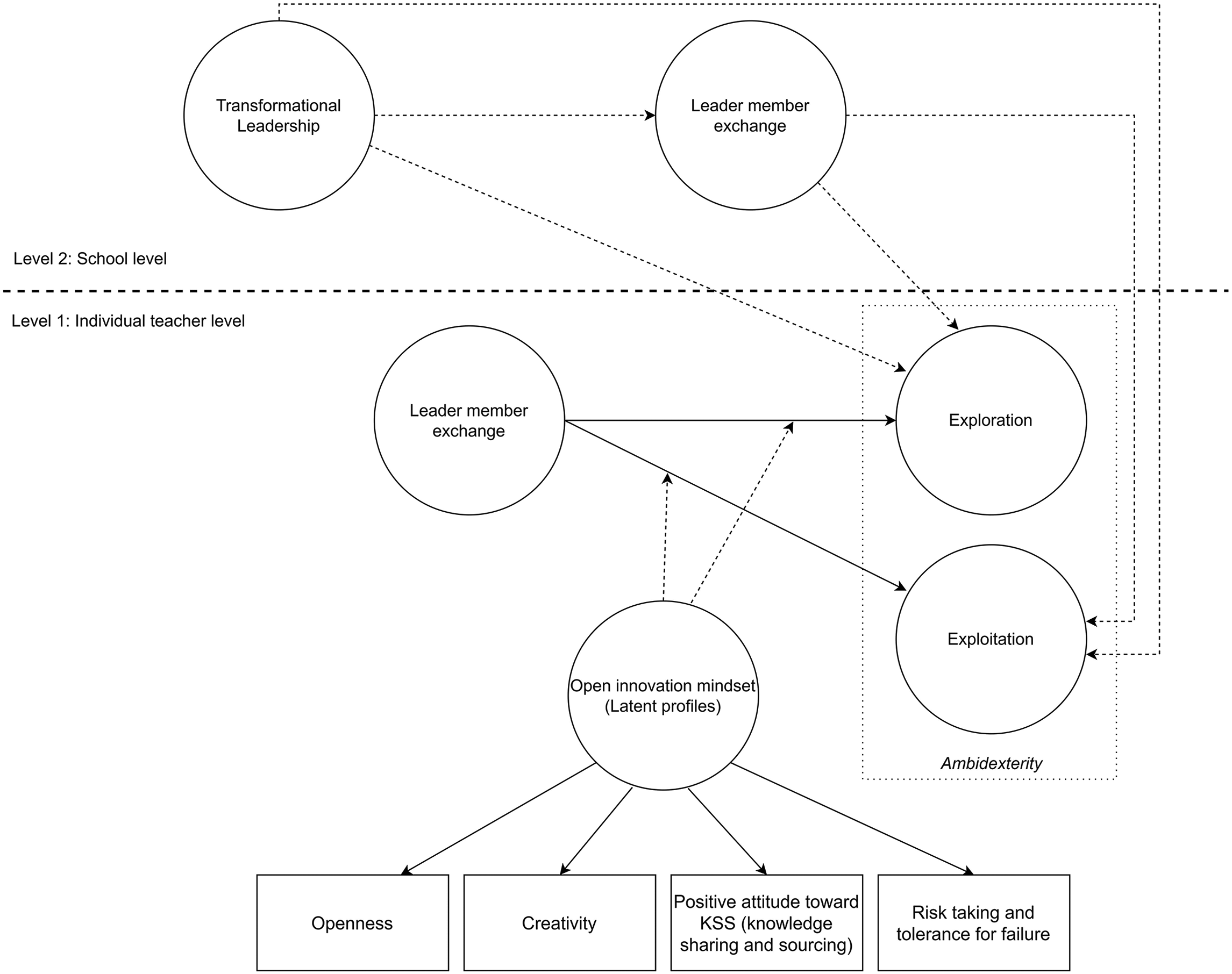
Study model.
Theoretical Background
Ambidexterity: Knowledge Exploration and Exploitation
The capability of individuals and organizations to actively explore opportunities and exploit existing practices is a critical prerequisite for organizational success in dynamic and constantly evolving environments (Junni et al., 2013; Levinthal & March, 1993; Mu et al., 2022; Raisch & Birkinshaw, 2008). In this context, exploration refers to activities such as “search, variation, risk-taking, experimentation, play, flexibility, discovery, and innovation,” whereas exploitation refers to “refinement, selection, production, efficiency, choice, implementation, and execution” (March, 1991, p. 71). As inherently opposing modes (Cao et al., 2009) competing for scarce resources (Gupta et al., 2006; Levinthal & March, 1993), these two knowledge strategies are in constant tension (Andriopoulos & Lewis, 2009; Lavie et al., 2010). The term “ambidexterity” refers to the management of these two contradictory yet complementary knowledge strategies (Birkinshaw & Gupta, 2013). It is worth noting that ambidexterity, while not commonly used by practitioners, serves as an analytical concept within academia, aiding in the understanding of organizational phenomena (Birkinshaw & Gupta, 2013).
Since March (1991) introduced the concept of ambidexterity to the scientific community over 30 years ago, most studies have primarily focused on the issue of organizational ambidexterity (Junni et al., 2013; O’Reilly & Tushman, 2013; Tarba et al., 2020). Accordingly, the main question driving this research was how organizations could succeed in acting effectively in the present while simultaneously creating and implementing innovative ideas and visions for an uncertain future (O’Reilly & Tushman, 2013; Raisch et al., 2009) in response to environmental changes and dynamics (Gibson & Birkinshaw, 2004; Lavie et al., 2010; Raisch & Birkinshaw, 2008). Thus, ambidexterity is understood as a dynamic capability of organizations (O’Reilly & Tushman, 2008), as it involves the “ability to integrate, build, and reconfigure internal and external competences to address rapidly changing environments” (Teece et al., 1997, p. 516). Organizational ambidexterity can be achieved sequentially, structurally, and contextually (Dedering & Pietsch, 2023) by (a) shifting organizational processes between exploitation and exploration over time, (b) establishing different organizational units that work either exploratively or exploitatively (O’Reilly & Tushman, 2013), or (c) creating a supportive work environment that encourages individuals in organizations to optimally allocate their time between exploratory and exploitative activities (Havermans et al., 2015).
Consequently, it has become increasingly evident in recent years that the ability of organizations to act ambidextrously depends primarily on the ability of organizational members to effectively manage exploration and exploitation activities (Gibson & Birkinshaw, 2004; O’Reilly & Tushman, 2013; Tarba et al., 2020). The assumption behind this is that the dynamic capabilities of an organization leading to its environmental adaptivity and superior performance are constituted by the underlying actions of individuals and groups within the organization (Eisenhardt et al., 2010).
This so-called “micro-foundational” view of dynamic capabilities (Eisenhardt et al., 2010) thus mainly explores whether and how the causes of higher-level organizational “macro phenomena” are formed at lower, “micro” within-levels (Felin et al., 2015; Tarba et al., 2020; Teece, 2007). Consequently, micro-foundations research examines what role individuals and their activities, decisions, and interactions within organizational structures play in shaping and developing organizational macrostructures and results longitudinally (Barney & Felin, 2013). In a nutshell, research on micro-foundations follows a multi-level approach that explores vertical and horizontal interrelations and interactions and favors the micro-level for explanations at the upper levels (Felin et al., 2015).
According to this micro-foundational view of dynamic capabilities in organizations (Eisenhardt et al., 2010; Felin et al., 2012, 2015), leaders and managers are the main drivers of organizational ambidexterity (Mom et al., 2009, 2019; O’Reilly & Tushman, 2011; Tushman et al., 2011), as they are uniquely positioned at the boundary between the environment and organization (Ernst & Yip, 2009; Tushman & Scanlan, 1981) and also wield significant influence on the design and development of organizational structures, processes, and functioning ( Leithwood et al., 2020a). However, ambidexterity at the organizational level requires the individualized management of exploration and exploitation by all organization's members (Gibson & Birkinshaw, 2004) across all organizational levels (Kassotaki et al., 2019), including front-line employees (Rosing & Zacher, 2017; Schnellbächer et al., 2019; Zimmermann et al., 2018). At the individual level, “ambidexterity is an individual's behavioral capacity to engage in and alternate between opposing task elements” (Kauppila & Tempelaar, 2016, p. 1022), rather than a psychological trait (Bledow et al., 2009). This is accompanied by the assumption that individual exploration and exploitation require different modes of human attention and therefore cannot be pursued simultaneously, or at least not without difficulty (Keller & Weibler, 2015).
In this regard, individual ambidexterity can be understood as an individual's self-regulated ability to flexibly adapt in dynamic contexts by appropriately shifting between exploratory and exploitative behaviors (Good & Michel, 2013; Mu et al., 2022), where exploitative behaviors aim to refine and expand an individual's existing assets, competencies, and knowledge, and exploratory behaviors aim to gain broader knowledge and facilitate new or alternative opportunities (Kauppila & Tempelaar, 2016). Applied to teachers, exploitation may involve, for example, the repeated use of the same teaching methods with different classes or students in various settings. Exploration, on the other hand, may involve the acquisition, development, and testing of new and alternative teaching methods to meet the needs of different classes or settings (e.g., in the context of inclusion, distance learning, etc.).
Especially at the individual level, however, it is challenging to act ambidextrously (Gupta et al., 2006), as one must be able to constantly refine and renew their knowledge, skills, and expertise (O’Reilly & Tushman, 2011), continuously switch between exploration and exploitation tasks (Bidmon & Boe-Lillegraven, 2020; Keller & Weibler, 2015; Tempelaar & Rosenkranz, 2019), and engage in divergent thinking (Good & Michel, 2013). Hence, dealing with the contradictory demands of exploration and exploitation may lead to cognitive strain (Keller & Weibler, 2015), stress (Hunter et al., 2017), frustration (Sok et al., 2016), and dissatisfaction (Bidmon & Boe-Lillegraven, 2020) in individuals. Because individuals also only have limited resources—i.e., in terms of time or cognitive capacity (Gibson & Birkinshaw, 2004; Helfat & Peteraf, 2015)—there is always a high possibility of being unable to leave a path once it has been taken or being unable to dynamically switch between the modes of exploration and exploitation, resulting in path dependency (Levinthal & March, 1993) and exploitation bias (Pietsch et al., 2023b).
In this context, exploration may be neglected in favor of exploitation, as exploitation promises greater certainty (Laureiro-Martínez et al., 2015) and visible short-term gains (Levinthal & March, 1993), and is thus perceived as less stressful than exploration (Bidmon & Boe-Lillegraven, 2020). Furthermore, conflicts between exploration and exploitation increase as available resources decrease, making a tradeoff between these two knowledge strategies more likely over time (Gupta et al., 2006). If this happens, it becomes increasingly difficult to act exploratively due to asymmetric competition for available resources, with exploitation harming exploration (but not vice versa; see Greve, 2007) and, consequently, lessening the number of resources available for explorative activities (Pietsch et al., 2022). If, however, individuals and organizations focus solely on exploitation, they are likely to fail in the long term due to their inability to manage innovation and change (O’Reilly & Tushman, 2013).
Accordingly, individuals and organizations maintain their capacity for ambidexterity and encourage exploratory activities in particular. In this context, empirical research has discovered various antecedents and drivers of individual ambidexterity at both the individual and organizational level (Mu et al., 2022, Tarba et al., 2020). Studies have revealed that individuals’ ability to dynamically explore and exploit within organizations mainly depends on how they think about problems and their solutions (Miron-Spektor et al., 2018), their ability to switch between different mindsets (Bledow et al., 2009; Jacobs & Cambré, 2020), and how they are supported by (formal) leaders in managing inherent tensions and experimenting (Jansen et al., 2016). For instance, individuals with a preference for exploitation are generally less likely to contribute to an organization's ambidexterity intuitively, but they may still do so when embedded in work contexts that provide them with clear guidelines and expose them to exploratory tasks (Tempelaar & Rosenkranz, 2019).
Although the concept of ambidexterity has only recently been introduced into educational research (Pietsch et al., 2022), evidence demonstrates that it can be applied in this context and can add value (Da’as, 2022, 2023a, 2023b; Dedering & Pietsch, 2023; Pietsch et al., 2022, 2023b), particularly in identifying describable levers of educational change, providing prescriptive guidance on how schools as organizations can manage and respond to policy pressures, and consequently addressing the dilemmas of educational reform (Bingham & Burch, 2019). Analogous to findings from research in the business sector, organizational ambidexterity (and in particular the exploration facet) in the school context was found to be a relevant predictor of teacher creativity (Da’as, 2023a) and collective teacher innovativeness (Dedering & Pietsch, 2023), as well as educational change—that is, significant improvement or more radical innovation in teaching and instruction over time (Pietsch et al., 2023b). Furthermore, preliminary findings also suggest that the individual ambidexterity of school leaders plays a role in this interplay, especially in more dynamic, fast-changing, and unpredictable contexts where disruptive change renders current methods or products of teaching and schooling obsolete (Pietsch et al., 2022, 2023b). This also aligns with the assumptions and findings of research on organizational and individual ambidexterity from other disciplines (e.g., Junni et al., 2013; Tushman & O’Reilly, 1996).
Leader-Member Exchange (LMX)
Interpersonal exchange processes in organizations are critical for generating and maintaining favorable work attitudes and behaviors among employees (Graen & Uhl-Bien, 1995; Sparrowe & Liden, 2005). Individuals in the workplace can form relationships based on their social exchanges of varying styles and qualities (Colquitt et al., 2013; Graen & Uhl-Bien, 1995; Liden & Maslyn, 1998; Uhl-Bien et al., 2014), especially with supervisors (Erdogan & Bauer, 2014; Martin et al., 2018). Although previous research has considered the leader as an active agent and the employee as a passive agent at work, the dyadic work-related exchanges between employees and their immediate supervisors emphasize the genuine bonds that develop over time (Götz et al., 2020).
In the broadest sense, leader-member exchange refers to the quality of the relationship between an employee and their supervisor built on a series of dyadic social exchanges (Graen & Uhl-Bien, 1995; Liden & Maslyn, 1998; Sparrowe & Liden, 2005). Thus, high-quality relationships are distinguished by mutual trust based on unique, proximal, open-ended, and long-term reciprocity benefiting both parties, whereas low-quality exchanges are frequently characterized as formal and balanced relationships with a lack of trust and low mutual expectations (Erdogan & Bauer, 2014; Graen et al., 2018; Liden & Maslyn, 1998). Specifically, employees in high-quality exchanges with their supervisors are more likely to exhibit extra-role behaviors compared to their colleagues in low-quality relationships (Colquitt et al., 2013; Martin et al., 2018; Mascareño et al., 2020).
LMX may play a pivotal role in fostering the development of trust, collaboration, risk-taking, dynamism, and innovation in the workplace (Götz et al., 2020; Jansen et al., 2016; Mascareño et al., 2020; Vermeulen et al., 2022). Organization members’ ability to conduct both exploration and exploitation activities successfully is central to organizational ambidexterity (O’Reilly & Tushman, 2008; Raisch et al., 2009). In this respect, organizational ambidexterity, as the dynamic capability of an organization (O’Reilly & Tushman, 2008), can be differentiated and stimulated by the quality of the proximal and reciprocal relationships between leaders and employees. Therefore, we posit that the quality of LMX has a direct and positive relationship with both the exploration and exploitation activities of the subordinates in an organization.
The Profiling Approach to Identifying the Open Innovation Mindset
Open innovation mindset emerged from dynamic capability theory (Bogers et al., 2019) and is composed of four capabilities: openness, positive attitudes toward knowledge sourcing and sharing (KSS), creativity, and risk and failure tolerance (Engelsberger et al., 2022). John and Srivastava (1999) examined the previous studies on the Big Five personality traits and explained that openness was related to an individual's mental, imaginative, and experimental life that excluded creative performance and important outputs in the workplace such as job performance, work behaviors, and artistic and innovative interests. Antons et al. (2017) underlined that positive attitudes toward KSS triggered an innovative atmosphere in the organization and blocked knowledge absorption, therefore preventing organizations from developing Not Invented Here (NIH) and Not Sold Here (NSH) syndromes due to a supportive atmosphere where employees freely exchanged ideas and thoughts. In this context, creativity refers to novel and potentially valuable ideas related to organizational processes and outcomes, such as innovative products, well-built services, and managerial processes. These processes and outcomes make organizations renewed, competitive, and innovative in today's chaotic environment, where the effects of crises and unpredictability have spread quickly and uncontrollably beyond local contexts (Arıcıoğlu & Berk, 2022; Wu et al., 2023; Zhou & George, 2001). The last term of the OI mindset, risk and failure tolerance, is described as one's general willingness or tendency to make risky choices or avoid them; the accompanying Big Five traits predicting this risk-taking capability are openness to experience and extraversion, respectively (Zhang et al., 2019b). For organizations, taking risks is inevitable in the competitive arena, but instead of an exploitative work atmosphere, this practice creates an explorative climate. Although organizations experience some failure, their resistance increases as a result of risk-taking (Danneels, 2008; Levinthal & March, 1993). This mindset creates a developing culture that encourages collaboration and blocks NIH and NSH syndromes (Salampasis et al., 2015). Additionally, in this innovative culture, organizations integrate and redesign individual employee and overall organizational capabilities (inbound open innovation) as well as those of external partners (outbound open innovation) by using these capabilities through implementing management practices, framing semi-autonomous work teams, and sharing innovative information (Helfat et al., 2009; Hong et al., 2019; Popadiuk et al., 2018; van Lieshout et al., 2021).
Overall, OI not only enhances the internal capabilities of organizations but also integrates these capabilities with external knowledge (Pietsch et al., 2023a). Moreover, this mindset is closely linked with the entrepreneurial mindset (Gomezel & Rangus, 2018). In this context, individual openness to innovation is crucial to searching for novelty and gathering innovative knowledge (Martínez-Román & Romero, 2013). Especially during the COVID-19 pandemic, organizations with an OI mindset found new solutions to problems quickly and made bridges with other stakeholders for the sake of their organizational futures (Chesbrough, 2020; Yücel, 2021). In an educational study, Schechter and Qadach (2012) emphasized that elementary schools built mechanisms to acquire, disseminate, and interpret knowledge from internal and external resources in an uncertain, dynamic environment. They concluded that teachers and school principals should analyze and share this knowledge to foster effectiveness in their schools. Furthermore, teachers should work as a team for the sake of improving the dynamic structure of schools (van Lieshout et al., 2021). Indeed, to indicate how teachers develop school capacity, Duff and Bowers (2022) conducted a profile analysis of teachers’ perceptions of school capacity and categorized them into six subgroups to interpret the school capacities: versatile, collaborative, developing, controlled, responsive, and demoralized. They emphasized that effective leadership, collaborative teachers, trust between school actors, and strong ties between stakeholders play an important role in a school's capacity and dynamism. On the contrary, scarcity of teacher collaboration and effective leadership pose significant impediments to school development.
The present study utilized OI as a moderator variable and classified it into three categories following Dweck's (2013) typology, via the profile analysis—fixed, average, and growth mindset—as these categories encompass qualities such as resisting or embracing change, believing in or doubting the development of intelligence and talent, and persisting in or avoiding trying harder and learning (Owusu-Manu et al., 2021). These individual knowledge and capabilities are vital for maintaining an organization's innovation processes and improving its performance (Chen & Huang, 2009; Scarbrough, 2003). Moreover, we borrowed from Engelsberger et al.'s (2022) conceptualization of an open innovation mindset to examine how teachers perceived themselves regarding innovativeness, creativity, and willingness to take risks. Our construct encompasses four capabilities: openness, creativity, positive attitude toward KSS, and risk and failure tolerance (Pan et al., 2015).
Recent research has indicated that adaptation of inflow and outflow knowledge into organizational products will trigger both exploration and exploitation activities (Nobakht et al., 2021; Ragazou et al., 2022; van Lieshout et al., 2021). Li et al. (2020) found that OI had a moderation effect on the relationship between OA and firm performance. Furthermore, Pietsch et al. (2024) demonstrated that open innovation can be a lever for change in schools, especially when it comes to the use of new technologies and innovation in the field of digitalization. To bolster firm performance, organizations need multi-skilled leaders that manage the chaotic atmosphere effectively, successfully, and rapidly. To accomplish this, leaders should interact with employees through LMX and create a trusting, collaborative, dynamic, and innovative atmosphere in the workplace (Korytkowski, 2017; Ragazou et al., 2022). Therefore, the present study assumes that the profiles of open innovation mindset moderate LMX's effects on OA.
Transformational Leadership (TL)
The concept of transformational leadership (TL) became one of the essential approaches to leadership after its establishment through a classic work by Burns (1978). Subsequently, Bass and Avolio (1993) gave direction to TL studies by developing their Multi-Factor Questionnaire (MLQ), which measures how organizations respond to the dynamic context of business, more competitive markets, technological changes, and restructuring international relations. They framed TL through four dimensions (4I): ideal effect (II), inspirational motivation (IM), individual impact (IC), and intellectual stimulation (IS) (Bass & Riggio, 2010). Transformational leaders provide followers with an inspiring mission and vision and give them an identity. More precisely, such leaders transform and motivate followers through charisma, intellectual stimulation, and individual evaluation. TL activates the structure by initiating a transformation process in accordance with changing environmental conditions; influencing employees’ beliefs, attitudes, and values with personality traits that evoke prestige, trust, and courage; and adopting the organization's mission and objectives.
Empirical research has emphasized that TL influences organizational outputs and individual and group outcomes such as commitment, high performance, and satisfaction. A recent study underlined the three key assumptions of TL theory—(i) leaders transform followers, (ii) followers transform in a specific way, and (iii) followers’ transformation is responsible for the effectiveness of TL—and reached a conclusion that these three assumptions are partly true (Siangchokyoo et al., 2020). In educational leadership research, a transformational leader focuses on empowering and influencing both individual teachers and teacher teams toward organizational change (Avolio et al., 2004; Leithwood et al., 2002). These leaders raise teachers’ motivation and capacities to improve teaching and instruction quality (Northouse, 2007). Teachers led by transformational leaders are active decision-makers and engage in the supervision of instruction, planning, and professional development (Marks & Printy, 2003). Our definition of TL in the present study underlined that transformational leaders should build a vision for teachers, demonstrate individual and intellectual consideration, and create an innovative climate in their schools.
Previous studies have indicated a positive relationship between TL and LMX relationship quality (e.g., Martin et al., 2016; Siangchokyoo et al., 2020; Wang et al., 2005). In the research, LMX quality involves the quality of the relationship between a leader and followers based on values such as a high level of mutual trust, interaction, and support. Bell and Kozlovski (2002) expressed that TL is an effective leadership style, where leaders inspire followers for their self-interest and personal goals. Deluga (1994) also revealed that TL creates high-quality relationships and improves a sense of common fate between leader and followers. Therefore, TL establishes a widespread cultural scheme and creates a supportive climate between leaders and followers, which is personalized in the LMX relationship-building process (Cashman et al., 1976). This process builds strong personal identification for followers because their leaders broaden their sense of self-worth. Consequently, followers pick up praise, recognition, and upgraded role responsibilities thanks to a higher quality of social exchange with their leaders (Goodwin et al., 2001). Thus, we expected TL to affect LMX positively in the present study.
Recent research has indicated that TL involves sets of leadership behaviors that support exploration and exploitation activities (Havermans et al., 2015; Tarba et al., 2020; Turner et al., 2016) for the sake of the organization's future in the dynamic environment. Accordingly, TL tackles this hard task by creating an innovative atmosphere that accelerates the pursuit of new knowledge, facilitates the exchange of existing knowledge among employees, and fosters psychological safety (Hannah & Lester, 2009; Nemanich & Vera, 2009; Zuraik & Kelly, 2019). Additionally, TL sparks exploration activities by creating an organizational climate and supporting organizational innovativeness (Zuraik & Kelly, 2019). In this safe yet innovative climate, employees have the courage to take risks and try new ideas for the future of their organization (Vermeulen et al., 2022). Thus, we assumed that TL is indirectly related to teachers’ exploration activities (i.e., trying new things, taking risks, and doing things that are uncertain but may be important for the future) via LMX.
Method
The present study was a part of an international project conducted in Austria, Chile, China, Germany, Kazakhstan, Kyrgyzstan, Malaysia, Mexico, Nigeria, Switzerland, and Türkiye. For this analysis, we used cross-sectional teacher data collected from Türkiye during the 2021–2022 school year.
Sample
The study adopted a two-stage stratified cluster sampling procedure with public K-12 schools (pre-primary, primary, lower secondary, and secondary) from 12 regions in Türkiye. The decision to include a diverse range of regions in our study was driven by several factors that bear relevance to our research. First and foremost, while it is true that all public schools in Türkiye operate under a centralized hierarchical structure, it is important to note that there are regional variations in socio-economic conditions, as well as regional disparities surrounding the presence of refugee students. Furthermore, teacher job experience exhibits regional differences, with a common trend of newly appointed teachers often beginning their careers in the eastern regions of Türkiye. Our sampling process unfolded in two distinct stages. In the first stage, all schools were divided into subgroups based on geographic location (village, town, and city) and educational stage (e.g., pre-primary). Next, we used stratified random sampling procedures to select 261 schools within these subgroups. In the second stage, our objective was to include at least ten teachers in schools with a larger teaching staff, while in schools with a smaller number of teachers, we aimed to include all available teachers. As a result, we reached out to a total of 3,075 out of 10,976 teachers across the 261 schools in our sample, or a response rate of 28%. Additionally, all school principals serving in these 261 schools were engaged in our study as part of the project. Their participation allowed us to collect essential school background information, including the percentage of refugee students. In this context, the response rate for school principals was 100%.
Of the 3,075 teachers who participated in our study, 1,999 (65%) were female. The average teacher had 8.91 (sd = 7.11) years of teaching experience, with total experience across the teachers in the study sample ranging from 1 to 44 years. This background illustrates a representative sample with regard to teachers’ characteristics in Türkiye, which has a 60.5% female teaching population (MoNE, 2022a). The schools in the study were pre-primary (13.7%), primary (34.9%), lower secondary (31.4%), and secondary schools (20.0%). Most sampled schools were located in a large city (40.80%), and the number of students ranged from 31 to 2,840, with an average of 704.13 (sd = 561.27). Only 88 (34.50%) school principals reported that their schools had no refugee students. In our data, the percentage of missing values was less than 1%.
Instruments
This study used teachers’ self-reports on exploitation and exploration activities (OA), individual dynamic capabilities (OI), LMX, and TL. We adopted the scales into Turkish by following Hambleton and Patsula's (1999) framework, and conducted confirmatory factor analyses (CFA) to determine scale construction. The results of the CFA measurement model showed a reasonably good model fit for all scales. To calculate the internal consistency of scale items, we performed McDonald's omega (ω) instead of Cronbach's alpha (α) coefficient, which is just the lower bound of the reliability in the case of congeneric variables (Dunn et al., 2014). The following section describes the items, validity, and reliability of the scales.
Distal Outcome Variables: Exploitation and Exploration
We measured teachers’ exploitation and exploration activities by applying six items developed by Mom et al. (2009). We asked to what extent the teachers engaged in exploitation and exploration activities during the last 12 months in their position. Teachers responded to the items on a four-point Likert scale ranging from (1) to a very small extent to (4) very large extent. Exploitation assesses individuals’ confidence in executing tasks within their existing knowledge and skills, by including items such as “activities which you can properly conduct by using your present knowledge.” Thus, exploitation is relevant to tasks that teachers feel confident about, based on their existing expertise. On the other hand, exploration measures individuals’ belief in their ability to engage in tasks demanding the acquisition of new skills or knowledge, by featuring items like “activities requiring you to learn new skills or knowledge.” Exploration may encompass activities involving the acquisition of new teaching methods or subject matter expertise. We calculated composite reliability for the internal consistency of scale items for both exploitation (ω = 0.905) and exploration (ω = 0.837), representing sufficient construct for all scale items (ω ≥ 0.70). The CFA for the proposed measurement model showed a good fit: x2/ df = 2.054, RMSEA = 0.019, CFI = 0.999, TLI = 0.998, and SRMR = 0.006 (Hu & Bentler, 1999). Additionally, the average variance extracted (AVE) confirmed the convergent validity of both the exploitation (AVE = 0.762) and exploration (AVE = 0.696) construct (AVE ≥ 0.50)
Moderator and Indicator variable: Open Innovation Mindset
We borrowed Engelsberger et al.'s (2022) conceptualization of open innovation mindset to examine how teachers perceived themselves regarding innovativeness, creativity, and willingness to take risks. Our construct encompassed four dimensions: openness, creativity, a positive attitude toward KSS and risk-taking, and tolerance for failure. All dimensions consisted of three items. Teachers responded to the items on a four-point Likert scale ranging from (1) strongly disagree to (4) strongly agree. The scale of openness assessing individuals’ willingness to learn and search for innovations was originally developed by John and Srivastava (1999). A sample item for openness is “I see myself as someone who is curious about many different things.” The results of composite reliability (ω = 0.893) and convergent validity (AVE = 0.736) showed sufficient construct for the scale items. We used Zhou and George's (2001) creativity scale to measure the level of teachers’ creativity on the job. A sample item for this scale is “I exhibit creativity on the job when given the opportunity to.” The results of composite reliability (ω = 0.913) and convergent validity (AVE = 0.779) showed sufficient construct for the scale items. We used two different syndromes to measure the positive attitude toward KSS, namely the negatively shaped attitude toward knowledge (Antons et al., 2017) and not-shared-here (de Araújo Burcharth et al., 2014). A sample item for the positive attitude toward KSS is “I think it's good when other people draw on my knowledge.” The results of composite reliability (ω = 0.898) and convergent validity (AVE = 0.747) showed sufficient construct for the scale items. Lastly, we included the risk-taking (Zhang et al., 2019a) and tolerance for failure (Danneels, 2008) scales to assess the extent to which risk-taking and failure are seen as an opportunity to learn. A sample item for risk-taking and tolerance for failure is “I believe that failure is a necessary part of success.” The results of composite reliability (ω = 0.841) and convergent validity (AVE = 0.645) showed sufficient construct for the scale items. The CFA for the proposed measurement model showed a good fit: x2/ df = 3.141, RMSEA = 0.064, CFI = 0.975, TLI = 0.965, and SRMR = 0.025 (Hu & Bentler, 1999).
Mediator variable: Leader-Member Exchange (LMX)
The scale measuring working relationships between employees and leaders, originally developed by Graen and Uhl-Bien (1995), consisted of seven items. Teachers were asked to assess what their relationship was like with their principal by responding to items on five-point Likert scales. For example, one of the scale items inquired how well the principal understood job problems and needs. Similarly, another item inquired if respondents knew where they stood with their principal and whether they usually knew how satisfied their principal was with their work, with response choices ranging from (1) rarely to (5) very often. The results of composite reliability (ω = 0.938) and convergent validity (AVE = 0.698) showed sufficient construct for the scale items. The CFA for the proposed measurement model showed a good fit: x2/ df = 3.763, RMSEA = 0.030, CFI = 0.998, TLI = 0.996, and SRMR = 0.009 (Hu & Bentler, 1999).
Predictor variable: Transformational Leadership (TL)
This scale, developed by Avolio and Bass (1991), included four items assessing teachers’ opinions on school principals’ TL behaviors. The items cover four dimensions: idealized influence, inspirational motivation, intellectual stimulation, and individualized consideration. We recognize the challenge posed by using only four items to measure these four dimensions of TL. However, it is well known that the (theoretically assumed) factorial structure of the MLQ often cannot be empirically substantiated (van Knippenberg & Sitkim, 2013) and that ultra-sorted scales (Carless et al., 2000) and even single-item measures (Matthews et al., 2022) allow for robust statements and analyses about TL in organizations and its correlates. Further, this approach aligns with established methodologies employed in prior educational research studies (e.g., Bellibas & Liu, 2017). This streamlined approach enhances practicality, especially when conducting large-scale data collection, and allows for a more detailed analysis of each individual TL dimension. Teachers responded to the items on a four-point Likert scale ranging from (1) very rarely or never to (4) very often. An example item from the scale is “my principal talks optimistically about the future.” The results of composite reliability (ω = 0.932) and convergent validity (AVE = 0.775) showed sufficient construct for the scale items. The CFA for the proposed measurement model showed a good fit: x2/df = 0.029, RMSEA = 0.000, CFI = 1.000, TLI = 1.000, and SRMR = 0.000 (Hu & Bentler, 1999).
Auxiliary Variables
In mixture modeling, researchers require an approach that takes into consideration classification errors and the relationships with auxiliary variables to explore the associations between latent class variables, predictors, and outcome variables (Nylund-Gibson et al., 2014). We thus incorporated auxiliary variables into our study to account for their influence. These variables include gender (coded as 1 for female), teaching experience, school level (coded as 1 for pre-primary and primary education), total number of students, percentage of refugee students, and percentage of socioeconomically disadvantaged students. Furthermore, we asked school principals to categorize the community their school is in, using categories such as village, hamlet, rural area, and town for rural settings and city and large city for urban settings (coded as 0 for rural and 1 for urban).
Analytic Approach
Organizational research, and thus school research, is multi-level by nature. Consequently, we applied a multi-level approach following previous studies (Marsh et al., 2009; Morin & Marsh, 2015). To do so, we first calculated descriptive statistics including mean, standard division, skewness, kurtosis, and correlation coefficients. We then adopted a person-centric approach to create groups of teachers according to their pattern of the open innovation mindset. Recent studies have shown that individuals within a population are divided into subgroups or typologies (e.g., Duff & Bowers, 2022; Mäkikangas et al., 2018). Accordingly, in the second step, we conducted an unconditional LPA with four dimensions (openness, creativity, positive attitude toward KSS and risk-taking, and tolerance for failure) to classify teachers into homogeneous subgroups. We used the robust maximum likelihood estimator (MLR) and 2,000 random starts, with 100 iterations for these random starts. Based on Nylund-Gibson et al.'s suggestion (2023), we estimated one to six latent profiles and selected the most appropriate profile solution by checking fit statistics, including log-likelihood, Bayesian information criterion (BIC), sample-size adjusted Bayesian information criterion (aBIC), consistent Akaike information criterion (CAIC), approximate weight of evidence criterion (AWE), and likelihood-based tests (bootstrapped likelihood ratio [BLRT]), Bayesian Factor (BF). We checked if the k-profile solution suggested an improvement in fit over the k-1 profile solution. We also examined the elbow plots of the AWE, CAIC, BIC, and aBIC to reveal the “flattening” or point of “diminishing returns” in model fit (Nylund et al., 2007).
In the third step, we tested the moderator role of LPAs on the exploration and exploitation activities as a distal outcome at the individual teacher level (Level 1). We conceptualized the LMX as a predictor variable to estimate the relationship with exploration and exploitation at Level 1. We calculated Wald tests for each slope difference (Nylund-Gibson et al., 2023) using Mplus software (version 8.6) by applying the wrapping package MplusAutomation, and in the R project (https://osf.io/jpwgr). We also estimated the Level 2 cross-level relationship of TL with LMX and exploration using latent factors. To conduct a two-level analysis, we first checked aggregation for variables at the school level using intra-class correlations (ICC1 and ICC2) and rwg(j). Finally, following suggestions from previous studies (e.g., Hayes & Preacher, 2014), we used the “model constraint” section of Mplus software to calculate indirect relationships. To do this, we tested the “TL-LMX” path and the “LMX-exploration” path.
Results
Step 1: Descriptive Statistics
We calculated descriptive statistics such as mean, standard division, skewness, kurtosis, correlation coefficients, ICC(1), ICC(2), and rwg(j) (see Table 1). While LMX (M = 3.88) and KSS (M = 3.28) had relatively high mean scores, as an outcome variable, exploration had a moderate level of mean score (M = 2.42). At the individual teacher level, we identified positive relations between LMX and outcome variables (exploitation and exploration). At the school level, TL had a positive association with LMX. We also examined the skewness and kurtosis values for the normality assumption. Given that both skewness and kurtosis were between + 2 and - 2, all variables had acceptable values for normal distribution. Table 1 also shows intra-class correlations for TL, LMX, exploration, and exploitation at the school level. While ICC(1) values for TL, LMX, and exploration were all greater than 0.05, indicating acceptable reliability for conducting a multilevel analysis (Bliese, 2000), the ICC(1) value for exploitation was notably lower at 0.021. Furthermore, ICC(2) values ranged from 0.388 to 0.765 for TL, LMX, and exploration, suggesting good reliability, but for exploitation, the ICC(2) value was 0.204. In terms of rwg(j), all values were greater than 0.70, indicating a moderate level of rater agreement (Brown & Hauenstein, 2005). Considering the ICC(1) and ICC(2) indices, we made the decision to exclude exploitation at the school level. Our analysis also included a thorough examination of multicollinearity concerns by assessing tolerance and VIF values. The results indicated that tolerance values ranged from 0.301 to 0.940 and VIF values ranged from 1.066 to 3.314, all well within the acceptable range. Additionally, the condition index showed a maximum value of 29.894, confirming the absence of significant multicollinearity issues in our study.
Descriptive Statistics and Pearson Correlations among Variables at the Individual Teacher Level (n = 3075 Teachers) and the School Level (n = 261 Schools).
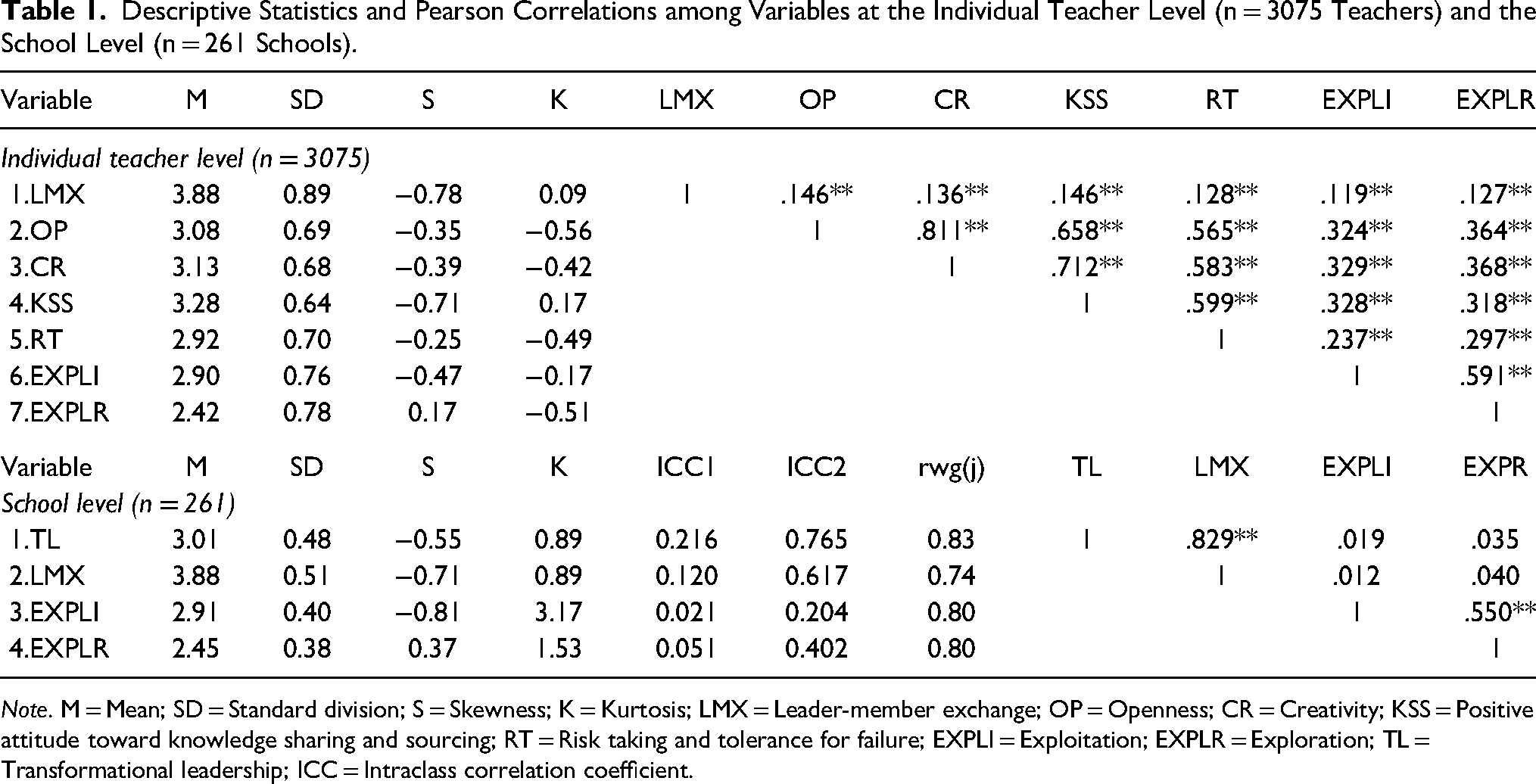
Note. M = Mean; SD = Standard division; S = Skewness; K = Kurtosis; LMX = Leader-member exchange; OP = Openness; CR = Creativity; KSS = Positive attitude toward knowledge sharing and sourcing; RT = Risk taking and tolerance for failure; EXPLI = Exploitation; EXPLR = Exploration; TL = Transformational leadership; ICC = Intraclass correlation coefficient.
Step 2: Identifying Latent Profiles
Based on the first research question, “Are teachers divided into different profiles in terms of open innovation mindset?” We conducted an unconditional LPA with four dimensions: openness, creativity, positive attitude toward KSS and risk-taking, and tolerance for failure. Our initial step involved an examination of four different models to compare their alternatives, focusing on their adequacy and classification accuracy.
According to the fit statistics in Table 2, BIC, aBIC, CAIC, and AWE all continued to decrease in the six-profile solution, and BLRT remained significant at the p < 0.05 level until the six-profile model. However, when we checked the elbow plots for the AWE, CAIC, BIC, and aBIC as shown in Figure 2, we confirmed the “flattening” and point of “diminishing returns” at the three-profile solution. Moreover, the BF value for the third profile solution is notably higher than the others (8.521). This indicates that a three-profile solution fits the data better. Several studies indicate that relying solely on fit criteria may be inadequate for selecting the optimal model. As a result, researchers often use their judgment to justify their choice of a particular model (Collie et al., 2021; Nylund-Gibson et al., 2014). Consequently, we explored alternative approaches that prioritize conceptual relevance and meaningfulness in model selection (Nylund-Gibson et al., 2014). In line with the mindset theory framework, we identified our profiles based on the theory that categorizes capacity beliefs into two groups: fixed mindset and growth mindset (Dweck, 2013). Additionally, we included one more profile, characterized as “average,” to better suit the Turkish context. The entropy for three latent profiles was .900, suggesting more precision in classification and clearer distinction among profiles.
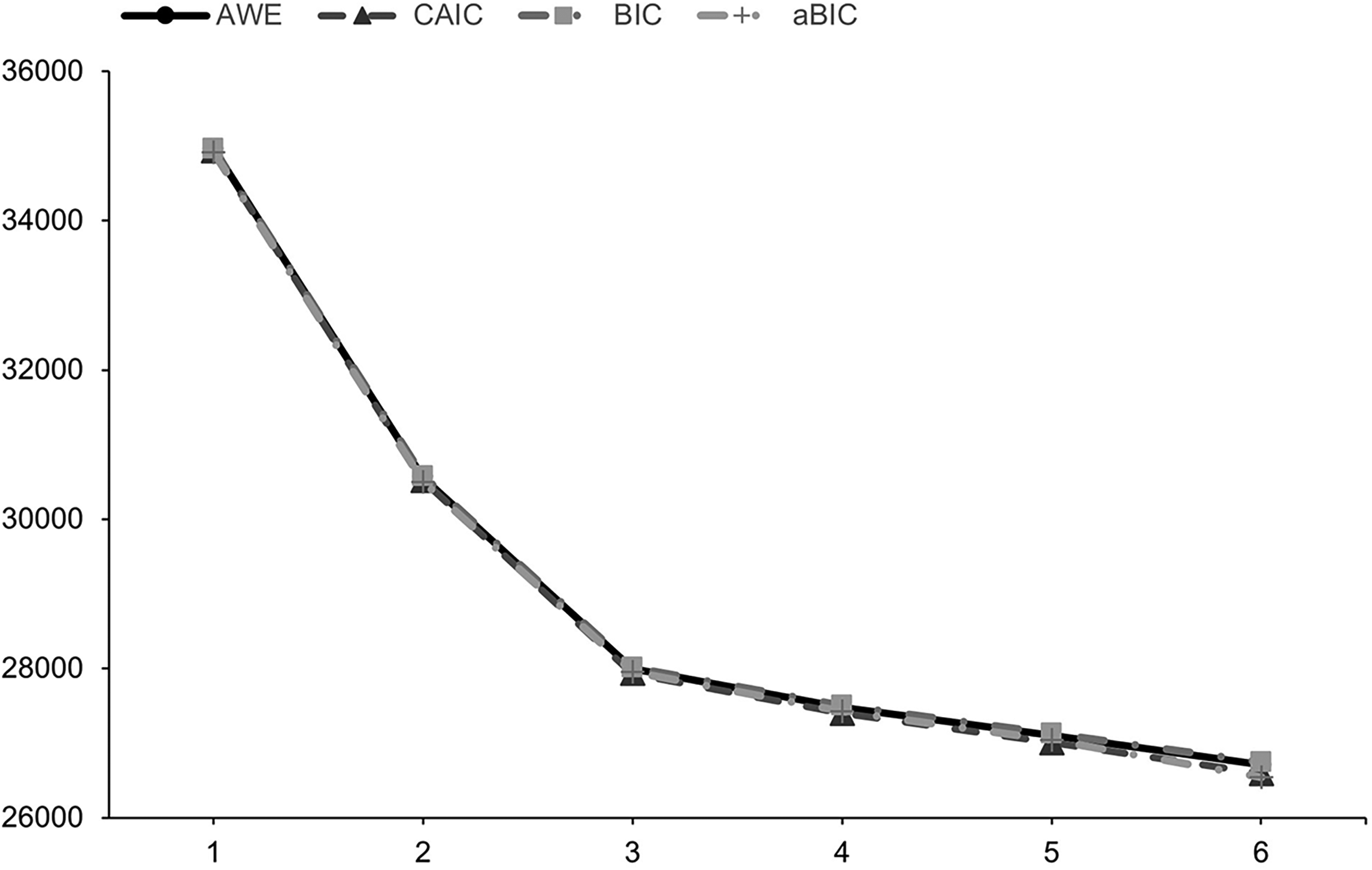
Elbow plots.
Fit Statistics for the LPA.
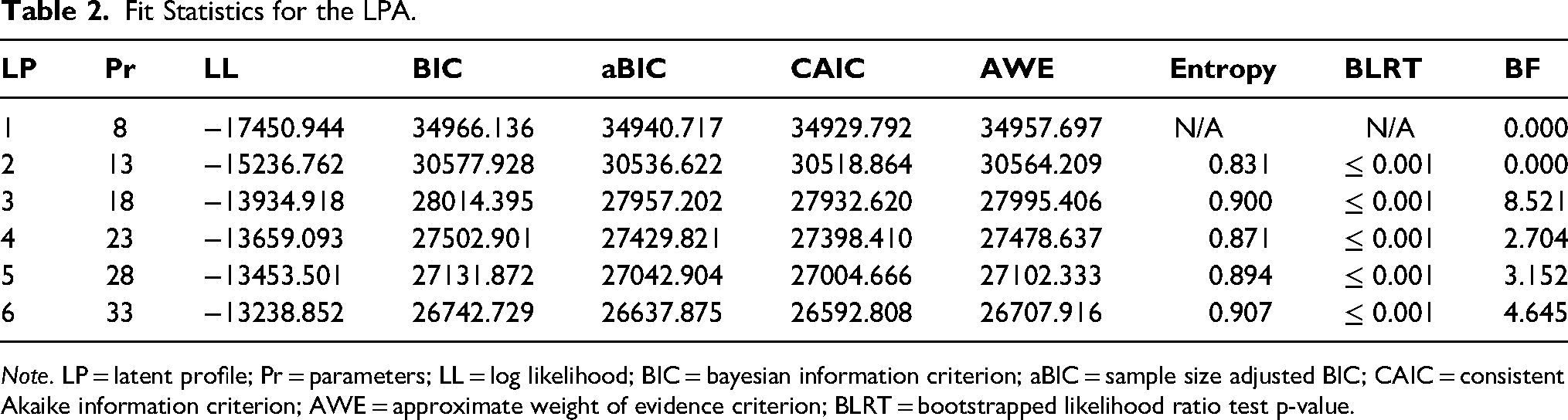
Note. LP = latent profile; Pr = parameters; LL = log likelihood; BIC = bayesian information criterion; aBIC = sample size adjusted BIC; CAIC = consistent Akaike information criterion; AWE = approximate weight of evidence criterion; BLRT = bootstrapped likelihood ratio test p-value.
Characteristics of the Teacher Profiles
As depicted in Figure 3, the three lines indicate the standardized scores of the three different latent profiles. Our first profile is characterized by a high perception of openness, creativity, positive attitude toward KSS and risk-taking, and tolerance for failure. Accordingly, we labeled this profile as a “growth mindset,” which indicates a high level of effort dedicated to innovation. The growth mindset profile was estimated to comprise 37% of the sample (n = 1122). Our second profile is characterized by an average perception of all dimensions. We labeled this profile as an “average mindset,” which indicates a typical level of effort to innovate. The average mindset profile was estimated to comprise 51% of the sample (n = 1560). Our last profile is characterized by a low perception of all dimensions. We labeled this profile as a “fixed mindset,” which indicates a lower level of effort to innovate. The fixed mindset profile was estimated to comprise 13% of the sample (n = 393).
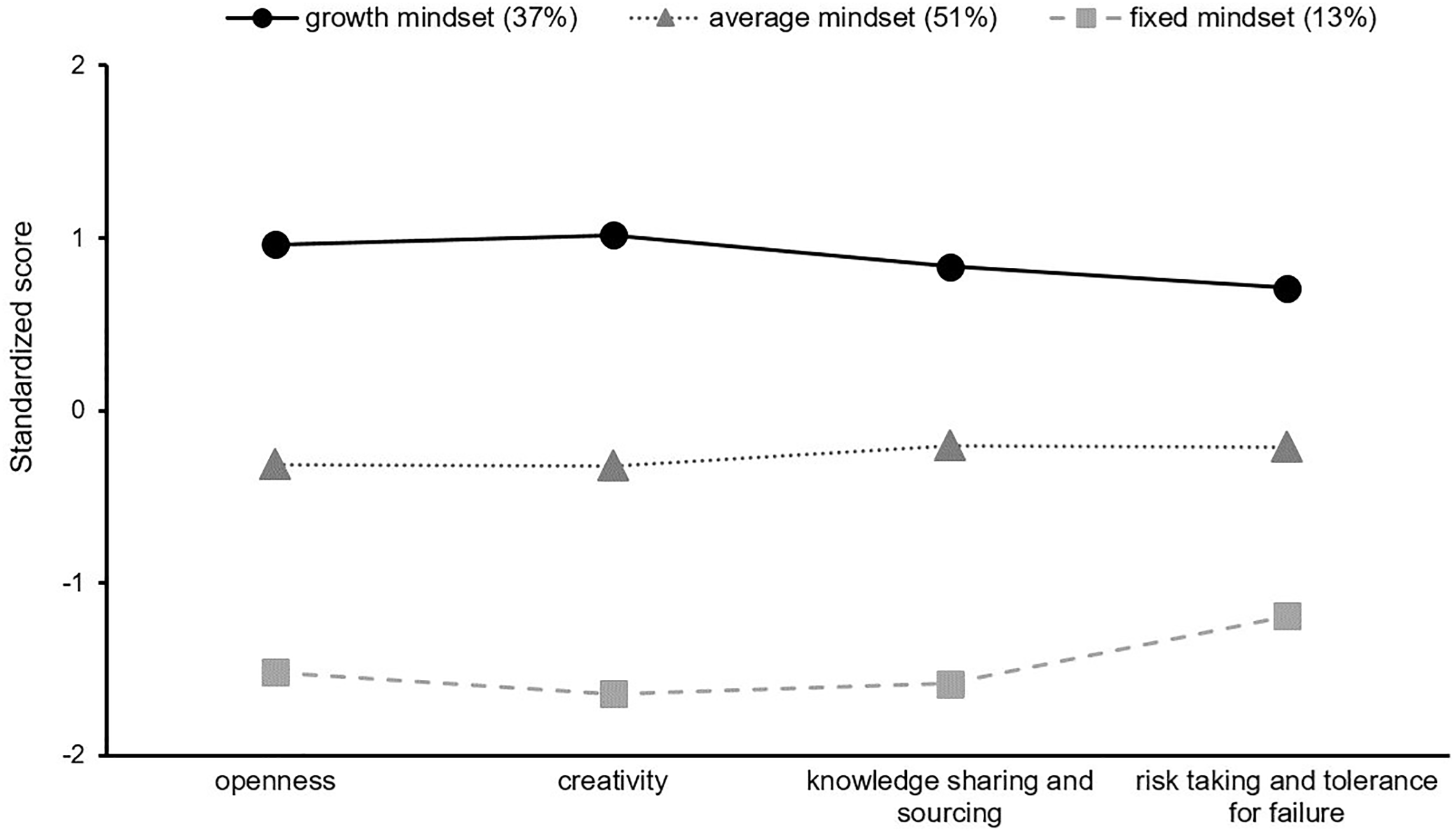
Standardized scores presenting the 3-class LPA solution of open innovation mindset.
Step 3: Testing the Model
Based on the second research question, “Does teachers’ membership in different profiles of the open innovation mindset moderate the relationship of LMX with their exploration and exploitation activities?” We first examined the direct relationship of LMX with exploration and exploitation activities. Our analysis showed that LMX had a positive relationship with both exploitation (β = 0.311, 95%CI = [0.223, 0.399]) and exploration (β = 0.300, 95%CI = [0.208, 0.392]) activities. The effect size was R2 = 1.9% for exploitation and R2 = 2.0% for exploration. These values suggest that the observed effects were relatively small and not very impressive. We then tested the moderator role of LPAs on the exploitation and exploration activities as a distal outcome at Level 1. We conceptualized the LMX as a predictor variable to estimate the relationship with exploitation and exploration at Level 1. First, our results indicated that LMX did not predict the exploitation activities for the “growth mindset” profile (β = 0.119, 95%CI = [-0.035, 0.273]). These results indicate that for teachers in Profile 1 (growth mindset), the mean exploitation activities are not higher for those who report that they have a high LMX level (see Figure 4). However, for teachers in this profile, LMX supported exploration activities with a positive relationship (β = 0.163, 95%CI = [0.018, 0.309]), albeit with a relatively small effect size (R2 = 0.5%) suggesting that teachers with a growth mindset tend to engage more in exploration activities when they report a high level of LMX (see Figure 5).
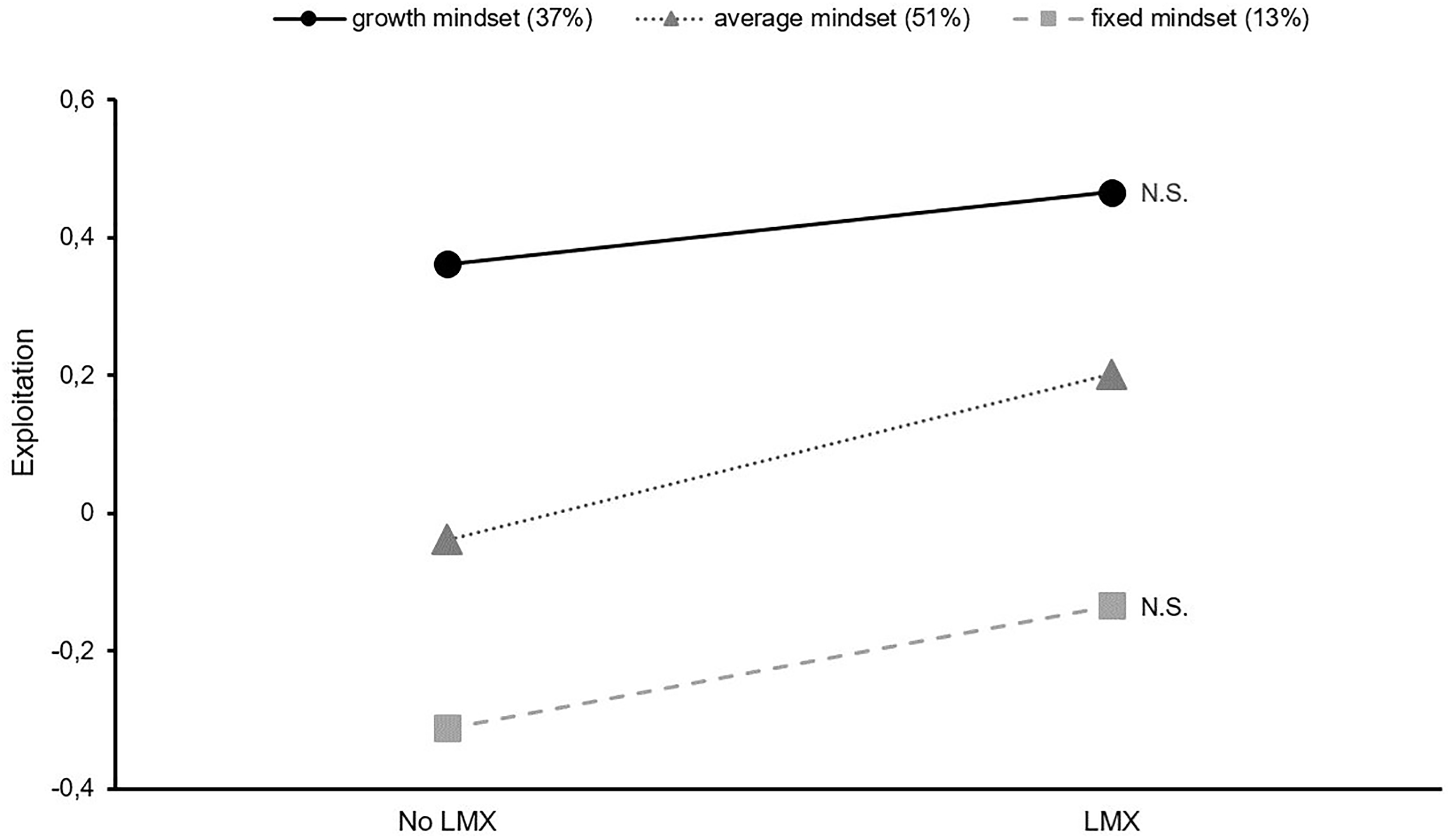
Moderation of exploitation and leader-member exchange by the teacher profiles. Note. N.S. = not significant.
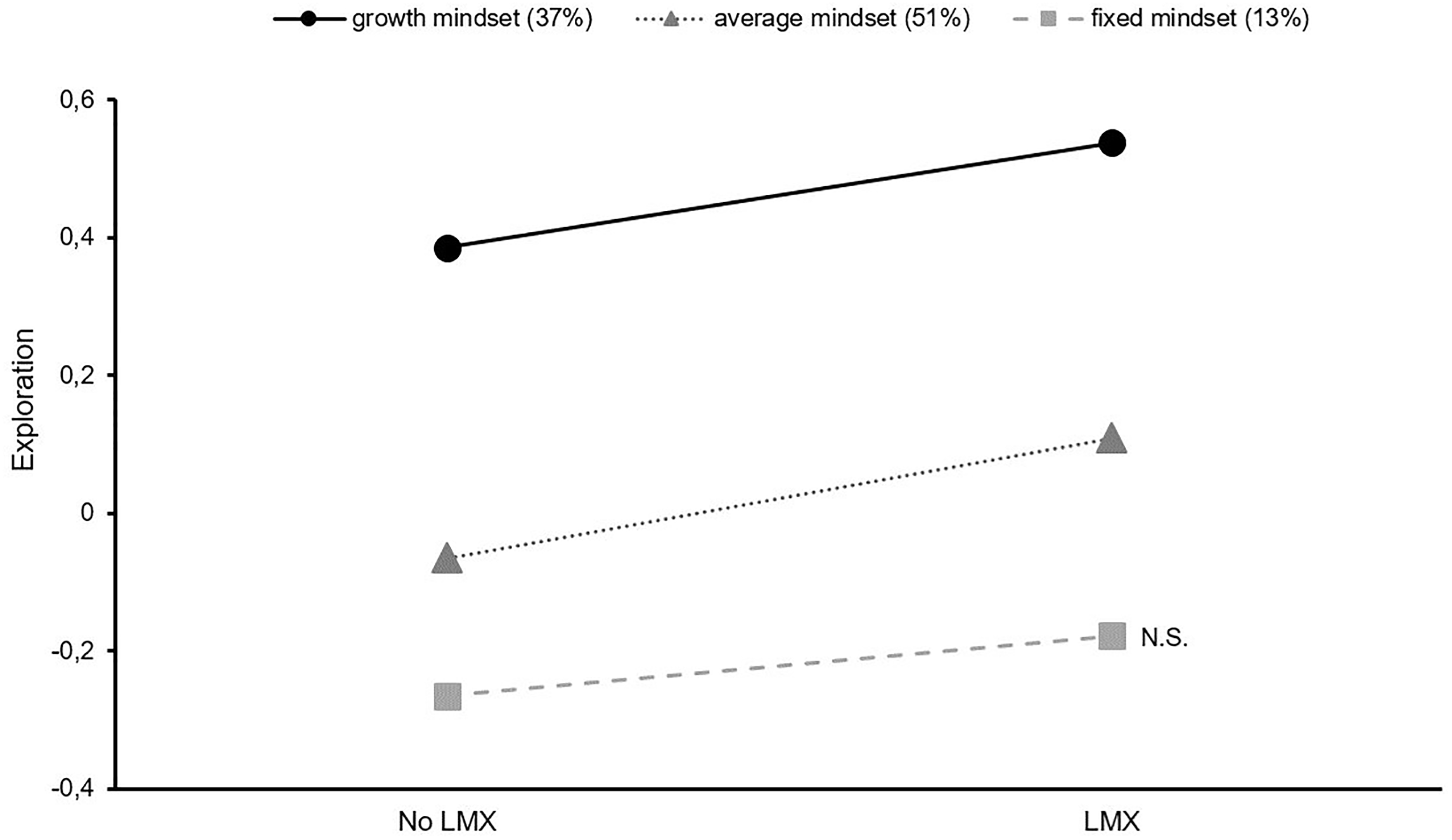
Moderation of exploration and leader-member exchange by the teacher profiles. Note. N.S. = not significant.
Second, our results indicated that the regression of exploitation activities on LMX was significant for the “average mindset” profile (β = 0.239, 95%CI = [0.093, 0.384]) with a relatively small and not very impressive effect size (R2 = 1.1%). These results demonstrate that for teachers in Profile 2 (average mindset), the mean exploitation activities are higher for those who report a high LMX level (see Figure 4). Additionally, the regression of exploration activities on LMX was significant for this profile (β = 0.176, 95%CI = [0.059, 0.293]), with a relatively small and not very impressive effect size (R2 = 0.8%), indicating that for teachers with an average mindset, the mean exploration activities are higher among those who report a high LMX level (see Figure 5).
Lastly, our results indicated that the regression of exploitation activities on LMX was not significant for the “fixed mindset” profile (β = 0.146, 95%CI = [-0.083, 0.414]). These results indicate that for teachers in profile 3 (fixed mindset), the mean exploitation activities are not higher for those who report a high LMX level (see Figure 4). Additionally, the regression of exploration activities on LMX was not significant for this profile (β = 0.076, 95%CI = [-0.120, 0.272]), indicating that for teachers with a fixed mindset, the mean exploration activities are not higher among those who report a high LMX level (see Figure 5).
The examination of the pairwise slope differences for exploitation activities regressed on LMX. The growth mindset was found to vary significantly from the average mindset (Wald χ2(1) = 0.536, p = .464) and fixed mindset (Wald χ2(1) = 0.253, p = .615). Slope differences between the average mindset and fixed mindset were significant (Wald χ2(1) = 0.036, p = .849). Additionally, the examination of the pairwise slope differences for exploration activities regressed on LMX revealed that Profile 1 (growth mindset) varied significantly from Profile 2 (average mindset) (Wald χ2(1) = 0.456, p = .000) and Profile 3 (fixed mindset) (Wald χ2(1) = 0.818, p = .000).
To answer our third research question, we examined the Level 2 cross-level relationship of TL with LMX and the exploration, and thus a multilevel mediation (Preacher et al., 2010). This is because we chose not to look at exploration at the school level, taking into account the ICC(1) and ICC(2) indices. Utilizing the “model constraint” section of Mplus 8.6 software to examine direct and indirect relationships, we assessed the combined effects “TL-LMX” and “LMX-exploration” paths. Our findings revealed that TL did not have a direct relationship with exploration. However, when the collective faculty of a school perceived their principal as displaying a higher level of TL behavior, they were more likely to have higher LMX scores (β = 0.413, 95%CI = [0.120, 0.572]). This, in turn, was indirectly associated with an increase in teachers’ exploration activities (β = 0.110, 95%CI = [0.001, 0.212]).
Discussion
Our first research question inquired whether teachers are divided into different profiles in terms of their open innovation mindsets. Using individual teacher-level LPA, we identified three teacher profiles for the open innovation mindset, namely (i) growth, (ii) average, and (iii) fixed. The results indicate that teachers with a fixed mindset are not open to innovation, have low levels of creativity, avoid sharing information, and do not want to take risks. Conversely, teachers with a growth mindset are open to innovation, have a high level of creativity, want to share knowledge, and are not afraid to take risks (Nobakht et al., 2021). This finding is in line with previous research suggesting profiles from both ends of the spectrum, such as being conservative or open to innovation, hiding or sharing knowledge, and collaborating with other stakeholders or working in an isolated way (Dweck, 2013; Owusu-Manu et al., 2021). Our results also expanded prior person-centered approaches by providing evidence that the OI mindset does not indicate homogeneity, but rather exhibits heterogeneity.
Our second research question was twofold, inquiring whether different profiles of the open innovation mindset moderated the role of LMX on teachers’ (1) exploitation and (2) exploration activities in schools. The results of the moderation analysis demonstrate that acting ambidextrously at the individual level is rather difficult (Gupta et al., 2006), unfolding some repercussions as well as heralding some opportunities for schools as working and learning environments. First, we identified that the quality of the dyadic exchange with the school principal did not influence engagement in exploitation activities for teachers with a growth mindset, whereas it contributed to the exploration activities of those teachers. Specifically, a growth mindset encourages teachers to be open to change, create innovative ideas and visions for the future, and explore new methods (Dweck, 2013; O’Reilly & Tushman, 2013; Raisch et al., 2009) when this openness is mirrored in their relationship with their school principal. This result provides reassuring evidence that interpersonal communication matters even in complex contexts such as schools (Price, 2012; Smith, 2019) and that exploration nurtures mutual trust and genuine work-related bonds (Danneels & Vestal, 2020; Vermeulen et al., 2022). Hence, how this interrelated dynamic plays out presents a thriving environment characterized by innovation, risk-taking, discovery, and flexibility, which is empowered by harnessing interpersonal candor, trust, and reciprocity (Edmondson, 2018; Wang et al., 2005), rather than by relying on legitimate power of the principals.
Second, the results revealed that teachers from an average mindset profile pursue interests to succeed in both exploitation and exploration activities when they feel more connected with their school principals. This result suggests that a mindset with moderate levels of openness, creativity, failure tolerance, and KSS shapes and triggers teachers’ efforts to explore future opportunities and exploit existing teaching and learning practices when they are satisfied with their interaction with their principal. Thus, both exploitative and explorative activities are facilitated by high-quality work-related social processes within the school, lending credence to social exchange theory. Indeed, mere structural and cognitive capacity is not enough for ambidexterity to occur (Gibson & Birkinshaw, 2004; Helfat & Peteraf, 2015); thus, we need to recognize the affective and relational contexts in schools as well, since they are primarily social institutions (Benoliel & Berkovich, 2021).
Third, the regression analysis for the fixed mindset profile indicated no significant relationship for teachers’ exploitation or exploration activities. This result echoes earlier evidence from diverse sectors (e.g., Danneels & Vestal, 2020; Plucker et al., 2004). More specifically, a fixed mindset creates a myopic state of mind in which people perceive their opinions and experiences as a singular truth and feel no need to change (Dweck, 2013), thereby becoming well-versed in justifying the norms, occasions, and practices to which they are often exposed. However, schools are expected to be dynamic rather than static (Vermeulen et al., 2022), in which professionals should constantly refine and renew their knowledge, expertise, and skills (O’Reilly & Tushman, 2013) so that continuous learning and development can take place. Yet, teachers with a fixed mindset most likely demonstrate lower levels of risk and failure tolerance and creativity, exhibit minimal KSS, and are unwilling to try new methods in the classroom, limiting their ability and thereby the school's ability to act ambidextrously. This mindset is influential in teachers’ work-related social and affective exchanges, especially in their relationships with their school principals. As teachers with a fixed mindset profile might tend to build formal relations (Burnette et al., 2013) and perceive the school leader as solely an administrative agent without attributing any affective value, rather than a collaborator for their continuous professional development, this tendency might deter them from investing extra effort, time, and interest on behalf of the school organization, as suggested by recent research results (Frondozo et al., 2022; Nalipay et al., 2021).
In our analysis, we found a positive correlation between OI, exploration, and exploitation. The relationship between openness to innovation and exploration is also strongly supported by the literature (i.e., Andriopoulos & Lewis, 2009; Da’as, 2023a; Pietsch et al., 2022) because organizations that research, develop, and produce knowledge from knowledge are also organizations that are open to innovation. However, it may seem surprising that there is such a relationship between exploitation and open innovation mindset. In the formation of a structure open to innovation, exploitation knowledge is as important as exploration knowledge, because understanding current needs, finding the best interventions, clarifying related actions and procedures, and implementing them effectively are also vital to achieving high performance (Masci et al., 2008). In this respect, exploitation refers to efficiency and refinement processes, namely the utilization of existing opportunities and resources (Da’as, 2023a; Dedering & Pietsch, 2023; March, 1991; Pietsch et al., 2022). Although these two concepts seem to oppose each other, when they are considered in terms of openness to innovation, they have a complementary role due to the aforementioned aspect and thus it is very natural for them to have a strong relationship with openness to innovation (Birkinshaw & Gupta, 2013). Our results tend to indicate that, like most other organizations, today's schools also need to fulfill their tasks with a balanced emphasis on exploration and exploitation. Thus, schools can become more flexible structures in terms of openness to innovation through using both exploration knowledge and exploitation knowledge.
Our last research question was “What are the direct and indirect relationships of principal TL with exploitation and exploration activities via LMX?” Our results indicated that when teachers perceived that their principal exhibited a higher level of TL behavior, their principal was more likely to engage in greater LMX, which in turn increased the teachers’ exploration behavior. This finding is in line with previous research suggesting that TL positively impacts LMX (e.g., Martin et al., 2016; Siangchokyoo et al., 2020; Wang et al., 2005). Goodwin et al. (2001) pointed out that TL creates a supportive climate where followers feel safe and trust their leaders. Additionally, TL increases followers’ sense of self-worth, which can trigger followers’ social exchange with their leaders. School principals in particular should exhibit TL behaviors and set up a trusting, supportive atmosphere where teachers feel safe and trust their leaders, thus setting the stage for social exchange. This finding also aligns with recent research claiming that the exhibition of TL behaviors activates exploration activities (Havermans et al., 2015; Tarba et al., 2020; Turner et al., 2016) for the sake of organizations’ future in the dynamic environment. According to recent studies, TL behaviors create an innovative atmosphere where people search for new knowledge, exchange their knowledge, and feel psychological safety (Hannah & Lester, 2009; Nemanich & Vera, 2009; Zuraik & Kelly, 2019), thus encouraging them to take risks and try innovative ideas for their organization's future (Vermeulen et al., 2022).
Limitations and Future Research
This study has key limitations that warrant attention when interpreting its results. First, our data came from self-reported measures, which are prone to bias due to the potential for social desirability or confidentiality of responses (Podsakoff et al., 2003). However, McCall (2013) elaborates on this debate by referring to Thomas’ theorem, arguing that self-report measures are not necessarily biased. People have genuine conceptions of themselves; thus, their perceptions of reality are real to them, and accordingly, the consequences of these situations are also real to them. Based on this argument, we assume in our study that self-reporting reflects the individual's own interpretation of the situation rather than a biased view. Second, we adopted a cross-sectional design, capturing no changes or trends in teachers’ exploration and exploitation activities over time; therefore, causality cannot be established here. Future research may examine the relationship between TL of school principals and teacher ambidexterity by employing alternative research designs such as experimental or longitudinal methodologies to determine causality among variables.
Third, the theoretical background presented in this study relies predominantly on research conducted in Western countries and cultures. Accordingly, future research from underrepresented countries in other regions would add evidence from a broader strand of cultural norms, values, and working environments to the diversity of the extant literature. Fourth, we utilized a singular leadership approach, transformational leadership, while the current literature suggests more blended perspectives (e.g., Day et al., 2016; Leithwood et al., 2020b), such as contingent leadership, flexible leadership, and hybrid leadership (e.g., Urick & Bowers, 2014). It would also be important to examine the concept of ambidextrous leadership and, accordingly, the opening and closing behaviors (Rosing & Zacher, 2023) of school leaders and their joint effects on teacher ambidexterity. Finally, few studies have utilized these scales in educational settings, which limits our ability to compare our results while also encouraging future research and validation of the scales. Overall, the current study enriches relevant theoretical and empirical knowledge and provides novel insights into the nature and sources of open innovation mindset and ambidexterity in educational contexts.
Conclusion
As one of the first studies focusing on organizational conditions that promote organizational ambidexterity in schools, this study makes a significant contribution to the relevant literature. The results indicate that TL leads to exploration (i.e., trying new things, taking risks, and doing things that are uncertain but may be important for the future) through high-quality LMX. It is also evident from our study that LMX has a significant influence on teachers’ explorative practices when the teachers have a mindset focused on using external stimuli to change their working behavior. While the same positive influence occurs for both exploration and exploitation for teachers with an average mindset, LMX does not show any meaningful association with either exploration or exploitation for teachers who have a fixed mindset, implying a low level of openness to change and risk-taking.
Schechter and Qadach (2012) indicated that schools can establish mechanisms to gather, interpret, and disseminate knowledge from internal and external sources. Based on our results, we argue that two factors, principals’ leadership and teachers’ open innovation mindsets, could facilitate such a process. Particularly in uncertain times such as the COVID-19 pandemic, strong leadership and a growth mindset could provide a competitive advantage by enabling quick and innovative solutions in a safe and trusting environment (Chesbrough, 2020; Yücel, 2021).
Our results have several implications for policymakers and practitioners. From a practical point of view, this study demonstrates that in an innovative climate, school principals who exhibit more TL will increase the exchange of ideas between teachers, which can lead to a quick response to an uncertain situation or environment. Although the education system in Türkiye is structured around strong hierarchical and centralized norms, school principals can still make a difference in this constrained environment by managing school processes well and encouraging their teachers to engage in both professional development and innovative thinking. Hence, we advise policymakers to provide school leaders with greater autonomy and discretion to manage potential school contextual factors linked with leadership effectiveness, and to increase their influence on teachers’ beliefs and practices.
Additionally, the transformation of teachers’ mindsets is of great importance for schools to manage uncertainties and become learning organizations (Avolio et al., 2004; Leithwood et al., 2002; Marks & Printy, 2003; Northouse, 2007). For this reason, school principals need to be equipped with leadership skills to encourage teachers to think innovatively, in addition to completing routine tasks as a part of their everyday roles in schools. Türkiye has minimal professional development and leadership training for school principals; consequently, we suggest that policy makers in Türkiye and other nations with comparable educational settings prioritize the creation and maintenance of effective leadership training programs for both aspiring and practicing principals.
The nascent literature on ambidexterity and open innovation in school environments also suggests that certain individual factors (e.g., learning orientation, innovation experience, goal orientation, risk-taking propensity, emotion mindset, etc.) or school characteristics (e.g., leader support, cultural factors, teacher collaboration, school resources, etc.) may cultivate a growth mindset among school professionals (e.g., Frondozo et al., 2022; Masry-Herzallah & Da’as, 2021; Nalipay et al., 2021). However, awareness, effort, and perseverance are of particular importance in order to achieve a lasting change in mindsets (Dweck, 2013), particularly in paradoxical, complex, or conflicting contexts (Crum et al., 2023). Accordingly, high exploitation and exploration within schools might influence certain school processes, including effectiveness, resource allocation, adaptability and organizational learning (e.g., Pietsch et al., 2022, 2023b). By creating such real-life changes in schools, organizational ambidexterity impacts outcome variables directly related to students or teachers (Bingham & Burch, 2019). Further research might elaborate on the respective influence of these aspects and how to balance both exploitation and exploration within schools.
In this context, it would also be important to take a closer look at the leadership that reinforces ambidextrous teacher behavior and to critically discuss the underlying models and assumptions. The concept of ambidextrous leadership has been recently developed in this regard (Zacher & Rosing, 2015) because existing leadership models could not sufficiently explain the influence of leaders on the innovative performance of followers (Rosing & Zacher, 2023). The ambidextrous leadership model suggests that two types of leader behaviors and their interaction at high levels are needed to support follower ambidexterity and, consequently, innovation: opening and closing leader behavior (Rosing et al., 2011). Here, opening leader behavior aims to increase variance in follower behavior to foster creativity (i.e., by encouraging followers to experiment with new ideas), and closing leader behavior aims to reduce variance in follower behavior (i.e., by monitoring goal achievement and controlling the adherence to rules) to promote implementation (Rosing & Zacher, 2023).
This idea seems to be closely related to the discussion of integrated school leadership in educational leadership research (Kwan, 2020), which also assumes that comprehensive educational change requires the interaction of different school leadership styles at the highest levels and that this interaction will lead to unique effects (Bellibas et al., 2021). In particular, instructional and transformational leadership are seen as fundamentally different but complementary approaches to school leadership as Kwan (2020, p. 322) states: “The former assumes principals directly supervise and monitor teaching activities, whereas the latter conceives their role as improving teaching quality through building teacher capacity and dedication”.
Accordingly, transformational leadership and opening leader behavior as well as instructional leadership and closing leader behavior show clear overlap. The ambidextrous leadership model, however, posits that opening leader behavior positively affects followers’ exploration behaviors, whereas closing leader behaviors positively affect their exploitation behaviors (Klonek et al., 2023). In our study, however, we considered only transformational leadership but not instructional leadership. This may explain why we only revealed an effect of school leadership on teachers’ knowledge exploration, but not on their knowledge exploitation. Therefore, it may be important for future research to examine different leadership orientations and to look more closely at the effects of integrated and ambidextrous leadership on teachers’ knowledge exploration and exploitation in schools.
Overall, despite the growing emphasis on understanding how school principals build and sustain the conditions that foster innovation, discovery of new and novel ideas, tolerance for failure, and educational efficiency and production (e.g., Moolenaar et al., 2010), the educational leadership field has been largely absent in the corresponding discourse (Röhl et al., 2022; Vermeulen et al., 2022). Hence, our results provide empirical arguments for incentivizing quality principal-teacher exchanges in favor of exploitation and exploration in school settings. The results also imply that explorative and exploitative practices should be encouraged for teachers with fixed mindsets, in particular. Future research may focus more specifically on this group of teachers to identify informed strategies.
Footnotes
Acknowledgements
We are grateful to Ege University Planning and Monitoring Coordination of Organizational Development and Directorate of Library and Documentation for their support in editing and proofreading service of this study.
Declaration of Conflicting Interests
The authors declared no potential conflicts of interest with respect to the research, authorship, and/or publication of this article.
Funding
The authors disclosed receipt of the following financial support for the research, authorship, and/or publication of this article: This work was supported by the Deutsche Forschungsgemeinschaft, (grant number 451458391 (PI 618/4-1)).
