




Abstract
School discipline is a significant educational policy and equity issue in K-12 education due to well-documented racial inequality in exclusionary discipline and the deleterious effects of exclusionary discipline on academic and adult outcomes. Drawing on interviews with district and school administrators and teachers in an “urban-emergent” district, this exploratory qualitative case study identifies and explicates the key factors that shape disciplinary practices within schools. Two major factors emerge as critical to school discipline practices in K-12 schools: (a) teacher preparation and (b) modeling of effective school discipline practices (how school leaders support teachers and how mentors support school leaders in the disciplinary process). Four key themes regarding teacher preparation emerge (a) relationship building, (b) classroom management, (c) cultural responsiveness and proficiency, and (d) experiential learning. The race and gender of educators permeate these factors. Implications for education policy and practice are discussed.
Keywords
School discipline is a significant educational policy and equity issue in K-12 education due to well-documented racial inequality in exclusionary discipline and the deleterious effects of exclusionary discipline on academic and adult outcomes. Students with disabilities, non-heterosexual youth, low socioeconomic students, low performing students, minoritized, and male students experience exclusionary discipline (e.g., out-of-school suspensions) at higher rates than their peers (Welsh & Little, 2018a; Welsh, 2022c; Skiba et al., 2014). Exclusionary discipline has been linked to adverse student outcomes (Welsh & Little, 2018b; Lacoe & Steinberg, 2019), and some scholars have posited that the racial, income, and gender disparities in exclusionary disciplinary outcomes contribute to achievement gaps (Gregory et al., 2010; Losen et al., 2015). Recent empirical evidence has highlighted the relationship between disparities in exclusionary discipline and adverse adult outcomes such as incarceration (Bacher-Hicks et al., 2019; Davison et al., 2022). School discipline is at a pivotal moment with the policy and practice landscapes characterized by multilayered disagreements on the direction and mixed results of alternative approaches to exclusionary discipline (Welsh & Little, 2018a; Welsh, 2022c, 2023; Johnson et al., 2019).
Research on the contributors to rates of and disparities in suspensions has underscored the importance of school-level factors such as racial composition, principals’ perspective, and teachers (Welsh & Little, 2018a; Skiba et al., 2014; Welch & Payne, 2010). Alternative approaches to exclusionary discipline generally emphasize school-wide positive behavior supports or restorative practices (Cruz et al., 2021; Johnson et al., 2019; Lustick, 2021; Welsh, 2023). Teachers and school administrators (principals, and assistant principals) play an important role in how perceived student misbehavior is addressed (Welsh, 2023). However, most studies on effective discipline practices have focused on teachers and highlighted the importance of teachers’ classroom interactions (Pane et al., 2014; Vavrus & Cole, 2002), teacher-student racial congruence (Lindsay & Hart, 2017), teachers’ beliefs, perceptions, expectations, and bias (Gregory, Bell, Pollock, 2016; Gregory, Clawson et al., 2016; Gregory, Hafen et al., 2016; Okonofua et al., 2016). Notwithstanding, the role of educators within the school disciplinary process (the organizational process in schools capturing the sequence from perceived student misbehavior to disciplinary consequences) remains poorly understood. The role of teachers, assistant principals, and principals in navigating the disciplinary process is often discussed separately among educational researchers, policymakers, and stakeholders (Welsh, 2023). Moreover, how school leaders (principals and assistant principals) may shape school discipline practices (Skiba et al., 2014) and the role of assistant principals (APs) in school discipline in K-12 schools has been largely overlooked (Gray et al., 2017; Kennedy et al., 2017; Mukuria, 2002; Williams et al., 2023). There is a need for informed thought and a richer understanding of disciplinary practices within schools. School discipline is an important source of disagreement between teachers and principals (EAB, 2019; Prothero, 2019) and recent studies have underlined the importance of differential treatment in shaping the disciplinary experiences of Black students and racial differences in exclusionary discipline (Welsh, 2022c; Owens, 2022; Owens & McLanahan, 2020). As such, a granular understanding of the dynamics of the disciplinary process, particularly, the key factors shaping discipline practices within schools is needed to inform reforms to reduce disparities in office discipline referrals and suspensions.
This exploratory qualitative case study identifies and explicates the key factors that shape disciplinary practices within schools. Drawing on interviews with district and school administrators, and teachers in an “urban-emergent” district, this study unpacks the role and approach of educators in the disciplinary process and sheds light on educators’ school discipline practices. The analyses are guided by the following research question: What are the key factors that shape discipline practices within schools?
The findings provide a better understanding of the micro-, school-level processes that may contribute to racial, gender, and income disparities in exclusionary discipline. This study provides valuable perspectives on how educators may influence school discipline outcomes. As such, the findings have significant policy, practice, and equity implications. The resulting insights are beneficial not only for policymakers attempting to eliminate discipline disparities but also for preparation programs that are molding future school leaders and teachers. The findings identify and discuss the challenges and areas in which school leaders can support teachers’ school discipline practices as well as ways in which district leaders may support school leaders’ school discipline practices. The results also have implications for the recruitment and assignment of school leaders and teachers. The rest of the paper proceeds as follows. First, I briefly review prior studies on the role of teachers and school leaders in the disciplinary process before outlining the guiding theoretical framework. I describe the data and methods employed in this study before presenting the findings. I conclude with a discussion of the implications of the findings.
Defining School Discipline Practices and Mapping the Disciplinary Process
Figure 1 outlines a conceptual framework for a typical within-school disciplinary process (Rodriguez & Welsh, 2022; Welsh, 2021). The main practices of exclusionary discipline include: (a) office discipline referrals (ODRs) or removals from classrooms by teachers with the possibility of further action by school leaders, and (b) suspensions (Welsh and Little, 2018b; Welsh, 2022c; C. Girvan et al., 2016). The referral process usually originates in the classroom. Most of the variation in disproportionality in school discipline is explained by the variation in subjective ODRs (E. J. Girvan et al., 2017) and there are vulnerable discipline-related decision points made by teachers that predict disproportionate discipline (Smolkowski et al., 2016).
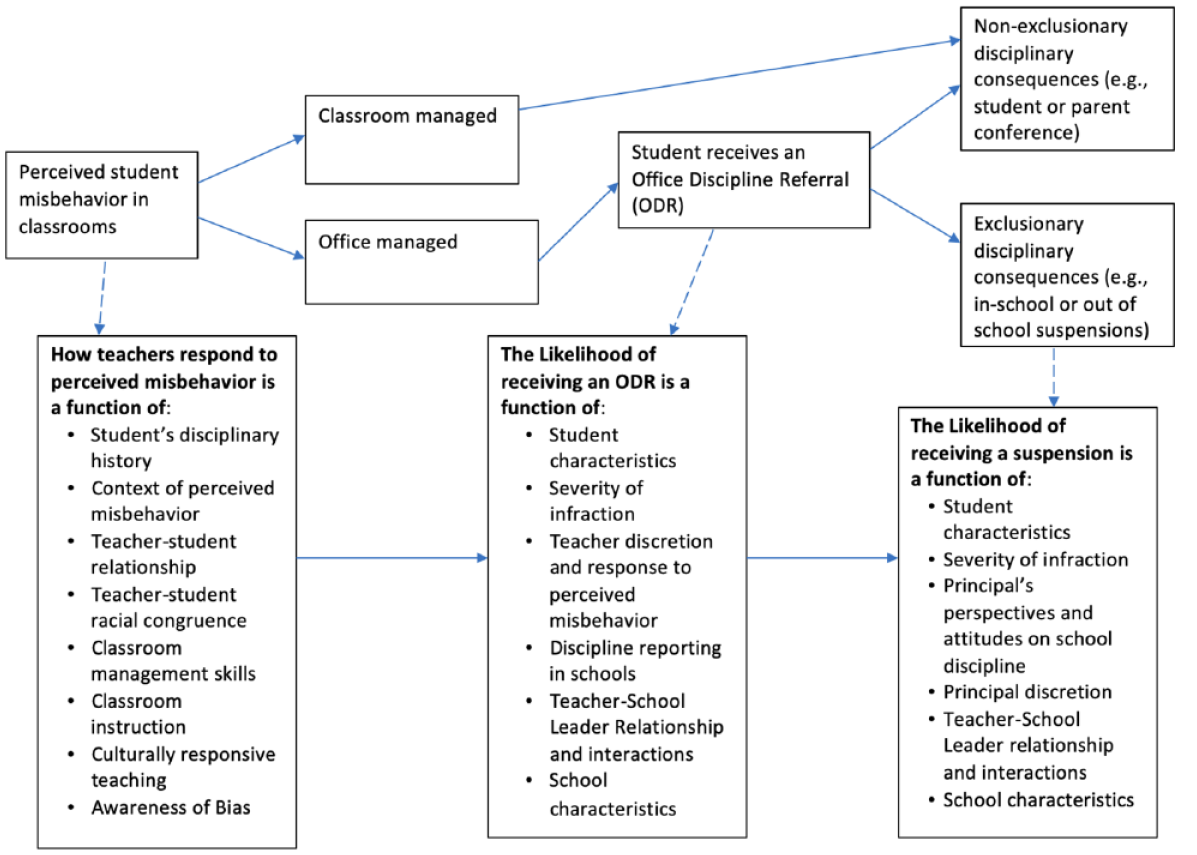
Conceptualizing the disciplinary process in schools.
Teachers and School Discipline
The extant literature suggests that teacher characteristics and behaviors—both observed and unobserved—play an important role in explaining discipline disparities (Welsh & Little, 2018a). Teachers are responsible for initiating the discipline process and multiple scholars have highlighted the central role that teachers play in contributing to disparities in exclusionary discipline (Blake et al., 2016; Gregory et al., 2010; Lindsay & Hart, 2017). Teachers’ classroom management skills (Skiba et al., 2014), teacher-student racial match (Bradshaw et al., 2010; Kinsler, 2011; Lindsay & Hart, 2017), the lack of representation (Blake et al., 2016; Staats, 2014), teachers’ negative perceptions, beliefs, expectations, and bias (Atiles et al., 2017; Ferguson, 2001; Gregory & Mosely, 2004; Hines-Datiri, 2015; Okonofua et al., 2016; Okonofua & Eberhardt, 2015; Skiba et al., 2011) and trusting teacher-student relationships (Anyon, Atteberry-Ash et al., 2018; Anyon, Lechuga et al., 2018; Gregory & Ripski, 2008) play a critical role in the school discipline process. Teacher judgment regarding the severity of a child’s behavior and whether or not misbehavior can be handled at the classroom-level is influenced by: (a) student behavior patterns, (b) the immediate context of behavior, (c) teacher tolerance level and skills in behavior management, and (d) the resources available to the teacher for managing disruptive behavior (Skiba et al., 2014).
School Leadership and School Discipline
Prior studies have highlighted that: (a) there is substantial variation in the disciplinary philosophies of principals within the same school district (Advancement Project/Civil Rights Project, 2000) and (b) suspension rates are linked to principals’ attitudes (Mukuria, 2002; Skiba et al., 2007, 2014). Principals’ perspectives were one of the most significant school-level predictors of the rates of and disparities in disciplinary outcomes (students’ race was statistically insignificant in predicting OSS when percent Black enrollment, average achievement, and principals’ disciplinary perspectives were considered) (Skiba et al., 2014).
A handful of studies have shed light on principals’ disciplinary practices outside of their disciplinary philosophy and the interplay between principals and teachers in the disciplinary process. Findlay (2015) examined how principals exercise discretion in their disciplinary decision making and found that principals believed that discretionary decision-making was necessary and essential to their role as school leaders. Principals’ discretion appeared to be guided and constrained by norms, professional standards, and social and organizational rules, regardless of the autonomy they expressed having (Findlay, 2015). Kennedy et al. (2017) found that administrator decisions were influenced by their upbringing, parental experiences, job requirements, parent expectations, and fear of reprisal. Numerous administrators were uneasy about the rigidity of discipline codes and made compromises based on multiple factors (Kennedy et al., 2017).
DeMatthews et al. (2017) highlighted that principals attributed the limited time afforded to principals as a contributor to the racial discipline gap and that most principals believed that teacher effectiveness influenced student behavior. Skiba et al. (2007) highlighted that principals believed that misbehavior should be handled by teachers in the classroom. A recent survey suggested that there are important differences in how teachers and school leaders view classroom disruptions as well as the lack of clear and consistent guidelines for behavior management (EAB, 2019). There is little research on the notion of accountability for school discipline in schools (Banks, 1980). Banks (1980) found that teachers accepted their role as a disciplinarian, but did not accept accountability for school discipline.
In sum, school administrators and teachers play an important role in the disciplinary process within schools. Yet, the roles and approaches of teachers and school leaders in addressing perceived misbehavior and the production of racial inequality in exclusionary discipline are poorly understood. Prior studies have examined teachers’ disciplinary perspectives and practices (Hambacher, 2018; Monroe, 2009) separately from those of school administrators (Skiba et al., 2014). This study contributes to the robust school discipline literature by focusing on identifying and explicating key factors that shape school discipline practices. A better understanding of educators’ role in the disciplinary process can inform alternative approaches to exclusionary discipline that reduce discipline disparities.
Data and Methods
The goal of this qualitative case study is not to generalize findings, but rather as Yin (2014) writes, “Case studies, like experiments, are generalizable to theoretical propositions and not to populations or universes. In this sense, the case study, like the experiment, does not represent a “sample,” and in doing case study research, your goal will be to expand and generalize theories (analytic generalizations) and not to extrapolate probabilities (statistical generalizations)” (p. 21). This design allows for a pragmatic approach to the research (Yin, 2014) and provides an opportunity to gain a granular understanding of school leaders’ and teachers’ disciplinary practices and the disciplinary process within schools. In this sense, the case study, like the experiment, does not represent a “sample,” and in doing case study research, your goal will be to expand and generalize theories (analytic generalizations) and not to extrapolate probabilities (statistical generalizations)” (p. 21). Peach State School District (PSSD) (a pseudonym) reflects the racial composition and school discipline trends facing urban districts. PSSD has less than 13,000 students enrolled with African American students accounting for 48% of the student population, followed by Latinx (25%), White (21%), Multi-racial (5%), and Asian (2%) students. As in other “urban emergent” districts nationwide (Welsh & Swain, 2020; Milner, 2012), school discipline is an important educational equity challenge in PSSD. Black and Latinx students are more likely to receive suspensions than their peers for similar infractions, and thousands of instructional days are lost to suspensions (Welsh & Swain, 2020, Welsh, 2022b). PSSD has a diverse school leadership relative to districts nationwide and this provides useful variation to unpack the perspectives and practices among Black school leaders in the disciplinary process. Data from the 2017 to 2018 school year indicates that most principals are White (78%) and female (54%). Only 9% of principals are Latinx and 11% are African American (National Center for Educational Statistics, 2019). Unlike most districts nationwide, roughly half of principals (and assistant principals) in PSSD are African American.
Data Sources and Data Collection
The main data source for the study is semi-structured interviews with school leaders, district leaders, and teachers. In addition, supplementary observations were used to contextualize interviews and provide additional insights into the disciplinary process. These included: (a) school discipline forums, town halls and community meetings, (b) restorative justice and equity workshops as well as restorative practice community of practice meetings (attended by a mix of counselors, teachers, and social workers), (c) alternative education task force consisting of school and district leaders, (d) code of conduct revisions task force, and (e) professional learning opportunities for principals and assistant principals over the course of the 2018 to 2019 school year and 2019 to 2020 school year.
Multiple data sources allowed for triangulation complementarity, confirm and discover, and explanation (Creswell & Clark, 2011; Greene et al., 1989). Utilizing a broad set of data also provides confidence that the analyses are representative of the nuances of disciplinary processes and allows for the contrast of diverse interpretations of educators’ roles and approaches in the disciplinary process across multiple constituency groups (Yin, 2009). Data was collected and analyzed over a multi-year period spanning January 2018 through June 2020.
Semi-Structured Interviews
Semi-structured interviews allow researchers to probe deeply into the process by which actors come to understand problems and policies as well as analyze the conflict between policy goals and actual implementation and practices. As such, interviews allowed participants to share their perspectives on school discipline and their practices within schools and provided a forum for them to share not only their views but also their underlying rationales. The interviews provide a detailed, insider’s perspective of the school discipline practices and processes as well as the challenges and considerations involved in navigating this complex socio-ecological process riddled with disciplinary moments.
Using purposeful sampling (Patton, 1990), interviewees were selected based on their knowledge of the practices and process of school discipline within schools and/or their involvement in the process of administering discipline in schools and districts. The sample of participants was significantly involved and knowledgeable of in-school discipline in the district and schools and the inner workings of the disciplinary process and represented a variety of contexts and perspectives. Interviewees included personnel in elementary, middle, and high schools and district administrators in various positions in the central office. This study is part of a larger study on school leadership and school discipline in an ongoing research-practice partnership between the researcher and PSSD on investigating and disrupting racial inequality in school discipline. This resulted in familiarity with the author among district and school leaders which boded well for recruiting participants. The recruitment approach consists of individual formal recruitment emails to selected participants.
Table 1 illustrates the characteristics of participants involved in this study. A total of 35 semi-structured interviews were conducted with 25 participants from March 2018 through June 2020, which included follow-up interviews to delve deeper into emergent themes. Eleven of the 25 participants were district-level administrators. I classify these administrators into two broad categories: (a) high-level administrators who may include positions such as superintendents, associate superintendents, chief of staff and, (b) services coordinators who may include instructional coaches, directors of student support such as SEL, social workers, behavior supports and restorative justice coordinators. Most of the district leaders were services coordinators (8) with a handful of high-level administrators (3). District administrators were almost always former school leaders and teachers and thus have granular knowledge of school discipline practices and processes within schools. Most of the participants were school personnel including: nine principals (four elementary schools, two middle schools, and three high schools), two assistant principals (one elementary and one middle school), and three elementary school teachers. The majority of the interviewees were White (14vs. 11 Black interviewees) and most of the participants were female (15vs. 10 male interviewees). Almost all of the interviewees had or were in the process of obtaining graduate degrees. It is important to highlight that a significant proportion of the participants are Black women principals and assistant principals whose leadership is pivotal to transforming schools (Lomotey, 2019). Of the 11 Black interviewees, seven were females and only four were males.
Interview Participants.
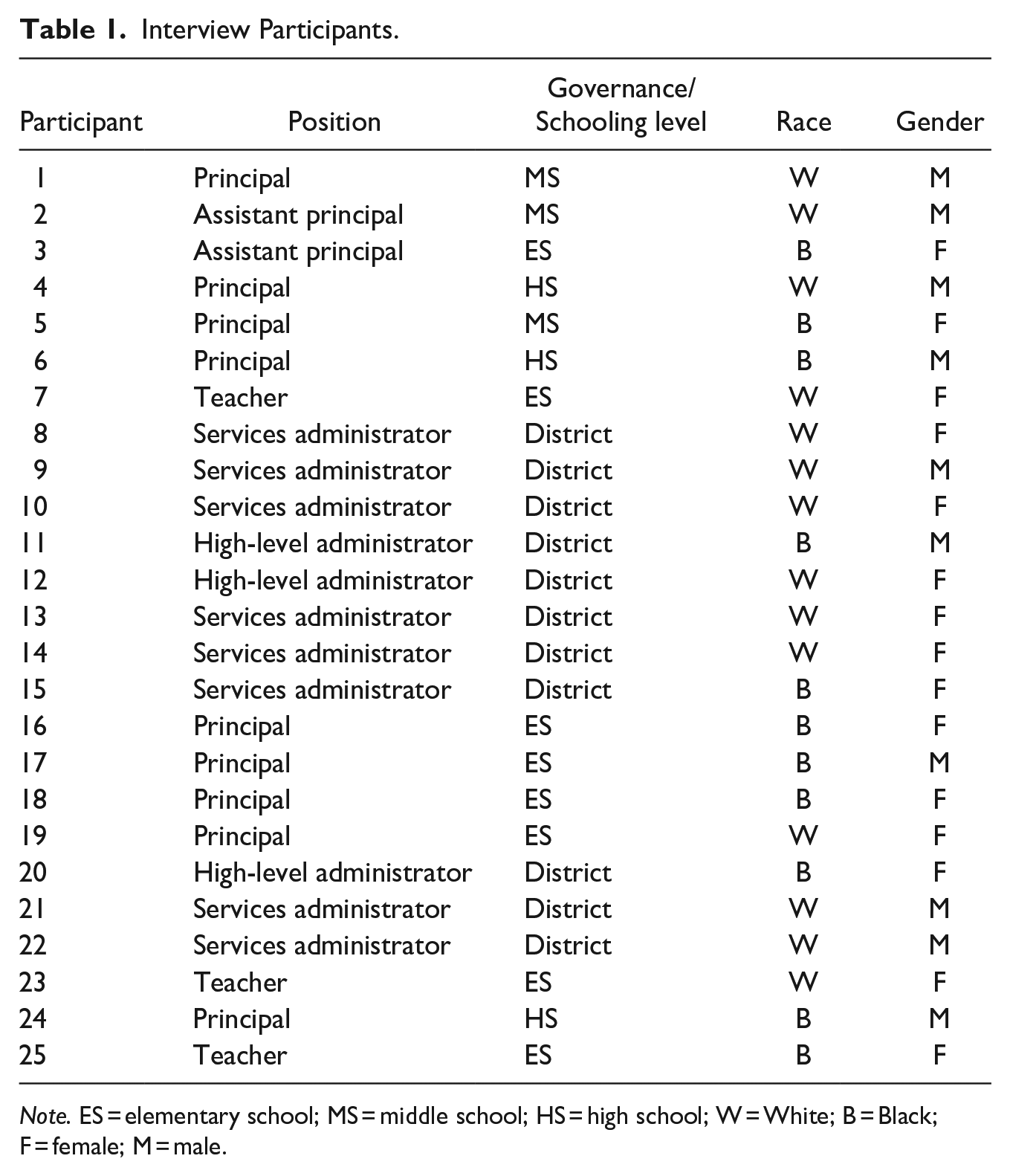
Note. ES = elementary school; MS = middle school; HS = high school; W = White; B = Black; F = female; M = male.
Interviews were conducted by the principal investigator and one of two research assistants. A “master protocol,” was developed and used to guide discussions with respondents. The interview protocol was designed to foster a granular understanding of: (a) educators’ perceptions of the contributors to the rates of and disparities in suspensions, (b) the infractions warranting disciplinary consequences and the process undergirding the response to infractions, (c) the extent of educators’ discretion and accountability in the disciplinary process, (d) available supports for addressing school discipline challenges, and (e) the role of race and gender in the interactions among school leaders and teachers in the disciplinary process. Researchers framed interviews as “guided conversations” in that researchers posed a series of open-ended questions and responses as well as follow-up questions that encouraged further explanation (Kvale, 1996). See the Appendix for a copy of the interview protocol.
Interviews were conducted via telephone or in-person, and each interview lasted between 60 and 90 min. In an effort to conduct a quality interview, the following best practices were attended to as suggested by Kvale (1996) and Roulston (2010), (a) the extent of spontaneous, rich, specific, and relevant answers from the interviewee; (b) the shorter the interviewer’s questions and the longer the subjects’ answers, the better; (c) the degree to which the interviewer follows up and clarifies the meanings of the relevant aspects of the answers; (d) the ideal interview is to a large extent interpreted throughout the interview; (e) the interviewer attempts to verify his or her interpretations of the subjects’ answers in the course of the interview; and (f) the interview is “self-communicating”—it is a story contained in itself that hardly requires much extra descriptions and explanations (Kvale, 1996, p. 145). Interviews were recorded and transcriptions of these recordings, along with notes taken during the interview, were used to uncover themes. Given the politicized nature of school discipline, participants were reassured their identity would remain confidential and additional measures were taken to ensure that interviewees felt comfortable participating in interviews with honesty.
Analytic Procedures
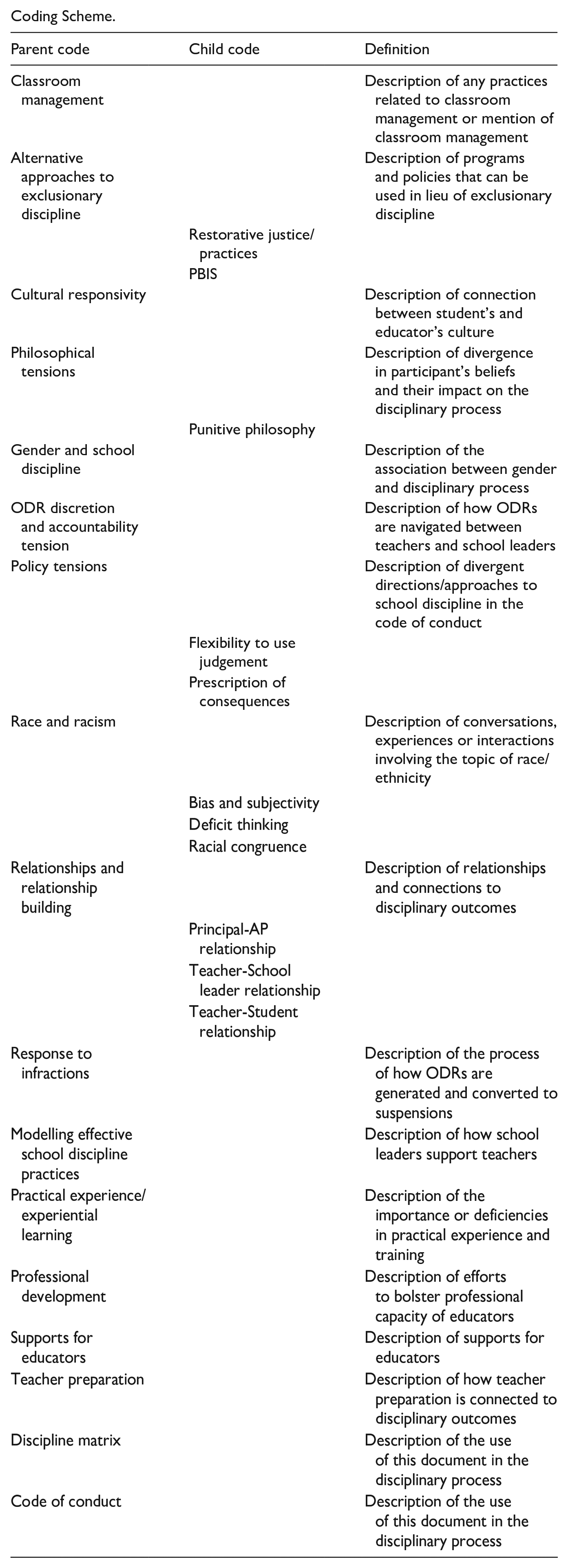
Analytic themes were informed by analytic codes designed to uncover the interpretive frames respondents used to navigate the disciplinary process. Coding and memo-writing were used to identify and explicate salient themes in school discipline practices. The analytic approach allowed for capitalizing on the robust data to not only explore a prior codes and existing notions while allowing new themes to emerge. First, a starting list of codes was developed based on prior empirical literature and theoretical reviews (Welsh & Little, 2018a; Little & Welsh, 2022) and this was used to code all interviews (see the Appendix for a list and description of codes). The principal investigator and research assistants coded several transcripts independently and then compared coded transcripts to ensure consistency in the application of codes. Interviews were transcribed and coded using Dedoose qualitative software. Second, new codes and categories were developed iteratively and inductively. Participant responses over time inform iterative coding.
The analysis of transcripts and other sources of data-focused predominantly on identifying the nature of and challenges in fostering effective school discipline practices. As such, while analyzing transcripts, particular attention was paid to references made to: (a) the disciplinary process in schools, (b) contributors to discipline disparities, (c) disciplinary policy, (d) strategies and alternative approaches to exclusionary discipline, and (e) race and gender in the interactions among educators. An iterative process was used to constantly think deeply about emergent themes, as new analytic topics came into focus. Making sense of the data required revisiting the design, research questions, and interview protocol while analyzing data (Kvale, 1996). Extensive measures were taken to ensure a high degree of intercoder reliability. For nearly all of the interviews, both researchers (author and research assistant) were present and took notes. These notes were shared and compared after the interviews were completed, which led to multiple “norming” sessions (Welsh & Graham, 2021), which were used to ensure consistent interpretation and application of codes. Specifically, researchers, using both individual notes and transcripts, highlighted excerpts related to any of the codes in which we were interested. This led to a document wherein excerpts were grouped based on the codes by which they were identified. For each interview, this process took place by both researchers, which allowed us to consistently compare notes and revise analytic themes iteratively. When there were divergences, transcriptions were revisited and excerpts re-examined to achieve consensus. This study employs a number of strategies such as triangulation among sources and cross-validation between researchers to address threats to the validity of inferences drawn from the qualitative data (Creswell, 2013; Miles & Huberman, 1994). The appendix provides an analysis plan with an exemplar of coding raw data from the interviews into themes.
Limitations
First, in order to maintain the confidentiality promised to interviewees, broad descriptions of participants’ identities accompany the quotes. While adhering to the aforementioned guidelines to conduct quality phone interviews, it is important to acknowledge the limitations of this approach. Specifically, important cues that may signal reactions, such as facial expressions, are missed via the telephone. Further, rapport building, which is necessary for quality interviews, and may further ensure honesty among respondents might also be more challenging with phone interviews. On the other hand, the phone interview might have mitigated other concerns. For instance, researcher’s positionality as a Black male, in the context of an educational equity issue that largely affects African American students, may have prompted challenges during in-person interviews when issues of race are discussed, which happened invariably during the process. This positionality, however, is somewhat masked during the phone interviews, as respondents are not immediately made aware of our racial backgrounds. Additionally, there is caution in the generalizability of the findings to all districts given the research design. The proportion of Black school leadership in this case study is also notably higher than the national rate which also limits applying the insights to the population of educators in the U.S.
Findings
Two major factors emerge as critical to school discipline practices in K-12 schools: (a) teacher preparation and (b) modeling of effective school discipline practices (how school leaders support teachers and how mentors support school leaders in the disciplinary process).
Teacher Preparation
Teacher preparation is central to school discipline practices. There was near unanimity among interviewees that teachers are not prepared to handle school discipline challenges. An African American female elementary school principal was frank in her assessment—“So I think that, um, many of our novice teachers are not prepared. They don’t truly know they aren’t prepared to understand all of the minute details that go into classroom management and classroom organization.” A White female elementary school principal noted that: I don’t think that our teachers are as well prepared as they should be, our new teachers coming in. Um, I don’t think they get enough of that work in their undergraduate work. I think they. Of course, it’s talked about. There’s probably a course on classroom management, but there’s not that practical piece.
Four key themes regarding teacher preparation emerge: (a) relationship building, (b) classroom management, (c) cultural responsiveness and proficiency, and (d) practical experience/experiential learning.
Relationship Building
Relationship building is a major area in which teacher preparation shapes school discipline. Several school leaders stressed the importance of establishing relationships within the school building and linked relationships to students’ sense of belonging and behavior expectations. Building relationships in schools is easier said than done. School leaders noted that novice teachers have much difficulty in establishing relationships and highlighted the importance of setting standards and expectations for students’ comportment. A high school principal highlighted the importance of effective relationships (teacher-student and teacher-parent) as a preventative measure to exclusionary disciplinary practices: Oftentimes if it’s an issue where we feel like it’s not as an actual referral, then we sit down and we talk about it and oftentimes try to help the teachers understand it’s about relations and to continue work with the student and or with the student and parent. Um, because establishing those relationships that have been would have been why a lot of the issues that take place in classrooms. A lot of teachers don’t understand the importance of having open dialogue and open lines of contact with parents.
The findings are congruent with prior studies that find that teachers who successfully and intentionally build trusting relationships with students use exclusionary discipline less, and are more likely to influence student behavior positively when an ODR or suspension is issued (Anyon, Atteberry-Ash et al., 2018; Gregory & Ripski, 2008). Expanding on this growing body of work, principals in this study linked the possible lack of focus on relationship building in teacher preparation programs to the unpreparedness of novice teachers who lacked key pedagogical tools related to school discipline.
The role of race in teacher-student relationships was also a pertinent theme. An African American female elementary school principal noted that “It’s difficult for White women to deal with our children.” Several interviewees highlighted that relatability often emanates from teacher-student or teacher-school leader racial congruence. For instance, multiple participants observed that racial congruence partly explains why Black female school leaders seem to be more comfortable with difficult racial conversations, able to relate to students, and build honest, reassuring relationships with children. An African American female middle school leader noted that “My kids know I love them dearly but I am firm.”
The results suggest that there is a communication and cultural gap between White teachers and Black students. A high school principal observed that “not all White teachers are not able to relate to Black students, but I do think there are some who this is their first time being in front of a class of Black students and to be honest communication is a bit different in some cultures. The way some students may communicate at home, some teachers may see it as disrespectful.” An African American female district leader with prior experience as a principal in the district highlighted that “it’s not just race, it’s also culture” as Black teachers’ treatment of Black students may vary by socioeconomic status. Importantly, the results suggest that relatability transcends race. A high school principal shared a story of a young White female teacher that “worked to establish relationships on the front end” that proved essential to her rapport with students.
Scholars have found that there is a positive influence of racial-matching between teachers and students on school discipline outcomes for Black students (Lindsay & Hart, 2017). This study adds to these findings by identifying the difficulties of relationship building and a disconnect in communication styles between students and teachers as salient mechanisms that may shape how the racial mismatch between students and teachers (the teaching force being largely White and female while the student population of public school is increasing students of color) shapes discipline disparities.
Classroom Management
Similar to prior studies (Nichols, 2006; Skiba et al., 2014), the findings suggest that the response of teachers to perceived misbehavior is a function of a teacher’s classroom management. Teachers frequently struggle with classroom management and interviews linked some of these struggles to areas for improvement in teacher preparation programs on classroom management. This suggests that teacher preparation programs need to focus more intently on preparing teachers for classroom management. There was consensus among the interviewees that most infractions were subjective offenses and there is a link between the nature of infractions and the deficiencies in teachers’ classroom management. An African American middle school AP characterized it as such, “I call it petty discipline. A lot of it comes down to classroom management.” Several interviewees highlighted that attention to detail in building a classroom culture was lacking and that novice teachers struggle to “teach students expectations.” An African American elementary school principal shared that: So being able to think about this from, at a very deep level of knowing that you have to plan for everything, have systems and procedures in place for everything, and really map out what you expect your classroom to look like, what the expectations are. Things as simple as how will they turn in assignments to how will we line up and understanding that all of that goes into building a classroom culture that is productive, that’s orderly, and that students know what to do in any situation, because I don’t think that they understand that.
Cultural Responsivity and Implicit Bias
There were multiple references to teachers’ cultural proficiency throughout the interviews. Several school leaders, regardless of schooling level, argued that teachers lack the preparation to work with a diverse student population and noted that the subjective lens through which teachers decide how to address perceived misbehavior is based largely on teachers’ perceptions of how they think students should act as well as whether these expectations are realistic and culturally relevant. An African American female elementary school principal linked classroom management to cultural responsivity and shared that: I’m not sure what the undergraduate classroom management and organization course looks like at this point, but I know when I did it, there was not a lot of depth to it. So, I think that they need to have greater opportunities to explore how to build their own cultural proficiency so that they can then be better prepared to serve students from diverse backgrounds and understanding what they’re bringing to the table and understanding how to build those relationships so that all students feel a part of the classroom environment. So that number one, you’re building that positive classroom culture. And I think they need to truly understand what all the pieces of a positive classroom culture look like and understand all of the work that they have to do on the front end, in order to build that so that they understand if you try to fix it later, you’re going to waste a whole lot of time.
The findings are aligned with evidence that explicit coaching of teachers on strategies to improve management and social-emotional support to students reduces reliance on punitive discipline (Welsh, 2023; Gregory, Bell, Pollock, 2016; Gregory, Clawson et al., 2016; Gregory, Hafen et al., 2016). Gregory, Bell, Pollock (2016), Gregory, Clawson et al. (2016), Gregory, Hafen et al. (2016) conducted a randomized control trial where they tested a 2-year coaching program called My Teaching Partner-Secondary (MTP-S) and found that when teachers increased their sensitivity to the social and emotional needs of students and pedagogical skills in inquiry and engagement, discipline disparities were eradicated. Similarly, participants in this study highlighted that management and relationship-building skills and tools will help alleviate discipline disparities and that these programs must also teach cultural proficiency and sustaining pedagogy. Implicit bias plays a role in teacher decision making in terms of discipline, and more needs to be understood about how racially biased beliefs may prevent teachers from creating classroom cultures that are culturally responsive (Gregory, Bell, Pollock, 2016; Gregory, Clawson et al., 2016; Gregory, Hafen et al., 2016; Okonofua et al., 2016) Scholars have developed theoretical frameworks on what culturally responsive and sustaining pedagogy could look like, but explicit practices have yet to be empirically studied (Lustick, 2021; Paris, 2012).
Practical Experience/Experiential Learning
The importance of and need for more practical experience and experiential learning in teacher preparation was also a salient theme. Multiple school leaders also highlighted deficiencies in practicum and experiential learning was seen as a key element of teacher preparation to address school discipline challenges. An African American high school principal shared that: “I don’t think teacher preparation programs prepare teachers for disciplinary concerns. I know they use scenarios and case studies but there’s nothing like being in that moment, when your adrenaline pumps and you’re breathing heavier, faster.” An elementary school principal underscored the importance of practical experience in classrooms. An African American female middle school principal highlighted the need for a thoughtful approach to experiential learning: . . .Not to mention, many of the students I’m noticing now when they go through their student teaching or their practicum, um, they’re really not left to deal with the behaviors. Um, they have them more of a co-teaching setup model. So, they’re never really, um, they never really learned that part. So, then they really don’t have to work through that until they get their first teaching job.
Modeling Effective School Discipline Practices
The results highlight the importance of modeling effective disciplinary practices within schools. The lion’s share of the modeling are school leaders (both principals and assistant principals) supporting teachers but there are also instances in which mentors model effective school discipline practices for principals. A White male middle school assistant principal encapsulated the importance of modeling in the disciplinary process: “But once they hit our building, when teachers hit our buildings, it’s pretty much our responsibility to teach them how to be good managers and how to deal with school discipline.” Some of the interviewees acknowledged that in some instances school leaders’ support of teachers was lacking. In response to a question about how school leaders support teachers in school discipline, a high school principal bluntly replied “Well, some don’t.” An elementary school principal noted that school leaders have to be better at supporting teachers—“We have to model it for them and tell them what we want.”
A handful of operative elements emerge as key to a school leader’s support of teachers’ effective school discipline including: (a) mentoring, (b) modeling, (c) supporting new teachers in classroom management, (d) non-evaluative feedback of disciplinary practices, and (e) fostering relationship-building skills. The results indicate that modeling and mentoring are key ingredients of the support that school leaders provide to teachers in working toward a shared understanding of school discipline. New teachers look to school leaders as mentors and it is important to model how to address students’ behavioral challenges. Modeling is especially salient for new teachers and maybe done by veteran teachers who exemplar classroom management skills as explained by an elementary school principal: We’ve had some of our other teachers who, um, we feel like are pretty good with classroom management and organization go in and model some things for teachers who might need that support. And typically it’s going to be our first year teachers. Um, we’ve had my assistant principal has gone in to model and to work alongside and we do it in a gradual release model of we’re in there. We’re modeling, we’re helping them put systems in place. And then we gradually back off and give them control of it. So those are the things that we are planning to do to support teachers as they build their not only knowledge, but confidence in their ability to manage their class.
Several interviewees highlighted that role play in addressing myriad situations and bolstering classroom management is a key part of the school leaders’ teaching of teachers. In response to how school leaders support teachers with schools, a White male middle school AP outlined how school leaders may support teachers in various ways: We start every year with classroom management plans. We try to make sure that teachers have clear routines and procedures and protocols, so that a lot of the things that went through doing really turned into discipline can be headed off proactively. We take assistance calls for teachers who have students that may find themselves unable to manage on any given day and we respond to those calls within minutes every day. We observe and provide feedback. We also have an excellent instructional coach who’s able to do the same thing for teachers who maybe just need some extra support with the management plan. And then where we’re able to, and this year has been a challenging year because we’ve had so much turnover from the teachers we had last year, we also provide regular professional learning on trauma sensitive and culturally sensitive practices.
Response to Infractions
School leaders also need mentorship in the disciplinary process, especially in navigating the tension between ODR discretion and accountability. An African American middle school principal shared that: I’m a new administrator. So, what I have done, and this happened yesterday. So, what I have done is asked, um, a veteran leader to come in and help me with those kinds of conversations. Because, um, so what I had, um, my mentor do yesterday is to observe the classroom herself to see if I was even seeing the same thing. And, um, and this teacher has chronically been sending kids to the office for no real reason. I don’t, I didn’t have the words to fix this or to even broach the subject. So, I let her model that for me yesterday. And, um, because it’s a tricky thing because to be honest my teachers are humans too. And I have to, I have to think about how they feel about things too. And, and I’ve been there. I taught for 24 years. So, I understand that. Yes, you’re right. Him throwing a pencil across the room was not an offense for the office, but that’s the 12th thing he’s done this week. So, I need a break and I have to recognize that and not, you know, play the blame game. Cause we can talk about this later, but right now you need a break.
A key area in which school leaders’ modeling of effective school discipline practices shapes disciplinary outcomes and disparities in the response to infractions. The results indicate that distinguishing what classroom versus office-managed infractions are is a process that requires patience and collaboration among school leaders and teachers. The interviewees highlighted the need for school leaders to install and maintain structures, procedures, and checklists to facilitate clarity in how disciplinary infractions are effectively managed. School leaders work with teachers to learn new systems and ways of considering how to respond to perceived misbehavior and engage students and their families. Ultimately, the response to infractions requires hard conversations between school leaders and teachers. It is a back and forth process of teachers facing different scenarios and consulting with school leaders to ensure they got it right or to find ways to do it better. “You have to talk through it and figure it out” observed an African American female middle school AP.
The process starts with clear protocols with clear options—“This is what you do in this situation.” An African American high school principal noted that “Teachers tend to react negatively when they don’t know what their options are. What do I do? I don’t feel supported. Where’s my SRO? Do I pick up the phone and call the principal?” An elementary school principal shared similar sentiments—“A lot of times teachers just are wanting you to take the time to talk them through it because they really didn’t know how to handle it.” The presentation of protocols also matters - the results indicate that a flow chart instead of sending out instructions may also be beneficial.
Conversations about race tend to be a difficult yet inescapable component of the interactions between school leaders and teachers in the disciplinary process. “That can be uncomfortable conversation” encapsulates the sentiments of school leaders when quizzed about approaching conversations on race and school discipline. An African American female principal noted the salience of race in navigating interactions among school personnel in the disciplinary process: When it comes to the teachers, I think building that sense of trust, that sense of, um, professionalism and respect took time. And it was a little bit harder with some of my non African-American teachers, because when we start having conversations centered around race and how we interact with students, then, that could be an uncomfortable conversation. And it automatically goes to the, are you saying I can’t teach black kids because I’m white. And so getting them to understand that that’s not the piece that we need to separate on. We need to be thinking about what is it, because just because I’m black does not mean that I don’t hold biases against other black students in ways that I may not have even realized until we began to have these deeper conversations and began to really delve into our own patterns of behavior.
Discussion
In the aftermath of the COVID-19 pandemic, educators have struggled to address student misbehavior (Welsh, 2022a; Perera & Diliberti, 2023). This study contributes to a richer understanding of the disciplinary process within schools. Two factors emerge as critical to school discipline practices: (a) teacher preparation and (b) school leaders’ modeling of effective school discipline practices (how school leaders support teachers in the disciplinary process). The study reaffirms the importance of teachers and supporting teachers in the disciplinary process. This study suggests that a host of instructive relationships among teachers, APs, and principals (principal-assistant principal, principal-teacher, and teacher-assistant principal relationships) shape the modeling of effective and non-punitive school discipline practices which in turn shapes school discipline practices, disciplinary outcomes, and disparities.
Relationships matter for school discipline. These findings support those of prior studies highlighting relationship building was a central strategy to reduce the use of exclusionary discipline (Anyon, Atteberry-Ash et al., 2018; Gregory et al., 2018). Similar to teacher-student classroom interactions (Pane et al., 2014), the findings of this study suggest that power relations among educators shape school discipline practices. The findings add to a growing number of studies that highlight the importance of assistant principals in the disciplinary process and in fostering effective school discipline practices (Welsh, 2023; Gray et al., 2017; Williams et al., 2023). Similar to Johnston and Young (2019), the results indicate that there are deficiencies in teachers’ contextual knowledge of urban districts.
The philosophical distinctions about the purpose of school discipline amid the evolving roles of educators has been documented in prior work (Welsh, 2023; Kafka, 2011). The findings of this study are congruent with prior studies that have highlighted that principals believed that misbehavior should be handled by teachers in the classroom (Skiba et al., 2007) and that there are important differences in how teachers and school leaders view classroom disruptions as well as the lack of clear and consistent guidelines for behavior management (EAB, 2019). The EAB survey also highlighted a disconnect between teachers and school administrators when it came to addressing behavior issues in the classroom. It indicated that school administrators overestimated how much training staff and teachers had received—with more than 70% of administrators stating their staff had been trained in various behavioral management techniques, while 53% or fewer teachers reported that was the case (EAB, 2019). Similarly, a more recent survey of principals highlighted teacher preparation and resources as key factors in addressing student behavior (Perera & Diliberti, 2023). For instance “in November 2021, only 36% of principals believed the teachers at their school were adequately trained by their teacher preparation programs to handle misbehavior and discipline” (Perera & Diliberti, 2023). The results are also congruent with the findings of Kennedy et al. (2017) which highlighted how numerous administrators made compromises based on a variety of factors.
Implications
A few policy and practice implications emerge from the findings. The results highlight the importance of two pivotal levers—teacher preparation and on-the job support—through which policymakers can support teachers and school administrators development of non-punitive and inclusive disciplinary practices. Recent research has underlined the importance of the diversity of teachers and school leaders for students’ disciplinary outcomes (Welsh, 2023; Welsh & Sobti, 2023; Hughes et al., 2020; Shirrell et al., 2023). The study adds to the emphasis on school personnel for students’ disciplinary outcomes and suggests the diversity, training and capacity of teachers and school administrators is a key element of the strategic approach to reducing racial inequality in school discipline. Investing in developing an empathic mindset, coaching, and professional development in classroom management and culturally responsive practices for educators is an evidence-based reform that shows promise (Welsh, 2023; Cho et al., 2020). Teachers’ training and capacity to better manage classrooms is a key plank of reducing discipline disproportionality considering documented deficiencies in teacher preparation program, how inexperience of teachers may have adverse disciplinary implications, and the significant contribution of top referrers to discipline disparities (Welsh, 2023; Welsh & Rodriguez, 2023; Liu et al., 2023). As such, supporting school administrators and teachers—emphasizing educator-focused interventions as much as student-focused programs—is a key strategic direction in school discipline reforms.
For example, targeting novice teachers for additional support such as teacher induction and pairing novice teachers with more veteran teachers, may help ameliorate teacher preparation gaps that manifest in the disciplinary process. Experiential learning through teacher professional development has been associated with meaningfully shaping beliefs and classroom practices (C. Girvan et al., 2016). The results also indicate that new teachers need maximum support in classroom management. The findings are congruent with emerging evidence on the effectiveness of school discipline reforms that highlight the importance of culturally responsive classroom management for students’ disciplinary outcomes (Welsh, 2023). In sum, relationship-building skills, classroom management, cultural responsiveness and proficiency, and practical experience/experiential learning are specific areas in which educational leaders and policymakers should provide more in-depth training in order to reduce discipline disparities, whether through supporting changes to preparation programs or mentoring and coaching at the school-level.
The results suggest that teacher preparation programs should intensify the curriculum and attention given to classroom management (Cho et al., 2020). The findings highlight the need for greater attention to teacher training programs and the preparation provided for teachers to foster non-punitive and inclusive disciplinary practices. There is a need to improve teacher preparation programs to meet the school discipline challenges of today’s classrooms and schools. Fostering experiential learning through a combination of improvements to preparation programs may help reduce the ODRs that are the genesis of racial disparities in suspensions (Welsh, 2023).
Finally, the results suggest that school discipline reforms should not only target or focus on teachers but school leaders. Principals and assistant principals are important yet overlooked actors in the disciplinary process in schools (DeMatthews et al., 2017; Welch, 2023; Williams et al., 2023). An important actionable insight is that school leaders also need support to develop and model effective and non-punitive school discipline practices. School leaders need support in order to better support teachers. The study highlights the importance of how school leaders support teachers in the school disciplinary process. As such, supporting teachers is a critical part of reducing racial inequality in school discipline. District leaders should find ways to encourage school leaders to model techniques and strategies for teachers especially given the deficiencies in classroom management. In addition to modeling, a key role of school leaders in the disciplinary process is providing formative (rather than evaluative) feedback to bolster teachers’ professional capacity in classroom management and addressing school discipline challenges. Districts ought to prioritize supporting school leaders in developing and expanding their professional capacity to navigate the multiple tensions in the disciplinary process (Welsh, 2023). School leaders also need to be aware of effective instructional and classroom management strategies in order to share and model these for teachers. Providing coaching and mentoring for school leaders in schools with high prevalence of and disparities in exclusionary discipline may be part of a school discipline reform strategy of cascading support to both students and educators.
Footnotes
Appendix A
Appendix B
Coding Scheme.
| Parent code | Child code | Definition |
|---|---|---|
| Classroom management | Description of any practices related to classroom management or mention of classroom management | |
| Alternative approaches to exclusionary discipline | Description of programs and policies that can be used in lieu of exclusionary discipline | |
| Restorative justice/practices | ||
| PBIS | ||
| Cultural responsivity | Description of connection between student’s and educator’s culture | |
| Philosophical tensions | Description of divergence in participant’s beliefs and their impact on the disciplinary process | |
| Punitive philosophy | ||
| Gender and school discipline | Description of the association between gender and disciplinary process | |
| ODR discretion and accountability tension | Description of how ODRs are navigated between teachers and school leaders | |
| Policy tensions | Description of divergent directions/approaches to school discipline in the code of conduct | |
| Flexibility to use judgement | ||
| Prescription of consequences | ||
| Race and racism | Description of conversations, experiences or interactions involving the topic of race/ethnicity | |
| Bias and subjectivity | ||
| Deficit thinking | ||
| Racial congruence | ||
| Relationships and relationship building | Description of relationships and connections to disciplinary outcomes | |
| Principal-AP relationship | ||
| Teacher-School leader relationship | ||
| Teacher-Student relationship | ||
| Response to infractions | Description of the process of how ODRs are generated and converted to suspensions | |
| Modelling effective school discipline practices | Description of how school leaders support teachers | |
| Practical experience/experiential learning | Description of the importance or deficiencies in practical experience and training | |
| Professional development | Description of efforts to bolster professional capacity of educators | |
| Supports for educators | Description of supports for educators | |
| Teacher preparation | Description of how teacher preparation is connected to disciplinary outcomes | |
| Discipline matrix | Description of the use of this document in the disciplinary process | |
| Code of conduct | Description of the use of this document in the disciplinary process |
Appendix C
Declaration of Conflicting Interests
The author declared no potential conflicts of interest with respect to the research, authorship, and/or publication of this article.
Funding
The author received no financial support for the research, authorship, and/or publication of this article.
