



Abstract
Social impact assessment as a concept and practice is generally framed as a process for delivering socially equitable outcomes, and in particular, a vehicle for improving the lives of society’s most vulnerable and marginalised people. For example, the International Association for Impact Assessment 2015 guidance document makes the normative statement that projects should benefit local communities and be a ‘force for positive social change and beneficial social development’. Yet most guidance provides little prescription for what this looks like in practice. More recently, the New South Wales 2021 guideline includes distributive equity as a principle for social impact assessment, but its application is yet to be tested. This article discusses key dimensions of equity concepts, drawing on international social impact assessment guidance documents, academic literature on equity, fairness and justice, and case studies in Australia. We elaborate process/procedural/participative and outcome/distributive dimensions of equity. We further argue that, to reflect the International Association for Impact Assessment position, social impact assessment needs to defend its normative purpose of advancing equity, rather than simply ‘considering’ equity impacts.
Introduction – why is equity important?
While the term ‘development’ suggests a beneficial or at least benign influence on society, its actual capacity for alleviating social disadvantage and inequities is contestable (Schulz, 2015). Large development projects are often located where the world’s poorest people live. Currently, the global energy transition is driving ever-increasing industrial demand for land that people depend upon for their livelihoods and cultural health. The resulting projects offer great opportunities to empower society’s most vulnerable, yet realising those opportunities cannot be assumed. India’s Pavagada solar park, for example, promised to empower rural communities, but ultimately women and the landless lost their livelihoods, while large landowners gained through long-term leases (Bryant et al., 2022). Inadvertently, the project exacerbated inequalities. The idea of ‘just transition’ sharpens our focus on justice, fairness and equity in this major upheaval process (Abram et al., 2022).
Similarly, the COVID-19 pandemic reignited concerns for social inequities and illustrated the costs of inequitable policies. For example, an independent review in Australia found that policy decisions exacerbated disadvantage by unfairly excluding vulnerable groups from economic and social support, and by applying blanket rules that disproportionately harmed marginalised communities (Shergold et al., 2022).
At the global level, concern for (intergenerational) equity is embedded in the United Nations’ definition of sustainable development: ‘meeting the needs of the present without compromising the ability of future generations to meet their own needs’ (UN, 2022b). The implication is that development programmes should actively seek equitable outcomes across generations. The 17 sustainable development goals require countries to reflect more deeply on the socio-economic disparities within and between countries (UN, 2022a). Many of the goals focus on vulnerability, and two focus explicitly on equality: Goal 5 ‘gender equality’ and Goal 10 ‘reduced inequalities’.
In the state of New South Wales (NSW), Australia – the location of our case studies below – the Environmental Planning and Assessment Act 1979, which underpins planning for all development, includes intergenerational equity in its definition of ecologically sustainable development. For development in NSW and beyond, social impact assessment (SIA) provides an appropriate focus for conceptualising and enacting intergenerational and other forms of equity. The feasibility of a development may depend substantially on questions of equity. As Munday (2020) notes, ‘The prospect of development may spark conflict within or between communities, particularly if the distribution of benefits and costs is seen as inequitable’ (p. 27).
In this article, we explore the meaning(s) of equity in an SIA context. We first interrogate its usage in SIA guidance literature, and discuss its intersections with social vulnerability, marginalisation, fairness and justice, before considering some case studies from Australia. We then propose ways of addressing both ‘process/procedural/participative’ and ‘content/outcome’ dimensions of equity in SIA.
Equity in SIA guidance
The last four decades have seen various SIA guidance documents published, aiming to present general applied frameworks, principles and methods. All refer to equity in varying ways. For example, Vanclay’s (2003) principles reference ‘equity considerations’ as being central to SIA, while Burdge et al. (2003) advocate that SIA should ‘consider the social equity or distributions of impacts on different populations’ (p. 238). Previously, the Interorganizational Committee on Guidelines and Principles for Social Impact Assessment (ICGP, 1994) noted that, prior to the US National Environmental Policy Act (NEPA) 1969, the distribution or ‘equity’ of social impacts on different populations had not been a consideration.
The most widely applied and referenced SIA guidance currently is Vanclay et al. (2015). This guidance does not define equity specifically, but mentions it seven times:
as a desirable outcome of a ‘community capitals’ approach to development (p. 11)
as a criterion for effective grievance mechanisms (p. 55)
as something that can be specifically considered in a dedicated ‘Equality impact assessment’, particularly to assess impacts on vulnerable people (p. 81)
as the notion that ‘the impacts in a society or of a project should be shared in an equitable manner, at least that there should be consideration given to the fair distribution of negative and positive impacts’ (p. 85)
as one of the primary purposes of SIA itself, being ‘to bring about a more sustainable and equitable biophysical and human environment’ (p. 95)
as one arm of ‘social justice’, the other being fairness (p. 96)
in the context of social risk, being something that is potentially threatened by an intervention (p. 97).
In general, equity features here as a core concept, largely as a principle for good practice but without clear practical explication. While equity seems a desirable or normative concept for SIA, it is not clear what equitable looks like in practice. Certainly, defining equity is trickier than defining equality. As Guy and McCandless (2012) explain, equality refers to identical quantities, whereas equity considers broader factors such as power imbalances, historical discrimination and underrepresentation and different material conditions, capacities or capabilities (Sen, 2009). Equity is therefore more contested, imprecise and value-laden.
The World Bank’s (2018) Environmental and Social Framework proposes that ‘all project-affected parties (should) benefit in an equitable manner from the project’ (p. 13). To demonstrate equity, the framework notes that projects should ‘propose and implement differentiated measures so that adverse impacts do not fall disproportionately on the disadvantaged or vulnerable, and they are not disadvantaged in sharing any development benefits and opportunities resulting from the project’ (World Bank, 2018: 13). Equity here seems largely a matter of avoiding bad situations becoming worse.
The NSW guideline (New South Wales Department of Planning and Environment [NSW DPE], 2021a: 10), similarly, lists distributive equity as a principle that holds when an SIA ‘Considers how different groups will experience social impacts differently (particularly vulnerable and marginalised groups, future generations compared with current generations, and differences by gender, age and cultural group)’. This definition appears to imply that equity is something to ‘consider’, but not necessarily to achieve in terms of social outcomes. Similarly, Munday (2020) frames equity as a consideration and a principle. However, in a distinct normative turn, the NSW guideline adds that positive impacts should be distributed equitably, without explaining what that means in practice. The Technical Supplement to the NSW guideline (NSW DPE, 2021b) is more specific, suggesting that social equity may ensue when project benefits are ‘directly targeted at economically marginalised groups’ (p.11).
Vanclay et al. (2015) identify the purpose of SIA as being to ‘bring about a more sustainable and equitable biophysical and human environment’ (p. 85). Drawing from earlier work into SIA principles, they define ‘impact equity’ as: the notion that the impacts in a society or of a project should be shared in an equitable manner, at least that there should be consideration given to the fair distribution of negative and positive impacts. For example, the flight paths for an airport might be adjusted to share the noise burden rather than the same people having all the noise (Vanclay et al., 2015: 85).
On preliminary analysis then, impact equity appears to be about assessing who ‘wins’ and who ‘loses’ (ICGP, 1994: 23). However, some conceptualisations indicate an additional normative component – proposing that impacts should be shared equitably. So, how does this normative position sit within broader impact assessment (IA) practices?
Equity in SIA and environmental impact assessment
As the guidance literature suggests, SIA is generally framed as a process for supporting and advancing socially equitable outcomes, and as a vehicle for improving the lives of society’s most vulnerable and marginalised people. Most commonly in a regulatory context, it occurs as part of environmental impact assessment (EIA), bringing a ‘social lens’ to understanding how proposed developments will affect people and their surroundings.
SIA often sits awkwardly among more ‘technical’ or biophysical EIA disciplines with their quantitative methods and air of objectivity that SIA cannot replicate (Parsons, 2019). Its emergence via the US NEPA 1969 introduced sociological concepts into natural resource management (Gale, 1984). Beyond social and environmental disciplines, the broad field of IA encompasses cultural heritage, health, transport and others.
The International Association for Impact Assessment (IAIA, 2022) defines the goal of IA as ‘a more ecologically, socio-culturally and economically sustainable and equitable environment’ (emphasis added). While equity is therefore an important concept within IA generally, SIA is the only IA practice explicitly concerned with social equity. (Some work exists on equality IA, e.g. Equality and Human Rights Commission, 2010; Transport for London, 2004. While thematically related to some equity issues considered within SIA, equality IA generally comprises a simple structured form intended to support public authorities in practising anti-discrimination.)
SIA, equity and vulnerability
The people who live in the path of the bulldozers are often the ones with the least say in what happens next’ (Brodeur, 2022).
Early conceptualisations of SIA frame equity as the ‘bottom-line’ question (Wolf, 1982, 1983), articulating it in terms of ‘who wins and who loses’. Wolf (1982) proposed that those who benefit should also bear the costs. Wolf (1983) also noted that equity is not a simple matter of income, but rather of fairness and social justice, and therefore the disciplinary domain of moral philosophy and values. Gale (1984) proposed that SIA needed to shift from its functionalist foundations to greater sensitivity towards equity. More recently, equity has been captured in the first principle of SIA practice: ‘Equity considerations should be a fundamental element of impact assessment and development planning’ (Vanclay, 2003: 9), and adopted as good practice in the international guidelines as noted previously (Vanclay et al., 2015).
Most SIA literature frames equity with reference to improving the lives of vulnerable and marginalised communities. The Sustainable Livelihoods Approach, which has strongly influenced SIA theory, starts by considering people’s vulnerability to change (DfID, 1999; Smyth and Vanclay, 2017).
In our experience, such concerns around inequalities, disempowerment and poverty can lead to accusations of ‘social engineering’ by implying a need for wealth redistribution. In practice, SIA’s remit is much broader than socio-economic matters, but with a core ethical commitment to alleviating disadvantage and disempowerment. ICGP (1994) conceptualises this commitment by equating SIA’s focus on vulnerable communities with reference to EIA’s focus on threatened or endangered species.
It is well known that certain groups in society, or people who live in certain locations, are marginalised and disadvantaged. As a consequence, some are disproportionately vulnerable – or less resilient – to project impacts (Smyth and Vanclay, 2017). This matters not only because inequality and disadvantage seem morally undesirable, but because of wider implications. Higher inequalities are generally associated with lower productivity (Gordon, 2022), lower public health and wellbeing outcomes (Marmot et al., 2020; Wilkinson and Pickett, 2009), less stable economies, lower social mobility, higher crime rates, lower civic participation and reduced likelihood of subjective happiness (Equality Trust, 2022).
Widening inequalities therefore reflect poor public policy, and, as extensively explained by Piketty (2014), are avoidable only through deliberate intervention. Indeed, from a more ecocentric perspective, Preston (2018) proposes that intergenerational equity, intragenerational equity and interspecies equity are all necessary for a productive, healthy and diverse environment, and are the responsibility of legislators and administrative and judicial decision-makers.
Exacerbating the structural reality of inequality, those most adversely affected by major developments are often the most marginalised and vulnerable. For example, mining operations typically harm those most vulnerable (Downing, 2002), leading to the view that the dominant, normative discourse of corporate social responsibility conflicts with empirical practices of corporate social irresponsibility (CSI; Kemp and Owen, 2022).
Empirically, CSI manifests as inequities of both outcome and process. Inequitable outcomes can be witnessed by comparing the recipients of positive and negative social impacts. In a meta-review of mining case studies, Mancini and Sala (2018) found that benefits accrue largely to those able to secure employment and business opportunities, and to a state’s revenue, while negative impacts accrue locally, for example through displacement (see also Ramsay and Askland, 2020), increased exposure to health and safety risks, competition for land and water, housing unaffordability, gender imbalance, loss of social cohesion, and human rights violations.
Inequitable processes of CSI are evident in the institutionalised exclusion of certain groups from decisions relating to development. For example, in the context of extractive industries, Oxfam International (2017) contends: ‘Gender-blind policies and practices in community consultation and decision-making processes give rise to the systematic exclusion of women and a silencing of women’s perspectives, agendas, and interests’ (p. 1).
While regulation might seem to offer a countervailing force to these structural inequities, Owen and Kemp (2017) propose that the ‘industrial ethic’ overwhelms the capacity of governments and communities. Their resolution is for shared control over assets and workings of projects, plus addressing the conditions of risk and vulnerability (Kemp and Owen, 2022).
SIA can constitute an intervention that addresses inequalities and vulnerabilities, if data are disaggregated to compare experiences and outcomes for different social groups. SIA examines differential outcomes across geographical or spatial areas, across demographic, social and cultural groups, and over time. Identifying, describing and (where appropriate) quantifying such differences can help to pinpoint places and social groups to target for project benefits and for avoiding harm. Understanding who stands to benefit and who will lose is a basic prerequisite for equitable decision-making (Walker, 2010).
Assessing equity can pose challenges for disciplines and practices focused on modelled approaches wanting to incorporate a comparative perspective of social costs and benefits. In business cases for infrastructure development, tools such as cost–benefit analysis (CBA) commonly aim to ‘calculate’ the merits of a project (Flyvbjerg, 2009; Searle and Legacy, 2019). However, CBA’s use of monetisation limits its capacity to adequately consider social impacts and their distribution (see e.g. Curl et al., 2020; Mottee et al., 2020; Searle and Legacy, 2019). Yet, CBA remains commonplace, imposing pressure on alternative methods such as SIA that might produce more nuanced analysis.
Equity therefore can be an explicit goal of SIA processes for major developments and other interventions. This position departs from earlier articles (e.g. Burdge, 2003; Burdge and Vanclay, 1996; Vanclay, 2003) that see equity as a ‘consideration’ in SIA – something to assess ‘objectively’ alongside other project-induced changes. As Burdge (1990: 91) observed, ‘Assessors should be aware that the project may indirectly increase or decrease social inequity in the impact area’. One could easily infer a preference for decreasing inequity here, but it is not explicit. Later articles adopt a stronger stance, explicitly advocating for greater equity. This position is consistent with long-standing sociological concerns for social justice and social transformation through practice (e.g. Abraham and Purkayastha, 2012).
In this article, we unequivocally frame equitable processes and improved equity outcomes as normative goals of projects, with SIA supporting this objective. This normative angle draws relevance from the related concepts of fairness and justice that we discuss later. First, though, we consider the principal object of equity concerns: ‘vulnerable and marginalised people’.
Who are the ‘vulnerable and marginalised’?
A core task in SIA is identifying who is most vulnerable to change, and supporting responses that enhance the lives and livelihoods of these groups. To help guide assessment, we propose that ‘vulnerable and marginalised people’ can apply to the following social groups, adapted from Vanclay et al. (2015), and based upon our own experiences:
Indigenous and land-connected peoples;
women;
gender minorities;
isolated elderly people;
children and young people;
single-parent families;
those on very low incomes;
those living with disabilities or poor health;
ethnic minorities, migrants, those who are culturally and linguistically diverse (CALD) or those from non-dominant language backgrounds;
those experiencing homelessness or insecure housing;
those living closest to locations of adverse impacts;
those who are unable or unwilling to express or represent themselves and their needs.
Compounding vulnerability and disadvantage, inequities may intersect. For example, the notion of ‘gendered housing’ refers to women being disproportionately at risk of homelessness and poverty, especially if they are Indigenous, have disabilities, are living alone, are fleeing domestic violence, are primary carers or are simply ageing (Jordan, 2022).
This is not to imply that all people who fit these descriptive categories are inevitably and universally or inherently vulnerable, marginalised or disadvantaged. Indeed, some individuals might object to being categorised or labelled in this way. And, within each category, in any society, some are better off than others. Vulnerability, therefore, is fundamentally a relational concept shaped by interactions between subjects and their social contexts.
Furthermore, we should always be careful with categorisations. Lived experience is always more complex than data. For example, there is no agreement on a satisfactory term for ‘CALD’ people, mainly because the diversity within it makes a single broad category almost meaningless, or reductionist, inadvertently negating the diversity it seeks to highlight. Analysis should always seek a more nuanced approach, focusing on the diversity of experience between different sub-groups, and on intersectional factors that may further influence wellbeing outcomes (Shepherd et al., 2021).
Finally, missing from the above list – or perhaps implicit in the last category – is arguably the most vulnerable social group – future generations. They are the ‘utterly disenfranchised’ (MacAskill, 2022), since they cannot speak whatsoever about how contemporary decisions might affect them. Conceptually, distributive equity includes intergenerational considerations, but the physical/temporal impossibility of future generations representing themselves justifies specific effort to consider their interests alongside those of other vulnerable groups. Meanwhile, regardless of the nature of vulnerability and marginalisation, what do we mean by fairness and justice in SIA?
Fairness and justice
The idea of equity is conceptually and philosophically interwoven with justice and fairness. Guy and McCandless (2012) define equity as the distribution of fairness. Vanclay et al. (2015) suggest that equity plus fairness equals social justice. We would perhaps visualise the relationships more as conceptually overlapping rather than as a linear equation, to emphasise the unique attributes of each. Either way, mathematical or visual representations inevitably belie these concepts’ long and contested histories in moral philosophy and ethics (e.g. Velasquez, 1998). For present purposes, we focus on distributive, procedural and participative forms of fairness and justice.
Distributive fairness and justice – concern with outcomes
Drawing on key concepts from environmental justice theory, distributive (or distributional) fairness and justice in an SIA context broadly refer to the distribution, or ‘social patterning’ (Walker, 2010: 312), of costs and benefits. Preston (2018: 443) defines procedural justice clearly in its relation to distributive justice: ‘meaningful participation by those entities in the decision-making concerning the distribution of benefits and burdens’. In Preston’s legal context, ‘meaningful participation’ means being able to access information, to participate in decision-making and to have access to judicial challenge. We discuss this further below, but the implication for SIA is that the distributive dimension of justice is the ultimate objective, with procedural justice influencing its attainment.
Through systematic analysis of social costs and benefits, SIA can support fair and just outcomes. In contrast to economic cost-benefit analysis, this analysis includes perceptions of fair distribution of social impacts, which Lacey et al. (2017) identify as a strong predictor of community trust in industrial operations, notably mining. Thinking about fairness and justice in this distributive way places emphasis on the substantive and perceived outcomes from a project or activity.
The concepts of fairness and justice in SIA are perhaps well illustrated by considering the social impacts of climate change on First Nations communities. While climate change was previously seen as a problem mainly of intergenerational equity (Davies, 2020; Weiss, 2008), increasingly its social impacts among current generations are receiving attention in international law. For example, in 2019, the UN Human Rights Committee found that Australia had violated the human rights of a group of Torres Strait Islanders by failing to protect them adequately from the effects of climate change, as rising sea levels had damaged food sources and ancestral burial sites (Faa, 2022). More broadly, social outcomes of climate change are matters well within the remit of SIA to assess.
Climate change clearly poses existential threats to people’s way of life, community, culture, health and wellbeing and livelihoods, highlighting overlaps between social and environmental impacts. The implication, it seems, is that any SIA in the energy and resources sectors should focus closely on these social dimensions of a project’s potential climate impacts, including people’s fears for the future. These matters are the fairness and justice of outcomes both intragenerationally and intergenerationally.
Analysing the distribution of impacts also serves to highlight intersecting vulnerabilities and disadvantage. Climate change confers impacts such as premature death, disability and unnecessary hardship disproportionately on poorer communities. For First Nations communities, this ‘colonisation of the atmosphere’ constitutes ‘a form of deeply entrenched colonial racism that arguably represents the most pressing global equity issue of our time’ (Fitz-Henry, 2022). Climate change also produces intangible harm through disruption to connections to land that are central to First Nations’ sense of wellbeing (Matthews et al., 2021). The sense of injustice, unfairness and inequity here stems from the situation whereby those who have contributed least to the problem tend to suffer most from the adverse impacts. This has led to calls for richer nations to provide ‘climate reparations’ for the ‘loss and damage’ inflicted upon poorer nations (Dunne et al., 2022). SIA could have a key role here in assessing the social costs of such damage.
Ultimately, we need to identify what kind of distribution of outcomes constitutes ‘fairness’ or ‘justice’. This brings us back to moral and political philosophy. A useful guide here is Robeyns (2019), who identifies three positions on legitimate inequalities. One is libertarianism, which holds that asking questions about distribution is simply erroneous. We unequivocally reject this position. The others are ‘sufficientarianism’, which equates justice with everyone having a minimum amount, and ‘prioritarianism’, which argues for focusing on the most disadvantaged. Robeyns (2019: 252) advocates instead for ‘limitarianism’, where no one holds more money than ‘what one needs for a fully flourishing life’.
From an SIA perspective, immediate limitations with limitarianism are, first, that it exclusively concerns economic distribution, not distribution of broader social impacts, and, second, that the apparent simplicity of a quantitative threshold obscures the myriad qualitative questions around defining needs. Nevertheless, if adapted for social impacts, Robeyns’ general typology might offer a broader approach to assessing distributive fairness and justice than any approach focused on just sufficiency or priorities.
A common scenario for potentially applying this thinking in SIA is when project development involves acquiring people’s homes and property. As Lacey et al. (2017) found, distributive fairness in allocating compensation and royalties is a key component of how people experience a project broadly. Applying Robeyn’s approach, we might in turn consider how much is sufficient, who should have priority and what is a reasonable limit for any compensation. Thinking of India’s Pavagada solar park discussed in the ‘Introduction’ section, this approach might help to avoid inadvertently exacerbating inequities by over-compensating wealthy landowners.
Equally important, though, is that the processes for distributing compensation and other benefits are procedurally fair and perceived to be so, for example by being based on transparent evidence. As Preston (2018) argues, a fair result requires a fair process.
Procedural/participative fairness and justice – concern with process
‘All the planning charts and demolition orders have been on display in your local planning department in Alpha Centauri for fifty of your Earth years, so you’ve had plenty of time to lodge any formal complaint and it’s far too late to start making a fuss about it now’ (Adams, 1979: 25).
The enduring appeal of The Hitch Hiker’s Guide to the Galaxy derives partly from encounters such as that described above bearing a close – if exaggerated – resemblance to familiar experiences in real life. In this instance, any possibility of perceived fairness or justice is denied through the assertion of normal bureaucratic process. Alternatively, it may be a question of different interpretations of procedural fairness and justice. So, in an SIA context, what do we mean by procedural fairness or justice?
Mirroring the emphasis on perceptions in their definition of distributive fairness, Lacey et al. (2017: 247) propose that procedural fairness ‘refers to whether individuals believe that they have had a reasonable voice in decision-making processes’, and they position procedural fairness as ‘a critical part of creating equitable participation and negotiating the subsequent outcomes’. This illustrates the difficult task of conceptually delineating fairness and equity in the literature. Walker (2010) defines procedural justice very similarly as ‘fairness of decision-making processes’, seemingly conflating fairness and justice to the point of synonymity. The point here, however, appears to be the important role for IA in addressing justice in decision-making, through stakeholder participation in the assessment process.
But what does procedurally fair participation look like? Using the case of the Waihi Gold mine in Aotearoa New Zealand, Lacey et al. (2017) identify the following characteristics:
spaces for constructive dialogue among diverse perspectives;
a collaborative, devolved, decision-making forum comprising company, local government and elected community representatives;
community participation in shaping the criteria and policies for allocating benefits;
inclusion of any groups opposed to the project in these dialogues.
Lacey et al.’s highlighting of ‘voice’, noted above, warrants deeper reflection. In our experience, many SIAs argue that they ‘give’ the community a voice. But what is really being ‘given’ here? Does it imply that, without SIA, people are effectively voiceless? And what does the concept of voicelessness do for the people most vulnerable to the impacts of development? As Arundhati Roy has said, ‘There is really no such thing as the “voiceless”. There are only the deliberately silenced, or the preferably unheard’ (quoted by Schwaikh, 2021). Reflecting on this perspective helps to shift the responsibility from community members who feel their views are not being heard or respected to those on the other side of power structures – project proponents and governments who can decide whose voices to privilege and whose voices to ignore, silence or misrepresent (e.g. Wright, 2022). Our moral responsibility in SIA is to listen, respect, amplify, centre and accurately represent different voices, not to ‘give’ voice. A similar argument could be used to counter the notion of certain groups being ‘hard to reach’. Reflecting on this perspective might help to shift our sense of fair or just process.
Munday (2020) provides perhaps a more comprehensive explication through the concept of participative justice, which focuses more clearly on process. She proposes that participative justice comprises eight principles:
trust and relationships (‘especially important when there is high uncertainty or insufficient knowledge to make lay judgements’);
voice (‘people’s ability to express what they feel or think’);
power (‘empowerment is aided by giving affected social groups greater influence and standing’);
control over important issues;
standing (‘all people should be accorded respect, dignity and equal worth . . . the voices of marginalised “others” should have equal standing with those of dominant groups’);
inclusiveness;
legitimacy or fair decision-making (the ‘degree to which people are treated with dignity and respect’);
independence and impartiality.
While the subject matter approximates to procedural fairness/justice, it explicitly places greater emphasis on the participatory quality of procedure/process. We now consider the application of equity, fairness and justice in case studies from Australia.
Case studies
This section discusses equity dimensions of three cases in the state of NSW, Australia: two urban transport projects and one rural mining project. As Champagne (2019) notes, urban sustainability policies, while promising to address social inequities, can entrench disadvantage through discourses of ‘environmental neoliberalism’. While issues of equity and justice in transportation are well established in literature (Pereira et al., 2017), just and equitable outcomes are rarely a determining factor in project assessment. Rural developments, similarly, are often cloaked in discourses of empowerment and economic development while in reality exacerbating inequities. These contradictions call for critical enquiry when examining claims of benefits from large development projects.
Central business district and South-East Light Rail (Sydney, NSW)
The CBD and South-East Light Rail (CSELR) project is a 12-km project completed in December 2019. Comprising 19 stops along a forked route, it was officially promoted as a modern, reliable and sustainable transport service that would connect communities, businesses, entertainment venues, educational facilities, health precincts and the Sydney central business district (CBD).
An SIA was prepared for the project as part of the planning approval process under the NSW Environmental Planning and Assessment Act 1979 in 2013. The SIA identified that negative impacts would be generally short term and the benefits long term. It concluded that any residual negative impacts could be adequately mitigated via Construction Environmental Management Plans and refinements of urban design. However, experience during construction demonstrated a different outcome.
The project presented clear inequities between recipients of benefits and burdens. While the long-term project benefits would accrue to the wider community, including those living outside Sydney and indeed Australia, neighbouring local businesses and residents experienced significant adverse impacts during the extended construction period (Public Accountability Committee, 2019). Adverse impacts included loss of amenity (owing to visual disturbance, loss of heritage trees and noise), loss of livelihoods (reduced business patronage, forced closure) and mental health problems associated with stress. Compounding these outcome inequities, many residents and small business proprietors felt they were powerless in the decision-making process and that their concerns were ignored.
This example illustrates the problems that can arise when impacts are inequitably distributed, and when decision-making processes are perceived to be procedurally unfair or unjust. Often, especially with large infrastructure projects, claims of wider community benefits are used to offset adverse local impacts. However, this approach clearly presents inequities that are morally problematic and potentially the source of delays and legal challenges.
WestConnex (Sydney, NSW)
WestConnex is a 30-km continuous motorway, incorporating 22 km of tunnel, proposed to connect the motorways of Sydney in the west and south-west to Sydney airport and the CBD, due for completion in 2023 over four stages (Public Accountability Committee, 2018; Transport for NSW, 2022). The project was officially justified to support future transport needs and long-term population and economic growth. Separate SIAs were prepared for each stage of the project under the NSW Environmental Planning and Assessment Act 1979.
The project experienced extensive local resistance, contestation, public scrutiny and negative media coverage from its announcement in 2012. Following significant community opposition, a public inquiry was conducted in December 2018 (Public Accountability Committee, 2018).
Decision-making about the project was dominated by the NSW government’s agenda to solve traffic congestion and economic connectivity for Sydney (Haughton and McManus, 2022; Hossain and Fuller, 2021). This created a power dynamic in which community voices were stifled, and negative impacts downplayed, exacerbating distrust in the project (Hossain and Fuller, 2021). A lack of meaningful engagement also led to overlooking local knowledge in the SIA and unbalanced assessment of the social impacts across multiple scales – for example, between the west and east of Sydney, and between state-level and local communities (Haughton and McManus, 2022; Hossain and Fuller, 2021; Searle and Legacy, 2021).
Furthermore, the compulsory acquisition process was largely perceived in the local and broader community to be unfair, and the compensation itself inadequate, causing many residents significant distress and anxiety (Public Accountability Committee, 2018). Indeed, Snow and O’Sullivan (2021) reflect on the inequitable human toll where ‘inner-city communities . . . have borne the impact of the project’s relentless march’.
Compounding matters, the project modelling depended upon a toll that drivers in Western Sydney (which has relatively low socio-economic demographics) would be obliged to pay. This led to community campaigns in opposition to the project’s perceived inequities, and later, in response to perceptions of poor management of environmental and social impacts (Haughton and McManus, 2022). Mirroring problems with the CSELR project, the discursive dominance of the supposed ‘need’ for the project reflected and reinforced a power imbalance typical of large infrastructure projects (Hossain and Fuller, 2021), and which effectively silenced local voices and their concerns for social impacts locally.
This example demonstrates how inadequate attention to the distribution of impacts in an SIA and in public discourse can lead to conflict and inequitable outcomes. Equally, both this and the previous case highlight the important role that SIA can have, if practitioners are supported in providing frank and fearless advice despite uneven power structures.
Rocky Hill coal project (Gloucester, NSW)
Our third case study is the proposed Rocky Hill open-cut coal mine. The proposal, based close to a small town in a picturesque, greenfield rural setting, caused considerable community unrest (Parsons and Luke, 2021). The proposal was refused by the state’s planning authorities in 2017, upon which the company appealed to the courts. In the final judgement, the Chief Judge dismissed the appeal, citing ‘distributive inequity’ as one of many social impacts constituting grounds for refusal. Indeed, the judgement devotes 19 paragraphs to discussing distributive equity (Gloucester Resources Limited v Minister for Planning, 2019).
The Chief Judge found several equity-related social impacts that constituted grounds for refusal. The project would disproportionately disadvantage those already marginalised – Aboriginal people, women, lower socio-economic groups, older people, those with pre-existing health conditions and future generations – while largely benefitting those with financial interests who would not experience the burdens. Also, citing intergenerational inequity, he found that the benefits would accrue to the current generation while the burdens would be experienced by current and future generations.
In reaching this decision, it is also significant that the Chief Judge considered Aboriginal epistemologies as legitimate knowledge systems, noting that local Aboriginal people felt that they – and their cultural knowledge – had been excluded from the assessment process. This illustrates the relevance of procedural justice as well as distributive justice in decision-making processes, as well as the broader role of SIA in facilitating just outcomes.
Discussion: practising equity in SIA
This article has considered various overlapping concepts relevant to discussions of equity in SIA – fairness, justice, distribution and procedure/participation. We now draw these concepts together and simplify them into two distinct but related dimensions of equity in SIA – equitable processes and equitable outcomes.
Equitable processes
The foregoing discussion suggests that, for SIA to meaningfully support society’s most vulnerable citizens, fair and just processes are critical. This may require a reorientation of dominant practices of SIA to rebalance power throughout the SIA process (Cashmore and Richardson, 2013). While leading guidelines advocate for this kind of orientation, in industry-led practice it is often lacking. According to Oxfam’s (2022) Community-based human rights impact assessment initiative, IA tools developed by industry are top-down, focus on management of risk to the project and are ‘weak on transparency, accountability and stakeholder engagement’. In an ironic, circular twist, a weak attention to community concerns may backfire, by overlooking hidden issues that then fester and grow into serious discontent, dissent and protest – thereby becoming a risk to the project.
A concern with equity of process resonates with standpoint theory, an emancipatory epistemology that derives from feminist philosophies and that views subjective positions not merely as perspectives but as socially constructed ‘standpoints’ from which people view and engage with the world (e.g. Harding, 1986). In common with other post-positivist epistemologies, standpoint theory rejects the idea that knowledge is objectively derived and value-neutral, in favour of seeing subjective experiences as valuable sources of knowledge. Its feminist origins make standpoint theory particularly relevant for integrating gender considerations with SIA, as exemplified in the Government of Canada’s (2022) ‘gender-based analysis plus’, where the ‘plus’ refers to intersections with other social identities. Similarly, Indigenous standpoint theory challenges colonialist knowledge–power structures to prioritise Indigenous epistemologies and voices (Dudgeon et al., 2020).
Standpoint theorists identify how intersections of social categories (e.g. gender, class, race) can multiply disadvantage (Berger and Guidroz, 2009). Some feminists effectively challenge the divisions between these categories. Bindel (2021), for example, refers to women and men as ‘sex classes’ to emphasise the entrenched, structural nature of patriarchy that leads to men having a perceived sense of power entitlement over women (see also Hill, 2019).
These insights help us to see how power structures reinforce social inequities. In turn, these inequities are manifested in dominant practices of contemporary administration such as planning and project assessment. For example, the practice of placing thousands of pages of technical data on public exhibition to invite ‘public participation’ assumes equitable access to the documentation, sufficient technical literacy, competent written communication skills and adequate time amid competing family and community responsibilities (see also Wright, 2022). Instead, more productive insights regarding likely social impacts of development may emerge from proactively seeking ‘local knowledge’; as Jermier (1998) suggests, ‘we will learn more about how the root mechanisms of the world work and about how things can be changed by adopting the standpoints of those people and other parts of nature that most deeply suffer its wounds’.
Equity in the SIA process is therefore about procedural/participative fairness and justice: ‘in order for the process of distribution to be fair, the entities to whom the benefits and burdens are distributed must be able to participate meaningfully in decision-making about the distribution’ (Preston, 2018:443). These concepts approximate to the SIA category ‘decision-making systems’ in the international guideline (Vanclay et al., 2015). That is, project-affected people experience distributive equity only when they have access to procedurally fair and just systems of decision-making.
This implies that, in practice, everyone would have a reasonable degree of influence over decisions that affect them, via engagement activities across the project lifecycle. For some, especially First Nations communities, this might alternatively be conceptualised as a perception and reality of self-determination.
The Oxfam initiative discussed above applies specifically to human rights, but may have more general application for equitable SIA processes. This community-based model is characterised by:
community leadership in the task of identifying impacts;
starting with the perspectives, concerns and aspirations of community members;
community collaboration in addressing threats of harm caused by projects;
lower risk of people and their views being overlooked;
a sense of co-ownership of the process.
Such an approach clearly differs from current mainstream SIA practice, but perhaps echoes Bice’s (2019) call for a stronger community orientation to SIA, focusing on people’s cumulative experiences of development-induced change.
Equitable outcomes
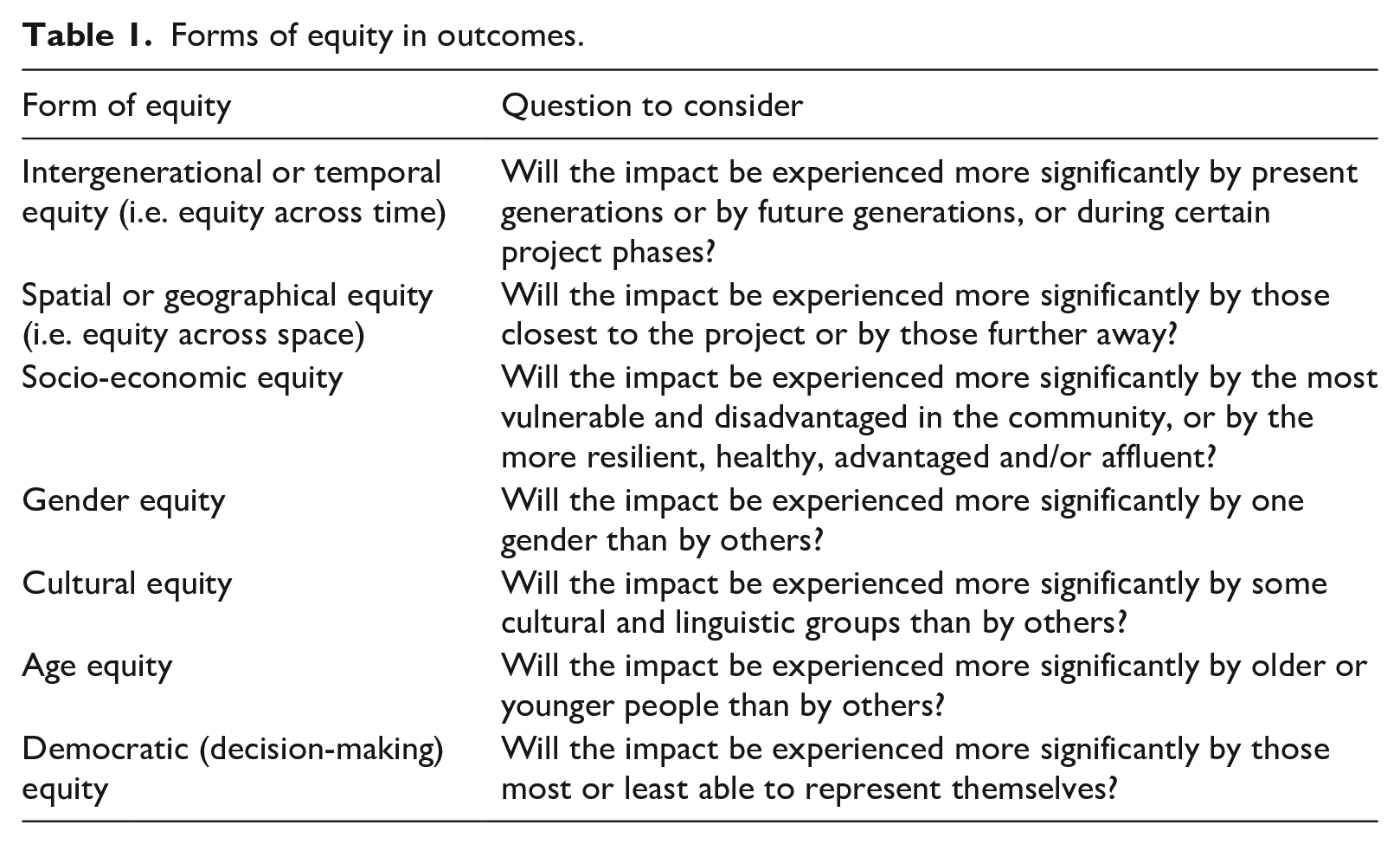
Equity of social outcomes concerns the distribution of a project’s impacts and benefits over space and time. Based on the discussion and cases above, and on the identified vulnerable groups, in Table 1 we summarise different forms of distributive equity in outcomes, and propose questions to test whether a project or other intervention might lead to (in)equitable social outcomes. We suggest that this supports SIA in two ways. First, it provides a simple framework for considering potential equity outcomes. Second, consistent with our normative framing, the methodological task of considering each of these forms of equity should lead directly to a commensurate response aimed at minimising inequities. The general objective might be understood as a fair or just distribution of the negative and positive impacts of a project.
Forms of equity in outcomes.
Concluding remarks
Historically, most work on equity views it through a justice or fairness lens, but rarely both. In an SIA context, we find both to be equally important in understanding equity. Furthermore, SIA, equity of process and equity of outcomes are equally fundamental for achieving equity overall. We propose that equitable processes are characterised by procedural/participative fairness and justice, including perceptions of such and with explicit attention to historically marginalised standpoints or epistemologies.
Meanwhile, equitable outcomes refer to distributive fairness and justice, also including perceptions of such. Attention is needed to multiple forms of equity, with particular focus on social vulnerability, marginalisation and disadvantage. This involves a sensitivity to power structures in society and critical scrutiny of dubious claims of project benefits and benign impacts.
Our analysis is limited by reference to case studies in one state. Further research might compare conceptualisations and practices of equity in different locations globally.
Footnotes
Funding
The authors received no financial support for the research, authorship, and/or publication of this article.
