



Abstract
With the rise of social media, forms of communication emerge that are increasingly defined by the use of images. From the perspective of biographical research and visual sociology, the article addresses the question in how far biographical work becomes visible while visual biographies are formed in digitalized visual communication. It proposes a way how these processes can be studied with interpretive biographical and visual methodologies. Based on empirical material from Austria, we show how biographical performances in social media differ, in form and content, from conventional verbal-narratives, and how they simultaneously relate to each other. We present a case study that shows in depth how images on Facebook and Instagram become biographically relevant and what kind of biographical work takes place there. The methodological procedure consists of an innovative triangulation that combines visual analyses, biographical-narrative interviews and media interviews. The aim of this article is to give insights into the biographical significance and biographical work of visual biographies in social media, and to propose by triangulation of different data analysis a way of exploring the intertwining of narrative and visual biographies.
Introduction
With the rise of social media, emerging forms of communication practices increasingly enable image-based new arenas of self-expression and self-presentation, which, in turn, become relevant for biographical construction processes. Starting from the sociological concept of biography, complemented by media studies on social media, in this article we raise the questions of how visual biographies emerge in social media, what kind of biographical work (Inowlocki and Lutz, 2000; Schütze, 2008) is connected to them and how this relates to narrated life stories.
Biographies have always been mediatized, which is reflected in the many forms of biographical expression, namely, narratives, diaries, letters, photo albums, videos, films. Until now, however, biographies have been researched primarily in the form of written and oral narratives and in sociology mostly by using narrative-biographical interviews (Kohler-Riessman, 2008; Schütze, 2008). With social media emerging as new arenas for biographical performance, visual practices of sense-making with mainly digital photos are becoming increasingly pertinent. This is particularly visible on Facebook and Instagram that support a chronological, temporal and thematic order, such as timelines, stories and self-curated photo albums or series of images.
Based on an ongoing research project, 1 we intend to show the extent to which biographical construction processes visually take place in social media as well as the specifics about emerging visual biographies in comparison to and in connection with narrated life stories, which is still largely unexplored. In order to grasp the interrelations of visual and narrated biographies, we apply an innovative triangulation of different methodologies of data collection and analysis as a complex reconstructive in-depth case analysis, based on the logic of theoretical sampling (Glaser and Strauss, 1967).
In this article, we first discuss the theoretical and conceptual frameworks related to biographical work in social media (part 2), give a short insight into the methodological approach (part 3), and subsequently show in a case study how images in social media can be biographically significant and how visual and narrative biographical constructions are related (part 4). Finally, in the conclusion, we summarize our findings and point out why it makes sense to include images especially from social media in biographical research (part 5).
Biographical work in social media
From a sociological perspective, biography is understood as a form of social order that has been established in modern societies since the 19th century (Breckner, 2015; Fischer-Rosenthal, 2000; Kohli, 2007; Rosenthal, 2004). Since normative institutional contexts like ‘family’, ‘nation’ or ‘class’ have been changing profoundly and did not fully determine biographical options any longer, people were organizing their experiences and patterns of orientation in biographical frameworks (Fischer-Rosenthal, 2000). Institutional life courses (Kohli, 2007) and the social form of biography evolved as a realm where sense-making, orientation, continuation and change in one’s own life could be related to generational, societal and historical time. Thus, biographies became an important dimension of social formation and a theoretical concept relating to experiences, practices and discourses in the temporal frame of a lifetime. Biographical processes of making sense are especially intense during periods of radical social change, when institutionalized ways of interpreting and orienting in social situations are questioned and new ones need to be built. Thus, the concept of biography allows us to consider societal processes of change and how they are dealt with biographically.
The processes in which individuals narratively deal with societal as well as personal challenges and changes conceptionally have been coined as biographical work. Biographical work in general means the effort that is undertaken in order to integrate different experiences and aspects of our life, especially if they are challenging or tense, disparate or even contradicting. Thus, biographical work becomes specifically intense in life crisis where orientations and action patterns have to be developed in complex life situations, or restored if they are shaken or even destroyed, or only altered in order to adjust to changing circumstances in different periods of life. In the words of Fritz Schütze, biographical work follows up the task of reconciling the expectations and urgencies of social differences and resulting otherness (the ‘reality principle’) on the one hand and the preconditions and the logic of production for constructing a unique personal self (the ‘creativity and self-empowerment principle’) on the other. The product will be a biographical identity that is both realistic and permanently striving for personal autonomy. For this it is important to learn to see oneself as a developing personal and social entity that matters. (Schütze, 2008: 26; see also Inowlocki and Lutz, 2000)
To date, the conceptualization of biography has been based primarily on linguistic patterns in which relations of experiences, actions and discourses are constituted while narrating one’s life that has taken shape in specific historical and social contexts (Breckner, 2015, 2017; Rosenthal and Fischer-Rosenthal, 2004; Schütze, 2008). This theoretical and methodological approach allows us to explore the time-specific relation between experience and narratives in the sense that experience is formed in a situation of acting under certain circumstances in certain contexts and is developing and changing over time in relation to other experiences while it is narratively formed in an overall biographical structuring with which we make sense of our life (Schütze, 2008). The analytical differentiation and connection between lived life and life story addresses this relation between past, present and future perspectives on our experiences and orientations while narrating our life history (Rosenthal and Fischer-Rosenthal, 2004).
It is only recently that sociological biography researchers have become aware that biographical work in the sense of meaning-making and orientation in one’s life-time also takes place visually, for example, through picture compilations like photo albums and boxes, files on a computer, through images we carry with us or that are placed prominently in our homes. Therefore, when exploring visual biographies, further approaches are required since their structuration is different from those constructed in narratives.
In order to investigate the specific relation between the ongoing life and its visual expression, concepts from image science (Boehm, 2007; Imdahl, 1994; Mitchell, 1994) and photo theory (Barthes, 1981; Hirsch, 1997) are specifically helpful. According to image science, pictorial meaning is not primarily constituted by the various representational references to external objects, events, texts, but by the inherent pictorial meaning that arises from both its compositional form and its use in specific contexts (Boehm, 2007; Imdahl, 1994; Rose, 2007). Pictures show something not linguistically by words and sentences but rather by relations of lines, forms, colours in a composition on a picture plane in a simultaneously and, at the same time, successively perceived presence. Even though images unfold multiple external references by mimetically depicting persons, objects and situations, they also create meaning beyond similarities to the existing material world, for example, by purely symbolic references, or as a trace like, for example, scars on the skin that are connected to a certain situation or event without depicting it. According to these views, images are thus not only media for representing a reality created independently of them, but are themselves creators of reality in the production of perspectives and pictorial references for action orientation and generally for developing an attitude towards the world (Merleau-Ponty, 1984). Ambiguity, ambivalence and contradictions can be expressed specifically well with images (see especially Imdahl, 1994), because all different aspects involved can be simultaneously part of the same picture without prioritizing or even ruling out one of them discursively.
Compared to painted and other kinds of images, photography takes on a special role because it can be all, mimetic, indexical and imaginative while it is embedded in multiple coded sign references (Barthes, 1998; Peirce, 1983: 64–67). As a material trace of a past, photos show something that we may not remember or remember in a different way. As a materiality fixed in a certain time, from a certain perspective, we believe in their indexicality. According to Roland Barthes, photos are, however, not a copy, but an ‘emanation of past reality’ (Barthes, 1981: 82) that confronts us with something inaccessible. Following him, photography carries the noema of ‘that-has-been’ (Barthes, 1981: 77), based on which we can state in a slight modification that in relation to ourselves photographs carry the noema of ‘how we have been’ (Breckner, 2017; see already Chalfen, 1987). This holds true, for example, for photos from our first years of life, which are barely accessible via memory. Photos of ourselves in different life periods can generate an image in our minds that might differ from the one we gain through our own or other people’s narrations. Thus, photos in general allow us to perceive different embodied selves also in relation to others (Davis, 1995; Müller, 2011). This not least applies to the construction of multi-generational family relations, where constellations of people, places and things can be perceived in embodied ways, even though they may not be remembered or may even be explicitly excluded from narrations (Hirsch and Spitzer, 2009; Pohn-Lauggas, 2016). In this way, and in our cultural contexts, photographs are an essential part of our biographical imagination, also created by the way we store, curate and trace our appearance and the changes and circumstances of our life, thus visually performing ourselves to others (Goffman, 1979). In that photos are a means of biographical work that is dealing with past experiences in a present while envisaging a future, trying to come across its different, diverging or even contradicting aspects in certain periods of life. Therefore, a specific relation between our life and its photographic images emerges (Breckner, 2010, 2017).
These concepts and findings mainly refer to analogue photography and do not yet consider the specifics of digital photography and biographical work in social media. But how is digital – compared to analogue – photography connected to lived life and biographical construction processes?
With the emergence of digital photography and particularly with the rise and spread of social media, the indexicality has changed and with it the possibilities of modification of photography, so that the material relation between a photo and a ‘real’ object, person or situation is no longer that evident. As a result, the scope for creativity in creating photographic images has become much greater. Countless editing and filtering functions in Photoshop, Instagram or Snapchat have appeared with which images of ourselves can be created far from our appearance in our offline everyday life. Also new image formats, such as the selfie (Frosh, 2015) and portrait photography as an identifying icon of a social media account came up (Astheimer et al., 2011: 15–59), which have given rise to new styles and aesthetics of visual self-presentation (Müller, 2018; Murray, 2008; Schreiber, 2017). However, these are still oriented towards normative expectations, now performed in specific media displays (Autenrieth and Neumann-Braun, 2011; Goffman, 1979; Müller, 2020; van Dijck, 2013). Furthermore, in everyday use of digital photographs, we still generally assume that the people, scenes, spaces and temporal contexts captured were in one way or another ‘present’ at the time the photograph was taken. These photos also show perspectives, views, ideas with which they are made, which go beyond the intention of the producer of the picture. Last not least, by the respective devices of the different platforms, snapshots are set into temporal, spatial, social and thematic relations with each other, which are comprehensible for others. Also transitional situations and ritual passages are addressed, sometimes combined with normative border crossings, which now partly take place in the semi-public sphere of the Internet (Astheimer, 2011; Breckner, 2021). Consequently, digital photographs in social media are still connected in many ways to the lives of those who take them, view them, share them, keep them, put them together and thus create meaning beyond the individual photo (Autenrieth, 2011; Gómez Cruz and Lehmuskallio, 2016; Jurgenson, 2019; Keightley and Pickering, 2014; Müller, 2020; Van House, 2011). Especially creating photo albums or other picture compilations is a way of curating and commenting on photos from different periods of life and ordering them such that life events and phases overlap and reference each other. Thus, social media open up new possibilities of self-expression and biographical work, which becomes visible especially on Facebook and Instagram where the creation of photo albums, timelines, ongoing feeds and ‘stories’ is supported and even asked for.
To explore different biographical constructions in different media contexts, we developed a research design that allows us to capture the complexity of visual biographies in social media.
A methodological approach for exploring visual biographies
Our research is focused on visual, verbal and written dimensions in biographically relevant processes of online and offline activities, and how they refer to each other. The whole methodology is based on principles of case reconstruction, developed mainly in interpretive sociology (Oevermann et al., 1987), grounded theory (Glaser and Strauss, 1967) and biographical research (Rosenthal and Fischer-Rosenthal, 2004; Schütze, 2008). Interpretive approaches are crucial for understanding biographical implications of visual communication in social media. They aim to reconstruct complex relations of online and offline practices and how they are related to biographical orientation and action patterns. The goal is to empirically identify theoretically interesting patterns of this intertwining and to generate and generalize concepts based on these findings (Glaser and Strauss, 1967).
With our research design we address three different age groups situated in different biographical periods, which we consider to be different media generations. 2 A case from the generation that experienced the advent of social media in their youth and now aged between 30 and 40 years is presented in this article.
In order to grasp various forms of biographical articulation, we use a multi-method approach. In our research procedures, the extensive collection of data is accompanied by a complex design for analysis. In an innovative combination of narrative and visual methodologies we collect social media data as well as analogue photos which are made available by our research participants, conduct narrative biographical interviews (Schütze, 2008) and additional interviews dedicated primarily to the images that become relevant in the biographies (analogue as well as digital). These are complemented with ethnographic field notes from the interviewers. The data analysis includes Image Cluster Analysis (Müller, 2020), Visual Segment Analysis (Breckner, 2010, 2021), and Biographical Case Reconstruction (Rosenthal, 2004). All cases are globally analysed, starting with image analyses, which is subsequently followed by analyses of the narratives. For the cases chosen for an in-depth-analysis, extensive analyses of their communication on Facebook and Instagram with a focus on images are undertaken and then compared with analyses of the related narrative biographical and media interviews as well as the participant observations (Breckner, 2021).
In the following we give an insight into a case study as to illustrate how the visual dimension of biographical construction connects to the narrative one.
Exemplary case study
Simon, born 1990, agreed end of December 2018 to participate in the VIS_BIO-project. We first looked at his Facebook and Instagram account with a rough analysis of his images in order to get an impression of his visual performance also independently of what he would tell about them. The interviews took place the same month on 3 different days and lasted about 6 hours in total.
Simon joined Facebook in 2009 and used Instagram mainly for 2 years from 2015 to 2017. His Facebook images 3 give the impression of a very multifaceted person: Simon presents himself dressed up, but also wearing casually sunglasses inside; he shows himself disguised, with and without make-up. He also refers to familiar conventions of presentation, for example, when he sends kissing hands into the camera or drapes rose petals around himself while lying in bed. Numerous portrait photos stand out, as they account for about half of all Facebook images. By contrast, he is almost only pictured in groups in the self-created album ‘pure self-presentation’, which suggests a party context. On Instagram, 4 also the many portrait photos stand out in numbers. In contrast to Facebook, situations seem to be made especially for the photo: while on Facebook, for example, a Christmas tinsel chain could still be interpreted as an accessory present in the situation, on Instagram it is deliberately used for the photo as such in an arranged form, wrapped around the legs. The images seem disorganized due to the diverse self-presentations and subjects – one does not recognize at first glance what this account is about, as no primary montage principle emerges and the further sequence of images is not conceivable. What does visual self-presentation mean to Simon and in what way does it play a role to be shown alone or with a group in the photo? The question remains, at first glance, open.
This first structural description allows us to get an overview and first analytic impression of the image compilations. The following reconstruction of Simon’s images in social media showed that even though their biographical references were not clear at first glance and the number of photos is compared to other accounts rather small, we can see that they are a significant part of the biographical construction of Simon. This shows specifically in the portrait photos, on which we focus in the presentation of the results of our analysis, 5 and in comparison to Simon’s narrated biography, which, by reconstructing the relevance systems (Schütz, 1982) of the interviewees, allows us to embed in a more complex way biographical themes already visible through the image analysis.
In Simon’s case, two conflicting biographical orientations remain side by side, without him prioritizing one or the other – he is living parallel existing biographical prospects. We will come back later to the question of how they are structured and related to each other. First, we want to show how biographical work becomes visible especially in and with his social media images and how what we coin as ‘biographical parallel montage’ expresses itself. The aim is, according to the methodological approach, to let the images speak first, independently of the biographical narration, in order to emphasize clearly why looking at images is relevant for biographical research.
The visual biography – handling different persona with ambiguity
The result of the image analysis shows that two biographical references emerge in Simon’s visual social media biography. On the one hand, his images are about dealing with his gender presentation and, on the other hand, with the presentation of his milieu affiliation. In Simon’s image compilation, ambiguity is an important means both to combine and separate his involvement in diverging social milieus in which he was socialized, on the one hand, and in one where a play on gender presentations that are not inherent in his milieu of origin is possible, on the other. Thus, his social media biography can be seen as an attempt to bridge diverging milieus while keeping distance between them, for example, by revealing diverse aspects of himself, which he allows to coexist visually, giving the impression that different personas emerge.
The gender play
Simon’s Facebook profile pictures focus on his face. While in initial posts he shows himself rather from an ‘ordinary side’ and stages a certain normality as a young man (Figure 1), in the course of posting he starts to play with the presentation of his gender identity. Already in the first Facebook years, Simon tries out more ‘feminine’ connoted forms of presentation by, for example, photographing his face from above (Figure 1).
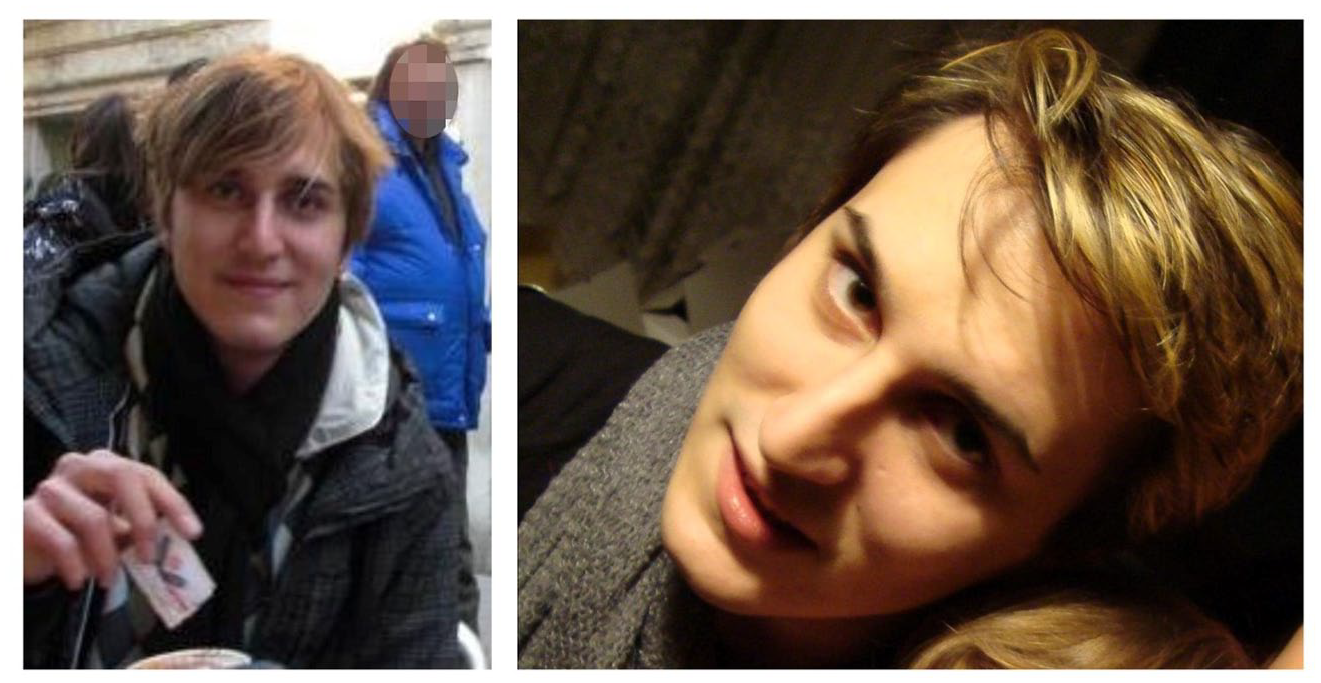
Facebook photos Simon, posted in 2009 and 2011 (use with consent).
Another photo from that time stands out as a more explicit self-presentation as a woman in this context, namely the one where he shows himself as a ‘glitter princess’ wearing a crown, which could still be seen as a playful disguise (Figure 2).
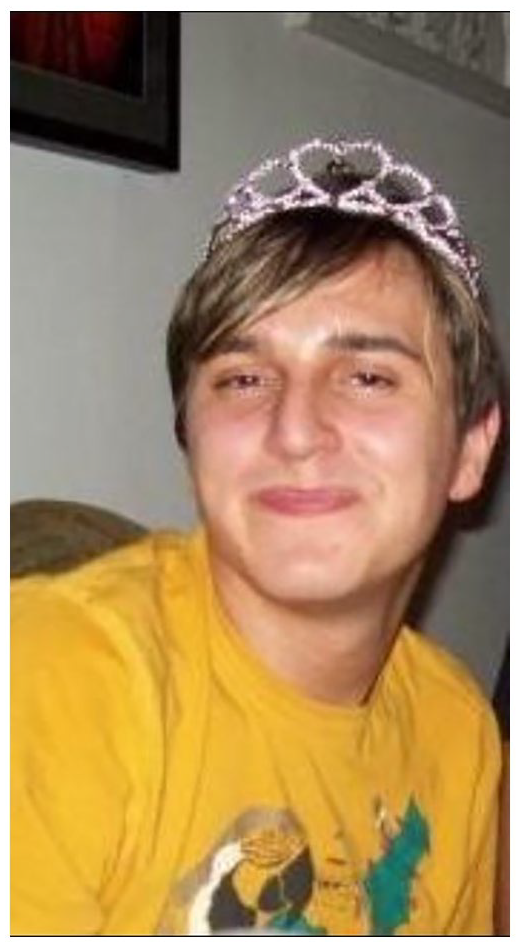
Facebook photo Simon, posted in 2009 (use with consent).
He also increasingly shows himself – even though he now has a beard – wearing black eyeliner (Figures 3 and 5).
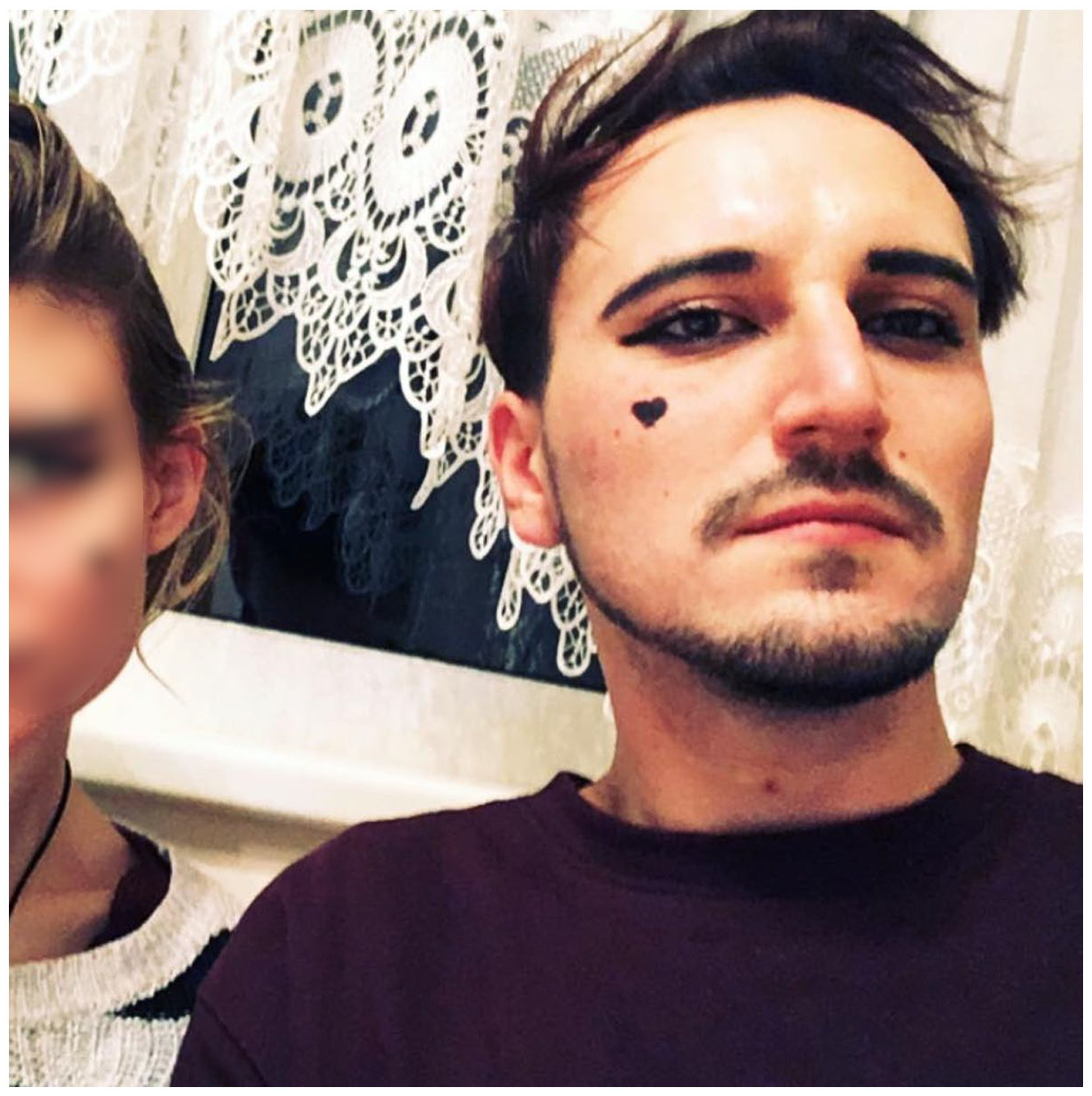
Facebook photo Simon, posted in 2017 (use with consent).
The aestheticization of one’s own body, especially of the face, suggests a homosexual background here, or at least these images trigger a specific, partly stereotypical idea with regard to the presentation of homosexual men. However, while in these profile pictures Simon, despite his increasingly ‘feminine’ appearance, can ‘still be a man’ or, in two-gender thinking, ‘still be both’, this balance tilts in the image in which the aestheticization reaches its climax and his play with gender identity simultaneously ends in a dream world. Now let us take a closer look at this particular image, on which Simon is lying on a bed, rose petals draped around him, his dreamy gaze lost in the void, looking at us without the gaze coming through (Figure 4).

Facebook and Instagram photos Simon, posted in 2016 (use with consent).
The image is reminiscent of a stereotypical feminine performance in the sense that Simon presents himself with flowers, in white sheets and shows softness, which can be seen, for example, through his hand gesture. In relation to his feminine gender presentation and sexual orientation, Simon evokes the impression of longing for an imaginative dream world and is situating himself within it, where he can now explicitly perform his feminine side. This biographical performance becomes visible with and through the image, but above all through his gradually approaching to this form of visual self-presentation, as the Facebook chronology of posting images shows.
Let us now take a look at the Instagram photos, especially since Simon also chose the rose picture as his Instagram profile picture. There is a recognizable structural continuation of the portrait theme and gender play on Instagram: While Simon’s Facebook images indicate a development towards the ‘feminine’, a few years later on Instagram an oscillation between the performance of a ‘glitter princess’ and a more heterosexual way of presenting himself becomes apparent. Accordingly, portrait photos can also be found on Instagram, which, on the one hand, show Simon with a hair band, flowers and makeup. There is also an aesthetic enhancement: the glitter crown on Facebook, for example, is replaced by a glitter necklace, which is now combined with further accessories (Figure 5). The chain can now no longer be seen as just an accessory or a possible disguise. Rather, it becomes recognizable in a certain way as a means of expression of a ‘feminine’ performance.
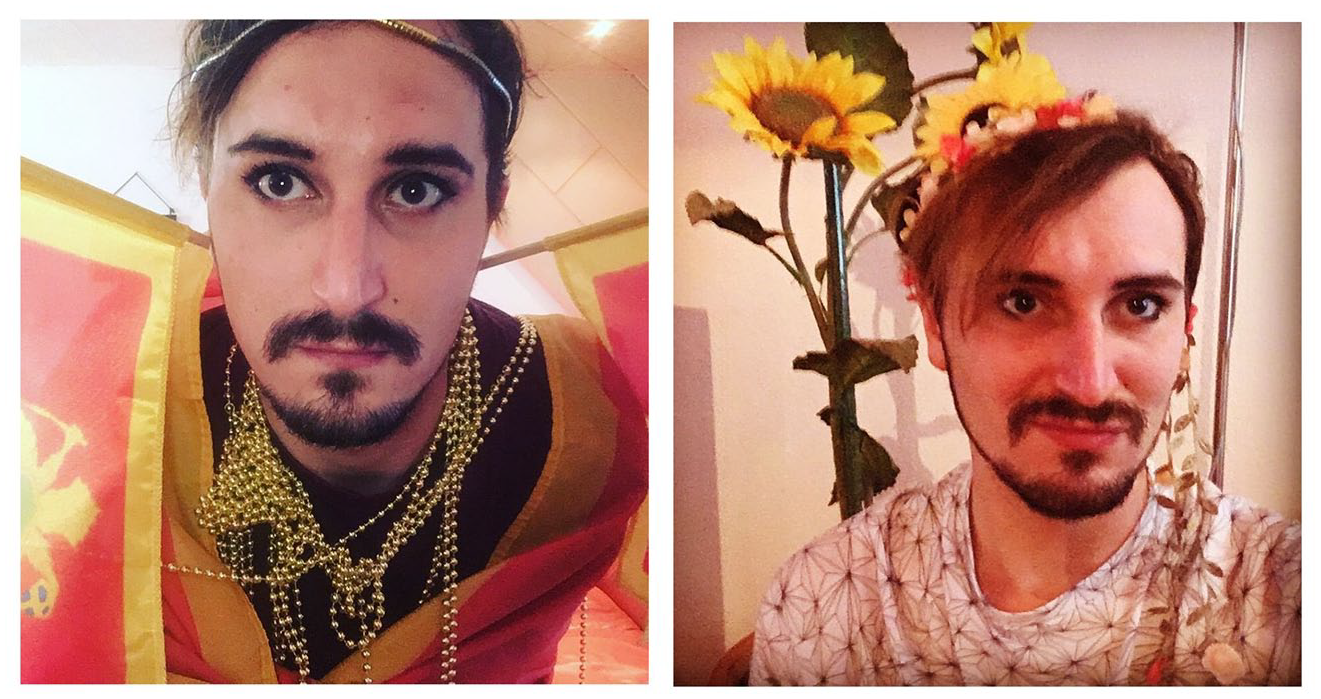
Instagram photos Simon, posted in 2017 (use with consent).
At the same time, Simon, on the other hand, refers to more ‘masculine’ visual presentations that now include full-body selfies in addition to portrait photos. He increasingly presents himself with masculine connoted symbols, for example, by posing broad-legged and with a long stick between his legs or as the mirror selfie shows in which he is wearing a black leather coat and sunglasses. The impression of a more ‘masculine’ performance is also evoked by Hercules poses newly added on Instagram, for example, when Simon gazes into the distance with his naked chest raised, like a Greek athlete (Figure 6).
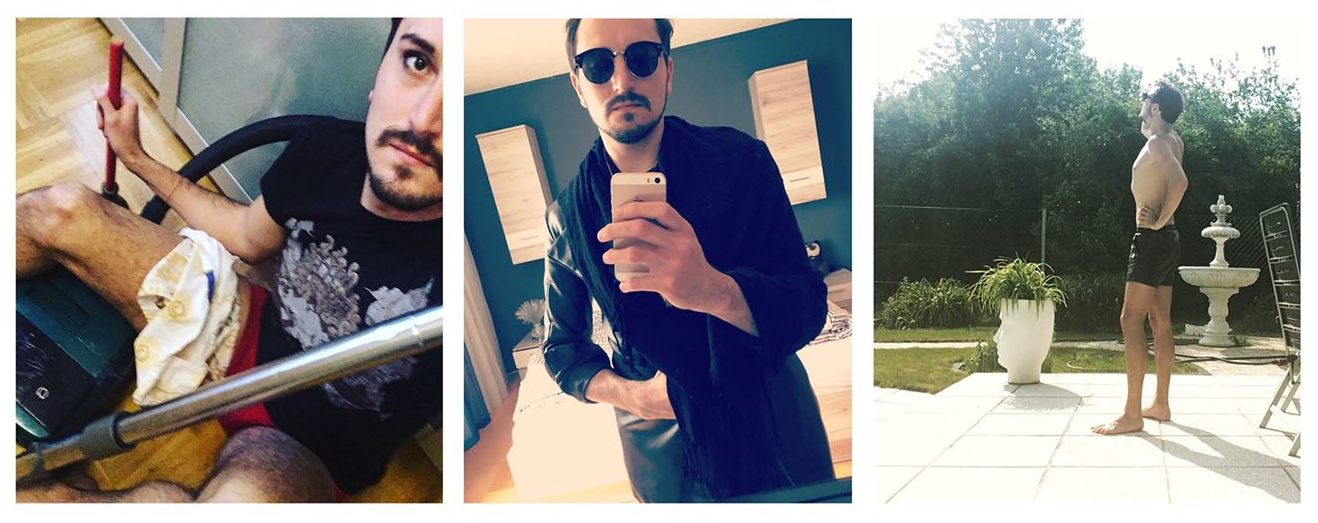
Facebook (on the left) and Instagram photos Simon, posted in 2017 (use with consent).
In comparison with these rather more masculine presentations, it becomes apparent that Simon not only plays with his feminine side, but also with his masculine side in a contrasting and oscillating way, and thus visually locates himself in different gender worlds: he shows himself not only as a, ‘cool man dressed in black with sunglasses’ but also as a ‘male thinker looking into the distance’ and, at the same time, as someone who sometimes likes to opt for a world with glitter and accessories and other forms of presentation that are stereotypically described as feminine. While Simon tries out different gender presentations in a rather implicit way on Facebook in his late teens, he increasingly uses social media as an arena where he can imagine the gender play and create a dream world in which, from young adulthood on, he allows various forms of gender presentation to coexist. The oscillation between diverse gender presentations visible especially in the portrait photos on Facebook as well as on Instagram, creates ambiguity that makes it difficult to classify Simon into existing gender orders.
Already when first looking at the images, the question arose which role group presentations play in Simon’s visual performance. Let us now take a closer look at the connection between gender and milieu that has become visible through the image analysis.
Gender positioning in the milieu of origin
In group presentations on Facebook and Instagram, the play with different gender performances doesn’t continue in its diversity and ambiguity. Rather, Simon usually presents himself in a heterosexual way as the ‘coveted cock of the walk’ among many women (Figure 7).
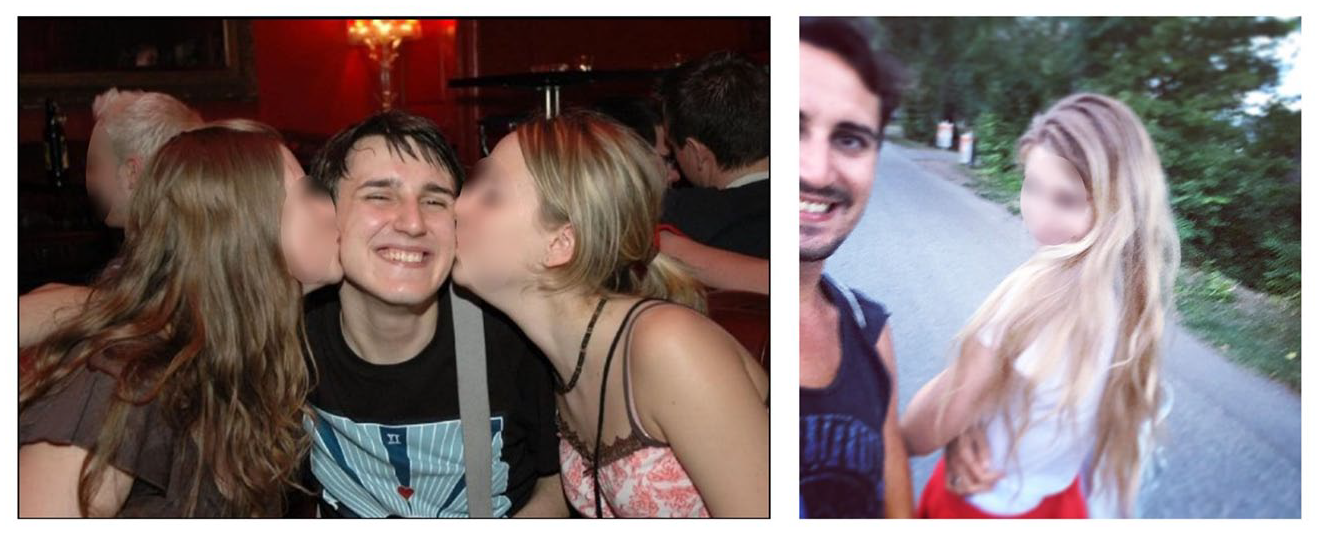
Facebook (on the right, posted in 2009) and Instagram (on the left, posted in 2017) photos Simon (use with consent).
It is striking that there is only one image showing a slightly intimate situation with another man. The intimate references to women succeed in presenting a masculine identity that doesn’t make Simon appear suspicious as a homosexual man in his milieu of origin. Rather, with these images he adapts to heterosexual social norms and, in the context of social gatherings, becomes a ‘subject of desire’ as a man who is kissed by two women, for example.
Three images in Simon’s Facebook and Instagram compilation can be interpreted as further milieu anchors, which at first glance stand out from the sample and can be interpreted as dealing with the construct of family (Figure 8).
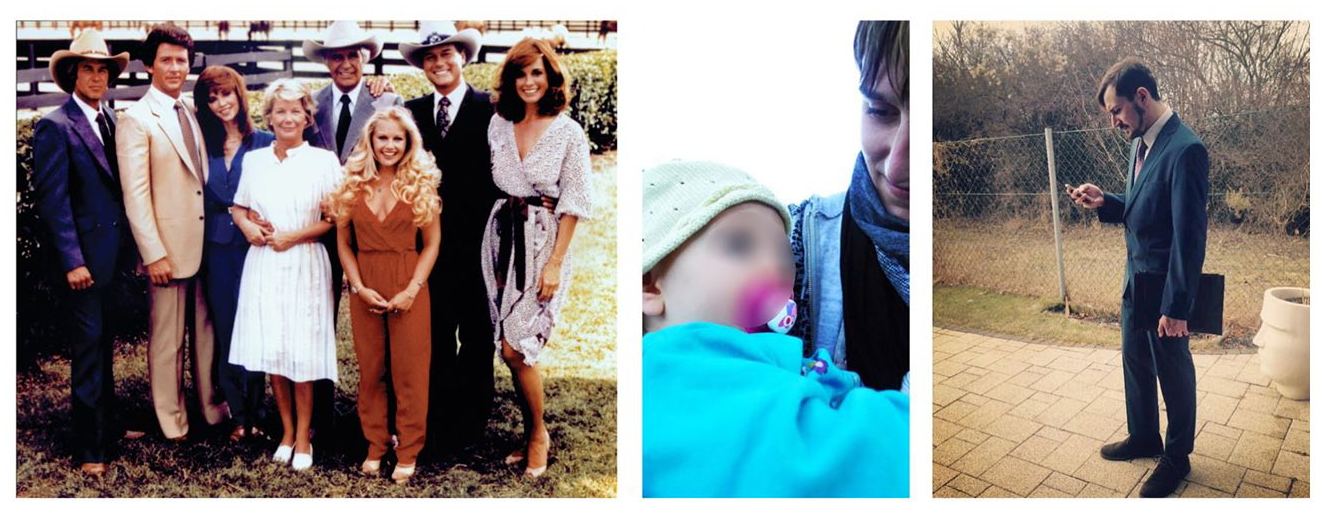
Facebook (posted in 2010, 2012) and Instagram (on the right, posted in 2017) photos Simon (use with consent).
One image on Facebook is a group photo reminiscent of a family reunion. However, Simon doesn’t locate himself in his own milieu with a photo of his own family, but with a fictional family from the TV series Dallas. 6 In Simon’s visual self-presentation, the media reference to the series family possibly enables a fictive family positioning that can also be seen, like the rose image, as an imaginative dream world, in which it becomes possible to position himself now in a traditional gender display. In the second image on Facebook, Simon is presenting himself as attached to caring for a baby, which is imaginatively connected to a family situation, too. Also, on the third image on Instagram he shows himself in a context, with which family is symbolically associated, namely as a ‘straight business accountant’ as breadwinner. With these last-mentioned images, it becomes clear that Simon visually negotiates traditional gender roles as a counterbalance to the more fluid gender boundaries that have become visible in the portrait photos, and that all these ambiguous visual performances constitute his persona repertoire.
So far, portrait photos have been the focus of the visual analysis. In this way, we wanted to show to what extent images are relevant for biographical articulations, as became visible in this case along gender presentation and milieu affiliation. The structure of the visual performance on Instagram and Facebook – namely, to show something and, at the same time, not to show it and thus to connect and imagine different worlds – is also continued in Simon’s other images on social media that at first glance seem to have nothing biographical about them. Using the following landscape image as an example, we finally would like to show the extent to which these images are nevertheless of biographical relevance (Figure 9).
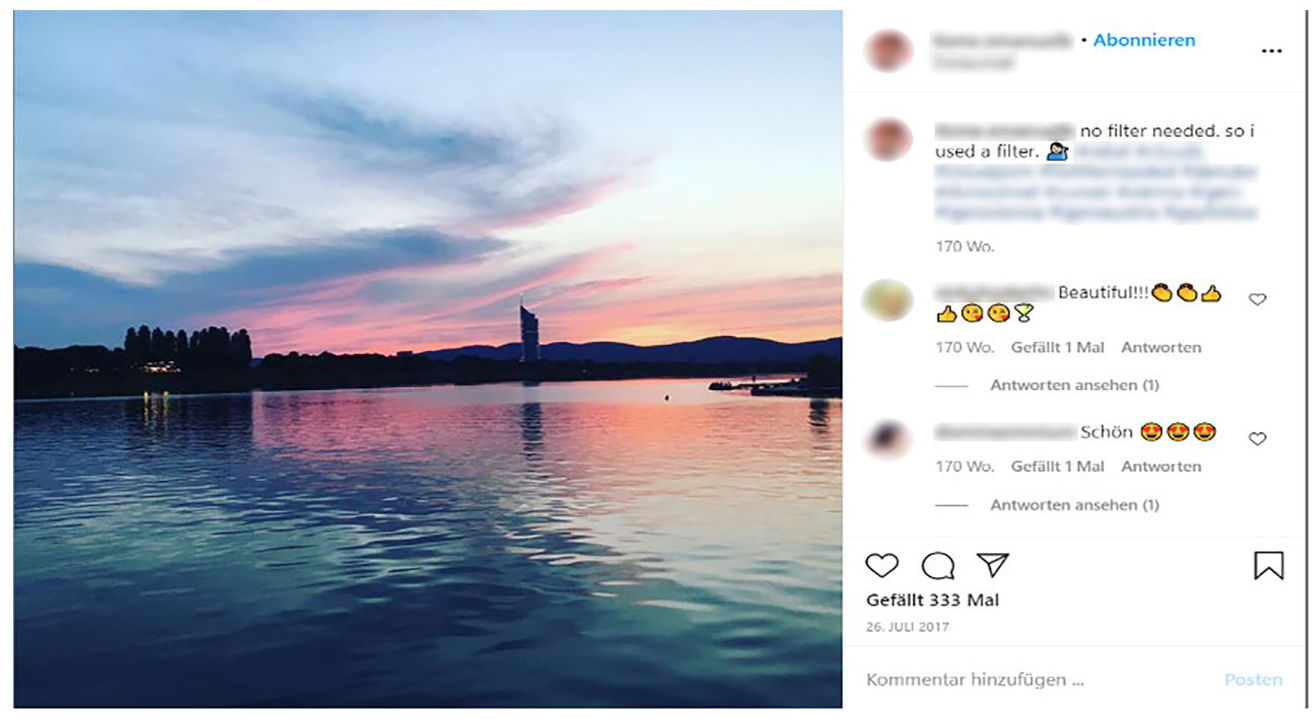
Instagram photos Simon, posted in 2017 (use with consent).
Under a photo showing water (Figure 9), Simon posts the information that the Danube is so beautiful that the picture does not need a filter. That in return would be the reason, as he further explains in the comment, why he uses a filter. He thus uses the potential of visual communication to ‘speak’ contradictorily according to the motto ‘It’s not what it looks like’. Through the play with captions and comments, which we call text-image montages (Mitchell, 1994), Simon also creates ambiguity resulting in continuous shifts in meaning. In other words, Simon is undermining any presumptions one might have about the images. As a consequence, different image interpretations and, in a further step, also self-presentations – as we have also seen along the gender and milieu theme – coexist in parallel.
In order to understand this finding of the visual analysis even more clearly as a biographical articulation, it is important to now turn to the narrated biography and to ask how it relates to the topics and experiences that the visual biography reveals.
The narrated biography – from heteronomy to (partial) autonomy
Living one’s own individuality without having to completely reject the world of the family of origin, but to ‘make them believe’ that he is still part of it, is the challenge that characterizes Simon’s biography. In his life story, this theme is reflected in his presentation of how he has partially succeeded in becoming autonomous by leaving an overprotected religious family environment and by emphasizing the feeling of otherness, especially with regard to his sexual orientation. In the structure of the life story this is shown by frequently pointing at the difference ‘me versus other children’ and ‘me versus the parents’ plan’ which both refer to his homosexuality. Especially his Coming Out is highlighted as an autonomous decision against his parents’ expectations. In contrast, education and profession are rather presented as those areas where he has succeeded in building a bridge between the expected and his own way of living. That this act of balancing different biographical orientations is not easy shows not least in the mostly argumentative pattern of Simon’s self-presentation in the interview (see Schütze, 2008). Why it is difficult for Simon to present a life story in which connections between events, experiences and orientations can be smoothly developed narratively, becomes understandable by following his life history.
Simon was born into a family in which there is a professional tradition concerning the men of the family who work in a gas and oil refinery company. His parents lived with the grandparents in a municipal building in Vienna and were looking forward to build a house for themselves and Simon’s future family. Thus, in order to develop and live his own biographical prospects, Simon is faced, on the one hand, with the difficulty of not fulfilling the parents’ plan, which entails job, house, wife, and children. On the other hand, he is confronted with the challenge of disengaging from a religious environment that imposes clear traditions, rules, conventions which result from the parents’ membership in Jehovah’s Witnesses which they joined when Simon was 3 years old in 1993. 7 At the Montessori primary school that he attended, half of his classmates were members of Jehovah’s Witnesses as well, including the class teacher, who is also a friend of the family. Therefore, a strong integration into this community is shown by the close spatial intergenerational contact as well as in social relations, which goes hand in hand with an entanglement of private space and institution.
The action schemes at hand in his family are in tension with situations in which Simon experienced himself as ‘different’, starting in secondary school where he was classified as an ‘integration child’ due to his asthma condition and where he was called gay for the first time by peers without being clear about his own sexual orientation. In this school, that had the special status of a ‘social hotspot school’, police operations often occurred. Simon responded to these experiences as an adolescent, not fearfully, or by backing away into the familiar family and religious environment, but by slowly detaching from his family and searching for autonomy. A detachment from his own faith community took place through a religious disaffiliation, which was not officially labelled as such. Simon thus risked being shunned by the religious social contacts, but also obtained a special position there, since he succeeded in leaving without being cast out. At the age of 17 years, he embarked on a relationship with a man and thus created the greatest possible distance from all the sexual and religious conventions that had previously affected him. Furthermore, he distanced himself from the family through educational ascent while staying in close contact: Simon took a different career path than men in his family when he was the first in his family to begin studying in 2009, but he also decided to stay in the community building and to join the family lunch at his grandparents’ every Sunday. In 2017, he completed his bachelor’s degree in economics and started a full-time job in a finance department, where he is responsible for accounting tasks – a job his parents were finally wishing for. In terms of his sexual orientation, Simon hardly makes any compromise. In his life- and work-related actions, in contrast, the acts of balancing different biographical orientations become very clear. He tries to lead an autonomous life by fulfilling some, but now self-selected, familial ideas in his own decisive way.
The visual and narrated biography seen as interrelated
With regard to the questions what kind of biographical work images can do and what becomes visible with and through the images compared to the narrated biography and vice versa, we can conclude the following: In this case, images on social media and the narrated biography are complementary to each other. The underlying biographical challenge – dealing with the gender presentation, on the one hand, and with the presentation of the milieu affiliation, on the other hand – is dealt with in both media, but the way in which this is done is different.
In the narrated biography, it becomes apparent that neither the life orientation anchored in the milieu of origin nor one that follows a completely different path is rejected or problematized, even if they are difficult to integrate. The biographer pursues his own path through his Coming Out and an educational ascent and rejects to move in with his parents or to actively live their religion, but at the same time approaches their proposed field of work and remains in the initial socio-economic living environment of the community building close to his grandparents. It is mainly through the narrated biography that the milieu background can be clearly understood, while it is hinted at in the images but remains vague.
However, the image analysis reveals, even before having analysed the narrated biography, the biographical work on the same biographical themes. Although the gender theme also characterizes the narrated biography, the play with different gender presentations only becomes visible in the visual performance. In the narrated biography the biographer rather positions himself very clearly through his Coming Out, but without elaborating more precisely on any ambivalences associated with regard to his self-performance. This can be explained by narrative theory as narratives take place retrospectively, which means that ambiguities are erased or have often already passed by the time of the interview. Images, on the contrast, are more tied to processes at the time they take place. The chronological posting of the portrait photos clearly shows the gender play in its development and also the moment when homosexuality could also be performed (see the rose profile picture, Figure 4). At the same time, however, we can observe that in the Instagram portrait photos the biographer opposes ‘feminine’ connoted presentations with ‘masculine’ ones which lead to the impression of different persona. The ambiguity that becomes apparent here is due to the fact that the biographer oscillates between various self-performances and therefore, becomes neither clearly assignable to a single gender presentation nor to the milieu – he plays with what is shown and what is not shown and thus suggests different interpretations. In this way, there is also place for group photos in which the biographer rather draws on heterosexual presentations that are compatible with his milieu and thus shows that he partly visually picks up biographical prospects from his milieu with regard to family and work.
In this way, Simon solves a biographical challenge by visually allowing two conflicting biographical prospects to coexist without betraying the one or the other, as we also see in the narrated biography. The images in social media, however, open up a visual space in which it is possible to try out various self-presentations over a certain period of time, to negotiate ambiguities and to imagine and perform various gender presentations with a different life.
Conclusion
In this article, we have discussed how images in social media serve as a means of visual self-performance and biographical work, and how the emerging visual biographies relate to narrated biographies. We have first addressed the theoretical concepts of biographical research with regard to the connection between the lived and narrated lives, in order to then explain how biographical articulations become visible through photographs. While visual biographies are highly selective in what they show, and in social media even remain largely ephemeral or relate to single life periods or spheres, a narrated biography is created retrospectively at once from a certain present perspective forming an overall biographical structuring (Schütze, 2008). Biographical work with images means not looking back from a present perspective like in a narrative, but letting see how the perspective on one’s own biography evolves in time – trying out different ways of self-presentations, specially ambivalent and even contradictory ones, thus pulling together what normatively seems to be set apart. Thus, visual biographies are documents of change and transformation at the time they take place.
We see this very clearly in the case analysis presented, where a visual biography in social media emerges that appears ambiguous, without allowing a clear affiliation to one single self-presentation – it is rather about living different persona. The structure of visual performance allows different self-presentations to coexist, thus connecting different worlds. Even images that are not recognizable at first glance as biographical articulations are embedded in biographical forms of self-presentation, as a structural homology concerning ambiguity becomes visible in that they problematize what one shows and doesn’t show.
This visual practice, as the image analysis focused on portraits has shown, relates to two biographical themes: on the one hand, it is about the negotiation of Simon’s gender presentation and, on the other, it is about the presentation of his milieu affiliation. This becomes visible through the methodological approach in both the visual and narrated biography, but the way in which it is dealt with differs even though the biographical articulations still remain complementary to each other.
While the narrated biography reveals important additional insight in terms of milieu affiliation, which has become less visible in the images, the play with fluid gender presentations only shows up in the visual self-performance in social media. And only through this, we can see the biographical work in relation to gender in its development and how the biographer through oscillating between co-existing gender performances creates and negotiates ambiguities. Furthermore, dream worlds can be seen as imaginations of oneself in contrast to recounting the ‘lived life’. In our case, images as well as references to popular culture like the Dallas series therefore can be seen as an attempt to open up a space of imagination that allows the biographer to build a bridge to his parents’ milieu while at the same time distancing himself from it.
In this way and in more general terms, we see the emergence of new phenomena such as creating iconic imaginations and phantasies about oneself (Müller, 2018) and at the same time documenting one’s life in the time it takes place. This applies, for example, to showing contexts of experiences and life situations that are no longer relevant at the time of the interview, thus literally making very different biographical contexts and periods and their respective modes of self-performance visible. But it also concerns the possibility of leaving biographical orientations that are difficult to reconcile to stand in a kind of parallel montage next to each other. And finally, as we see it in other cases, it concerns the possibility of creating a counter-horizon to stressful or even traumatic biographical experiences with ‘beautiful pictures’ of nature or animals, for example. In doing that, some kind of control over one’s biographical performance is tried to achieve in life situations that, due to present societal challenges of transformations, are not easy to manage especially building a biography in a perspective of a lifetime. Generally speaking, we see biographies in the making in a world of uncertainty and increasing options while normative constraints, for example, concerning the heterosexual gender order, milieu boundaries and other social structures are still in place. This has to be tackled also by imagining new or yet unfamiliar worlds – and the images in social media are a suitable tool to do so, which not least explains their popularity.
Footnotes
Acknowledgements
The authors would like to express their gratitude to Simon and all interviewees related to the VIS_BIO-project for sharing their images and life stories with them. They would also like to thank the anonymous reviewers for their very helpful comments.
Funding
The authors disclosed receipt of the following financial support for the research, authorship and/or publication of this article: The article is based on research funded by the Austrian Science Fund (FWF) (2020–2023; P 32957-G). The open access publication is funded by the University of Vienna.
