



Abstract
Spanish youth’s process of transition to adult life illustrates the complex effects of a prolonged economic crisis that emerged in 2008 and exacerbated an already precarious labour market. In this article, we approach this panorama of social change from the perspective of the young individuals who find themselves immersed in this passage from one crisis to another – from a global economic crisis to COVID-19 – and between two symbolic realities, one marked by individualism and the other by individualisation. Based on a discourse analysis of 20 in-depth interviews and three focus groups with young adults, conducted between 2018 and 2019 for a publicly funded RDI project, we analyse how the process of individualisation tied to a self-sufficient model of human agency may contribute to an increased reliance on individual solutions to social problems. Furthermore, we underline how these individualised pathways involve a dependency on multiple supports which are characterised by a series of tensions. Consequently, we seek to elucidate the manner in which vulnerable young workers navigate, both interpretively and practically, the trials of social life as well as the expectations associated with individualism/individualisation within a context of crisis and uncertainty.
Introduction
The transition for young people to adult life has always been a process of great interest for sociology. In recent decades, this passage has become longer, more complex and to a certain degree, incomplete (Côté and Allahar, 1996; Leccardi, 2005; Reiter, 2003; Santos Ortega, 2008; Shildrick and MacDonald, 2007). Young people are now making this journey to adulthood within a society characterised by individualisation (Bauman, 2001; Beck and Beck-Gernsheim, 2001; Genov, 2018; Zürn, 2019), deinstitutionalisation (Dubet and Martuccelli, 2000), uncertainty and risk (Beck, 2006; Giddens, 1990; Sennett, 1998; Wilkinson, 2009). However, these global transformations are, to a certain extent, partial and unfinished. They have produced overlapping social worlds and specific challenges to the pathways of young individuals. On one hand, a certain notion of individuality/agency continues to be present, one based on a model of self-sufficiency rooted in individualism, an independent person perhaps best exemplified by the myth of the self-made man. This outlook, which exalts individual sovereignty and the entrepreneurial self, is symbolically important for the social imaginary of young people (Kelly, 2006; Mørch et al., 2018). At the same time, this archetype is applied within an environment in which it is increasingly difficult to follow life trajectories hinging on this notion of individuality (Furlong and Cartmel, 2007). It is a scenario in which the individual is the protagonist but certainly not an independent or self-sufficient actor. What emerges is a growing need for material and symbolic supports, whether conscious or unconscious, an individual who is characterised by vulnerability and interdependence (Araujo, 2020; Martuccelli, 2007).
In this article, we examine how a generation of young people situated presently between two major crises (the 2008 economic crisis and the COVID-19 pandemic) perceive and employ these supports as they navigate this transition to adult life within a context of overlapping universes. In considering the discourses of these young Spaniards, our primary objective is to highlight the way in which they support themselves by relying on a variety of socio-existential buoys marked by ambivalence, tensions and contradictions. In addition, we seek to underscore the subjective and symbolic nature of these supports, a dimension which affords sociology with the opportunity to better understand the nature of human interdependent existence in a more individualised society.
Individualism and individualisation: tensions between coexisting universes
At the beginning of the 19th century, the expression ‘self-made man’ emerged in the United States as a reference to entrepreneurs who had achieved success without the help of others. This idea would grow in association with another concept, ‘individualism’ (Winkle, 2000: 6), where success was understood to depend on the individual’s decisions and self-work, a dynamic of self-help broadly understood, rather than on exogenous conditions (Smiles, 1859; Winkle, 2000: 16). In the 20th century, this legacy was incorporated into the individualistic philosophy proposed by Ayn Rand, a key figure in the rise of the neoliberal ideology of the 1970s. For Rand (1961), ‘the highest type of human being’ is precisely this ‘self-made man, the American industrialist’ (p. 111). Rand’s ‘Objectivism’ is rooted in a radical conception of individual agency, understanding it as a never-ending struggle in which human beings must win or demonstrate their individuality, a process that need not be determined by social reality (Rand, 1961: 160–161). This congruence between the myth of the self-made man and individualism served to protect and foster a type of individual in line with labour market institutions and a certain production model.
Although there have been changes to this model, the ideal of an independent and responsible individual continues to exhibit considerable symbolic weight and normative social influence (Blair-Loy and Williams, 2013). Nevertheless, it is no longer associated with the achievement of a democratic project or the consolidation of social and national progress. The demands of self-governance tied to this liberal ideal of the self-made man have shifted from the political sphere to a psychological one (Cabanas, 2019: 249). This change can be observed, for example, in self-help books, which project an autarkic model of individuality marked by self-development/self-production. The neoliberal narrative defends the validity of a sovereign and independent individual, one that is ‘self-contained’ (Shotter, 1993: 43) but with ‘a new global dimension’ (Paul, 2014: 405).
With the shift to second modernity at the end of the 20th century and the reorganisation of the relationship between the individual and society, it is no longer simply a case of individualism understood as an ideology or as the neoliberal ideal of the laissez-faire individual. Rather, individualisation, conceived as a broad social process, involves profound societal changes, a transition into an institutionalised form of individualism (Beck and Beck-Gernsheim, 2001). Within this new structural environment, individuals are no longer limited to traditional institutionalised established parameters. They have the possibility, but more importantly, the social imperative of choosing and developing their own pathways. In convergence with the myth of the self-made man, the individual’s life would be based primarily on personal plans not determined previously by institutions such as the family, the church or the school (Martuccelli, 2007). The individual must run its own life and is expected to shape its own destiny but ‘the possibilities of biographical slippage and collapse are ever present’ (Beck and Beck-Gernsheim, 2001: 234). With a reality that must be constantly produced and a context of transition and tensions between the recognisable or predictable and that which is uncertain, individuals are confronted directly with their vulnerability, their dependency on others and their exposure to the hazards of life.
What comes into focus is the overlapping of two symbolic frameworks: a prescriptive model of the sovereign individual and a social context in which individuals are characterised by their vulnerability. The result is a palpable tension between the normative and patriarchal notion of agency erected for decades upon the myth of an independent individual free from any sort of material and symbolic support (Martínez, 2019) and one that is increasingly characterised by an existence of interdependency. Therefore, in this individualised context, the individual does not fall into an individualistic independent atomic state, but, rather, depends on a series of relational ties, a growing number of supports which allow it to make its way through world (Martuccelli, 2007). And yet, these supports are experienced through a subjective and reflexive lens. They can change according to the spatio-temporal conditions, they can go unnoticed; but they confirm the interconnection between our agentic capacity and our relational or dialogical nature, that which links us to others, with things and other realities of a more ethereal and symbolic nature. But at the same time, we find ourselves within a scenario in which the myth of the self-made man continues to exert considerable influence. Despite the increasing uncertainty surrounding the labour market, specifically for youth, it continues to project normative models for individual agency, one in which their success and failure depends on themselves.
The tensions and contradictions of facing this fragmented transition from individualism to individualisation have become significant in the southern European context (Lavrič et al., 2018; Lobato et al., 2018; Serracant, 2015; Visanich, 2020), but in Spain, there are also particular characteristics related to the nature of its production model and its late incorporation into the global capitalist economy. The culture of meritocracy did not begin to establish itself in this country until the end of the century (Noya Miranda, 1999) with the creation of the university system in the 1970s, the growth of the new democratic state and the expansion of the service sector. This latter development gave rise to new generations whose social and economic status was no longer purely reproductive. This culture was strengthened with sustained economic growth and technological developments, despite phases of stagnation. The individualist culture and the myth of the self-made man began to take root in Spanish society based on this model of the entrepreneurial individual (Rodríguez López and Borges, 2018; Serrano Pascual and Fernández Rodríguez, 2018), in which individuals assume complete responsibility for their lives and take risks to achieve work success.
However, Spain’s entrance into second modernity was more condensed and abrupt. As a result, the labour market, which has historically been particularly difficult for young people, has become notably threatening in the last two decades (Artegui Alcaide, 2017). As we consider the plight of its young people, it is important to note that Spain has led Europe in the post-crisis period with the highest youth unemployment rate. In 2007, the year preceding the economic crisis, 1 the unemployment rate of young people aged 30–34 was at 7.38%. But between 2010 and 2011, this figure grew to 20% and peaked at 25.89% in 2013. The interviews were conducted in 2018 and 2019, just before the pandemic, with unemployment rates for this age group at 15.19% and 13.91%, respectively. For individuals ages 25–29, the numbers are even more dramatic. The unemployment figures were at 8.92% in 2007, rising to 21% in 2009 and topping off at 33.27% in 2013. In 2018 and 2019, they were 20.36% and 18.98% for these respective years. Another factor of equal significance is that of labour instability. Spain was the European Union country with the highest temporary employment rate at 26% in 2019, at 50% for those under 30 years of age. And according to the European Statistical Office (Eurostat), compared to the European average of 26.2, the average age for emancipation in Spain in 2019 was 29.5 years.
Within the space of barely one generation, young Spanish people have ceased from associating work with security and now understand it to be a source of risk and peril (Santamaría, 2011; Santos Ortega, 2008). Our research makes clear that young people live and operate with a permanent fear that their life plans and labour trajectory will end in failure (Fernández de Mosteyrín and Morán, 2017); while suffering from an internal and external existential pressure to aim for unachievable standards of agency and success rooted primarily in the individual.
Methodology
This article is based on qualitative data from a publicly funded research project, specifically the results of 20 interviews and three discussion groups conducted between 2018 and 2019 with young people aged 25–34 years. Its primary objective was to analyse new forms of socio-existential vulnerability and support in Spain, a society undergoing deep social changes tied to an economic crisis, the transformation of the Welfare State, deinstitutionalisation and individualisation (Martuccelli and Santiago, 2017; Ramos Torre, 2017). Based on the empirical evidence from this research project, we focus our attention on young adults from middle- and working-class backgrounds in Andalusia, Madrid and the Basque Country, not for comparative purposes but rather as a means of delving into this age group of Spaniards management of their vulnerability and their reliance on different supports. Vulnerability is intrinsic to the human condition, but there are also circumstances in life that can intensify this process, such as the social transformations we just identified. In this article, we focus primarily on this generation of Spaniards from the perspective of these young individuals facing a series of common struggles. There are a number of shared contextual factors, a general environment of uncertainty and labour precarity, following the economic crisis of 2008, which condition this age group’s ability to carry out their life plans (Furlong et al., 2011). Our objective is to better understand their means of navigating the social changes related to second modernity and the demands of individualisation at a time when their transition to adult life is prolonged indefinitely (Borràs Català et al., 2019).
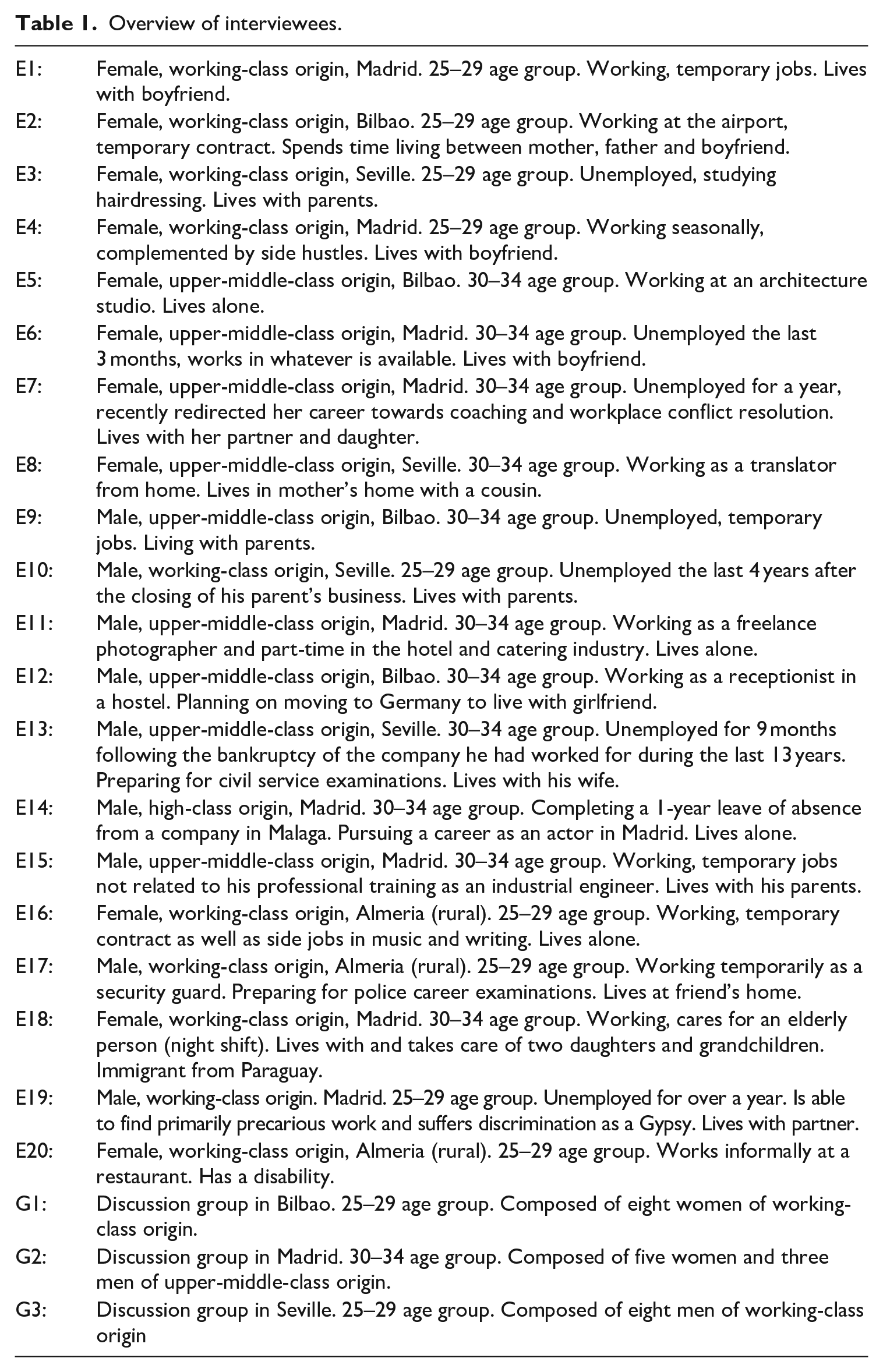
The use of a qualitative methodology is directly related to the manner in which we approach and explore these supports. We recognise that the material dimension of these supports, which would include quantitative and structural aspects such as access to a home or changes in the family, are essential for understanding the transformation experienced by youth transitioning to adulthood (Ballesteros Guerra et al., 2012). Nevertheless, this article looks to analyse how young individuals conceive and utilise these supports. In this respect, the in-depth interviews provide us with access to discourses characterised by a high level of self-reflection. This opens the door to the subjective and symbolic universe, how they interpret individually their situation of vulnerability and the ways in which they employ their supports. The discussion groups allow us to focus on the discursive formation within an intersubjective space, the interaction between young people who share, due to the contextual factors that we underlined, somewhat similar life experiences. For this reason, the team of researchers opted for this technique, which differs from the focus group in that it is more spontaneous, open, flexible and a less focused process in which the moderator plays a more passive role, allowing the group participants to interact freely. The goal was to permit, as much as possible, the emergence of a conversation not conditioned by the interviewers’ preconceptions. In the first part of the group discussions and interviews, participants were invited to share about their experiences and current situation related to issues such as employment, housing as well as their expectations concerning the future. The interviewees were then asked to discuss their means of confronting and dealing with these circumstances, which brought out their dependency on those resources which we have defined as supports. We carried out a classic discursive analysis, seeking the saturation of discursive themes in line with the objectives of the research project (Callejo, 2001; Ibáñez, 1979). The sociodemographic profiles of the participants are included in Table 1.
Overview of interviewees.
A (self)-supported individual
The coexistence of two ontologically opposed models or realities produces contradictory forms of understanding agency and perceiving human vulnerability. In contrast with a hyper-individualised agentic model that presents a self-sufficient individual, the sociology of the individual recognises the socio-existential dependence of each person and their need for supports, an element which can be understood as the cornerstone for the survival of any human being (Chalari, 2017; Martuccelli and Santiago, 2017; Martuccelli and Singly, 2012). It is through the relational nature of these supports where we can better understand the process of individuality. These material and symbolic resources, whether utilised consciously or unconsciously, constitute effective ways in which individuals support themselves in the world and constitute a manner of addressing the growing social imperatives which they are compelled to navigate. They may be characterised by a certain ambivalence, they can even be contradictory; but however fragile or unappreciated they may be, the individual cannot exist without these supports (Martuccelli, 2007).
Despite the support’s relational and social nature, the discourse utilised by some young people, particularly men, demonstrates a repeated shift towards an individual logic. Although the problems that give rise to this multidimensional situation of precarity (Tejerina, 2020) have a clearly collective dimension, their means of being confronted are individualised. In our study, young adults explain their experience of vulnerability in a manner that pivots between the individual and the collective. It may be attributed to bad luck, a poor decision or not working hard enough; or it may be understood as something of a more systemic nature.
He had a lot of . . . bad luck; he started in one job, they gave him a permanent contract, but the boss harassed him. (E1) If I’d studied languages, for example, if I’d learned Basque, well maybe I’d have had more chances of finding a job, or . . . or . . . if I’d worked in other places . . . I don’t know, you rethink your whole life completely . . . (E9) To hell with it, there isn’t any work and there aren’t any opportunities. (GD3)
And yet, with respect to solutions, the weight of the individual is much stronger than that of the group. Although in some cases there may be an external justification for precarity, what we find is that there tends to be an individualised search, a dependence on biographical solutions to systemic contradictions (Beck and Beck-Gernsheim, 2001). These solutions involve a normative conception of agency which is based primarily on the work of the individual: studying harder, relying on a process of self-awareness or self-knowledge, searching more and not giving up, or moving to a different location in order to carry out one’s plans (Fernández de Mosteyrín and Morán, 2017).
Now there are many people who have gone to Germany, and you think to yourself, I’ll start my plans somewhere else. (E15) I prefer . . . to set out on my own in whatever way possible and . . . to do it myself. I’m a resourceful type . . . you have to continue . . . no one gifts you a job . . . you have to know yourself and know what it is you have to do at any given time. (E13)
The meritocratic system, despite its failings, continues to operate as a basic reference point for young people. It serves as a means of explaining and justifying their completion of studies, their life plans and their continued job search (Farrugia, 2020). For this reason, the notion of personal merit habitually permeates their understanding of luck under a logic of winners and losers (Sandel, 2020). And obtaining good fortune is viewed as an individualised search, as the cornerstone of personal and professional success, but one that depends on one’s own frame of mind: You find your own luck, and your attitude is super important for that. (E14) Everything in life is based on attitude. If you have a strong, positive attitude, obviously positive things will happen to you, but then you must be patient. (E9)
Supports are particularly visible when these young individuals are confronted with managing a period of flux. And yet, in these situations, many individuals appear almost incapable of acknowledging their supports or they attempt to distance themselves from them. In many cases, they prefer to ignore their situation of dependence, a development related to the conception of agency rooted in the sovereignty of the individual that we underscored previously. Indeed, this symbolic framework can guide the individual’s course of action, a dynamic that is more acute among young men. Given that this notion of agency is tied to a certain form of gender demarcation, the acceptance of help from others can be conceived as a threat to one’s manhood.
I’ve never liked asking for money from family, in other words, I mean if it had been necessary, I know they would have supported me, but . . . I prefer that it not be necessary, to find a way on my own, relying on my own efforts, you know? . . . (E11) Your partner can always look after you and so on, but, but if you want to be looked after, to be looked after well, no one will look after you like you do yourself, the person who will think about you most is you. (E15)
Some may even recognise their need to be supported by others, but interpret this help as an isolated occurrence. The demand placed on individuals to be the creators of their own paths constitutes an ideal very much present among the young people interviewed for this study.
I’m going to try to get out of this by myself. (E4) I want to be self-sufficient and not depend on anyone. (E9) You have to know how to do it for yourself as well, not be dependent. (GD1) I’ve always liked to achieve things through my own means, not having to depend on anyone. (E1)
It is important to note that the relationship between individuals and their supports is changeable and ambiguous, it varies according to their socio-existential context. In addition, these supports are not absolutes, they are viewed subjectively: what for one individual may be a support, for another may be a stumbling block; and likewise, what has been a support for an individual at a certain moment may become an element that increases his or her vulnerability, a personal stressor, at another moment. The family is probably the most significant support in terms of expressing this ambivalence. It certainly has a specific weight in southern European societies (Esping-Andersen, 1993) and has been essential for understanding a number of situations and processes related to the economic crisis of 2008 (Serracant, 2015). Family-based cultures allow the family, even extended ones, to participate actively in the process of social representation, identification and reproduction of individuals, as well as serving as a material and symbolic support. However, the narrative of the family as an economic and existential support contrasts with another discourse which places a premium on the individual becoming independent of them.
No, let’s see, they try . . . I don’t, I, well, I don’t like it . . . I don’t like to talk about my problems . . . perhaps with my partner, perhaps with my partner yes, but with your family you’re not going to be telling them the negative stuff because I’m not one to complain, you know? I was . . . let’s see, initially I was very happy, you know? It was later over the years that . . . that I began to be frustrated, you know? and . . . well, my family, I didn’t tell them all that, I told them the good things, right? You want your family to see you happy, to see you well and so you tell them that . . . well, great, I’m in this project, look where I’ve been, you know? Things like that, you know? (. . .) my partner, absolutely . . . my partner, yes, I could rant against everything . . . everything happening and that could happen, you know? It’s like a bag of . . . yes, yes, it’s a bag to let off steam, you know? A buffer to let off steam, so with my partner, you know? Rather than with my family. (E11)
In this situation, the individual perceives his family as a stressor because showing his vulnerability is interpreted as a failure; asking for help could generate disappointment and culpability because of not meeting certain expectations. At the same time, this shift in the family from being a support to a stressor is a reflection of the process of contemporary individualisation, a development that is also present in southern European societies (Lavrič et al., 2018). With this dynamic, the individual’s social environment is increasingly narrow as a result of the emphasis on personal responsibility and the social expectations for each individual to cultivate his or her own life path. Within this symbolic framework, what emerges is an independent individual who is not tied to others, one who, in theory, has the power to achieve his goals through sheer force of will. Given the impossibility of following in the footsteps of this invulnerable individual, the person interviewed prefers to turn to his partner, to an area of intimacy that allows him to show himself without hiding his vulnerability, his frustration and his need of supports. However, the partner may also be a stressor, not so much because of unfulfilled expectations as because of the draining nature of sharing problems. In a hostile labour situation, this intimate support may sow seeds of unease.
Problems of all kinds, including family ones, bad vibes at home . . . my boyfriend is also being driven to death at work, he comes back very half-hearted . . . in the end it’s all full of shit. (GD1)
This ambivalence surrounding the supports and the frictions between the individual and the collective are also present in their relationships with friends. In these networks, young people may be more open because of their shared feeling of failure, of not responding to personal and social expectations. They represent spaces of intimacy and trust, in which we can ask for help; a well-known, controllable and predictable environment.
I often call . . . make video calls to my folks, sometimes I do that, and then I also have friends here, friends in Malaga who work here, in their own thing, nursing, advertising (. . . ) We call each other, look . . . when I feel, when I feel alone, well, I say: Look, guys, let’s meet for a drink, and OK, great. (E14)
Young adults can choose, to a certain degree, their groups of friends, and they become a central component of their social network and identity. This is sociologically relevant, as it again shows the tension between a universe of people subject to coexistence and the social imperative of being independent. From an individualised perspective, my friendship network is mine, it’s part of my individuality, it can be viewed as a kind of personal attribute. Although both family and friends are generally recognised as positive supports, they become stressors when they do not align with the social expectations of self-management, or question the individual’s autonomy in some way or another. Indeed, the comparison between one’s own life with the normative trajectories of key friends can produce negative feelings and make more explicit one’s own personal vulnerability.
The passage of time as well, lately even more so, and perhaps because of my age, I don’t know, seeing that . . . that I haven’t managed to make . . . to make a career for myself, or, I don’t know, you also see your colleagues, your friends, who, well, have done so; because in the end, even those who were progressing more or less at my pace, are also beginning to find stability, so it’s like, oh, I’m beginning to see myself as . . . that the years pass by and I still haven’t . . . managed, well, to make progress in something. (E12)
The symbolic and subjective articulations of the supports
Individual’s supports can be material or immaterial. However, all supports are, to a certain extent, symbolic in nature because it is the individual who endows them with meaning. Supports may go unnoticed, not be taken into account, and even become sources of tension, precisely because they are experienced subjectively. Within this individualised context of risk and vulnerability in which young people are required to become self-sufficient beings, the non-material supports utilised by individuals are particularly significant. One particularly interesting immaterial support that has emerged from our research is the notion of remaining active. Doing something, whatever it is, becomes a tremendously powerful support (Tejerina, 2020). Being active can help individuals avoid overthinking in a situation of vulnerability; it operates as a form of escapism (Stenseng et al., 2012). At the same time, it allows people to respond to this imperative of being autonomous and productive human beings.
I like to read, I like to go for walks, I like to go jogging; so yes, I do things, but I get into a routine in which I do things, but I don’t feel very productive, or rather, perhaps I’m not doing a course, or rather, I do it all for . . . more on my account, not . . . and I don’t feel that I’m making progress in something, that weighs me down, or rather, it’s like a feeling of unproductivity, of . . . of, well, not doing anything, or rather, it’s not literally doing nothing. (E12)
Being active or overly active may be seen as an immaterial and symbolic support that is not necessarily perceived in a strategic sense. The majority of those interviewed use job portals such as Job Today, CornerJob or InfoJobs. And this search is not limited to the unemployed, but also includes many young people who have jobs. It is an activity that allows one to be alert, a way of being prepared for a possible future situation of unemployment. It also serves as a support in the sense that it enables the individual to not give up the dream of finding something better, more stable or more fulfilling. It leaves open the possibility of finding a job in your line of work, to do what you love (Farrugia, 2020): Well, a normal day involves getting up, looking on Infojobs, looking for work, well, normally, I have breakfast, I look on Infojobs, I look for work. (E19) Well, I imagine that being in a job that is my thing would also make me feel . . . more . . . more useful, more important. (E15)
This first-person possessive pronoun (my thing) appears systematically in our fieldwork and demonstrates a resistance to giving up on one’s imagined life plans. In an individualised scenario, where the individual’s biography is not institutionally predefined, and is often non-linear, less stable and more unpredictable, the young person may support himself or herself by relying on this life project as a route map, one in which the person’s existence is understood as open-ended (Martuccelli, 2007). The individual experiences these imagined plans not as a mere desideratum, but as a reason for continuing to do things. The search for a job, although it may appear contradictory and be experienced as a stressor, is a vital immaterial support for some young people.
This is because thinking that I have studies and that at some time something must come from this (from ‘my thing’), whether as a result of competitive exams or luck, I don’t know, there’s a job offer that I’m looking for all the time in Job Today for an infant school, each time they say that haven’t read my CV and I go back again, to see if there’s any luck. (E4)
In this respect, lottery emerges as another immaterial symbolic support that allows young people to imagine a possible solution to the obstacles they face. It can also be used as a way of projecting oneself into the future, overcoming a dynamic of ‘presentism’ or ‘short-termism’ (Standing, 2011: 43). And it becomes a key emotional support that permits them to carve out their own work-life path.
My friend and I say the same thing, ‘Well, I already bought the EuroMillions yesterday’, I say if we win . . . I don’t want a yacht, or a private jet, please, I want the EuroMillions to live a normal life, you know? . . . you construct your life with money . . . I’m not losing hope . . . you have to wait for the EuroMillions on Saturdays, to see what happens. (GD1)
The significance of the affective sphere associated with the management of their vulnerability becomes apparent with the relevance of the psychological dimension in young people’s explanations. All those interviewed referred to problems that go beyond financial and labour matters. And although their origin is connected to these variables, they are expressed in socio-existential terms through a panoply of feelings, such as guilt, anxiety, anguish, suffering, disappointment, unease, panic, depression, feeling down, pressure, tension, rage, bitterness and demotivation. Most employ a psychotherapeutic discourse that demonstrates just how prevalent certain psychological formulas have become at the social level (Furedi, 2004; Illouz, 2010).
These types of explanations and descriptions highlight their personal struggle against a hostile reality. And the shift to an individualised institutional model with its own social prescriptions, specifically, the requirement of a kind of permanent performance, may lead the individual to a depressive emotional state (Ehrenberg, 2000). To a certain extent, these treatments involve a recognition of the individual’s weakness and inability to face life’s difficulties alone, underscoring the relational nature of the supports. The reparative procedures may take place through the individual’s growing awareness of the vulnerable self and of its limitations, of his or her need for supports. One may ask for help which involves leaving the isolated self in order to be reunited again with the self in/through others (Martuccelli, 2007). Psychological assistance, or rather the supports that are directly related to the psycho-social dimension (the vulnerability that is expressed in the ‘spirit’), may also be experienced through family, friends or activities such as sports or music.
It’s difficult and then, for example, I tend to do something we call ‘jogging therapy’ with a friend, as something of a joke; we go for a run in the afternoons and we both relax a little and . . . the fact is, it’s good for us . . . (E12)
However, this help can also be conceived as a process of reinforcement of individuality and the capacity for normative agency. This path is justified through the psychological answers proposed by professionals, ones that are rooted in the individual. They are based on a process of working on oneself, reflecting the social categories of the self-made man, who is autonomous and the creator of his own reality (Béjar, 2011).
It’s true that with the help of a psychologist you can bear it in another way . . . he knows how to channel you so that . . . it doesn’t hurt, it will hurt you just the same, but so that it hurts a little less, so you know how to handle your emotions, feelings, are able to control anxiety, etc. (E5)
Therefore, the capacity to cure or repair does not lie inherently in the support, in its characteristics or its materiality or immateriality, but rather in how it is experienced personally. The notion of individuality operates as an imperative when seeking psychological treatment, but this process of going beyond the individual (even if only temporarily) can be conceptualised as a support. In this sense, escapism is a support that is wide-spread among the young (Cohen and Taylor, 1992; Stenseng et al., 2012). Escaping implies placing the surrounding reality I cannot control or handle on hold, and leaving to one side this reflexive project (Giddens, 1991). It allows this situation of uncertainty to be suspended, if only temporarily. This escape may be sport, humour, videogames, watching TV, listening to music, going out or literally anything else, something that clouds everyday reality.
You escape . . . of course, by being entertained . . . well, it’s not the same thing, but it could perhaps be likened to the loss of someone . . . going out and all that means escaping the problem a bit, doesn’t it? Or the loss. (E13) I like to play sport, it’s what works best for me, better than . . . I’m someone who finds it difficult to get to sleep and I need to do sport, even if only an hour and a half . . . (E11)
Getting away from oneself and escaping this hostile and negative reality is a support, but it can also become pathological (Baumeister, 1991). When this occurs, it prevents the individual being able to return to and confront his or her reality, however adverse it may be. Alcohol or drugs are two obvious examples. Their use may be a support for the individual, a form of escape, which may even have the capacity to strengthen social ties when consumed with other people. However, they can also become pathological and lead individuals away from their support networks, even if only symbolically. In other words, these links may continue to be there; what disappears is the capacity to handle this getting away from oneself. The individual is hyper-individualised and the support becomes a chain, a type of subjection.
Consumption is another analytically fascinating example of support that is polysemous and subjective, having the capacity both to cure and to become pathological. In a capitalist society that includes a certain ‘spirit of consumerism’ (Boltanski and Chiapello, 2002: 441), being able to consume can be understood as an indicator of normality. It may be a privileged way by which the subject projects herself as an autonomous individual in an individualised society (Alonso and Fernández, 2013), but it may go beyond that. In the discussion group with young women in Bilbao, they talked of their financial difficulties, the impossibility of having a home, paying bills and so on. One of the young women mentioned a way of escaping this reality was ‘giving oneself a treat’ (GD1).
It’s difficult, because I want to, well, I want to go to the mountains with my dog, but hell, until I get to the mountains there’s the petrol . . . it’s everything, anything . . . As soon as I go out of the front door–and I go out of the front door a lot too, eh . . . You have to do something, don’t you? Because as you’re frustrated and stressed out you want to fight it with a treat, you want to pamper yourself. (GD1)
Treating oneself to something special is a very important support symbolically, as it’s not a case of needing to purchase something nor is it related to the product itself. Rather, the key is being able to buy, of being the projected individual that one wishes to be. It means fulfilling the demands of that normative individual, expressing this power to be oneself through consumerism. It directs us to an imagined world in which human beings control their present and future circumstances. The tensions experienced by young people when handling their individuality results in various and apparently contradictory articulations of the self. Not being able to buy, and above all not being able to give oneself a treat, puts the focus on the individual, but one who cannot meet these social demands for individuality. It therefore makes us hyper-visible to ourselves. Being aware of oneself, of one’s own reality, generates unease. And yet, being able to give oneself a treat, following in the footsteps of others, transforms the individual into a self that is not so concerned about/for himself or herself. It implies a certain type of agency and a sense of fulfilment. Consuming for the sake of consuming restores to these individuals their capacity for action. Moreover, it is a form of caring for one’s own individuality, of pampering oneself.
Conclusion
This generation of young people’s experiences and narratives are marked by a prolonged economic crisis and the impact of individualisation. They underscore the tensions that arise in response to the difficulties of facing the labour market, of pursuing life plans or managing their own vulnerability. All this takes place within a context conditioned by the imperatives of an individualistic model of agency and the myth of the self-made man. Nonetheless, in contrast to this model of a self-sufficient and independent person, what we find in the explanations offered by these young adults is an implicit or explicit recognition of their dependency on a growing diversity of supports, both material and immaterial in nature. These supports include a variety of possibilities such as family, friends, remaining active, different forms of escapism, consumption, psychological assistance or even something as capricious as the lottery. And these elements, which young adults lean on as they seek to navigate the uncertain waters of life, have the potential of becoming personal stressors. They may be fragile, subjective, symbolic and at times unnoticed, but they highlight a way in which individuals, as vulnerable beings, relate to the social sphere within an individualised society.
As we consider the effects of COVID-19 and the future of young people in Spain, the horizon is undoubtedly bleak. And yet, as we ponder this situation, we are also led to reconsider the relationship between the individual and society (Beck, 2006; Furlong and Cartmel, 2007; Santiago, 2016), and to rethink the manner in which we approach concepts such as agency (Gatti and Tejerina, 2016; Martínez, 2019; Rebughini, 2019). We have presented a sociology of the individual and its supports which has directed our attention to an alternative model of individuality. This interdependent individual is characterised by a capacity for resistance and the ability to support itself through this individualised scenario. Among the young people interviewed, despite the numerous difficulties, tensions, contradictions and failures, although the present is contingent and the future uncertain, we still find a desire to pursue life plans, not to give up and to continue trying. Perhaps we should begin by conceiving agency as a multifaceted concept, an idea which would include, at the very least, both the individual’s autonomy as well as the social dependence that exist through human ties and socio-existential supports. Ultimately, this reality is what enables young people, and everyone else, to live their own lives.
Footnotes
Acknowledgements
We would like to thank Jose Antonio Santiago, the PI of the research project ‘New Forms of Socio-existential Vulnerability, Supports and Care in Spain’ (VULSOCU), for his direction, suggestions and valuable insights. Furthermore, we are also grateful to all the young adults who participated in this study.
Funding
The authors disclosed receipt of the following financial support for the research, authorship and/or publication of this article: Research for this article was made possible by the publicly funded RDI project, “New forms of socio-existential vulnerability, supports and care in Spain” (VULSOCU) (CSO2016-76179-R) (AEI/FEDER, EU), under the State National Plan for Scientific and Technical Research and Innovation Aimed at Societal Challenges (2013-2016). Funding was provided by the Ministry of Economy, Industry and Competiveness and the European Regional Development Fund (ERDF).
