




Abstract
Sociology’s tendency to branch into applied scientific disciplines is regularly debated. This debate focuses either on the organisation of sociology in academic institutions or on how the content of sociologically informed interdisciplinary research diverges from disciplinary sociology. This article bridges these debates in a study of the sociology of food in Sweden. The aim is to analyse how Swedish food sociology reflects the tension between disciplinary sociology and interdisciplinary research. The data comprise the doctoral dissertations and post-PhD career paths of Swedish sociologists whose dissertations are about food. The article finds that these dissertations treat food either as an inherently social phenomenon or as a social lens (i.e. a social phenomenon viewed as instrumental for analysing something else). Second, it is found that sociologists whose dissertations treated food as an inherently social phenomenon were more likely to pursue careers in food sociology but also to hold affiliations outside of sociology departments. The article concludes that the academic locus of Swedish food sociology is organised outside sociology departments but that its approaches are not necessarily any less sociological. Thus, the analysis questions the basis for arguments that interdisciplinary research represents a threat to the critical and analytical core of sociology.
Introduction
Studies of the organisation of sociology in academia have shown that the discipline tends to penetrate into various applied sciences, such as criminology and business administration (Holmwood, 2011; Scott, 2020; cf. Dobbelaere, 2000). This tendency has, predictably, resulted in debates about the relation between interdisciplinary uses of sociology and sociology’s disciplinary core. For example, Holmwood (2010, 2011) argues that the rise of interdisciplinary and applied social studies has made sociology an ‘exporter’ of scholars and analytical tools, resulting in a loss of disciplinary identity and a demise of critical scholarship (see also Cooper, 2013; Gane, 2011). Others have argued that such worries are uncalled for and potentially denigrate the merits of specialised sociologies (Savage, 2010; Scott, 2020). Lyle (2017) takes the middle ground in this debate, arguing that the quality of sociological enquiry in interdisciplinary research depends on whether or not it engages with social issues.
The debates concern different matters: the former focuses on the general organisation of sociology in academic institutions, while the latter focuses on how the content of sociologically informed interdisciplinary research diverges from disciplinary sociology. Here, we set out to bridge these positions by exploring the sociology of food (henceforth: food sociology) in Sweden.
Food sociology – sociological analyses of the production, distribution, consumption and discarding of food in society (Murcott, 2019) – is a fitting case for two reasons. First, food is present throughout social life and lies at the very core of the social nature of our species (Jones, 2007). Sociology has indeed touched upon issues more or less related to food ever since its classics (Mennell et al., 1992b). However, an explicitly specialised sociological interest in food is a relatively new phenomenon compared to the long-lasting tradition of food research in ethnology and anthropology (Carolan, 2012; Neuman, 2019c; cf. Mennell et al., 1992a). While the literature remains dominated by the Anglophone world and Europe, it is now a global field of sociological research and often associated with the multidisciplinary field of food studies (Motta and Martín, 2021; Neuman, 2019b). In the UK, sociologists have clearly distinguished their studies of food from food studies’ supposed preoccupation with food as cultural expression (Boni, 2019; Warde, 2016). However, sociologists from other contexts instead point to synergies between food studies and sociology (Motta and Martín, 2021; Poulain, 2017). As for Nordic food sociology, it began to influence the field in the early 1990s (e.g. Fürst, 1991), in close relation to British sociology, and has since been primarily influenced by sociologists in Finland, Denmark and Norway.
Second, food sociology is characteristic of the aforementioned broader debate within sociology. Murcott, for example, employs food to think sociologically, and food sociology also has applied and interdisciplinary implications (2019: 12–15). In other words, it studies the specific social characteristics of food as well as using food in society as a lens through which to analyse other social phenomena (Boni, 2019). There is, therefore, a tension between food sociology as disciplinary sociology and as a component of interdisciplinary research.
This tension is reflected within Swedish academia. Sweden has numerous disciplinary sociology departments and what we henceforth call ‘food-specialised departments’ – that is, departments hosting interdisciplinary food research, which encompasses sociological approaches, in specialised areas such as culinary arts, dietetics and nutrition. Due to this institutional diversity, Swedish food sociology, despite being a small case, is particularly suitable for examining scholarly orientations towards both disciplinary sociology and interdisciplinary research. For this reason, the article’s aim is to analyse how Swedish food sociology reflects the tension between disciplinary sociology and interdisciplinary research. To this end, we have examined how career paths relate to the scholarly treatment of food among Swedish sociology PhDs whose dissertations focus on food.
Placing food in Swedish sociology and interdisciplinary research
In Sweden, sociology became an institutionalised discipline in 1947 as an outgrowth of practical philosophy. Early studies were primarily concerned with social psychology and research for large-scale social welfare programmes (Segerstedt, 1987), followed by an emancipatory and politically engaged sociology (e.g. a Marxist and/or feminist one) in the wake of 1968 (Larsson and Magdalenić, 2015: 44–52). In the 1980s, following the restructuring of the welfare state, the discipline fragmented into sub-disciplines and informed various applied interdisciplinary sciences and academic vocational programmes (Larsson and Magdalenić, 2015; see also Larsson [2008] on the disciplinary formation of Swedish sociology).
Domestic sciences and dietetics grew due to demands of the Swedish society of the early-to-mid-1900s – for example, to improve the nutritional status of school children – and the first academic department in domestic sciences was established in 1977 in Uppsala (Mattsson Sydner and Skinnars Josefsson, 2019). In the evolution of the Swedish welfare state, the fragmentation of sociology thus appears in parallel with the emergence of food-specialised departments. This development meant new career paths for sociology PhDs and new possible venues for sociological research. Therefore, it does not seem like a coincidence that Ann-Mari Sellerberg conducted the first in-depth sociological study of food in the 1970s (1976a, 1976b). Her research included studies on topics with significant relevance for an interdisciplinary audience, such as public nutrition (Sellerberg, 1976b). It is also worth noting that she would be rather alone in this venture among Swedish sociologists until the late 1980s. And even after this decade, the study of food continued to be rare among Swedish sociologist. However, in that same period, food-specialised departments would continue to increase in both number and size and develop research environments that include engagement with social issues and use of sociological theory.
Boundary work: Scientific demarcations and the organisation of academic sociology
We approach our study by analysing demarcations – how sociologists treat food and how those treatments imply a border between different analytical approaches to food. These demarcations produce boundary work – a term coined by Gieryn (1983) in his study of scientists’ demarcation of ‘science’ from ‘non-science’. While Gieryn focused on how scientists selected certain attributes as scientific or non-scientific, we focus on how Swedish sociologists make demarcations in their research approaches to food.
Over time, symbolic demarcations and boundary work may produce observable social effects on such things as the allocation of funding, the physical location of offices and departments, and scholarly orientations (Lamont and Molnár, 2002). Such effects concern what we refer to as the organisation of academic sociology. In other words, organisation is an ongoing process in which boundaries evolve from a process of selecting symbolic and intellectual attributes into one that affects concrete social (i.e. organisational) boundaries. It does the latter by influencing the conditions for social relationships, the hierarchies that regulate, monitor and sanction research practices, and access to shared resources (Ahrne and Brunsson, 2011). An example of such organisation is whether a sociologist is employed by a sociology department or food-specialised department, which affects the sociologist’s professional networks within and outside academia and access to research funding and application processes.
Method: Examining the academic organisation of Swedish food sociology
Our study builds on two kinds of data: (1) analytical approaches to food in Swedish doctoral dissertations defended at sociology departments and generic social science departments (at smaller universities without separate sociology departments); and (2) the career paths and research developments of the sociologists who authored these dissertations.
We consider the dissertation to be a culturally saturated document which not only supplies insights about research but also about the organisational culture of academia (Atkinson and Coffey, 2010). In contrast to other academic genres, the dissertation follows nationally specific conventions and is, in Sweden, governed by higher education legislation (SFS 1993:100, 2010). For the doctoral candidate to be eligible for a PhD, their doctoral dissertation must conform to these conventions and laws. Ideally, the dissertation thus demonstrates the individual candidate’s disciplinary skills and knowledge. We focused on three aspects of the dissertations:
1. Scope: whether and how food is the subject matter of the dissertation.
2. Data: how food was present in the analysed data.
3. Conclusion: whether and how the study supplied insights into food sociology.
Analysing the scholarly treatment of food across these three aspects, we focused on how the sociologists presented and discussed the analytical value of food for sociology and which particular food-related phenomena (meals, particular foodstuffs, etc.) their studies concerned.
Data collection
We began our data collection by systematically surveying publications. There is no definitive way of identifying every publication to come out of Swedish sociology departments, but it is possible to identify the majority of submitted doctoral dissertations. The database Avhandlingar.se lists 97,762 Swedish publications, 1682 of which are labelled as sociologi (sociology) (Avhandlingar.se, 2020). Out of these 1682, we reviewed the abstracts of all dissertations whose title or keywords indicated that they might concern the study of food (e.g. meals, agriculture, nutrition, housework) for potential inclusion. To lower the risk of missing any relevant dissertation, we also reviewed the 1697 hits for the keywords sociology or sociologi on DiVA Portal (DiVA Portal, 2020). We chose a conservative approach in this review process, limiting the sample to dissertations whose abstracts indicated a scope, data, or conclusions alluding to food or eating.
To identify the dissertations falling within the area of food sociology, we defined that category as follows: sociological studies whose subject matter included food, meals or eating. An advantage of this definition is that it encompasses all studies using data relevant for food sociology, including studies that are not labelled as such. The review procedure was conducted twice, in 2019 and 2020. Notably, dissertations published before the 1980s do not seem to have been systematically digitalised. To make up for this deficit, and to verify our selection, we consulted two inventories of food research in Swedish doctoral dissertations (Fjellström and Jönsson, 2014; Yngve, 2020).
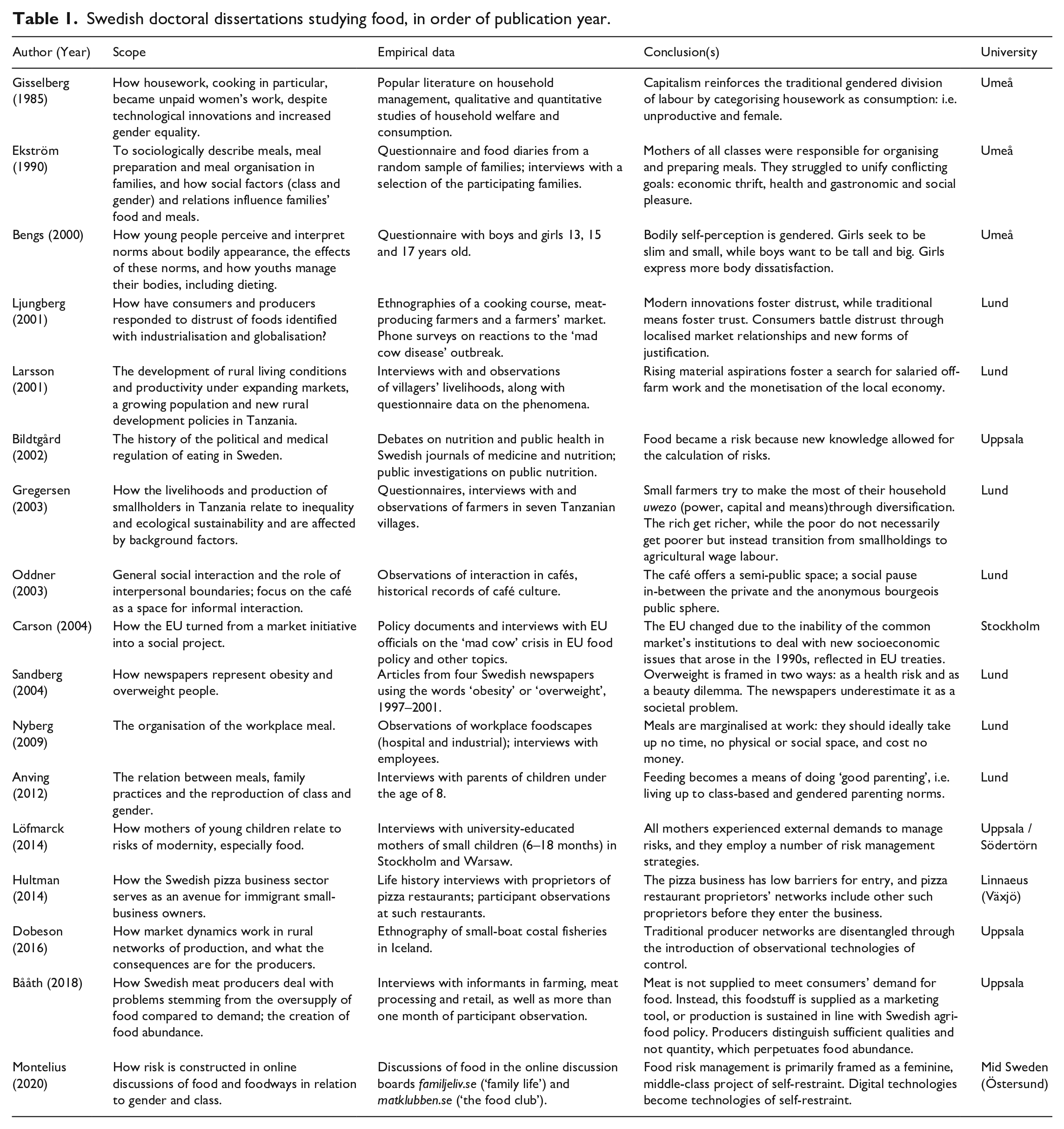
The whole process yielded 25 dissertations. By reviewing their scopes, data and conclusions we found that a further nine failed to meet our criteria, and they were thus excluded. These cases included dissertations using data on alcohol consumption without considering alcohol a food item per se and studies that concerned spaces where food might be important (e.g. restaurants) but did not highlight food in the dissertations’ scope, data or conclusions. Our analysis ultimately included 17 dissertations, published between 1985 and 2020 (Table 1).
Swedish doctoral dissertations studying food, in order of publication year.
We then studied the sociologists’ (i.e. dissertation authors’) career paths in two ways (Table 2). First, we identified their current or most recent academic affiliation after completing their PhDs. Second, we classified the sociologists according to whether they were currently doing food sociology according to their web pages and publications in DiVA Portal and Google Scholar. If a sociologist’s web page presented an ongoing project focused on food or if we found a publication about food in the 2017–2021 period (excluding publications based entirely on the PhD project), we scored this as yes and entered no otherwise. We also labelled one case, which did not clearly fall within either of the previous categories, as borderline. Moreover, we were unable to determine the career path of one sociologist, and two of them had no publications beyond their dissertations. The argument for the choice of time period is that the time allocated to pursuing a PhD in Sweden is four years. Thus, we found a five-year-period of non-engagement long enough to indicate absence from the field.
A brief summary of career paths in chronological order of obtained PhD. The summary is based on contemporary or (if retired or no longer within academia) most recent academic affiliation after the PhD defence and whether or not the contemporary research activity is classified as food sociology.
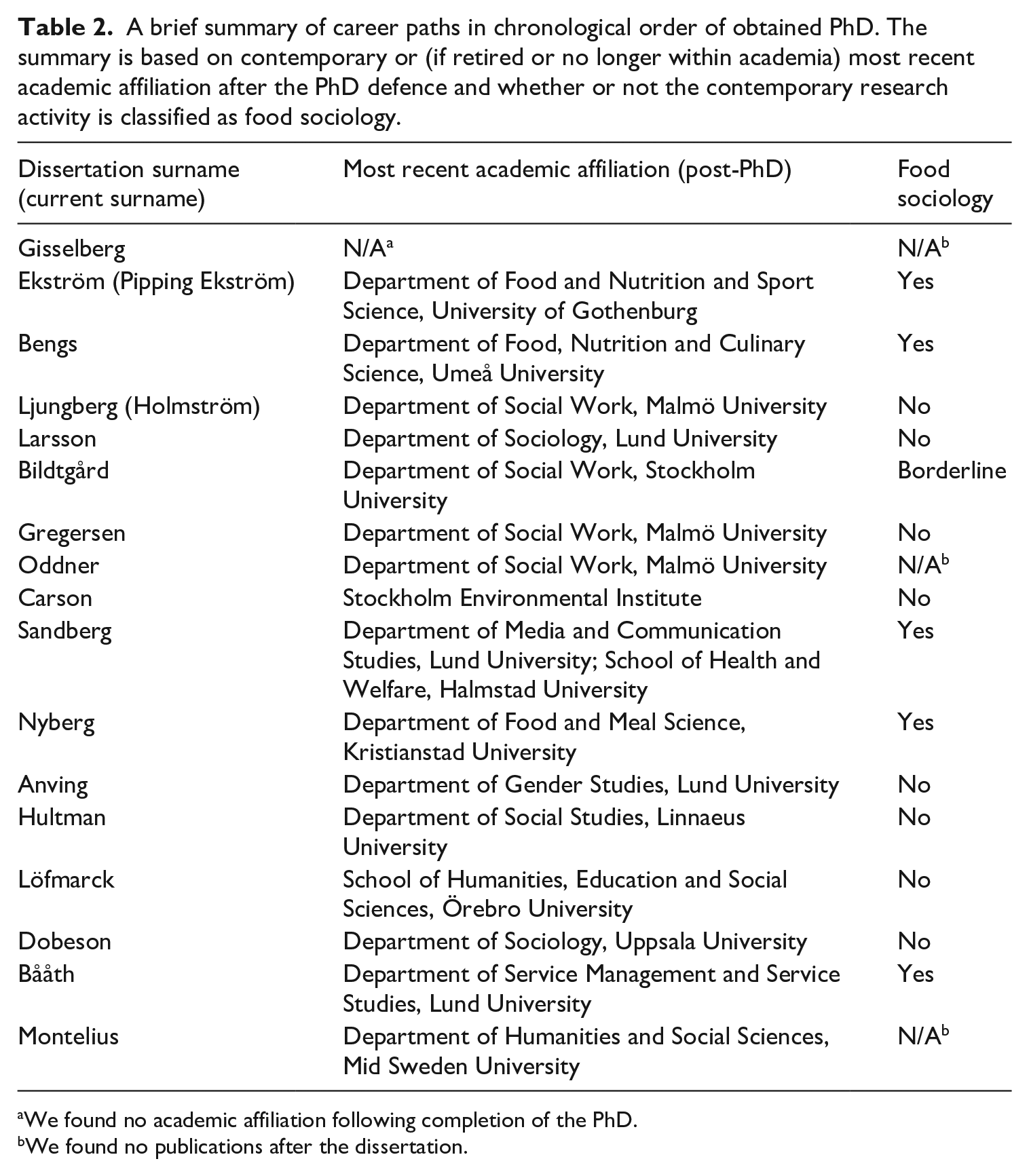
We found no academic affiliation following completion of the PhD.
We found no publications after the dissertation.
Together, these two sources of information tell us something about how academic affiliations, and thus the departmental organisation of sociologists, relate to research developments after the PhD. The method’s strength is its ability to map scholarly and organisational developments. However, this method indicates neither whether a career has been (un)successful nor whether a given affiliation caused (or is caused by) a given sociologist’s ongoing research.
Organising food sociology: Demarcations and academic career paths
Analysing Swedish food sociology dissertations, we identified two distinct approaches to food in the way that the sociologists made their demarcations: some treated food as an inherently social phenomenon, others as a social lens. Both approaches fall within food sociology, but they reveal distinct conceptions of the sociological significance of food. The first means approaching food as ‘not only a biological or nutritional phenomenon, but an inherently social one’ (Boni, 2019: 2). The second means approaching food as ‘a vantage point to analyse symbolic meanings and materiality; issues pertaining to [a variety of social phenomena], power relations and social processes at different scales’ (Boni, 2019: 2). Here, food and food-related phenomena are instrumental for the sociological analysis of other social phenomena, such as gender or markets.
Before we present our analysis of how these approaches relate to sociology dissertations and the sociological study of food, certain general patterns in Table 1 are worth mentioning. First, most of the dissertations were published by the sociology departments at Lund, Umeå and Uppsala universities. While there are some dissertations from other departments, they are few and far between in time, and some Swedish sociology departments are completely absent from the sample. Second, there is a slight uptick in dissertations in the early 2000s. This coincides with generally increasing publications of sociology dissertations at that time, although food sociology dissertations do not follow the general trend for Swedish sociology PhDs throughout the 2000s, which peaked around 2015/2016 (Figure 1, Supplement). Swedish food sociology also differs from US sociology, for example, which has seen a continued increase in PhD output since the early 2000s (ASA, 2016). These patterns having been noted, we now turn to the question: how did the sociologists demarcate food analytically, and how did their research and careers develop?
Demarcated approaches to food: Social lens or inherently social phenomenon?
The earliest dissertation classified by us as food sociology is Gisselberg’s, a study of why housework (food preparation included), which generally falls on women, had not benefited from technological advancements similar to those enjoyed by wage labour. Gisselberg concludes that capitalism reinforces traditional gender roles by categorising housework as non-productive (i.e. consumption) and, in effect, women’s identities as domestic. Gisselberg later came to influence Pipping Ekström’s (née Ekström) dissertation about how gender and class relate to the organisation of meals in families with children. Pipping Ekström concludes that food marks cultural distinctions pertaining to class and that women of all classes were responsible for meal preparation. She also argues that the gender system is based on ‘men’s open or hidden domination and women’s open or hidden subordination’ (1990: 216).
Gisselberg and Pipping Ekström both studied food and gender in the family but approach the relation of food analysis and sociology in different ways. Gisselberg’s focus is mainly housework under capitalism. While food preparation is a core part of housework, her study approaches food and meals as lenses for advancing the understanding of how capitalism affects women’s everyday lives. Thus, her dissertation is one of the 12 in our dataset that approach food as a social lens. This approach is especially evident in her conclusion, where the discussion focuses primarily on the relation between women’s economic power and their responsibility for housework (Gisselberg, 1985: 164–173).
In contrast, Pipping Ekström defines meals as inherently social in her scope, and her conclusion supplies a sociological explanation for how meals are organised: by women in all classes, struggling to cope with conflicting goals of meal provision (economic thrift, health and food preferences). For our purposes, it is also relevant to consider how Pipping Ekström defines her dissertation as a study of food as an inherently social phenomenon: ‘[T]o describe and analyse the organization of meals, the choice of food, methods used for food preparation in its social context and to analyse the impact of social relations on the process as a whole’ (1990: 207). Here, she frames food and meals as products of social processes, consistent with of the study’s initial statements, that food choice ‘does not take place in a social vacuum’ (Ekström, 1990: 14, translation ours). Including Pipping Ekström’s study, five dissertations have a scope that includes providing sociological explanations of food as a social phenomenon, which we categorise as research on food as an inherently social phenomenon. We discuss this approach to food in the following paragraphs, after which we discuss the social lens approach.
Bildtgård specifies the scope of his dissertation as ‘the medical and political regulation of Swedish eating’ (2002: 266). This framing suggests that he sees eating as at least partly organised by institutions and public policy, and that this organisation must be explained if we are to answer the question posed in his first sentence: ‘Why do we eat the way we do?’ (Bildtgård, 2002: 7, translation ours). Nyberg’s scope is the organisation of workplace meals, including their ‘time, place, and social relations, as well as the food itself, which are all important aspects for understanding the conditions of the meal’ (2009: 249). She thus demonstrates the sociological significance of food and defines the conditions surrounding the meal as her object of enquiry. Studying the Swedish meat industry, Bååth asks: ‘How do Swedish meat producers deal with producing an abundant foodstuff?’ (2018: 29). This question implies that the way actors deal with an abundant supply might be distinct in the case of food. These three examples differ in many respects, but they all conceptualise food as a social phenomenon, and this social phenomenon is at the centre of their respective scopes. The conceptualisation implies an ambition to explain the social processes or conditions underlying the social nature of food, such as eating practices or commodification.
While a study’s scope is indicative of a scholar’s ambition, its conclusions point to its scholarly contributions and to what questions it answers. The studies discussed here supply conclusions regarding food as a social phenomenon, for example that Swedish media promote certain foods and ways of eating as ‘cures’ for overweight and obesity to attain a certain valorised bodily aesthetics rather than improved health (Sandberg, 2004: 238–239). This particular conclusion highlights the fact that food has specific social dimensions in relation to health risks. The view of food as inherently social is even more pronounced in studies that find that food is socially contested. Nyberg shows that there is a tension between having a meal and just eating, where the latter entails reducing food to its nutritional content (2009: 238–248). Bååth shows how food abundance is perpetuated by obscuring the food qualities of meat and instead emphasising other uses and values (2018: 190–193). In addition to his empirical findings, Bildtgård criticises Mennell (1996), contending that hunger and appetite cannot be separated as natural and cultural phenomena (2002: 250–251). These examples suggest that the social character of food cannot be ignored without departing from a complete understanding of the phenomenon itself.
In sum, the five studies discussed above approach food as an inherently social phenomenon with a specific relation to human experience and organisation. In contrast, 12 dissertations (including Gisselberg’s) use food as a social lens. Consider first Dobeson. With the goal of explaining the revival of small-boat coastal fisheries on Iceland, Dobeson aims to ‘understand processes of economic- and cultural valorisation as changes in economic practices’ (2016: 20). This aim demands an analysis of ‘Northern Atlantic fisheries in the context of liberal rural capitalism’ (Dobeson, 2016: 20). Dobeson thus engages with the practices of fishermen and fisheries, but asks: ‘[T]o what extent has this research [the sociology of fishing] contributed to general sociological theory?’ (2016: 43). From this point onward, Dobeson’s dissertation understands fish and fishing not as food and food supply but as a lens for explaining how liberal rural capitalism has organised new markets.
In Holmström’s (née Ljungberg) study of trust in food and food commodities, the scope is motivated by insights about food in society. Yet, in her scope, she approaches food as a social lens, approaching markets for food as ‘situations where the relation between trust and distrust becomes particularly visible’ (2001: 22, translation ours). The study’s scope is thus primarily the sociology of trust. In his study of the Swedish pizza business, Hultman acknowledges that the restaurant industry is distinct from other industries, but in his scope he primarily treats this difference in terms of its comparably large number of immigrant business owners and workers (2013: 22) and not in terms of the food product involved. Finally, Anving’s scope is ‘the relation between the everyday meal, the doings of family and the reproduction of difference in Swedish family life’ (2012: 197). Although Anving’s study engages thoroughly with meal practices, her engagement serves as an instrument to explain the reproduction of gender and class in family life, treating the meal as instrumental for such reproduction and the analysis thereof.
Lack of findings and arguments regarding food in a study’s conclusion also points to the sociologists’ use of food as a social lens. Gregersen’s dissertation is a notable example. In its conclusion, this study of the social and productive dynamics of Tanzanian smallholders discusses productivity, market conditions, household composition, wealth distribution, and sustainability, but does not distinguish food from other agricultural products (Gregersen, 2003: 217–222). In Bengs’s study of how young people perceive and internalise bodily norms, eating is an important aspect, but the conclusions focus on gendered differences among these perceptions and internalisations (2000: 177–189). Less obviously, Anving’s study of the reproduction of gender differences in meal practices emphasises the importance of meals for social reproduction. However, this importance is not due to the social nature of food per se but to the heavily gendered and class-based practices of meals (Anving, 2012: 186). Furthermore, this study does include the most explicit designation of food as a social lens, stating that the meal is ‘a prism through which we can study different kinds of inequalities’ (Anving, 2012: 205).
To be sure, the approaches to food as an inherently social phenomenon or as a social lens suggest a continuum rather than two discrete categories, with most studies falling closer to one end than the other. In other words, demarcating these approaches in a manner suggesting a boundary work. We reject any implication that where a study falls along this continuum is indicative of its quality or relevance. The point we wish to make by describing the different approaches to food in Swedish food sociology is that these approaches form a systematic pattern. The existence of this pattern will be shown to possess further relevance in the following section, where we relate it to the career paths and research developments of the sociologists.
Career paths: Food sociology in Swedish academia
Relating the sociologists’ career paths to the previous findings reveals at least one very clear pattern: most sociologists are no longer engaged in food sociology (Table 2). But there are some further nuances that emerge when one compares the sociologists’ current institutional affiliations to their approaches to food.
All five sociologists whose dissertations treat food as an inherently social phenomenon hold affiliations outside sociology departments. Four of them have either continued to pursue careers in food-specialised departments (Pipping Ekström and Nyberg) or participated in research projects focused on food in other interdisciplinary environments (Sandberg and Bååth). Bildtgård is a borderline case to whom we will return.
Among the 12 sociologists whose dissertations used food as a social lens, only Bengs is affiliated with a food-specialised department: she currently holds Sweden’s only chair in kostsociologi (roughly, ‘sociology of food and nutrition’). Eight of the sociologists pursued other kinds of sociological research. Three are affiliated with sociology departments (Dobeson, Larsson and Hultman) and two with general social science departments (Löfmarck and Montelius); the other four work(ed) in interdisciplinary departments (Anving, Carson, Gregersen, Holmström). In two cases we were unable to identify any academic publications, projects, or affiliations (Gisselberg and Oddner).
The pattern outlined above yields two immediate impressions. First, sociologists who treat food as an inherently social phenomenon tend to have continued to study food and to be affiliated with food-specialised departments. Those who approach food as a social lens tend, with one exception, not to have continued in food sociology. Second, irrespective of approach, few of the sociologists were affiliated with sociology departments.
What, then, does a career in a food-specialised department look like? Pipping Ekström’s is both the first and perhaps the clearest example of a career path that leads through food-specialised departments. She has continued to study food after her dissertation, partly in collaboration with sociologists in other Nordic countries (Fürst, 1991; Holm and Gronow, 2019; Kjærnes, 2001). Her affiliations have primarily been to the Department of Food and Nutrition and Sport Science at Gothenburg University and to the School of Hospitality, Culinary Arts and Meal Science at Örebro University.
Bengs, who holds Sweden’s only chair with an explicitly food-sociological orientation, is the only scholar in the sample who is engaged in food sociology even though her dissertation treated food as a social lens. We marked her as ‘yes’, although her research output on food topics is limited to just one article (Sundqvist and Bengs, 2021), co-authored with her previous PhD candidate as a part of his dissertation (Sundqvist, 2020). Her engagement with food sociology might thus primarily be guided by an interest in what food tells us about other social phenomena, and the lion’s share of her publications do not concern food. However, it should be emphasised that her career shows that affiliation with a food-specialised department need not prevent sociologists from engaging with a variety of social issues.
Bildtgård is classified as a borderline case, for two reasons. First, he actually continued to study food as a postdoctoral researcher, exploring the meanings of ‘eating well’ in Sweden and France (Bildtgård, 2010). However, the focus of his research output since 2017 is on non-food topics. Second, even after he ceased doing research on food, he continued as co-coordinator of the Nordic Association for Food Studies until 2019 and has thus contributed to food sociology in other ways.
Having described the results, we will now compare Anving and Nyberg, who were both awarded their PhDs from the same department at around the same time, in order to illustrate how scholarly choices and career paths correlate. As mentioned previously, Nyberg puts food centre stage. Through her analysis of social interaction, we learn more about meals and meal actors as intrinsically social. In contrast, Anving considers the meal a lens with which to analyse gender and class within the family. This contrast also shows in that Nyberg has remained in food sociology, now an Associate Professor at the Department of Food and Meal Science at Kristianstad University. Anving, by contrast, has continued to study the sociology of family and gender, first at the Department of Sociology at Linnaeus University and currently at the Department of Gender Studies at Lund University. Nyberg has published extensively on interdisciplinary subjects involving food and meals, as well as on specific food sociology topics (e.g. Nyberg et al., 2018). While Anving’s research still highlights food empirically, due to its centrality for ‘doing family’ in everyday life (Eldén and Anving, 2019), both her research output and her academic affiliation mirror her aim of supplying sociological explanations for families and gender.
Discussion
Our study of how Swedish food sociology reflects the tension between disciplinary sociology and interdisciplinary research has three main findings. First, Swedish food sociology dissertations focus on food either as an inherently social phenomenon or as a social lens (a social phenomenon instrumental for the analysis of some other social phenomenon). Second, sociologists whose dissertations examine food as an inherently social phenomenon have either continued to pursue careers in food-specialised departments or have engaged in interdisciplinary research projects with a distinct focus on food (albeit outside sociology departments). Third, among those sociologists who treat food as a social lens in their dissertations, only one has proceeded to work in food sociology. While many of these sociologists are affiliated with interdisciplinary departments, four of them are, in fact, affiliated with sociology departments, compared to no sociology department affiliates among those who studied food as an inherently social phenomenon. The main pattern indicates the existence of demarcations and boundary work aimed at distinguishing two different approaches to food, and that the researcher’s choice of approach coincides with the kind of academic institution with which she is affiliated: food-specialised departments, not sociology departments, organise Swedish food sociology.
We have limited the scope of our study to doctoral dissertations and their authors, but it bears noting that there are few examples of Swedish sociologists who have studied food as senior researchers without having done so in their doctoral dissertations. Aside from a handful of publications (e.g. Gunnarsson and Elam, 2012; Leppänen, 2015; Linné and McCrow Young, 2017), the most notable exceptions are probably Djurfeldt and Lindberg, whose co-authored dissertation studied poverty in southern India (1975). Throughout their careers, both have studied development in the global south, focusing on medicinal and biological aspects of food while studying the societal conditions of and the remedies for poverty and famines (e.g. Djurfeldt et al., 2005).
Swedish food sociology is certainly a limited case. Yet, it is a case that clearly distinguishes itself in that careers and scholarly works are organised in both disciplinary sociology and food-specialised departments. We are therefore confident that our findings are not merely methodological artefacts of the limits of our dataset. We suggest it is an illustrative example of how academic sociology can be organised, reflecting the tension between disciplinary and interdisciplinary sociology. In terms of changes in the interest in food sociology over time, there is little to suggest that food is a more central part of disciplinary Swedish sociology today than, say, 20 years ago. On the contrary, the ‘peak’, according to our findings, was in the early 2000s. This deviates from the general pattern of sociology dissertations in recent years (Figure 1, Supplement). On the other hand, there are some indications of a growing role for sociology in food-specialised research (and teaching). The careers of Nyberg, Pipping Ekström and Bengs suggest that food-specialised departments foster commitments, not only to food-oriented issues, but also to social ones (cf. Lyle, 2017), and that interdisciplinary food research offers opportunities for careers in sociological research. Some further indications of sociology’s relevance to food-specialised research are the publication of the first introductory book on sociological perspectives on food in Swedish (Neuman, 2019a), the continued use of sociological theory in doctoral dissertations from food-specialised departments (e.g. Rendahl, 2018; Scander, 2019; Sundqvist, 2020), and the continued development of Swedish food studies in the direction of encouraging synergies between sociology and interdisciplinary research (Motta and Martín, 2021; Neuman, 2019b; Poulain, 2017) rather than the separation of sociology and food studies prevalent in the UK (Boni, 2019; Warde, 2016).
As mentioned earlier, some scholars argue that interdisciplinary and applied versions of sociology threaten (disciplinary) sociology (Gane, 2011; Holmwood, 2010, 2011) and that sociologists need to ensure the inclusion of conventional sociological perspectives in interdisciplinary studies, or would at least benefit from so doing (Lyle, 2017; Scott, 2020). Our findings contribute to this debate and show that there is an ‘export’ of sociology to interdisciplinary food research – at least in Sweden. However, our findings do not suggest that such exports necessarily pose a threat to disciplinary sociology. While such issues might very well arise in certain cases, these exports might just as well offer new and perhaps improved opportunities for sociological research on food.
As we have shown, sociologists employed in food-specialised departments have continued to study the social dimensions of food. This finding mirrors Lyle’s (2017) argument that sociologists in interdisciplinary projects can do sociological research by ensuring that such projects engage with a social issue. For future research, we firstly welcome researchers who share our interest to make use of our method, perhaps in a context that allows for larger sample sizes. In addition, we suggest that there should be studies of whether interdisciplinary projects (about food or something else) hamper or preclude the exercise of critical sociological knowledge, or whether, to the contrary, the presence of sociologists inspires further critical thinking throughout the interdisciplinary mixture of scholars. If the latter is the case, interdisciplinary research and environments may offer further opportunities for sociological scholarship. Given the absence of empirical evidence confirming or refuting either of these possibilities, what the virtues of sociology are, and what institutional arrangement within academia best fosters those virtues, remain empirical questions.
Supplemental Material
sj-docx-1-csi-10.1177_00113921211048520 – Supplemental material for Social lens or inherently social phenomenon? The study of food in Swedish sociology
Supplemental material, sj-docx-1-csi-10.1177_00113921211048520 for Social lens or inherently social phenomenon? The study of food in Swedish sociology by Jonas Bååth and Nicklas Neuman in Current Sociology
Footnotes
Acknowledgements
The authors want to thank Tobias Olofsson, Markus Lundström, Ylva Mattsson Sydner and two anonymous reviewers for helpful comments on previous versions of this article.
Declaration of conflicting interest
The authors declared no potential conflicts of interest with respect to the research, authorship, and/or publication of this article.
Funding
The authors received no financial support for the research, authorship, and/or publication of this article.

Data availability statement
The data that support the findings of this study are publicly available.
Supplemental material
Supplemental material for this article is available online.
Author biographies
References
Supplementary Material
Please find the following supplemental material available below.
For Open Access articles published under a Creative Commons License, all supplemental material carries the same license as the article it is associated with.
For non-Open Access articles published, all supplemental material carries a non-exclusive license, and permission requests for re-use of supplemental material or any part of supplemental material shall be sent directly to the copyright owner as specified in the copyright notice associated with the article.
