




Abstract
The conspiracy theory known as ‘Pizzagate’ gained a cult following on alt-right forums, ultimately prompting one believer to conduct a shooting on the pizzeria identified by online conspiracists. A thematic analysis of 767 tweets referencing Pizzagate selected from five key intervention points in this timeframe reveals several factors influencing Pizzagate’s continued appeal over a four-year period. The article examines how an online alt-right conspiracy collective, QAnon, weaponized Pizzagate as part of its overarching campaign to attract support for President Donald Trump and worked to establish the theory as a popular (albeit false) narrative within the contemporary political zeitgeist.
Introduction
More than any other in United States history, the four-year electoral period following the 2016 presidential election has been characterized by a general rejection of the concept of objective facts. This post-truth culture has been spearheaded by President Donald Trump, a political outsider who has nevertheless been able to secure political success on a platform of questioning the motivations and actions of both the political establishment and the permanent civil service. While the alt-right have propagated outlandish conspiracy theories targeting Trump’s (often liberal) opponents since long before the 2016 election, there was surge in the acceptance of conspiratorial narratives online in the later years of the Trump presidency. Of particular note is the emergence of prominent anti-liberal narratives like Pizzagate, a theory that emerged shortly before the 2016 election that suggested a cabal of Democratic Party leaders including Hillary Clinton and campaign manager John Podesta were involved in ritual Satanic abuse of children at a pizza parlour in Washington, DC. Beginning as just another fringe theory peddled on the internet by the alt-right, Pizzagate has proven particularly resistant to being debunked. A resurgence of interest in the Pizzagate theory in early 2020 breathed new life into the general acceptance of Pizzagate’s legitimacy, supported in part by the high-profile suicide of child sex trafficker Jeffrey Epstein and his links to the political establishment (Cosentino, 2020). Most interestingly, it is no longer only the alt-right or supporters of Donald Trump who propagate the Pizzagate myth. The conspiracist movement has grown beyond its niche origins, expanding into the discourse of the esoteric left as well as social media platforms popular with otherwise apolitical young people such as TikTok.
There is a real importance in understanding the reason that some fringe theories, like Pizzagate, acquire a level of social acceptance and uptake: if nothing else, the January 2021 riot at the United States Capitol – itself motivated by alt-right conspiracies – offers proof that broad belief in false narratives peddled on the internet can have serious, even fatal, repercussions in the offline world (Garrett, 2021). This article examines Twitter references to Pizzagate at several key ‘moments’ throughout the Trump presidency, using these intervention points to chart the growth (or, in some cases, recession) of Pizzagate over this period. In doing so, this research suggests a recuperation of the Pizzagate conspiracy in recent times, with proponents capitalizing on general anti-establishment sentiment to promote Pizzagate to an audience already primed to accept corruption within the American political elite. The results of the research indicate that, rather than dissipating as other conspiracies have, Pizzagate has continued to grow in popularity, moving increasingly out of websites popular with the alt-right such as 4chan (where the conspiracy was first observed) and 8chan (or its later incarnation, 8kun) and into the mainstream discourse of the digital world, where it has enjoyed far wider exposure than it would have if it had never moved from these forums and bled onto platforms like Twitter or TikTok (Q: Into the Storm, 2021). The data highlight the impact of Pizzagate’s crossover appeal, as its connection to prominent events (like the Epstein allegations) and popularity on TikTok reflected in an exponential growth in Twitter mentions that were (largely) open to accepting the theory as truth. This ‘mainstreaming’ of Pizzagate has broader societal implications: it highlights how conspiratorial theories fomented via social media can be weaponized for political means and play a crucial (often damaging) role in shaping political discourse (Zannettou et al., 2018).
Methods
There are a range of research techniques available for use when analysing communications via social media platforms like Twitter, with the utility of each dependent on what the investigation sets out to achieve. In this case, it was determined that a general thematic analysis would prove the most useful in developing a comparative perspective on how discussions around Pizzagate have evolved over time, and in conjunction with other relevant key terms. With this in mind, the analysis of Twitter posts using the ‘#Pizzagate’ tag was constructed in a manner designed to control both (a) timeframe and (b) key terms or concepts. For the first, a limited set of five events were selected from between 2016 and 2020 based on relevance to the Pizzagate theory. The events chosen include:
The 2016 election of Donald Trump as United States President (8 November 2016);
The attack by Edgar Maddison Welch on Comet Ping Pong pizzeria in Washington, DC (4 December 2016);
The date predicted by QAnon for Trump’s ‘coup’ to take place, when many of the corrupt elite would be arrested (5 December 2018);
The suicide of Jeffrey Epstein (10 August 2019) and;
The banning of #Pizzagate tag by social media platform TikTok to limit the spread of misinformation (24 June 2020).
To provide a more holistic (yet still reasonably limited) perspective on the use of the #Pizzagate tag on these specific days, search parameters were inclusive of one day before and one day after the above-mentioned dates. While restricting the evaluation of #Pizzagate posts to these dates does not provide a complete overarching picture of the tag’s usage over the four years between 2016 and 2020, these intervention points were chosen as significant junctures reflecting pivotal moments in the theory’s development. All posts using the #Pizzagate tag were manually evaluated and, after excluding posts that used the tag in a way divorced from the conspiracy theory (e.g. suspected bots), a total of 767 individual tweets were collated, evaluated and categorized. Following this initial selection process, a second-phase analysis took place examining the use of #Pizzagate tag in conjunction with specific key terms: three categories were established that examined the use of the #Pizzagate tag in conjunction with (a) ‘Trump’, (b) ‘#QAnon’ and (c) ‘Satan’ and/or ‘Satanic’ and/or ‘Devil’. These search terms were chosen based on the initial hypotheses of the researcher, reflecting the preexisting assumptions of concepts associated with Pizzagate in the online sphere over the chosen period. Though the thematic analysis conducted here was directed to some degree by these existing assumptions, the number of thematic variables was intentionally restricted to a small number in order to limit the potential impact of bias in the research design on the final results.
Limitations
Instead of using data-aggregation software, the thematic analysis conducted for this study was based on a manual assessment of the selected content, as outlined above (Braun and Clarke, 2006). As such, it is important to note the heightened potential for human error in the analytical phase of the research, with the researcher solely responsible for categorizing the data into thematic groups based on their own subjective interpretation of the material. As Nowell et al. (2017) note, the issue of preexisting assumptions is critical to designing an effective thematic analysis: on the one hand, evidence-based assumptions are necessary to identify relevant ‘themes’ in the first place and, on the other, ‘starting [analysis] with too many predefined codes may prevent the consideration of data that conflicts with previously made assumptions’ (2017: 8). Following Nowell et al.’s framework, the researcher has endeavored to enhance the reliability of the findings by limiting codes to a simple set of three correlates: Trump, QAnon and Satanic. The positive result is that the thematic analysis here is streamlined and not compromised by preexisting assumptions; however this method also creates a limitation in the sense that unanticipated patterns were not specifically searched for, and may have been missed during the analysis phase.
Another limitation was in the challenge of telling apart ‘real’ users on social media and automated ‘bot’ accounts, reposting content based on algorithmic formulae. The filtering out of these accounts was undertaken based on the subjective judgement of the researcher and, as such, there is potential that real users were inadvertently removed from the dataset erroneously. With this in mind, a high benchmark was set for decisions to exclude tweets from the sample: only after further examination of a Twitter user’s account showed telltale signs of being a bot (e.g. a string of numbers after the user name, an imbalanced follower/following ratio, no profile picture) was a qualitative judgement to exclude verified.
Literature review
Over recent political cycles, a growing sentiment has arisen in the public discourse that possession of knowledge itself is ‘elitist’. In their analysis of how misinformation spreads online Lewandowsky et al. cautioned that this was a potential outcome of the exponential growth in post-truth politics, which they described as the product of ‘alternative epistemologies that defy conventional standards of evidence’ (2017: 354). They attribute the evolution of these divergent knowledge frameworks to factors ranging from declining social capital, a lack of trust in scientific thought, and an increasingly polarized political landscape. The acceptance of non-factual news (as distinct from the term fake news, ubiquitously used by President Trump and others to describe news that may be factual, but does not suit their political agenda) is tied to a distrust of the mainstream, typically left-wing liberal, media – a premise which underpins much of Trump’s rhetoric on the subject. For this reason, a contradiction emerges wherein those who believe most strongly in the media’s propagation of non-factual news are, in fact, most susceptible to consuming it by seeking out alternative news sources on platforms like Twitter. While these mainstream platforms have increasingly committed to no-platforming the accounts of overt far-right extremists, as Donovan et al. (2019) note, social media companies continue to contend with how to police community standards and still avoid accusations of political censorship. Conspiracy theories like Pizzagate that have underlying political motivations have proven to be a useful way for groups like the alt-right to propagate their agenda in a way that is ‘under the radar’ – as Berger (2018) contends, utilizing the medium purposefully to support the alt-right’s interests.
In many cases, the alt-right (or, ‘alternative right’) act as both originator and target of misinformation disseminated over social media platforms like Twitter. Hermansson et al. (2020) define the alt-right in an oppositional sense as ‘an international set of groups . . . whose core belief is that “white identity” is under attack from pro-multicultural and liberal elites and so-called “social justice warriors”’ (p. 1). It is unlike other political movements in that there is (generally) no top-down leadership: as George Hawley describes, the alt-right is ‘atomized, amorphous, predominantly online, and mostly anonymous’ (2017: 3). While there is an undeniable racist tenor to alt-right rhetoric, on- and offline, the crossover appeal of the alt-right has been possible through what Carolyn Gallaher refers to as ‘mainstreaming . . . [which] occurs when movements on the political margins try to expand their influence by making their views palatable to a wider audience’ (2021: 224). The alt-right has achieved, to some extent, this ‘mainstreaming’ via a cultural process where taboo ideas are normalized and expressed through use of coded language which, though seemingly innocuous, has sub-textual meaning to initiated members (Zannettou et al., 2018). Fringe far-right rhetoric being accepted by mainstream audiences is far from a ‘new’ concept – indeed, there is a long history of pseudoscientific eugenics being used to justify (and ‘sell’) racist political positions, both in the United States and elsewhere. Nevertheless, Pizzagate is instructive as an innately modern phenomenon, born on the online forums frequented by the alt-right and transferred to the mainstream via bleeds from these venues to more traditional, widely-used platforms like Twitter, with public recognition (if not widespread acceptance) solidifying over a relatively short period of time.
The intersection between the alt-right and conspiracy theories was extended further with the entry of 4chan poster ‘Q’ into the online alt-right community. Claiming to be a government insider, Q achieved notoriety by promoting the idea that Donald Trump was, in actuality, a sleeper agent working to dismantle the corrupt Washington elite from the inside (Cosentino, 2020). This initial posting attained a cult following online and forms the basis of the ‘QAnon’ theory, described by Amarasingam and Argentino as a ‘bizarre assemblage of far-right conspiracy theories’ centred on Trump’s ‘secret war against an international cabal of satanic pedophiles’ (2020: 37). In Berger’s census of the alt-right presence on Twitter (2018), support for the Trump presidency was found to be an overwhelming characteristic of alt-right rhetoric on the platform; importantly, he notes that conspiracies were ‘marbled into the network’ insofar as these narratives were used to bolster one of its principal objectives, such as support for Trump or the politics of white nationalism (p. 7). Gabriele Cosentino characterizes QAnon as ‘an open-ended collective narrative based on paranoid attitudes toward political institutions and establishments’ such as those routinely propagated by the alt-right (2020: 59–60). Sternisko et al. (2020) caution about the rising appeal of conspiracy theories like Pizzagate and QAnon: their research found that there are critical links between ‘conspiracy theory beliefs . . . [and] anti-democratic attitudes, prejudice and non-normative political behavior’ (p. 1). This article will further explore the anti-democratic or, perhaps more accurately, anti-establishment rhetoric used by adherents of Pizzagate and QAnon, and how this rhetoric has evolved as the theories have become increasingly mainstream.
Results
After a selection and filtering process (described above), a total of 767 relevant Twitter posts were selected for inclusion in this study. The breakdown of these tweets across the five intervention points chosen between 7 November 2016 and 23 June 2020 was not evenly split, with exponentially more relevant posts included in the later periods studied – particularly the most recent period, focused on the banning of the #Pizzagate tag on TikTok from 23 June to 25 June 2020 (see Figure 1). This uneven spread was predictable and expected, as the study charts the evolution and growth of the Pizzagate tag from its nascent stage to its widespread popularity almost four years later. During the first intervention period, around Trump’s election (7 November to 9 November 2016), only 16 tweets referenced Pizzagate, by far the smallest number of all five periods covered in this research. In the second period, around the Pizzagate-related shooting at Comet Ping Pong pizzeria (3 December to 5 December 2016), the total number of tweets rose to 208. Again, this is understandable when considering the specific relevance of the conspiracy theory to the events that transpired during this time. The total number of tweets in the third period around the predicted ‘Trump coup’ (4 December to 6 December 2018) was 56, while the total number in the days around the death of Jeffrey Epstein (9 August to 11 August 2019) was more than double the previous period at 137 total tweets. Finally, as noted, the last period around the banning of #Pizzagate on TikTok (23 June to 25 June 2020) was the highest total number by an exponential increase, with 350 total tweets during the three-day period. As shown, though use of #Pizzagate tag experienced a general decline after peaking around the Pizzagate shooting in December 2016, events in the first half of 2020 seemingly revived the popularity of the conspiracy theory, as evidenced by the highest rate of hashtag usage on Twitter found in this study.
Tweets using hashtag #Pizzagate (7 November 2016 to 25 June 2020).
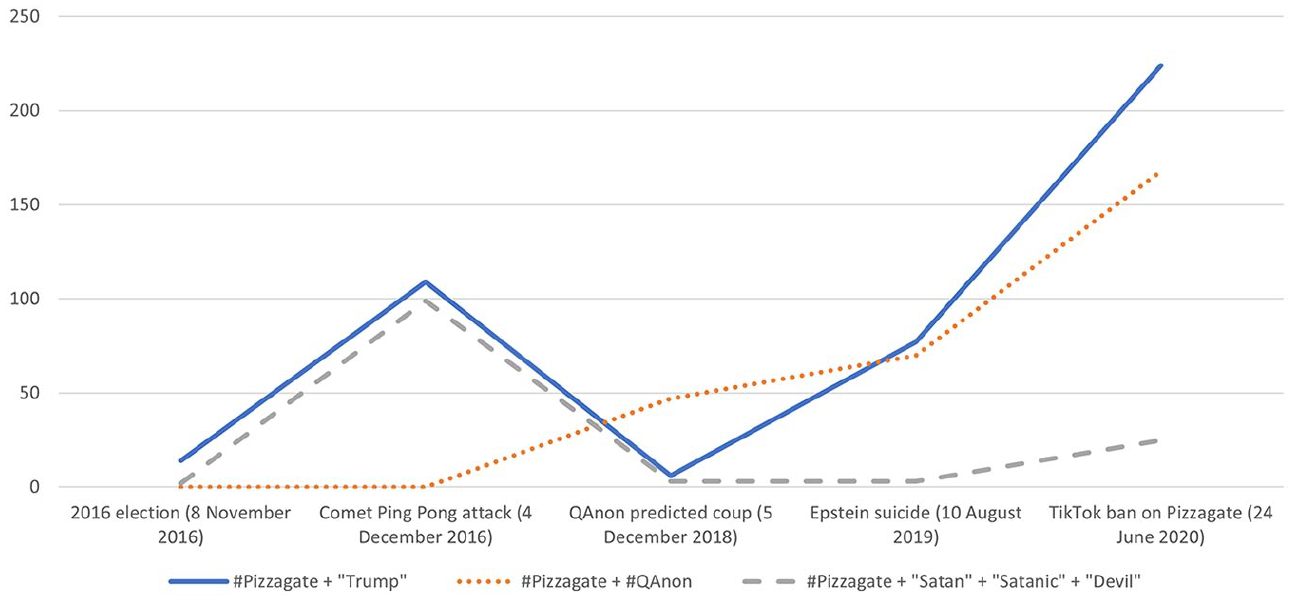
Part of the thematic analysis used in this research was to code the selected tweets into three general categories: (a) tweets mentioning #Pizzagate + ‘Trump’, (b) tweets mentioning #Pizzagate + #QAnon and (c) tweets mentioning #Pizzagate + ‘Satan’ and/or ‘Satanic’ and/or ‘Devil’. While there was some crossover in the sense that certain tweets referenced #Pizzagate as well as both ‘Trump’ and #QAnon, the analysis found that this was relatively rare. Interestingly, only three of the 767 tweets analysed used Satanic rhetoric in conjunction with either ‘Trump’ or #QAnon, suggesting a dissonant relationship between the two underpinning drivers of the Pizzagate theory. Significantly more used both ‘Trump’ and #QAnon, particularly in later periods, with 77 tweets using #Pizzagate in conjunction with both terms. Even so, 77 tweets from a total of 767 represents only 10.04% of the total – a limited, though not insignificant, number in the overall context of the study.
Most interesting is the trajectory of how the use of these ‘themes’ emerged and developed over the course of the period studied. To begin with, in the first two periods encompassing Trump’s election and the Pizzagate shooting, there were zero references to #QAnon. This should not be surprising, as Q’s initial post (triggering the theory) was not published in web forum 4chan until 28 October 2017 (Amarasingam and Argentino, 2020). After this point, association between Pizzagate and QAnon increased steadily: first, with 47 posts around ‘coup day’ (an important date in the QAnon canon), then 70 tweets around Epstein’s death and, finally, 168 posts in the days around the TikTok ban. Of these posts referencing QAnon, a limited number were critical of the theory and its proponents: 13 of the 70 tweets referencing #QAnon were critical around Epstein’s death (18.6%), while there were only six critical tweets using #QAnon out of 168 total — a rate of 3.6%. The rate of negative or critical tweets referencing #Pizzagate and ‘Trump’ during this final period was slightly higher, with 30 of a total 224, representing 13.4%. The percentage of tweets critical of Trump in the final period was down significantly from the previous period around Epstein’s death, in which 39 of 77 total tweets referencing Trump directly (50.6%) were negative, or even implicated the president in Epstein’s illegal activity. This high number of negative tweets around Epstein’s death was part of a broader trend: although only six tweets reference Trump and #Pizzagate in the third period, every one of these was negative or critical, most of which judging Trump for not fulfilling his ‘promise’ to dismantle Pizzagate after entering office. The trend suggests that, despite initial belief in Trump as an ally against Pizzagate, adherents of the theory came to doubt the president’s role and ability over the course of 2018 and 2019 before the 2020 revival of the theory appeared to mitigate growing criticism of Trump.
Another trend that emerged from the analysis was the trajectory of references to Satanism, a foundational core of the Pizzagate theory. To begin with, reference to Satanism was limited: at the time of the 2016 election, only two of 16 tweets used some combination of these terms (12.5%). However, around the time of the Pizzagate shooting around a month later, the rate of reference to Satanic concepts reached its zenith with 99 tweets, or 47.6% of the total. After this, the number of tweets invoking Satanism fell dramatically: by the ‘coup day’ in December 2018, only three tweets referred to these concepts out of a total of 56 (5.4%), a number that remained stable around Epstein’s death in August 2019, this time representing 2.2% of the total. Though the number of Satanic-related tweets reached its highest point in almost four years during the TikTok ban period, with 25 tweets, this was a negligible number when compared to overall #Pizzagate tweets between 23 June and 25 June 2020. The number of Satanic tweets was only 7.1% of the total during this period but, more critically, the ratio of #Pizzagate tweets referring to Satanic concepts compared with those referencing Trump reached a nadir – whereas, around the Pizzagate shooting, there were 99 Satanic tweets to 109 referencing Trump (or 90%), the ratio by the TikTok ban was 25 Satanic tweets compared with 224 referring to Trump (or 11.16%). The implication of this is that, over the four years of Pizzagate’s development, the connection to Satanic ideas and concepts waned significantly, whereas the characterization of Donald Trump as a ‘saviour’ grew and evolved from its origins in the dichotomy of Satanic/saviour into the more lasting corrupt establishment/saviour construction. This is significant, especially when it is taken into account that this trend generally coincides with the entry of QAnon into the Pizzagate conspiracy, with its explicit interest in promoting the narrative of Trump as an anti-elitist corruption buster. This suggests the recuperation of Pizzagate and incorporation into QAnon for partisan purposes, which will be analysed further in the discussion of these results.
Discussion
WikiLeaks to TikTok: The trajectory of an online conspiracy
Like many conspiracy theories of the internet era, Pizzagate originated through a confluence of legitimate whistleblowing and purposeful dissemination of false information. In March 2016, the unsecured Gmail account of Hillary Clinton’s presidential campaign chair, John Podesta, was hacked in a cyberattack purportedly conducted by a Russian military intelligence agency (Cosentino, 2020). More than 20,000 pages of emails allegedly sent and received by Podesta were subsequently supplied to hacktivist organization WikiLeaks who, in turn, published the material online throughout October and November 2016, just before the 2016 presidential election. The WikiLeaks information dump coincided with non-factual news spread via Twitter by alt-right groups claiming, similarly, that the New York Police Department discovered evidence of an elite paedophilia ring operating in the Democratic Party on the computer of politician Anthony Weiner, the husband of Podesta’s deputy Huma Abedin (Gillin, 2016). Together, these separate (yet interconnected) events gave rise to Pizzagate: primed by the non-factual news about the evidence found on Weiner’s computer, alt-right conspiracists online searched the Podesta emails for evidence that a paedophilia ring existed within the Democratic Party. The search of the Podesta emails was subject to extreme confirmation bias, where the amateur ‘investigators’ on websites like 4chan and Reddit set out not to find evidence of wrongdoing, but information to fit the already existing narrative (Acks, 2019; Aisch et al., 2016). The construction of the Pizzagate (and, later, QAnon) conspiracy has also been speculated to be a form of Live Action Role-Playing (or LARPing) wherein, at least initially, the fictional scenario of a ‘deep state conspiracy’ was first created as a puzzle for members of the online community to solve and, over time, evolved into a legitimate belief (QAnon: The Search for Q, 2021). Unsurprisingly, with the reinforcement of other alt-right adherents, a theory developed that emails sent by Podesta in which he appeared to be making dinner plans to get pizza were reinterpreted by the alt-right as coded messages referring to child sex trafficking, which early proponents of Pizzagate believed was being carried out at Comet Ping Pong pizzeria in Washington, DC, owned by Podesta associate James Alefantis (Gillin, 2016). Shortly thereafter on 4 December 2016, the pizzeria was targeted in a shooting by Edgar Maddison Welch, a Pizzagate believer who fired at the restaurant in a misguided attempt to ‘save’ child victims he believed were being held there.
Though the two have since become intertwined, the QAnon theory did not emerge until almost a year after Pizzagate in October 2017. At first, QAnon was primarily concerned with crafting the narrative that recently-elected President Donald Trump was secretly on a mission to dismantle the liberal elite who clandestinely controlled the country, including political families like the Clintons and wealthy dynasties (mostly Jewish) like the Rothschilds (Amarasingam and Argentino, 2020). As the results of the Twitter analysis show, the connection between Pizzagate and Trump as a QAnon-designated protagonist remained weak in December 2018, a time shortly after the first mid-term Congressional elections when QAnon predicted that Trump would purge the deep state (Chapman, 2018). While ‘#Pizzagate’ and ‘#QAnon’ were used in conjunction with each other 47 times, ‘#Pizzagate’ and ‘Trump’ were only used together six times – all of which negative or critical of the president, and either critical of Trump’s failure to act on Pizzagate or dismissive of the theory entirely.
The death of financier and child sex trafficker Jeffrey Epstein, an associate of both Trump and the Clintons, further fuelled the Pizzagate discussion in August 2019, in a way that seemed to signal the end of the Trump as saviour narrative: of the posts linking ‘Trump’ to ‘#Pizzagate’, just over half referred to Trump as a potential offender, not the Democratic Party members originally implicated in the Pizzagate conspiracy. This was partly due to the long-term connections between Trump and Epstein on the New York City social scene, however this does not fully explain the backlash against Trump. Just as Epstein was linked to Trump, he was also closely tied to former President Bill Clinton, which was the focus of much criticism within the alt-right. This is significant, as it suggests that (at this point) the Pizzagate movement was not so tightly connected to the Trump movement that persuasive events, like the Epstein revelations, did not have the potential to derail its explicit pro-Trump narrative. The pushback against Trump can also be attributed to his perceived failure to act on Pizzagate and the deep state after almost three years in power, increasingly seen as a signal that QAnon’s saviour ideation may have been incorrect (Chapman, 2018; Rothschild, 2018). Nevertheless, the early months of 2020 saw the trend against Trump reverse: by mid-2020, Pizzagate had re-emerged as a popular conspiracy theory on alternative social media platforms like TikTok, becoming so prolific that the company banned use of ‘#Pizzagate’ on 24 June 2020 (Ovide, 2020). Other platforms have followed suit, with Reddit having a ban on Pizzagate discussions predating TikTok’s ban and Facebook removing various QAnon-related groups in August 2020 (Frenkel, 2020). Twitter also banned a number of users identified as QAnon theorists in July 2020, though stopped short of banning the hashtag altogether. Despite these company-wide crackdowns, the Pizzagate theory remains popular in online alt-right communities, as well as on mainstream platforms like Twitter, which is the specific focus of this study.
The great panic: Incorporating Satanism in the Pizzagate myth
The inclusion of Satanic concepts and motifs in the Pizzagate myth is an unusual, but not unprecedented, element of the child trafficking theory. The idea that the elite paedophilia ring revealed in the Podesta emails was underpinned by Satanism was clear from the earliest development of the conspiracy. Even before Welch’s attack on Comet Ping Pong, prominent figures in the alt-right and the Trump milieu were openly asserting that devil-worship was involved in Pizzagate. In November 2016, shortly after Trump’s election, the president’s nominee for National Security Advisor, Michael Flynn, tweeted unsubstantiated claims that John Podesta was involved in ritual sexual abuse in which he alleged Podesta was involved in a practice called ‘#spiritcooking’ wherein he ‘consume[d] blood and other bodily fluids’ of the children who were abused and trafficked (Bender and Hanna, 2016). Flynn’s public profile resulted in the tweets accusing Podesta of going viral among the alt-right, and have been attributed with catapulting Pizzagate into the canon of alt-right conspiracies. The origins of Flynn’s accusation are not clear, but appear to derive from the same kind of non-factual news article that (falsely) claimed that proof of a Democratic Party paedophilia scandal was discovered on Weiner’s computer.
The construction of these non-factual news articles occurs in various ways, including where it is produced by algorithmic programs fed with billions of words of text from the internet and designed to construct coherent, albeit inaccurate, news reports (Laquintano and Vee, 2017). In 2016, however, the production of non-factual news was still human-centred: around the time of Flynn’s tweet, more than 100 fake news websites were traced to a single town in Macedonia, with producers profiting from the advertising revenue accrued by foreigners consuming the false narratives they produced (Kshetri and Voas, 2017). The financial incentive to produce ‘clickbait’ offers a clear motive for producing sensationalist non-factual news stories, including those pursuing the Satanic abuse narrative. The allegations of Satanic abuse were not entirely a fabrication of contemporary non-factual news producers, however. There is a lengthy history in the United States, and globally, of organized child abuse being linked to Satanic rituals, dating back to at least the early 1980s (Nathan and Snedeker, 1995). Though most ritual abuse cases in this era were ultimately debunked, the revival of Satanic paedophilia claims with Pizzagate stoked established fears that rationalized child sex abuse as the work of the Devil and, in turn, exacerbated existing conceptions of liberals as atheistic threats to the United States of America’s Judeo-Christian foundations.
As noted, the concept of Satanic abuse was central to the initial construction of the Pizzagate theory after Flynn’s November 2016 tweet. The data bear this out: around election day 2016, there were only two posts suggested Pizzagate was linked to Satanism but, after Flynn popularized the theory, references to Satanic devil-worship in conjunction with Pizzagate reached their highest point with 99 individual tweets, a rate 46.5 times higher than on Election Day. After the December 2016 shooting at Comet Ping Pong, the correlation with Satanism largely dissipated: only three tweets referenced Satanic concepts in December 2018, and only three tweets of this nature at the time of Epstein’s death in August 2019. While there was an apparent rise to 25 Satanic-related tweets in June 2020, this larger number was only a fraction of the total during the period sampled (7.1% down from 47.6% around Welch’s attack in December 2016).
The downward trend in Satanic references from an initial peak coincides with the entry of QAnon into the Pizzagate discourse in 2017. Prior to Welch’s shooting, QAnon did not exist, and Pizzagate was a theory that developed independently and organically on alt-right internet forums. When incorporating Pizzagate into its own narrative, QAnon seems to have minimized the Satanic connection to focus on a secular deep state – perhaps concerned that reference to Satanism would prevent widespread acceptance of the theory and, in the end, undermine the ultimate goal of reinforcing the alt-right agenda via Trump (Berger, 2018). Whatever the reason, the data show that as tweets citing #QAnon after the Welch attack steadily grew, the proportion of total tweets referencing Satanic concepts fell exponentially. While this can only be highlighted as correlation, the implication is that a concerted shift occurred over this period, with conceptions of Pizzagate shifting over a period that coincided with QAnon’s adoption and incorporation of the conspiracy into its own, more overtly partisan narrative.
Epstein’s death and Pizzagate’s push into the mainstream
The scandal around the crimes of child sex trafficker Jeffrey Epstein has run parallel to Pizzagate for much of the conspiracy theory’s existence. Epstein’s involvement in sexually abusing underage girls had been public record since he pleaded guilty to charges of procuring prostitution from a minor in 2008 (Whyte, 2019). Epstein served only 13 months before being released and, allegedly, resuming his illegal conduct. His case re-entered the public discourse in 2014 when several past victims came together to sue the United States government for misconduct in its plea arrangements with Epstein. As more victims of Epstein began to emerge in the wake of this lawsuit, formal investigation into Epstein’s sex crimes resumed and, on 6 July 2019, he was arrested and charged with sexually trafficking minors. He was remanded in custody where, on 19 August 2019, he was found dead of an apparent suicide in his cell (Helmore, 2019). In many respects, the crimes Epstein was accused of were generally comparable to those at the core of the Pizzagate theory: while there was none of the more fantastical elements of Satanism and spiritcooking in the allegations, there was nevertheless claims that Epstein procured underage girls for sex on behalf of prominent, wealthy men. As such, the Epstein revelations were soon recuperated into the overarching Pizzagate/QAnon narrative. Recuperation is, traditionally, a process where radical ideas are co-opted and absorbed by the mainstream culture and, as a result, become a more conventional view that is fundamentally neutralized (Bleakley, 2018; Bonnett, 1999). In this sense, the incorporation of the Epstein narrative into Pizzagate could be treated as a form of reverse-recuperation: rather than a radical idea being transformed into a conventional one, in this case accusations against Epstein that were based on hard evidence were adopted by conspiracy theorists who amalgamated them into an existing, fringe theory. The incorporation of evidence-based claims against Epstein into the fantastical Pizzagate theory did not just strengthen Pizzagate, but also risked having the converse affect of causing the public to question legitimate allegations, not dissimilar to the public doubt that emerged after the false accusations of the 1980s Satanic panic (Nathan and Snedeker, 1995).
With his death coming so soon after being incarcerated, Epstein’s suicide attracted speculation from within QAnon. The belief that Epstein was killed crossed partisan lines, with those on the right attributing it to the ever-growing ‘Clinton body count’, a conspiratorial belief that whistleblowers against the Clinton family were routinely killed to assure their silence (Weill, 2019). Unlike the predominantly anti-Democratic Party rhetoric of previous Pizzagate discussion points, however, Epstein’s death added a new element to the Twitter discourse. Just as Epstein was an associate of former president Bill Clinton, he also enjoyed a long-standing relationship with sitting President Donald Trump, who has also been accused of sexual impropriety. The data on Pizzagate in the days around Epstein’s death indicate a clear schism focused on Trump’s complicity in organized paedophilia, even Pizzagate itself. There were a total of 137 total tweets using the ‘#Pizzagate’ tag between 18 August and 20 August 2019, around Epstein’s death. Of these, only three referenced Satanic ideas, with the other 134 engaging in some level of partisan discussion attributing blame to either the alleged cabal of child sex abusers in the Democratic Party or, in a rhetorical shift, Trump himself. When broken down further, there was a positive correlation when looking at anti-Democratic Party tweets and those that referenced QAnon: of the 70 tweets using the #QAnon tag, only 13 (or 18.6%) could be considered as anti-Trump, or at least expressing concern over Trump’s links to Epstein. This is compared with the 64 tweets that used both #Pizzagate and ‘Trump’ without the #QAnon tag, of which 26 were negative towards the president, or 40.6%. When accounting for all 77 tweets referencing Trump (using #QAnon or not), 39 were negative, accounting for more than half of the total (50.6%).
As noted, Epstein’s death came at time where QAnon’s support of Trump was already waning, due in part to his perceived failure to follow through on the purging of the deep state promised in Q’s original 4chan posts. Nevertheless, tweets maintaining the accepted narrative that the Democratic Party were the central players in child sex trafficking, no matter if Epstein or Pizzagate, was still promoted by 81.4% of posters using #QAnon. This is at a rate roughly 20% more than that of posters referring to Trump and Pizzagate in conjunction without the #QAnon tag, indicating that suspicion of Trump’s involvement was much higher outside partisan QAnon circles than within it. In part, this is due to the echo chambers that take shape on social media platforms like Twitter when hashtags are used. The term ‘echo chamber’ refers to polarized platforms where information or discourse aligned with the views of the majority are reinforced and repeated, whereas competing or dissenting perspectives are actively repressed (Nguyen, 2019).
Technical features exist on social media platforms like Twitter and TikTok that assist in the construction of these echo chambers. The purpose of hashtags is, largely, to label and categorize online conversations in a consistent way, allowing users seeking out information on certain topics to filter Twitter content effectively (Zappavigna, 2015). By definition, searching for a specific hashtag creates a digital echo chamber wherein every post located uses the same tag. When this is used to label discussions on a popular television show or sporting event, this is an innocuous and useful filtration process. When used as a way of identifying affiliation with a conspiracy theory like QAnon, however, the results are very different. Instead of simply identifying discussion of QAnon, a search for the hashtag generally excludes tweets by those that are not engaged with the group’s foundational conspiracy theory.
With QAnon generally supportive of Trump, it stands to reason that discussions using the hashtag also reflect a greater proportion of tweets that minimize Trump’s links to Epstein or, more commonly, deflect blame onto Trump’s enemies on the political left. The creation of digital echo chambers has been identified as a key factor in the alt-right’s indoctrination process. Previously, these echo chambers were formed on alt-right dominated forums like 4chan or, later, 8chan (Bleakley, 2020; Margetts, 2017). With popular hashtags like QAnon gaining traction, however, it has been possible to construct pseudo-echo chambers on mainstream social media platforms like Twitter by manipulating the filtration of data to only reflect alt-right perspectives, when the hashtag is used. The importance of QAnon establishing itself on mainstream platforms cannot be understated. When contained to dedicated alt-right spaces online, theories like Pizzagate could remain niche views limited to a hardened core of individuals who are already ideologically-opposed to the political left. These forums are, generally, not sought out by non-aligned users who (thus) remain unaware of the conspiracy as a result (Dagnes, 2019). This situation changes when conspiracist echo chambers are formed on popular platforms like Twitter or, more recently, TikTok. On these platforms, it is far easier for non-aligned users to engage with tags like #QAnon and stumble into the echo chamber that such a hashtag forms.
Closer analysis indicates that the pro-Trump echo chamber constructed by QAnon has played a significant role in Pizzagate’s increased presence on mainstream social media platforms. Whereas co-references to #Pizzagate and #QAnon were at 168, up from 70 (a 240% rise), references to #Pizzagate and ‘Trump’ were at 224, up from 77 (a 290% rise). Only 30 (or 13.4%) of the ‘Trump’ + #Pizzagate tweets were negative towards the president, down from 50.6% at the time of Epstein’s death. More tellingly, there were only six of 168 tweets using the #QAnon tag that were negative towards Trump or the conspiracy itself – only 3.6%, down from 18.6% in the previous period. The 96.4% acceptance of Pizzagate by those using #QAnon suggests an almost completely sealed off echo chamber, with very few contrarian views expressed when the hashtag is engaged with. This mature QAnon echo chamber is a particular threat when the ubiquitous nature of social media platforms like Twitter and, increasingly, TikTok is considered. Whereas conspiracies on alt-right forums are dangerous as it is, as evidenced by the Comet Ping Pong shooting, the greater level of access to these echo chambers on mainstream sites increases exposure and, in turn, the proliferation of fringe theories. Reference to Pizzagate on Twitter experienced ebbs and peaks over the past four years, but since QAnon’s emergence it has steadily grown, with reference to the theory now 2190% higher than it was in November 2016 when the theory first surfaced. This growth was exponential in the early months of 2020, coinciding with a newly-strengthened support for Donald Trump among adherents of the theory. That this should occur in the lead-up to the 2020 presidential election, in which Trump was a candidate, cannot be ignored given QAnon’s alt-right origins, and it might be interpreted that the renewed push to cast Trump as a ‘saviour’ in the Pizzagate narrative is a concerted effort by QAnon to promote the political interests of their chosen candidate.
Conclusions
The internet is a place where wild conspiracy theories are rife, but there have been few cases in recent times that can match the prolific spread of Pizzagate – a narrative incorporating devil-worship, ritual child sexual abuse and murder taking place under the protection of a political ‘deep state’. What began as a speculative interpretation of leaked emails, fuelled by non-factual news, has evolved in the four years from 2016 to 2020 into a resilient and (for many) persuasive explanation for recent events. Incorporated into the wider QAnon mythos from 2017, Pizzagate is just one component of a multidimensional (and complex) alt-world imaginary in which the COVID-19 pandemic is a fraudulent attack on American freedom and 5G cellular towers can be used to brainwash the public (Rudgard, 2020).
In a statement made on 20 August 2020, Trump openly praised QAnon and noted that he ‘heard that [QAnon] are people that love our country’ (Mosbergen, 2020). If there was any doubt that QAnon was ever an ideologically independent collective, Trump’s endorsement and recent Twitter analytics suggest otherwise: there is little doubt that, at least in recent times, QAnon have sought to elevate the president’s interests, using Pizzagate as a vehicle to reinforce their foundational myth that Trump is an anti-establishment crusader and saviour of the American people (Berger, 2018). This was rendered clearly in the 6 January attack on the United States Capitol Building, where QAnon acolytes were among a broad coalition of Trump supporters rioting, at behest of the then-President, to derail the electoral process that was set to formally name Joe Biden as the next US President (Garrett, 2021). The Capitol riot revealed not just the intrinsic connection between QAnon and the Trump base, but also the lengths to which adherents of Trump-era conspiracies (like Pizzagate, QAnon or the more recent ‘Stop the Steal’ movement) are willing to go to further their agenda, however misguided.
Though QAnon’s role in pursuing conspiratorial agendas like Pizzagate has diminished in the wake of the 2021 Capitol riot, the increasing prevalence (and acceptance) of narratives like Pizzagate shows no signs of abating, reflected in comparable anti-establishment dynamics observed in discourse resistant to the effort to control and vaccinate against COVID-19 or the (diminishing) pro-Trump Stop the Steal movement. As with Pizzagate, believers in these debunked theories have transitioned from online rhetoric to taking tangible action, often violent, in response to these false narratives. These recent cases, including Pizzagate, should reiterate to policy makers that proactively combating the spread of conspiratorial rhetoric is a vital step to prevent extremist actions taking place in response to false narratives. It is not simply ‘enough’ to ignore fringe theories promoted by the alt-right online, as has been policy in the past. This tactic, withholding attention from online ‘trolls’, has proven to be a riskier prospect than first thought, with silence giving conspiracies time to develop and become engrained in the online (and, thus, public) discourse. To combat the conspiracies propagated by the likes of QAnon, such as Pizzagate, it is essential to gain greater understanding of both its origins and trajectory in recent years. In doing so, social media consumers can be more aware of QAnon’s role in recuperating Pizzagate, as well as how QAnon was able to hijack a fringe theory in a way that supported its objective: to promote a positive representation of Trump, using the conspiracy as a convenient vehicle to sell its preferred construction of the president as the central figure in a broader establishment/saviour narrative peddled by proponents of alt-right politics.
Footnotes
Funding
The author received no financial support for the research, authorship, and/or publication of this article.
