




Abstract
The religious dimensions of the QAnon movement and links with political violence have been noted by researchers. This paper furthers this scholarship by conducting an analysis of 121 religious images taken from QAnon Telegram channels over 18 months. Through adopting semiotic and hermeneutical theory, it is argued that QAnon religious imagery can be categorised into a series of types, all influenced by Christian theological themes. When interpreted in a Christian context, these images reveal a close relationship with US-based Christian evangelicalism and with Christian liberation theology movements. By presenting contemporary politics as an eschatological battle between the oppressed and oppressors, framed as the QAnon community versus the devil, the QAnon movement encourages political activism closely analogous to Christian liberation theology movements. This contributes to an explanatory framework for the connections between QAnon followers and anti-government protest and violence during the Covid-19 pandemic and the 6 January storming of the US Capitol.
Introduction
Since its emergence as an online conspiracy theory in 2017, self-described QAnon followers have engaged in criminal and violent extremist acts (Amarasingam and Argentino, 2020; Argentino and Amarasingam, 2021). QAnon-related violence has been framed as a security threat by authorities in the United States as well as Australia, the Netherlands and Germany, testifying to its international appeal (Federal Bureau of Investigation (FBI), 2019). The Covid-19 pandemic saw QAnon supporters spread disinformation and support anti-lockdown and anti-vaccine protests (Waldek et al., 2021), leading to governmental concern about the potential for the movement to transform into one supportive of mass political violence (Suber and Ware, 2021). Most dramatically, the presence of QAnon followers among the motley crowds that attacked the US Capitol building in 2021 exposed the online conspiracy theory’s potential to incite political unrest (Argentino and Aniano, 2022; Farivar, 2021).
Although QAnon is a decentralised, amorphous and dynamic phenomenon that can be studied from diverse perspectives, researchers in violent extremism and terrorism studies have suggested that the movement’s religious dimensions have played a role in radicalising its followers online (Argentino, 2020a, 2020b; Badham, 2021; Balzakis, 2021; Stanton, 2020). Indeed, survey data documents that the conspiracy theory has found fertile ground among White and Hispanic protestant evangelical communities in the United States (Public Religion Research Institute (PRRI), 2021a, 2021b, 2022). Moreover, the QAnon supporters who participated in both the 6 January storming of the Capitol in the United States and the 2022 Canadian Freedom Convoy were strongly influenced by QAnon’s supposed religious aspects, especially those related to Christianity (Boorstein, 2021; Lecaque, 2022).
This paper contributes to the study of QAnon’s religiosity and potential connection to violence by performing a visual semiotic analysis of online QAnon religious meme-based imagery taken from the social media platform Telegram. It shows how QAnon’s religious dimensions are mostly (but not exclusively) rooted in Christianity, can best be conceptualised as a form of pseudo-Christian extremism akin to liberation theology and can be argued to share an affinity to violence on this basis. QAnon visual imagery emphasises the importance of Jesus as a saviour and protector against the forces of evil, reinterprets Christian apocalyptic scripture in light of current political events (and vice versa) and encourages supporters to prepare for an ultimate eschatological battle for freedom from oppression. This Christianity-like mythos (termed here ‘pseudo-Christianity’ to distinguish it from normative branches of the religion) shares significant characteristics with liberation theology, potentially radicalising individuals and increasing their propensity to engage in acts of political violence.
The pseudo-Christian extremism that dominates QAnon visual imagery reveals an intrinsically violent socio-political character that draws upon fervent US nationalism, most strikingly a religio-political support for the former President Donald Trump who is viewed as a messiah figure and religious liberator. These themes have been intermixed with religious interpretations of the Covid-19 pandemic as presaging Biblical end-times. The commonalities between these themes and Christian liberation theology are striking. QAnon imagery consistently portrays current politics as a cosmic battle of the oppressed against the oppressors and views Jesus and his elect political leaders such as Trump as a source of liberation from evil. Although important differences exist between Christian liberation theology and QAnon, not least the traditionally left wing and Marxist orientation of liberation theology movements, identifying the pronounced similarities helps to frame QAnon’s contemporary appeal and relationship with anti-government movements.
Literature Review
Here, we survey security studies research into QAnon with a focus on the movement’s relationship to processes of radicalisation and religion. It will be shown that discussions about the religious aspects of QAnon lack a well-informed theoretical perspective grounded in the academic study of religion. Evidence-based empirical analyses are also largely absent from these discussions.
The impact of QAnon narratives on online radicalisation has been the focus of significant debate. It has been shown that online QAnon content facilitates radicalisation through the creation of ideological echo-chambers resulting from social media recommendation algorithms (DiMaggio, 2022; Garry et al., 2021; Priniski et al., 2021). Members exploit these algorithms using topical hashtags and group suggestions to effectively spread narratives online (Forberg, 2022; Hannah, 2021). These online conspiratorial narratives have been argued to cause radicalising effects like the ones produced by jihadi groups (The Soufan Center, 2021) and have been related to far-right narratives that promote distrust in public institutions and government (Bleakley, 2023; Conner and MacMurray, 2022). Through spreading disinformation about Covid-19 and the 2021 US Capitol attack, QAnon adherents encourage antisemitism, anti-government sentiment and violence (The Soufan Center, 2021).
The antisemitic character of the conspiracy theory’s online discourse is particularly evident. As survey data has shown, 49% of QAnon affiliates believe the false claims made in the Protocols of the Elders of Zion (Palmer, 2021). Moreover, as numerous observers have noted, the conspiracy theory’s claim that satanist paedophiles are kidnapping and extracting blood from children resembles the blood libel conspiracy theory (Bloom and Moskalenko, 2021; Stanton, 2020; Vrzal, 2020), an antisemitic trope, developed during the Middle Ages and widely spread in Nazi Germany, accusing Jews of murdering Christian children to use their blood for religious rituals.
Online radicalisation has been linked to violent outcomes. Amarasingam and Argentino (2020) have explored the link between the QAnon conspiracy theory and five prominent violent crime cases. Their study highlighted how the conspiracy theory can impact ideologically motivated violent extremism by constructing narratives that legitimise violence. These concerns are shared by others who have drawn attention to the multifaceted violent crime and security threats the online conspiracy poses (Jensen and Kane, 2024).
Research into the religious aspect of the QAnon movement has been a most promising area for gaining novel insight into the movement’s ability to radicalise some followers. Scholarship in this space has largely focused on the identification of religious elements within QAnon narratives, particularly those stemming from New Age subcultures, online gaming mythologies and evangelical Christianity.
Eclectic New Age influences have been identified throughout the movement’s diverse body of myth and symbolism (Beres et al., 2023), particularly in the iconography associated with Jake Angeli, the so-called QAnon Shaman (Meltzer, 2021). QAnon’s quasi-religious mythmaking has been linked to the movements’ possible, in part, origin as an alternative reality game (ARG). QAnon shares similarities such as good–evil dualism and in-group participation with augmented reality games that resemble the mythmaking of cults and extremist religious movements like Aum Shinrikyo (Goldenberg, 2020). Cicada 3301, the online cyber-puzzle from which QAnon possibly, in part, emerged, was characterised by occultist, esoteric and religious symbology (Andjelkovic, 2021; Bloom and Moskalenko, 2021). Argentino (2020a) has drawn on these connections to suggest that QAnon can be analysed as a hyper-real religion similar to Heaven’s Gate, the Church of All Worlds or Jediism. The blend of mythos with familiar pop cultural references (i.e. appropriating the ‘red pill’ from ‘The Matrix’ films as a symbol for gnostic knowledge) allows its radical and conspiratorial narratives to appeal widely to contemporary online audiences.
Along with eclectic symbols and mythic structure taken from the New Age and digital cultures, the prevalence of Christian imagery and ideas, often associated with apocalyptic and evangelical traditions, has been identified (Hardy, 2021; Kline, 2021; LaFrance, 2020; MacMillen and Rush, 2022). QAnon narratives clearly draw on fundamental Christian concepts such as good/evil and apocalypticism/millenarism dualism, and traditions of prophetism and messianism, suggesting a connection with contemporary US Christian fundamentalism and evangelicalism (Argentino, 2020a).
The conspiracy theory strikingly builds on Christian dualism, portraying a battle between the forces of evil, as guided by Satan, and the forces of good, supported by God and his elect (Vrzal, 2020: 46). QAnon’s conceptualisation of evil – represented by a global satanic cabal feeding off the blood of children – appears rooted in the US satanic panic of the 1980s and 1990s (Argentino, 2020a; Kaplan, 2021; Thomas, 2020; Vrzal, 2020). At the time, it was alleged that secret satanic organisations were kidnapping and murdering children, a claim that some Protestant groups interpreted according to apocalyptic Christian scripture (Vrzal, 2020). QAnon followers have extended this paranoid narrative to elevate Donald Trump to a messiah figure who will triumph over Satan and his enablers who occupy positions of political and social influence. This final triumph of good over evil is framed according to Christian apocalyptic rhetoric through the idea of ‘The Storm’, an eschatological showdown within which Q and Donald Trump act as divinely inspired prophets (Argentino, 2020a; Hardy, 2021; LaFrance, 2020). This dualism and apocalypticism assume further relevance through the concept of ‘The Great Awakening’, a process of spiritual awakening among QAnon followers that will lead, following the tribulations of ‘The Storm’, to a purified and righteous US freed from demonic forces (Kline, 2021).
These thematic connections with fundamentalist Christian evangelicalism have been notably illustrated through the Omega Kingdom Ministry (OKM), an online forum where QAnon supporters interpret passages of the Bible through the lens of the conspiracy theory (Argentino, 2020a; Hardy, 2021). The OKM offers a formalised Christian religious space for QAnon’s adherents where Christian fundamentalist themes and concerns inform the exegesis-like interpretation of Q-drops and then go on to influence the formulation and spread of wider QAnon narratives.
The QAnon phenomenon is replete with religious symbols, mythic structures and motivations, most prominently taken from fundamentalist Christianity as practised in the United States. However, the question remains how QAnon’s religious nature can best be described, and what relationship, if any, this has with radicalisation to violence. The exotic merger of New Age spirituality, pop culture and Christianity has led academics and the media to variously characterise QAnon as a sect (Kaplan, 2021), a cult (Badham, 2021; Balzakis, 2021; Hassan, 2021; Stanton, 2020) and as a pseudo-Christian new religious movement similar to the Seventh Day Adventist Church or the Church of Jesus Christ of Latter Days Saints (Argentino, 2020a, 2020b; LaFrance, 2020; Pettipiece, 2021). While concepts of ‘cult’ and ‘sect’ have been applied without clear definition, the terms ‘religion’ and ‘new religious movement’ are general and in need of further clarification.
Investigating QAnon as a Christian-inspired new religious movement has significant merit, yet more work needs to be done to decipher the ways QAnon narratives intersect with and draw from existing patterns of religiosity. Unfortunately, studies focusing on QAnon’s religious dimensions have so far been speculative, lacking either a strong conceptual framework taken from the field of religious studies or an empirical grounding. In addition, research has not yet provided sound arguments exploring the potential connection between QAnon’s religious dimensions and some affiliates’ radicalisation and propensity to violence. Only a few recent works focused on the 6 January storming of the Capitol in the United States have explored how the theological and spiritual beliefs shared by QAnon affiliates transformed into organised political violence (Bond and Neville-Shepard, 2023; Conner, 2023; Gorski and Perry, 2022; Moskalenko, 2023). To begin to fill these gaps, this study hypothesises that QAnon affiliates’ propensity to political action and violence stems from a form of pseudo-Christian extremism and can best be explored by looking at the concept of liberation theology.
Method
This study addresses three main objectives. First, it contributes to debates about the religious aspects of QAnon by providing a theoretically grounded empirical analysis. Second, it increases knowledge about QAnon by providing a structured analysis of the movement’s religious imagery. Finally, it contributes to the field of terrorism and extremism studies by presenting a framework for understanding QAnon violence as informed by Christian liberation theology.
The adopted method is qualitative, focusing on the collection and analysis of religious images spread via a sample of QAnon-affiliated Telegram groups. Visual analysis has been employed to analyse propaganda produced by extremist groups, including Salafi-Jihadists (Abdelrahim, 2019; Ayad, 2021; Baele et al., 2019) and far-right extremists (Kingdon, 2021; McSwiney et al., 2021; Miller-Idriss, 2019; Miotto, 2022). The present research design takes inspiration from these works, acknowledging the importance of visual analysis to understand extremist propaganda (Conway, 2019).
Images were first analysed through the application of visual semiotics. The religious significance of these images was then interpreted through the application of a hermeneutical method. Both semiotics and hermeneutics are interpretive approaches that require a deep and careful understanding of context (Engler and Stausberg, 2022). Hence, a critical analysis of religious studies literature on Christian evangelicalism and new religious movements, as well as a thorough review of QAnon narratives, helped provide the theoretical grounding necessary for interpretation.
Semiotics and hermeneutics are methods uniquely able to access complex and hidden, yet historically objective, symbolic meaning within text or imagery, and are thus well used in explorations of religious symbolism. However, interpreting religious imagery is fraught because not all readings of an image necessarily respond to all its symbolic valences. The symbolic ‘inner meanings’ of the memes identified in this study through a process of close contextualisation are not the only, or necessarily the ‘truest’, interpretation that can be given. Indeed, many casual viewers and QAnon supporters may be unaware of the full range of a religious image’s symbolic meaning and may simply respond to the most obvious interpretation of the quasi-Christian imagery explored below – that is, that Trump is ordained by God and that the QAnon movement is divinely guided. However, semiotic and hermeneutical theory acknowledge that with greater contextualisation increasingly complex layers of symbolic meaning can be ascribed to religious imagery and that these ‘deeper’ levels of meaning, while not replacing more immediate interpretations, do supplement them by adding greater complexity and nuance.
Because mainstream social media platforms such as Facebook, YouTube and Twitter have increasingly moderated and banned QAnon accounts and content (Bond, 2021; Zadrozny and Collins, 2020), the research drew on a sample of Telegram channels. QAnon followers have been shown to be strongly active on Telegram, due, in part, to migration from more mainstream social media platforms (Wildon and Argentino, 2021).
After receiving university research ethics approval, 17 Telegram channels were selected using previously identified QAnon-related keywords common to QAnon-related accounts and pages (Garry et al., 2021; O’Connor et al., 2020; Papasavva et al., 2022; Priniski et al., 2021). These included ‘Q’, ‘QAnon’, ‘Great Awakening’, ‘The Storm’, ‘Pizzagate’, ‘Savethechildren’ and ‘WWG1WGA’. Channel and group selection was also informed by a literature review that identified prominent QAnon Telegram groups and high-profile influencers (Argentino and Aniano, 2022; Fitzgerald, 2022). These represent a selection of prominent channels rather than an exhaustive list of all existing QAnon specific channels. Due to ethical considerations, we have not included a list of the 17 Telegram group channels. The full list is available to interested scholars upon request.
The selected Telegram channels were manually reviewed across an 18-month time period extending from January 2020 to June 2022. A total of 121 images containing religious symbolism were collected. The images were retrieved manually by the research team via screenshots. Collected content was anonymised to remove users’ names, nicknames and comments before storage, removing any element which could reveal the social media users’ identity. Similarly, some images containing hashtags that could potentially reveal identities were edited to ensure the privacy of users.
Images were selected from these group pages based on three criteria: (1) similarity, (2) theme and (3) language (McSwiney et al., 2021). Therefore, the content analysed includes (1) images which (2) make religious references and (3) use English language when text is included. The literature review played a pivotal role in assisting initial image selection through identifying religious content. The support of existing works on QAnon was fundamental in identifying the ways in which Christian imagery, New Age spirituality and pop culture religious symbolism were relevant to the analysis. The method chosen dictated that we would select for QAnon imagery containing religious content, but not the differing types of religious content identified or their meaning. The 121 images containing references to religion were thus sorted into different types, with 38 categorised as ‘purely religious’, 19 as primarily ‘QAnon focused’, 35 as primarily ‘political’, 21 as ‘pop culture’ and 8 as ‘New Age’.
Once collected and stored, the images were analysed using a combination of visual semiotics and hermeneutics. These approaches facilitated the understanding of the role images play in meaning-making and identity formation online, an approach that has recently been applied in social movement and violent extremism studies (Askanius, 2021), including QAnon (Demeru, 2022).
Visual semiotics involves the study of layered meanings and symbols to identify the messages conveyed and received (Yelle, 2021). This approach was used to explore the literal and symbolic aspects of the images. Drawing on Barthes’ understanding of pictorial semiotics as conveying three messages: linguistic, literal and symbolic, the adopted research method incorporated a staged and iterative research design sensitive to uncovering layered meaning. Telegram posts often employed a combination of text and imagery (Ornager and Lund, 2018), allowing them to convey both linguistic as well as literal and symbolic meaning. Religious imagery can, therefore, be read on different levels. An image combining Trump and Jesus, for example, can simply be read to mean that Trump is close to or ordained by God, while the occurrence of several similar images with explicit political imagery can be read as symbolic of more revolutionary and liberational themes. It was also acknowledged that humour, irony, ambiguity and implied meaning were likely employed in imagery (Askanius, 2021).
Hermeneutics was used to further identify religious symbolic meaning within the images. Hermeneutics shares commonalities with semiotics as it is centred on the interpretation of meanings and symbols. However, it requires familiarisation with the subject and a constant critical questioning and self-examination of the processes of interpretation (Gilhus, 2021). This resulted in a process of continuous interpretation and reinterpretation of the sources, dedicating special attention to social and cultural factors that could inform this process. Although time consuming, the hermeneutical approach allowed for a multi-layered analysis of the images by relating them to the likely context in which they were created. As a result of this two-folded methodological approach, QAnon’s religious dimensions were able to be interpreted as a form of pseudo-Christian extremism, and analysed through comparison with Christian liberation theology, the closest analogue identified.
Despite advantages in drawing deep contextual meaning from images, both semiotics and hermeneutics presented limitations in need of mitigation. Most important was an acknowledgement that the process of interpretation needed to be constrained and sensitive to context. Although there may be multiple interpretations of a source, interpretation is not arbitrary and is limited by specific factors. This means that the literal and most obvious presentation of a source needs to be acknowledged and that the interpretation of one part of a source should always be compared with interpretations of other parts (Engler and Stausberg, 2022). Hence, any interpretative conjectures was preceded by a literal reading and then verified by addressing the source as a whole. Context was also acknowledged as a crucial variable when interpreting sources (Bleiker, 2015). The meaning of an image was understood as connected to the intent and aim behind its production and dissemination (Bleiker, 2001).
Regarding sampling, this study addresses only QAnon content spread via Telegram groups from 2020 to 2022, thus excluding other social media channels from analysis. This is an acknowledged limitation of the study. It is recommended that future research evaluates content disseminated on other social media platforms (e.g. Reddit, Gab, and select Chan boards and forums). In addition, because semiotic approaches are ‘case-centric’ (Curtis and Curtis, 2011), this research can present only a select sample of the visual content diffused within QAnon networks. Therefore, generalisations are cautious and should be tested through further research focusing on other types of content such as video, text and audio material.
QAnon Religious Imagery
The analysis of the 121 images collected highlights the presence of four types of religious imagery: (1) purely religious, (2) QAnon-focused, (3) political and (4) pop cultural. More than one of these types was often found to be present within a single image. The next two sections present nine images selected from the sample as illustrative examples. The inclusion of all 121 images was beyond the scope of a published journal article.
Images containing explicit religious symbolism were mostly shaped by Christian references. Their analysis identified three recurrent themes: the presence of Jesus Christ, a cosmic battle between God and Satan, and the presence of antisemitism.
First, emphasis was dedicated to the figure of Jesus Christ who appears to metaphorically represent Q/QAnon and its divine power to save believers (Figure 1). An analysis of Figure 1, as typical of this group, reveals fundamental Christian references that relate to the concepts of faith and salvation. Indeed, the image is an explicit reference to Jesus walking on water, one of the miracles recounted in the New Testament. The image portrays Jesus walking on water and offering his hand to a subject depicted as Pepe the Frog, a cartoon character appropriated by alt-right and far-right online movements. The sea is stormy, and a boat with people on it can be seen in the background. The image likely refers to the Gospel of Matthew and resembles core lines of Matthew’s account of the miracle:
Then Peter got down out of the boat, walked on the water and came toward Jesus. But when he saw the wind, he was afraid and, beginning to sink, cried out, ‘Lord, save me!’ Immediately Jesus reached out his hand and caught him. ‘You of little faith’, he said, ‘why did you doubt?’ (Matthew 14: 29-31, KJV)
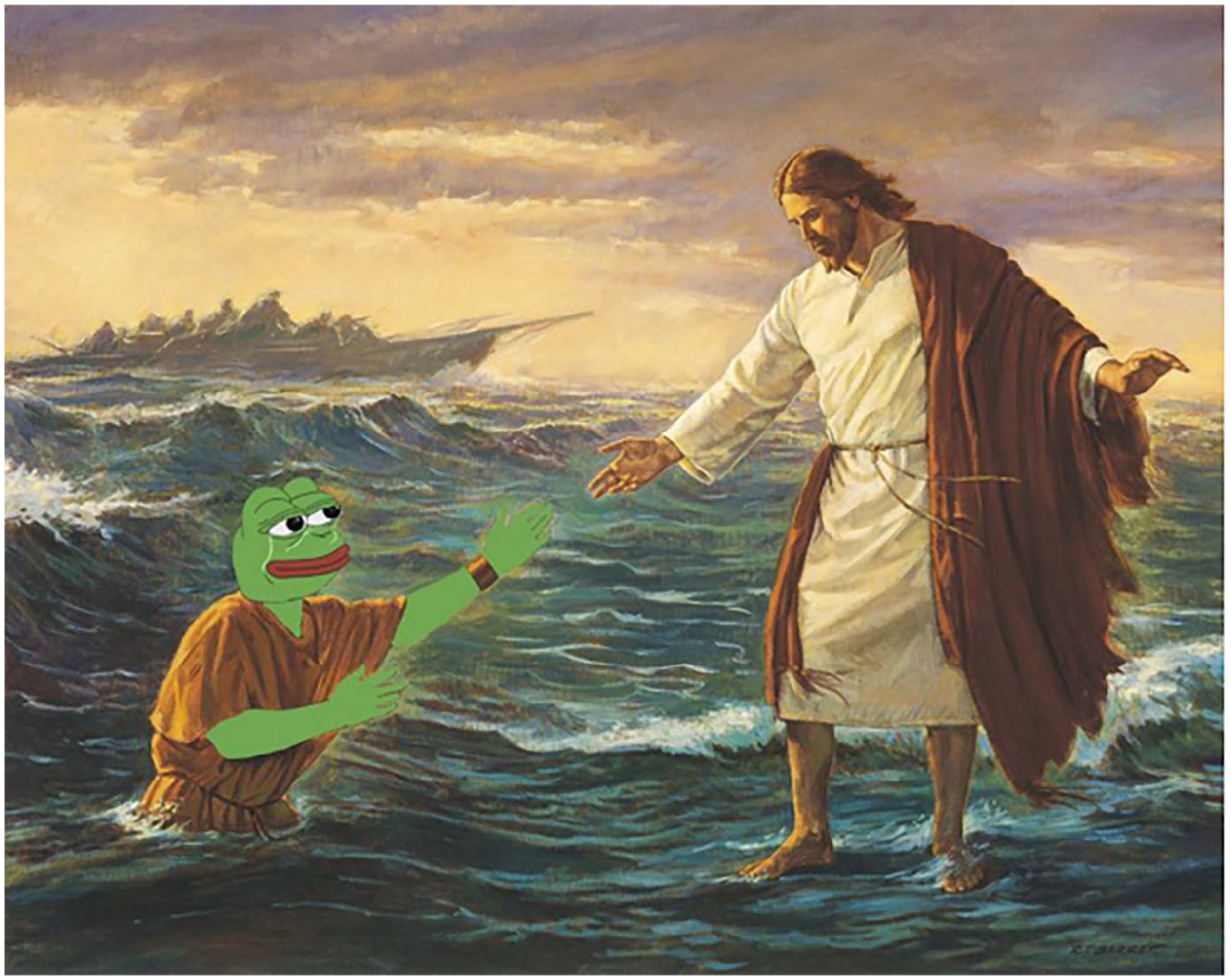
Jesus walking on water and giving his hand to Pepe the Frog.
Pepe the Frog most likely represents the QAnon affiliate who, like Peter, is called by Christ to walk on water. Walking on water – a call to have faith – reveals the power of Christ to rescue and save the faithful (Derrett, 1981). Christ’s act assumes further significance; as Jesus helps Peter and takes him to the boat, the wind ceases, and the sea becomes calm (Matthew 14: 31-32 KJV). Therefore, the image likely conveys the idea that Q/QAnon has the power to save believers in troubled times (i.e. during ‘The Storm’), represented as the stormy sea. As a result, other individuals – the disciples on the boat – witness the miracle and recognise Q/QAnon’s superior and divine nature, thus developing faith in it.
Second, repeated emphasis was placed on the dichotomy of good versus evil and an ultimate apocalyptic battle between God and Satan. This is conveyed mainly through images that included literal passages from the scriptures. For instance, Figure 2 references Ephesians 6:11, a text that relates to the theological concept of ‘spiritual warfare’, in which believers are called to engage in a spiritual battle against evil by adopting Christian virtues (Yates, 1977: 520). Hypothetically, the image calls upon followers to hold onto QAnon beliefs in their daily lives as they engage in a spiritual battle against the forces of evil. Individuals can win the battle because they are equipped with QAnon’s principles and protected by the conspiratorial ‘truth’ and its community. Although the meaning is metaphorical in nature, the discourse is highly weaponised and adopts the language of warfare.
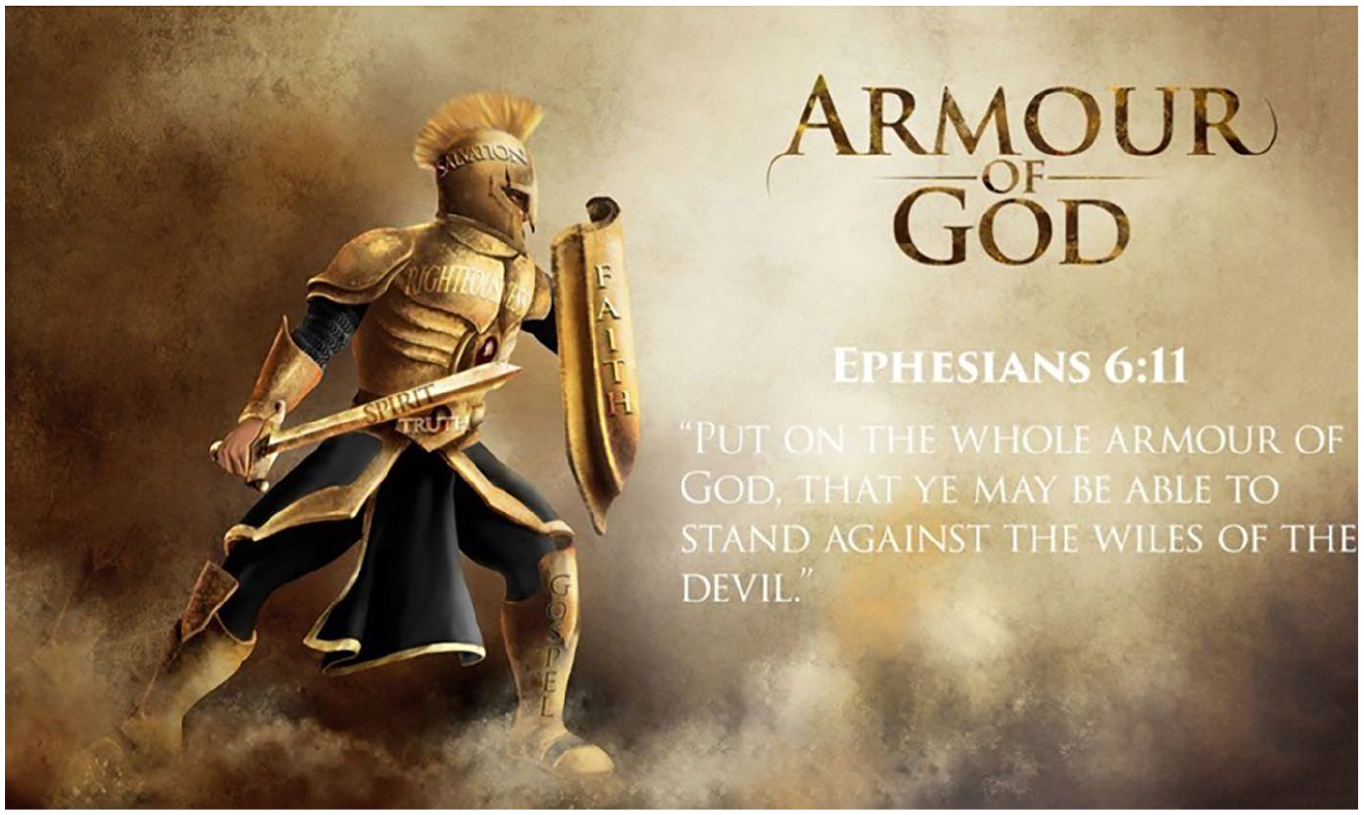
Image quoting Ephesians 6:11.
Third, religious symbolism, particularly that portraying Satan, was often characterised by antisemitism. Implicit antisemitism can be detected in the image portraying Baphomet (Figure 3), as originally drawn by Eliphas Lévi. Although Lévi’s conceptualisation of Baphomet was not originally connected to Satanism or anti-Christian values, Baphomet has been popularly interpreted as a representation of evil (Strube, 2016). The words ‘Solve’ and ‘Coagula’ are superimposed onto the figure’s arms and highlighted in red. Translating as ‘dissolve’ and ‘coagulate’, and referring to alchemic processes (Huckvale, 2011: 35), the terms have been appropriated by QAnon as reference to satanic blood drinking. An association between blood-drinking and satanic worship dates to a medieval antisemitic conspiracy theory accusing Jews of torturing and murdering Christian children. This ‘blood-libel’ conspiracy falsely claimed Jews were conducting ritual murders of children – a trending topic in QAnon rhetoric – to extract their blood and bake bread for Passover (Johnson, 2012), and has endured over the centuries under different forms (Bemporad, 2012; Kotlerman, 2012).
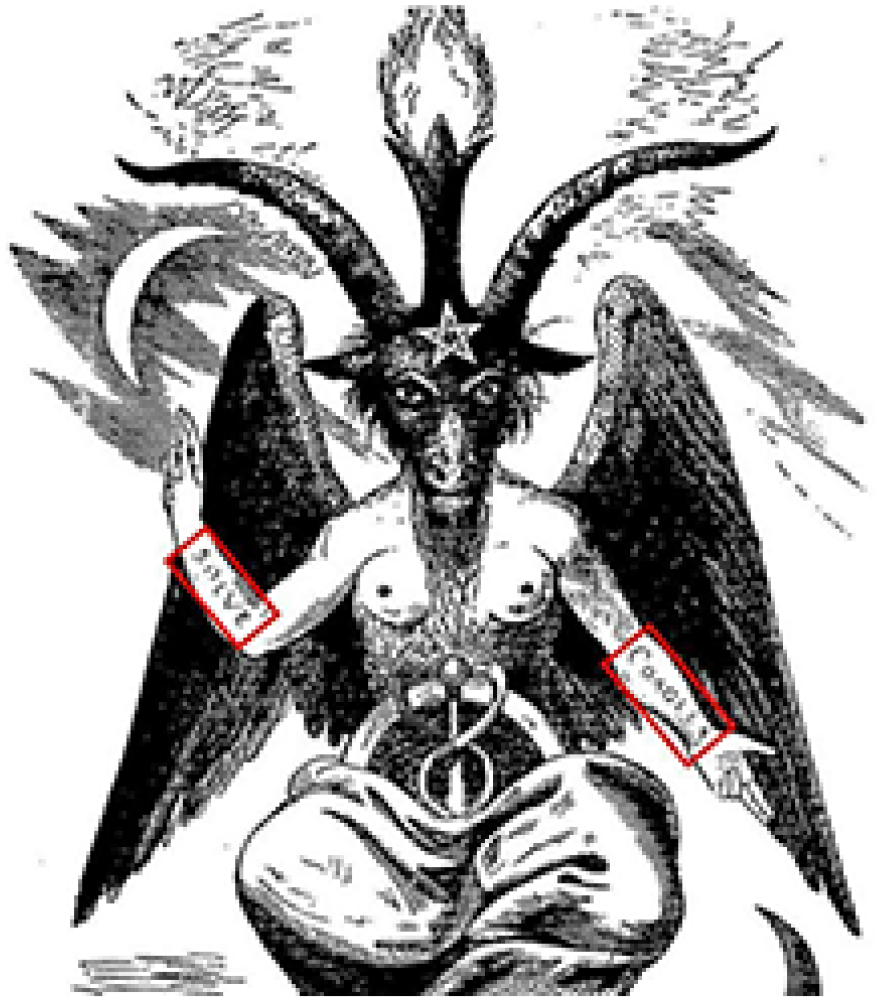
Baphomet as drawn by Eliphas Lévi with the words ‘Solve’ and ‘Coagula’ highlighted in red by QAnon affiliates.
The second category of images identified from the sample conveyed explicit QAnon symbolism, but combined with religious aesthetics. These visuals often adopted a direct QAnon symbology by using sentences, letters and acronyms such as ‘WWG1WGA’ (‘where we go one we go all’) (Figure 5). Others conveyed a less explicit symbolism which could be traced back to QAnon narratives; for example, concepts such as the ‘white rabbit’ (Figure 4) and the portrayal of Jesus surrounded by children (Figure 5). The white rabbit represents a metaphor taken from Lewis Carroll’s Alice in Wonderland and the film ‘The Matrix’, and has been widely used by QAnon followers and incorporated into the names and titles of QAnon social media groups and users (Bloom and Moskalenko, 2021; Wong, 2020). Similarly, the emphasis on children protected by Christ with the accompanying QAnon slogan WWG1WGA relates to the protection of children from an alleged satanic paedophile ring, a claim that sits at the core of the conspiracy theory (Donegan, 2020; North, 2020).
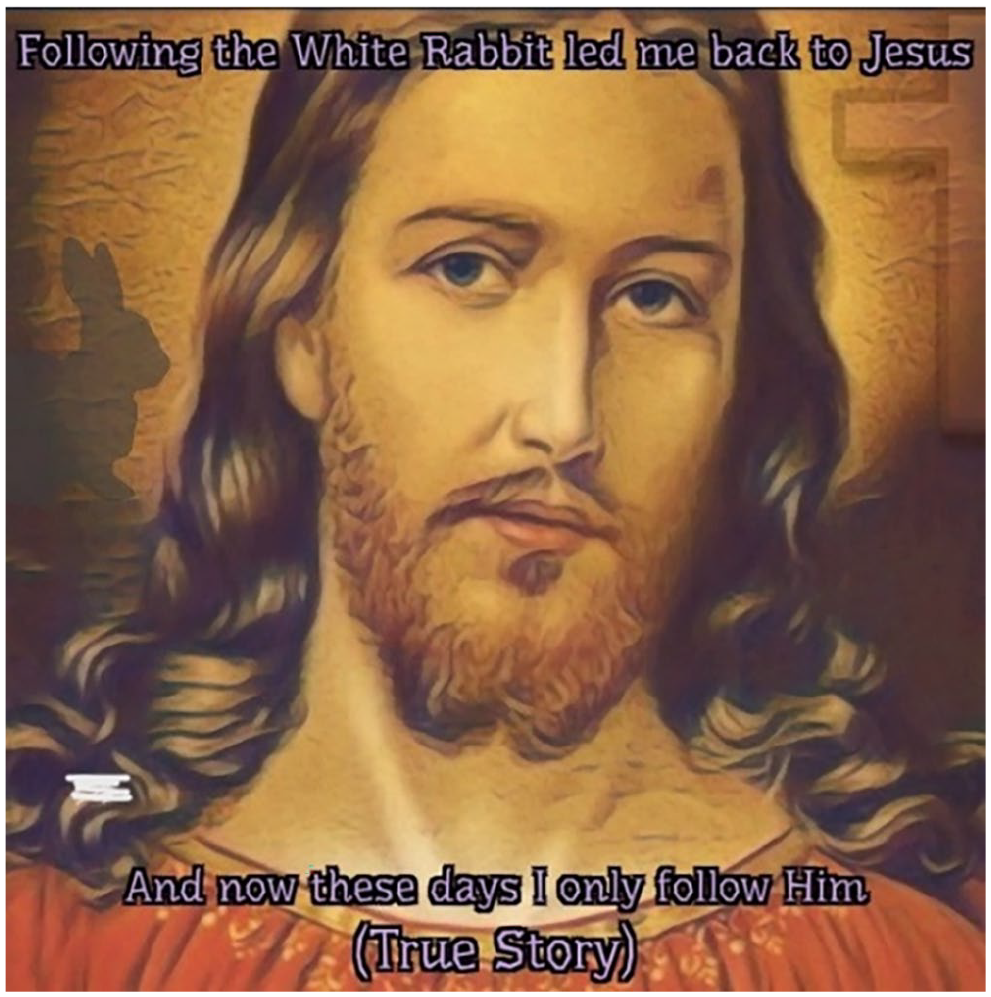
Image using the metaphor of the White Rabbit.
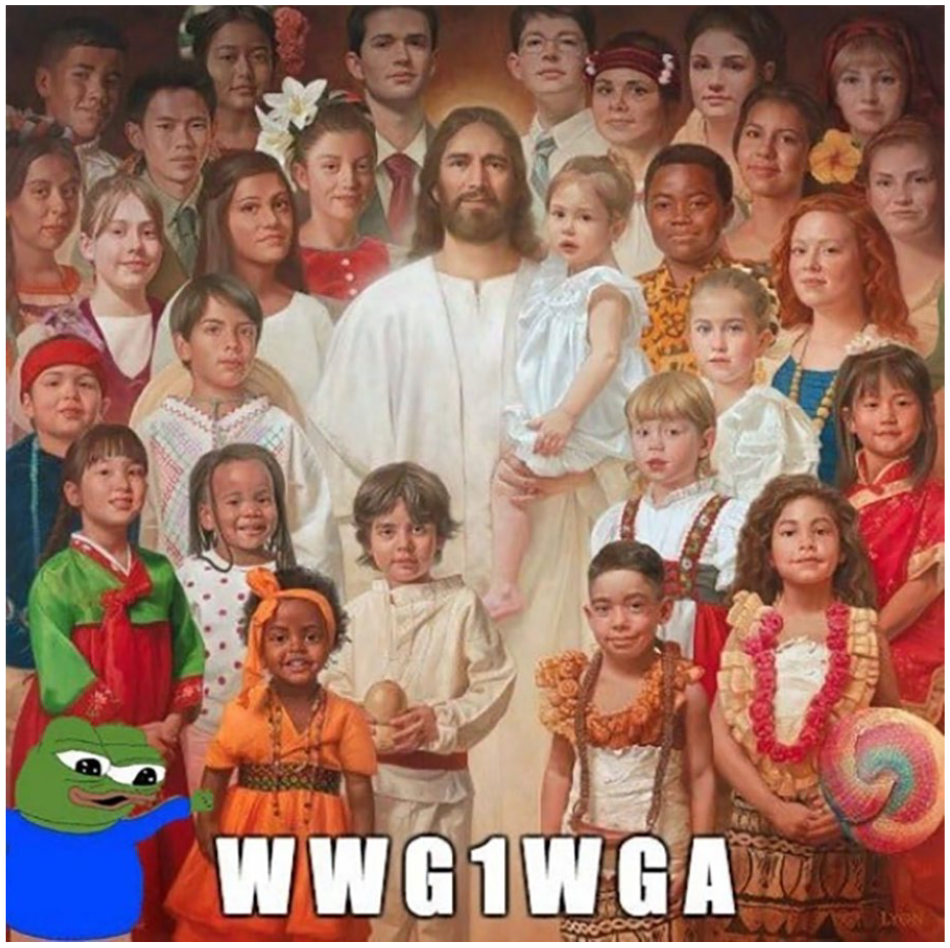
Jesus Christ among children and Pepe the Frog and reporting the acronym WWG1WG.
The third category of images was associated with a mix of overtly US political and religious symbolism. These images typically incorporated the theme of a battle between the forces of good and evil as described above. The merger of Trumpism, nationalism and evangelical-inspired Christianity is prominent, often representing Donald Trump and his political movement as divinely anointed and supported by Christ. QAnon’s religious imagery repeatedly portrays themes centred on Trumpism and US Christian nationalism. The US flag is often used as a symbol to convey national identity, while the US President Trump is repeatedly depicted as a messiah figure anointed by Jesus. This is evident in Figure 6 where religious, political and QAnon symbols are co-present and convey theological and ideological meanings, connecting Christianity, Trumpism and QAnon conspiratorialism. QAnon symbolism can be detected in the use of the words in the image. Jesus is framed by a large capital Q, likely referring to the mysterious prophetic figure Q, the purported author of the cryptic Q-drops. ‘THE PLAN’ refers to the sentence ‘Trust the Plan’, one of QAnon’s most infamous phrases referring to the political and cosmic meaning behind Q’s enigmatic writings and their ability to lead to the eventual defeat of satanic forces (LaFrance, 2020). In the image, the concept of the plan conveys a multi-layered meaning that connects Christian nationalism, Trumpism and QAnon. The plan is QAnon’s plan, ‘God’s plan’ and, likely, Trump’s plan which includes his political agenda.
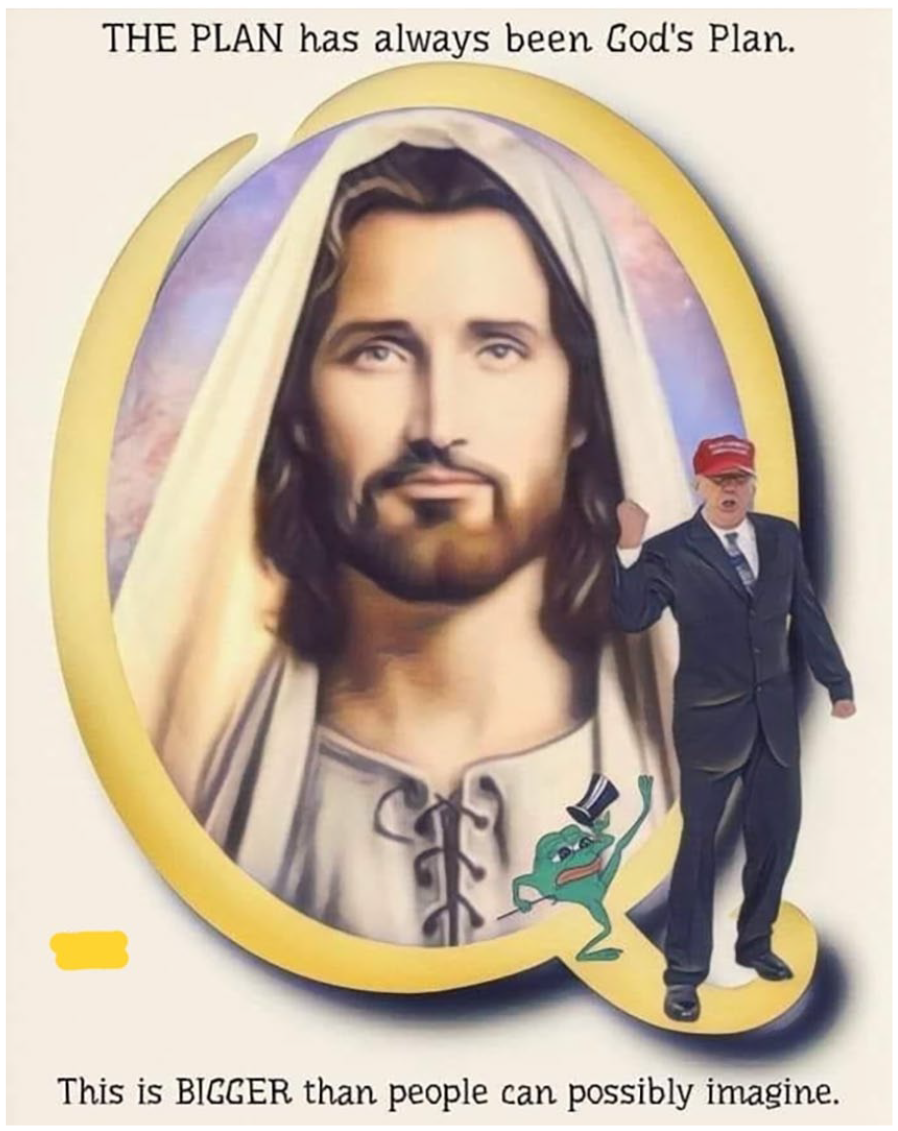
Image employing religious, QAnon, political and pop culture symbolism.
As mentioned, QAnon religious imagery typically presents a dichotomous cosmos in which the forces of good conflict with evil. Imagery presents this drama as played out in the US political landscape, with the forces of good represented by former President Trump and by Jesus Christ who promises salvation for the oppressed (the American public, vulnerable children). Evil is incarnated by numerous figures who are part of a hidden system of global oppression, ranging from Satan to US Democratic Party politicians and other cultural and financial elites (Figure 8). Images present an apocalyptic battle between these forces of the oppressors and the oppressed, which will lead to an eventual state of liberation.
The fourth and final category of religious images employ pop cultural and eclectic religious symbolism. The use of Pepe the Frog is frequent (Figures 1, 5, 6 and 7), but this meme is not the sole pop culture symbol adopted. The white rabbit metaphor is often used (Figure 4), drawing not only from the Alice in Wonderland novel but also from ‘The Matrix’ film (Shenk, 2006), referring to a mystical call for a follower to pursue an unconventional pathway towards illumination and truth. The use of pop cultural references and memes to link QAnon imagery with wider online meme-based movements such as the alt-right and provide shared symbolism of in-group affiliation. Likely, the references to movies and books in the images serve a similar function, spreading a message that targets a specific audience through an alternative means of communication. Further examination of these pop cultural elements of QAnon imagery was beyond the scope of this paper, but would likely provide a fruitful object of further study.
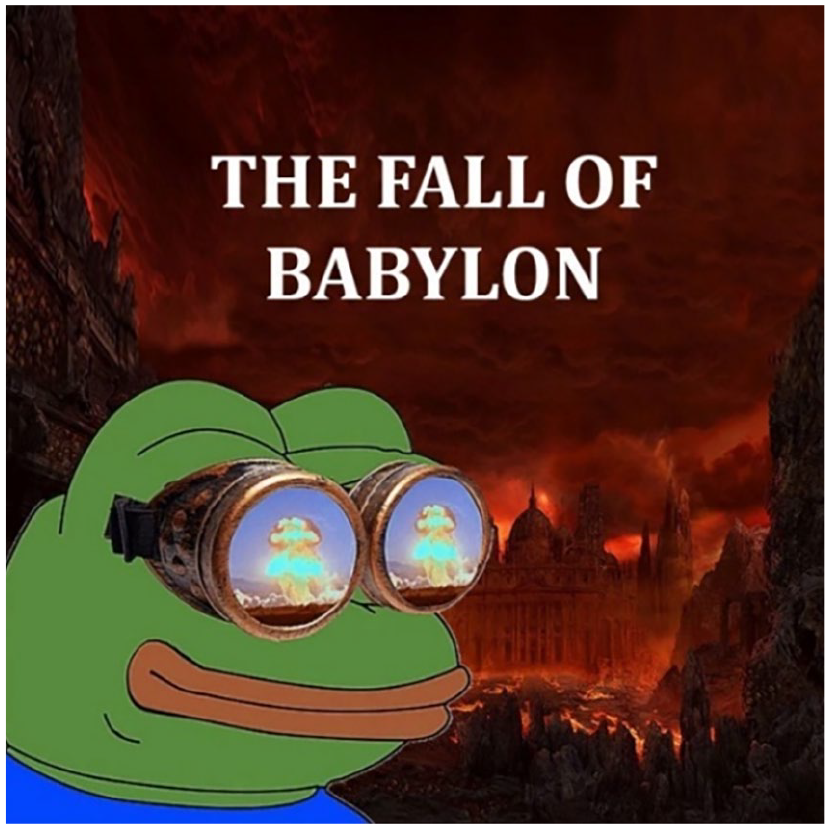
Pepe the Frog and the US Capitol depicted as Babylon, reference to nuclear war.
The four types of symbolism detailed above were often co-present, in some cases overlapping, within a single image. For example, the Pepe the Frog meme is not only a pop culture symbol but can also convey political significance (Greene, 2019; Miller-Idriss, 2019). QAnon symbolism very often overlapped with political and pop culture symbolism, all of which was infused with religious references.
QAnon as a Pseudo-Christian Extremist Movement
Although scholars have emphasised the likely increase in QAnon affiliates’ propensity to violence due to the influence of religious extremism (Argentino, 2020a; Hardy, 2021), situating QAnon’s religious extremism in the context of Christian movements like US evangelicalism and liberation theology can better account for the propensity to anti-government action and violence by QAnon followers. This section analyses the religious themes presented above and their blending with political and pop cultural motifs in the context of contemporary US Christianity. It is shown how close parallels exist between QAnon’s unique form of religiosity and traits from evangelicalism and liberation theology movements. These parallels help account for the propensity for QAnon members to join anti-government political movements and to engage in acts of violence. Images referring to two seminal events that have shaped the QAnon movement, the Covid-19 pandemic and the 6 January storming of the US Capitol building, are used to illustrate these points of connection.
Previous research points to the influence of evangelicalism on the QAnon movement (Argentino, 2020a; Hardy, 2021; PRRI, 2021a: 37, 2022; Vrzal, 2020). The present semiotic analysis of QAnon imagery bares out this connection, expands it and adds nuance. Of the four distinctive aspects of evangelical faith as defined by Bebbington (1989: 2–17), a focus on conversion and being ‘born again’ (conversionism), the priority of the Bible and its literal interpretation (Biblicism), personal atonement through Christ (crucicentrism) and engagement in social action (activism), three were identified in the semiotic analysis of imagery. These are Biblical literalism, an emphasis on Jesus (although not necessarily on personal atonement from sin), and a propensity for social and political engagement.
The high number of direct quotes from the Bible contained in the sample suggests QAnon’s followers do place importance on biblical scripture. However, they do not perform what could be considered orthodox literal interpretation, as their interpretations must be made in the context of the very un-Christian Q-drops. The visual emphasis on the figure of Jesus Christ who metaphorically represents Q/QAnon and its divine power to save followers has been noted above. Yet his image appears to represent the QAnon movement rather than the Christian congregation. The blending of political and religious themes in the dramatic cosmic battle between the forces of good and evil creates a strongly contemporary and this-worldly emphasis. This emphasis on activism manifests as attempts to spread the QAnon message more widely online and to encourage direct political engagement. The fourth element of Christian evangelicalism, being born again and personally ‘saved’ through the presence of Jesus/‘Q’, was not identified in the imagery.
Two other aspects of the images indicate similarities with US evangelical Christianity and Christian fundamentalism movements more broadly: a focus on apocalypticism, and the literal acceptance of the presence and works of Satan.
As noted, the sampled images point to the importance on biblical literalism. Several images referred directly or indirectly to the Book of Revelation and the broader idea of salvation provided by God to the believers, and of a coming golden age. The Book of Revelation is intrinsically connected to both apocalypticism and millennialism that respectively focus on the catastrophic global judgement of the world and the expectation of a future state of political and spiritual liberation (Sweetnam, 2018: 179). In the images collected, apocalypticism refers mainly to the fate of the out-group – QAnon’s enemies – while millennialism characterises the in-group – Q, QAnon, Trump and affiliates.
A significant number of images made direct reference to either Satan or the presence of demonic powers. The central QAnon belief in the satanic nature of the ‘deep state’ aligns with some trajectories of contemporary US Christianity. The spread of anti-Satanism movements in the United States, for example, was strongly connected to the rise of Christian fundamentalism in the 1970s–1980s (Richardson et al., 1991). For Christian fundamentalists, the sacred scriptures interpreted through the lenses of biblical literalism clearly predict the spread of Satanism and the increase in Satan’s power. Therefore, it is not surprising that the visuals collected often refer to Satan as an immanent threatening presence in the world (Figures 3 and 8). Moreover, QAnon’s narratives about Satanists murdering children and harvesting their blood (Figures 3 and 8) resemble the ‘Satanic panic’ rumours that spread especially in the United States in the 1980s–1990s. At that time, ‘Satanic panic’ strongly affected evangelical communities in the United States, being spread especially by media affiliated with evangelical groups (Soto-Vásquez and Sánchez-Santos, 2022: 3).
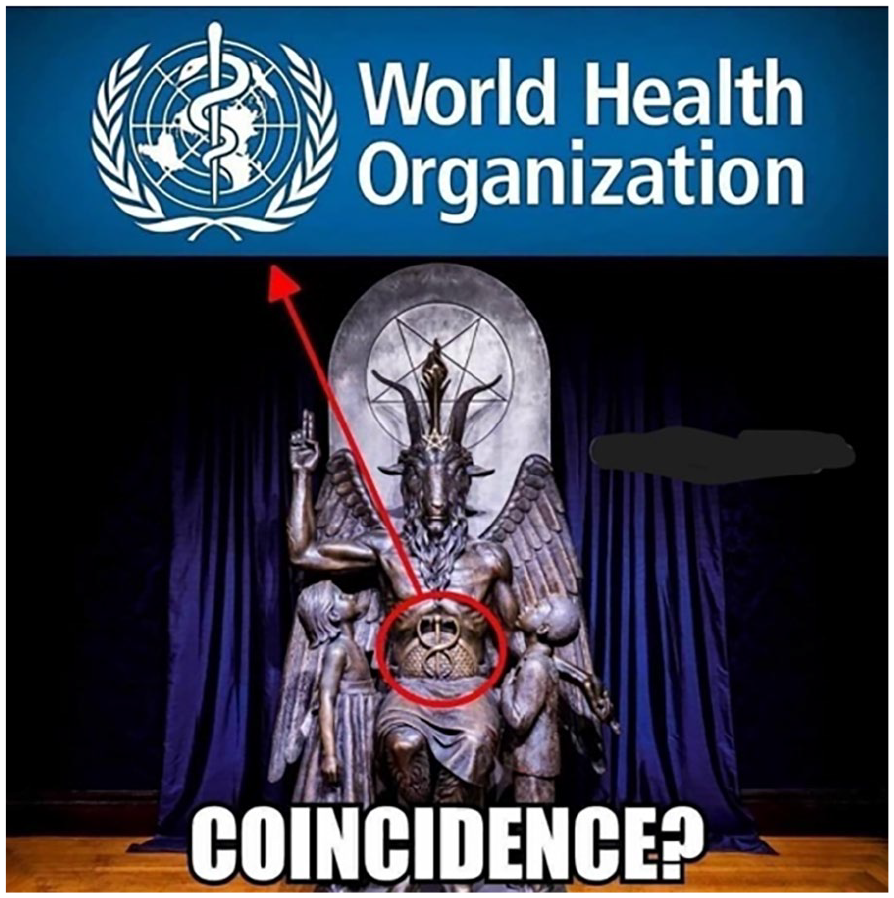
Image associating the World Health Organization with Baphomet flanked by children.
Although Christian evangelicalism does provide a useful lens through which to understand QAnon visuals, a consideration of a very different form of Christianity, liberation theology, provides a more suitable and useful frame to further understand connections between QAnon religious appeal, political extremism and violence. This is a contrast that has not yet been made in the academic literature. However, it should be emphasised that the concept is used for explanatory purposes to better understand the strong political character of QAnon pseudo-Christian extremism, rather than as a way of claiming any direct historical connection between the two. Indeed, liberation theology is not a formal church or branch of Christianity, but rather a way to describe a diversity of Christian-inspired political liberation movements. This caveat is necessary because QAnon is clearly not a form of liberation theology as normally understood. QAnon is usually associated with far-right politics while liberation theologies have historically been influenced by the far-left and Marxism. Moreover, liberation theology movements have not traditionally shared QAnon’s antisemitism.
The term liberation theology encompasses a range of social movements from Latin America (Foroohar, 1986), Africa (Jakobsen and Pillay, 2022), among US Black communities (Cone, 2000), Palestine (Patierno, 2015), to East Asia (Kim, 2018) that have developed within Christian congregations since the 1960s and that have been heavily criticised by the Catholic Church. Liberation theology emphasises the dichotomy ‘oppressors-oppressed’, the figure of Jesus as revolutionary and saviour, and the need to take socio-political action to liberate the oppressed and to confront political and economic injustice. The QAnon movement shares all these theological and socio-political perspectives.
Liberation theology’s emphasis on the oppressors-oppressed dichotomy derives from the work of Paulo Freire, a Brazilian philosopher whose writings strongly influenced liberation theology thinking in Latin America. In his 1968 book Pedagogy of the Oppressed, Freire argued that power structures in education, in particular the oppressive teacher–student relationship, deprived individuals of their humanity and agency, silencing voices of dissent. He made the case for radically changing education by transforming it into a means for enhancing critical thinking, making individuals aware of their status as oppressed and, eventually, liberating society. In his analysis, Freire (1968) strongly emphasised the operative nature of the process of liberation, noting that ‘a revolution is achieved with neither verbalism nor activism, but rather with praxis, that is, with reflection and action directed at the structures to be transformed’ (p. 126).
Freire’s views exerted a strong influence on liberation theology and inspired the reflection of some of its key thinkers. Among others, Gustavo Gutiérrez, a Peruvian Dominican priest and Catholic theologian who was among the founding fathers of liberation theology in Latin America, translated Freire’s ideas into a Christian theological framework. Gutiérrez analysed the extreme poverty affecting Latin American society as an unjust structure stemming from sin and argued for the transformative role of faith in tackling socio-political injustice. By reflecting upon the figure and message of Jesus and the Gospel, Gutiérrez (1973) argued for the merger between theology and socio-political action, affirming that a ‘direct, immediate relationship between faith and political action encourages one to seek from faith norms and criteria for particular political options’ (p. 138).
Gutiérrez’s ideas, as well as the arguments promoted by other liberation theologians such as Leonardo Boff, Jon Sobrino and Juan Luis Segundo, strongly emphasise that liberation from oppression translates into a form of theological and socio-political salvation through Jesus. The life, words and acts of Jesus are not mere religious messages but rather the spiritual and material guides to actively liberating the oppressed and wider society. Indeed, Jesus’ ministry is understood as a model of praxis that leads to liberation through socio-political direct action against elites (including the Jewish and Roman elites at the time of Jesus) and the uplifting of the most oppressed and marginalised sectors of society (Gutiérrez, 1973: 126–135). Jesus’ love for the marginalised and his struggle with the powerful elites during his own lifetime are framed by liberation theology as the template for the ongoing struggle against unjust and sinful political structures that needs to be carried out as a theological imperative.
The similarities between liberation theology movements and QAnon are pronounced. Like QAnon, liberation theology movements place particular emphasis on the figure of Jesus and the need to act in society by siding with the oppressed to fight political and economic injustice and achieve freedom (Kim, 2018: 3–4; Leathers, 1984: 1160–1162). Similarly, liberation theology places great emphasis on liberation and salvation, and interprets the sacred scriptures according to current political events and vice versa. Salvation is granted to the oppressed by Jesus who guides them in the spiritual fight for remission from sins and, simultaneously, in a socio-political fight for social justice and equality (Goizueta, 2015). QAnon emphasises the love of Jesus for the oppressed (QAnon followers), prophesises salvation and liberation from the current political moment, and encourages affiliates to take up direct socio-political action. As the visual analysis shows, Christ is a central figure in the QAnon religious discourse and is seen as the protector of the oppressed against the oppressors. The oppressors are identified as a satanic cabal made up of figures ranging from the US Democratic Party leadership, bankers and financiers, and Hollywood cultural elites (many of whom are Jewish). The oppressed are the QAnon believers and affiliates who struggle to interpret cryptic and prophetic Q-drops and resist the deceptions of the devil. Donald Trump is a messiah figure whose presidency embodies a divine plan towards political and religious liberation from evil. Hence, oppression and liberation are perceived as multifaceted and relating to both the worldly and political, and otherworld and spiritual, domains.
Finally, in a similar way to liberation theology, QAnon’s ultimate focus is on praxis, or the active merger of theology and socio-political action. From the perspective of QAnon believers, the theological-political message of Jesus resonates through former US President Trump and exhorts individuals to reflect on the unjust society they live in, and act to liberate it from evil forces. QAnon, through a theological reading of perceived oppression, encourages individuals to act directly to achieve salvation and liberation.
The most prominent example of perceived political and spiritual oppression among QAnon followers was the governmental public health measures and mandates taken in response to the Covid-19 pandemic. Visual imagery reveals how QAnon followers viewed lockdown and vaccination mandates as oppressive measures influenced by the devil. As Figure 8 illustrates, public authorities such as the World Health Organization (WHO) were associated with satanic forces, represented here by Baphomet. The image depicts Baphomet seated between two children, the caduceus symbol on his belly contrasted with the ‘rod of Asclepius’ medical symbol adopted by the WHO. The reference to the children conveys the core child sacrifice narrative of the conspiracy theory, linking it to the WHO and, by implication, to Covid-19 public health responses. By leveraging public anxieties around public health measures, QAnon followers were able to interpret the pandemic and its response as a religious and political battleground between oppressors and the oppressed.
This dynamic is further enhanced in Figure 9. The image represents a child sacrificial offering to Molech, a Canaanite pagan deity referred to in the Old Testament (Smelik, 1995; Stavrakopoulou, 2012). The image is an edited version of an original illustration found in the 1807 book Bible Pictures and What They Teach Us by Charles Foster. Molech is identified through pasted blurbs with the Pfizer vaccine, the priest presiding over the child sacrifice with the Federal Drug Administration (FDA), and the pagan worshippers with US media companies. The political message is clear; mainstream US media are supporting the FDA in their diabolic intent to vaccinate children with the Pfizer vaccine. Acquiescing to Covid-19 vaccination means succumbing to pagan child sacrifice. Therefore, vaccination refusal assumes a religious and political dimension, with the oppressors here depicted as the US government, pharmaceutical companies and the media.
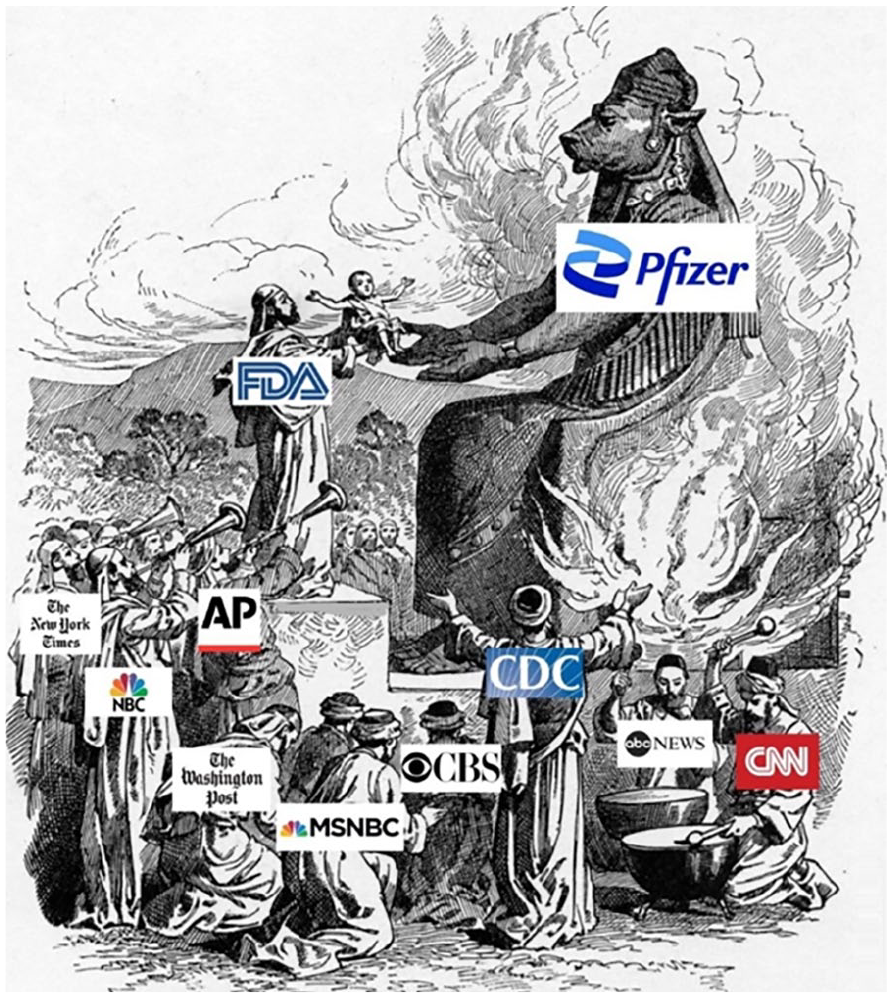
Image portraying Molech and drawing a parallel between child sacrifice and vaccination.
This reading of political oppression through a religious lens encourages affiliates to act against oppressors to achieve salvation and freedom. QAnon imagery consistently implies support for political activism in the guise of Christian nationalism and, especially, Trumpism. As noted above, Trump is a central figure in QAnon religious imagery. He is not just a political figure, but a messiah who will triumph over Satan through a series of cataclysmic events (Vrzal, 2020: 54). For QAnon followers, the arrival of Trump was ordained by God, and his political ascension cannot be stopped by the forces of the evil. Indeed, this eschatological perspective was adopted by Trump himself in his speeches, especially in the moments preceding the 6 January insurrection (Bond and Neville-Shepard, 2023).
As illustrated by Figure 7, the Capitol storming is viewed as a deeply significant religio-political moment in the struggle between oppressors and the oppressed. In this image, the Capitol building in Washington is identified with the ancient city of Babylon. As narrated in the Old Testament Book of Isaiah, Babylon was conquered in the 6th century BCE by the Achaemenid King Cyrus who was supposedly chosen by God to allow the exiled Jews to return to Jerusalem. The fall of Babylon/Washington implicitly conveys a reference to the former US President. Christian groups supportive of Trump have drawn parallels between him and Cyrus, seeing Trump as a modern-day liberator guided by God (Burton, 2018; Duff, 2021). The apocalyptical nature of the fall of Babylon and the Capitol storming is further enhanced by the image of the nuclear explosion reflected in the glasses of Pepe the Frog (Figure 7). The fall of Babylon/storming of the Capitol is the ultimate symbol of socio-political change, infused with religious significance and resulting in salvation and freedom. Indeed, on the day, numerous individuals affiliated with Christian organisations and movements displayed Christian symbols, sang Christian songs and recited passages from the Bible, referring to Trump and the Storming as a religious event connected to the concept of salvation (Rowley, 2021).
This dynamic of the ‘oppressed’ revolting against state ‘oppressors’ is highly indicative of liberation theology movements, which see the political establishment as responsible for the systemic discrimination against and domination of the oppressed (Goizueta, 2015). In this context, acting violently against the oppressive political establishment becomes a socio-political duty infused with theological legitimacy. Liberation theologies have been supportive of anti-government violence in Latin America, especially in countries such as Nicaragua and El Salvador where theologians have supported and even joined Marxist guerrillas (Sigmund, 1991). In a similar vein, both movements see in the establishment an oppressive agent that needs to be actively resisted. According to QAnon narratives, Donald Trump represents the socio-political opportunity to defeat the satanic establishment and accomplish the religious mission assigned by Jesus. Resisting Covid-19 health mandates and supporting Capitol Storming are part of the process of salvation and liberation from evil.
To summarise, QAnon’s brand of pseudo-Christian extremism and its propensity to violence can be better appreciated in terms of the movement’s theological and political legitimisation and justification of violent acts. Not only is violence contemplated from a theological perspective as it relates to the ultimate battle between good and evil, but it is also politically legitimised and infused with Christianity and Trumpism. QAnon’s brand of pseudo-Christian extremism defines the need to act violently in society as a religious duty by portraying the battle against the forces of evil as a theological necessity. The fight against a largely Jewish satanic cabal governing the world is simultaneously a Biblical battle ordained by God and a real political struggle played out in the dynamics of US presidential politics. As with earlier liberation theology movements, QAnon Christian extremism connects its theology to socio-political activism. This perspective and form of activism was heavily influenced by the global pandemic and associated governmental health responses which occurred from late 2019, 2 years after the origins of the online conspiracy. What followed was an interpretation of the Covid-19 pandemic as battleground between oppressors and the oppressed, and the elevation of the former US President Donald Trump as a religious-political messiah. This mythologisation of US politics offers QAnon affiliates the chance to transform politics into theology, defeat oppressors and obtain salvation and liberation. The 2021 Capitol Storming represented a prominent example of political extremism merged with theological extremism. As did Babylon fall, so did the Capitol (Figure 7) under the violent acts of QAnon supporters, guided by God, Jesus, Trump and Q.
Conclusion
Research focusing on QAnon’s religious dimensions provides useful perspective to better understand and conceptualise the influence of various strands of religiosity within the movement. This paper has taken this debate further through an empirical examination of QAnon imagery to better theorise the conspiracy theory’s relationship with religious themes, particularly those drawn from contemporary US Christianity. While numerous studies have suggested that QAnon is a cult, sect or new religious movement, this paper has shown that QAnon’s religious dimensions are deeply influenced by Christianity and can be well understood through the prism of liberation theology.
QAnon’s religious dimensions are multifaceted and infused with diverse symbolism and cultural references. However, Christian symbolism plays a crucial role in shaping QAnon’s visual narratives, often through its connections with other religiously inspired cultural and sub-cultural references. These include QAnon slogans, US politics and Trumpism, New Age and pop cultural references, and meme-culture. These different types of symbolism are interconnected and often co-present within the religious visuals examined, thus creating a form of pseudo-Christian political extremism focused on personal and social liberation from evil and oppression.
By comparing QAnon with Christian liberation theology movements, it is possible to better understand the movement’s connections with political extremism and aggression. Strongly connected to evangelical fundamentalist theology and the US socio-political landscape, QAnon Christian extremism conceptualises the world in apocalyptic/millennialist terms by portraying an ultimate battle between the forces of good and evil. QAnon conceptualises a world where the oppressed are promised salvation by God and Jesus. Salvation comes in the form of a religious socio-political struggle to defeat the oppressors and achieve freedom. The former US President Donald Trump is the ultimate representation of this struggle that can be carried out by engaging in political activism, such as protesting against Covid-19 health mandates, and violent acts such as the 2021 US Capitol Storming. In this context, support for the former US President Donald Trump does not result from mere political conviction but rather from an extremist theological interpretation of reality that sees in Trump a liberator and fighter siding with Jesus against the devil.
These findings encourage an attentive critique of the literature on QAnon’s religious dimensions, moving towards a clearer categorisation of QAnon as a religious phenomenon. The symbolism conveyed in the images suggests QAnon can best be understood as a pseudo-Christian extremist movement which shares commonalities with US evangelicalism and liberation theology. The application of liberation theology illustrates the connection between QAnon’s religious and socio-political themes, shedding light on why QAnon followers have engaged in political violence. Liberation theologies transform the religiosity of the oppressed into socio-political activism against the oppressors. Because QAnon affiliates see the oppressor as an evil entity, the incarnation of Satan on earth, they see themselves as religiously and politically legitimised to use potentially violent means. The pursuit of liberation is the natural outcome of this religious-inspired socio-political view.
However, labels such as evangelicalism and liberation theology need to be used carefully and with qualification. QAnon visual imagery shares elements with Christian evangelicalism such as Biblical literalism, crucicentrism and a focus on active political engagement, but expresses them in radially differing ways. It does not share an evangelical emphasis on conversion. Its main difference with liberation theologies is in political orientation. Liberation theologies have been mainly influenced by far-left ideologies like Marxism, while QAnon can be linked mainly to the far-right. QAnon visuals also spread antisemitism, theorising a spiritual and physical battle between the allegedly Jewish satanic ‘deep state’ aiming to destroy righteous Christians and God’s devotes.
QAnon is an online and (increasingly) offline phenomenon that is constantly evolving and changing. Hence, further research is needed to analyse QAnon’s religious dimensions and their impact on its affiliates’ propensity to violence. Because QAnon affiliates are increasingly participating in politics by running as candidates in US Congressional elections (Zitser and Ankel, 2021), future studies could pay attention to the socio-political dimension of QAnon and assess whether religiosity is playing a role in encouraging QAnon supporters to engage in mainstream politics. Moreover, it is important to further analyse QAnon religious dimensions from an international perspective. While this research focused on English-language Telegram sites, future research could address QAnon religious dimensions by looking at content production in different cultural and linguistic online spaces.
