




Abstract
We live in a time of protest. Relative to sociology, political science has traditionally paid little attention to ‘extra-institutional’ forms of political behaviour. For its part, sociology has tended to prioritize the explanation of mobilization processes over political outcomes. Using bibliometric records from 14 political science and sociology journals over the last two decades, this study demonstrates that protest has witnessed a resurgence of interest in political science and that both sociology and political science now share a focus on the outcomes of protest. The article lays out key trends in this research agenda and suggests what is missing, arguing that a political sociology of protest should integrate recent findings from both disciplines to better understand elite decision-making, the mediation of protest information and protestor aims.
Introduction
The 2010s has been hailed a decade of protest (Clement, 2016). Ushered in with the wave of Arab Spring protests across the Middle East and North Africa alongside ongoing street protest after the 2008 financial crisis in Europe and North America, major protest episodes would continue to stir throughout the decade. This culminated, in 2019, with large waves of civil unrest in all of Algeria, Bolivia, Catalonia, Chile, France, Hong Kong, Iran, Iraq, Kazakhstan, Lebanon, Sudan and Venezuela. The last year of the decade also saw one of the largest simultaneous protests in history, as millions mobilized for the September 2019 Global Climate Strike. Amid the global pandemic of 2020–2021, protest did not abate. Popular mobilization against state-enforced lockdown measures combined with worldwide protest against racism triggered by the murder of George Floyd by a police officer in Minneapolis, Minnesota (Kishi and Jones, 2020; Pavlik, 2020).
Available cross-national data lend empirical weight to this impression of escalating worldwide protest. Event data from six separate sources show, with the partial exception of Europe, generalized increases in protest frequency or intensity over the post-2008 period (Figure 1). In the news, too, protest reporting took centre stage as politics took to the street. Figure 2 displays some examples of this reporting alongside time-series data from Google Trends showing that English-language news interest in ‘protest’ has steadily increased since measurement began in 2007, with peaks in 2011, 2016, 2019 and 2020. 1 Search trends in the aftermath of the George Floyd protests of 2020 point similarly to the worldwide resonance of this protest campaign (Barrie, 2020). Contentious claim-making, it seems, has become an ever more routine part of political life.
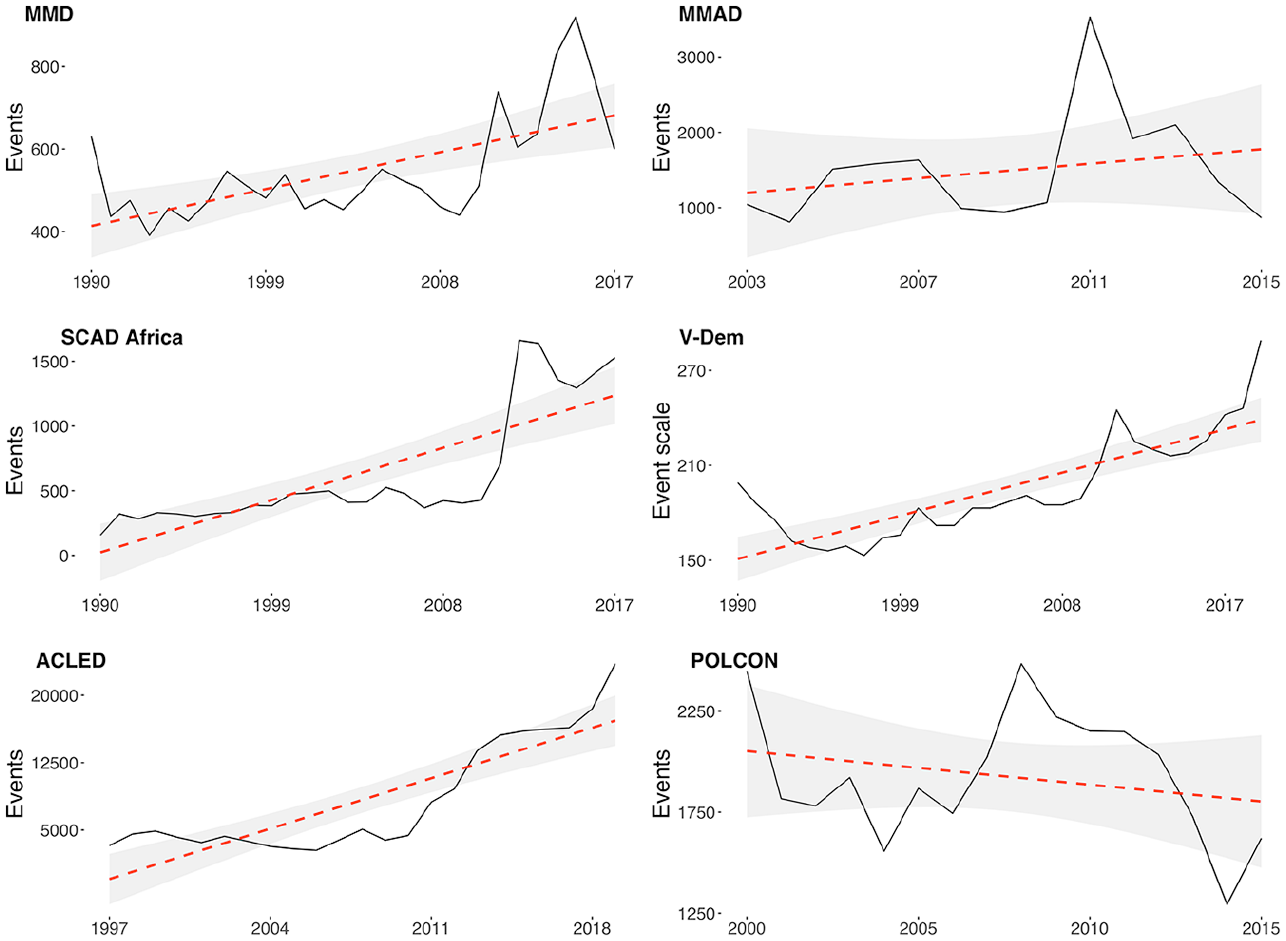
MMD (Mass Mobilization Database) from Clark and Regan (2018): 166 countries across South America, Central America, North America, Europe, Asia, MENA, Africa; MMAD (Mass Mobilization in Autocracies Database) from Weidmann and Rød (2019): 76 autocracies across Central America, Asia, MENA, Africa; SCAD (Social Conflict Analysis Database) from Salehyan et al. (2012): 49 countries across Africa; V-Dem (Varieties of Democracy version 10) from Coppedge et al. (2020): 202 countries worldwide, events summed over (0–4) ordinal scale of intensity; ACLED (Armed Conflict Location and Event Data Project) from Raleigh et al. (2010): 48 countries across Africa; POLCON (Political Conflict in Europe in the Shadow of the Great Recession) from Kriesi et al. (2019): 30 countries across Europe.
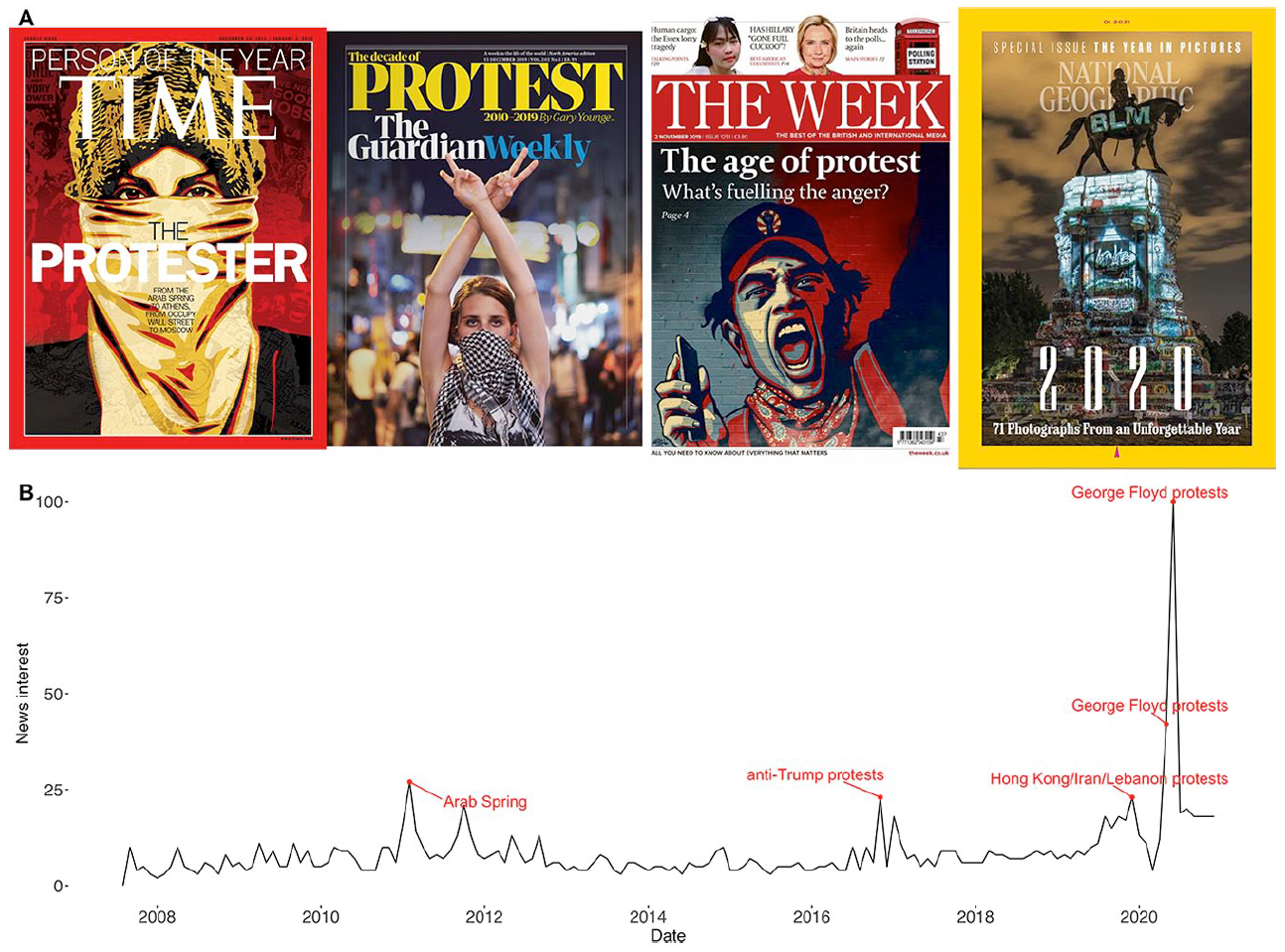
A: Front pages of Time (Dec. 2011); The Guardian Weekly (Dec. 2019); The Week (Nov. 2019); National Geographic (Dec. 2020). B: English-language news interest for ‘protest’ from Google Trends.
In this article, I ask whether the study of protest has also become more routine across both sociology and political science, and what this might mean for the political sociology of protest. Political sociology examines the connections between the social relations of human society and the institutional – and extra-institutional – dimensions of politics. What distinguishes political sociology is its focus on the ‘intersection’ of the social and the political; that is, how social forces are ‘translated’ or ‘channelled’ into political outcomes (Sartori, 1969).
The empirical basis of this article is a set of bibliometric data from 14 sociology and political science journals over the last two decades. With these data, I demonstrate a resurgence of interest in protest among political science researchers as well as an emergent shared interest between sociology and political science in the outcomes of protest. This research targets precisely that region where political sociology is most relevant: the intersection of social forces and political outcomes.
As I go on to describe in the next section, an emphasis on outcomes also represents an important shift of direction for sociology, which has long favoured the explanation of mobilization processes over outcomes. The more recent shared focus on political outcomes means we can build on the emphasis placed by sociology on processes of mobilization. That is, a political sociology of protest will not abandon the search for understanding processes of mobilization but redirect the study of such processes to understanding how they might contribute to achieving concrete political outcomes. The how of protest mobilization throws into relief the organizations and institutional vehicles through which popular grievances are heard. And this close attention to the how of mobilization may yet speak productively to the corollary emphasis placed by political scientists on the electoral or attitudinal outcomes of collective action. Instead of asking only how protestors mobilize, how they marshal resources available to them, take advantage of political opportunity, and frame their campaigns to recruit activists, political sociologists of protest might ask how they exploit these dimensions of the mobilization process to win political gains. I close the article with a discussion of three main areas where this agenda is most promising: in understanding elite decision-making; in the channelling of protest information through news media; and in a closer attention to the aims of protest campaigns.
Sociology, political science and protest
For a long time, the study of protest and social movements – as a specialized subfield – has been the domain of sociology. 2 The American Political Science Association does not count a dedicated outlet for protest and social movements among its 49 Sections; the Section for ‘Collective Behavior and Social Movements’ in the American Sociological Association dates, for its part, to 1981. That is not to say that political science had nothing to say about protest over this period. Two of the central tenets of Social Movement Theory – political opportunity and resource mobilization – can be traced to contributions from political science (Eisinger, 1973; Lipsky, 1968; for reviews see: Meyer and Lupo, 2010; Vassallo, 2018). Alongside framing (Snow et al., 1986), political opportunity structures (Tarrow, 1998) and resource mobilization (McCarthy and Zald, 1977) would come to constitute the theoretical core of social movements studies as a self-contained discipline. And, by the late 1970s, the specialized study of social movements and collective protest ‘was largely ceded to sociology’ (Meyer and Lupo, 2010: 112; see also Walder, 2009).
Born in the context of mounting protest worldwide and, in the US, ongoing civil rights protest, the study of social movements became a core discipline within US and European sociology departments. Compared to scholarship that preceded them, the approach of the post-1960s generation of scholars to the study of protest looked starkly different. Instead of searching out structural causes for the why of mass protest, scholars turned to the how of mass mobilization: to the processes and context of its onset, development, and success or failure (McAdam, 1982). Over the course of the 1980s and subsequent decades, the core tenets of social movement theory would become touchstones for most sociological work on protest and social movements. As a result, Walder (2009) has argued, a concern with mobilization processes took over from any concern with explaining the political context or political outcomes of social movements.
At around the same time sociology abandoned the search for relationships between social movements and social structure, sociology’s interest in public opinion research also began to wane (Manza and Brooks, 2012). 3 These two trends were no doubt connected. As Manza and Brooks (2012) explain, in the context of mass movement mobilization in the 1960s and 1970s worldwide, and particularly in the US, sociologists viewed public opinion as a flawed research agenda, ill-equipped to cope with the rapid social change defining the period. As a result, ‘public opinion came to be viewed as an individual and behaviorist phenomenon, of little relevance in the . . . movement-oriented agendas that were coming to dominate the field’ (2012: 90). The (2004) Blackwell Companion to Social Movements includes just two index entries for ‘public opinion’ and one chapter explicitly treating the topic in which we are told that ‘[n]ot only do polls fail to measure public opinion, but their ability to measure population opinion is fundamentally problematic’ (Gamson, 2004: 246). That is not to say that sociology has had nothing to say about outcomes, and public opinion specifically. Giugni (1998) does see public opinion as a potential mediating factor determining outcomes, and Burstein (1998) made an early – if unheeded – call for sociology ‘to bring the public back in’. But when it comes to public opinion and outcomes more generally, the sociological field has been marked by a reluctance to speak in terms of movement ‘success’ or ‘failure’, instead pointing to the ‘diffuse consequences [of social movements] that go far beyond the question of whether a particular goal has been attained’ (Oliver et al., 2003: 220). What is more, these authors argue, outcomes tend to be decided iteratively in the contingent (and sometimes offstage) process of action and reaction characterizing contentious claims-making (e.g. Giugni, 2007; Oliver and Myers, 2003; Tilly, 1998), leading one contributor in the 2015 Oxford Handbook of Social Movements to conclude of environmental movements that ‘determining the extent and significance of their impact is more art than science’ (Rootes and Nulman, 2015: 734). Once again, then, we are returned to mobilization processes and to a focus on the how of collective action; a focus which most often runs counter to any causal account of mobilization outcomes.
Recently, I show below, we have witnessed an uptick of political scientific interest in the study of protest. Moreover, we see a shared interest from both sociologists and political scientists in the attitudinal dimensions of protest outcomes. What questions does this new research seek to answer? How do these questions compare to those asked in the sociology literature? How is protest conceptualized? And what are the implications of this resurgent political science interest for a political sociology of protest? I aim to provide some answers in what follows.
Data and analysis
For the bibliometric analysis, I extract information on author, date of publication, title, keywords and abstract for all articles published in the top seven generalist political science and top seven sociology journals over the period 2000–2020. Journals were selected on the basis of impact factor (h5-index) and generality of scope. The political science journals are American Journal of Political Science; American Political Science Review; British Journal of Political Science; Comparative Political Studies; Journal of Politics; International Organization; and World Politics. The sociology journals are American Journal of Sociology; American Sociological Review; British Journal of Sociology; European Sociological Review; Social Forces; Sociological Methods and Research; and Social Problems. 4
The observation period is chosen to capture more recent trends in scholarly output. It also enables us to compare publishing trends before and after the 2007–2008 financial crisis, and before and after the mass adoption of new online media as protest resources, two defining events of the past 20 years that have left their mark on the landscape of protest worldwide (Borbáth and Gessler, 2020; Bremer et al., 2020; Milkman, 2017; Tufekci, 2017). 5 Data were extracted from the Web of Science and analysed with the aid of the R package ‘bibliometrix’ (Aria and Cuccurullo, 2017). This process generated 10,131 political science journal contributions and 11,717 in sociology. Collectively, I will refer to these as the ‘records’. I follow the recommended workflow for bibliometric analysis outlined in Aria and Cuccurullo (2017), which involves three stages: (1) data collection; (2) descriptive analysis and data reduction/network generation; (3) cluster visualization.
Four main keywords or phrases were used to collect articles relating to protest from the content of article abstracts. These were: ‘protest’, ‘protestor’, ‘social movement’ and ‘contentious politics’. 6 For the first three terms, the pluralized versions were also used. This process generated 437 protest-related articles; 133 in political science and 304 in sociology.
By visualizing the citation landscape of protest research across both political science and sociology, we are able to examine the most common references in protest research over the past two decades (Figure 3). Here, I use the bibliographies of all protest articles from 2000–2020 across 14 political science and sociology journals and generate a co-citation network. 7 Nodes in a co-citation network represent articles that appear in the bibliographies of protest articles. Edges between nodes occur when both nodes (bibliography entries) are cited in one of our records (protest articles). To take an example from both political science and sociology, an edge will link Kuran (1991) to Olson (1965) because both are cited in Tucker (2007) and an edge will link McAdam (1982) to Earl et al. (2004) because both are cited in Biggs (2018). Visualizing the network in this way helps identify both the most commonly cited articles (larger nodes) as well as the clusters of co-citations or ‘communities’ within the network (Aria and Cuccurullo, 2017). 8 Three communities emerge, which correspond broadly to sociology (blue), political science and sociology/political sociology (red), and political science (green). 9 Nodes are sized by in-degree – calculated from the number of times they are cited across all records.
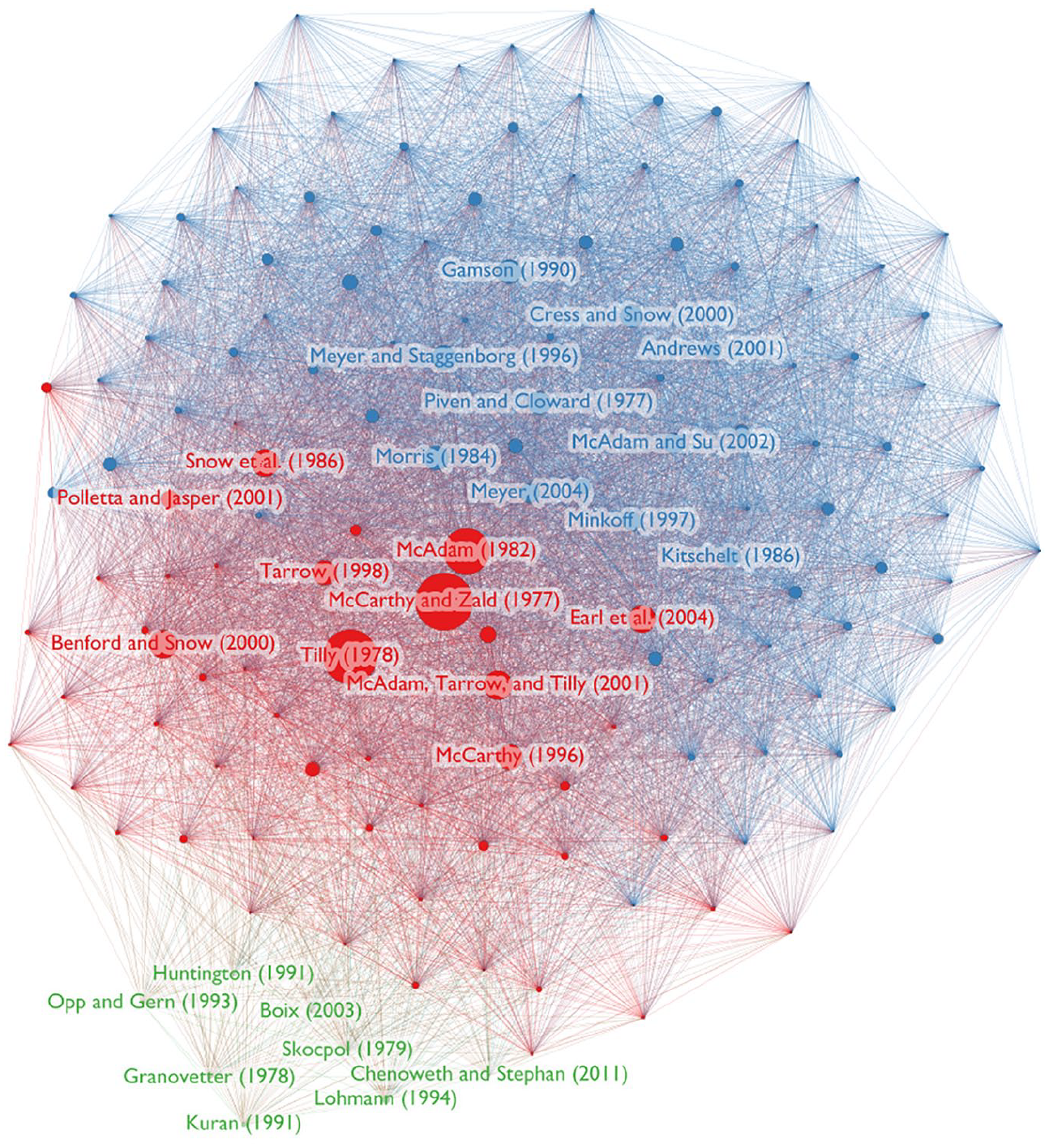
Co-citation network based on protest article bibliographies.
What are the key references for the study of protest according to the bibliographic record? Five of the top 20 most frequently cited articles in the bibliographies of our political science articles also appear in the top 20 most cited articles from the sociology bibliographies. These are: McAdam (1982); McAdam et al. (2001); McCarthy and Zald (1977); Tarrow (1998); Tilly (1978). 10 We thus see that Walder’s (2009) diagnosis borne out. The key references derive from a social movement theory paradigm foregrounding the explanation of mobilization processes over the political correlates of movement outcomes and emergence.
I then pooled abstracts across journals and years separately for political science and sociology journals. From these, I calculated the proportion of total words contained in abstracts for each discipline-year that were related to protest (i.e. which matched one of our protest keywords). Second, I calculated the proportion of articles for each discipline-year that contained at least one of the protest keywords. The results of this analysis are visualized in Figure 4. As should be clear, protest has become, over the last two decades, increasingly popular in political science. In sociology, on the other hand, we see a slight downward trend when measured in terms of word frequency and article count. Comparing between overall levels of popularity across disciplines, we see that in the last two decades, the popularity of protest as a topic in political science has now equalled its popularity in sociology. As a proportion of overall words, protest-related words fall from above 0.15% to around 0.1% of journal abstract words in sociology across the 20-year observation window. In political science, barely any abstracts mentioned protest in the year 2000, but 20 years later protest was featuring with the same, or greater, frequency as it was in sociology. Looking to the right-hand column of Figure 4, we see that, at the start of the millennium, protest was a focus in around 1% of articles in political science but that, 20 years later, this figure had increased to around 3.5% – a level almost equal to that of sociology over the 20-year observation window. 11
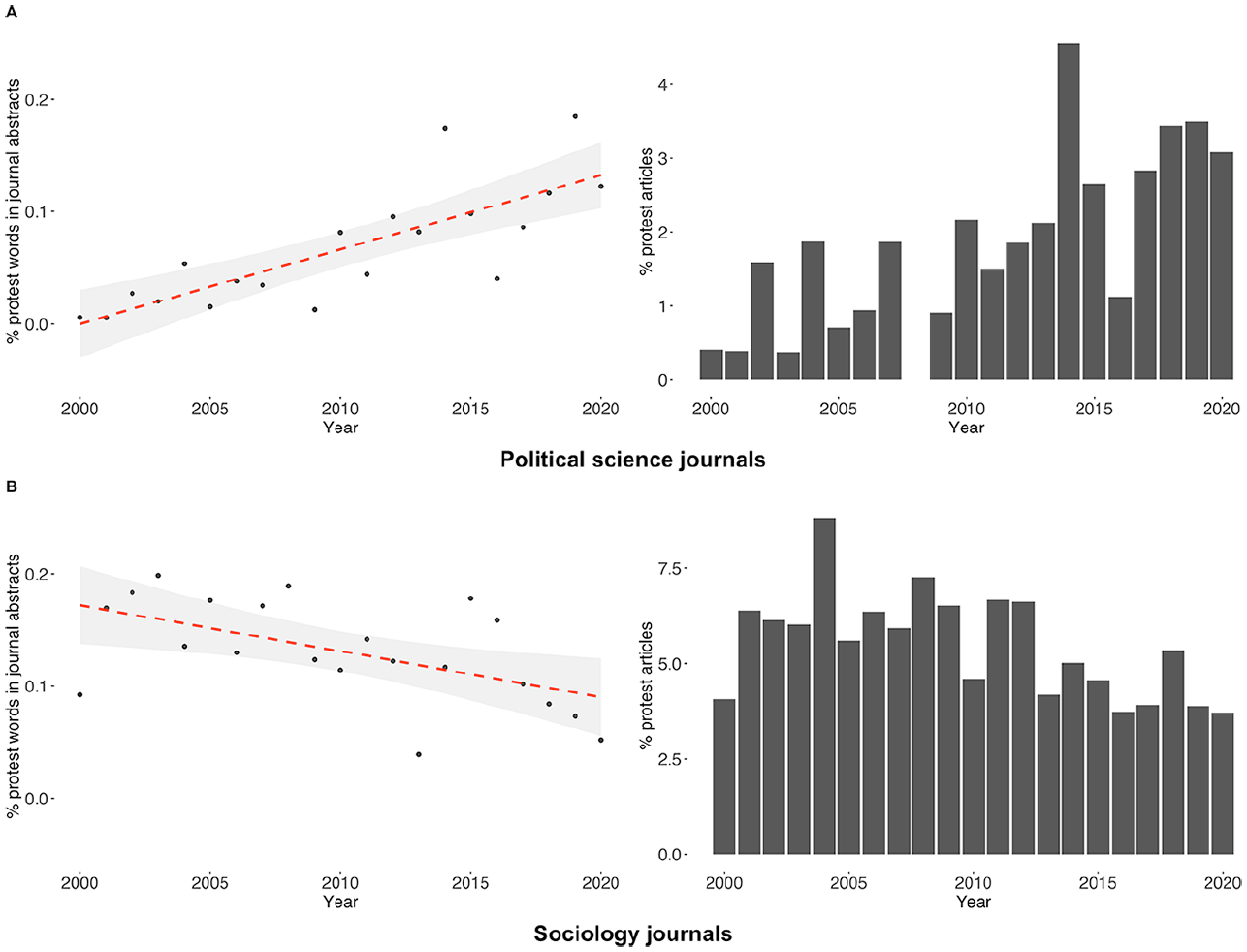
Protest word frequency (A) and protest article frequency (B) in political science and sociology journals, 2000–2020.
The network graph in Figure 3 provides insights into commonalities in bibliographic records; i.e. into key points of reference from citations to past protest research. In order to study the topical focus of current protest research, we can analyse keywords assigned to each of our records. Relative keyword frequency is calculated by first taking all keywords for each of the sociology or political science journals, calculating their frequency, and denominating each keyword with the total number of keywords for each discipline. Those words that fall along the 45° line in Figure 5 appear with similar frequency in both political science and sociology. We notice that a common family of keywords falls within this area: ‘attitudes’, ‘outcomes’, ‘public opinion’, ‘impact’ and ‘consequences’. All of these words pertain directly or indirectly to the outcomes of protest. 12 Aside from the common keyword topics relating to protest generally – e.g. ‘dynamics’, ‘mobilization’ and ‘collective action’ – these keywords were the only ones to appear with a similar high frequency between political science and sociology.
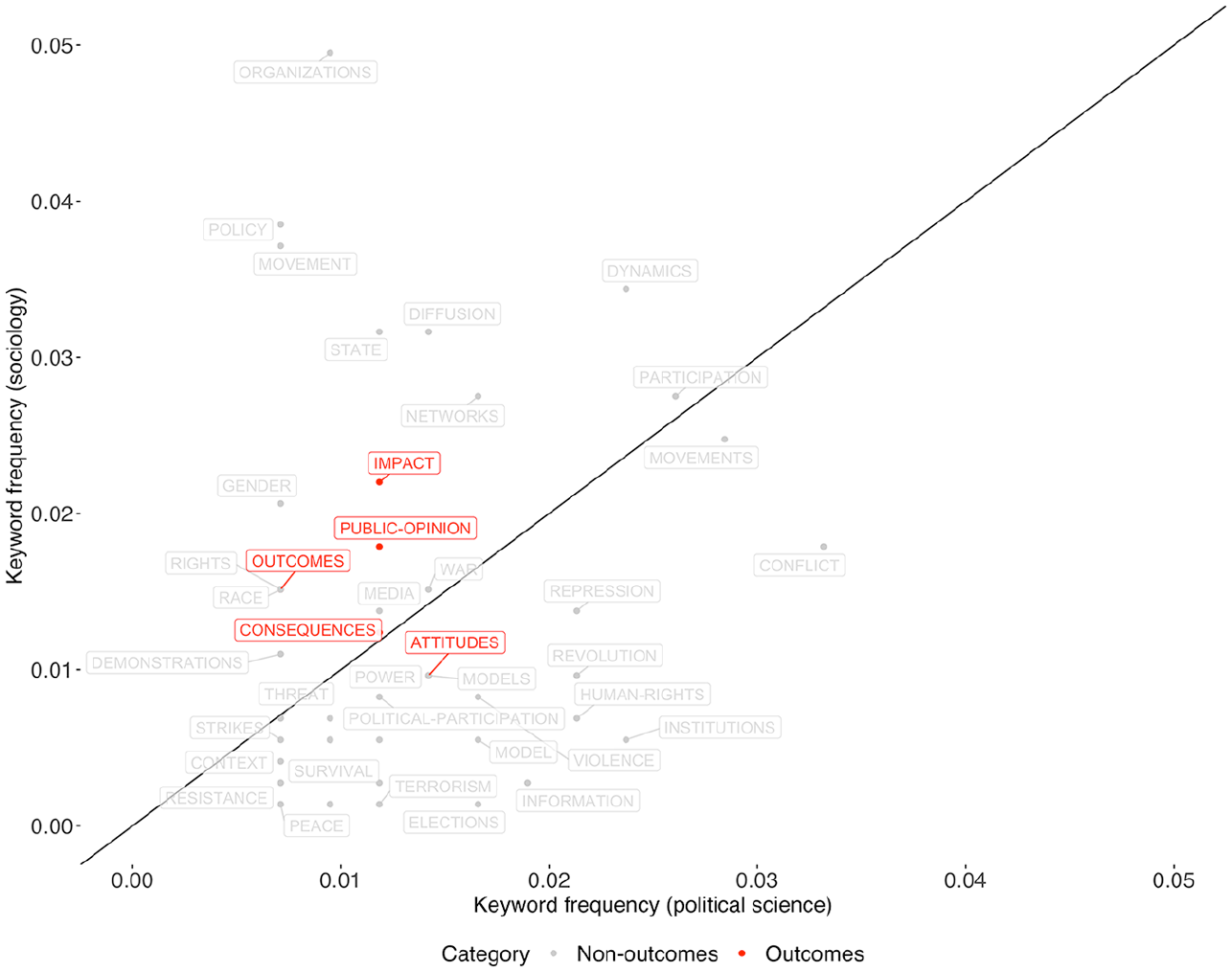
Shared topic keywords between political science and sociology.
Just 11 of 41 sociology articles on the subject of outcomes were published before 2010; four of the 19 political science articles were published before this date. The recent convergence between political science and sociology on outcomes is, then, a more recent phenomenon. 13 I elect, in what follows, to discuss the possibilities for a future research agenda built around the study of the protest outcomes.
Protest outcomes
What do we mean when we talk of protest outcomes? It is worth stating firstly what we do not mean. Democratic transition or the toppling of an authoritarian incumbent are, of course, outcomes often accompanied or precipitated by protest (Chenoweth and Stephan, 2011; Haggard and Kaufman, 2016; Kadivar, 2018). Given the size of this literature, however, I leave to one side any discussion of democratization ‘from below’. Instead, I employ a more minimal understanding of outcomes that includes changes in public opinion and voting, as well as changes to policy and the behaviour of political elites. As will become clear, these types of outcome, and the theoretical frameworks used to understand their relationship to protest, are most relevant to democratic contexts. I nonetheless make reference to examples from non-democratic contexts where appropriate. This narrowed definition still includes a majority of the most recent research on protest outcomes.
Protest occupies a position of only minor importance for explaining outcomes in the earlier political science literature. Page et al. (1987) suggest that ‘interest groups’, such as the anti-war movement, tend to deter the public from adopting their position, while Zaller (1992) sees minority group interests as orthogonal to changes in mass opinion and voting, which derive mainly from political elites and the media. With regard to legislative outcomes, Lohmann (1993: 319) concludes that, since politicians aim to satisfy the preferences of the median voter, ‘[i]t is puzzling that rational political leaders with majoritarian incentives would ever respond to political action’ by protest groups (see also Burstein and Linton, 2002: 384). In summary, a student of political science during this period would have reason to understand protest as either irrelevant, off-putting, or bound not to influence legislators whose incentives are at odds with minority group interests.
More recent contributions take a different course. Figure 6 summarizes the causal sequences proposed by this literature. 14 I take each pathway in turn, and discuss the mechanisms proposed by recent political science and sociology articles in our bibliographic record set.
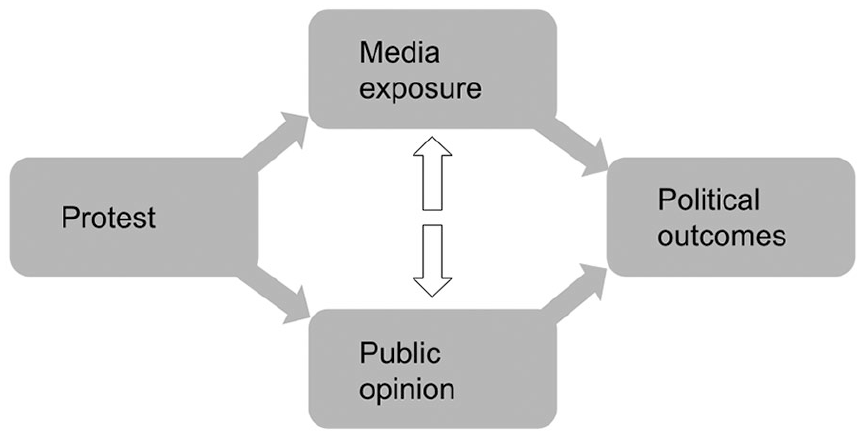
Causal diagram of pathways of protest influence on political outcomes.
Protest and public opinion
A first mechanism linking protest and public opinion is that of identification or appeal. Wouters (2019) argues that protestor groups aim to bring the public round to their opinion by deploying persuasive tactical repertoires. Persuasive repertoires look like those Tilly (1995) characterized as having ‘WUNC’ (Worthiness, Unity, Numbers and Commitment). Taking lessons from Social Identity Theory (Tajfel and Turner, 1979), Wouters argues that protestors thus make available alternative group categorizations with which bystanders might identify. Mazumder (2018) makes a similar claim, arguing that US Civil Rights groups succeeded by priming an inclusive ‘common ingroup’ (Gaertner and Dovidio, 2000) to which white Americans could claim allegiance.
The idea that protest primes, or makes salient, certain issues is central to the second mechanism apparently linking protest to changes in public opinion. Direct exposure to protest increases the salience of a given issue in the mind of the public, increases awareness, and leads to shifts in mass opinion toward the positions of protestors (Branton et al., 2015; Carey et al., 2014). The increased issue salience brought about by protest also has the capacity to bring about what Lee (2002) calls ‘activated mass opinion’, whereby small groups can impel wider publics to act on new items on the issue agenda (by e.g. writing letters, signing petitions, or engaging with popular referendums). 15
Direct experience of protest might also have downstream effects on public opinion, which result from social interaction in the aftermath of an event. McVeigh et al. (2014) find a sustained correlation between racial attitudes and exposure to Klu Klux Klan activism, explaining these findings with reference to patterns of interaction and social sorting that resulted from KKK activity. 16 Enos et al. (2019) argue that voter mobilization in the wake of race riots, resulting from the network activation prompted by these events, lay behind subsequent electoral shifts.
Importantly, the articles privileging issue salience and social interaction assume that protest exerts any effect locally. However, we know that protest and social movements are acutely mediatized phenomena (Gamson and Wolfsfeld, 1993). To what extent does protest rely on this mediation?
Protest and media exposure
The assumption underlying much of the sociological literature on protest and media coverage is that protest requires public exposure to have any effect (Andrews and Caren, 2010). And there is bias to this coverage. Certain protests – those that are backed up with stronger organizational infrastructures, use disruptive tactics, resonant frames, and encompass large swaths of society – are more likely to make the news (Amenta and Elliott, 2017). The reason for this is that such events, and the issues they advance, resonate with the values of news organizations (Andrews and Caren, 2010).
Of course, and as depicted by the bidirectional arrow linking media and public opinion, media attention is likely to lead to more public discussion, which might feed back to help sustain the media exposure a movement receives (Jennings and Saunders, 2019).
Protest and political agendas
Once an item reaches the public agenda, recent research finds that legislators tend to take their cues from both citizens and the media (Barberá et al., 2019; see also King et al., 2017). The effect of protest on political outcomes, in other words, is likely mediated through shifts in public opinion and shifts in media attention. 17 According to this understanding, legislators respond to shifts in public mood and media coverage rather than setting the agenda themselves.
A parallel strand of literature finds that protest can also exert a direct effect on political outcomes. The mechanism common to articles claiming a direct effect is information.
Protest, per these accounts, is a signal of information, or ‘informative cue’ (Gillion, 2013; Wouters and Walgrave, 2017). 18 That is, in a limited information environment, protest provides legislators with a source of information about the issue priorities of citizens. Encoded in this information is electoral threat: unless legislators satisfy the demands of key publics, they face missing out on re-election (Andrews and Seguin, 2015; Gillion, 2013).
Toward a political sociology of protest outcomes
How might these contributions complement each other and what questions remain? Each of the above areas of research speak to particular types of political outcomes. For each of these, I argue, there are key questions that need to be answered. In what follows, I outline these questions and suggest several future research agendas. With regard to protest and public opinion, I argue that to understand legislator responsiveness to perceived constituency concerns and public opinion we need to focus on the individual and institutional determinants of legislator responsiveness. As for protest and its mediation through news organizations, I argue that an attention to movement-level characteristics can be combined with data on legislative speech and outcomes to evaluate the efficacy of different campaigns. Here, digital trace data may be of particular value for providing spatially and temporally granular data on movement and legislator activity. Finally, by focusing on protestor aims we can better understand how movements might influence political agendas. Here, the calculus of inflicting costs is distinct from raising awareness, and thus we should be sensitive to the aims of protestors when examining the political outcomes of popular mobilization.
Elite decision-making
Common to several of the recent political science contributions discussed above is a focus on the informational function of protest. Protest provides elites with a signal of citizens’ priorities and thus moves them to action. However, a tension remains in this literature. Protest rarely, if ever, incorporates mass constituencies within its fold (Chenoweth and Belgioioso, 2019). Why, then, would politicians respond to what is manifestly minority opinion? Recent work by Miler (2009) in the field of political psychology points to one reason. Legislative elites often rely on the ‘availability heuristic’ (Tversky and Kahneman, 1973) to make judgements about the priorities of their constituents. Constituent concerns that come to mind most readily, Miler (2009) finds, are those advanced by the active and resource-rich; i.e. precisely those who are likely to participate in social movement organizations (Schussman and Soule, 2005). This finding tallies with the recent work of Barberá et al. (2019), who find that legislators tend to respond to more partisan constituents, whose voices are amplified by the media (cf. Gause, 2020). 19 A second potential answer comes in the form of cost. Protest imposes costs on governments by signalling instability, diverting media attention from new policy directions and achievements, or inflicting economic costs through disruption. Cost is also central to sociological explanations of movement impact and success (Biggs and Andrews, 2015; King and Soule, 2007).
The incorporation of cost considerations into a political sociology of protest outcomes would also require an attention to political and institutional fields. Among the protest articles analysed above, far fewer contributions in sociology compared to political science take institutional contexts into account. This is perhaps to be expected. But institutions are of central importance for understanding likely political outcomes. Where politicians are principally accountable to their party leader – where fewer ‘principals’ prevail – party unity is more likely, meaning that individual legislators are less likely to respond to the targeted demands of outside actors (Carey, 2009). Protestors may also be able to influence the political agenda at earlier stages of the policy-making process, where ‘institutional friction’ (Bevan and Jennings, 2014) is lowest, but may be less successful later on (Santoro, 2002; Soule and King, 2006). Electoral systems, too, will shape political responses. The incentive structure of individual legislators in closed-list versus single-transferable-vote systems are at odds (Carey and Shugart, 1995); while the first incentivizes party discipline and dissuades legislators from personal vote-seeking, the latter does the opposite. More generally, in proportional representation systems, single-issue and minority parties are more likely to enter government (Carey, 2009). It remains an open question whether parties in such systems are more likely to give voice to minority demands (Soroka and Wlezien, 2015). Finally, political competition is known to influence the responsiveness of governments: where competition is high, legislators have an incentive to respond to citizen concerns (Binzer Hobolt and Klemmensen, 2008). Whether or not such competition leads to heightened responsiveness to minority demands remains an open question (but see Hutter and Vliegenthart, 2018).
Some recent contributions do pay attention to institutional context. Cornell and Grimes (2015), for example, find that politicized public administrations are more likely to respond to the protest demands of constituents. In such contexts, they argue, politicians very often have links to, and thus sanction, those instigating protest. In somewhat similar fashion, sociologists have argued that protest might exert its effect through ‘insiders’. That is, movement members may themselves attain office-holding positions, thereby allowing them to implement the policy agendas of a given movement (Gibson, 2017). 20
How, then, would a renewed attention to elite decision-making help advance a political sociology of protest? To understand which political elites would be most sensitive to these costs, we would need to ask under what institutional arrangements are they likely to be most vulnerable, as well as what branches of government are most likely to be responsive to protest? Such research might operate in a quantitative setting, examining the responsiveness of elites to protest cross-nationally, where the key variation of interest is institutional context. The effect of electoral competition on responsiveness might operate in a subnational context, where the key axis of variation is some operationalization of competitiveness (Cox et al., 2020). While these quantitative investigations may shed light on the role of institutional and electoral context on legislator responsiveness, they do not solve the riddle of why legislators might respond to minority protest demands in the first place. Here, political sociologists have much to learn from qualitative and experimental scholarship in political communication that shows how individual legislator biases inform their responses to perceived constituent concerns (Butler and Dynes, 2016; Miler, 2009).
Mediating protest
Related to institutional context, political sociologists of protest need to spend more time considering the appropriate level at which to measure the effects of protest. Protest may exert its effect at different geographical levels, as well as different levels (branches) of government. Various examples discussed above focus on the effects of local protest exposure. Whether this choice is theoretically driven or imposed by concerns of causal identification, however, is not always clear. Spatially disaggregated protest event data are a requirement for research designs seeking out exogenous variation in exposure from observational data. But we know from past research that protestors pick protest locations wisely (Tilly, 1995) and campaigns aiming for a place on the national agenda will protest in capital cities and outside institutions of state (McCarthy et al., 1996). Further, very few bystanders will witness protest directly, meaning that any effect of protest on mass opinion is likely filtered through the media.
This is not to discount the findings of those authors who find localized effects (but see Biggs et al., 2020). 21 Instead, it is to claim that a political sociology of protest would do well to combine a political scientific focus on mass opinion and legislative behaviour with a sociological attention to the relationship between social movements and the media. Wasow (2020) provides a notable example in this direction. Here, attention is given to both the how of protest mobilization (including movement frames and tactics) as well as media attention, legislative speech and electoral outcomes. In other words, the how of protest mobilization is directly related to both media attention and consequent political outcomes.
What is more, the increasing availability of digital trace data, and increased use of social media by political elites as a tool of communication, makes it possible to analyse campaign demands and movement frames as well as legislator responsiveness at new levels of granularity (Barberá et al., 2019; Theocharis and Jungherr, 2021). With these data we are able to automate the harvesting of information on the online and offline activity of movement campaigns (Anastasopoulos and Williams, 2019; Zhang and Pan, 2019) as well as the likely information about such mobilization to which legislators are exposed (Barberá et al., 2019; Ennser-Jedenastik et al., 2021). Here, one research design would involve the collection of spatially disaggregated data on both online and offline movement activity as well as online and offline legislative speech. Analysing these quantitative time-series data would then shed light on the responsiveness of political elites to movement activity both online and offline.
Protestor aims
If protest groups target their campaigns in strategic ways, they also employ tactical repertoires particular to the claim at hand. Nonetheless, a notable omission in much protest research recent and past has precisely to do with protest aims. Protest groups can aim to boost their size by bringing in bystanders (Oliver, 1989), they can inflict costs by using violence and employing particular tactics (Huff and Kruszewska, 2016), or they can aim specifically to raise the salience of an issue (Vliegenthart et al., 2016). 22 Protestors are commonly aware of the potential payoffs of different tactics. Witness early anarchist theorizing into the ‘propaganda of the deed’ or the ‘Theory of Change’ advanced by such recent entrants as the environmental activist group Extinction Rebellion. 23 Unless future research takes proper account of this diversity of aims, we will err, for example, in asking whether ‘protest’ in its undifferentiated form has a positive or negative impact on public opinion or political agendas. 24 After all, protest may succeed in raising the salience of an issue, even if it fails to win support or influence policy agendas. A recognition of diverse protest aims, then, requires a similar recognition of diverse protest outcomes.
Perhaps because the one aim that is constant across protest groups is a desire for publicity, the few articles in sociology exploiting large-N data on movement-level (versus event-level, e.g. Martin et al., 2009) characteristics focus on the correlates of media attention and stop short of discussing political outcomes (Andrews and Caren, 2010; Seguin, 2016). Conversely, the political science and international relations literature exploits coarser movement-level characteristics (violent versus nonviolent) but focuses on democratic outcomes, self-determination disputes, and revolutionary organizations mostly in authoritarian settings (Acosta, 2019; Chenoweth and Stephan, 2011; Cunningham et al., 2019). 25
A political sociology of protest outcomes would complement these agendas by using more fine-grained movement-level characteristics (inspired by the sociology literature) alongside a sustained attention to professed movement aims (a more frequent focus in political science). 26 This renewed focus on aims will also complement research discussed above on elite-level decision-making, protest mediation and public support. If protestors desire to inflict costs rather than increase public support, this would mean any positive political outcome would bypass public opinion and exert a more direct effect on elite decision-making. A worthwhile agenda that builds from this observation would examine when and how movements succeed in making political gains in the absence of widespread issue salience or public support. Conversely, if the aim of protest campaigns is to raise awareness and boost membership, another agenda would assess whether movement-led shifts in public opinion translate into material legislative response.
Conclusion
A survey of disciplinary encyclopaedias will tell you that political sociology has long existed at the intersection of multiple fields in the social sciences. Early so-called political sociologists were very much alive to the potential influence of mass publics, interest groups and social movements on politics (see e.g. Lipset and Rokkan, 1967; Lipsky, 1968). And yet, since that time, the study of political agendas and the study of social movements have travelled parallel paths. The result has a been an enriched understanding of the organizational logics of collective action, as well as the institutional and social psychological dimensions of elite and mass opinion. Rarely, however, have these literatures spoken to each other.
Prompted by the recent upswell of interest among political scientists in protest, and common focus of sociologists and political scientists on protest as the independent variable, my proposal is that a political sociology of protest would do well to prioritize the neglected study of protest outcomes. In this, I have recommended a focus on understanding protest in its relation to: (1) elite decision-making and institutional contexts; (2) the mediation of protest information; and (3) movement-level characteristics and aims. It is ‘at the boundaries of established political institutions’, Elisabeth Clemens (2016: 1) tells us in her recent introduction to political sociology, that we see emerge ‘[a] particularly potent form of politics’. By digging through the boundaries of our own established disciplines, we can hope to see emerge a new political sociology of protest.
Supplemental Material
sj-pdf-1-csi-10.1177_00113921211024692 – Supplemental material for Political sociology in a time of protest
Supplemental material, sj-pdf-1-csi-10.1177_00113921211024692 for Political sociology in a time of protest by Christopher Barrie in Current Sociology
Footnotes
Acknowledgements
I thank Killian Clarke, Thomas Fleming, Arun Frey, Neil Ketchley, and the three anonymous reviewers for their helpful comments on previous drafts. I am also grateful for the supportive research environment at Nuffield College, University of Oxford where research for this article began.
Funding
The author received no financial support for the research, authorship, and/or publication of this article.

Supplemental material
Notes
Author biography
References
Supplementary Material
Please find the following supplemental material available below.
For Open Access articles published under a Creative Commons License, all supplemental material carries the same license as the article it is associated with.
For non-Open Access articles published, all supplemental material carries a non-exclusive license, and permission requests for re-use of supplemental material or any part of supplemental material shall be sent directly to the copyright owner as specified in the copyright notice associated with the article.
