




Abstract
This study explores how and to what extent early onset of delinquency and developmental trajectories of delinquent peer association influence the likelihood of violent delinquency during mid- to late adolescence. Relying on a sample of Korean adolescents, we employed group-based trajectory models and mixed effects negative binomial regression models to estimate the questions. We identified distinctive developmental patterns of delinquent peer association and found that the effect of early onset delinquency on violent delinquency was greater at lower levels of delinquent peer association while early onset delinquency was not predictive of violent delinquency among adolescents with higher levels of delinquent peer association. Policy implications, including intervention and prevention efforts, as well as suggestions for future research are highlighted.
Keywords
Introduction
For decades, criminology has made significant efforts to understand and prevent violent behavior. Notably, previous research identifies early onset of offending and delinquent peer associations as important factors in explaining violence (Akers, 1973, 2017; Blumstein et al., 1985). While extant literature leaves little doubt that these two factors correlate with violent behavior, far less scholarly attention has focused on the potential developmental relationship between these two factors and how their concurrent processes are associated with violent offending over time. As suggested by Farrington et al. (2002), significant risk factors for delinquency may operate differently when the focus shifts to within-individual changes, prompting further inquiries into the changing patterns of such risk factors and their varying degrees of association with subsequent delinquency.
Much of the research on this topic does not specifically address the diverse developmental patterns of delinquent peer influence among early onsetters and their potentially differential impacts on offending behavior. This void is somewhat surprising given heterogeneity in peer delinquency has been noted in several studies (Dong & Krohn, 2016; D. S. Elliott & Menard, 1996; Haynie, 2002; Kim & Lee, 2022; Wojciechowski, 2018). Furthermore, there remain conflicting results with regard to whether individuals with a higher criminal propensity are at an increased likelihood of offending when they are exposed to deviance prone environments (e.g., deviant peer context; Gardner et al., 2008; Thomas & McGloin, 2013; Vitulano et al., 2010; Wright et al., 2001, 2004).
Given this background, the current study aims to explore how early onset of delinquency differentially influences the extent of violent offending depending on the divergent developmental pathways of delinquent peer affiliation. To accomplish this, we analyzed a longitudinal sample of Korean youth aged 14 to 18 over five waves of data. Initially, we applied group-based trajectory models to identify and visualize distinct patterns of deviant peer association among Korean youth. Subsequently, we used mixed-effects negative binomial regression models to explore whether early onset delinquency has varying impacts on violent delinquency, depending on the different patterns of peer delinquency from mid- to late adolescence. Before presenting our findings, we conducted a review of the prior literature, which we have summarized into three sections: the link between early onset of delinquency and violent delinquency, the association between delinquent peer groups and violent delinquency, and the interconnections between early onset of delinquency and association with delinquent peers.
Literature Review
Early Onset of Delinquency and Violent Delinquency
Previous studies suggest that individuals with an early onset of offending behavior are more likely to persist in offending throughout adulthood and to engage in more severe types of crime such as violence (Capaldi & Patterson, 1996; Farrington, 1986; Loeber & Farrington, 2001). Specifically, the prior research examining the relationship between age of onset and violent offending has found general support for their connection (Kim et al., 2023; Mazerolle et al., 2000; McCluskey et al., 2006; Piquero & Chung, 2001; Tzoumakis et al., 2013). For instance, Piquero and Chung (2001) found that individuals with earlier offending onsets were more likely to engage in serious offending behavior in late adolescence as compared to individuals with later offending onsets. McCluskey et al. (2006) also identified age of onset was associated with offense severity in that youth with early offending onsets were more likely to be arrested for violent crimes, including violent felony offenses and violent offenses involving weapons, compared to youth with later offending onsets. Additionally, Tzoumakis et al. (2013) found that their results generally support the relationship between early onset of offending and subsequent violent offending in a sample of 210 adolescents.
More recent longitudinal work corroborates these findings. In a longitudinal sample of low-income young men, Hyde et al. (2015) reported that early starters exhibited the highest levels of aggressive symptoms, and that both early onset and adolescent aggression predicted a range of later antisocial and psychiatric outcomes, including antisocial personality disorder, substance-use diagnoses, and arrests in adolescence and adulthood. Similarly, a longitudinal study found that early onset of delinquency was positively associated with later violent delinquency (Kim et al., 2023). Sitnick et al. (2019) found that early childhood oppositional behavior and trajectories of conduct problems beginning in toddlerhood were significant predictors of violent offending in adolescence and early adulthood. In multivariate models, early oppositionality, alongside poor emotion regulation, lower family income, and less supportive home environments, distinguished those later arrested for violent crimes from nonoffenders, and persistently high conduct-problem trajectories were particularly predictive of self-reported violent behavior at age 20 years. Together, these recent longitudinal studies provide converging evidence that early problematic behavior is an important precursor of later violent outcomes and underscore the need to consider early behavioral trajectories when linking age of onset to violence.
Delinquent Peer Association and Violent Delinquency
In addition to early-onset offending, deviant peer association has been found to be associated with an increase in violent delinquency (Akers, 2017; Fergusson et al., 2002; Hoeben et al., 2021). Though the extent to which deviant peer association causes offending behavior is debated (Fergusson et al., 2002; Weerman et al., 2018), existing research indicates the relationship between deviant peer association and offending, particularly violent offending behavior, is not spurious (Conway & McCord, 2002; Henry et al., 2001; McGloin & Piquero, 2009). Using a fixed-effects approach, Fergusson et al. (2002) found deviant peer association was associated with small but statistically significant increases in violent offending over adolescence to early adulthood, controlling for time-variant and time-invariant factors. As concluded by Fergusson et al. (2002), delinquent peer association was related to violent offending behavior, beyond the effects of relationships between individual-level tendencies and offending outcomes.
More recent research has used network methodologies to examine how deviant peer association influences violent offending behavior. Weerman et al. (2018) used short-term longitudinal data to examine the effects of peer selection and socialization on various forms of offending behavior in adolescence, including minor and more serious violent offending. Their results suggest socialization opportunities, rather than peers, may be related to violent offending behavior in adolescence. Also, unstructured socialization with friends who commit violence was found to be associated with higher rates of violent offending (Hoeben et al., 2021).
Recognizing deviant peer association may change across adolescence, research has also examined how patterns of deviant peer association may be related to offending behavior in late adolescence and early adulthood. Examining trajectories of peer delinquency using data from the Rochester Youth Development Study, Dong and Krohn (2016) found that youth deviant peer affiliations were not stable throughout adolescence; instead, they followed varying patterns of increasing, decreasing, and stable levels over time. These patterns were predictive of general offending behavior in early adulthood, but were not specifically associated with violent offending behavior. More recent research has built on and extended this work, investigating how diverse patterns of peer delinquency are linked not only general delinquency but also with violence in particular. Wojciechowski (2018) identified three trajectories of delinquent peer affiliation from ages 16 to 23 years, including a low-level trajectory, moderate trajectory, and high trajectory. Wojciechowski (2018) also found youth in the moderate and high deviant peer association trajectories were more likely to report engaging in higher levels of offending behavior in early adulthood as compared to youth in the low-level deviant peer association trajectory, suggesting patterns of deviant peer association throughout adolescence impact offending behavior. Research, therefore, suggests deviant peer association is not always stable over time, and these associations may vary in their relationships with later violent offending (Dong & Krohn, 2016; Wojciechowski, 2018).
Though existing research seems to indicate developmental patterns and variations in deviant peer association are apparent and are related to offending behavior, the extent to which these developmental patterns are associated with violent offending has been subject to less frequent examination. Research suggests deviant peer association itself is associated with violent offending and that individual-level changes in deviant peer association may predict changes in violent offending behavior (Conway & McCord, 2002; Fergusson et al., 2002). However, the extent to which patterns of deviant peer development are associated with violent offending is less understood, and existing research on the relationship has been mixed (Dong & Krohn, 2016; Wojciechowski, 2018).
Early Onset of Delinquency and Delinquent Peer Association
A limited body of research has examined the relationships between early onset offending and delinquent peer association, but suggests that individuals with earlier-onsets of delinquency and antisocial behavior may be more likely to associate with deviant peers (Fergusson & Horwood, 1999; Lacourse et al., 2006). Research finds that children who exhibit higher levels of aggression and conduct problems in early childhood are more likely to report associating with deviant peers in early adolescence (Fergusson & Horwood, 1999). Children who exhibit higher levels of aggression and attention problems in early childhood are also more likely to experience early-onset and persistent patterns of deviant peer association throughout late childhood and adolescence (Lacourse et al., 2006).
Though some research indicates that children who exhibit higher levels of antisocial behavior are more likely to associate with deviant peers, other research suggests children with early-onset antisocial behavioral patterns are less likely to associate with deviant peers as compared to youth with low antisocial behavioral patterns or adolescence-onset antisocial behavior. van Lier et al. (2007) found children with early-onset antisocial behavioral trajectories were less likely to associate with deviant peers as compared to youth with adolescence-onset trajectories. Further, children with early onsets of antisocial behavior were more likely to report higher levels of antisocial behavior as compared to their friends and may have contributed to antisocial socialization of peers rather than being socialized themselves.
In contrast to the findings of van Lier et al. (2007), Kim and Lee (2022) found early onset offending behavior was associated with deviant peer association in adolescence. They explored trajectories of deviant peer association throughout adolescence, as well as examined the relationship between trajectories of deviant peer association and age of offending onset. They identified six groups of deviant peer association, including youth with little to no association, low increasing association, sharp-increasing association, decreasing association and mid and high stable levels of association between the ages of 14 and 18 years. According to results, youth with earlier onsets of delinquent behavior were more likely to adhere to patterns of deviant peer association, with youth reporting earlier onsets of delinquent behavior significantly more likely to be members of all trajectories as compared to the little to no association trajectory.
The Current Study
The relationships among early onset offending, delinquent peer association, and violent offending have long been central to criminological research, yet how different developmental patterns of peer association shape the effect of early onset on violent outcomes remains understudied. Reviews indicate that early initiation of delinquent behavior is associated with more persistent antisocial trajectories and greater risk for serious offending, and that early starters are more likely to affiliate with deviant peers during adolescence, an affiliation that can further elevate the risk of violence (Capaldi & Patterson, 1996; Farrington, 1986; Lacourse et al., 2006; Loeber & Farrington, 2001; Moffitt, 1993). Based on these patterns, early onset may predict continued delinquency regardless of peer context, lead to escalation into violent offending when coupled with persistent deviant peer ties, or pose less risk when early offenders subsequently disengage from delinquent peers (Akers, 2017; Thornberry & Krohn, 2005).
Accordingly, the purpose of this study is to examine the ways in which early onset delinquency and delinquent peer association patterns may relate to one another throughout adolescence and the ways in which these relationships may impact violent delinquency over time by addressing the following research questions:
Method
Data
This study involved a secondary analysis of the nationally representative youth sample in South Korea, the Korean Youth Panel Survey (KYPS). Using a stratified multistage cluster sampling, participants were recruited from 104 junior high schools that were randomly selected across South Korea. Data were collected annually from 2004 (second year in junior high school; 14 years old) to 2008, comprising five waves. The analyzed sample includes 1,351 females and 1,370 males (n = 2,721). Self-report questionnaires were used for youth and parents were interviewed via telephone. The average family income was about 3,000 U.S. dollars per a month. Over 60% of mothers graduated high school and 23.1% earned a college degree, while 43% of fathers completed high school and 35% completed college. About 50% of mothers did not have a job, however, almost every father was employed (99.1%). There was no racial or ethnic diversity in the KYPS.
The analytic sample for this study consists of participants who completed all five waves of the survey. We excluded individuals who provided only baseline data and subsequently dropped out of the study. This decision was based on methodological concerns that estimating longitudinal trajectories for individuals with no post-baseline observations relies on strong, unverifiable assumptions regarding the missingness mechanism, which can introduce significant bias (Diggle & Kenward, 1994; Molenberghs et al., 2003). Without empirical information from follow-up waves, imputing entire waves of data may reduce the reliability of within-individual change estimates (Hogan & Laird, 1997). Consequently, the final analytic sample represents approximately 80% of the original KYPS cohort. To assess potential selection bias, we conducted independent-samples t-tests comparing baseline characteristics between the longitudinal analytic sample and individuals who dropped out. The results showed no statistically significant differences across key measures, suggesting that attrition may not be systematically related to observed baseline variables. Nevertheless, we acknowledge that this does not fully rule out the possibility of non-random attrition based on unobserved characteristics. For participants remaining in the longitudinal sample, we addressed item-level missingness using multiple imputation (implemented in Stata 18). Specifically, we employed the multivariate normal imputation method, which accounts for the longitudinal structure of the data by including variables from all five waves as well as time-invariant covariates in the imputation model. Twenty imputed datasets were generated to ensure stable and reproducible estimates. This dual approach, restricting the analytic sample to continuing participants while applying multiple imputation to item-level gaps, balances the need for internal validity with rigorous handling of missing responses among the active cohort.
Measures
Key Variables
Violent delinquency was composed of the sum of four items: whether the youth had engaged in (1) robbery, (2) aggravated assault, (3) threatening other people, and (4) taking part in a gang fight during the last year. In the original survey, each of these behaviors was assessed with separate questions asking whether the respondent had engaged in the behavior during the past year. Responses were coded as 1 (Yes) when the respondent engaged in a behavior, and 0 (No) when the respondent did not engage in the behavior in question. The same questions were repeatedly asked across Waves 1 to 5. Responses to each question were summed and ranged from 0 (did not engage in any violent delinquency) to 4 (engaged in all of the assessed delinquent behaviors) in the form of a variety scale (Sweeten, 2012). This approach was adopted because variety scales are designed to capture the breadth of offending rather than a single underlying latent construct, making them a robust alternative to reflective scales in delinquency research (Sweeten, 2012).
Early onset of delinquency was measured by one item collected at wave 1. Youths were asked the age of their first involvement in any of 14 delinquent behaviors: (1) smoking, (2) drinking, (3) school absence without an excuse, (4) running away, (5) sexual intercourse, (6) aggravated assault, (7) gang fighting, (8) robbery, (9) larceny, (10) prostitution, (11) ridiculing or make fun of another person severely, (12) threatening other people, (13) bullying, and (14) sexual assault or sexual harassment (DeLisi et al., 2013; D. Elliott et al., 1989). We converted the original item into the following scale, where higher scores represent an earlier onset of delinquency: 0 (did not involve in delinquent behaviors before age 14 years), 1 (first involved at age 13 years), 2 (first involved at age 12 years), . . ., 7 (first involved at age 7 years), and 8 (first involved at age 6 years). As this variable represents a single temporal milestone (the earliest age of any delinquency), it was treated as a single-item measure of developmental onset.
A measure of delinquent peers was constructed using two questions about the respondent’s best friends. Initially, youth were asked about the total number of their best friends, and then, the following questions asked them to indicate the number of their best friends who were involved in delinquent behaviors (including aggravated assault, robbery, and gang fights) in the last year. The ratio of delinquent peers among their best friends was calculated using the questions above, as the number of best friends involved in delinquent behaviors was divided by the total number of best friends. Higher values represent a greater proportion of deviant friends among their best friends. The same questions were repeatedly asked through waves 1 to 5, and the calculated measures were used to estimate the developmental trajectory of delinquent peer associations.
Time Invariant and Time Variant Control Variables
Gender indicated self-identified gender of respondents (0 for girls or 1 for boys; wave 1). Family income was reported by participants’ parents (wave 1). The average family income was about 3,000 U.S. dollars per month (roughly USD 1 = KRW 1,000). Self-control was composed of the sum of six questions (impulsivity, abandoning simple tasks, risk-taking, self-centeredness, and having a temper) capturing Grasmick et al. (1993) conceptualization of low self-control (waves 1–5). This is a five-point Likert scale ranging from 1 (strongly disagree) to 5 (strongly agree) with higher scores indicating lower perceptions of self-control. Across the five waves, Cronbach’s alpha for this measure ranged from .624 to .633. Parental monitoring was comprised of the sum of four items (waves 1–5; “When I go out, my parents usually know where I am”). This was a five-point Likert scale ranging from 1 (strongly disagree) to 5 (strongly agree), with higher values indicating greater perceptions of parental monitoring. The internal consistency of this measure was high across all waves, with Cronbach’s alpha values ranging between .844 and .893. Parental warmth was measured by summing three items (waves 1–5; e.g., “My parents always show their affection for me”). This was a five-point Likert scale ranging from 1 (strongly disagree) to 5 (strongly agree), with higher scores representing higher perceptions of parental warmth. Cronbach’s alpha remained relatively stable over the five waves, ranging from .770 to .812. The sum of four questions was used to estimate peer attachment (waves 1–5; e.g., “I have candid conversations with my friends”). This was a five-point Likert scale ranging from 1 (strongly disagree) to 5 (strongly agree), with higher values indicating greater perceptions of peer attachment. Cronbach’s alpha for the peer attachment measure ranged from .752 to .824 across Waves 1 through 5. A measure of teacher attachment was constructed by summing three items (waves 1–5; e.g., “I can share and discuss my problem with teachers”). This was a five-point Likert scale ranging from 1 (strongly disagree) to 5 (strongly agree), with higher values representing higher perceptions of teacher attachment. Across the five waves, the scale demonstrated consistent reliability, with Cronbach’s alpha values ranging from .710 to .799 (Table 1).
Descriptive Statistics (N = 2,721).
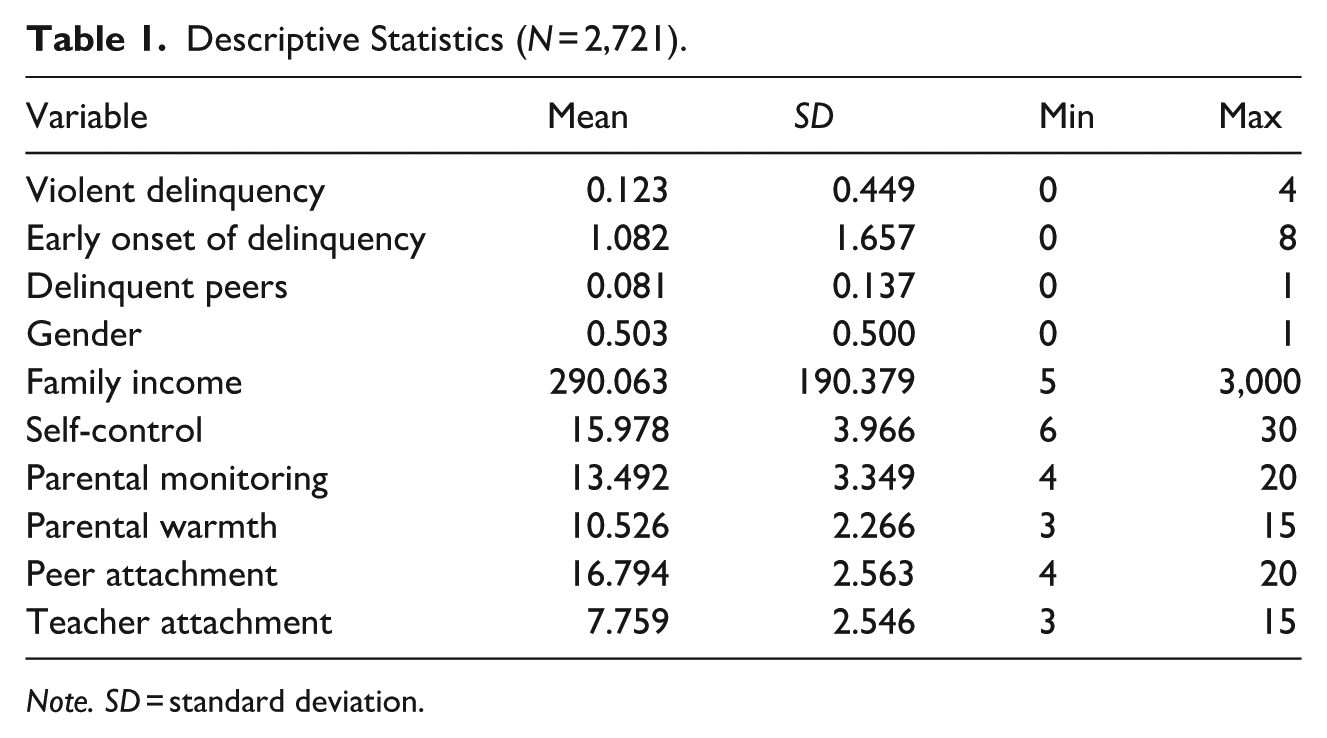
Note. SD = standard deviation.
Analytic Plan
Our analytic strategy proceeded in a series of steps. First, we estimated developmental trajectories of delinquent peer associations from ages 14 to 18 years by employing group-based trajectory models (Nagin, 2005, 2010). Group-based trajectory modeling was chosen over alternative mixture modeling approaches because it is well suited to identifying distinct behavioral patterns and provides a parsimonious framework for classifying individuals into prototypical trajectory groups (Jones et al., 2001). Although latent class growth analysis and growth mixture modeling allow for more flexible variance structures, these approaches primarily emphasize within-group heterogeneity. In contrast, group-based trajectory modeling focuses on between-group differences, which aligns more closely with our objective of examining how qualitatively distinct pathways of peer association shape the relationship between early delinquency onset and violent delinquency. This step was required to be undertaken in the initial stage of the analytic process because the current study focused on the developmental trajectories of delinquent peer association, and the subsequent analytic steps utilized these trajectories as part of the estimations. Group-based trajectory models allowed the identification of sub-groups of individuals that reflected similar patterns of delinquent peer association and visualized such clusters of patterns. We adopted three suggested criteria to identify the best fitting model of delinquent peer association trajectories: (1) Bayesian Information Criterion (BIC) indicating the best model fit when closer to zero; (2) group mean posterior probabilities of assignment (groupAPP) set to .7 as the cutoff point; and (3) the odds of correct classification (OCC), which specified 5 as the cutoff criterion (Nagin, 2005, 2010).
Second, we used multinomial logistic regression models to estimate the impact of early onset of delinquency on delinquent peer association trajectory groups. This analytic step allowed us to examine whether the early onset of delinquency was related to different trajectories of delinquent peer association during mid- to late adolescence. The non-delinquent peer associated group was assigned as the reference group, and control variables such as gender, family income, self-control, parental monitoring, parental warmth, peer attachment, and teacher attachment were included (wave 1).
Third, we estimated a series of mixed effects negative binomial regression models estimating violent delinquency from early onset delinquency and delinquent peer association trajectory groups. This model accounts for overdispersion and allows for the inclusion of time-invariant (e.g., onset age of delinquency) and time-variant (e.g., self-control) factors in the same analytic model (Booth et al., 2003; Hilbe, 2011). Model 1 exclusively examined early onset of delinquency with controls, while Model 2 included delinquent peer trajectories with controls. Model 3 examined both early onset of delinquency and delinquent peer association trajectory groups in the same analytic model. From this analytic step, assessed the link between early onset of delinquency and violent delinquency, as well as the trajectories of delinquent peer association and their relation to violent delinquency. This allowed us to proceed to the next step, which was the main focus of the current study.
Lastly, we conducted mixed-effects negative binomial models for each delinquent peer association trajectory group to assess the effect of early onset of delinquency on violent delinquency across different trajectory groups. Specifically, we divided the total study sample into six different sub-groups based on their group membership in the delinquent peer association trajectories. Then, we conducted six separate mixed-effects negative binomial models to examine whether the early onset of delinquency has varying effects on changes in violent delinquency when youth associate with different patterns of delinquent peers during mid- to late adolescence. Additionally, to enhance the interpretability of the findings, predicted mean variety scores and average marginal effects were calculated following the multinomial logistic and mixed-effects negative binomial regression models. These measures were utilized to illustrate the substantive magnitude and relative importance of the key predictors beyond statistical significance.
Results
Figure 1 shows the best fitting model of developmental trajectories of delinquent peer association ages between 14 and 18 years. The number of trajectory groups was selected based on the changes in BIC scores, and the six-group model indicated −3,740.97, which was the closest to zero among other models with a different number of latent groups. All scores of group mean posterior probabilities of assignment were above the cutoff point (scores between .75 and .91), and the lowest score of the odds of correct classification was 8.19, which is greater than the cutoff criterion. The identified delinquent peer association trajectory groups were as follows: non-associated, low-increasing, sharp-increasing, decreasing, mid-stable, and high-stable. The two increasing groups were listed as the largest and the smallest prevalence groups. The low-increasing trajectory group was the largest group with 37.01% of the sample, while the sharp-increasing trajectory group was the smallest group with 3.97% of the sample. There were three stable trajectory groups that occupy approximately half of the total sample: non-associated (28.85%), mid-stable (19.15%), and high-stable (4.33%). Lastly, the decreasing trajectory group was comprised of 6.69% of the total sample.
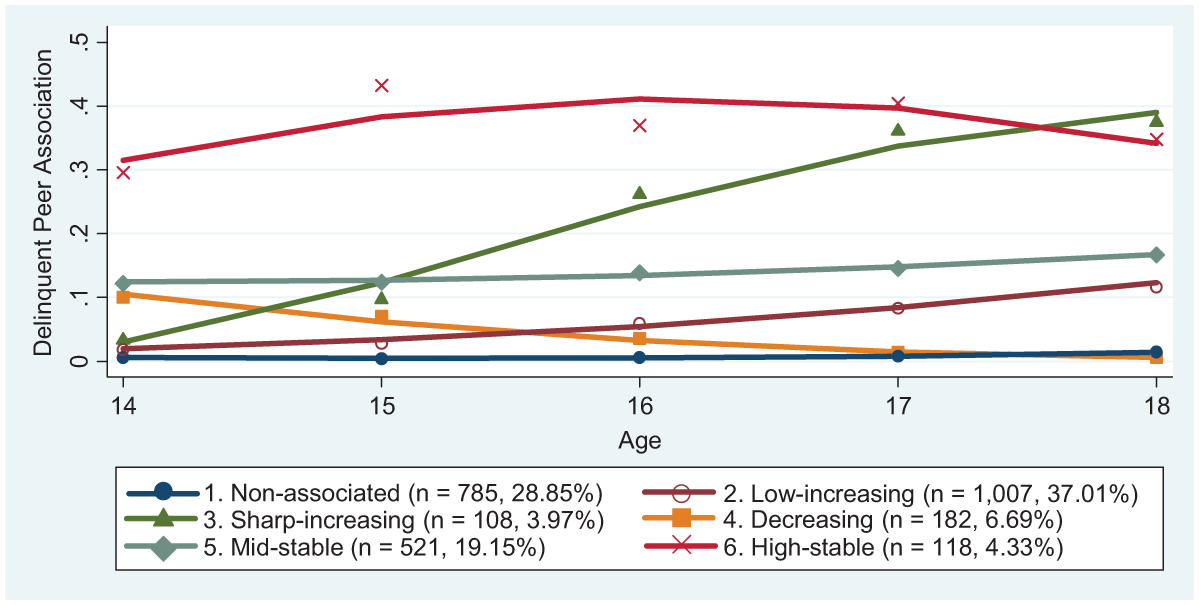
Developmental trajectories of delinquent peer association during mid- to late adolescence.
Multinomial logistic regression models estimating the relative risk ratios of early onset of delinquency on delinquent peer trajectory groups are summarized in Table 2. The results indicated that early onset of delinquency was a statistically significant predictor for all delinquent peer trajectory groups when the non-involved group was used as the reference. Adolescents who initiated delinquency at earlier ages were more likely to maintain associations with delinquent peers throughout mid- to late adolescence, with larger relative risk ratios observed among trajectory groups characterized by higher and more chronic levels of delinquent peer associations. Similar patterns were observed in the estimated average marginal effects. Specifically, a one-year earlier onset of delinquency was associated with a 6.38 percentage-point increase in the probability of belonging to the mid-stable group and a 1.32 percentage-point increase for the high-stable group.
Multinomial Logistic Regression Models Estimating the Impact of Early Onset of Delinquency on Delinquent Peer Trajectory Groups (Reference Group: Non-involved Group).
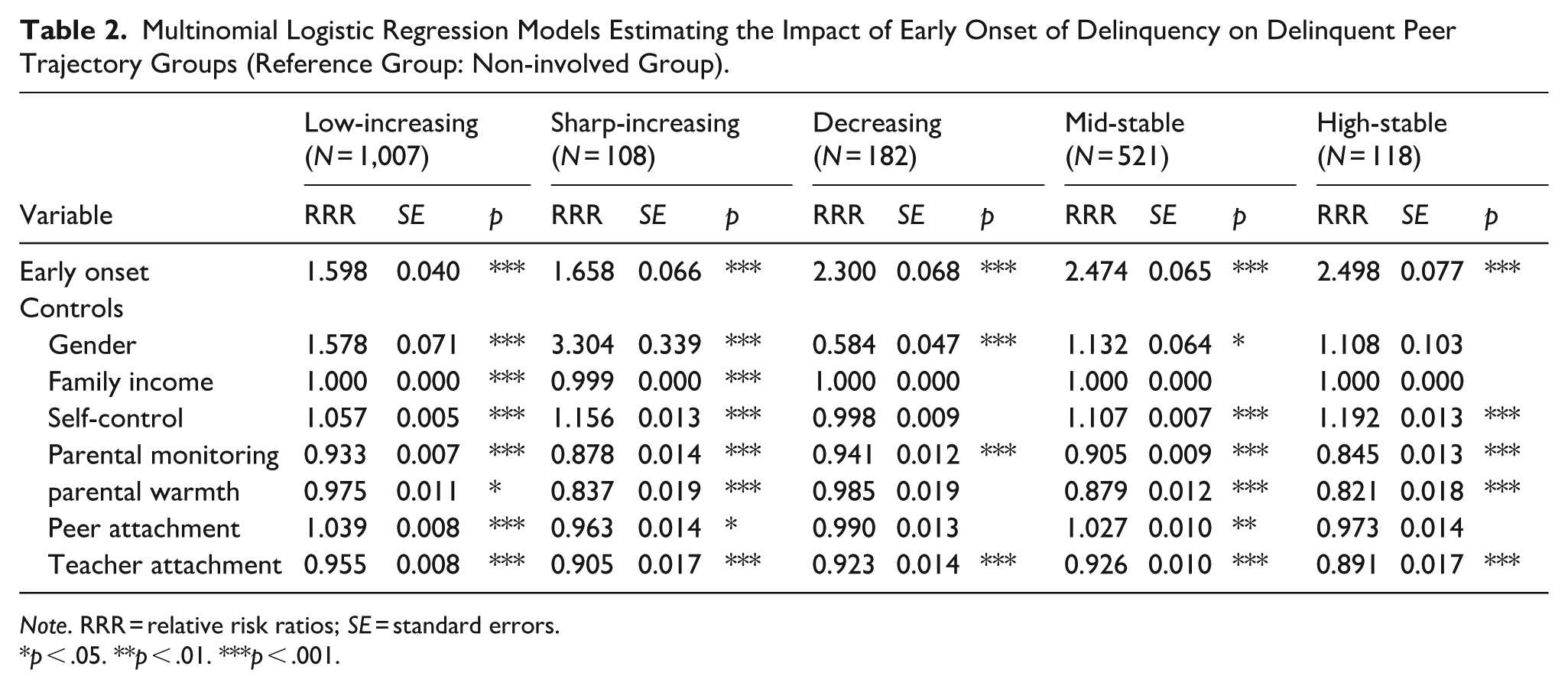
Note. RRR = relative risk ratios; SE = standard errors.
p < .05. **p < .01. ***p < .001.
Table 3 presents three mixed-effects negative binomial models addressing the effects of early onset delinquency and delinquent peer association trajectory groups on violent delinquency. In Model 1, an early onset of delinquency was statistically and significantly associated with violent delinquency. Among the control variables, adolescents who were boys and those with lower levels of self-control were more likely to increase their violent delinquency over time. Conversely, those with more parental monitoring and stronger teacher attachments had statistically and significantly lower levels of violent delinquency over time. In Model 2, all delinquent peer association trajectory group memberships were statistically and significantly associated with and increased likelihood of violent delinquency. Further, membership in the high-stable delinquent peer association trajectory group was associated with the highest levels of violent delinquency. In Model 3, the overall results were similar to Models 1 and 2; early onset delinquency and different trajectories of delinquent peer associations were statistically and significantly associated with increases in violent delinquency over time.
Mixed-Effects Negative Binomial Models for Estimating the Impact of Early Onset of Delinquency and Delinquent Peer trajectory on Violent Delinquency (N = 2,721).
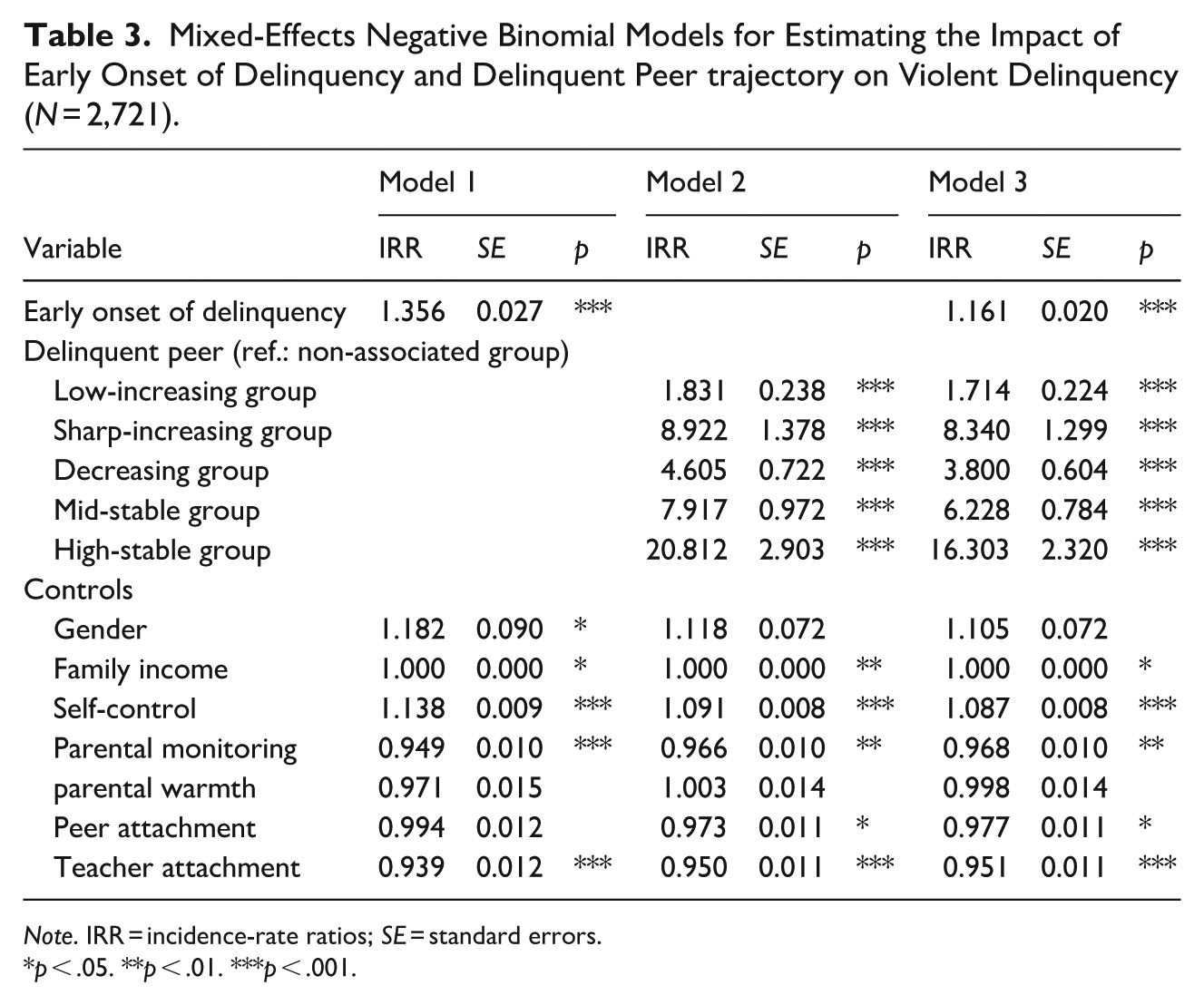
Note. IRR = incidence-rate ratios; SE = standard errors.
p < .05. **p < .01. ***p < .001.
Additionally, we calculated the predicted mean variety scores and average marginal effects for each trajectory group to further substantiate our findings. The predicted mean variety scores of violent delinquency illustrate the substantive differences across the trajectory groups. Adolescents in the high-stable group were predicted to engage in a significantly wider range of violent delinquency, with an expected variety score of .487. Notable differences were also observed in other active trajectory groups; the sharp-increasing group and the mid-stable group exhibited predicted variety scores of .249 and .186, respectively. In contrast, the non-associated group exhibited a predicted score of only .030. This indicates that members of the high-stable trajectory are expected to engage in approximately 16 times more diverse types of violent delinquency than those in the non-associated group.
The average marginal effects further reveal that trajectory membership is the most potent predictor of violent delinquency in the model. The marginal increase in the variety score for being in the high-stable group (.457) compared to the non-associated group was substantially larger than the effects of other significant predictors. Similarly, the sharp-increasing group (.219) and the mid-stable group (.156) also exhibited significantly higher marginal effects than the other factors. Specifically, the impact of being in the high-stable group was approximately 24 times larger than the effect of early onset (.019) and 45 times larger than the effect of self-control (.010). Furthermore, the magnitude of the trajectory group effect far exceeded the protective effects of parental monitoring (−.004) and teacher attachment (−.006).
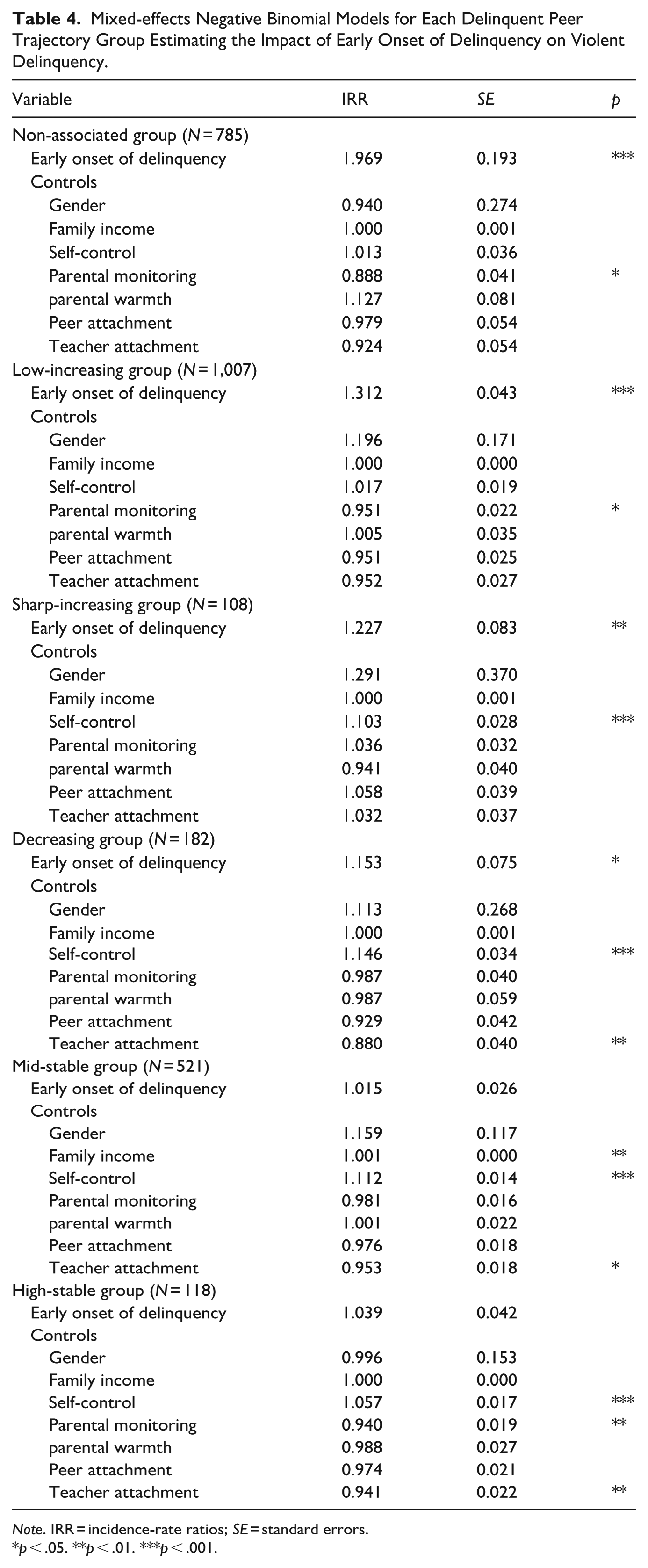
Table 4 summarizes the results of a series of mixed-effects negative binomial regression models for each delinquent peer trajectory group estimating the impact of early onset of delinquency on violent delinquency. An early onset of delinquency was statistically significant predictor of violent delinquency among groups with relatively lower levels of delinquent peer association patterns. The mid-stable and high-stable groups indicated that early-onset delinquency was not a statistically significant predictor of violent delinquency.
Mixed-effects Negative Binomial Models for Each Delinquent Peer Trajectory Group Estimating the Impact of Early Onset of Delinquency on Violent Delinquency.
Note. IRR = incidence-rate ratios; SE = standard errors.
p < .05. **p < .01. ***p < .001.
To further delineate the developmental dynamics of violent delinquency, we examined the average marginal effects of early onset and other factors within each trajectory group independently. Regarding the early onset of delinquency, the results showed that its influence was not statistically significant within the mid-stable and high-stable groups. In contrast, early onset emerged as a significant predictor within the sharp-increasing group (.063) and the non-associated group (.023). Regarding other variables, several selective results were observed across the separate group analyses. Self-control was found to be a significant predictor of violent variety specifically within the high-stable (.043), sharp-increasing (.030), and mid-stable (.025) groups, while no significant effects were found in the non-associated or low-increasing groups. In terms of protective factors, parental monitoring showed a significant negative association with violent variety within the high-stable group (−.048) and the low-increasing group (−.002). Similarly, teacher attachment was significantly and negatively related to violent delinquency variety within the high-stable (−.047), decreasing (−.015), and mid-stable (−.011) groups.
Discussion
Research has long linked early onset offending and delinquent peer associations to later violent behavior, but how different developmental patterns of peer affiliation shape the effect of early onset remains understudied (Akers, 1973; Lacourse et al., 2006; Moffitt, 1993). Using a nationally representative longitudinal sample of Korean youth, the current study addresses this gap by examining how early-onset delinquency and trajectories of deviant peer association jointly relate to violent offending across adolescence.
Regarding the first question (the extent to which early-onset delinquency is associated with violent offending), results from the marginal effects analysis showed that an earlier onset of offending was associated with a significant increase in the variety score of violent delinquency (0.019). Notably, this association remained robust even after accounting for developmental trajectories of deviant peer associations and a comprehensive set of individual and social control factors. This indicates that adolescents who initiate their delinquent behavior early tend to diversify their violent conduct, engaging in a broader repertoire of violent offenses throughout their development. This finding corroborates the argument presented by control and propensity theories, which suggest that the primary reasons for an individual’s engagement in crime are established early in the life-course (Gottfredson & Hirschi, 1990), with early antisocial behavior reflecting these characteristics (Moffitt, 1993).
Concerning the second research question (the extent to which the different trajectories of deviant peer associations were related to violent offending), we found a robust link between peer delinquency trajectories and violence. While early onset remains a significant predictor, the substantive impact of trajectory membership appeared to be considerably more pronounced. Specifically, the marginal effects of being in the high-stable (.457), sharp-increasing (.219), and mid-stable (.156) groups were notably larger than those of risk factors, including the age of onset. In other words, compared to the non-associated group, all five delinquent peer trajectory groups were significantly related to greater engagement in violent behaviors, with the most substantial impacts observed among those with higher levels of delinquent peer associations. This finding is consistent with the socialization thesis, highlighting the impacts of differential association through interaction and communication with others (Akers, 1973, 2017). Individuals learn the definitions favorable to crime as well as the techniques and skills necessary for engaging in such behavior via deviant peer affiliation. These findings from the first two questions echo the results of previous studies examining age of onset and delinquent peer associations in relation to violent delinquency (Fergusson & Horwood, 1999; Lacourse et al., 2006) and underscore the need for further research into how the developmental dynamics between these factors jointly influence violence over time.
The third research question examined the extent to which early onset of delinquency is associated with trajectories of peer delinquency. Multinomial logistic regression analyses, with the non-involved group as the reference, indicated that early initiation of delinquency was significantly related to membership in delinquent peer trajectory groups. This association was particularly pronounced among adolescents with higher levels of stable affiliation with deviant peers. These patterns were further supported by average marginal effects, which suggested that earlier onset of delinquency increased the likelihood of adolescents belonging to trajectory groups characterized by persistent and elevated delinquent peer involvement. Collectively, these findings highlight that even modest advances in the age of delinquency onset can meaningfully elevate the risk of long-term associations with deviant peers. This pattern aligns with theoretical perspectives suggesting that individuals with a propensity for criminal behavior tend to self-select into peer groups with similar tendencies (Gottfredson & Hirschi, 1990). Additionally, the concept of population heterogeneity may help explain these findings, indicating that the long-term effects of antisocial characteristics manifest across the life course (Nagin & Paternoster, 2000). Within this framework, an early age of offending onset can be interpreted as “a harbinger of undesirable things to come” (Piquero et al., 2007, p. 71), emphasizing the developmental significance of early delinquent behavior.
The final question addressed to what extent early-onset delinquency is associated with violent offending in adolescence, accounting for trajectories of deviant peer association. A series of mixed-effects negative binomial regressions revealed that the predictive power of early onset was not uniform across all peer trajectories. Specifically, the relationship was not statistically significant within either of the two groups with the highest and most sustained levels of peer delinquency: the mid-stable and high-stable groups. This finding suggests that while an early start in delinquency is a potent risk factor, its independent influence may be overshadowed by chronic exposure to high-level and chronic deviant peer environments. In these high-risk contexts, the ongoing socialization and reinforcement within the peer group may become the dominant drivers of violent variety, potentially neutralizing the unique contribution of an individual’s behavioral history. In contrast, early onset emerged as a significant predictor within the sharp-increasing and non-associated groups. For the sharp-increasing group, the rapid acceleration of deviant peer associations may act as a catalyst that reactivates the risks associated with an early onset. Furthermore, within the non-associated group, in the absence of peer-driven delinquency, early onset remains a primary individual-level determinant of violent behavior. These results highlight that early onset is not a purely deterministic trait, but its impact is deeply contingent upon the developmental dynamics of peer affiliation.
This finding suggests that enduring individual characteristics affect behavior differently depending on the level of peer delinquency. In other words, the effects of social ties on crime can vary based on individuals’ propensity for antisocial behavior, with peer influences playing a significant role for everyone. However, the underlying mechanisms of these influences can differ substantially across various types of people and may also vary within individuals depending on their unique circumstances and experiences. Our study aligns with prior research arguing that propensity theories oversimplify the causes of criminal behavior by dismissing the influence of relational dynamics (Thomas & McGloin, 2013; Wright et al., 2001). Therefore, to fully grasp the role of antisocial dispositions in long-term offending behavior, it is crucial to consider contextual variation since delinquent tendencies and social influence can dynamically modify and shape each other (Matza, 1969; McGloin & Thomas, 2018; Thornberry & Krohn, 2005). This interplay, in turn, enhances our understanding of the stability or change in criminal behavior over time.
One possible mechanism contributing to the persistence of crime that we identified is contemporary continuity and cumulative continuity, which delineate the interactions between individuals and their environments in shaping criminal trajectories over the life course (Caspi & Bem, 1990; Caspi et al., 1989). We found direct impacts of criminal disposition on problematic behavior, such as violence, when deviant peer affiliation was minimal, which corresponds to the concept of contemporary continuity. In addition, our results indicate that early onset delinquency indirectly influences violent offending by increasing the likelihood of greater delinquent peer association. This illustrates the notion of cumulative continuity, encapsulated in the idea of progressive accumulation of maladaptive behaviors (Caspi & Bem, 1990; Krohn et al., 2011; Moffitt, 1993; Sampson & Laub, 1997, 2003).
From a policy perspective, our findings underscore the importance of early, targeted interventions for youth who initiate delinquent behavior at younger ages (Loeber et al., 2003). These early intervention efforts should be designed to bolster the two key protective factors identified in our study: parental monitoring and teacher attachment.
First, the protective role of parental monitoring suggests a need for early family-based supports that enhance supervision, communication, and consistent caregiving practices before and during adolescence. Family-focused programs that address multiple domains of risk—such as multisystemic therapy—remain relevant because they target family functioning and peer exposure and have demonstrated efficacy relative to individual therapy or punitive approaches (Borduin et al., 1995; Henggeler et al., 1992; National Institute of Justice, 2011).
At the same time, the significance of teacher attachment indicates that schools are a primary site for prevention. Rather than relying on punitive zero-tolerance policies that can weaken student–teacher bonds and increase the likelihood of affiliation with deviant peers, policymakers should invest in schoolwide approaches that foster positive relationships and prosocial climates, for example School-Wide Positive Behavioral Interventions and Supports (SWPBIS) and teacher training programs that emphasize relational pedagogy and classroom management (Noltemeyer et al., 2019). Implementation strategies could include routine screening in schools to identify early-onset youth, clear referral pathways linking schools to family-centered services, and professional development for educators aimed at strengthening teacher–student attachment.
Our study is not without limitations. First and foremost, while the data we use includes a large sample from the general population, participants come from a single country: South Korea. Future research utilizing samples from other countries and those with different demographic characteristics would be useful for assessing the generalizability of these findings. Second, future research could also focus on identifying other factors that may impact the relationship between early onset delinquency, trajectories of peer delinquency, and violence. For instance, other potential risk factors in the individual, family, peer, and neighborhood domains may be able to explain the relationship. Additionally, it is important to note the limitations of our measures of peer delinquency. Much research finds that indirect measures of delinquent peer associations, which we utilize in our study, are highly related to self-reported delinquent outcomes (Boman et al., 2012) and may actually be reflective of the individual respondents’ delinquent behavior (Meldrum & Boman, 2013). Future research could benefit from direct measures of individual peer associations as a way to understand how young people’s peers and friends self-reported delinquency impacts the relationship. Finally, our approach to missing data may limit the generalizability of the results. We excluded participants with no post-baseline observations to avoid the bias associated with making unverifiable assumptions about early dropouts. While our diagnostic tests showed no significant baseline differences between these individuals and the analytic sample, the possibility of non-random attrition due to unobserved factors (MNAR) cannot be fully ruled out. Although multiple imputation was used to address item-level missingness among the remaining participants, the final sample may not fully represent the diversity of the original cohort, and some caution is warranted when interpreting the findings.
Footnotes

Funding
The authors received no financial support for the research, authorship, and/or publication of this article.
Declaration of Conflicting Interests
The authors declared no potential conflicts of interest with respect to the research, authorship, and/or publication of this article.