



Abstract
The concept of victim-offender overlap has garnered increasing attention in criminology. Building on previous research, the current study aims to enhance our understanding of continuity in criminal behavior by examining the effects of early-onset delinquency, a well-established predictor of subsequent offending. Using a nationally representative sample of Korean adolescents, the results reveal that both early initiation of deviant behavior and victimization independently contribute to increased subsequent violence. Furthermore, their interaction effects are significant, indicating that the combination of these factors leads to a notable increase in violent delinquency over time. Theoretical implications, limitations, and suggestions for future research are discussed.
The persistence of crime has long been a focus in criminology. In exploring the factors behind long-term offending behavior, it has become evident that victimization is significantly related to offending (Choi & Park, 2018; Lauritsen & Laub, 2007). While offenders and victims were once viewed as distinct categories, solely offenders and solely victims, more recent research has introduced the concept of the victim-offender overlap to describe the convergence between these two groups (Berg & Schreck, 2022; Lauritsen & Laub, 2007; Loeber & Farrington, 2011; Singer, 1981). This notion suggests that victims and offenders do not always belong to separate groups, rather they can often be the same individuals, which has been supported by empirical research (Berg & Mulford, 2020; Jennings et al., 2012).
Despite the substantial support for this overlap, several challenges remain in advancing the field (Berg & Mulford, 2020; Berg & Schreck, 2022; Schreck et al., 2017). For instance, there is a need for more rigorous methodological approaches, including the examination of temporal sequences and the accounting for confounding variables—both stable and time-varying. A life-course perspective, particularly investigating age-graded links between victimization and criminal behavior, has also been highlighted.
In response to these challenges, the current study adopts a life-course approach, incorporating the concept of early-onset delinquency since early initiation of criminal behavior has been identified as a strong predictor of both the duration and severity of a criminal career (DeLisi & Piquero, 2011; Moffitt, 1993; Zara & Farrington, 2016). Specifically, this study examines the mechanisms of the victim-offender overlap across the life course by exploring how early initiation of deviance triggers cascading effects, leading to victimization and future violence. Furthermore, we aim to enhance methodological rigor by accounting for both time-varying and invariant control factors in our analysis, using a longitudinal youth sample that spans mid to late adolescence.
Victim-Offender Overlap
Various theoretical frameworks can be utilized to comprehend the phenomenon of victim-offender overlap. First, the convergence of offending and victimization can be explained by individuals’ level of self-control (Jennings et al., 2012; Reisig & Holtfreter, 2018). Characteristics associated with low self-control, such as pursuit of immediate gratification, risk-seeking behavior, hot-tempered, and a preference for physical over mental activities, contribute not only to engage in offending behavior, but also to increased exposure to victimization. Also, routine activity/lifestyle perspectives suggest that criminal behavior is often associated with particular lifestyles and daily activities, which can increase an individual’s vulnerability to victimization (Schreck et al., 2008; van Gelder et al., 2015). For example, associating with deviant peers or engaging in excessive drinking can increase an individual’s risk of both offending and victimization (Kim & Lee, 2023; Reisig & Holtfreter, 2018). In addition, general strain theory proposes criminogenic strains, those perceived as unjust, high in magnitude, low in social control, or creating pressure or incentive for crime, are likely to lead to criminal coping (Agnew, 2006). Victims of crime who lack healthy stress-relief strategies may engage in criminal behavior as a way to deal with negative emotions resulting from a stressful life event (Cullen et al., 2008; Gebo et al., 2022; Hay & Meldrum, 2010; Lee et al., 2022).
A significant body of research has demonstrated a notable overlap between victimization and offending. A dual trajectory analysis revealed that the number, shape, and distribution of youth who were identified in general offending and victimization trajectories were comparable across the key variables, with a significant degree of victim-offender overlap (Lee et al., 2020). In addition to general offending, the co-occurrence of offending and victimization is also found across various types of criminal behavior. For instance, net of demographic, clinical, and social risk factors, the overlap between violent offending and violent victimization was revealed, with shared risk factors, such as substance abuse, psychopathy, stress, and residential instability (Silver et al., 2011). The overlap in intimate partner violence is evident not only within intimate relationships, but also between intimate partner violence and other forms of criminal behavior, both as a perpetrator and a victim (Carbone-Lopez & Kruttschnitt, 2010; Richards et al., 2017; Tanskanen, 2023; Taylor et al., 2019; Tillyer & Wright, 2014). In addition, bullying research suggests a bidirectional relationship between victimization and perpetration. Adolescents who experience bullying are more likely to engage in bullying behavior themselves, and conversely, bullies are at increased risk of becoming victims over time (Choi & Park, 2018; Kim et al., 2023). A similar pattern is observed in cases of sexual crime. Applying the cycle of violence hypothesis, Jennings et al. (2014) found a substantial degree of overlap between sexual victimization and sex offending among male inmates.
Also, the strong association between the two has been tested across diverse samples and data from a wide range of countries and regions, highlighting the far-reaching nature of this relationship. In North America, overlap studies have been conducted in Canada (Hiltz et al., 2020), the United States (Berg & Loeber, 2011), and Puerto Rico (Maldonado-Molina et al., 2010), which have provided insights into how these patterns manifest in different cultural contexts. In South America, research in Colombia (Klevens et al., 2002) has contributed to understanding the dynamics of victim-offender overlap. Europe has been well-represented, with studies conducted in the United Kingdom (Beckley et al., 2018), Sweden (Kahlmeter, 2023), Germany (Erdmann & Reinecke, 2018), the Netherlands (Averdijk et al., 2016), Italy (Mannozzi, 2013), and Finland (Tanskanen, 2023). In addition, research from Asian countries, such as South Korea (Jennings et al., 2011; Kim et al., 2023) and China (Cheung & Zhong, 2023), offers an Asian perspective. Furthermore, an international study encompassing 30 countries (Posick, 2013) has broadened our understanding of this global phenomenon, allowing for comparisons across different cultural and social contexts.
Early Onset of Delinquency and Its Impact on Subsequent Criminal Behavior
Although the volume of studies on the victim-offender overlap has increased, there are still some gaps, particularly regarding how the early onset of delinquency plays a role in long-term criminal behavior. This void is somewhat surprising, given that early-onset delinquency has been noted in criminology, with research spanning from earlier to more recent studies. For instance, the recognition of early-onset antisocial behavior as a red flag dates back to the early 20th century. Healy (1915) stated that “[p]ractically all confirmed criminals begin their careers in childhood or early youth” (p. 10). Similarly, Shaw’s (1930) book, The Jack-Roller, describes Stanley, a chronic offender, beginning his antisocial career at the age of six. Glueck and Glueck (1950) also observed that the 500 delinquents they studied exhibited early signs of problematic behavior, both in and out of school, around the age of eight. By the time these individuals first appeared in court, they were, on average, 12 and a half years old. In addition, relying on 1945 Philadelphia birth cohort, Wolfgang et al. (1972) found that boys who initiated their delinquency at age 13 years committed more offenses between ages 13 to 17 years relative to those who started at a different age.
Recent empirical research has also supported the significance of early involvement in delinquency as a strong predictor of reoffending trajectories. For example, early onset of offending is predictive of future violent and gun-related crimes in an American youth cohort (McCluskey et al., 2006). Broidy et al. (2003) found that early problem behaviors, such as physical aggression, are significantly related to violent delinquency among boys in Canada, New Zealand, and the United States. DeLisi et al. (2011) compared the offending careers of two offender groups: habitual criminals with 30 career arrests and a random sample of offenders with an average career arrest total of six. Whereas habitual offenders were first arrested at an average age of 18.64 years, the average arrest onset for the non-habitual group was 26 years old. Early-onset arrests are also strongly associated with serious offenses, including murder, rape, and kidnapping (DeLisi, 2001). This body of research tends to indicate that individuals who begin criminal activities at a young age are more likely to engage in serious crimes and persist in criminal behavior over time (DeLisi & Piquero, 2011; Moffitt, 1993; Whitten et al., 2017; Wolfgang et al., 1972; Zara & Farrington, 2016).
In addition, several factors have been identified as antecedents or early risk factors for early-onset delinquency. Moffitt (1993) attributes persistent criminal behavior in some individuals who exhibit antisocial behavior at an early age to neuropsychological deficits, such as cognitive impairments, difficult temperament, hyperactivity, slow heart rate, neurological abnormalities, low intellectual ability, and environmental factors, including poor parenting, weak family bonds, and poverty. Prior literature also suggests that coercive discipline, disruptive family management, rejection by peers, academic failure, low self-esteem, impulsivity, early substance use, deviant peer associations, disadvantaged neighborhoods, and family history of antisocial behavior are risk factors for the early initiation of delinquency (Forsyth et al., 2018; Loeber & Farrington, 2000; Patterson, 1986, 1995; van Hazebroek et al., 2019). A recent meta-analysis of studies focusing on individuals with onset ages up to 13 years and followed to at least age 30 years identified differences in risk factors for different types of offender groups: life-course-persistent, adolescence-limited, and late-onset offenders (Jolliffe et al., 2017). This study found that the early offending group were more prone to having a greater number of risk factors, and the magnitude of these was somewhat greater relative to individuals with later onset.
Furthermore, there have been efforts to identify moderating variables that impact the association between early initiation of delinquency and later criminal behavior. For example, early-onset delinquents who are exposed to delinquent peer affiliation and parental abuse are more likely to engage in subsequent delinquency (Kim et al., 2023). Carroll et al. (2006) explored the role of impulsivity among different juvenile populations, including early-onset, late-onset, and non-offending groups. They found significant differences in impulsivity between offenders and non-offenders across various measures. Those with rapid cognitive tempo, diminished mental inhibitory control, and high levels of impulsivity are at greater risk of engaging in early-onset offending. Drawing on the Dutch Childhood Arrestees Study, van Hazebroek et al. (2019) examined long-term reoffending trajectories among early-onset offenders from ages 12 to 25 years. Compared to non-recidivists, ethnicity (non-Western) and childhood residence in poor neighborhood are significant predictors for reoffending.
Considering the need for a life-course approach to victim-offender overlap (see Schreck et al., 2017), exploring the interplay between early onset of offending and victimization in relation to subsequent delinquency could enhance our insight into the long-term association between antisocial behavior and victimization. This study aims to deepen our understanding of violent delinquency by investigating how early initiation of delinquent behavior intersects with victimization over time.
Method
Data
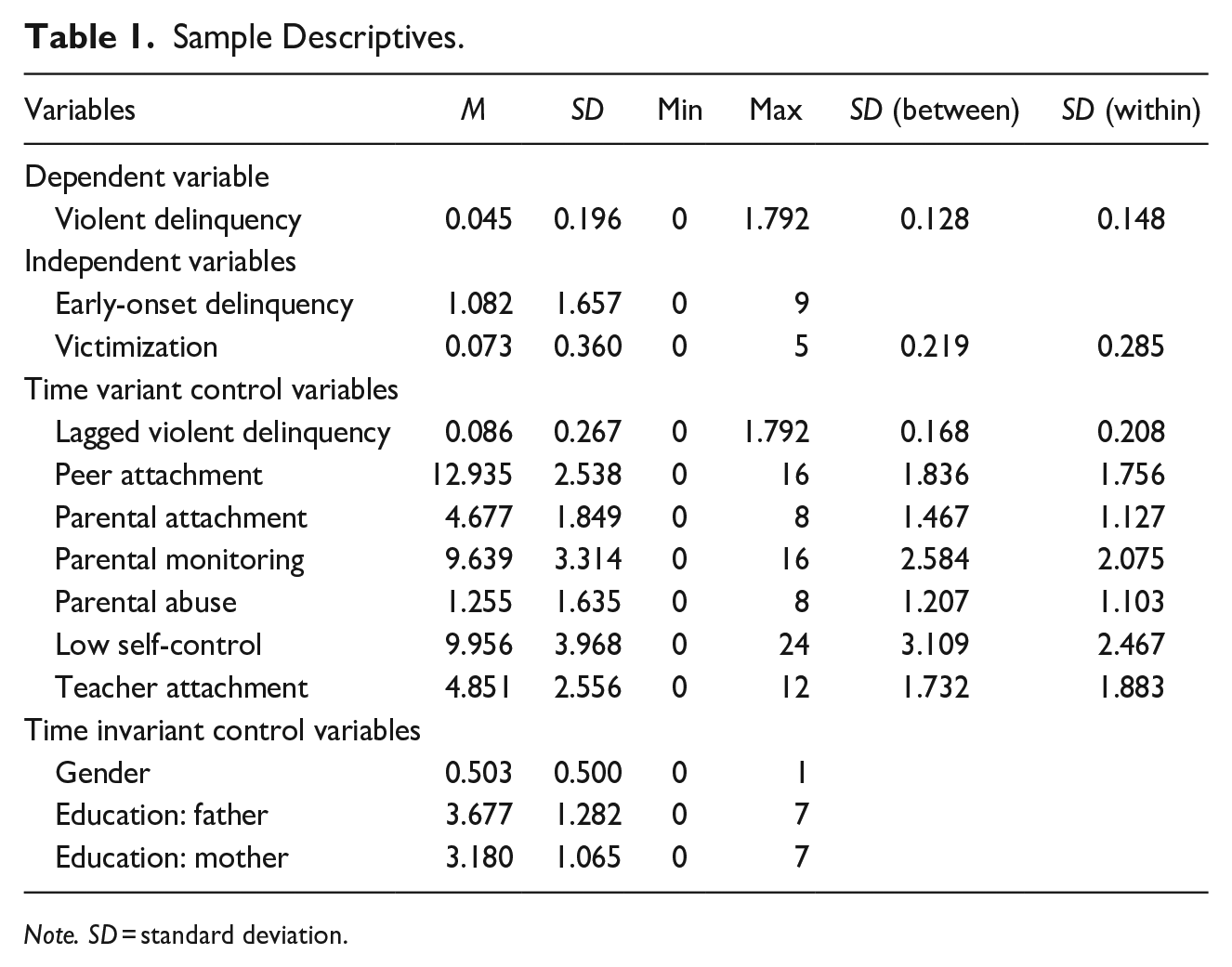
The current study utilized data from a nationally representative adolescent sample in Korea, known as the Korean Youth Panel Survey (KYPS). The Korean National Youth Policy Institute (NYPI) employed stratified multistage cluster sampling to ensure sample representativeness. Participating schools and respondents were randomly selected. The study followed eighth graders annually from 2003. Participants provided informed consent and completed a paper-and-pencil questionnaire, while parents underwent a phone interview. The analysis included data from five waves, comprising a total of 2,721 juveniles. Gender ratio was nearly equal (Table 1). The retention rate was 82.1%, with 6.7% due to parental refusal at wave 1.
Sample Descriptives.
Note. SD = standard deviation.
Key Variables
Violent delinquency was measured by summing responses to four items: assault, threatening, robbery, and involvement in a gang fight. A variety scale ranging from 0 (no engagement in any of the violent behaviors) to 4 (engagement in all four types of violent behaviors) was employed.
Early onset of delinquency was measured by a single item in wave 1, which asked at what age respondents first engaged in any delinquent behavior. These behaviors included smoking, drinking, skipping school without permission, running away, sexual intercourse, severe assault, involvement in a gang fight, robbery, larceny, prostitution, ridicule or make fun of another person severely, threatening other people, collectively bullying, and sexual assault. The responses ranged between 6 to 13 years old and were recoded as follows: not committed = 0, 13 years old = 1, 12 years old = 2. . .7 years old = 6, and 6 years old = 8, with higher scores indicating earlier onset of delinquency.
Victimization was assessed by summing responses to five questions asking whether respondents experienced various types of victimization (e.g., physical assault, threats, bullying, sexual assault, and severe teasing). A variety scale was used, with responses ranging from 0 (no experience of victimization) to 5 (experience of all five types of victimization).
Time Variant Control Variables
Lagged violent delinquency was measured in the same manner as violent delinquency as described above.
Peer attachment was assessed using four questions (e.g., shared feeling, having candid conversation with peers) on a 5-point Likert-type scale. Higher scores represented stronger peer attachment.
Parental attachment was measured with two items on a 5-point Likert scale ranging from 1 (strongly disagree) to 5 (strongly agree): (1) “I am comfortable sharing my thoughts and feelings with my parents” and (2) “I often talk about what happens to me outside the home. Higher values indicated stronger attachment to parents.”
Parental monitoring was determined by summing responses to four items on a 5-point Likert scale, assessing whether “parents usually know (1) where I am, (2) whom I am with, (3) what I am doing, and (4) when I will return.” Higher scores indicated greater parental monitoring.
Parental abuse was measured with two items (e.g., verbal and physical abuse) on a 5-point Likert scale from 1 (strongly disagree) to 5 (strongly agree). Higher values indicated greater perceived parental abuse.
Low self-control was assessed by summing responses to six questions (e.g., “I abandon a task soon once it becomes hard and laborious to do,” “I jump into exciting things even if I have an exam tomorrow”). High scores represented lower self-control.
Teacher attachment was measured using three questions (“I can share and discuss my problem with teachers,” “Teachers show their love and affection to me”) on a 5-point Likert-type scale. Higher values indicated stronger teacher attachment.
Time Invariant Control Variables
Gender was determined by respondents’ self-report with female coded as 0 and male coded as 1.
Parental education was assessed by a single question asking the highest degree completed by father and mother, respectively (0 = elementary school, 1 = middle school . . . 6 = master’s degree, and 7 = doctoral degree).
Analytical Strategy
This study employed a cross-lagged dynamic panel model, which is well-suited for examining the associations among key variables over time. A cross-lagged dynamic panel model offers several advantages (Allison et al., 2017; Williams et al., 2018) for this type of research, including the ability to: (1) explore the complex relationships between variables over the long term, (2) account for both time-variant and time-invariant control factors, and (3) control for the effects of the lagged dependent variable (t − 1).
The analysis proceeded in a series of steps. After descriptive statistics were computed, the relationships between key independent variables, early onset of delinquency (Model 1) and victimization (Model 2), and violent delinquency were assessed, respectively. Next, the impacts of two independent variables were simultaneously analyzed in a single model (Model 3). Lastly, the interaction term between the two variables (i.e., early-onset × victimization) was introduced (Model 4).
Results
Regarding model fit, the fit indices represent that the model fits the data well (RMSEA below 0.05 and CFI above 0.95), except for the significant Chi-Square statistics. Scholars have noted that Chi-Square values could be problematic, as “the Chi-Square statistic nearly always rejects the model when large samples are used. . .. where small samples are used, the Chi-Square statistic lacks power” (Hooper et al., 2008, p. 54). To address this issue, the estimated models were compared with saturated models, following the suggestion of Allison et al. (2017). Therefore, higher p values for the χ2 statistics represents a better-fitting models.
The results of the cross-lagged dynamic panel model assessing violent delinquency are presented in Table 2. In the first two models, two independent variables are tested separately. Model 1 shows that early onset of delinquency is significantly associated with increased violent delinquency across time. In Model 2, the role of victimization is assessed, revealing that victimization is significantly related to heightened violence over time. Next, both independent variables are added in Model 3, demonstrating their significant impacts on the outcome. Finally, an interaction term is introduced in Model 4, which shows a positive and significant interaction effect between early onset of delinquency and victimization on violent delinquency. That is, these two factors together lead to a significant increase in violent delinquency over time. Among the control variables, previous engagement in violence, parental abuse, low self-control, gender, and teacher attachment are significant across all models.
Cross-Lagged Dynamic Panel Data Models Assessing Violent Delinquency.
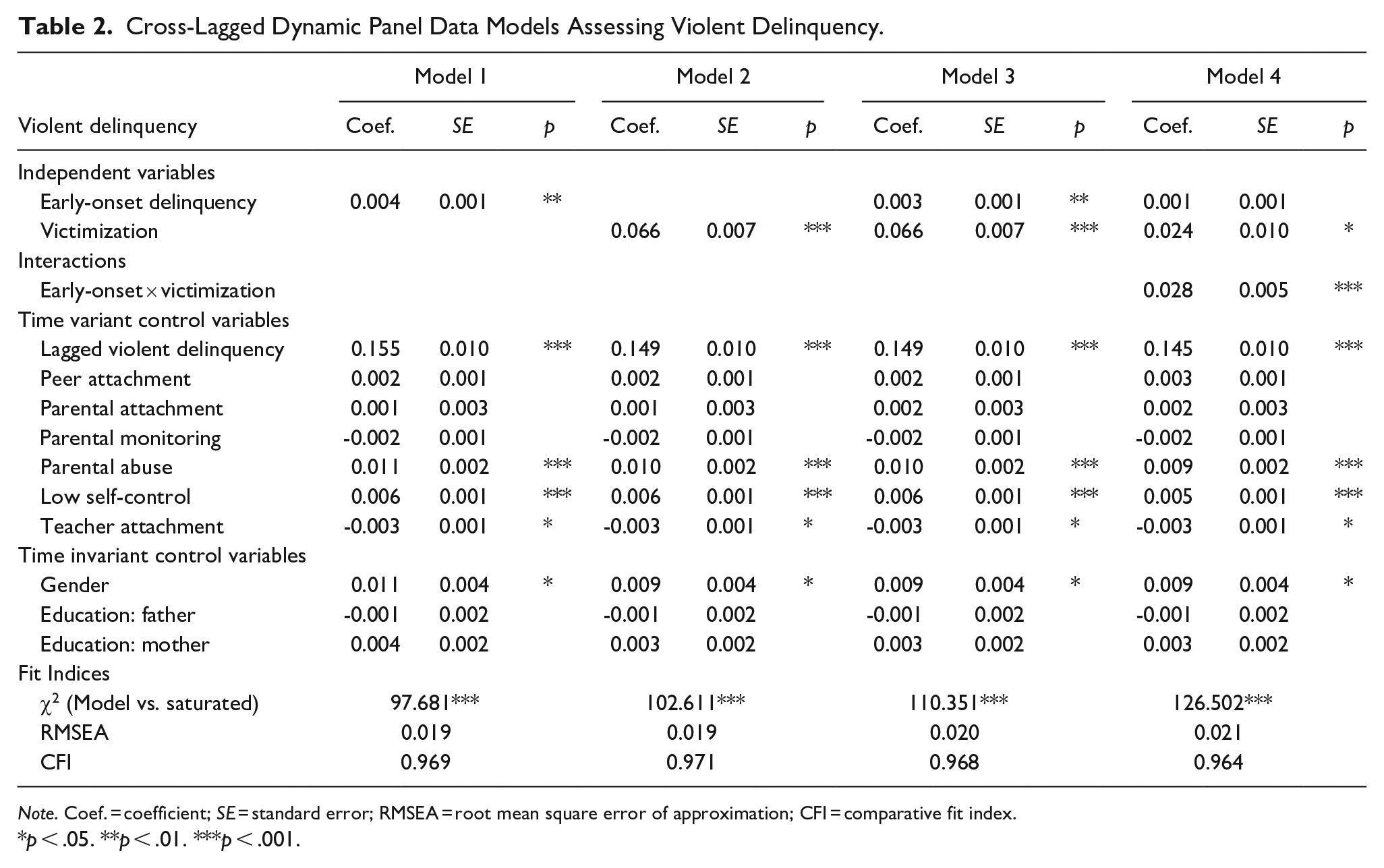
Note. Coef. = coefficient; SE = standard error; RMSEA = root mean square error of approximation; CFI = comparative fit index.
p < .05. **p < .01. ***p < .001.
Discussion
According to the criminal career framework, the onset of crime, the point at which individuals first engage in criminal behavior, is crucial for understanding the longitudinal patterns of criminal behavior (Blumstein et al., 1986; DeLisi et al., 2013; Doherty & Bacon, 2018; van Hazebroek et al., 2019). Despite the substantial body of research in this area, the link between early-onset delinquency, victimization, and subsequent violence over time remains underexplored from the perspective of victim-offender overlap. Therefore, this study aimed to better understand violent delinquency by examining the relationship between the early initiation of delinquency and victimization among general population of youth.
The results from the cross-lagged dynamic panel model showed that early onset of delinquency and victimization independently contribute to an increased risk of subsequent violence. These findings are consistent with previous research on the detrimental effects of early-onset delinquency and exposure to crime (Berg & Loeber, 2011; Broidy et al., 2003; DeLisi & Piquero, 2011; McCluskey et al., 2006; Moffitt, 1993). Notably, these significant impacts persisted in rigorous analyses, even after accounting for the impacts of various time variant and time invariant control factors. In particular, by controlling for the lagged dependent variable (i.e., previous violence), one of the best predictors of future behavior (Allison, 2015), our analyses benefit from a clear specification of the temporal associations between the key variables.
Furthermore, this study revealed interaction effects between early-onset delinquency and victimization on later violence, suggesting that both factors have simultaneous effects on the outcome over time. While the relationship between age and crime is well-documented in criminology, with the timing of criminal behavior onset being a key dimension of the criminal career (Blumstein et al., 1986; DeLisi & Piquero, 2011; Doherty & Bacon, 2018; Sweeten et al., 2013), the impacts of early initiation of antisocial behavior have rarely been examined through the lens of the victim-offender overlap. By exploring how early-onset delinquency contributes to the heightened likelihood of later violence over time, this study extends victim-offender overlap research, which typically focuses on immediate or current offending and victimization experiences (Chan, 2019; Jennings et al., 2011; Tanskanen, 2023).
Overall, the findings support the state dependence thesis, which ascribes the continuity of criminal behavior to a process of contagion (Blokland & Nieuwbeerta, 2010; Kim et al., 2023; Nagin & Paternoster, 2000). According to the state dependence perspective, past criminal behavior worsens an offender’s life circumstances by weakening constraints and heightening rewards for crime, thus increasing the likelihood of future criminal activity (Rocque et al., 2013; Wright et al., 2001). In other words, early initiation of criminal behavior makes individuals more vulnerable to victimization, which, in turn, raises the probability of later violence. Although this study cannot definitively establish causal relationships due to its research design, the results suggest a dynamic link between past and future criminal behavior, advancing beyond previous overlap studies within the short-term time frame. The findings illustrate the mutual relationship between offending and victimization over the long term and capture the mechanism of delinquent career by investigating how early deviant behavior exacerbates cumulative disadvantage, thereby refining our understanding of criminal career. Therefore, this study underscores the importance of exploring the mechanisms that drive early initiation of delinquency and its intersection with victimization, which is essential for developing interventions aimed at disrupting these harmful trajectories before they become ingrained (Mann & Reynolds, 2006; Piquero et al., 2016; Welsh et al., 2010).
There are several limitations to our study that should be noted. First, the measure of early onset ranged from 6 to 13 years old. Although much literature discusses age 14 as an indicator of early onset, future research may benefit from considering an earlier onset age. Second, while the current study does not extensively address population heterogeneity, as it is not focus of this research, investigating both population heterogeneity and state dependence theories together could enhance our understanding of the dynamic process of victim-offender overlap. Third, we recommend that future studies examine the relationship between early onset, victimization, and violence over a longer period, extending beyond adolescence, to provide a more complete picture of how these phenomena develop.
Footnotes
Declaration of Conflicting Interests
The author declared no potential conflicts of interest with respect to the research, authorship, and/or publication of this article.
Funding
The author received no financial support for the research, authorship, and/or publication of this article.
