



Abstract
Previous research links school suspension with delinquency and arrest. The majority of the research in this area, however, has primarily focused on suspensions in adolescence and has not examined the role of exclusionary discipline at younger ages. This study addresses this gap in the literature by examining associations between age of first suspension and delinquency in a representative sample of Florida adolescents. Accordingly, this study employs a novel typology of suspension exposure that incorporates both timing of first suspension and exposure to suspensions in the last year. In addition, this study also tests whether the relationship between suspension and delinquency varies by race. The findings reveal that age at first suspension and recent suspensions are significantly related to delinquency.
Keywords
Introduction
Schools employ a variety of different disciplinary measures in order to encourage students to comply with school regulations and to ensure campus safety. In previous decades many schools in the United States began to emphasize disciplinary strategies that relied on exclusionary mechanisms such as school suspensions and expulsions (Hwang et al., 2022; Leung-Gagne et al., 2022; Sykes et al., 2015). Suspensions generally entail removing a student from the regular classroom for disciplinary reasons. While some schools employ in-school suspensions where students are removed from the classroom but remain on school grounds, many schools also employ out-of-school suspensions where students are removed from school grounds. Research examining the outcomes of these exclusionary discipline policies links school suspensions with arrest in adolescents (Monahan et al., 2014; Mowen & Brent, 2016; Shollenberger, 2015). In addition, there is a body of research linking school suspension with a host of other negative consequences including reduced school engagement (Balfanz et al., 2015; Skiba et al., 2014), criminal behavior (Wolf & Kupchik, 2016), dropping out of school (Balfanz et al., 2015; Fabelo et al., 2011; Shollenberger, 2015), and later incarceration (Wolf & Kupchik, 2016). Of note, much of the research examining school suspensions and other forms of exclusionary discipline, indicates that exposure to exclusionary discipline varies dramatically by race with Black and Hispanic youth being significantly more likely to experience a suspension than White youth (Anyon et al., 2018; Balfanz et al., 2015; Fabelo et al., 2011; Owens & McLanahan, 2020; Rocque, 2010; Shollenberger, 2015).
Much of the research that links experiencing a school suspension with negative outcomes, however, tends to focus on school suspensions in adolescence and primarily in high school (Novak, 2018). As a result, while this research can provide information on how experiencing a school suspension in adolescence is associated negative outcomes, it does not provide information on how experiencing exclusionary discipline at earlier ages may affect later behavior. This is a significant gap in the literature, as youth suspended at earlier ages may be more vulnerable to the negative outcomes associated with exclusionary discipline (Jackson et al., 2022). Research to date suggests that youths suspended in elementary school are more likely to engage in aggressive behaviors (Jacobsen et al., 2019) and have contact with police (Jackson et al., 2022). This study builds off the previous literature and examines the relationship between early school suspension (age 10 or earlier) and delinquent involvement. In addition, given a wealth of research documenting racial disparities in exclusionary school discipline (Anyon et al., 2018; Balfanz et al., 2015; Fabelo et al., 2011; Fisher & Widdowson, 2023; Owens & McLanahan, 2020; Shollenberger, 2015; Rocque, 2010), this study examines how the relationship between early school suspension and delinquent outcomes may vary by racial and ethnic identity.
Exclusionary School Discipline
Schools employ a variety of measures to ensure adherence to discipline and standards for students in attendance. These disciplinary methods are generally utilized in accordance with the rationale that they will help to preserve student safety and the functionality of the learning environment through punishing or removing problematic students (Mongan & Walker, 2012). These punishments are thought to help facilitate and maintain an effective learning environment through deterrence—wherein students will behave in accordance with school rules as they fear punishment (Mongan & Walker, 2012; Novak, 2019). Still, under certain circumstances, these punishments may also act as labels that entrench young people further into deviant networks and behavior and block opportunities to traverse prosocial relationships and conventional pathways to success (Gerlinger et al., 2021; Jacobsen, 2020; Novak & Krohn, 2021). Historically, schools have employed a variety of disciplinary measures including detention, additional coursework, mandatory counseling, suspension, and expulsion. In recent decades, with many school districts embracing “zero tolerance” policies, there has been a shift to employing exclusionary discipline (i.e., suspension and expulsion) more readily (Leung-Gagne et al., 2022; Sykes et al., 2015). Of note, this shift to increasingly relying on exclusionary school discipline has persisted despite overall reductions in juvenile delinquency and student misconduct (Cook et al., 2010). To illustrate, suspension rates increased from 3.7% in 1976 (D. J. Losen & Skiba, 2010) to 7% in the 2009 to 2010 academic year, although recent estimates suggest rates have decreased in subsequent years (Leung-Gagne et al., 2022; National Center for Education Statistics, 2018). For instance, suspension rates decreased to approximately 5% by the 2017 to 2018 academic year, however, there is marked variation in the prevalence of suspension across different levels of schools with nearly 7% of students in secondary schools being suspended in the 2017 to 2018 academic year compared to approximately 2% of elementary school students (Leung-Gagne et al., 2022). Of note, while rates of school suspension have decreased in recent years, racial disparities in exposure to exclusionary discipline have persisted (Anyon et al., 2018; Lehmann, 2023; Owens & McLanahan, 2020).
While the use of suspension and other forms of exclusionary school discipline may be well-intentioned (e.g., preserving a safe and functional learning environment), previous research indicates that experiencing suspension is linked with an array of negative outcomes including increased involvement in juvenile delinquency and increased risks of criminal justice system involvement (Gerlinger et al., 2021; Jackson et al., 2022; Monahan et al., 2014; Novak, 2018). Broadly, this work is consistent with the tenets of labeling theory (Lemert, 1951), revealing the stigma of suspensions during childhood can worsen social exclusion and behavioral trajectories and place youth in a downward spiral toward delinquency and justice involvement (Jacobsen, 2020). For instance, a study by Mittleman (2018) revealed that experiencing a suspension doubles the odds of also experiencing an arrest and increases the likelihood of experiencing a later school suspension. Similarly, a study by Monahan et al. (2014) revealed that experiencing a suspension is linked with being arrested in the same month. Furthermore, a study by Mowen and Brent (2016) indicates that adolescents who have experienced a suspension exhibit 157% greater odds of being arrested in the same time wave. Moreover, a meta-analysis conducted by Gerlinger et al. (2021) examining 40 studies testing relationships between exclusionary discipline (i.e., suspensions and expulsions) and unfavorable behavior outcomes (e.g., delinquency, contact with the criminal justice system, gang involvement, and deviant peer association), revealed that exclusionary discipline is a consistent predictor of increased involvement in delinquent behavior.
In line with this research and with the life-course paradigm (Laub & Sampson, 1993), some scholars have suggested that experiencing a school suspension may function as a “turning point” that may lead to accelerations in deviant and troublesome behavior among youths (Mowen & Brent, 2016). Experiencing a school suspension may lead to substantial changes in a youth’s social environment—such as, impaired bonds with parents, reduced socialization with prosocial peers (Duxbury & Haynie, 2020; Jacobsen, 2020), increased socialization with deviant peers (Jacobsen, 2020; Quin & Hemphill, 2014), and hostility and resentment toward authority figures (Klein, 2015). Youths who have been suspended therefore, are simultaneously exposed to an enhanced array of criminogenic risk factors and a reduced assortment of prosocial influences thus increasing their risks for involvement in delinquency. In addition, experiencing a suspension may lead suspended youth to take on and internalize the stigma of a deviant “label” or identity which may also lead to further engagement in deviant behavior (Lemert, 1951).
Disparities Across Racial Lines
Research examining school disciplinary practices has found significant racial disparities in the utilization of exclusionary practices (Anyon et al., 2018; Lehmann, 2023; Owens & McLanahan, 2020; Rocque, 2010). Overall, this research reveals that Black and Hispanic youth are more likely to be suspended than White youth (Anyon et al., 2018; Owens & McLanahan, 2020; Rocque, 2010). To illustrate, a study by Losen and Martinez (2013) revealed that approximately 1 in 7 Black students are suspended each year compared to 1 out of 20 White students. In addition, more recent estimates suggest Black youths in elementary school are four times more likely to be suspended compared to White youths (Owens & McLanahan, 2020). Meanwhile, a study by Balfanz et al. (2015) found that among ninth graders in Florida, Black youths received twice as many suspensions as White youths and nearly twice as many as Hispanic youths despite making up less than a quarter (24%) of their sample. In addition, a study by Lehmann and Meldrum (2021) examining data from Florida adolescents collected in 2018 found that Black youth have >128% higher odds of begins suspended compared to White youth. Relatedly, a study by Fisher and Widdowson (2023) revealed that the relationship between exposure to suspension and arrest may vary across racial/ethnic groups wherein Black and Hispanic youth are more likely to be arrested after being exposed to school suspension compared to White youth. These racial disparities in punishment, paired with the research linking suspension with delinquency and criminal justice system involvement, has led some scholars to suggest that the racially disparate use of school discipline may in part explain racial disparities in involvement with the criminal justice system (Barnes & Motz, 2018; Welch et al., 2022), a phenomenon referred to as the school-to-prison pipeline (Skiba et al., 2014).
The Current Study
Previous research links exclusionary discipline with a host of negative outcomes including worse academic outcomes, greater likelihood of delinquent involvement, and more criminal justice system contact (Balfanz et al., 2015; Mowen & Brent, 2016; Shollenberger, 2015; Wolf & Kupchik, 2016). However, the majority of research in this area has examined school suspension in mid-to-late adolescence, with few studies exploring the potential relevance of early school suspension (i.e. during childhood) in delinquent involvement. This is a notable omission in the literature as early school suspensions (among respondents in elementary school) may have heightened effects on delinquent behavior as they happen earlier in the life course and earlier in the youth’s educational career. As a result, if a youth is exposed to suspension at an earlier age, there may be more time for deleterious effects on school involvement and engagement and peer group composition which may subsequently lead to greater likelihood of involvement in delinquency. Unpacking the relevance of childhood exclusionary discipline for adolescent delinquency can help to inform early school-based strategies to prevent adolescent delinquency, including potential efforts to develop and implement alternative approaches that help to engage students, rather than exclude and punish them.
This paper will address this gap in the literature by examining the relationship between experiencing an early suspension (age 10 or younger), a later suspension (age 11 or later), and delinquent involvement in a sample of Florida youths. Specifically, this study will employ a novel typology of exposure to school suspensions to assess the relationships between timing of first suspension and recent experiences of suspension with delinquent involvement. In addition, as a wealth of literature indicates substantial variability in exposure to exclusionary discipline by race, this study will examine relationships between suspension and delinquent involvement separately in Black, Hispanic, White, Other racial identity, and Multiracial youths. Specifically, this study will address four primary research questions.
Methods
Data
This study uses data from the 2022 cohort of the Florida Youth Substance Abuse Survey (FYSAS). FYSAS is an annual survey administered to a representative sample of Florida adolescents enrolled in public middle schools and high schools. Administration of the FYSAS is a collective effort between the Florida Departments of Health, Education, Children and Families, Juvenile Justice, and the Governor’s Office of Drug Control. Selection for the survey employs a two-stage cluster sampling strategy. First, random groupings of public middle schools and high schools are selected in accordance with enrollment size. Of note, adult education, correctional, and special education schools were excluded from the sampling frame. Second, classrooms are randomly selected from the selected schools excluding classes designated as “English for speakers of other languages.” In 2022, the survey was administered in either a paper and pencil format or through an internet-based system. Decisions regarding the modality of the survey were made at the county level. The majority of counties (43) elected the internet-based modality while the remaining 24 counties opted to use the paper booklet modality (Florida Department of Children and Families, 2022).
Questions on the survey are primarily related to adolescent substance use, however, there are also a number of items tapping school engagement, school attendance, suspension, delinquency, daily activities, residential contexts, and attitudes. In 2022, 384 public middle schools and 352 public high schools participated in the survey with 50,925 students participating. A series of validation checks performed by the FYSAS team led to removing 3,095 respondents who exaggerated substance use, exaggerated antisocial behavior, reported using a fictitious drug, reported logically inconsistent answers regarding substance use, or responded to less than 25% of the survey items. 1 An additional 258 respondents were removed due to reporting inconsistent grade levels on their surveys compared to school and classroom information (Florida Department of Children and Families, 2022). After validation checks, 47,572 respondents remained in the sample. Analyses for this study are limited to respondents who have complete data on all of the key independent and dependent variables. Missing data on the covariates was handled using multiple imputation leading to a final analytic sample of 41,158 respondents. Descriptive statistics are provided prior to imputation. All analyses for this study were implemented both prior to and after imputation. The findings from the analyses utilizing the non-imputed data yielded the same general pattern of findings as the analyses with the imputed data.
Measures
Outcome Measures
Delinquency
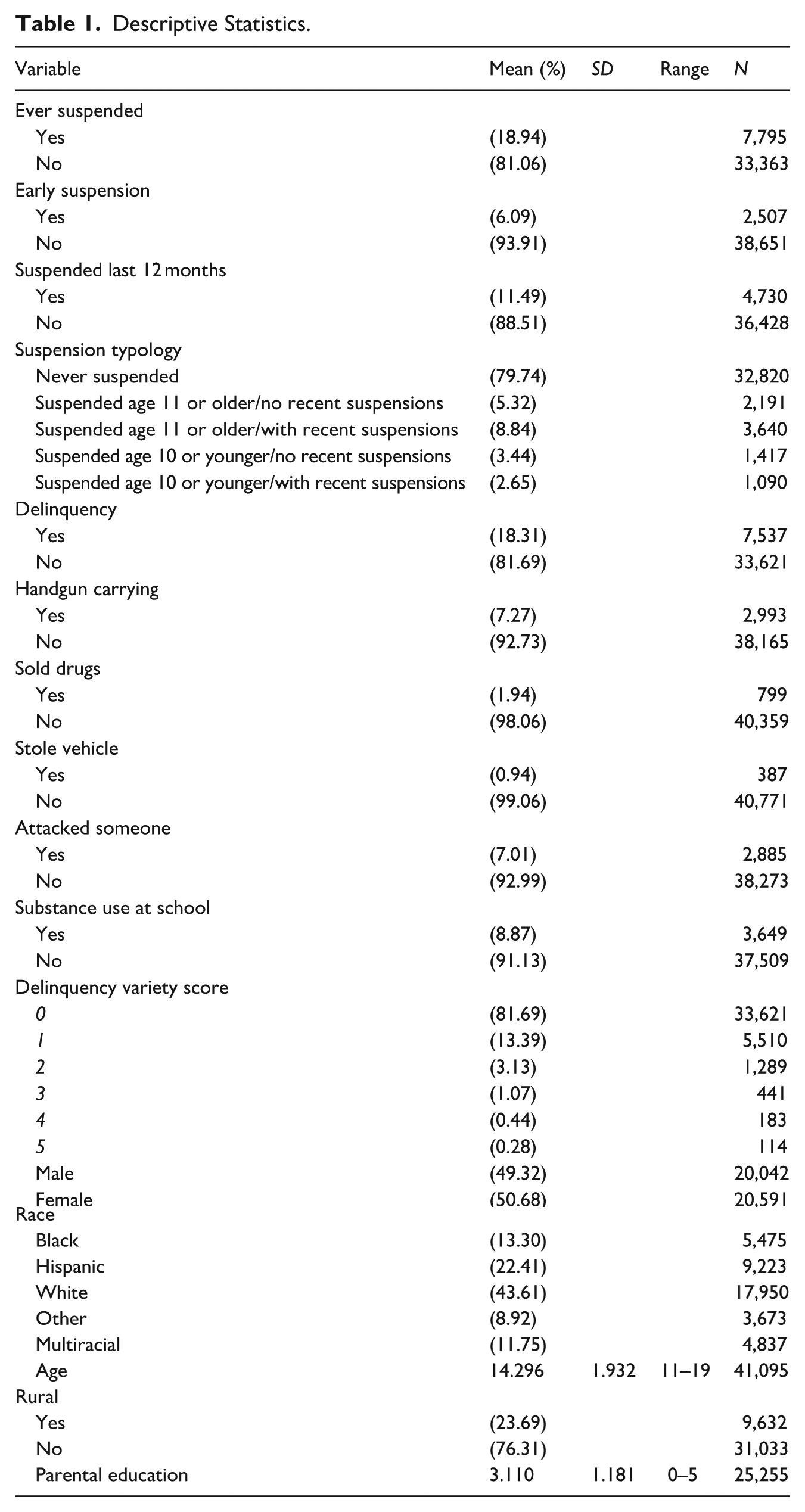
Delinquency was measured using a number of items that tap engagement in five different forms of delinquent behavior in the last 12 months. Specifically, respondents were asked the number of times they have “carried a handgun,” “sold illegal drugs,” “stolen or tried to steal a motor vehicle such as a car or motorcycle,” or “attacked someone with the idea of seriously hurting them” in the past year. Response options for these items included “never,” “1 or 2 times,” “3 to 5 times,” “6 to 9 times,” “10 to 19 times,” “20 to 29 times,” “30 to 39 times,” and “40+ times.” Responses to each of these items were dichotomized so that 0 = did not participate in this delinquent activity in the past 12 months and 1 = did participate in this delinquent activity in the past 12 months. In addition, respondents were asked questions tapping their substance use during or before school. To illustrate, respondents were asked “how many times in the past year (12 months)” they have “drank alcohol before or during school,” “smoked marijuana before or during school,” and “used another drug before or during school.” These items have the same response categories as the previous delinquency items. Each of these three items were dichotomized and then combined together in an index of substance use before or during school. This index was then dichotomized so that 0 = did not engage in substance use before or during school in the past year and 1 = has engaged in substance use before or during school in the past year. Each of the delinquency items is used separately to assess engagement in each form of delinquency. In addition, the delinquency items have been combined together to create a dichotomous indicator of participation in delinquency in the last year where 0 = has not participated in delinquency in the past year and 1 = has participated in delinquency in the past year. Descriptive statistics for the delinquency measures and all other measures included in this study are displayed in Table 1.
Descriptive Statistics.
Delinquency Variety Scale
After creating dichotomous indicators for the five different indicators of delinquent involvement we then summed these items together to create a delinquency variety scale (α = .54). This item is coded so that higher values reflect participation in more forms of delinquency (0–5).
Predictor Measures
Suspension Typology
A school suspension typology was created using two items tapping experiences with school suspensions. First, timing of first suspension was assessed using a single item where respondents were asked to indicate “How old were you when you first. . .got suspended from school?” Response categories included “never have” (0), “10 or younger” (1), “11” (2), “12” (3), “13” (4), “14” (5), “15” (6), “16” (7), and “17 or older” (8). This item has been recoded as a trichotomous variable where 0 = has never been suspended, 1 = suspended age 11 or older, and 2 = suspended age 10 or younger. Second, experiencing a recent school suspension was measured using a single item where respondents were asked “How many times in the past year (12 months) have you. . .been suspended from school?” Response options for this item ranged from “never” (0) to “40+ times” (7). This item has been recoded as a dichotomous indicator of experiencing a recent suspension where 0 = no and 1 = yes. Then, both the timing of first suspension and the recent suspension variables were combined together to create a suspension typology where 0 = Never Suspended, 1 = Suspended Age 11 or Older with No Recent Suspension, 2 = Suspended Age 11 or Older with Recent Suspensions, 3 = Suspended Age 10 or Younger with No Recent Suspensions, and 4 = Suspended age 10 or Younger with Recent Suspensions. For ease of interpretation, Never Suspended is used as the reference category for all for the models in this study.
Controls
The analyses of this study were estimated controlling for age, gender, race, living in a rural area, and parental education. First, age was measured in years. Second gender was measured so that 0 = female and 1 = male. Third, race was measured using five dichotomous indicators for racial identity. Specifically, dichotomous indicators were employed for Non-Hispanic Black (0 = non-Black, Hispanic, Other, White, or Multiracial; 1 = Black), Hispanic (0 = non-Hispanic, Black, Other, or Multiracial; 1 = Hispanic), Non-Hispanic Other (0 = Black, Hispanic, White, or Multiracial; 1 = Asian, Pacific Islander, Native American, or Other), and Non-Hispanic White (0 = non-White, Black, Hispanic, Other, or Multiracial; 1 = White). Respondents who indicated multiple racial identities (except for Hispanic-White) were coded as Multiracial (0 = reported only one racial identity or Hispanic-White; 1 = Multiracial). For ease of interpretation, Non-Hispanic White is used as the reference category for the analyses of this study. Fourth, living in a rural area was measured using a single item where respondents asked to report if they live “on a farm,” “in the country, not on a farm,” or “in a city, town or suburb.” This item is coded so that 0 = the respondent lives in a “city, town, or suburb” and 1 = the respondents lives “on a farm” or “in the country.” Finally, parental education was measured using the average of two items where respondents were asked to indicate the highest level of education completed by their mother and their father. Response options for both the maternal education and paternal education items included “completed grade school or less,” “some high school,” “completed high school,” “some college,” “completed college, to “graduate or professional school after college.” These items are coded so that higher values represent higher levels of completed education (0–5).
Analytic Strategy
The analysis for this study was conducted using StataSE 18. The analytic strategy for this study took place over a number of steps. First, we examined the descriptive statistics for suspension for the full sample and then again for the sample partitioned by race. Second, we employed logistic regression to examine the relationship between the suspension typology and each of the delinquent outcomes. Third, we employed negative binomial regression to assess the relationship between the suspension typology and scores on the delinquency variety index. Finally, we estimated another series of models examining relationships between the suspension typology and engagement in any delinquency and scores on the delinquency variety index partitioned by race. All models were estimated employing robust standard errors to adjust for the clustering of respondents within schools.
Results
In the first step of the analysis, we examined the descriptive statistics for the suspension variable. As can be seen in Table 1, 18.94% (N = 7,795) of respondents indicate that they have ever been suspended. In addition, 6.09% (N = 2,507) report that they were suspended at age 10 or younger. As for the suspension typology, 79.74% (N = 32,820) of respondents report never being suspended, 5.32% (N = 2,191) report being suspended age 11 or older with no recent suspensions, 8.84% (N = 3,640) report being suspended age 11 or older with recent suspensions, 3.44% (N = 1,417) report being suspended age 10 or younger with no recent suspensions, and 2.65% (N = 1,090) report being suspended age 10 or younger with recent suspensions.
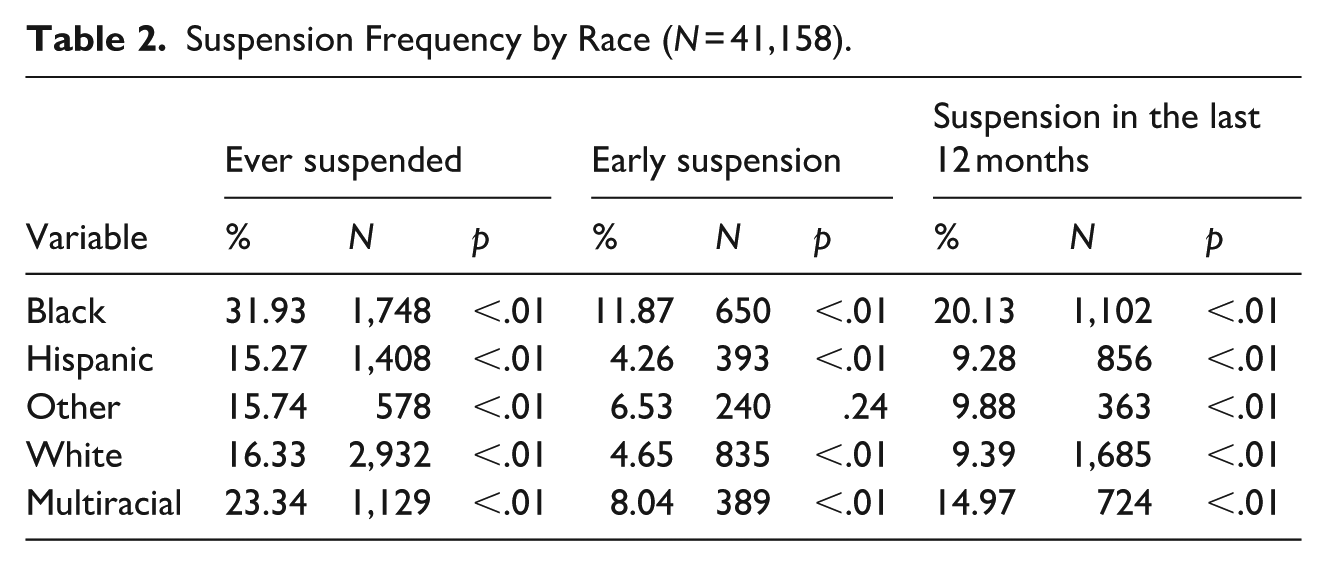
Table 2 displays descriptive statistics for timing of suspensions stratified by race. Examination of Table 2 reveals that 31.93% (N = 1,748) of Black respondents report that they have been suspended along with 15.27% (N = 1,408) of Hispanic respondents, 15.74% (N = 578) of respondents in the “other” racial category, 16.33% (N = 2,932) of White respondents, and 23.34% (N = 1,129) of Multiracial respondents. Chi-square tests for differences in experiencing a school suspension across racial identity revealed statistical differences in the incidence of suspension across racial lines. Moreover, 11.87% (N = 650) of Black respondents report that they were suspended at age 10 or younger compared to 4.26% (N = 393) of Hispanic respondents, 6.53% (N = 240) of other respondents, 4.65% (N = 835) of White respondents, and 8.04% (N = 389) of Multiracial respondents. In addition, 20.13% (N = 1,102) of Black respondents report being suspended in the past 12 months along with 9.28% (N = 856) of Hispanic respondents, 9.88% (N = 363) of “other” respondents, 9.39% (N = 1,685) of White respondents, and 14.97% (N = 724) of Multiracial respondents. Chi-square tests reveal statistical differences in prevalence of experiencing an early suspension across racial identities along with statistical differences in the likelihood of being suspended in the past year across racial lines. Taken together, the findings indicate that Black and Multiracial respondents are more likely to ever be suspended, more likely to have been suspended at age 10 or younger, and more likely to be suspended in the past year compared to the other racial categories.
Suspension Frequency by Race (N = 41,158).
In the next step of the analysis, we employed multivariable logistic regression to examine the relationship between the suspension typology and likelihood of delinquency. As can be seen in Table 3, all forms of school suspension are positively associated with the likelihood of all five individual indicators of delinquency and the composite delinquency measure. In addition, Odds Ratios (ORs) for suspended age 10 or younger with recent suspensions seem marginally larger than Odds Ratios for suspension age 11 or older both with and without recent suspensions across all six logistic regression models. For example, for the first model, the OR for suspended age 10 or younger with recent suspensions is 16.685 (p < .01), while the OR for suspended age 11 or older with recent suspensions is 11.896 (p < .01). Meanwhile, the OR for suspended age 10 or younger without recent suspensions is 3.147 (p < .01), and the OR for suspended age 11 or older without recent suspensions is 3.771 (p < .01). These findings indicate that respondents who have been suspended previously are more likely to sell illicit drugs compared to those who have never been suspended. Moreover, that respondents who were suspended at age 10 or younger and have experienced a recent suspension are slightly more likely to sell illicit drugs compared to those who experienced their first suspension age 11 or later even among those who have also experienced a recent suspension. Examination of the other logistic regression models in the table reveals a similar pattern of findings, where ORs are the highest for respondents who were suspended age 10 with recent suspensions compared to the other suspension groups.
Regression Models of the Association between Suspension and Delinquent Outcomes in the Last 12 Months (N = 41,158).
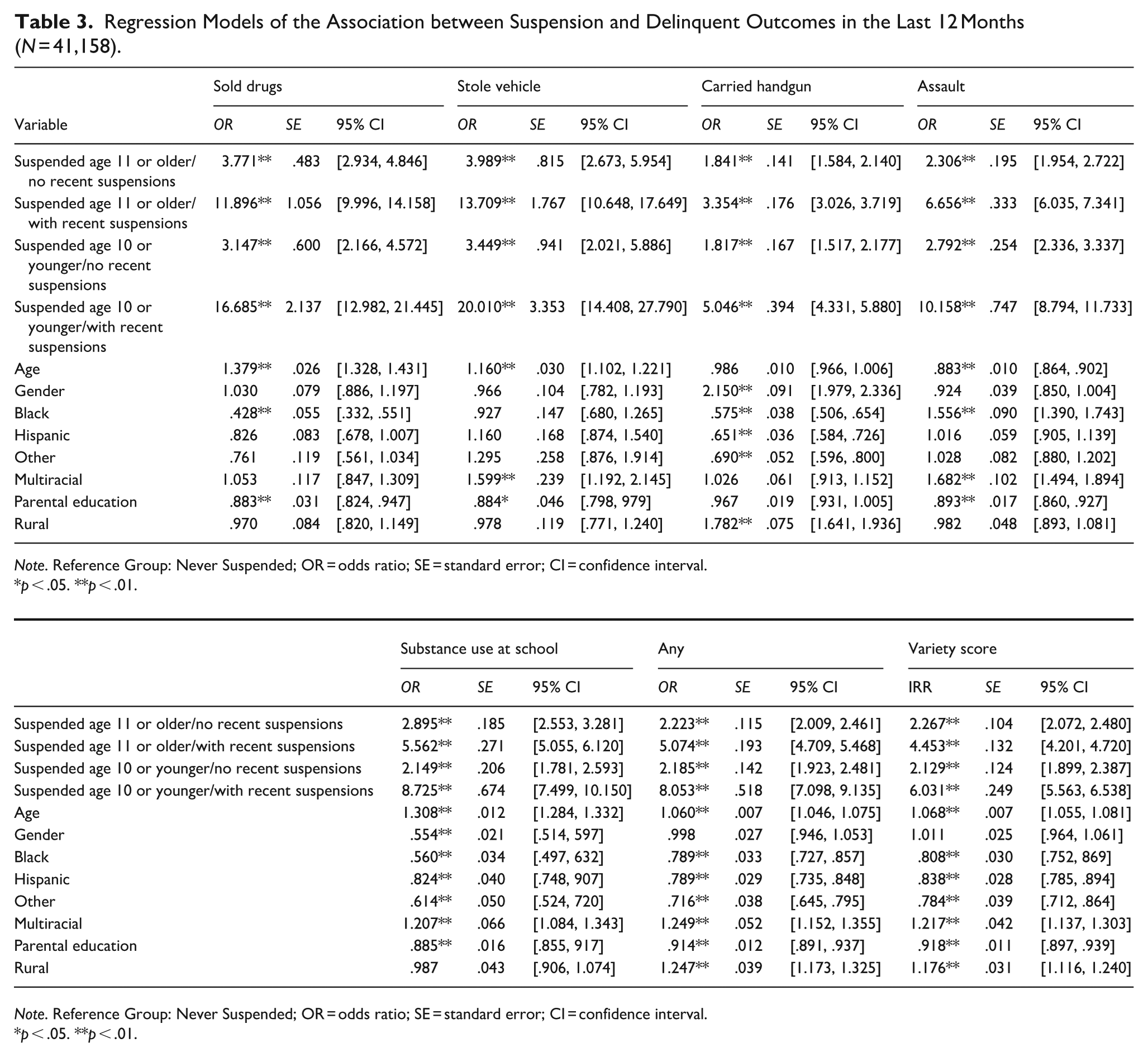
Note. Reference Group: Never Suspended; OR = odds ratio; SE = standard error; CI = confidence interval.
p < .05. **p < .01.
In the second part of Table 3 we examine the relationships between the suspension typology, drug use at school, likelihood of any delinquency, and scores on the delinquency variety index. As can be seen, the findings of these models reveal a similar pattern as the models in the first half of the table. To illustrate, for the model predicting any delinquency, the OR for suspended age 10 or younger with recent suspension is 8.053 (p < .01) while the OR for suspended age 11 or older with recent suspensions is 5.074 (p < .01). Meanwhile the ORs for the two groups without recent suspensions are lower (Suspended Age 11 or Older/No Recent Suspensions: OR = 2.223, p < .01; Suspended Age 10 or Younger/No Recent Suspensions: OR = 2.185, p < .01). As such, respondents who were suspended age 10 or younger and experienced a recent suspension have 705.3% greater odds of being involved in delinquency compared to respondents who were never suspended. Additionally, respondents suspended age 11 or older and experienced a recent suspension have 407.4% greater odds of involvement in delinquency compared to youths who have never been suspended. In addition, in the model predicting scores on the delinquency variety index respondents who were suspended age 10 or younger with recent suspensions (IRR = 6.031, p < .01) are predicted to have the highest scores on the delinquency variety index compared to the other suspension groups (Suspended Age 11 or Older/No Recent Suspensions: IRR = 2.267, p < .01; Suspended Age 11 or Older/With Recent Suspensions: IRR = 4.453, p < .01; Suspended Age 10 or Younger/No Recent Suspensions: IRR = 2.129, p < .01). Overall, these findings appear to indicate that respondents who experienced an early suspension (age 10 or younger) and have experienced a recent suspension (within the last 12 months) are more likely to engage in delinquency than respondents who were suspended later (age 11 or older) and those who have not experienced a recent suspension. In addition, those who experienced an early suspension and a recent suspension are more likely to have higher scores on the delinquency variety index than those suspended later and those who have not experienced a recent suspension.
In order to test the robustness of these findings, we estimated a series of ancillary analyses alternating the reference variable through all different possible values of the suspension typology for the models examining any delinquency and the delinquency variety index. The findings from these ancillary analyses indicate that respondents who were suspended age 10 or younger and have recent suspensions have a greater likelihood of engaging in any delinquency compared to all other suspension groups. In addition, respondents who were suspended age 10 or younger and have experienced a recent suspension are likely to have higher scores on the delinquency variety index compared to all other suspension groups. 2
In order to garner a better understanding of the relationship between suspension and delinquency, the probability of engaging in any delinquency as a function of the suspension typology is presented in Figure 1(A). These estimates were calculated using predictive margins and adjusting for controls. As can be seen, respondents who experienced a suspension age 10 or younger and a recent suspension have the highest likelihood of engaging in delinquency followed by respondents who experienced a suspension age 11 or later and experienced a recent suspension. In addition, Figure 1(B) presents predicted scores on the delinquency variety index as a function of scores on the suspension typology index. Examination of Figure 1(B) reveals that respondents who experienced a suspension age 10 or younger and experienced a recent suspension have the highest predicted scores on the delinquency variety index. The next highest group is suspended age 11 or older with recent suspensions.
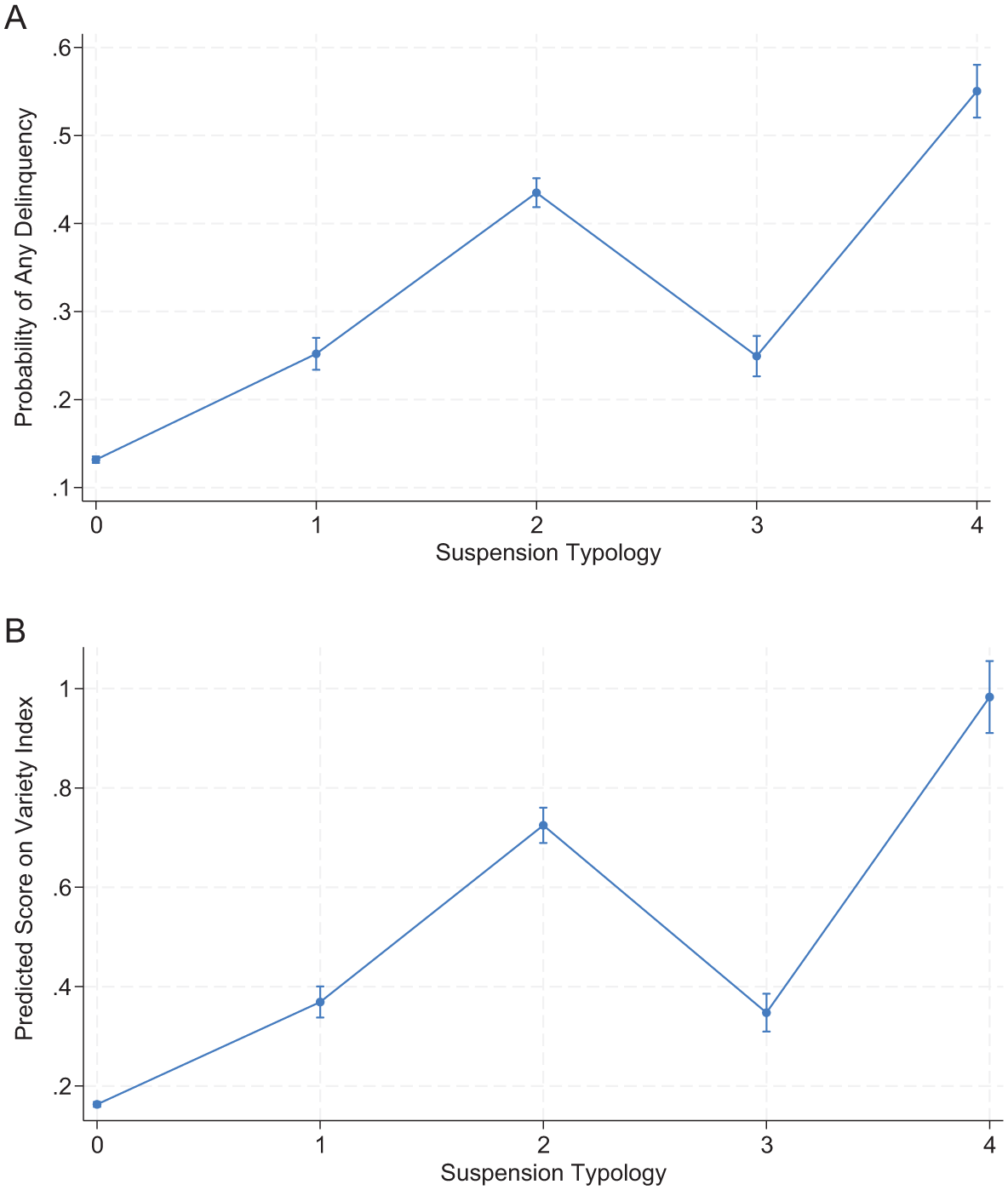
(A) Probability of any delinquency as a function of suspension typology categorization with 95% confidence intervals. (B) Predicted score on delinquency variety index as a function of suspension typology categorization with 95% confidence intervals.
Given significant associations between suspension and delinquency, we then examined these relationships partitioned by race. Table 4 displays models examining the likelihood of engaging in any delinquency and predicted scores on the delinquency variety index for respondents of different races. The first part of the table displays results for Black, Hispanic, and White respondents. As can be seen, the relationships between suspension exposure and delinquency appear similar for Black, Hispanic, and White respondents compared to the full sample. Once again, respondents who experienced an early suspension (age 10 or younger) and a recent suspension are the youths most likely to engage in delinquency and those predicted to have the highest scores on the delinquency variety index compared to those who experienced their first suspension later in life and those who have not experienced a recent suspension.
Regression Models of the Association between Suspension and Delinquency in the Last 12 Months across Racial Categories.
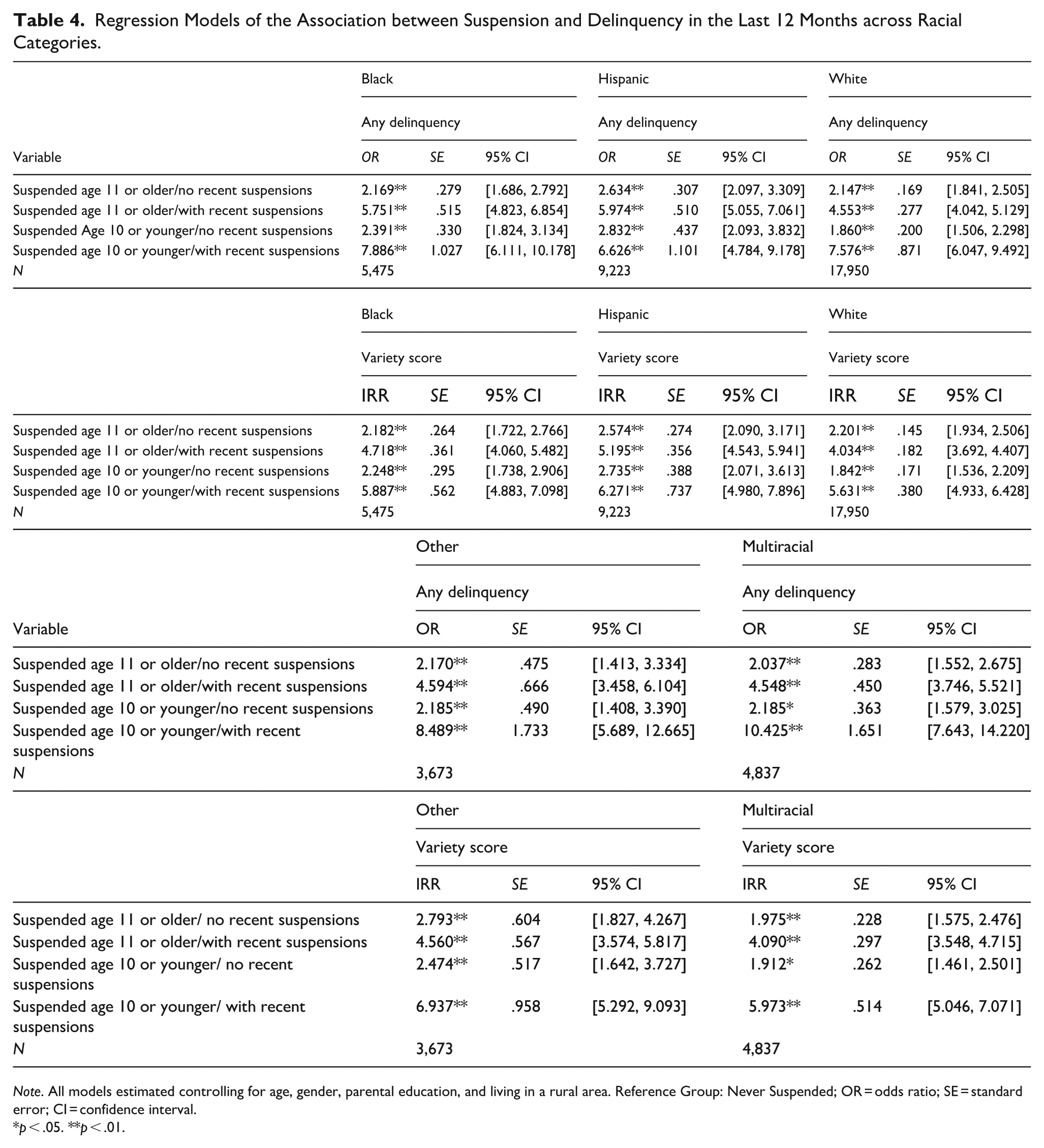
Note. All models estimated controlling for age, gender, parental education, and living in a rural area. Reference Group: Never Suspended; OR = odds ratio; SE = standard error; CI = confidence interval.
p < .05. **p < .01.
The second part of Table 4 examines relationships between the suspension typology and delinquency in respondents who reported “other” racial identity or multiple racial identities. As can be seen, the findings of these models exhibit a similar pattern to the models examining these relationships in the full sample and in the Black, Hispanic, and White respondents. Once again, respondents who experienced their first suspension age 10 or younger and experienced a recent suspension are the youths most likely to engage in delinquency compared to youths who experienced their first suspension later in life and/or have not experienced a recent suspension.
Finally, we graphed the relationships depicted in Table 4 using predictive margins in Figure 2. Figure 2(A) displays probability of delinquency as a function of suspension typology categorization partitioned by race. As can be seen, any experience with suspension is associated with an increased likelihood of engaging in delinquency compared to never being suspended for all racial groups. In addition, suspension age 10 or younger with recent experiences with suspension is associated with an increased probability of engaging in delinquency compared to suspension at age 11 or older for both those with and without recent suspension experiences for nearly all racial categories. As such, the relationship appears to be relatively general across racial categories. Of note, respondents in the Multiracial category appear to have higher probabilities of engagement in delinquency for all suspension typology categorizations.
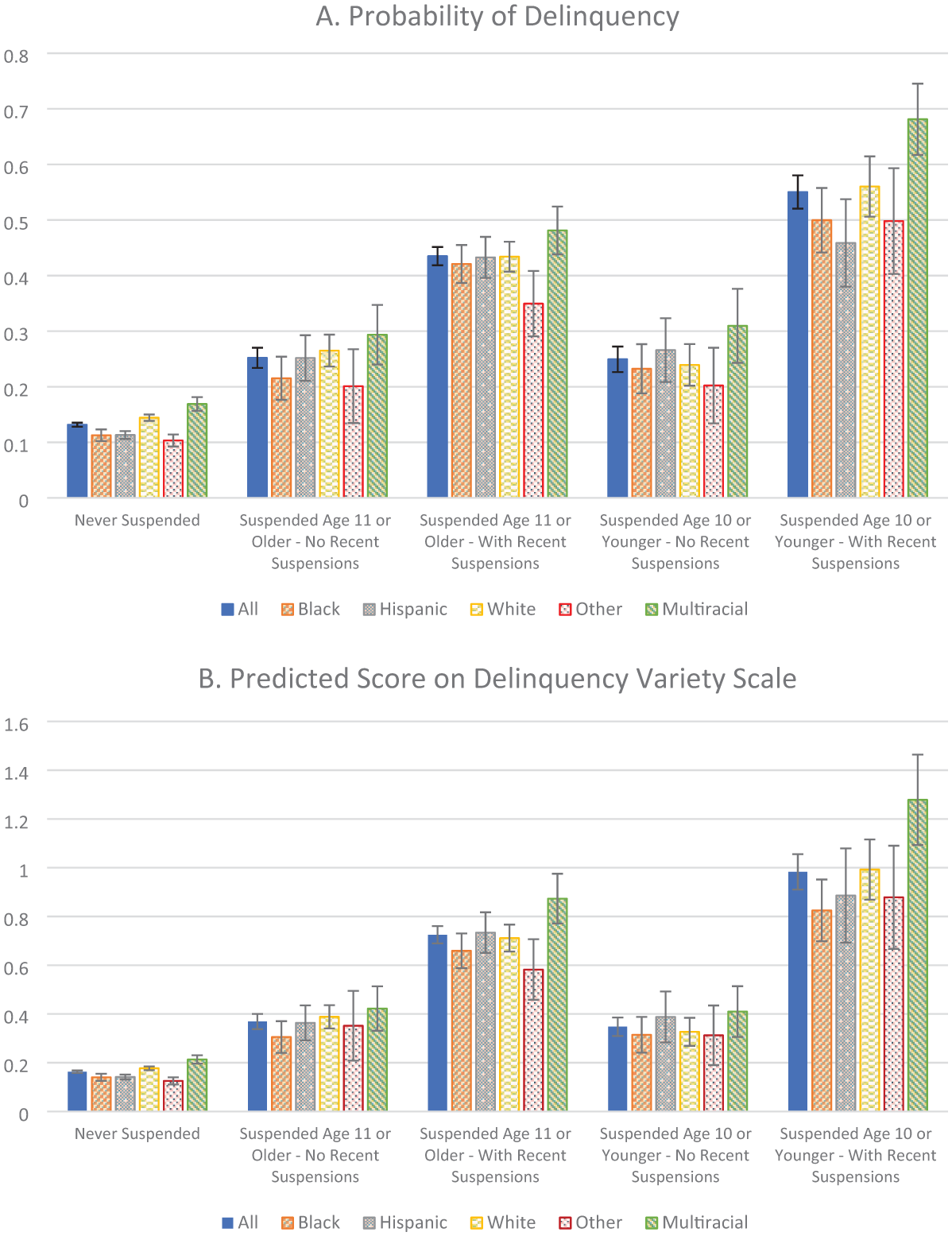
(A) Probability of any delinquency as a function of suspension typology categorization across racial identities with 95% confidence intervals. (B) Predicted score on delinquency variety scale as a function of suspension typology categorization across racial identities with 95% confidence intervals.
Figure 2(B) presents predicted scores on the delinquency variety index separated by suspension typology categorization and racial identity. Examination of the figure reveals a similar pattern of findings to those displayed in Figure 2(A)—wherein respondents who experienced an early suspension and have recent experiences with suspension have higher predicted scores on the delinquency variety index compared to all other suspension subgroups. This pattern of findings seems relatively general across all five racial categories.
Discussion
Previous research documents links between school suspension and delinquent involvement (Monahan et al., 2014; Mowen & Brent, 2016; Wolf & Kupchik, 2016). Most of the research in this area, however, tends to focus on experiencing exclusionary discipline in mid to late adolescence and does not take into account the experience of exclusionary discipline earlier in the life course. This study extended the existing research by examining the relationship between experiencing an early suspension (age 10 or younger) and engagement in delinquency during adolescence by employing a novel typology of exposure to school suspension. Further this study examined whether relationships between exposure to suspension and delinquency vary by race. This study yielded two major findings.
First, the descriptive statistics regarding experiencing a suspension and race conformed with the findings of a wealth of research indicating that Black youth are significantly more likely to be suspended than youth in other racial categories (Anyon et al., 2018; Balfanz et al., 2015; Owens & McLanahan, 2020). Our findings also indicate that multiracial youth are significantly more likely to be suspended compared to Hispanic, White, and other racial identity youth. To illustrate, 31.93% of Black youth and 23.34% of Multiracial youth in the sample experienced a school suspension while only ~15% to 16% of Hispanic, White, and other racial category youth experienced a suspension. Similarly, 11.87% of Black youth and 8.04% of Multiracial youth experienced a suspension before the age of 11 compared to 4.65% of White youth, 4.26% of Hispanic youth, and 6.53% of youth reporting a different racial category. These findings indicate substantial variation in experiencing school suspensions across racial groups. Similar disparities are also noted for recent suspensions—wherein Black and Multiracial youths were more likely to experience a suspension in the past 12 months compared to Hispanic, White, and other racial identity youth. Of note, these results echo other reports that racial disparities still persist in recent years (Anyon et al., 2018; Balfanz et al., 2015; Hwang et al., 2022; Owens & McLanahan, 2020).
Second, in line with our first research question, any experience with school suspension, including early suspension, is significantly related with the probability of engaging in selling drugs, stealing vehicles, carrying a handgun, assault, and substance use before or during school. These findings dovetail with a body of literature linking experiencing exclusionary discipline with delinquency (Monahan et al., 2014; Mowen & Brent, 2016; Wolf & Kupchik, 2016). In line with our second and third research questions, the ORs for experiencing an early suspension and a recent suspension are marginally larger than the ORs for later school suspensions for both those who have experienced recent suspensions and for those who have not, indicating that experiencing an early school suspension may slightly increase the risks of delinquent involvement compared to later experiences with suspension. These findings add to the current literature as they highlight the importance of experiencing school suspensions in elementary school and how these suspensions may increase the risks of later delinquency. Therefore, overlooking early suspensions is problematic and may miss opportunities to shift elementary school policies away from exclusionary discipline. At the same time, examination of the ORs across the different typology categorizations reveals that exposure to recent suspensions is also associated with increased risks of delinquent behavior. As such, the relationship between timing of first suspension and delinquency needs to interpreted taking into account recent experiences with suspensions as well.
As for our fourth research question, the models examining relationships between the suspension typology and delinquency separated by race revealed a general pattern findings. In this data, it appears that the relationship between suspension typology categorization and involvement in delinquency appears relatively similar across racial lines. These findings run counter to the findings of previous studies which have suggested that the influence of school suspensions on arrest vary across racial and ethnic lines (Fisher & Widdowson, 2023). Even so, the current outcome of interest is delinquency, whereas Fisher and Widdowson (2023) examined arrest. Thus, these associations may not be generalizable across outcomes. It may be that moderation by race/ethnicity emerges when examining who is arrested but not for engagement in delinquent behaviors. Furthermore, Fisher and Widdowson (2023) examined youth born in the early 1980s, whereas our sample were born more recently (in the 2000s and 2010s). Thus, these associations may not be generalizable across time. To further probe the possibility of variation in suspension-delinquency relationship across racial and ethnic groups, future research should explore alternative outcomes capturing formal justice involvement (e.g., arrest and incarceration) in addition to delinquency among recent samples of youth.
As school is where youths spend a substantial portion of their daily lives, exclusionary practices, like suspension, can interfere with their ability to receive educational benefits. Zero-tolerance policies, like those that suspend youths from school, have the potential to do more harm than good. In some schools, policies have been implemented to limit the use of suspension and other practices that exclude youths from school due to their noted association with negative outcomes (Anderson, 2020; Craigie, 2022; Yaluma et al., 2022). Research on such policies have shown small but positive outcomes following the prohibition of suspension as a response to disciplining behavior, such as truancy, on behavioral and educational outcomes. Further, this research shows that such policies have the potential to reduce racial and ethnic disparities in these outcomes (Anderson, 2020; Craigie, 2022; Yaluma et al., 2022). Likewise, some school-based programs have been identified as effective at reducing suspensions among students (Lee & Gage, 2020). As an example, the School-wide Positive Behavioral Interventions and Supports program focuses on developing a “culture” within the school that emphasizes expectations of appropriate and inappropriate behavior among students in elementary schools (Bradshaw et al., 2010; Horner et al., 2009). Results indicated that the program was associated with lower school suspensions in schools that received the program when compared to those that did not receive the program (Bradshaw et al., 2010). Such programs could be beneficial in elementary schools to positively engage youth in school settings and reduce the likelihood of suspensions among this group of students and their subsequent engagement in antisocial behavior.
Findings from this research should be interpreted with some limitations in mind. First, these data are cross-sectional, restricting our ability to investigate the long-term effects of early suspension on later antisocial behaviors. Similarly, the cross-sectional nature of the data limits our ability to make causal claims pertaining to the associations between school suspensions and delinquency. Second, the data for this study are drawn from a representative sample of Florida adolescents. As such, findings from this study may not be generalizable to students in other States or countries. Third, while we were able to examine the timing of the first suspension and recent experiences with suspension, we lacked information on lifetime number of suspensions. Future research is needed to assess whether early suspension is related to subsequent suspensions (and their frequency) and how the number of lifetime suspensions may be related to delinquent outcomes.
Fourth, the FYSAS is a school-based survey that is administered to public middle schoolers and high schoolers attending classes in mainstream schools and excludes students in special education schools and students in mainstream schools who are in classrooms designated as “English for speakers of other languages.” Given these sampling restrictions, students selected for the survey were presumed to have sufficient literacy skills to read and respond to the survey items. As such, no special considerations were given toward respondents with low literacy skills. As a result, students with lower levels of literacy may not have responded in line with the survey administrators expectations and may have been more likely to not respond to survey items or respond in a haphazard fashion. As such, the lack of accounting for low literacy skills may bias the findings in some ways. At the same time, the validity checks performed after survey completion screened out surveys with inconsistent patterns of findings and those with less than 25% of the items completed (Florida Department of Children and Families, 2022). Future research will need to be conducted in order to determine whether the same pattern of findings emerges using data that accounts for variety in levels of literacy skills. Fifth, the FYSAS asks respondents to report their experiences with school suspension without distinguishing between in-school and out-of-school suspensions. As such, the measure of suspension included in this study likely includes both forms of suspension. Future research will be needed in order to investigate differential relationships between delinquency and in-school versus out-of-school suspensions. Finally, as this study relied on self-report data, there is also the possibility that respondents may not have accurately reported their experiences with school suspensions and delinquent involvement due to social desirability bias. Future research should incorporate multiple measures to gain a more thorough understanding of the relationship between early suspension and delinquency.
Footnotes
Declaration of Conflicting Interests
The authors declared no potential conflicts of interest with respect to the research, authorship, and/or publication of this article.
Funding
The authors received no financial support for the research, authorship, and/or publication of this article.
