



Abstract
A sample of 1,247 adults from two Ukrainian cities was analyzed to understand how exposure to the Donbas war in 2017 influenced decision-making related to violent behaviors among civilians. The study seeks to: (a) evaluate perceived rewards and costs as mediators between war exposure and violence; (b) test if war exposure increases the effect of perceived rewards and decreases the influence of perceived costs of crime on violence; (c) assess war exposure’s impact on the interaction between perceived rewards/costs of violence and decision-making moderators. As findings show, high war exposure diminishes the relevance of perceived benefits and alters their interrelationships with other factors in violent decisions. Overall, results suggest a shift toward “hot” reasoning during war.
Keywords
Introduction
Initiated by Russia in 2014, the ongoing Russo-Ukrainian war grew from the annexation of the Crimean Peninsula and regional violent conflict in the Donbas region of Ukraine to a full-blown attack on the entire country 8 years later. Although the Donbas war did not involve long-range missiles or drones the way Russian aggression toward Ukraine does today, it was a protracted period of bloodshed that displaced over 1.5 million and killed at least 10,000 (Council on Foreign Relations, 2021). The full range of consequences of the Donbas conflict and subsequent Russo-Ukrainian war has yet to be fully explored. However, any society facing war conditions sees elevated risks of death, injuries, displacement, and a spectrum of physical and mental health outcomes lingering for years (e.g., Miller & Rasmussen, 2010). Of particular concern is the possibility of heightened interpersonal violence that could be encountered by Ukrainian society as a result of these events.
While the association between war and violence has been reported both on macro (Archer & Gartner, 1984; Ember & Ember, 1994; see also DiPietro, 2016; Elfversson et al., 2019; Gartner & Kennedy, 2018 for reviews) and micro (Timmer et al., 2023) levels, no existing studies provide definitive answers about the exact mechanisms translating war exposure into violence (c.f. Ember & Ember, 1994; Timmer et al., 2023). We argue that rational choice theory (Becker, 1968; Kahneman, 2003) may offer a particularly useful framework for investigating the impact of war on human behavior. In criminology, rational choice theory has morphed from an economics-driven viewpoint focusing strictly on the costs and benefits of behavior (Becker, 1968) to a complex understanding of decision-making incorporating multiple contextual and individual factors (e.g., Pogarsky & Herman, 2019). While research has examined a number of contingencies theorized to affect the process of individual crime-related decision-making (Pogarsky et al., 2017), the potential for dramatic and stressful events such as exposure to war to influence the relationships between rational considerations and criminal involvement has yet to be assessed. Yet, as a particularly stressful event, war exposure may disrupt the regular crime-related decision-making process increasing the salience of perceived rewards of crime and lowering the inhibiting effect of perceived costs of engaging in violence.
We use a random sample of 1,247 adults from two large Ukrainian cities, Kharkiv and Lviv, to understand how exposure to the Donbas war in 2017 may have impacted the process of decision-making related to individual involvement in violent behaviors among the civilian population. Our goals in this study are fourfold. First, we seek to understand the impacts of war exposure on individual perceptions of the costs and benefits of engaging in violence. Second, we investigate whether the relationship between interpersonal violence and war exposure is mediated by individual perceptions of the benefits and costs associated with violent behavior. Third, we assess the possible conditioning effects of war exposure on the relationships between violence and the perceived costs/benefits of engaging in this behavior. Finally, we investigate the extent to which non-war-associated contingencies, such as personal anomic orientation, association with violent peers, and negative affect, interact with war exposure to influence individual decisions to engage in violent behavior.
The War in Ukraine
On February 24, 2022, Russia launched a full-fledged attack on Ukraine and its major cities. While the resulting humanitarian crisis has received significant attention from both the press and scholarly community (e.g., Chumachenko & Chumachenko, 2022), the preceding 8-year war in the Donbas region between the Ukrainian army and the Russia-backed separatists backed by the Russian army saw much less publicity.
Formerly part of czarist Russia and other empires and, later, the Soviet Union, Ukraine has always had a contentious relationship with Russia (Cancio et al., 2020) that consistently attempted to undermine Ukraine’s sovereignty. By late 2013, Ukraine was revolting against the actions of its pro-Russian president, Viktor Yanukovych, who actively resisted the integration of Ukraine into Europe. The protests lasted for months and involved state troops reacting violently toward peaceful protesters. In early February 2014, Yanukovych fled the country (Kochnev, 2020) leaving the country in political turmoil. By mid-March of the same year, Russia annexed the Crimean Peninsula from Ukraine, planted its military troops in the southeastern part of the country (the Donbas region), and, with the help from pro-Russian separatists, sparked a military conflict that transformed quickly into a full-blown war. Aided by the Russian Federation and its troops, the insurgents cut into the region of Donbas and declared the independence of two large areas with the capital cities of Donetsk and Luhansk.
While regionally limited, the Donbas war made its way into every Ukrainian household through the media reports of deaths and injuries in the Donbas region and the stories of internally displaced civilians and Ukrainian soldiers forced to contain the flames of war threatening to spread deeper into the country. Unsurprisingly, recent studies have found Ukrainians to display heightened levels of PTSD, anger, and risk of involvement in violence (Johnson et al., 2022; Timmer et al., 2023). One intriguing possibility that has yet to be investigated is that war can be a uniquely strong and multifaceted stressor capable of affecting individual behavior through its impact on decision-making.
The Current State of Rational Choice Theory
In their effort to understand the decision-making process, research initially drifted away from full consideration of rewards and costs associated with crime (Becker, 1968) focusing primarily on the associations between subjective perceptions of sanction certainty and severity and individual offending (e.g., Matsueda et al., 2006; Nagin & Pogarsky, 2001; Tittle et al., 2011), then shifted toward models incorporating both costs and rewards of crime (e.g., Kroneberg et al., 2010; Loughran et al., 2016; Neissl et al., 2019; Paternoster & Pogarsky, 2009), and most recently—to dual-system/dual-process approaches (e.g., Kahneman, 2011; Van Gelder & De Vries, 2012).
One of such approaches is the hot/cool perspective on criminal decision-making (e.g., Van Gelder, 2017; Van Gelder & De Vries, 2012, 2014), which proposes that criminal decision-making may be based on a careful consideration of costs and benefits (cool mode) or be intuitive, emotion-based, and quick (hot mode). An approach grounded in Kahneman’s (2011) reasoning suggests a two-system decision-making process, describing System 1 as quick, often operating on the basis of habit or intuition, and System 2—as slow, calculative, and based on self-awareness. While some studies incorporate both modes of the decision-making process (e.g., Thomas & McGloin, 2013; Van Gelder & De Vries, 2014), much available research has pursued the cognitive, deliberative or “cool” mode investigating the impact of situational factors (e.g., presence of peers) or personal predispositions (e.g., moral beliefs or self-control) on cognitive assessments of risks and benefits made within System 2, as well as ways in which such factors interact with these assessments in their effects on decisions to engage in crime. For instance, the process of deliberative decision-making may be conditioned, among others, by strain, depression, and sleep problems (Timmer et al., 2021), negative emotions (Barnum & Solomon, 2019); delinquent peer association (Matthews & Agnew, 2008), gendered socialization (Neissl et al., 2019), and psychopathy (Ray et al., 2020).
Recent developments in the literature frame some of these influences as heuristics or shortcuts used by individuals to expedite or ease the decision-making process (Gigerenzer & Gaissmaier, 2011; Pogarsky et al., 2017). Such shortcuts are situationally grounded and may change the deliberative process as timesaving sometimes occurs at the expense of misjudging the likelihood of beneficial outcomes. The use of heuristics such as relying on prior experiences allows individuals to examine fewer cues and alternatives in decision-making (Shah & Oppenheimer, 2008) or make decisions under less familiar circumstances (Gigerenzer & Gaissmaier, 2011).
A condition that may be uniquely conducive to the use of heuristics and/or biased decision-making is strain. To be sure, we identify only three relevant studies focusing solely on the deterrence part of decision-making and utilizing a limited range of strains affecting exclusively youth populations (Baron, 2011; Kuptsevych-Timmer et al., 2019). As a precursor to stress (Pearlin et al., 1981) known to interrupt decision-making process (Arnsten & Shansky, 2004; see also Timmer et al., 2022), strain may be particularly important to investigate in the context of decisions related to crime involvement. For this reason, we focus on war, a peculiar stressful context that may be associated with heightened uncertainty and, possibly, greater or lesser reliance on heuristics and intuition in decision-making (see Starcke & Brandt, 2012 for review).
War Exposure as Antecedent and Moderator of Criminal Decision-Making Process
While individuals may encounter a variety of stressors, war is undoubtedly one of the most stressful events known to mankind. Wars expose people to personal injury, death of loved ones, sexual violence, and displacement (Akello et al., 2010; Gartner & Kennedy, 2018; Priebe et al., 2010), which have been found to be detrimental to the physical and mental health of war survivors (e.g., Johnson et al., 2022). Consistent with the arguments of general strain theory (GST; Agnew, 1992, 2006), in the context of war, individuals may experience both direct and indirect/vicarious forms of war-related strain. A recent study by Timmer et al. (2023) confirms that both types of war exposure are criminogenic and thus may be considered theoretically important stressors associated with adverse behavioral outcomes.
The strain of war may affect the decision-making process on multiple dimensions. As suggested by behavioral economics, heuristic, quick decision-making often relies on memory, bringing up relevant past events that may help in the decision-making process and playing on the similarity between previously received information and current events or situations (e.g., Hastie & Dawes, 2010, pp. 90–103). War brings chaos and destruction, likely rendering prior memories and similarities gleaned from some of the previous experiences obsolete. It is thus possible that, absent similar past experiences, at least some associated risks and rewards get reappraised and reevaluated by those who experience war-related strains (see also Starcke & Brandt, 2012).
On one hand, war exposure may be associated with changes in expectations (Becker, 1968; see also Thomas et al., 2022), such as anticipated rewards or loss of informal networks, associated with offending. For instance, war may push a person to perceive at least some forms of offending as more rewarding (see also Slovic et al., 2004), particularly if the individual now believes in living life to the fullest. A prior study by Averdijk et al. (2016) linking non-war victimization to assessment of costs and rewards of offending provides some support for this argument by reporting a decrease in anticipated costs but an increase in anticipated rewards associated with violence among those who previously experienced violent victimization. If the antecedent influence of war exposure on individual perceptions of rewards and costs of violence is confirmed, then those cognitive assessments may serve as a pathway linking war exposure and engagement in violent behavior. On the other hand, war exposure may moderate the relationship between perceived rewards/costs and offending. Because wars are inherently violent, they create new memories and experiences used in decision-making. With formal control being perceived as absent or relaxed, war exposure may decrease the violence-inhibitive influence of perceived costs and heighten the violence-inducing effect of perceived rewards of violence on violent behavior (c.f. Starcke & Brandt, 2012).
Importantly, while war exposure likely has formational and conditional effects on various elements and links in the decision-making process, it may also affect ways in which certain personal predispositions and circumstances integrate into the decision-making process. We note three such factors: anomic value orientation, involvement of delinquent associates, and negative affect. While literature suggests that any of these three conditions may interfere with rational choice considerations, we argue that war exposure may be particularly likely to exacerbate their effects on the relationships between rational choice elements and crime.
Additional Contingencies in Criminal Decision-Making
Anomic Orientation
A considerable number of studies have documented a direct preventive effect of moral beliefs on crime (see Wikström et al., 2012 for review) or treated morality as an extralegal sanction (Grasmick, Bursik, & Arneklev, 1993). Some studies have examined moderating effects of moral values on the association between anticipated costs (e.g., Gallupe & Baron, 2014; Piquero et al., 2016) or benefits and costs (Paternoster & Simpson, 1996) of engaging in crime and offending, producing mixed results. One type of individual values, personal anomic orientation, and its interrelationship with the rational calculus in impacting criminal behavior has received much less attention. Merton (1938) posited the combination of individual values overemphasizing monetary goals and undervaluing legal means of achieving them as anomic, with high potential to induce criminal outcomes in those possessing them. More recently, criminologists found anomic values oriented toward commitment to monetary goals and weakened commitment to legitimate means to achieve them to be potentially crime-motivating, typically in conjunction with other conditions (e.g., Hughes et al., 2018).
Several lines of thought suggest that personal beliefs such as anomic orientation may condition the relationship between perceptions of risks/costs and benefits of crime and criminal involvement but their predictions about the direction of those interactions have differed. Some studies suggest that strong moral beliefs, possibly linked to less anomic orientation, weaken the effects of rational considerations on criminal behavior (Paternoster & Simpson, 1996; Piquero et al., 2016). In that case, high morality allows individuals to effectively filter out nonconforming behavioral options (e.g., Herman & Pogarsky, 2020; Pogarsky, 2002). By contrast, rational calculus could be especially salient among those with a strong disposition for crime (Pogarsky, 2007; Wright et al., 2004). This is because people with characteristics predisposing them to crime, including anomic orientation, cannot be prevented from committing crimes by much else except rational considerations. Such individuals may be especially motivated to engage in crime and particularly attuned to the criminogenic effect of crime benefits, though, likely, not to the crime-reducing effect of perceived sanction risks.
War context helps shed a different light on previous life experiences, exposing individuals to violent behaviors, magnifying negative emotional states, and removing many of the existing constraints. In wartime, people may see violence as a particularly gratifying option, feel anger and a variety of other negative emotions, and experience a state of anomie (Durkheim, [1893] 1933) perceiving the risks associated with nonconforming behaviors to be minimal. We could thus argue that, facing high levels of war exposure, those with stronger anomic, instrumental gain-associated orientation may become even more sensitive to the violence-inducing effect of perceived rewards of violent behavior, whereas the deterrent effect of perceived risks will be further diminished among them. In other words, those with anomic value orientation, when exposed to war, may be further pushed to concentrate on immediate gratification following engagement in violence while disregarding possible consequences of such actions.
Violent Peer Associations
Peer influence has long been theorized to be an important factor in decision-making processes regarding crime (Stafford & Warr, 1993; see also Paternoster & Piquero, 1995; Pogarsky & Piquero, 2003). In the rational choice literature, most studies focus on ways in which perceived benefits and risks of crime are updated as a result of experiences with deviant peers (Barnum & Pogarsky, 2022; McGloin & Thomas, 2016; McGloin et al., 2021; Thomas & Vogel, 2019). As noted by Hoeben and Thomas (2019), exposure to deviant peers and rational calculus elements may also interact in their association with offending (see also Thomas & McCuddy, 2019). For example, according to Matthews and Agnew (2008), perceived crime costs may be less effective in their crime-preventive effects among those with delinquent peers because such individuals may be less likely to consider the probability of getting caught and perceive negative consequences of crime as important. On the other hand, perceived criminal rewards may exert stronger crime-inducing effects among those with more delinquent peers because such individuals are more likely to be exposed to criminal opportunities as well as be rewarded for being involved in crime.
In wartime, the crime-preventive efficiency of formal control may be further reduced and the crime-inducing effect of perceived rewards of crime heightened. It could be argued that, when experiencing higher levels of war exposure, individuals with more associations with violent peers may become even more sensitive to violence-provoking effects of perceived rewards of violent behavior, By the same token, the deterrent effect of perceived costs of crime already weakened by association with violent peers will be further eroded among those especially exposed to war.
Negative Affect
Past research investigated the role of negative emotions in the context of individual decision-making. Studies incorporated emotional thrill as a perceived crime benefit (Matsueda et al., 2006; Paternoster & Simpson, 1996) and used anticipated shame or humiliation as a potential cost of crime (e.g., Grasmick & Bursik, 1990; Paternoster & Simpson, 1996). Negative emotions (Kamerdze et al., 2014) have also been assessed as a factor influencing decision-making process, and anger has been noted to significantly decrease perceived costs of offending (Bouffard, 2015).
Importantly, studies have also reported possible moderating effects that negative affect, either in its incidental or integral to the situation form, could have on the relationships between costs/benefits perceptions and behavioral decisions (e.g., Barnum & Solomon, 2019; Carmichael & Piquero, 2006). It appears that negative emotions may diminish the effects of such perceptions on the decisions to engage in crime (e.g., Barnum & Solomon 2019; Carmichael & Piquero, 2004) potentially restricting the crime-preventive effects of cost considerations to those experiencing less negative affect. The perceptions of crime rewards, on the other hand, may be heightened in those experiencing anger and related negative emotions. This line of thought is also consistent with the “hot/cool” perspective on criminal decision-making suggesting that different stimuli, including experiencing negative emotions, may trigger the “hot” mode of processing and deactivate the “cool” mode of decision-making (Van Gelder, 2017; Van Gelder & De Vries, 2012, 2014).
Finally, it could also be argued that war exposure, associated with particularly strong negative affect, will further exacerbate its interaction with rational choice elements. Therefore, the violence-inducing effect of perceived violence rewards will be particularly strong in those experiencing negative emotional states as well as higher levels of war exposure. Furthermore, among those exposed to war at higher levels, the negative association between perceived costs of violent behavior and violence itself, already weakened by experienced negative affect, will be further diminished.
Current Study
Using unique data collected from a random sample of civilians in two large cities in Ukraine during the Donbas war, our study seeks to understand the complex ways in which the social context of war and the rational calculus are involved in decision-making regarding interpersonal violence. We assess the following hypotheses (see Figure 1):
Hypotheses 1a–b: Perceived rewards of violence will be higher and perceived costs lower among those with higher levels of war exposure.
Hypotheses 2a–b: Perceived rewards of violence will be positively associated with the likelihood of individual violence, whereas perceived costs of violence will be negatively associated with the likelihood of individual involvement in violent behavior.
Hypotheses 3a–b: The positive effect of war exposure on violent outcomes will be partially mediated by perceived rewards and costs of engaging in violence.
Hypotheses 4a–d: The violence-inducing effect of perceived benefits of violence will be contingent on individual levels of war exposure, anomic orientation, peer violence, and negative affect such that the violence-promoting effect of perceived benefits of violence will be more pronounced in those with greater war exposure, more anomic orientation, more association with violent peers, and higher levels of negative affect.
Hypotheses 5a–d: The violence-inhibitive effect of perceived costs of violence will be contingent on individual levels of war exposure, anomic orientation, peer violence, and negative affect such that violence-reducing effects of perceived costs will be more pronounced in those with less war exposure, less anomic orientation, less association with violent peers, and lower levels of negative affect.
Hypotheses 6a–c: The interactive relationships between perceived rewards of violence and anomic orientation/peer violence/negative affect in their effects on violent behavior will be magnified among those with greater war exposure.
Hypotheses 7a–c: The interactive relationships between perceived costs of violence and anomic orientation/peer violence/negative affect in their effects on violent behavior will be amplified among those with greater war exposure.
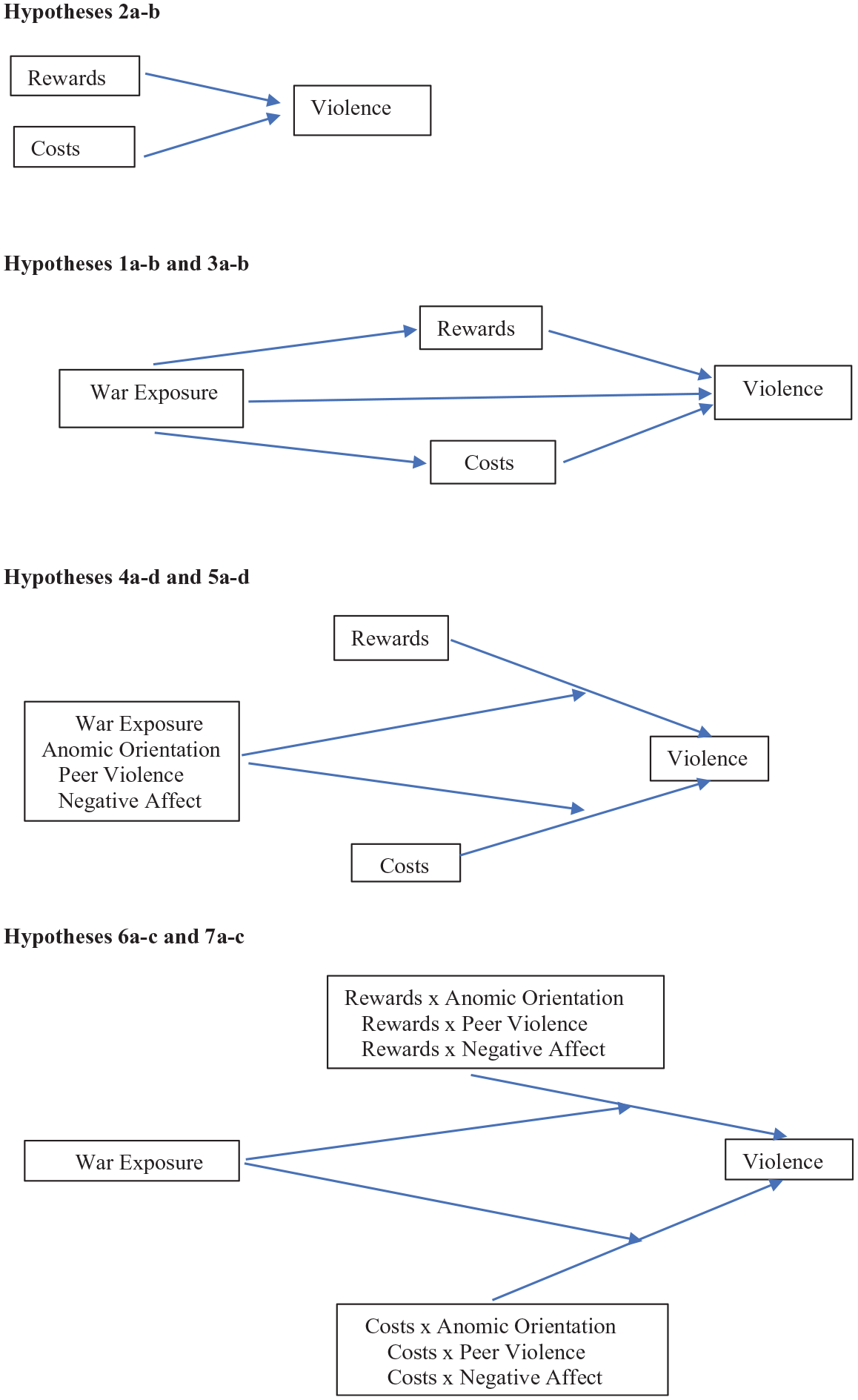
Theoretical Diagrams of Study Hypotheses.
Methods
Data
Collected in 2017, 3 years after the onset of the Donbas war, the survey data for this study were elicited from a random sample of adults residing in two large Ukrainian cities, Lviv and Kharkiv. The decision to select these two cities for the study was made based on the physical proximity of Kharkiv to the Donbas war zone and the large number of internally displaced persons, troops, and volunteers residing in Lviv. After the beginning of the war and prior to the onset of the full-fledged war of 2022, Kharkiv sheltered those fleeing the war zone. Lviv, on the other hand, welcomed a large number of internally displaced people from the annexed Crimea and Donbas area, while sending a large number of soldiers to the war zone. Kharkiv is located in the Eastern part of Ukraine and, at the time of the Donbas conflict, had a population of over one million, whereas Lviv, a slightly smaller city under one million, is located in the Western part of Ukraine near the Ukrainian-Polish border. SOCIOINFORM, a Ukrainian survey company with significant experience in criminological survey research was employed to assist with sampling and survey data collection. A random sample of Kharkov and Lviv residents was selected using a multi-stage stratified random household sampling in each city, and it proceeded in several stages, 1 resulting in a final sample of 1,247 individuals (616 in Lviv and 631 in Kharkiv). The demographics of the final sample for the study largely reflect the actual demographics for the two cities of Lviv and Kharkiv (State Statistics Committee of Ukraine, 2018). Missing data in the sample were rare, with less than 3% missing data in each variable. To retain a fuller sample, missing data were imputed using expectation maximization (EM) algorithm (crime-related data were not imputed). Cases with missing data on violence involvement were deleted listwise resulting in the analytic sample of 1,240 respondents.
Measures
Dependent Variable: Projected Violent Behavior
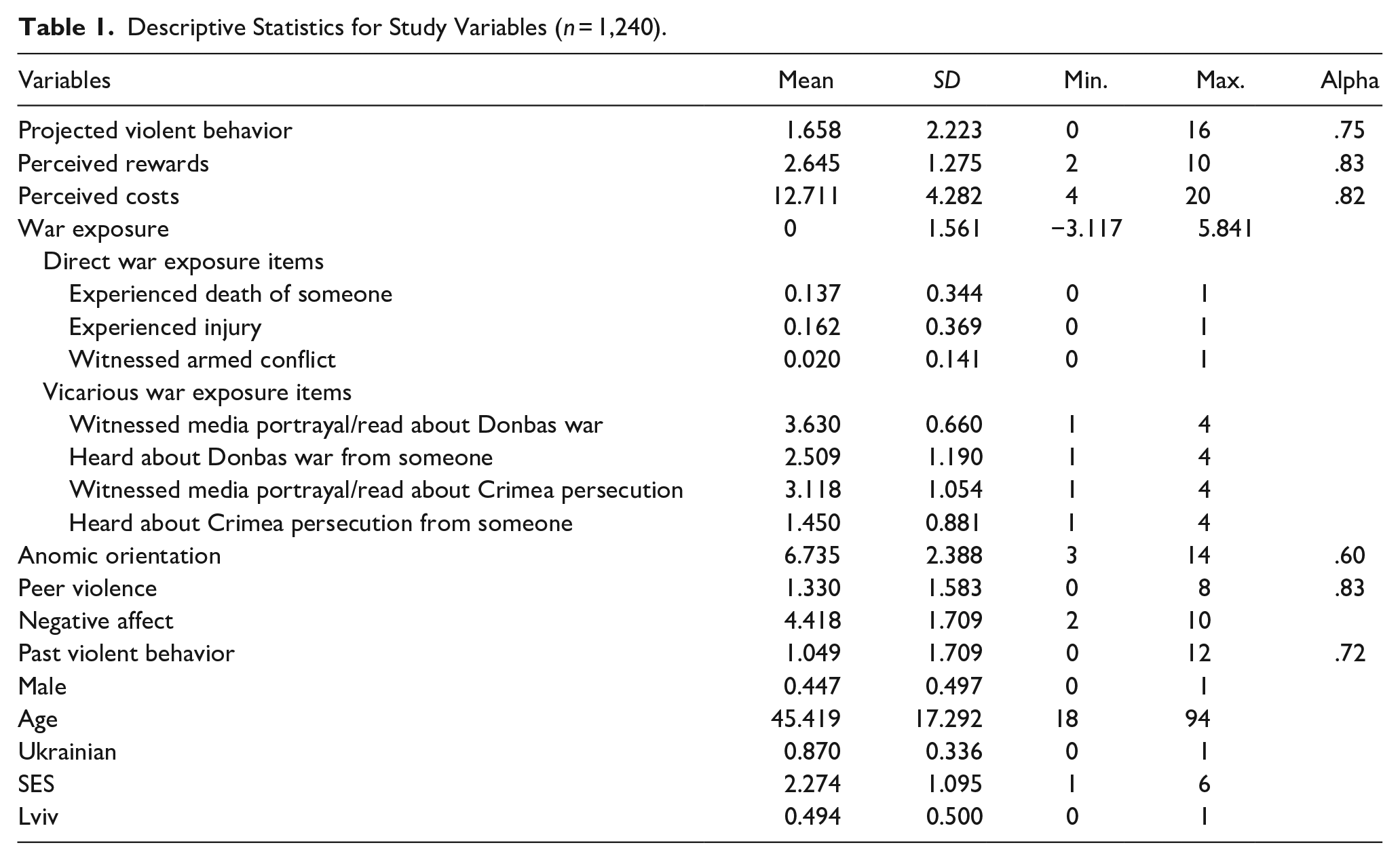
Projected offending was measured using four items asking about the perceived likelihood of committing future violent crimes ranging from less to more serious offenses (see Appendix A). The item response categories ranged from 0 = “not likely at all” to 4 = “very likely.” The four items were then summed to create a count scale (α = 0.75). In our choice of projected offending measures over past self-reported offending, we hoped to better tap the temporal order of events, given the cross-sectional nature of our data. Self-projected criminal behavior has been successfully used in previous criminological research (e.g., Zimmerman et al., 2015), and it has been found to accurately estimate actual offending (Murray & Erickson, 1987; Pogarsky, 2004; Wikström et al., 2012). Furthermore, projected offending is less likely to elicit response bias compared to self-reported offending (Tittle et al., 2003) and may help capture more instantaneous effects that are otherwise hidden in longitudinal surveys (Cullen et al., 2019). In our study, past and projected violence are strongly correlated (.71), which reassures us both the empirical and theoretical closeness of these two variables. Descriptive statistics for this and other variables used in the study are shown in Table 1.
Descriptive Statistics for Study Variables (n = 1,240).
Independent Variables
Perceived Benefits of Crime
Following past research (e.g., Loughran et al., 2016; Tittle et al., 2010), perceived benefits were measured using two items asking about the potential rewards associated with committing violent crimes (see Appendix A for the list of items). Response categories ranged from 1 = “not rewarding or thrilling at all” to 5 = “very rewarding or thrilling.” Scores for these two items were summed, and the resulting measure was standardized (α = .83). Higher values tap higher perceived rewards of engaging in violence.
Perceived Costs of Crime
Following past research on crime costs and benefits, perceived costs of crime were measured using four items that tap into perceptions of the sanction risks associated with violent crime (e.g., Loughran et al., 2016; Tittle et al., 2011). Whereas two items captured perceived informal costs, the other two focused on perceived formal costs of criminal behavior (see Appendix A for the list of items). Response categories ranged from 1 = “not likely at all” to 5 = “very likely.” Scores for the four items were summed, and the resulting scale was standardized (α = .82). Higher values on the scale were associated with perceptions of higher crime costs.
War Exposure
People may experience war directly, by personally witnessing death and destruction associated with it, or indirectly—as a result of vicarious exposure through media reports or stories told by friends, family or other people in their circles. Research suggests that experiences related to war—both direct and indirect—have the capacity to impact individual behavior (Johnson et al., 2017; see also Timmer et al., 2023). The cumulative effects of direct and indirect exposure to war, then, may be particularly important modifiers of attitudes and behaviors. To gauge the cumulative effects of war exposure on the decision-making process, we created a summative measure consisting of reported direct and indirect war exposure following a series of steps.
First, indirect exposure was tapped by four questions asking respondents the frequency with which they heard about the war and the extent to which they were exposed to it in the media (Appendix A). The question response categories ranged from 1 “never” to 4 “many times.” The responses to each of the questions tapping indirect war exposure were summed to produce a scale of vicarious war exposure, which was then standardized. Next, direct exposure was captured with three items gauging whether respondents have been injured, lost property, or otherwise personally affected by the war in Donbas (Appendix A). All three items are dichotomous variables (yes “1” and no “0”). These items were then summed to produce a scale tapping direct war exposure, which was then standardized. Finally, the two scales were summed and standardized to construct a measure, which captures a full range of experiences related to war exposure. In our analyses, we used this scale as a predictor of perceived rewards and costs associated with violence and as well as a predictor of the likelihood of violent behavior.
To evaluate the effect of war exposure on the interactive relationships between perceived costs and rewards of violence and anomic orientation, peer violence, and negative affect, and to ease the interpretation of these three-way interactions, we split the scale tapping war exposure at the median (−.244). Whereas respondents whose war exposure scores fell below the median were categorized as experiencing low levels of war exposure, those with scores at or above the median were categorized as having experienced high levels of war exposure. The group who experienced high levels of war exposure consists of 48% of the sample (n = 599), whereas the group who experienced low levels of war exposure makes up 52% of the sample (n = 641). Thus, the split around the median produced two groups approximately equal in size.
Peer Violence
To gauge the extent to which individuals are influenced by the behavior of their peers, a scale evaluating peer offending was used. Following prior research (e.g., Neissl et al., 2019), a two-item scale was constructed asking respondents about their perceptions of the frequency of their peers’ involvement in two violent offenses (Appendix A). The items were measured using a five-point scale where 1 = “never” to 5 = “very often.” The scale resulting from the summation of these two items was standardized (r = .72). Higher values on the scale were associated with higher levels of peer involvement in violent behavior.
Anomic Orientation
Three items were used to create a measure of anomic value orientation (see Appendix A), which taps the extent to which respondents value anomic goals and desire to abide by the law and be involved in conforming behaviors. Response categories ranged from 1 = “strongly agree” to 5 = “strongly disagree” and were reverse-coded. Scores for the reverse-coded items were added together, and the resulting scale was standardized (α = .60). Higher values on the scale reflect a stronger anomic orientation.
Negative Affect
Consistent with Agnew (2006), negative affect was measured using two items tapping two types of negative emotions. The questions asked respondents about the extent to which they felt angry and irritable in the last several months (see Appendix A). Response categories ranged from 1 = “very slightly or not at all” to 5 = “extremely.” Scores for the two items were summed, and the resulting scale was standardized (r = .51). Higher values on the scale reflect higher levels of negative affect (see also Timmer et al., 2023 for a similar measure). 2
Control Variables
Past Violent Behavior
Past offending was measured using two items that ask about self-reported violent offending in the past year. A five-point scale where 0 = “never” to 4 = “very often” (see Appendix A for list of items) was used to capture the full range of experiences. After summing the two items, the resulting scale was standardized (α = .72). Higher levels on this scale correspond to higher levels of reported violence involvement.
Socio-Economic Status (SES)
We also control for the individual socio-economic status (SES). In the context of Ukraine, traditional questions about income are not appropriate measures of SES. Thus, respondents were asked to report which of the six items related to consumption patterns they could afford on their income (Appendix A), with dichotomous response categories 1 = “yes” and 0 = “no.” Scores for the items were added for each respondent to create an additive SES scale. Higher scores on this scale reflect higher SES. Similar scales have been used and found to be reliable measures in previous studies (e.g., Botchkovar et al., 2013).
Demographic Characteristics
We also control for a number of demographic characteristics including age, city of residence, sex, and ethnicity. Age is a continuous measure that ranges from 18 to 94. Sex is a dichotomous measure where 1 = “male” and 0 = “female.” City of residence is a dichotomous measure where 1 = “Lviv” and 0 = “Kharkiv.” Finally, ethnicity is measured where 1 = “Ukrainian” and 0 = “all other ethnicities.”
Analytical Strategy
Because projected violence, the key outcome variable in our study, is a skewed measure approximating counts, we estimated a series of negative binomial linear regression models (Osgood, 2000) to assess the direct and interactive effects of crime costs and benefits, various conditions, war exposure, and a number of control variables on projected violence.
Models assessing perceived rewards and costs of violence as outcomes were analyzed with ordinary least squares (OLS) regression. The scale tapping perceived rewards was logged prior to analyses to reduce its skewness. Perceived costs of violence, on the other hand, appeared to be distributed normally and thus did not need to be logged. All principal continuous predictor variables were standardized to ease the interpretation of interaction effects. Standard errors in our models were adjusted for neighborhood clustering, and variance inflation factors in all models fell below 4 (Fisher & Mason, 1981), which indicates a low chance of multicollinearity.
The analyses were carried out in stages. Our first set of models assessed the direct effects of war exposure, violent peer associations, negative affect, and anomic orientation on individual perceptions of costs and rewards associated with violence. A second set of models investigated the interactive relationships between perceived costs/rewards of violence and four proposed moderators, including war exposure, violent peer associations, negative affect, and anomic orientation, in their effect on offending. Finally, to evaluate three-way interactions and assess whether the three potential moderators of the rewards/costs-offending relationship (violent peer associations, negative affect, and anomic orientation) affect this relationship differently depending on the level of war exposure, the data were split and analyses conducted across the groups of high and low war exposure. 3
Results
Descriptive Statistics
Table 1 provides descriptive statistics for key variables included in the study and indicates that our respondents are slightly more likely to be female, are, on average, 45 years old (with the range of 18–94), and they tend to fall below average on the SES scale.
Perceived Rewards/Risks as Mediators of the Link Between War Exposure and Violence
Our first set of analyses focused on the formational effects of war exposure on perceived rewards and costs of violence (Table 2). The coefficients for war exposure shown in Models 1a and 1b are not significant. Thus, our results fail to support hypotheses 1a and 1b suggesting that perceived rewards of violence would be higher and perceived costs lower among those whose high war exposure (Models 1a and 1b). However, we find that other principal predictors from Model 1b such as anomic orientation and peer violence significantly affect anticipated rewards and costs. Both anomic orientation and higher levels of peer violence appear to heighten perceived rewards of violence (standardized regression coefficients of .094 and .181, respectively). As to control variables, perceived rewards of violent behavior are also larger for those who previously engaged in violence (B = .105) and have higher SES (B = .019). Further, as shown in Model 2b, anticipated costs of violence are predicted by anomic orientation and past violence, such that individuals having a stronger anomic orientation and more past violent crime involvement perceive lower costs of violent behavior (B = −.206 and −.083, respectively). 4
OLS Regression Models Predicting Perceived Rewards and Costs.
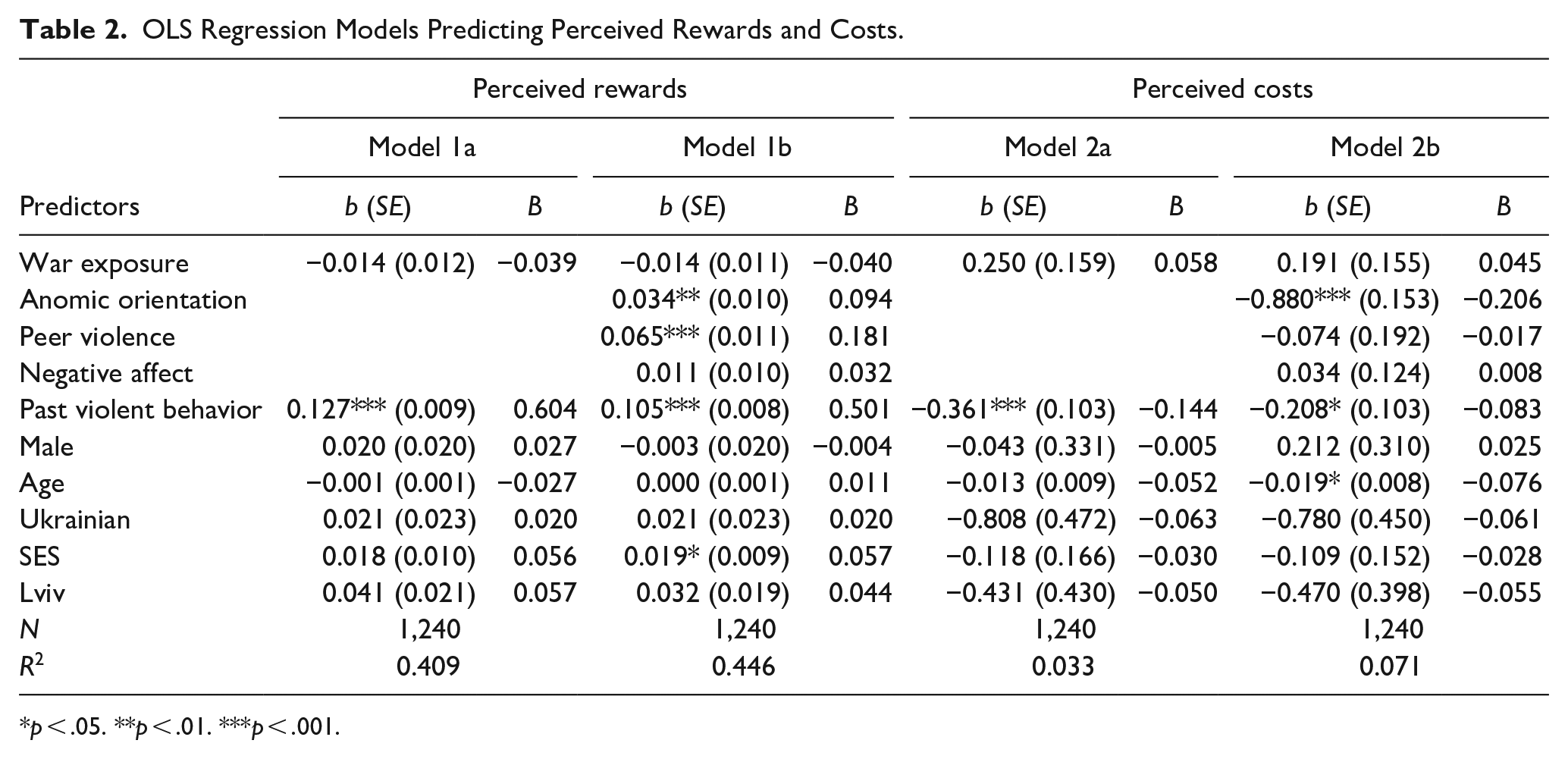
p < .05. **p < .01. ***p < .001.
Table 3 allows us to investigate the relationship between war exposure, perceived risks and rewards of violence, and violent behavior. Model 1, Table 3 demonstrates that war exposure is significantly and positively associated with projected violence (IRR = 1.155) predicting higher violence among those with greater war exposure levels, and this positive effect persists when all other principal predictors are incorporated in Models 2 and 3. Next, supportive of hypothesis 2a, our results from Model 2b indicate that, net of controls, perceived rewards of violence predict projected violent behavior, such that the likelihood of violence is higher among those anticipating higher rewards associated with violent behavior (IRR = 1.207). This effect persists when other principal predictors are included into Model 3. By contrast, the figures from Model 2 demonstrate that perceived costs do not appear to significantly affect projected violence providing no support for hypothesis 2b. Furthermore, we fail to confirm hypotheses 3a and 3b proposing that the effects of war exposure on violence would be mediated by perceived rewards and costs of engaging in violent behavior. This is because, as described above, war exposure is not associated with either anticipated rewards or costs of violence (see Table 2) and because, as shown in Model 2, Table 3, the violence-inducing effect of war exposure actually increases (IRR = 1.179) when perceived rewards and costs are incorporated into the model rather than decreases in strength as would be expected in the case of mediation (Baron & Kenny, 1986).
Negative Binomial Regression Models Predicting Projected Violent Behavior.
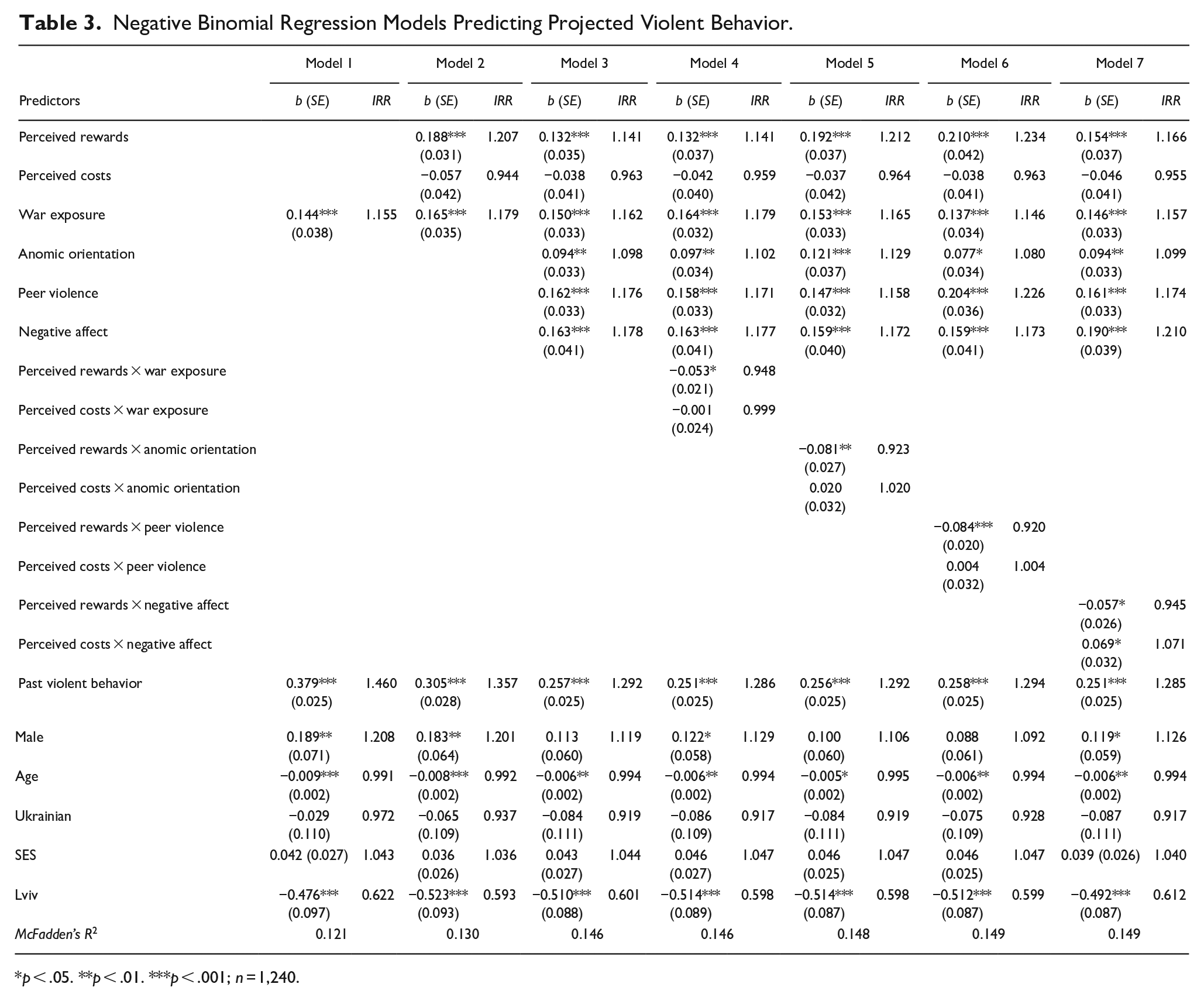
p < .05. **p < .01. ***p < .001; n = 1,240.
Two-Way Interactions Between Rational Choice Elements and War Exposure/Anomic Orientation/Peer Violence/Negative Affect
Other models in Table 3 provide the results of analyses pertinent to the hypothesized two-way interactions. Hypotheses 4a–d suggested that the association between perceived rewards and costs of violence and projected involvement in violence would be contingent on individual levels of war exposure, anomic orientation, peer violence, and negative affect. Our results indicate that perceived rewards of violence interact with each of the proposed moderators. However, they provide no support for the direction of the interactions stated in hypotheses.
First, as shown in Model 4, perceived rewards of violence interact with war exposure, and this interaction is negative (b = −.053). Contrary to hypothesis 4a that suggested that war exposure would exacerbate the positive effect of perceived rewards on violence, the calculated simple slopes demonstrate that the estimated violence-instigating effect of anticipated benefits of violence is stronger among individuals with low levels of war exposure (b = .185 at one SD below the mean). This effect is much weaker and not statistically significant among individuals with high levels of war exposure (b = .079 at one SD above the mean). These results reveal that higher levels of war exposure weaken the positive association between perceived rewards of violence and projected violence.
Next, as shown in Model 5, perceived rewards of violence interact with anomic orientation, and the interaction is negative (b = −.081). Contrary to hypothesis 4b proposing that anomic orientation would amplify the positive effect of perceived rewards on violence, the calculated simple slopes illustrate that the violence-inducing effect of rewards of violence is stronger among those with less anomic orientation (b = .273 at one SD below the mean), and it is weaker among those with more anomic orientation (b = .192 at one SD above the mean). These findings indicate that stronger anomic orientation reduces the positive association between perceived rewards of violence and projected violence.
Furthermore, as shown in Model 6, the interaction between perceived rewards and peer violence is significant and negative (b = −.084). Contrary to hypothesis 4c suggesting that violent peer association would increase the positive effect of perceived rewards on violence, the calculated simple slopes demonstrate that the positive effect of perceived rewards on projected violence is stronger among individuals with less association with violent peers (b = .294 at one SD below the mean), and it is weaker among those with more violent peer association (b = .126 at one SD above the mean). Again, these results reveal that more violent peer association diminishes the positive relationship between perceived rewards of violence and projected violence.
Finally, as shown in Model 7, the interaction between perceived reward of violence and negative affect is significant and negative (b = −.057). Contrary to hypothesis 4d proposing that negative affect would exacerbate the positive effect of perceived rewards on violence, the calculated simple slopes demonstrate that the violence-inducing effect of perceived rewards is stronger at lower levels of negative affect (b = .211 at one SD below the mean) and weaker at higher levels of negative affect (b = .097 at one SD above the mean). These findings indicate that higher levels of negative affect weaken the positive association between perceived rewards of violence and projected violence.
Hypotheses 5a–d suggested a pattern of interactive relationships between perceived costs of violence and proposed moderators (war exposure, anomic orientation, peer violence, and negative affect) in their effects on projected violence. However, according to the results shown in Table 3, anticipated costs of violent behavior appear to interact only with negative affect and that this interaction is positive (b = .069; Model 3). The calculated simple slopes illustrate that the deterrent effect of perceived costs of violence on violent behavior is stronger at the low level of negative affect (b = −.115 at one SD below the mean), whereas this effect is close to zero and not statistically significant at a high level of negative affect (b = .023 at one SD above the mean). These results suggest that higher levels of negative affect weaken or even completely eliminate the negative relationship between perceived costs of violence and projected violence. Therefore, hypothesis 5d is supported by our findings whereas hypotheses 5a–c are not.
Three-Way Interactions Between Rational Choice Elements, War Exposure and Other Contingencies
Finally, our last two sets of hypotheses, 6a–c and 7a–c, specified three-way interactions proposing that the interactive relationships between perceived rewards/costs of violence and peer violence/anomic orientation/negative affect would be also contingent on levels of war exposure. Using the results reported in Table 4, and after conducting a series of tests devised by Paternoster et al. (1998; Brame et al., 1998), we found no support for hypotheses 6a and 6b and some support for hypothesis 6c, as only one interaction, that of perceived rewards of violence and negative affect, appeared to be significantly different across varying levels of war exposure.
Split-Sample Negative Binomial Regression Models Predicting Projected Violent Behavior.
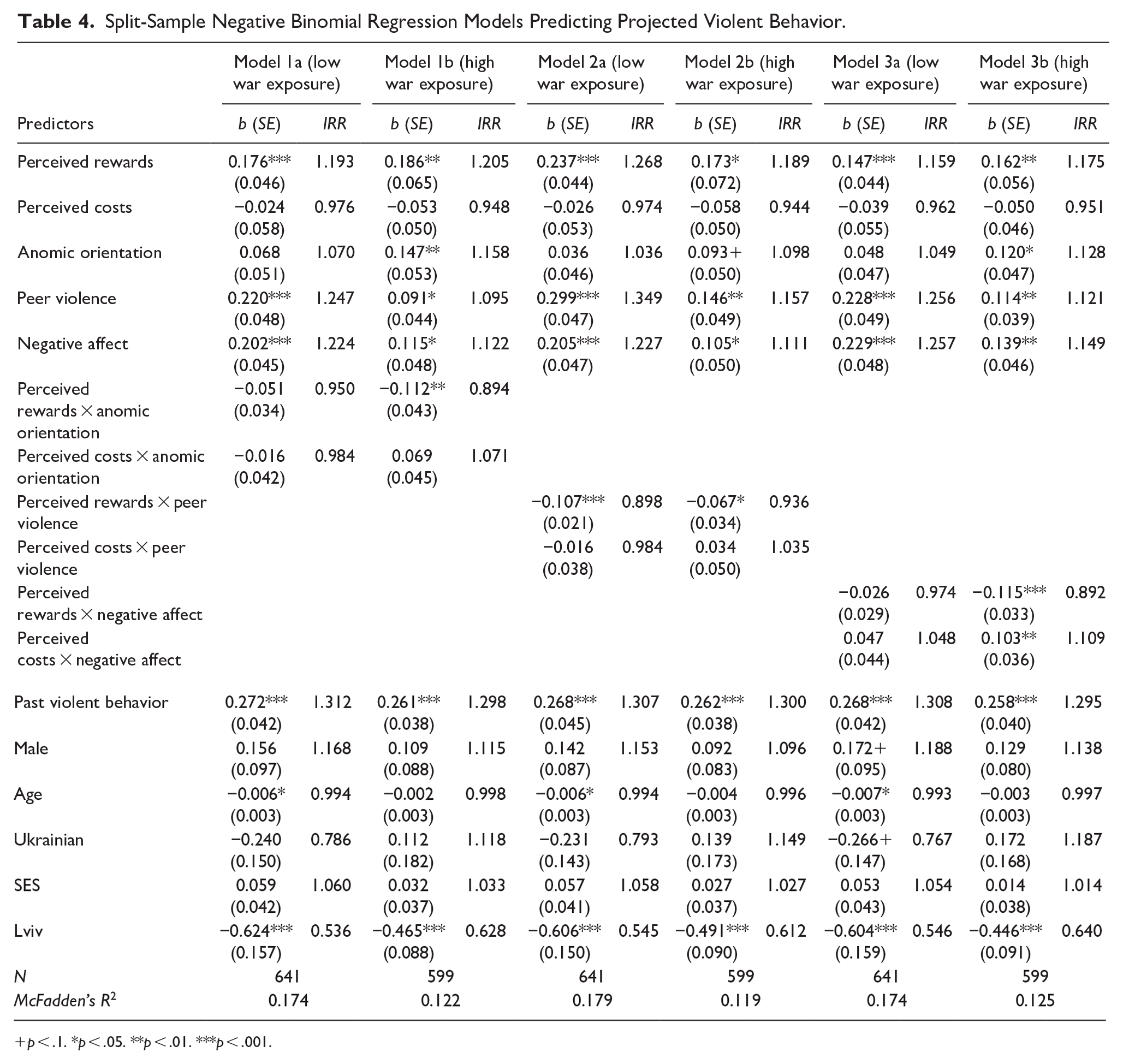
p < .1. *p < .05. **p < .01. ***p < .001.
Our findings in Models 3a and 3b, Table 4, demonstrate that this interaction effect is significant and negative only in the high exposure group (b = −.115) and, in addition, according to Paternoster et al. test, this coefficient is significantly different from the coefficient in the low war exposure group (z = 2.03). The calculated simple slopes demonstrate that, among individuals with high war exposure, the positive effect of perceived rewards on violence is strongest when negative affect is low (.277 at one standard deviation below the mean) and weakest when negative affect is high (.047 at one standard deviation above the mean). These results confirm the magnifying effect of war exposure on the interactive relationship between perceived rewards of violence and negative affect. Nonetheless, the actual direction of the interactive relationship between perceived rewards of violence and negative emotions runs counter to the original hypothesis. Notably, our results from Table 4 and Paternoster et al. tests do not provide any support for the set of hypotheses 7a–c, indicating that war exposure has no bearing on the observed interactions between perceived costs of engaging in violence and any of the proposed moderators in their relationship with projected violent behavior. 5
Discussion
The key goals of our study were to understand the impact of war exposure on rational calculus and some of its modifying elements. We argued that war is a complex context that exposes individuals to extreme levels of stress and dynamic circumstances possibly affecting patterns of responses to situations conducive to violence. We assumed that war exposure may have significant effects on both the way people gauge potential benefits or costs of engaging in violence as well as the way these perceptions translate into violent outcomes. We also proposed that war exposure could affect the strength of the relationships between the elements of rational calculus and involvement in violence as well as the typical patterns of interactions between perceived costs/rewards of violence and various personal characteristics, including anomic orientation in values, peer violence, and negative affect.
Several key findings emerge from our analyses. First, our results suggest that war exposure does not necessarily directly shape perceived benefits and costs of violence. Instead, those appear to be, to a significant extent, affected by anomic orientations and past engagement in violent behavior (both rewards and costs), as well as associations with violent peers (rewards only). Importantly, neither of these perceptions were affected by negative emotions (c.f. Bouffard, 2015). We also found that war exposure has a persistent positive effect on the likelihood of interpersonal violence, even in the presence of reward and cost considerations. War exposure also appears to interact with perceived rewards of violent behavior in its effect on projected violence. In particular, our results suggest that high levels of war exposure may render benefit considerations much less relevant in making decisions about violent behavior. This finding can be explained in two different ways. On one hand, this finding could be interpreted as evidence that reward considerations are less important during war, which would suggest that interpersonal violence among those exposed to war may be dictated by quick, reactive, intuitive responses consistent with the “hot” mode of decision-making (Van Gelder, 2013). On the other hand, the reduced association between perceived thrills and gratification from violent behavior and violence engagement may signal less reliance on the “hot” cognition in wartime. To fully resolve this issue may be impossible with our data as the framework of the dual mode of decision-making relies on momentary, situational assessments and decisions made by individuals, whereas the measures of the rational choice elements and violent outcomes in our study focus on more generalized and stable response patterns. However, we note that, as measured in the study, perceptions of rewards and costs of violence are more stable in time and thus likely indicative of “cool” reasoning (see also Van Gelder & De Vries, 2012). Therefore, the declining role of a stable inclination to lean on rewards of crime in making behavioral decisions when experiencing greater war exposure likely points to a shift in decision-making from the “cool” mode to intuitive, quick decisions.
Furthermore, exposure to war appears to change the salience of the interrelationships between perceived benefits of violence and some other factors on which the decision-making process is contingent. Specifically, among those more exposed to war, the violence-instigating effect of perceived rewards appeared weaker when negative affect was high. These findings again highlight the potential of war exposure to push for the “expedited,” non-deliberative decision-making, at least among those who experience higher levels of negative affect.
Together, our results suggest that at least some violent responses during war may stem from quick, non-deliberative responses to encountered stimuli, and significant war exposure may diminish the significance of the rational calculus elements in predicting individual violent behavior (see also Agnew, 2006). A complex social context of war may present with multiple mechanisms discouraging deliberative decision-making in the times of war. The non-deliberative responses promoted by war may stem from higher exposure to violence supplying individuals with a variety of behavioral models to be imitated (e.g., Akers, 1998). Thus, the old adage of “violence begetting violence” (e.g., Widom, 1989) may be particularly true in the context of war. A much greater variety of war-related negative emotions than those that we were able to tap could also destabilize the “cool” reasoning mode, making individuals vulnerable to any cues that could be interpreted as provocations. Finally, important structural shifts associated with a weakening of formal institutions, including the criminal justice system, as well as quickly changing circumstances in the times of crises may also leave individuals unequipped for potential deliberations.
Aside from the findings pointing to the importance of considering war context in the process of decision-making, our study offers additional insights into the role of some characteristics and conditions, such as individual anomic orientation, peer violence, and negative affect, in both the formation of perceived rewards and costs of violence as well as their interplay with perceptions of benefits and costs of violent behavior in their effects on projected violence. Of note are the persistent anticipated cost-reducing and reward-magnifying effects of anomic orientation in individuals. These findings confirm the malleability of perceived rewards and costs of misbehavior that goes beyond emotions as well as direct and vicarious experiences with crime previously investigated in the literature (e.g., Matsueda et al., 2006; Neissl et al., 2019).
Results also suggest that the linkages between rational choice considerations regarding benefits of violence and violent behavior tend to be more pronounced among those with less exposure to violent peers, lower levels of negative affect, and less anomic orientation. All of these findings run counter to our original hypotheses as well as some of the literature suggesting that elevated negative affect, violent peer exposure, and anomic orientation may make individuals more attuned to the considerations of crime benefits when considering involvement in crime (e.g., Carmichael & Piquero, 2004; Pogarsky, 2007; McGloin and Thomas, 2016; c.f. Exum, 2002). Combined, our results may indicate that patterns of decision-making made by those angered, routinely exposed to peer violence, or possessing anomic values are not necessarily reliant on the careful weighing of crime benefits but, rather, mostly exist in the “hot,” non-deliberative mode. An argument could be made that the observed pattern of the declining significance of reward considerations is due to the strong predictive power of negative affect, peer violence, and anomic orientation, which simply render perceived rewards of violence less powerful as a predictor of violent outcomes. We hasten to note that, as an independent predictor of violent behavior, perceived benefits of violence is one of the strongest in all analytical models. This suggests that the reported findings reflect true patterns of conditional relationships between reward considerations and the three moderators above.
Although our findings significantly contribute to the literature on rational choice, the study is not without its limitations. First, our findings may potentially be generalizable only to the two large cities within Ukraine. Furthermore, as is typical of any survey data, our data may potentially be vulnerable to telescoping, exaggeration, and/or misreporting information. Yet a number of close parallels between the key findings of our study and some previously conducted research using different datasets (e.g., Tittle et al., 2010) from similar locales in Ukraine points to the reliability of our results. Also, although any measures we use are cross-sectional. However, we feel that the use of projected reports of offending mitigates some of the worries related to the causal order between predictors and dependent variables. Finally, while rational choice models tap the situational context of criminal decision-making, our measures of rational choice elements as well as violent outcomes refer to meso-level inclinations and outcomes, stable across situational contexts.
Policy Implications
Overall, our findings suggest that shifts in utilized modes of reasoning, with the likely preference toward the “hot” rather than “cool” mode of decision-making, may explain the association between exposure to war events and violence. Assuming that the effects of war exposure can linger even after the war conditions are over (e.g., Gartner & Kennedy, 2018), we can anticipate long-term inclination to engage in emotion-driven, quick reasoning, among those who lived through military conflicts. Although stability and the removal of war-associated stressors appear to be the specific conditions necessary for deliberative decision-making, addressing the psychological needs of war refugees as well as those who remained in the zone of the conflict, might go a long way toward curbing violence in those affected by war.
To reduce and prevent violent behavior in war-torn contexts like Ukraine, it is imperative to design evidence-based strategies to understand and alleviate the traumatic and stressful experiences of war victims while, at the same time, focusing on the nuances of decision-making patterns among civilians. Collaboration between researchers, crisis specialists, and other clinicians is necessary to design and provide accessible trauma-focused services addressing stress management and crisis response. Among other solutions and long-term strategies, interactive mobile apps and workshops helping to avoid emotion-driven responses could be offered.
Ideally, all members of Ukrainian society should also be offered a comprehensive list of local health clinics, victim-focused community-based organizations, as well as free psychological counseling. It is expected that these trauma-focused efforts be accompanied by widespread public campaigns against the stigma of acknowledging psychological distress and seeking out professional help to address it. Such campaigns will likely facilitate long-term relationships between communities and professional organizations seeking to address the effects of war trauma and build effective resilience strategies.
Footnotes
Appendix
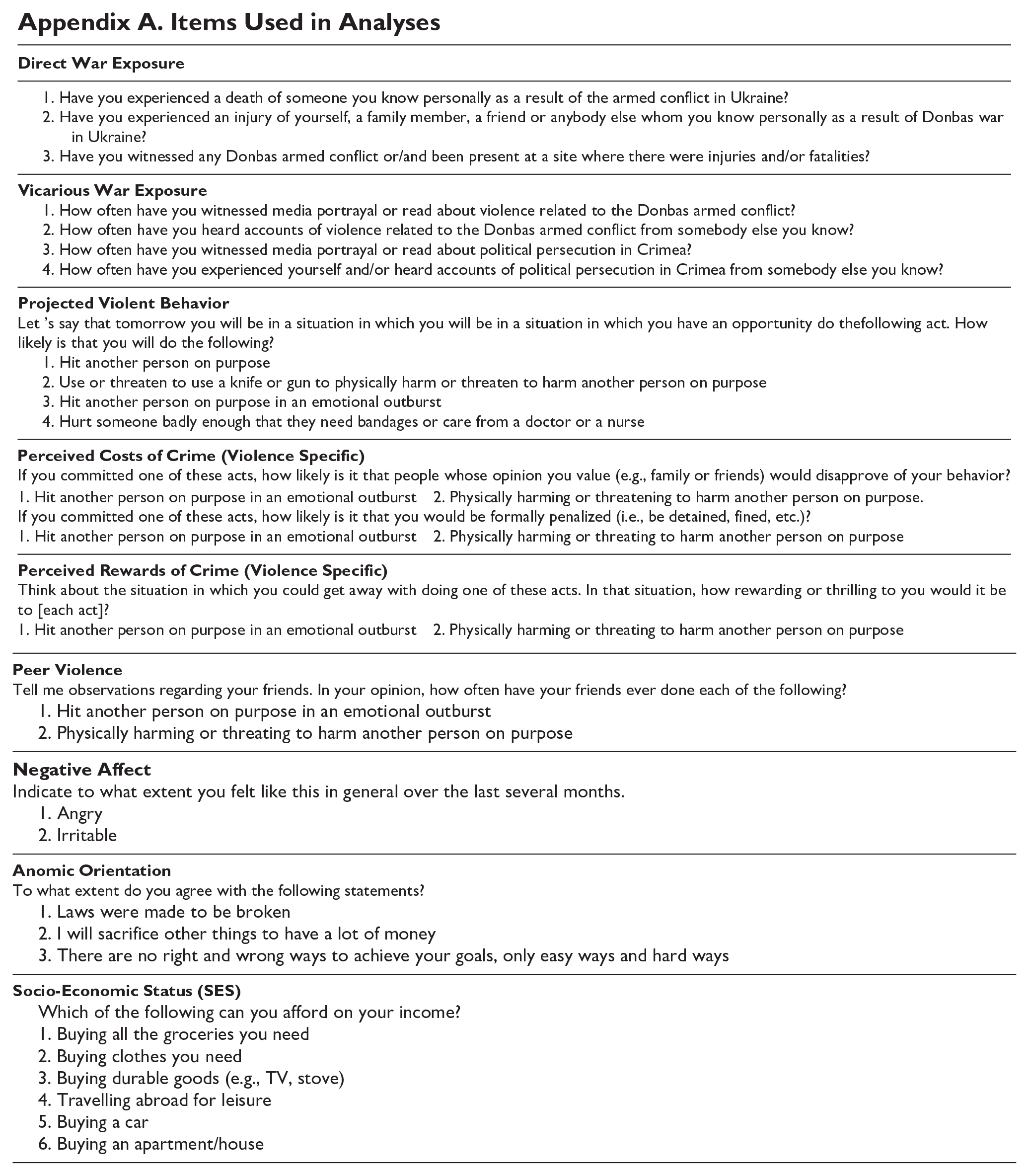
Items Used in Analyses
|
|
| 1. Have you experienced a death of someone you know personally as a result of the armed conflict in Ukraine? 2. Have you experienced an injury of yourself, a family member, a friend or anybody else whom you know personally as a result of Donbas war in Ukraine? 3. Have you witnessed any Donbas armed conflict or/and been present at a site where there were injuries and/or fatalities? |
1. How often have you witnessed media portrayal or read about violence related to the Donbas armed conflict? 2. How often have you heard accounts of violence related to the Donbas armed conflict from somebody else you know? 3. How often have you witnessed media portrayal or read about political persecution in Crimea? 4. How often have you experienced yourself and/or heard accounts of political persecution in Crimea from somebody else you know? |
Let ’s say that tomorrow you will be in a situation in which you will be in a situation in which you have an opportunity do thefollowing act. How likely is that you will do the following? 1. Hit another person on purpose 2. Use or threaten to use a knife or gun to physically harm or threaten to harm another person on purpose 3. Hit another person on purpose in an emotional outburst 4. Hurt someone badly enough that they need bandages or care from a doctor or a nurse |
If you committed one of these acts, how likely is it that people whose opinion you value (e.g., family or friends) would disapprove of your behavior? |
| 1. Hit another person on purpose in an emotional outburst 2. Physically harming or threatening to harm another person on purpose. If you committed one of these acts, how likely is it that you would be formally penalized (i.e., be detained, fined, etc.)? 1. Hit another person on purpose in an emotional outburst 2. Physically harming or threating to harm another person on purpose |
Think about the situation in which you could get away with doing one of these acts. In that situation, how rewarding or thrilling to you would it be to [each act]? 1. Hit another person on purpose in an emotional outburst 2. Physically harming or threating to harm another person on purpose |
Tell me observations regarding your friends. In your opinion, how often have your friends ever done each of the following? 1. Hit another person on purpose in an emotional outburst 2. Physically harming or threating to harm another person on purpose |
To what extent do you agree with the following statements? 1. Laws were made to be broken 2. I will sacrifice other things to have a lot of money 3. There are no right and wrong ways to achieve your goals, only easy ways and hard ways |
Which of the following can you afford on your income? 1. Buying all the groceries you need 2. Buying clothes you need 3. Buying durable goods (e.g., TV, stove) 4. Travelling abroad for leisure 5. Buying a car 6. Buying an apartment/house |
Declaration of Conflicting Interests
The author(s) declared no potential conflicts of interest with respect to the research, authorship, and/or publication of this article.
Funding
The author(s) disclosed receipt of the following financial support for the research, authorship, and/or publication of this article: This research was supported by internal funding from Northeastern University and University of Miami.
