




Abstract
Central to the police role and function are the inter- and extra-institutional demands for “knowledge” on crime and frontline policing. However, this subject has failed to generate the required empirical attention. The current study thus draws on Ericson and Haggerty’s conceptualization of police as “knowledge workers” to reveal the extent to which knowledge production for other institutions remains salient and, as a latent function, burdens policing. To do so, we employ results from the analysis of two ethnographic studies of police paperwork. Results revealed significant extra-institutional information needs that have considerable effects on police work with seemingly little use-value, and a consensus that much of police paperwork represents a misplaced burden due to repetition. We conclude with a critical discussion on the policy implications of these findings.
Introduction
The 1990s was a significant period of creation, development, adoption, and growth in using diverse social scientific theories in the criminal justice domain. Besides the continuous testing and refinement of standard theories within the field—such as learning and developmental theories—we also witnessed the rise of a new suite of theories imported from various knowledge domains, from Foucault’s (1977) work on panopticism to the body of work produced by Giddens (1991) and others on late modernity. This extends to Castells’s (1996) “network society” to Beck’s (1992) “risk society.” Although each of these bodies of theory was picked up within various criminologies and, indeed, remains in use today, Beck’s (1992) “risk society”—his conceptualization of modern societies as increasingly structured around the identification and management of large-scale risks to the body politic—is of particular importance. Beck’s “risk society” thesis attracted the attention of several prominent criminologists due to a growing recognition of how “risk” had come to dominate public discourse on crime and institutional and social responses to crime. A notable example of work that prefigured the adoption of Beck’s work by criminologists is Feeley and Simon’s (1992) “actuarial justice” (see also Simon, 1988). These scholars recognized how contemporary criminal justice systems shifted away from outdated concepts of criminality as evil and moral failings and were increasingly oriented toward the adoption of more knowledge-based approaches for assessing, categorizing, and managing people as actual or potential criminal “risks” (Feeley & Simon, 1992).
One prominent criminologist interested in both Beck’s “risk society” thesis and the emergent literature on risk management within criminal justice systems was the late Richard Ericson. Ericson had a long-standing interest in the routine—some might say more mundane—aspects of policing and criminal justice, including the role of communication and communication styles and formats in shaping both individual officers and their occupational culture. As documented elsewhere (Huey, 2018), a chance conversation with one of his graduate students, a police officer, about the police “paperwork burden” led him to consider how policing is increasingly driven by concerns over the management of “risk” and demands for knowledge on potential risks for internal and external audiences. The result was a multi-year ethnographic study of policing as “knowledge work” conducted by Ericson and Haggerty (1997), research that today can be found in Policing the Risk Society (PTRS).
Heralded upon its release as a significant theoretical and empirical achievement in policing scholarship, more recent assessments suggest that the promise of PTRS—namely, that the work would modernize and reorient our understanding of critical aspects of the police role and function in contemporary societies—has not been met. In the words of one such commentator: “My own investigations have failed to find anything approaching a concerted engagement with PTRS’s broad thesis, let alone the development of a systematic research program from its foundation” (O’Malley, 2015, p. 427). For O’Malley (2015), the issue is not that the book over-stated its case—something its authors had privately acknowledged 1 —but that this “watershed study” has not been taken up because of an “almost complete failure of criminologists, and particularly those convinced by the risk society thesis, to follow up its insightful and illuminating leads in anything like a systematic, sustained and critical fashion” (p. 431).
We would suggest that one of the main reasons why PTRS has been limited in its contribution is the lack of development of subsequent theoretical and empirical lines of investigation into public policing as subject matter: basically, the lack of an abundance of research focused on police paperwork. In a world where researchers can study dazzling new police technologies, explore gritty aspects of criminal investigations, and focus on how police can better understand “the criminal mind,” the topic of completing mundane tasks within the confines of often stifling bureaucratic rules is not one to generate significant interest. Yet, paperwork serves as the oil that greases the gears of the entire criminal justice enterprise and each of its operations. Further, as Ericson and Haggerty (1997) similarly observed, police paperwork has become a mechanism for external actors to increasingly meet their own bureaucratic and other needs. It is this latter function of police paperwork that we explore within the current article.
In the ensuing pages, we draw on Ericson and Haggerty’s conceptualization of police as “knowledge workers” to reveal the extent these scholars’ characterization of the police paperwork function—particularly as it relates to producing knowledge for other institutions beyond serving the goals of the criminal justice system—remains salient. We draw on our analysis of the results of two ethnographic studies of police paperwork. Data from the first study comprises 55 (n = 55) in-depth qualitative interviews with provincial police officers, notes taken from field-based observations, and some 40 documents. Data from the second study includes 34 (n = 34) interviews with officers from municipal police services in two different Canadian provinces, notes taken from 100 hours of field observation, and documents collected during fieldwork.
The structure of the article is as follows. First, we review the relevant literature on policing and paperwork before presenting a more detailed examination of relevant aspects of PTRS and how it relates to our work. Then, we provide an overview of the methods used to collect and analyze the data that informs this study. Next, we turn to a presentation of our results before exploring the conclusions drawn and the public policy import of our findings, making recommendations for future research and changes in police practices.
Police and Paperwork
A central aspect of the police role and function, which produces voluble frustration among police officers, is paperwork. Paperwork is central to investigations, fact-finding, charge laying, and all aspects of police responsibilities. However, officers, like most academics, find police paperwork to be a rather mundane task—far from the police role many envisioned when they “signed up for” the occupation (Huey, 2018). Resultantly, historically, when scholars referenced police paperwork, it was often in passing. This absence from the literature began to change in the late 1970s and early 1980s, primarily due to significant transformations within policing. We started to see studies from the United States (U.S.) pointing to inter-institutional demands for “knowledge” on crime and frontline policing, namely in the form of bureaucratic controls (Brehm et al., 2003), variously explained due to police professionalization and the desire for increased public accountability (Crank, 2004; Crank & Langworthy, 1996; Sherman, 1978). For example, in his study of police accountability, Walker (2007) referenced the role of police supervisors in providing needed oversight through monitoring police-citizen interactions in their reviews of officer incident reports.
In Canada, paperwork generated some scholarly attention from the 1980s onward, but from a different angle. A key concern of much early policing research centered on the question of the police role and function—that is, answering the question of “what do police actually do?” (e.g., Bayley, 1994; Reiss, 1973; Skolnick, 1966). One of the earliest Canadian ethnographies to explore this, and to somewhat touch on the issue of paperwork, was Ericson’s (1982) Reproducing Order: A Study of Police Patrol Work. Although not a central concern of the book, Ericson (1982) did observe that police had long complained about being forced to spend a significant portion of their on-duty hours completing paperwork rather than engaged in patrol duties. This finding was referenced in later work by scholars such as Brodeur and Dupont (2006), Chan (2005), and Malm et al. (2005). Of these, the most extensive investigation into police paperwork was conducted by Malm et al. (2005), who completed a time/task study on police service delivery by the Royal Canadian Mounted Police in British Columbia over 30 years. These Malm et al. (2005) found the volume of paperwork was growing due to demands by the courts for increased transparency in the form of expanded rules around disclosure (Malm et al., 2005). The result of these changes, they stated, was that officers often felt pressured to work unpaid hours off-duty to keep up with such growing demands (Malm et al., 2005). Their finding was hardly unique to Canada and reinstated as a concern as researchers, like Lasiewicki (2007), who reported that police interviewed in the U.S. similarly expressed frustration. Although we note our focus of the present article is on the patrol side of policing, scholars have also observed similar pressures on investigative officers (Heinsler et al., 1990). For instance, Waegel (1981) stated, “detectives experience paperwork requirements and deadlines as central sources of pressure and tension in their job, and stories abound concerning former detectives who ‘could handle the job but couldn’t handle the paperwork’” (p. 266). This sentiment among officers is similarly noted by Brodeur and Dupont (2006): The impressive multiplication of the number of forms that the police have to fill out may be indicative of a scientification of police work, if we only consider the blank forms. When, however, we look at how the forms are actually filled out by police officers (with very little zeal), it indicates instead a stifling bureaucratization of policing, a trend which is acutely resented (italics ours) (p. 12).
Researchers have recently teased out chronically under-examined aspects of police data collection. One study by Yu and Monas (2020) has explored training issues linked to report-writing in the U.S., noting that while police reports play a valuable legal and social role, recruits receive minimal training on producing quality reports—their paperwork is not necessarily carefully reviewed, critiqued, or edited, instead, it is simply completed for practice. A United Kingdom (U.K.) study by Dabney et al. (2013) included a critical discussion on the psychological stresses of having successful cases hinge on police performance in documenting their cases—their creation of comprehensive and legally binding paperwork. Given such pressures, perhaps not surprisingly, at least one review of case processing within a U.K. police service found that “the move to minimum file content” was “largely ignored” in favor of the construction of full dossiers which were “unnecessarily compiled” (Campbell, 2004, p. 698). Another more recent study by two of the present authors tracked the creation of police data from initial report writing to quality control and data cleaning to issues with its final dissemination and use. They observed that bureaucratic controls aimed at producing quality information were often undermined because of competing demands on resources—such as the twin desires to increase internal and external oversight and minimize time spent off the road (Huey, 2018).
Policing as “Knowledge Work”
Just as the subject of paperwork has failed to generate much empirical attention, so too has this been the case with theory and its application to this aspect of police work. The one exception is Ericson and Haggerty’s (1997) development of a risk-based theoretical model to reconceptualize contemporary policing as “knowledge work” in PTRS. Police, these scholars demonstrate, spend a portion of their workday on paperwork used to produce information about topics ranging from police resources to statistics on crime and disorder. While much of it is geared toward processing criminal justice cases or internal oversight purposes, officers also produce information at the behest of external audiences for consumption outside of policing and the criminal justice mandate. As Ericson and Haggerty (1997) state, other institutional actors use police to produce “knowledge of populations that is useful for administering them” (p. 41). Much of PTRS focuses on the knowledge-sharing relationship between police and private insurance—a relationship designed to assist insurance companies in detecting and managing criminal and other risks—however, other private and state actors also benefit from using the police in this fashion. The value of this extra-judicial information and its subsequent use by outside agencies remains a mystery to the officer(s) engaged in this task. As Ericson and Haggerty (1997) note, “there is a pervasive sentiment in police occupational culture that the paper burden is excessive and a source of alienation” (p. 296).
Ericson and Haggerty’s recasting of the police role and function is foundational because it marked a significant divergence from earlier ways of viewing police work among policing scholars—as “peacekeeping” (Bittner, 1967), “law enforcement” (Banton, 1964), and “social work” (Wallace, 1965). Again, this new reality was less aspirational and more grounded in mundane truths that officers spent increasingly more of their time on computers than chasing so-called “bad guys” (Ericson & Haggerty, 1997). The fact that a subsequent generation of policing scholars has not embraced the paperwork aspect of their job remains something of a mystery, particularly given paperwork’s public policy implications. As we write this in 2022, we have just observed significant calls for police de-funding across North America. In Canada, these were preceded in 2013 and 2014 with a national policy exercise wherein federal and provincial governments launched a re-examination of police funding, which, at that time, was deemed to be “unsustainable” (Huey, 2018). Such exercises have called attention to the bulk of most police budgets being for salaries and personnel costs. Thus, any attempt at rationalizing police budgets should, one would think, start with a careful analysis of “what do police do?” and “what do we want them to do?” To the extent that paperwork appears to be one of the primary tasks of police officers that consumes a significant amount of their working hours, understanding what they do in this area and for what purposes are important.
In this article, we tackle this challenge by examining the results of two studies on the police paperwork burden in Canada. Drawing on Ericson and Haggerty’s (1997) exploration of police “knowledge work,” we demonstrate that not only does their work remain salient for understanding this critical if mundane aspect of policing, but the problems they identified 25 years ago remain just as pressing today. To do this, we focus on the use of police by external public and private agencies—from insurance companies to provincial health and other government departments—to collect data that has limited criminal justice value but is deemed useful to those actors in the management of the actual and perceived risks that fall within their mandates. These duties, individually and cumulatively, create a time burden on police officers that can impede their ability to respond to service calls or engage in proactive and/or problem-oriented tasks.
Methodology
Our article draws on qualitative data from two mixed-methods studies conducted with two provincial and two municipal police services in three Canadian provinces. 2 The data analyzed here consists of 89 (n = 89) in-depth interviews with police officers, ethnographic field notes taken during approximately 100 hours of observation of officers performing paperwork and other routine tasks and examples of paperwork/computerized templates used by officers concerning the processing of different types of criminal offenses and vehicle safety issues. Also collected were documents such as instruction manuals for using police Record Management Systems (RMS) and field training manuals for recruits learning how to complete forms and document service calls. Still, our study is limited as the perspectives of our sample may not be generalizable beyond the three provinces under study; however, caution is necessary when generalizing any qualitative data.
Study 1
In 2014, one of the researchers initiated a 5-year study of youth policing with a provincial service in Atlantic Canada. The project focused on assessing and delivering opportunities for creating extra-judicial measures for youths who transgress the law to decrease youth involvement with the criminal justice system. Almost immediately, officers interviewed expressed concerns over the potential for increased paperwork. In response to this and other feedback emerging through initial interviews—and ethnographic observations, as two of the authors spent weeks, even months, in detachments observing police at work, the decision was made to add other researchers (including one of the co-authors) and a series of questions to the interview guide about paperwork issues and other potential barriers to implementing extra-judicial measures.
Over the 5 years of study, the researchers conducted in-depth, semi-structured interviews with 104 (n = 104) police officers from detachments across the province. These interviews were audio-recorded and ranged from 40 to 70 minutes. 3 While interviews were informal and semi-structured—thus allowing conversations to have a naturalistic flow—the research team used an interview guide covering the following topics: (a) demographic information; (b) views on youth crime; (c) attitudes toward youth policing; (d) strengths and limitations of the policing environment and their effects on youth policing, and (e) paperwork and other operational or organizational stressors. These interviews were supplemented with data from 30 (n = 30) focus groups, which provided information on the experiences, thoughts, and beliefs of a total of 134 (n = 134) officers. Additional data related to paperwork and occupational stress was secured through observations made by one of the authors during fieldwork conducted in a rural detachment over one full working week. While conducting fieldwork, the researcher was stationed at a desk among general duty officers, with access to police commanders’ offices, and was thus able to observe officers’ work during their day shifts freely. Another author spent time intermittently over the years in and out of police detachments collecting ethnographic data. For validity purposes, they shared some of the observations recorded in their field notes with the officers studied to solicit their feedback. During this, we secured 29 (n = 29) forms related to one of two criminal offenses (see Table 2). The choice of forms was driven by information provided by the interviewees, who cited some offenses (e.g., motor vehicle reports) as producing particularly onerous paperwork burdens exacerbated by just how common such “offenses” remain.
Study 2
Data collected in Study 1 was subject to an initial analysis using thematic coding (we present more details on this shortly). The results of this preliminary work informed the direction of the second study, which focused on police data collection, handling, sharing and analysis in one small and one mid-size municipal service in Ontario and B.C. This second study was conducted from 2017 to 2020 and used a mixed-methods approach that combined interviews with fieldwork and document analysis. Interviews for our second study were audio recorded with the knowledge and consent of police officers by all University and Tri-Council guidelines. The interviews took place in police stations and entailed using an interview guide covering demographic, experiential, and opinion-based questions related to police paperwork. More specifically, questions focused on: (a) individuals’ roles within the police service; (b) experiences of collecting, checking, and using crime data; (c) perceptions about collecting, checking, and using crime data; and (d) opinions on factors that may impact the quality of police data. As queries comprised a mix of closed and open-ended questions, participants could provide lengthy explanations or deviate into new topics throughout the interview. Interview data were supplemented with notes taken from naturalistic observations conducted by one researcher who spent an estimated 100 hours in the field with police patrol officers (in cars, on foot patrol, and on bike patrol). During fieldwork, she also collected several relevant documents, including training manuals and selected police forms.
Data Analysis
We began by conducting an exploratory analysis of the first sets of interview and focus group data produced during Study 1 using an open-focused approach to coding. The goal of this inductive approach was to use the data to identify major themes and sub-themes—a process known as thematic analysis (Braun & Clarke, 2006). An emergent theme was constituted by multiple police officers expressing similar experiences and feelings, which collectively illuminated focus points for analysis. From these initial results, a more focused second study was conducted that would allow us to further develop, compare, and contrast our initial thematic results across multiple agencies within the different provinces.
In 2021, once both studies were fully complete, we extracted 89 (n = 89) interviews containing applicable data on police paperwork and then created a combined data set. The initial coding process similarly involved using an open-focused thematic approach, which allowed for the identification of a set of major themes and sub-themes from the data. For example, one major theme was “Internal demands,” which had sub-themes termed “accountability” (internal oversight) and “management” (resource allocation). As these themes began to emerge, we observed that one recurring theme across multiple interviews within and across our data sets was “external demands”—in other words, requests for police to produce knowledge for other institutions, agencies, social groups, and others for their non-police purposes (see Figure 1).
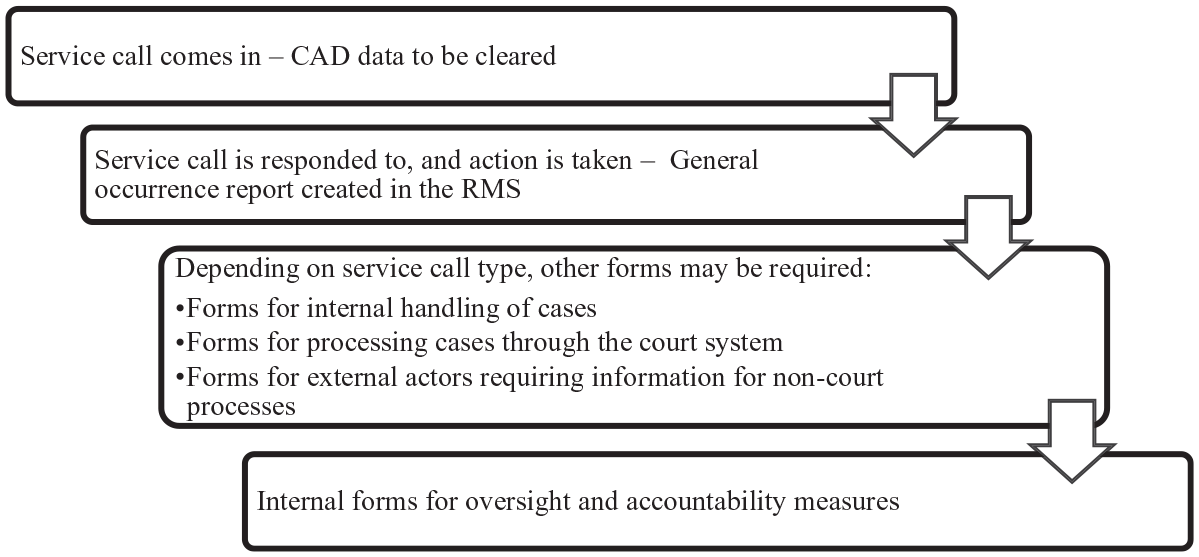
Provincial police service RMS system.
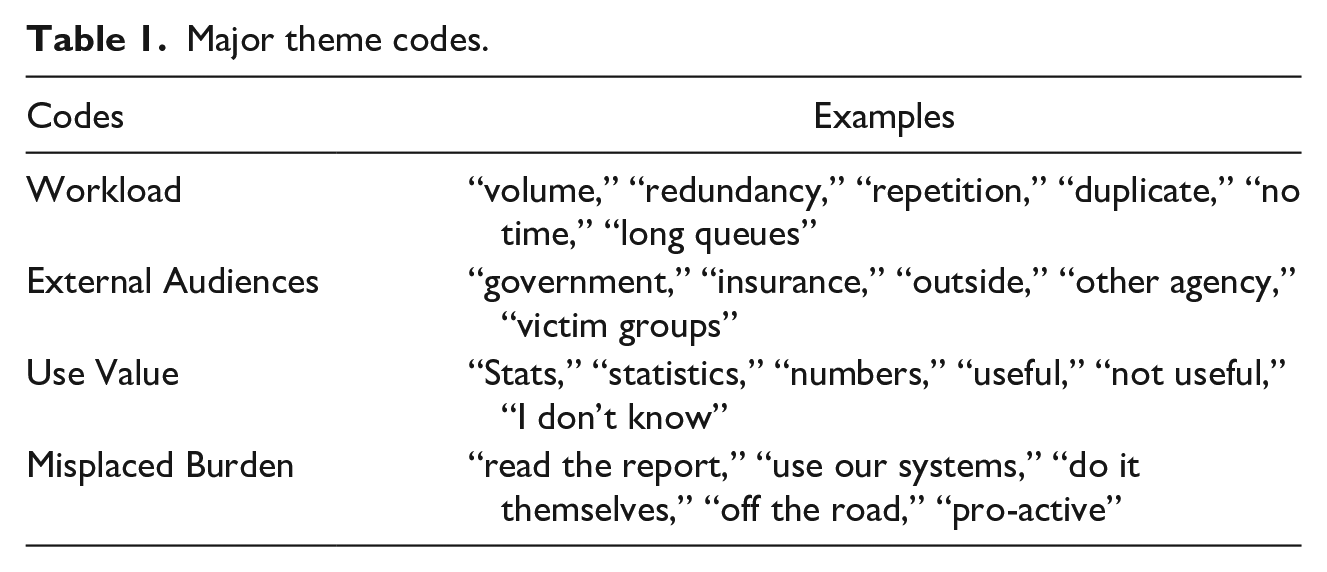
This initial finding called to mind Ericson and Haggerty’s (1997) work on police as “knowledge workers.” With this insight in mind, the first author returned to the data to examine the extent the data would or would not support the thesis that much of the police paperwork burden is driven by external pressures on frontline officers to produce data for others; data that was often repetitive. Examples of how the data were re-coded are in Table 1. Once all coding was completed by an author, the other authors verified the coding.
Major theme codes.
Results
Theme 1: Workload
“The police face the risk of having their organization overwhelmed by both externally derived risk criteria and the sheer volume of knowledge work” (Ericson & Haggerty, 1997, p. 295). “We’re paper cops for the most part. We do a lot of paperwork” (Provincial Police Officer).
As noted earlier, our interest in police paperwork began during Study 1 when we attempted to solicit officer views on introducing a new method for diverting youth away from the criminal justice system. While most participants were receptive to the idea of diversion, a recurring theme in early interviews was reticence about taking on another task that might generate paperwork. This is depicted in the following from a provincial officer of a larger community:
: We’ve been hearing the same thing just like, “please no more forms” [laughing].
: Yeah.
: Which is totally understandable because it sounds like you guys. . .
: It’s out of control as it is right now.
During interviews and focus groups in Study 1 and then in Study 2, we solicited officer impressions on the volume of paperwork they deal with. Seven (n = 7) of the officers responded by offering rough estimates on time spent on administrative tasks, including paperwork, which they typically termed “desk time.” These estimates ranged from 70% to 90% of their regular working hours.
Other officers spoke of the paperwork volume and its impact on their ability to execute other work. One officer indirectly invoked drowning as a metaphor: “I look at my to-do list, and I can see myself having to sit here all day just trying to stay afloat in paperwork.” Two officers from a provincial police focus group described their workday as being “tied to the office . . . tied to the computer . . . tied to all [of] those admin functions.” An officer from another station similarly opined, “I find we spend way too much time in the office on paperwork,” while a colleague described his work as a “lot of data entry stuff,” reporting that for “every hour or two that you spend doing something on the street feels like it’s another three tied to a computer doing paperwork.” Sighing, he questioned why, given that he is “stuck at a desk,” “do I even have a sidearm?” Another Constable described himself as trying to catch up on paperwork from a couple of months previously. On the day of his interview, he stated, “I haven’t left the office today . . . I’ve parked myself in front of the desk, trying to get some paperwork caught up.”
Still, others referenced the deleterious personal effects of managing paperwork burdens. One provincial officer described paperwork as a “disheartening” merry-go-round in which “every time I conclude a file, I get two more back. You pick up two more. And you get rid of those two, and you pick up two more.” Another expressed himself as “a paperboy” who is “good at paperwork.” With frustration in her voice, another officer referred to herself as a “walking statistic,” adding that her job felt like it was all about, “How many tickets did you write, how many domestics did you go to? How many this, how many that?”
Some might suggest that the various estimates and claims proffered by officers might be exaggerated and thus should be treated with skepticism. While we did not stand behind officers with a stopwatch tracking the number of hours each spent on paperwork, 4 we did seek to validate aspects of their claims. Ergo, we collected, counted, and coded forms used by officers for those call types they stated generated the most paperwork. Table 2 lists the number of required and potentially required forms for two offense types: impaired driving and domestic violence. There are also other forms, although inconsistently used in/for each call type. Two of these that emerged for an impaired driving offense, where applicable, are a Victim Services Referral and Victim Report. One possible form for domestic violence offenses is a Child Protection Report.
Required and potentially required forms for two offenses.
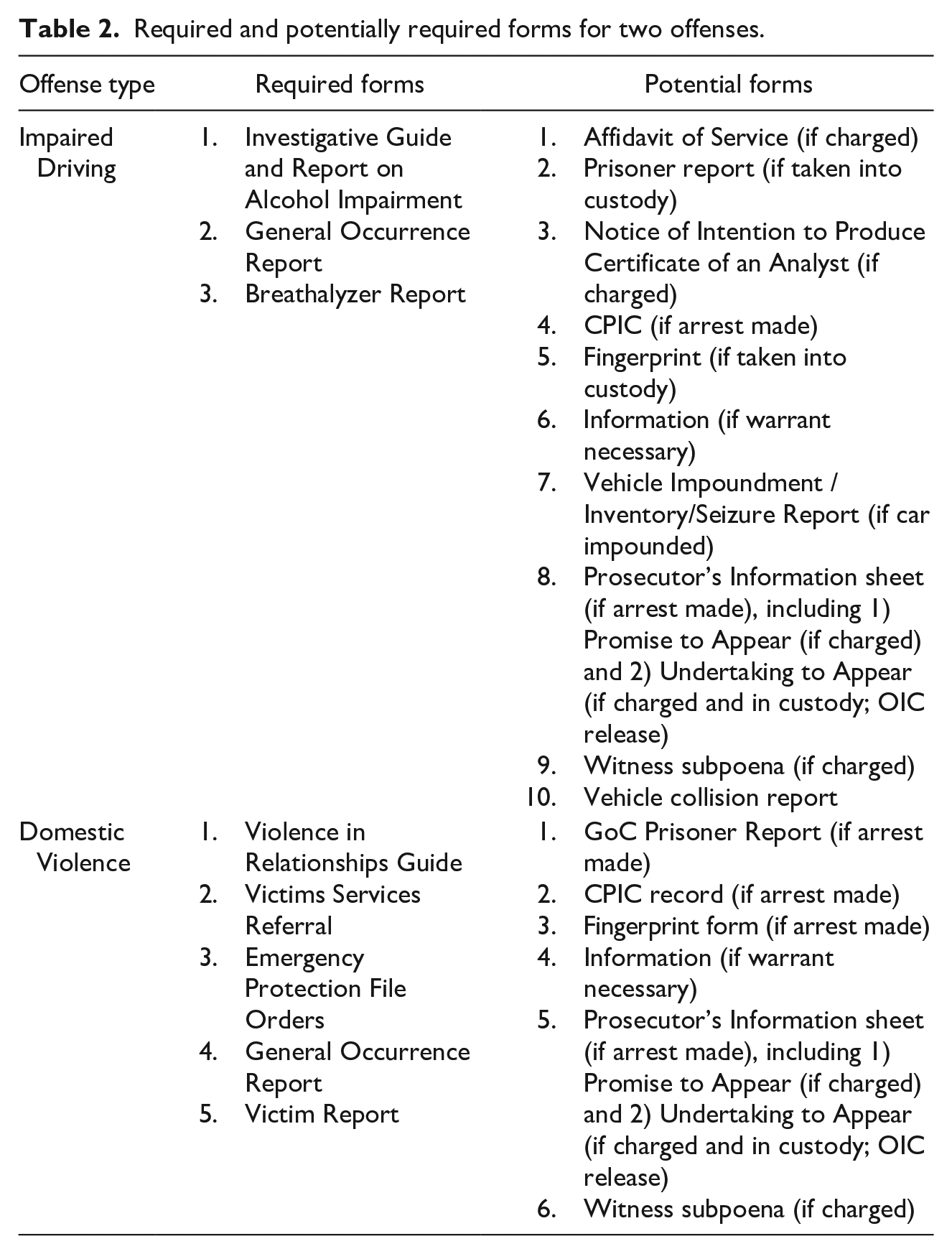
Although much of this same information is captured in the General Occurrence form filed by officers to an agency’s RMS, officers have to complete duplicate forms. A significant source of frustration for officers is the amount of duplication of effort that occurs due to demands by external actors to share information as they wish it to be formatted. As a frontline officer explained, “there’s a lot of, I would argue, duplication of information in that system, where you’re required to do all these separate forms, and you’re repeating information, depending on the file, numerous times within it.” Other officers agreed. For example, when asked about duplication, one sarcastically laughed, saying “we [in policing] love duplication, replication, triplication.”
Recognizing certain offenses can generate multiple forms, most containing the same information; the rationale for having multiple forms given is that each form has a different purpose and goes to different internal and external users. For the officer, however, lack of coherence on data collection, and the unwillingness of services to push back on external requests from other government agencies or demand multiple services coordinates in the development of one or two forms rather than each having their own, means not only duplication and triplication of effort, but often the addition of yet another form: the checklist. The purpose of the checklist is to ensure that officers have completed each of the requisite forms depending on the nature of the event. As one officer described the domestic violence checklist in his province, “that’s a checklist to make sure that you’ve covered off everything that [you] already [put] in the report.”
We also, as previously noted, spent hours conducting field observations of officers engaged in paperwork activities. The following remarks capture what we saw on the road and in the office: Like 10 am, Constable is doing paperwork. 11:45 Constable is still doing paperwork. When I tell people that this goes on, they say, “Oh, you know, they’re probably just shirking.” I’m like, “no, he was pretty solidly putting it in.” And I remember at the end of the second day, I’m asking, “How many do you still have left in your queue?” He’s like, “16.” And I’m like, “Didn’t you have 16 yesterday?”
The paperwork burden appears insurmountable to complete, replenishing itself, with or without officers leaving their desks.
Theme 2: Extra-Institutional Information Needs
“[Previously] we documented the elaborate networking between the police and external institutions and analysed the ways in which these interinstitutional entanglements are held together by webs of communication. In the light of this analysis, it is not surprising that police officers attribute much of the paper burden to the demands of external institutions” (Ericson & Haggerty, 1997, p. 302). “There are a lot of things that we fill out – I’m not sure of the specifics – that are primarily for stats for [the province]” (Provincial Police Officer).
Researchers have attributed the police “paperwork burden” to judicial decisions leading to significant changes to documentation levels required of police (Malm et al., 2005). We do not disagree with such contention, nor do the police officers interviewed in our research. However, except for Ericson and Haggerty’s (1997) work in PTRS, what has generated less attention from policing scholars is the extent of the volume of paperwork that can be attributed to demands from external actors for information that is then made necessary to process cases (e.g., through the courts, family services). This section provides a glimpse into the volume and nature of these demands.
One question posed to officers involved what one form creates the most frustration. The clearcut answer for most: “motor collision is the worst one.” In the study provinces, police are mandated through legislation to take reports of all motor vehicle collisions
5
and process the paperwork for an external audience. In one province, that external audience is the provincial motor vehicle insurance company, here referred to as ICB this requirement is mandated by provincial law: the Insurance Corporation of British Columbia: “a police officer who attends the accident must complete a written report of the accident in the form established by the and forward it to the corporation within 10 days of the accident” (Motor Vehicle Act, 1996). An officer described the process as “a joke,” elaborating that: People that call in a month later come to our office a month later, “I just came back from my lawyer, and I need to create a police file.” So, we have to get his information, then we have to track down whoever was involved, all the witnesses, anyone that was in those two vehicles. Let’s say there’s five people in those vehicles; I’ve got to get those five people. And to track down all those five people, that file can go on for six months, however long it takes me to get a hold of them . . . so those files stay in your task queue forever, until I can get everyone in here for something that’s not even a police matter. I’m not going to decide who’s at fault and who’s not at fault. That’s what the insurance does. But no, what do the insurance people do? They call us. They send us emails. They send us referrals, wanting our investigative report so that we make the decision for them.
Her words highlight the futility of work for reporting motor vehicle collisions, evidencing the extension of work that should be completed by the insurance company into the responsibilities of police.
In the other two study provinces, the information officers produce for vehicle collisions goes to the relevant Ministry of Transportation. We secured copies of one of these forms (see Figure 2, although we only show one of four pages required for the report). The form requests officers to provide detailed information on road conditions at the time of the accident, road material, street configuration, road grade, surface, and street alignment (whether the road curves right or left). It also asks officers to determine vehicle tire pressure, weather and light conditions at the scene, and if the vehicle(s) involved were used for school-related purposes.
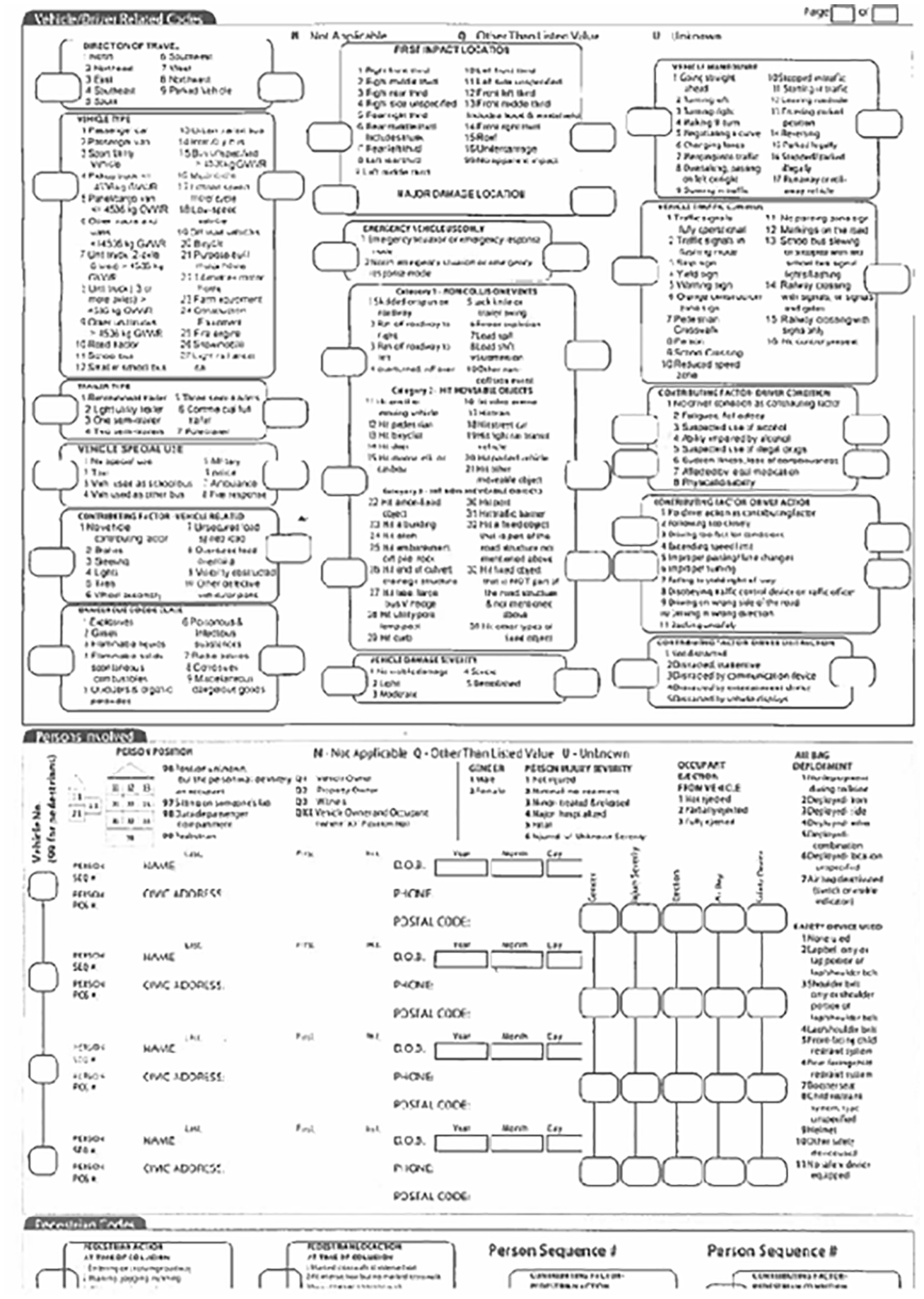
Motor vehicle collision form. 6
When we asked officers about this particular form, the response was universal condemnation. For example, one replied, “Oh Jesus, this new motor vehicle collision form . . . It’s just crazy. We’ve brought this forward to our division reps, and I mean, basically we’ve been told to just shut up and do it.” Another officer decried “doing monotonous reports for the provincial government,” which he described as “sucking up an hour or two just on doing one fender bender.”
The form, a version of Figure 2, is provided to officers as an electronic template. In other agencies, including a municipal service studied in another province, officers use paper-based forms requiring a hand-drawn depiction of the accident scene. An officer here laughed, “I’m the least artistic person in the world, and we’re drawing diagrams where cars are going in this that and the other thing. So, I’m literally using a ruler.” He added that drawing the scene increases the amount of time spent on an already time-consuming process that officers perceive as having little value.
Other examples of reports for external consumers are provided in the following sections; however, we want to focus on one more police reporting process for the benefit of external actors before turning to the question of what police know about the uses of this information. In 2019, the Ontario Society for the Prevention of Cruelty to Animals advised the provincial Solicitor General’s office that they would no longer conduct investigation and enforcement activities in this area. As a result, animal control issues—from dog bites to significant abuse and neglect cases—became the responsibility of local police services. Before this change, police might be requested to attend a dog bite call, which generated additional paperwork to be passed on to the local animal control or humane society and the provincial Medical Officer of Health. One officer described the process: I get dispatched to a dog bite call, and I called Animal Control . . . [they have] a person who works there whose title is ‘Dog Bite Investigator,’ so I asked them to send me their dog bite investigator. ‘No, we don’t do that. You do the investigation, and then the dog bite investigator follows up with the investigations.’ So, this is not a CAD,
7
this is a general occurrence report.
8
So, I need statements from the victim who was bit. Statements from the dog owner. I need the dog owner to produce the dog’s documents for vaccinations, which if they don’t have in front of them . . . I need to go through the Vet . . . Animal Control gets our files and so does the Medical Officer of Health, and then they do their thing based on what we have done.
What frustrated this and other officers was that Animal Control and provincial health services had downloaded the responsibility of investigating bylaw offenses onto local police, using their paperwork for conducting their own surveillance, investigation needs, and public health response.
Theme 3: Use Value: Where Does This Go and What Is It For?
“ . . . field officers are often unaware of why particular reports are required, where the knowledge goes, and how it is used” (Ericson & Haggerty, 1997, p. 296). “[I’m] typing in shit that gets turned into statistics that gets used by somebody for something else” (Provincial Police Officer).
Analysis of our data yielded only three situations in which an officer identified the potential use-value of the recorded information for external consumption. Thus, a significant theme that arose across interviews conducted in all three sites was the lack of officer knowledge about the purpose of the information encoded in the forms they were required to fill out for external consumers. As one officer explained, the intent behind some forms of data collection was “self-evident.” However, for other forms, the intended purpose was unclear. When we asked officers about specific forms, we often received the following answer: “I don’t know.” For example, a provincial police officer replied to one such query: “I don’t know about the attachments list.” He then proceeded to advise he was unaware of how a new mental health report mandated by the provincial government in cases involving persons with mental illness (PMI) was providing helpful information: “I’m not entirely sure how that generates statistics.” A municipal police officer was similarly unsure how a new report he was required to fill out before taking a PMI to a local hospital was being used. He explained, “it’s shared with the hospital. I don’t know where it goes within the hospital, umm, but it’s somewhere. That’s the reason that I was told we have to do it.” Another officer in the same city thought the mental health form was intended to serve as a tool for helping officers make determinations as to whether a PMI should be transferred to a hospital for assessment. However, she viewed that “it doesn’t make any sense, really.” As she explained, I’ll apprehend somebody, we’re sitting in the car. I’m supposed to fill this out before we leave and get to the hospital. It’s basically a guideline like ‘should I be apprehending them’ to assist us, but I’ve already done it, so it’s kind of putting the cart in front of the horse . . . And some of the questions at the end are – what time have you left the hospital? Well, I haven’t even gotten there yet. But the program won’t let you upload it until you fill that in.
A Sergeant in another city was similarly unsure of the purpose of a provincial mental health form he and his colleagues were mandated to complete: “I think that only goes to one person who is doing some sort of study.” He then added, “There’s always something else that we’re adding, and I’m not really sure what the purpose for it is. So, to answer your question, I have no idea who else is getting access to this stuff . . . or what it’s for.” 9
We received similar answers when we asked provincial officers about a victim services report they must complete for every alleged domestic violence (DV) case they attend. One of the authors started to analyze each of the reports related to DV and had become confused about the level of duplication across reports and asked if an interviewee could explain its purpose. The response: “I can’t.” Another admitted, “I don’t know. I just fill it out because people tell me I have to.” A third shrugged and said, “there’s probably some good stuff in there.”
Although officers in two provinces were quick to note some of the absurdities encountered with mental health forms and their purported purposes, the bane of their paperwork existence remains motor vehicle reports—whether for provincial governments and/or insurance companies. Not surprisingly, several raised questions about the purpose of these forms and whether anyone actually uses the information. One curious officer showed the form to a neighbor, who happens to be a traffic engineer. “He’s like, ‘nobody looks at these. They go into the box of ‘never to be seen again.’” He then added, “nobody is pulling these forms from [Ministry of Transportation] and saying, ‘we need to refigure our roads.’” Thus, he wanted to know, “why are we doing them?”
Generally, the majority of officers were unaware of the designated uses of most of the external reports they were required to complete. The consensus was some type of governmental “statistics.” For example, one officer said, “things get coded obviously for statistical purposes and reasons. I can understand that, but I don’t know what the deal is on that part.” In another province, an officer advised, “there are a lot of things that we fill out, I’m not sure of the specifics, that are primarily for stats.” Another noted that specific external reports are “statistical gathering for the province.”
An essential aspect of officers’ lack of awareness of the use-value (if any) of this data is how this impacts officers’ attitudes and morale. Individuals dealing with the twin demands of outstanding call service queues, community and partnership needs, as well as mounting tasks, which are all accompanied by paperwork, can become frustrated and cynical: Maybe it’s just us as members being pessimistic and being in a rotten mood, but a lot of the time, we feel like some of the resources are just nagging us, and we feel like, ‘okay, what is the point of this?’ We feel like they’re. . .they’re hounding us for certain information, and we’re having to fill out a form and send it to them so they can justify their job (Municipal Police Officer).
The officer’s words also demonstrate a disconnection between their work responsibilities and actual work duties. They are producing, at times, seemingly invaluable and, at other times, duplicated paperwork without any true insight into the purpose.
Officers who spoke about querying the utility of these forms or expressed dissatisfaction with conducting additional taskwork for no known reason advised they were told to “suck it up.” To illustrate, one municipal police officer referenced a burglary form used for external purposes, of which he was unclear. “At some point, I asked, and I couldn’t get a reasonable answer. Like does anyone even look at this anymore?” He continued to explain that when answers to such questions are not forthcoming, people stop asking them because they have learned that individuals who “ask those [those] types of questions are [viewed as] kind of a pain in the ass.” Rather than agreeing with the need to question the logic of what may seem like arbitrary data collection, supervisors and managers are instead seen as manifesting an attitude of, “‘Just go to work and don’t bother me with these stupid questions.’” Although, an alternative would be that paperwork has become so deeply ingrained in police work that superior officers, who are often more tenured, view the topic as normative and thus futile to fight against or pass the time discussing. Either way, the result is that police agencies can “get stuck in a loop that may have made sense 10 years ago, but nobody necessarily looks at it today.”
Theme 4: Misplaced Burden: Should Police Even Be Doing This?
Given that most officers tended to be unaware of or otherwise confused about the potential utility of the data they collect for external audiences, it is of little surprise that a significant theme that emerged was what we have termed here a “misplaced burden.” By this, we mean participants tended to believe that if an external actor thought there was a use-value for the type of data captured, they should be responsible for identifying and collecting it themselves through either existing police reporting systems or alternate channels. The following exchange with officers in a focus group illustrates this:
: It’s administrative garbage.
: We’re catering to other industries: victim services . . .
: We do so many extra reports . . .
: That the information is already captured in the file and we’re expected to write up other reports that captures the same information. But somebody needs a specific form that they can look up, because they can’t actually go and find it themselves.
: They can’t just read through?
: No, God no. Heaven forbid.
Interviewer: And it falls on you guys?
: It falls on us.
In another province, a frontline officer questioned why the public insurance agency could not conduct its own investigations—including collecting witness statements—with individual and vehicle information provided by an officer on scene or through self-reporting. 10
As we argued, the volume of data collection officers are tasked with is seen by many as overwhelming, requiring hours spent at a computer as part of one’s daily shift. The consequences of such are clear: officers are not engaged in what both they and the public see as their primary responsibilities—policing. As a provincial police officer explained, one expects officers “being visible, being on the road, talking to people. But there’s just so much of this foolish paperwork.” Time spent at a computer processing information also means that officers are less likely to have the time to engage in proactive policing work within their communities. “You’re tied up with that shit,” one explained of paperwork, “don’t’ have a whole lot of time . . . you’re basically just responding to police calls . . . when you’re done your call, you come back to the office, you type it up.” An officer in one of our focus groups offered the following thoughts on what she sees as the cumulative effect of too many demands for data collection: “we’re too far away from actual policing . . . the pro-active stuff is gone.” Another hidden impact of the police paperwork burden is that when external actors have ideas for new policing-based programs, officers are cynical about its utility, suspecting it will lead to more work, precisely more paperwork. We encountered this attitude early in Study 1 when discussing a program idea supported by a provincial government: “We feel it’s gonna be more crap thrown back on us,” one said because these types of programs usually do little more than create “one more form for us [to fill out].”
Conclusion
Following the adoption of more knowledge-based approaches to managing people within a risk society, coupled with increases in inter- and intra-institutional demands for “knowledge” and the collection and dissemination of data on crime, criminal justice actors find themselves with greater reporting responsibilities. Police are increasingly tasked with gathering data and filing forms designated to meet internal standards, processes, and policies while also navigating extra-institutional administrative requirements. Fueled by this recognition, we return to Ericson and Haggerty’s (1997) concept of “knowledge work” to explore how police paperwork is driven by external pressures on officers to produce data, reflecting on our analysis of interviews and ethnographic field notes involving Canadian police officers across three provinces, along with document analysis. Our findings highlight the seriousness, persuasiveness, and mounting quantities of paperwork obligations on police and policing.
Ericson and Haggerty (1997) remark that “the police experience what they call a ‘paper burden’ that is largely attributable to the demands of external institutions” (p. 296), we found the same. We also noted considerable effects of the “paper burden” throughout the policing system. First, external institutions’ demands led to operational, organizational, and cultural impacts, such as increases in police work and police officers feeling overwhelmed, frustrated, and inundated with administrative responsibilities tied to paperwork. Second, participants discussed scads of inefficiencies built into processes oriented toward meeting extra-institutional informational needs. Officers felt inefficiencies were often multiple, each beyond their control, varying from duplication or triplication in information inputted on forms to external actors’ needs that can delay police work completion for several months. Third, the external institutions included multiple actors, such as insurance companies, provincial governments, transportation agencies, social and health services, and animal control. Fourth, extra-institutional demands on police emerged as informal and formal, involving regulative (e.g., required forms by internal policy), normative (e.g., the culture around how to fill out forms, competence in navigating external actors’ processes), and cultural-cognitive (e.g., projected shared beliefs on set expectations for the paperwork) expectations. Lastly, each institution had different requirements of police for information and paperwork, and these changes depended upon the respective processes related to each documented transgression.
We also discovered that police appear disconnected from the knowledge they push, the information they produce, and how the information is documented. Officers in our study were mostly unaware of the purposes of the knowledge they were producing, and even when they were aware, they lamented the duplication and triplication of their efforts and ineffective use of their time. Here, what is necessary is informing officers of how their paperwork is used, revealing its utility and role in case constructions, investigation, or proactive policing. Further, they had no voice to inform the paperwork for which they were responsible. Our findings highlight how this persists because police have become the collectors of information that informs paperwork requirements (form filling and the collection, collation, and communication of specific information) for the navigation of extra-institutional systems and processes that serve to mitigate risks that abound in a contemporary risk society. “Risks” here refers to the increased vulnerabilities inherent in navigating the uncertainty that comes with advancing knowledge and technologies.
For context on the implications of these findings, risk society has crept into the criminal justice systems in many diverse ways, all requiring more research and even recognition, particularly given technological innovations and introductions (e.g., body-worn cameras, co-response units). This is evinced in requests made for explicit information on forms that serve to perpetuate, even reinforce, “actuarial science” (Feeley & Simon, 1992). Each justice agency or organization strives to collect the information thought necessary as a strategy to counter the risk inherent to contemporary societal living. The modern knowledge-based policing approach pushes toward evidence-informed practices and statistical computations but also equates to police officers spending more time on risk management through paperwork than in active policing—an area necessitating further inquiry, specifically the legal terrain that underpins paperwork completion. There is a need to unpack how risk and vulnerability inform the paperwork demands imposed by external agencies on police, who need to meet their own paperwork demands (Ericson & Haggerty, 1997). Thus, although under-researched, the “knowledge work” (Ericson & Haggerty, 1997) function of police has become central to their occupational role.
What this means for policing—broadly for how police spend their time and specifically for what police are responsible for in their occupational duties—is how officers are spending upwards of 90% of their working hours is not yet truly receiving fulsome consideration, discussion, and analysis. Although outside of this study, Ericson and Haggerty (1997) also found that paperwork was a deterrent to policing, impacting officer discretion as they balanced their need to “stop crime” and the consequences of their actions on their workload. Thus, the impacts of paperwork are vast for police. Yet, overall, at organizational and governmental levels, paperwork is not being considered, assessed, or streamlined—to the best of our knowledge. Doing so could equate to significant cost savings, given that police salaries comprise such an overwhelming proportion of police expenditures. To this end, we recommend a fulsome reassessment and coordination of paperwork across organizations and government, with a keen eye to eliminating duplication (or triplication) and creating more nuanced but intuitive knowledge creation processes.
Inter-institutional collaborations require cooperation to attenuate challenges surrounding the nature of these relationships. However, for police work with external institutions, the outcome appears that institutions place demands on the police for information, which police must provide while jockeying around the institution’s processes, rules, and expectations. Although saying for certain is beyond this study, the vast consensus in our research was that police feel they are used to fulfill an array of paperwork requirements; thus, rather than collaboration between institutions, there exists a displacement or shifting of responsibilities to police. In meeting their knowledge production demands, police appear to be operating as administrative agents for and on behalf of external institutions. This warrants research into how administrative work is displaced and loaded onto police (without reducing their other work obligations). Suppose paperwork across institutions is being pushed onto police officers. In that case, there is a need to clarify obligations, occupational responsibilities, and, again, to streamline processes to reduce the burden that comes with “knowledge work” (Ericson & Haggerty, 1997) and make space for other aspects of the job.
The implications of using the police to do this work for external institutions (and their own) means “office work” bogs down police, rather than “police work.” Thus, to respond to public safety needs, freeing up police officers’ time by reevaluating the role of police in filling out external agency forms (combined with simplifying forms and removing duplication) may provide a more economical and community-oriented way forward for policing. Without a manageable and accomplishable workload for police, there is a high likelihood that officers will experience role strain, burnout, or associated compromised well-being—an area in which we encourage future study. Although we found that paperwork left officers demoralized and frustrated, there is a need to more fully unpack how officers psychologically experience the paperwork burden of their occupational work. Given, as Ericson and Haggerty (1997) noted, “complaints about paperwork abound in police culture” (p. 300), we ask, what explicitly is it about paperwork that creates organizational stress for officers, particularly to the point that paperwork is such a common complaint?
Again, our study is limited in generalizability. Moreover, we did not interview all police services across Canada, nor did we analyze all paperwork forms across different areas of policing—realms requiring future study. In addition, the jurisdictions in which our data were collected have not transitioned to all “fillable forms,” nor introduced body-worn cameras; thus, how these developments may impact the paperwork burden too requires future study. We also recognize that some paperwork is necessary and—to be clear—are not suggesting paperwork be eliminated or that all paperwork is futile or time-wasting; instead, we question the necessity of duplication and triplication of paperwork as well that of all required information in such forms. In some cases, customized forms may be necessary for referrals, particularly when dealing with difficult social challenges (e.g., homelessness, addiction, poverty, and mental health). Still, if police were clear on the purpose of such forms, it might reduce the occupational stress induced. Perhaps also of interest here is for future researchers to test the utility of paperwork produced by police and to do so to ensure that all efforts do have value. A possible remedy to the extent of the paperwork burden may be to transfer some paperwork, as part of the civilianization processes, to administrative supports where possible.
Our study found that knowledge working is still alive and well within present-day policing, which includes community engagement, crime analysis and prevention, service provision, partnership work, and patrol, among other functions, and continues to influence the paperwork burden. Thus, we confirmed that police seem to have become knowledge pushers. Overall, the consequences of the paperwork burden and related inefficiencies could be substantial for policing. In light of our findings, we conclude that streamlining paperwork processes could assist with officer morale and wellness and save time and cost for the broader police service organization.
Footnotes
Declaration of Conflicting Interests
The author(s) declared no potential conflicts of interest with respect to the research, authorship, and/or publication of this article.
Funding
The author(s) received no financial support for the research, authorship, and/or publication of this article.
