




Abstract
Victimization has been anecdotally connected to missing persons within several reviews, inquiries, and media stories, particularly in consequence of missing-turned-serial murder cases. However, this has been paid little attention within the scholarship. To remedy this gap, this study empirically explores the link between missing persons and victimization through the perspective of lifestyle exposure theory. A qualitative thematic analysis of 1,920 missing person files uncovers several demographic and lifestyle factors implicating victimization risk, as well as their ranked aggregated and disaggregated saliency. Examples include criminality, victimizing events, sex work, and gender identity. Also discovered is that the context and nature of victimization risk differ for specific people and groups. The implications of these findings and future research areas are herein discussed.
Introduction
Much of the public discourse surrounding missing persons has centered on the extreme and anomalous: the missing-turned-serial murder reports and, in parallel, missing person cases connected to crime, harm, and violence. One such example relates to a known Canadian serial killer, Bruce McArthur, who caused the disappearance and murder of eight people (Epstein, 2021). From it, the Honorable Gloria J. Epstein conducted and published an independent review scrutinizing the police handling of these investigations as rife with faults and failings. This review stressed that these issues are compounded as McArthur targeted primarily vulnerable and marginalized persons (e.g., immigrants, racialized, and LGBTQ2S+ communities; Epstein, 2021). Indeed, the McArthur cases are not unique. Interrelations between missingness, vulnerability, and victimization have been the focus of public inquiry (Hedges, 2017; Oppal, 2012), but few studies have paid attention to such connections. When these links are noted in the scholarship, it is often through the same extreme lens (see LePard et al., 2015; Quinet, 2007).
However, some research broadly examining missing persons has stated that the actuality of these incidents could be, instead, less notable. For example, a recent study on homeless missing person police reports writes, “this analysis reveals a somewhat more mundane picture. . .most people are reported missing due to shelter/mission reporting issues with curfews, and all are located alive” (Huey & Ferguson, 2020a, p. 1). The issue with such conclusions on mundaneness surrounds police data limitations, further confounding understandings. Police data systems are designed to reclassify missing person occurrences that intersect with matters like criminal offences from the category of “missing person” to the associated offence type before case closure. Ergo, missing person events related to victimization become “hidden” under other case categories. These system effects have resulted in victimization being overlooked within studies using such data, which are heavily relied upon as police reports are one of the only sources with details on missing people. Altogether, the relationship between victimization and missing persons is likely underestimated, lacking depth, and undetermined.
This study thus attends to three intertwined issues: a dearth of research on missing persons and victimization, insufficient understanding of factors related to missingness through this lens, and data limitations. We use a combination of different police data to explore the connection between victimization and missingness and apply lifestyle exposure theory (LET). These data feature both qualitative information documented before files are reclassified, transferred, and closed, and case closure details. In these, ties to victimization are visible, and, therefore, a more rounded account of the factors impacting missing persons can be offered.
Literature Review
Victimization Risks
High rates of victimization tend to be reported by men, younger people, and single people (Hindelang et al., 1978). These trends have endured, except for the gender gap in victimization. Like the liberation hypothesis used to explain the gender gap in offending, some scholars suggest that, as women become more economically and socially independent from men, the gender gap in victimization will diminish (Lauritsen & Heimer, 2008). For crimes such as aggravated and simple assault, the gender gap in victimization has narrowed (Lauritsen & Heimer, 2008). However, recent statistics point to a possible reversal of the gender gap in victimization. The risk of violent victimization for women is about 20% higher than the risk reported by men (Perreault, 2015). This problematizes the standard use of men as the “default” comparison category.
Another critical dimension to consider is race/ethnicity. Racial/ethnic groups are defined and categorized differently within and between jurisdictions, making comparisons difficult. Still, studies note that Black Americans experience higher victimization rates than white Americans (BJS, 2010; Catalano, 2006). Disparities in violent victimization rates persist when gender is considered. Black men report the highest victimization rates, followed by Black women, white men, and white women (BJS, 2010). Recent United States (US) estimates suggest that the population percentages of racial/ethnic groups are comparable to their share of violent victimization (Morgan & Truman, 2020). Canadian statistics show that visible minorities report lower victimization rates than non-visible minorities. These findings change dramatically when immigration is considered. Canadian-born visible minorities report nearly five times higher victimization rates than their visible minority immigrant counterparts (Simpson, 2018a). In Canadian crime statistics, only Indigenous peoples are treated as a distinct entity, and they experience markedly high victimization rates (Boyce, 2016). The National Inquiry into Missing and Murdered Indigenous Women and Girls (MMIWG, 2019) outlines how Canada’s colonial practices have marginalized and oppressed Indigenous peoples, reflecting the ongoing criticism that Canadian institutions offer weak responses to the needs of Indigenous communities.
Lastly, lesbian, gay, and bisexual people report higher victimization rates than their non-sexual minority counterparts (Flores et al., 2020; Perreault, 2015; Simpson, 2018b). Statistics on other sexual minorities, as well as gender-diverse people, are scarce due to gaps in existing victimization surveys and police-reported data. A recent analysis of gender-diverse Canadians indicated that risk factors like substance use, poor mental health, and previous experiences of harassment, violence, and discrimination are prevalent among gender-diverse Canadians (Jaffray, 2020). Beyond sociodemographics, scholars have identified “risky” behaviors and lifestyles that increase one’s vulnerability to victimization. For example, victimization risk increases with time spent outside the home at night, chiefly in public places (Piquero & Hickman, 2003). Current Canadian data show that drug use, binge drinking, and frequent evening activities significantly increase victimization risk (Perreault, 2015). Some scholars cite different (and sometimes opposing) risk factors, explainable by the degree of emphasis on personal versus property victimization. Still, both approaches remain focused on crime victims’ lifestyles and daily routines.
People who have experienced victimization report a wide range of outcomes. Beyond short-term concerns related to the initial incident (e.g., physical injury), long-term consequences can include increased alcohol and substance abuse, anger, fear, anxiety, depression, and many lasting symptoms related to post-traumatic stress disorder (Perreault, 2015). Indeed, Canadian data show that about 25% of those victimized in violent crime incidents experienced disruptions to their daily activities for at least 1 day (Perreault, 2015).
Victimization and Missing Persons
The most explicit connection between missing persons and victimization is homicide and serial murder (LePard et al., 2015; MMIWG, 2019; Newiss, 2004, 2005; Quinet, 2007). Studies discuss this victimization form to introduce it tacitly as thought-points when examining risk in the context of missing persons, police response issues leading to such outcomes, and as a spectacle of worst-case scenarios. For instance, reviews of police procedures and inquiries into missing person investigations claim that missingness increases vulnerability to victimization, primarily asserted based on shared experiences, stories, and high-profile cases (Epstein, 2021; Hedges, 2017; MMIWG, 2019; Oppal, 2012). These often note that ongoing police failure to enhance missing person responses, incorporate community feedback, and better elucidate the relationship between missingness and victimization diminishes community trust and confidence in the police. This is amplified by criticisms that not all missing person cases are treated equally. For example, “Missing White Woman Syndrome” refers to more sympathetic and greater media attention paid to missing white women and girls (Moody et al., 2009). Police efforts may alter in light of media coverage (e.g., escalate; Lee, 2005); thus, disparities in newsworthiness, and media narratives being shaped by factors like race and sex/gender (Slakoff & Brennan, 2020; Slakoff & Fradella, 2019), can affect case events/outcomes, including with respect to victimization.
Another common way victimization related to missing persons is understood surrounds notions of harm. One of the most comprehensive studies into missing persons and serious harm experiences (often entangled with victimization) was conducted by Doyle and Barnes (2020). In this, risk of harm pertains to “A risk which is life threatening and/or traumatic, and from which recovery, whether physical or psychological, can be expected to be difficult or impossible” (Doyle & Barnes, 2020, p. 164). These authors report an acute inequality in the spread of harm across missing person reports by sex/gender and age, whereby juveniles, adults, and women are more likely to experience harm across many factors when missing (Doyle & Barnes, 2020). However, it is not clear from this study what “serious harm” means in relation to victimization. In fact, despite the concept of harm being discussed throughout studies on missing persons, few mention its association with victimization (Hill et al., 2016; Huey et al., 2020).
Studies of missing youth and children report prominent findings regarding victimization. Notably, victimization in connection with this group stems from “survival crimes” to fund/meet basic needs, thrill-seeking, grooming, and vulnerability (Biehal et al., 2003; Hayden & Goodship, 2015). Pre-eminently, missing children and youth are victims of sexual exploitation (Babuta & Sidebottom, 2020; Crosland & Dunlap, 2015; Hutchings et al., 2019; Stevenson & Thomas, 2018). Stevenson and Thomas (2018), in studying missing young people, found that just under 70% had a victimization history, such as family violence and sexual abuse and exploitation, proportionally more related to females, young people, and repeat missing episodes. Such findings are paralleled in other studies on missing children/youth (Crosland & Dunlap, 2015; Hutchings et al., 2019), but extensions to missing adults are rare.
Police Data Issues
An inherent limitation of Canadian police RMS
Despite victimization being a central area of criminological study and an understanding that missing person occurrences are connected to victimization, empirical research on this matter is scant and tends to be impacted by police data issues. The first problem relates to Canadian police record management systems (RMS). Police RMS are primarily designed to capture police service calls into reports categorized by either offence or incident type(s), but not both. Offence-based occurrences label investigations into the contravention of enforceable law, while incident-based events are suspicious non-offence-related investigations and/or address public safety concerns. Missingness is an anomaly broadly encapsulating various offence and incident-based scenarios.
Also, within Canadian police RMS, a “missing person” is an incident type sub-categorized as either “open” or “closed/located.” This can be misleading as it is generally only applicable to cases where the circumstances of a person’s disappearance are unknown, or the incident is unrelated to any criminal offence (i.e., abduction and murder) or regulated apprehension (i.e., “elopee,” Mental Health Act apprehension). When a missing person occurrence intersects with these matters, these RMS are structured to prioritize the offence category over the incident category. Thus, files that intersect with a law enforcement provision will be reindexed in a naming convention within police RMS as something other than “missing person.” This makes practical sense from a police perspective to trigger a series of required actions and procedures, such as transferring the file to a more felicitous or specialized policing area for further investigation, apprehension of an offender, and/or case closure. Such processes ensure that police personnel with the necessary skills and knowledge are assigned to the file and can respond with appropriate actions and resources. This does not mean that the person is not missing; it represents the recognition that the case has complexity warranting particular attention from dedicated officers and resources.
The inability to categorize missing persons under a mutually exclusive category is an inherent RMS design limitation that impacts the scholarship. Analyses of data only from Canadian police RMS will generally exclude crime-related incidents or mental health apprehensions. This is especially alarming when examining missing persons from a victimization perspective, as criminal offences and regulated apprehensions are meaningful data related to harm. Missing person occurrences will thus become “hidden” or invisible in various RMS categories and overlooked in any analyses that seek to gain insights into missing persons.
Hidden data
Resulting chiefly from police data system impediments is the matter of hidden data, conceptualized in criminological research as the “dark figure.” Missing person incidents that intersect with matters like victimization can become hidden in two ways by Canadian police RMS: (1) missing person sub-categories or (2) offences with circumstances unrelated to missing persons. For point one, an “elopee” is a missing person sub-category, whereby a person under the custody of a health facility left without authorization or failed to return as required. It is not immediately apparent that the “elopee” category should be included when extracting missing person data from police RMS. Also, if police locate the “elopee” shortly after they are reported missing, the case may instead be captured as a mental health apprehension rather than a located “elopee.”
For point two, disappearances can also be hidden by a broader offence category, such as “homicide” or “human trafficking,” which are not mutually exclusive to missing persons. Although missing person cases can involve murders, homicides may occur for various reasons. Attempting to parse missing person incidents from these broader offence categories is a manual and labor-intensive process without a system to label or flag these occurrences as “missing person” at the onset. The connection between victimization and missing persons will remain largely unknown until consideration is given to these issues and incidents intersecting with such matters.
Theoretical Framework: Lifestyle Exposure Theory
Opportunity models of crime, such as routine activities theory (Cohen & Felson, 1979) and LET (Hindelang et al., 1978), focus on explaining patterns of victimization through exposure to risky situations and circumstances. With the attention placed on victims, scholars work to understand and predict the places and times that bring potential victims into contact with dangerous offenders and identify the factors that increase a person’s overall vulnerability to victimization. Using one of the first established victimization surveys, Hindelang et al. (1978) discovered consistent demographic trends in victimization, highlighting how sex/gender, relationship status, and age affect victimization risk. While overall crime rates can differ dramatically within and between jurisdictions, these disparities in victimization trends persisted (Hindelang et al., 1978).
These authors argue that the disproportionate distribution of victimization risk across social groups occurs as a function of lifestyle. They define “lifestyle” as the regular routines, vocational activities, and other engagements that occupy individuals’ time, emphasizing daily tasks (Hindelang et al., 1978). For instance, lower victimization rates reported by the elderly are explained through their daily routines: the elderly tend to be less occupied with work and events outside the home compared to younger people (Hindelang et al., 1978). They explain gender and marital status disparities similarly, arguing that men spend more time outside the home and experience less activity supervision than women, while married people take on more familial responsibilities and tend to be accompanied when leaving home compared to single persons (Hindelang et al., 1978). Other sociodemographic factors, like household income, are also relevant to LET.
LET helps identify the factors associated with victimization risk and how these factors overlap and intersect to offer greater protection or increased vulnerability. While the original framework has intersectionality gaps, LET recognizes how demographic characteristics create different role expectations and structural constraints that affect the prevalence of different lifestyles across social groups. For example, Hindelang et al. (1978) identify income as a factor that gives individuals more freedom over their daily routines while acknowledging that the impact of higher income is limited for Black people due to structural conditions like residential segregation. Further, a central proposition of LET states: “[v]ariations in lifestyle are associated with variations in the convenience, the desirability, and vincibility of the person as a target for personal victimization” (Hindelang et al., 1978, p. 264). This highlights how a victim may be seen as desirable to the offender, arguing that offenders may target sex workers, substance users, or non-heterosexuals, believing that they are less likely to report victimization due to their involvement in illegal activities or out of fear of outing their sexuality (Hindelang et al., 1978). Perhaps this can be extended to how the offender perceives the relationship between police and various social groups: if there is mistrust between a community and its law enforcement, offenders may find members of that community more desirable targets for victimization. Lastly, LET has been critiqued for contributing to victim-blaming ideologies, in that individuals become personally responsible for “choosing” safer lifestyles (Pratt & Turanovic, 2016). However, LET is used herein to identify victimization risk related to missing persons, not to blame victims for what they have experienced.
The Current Study
This study examines the connection between victimization and missing persons by applying LET. This theory argues that different factors expose individuals to various conditions and lifestyles that can bring about more crime-prone situations with exposure to victimization risk. While missing person occurrences are often not crime-related, these events have been noted as related to victimization, especially for certain people and groups. Reviews and inquiries highlight that this has resulted in tension between police and the communities they serve, faults in police responses, and increased victimization risk for missing people. Despite the potential implications, empirical examinations concentrating on victimization and missing persons are scant. Therefore, this study explores the factors linking missing person incidents with victimization risk in police reports. The research questions addressed are: (1) What factors connect missing persons with victimization risk? (2) Which factors are the most prominent?
Materials and Methods
Data and Sample
We secured police service calls (known as Computer-Aided Dispatch or CAD data) and RMS data from a crime analyst at one municipal Canadian police service. 1 CAD data provides the originating call-for-service correspondence between the complainant and police call-taker, while RMS data features synopses of the investigation and response, subsequent follow-up actions, and case outcome and closures. The latter contains information verified through reportees, information sources (i.e., personal records, surveillance footage, and witnesses 2 ), and even sometimes the missing person themselves. CAD data were cross-referenced with RMS data to: (1) substantiate case details related to missing persons found in the CAD data and (2) extract further qualitative data from the occurrence reports. From these data, we were able to identify a variety of individual and case-specific factors (i.e., age, sex/gender, and transientness) that provide perceptive and evidentiary details on victimization risk. 3
The crime analyst anonymized and extracted these missing person files into Excel. These data encompass 1 year (2019) and initially comprised 42,996 crime- and social-related reports. A separate dataset was then created containing only incidents involving a missing person; all other crime- and social-related reports were eliminated. This reduced our sample to 2,033 reports. Then, files with no qualitative information and/or duplicate entries were removed. This excluded 113 reports. Our final sample, therefore, involves 1,920 police missing person reports.
Analytical Procedure
We conducted a qualitative thematic analysis of the missing person files. Qualitative analysis is appropriate for offering first insights on a topic and a systematic way of exploring the complex nuances actuating or contributing to the phenomenon under study (Austin & Sutton, 2014; Braun & Clarke, 2006; Goldberg & Allen, 2015; Hesse-Biber & Leavy, 2010). As the connection between victimization and missing persons has seldom been explored within the scholarship, qualitative analyses would offer an exploratory, in-depth, and contextual examination of this relationship (Braun & Clarke, 2006; Hesse-Biber & Leavy, 2010). Hence, this method was selected to provide a richer understanding of this connection (Austin & Sutton, 2014; Hesse-Biber & Levy, 2010). It can, therefore, provide a robust understanding of the link between victimization and missing persons.
Missing person files were analyzed inductively through Braun and Clarke’s (2006) six-step thematic analysis. In keeping with this study’s goals, thematic analysis is a flexible approach that allows for a rich account of the phenomenon under study by bringing to light the differences and similarities across and within files (Braun & Clarke, 2006). First, files were manually read in full, and notes were made about some initial codes surfacing (called “candidate themes”) (Braun & Clarke, 2006). Guided by inductive reasoning, codes were then sorted and grouped based on similarity, and analogous codes were combined to form “overarching themes” (Braun & Clarke, 2006). Also, preliminary overarching themes were collectively reviewed based on internal homogeneity and external heterogeneity (Patton, 1990) and how these emerging themes related to the entire dataset.
Next, the overarching themes were named, defined, and coded using NVivo 12 software. These were subsequently organized according to categories of “demographic factors” and “lifestyle factors,” concepts derived from the theoretical framework. Specifically, demographic factors can impact one’s experiences with victimization because different status variables are associated with varying lifestyle factors. Lifestyle factors are any direct and indirect measures of one’s lifestyle, leading to differential exposure to situations that can impact the connection between victimization and missingness (Hindelang et al., 1978).
Results
Factors Linked to Victimization Risk
Demographic factors
Demographic factors connected to victimization risk in the missing person files emerged as sex/gender 4 and age. Most events involving women and girls implicated victimization risk within the files. Few male missing person cases mentioning victimization risk signifies that the context and nature of this connection may differ for women and girls compared to men and boys. Of the reports that did connect to victimization risk for males, the majority cited this linkage due to substance use and abuse and previous and/or current crime-related activities impacting both the missing male and the public. However, reports of women and girls implicating victimization risk were regularly associated with multiple previous and current victimization forms. The following files involving women and girls flagged for victimization risk are illustrative of this: “considered high risk due to her recent domestic issues” and “high risk – female known to be involved in human trafficking.”
All files noting the missing individuals’ gender identity as transgender were connected to victimization risk, stressing concerns over previous and/or current victimization. As an example, one file remarked that the complainant’s daughter “is transgendered [sic],” so has victimization risk “because of multiple [previous] assaults due to being trans [sic].” From the upcoming lifestyle factors, we found that most missing people who identify as transgender were also reported as having mental health and substance use or abuse issues and going missing repeatedly.
Regarding age, primarily children/youth and elderly missing people were connected to victimization risk within the files. Expressly, elderly missing persons were often linked to victimization risk if they had health and/or disability issues. References were usually made in relation to Alzheimer’s or dementia and/or mobility problems impacting the missing individual’s ability to maneuver around their environment. To illustrate, one case noting victimization risk links this due to her getting “confused about whereabouts & last time went missing she ended up at someone else’s house without stuff like purse and coat that she left with.” This suggests that the person’s age does not necessarily bring about victimization risk for this group. Rather, it may be factors related to older age, like diminishing cognitive, physical, and mobility capabilities.
This contrasts with child/youth missing pesrson cases wherein their age alone was connected to victimization risk. An instance of this is “a grade 1 student (6 y/o) got onto bus but not supposed to – flagged for risk because of age.” When considering both sex/gender and age, if a missing person report involved both a female and child/youth status, the missing episode was linked to victimization risk, whereas this was not typically the case for male child/youth missing persons. This signals that missing person files involving individuals who occupy both a female and child/youth status are more commonly connected with victimization risk than male children/youth. A similar trend emerged for adults: female adult missing persons were more linked to victimization risk than male adult missing persons.
Lifestyle factors
Table 1 shows the lifestyle factors tied to victimization risk: (1) substance use and abuse, (2) transientness, (3) previous and current victimization, (4) sex work, (5) repeat/chronic, (6) previous and current crime-related activities, (7) mental health issues, and (8) other health concerns.
Information on the Lifestyle Factors.
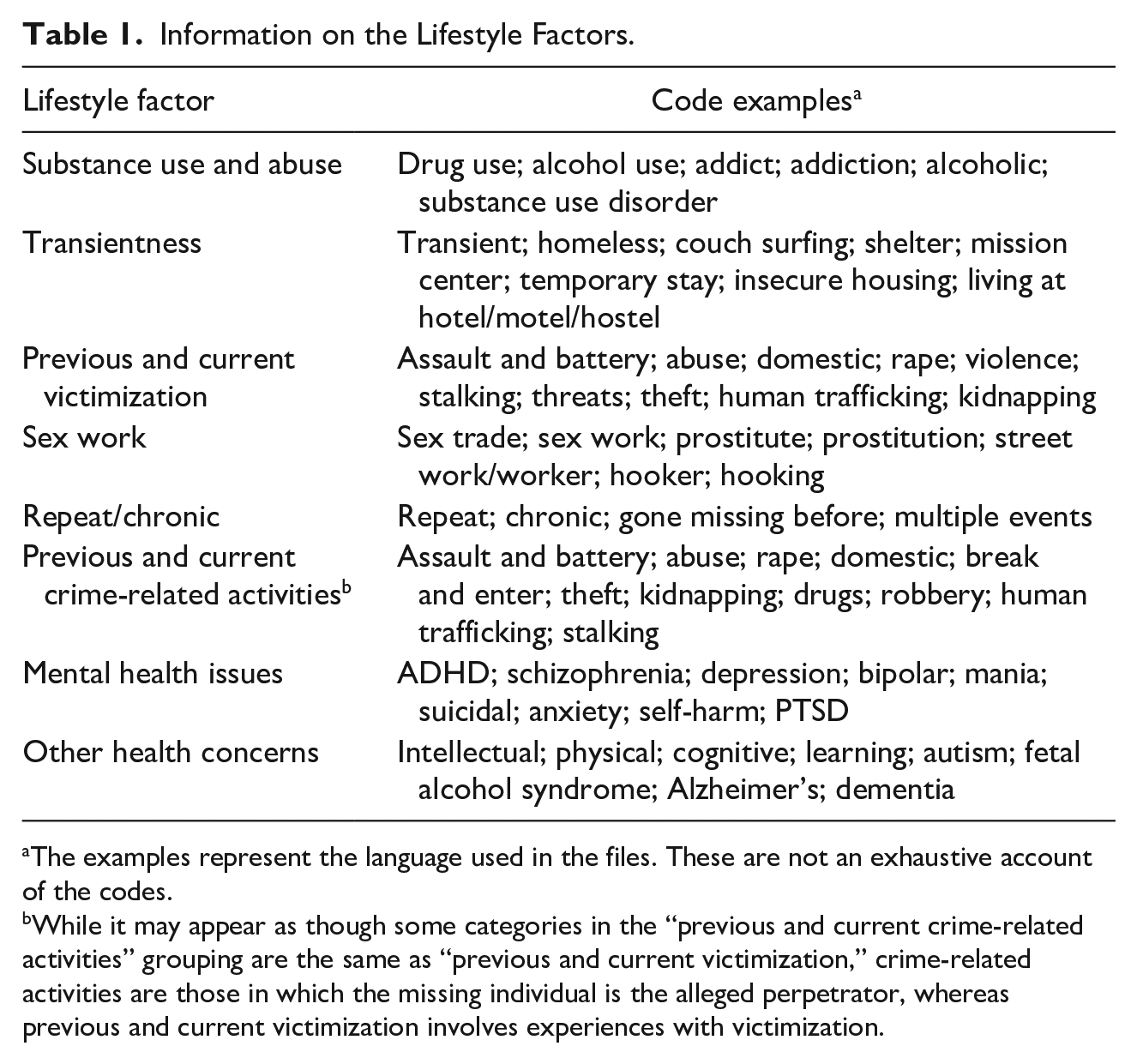
The examples represent the language used in the files. These are not an exhaustive account of the codes.
While it may appear as though some categories in the “previous and current crime-related activities” grouping are the same as “previous and current victimization,” crime-related activities are those in which the missing individual is the alleged perpetrator, whereas previous and current victimization involves experiences with victimization.
Substance use and abuse was mostly connected to victimization risk due to the missing individual’s previous history with drugs and alcohol. This occurred as past substance use and abuse behavior was considered predictive of future risky behavior. For example, one file notes “marked for risk – soc [social] worker says alch [alcohol] binge related. alcohlic [sic] and b&es [break and enters] lots if drunk.” Less frequently were cases linked to victimization risk when the individual was using drugs or alcohol at the time of the missing episode. Although, cases that did identify this factor noted it as a contributing element in the individual’s disappearance. An illustration of this is a file flagged for victimization risk as “he left b.c. [because] on a drug binge and looking for drugs.” Other cases that implicated victimization risk concerning substance use and abuse involve people who are a part of alcohol- and drug-related social circles. That is, persons reported missing with ties to alcohol and drug use or abuse and who associate with others with these same issues are regularly tied to victimization risk. This linkage denotes that one’s victimization risk when missing may be influenced by and related to their social network.
For transientness, missing person cases noting victimization risk are stated to frequent areas of the city known for more crime- and drug-related activity and generally unsafe conditions. These missing people were also often remarked as drug and alcohol users with a crime-related history. As an example, one report connected to victimization risk noted, “male currently homeless, high risk – mug[shot] on file – hx [history] of drug dealing and use.” Other reports involving missing people experiencing transientness cited victimization risk because of concerns over a lack of safety and secure shelter. Thus, the nature of transientness leads to linkages to victimization risk for missing people in this category, which is notable as LET proposes that the more time spent in public places (especially at night), the higher the probability of being victimized. Often, files that highlighted transientness as connected to victimization risk mostly also did so because individuals in this grouping often disappeared from contact and were marked as repeat/chronic.
Previous and current victimization was primarily cited in reports involving women and girls. Examples of this factor identified in the files are physical and sexual assault, domestic violence, family violence, and criminal harassment. Reports that described victimization experiences often did so for consideration when searching for and investigating the missing person case concerning further/additional victimization and police risk assessment. For example, one file writes, “flagged for risk b/c [because] recently sexually assaulted by ex-boyfriend – assaulted again concerns, maybe related to unknown whereabouts.” Current victimization was often referenced as an actuating or contributing factor in the disappearance—that is, as directly impacting the missing event. As an illustration, a case involving a missing 15-year-old girl commented: “missing for two weeks, received text last night saying she was held by drug dealers for two weeks, unknown where she is now, concerned re: human trafficking.”
While cases indicating the missing person’s participation in sex work can be related to previous and current victimization, this was coded separately unless crime, human trafficking, lack of choice, coercion, and other related mechanisms that remove an individual’s willingness to engage in sex work were indicated. For this lifestyle factor, missing persons discussing sex work in the files all cited victimization risk involving missing women and girls. But most of these cases also did not have additional information relevant to this connection or other factors. This may be because the missing woman or girl’s involvement in sex work is a lifestyle factor that warrants concern and attention without further prompt or information. This finding may relate to LET’s proposition that some victims’ lifestyles make them more desirable or convenient for offenders, or perhaps this speaks to an awareness of the stigma associated with sex work.
Repeat/chronic missing person cases (people with previous missing reports) mentioned victimization risk due to the expectation that each time a person goes missing, their chances of risky behavior, vulnerability, and experiences with victimization increase. Quotes exemplifying this are “chronic issues with her running away and getting into trouble—flagged for this, last time assaulted” and “repeated issue w/ [with] [him] not returning when supposed to—risk b/c [because] of history with relapsing when missing.” Many files with previous missing episodes were linked to mental health concerns and/or threatened or were at high risk of suicide or had suicidal tendencies. This signifies that, despite missingness being a pattern of behavior in such cases (i.e., not out of character), such incidents warranted concern regarding victimization risk due to the connection to mental health issues, especially suicidal ideation.
The factor of previous and current crime-related activities represents any forms of involvement in criminal activities. A few missing person cases were due to abduction, wherein a parent or guardian and their child or children were reported missing, with the parent or guardian being reported missing due to taking the child/children without the consent of the other parent(s) or guardian(s) (i.e., committing a crime), and the child/children being reported missing and flagged for victimization risk. For example, one missing parent case marked for victimization risk notes that “compl. [complainant] has custody of granddaughter – mother picked granddaughter up from school and compl. hasn’t heard from them since – compl. concerned that mother took granddaughter to [a different province].” To this end, regarding a crime-related missing child report, one flagged file documented that a child was “running in the street – hiding behind things when cars came by – child saying he has 2 homes and is running from one home because his parent is sleeping.” This case concluded that the father had taken the child without the mother’s consent (“previous and current crime-related activity”), and the child was attempting to return to his mother (“previous and current victimization”).
Most current crime-related activities linking missingness and victimization risk involved people who had committed crimes and/or breached their conditions of release (i.e., probation or parole terms) and so were avoiding the police, their social networks, and their common locations. These include assault, theft, and breaking and entering. As well as the alleged crime-related activity, avoiding being located was the factor connecting victimization risk and missingness. One youth female missing person, for instance, was noted as having a history of assaulting and evading the police and, ergo, avoiding being located. Due to this, the case was marked for victimization risk because of her age, risk of victimizing police, and “[she] will be difficult to locate – often is missing for longer periods of time.”
An additional example under this lifestyle factor is a male missing person, noted as at high risk of victimizing during a missing event. This file pointed out that the male “is currently charged with assault” and “will likely resist police” to “avoid facing charges.” The file noted that police were to check in with and protect his ex-partner–the individual he had committed the prior assault against–while he was missing because he had previously breached his probation conditions to “go back and beat on her.” Most files mentioning current crime-related activities associated victimization risk with missingness as the case brought about increased chances of victimization for the public, specific persons, and/or the police. In sum, this presents another way victimization risk may be connected to missingness: enhanced risk of exposure to or experiences with victimization for the community in which the person is missing within.
The factor of mental health issues was the most pervasive across the files in that many of the demographic and lifestyle factors were often referenced along with some mental health concerns, and many cases more generally mentioned this as a factor implicating victimization risk. Plainly, most files reference the mental health concerns, such as depression, anxiety, and/or bipolar disorder, rendering the individual at higher risk of victimization. The remaining highlighted and connected issues or factors related to the missing individual having mental health issues contributing to their victimization risk, such as being “unpredictable,” “erratic,” or “psychotic,” as well as a “deteriorating mental state,” and introducing a “threat of suicide.”
Lastly, other health concerns emerged as particularly relevant for elderly missing persons. People in this age group had issues that impacted their physical and cognitive capacity, such as Alzheimer’s, dementia, and mobility issues, that elevated their risk of victimization during a missing episode. LET would explain that this may be related to concerns that victims become more convenient for offenders if they suspect the victim to be less able to physically defend themselves. Further, many of the Alzheimer’s and dementia missing persons noted that the individuals left or disappeared from their surroundings without notice. This emerged as problematic because individuals experiencing these health concerns are commonly unsure of their surroundings or whereabouts. Other cases tying this lifestyle factor to victimization risk mention that the missing individual has fetal alcohol syndrome or autism. These two concerns were flagged as they often affected the missing individual’s functionality, such as behaving at a lower developmental age than they appear or being non-responsive to police, putting them at higher risk of victimization. As an example, one case explains that the missing male is “non-responsive to staff and police” as “he is autistic” and “will walk by police letting on that he is not [who they think he is],” making it challenging to successfully locate and return the individual to the appropriate place safely and so is likely to be missing for long. This, in turn, seems to create barriers to assisting with returning individuals in this group to the appropriate location and implicates victimization risk due to being missing longer.
Prominence of Factors Linked to Victimization Risk
Table 2 presents the prominence of the demographic and lifestyle factors connecting victimization risk and missing persons. Regarding the full sample, 758 or 39.5% of files linked to victimization risk related to at least one of the demographic or lifestyle factors; thus, 1,162 or 60.5% did not. Ergo, nearly 40% of the reports noted that one or more factors were connected to victimization risk. For demographics, child/youth and female factors were most consistently linked to victimization risk across the files. Specifically, 1,166 missing person cases implicated victimization risk concerning a child/youth status, contrasting with the adult group wherein only 127 cases did so. A total of 746 missing female files noted victimization risk, but this occurred in only 119 male cases. Repeat/chronic (n = 628), transientness (n = 557), and mental health issues (n = 516) notably tied victimization risk and missingness. Next are the lifestyle factors substance use/abuse (n = 456), disabilities (n = 420), and previous and current victimization (n = 315). Least frequently, sex work (n = 176) and previous and current crime-related activities (n = 86) were linked to victimization risk across all files. Demographic factors had a greater connection to victimization risk for the aggregate data, as sex/gender and age are the most prominent factors.
Frequency of the Demographic and Lifestyle Factors Referencing Victimization Risk Across the Missing Person Police Files, 2019 (N = 1,920).
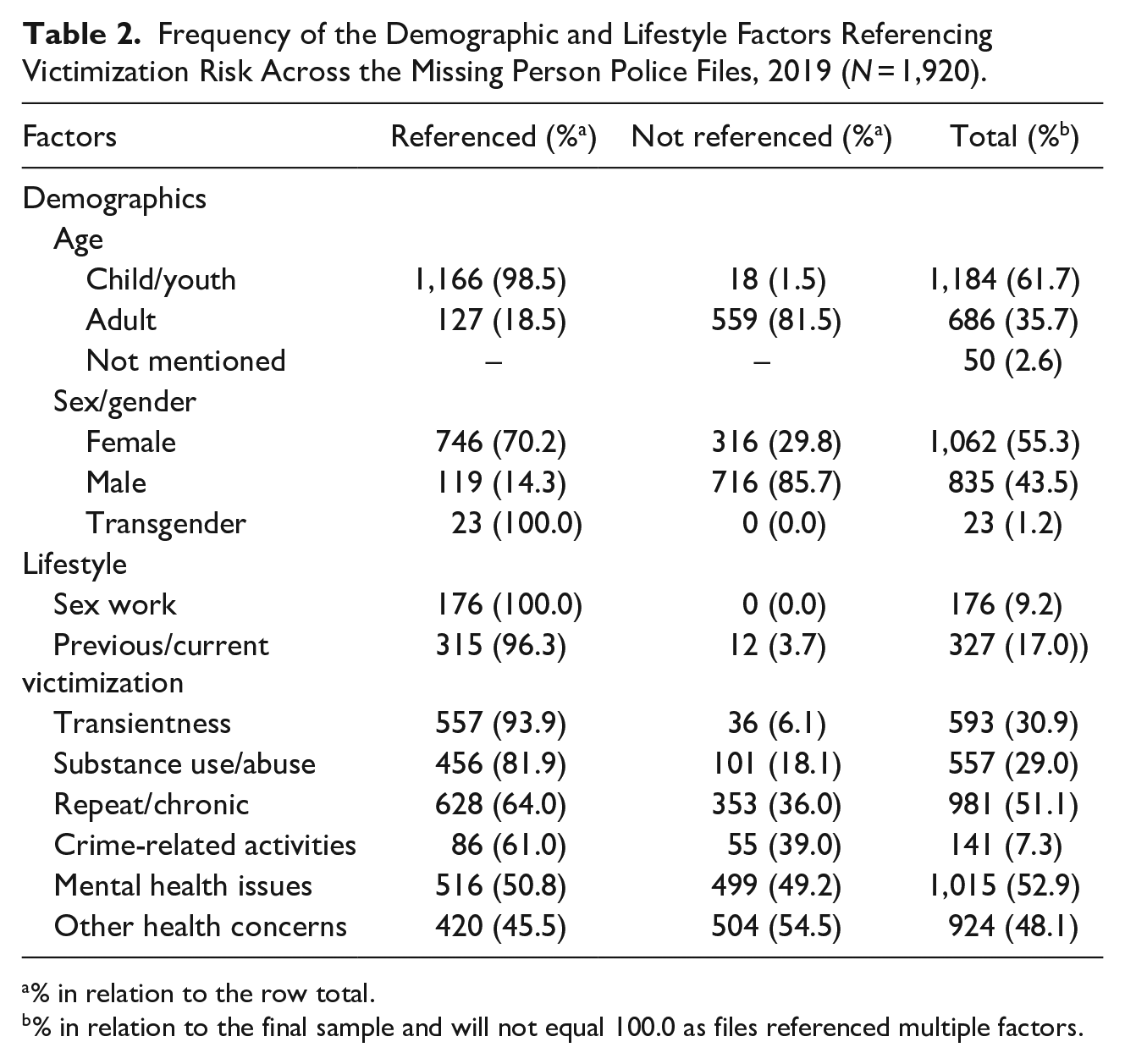
% in relation to the row total.
% in relation to the final sample and will not equal 100.0 as files referenced multiple factors.
Interestingly, disaggregating within and across each factor shows that all files citing a transgender identity and sex work referenced victimization risk (100.0%). Further, child/youth (98.5%), previous and current victimization (96.3%), and transientness (93.9%) also significantly cited victimization risk in files with these factors. Following these were the lifestyle factors of substance use/abuse (81.9%), repeat/chronic (64.0%), and crime-related activities (61.0%). Other health concerns (45.5%) least frequently cited victimization risk in the files involving this factor. For demographic factors, adult (18.5%) and male (14.3%) identities were the least connected to victimization risk across the occurrences with these factors. This uncovers that, when disaggregated and isolated, lifestyle factors connected to victimization risk more substantially.
Discussion
This study sought to better understand the connection between victimization and missing persons by applying LET. This is one of the few examinations of missing persons focusing exclusively on victimization; it is also one of the first to use a combination of police missing person CAD and RMS data. With these, we examined CAD missing person data at the onset of the police response and identified corresponding RMS cases prior to any offence reclassification process. This attends to some of the limitations researchers face with police data “hiding” connections such as to crime and victimization. Ultimately, this qualitative study offers several key findings that extend the missing persons literature and advances victimization research to a topic with little exploration in the field of victimology.
First, there is a connection between victimization and missingness. Nearly 40% of the missing person files linked the incident to a demographic or lifestyle factor associated with victimization risk. Therefore, “going missing” can play a role in one’s victimization and, vice versa, being victimized can impact missingness. The notion that some missing people may be victimized, victims, and victimizers is previously unrecognized in existing research by way of the data used and lack of exploration of such ties from this perspective. These findings provide rudimentary empirical support for the use of victimization and criminal opportunity theories to account for mechanisms and factors interplaying in and impacting missing person occurrences. Future study is needed to understand the germaneness of these perspectives. Additional research on the cause-and-effect association between victimization and missing persons is also necessary to better recognize this relationship (Stevenson & Thomas, 2018).
The implications of this connection can be notable. Several studies have emphasized the pervasive effects of victimization on individuals, communities, and health and social services alike. For instance, poor self-reported mental health, mental disorders, and substance abuse are prevalent among victims of crime (Lo et al., 2008; Perreault, 2015). Socio-emotional problems associated with victimization are also prominent, including psychological scars, distress, problems with work and school, and difficulties trusting in personal relationships (Langton & Truman, 2014). These personal consequences are often even more severe for children and youth, who are still amid their development and may have less access to proper social support (Turanovic & Pratt, 2019). Such effects are worth mentioning, given that children and youth missing person files emerged as more substantially connected to victimization risk than other age groups. The burdens may also be intensified by the direct experiences with the criminal justice system (Turanovic & Pratt, 2019); encounters of which are present in our findings. With prominent victimization risk linked to missing person occurrences, it is likely that these impacts suffuse missingness and have influential consequences. Therefore, any knock-on effects of missing persons are heightened with the recognition that victimization plays a part in these incidents. The outcomes of victimization will thus be relevant to how we theorize about the impacts of “going missing” on individuals and their communities. These findings and potential implications stress the need to explore how police and other services could and should support missing persons with experiences related to victimization. Recommendations include enhancing police response processes to include considerations for victim support, and bridging collaborative relationships with community agencies that provide victim support (e.g., helplines and local shelters) and have the required specialized training, knowledge, and skills.
Next, of the missing person reports in our sample that did connect to victimization risk, many cited a series of demographic and lifestyle factors. For instance, missing persons with a transgender identity noted victimization risk due to the interaction between sex/gender identity and mental illness, substance use/abuse, multiple missing events, and prior victimization. These factors are each, separately, cause for concern. Further, these factors are not discrete entities: how they overlap and/or intersect can impact victimization risk. Our findings lend support for the application of cumulative risk theories in future research to understand the effect of these interactions. These theories argue that the combined effects of multiple risk factors over time explain adverse social outcomes (Bermudez et al., 2020; Linder & Sexton, 2011). Hence, cumulative risk theories may clarify the connection between missingness and victimization and identify how risk levels are affected when various factors are combined.
Third, our findings along the dimensions of age and sex/gender highlight the importance of disaggregating and isolating data to identify factors impacting victimization risk for each distinct social group. Victimization risk in the context of missingness surfaced as experienced differently both across and within socio-demographic categories. Mainly, victimization risk is more considerable for women and girls, youth, and elderly missing persons. When looking at the intersection of both age and sex/gender, the connection was greatest for young girls as, compared to male children and youth, female missing children and youth more considerably cited victimization risk. Despite the literature lacking information on these connections, such findings are mirrored in the victimization scholarship concerning crime. Additional studies could add clarity to this, such as considering missingness and the sex/gender gap in victimization risk. One way to gather these necessary disaggregated insights could involve instituting some form of a police follow-up inquiry (e.g., return home interviews; see Neubauer et al., 2021) with located missing persons. For instance, questions could be asked about if a victimization incident played a role in the missing occurrence or if the person experienced victimization while missing. With this, data could be captured on triggers for missingness, victimization risk and outcomes, and people in need of focused intervention (such as requiring specific services like addiction or housing support) to prevent future missing episodes and thus future connections to victimization.
Our sample could not discuss other social conditions affecting victimization risk for missing people, likely because such details are regularly left out of police data (Duncan, 2020; Epstein, 2021). For example, race/ethnicity and sexual orientation were rarely and haphazardly recorded (Duncan, 2020; Epstein, 2021; MMIWG, 2019). Given the linkages to victimization risk for certain people and groups in the victimological literature, using additional data sources is necessary to investigate possible intersections with race/ethnicity, sexual orientation, and other demographic factors. For example, special attention to Canada’s Indigenous population is warranted, given the disproportionate levels of violence experienced by Indigenous peoples, particularly women, girls, and LGBTQ2S+ peoples (Epstein, 2021; MMIWG, 2019; Oppal, 2012). The usefulness of intersectional and victimological approaches reminds us that expanding on these theories and frameworks may give more insight into missing persons.
Fourth, previous research indicates that missingness is more of a mundane issue linked to “elopees,” curfew issues deriving from institutional locations, and youth repeatedly running away (Hayden & Shalev-Greene, 2018; Huey et al., 2020; Huey & Ferguson, 2020b; Jeanis et al., 2019); however, our findings suggest that this phenomenon is also impacted by crime, harm, violence, and victimization. In fact, a confluence materialized between harm, crime, vulnerability, violence, and identity markers to form victimization risk. Given this, exploring the conceptualization of victimization risk would add a deeper layer of insight into this connection. As LET would remark, missing person occurrences can thus contribute to the volume and type of crime found in a community, bringing attention to another dimension of missing persons that introduces complexity and nuance to police responses to missing persons. While ties to crime-related activities are slight, there is a lack of research on this matter, so the scope and extent of this connection are not known. Criminological perspectives could offer insights into this finding. The conversation around responsibilities over missing persons—whether it should be the police handling this matter or social workers and other health and social services—is challenged by this finding; if there is a connection to criminality, who may be best tasked with response? Again, this points to the need for greater examination of these linkages to advance strategies, practices, and policies drawn from research for responding to reports of missing persons. Without this, the situation is unlikely to improve, and policymakers, health and social sectors, scholars, and others alike are operating sightless or without information on the reality of these cases. This can, for example, misguide police responses and risk assessment in ways that affect missing individuals and communities.
Ultimately, our study draws attention to discrepancies across and within police data, presenting questions over conclusions drawn in the existing body of literature. Declaring missing person cases as mundane, therefore, may be premature. It is imperative to consider the specifics of the data used, as police data systems are evidently capturing an incomplete picture of missingness as a by-product of reclassification procedures. Consequently, our findings speak to a dark or hidden figure of victimization risk in the context of missingness. Thus, the lack of emphasis on this relationship is more than just an area for future research: it also highlights flaws in police data systems and conclusions offered in the body of research on missing persons.
Limitations
Our study is not without limitations. First, qualitative methods are critiqued, such as for being descriptive. Yet, they are valuable for uncovering connections related to vulnerable and marginalized groups and investigating unstudied or understudied issues. Ergo, it was an appropriate method for this topic. Second, we focus on victimization risk rather than victimization outcomes. Analyzing victimization outcomes from service call (CAD data) to case closure (RMS data) as we have done here for victimization risk would provide much-needed insights and a multifaceted account of, for example, the frequency and type of harm associated with missingness and the type of groups most impacted. From a policing perspective, this could also assist in understanding gaps in data processes and what may be generating this disconnect.
Third, our sample involves one police agency’s data. Research conducted in different contexts would expand on the findings. Also, while this study presents a unique perspective by utilizing such data, these files are not immune to drawbacks like inaccuracies and incomplete records. Qualitative inquiry attenuated these concerns with the manual and thematic analysis of files instead of relying upon police classifications. Still, police data use is a limitation that can affect definitive conclusions. Namely, community-police tensions and a distrust of police impact underreporting and underdocumenting incidents, especially regarding victimization and minority communities (Canter & Alison, 2003; Carmody, 2017; Loftin et al., 2015; Nolan et al., 2011).
The fourth limitation relates to the frequencies of coded themes and subthemes. While offering frequencies in qualitative research helps enable data patterns to emerge with greater clarity and enhances the meanings of the findings (Neale et al., 2014; Sandelowski, 2001), no inferences can be drawn about the saliencies beyond the included sample. Future research reproducing/replicating this study would establish a knowledge base on these patterns. Finally, as this is an exploratory study, future research using additional data sources would help garner an extensive account of this relationship and the influencing mechanisms and factors and their related impacts. Other methods, such as mixed or quantitative, would assist in advancing patterns and a research base from which sound policy and practice can be formed. Further study is also crucial for developing reduction and prevention programs in the missing persons context.
Footnotes
Declaration of Conflicting Interests
The author(s) declared no potential conflicts of interest with respect to the research, authorship, and/or publication of this article.
Funding
The author(s) received no financial support for the research, authorship, and/or publication of this article.
