



Abstract
In this phenomenological study, we examined the meaning of resilience for seventh generation Pueblo people who took part in the historic Water Protector movement against the construction of the Dakota Access pipeline. Using focus group data from eight Pueblo participants, four themes were developed: (a) Creating Interconnectivity, highlighting the significance of resilience in fostering connections with all living beings and things across time; (b) Cultivating Resilience, emphasizing the role of relationships, especially with women caregivers and role models, in nurturing resilience; (c) Being Resourceful to Overcome Oppressive Hurdles, involving awareness of historical trauma, proactive actions like protests, and patience for change; and (d) A Way of Healing, illustrating how resilience serves as a source of healing through engagement in spiritual practices of prayer, ceremony, love, forgiveness, and sovereignty. These findings may encourage counseling psychologists to reflect Indigenous epistemologies of resilience for genuine decolonization of the psychological literature.
In this phenomenological study, we examined the meaning of resilience for seventh generation Pueblo people who took part in the historic Water Protector movement against the construction of the Dakota Access pipeline. Participants highlighted the significance of resilience in fostering connections with all living beings and things across time, cultivating resilience through relationships, being resourceful to overcome oppressive hurdles, and how resilience serves as a source of healing through engagement in prayer, ceremony, love, forgiveness, and sovereignty. These findings encourage counseling psychologists to reflect Indigenous epistemologies of resilience for genuine decolonization of the literature.Significance of the Scholarship to the Public
In recent years, researchers have acknowledged a significant gap in research concerning Indigenous people from a strength-based perspective. Existing literature often depicts narratives of psychopathology and helplessness, perpetuating negative stereotypes about this community (Grandbois & Sanders, 2012). However, a transformative movement led by Indigenous scholars has gained momentum, aiming to explore adaptive behaviors and phenomena, such as resilience, using Indigenous epistemologies (Chilisa, 2011; Hartmann et al., 2019; Ore et al., 2016; Smith, 2012). Despite this progress, resilience research for this specific population remains limited and often confined to a Western individualistic approach (Teufel-Shone et al., 2018). To address this gap, we embraced a phenomenological research design to explore the meaning of resilience for seventh generation Pueblo People who had taken part in the historic Water Protector movement that sought to prevent the construction of the Dakota Access pipeline. Understanding their lived experiences can provide meaningful insights into the meaning of resilience from an Indigenous perspective and provide counternarratives to prevalent pathologizing stories. Simply stated, this study sought to create space for Indigenous people to rewrite and reright (Smith, 2012) a Western psychological construct to appropriately reflect their lived experiences.
Guiding Assumptions and Theoretical Frameworks
Although Indigenous people are a diverse and heterogeneous group, they share a history of oppressive federal policies oriented toward extermination, which impact them to this day (Barkan, 2003). Yet, they also share a belief that solutions to current health and mental health challenges lie within their traditional ways and heritages (Gone, 2008; Grayshield et al., 2010). For that reason, to understand and investigate a concept like resilience, it is vital to recognize Indigenous epistemologies, ontologies, cosmologies, and ways of knowing, which are distinct from those of Western cultures and tend to be omitted from Western literature (Chilisa, 2011; Denzin et al., 2008; Grayshield et al., 2010; Kovach, 2012; Smith, 2012). Therefore, it is important that we share the theoretical frameworks of Tribal Critical Race Theory (TribalCrit; Brayboy, 2005) and Indigenous Ways of Knowing (IWOK; Grayshield et al., 2010) that guided us in conducting the present study.
Brayboy (2005) developed TribalCrit as an extension of Critical Race Theory (CRT) to address the unique experiences of Indigenous people. Although CRT recognizes the deleterious impact of racism in education and society, it fails to acknowledge the liminality of Indigenous people—at once a legal/political and racialized group—or their experience of colonization (Brayboy, 2005). Thus, a foundational tenet of TribalCrit is that colonization, not racism, is endemic to society. Brayboy (2005) outlined nine additional interconnected tenets to support this argument, including the rootedness of U.S. policies in imperialism, White supremacy, and material gain; the recognition that Indigenous people occupy liminal space that accounts for their legal/political and racialized identities; the pursuit of tribal sovereignty, autonomy, self-determination, and self-identification; a reevaluation of culture, knowledge, and power through an Indigenous lens; the problematic goal of assimilation in governmental and educational policies; the importance of understanding the diversity and adaptability among Indigenous people and groups; the acknowledgment of stories as theory and valid sources of data; and the interconnection of theory and practice for social change.
In our exploration of resilience among Indigenous people, we found TribalCrit to be an invaluable framework, but we sought to enrich our understanding with a paradigm that could more readily apply to a counseling or helping context. To achieve this aim, we integrated IWOK (Grayshield et al., 2010) into Brayboy’s (2005) TribalCrit. IWOK is an emerging paradigm in counseling and psychology that draws from Indigenous philosophies, emphasizing a holistic approach encompassing body, mind, emotions, and spirit to attain balance, harmony, and sustainability. Like TribalCrit, IWOK’s central features include recognition of the harmonious nature of Indigenous cultures, acknowledgment of the impact of colonization on Indigenous experiences, and acceptance of the distinct epistemologies, ontologies, and cosmologies of Indigenous peoples. However, IWOK places greater emphasis on spirituality, defined as connections with past, present, and future generations (Grayshield et al., 2010). In contrast to most Western counseling, IWOK considers additional life elements like socialization and community, which influence individuals and promote healing. Unlike Western models that see health from the scientific model, an Indigenous meaning of health and being well is one of holism and harmonious unity, symbolized by the Medicine Wheel and its four domains (physical, mental, emotional, and spiritual; McCabe, 2008). Within the multidimensional IWOK approach, interconnectedness and generational connections are vital, fostering grounding and self-awareness, in contrast to the linear and one-dimensional nature of Western counseling methods (Gone, 2011; Grayshield et al., 2010; Rosado, 2007).
As can be seen, TribalCrit and IWOK recognize historical and present experiences of colonization, validate Indigenous philosophies of knowledge, and call for transformative action against oppression. What follows is a review of relevant scholarship on resilience and how it uses or appears compatible with the tenets of TribalCrit and IWOK, which provided an adequate background for our study.
Indigenous Resilience: A Shift From Individual to Collective Perspectives
Resilience, a multifaceted construct, has been traditionally understood as a physical and mental “toughness” when confronting challenges (Kirmayer et al., 2009; Ore et al., 2016). However, the understanding of resilience has been significantly enriched by the insightful contributions of Indigenous scholars (see Hartmann et al., 2019, for an overview). Some of these contributions have emphasized the meaning of resilience as a process of adaptation amid adversity (e.g., Grandbois & Sander, 2009; Kahn et al., 2016; Masten, 1994), an empowered journey of transcending risks and trauma (e.g., LaFromboise et al., 2006; Kelley & Small, 2016), and a transformative experience intertwined within the dynamics of family, community, spirituality, and environment (e.g., Burnette & Figley, 2017; Kirmayer et al., 2009; Meili et al., 2020; Ore et al., 2016). Consistent with TribalCrit (Brayboy, 2005) and IWOK (Grayshield et al., 2010), much of this scholarship has highlighted the need to understand resilience and associated factors within the context of the historical and ongoing oppression experienced by Indigenous people (Kirmayer et al., 2014).
In addition to highlighting resilience as a means for Indigenous people to adapt to and transcend historical and ongoing oppression, there has been a notable shift in its conventional definition, transforming it from a solitary, individualistic trait to a conceptualization that emphasizes its reciprocal nature between the individual and broader systems (e.g., family, community, and environment; Ore et al., 2016). This community-based resilience aligns with an Indigenous perspective that understands that health and wellness are addressed by the community in family or group settings (Gone, 2004, 2008; Grayshield et al., 2010; Meili et al., 2020). This cultural practice of community involvement demonstrates a sociocentric orientation (Spiro, 1993). Sociocentrism contrasts with the individualistic egocentric orientation where the individual is perceived as independent and autonomous (Schweder & Bourne, 1984). Therefore, the collective process of community resilience in the form of adaptation and transformation through social networks, relationships, and cultural beliefs and practices may more accurately reflect a decolonized interpretation of Indigenous people’s perspectives of resilience (Kirmayer et al., 2009; Ore et al., 2016).
These shifts in our understanding of the concept of resilience also evoke the concept of survivance. Coined by the Anishinaabe writer and scholar, Gerald Vizenor (1994), the term describes the active resilience and cultural vitality of Indigenous peoples in the face of historical adversity and ongoing challenges. It is meant to encompass both survival and resistance to cultural erasure and domination. In a recent scoping review of the health and resilience literature, Wilbur and Gone (2023) noted that survivance involves shifting narratives from illness and deficits to wellness and strengths among Indigenous people, emphasizing healing and health while reconnecting the present to the past and future through a generational perspective. In addition, survivance highlights the significance of community and collectivism, alongside the importance of decolonization through the revival of traditional practices, contributing to the resilience and cultural continuity of Indigenous communities. As such, in line with TribalCrit (Brayboy, 2005) and IWOK (Grayshield et al., 2010), survivance incorporates understanding of historical trauma and structural oppression experienced by Indigenous people and emphasizes community strengths rather than deficits (Wilbur & Gone, 2023).
Despite the emphasis on community evident in the recent reconceptualization of resilience through an Indigenous lens, Teufel-Shone et al. (2018) concluded that community-based or collective resilience remains unexplored in the literature. Instead, research and interventions mainly center on individual resilience and continue to reflect the usual deficit approach. Through a systematic review of the literature on resilience and health promotion, Teufel-Shone et al. (2018) also underscored the scarcity of resilience research pertaining to young and middle-aged adult Indigenous peoples. The relative neglect of community-based resilience has created a major gap in how to effectively understand and promote Indigenous resilience, particularly from the perspective of young and middle-aged adult Indigenous people who, like younger Indigenous scholars, may resonate more with understandings of resilience that emphasize elements of survivance rather than with more Western-based notions of resilience (Wilbur & Gone, 2023). To address this gap, the present study delved into the meaning of resilience for seventh generation Pueblo people who were members of the Standing Rock Water Protector Camp. This peaceful movement of resistance, briefly explained in the following section, serves as an exemplar of communal Indigenous resilience for the 21st century.
Standing Rock Protests and Water Protector Movement
The Standing Rock protests and the Water protector movement unfolded in 2016 and 2017 as a powerful expression of Indigenous resilience, environmental concerns, and opposition to the construction of the Dakota Access Pipeline (DAPL). Sparked by the Standing Rock Sioux Tribe’s call for support in April 2016, the movement quickly grew into a diverse coalition of activists and Indigenous people from across the country (Alkire, 2023). Indeed, hundreds of people from different tribal nations as well as non-Indigenous backgrounds rallied together in North Dakota to answer this call (ICT News., 2016; Rivas, 2017). The protests drew widespread support (Montare, 2018), including from the American Psychological Association (2017). The main point of contention was the DAPL’s proposed route which, according to the Standing Rock Sioux Tribal Council (2015), posed potential threats to their water supply, ancestral burial grounds, and tribal sovereignty (Alkire, 2023). Protests, marked by peaceful demonstrations, praying, and religious ceremonies, brought attention to these issues (Montare, 2018). Yet despite the mostly peaceful nature of the protests, demonstrators were met with violence from public and private security groups employing tactics such as attack dogs and other counterterrorism measures, as well as dangerous racist and colonialist rhetoric (Dakwar, 2017; Montare, 2018; Smith et al., 2018). Despite widespread opposition, DAPL’s construction was completed in 2017.
Those who arrived at Standing Rock were dubbed Water Protectors and lived in large camps on treaty land. The first of these camps, which would remain the focal point of many of the peaceful demonstrations, was called Oceti Sakowin and was established by a group of Lakota Youth from Standing Rock (Montare, 2018). Many other tribes established smaller camps within the larger Oceti Sakowin Camp. Pueblo Camp was one of these camps. Here, individuals from the 21 different Pueblo tribes from the Southwest banded together in solidarity at Standing Rock. These members of Pueblo Camp participated in a historic movement that served as a template for modern-day communal resilience, with echoes of past acts of resistance by Indigenous communities (Estes, 2019; Hoover, 2019), including Pueblo People. The Pueblo Revolt of 1680 most readily comes to mind. In this instance, Pueblo People in Northern New Mexico banded together with other Southwestern tribes and rose in rebellion against the Spanish conquistadores to reclaim the cultural heritage, religious practices, and ancestral lands that had been forcibly taken from them by the Spanish (Liebmann, 2012). Mirroring their ancestors, then, members of Pueblo Camp took part in a large demonstration of decolonizing and indigenizing the narrative of activism and protest.
In addition, the inhabitants of Pueblo Camp were, by and large, members of what may be called the seventh generation. This is a multifaceted concept used among Indigenous communities. The term is said to stem from Iroquois philosophies that the decisions made today should be for the benefit of seven generations into the future (Indigenous Corporate Training Inc., 2020). The term has also been applied to Indigenous youth believed to be the seventh generation from the ancestors who first encountered Westerners and who are leaders for healing and social justice within the Indigenous community (Shendo, personal communication, October 23, 2019). Their experiences, thus, can provide unique and important perspectives and fill critical gaps in the literature, which, as we have noted, often overlooks communal resilience, and lacks insights into the resilience of younger Indigenous people.
The Present Study
Given gaps in the existing literature on resilience—namely the lack of research using a strength-based perspective, limited focus on communal forms of resilience, and dearth of research pertaining to younger Indigenous peoples—the goal of this study was to explore how resilience is shaped within sociocentric orientations of tribal community relations and interdependence and how resilience is experienced by seventh generation Pueblo people who took part in the Water Protector movement at Standing Rock. To this end, we used a qualitative research design, specifically phenomenology (Creswell, 2013; Patton, 2015). The core inquiry of phenomenology is to address “what is the meaning of the lived experience of the phenomenon in question for a person or group of people” (Patton, 2015, p. 115). Phenomenology also assumes that “there is an essence to shared experience” (Patton, 2015, p. 116). Accordingly, this approach fit the goal of examining the meaning of resilience from an Indigenous perspective. As stated previously, we grounded our inquiry in TribalCrit (Brayboy, 2005) and IWOK (Grayshield et al., 2010), highly relevant frameworks that allowed us to better interpret the essence of participants’ meaning of resilience, in line with phenomenology. Thus, our study was guided by this central question: What does resilience mean for seventh generation Pueblo People from Pueblo Camp in Standing Rock?
Method
Participants
Participants were recruited using a combination of purposeful, convenience, and snowball sampling techniques (Creswell, 2013; Patton, 2015). That is, eligibility for the study was determined based on specific inclusion criteria, but participant selection was carried out through the researchers’ existing social networks, specifically, the first and second authors’ connections amongst Pueblo People who were in Standing Rock. Potential participants were also encouraged to refer others who met inclusion criteria. To be included in the study, participants needed to be able and willing to discuss their views and experiences of resilience, and they had to fall within the seventh-generation age range (i.e., 18 to 35 years) and self-identify as having Pueblo or Native American ancestry while living or having lived in a tribal community. These criteria ensured a relatively homogenous sample of participants with lived experience with the phenomenon of interest, an essential requirement of phenomenology (Bartholomew et al., 2021).
The final sample consisted of eight Pueblo participants whose ages ranged from 18 to 35 years (M = 27.50, SD = 7.52) and who had been in Standing Rock. There were four cisgender women and four cisgender men. Most participants (n = 6 or 75%) reported fluency in their tribal language, while the remaining two (25%) reported some level of proficiency or understanding. The tribal languages reported were Keres, Towa, and Tewa. All participants reported being born off the reservation but having been primarily raised within a tribal community. In this study, dried Pueblo tea was provided as a token of appreciation for participating in the study, along with a small reimbursement for travel expenses.
Researcher Reflexivity
In phenomenology, researchers bear the responsibility of acknowledging and reflecting upon their biases (Finlay, 2008). An anti-oppressive approach of decolonized methodologies also calls for critical reflexivity, which requires additional self-reflection on location and privilege as a researcher (Kovach, 2012). For these reasons, the research team engaged in a process of self-reflection regarding their intersecting identities as it pertains to (but not limited to) race, ethnicity, generation status, Western education, social justice values, experiences of resilience, and ties with Indigenous communities across the United States. The first author is a 2.5 generation 1 cisgender Xicana who holds a doctorate in counseling psychology, and who was raised to acknowledge, among other things, the resilience of Mexico’s Indigenous peoples to Spanish colonialism. The second author is an enrolled member of Cochiti Pueblo and active member of his paternal community in Jemez Pueblo in New Mexico. Both authors have extensive ties to Indigenous communities, having worked in various settings that advocate for or that provide services to this community. Both also lived in the Water Protector camps in Standing Rock for over a month and took part in the Water Protector movement. The third author is a 1.5 generation Venezuelan American cisgender man who is a professor in a counseling psychology doctoral program. Although his involvement with Indigenous communities is nowhere near as extensive as that of the first and second authors, he identifies as a proponent of social change and an ally to Indigenous peoples. He has made a personal commitment to educate himself on Indigenous issues and to actively challenge his privilege in this domain.
As researchers, we entered the study with the premise that settler colonialism permeates all of society, including the field of psychology, which has been complicit in harming Indigenous communities. At the same time, we hold the belief that Indigenous peoples possess the resilience to thrive despite ongoing oppression, both as individuals and, more crucially, as a collective. We recognized the concept of resilience within Indigenous communities as a phenomenon rooted in community dynamics, rather than being solely an individualistic trait. We were mindful that these underlying assumptions could shape our interpretation of the data, potentially giving undue weight to our initial convictions. To address this possibility, we engaged in a continuous reflective process, both collectively and individually, to identify and challenge our assumptions and biases. Also, we implemented various verification steps, which we will elaborate later, to ensure that the influence of these factors on the data analysis process was duly considered.
Procedure
Research Approvals, Researcher-Participant Relationship, and Informed Consent
Prior to the study, the first author worked with the second author, who agreed to serve as a known sponsor for the study and provided guidance on culturally appropriate behavior for obtaining research approval from Pueblo communities, as well as engaging with and compensating participants. Adhering to our Institutional Review Board’s (IRB) guidance, the researchers also sought and received approval from the Pueblo communities whose members expressed interest in participating in the study.
As stated, the first and second authors relied on their social networks, specifically their connections within various Pueblos, to recruit participants. It is important to reiterate that both authors had established relationships with numerous Pueblo people from the Pueblo Camp in Standing Rock, which ultimately influenced the composition of the sample. Although this approach may differ from conventional Western research practices, Kovach (2012) emphasizes that, in the realm of Indigenous methodologies for decolonized research, building trust is crucial for participants to openly share their stories, and such trust in a decolonized context often relies on preestablished relationships (Kovach, 2012).
A total of 11 eligible individuals expressed interest in participating in the study. These individuals received detailed information about the study, including study procedures. Ultimately, nine out of the 11 potential participants attended focus group interviews (described in detail next), which were held at the Indian Pueblo Cultural Center in Albuquerque, New Mexico. Before the interviews, participants underwent a standard informed consent process, which highlighted the confidential and voluntary nature of their participation. Only one participant out of the nine declined to sign the consent paperwork after receiving informed consent. Although this participant expressed a desire to still attend the focus groups, their limited responses were excluded from the interview transcripts and data analysis.
Focus Group Interviews
Despite some limitations identified in phenomenological studies utilizing focus groups (Bartholomew et al., 2021), we deemed their use suitable for our aims. Focus groups are well-suited for gathering data on the experiences and attitudes of marginalized and minoritized groups, such as Indigenous people. Indeed, Dodson et al. (2007) found that focus groups can provide a safer space for marginalized groups to express their experiences and perspectives. Similarly, Kitzinger (1994) stressed the significance of focus groups in giving voice to subjugated populations often silenced in dominant society. Finally, a focus group design seemed to us to naturally reflect the sociocentric lens through which Indigenous peoples perceive themselves as interconnected and interdependent with their community.
Participants took part in two focus groups held 1 week apart, each lasting 1.5 to 2 hours. The first and second authors served as moderators for the focus groups. For the first focus group, a semi-structured interview protocol was used (see Appendix). The protocol began by presenting a Western definition of resilience and invited participants to react to it and provide their own definition. In addition, the protocol included questions aimed at eliciting participants’ stories of resilience and exploring how resilience manifests in their communities. The moderators also asked unique questions based on the responses to the standard interview questions. The second focus group was a follow-up to the first interview—a chance for participants to confirm or expand on their initial views—and thus did not follow a semi-structured format. The interviews were audio recorded and later transcribed.
Data Analysis
The data analysis process mainly followed Moustakas' (1994) recommendations for phenomenology. Transcripts of focus group interviews served as the main sources of data. Markle et al. (2011) also recommended analyzing data in its original audio form to capture nuances of language and communication. Thus, the transcripts were enhanced by adding elements beyond textual content, such as group dynamics (e.g., who spoke with whom, how often), nonverbal cues, and affective expressions, and the audio recordings were routinely referenced when analyzing the transcripts. Detailed descriptive and analytic memos were also integrated throughout the data analysis process, which aided in bracketing reactions, providing context, tracking patterns in the data, developing labels for codes and themes, and enhancing the clarity of data interpretations.
The first author assumed a primary role in analyzing data. To gain familiarity with the data, she listened to the audio of the focus groups while reading the transcripts. Then, while reviewing the transcripts, audio recordings, and memos, she identified significant statements that held relevance to the research question. A total of 538 such statements were identified. Each statement underwent coding, which involved giving each statement a succinct label that reflected the underlying meaning of participants’ expressions (Creswell, 2013; Moustaka, 1994). The third author then reviewed the transcripts, audio recordings, significant statements, and codes, and provided feedback on the clarity and relevance of each code. Once consensus between the two authors on coding was reached, the first author grouped similar codes into themes and subthemes, capturing different dimensions of resilience as expressed by participants (Moustakas, 1994). The third author subsequently provided feedback on the themes and subthemes, once again ensuring clarity, and confirming the results overall. The first author then crafted thematic narratives for each theme and subtheme, incorporating quotes from the focus groups to convey the voices of the participants and provide a thick description of the findings. Lastly, in collaboration with the third author, the first author completed a synthesis of the themes, an integral part of phenomenology (Bartholomew et al., 2021), which encapsulated the essence of what resilience means to the participants.
Methodological Rigor
As may be evident, we used many different approaches to ensure methodological rigor throughout the study, in line with best practices (Levitt et al., 2018). In addition to what has already been described (i.e., reflexivity, triangulation of data sources, extensive engagement with participants, and auditing), we also attempted to contact participants to engage in member checks, which involved asking participants if the generated themes accurately reflected their realities and whether they had additional information, such as reactions, clarification, correction, and further insights. The first and second authors made a good faith effort to send a draft of the thematic analyses to participants; however, only one participant was able to provide feedback. He recommended referencing that most Pueblo tribes are matriarchal, which was highlighted in the Results and Discussion sections.
Results
Themes and Subthemes of the Meaning of Resilience
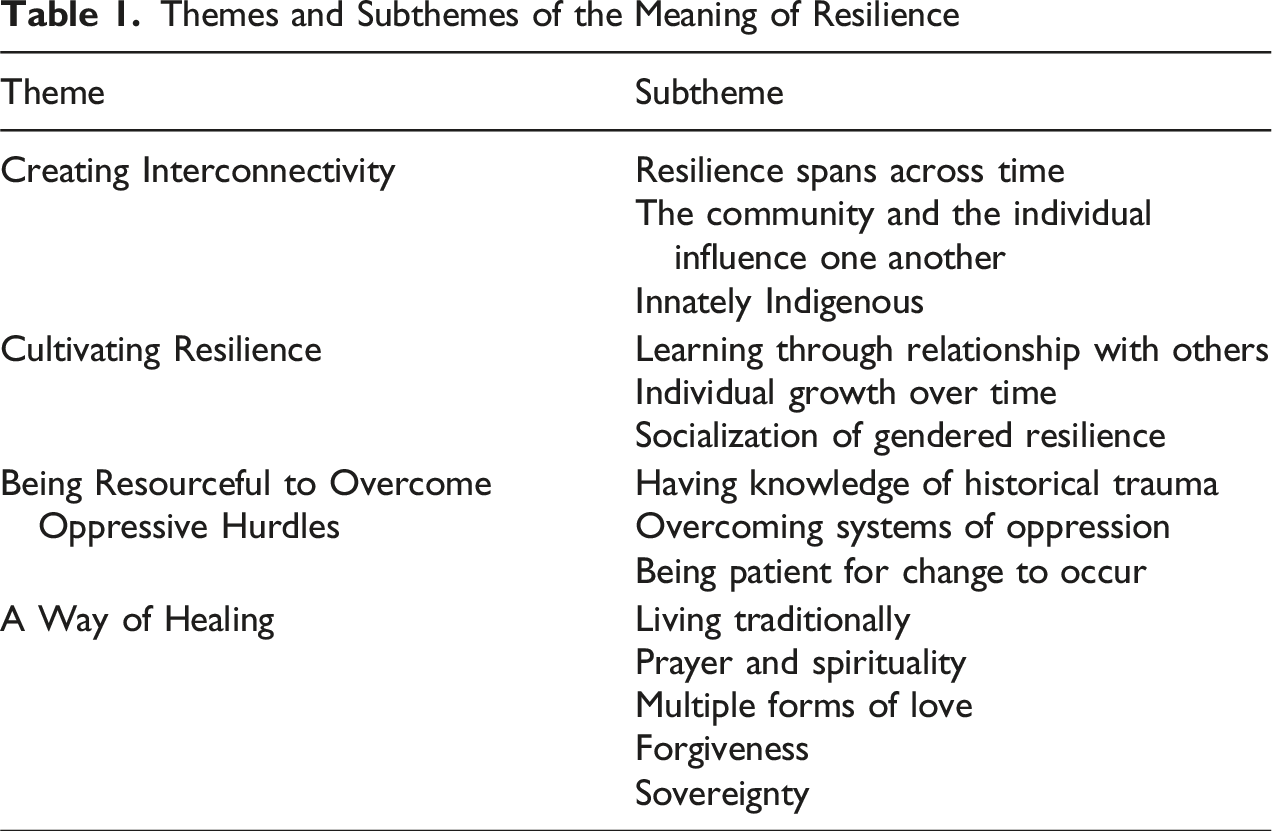
Creating Interconnectivity
A major theme that captured what all participants shared was the significance of interconnectivity that resilience creates. Resilience was described in ways that were not limited to a single moment or dimension of time but that worked across time, where the resilience of ancestors contributed to that of Indigenous people today. This interconnectedness was also present through the interplay of resilience at community and individual levels. Finally, another component of interconnectivity was the meaning of resilience as something innate across Indigenous peoples. Accordingly, this theme was divided into the following subthemes: (a) Resilience Spans Across Time, (b) The Community and the Individual Influence One Another, and (c) Innately Indigenous.
Resilience Spans Across Time
This subtheme captures the meaning of resilience as existing in past, present, and future in the eyes of the participants. Essentially, this subtheme demonstrates that resilience spans across dimensions of time rather than being limited to a single moment in the present. Most of the participants discussed what their ancestors (e.g., grandparents, distant 15th century relatives) did to survive as a form of resilience. Some participants, such as J, described what three generations of her family have done to survive. J shared how resilience during her grandmother’s generation meant hard work, whereas resilience during her mother’s generation meant “to maintain who you are” by returning to one’s community, as this was the first generation to leave the tribal community. For her own generation, J stated that resilience “is going to take on a new definition, and it’s going to mean you know… How do I… create our life so that I can pass that on to [my daughter]?”
The Community and the Individual Influence one Another
In addition to resilience connecting across time, for every participant, resilience also meant interconnection at individual, familial, tribal, and generational levels that constantly influence one another. Several participants discussed this interconnection as stemming from a developed sense of self and purpose. JC conveyed this idea through an analogy he heard from a Quechua man: A seed is dead. A dead seed until you put water on it, it comes to life. But in between the life of when it cracks open to become some plant, there’s also that moment when it’s developing an understanding of “what am I? I just came outta this seed, now am I a corn? Am I a chile?” And then you start to realize “Alright, I am this.”
Subsequently, when the individual has a sense of purpose, responsibility for others in the community naturally arises. Several participants, such as SF, discussed some of these responsibilities with direct examples from camp life in Standing Rock: “That was a big part for me [exasperated laugh]. Making sure everybody was alright; making sure everybody had food, water, warmth…” Others discussed responsibilities to the community in more abstract terms, like J: “So, on top of teaching while we’re learning, we have the task of… healing all these generations of trauma so that we don’t continue the cycle and pass it on.”
Similarly, just as individuals affect the community, the community affects the individual. Several participants spoke of their community as a resilient entity that provided them with healing or space to recover from life’s hardships. This concept of a community’s resilience to help others was best captured by J’s definition of resilience as communal. She explained that resilience is communal because “nobody can be strong all the time. Everyone is going to have a time they need help. Or they… [are] feeling weak. And without that resilience in the community… to maintain that sense of resilience… it’s a lot harder.” J explained how a resilient community maintains a feeling of survival, perseverance, and culture and identity, which is what the individual can lean on in hardship.
Innately Indigenous
This subtheme captured participants’ belief of resilience as innate across Indigenous peoples. Many agreed in describing resilience as a given for Indigenous peoples; the simple fact that they continue to exist despite centuries of oppression is proof of their innate resilience as a people. It was recommended by J that her statement be shared with Native communities: “… Don’t forget… And that’s why we are Native. And that we don’t have to look for [resilience] either because it’s there. It’s already in us. Just by being Native. Just by being Indigenous. You are resilient, you know?” Similarly, all participants shared either instances from specific Pueblo tribal history or talked about the Pueblo Revolt of 1680, when most of the Indigenous Pueblo people successfully rose against the Spanish colonizers, as examples of the innate resilience of Pueblo people. SCZ referenced Pueblo resilience and that the different Pueblos can learn from one another’s unique histories of resilience: “Between needing to be resilient like where we come from [the Pueblos], but maybe be like Sandia, Santa Clara… like the Hopis did and their mesa.”
Cultivating Resilience
A second overarching theme captured the meaning of resilience as a quality that can be nurtured or cultivated. Participants described this nurturance of resilience as being learned through relationships with others, such as family, teachers, and role models. In addition, cultivating resilience was explained as a gradual process that was neither quick nor effortless. Lastly, participants emphasized the importance of socialization of gender roles in providing some of their first templates of resilience. Thus, this theme was divided into three subthemes: (a) Learning through relationships with others, (b) Individual growth over time, and (c) Socialization of gendered resilience.
Learning Through Relationships With Others
Most participants emphasized the importance of “learning through relationships with others.” Many referenced parents, grandparents, and other family members as people from whom they learned to be resilient. Some participants, such as K, learned resilience from their larger tribal community: “That’s kinda like how I learned resilience too! It was on the rez. But also, it’s experiencing those things, like, from our Elders. How they learned to be resilient.” Every participant agreed that just as they learned to be resilient from others, they too served as teachers and role models, highlighting a different aspect of the meaning of resilience as something that is nurtured. JC shared what he was taught in his village: “You guys are leaders; you guys are role models to people you don’t even know.” One of the younger participants, SF, referenced being “walking trainees,” a process of simultaneously being a teacher while also a student learning from others. OS added that role models have a responsibility to genuinely connect with the youth to instill a desire to learn: “Like, make them really aware in a way like we’re talking right now… like really touch their hearts and their minds and create… like true awareness to make them… want to learn more.”
Individual Growth Over Time
Similarly, most participants agreed that fostering resilience in individuals is a gradual process of growth, not something that is immediately achieved. Several participants shared that they were currently experiencing this change process. JC reflected on the maturation he experienced following his time in the Water Protectors Camp in Standing Rock: “The person I was when I was there was another person. And my trying to reconcile that plus, you know, coming back and trying to like find yourself, or you know, find your own way again… Like it’s… it’s a lot.” JC’s description of his own growth during and after Standing Rock reflects resilience as an ongoing task that requires a significant amount of effort.
Another form of gradual change that was mentioned included biculturalism. There were differences among participants in the influence of biculturalism on resilience. About half of the participants felt it was important for Native youth to be able to navigate both mainstream and traditional Native culture. Several who are parents agreed with OS’s sentiment: “Do you teach your kids this way? Or do you teach them that way? You gotta teach them in both ways.” In contrast, several others, such as JC, talked about being bicultural to maintain the survival and progress of tribal communities. He paralleled how Pueblo youth leave to go to college and bring this back to the community with how the Pueblo ancestors would travel “down South” to trade for supplies to bring “home.”
Socialization of Gendered Resilience
This subtheme was a powerful topic that participants felt was particularly important for the cultivation of resilience. Interestingly, both men and women placed an emphasis on the role of women and how it related to resilience. K shared how she practices resilience in raising her children: It’s like in my own family a lot of time I do the resilience with my children… My daughter is five and never been in daycare or preschool… but in my own that’s my resilience. “No, you’re gonna stay here, you’re…you’ll hear us speaking the language at home.”… Things like that are the resilience. My boys having their hair long… We have to make those decisions within our own lives.
Echoing this idea, SCZ, LW, K, OS and J recounted stories of the resilience and strength of their mothers and grandmothers. They specifically focused on the traditionally feminine responsibilities of “creating life,” raising children, praying, being nurturing, and managing households. They all shared how these women were some of their first examples of resilience growing up.
Being Resourceful to Overcome Oppressive Hurdles
The third major theme captured a meaning of resilience as a form of resourcefulness, specifically against oppression. Being resourceful meant having knowledge and awareness of historical trauma, and recognizing internalized oppression and trauma within Indigenous communities, to generate solutions. Being resourceful also meant engaging in different acts of resistance against systems of oppression and was attributed to the element of time, specifically having patience for change to occur following acts of resistance. Accordingly, as seen in Table 1, this theme was divided into three subthemes: (a) Having Knowledge of Historical Trauma, (b) Overcoming Systems of Oppression, and (c) Being Patient for Change to Occur.
Having Knowledge of Historical Trauma
This subtheme captured participants’ understanding of the histories of oppression that impacted their communities following contact with Europeans as well as modern day discriminatory federal policies. Essentially, according to participants’ responses, part of being resourceful to overcome oppressive barriers involves first being able to recognize the barriers. Having awareness of the presence of oppression in U.S. federal policies was one of the topics that participants discussed for recognizing barriers. For example, J described U.S. education policies that sees the traditional Indigenous practice of educating children in the home as illegal and a form of neglect: “They’ll come into our homes and say that this home is not fit for that child. When it’s our traditional way of living!” J and others went on to discuss how U.S. schools continue to assimilate Indigenous children to meet “Western standards,” adding: “They set the table a certain way. They gotta eat in a certain way. They gotta walk in line a certain way…” There was agreement among J and several of the other parent participants about the need for Indigenous people to create their own programs that maintain their traditional values while working within the legal requirements of the U.S. education system. J listed one place she found to be a source of hope: “And that’s why I’m grateful for places like NACA [Native American Community Academy]… which is… outside of the [U.S.] public system…”
In contrast, some participants discussed the importance of recognizing internalized oppression in their own communities and homes, and the need to make changes. SCZ shared a personal story of his uncle who is insistent that youth learn their language while at the same time being unwilling to share his knowledge of the language. SCZ explained that this internalized oppression is an example of the need to “have our Elders change their way of thinking, because this is lineage. This is over hundreds of years in making.”
Overcoming Systems of Oppression
This subtheme reflects the meaning of resilience as a means of overcoming oppressive systems faced by Indigenous peoples historically and presently. Participants readily shared specific examples from Standing Rock, as this seemed the most recent and salient experience of overcoming a system of oppression for them. Oftentimes participants spoke of general ways they can overcome oppressive hurdles, such as the need to “… stand up and say something about it…” or to “… not be so dependent on mainstream culture,” or talking about “… people now rising up, coming together, learning how to organize…” Conversely, some participants provided more concrete ways of resisting these barriers. SF and LW provided an example they saw in the Santa Fe Plaza of “people trying to fight back in words or in writing. Like up on the walls—We found ‘Indian Land.’” SCZ talked about “people coming together saying ‘NO!’” and “… the power of those people voting” to make change and prevent certain policies or people coming into power.
Being Patient for Change to Occur
A third subtheme, generated from the participants’ dialogue of overcoming oppressive hurdles through acts of resistance, included the element of delayed outcomes of change. According to participants, resistance may benefit future generations, and oftentimes does not provide immediate solutions. Participants emphasized the need to be patient with this gradual process, which OS described as sometimes involving “[taking] a step backwards to move forward.” Within this subtheme, participants highlighted the significance of actions of resistance as being for future generations. JC described the history of Indigenous peoples’ survival of colonization as an act of patience and sacrifice: Maybe our people at the time when it [colonization] was first happening, made a deal or something? Because, now what we’re trying to go back to is the thing that was taken from us. And then, maybe a long time ago it was saying, yanno, “We’ll give into what needs to happen right now, but just in return seven generations from here, give this back to my people.”
In sum, oftentimes the culmination of participants’ actions of resourcefulness may not always be for them to directly experience, but for others to derive benefit in the future.
A Way of Healing
The final theme captured the meaning of resilience as a source of healing for participants. The concept of healing was multifaceted and rooted in the participants’ respective Pueblo traditions, cultural practices, and spirituality. A component of spirituality included prayer, which was repeatedly equated with resilience. Paralleling prayer, resilience was also attributed to love and forgiveness, in that these were considered necessary strengths that contribute to one’s resilience. Lastly, participants expressed the belief that healing for Indigenous peoples will be achieved and maintained within their own communities, highlighting the importance of sovereignty of Indigenous peoples. Therefore, several subthemes make up this theme, each reflecting these different components of healing: (a) Living Traditionally, (b) Prayer and Spirituality, (c) Multiple Forms of Love, (d) Forgiveness, and (e) Sovereignty.
Living Traditionally
Participants spoke frequently of different ways Indigenous people are “living traditionally.” Some spoke of how the act of living a traditional life and observing traditional practices is healing. JC shared a personal story of loss and the healing he experienced when his dog was killed by a motor vehicle in the Pueblo. He expressed the warmth and safety he felt from observing how one small Pueblo child brought ceremonial medicine to the fallen dog and nearby Pueblo children followed suit. Similarly, describing how a return to traditional life is healing, J reflected that “… when you go back [to one’s culture] that’s when you really feel good and better and resilient.” Several participants referenced specific traditional cultural practices of their respective Pueblos that provide healing to them and within their communities.
Prayer and Spirituality
Related to living traditionally was the subtheme of “prayer and spirituality,” which captures the significance of spiritual beliefs and the practice of prayer as a factor in healing. Several participants spoke of spirituality as a way of being or as an entity, as opposed to beliefs or actions. This is reflected in SCZ’s metaphor: If we listen to the wind there’s those voices in the wind that say “you can do it, I’ll give you the strength. No matter what happens in this physical form we have you in the spiritual form.” And [in] spiritual form you can always stay happy and prayerful.
Others, like K, were more explicit in explaining the connection of prayer and spirituality to resilience. K described how at Pueblo Camp in Standing Rock “there was like uh resilience in coming together and praying, or even just eating, because for us eating was-is prayer. It starts with the prayer and your breath…”
A facet of prayer and spirituality was “connection to place” such as sacred sites, homelands, or ancestral lands. J talked about how her Indigenous identity and survivance are dependent on returning to the place of her community: “It’s to go home. It’s to go back. In order for us as Indian People, as Pueblo People, as Jemez People…” Echoing this, JC spoke of the return to ancestral lands: “… If you walk up there to your sites, yanno?… Yanno… we’re not meant to live where we are now. We all wanna go back up that way…”
Multiple Forms of Love
Within the theme of healing emerged a concept of multi-faceted love as a form of resilience. Essentially, love included romantic love, love between friends, love for oneself, love within the family, and love for one’s community. JC shared a lesson his grandfather instilled in him about providing love and kindness toward others: “If you see someone cry—a child or anybody, yanno—just go up to them, wipe their tears, yanno? Take care of them. See if they need anything.” K reflected on love from a place of compassion and acceptance within Pueblo history. K specifically talked about the compassion and love of their ancestors when the Spanish arrived and “… chopped off [Pueblo peoples’] feet and… things like that, like… And for us to still be able to respect the Church in a way that we… can still say prayers and send prayers from those… atrocious memories!”
Forgiveness
A similarly powerful topic of healing included forgiveness. This subtheme was related to love, in that love and forgiveness were usually spoken of as complements of one another. However, it appeared that forgiveness was seen as an action that could only occur when love was present, thereby distinguishing forgiveness from love. This is best reflected in JC’s statement: “It’s forgiving what happened. I think when you hold onto something for so long, and then you have to be at peace… [by letting the anger] go to the Creator…” In this way, forgiveness can serve to let go of past hurts that obstruct healing.
Sovereignty
The final subtheme of healing was that of “sovereignty,” which captured participants’ views regarding self-determination and self-sustainability. Several of the younger participants heavily contributed to this dialogue of allowing Indigenous communities to reclaim and regain their independence from federal systems (e.g., U.S. government). Essentially, this subtheme reflected the sentiment that the answer for healing Indigenous Peoples—and thus be resilient—exists within their own Indigenous communities. A dialogue between LW and JL highlighted the push for self-determination and self-sustainability. LW talked about the need to remove tribal dependency from the U.S. government by becoming self-sustaining through hunting, farming, and creating jobs. JL agreed and described this process as “retracing our roots… [because] every single Indigenous group has everything they need to sustain their own… everything! Yanno! We have Medicine Men. We have our own way to grow food.”
Adding to the conversation of self-determination, SF emphasized the need for Indigenous communities to create their own idols and role models for the youth to look up to. He asked that the youth “… look up to the warriors today.” Echoing this sentiment, JC encouraged Indigenous people to be sustainable and take care of their own communities instead of being dependent on federal entities: “Just be those humble warriors again. Be able to take care of ourselves, our families.” In this way, participants conveyed that healing for Indigenous peoples will be found and achieved among themselves.
Essence: The Meaning of Resilience to Seventh Generation Pueblo People
The meaning of resilience for the seventh generation Pueblo participants was multifaceted. They described resilience as connecting Indigenous people across time with ancestors and future generations, as well as including present-day relationships with others, their tribal community, and even across Indigenous peoples. Through these existing relationships with teachers or role models, resilience can be cultivated or nurtured carefully over time. Participants described this nurturance of resilience as beginning during early socialization of traditional gender roles, where many recalled learning a gendered resilience through modeling from women caregivers. Learning to be resilient, for participants, meant also being resourceful. They emphasized the importance of having the knowledge and awareness of recognizing historical or contemporary systems of oppression to be resourceful. When this awareness is present, one’s resourcefulness can help to overcome and change systemic oppression. The outcomes for change to these systems, participants acknowledged, are not always immediate; they require patience. Healing occurred for participants who engaged in their respective Pueblo traditions, cultural practices, prayer, and spirituality; loving and forgiving others; and embracing sovereignty of Indigenous peoples, for if healing is to occur and be maintained, it will be from within Indigenous communities by Indigenous peoples.
Discussion
Current research on resilience among Indigenous peoples is often framed in a Western and deficit-based context (Grandbois & Sanders, 2012). Thus, the aim of the present study was to create space for Indigenous peoples to reconceptualize the Western construct of resilience to better reflect their lived experiences. Using phenomenology, the meaning of resilience for eight seventh generation Pueblo people was explored. Importantly, these eight participants had all been members of Pueblo Camp in Standing Rock during the historic Water Protector movement, a modern-day act of communal resilience. Analyses of dialogues with the participants resulted in four themes: Creating Interconnectivity, Cultivating Resilience, Being Resourceful to Overcome Oppressive Hurdles, and A Way of Healing. These themes, discussed next, reflect a multifaceted meaning of resilience that extends beyond its current Western view as a physical and mental “toughness” in the face of difficulty.
Creating Interconnectivity and Cultivating Resilience Through Relationships
Participants described resilience as a thread linking Indigenous people with ancestors and future generations, while encompassing current relationships with others within and across tribes. This interconnected view on resilience aligns with a central tenet of IWOK—the significance of being in connections with past, present, and future generations (Grayshield et al., 2010)—and with a sociocentric orientation that differs from Western concepts of individualism (Spiro, 1993). In many ways, the findings also align with the more recent conception of survivance, which similarly emphasizes a generational perspective of survival and resistance that connects past, present, and future (Wilbur & Gone, 2023). In addition, our findings corroborate past research underscoring the significance of relationships, particularly with family, in nurturing resilience (Burnette et al., 2018; Ponce-Garcia et al., 2019). But they extend this literature by describing not just how Indigenous people can be individually resilient, but how resilience is a communal experience (cf. Teufel-Shone et al., 2018).
The importance of relationships was also prominent in the second theme of cultivating resilience. Indeed, although participants listed several ways resilience could be nurtured—both individually and communally—the most prevalent involved relationships. This finding closely aligns with past research indicating that actively learning from others, like teachers, role models, and Elders, plays a major role in nurturing resilience among Indigenous peoples, including Pueblo People (Burnette et al., 2018; Romero-Little, 2010, 2014). The present study thus adds to scholarship highlighting the value of learning in a relational context, suggesting that resilience, too, is something that can be learned in relationships.
Another key finding within the theme of cultivating resilience was a unique form of gendered resilience found in motherhood, parenting, and feminine strength. In some ways, this result echoes past studies. McKinley et al. (2021), for instance, found that Indigenous parents foster resilience in their children by sheltering them from violence, trauma, and other stressors. Romero-Little (2010, 2014) discussed gender-specific socialization practices within Pueblo communities, wherein one learns the roles, duties, and responsibilities of one’s gender from family and same-gender siblings and mentors. However, unlike our study, past studies have not addressed a feminine presentation of resilience-fostering parenting. To understand this finding, it may be worth considering that many Pueblo tribes are matriarchal; the roles of women are equal, if not more salient, for the well-being of a Pueblo community (Shendo, personal communication, October 23, 2019). In short, our study expands current literature, suggesting it is important to consider gender roles in cultivating resilience for Indigenous people. Future scholarship should therefore address how perceptions of resilience and healing are influenced by traditional gender roles within and across Indigenous communities.
On Being Resourceful to Resist Oppression
Based on the dialogues with participants, we found a kind of action-oriented meaning of resilience that touched on being resourceful to overcome oppressive hurdles. A key aspect of this resourcefulness involved having knowledge of historical trauma and oppression. This finding aligns with recommendations by Indigenous Elders, scholars, and providers that stress the significance of having knowledge of historical trauma, recognizing internalized oppression, and fostering critical awareness or consciousness to generate adequate solutions for healing and to resist oppression (e.g., Brayboy, 2005; Linklater, 2014; Stone et al., 2021; Wilbur & Gone, 2023). The findings also echo those from recent research that has found that promoting resourcefulness can foster resilience and well-being among Indigenous communities facing precarity (Burnette et al., 2018).
Interestingly, in our examination of resourcefulness to overcome oppressive hurdles, we noted that participants seemed to view resilience as identical or closely related to resisting oppression. Indeed, we uncovered many instances of resistance, ranging from broad sentiments like challenging oppressive systems to specific examples, such as the peaceful demonstrations by the Water Protectors and historical events like the Pueblo Revolt. This unique perspective might be attributed to the fact that all participants took part in the Water Protector movement, or it could be connected to their identities as Pueblo People with a history of resistance (i.e., Pueblo Revolt). Participants’ view of resilience as equivalent to resistance seems to echo the recent shifts by Indigenous scholars toward the concept of survivance (Wilbur & Gone, 2023). Hence, this perspective offers a potentially new direction for understanding resilience amongst younger generations of Indigenous people (not just among Indigenous scholars) and warrants further scholarship. Similarly, unlike in the present study, the notion of having patience for change to occur now or for future generations—a component of being resourceful to overcome oppressive hurdles—has not been highlighted within the resilience or survivance literature, although it does align with Indigenous epistemologies of being in relation across time.
Resilience as a Source of Healing
Perhaps the theme that most contests the Western view of resilience as mere physical and mental toughness is the view of resilience as a source of healing from oppression. For our participants, resilience as healing encompassed elements of tradition, cultural practices, and spirituality, resonating with past scholarship (e.g., Linklater, 2014; Meili et al., 2020). However, resilience as healing also involved multiple forms of love and forgiveness, attributes not typically associated with the Western view and even potentially conflicting with Indigenous definitions of resilience as adaptation or transformation (see Hartmann et al., 2019). Overall, the present study provides support for the idea that resilience is not simply a manifestation of physical and mental toughness, highlighting the importance of more spiritual, emotional, and communal domains of resilience.
In addition, the notion of sovereignty within the theme of resilience as healing is not typically highlighted in the literature, but it may be increasingly recognized as central to the concept of survivance and to healing from historical trauma or postcolonial distress (Stone et al., 2021; Wilbur & Gone, 2023). The concept of sovereignty overall is prevalent in Indigenous literature, particularly in decolonization scholarship advocating for Indigenous peoples’ rights to tribal autonomy, self-determination, and self-identification (Brayboy, 2005; Chilisa, 2011; Kovach, 2012; Linklater, 2014; Smith, 2012). Building upon past scholarship, then, the findings from the present study suggest that the process of self-determination and self-sustainability plays an important role in Pueblo peoples’ attempts to heal and, consequently, be resilient, providing further impetus for understanding Indigenous epistemologies that emphasize sovereignty.
Limitations
The present study offered important insights on the meaning of resilience, but it is not without limitations. One set of limitations has to do with researcher bias. Our positionality no doubt influenced how we conducted the study and interpreted the data. Moreover, the first and second authors had preexisting relationships with participants, which likely influenced what was discussed during the focus groups. In addition, it is important to acknowledge that the third author, not being Indigenous, brought a different perspective and understanding of the subject matter, which undoubtedly influenced the research process and interpretation of the findings as well. On the other hand, many steps were taken, including reflexivity, peer auditing, and member checking, to maintain methodological rigor (Levitt et al., 2018). Of course, bias in research, including phenomenology, is inevitable, so readers are encouraged to consider the views of the researchers while evaluating the results of the study.
Finally, it is important to consider limitations with the sample. Currently, there are 574 federally recognized tribes with over 650 different Indigenous languages (U.S. Bureau of Indian Affairs, 2023), and we acknowledge that due to such variability, the results obtained from one sample of eight Pueblo participants may not easily transfer to other contexts or even to the Native American population at large. Nonetheless, the findings from the study do find resonance with much Indigenous scholarship and, as such, may be quite applicable to other Indigenous communities while simultaneously capturing a more Pueblo-specific understanding of resilience (cf. Meili et al., 2020). It is also worth noting that participants often discussed their views and experiences of resilience in relation to their experiences in Standing Rock. On one hand, this emphasis on Standing Rock might have overshadowed other relevant experiences related to the research question. On the other hand, it is likely that Standing Rock was the most recent and salient example of communal resilience for participants, and an explicit focus on this vivid, recent experience added (rather than diminished) depth to the study.
Implications for Practice, Advocacy, Education and Training, and Scholarship
In terms of practice, our findings offer valuable insights to practitioners working with Pueblo and other Indigenous clients. First, the findings should prompt practitioners to critically examine the narratives that shape their conceptualizations and treatment of Indigenous people. While acknowledging the profound impact of colonialization and historical trauma, it is equally important to recognize and honor the strength, resilience, and survivance that have endured within Indigenous communities (Barkan, 2003; Vizenor, 1994; Wilbur & Gone, 2023). Second, our findings suggest new avenues for exploration into the diverse meanings of resilience for Indigenous clients. How do clients, like our participants, perceive resilience? Is it something that connects them with their ancestors or future generations? Is it something they perceive as being nurtured or cultivated? Do they view resilience as an expression of resistance? By exploring these and other facets of what resilience might mean, practitioners can gain deeper insights into the unique experiences of their Indigenous clients and utilize this insight to foster growth and empowerment.
Drawing from our results, counseling psychologists could advocate for the appropriate and accurate application of the culturally informed psychological construct of Indigenous resilience within Indigenous communities, fostering a deeper understanding and appreciation of the unique aspects of resilience that are Pueblo- or Indigenous-specific. Academics play a critical role in this advocacy, as they possess the responsibility to leverage the inherent privilege of academia to amplify the voices and representation of marginalized communities (Chilisa, 2011; Smith, 2012; Willis et al., 2014). By doing so, they can create valuable opportunities for these communities, including Indigenous peoples, to be heard and be properly represented in matters related to resilience and beyond. To further raise awareness of the diverse meanings of resilience for Indigenous peoples—and thus push against the predominant deficit-based narratives surrounding this population—specialized workshops and training offered through campus organizations and other relevant groups may be beneficial.
Similarly, through education and training, trainees should be taught to recognize and appreciate the diverse meanings that Indigenous people attribute to the notion of resilience. Our findings indicate that emphasis should be placed on understanding the significance of relationships, traditional gender roles, love, forgiveness, and sovereignty in shaping the meaning of resilience within Indigenous communities. We advocate for training programs to incorporate coursework and training that truly represent the unique experiences and perspectives of Indigenous peoples. By doing so, future counselors can develop the competence needed to provide effective and sensitive support to Indigenous clients.
Finally, our findings hold many implications for future research. One crucial area of future study is the impact of culturally defined responsibilities, particularly traditional gender roles, on the experience of Indigenous resilience. Similarly, the meaning of resilience linked to forgiveness and sovereignty requires further examination, as these are possibly novel views of the concept. Finally, our findings may motivate future researchers to develop new measures to accurately assess resilience within Indigenous contexts and how it develops overtime. Indeed, further investigations into the factors mediating the learning process for developing resilience can build upon our findings indicating that resilience can be cultivated. By addressing these considerations, future research can significantly advance the understanding and support of resilience within Indigenous peoples.
Conclusion
This study built on IWOK (Grayshield et al., 2010) and TribalCrit (Brayboy, 2005) to understand the meaning of resilience for seventh generation Pueblo participants. These participants played important roles in the historic Water Protector movement at Standing Rock, exhibiting resilience on a communal level. From conversations with the eight Pueblo participants emerged four themes: Creating Interconnectivity, Cultivating Resilience, Being Resourceful to Overcome Oppressive Hurdles, and A Way of Healing. With these findings, counseling psychologists will hopefully move toward accurately reflecting tribal epistemologies of resilience, thereby providing a genuine decolonization of the resilience literature informed by Indigenous peoples for Indigenous peoples (Chilisa, 2011; Kovach, 2012; Smith, 2012).
Footnotes
Declaration of Conflicting Interests
The author(s) declared no potential conflicts of interest with respect to the research, authorship, and/or publication of this article.
Funding
The author(s) disclosed receipt of the following financial support for the research, authorship, and/or publication of this article: This research was supported by the National Institute of Health, Research Initiative in Science Enhancement (RISE) grant 5R25GM061222 (Sibella B. Salazar).
