




Abstract
Historically, Native American (NA) mothers have proven essential to the survival of their families and communities, yet scant research has examined their roles today. Current gender roles in NA communities are influenced by historical oppression (both historic and contemporary forms) that acted to reverse matrilineal gender norms in favor of patriarchy. The present study sought to explore norms and expectations for women among two NA tribes located in the southeastern region of the United States. The framework of Historical Oppression, Resilience and Transcendence (FHORT), Hill-Collins’s concept of “motherwork,” and a framework of reproductive justice were used to frame the study and interpret findings. This critical ethnography included data from field notes, semistructured interviews, and focus groups. Reconstructive analysis, a specific type of thematic qualitative analysis for critical ethnographies, was used to interpret data. Participants from both tribes described themes related to the expectations and roles of mothers. These expectations included themes of (a) mothers as caretakers, (b) mothers as the centers of family and role models, (c) women to prioritize family over economic and educational aspirations, and (d) decolonizing norms for mothers. While historical oppression and patriarchal norms have constrained and regulated expectations for motherhood and the domestic roles of NA women, these findings also highlight how women decolonize these norms and find ways to reclaim their power through their roles as mothers.
Historically, Native American (NA) mothers have proven essential for the survival of their families and communities, yet scant research has examined their roles today. Social work research suggests that when women are overburdened with family responsibilities, they suffer negative outcomes including depression, mental distress, and cardiovascular health problems (Ciciolla & Luthar, 2019; Henderson et al., 2016; Manuel et al., 2012). However, relatively little research has explored the impact of these stressors for NA women (McKinley et al., 2019; Dalla & Gamble, 2001; Gurr, 2014; Palacios et al., 2014; Theobald, 2019) who are at much higher risk of postpartum depression (Baker et al., 2005), maternal morbidity and mortality (Gurr, 2014; Theobald, 2019), and death by suicide (Curtin & Hedegaard, 2019). These health implications underscore the importance of examining the responsibilities and expectations for contemporary NA mothers to inform social work practice with NA communities.
This study explores the “motherwork” roles of NA women in the Southeast who have ancestral roots in matrilineal societies and have weathered centuries of colonialism. The impact of colonization on gender dynamics across tribes in the United States (Burnette, 2015a; Gurr, 2014; Theobald, 2019) is essential to understanding how NA women’s roles have been shaped today. There is variation among heterogeneous tribal nations and a dearth of research on Southeastern tribes; thus, it is important to examine Southeastern NA women’s contextually specific experiences. Findings are situated within the historical context of gender relations among tribes of this region, which is necessarily general as there is limited information available on NA women prior to and during colonization. Because much of NA history has been told through the perspective of the colonizers, approaching the topic of NA women’s roles through this historical lens is particularly important (Burnette, 2015a; 2015b; LaFromboise & Heyle, 1990; Mihesuah, 1996; Shoemaker, 2012).
Theoretical Background
We approach this work through the Framework of Historical Oppression, Resilience and Transcendence (FHORT; Burnette & Figley, 2017) that was developed with the focal tribes in this study (Burnette, 2015b). In this framework, “historical oppression” is conceptualized as the “chronic, pervasive and intergenerational experiences of subjugation that, over time, have been imposed, normalized and internalized into the daily lives of many Indigenous American people” (Burnette, 2015b, p. 536). Historical oppression expands on the prominent concept of historical trauma yet is localized to specific contexts (in this case two Southeastern tribes), and is inclusive of proximal factors that continue to perpetuate oppression. We define resilience as recovering from adversity, and in some cases, adapting and developing skills to transcend oppression. The balance of risk and protective factors across multiple ecological levels predicts whether a person experiences resilience, transcendence, and wellness (balance across physical, mental, emotional, and spiritual health) after experiencing adversity. The FHORT allows for a nuanced understanding of both historic (i.e., genocide, boarding schools, land loss) and contemporary forms of oppression (i.e., poverty, discrimination, political, or social marginalization) while centering how Indigenous people have been resilient and transcended oppression.
When considering the roles of women, the FHORT helps in understanding the imposition of patriarchy as part of historical oppression, which undermined the status and wellness of NA women. Patriarchal norms reversed and undermined the matrilineal and matrilocal (female-centered) values of these Southeastern tribes (Burnette, 2015a). This historical oppression set the stage for an overburden of responsibility placed on NA women, despite demonstrated resilience and transcendence, contributing to the social and health disparities clearly documented in extant research (Burnette & Figley, 2017).
We also apply the concept of motherwork to examine the roles of NA mothers (Hill-Collins, 1997). Motherwork emphasizes the importance of social context in analyzing motherhood, particularly the ways that “racial domination and economic exploitation profoundly shape the mothering context” (Hill-Collins, 1997, p. 371). This concept blurs the rigid boundaries between public and private domains and individual and collective identities that constitute Western ideals and norms, making it more useful for understanding the lives of “women in alternative family structures with quite different political economies” (Hill-Collins, 1997, p. 372). Hill-Collins (1997) argues that motherwork refocuses attention on three main themes—(a) survival (the essential work mothers perform to ensure the survival of their children and thus their communities, and its concomitant tolls on mothers), (b) power (mothers’ struggle for control of their own bodies and of their children’s upbringing, education, and values), and (c) identity (mothers’ constant negotiation to constitute their own self-definitions as mothers of color embedded in oppressive systems). Motherwork includes not only caring for one’s own children but caring for other children in the community and future generations of children; this more expansive purview of mothering is needed to analyze NA family systems that tend to be characterized by intergenerational extended family and kinship networks (Burnette et al., 2018; Burnette et al., 2019; Tam et al., 2017).
NA women’s motherwork is better understood when situated in the reproductive justice framework, which highlights the impact of historical and contemporary reproductive and sexual health injustices experienced by NA women (Gurr, 2014). Reproductive justice focuses on three key, fully autonomous rights of women: (1) to have children, (2) to not have children, and (3) to parent their children in secure and healthy environments (Ross & Solinger, 2017). NA women have experienced several forms of reproductive oppression including forced sterilization, lack of access to reproductive and sexual health care, and the removal of children (Gurr, 2014; Theobald, 2019). NA children continue to be disproportionately represented in the foster-care system (Lawler et al., 2012). This framework is particularly useful for understanding how the right to mother children has been undermined in NA communities through the removal of children.
The Prominence of Resilient Native Women Prior to Colonization
Although gender roles varied across tribes, historians generally posit that gender dynamics changed significantly postcolonization and that these changes negatively impacted the role of women (Burnette, 2015a; 2015b; Shoemaker, 2012; Vinyeta et al., 2016; Weaver, 2009). Precolonization, many NA societies were matrilineal, including those in the Southeast where the focal tribes for this study are situated (Murray, 1998; Shoemaker, 2012; Weaver, 2009). Additionally, those tribes with patrilineal organization were generally more egalitarian than in colonizing European societies and experienced low rates of gender-based violence (Murray, 1998). Egalitarian social norms are thought to be protective against violence (Amin & Chandra-Mouli, 2014), indicating that these gender relations promote resilience.
While separate spheres for men and women existed in many communities, gender roles were viewed as complementary rather than hierarchical (Shoemaker, 2012; Sullivan & Rodning, 2010). Labor divisions frequently existed as mechanisms of survival, not mechanisms of oppression (Vinyeta et al., 2016). For example, hunting was a cooperative task—men hunted game and women cleaned it (Burnette, 2015a). Further, gender roles were more flexible, with individuals permitted to perform tasks outside of their prescribed gender role (LaFromboise & Heyle, 1990; Shoemaker, 2012). These roles have been described in previous works with the focal and surrounding NA communities as complementary, cooperative, reciprocal, and balanced—all components of resilient and harmonious gender relations (Brave Heart et al., 2012; Burnette, 2015b; Guerrero, 2003; LaFromboise & Heyle, 1990).
Historical Oppression: Reversing Matrilineal Roles and Imposing Patriarchy
The imposition of patriarchal values and societal structures by colonizers was enacted rapidly at times and built gradually at other times (Shoemaker, 2012). Scholars have proposed that changes in gender structure were deliberate strategies of colonization and are a risk factor for relational resilience (Deer, 2009; Guerrero, 2003; Vinyeta et al., 2016; Weaver, 2009). For instance, many colonizers refused to conduct business with Native women in the Southeast; the threat of violence and abduction of NA women by colonizers halted women’s involvement in trade and food production (Deer, 2009; Mihesuah, 1996; Weaver, 2009). In the Southeast, legal actions were taken to forcibly convert matrilineal societies to patrilineal ones by reassigning land ownership to men and changing inheritance laws (Burnette, 2015a; 2015b; Murray, 1998; Vinyeta et al., 2016). Additionally, the economic strain brought on by colonization paired with forced migrations—such as the Trail of Tears—threatened the interdependence of extended family networks which had enabled cooperative gender roles (LaFromboise & Heyle, 1990).
The introduction and imposition of Christianity undermined women’s importance in traditional spiritual practices and enforced the belief in one male God (Burnette, 2015b; LaFromboise & Heyle, 1990; Mihesuah, 1996; Weaver, 2009). Prior to this time, female figures were prominent deities in the region (Burnette, 2015a). In contemporary times, Christian patriarchy has influenced NA women in violent relationships, indicating that the colonial tactics of cultural disruption, oppression, losses, and patriarchal dehumanizing beliefs were present and risk factors for such violence (Burnette, 2015b). Speaking about violence was taboo, which may be related to the heavy influence of Christianity in the Deep South and may promote staying in unhealthy or abusive relationships (Burnette, 2015b). Similarly, boarding schools eroded precolonial gender roles over time by removing children from their families and rigidly enforcing European, patriarchal conceptions of appropriate gender roles (Brave Heart et al., 2012; LaFromboise & Heyle, 1990; Murray, 1998; Vinyeta et al., 2016; Weaver, 2009). It has been argued that mission school education targeted NA girls, specifically, inculcating them with Western, Christian values and ideals of female submissiveness—a strategy designed to influence generations of future mothers (Gurr, 2014; Theobald, 2019). Thus, the imposition of historical oppression and, in particular, oppressive patriarchal gender norms are risk factors that undermine the roles and status of NA women in the Southeast. To understand the current perceptions, the purpose of this study was to explore the contemporary roles and expectations related to motherwork among two NA tribes. The overarching research question was “What are the expectations of mothers and what roles do they take on?”
Method
Research Design
This research focuses on qualitative data from a larger mixed-methodology study (McKinley et al., 2019). A critical ethnographic approach was used to explore the expectations of women among two tribes in the southeastern region of the United States (Carspecken, 1996). This methodological approach was selected because of its focus on power dynamics, centering of culture, and emphasis on empowering and sticking closely to participant voices (Carspecken, 1996). Several forms of data were collected by the principal investigator (PI) or second author, including field notes from observations, individual and family interviews, and focus groups (McKinley et al., 2019).
Setting and Participants
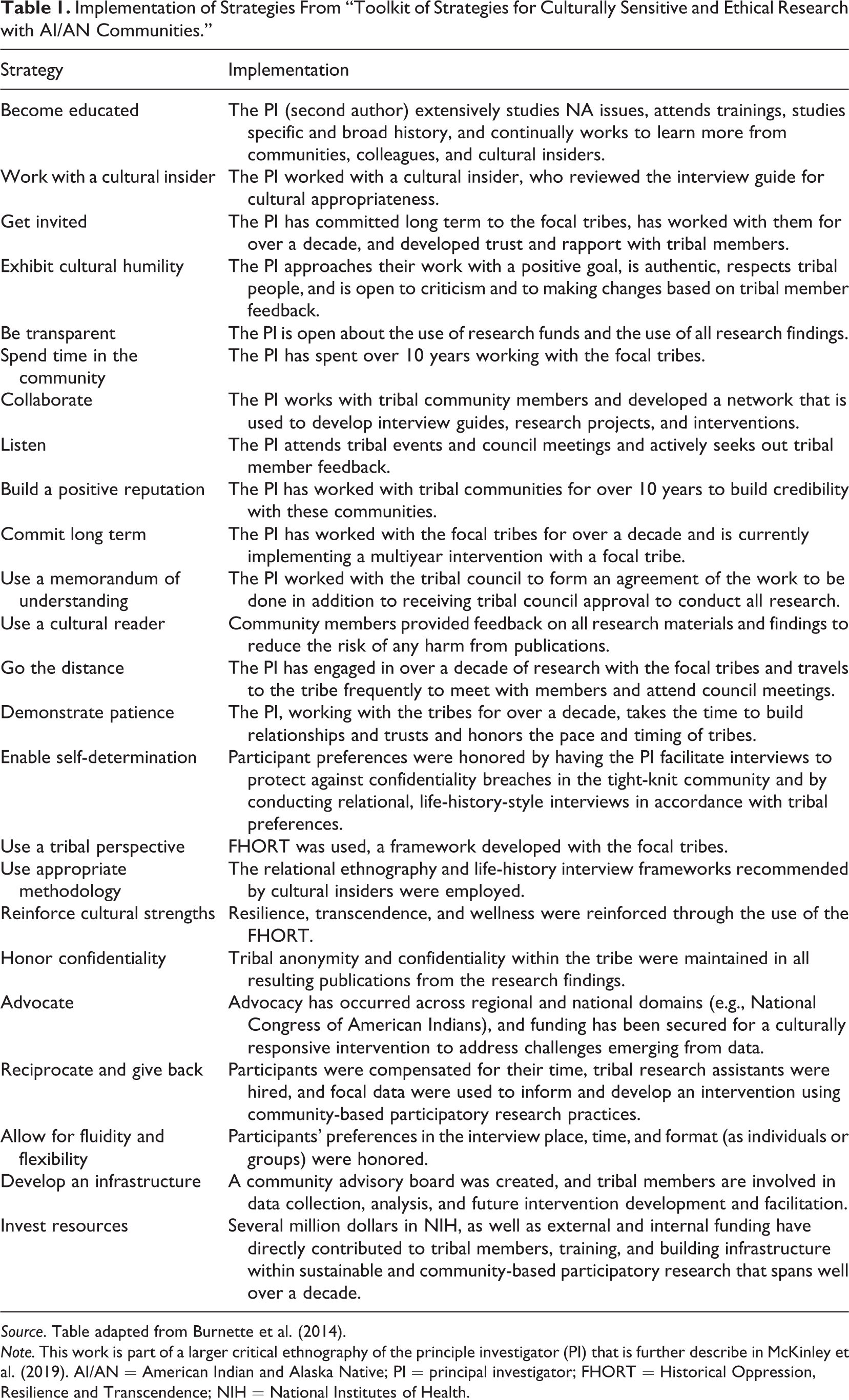
This research was conducted with two tribes located in the southeastern region of the United States. The particular tribal identities of the two tribes remain confidential because of agreements established with the two tribal councils before beginning data collection and to honor community confidentiality as recommended for ethical research with tribes (Burnette et al., 2014). This precaution is taken to prevent the negative social, economic, and health consequences of other research that reported tribal identities and failed to adequately protect against harmful implications (Burnette et al., 2014; Smith, 2013). The work was further guided by the recommendations for conducting ethical and culturally sensitive research in “A Toolkit for Ethical and Culturally Sensitive Research: An Application with Indigenous Communities” (Burnette et al., 2014; see Table 1).
Implementation of Strategies From “Toolkit of Strategies for Culturally Sensitive and Ethical Research with AI/AN Communities.”
Source. Table adapted from Burnette et al. (2014).
Note. This work is part of a larger critical ethnography of the principle investigator (PI) that is further describe in McKinley et al. (2019). AI/AN = American Indian and Alaska Native; PI = principal investigator; FHORT = Historical Oppression, Resilience and Transcendence; NIH = National Institutes of Health.
The focus of this study is to identify universal themes that were evidenced in both tribes while maintaining the localized perspectives of respondents from each community. For the themes reported in this study, we first analyzed whether there were meaningful differences in the overarching themes between the two tribes. Although particulars of experience were specific to individual and community, the overarching themes were consistent. Our purpose was not to compare the two tribes; however, to ensure proper recognition of the distinction between them, we use the terms “Inland Tribe” and “Coastal Tribe” to denote the two tribes in this study.
The Inland Tribe is located inland from the Gulf Coast and is a federally recognized tribe. Being federally recognized has facilitated increased political autonomy for this tribe, in addition to increasing access to centralized tribal resources, such as law enforcement, a criminal justice system, schools, and other social and healthcare services. The Inland Tribe is situated in the Deep South, with strong Protestant Christian faith traditions. Its surrounding communities tend to be conservative with strong racial tensions historically acknowledged. The Coastal Tribe is situated in close proximity to the Gulf Coast, which has important implications for tribal members who depend on natural assets from the region, relying on the coast, swamps, and rivers in the area for their economic security and for social and cultural resources. The Coastal Tribe is not currently recognized at a federal level (though recognized at the state level), which has served to undermine the tribe’s political autonomy and access to resources.
Although representative prevalence rates are unknown, community members from both tribes expressed concerns about rates of violence against women. Excluding youth participants, among this sample (n = 107) approximately 53%, had experienced some form of intimate partner violence. Across tribes, participants, on average, had between two and three children. Community risk factors included teen pregnancy and violence against women and children (McKinley et al., 2019). The majority of participants were employed, students, or retired, with only 10% unemployed. Participants reported blended and stepparent families as normative in these communities. Criteria for inclusion in the study were being a member of one of the NA tribes ages 11 or above and/or being a social, behavioral, law enforcement, family, or criminal justice professional working with these tribes. See Table 2 for additional information on participant demographics.
Qualitative Data and Demographic Information for Participants.
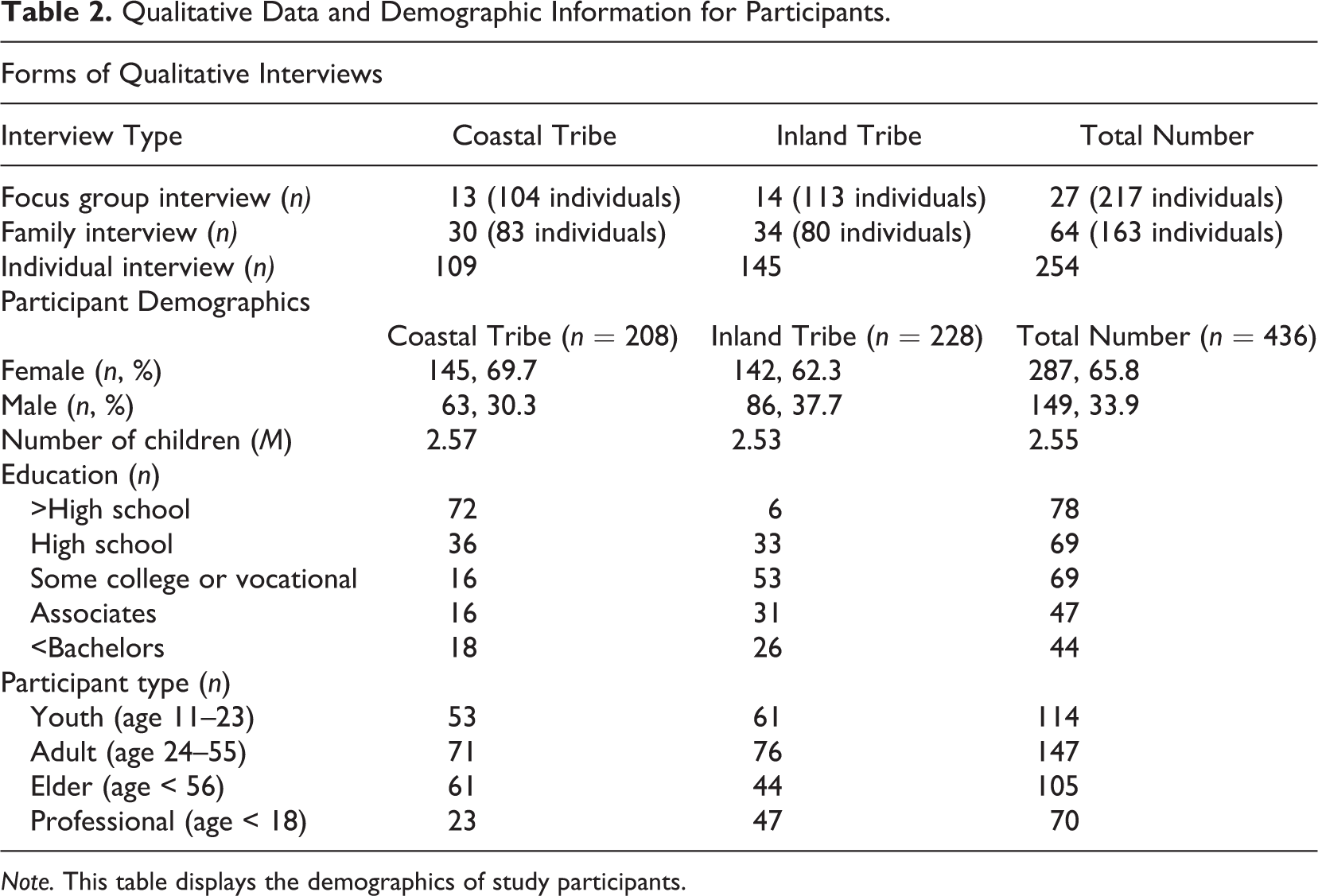
Note. This table displays the demographics of study participants.
Overarching themes and subthemes for the larger study (see McKinley et al., 2019) focused on culturally specific risk and protective factors related to wellness across ecosystemic levels. For a list of the overarching themes that were identified in the larger study, see Table 3. These risk and protective factors were organized along the ecological domains of community, cultural, family, and individual levels of resilience along with effects of adversity, solutions to violence and substance abuse, and the focus of this study, gender roles. This article is drawn from the gender role themes that focus on the expectations and the roles of mothers. These themes were present across 122/245 (50%) of the individual interviews, 30/64 (47%) of the family interviews, and 12/27 (44%) of the focus groups. For an overview of the larger research study and a summary of its overall findings, please refer to McKinley et al., 2019.
Culturally Specific Risk and Protective Factors Related to Wellness Identified in the Larger Study.
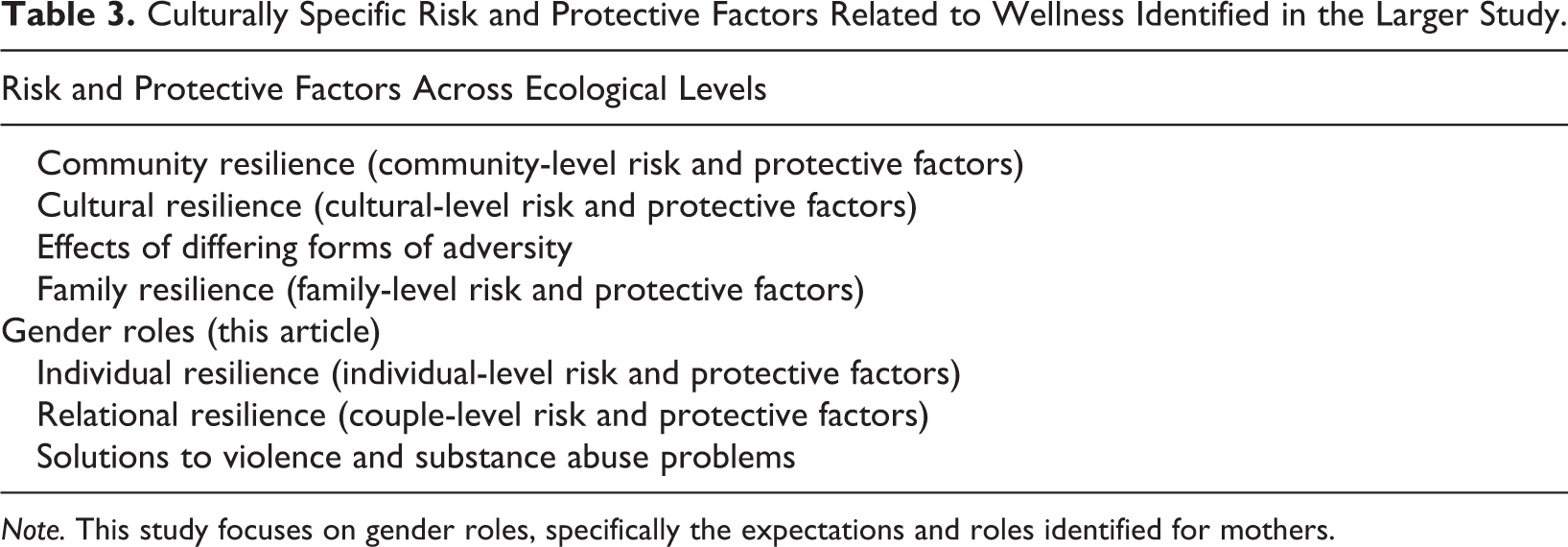
Note. This study focuses on gender roles, specifically the expectations and roles identified for mothers.
Data Collection
Data collection began after receiving approval from Tulane University’s Institutional Review Board (IRB) in addition to the tribal council IRB approval. Considering the long history of researcher exploitation of NA people (Smith, 2013), investigators followed the toolkit (Burnette et al., 2014) to ensure the ethicality of this study (see Table 1). Participants were recruited through face-to-face interactions at tribal events, word of mouth, fliers on tribal social media, and tribal newsletters. Interviews were conducted by the second author in locations requested by participants. These occurred in the homes of participants or in tribal or community buildings between June 2014 and July 2015.
Data were collected through audio-recorded, semistructured individual, family, and focus group interviews (Carspecken, 1996). A semistructured interview guide was developed to address the overarching research questions that focused on family resilience and the culturally specific risk and protective factors related to resilience such as men’s and women’s roles. Examples of questions related to this study included in the semistructured interview guide are the following: “Whom did you go to for support?” “How would you describe the role of your mother figure?” and “Who cared for you most of the time?” The average duration of each type of interview was as follows: individual interviews = 64 min, family interviews = 70 min, and focus group interviews = 57 min. Participants were compensated for their time following the toolkit’s (Burnette et al., 2014) recommendation to contribute to the tribal community members in reciprocity. Individual and focus group interviewees were given $20 gift cards, and families were given $60 gift cards.
Participants had the option to have a tribal member and/or the PI (second author) conduct the interviews and focus groups. To adhere to confidentiality preferences, the PI facilitated all groups. Some groups also had community insiders participate on the recommendation of the cultural insider and participant preferences (Burnette et al., 2014). Focus groups from each subsample (i.e., professionals, elders, adults, and children) were purposively selected. Between the two tribes, 436 respondents participated in the study (see Table 2). Over half of the participants were interviewed on more than one occasion, adding additional depth to our findings.
Data Analysis
A research team of the PI and four PhD students (two of whom were Indigenous) analyzed the data using a team-based collaborative approach (Guest & MacQueen, 2008). After transcribing verbatim and cleaning transcripts, Nvivo software (Version 12) was used for analysis. Researchers engaged in reconstructive analysis (Carspecken, 1996), first immersing themselves in the data through repeated listening and reading of the interview transcripts. Then, researchers created a hierarchical scheme of codes that was agreed upon through research team discussions (Guest & MacQueen, 2008) and finally coded all interview transcripts and analyzed them in depth to explore implicit and explicit interpretations of the coded data segments. Research team interrater reliability was calculated using NVivo at .90 or above, which is considered very high in Cohen’s κ coefficients (McHugh, 2012). The results below are presented in terms of universal themes, yet individual tribes are designated to maintain the integrity of these separate samples. Themes related to women’s roles and motherwork occurred frequently (212 times across 109 unique sources) within the data set.
Rigor
A variety of steps were taken to ensure study rigor. The steps from the “Toolkit for Ethical and Culturally Sensitive Research” (described in Table 1; Burnette et al., 2014) serve as the evaluative criteria for this study. In addition to what is described in this table, the PI, tribal partners, and the research team have developed an adapted intervention to prevent violence and promote healthy relationships, resilience, and wellness while preventing substance abuse. Through funding from the National Institutes of Health (1R01AA028201-01), we are testing this for efficacy and sustainability. This will provide a culturally relevant and effective evidence-informed intervention (McKinley et al., 2019). Member checks were performed with all study participants who consented to being contacted and who could be reached. During member checks, participants were provided a copy of their interview transcript and a summary of study findings and asked whether they had any changes, additions, corrections, or other insights to add to either. No participants asked for changes to be made to these documents though several expounded upon their initial statements. These results were also disseminated to each tribal community at tribal and community events on more than 10 different occasions. Additionally, research team members met biweekly during data analysis to reflect, discuss findings, and ensure consistency throughout the analysis process. Using research methods that are culturally congruent and sensitive enhances the rigor and facilitates research products that are more likely to be relevant and useful for tribal communities and researchers (Burnette et al., 2014; McKinley et al., 2019; Smith, 2013).
Results
Participants from both tribes described a variety of expectations and roles for mothers. These findings included themes of (a) mothers as caretakers, (b) mothers as center of family and role model, (c) women to prioritize family over economic and educational aspirations, and (d) decolonizing norms for mothers. Among both tribes, results indicated that being family focused and filling a variety of roles were norms for mothers. Mothers were expected to be caretakers of their families’ physical and emotional needs, the center of and role model for the family, and to act as disciplinarians. Speakers also described seeing changes in the norms expected for mothers and female tribal members.
Mothers as Caretakers: “She Always Knows What to Do”
Parallel to precolonial times, mothers were often described in their role as caretakers of the family, taking on both the mental and physical household labor within families. This caretaking role included providing for the family physically, by feeding and taking care of household needs, and also providing emotional support for family members.
Inland Tribe
First, mothers cared for physical aspects of families. One adult male speaker from a family interview described the role of a mother as entailing: “Clean them [the children]. Watch them. Take care of them if they need it.” When describing her own mother, one adult female speaker listed the multiple roles she saw her mother fill: “She…made sure…all of us kids were fed, all of us kids were clean…she was in charge of the domestic duties.” A focus group member stated that it seemed that the role of the mother was to do it all: “They do everything…They cook, they clean, they mow the yard.” Despite mothers caring for mental and emotional needs, participants did not note how partners offset this cognitive load.
In addition to providing for the physical needs of children in the home, mothers were expected to provide for the emotional needs of the family. Speakers emphasized the idea that mothers were meant to be caring and nurturing. One adult female family interview participant noted this: “Moms to me, moms are supposed to be the, the loving one, the nurturing one, you know.” A male youth focus group participant also described mothers in this way when asked to indicate what mothers provided: “Moral support…Encouragement…The soft side…Role model.” This role of mothers providing emotional support was described by several speakers. One elder female family interview participant stated: “My mother was like the nurturing type and, and…my dad was just busy trying to make ends meet.” One female youth speaker noted how her mother always seemed to sense when she was feeling bad: My mom kind of had a sixth sense when I was feeling down…. I don’t know how she knows this but I guess it’s motherly instinct…. But when I would feel down, she’ll come and see me and talk to me and see what’s wrong.
One female youth focus group participant stated: “She always knows what to do.”
Coastal Tribe
Consistent with the Inland Tribe, participants in the Coastal Tribe described mothers providing for physical needs. One elder female participant felt her mother performed these activities to demonstrate care: “My mama would cook. She’d wash clothes and do the house chores.” Another female elder speaker recalled how her mother made sure the family was fed: “Made sure we had something to eat, for sure. Mom could take a little pan of shrimp and make a big pot of dinner.” Mothers often juggled economic and household responsibilities. One female elder focus group participant described this dual obligation: I took care of my kid when they were growing up…. I had to cook before I leave to go to work. Then I work at taking care of people at the hospital, ironed for people that couldn’t iron their clothes and take care of some old lady at the house and the old man.
For these participants, mothers were expected to take care of physical and emotional needs within the family and, in some cases, the community.
Mothers as Center of the Family and Role Model: “She’s the Center of My Life, the One That Keeps My Heart Open”
In line with the matrilocal or female-centered social arrangements prior to colonization, mothers continued to be central to family life. They were described as the glue holding family members together and role models.
Inland Tribe
Participants often described their mothers as the center of the family. Mothers were frequently characterized as role models, providing positive moral guidance for their children. When asked what it was important for a mom to do, a youth focus group participant reported: To be in your life…. Everything…. Feed you…. And do your laundry…. That she cooked breakfast…. And fix you a snack. And buy you the snacks you want…. To be the one to listen…. To be your best friend when you need her…be the nurturing figure and everything. To, to me, I mean, the role as a mom is whatever needs done just needs to get done…. If they’re [family members] sick, you take care of them. If they’re sad, you take care of them. If they’re mad, you try to help them.…. I do my absolute best to be there…. But, to me, the role of the mom is to keep the family [together]. Partly is um, partly it’s my mom. You know like she’s pretty, she’s pretty stern…if you tried to be smart aleck, she didn’t let you get away with it…. So…they [children] were respectful, but they were scared of her,…so in our family she was the glue…. So when she passed away they just kind of, you know, didn’t really care to hang onto family…. It was kind of for her sake almost that we were family.
Coastal Tribe
Participants in the Coastal Tribe also described their mothers as being central figures in the household and role models. Mothers were frequently described as teachers, as one male youth participant expressed: They [mothers] help with the kid’s problems. If it’s a girl, help with all of her private stuff. With the boys, they just keep the boys in [sic] sane. They tell the boys, “Don’t go crazy.” People take women. They try to prevent that. And teach boys to be men.
Other participants emphasized support from their mothers. As one adult female participant reported: “Oh, she was loving, supporting. She didn’t like some of the things I did but she supported me and she was always there for me.” The importance of this support was echoed by another female adult family interview participant who stated, “Being there for us” was most important in a mother. Finally, one family interview participant summed up the importance of their mother by simply stating: “She’s the center of my life, the one that keeps my heart open.” As detailed above, mothers were described as being the center of the family and role models.
Women to Prioritize Family Over Economic and Educational Aspirations: “Cause I Wanted to Go Back to School”
While NA women in the Southeast were commonly the center of their households, this role was coupled with lower economic and sociopolitical power when translated to contemporary times. In contrast to historical roles, where women were able to be the center of households and hold political and social power, in current times, women experienced a devaluation that was a departure from the matrilineal and matrilocal tendencies of the past (Burnette, 2015a).
Inland Tribe
The expectation that women become mothers and focus on taking care of their families was described by many speakers. In some cases, the expectation was that the women would raise children, while men would provide income. One female elder seemed to internalize patriarchal norms, explaining her expectations that her daughters focus on their children: In my case, I want my girls to, um, my granddaughters to, um, raise their kids well…. And, um, I want them to take care of the kids and take care of their husbands, ‘cause their husbands are taking care of them pretty well.
Yet, some participants described feeling pressured to stay at home and take care of the family. One female adult speaker described her partner not wanting her to work until their child was older: “[Partner name] didn’t want me to go to work until [child’s name] was at least 18 months old.” Another family interview participant described how the pressure to pursue pregnancy and start a family disrupted her desire to pursue her education. I cried. I sat there and cried and he’s [partner] like, “Why you, why you crying?” And I said, “Cause I wanted to go back to school”…. And so then my mom too she was like, “Well at least you getting it out of the way”…. Cause I wanted to go to school, finish school…. But mom said, “Look at it this way at least you don’t have to worry about it….”
Coastal Tribe
Participants in the Coastal Tribe similarly reported the expectation that women would not only become wives and mothers but also prioritize the family, especially in the older generation. One adult male speaker described how his mother gave up school for family duties: My mom, she grew up helping my grandma, helping her mom a whole lot around the house and helping her with her three brothers. She was more out of school than in school, but she said she thinks that if she could have been in school more, she would be real smart, because she loved school but it’s just like my grandma held her back.
While some women felt pressure to stay home and take care of the family, this expectation did not necessarily extend to fathers and male partners. One adult female reported how many of her disagreements with her partner centered on his desire to party and be free. In describing their disagreements, she stated they were “About him just being young and wild, him. I was more wanted to stay home [sic] and [to] be a family.” Another family interview participant described her partner as frequently being absent, even when physically present: [When asked if father was around] If you mean around, like physically [yes]…. Around as a father, no, never been…. He’s just a…he never grew up. He never matured. He still hasn’t socially. He wasn’t the father or the husband type. He was, you know, he wanted to be in the car, clubs, running the streets, he never did settle down. Right after I had my son [I] pretty much got pregnant again and not long after [child’s name omitted] was born my dad was just like, “Look, you have two kids. This is the life you’re living. Y’ all are going to get married.” I did not want to marry him. I was just staying together for my child, for my children. He’s like, “No if y’ all are providing a life together, y’ all are going to be married. This is not the way I raised you….” I don’t [sic] know, it was toxic. We were like okay marriage is going to fix it, I guess…. All the infidelity and the beating and everything else like that carried over into my marriage.
Decolonizing Norms for Mothers: “My Mom Could Do Anything”
Although the heavy blanket of patriarchy constrained many women’s mobility and opportunity, some women negotiated more fluidity, rebalancing, and flexibility in their roles, decolonizing patriarchal colonialism in favor of more egalitarian gender norms. Still, the accumulation of more opportunity in economic and educational spheres was not often met with lessening expectations in the family and household sphere.
Inland Tribe
Several participants noted exceptions or changing norms regarding expectations for mothers to be the primary caretakers of children. One female elder appreciated that her husband helped with household tasks but also noted that she still had to be the backbone for the family: “I said one of these days when I’m not here, what are y’all gonna do?…. I wish he would [step up more].” A focus group participant reported that women were more likely to head the households: Yeah because, like the men used to be the head of the house. Now it’s the woman…. Roles changed…. I see it a lot with the younger ones…. They want to depend on the girl because it seems like the girls are more stronger [sic]…. The ones that go to school and try to finish, it’s like they’re trying but the men kind of like depend on them too. When she’s taking care of another child or something like that. I’ve heard that a lot of times…. The young daddies…just stay home and let the girls do the working or whatever. Their roles is just not there for the younger daddies.
In contrast to the norm that male partners act as the primary authority figure in the household, one female youth speaker described her mother as being the authority in the home and having the last word on decisions: “Whatever my mom says, my dad did and that’s how it was.” This speaker described matrilocal roles and how her mother challenged the norm of male as the final decision maker. Other exceptions included mothers acting as the primary provider. One female family interview participant discussed being the primary financial provider while her partner stayed at home: “He’s more like the mom-dad. I just work.” These speakers all noted that certain changes were observable in the expectations of women in their role as mothers.
Coastal Tribe
Androgynous gender norms were more often spoken about in the Coastal Tribe, which has a French background and is in proximity to a large metropolitan area. Coastal tribal members also noted important exceptions to the norm that women become mothers, act as primary care providers, and be indoor or domestically focused. One female adult participant reported being actively encouraged by her father to participate in outdoor activities: Yeah, so we grew up different. I grew up mostly fishing and trawling and hunting, because I’m the oldest. I think my dad thought I was a boy or something. …. I played ball. I was just kind of tomboy-ish, because I would go hunting. Most girls wouldn’t go hunting. I thought I was the odd ball because there was me, my cousin [name omitted]…. We, the girls, went hunting. My little cousins, all the girls hunt. All of them, they all hunt and I have done deer hunting but they all go deer hunting now.
In another instance, a male adult interviewee noted that after the loss of his father, his mother learned how to run the family seafood operation: “Everything went to my mom after [father’s death]. Then she had to learn how to [run the boat and operation]…that’s actually how she was able to provide for us.” Another speaker noted how after observing her parents’ harmonious relationship she was shocked when she found herself in an abusive relationship: “I’ve never heard of a man hitting a woman. My daddy never did that and I never heard of that in my family.” She went on to further describe the strengths and independence of her mother: My mom could do anything. My mom was like this, she grew up poor. If something broke in the house, it was not my daddy to fix it, it was my mom to fix it. I don’t care if it’s a washing machine, I don’t care if it’s hot water heater…. My mama could fix it.
Discussion
These results highlight how expectations for mothers include both norms imposed by patriarchal colonization and norms of the mother as the central and most valued figure in the home. The latter is congruent with the female-focused and matrilocal norms before colonization. Both tribes reported similar norms and expectations for women in their roles as mothers. Mothers were described as the primary caregivers in the household by both tribes. Mothers were also often portrayed as the “glue” that held the family together and as playing important roles as role models and leaders in the home. This is similar to norms precolonization, where mothers acted as the caretakers of the family’s emotional and physical needs, in addition to being important and respected figures in the home.
However, both tribes also documented the strain that mothers currently experience, with the expectation that they provide for all needs in the home, while also providing financially, without the previous social support and associated respect of motherhood. Both tribes described the expectation that women prioritize becoming mothers and staying at home over their own economic and educational aspirations. This may be due, in part, to the sociopolitical structures associated with the gender dynamics of colonial historical oppressoin and the Deep South. However, women also described the tension that existed when they became the primary breadwinners, as this could contradict the patriarchal norm that men head the household financially. This strain has been documented among other American families, where labor opportunities for men have declined while low-wage jobs for women have increased in the past 4 decades (Ruggles, 2015). Even though both tribes portrayed mothers as the center of the home, which is congruent with precolonial times, this role carries less sociopolitical and economic power in the home and community today.
These contradictions can be understood in terms of the FHORT that emphasizes how NA people can challenge and subvert their experiences of contemporary and historical oppression to demonstrate resilience (Burnette 2015a; 2015b). Despite the pervasive and oppressive patriarchal norms and pressures reported by participants, speakers also noted that women were acting in ways to decolonize the norms imposed by patriarchal colonialism. This often came in the form of participants advocating for and describing more egalitarian gender relations in their own families and the desire for more educational opportunities for women. Through the lens of the FHORT, as well as in relationship to the theoretical concept of motherwork, these results highlight the ways NA mothers are essential to the survival of their communities in their provision of care, support, and guidance to future generations of tribal members.
NA families have been, and continue to be, subject to reproductive injustices through systematic efforts to destroy family systems by removing children from the care of their parents. Historically, boarding schools and mission schools forcibly separated Native children from their tribal communities to assimilate them to Western norms. Today, this practice continues through the frequent removal of children from their homes by the child welfare system (Lawler et al., 2012). These practices violate the right of women to parent their own children and to do so in safe and healthy environments. When considered in this context, women’s motherwork in caring for children (both biological children and other children within the community) demonstrates their vital efforts in resisting the destruction of the family. Thus, Southeast NA women’s dedication to motherwork can be seen as a means of transcending experiences of reproductive injustice and historical oppression that denied them the ability to mother.
Participants described mothers as “the glue” that holds families together, and women themselves understood that keeping the family together was a driving motivation for their motherwork. Mothers’ labor both inside and outside the home contributed to the survival of the family. Some participants described how women became engaged in caretaking work as young girls helping their mothers to care for siblings; as Hill-Collins (1997) argues, these “children learn to see their work and that of their mother not as isolated from the wider society but as essential to their family’s survival” (p. 376). In other cases, women worked outside the home, requiring them to be away from their children in order to ensure their economic survival.
These findings also show the ways in which NA women actively struggled for maternal empowerment and self-definition in the context of imposed, patriarchal norms. Women demonstrated a desire to control their own bodies and maintain their own identities, especially when unexpected pregnancies disrupted their educational or career pursuits. Congruent with research done on teen pregnancies in NA tribes, whether children were planned or not, women’s care for them shows that their children were wanted, claiming their power as mothers to keep their children in the face of historical and ongoing threats by authorities to determine their children’s fate (Dalla & Gamble, 2001; Palacios et al., 2014). As Hill-Collins (1997) notes, “In such a situation, simply keeping and rearing one’s children becomes empowerment” (p. 379). Rather than viewing NA women as complicit in patriarchal systems that overburden them with responsibilities as mothers, their ability to negotiate multiple, and sometimes competing, roles and expectations actually demonstrates their resilience in the face of difficult circumstances and transcendence of oppressive systems that aim to destroy NA families (Burnette 2015a; 2015b).
Furthermore, mothers acted as disciplinarians and role models, teaching their children culturally appropriate norms, values, and behaviors, enacting their power to raise their children as they see fit while maintaining their Native culture. Ultimately, NA women’s motherwork as caretakers, disciplinarians, role models, and as the center of their families, safeguards families and communities from some of the impacts of historical oppression. The motherwork and reproductive justice frameworks have infrequently been employed in NA research and have not been utilized for investigating the roles and expectations of mothers for women in Southeastern tribal communities. These findings suggest that NA women are experiencing patriarchal norms regarding their expectations as mothers while also highlighting the ways these norms are being decolonized and the strength and resilience NA women demonstrate in their role as mothers.
Limitations
Some limitations of this study include that the data were cross-sectional and participants were not interviewed over several years. Attempts to address this weakness included interviewing participants multiple times and interviewing participants across the life span (interviewing youth, adults, elders, etc.). Future research may benefit from tracking individuals or families over the life course. Additional research may also want to investigate these findings among tribes outside of the Southeast region as racial and patriarchal dynamics associated with being situated in the Deep South may make these issues particularly salient among these tribes.
Conclusions and Implications
Motherwork plays a vital role in the resilience of these tribal communities. These findings point to the need to consider mothering within a specific sociohistorical context and to revalue the work of mothers, especially mothers of color, who are demonstrating their power/resilience/transcendence in the face of intersecting oppressions. Applying the lens of the FHORT (Burnette 2015a; 2015b; Burnette & Figley, 2017), NA mothers demonstrate resilience and transcendence beyond the gendered colonial expectations imposed upon them through acts of motherwork. NA women have reclaimed rights of leadership along economic, social, and familial roles; however, due to patriarchal colonization, these roles have become more constrained and prescribed.
Social workers are increasingly being called to incorporate reproductive justice frameworks in their research and practice (Alzate, 2009), and this framework should be applied to social work research and interventions among NA women (McKinley et al., 2019). This framework acknowledges the importance of the right to mother as central to holistic reproductive and sexual health, which can guide social work practitioners who frequently act as gatekeepers for reproductive, sexual, and social services (Ross & Solinger, 2017). It is essential that social workers understand the multiplicity of roles NA women fulfill in their families and the variety of responsibilities they take on within the context of historical oppression and reproductive injustice and recognize the immense resilience and strength displayed through women’s motherwork in NA communities. These results suggest that additional resources, such as incentives for women returning to school, or economic resources for single mothers, may be needed to further support mothers. These findings were disseminated to each tribal community and have informed a family-focused intervention focused on improving physical, mental, and social well-being and health currently being tested. While the context of historical oppression and patriarchal norms of the dominant culture constrain, regulate, and limit the roles of NA women, proscribing them into motherhood and domestic life, these findings also highlight how women find avenues to reclaim their power through their roles as mothers.
Footnotes
Authors’ Note
The content is solely the responsibility of the authors and does not necessarily represent the official views of the National Institutes of Health.
Acknowledgment
The authors thank the dedicated work and participation of the tribe who contributed to this work.
Declaration of Conflicting Interests
The author(s) declared no potential conflicts of interest with respect to the research, authorship, and/or publication of this article.
Funding
The author(s) disclosed receipt of the following financial support for the research, authorship, and/or publication of this article: This work was supported by the Fahs-Beck Fund for Research and Experimentation Faculty Grant Program (grant number #552745); The Silberman Fund Faculty Grant Program (grant #552781); the Newcomb College Institute Faculty Grant at Tulane University; University Senate Committee on Research Grant Program at Tulane University; the Global South Research Grant through the New Orleans Center for the Gulf South at Tulane University; The Center for Public Service at Tulane University; Office of Research Bridge Funding Program support, Tulane University; and the Carol Lavin Bernick Research Grant at Tulane University. This work was also supported, in part, by Award K12HD043451 from the Eunice Kennedy Shriver National Institute of Child Health and Human Development of the National Institutes of Health (Krousel-Wood—principal investigator; Catherine Burnette—Building Interdisciplinary Research Careers in Women’s Health [BIRCWH] Scholar); by U54 GM104940 from the National Institute of General Medical Sciences of the National Institutes of Health, which funds the Louisiana Clinical and Translational Science Center; and by National Institutes of Health grant 1R01AA028201-01.
