



Abstract
We examined the potential anticipatory response (rumination, vigilance) associated with online racism and its impact on psychological distress, loneliness, and alcohol use severity. With a sample of 407 racial minority adults, we conducted a path analysis to examine the indirect relation of online racism on our outcome variables via online racism-related rumination and offline racism-related vigilance. Online racism was significantly linked to psychological distress, alcohol use severity, and loneliness. Rumination and vigilance explained significant indirect relations between online racism and psychological distress and loneliness. Only rumination explained the significant indirect relation between online racism and alcohol use severity. Posthoc multigroup analysis suggested that the path model estimates for the full sample applied equivalently to the African American/Black, Asian/Asian American, and Latinx/Hispanic American groups. Online racism is likely an unjust burden for racial minority individuals that may give rise to prolonged rumination and anticipation about facing racial discrimination in their offline world.
Racial minority individuals exposed to racist interactions (e.g., hate speech, racial cyberaggression) and content (e.g., hate crimes, systemic inequality) on the internet may engage in rumination about these experiences that may give rise to being vigilant about potential racial discrimination in their offline social environments. This anticipation may increase the risk of distress and loneliness, as well as the risk of engaging in greater alcohol use to cope with the stressful nature of this process.Significance of the Scholarship to the Public
Racism affects racial minority individuals at multiple levels including individual (e.g., interpersonal discrimination, maltreatment based on racial and/or ethnic affiliations), cultural (e.g., promotion of White supremacist norms and devaluation of the culture of racial minority individuals), and systemic levels (e.g., policies and institutional practices that disadvantage racial minority groups systematically; Harrell, 2000). In today’s digital era, online racism has been receiving growing empirical attention. Based on the conceptualization of online racism as having a pervasive, permanent, and evolving presence on the internet, Keum and Miller (2017) suggest that people can be exposed to online racism by being racially victimized by others on the internet, witnessing racial victimization inflicted against other racial minority individuals on the Internet, and encountering online content that highlights systemic racism and disparities against racial minority groups (e.g., information on various systemic racial inequalities, online media dehumanizing entire cultures of racial minority groups, physically violent police brutality videos). These aspects collectively make up how racial minority individuals may be exposed to online racism.
Studies have shown that online racism is significantly linked to negative mental health outcomes among racial minority youths and adults (Keum & Miller, 2017; Tynes et al., 2008; Umaña-Taylor et al., 2015), including psychological distress, alcohol use severity (Keum & Cano, 2021, 2023), loneliness (Keum, 2021), and suicidal ideation (Keum, 2022). As racial minority individuals are likely to be exposed to racist content and interactions much more frequently on the internet than nonracial minority individuals, the growing evidence of the harmful costs of online racism signifies an unjust digital burden. These costs also bear chronic implications as online racist materials may sustain a permanent presence and are polarized on social media, often becoming “viralized” and “trending” for society to observe with real-time updates. Furthermore, Keum & Miller (2018a) noted that the internet provides virtual courage as people take advantage of the anonymity in the online world to express their racist beliefs without feeling accountable. For instance, people are now more likely to come across their acquaintances, friends, and family members revealing their explicit racist ideologies on the internet than in offline settings (Keum, 2017). This likely brings a sense of disillusionment, betrayal, and helplessness for racial minority individuals dealing with the persistence of racism within their social circles. Moreover, people are exposed to online content that highlights the reality and persistence of systemic racism (Keum & Miller, 2017). Importantly, online exposure to race-related violence and traumatic events (e.g., videos of police brutality) has been found to be debilitating and costly to the well-being of racial minority individuals (Carter, 2007; Tynes et al., 2019; Williams et al., 2018).
In understanding the risks associated with online racism, one unique area that needs greater empirical attention is how exposure to racist online interactions (e.g., threats, insults, abuse) and content (e.g., videos and photos of hate crimes, systemic inequities) that depict violence and injustice toward racial minority individuals may shape racial minority individuals’ offline social perceptions and psychological states, particularly about their position in society as a person of Color. Even after accounting for offline experiences of racism, Keum and Miller (2017) found that online racism contributed unique significant variances to psychological distress among young racial minority adults. Racial minority adults in this sample reported increased unjust views of society and perceived stress in their future as their exposure to online racism increased. These findings suggest that they may also experience heightened sensitivity to racial injustices in offline society and worry about potential racial discrimination in future social interactions. Given that exposure to violence in social media can have a significant role in shaping real-world attitudes and behaviors (Gentile & Bushman, 2012), persistent and explicit exposure to online racism may reinforce greater racism-related anticipatory attitudes and behaviors among racial minority individuals in their offline settings. Such anticipation may push racial minority individuals to be hypervigilant in their offline social surroundings, a process that may be stressful and socially isolating (Hicken et al., 2018) and even evoke alcohol use for coping (Keum & Cano, 2021; Keum & Choi, 2022). Thus, we tested whether exposure to online racism was associated with relevant psychosocial costs (distress, loneliness, alcohol use severity) via online racism-related rumination and offline racism-related vigilance.
Online Racism-Related Rumination and Offline Racism-Related Vigilance
Racial trauma theory (Carter, 2007; Tynes et al., 2019; Watson-Singleton et al., 2021; Williams et al., 2018) suggests that racial discrimination may be perceived as a chronic stressor and threat to the integrity and safety of the individual, resulting in hypervigilance, social avoidance or numbing, and emotional distress. Considering that online racism may be a chronic stressor consistently portraying an unsafe outlook on society for racial minority individuals, one likely response to online racism is rumination about potential discrimination (Utsey et al., 2013; Watson-Singleton et al., 2021). With increasing exposure to online racism, racial minority individuals may ruminate about the racist events, interactions, and information they see on the internet (even when they are not online; i.e., online racism-related rumination). They may also ruminate about the possibility of facing a society that may be perceived to be increasingly hostile and discriminatory toward racial minority groups based on their online racism experiences. According to cultivation theory (Gerbner et al., 2002), which suggests that prolonged exposure to media depicting violent and threatening content (such as online racism) can create fear of those experiences happening in the offline world, racial minority individuals ruminating about online racism may adopt a fearful outlook due to anticipating racial discrimination in their offline social environments.
In turn, online racism-related rumination may trigger racial minority individuals to engage in hypervigilant behaviors to minimize potential racial discrimination in their offline world (offline racism-related vigilance). Racism-related vigilance has been identified as an insidious and costly response to racism for people of Color (Hicken et al., 2018). Scholars posit that victims of racial discrimination may engage in vigilance coping, or heightened interpersonal and environmental surveillance and caution to protect themselves from potential and future incidents of racism and racial biases (Himmelstein et al., 2015). Concerning online experiences, the literature suggests that exposure to violent media content may facilitate future aggressive behavior and social avoidance among youths (Gentile & Bushman, 2012). Theories on social media influence, such as the social instrumental learning theory, suggest that individuals exposed to violence and aggression in online interactions are likely to reinforce certain attitudes and behaviors to avoid such violence and aggression in the future (Branley & Covey, 2017; Rösner, 2018). Thus, racial minority individuals’ ruminations about online racism experiences may be associated with the adoption of a vigilant outlook that is distrusting and avoidant of others to minimize any potential impact of racism in their daily lives.
Although we posited that exposure to online racism would give rise to online racism-related rumination and offline racism-related vigilance, this anticipatory response associated with online racism may not be relevant in several regards. Some research suggests that constant exposure to violent media content (e.g., repeated exposure to content on racial violence in the community) may emotionally desensitize individuals. Although the initial exposure to violent content may evoke strong negative emotional reactions among people, these emotional reactions may be dampened after repeated exposure to such content (Mrug et al., 2016). For example, Mrug et al. (2016) found that youths and emerging adults with high levels of repeated exposure to violent media reported diminished empathy and emotional reactivity. Coupled with the notion that some may choose to take online racism less seriously (Keum & Miller, 2018a), these findings suggest that rumination and vigilance may be less salient for those who are emotionally desensitized from online racism. Additionally, although the literature is limited, some research suggests that there may be nuanced racial differences in the salience of anticipatory responses. For instance, Hicken et al. (2013) found that racism-related vigilance played a more significant role in sleep difficulty disparities between Black and White individuals than between Latinx and White individuals. This finding may be contextualized within the history of deep-rooted anti-Black racism in the United States (Jones et al., 2020) and suggests that Black individuals may particularly suffer from engaging in racism-related vigilance.
Distress, Alcohol Use Severity, and Loneliness Associated With Rumination and Vigilance
Racial minority individuals anticipating and being vigilant about future racial discrimination may appear adaptive and protective, however, they may experience consequences in social (e.g., loneliness), psychological (e.g., distress), and behavioral (e.g., substance use) domains that are ultimately unhelpful, self-inflicting, and create risk for developing mental health issues such as depression (Carter, 2007). Thus, we examined several psychosocial and behavioral costs potentially relevant to online racism-related anticipatory responses. First, as consistently established in prior studies of racism and racism-related vigilance (Carter, 2007; Hicken et al., 2018; Utsey et al., 2013), rumination and hypervigilance may be chronically distressing for racial minority individuals. Over time, this process has been posited to reinforce racial minority individuals’ cognitive representation of the world as hostile and unwelcoming, and evoke continuous activation of psychological and physiological stress responses (Brosschot et al., 2006). Such states of being are associated with adverse distal health outcomes (e.g., emotional distress, and cardiovascular risk; Ottaviani et al., 2016). Further, rumination and vigilance are increasingly being studied as intermediary variables in the association between racism and health outcomes (Lewis et al., 2015).
Second, racism-related stress has been associated with risky alcohol use and coping-motivated drinking among racial minority adults (Grekin, 2012). Despite the health risks, studies have found that people may consume alcohol to cope with difficult feelings and racism-related distress (Howell et al., 2010). Notably, Keum and Cano (2021) found that among racial minority young adults, greater exposure to online racism was associated with increased social media stress and general psychological distress, which in turn was associated with greater alcohol use severity. Thus, in dealing with the psychological toll of online racism-related rumination and offline vigilance, it is likely that racial minority individuals may engage in increased alcohol use.
Third, given the socially isolating and avoidant implications of vigilance (Carter, 2007; Priest et al., 2017; Utsey et al., 2013), those who report greater online racism-related rumination and subsequent vigilance may experience greater feelings of loneliness. The painful state of loneliness is an important and insidious outcome to examine, as loneliness has become a public health concern associated with fatal outcomes such as suicidality and substance abuse (Lim et al., 2020). The internet’s facilitation of greater access and exposure to online racism also likely contributes to a heightened sense of loneliness among people. With the increasing reliance on and salience of digital communication as a means of social interaction among emerging adults, loneliness has been significantly correlated with social media use (Keum et al., 2022; Yang & Robinson, 2018). Social media use may evoke greater feelings of loneliness and social isolation among individuals who feel ostracized from online interactions (e.g., cyber aggression) and are frequently exposed to violent media that shape an unsafe outlook of their surrounding communities (e.g., violence in communities; Lim et al., 2020). These negative online social experiences are associated with a greater likelihood to adopt a hostile attribution bias, and a vigilant perceptual tendency to view future social situations as hostile and threatening (Gentile & Bushman, 2012). Those navigating social interactions with hypervigilance may generally view social encounters as threatening and may be socially avoidant until safety and trust are established. Thus, individuals engaging in hypervigilance about potential discriminatory events may report increased feelings of loneliness.
The Present Study
Based on our conceptualization, we tested a path model (Figure 1) to examine the role of online racism-related rumination and offline racism-related vigilance as serial mediators that can help explain the link between online racism and specific outcome variables (distress, loneliness, alcohol use severity). We examined the below hypotheses based on our review and conceptualization: Hypothesized Path Model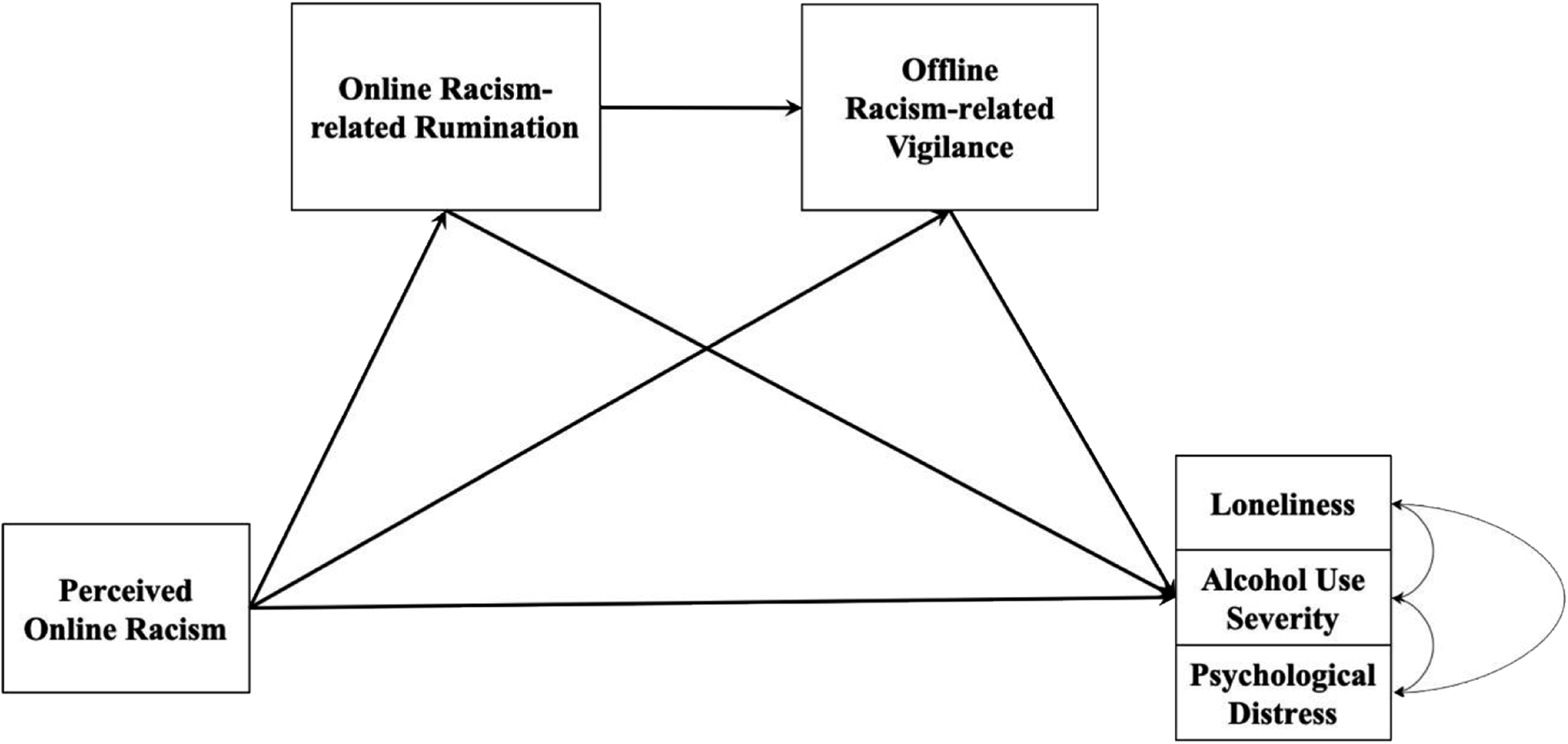
(H1) Online racism, online racism-related rumination, and offline racism-related vigilance would be significantly and positively associated with greater distress, loneliness, and alcohol use severity among racial minority adults (direct paths from online racism, rumination, and vigilance to outcome variables; Figure 1).
(H2) Online racism would be indirectly related to offline racism-related vigilance via online racism-related rumination; greater exposure to online racism would be related to greater rumination, which in turn would be related to greater vigilance.
(H3) Online racism would be indirectly related to loneliness, alcohol use severity, and psychological distress sequentially via online racism-related rumination and offline racism-related vigilance; greater exposure to online racism would be related to greater rumination, which in turn would be related to greater vigilance, which in turn would be related to greater psychological distress, loneliness, and alcohol use severity.
Additionally, given the differences across racial groups on their racism and vigilance experiences (e.g., Hicken et al., 2013), we conducted a posthoc multigroup analysis on the potential differences between racial groups (i.e., Black/African American, Asian/Asian American, and Hispanic/Latinx American) based on adequate sample sizes. Specifically, we examined whether racial minority groups differed in their levels of the study variables, as well as the significance of the hypothesized paths in the model. Although this analysis was exploratory, we anticipated that the hypothesized paths were more likely to be supported for the Black/African American group compared to other groups given the persistent portrayal of the brutal and violent nature of anti-Black racism (Jones et al., 2020) on the internet (H4).
Method
Participants
A convenience sample of 407 racial minority adults (Mage = 34.12, SD = 11.19) provided data for this study. About 57% of participants identified as women, 41% as men, and 2% as transgender. Approximately 40% of participants identified as Black/African American, 23% as Asian/Asian American, 20% as Hispanic/Latinx American, 9% as multiracial/multiethnic, 5% as Native American, 2% as Middle Eastern, and 1% Native Hawaiian/Pacific Islander. About 84% of participants identified as heterosexual, 9% as bisexual, 2% as lesbian, 2% as gay, 2% as asexual, and 1% as queer. On average, participants reported spending 5.80 hours (SD = 4.67) on the internet a day.
Procedure
The study was approved by the Institutional Review Board. Participants were recruited via convenience sampling by advertising study invitation messages in online groups on social media (e.g., Facebook, Reddit) with significant traffic by racial minority individuals. The survey was advertised as an assessment of participants’ online racial experiences. Participants were invited to participate in an online survey consisting of study variable measures and demographic items hosted by Qualtrics. The inclusion criteria for the study were: (a) 18 years old or older, (b) self-identify as a racial minority, and (c) living in the United States. Informed consent was provided and obtained from all participants. The survey took 15 to 20 min to complete and included two attention check items (e.g., “Please choose always”). Participants were provided an option to enter a raffle for a $50 Amazon gift card for completing the survey.
Measures
Perceived Online Racism
The Perceived Online Racism Scale (PORS) was used to assess participants’ exposure to racist online interactions and racist online content and information (Keum & Miller, 2017). Participants rated how often they had experienced online racism represented by each of the 30 items in the past six months on a 5-point Likert-type scale ranging from 1 (never) to 5 (all the time). Items span three domain subscales: Personal Experience of Racial Cyber-Aggression (14 items; “I have received racist insults regarding my online profile [e.g., profile pictures, user ID.”]), Vicarious Exposure to Racial Cyber-Aggression (five items; “I have seen other racial/minority users being treated like a second-class citizen.”), and Online-Mediated Exposure to Racist Reality (11 items; “I have been informed about a viral/trending racist event happening elsewhere [e.g., in a different location].”). The 30-item PORS was developed as a bifactor model, with the total scale score representing the general factor that accounts for unique shared variance across all items. As we were interested in assessing the collective online racism experience, we used the total scale score. Keum and Miller (2017) found good internal consistency for the measure (.94 or higher) and established concurrent validity via significant positive associations with racism-related stress, psychological distress, and unjust views of society. Measurement equivalence was demonstrated across four racial groups (Black, Asian, Latinx, and multiracial; Keum & Miller, 2017), gender (men, women), and age groups (younger to older adults; Keum & Miller, 2018b). Cronbach’s alpha for the total scale score was .96.
Alcohol Use Severity
The 10-item Alcohol Use Disorders Identification Test (AUDIT; Saunders et al., 1993) was used to assess participants’ risky or harmful alcohol consumption as well as alcohol dependence and abuse. The AUDIT items represent alcohol consumption (Items 1–3), drinking behavior/dependence (Items 4–7), and alcohol-related problems or consequences (Items 8–10), and are scored by summing all the items. The first eight items are scored on a 5-point Likert-type scale ranging from 0 to 4, and the last two are scored on a 3-point Likert-type scale with values of 0, 2, and 4. Total scores range from 0 to 40, with higher scores indicating more severe alcohol problems. The AUDIT cutoff score for harmful use of alcohol is generally recommended as 8, although for women a lower cutoff score of 5 or 6 is suggested (Reinert & Allen, 2007). The mean AUDIT score in our sample was 8.38 (SD = 8.32; Range: 0–39), with nearly 39% (n = 157) endorsing harmful alcohol use (score ≥ 8). The convergent validity of the AUDIT has been demonstrated via significant associations with other alcohol measures (e.g., McAndrew alcoholism screening test) and alcoholism vulnerability, and its criterion validity has been shown by positive associations with somatic and affective costs of drinking (Bohn et al., 1995). Cronbach’s alpha for the current study was .93.
Psychological Distress
We used the Kessler-6 (K6) to test for general psychological distress (Kessler et al., 2003). The measure includes six questions and asks the frequency of psychological distress symptoms such as depression and anxiety in the past 30 days on a 6-point Likert-type scale from 0 (none of the time) to 5 (all of the time). Items included the following: “felt hopeless,” “so depressed that nothing could cheer them up,” “worthless,” “nervous,” “restless or fidgety,” and “everything was an effort.” Scores range from 6 to 30, with higher scores indicating higher levels of psychological distress. Cronbach’s alpha was high in the development sample (α
Loneliness
The three-item Loneliness Scale (Hughes et al., 2004) was used to assess participants’ perceived loneliness. The three items assess how often participants lack companionship, feel left out, and feel isolated, measured on a 1 to 3 scale (1 = hardly ever, 2 = some of the time, and 3 = often). The average score across the three items is calculated, with higher scores indicating greater loneliness. Hughes et al. (2004) reported that the scale had acceptable Cronbach’s alpha (α = .72) in adult samples and was highly correlated with scores on the original Revised-UCLA Loneliness scale (r = .82, p < .001) and with scores on loneliness-related items in the Center for Epidemiologic Studies–Depression Scale demonstrating convergent validity. Cronbach’s alpha for the current study was .86.
Online Racism-Related Rumination
The five-item Perseverative Cognition subscale of the Prolonged Activation and Anticipatory Race-Related Stress Scale (Utsey et al., 2013) was used to assess the extent to which individuals engaged in rumination about online racism experiences. We modified the prompts to ask about participant rumination based on online racism experiences (changing “racism” to “racism on the internet”). Items such as, “Whenever I thought about my experience with racism on the internet (e.g., seeing a racist message, viral racist incident, etc.), I would typically think about it for . . .” were assessed for the duration (1 = did not think about it at all, 2 = less than 7 days, 3 = 7 to 30 days, 4 = 1 to 2 months, 5 = 2 to 5 months, 6 = 6 to 9 months, 7 = I still think about it), frequency (1 = not at all, 2 = once weekly, 3 = 2 to 3 times a week, 4 = 3 or more times a week, 5 = once a day, 6 = 2 to 3 times a day, 7 = more than 3 times a day), intensity (1 = did not think about it, 2 = less than 1 min, 3 = 1 to 5 min, 4 = 5 to 20 min, 5 = 20 min or more but less than 1 hr, 6 = could not stop thinking about it), and controllability (1 = never, 2 = rarely, 3 = sometimes, 4 = often, 5 = very often, 6 = all the time) of their thoughts. Higher scores reflected more rumination about online racism experiences. The Perseverative Cognition subscale has exhibited convergent validity with related constructs and adequate Cronbach’s alpha (α = .83; Utsey et al., 2013). However, the measure was developed with an African American sample and has not been validated for use with multiple racial minority groups. Thus, we conducted a confirmatory factor analysis and found a good fit (Comparative Fit Index [CFI] = 1.00; Root Mean Square Error of Approximation [RMSEA] = 0.000 [.000, .072]; Standardized Root Mean Squared Residual [SRMR] = .004) for our sample and all items significantly loaded with factor loadings ranging from .79 to .85. Cronbach’s alpha for the current study was .89.
Offline Racism-Related Vigilance
The abbreviated Heightened Vigilance Scale developed in the Chicago Community Adult Health Study (Hicken et al., 2013) was used in the study. It consists of four items asking participants how often they avoid certain situations and experiences in their daily lives due to anticipation of racial discrimination. Items are rated on a 5-point Likert-type scale from 1 (at least once a week) to 5 (never). Sample items include: “try to prepare for possible insults from other people before leaving home,” and “try to avoid certain social situations and places.” Responses were reverse-coded such that higher scores indicate greater racism-related vigilance in their offline experiences. The measure has been correlated with discrimination and negative health implications (Hicken et al., 2013, 2018) for concurrent validity. Cronbach’s alpha for the current study was .85.
Data Inspection and Analysis
A total of 922 participants accessed the survey. We removed 234 cases for not meeting the inclusion criteria, 78 for failing the attention check items, and 203 for missing more than 20% of the data. This resulted in 407 cases (44%) used in subsequent analyses. Little’s missing completely at random (MCAR) test was not significant, suggesting that the missing data pattern in our sample was completely random, χ2 (34) = 28.427, p = .691. Correspondingly, we used the expectation-maximization estimates for multiple imputations of the missing values in SPSS and calculated the mean or total scores for the corresponding scales, which were used in subsequent analyses. Next, we inspected the distribution of the total scores for the investigated variables and checked the normality of the data. Using the criteria that kurtosis and skewness between −2 and +2 suggest univariate normality (George & Mallery, 2010), all the variables were considered to have a normal distribution.
In the main analysis, we examined the proposed model with the full sample using the path analysis in the Mplus 8.0 software. Path analysis was used because this method can be used to simultaneously test a structural model with observed (instead of latent) predictors, mediators, and outcomes (Kline, 2015). To test the equivalency of the path model across the three different racial groups, we conducted a multigroup path analysis by comparing an unconstrained model that allowed the structural paths to be freely estimated across the three racial groups and a constrained model that fixed the corresponding structural paths to be the same across the three groups. If the constrained model shows significantly worse fit indices than the unconstrained model, the unconstrained model is adopted and it further suggests that the different subgroups have different path coefficients; otherwise, the constrained model is adopted due to the parsimony principle, indicating that the different subgroups do not show significant differences in their path estimates.
Results
Preliminary Analysis
To examine the statistical power in testing the hypothesized path model, we conducted a Monte Carlo simulation analysis according to the procedures outlined in Muthén & Muthén (2017). Specifically, we drew effect size estimates for each of the proposed paths (mostly ranging from .20–.35 as small to moderate effect sizes were previously reported) from previous empirical studies (e.g., Hicken et al., 2013, 2018; Utsey et al., 2013). Results after 10,000 repetitions indicated that with the current full sample of 407 participants, all path coefficient estimates exceeded the desired power of .80 except for one path from vigilance to alcohol use severity (power = .61). In terms of estimation accuracy, all estimation bias rates were below the recommended .05 threshold and the 95% coverage rates were also above the recommended .90 threshold (Muthén & Muthén, 2017), which supported the stability and accuracy of the yielded findings for the overall model. For the multigroup comparison analysis (see Results), the smallest subgroup included in the analysis was the Latinx group with 81 participants. And the Monte Carlo estimation showed that for a sample size of 81, only three of all the prediction paths did not achieve the desired power of .80 (for online racism → vigilance, power = .52; for vigilance → alcohol use severity, power = .21; and for online racism → distress, power = .66). However, all 95% coverage rates were above .90 and all bias rates were below .05. With the smallest subsample, three paths were underpowered to detect potentially significant associations (cautioning us against interpreting nonsignificant findings as a lack of true effects for these three specific paths), but the estimation accuracy reached the satisfactory threshold.
Descriptive Statistics and Bivariate Correlations of Investigated Variables
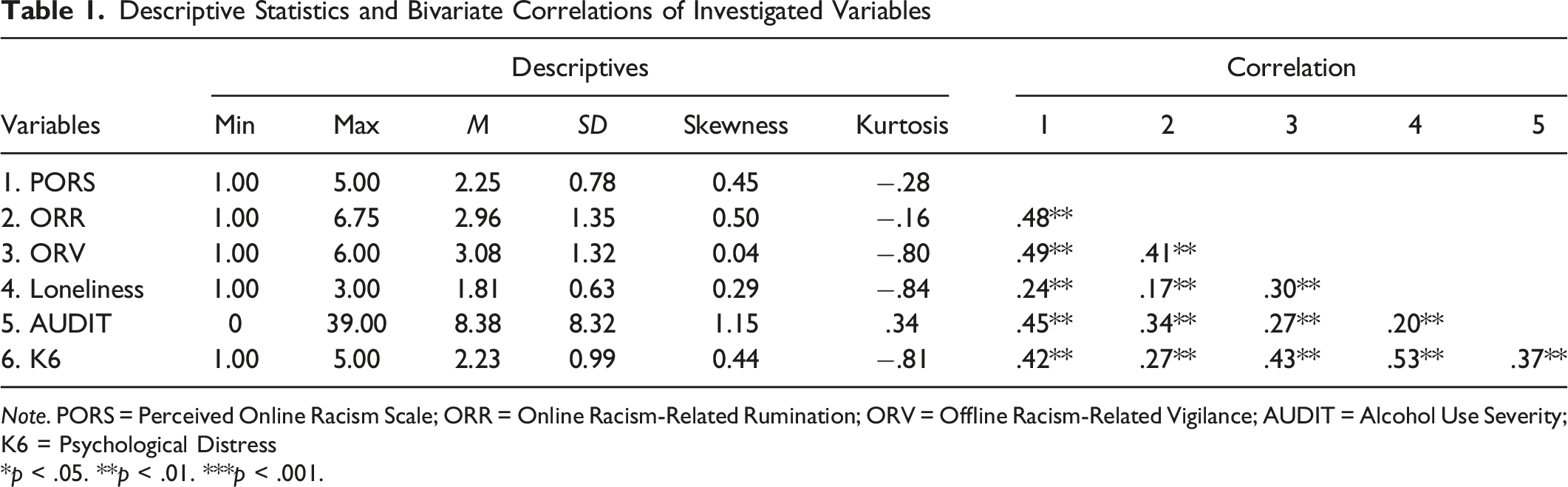
Note. PORS = Perceived Online Racism Scale; ORR = Online Racism-Related Rumination; ORV = Offline Racism-Related Vigilance; AUDIT = Alcohol Use Severity; K6 = Psychological Distress
*p < .05. **p < .01. ***p < .001.
Path Analysis for the Overall Model
Overall, model (Figure 1) fit indices suggested that our hypothesized model was saturated and just-identified: χ2 = 0, df = 0. Because model fit indices of a saturated, just-identified model do not provide meaningful information about how well the model actually fits the data (because in this case, the number of parameters in the model is equal to the number of data points thus df = 0), we inspected the specific paths and then constrained the nonsignificant paths to be 0 to free up needed degrees of freedom and obtain a more parsimonious model. If the more parsimonious constrained model has an adequate fit, it suggests that the constrained model should be adopted as the final model over the saturated model given the rule of parsimony (Kline, 2015).
In the saturated overall model, three regression paths were nonsignificant: loneliness on rumination, distress on rumination, and substance use on vigilance. Further, the residual correlation between loneliness and substance use was also nonsignificant. Therefore, we constrained these parameters to be 0 to free up degrees of freedom and examined the model fit indices of this more parsimonious constrained model: χ2 = 4.081, df = 4, p = .395; RMSEA = .007; CFI = 1.000; Tucker-Lewis Index (TLI) = .999; SRMR = .020. These results indicated that the constrained model fit the data well and was also not different from the saturated model (Δχ2 = 4.081, Δdf = 4, p = .395). Therefore, we elected to accept the parsimonious, constrained model as our final overall model and proceeded to inspect the specific path coefficients and the specific mediation (i.e., indirect) effects. To compute the indirect effects, we followed recommended practices in statistical texts (Hayes & Scharkow, 2013) and adopted the bootstrap method with 5,000 random samples, which has the advantage of not assuming a normal distribution and using randomly generated samples to more accurately determine the standard errors, confidence intervals (CI), and the significance of the indirect mediation effects. We used the 95% CI to examine the significance levels: if the 95% CI did not include zero, the estimates were considered significant at the p < .05 level.
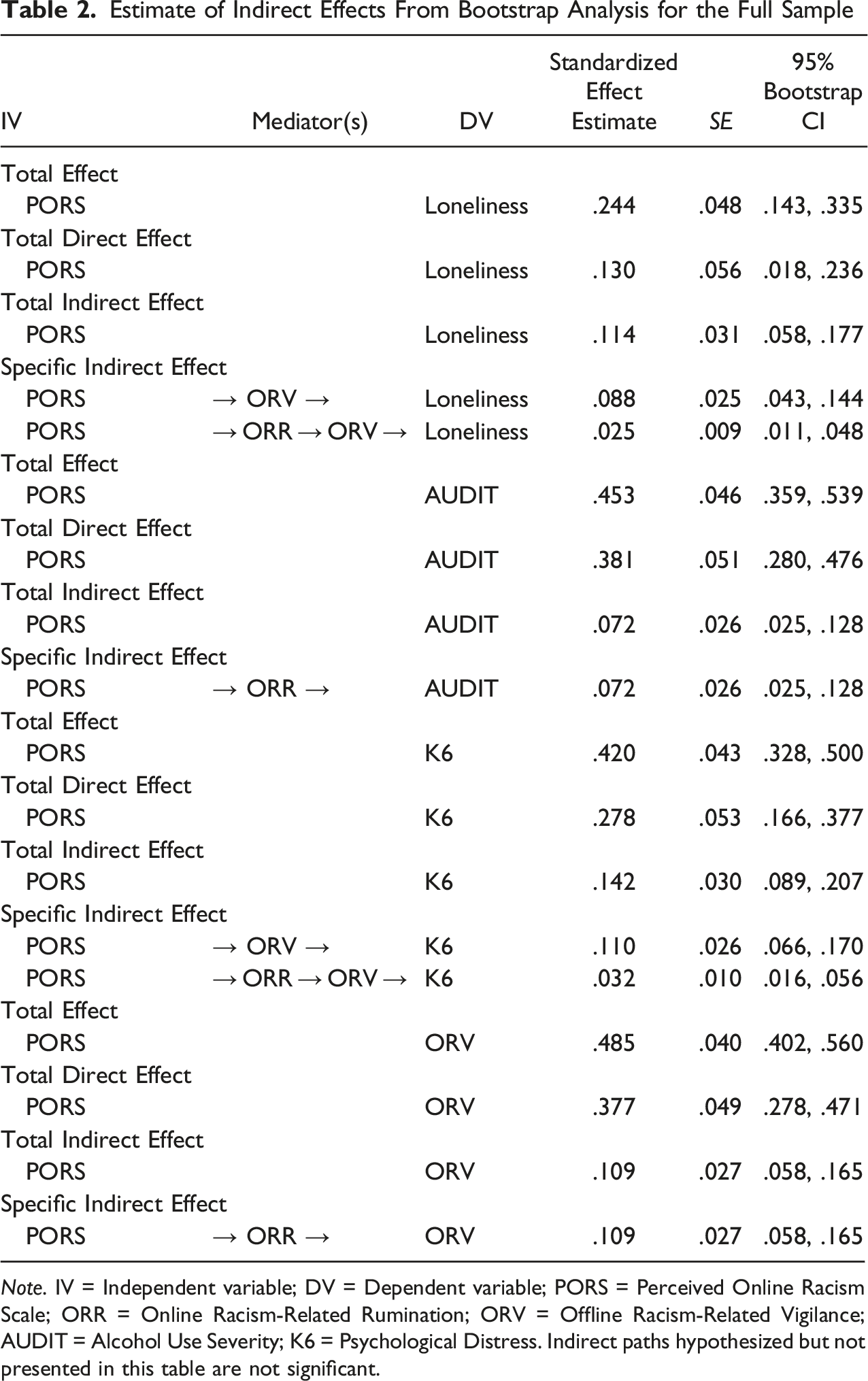
The completely standardized path coefficient estimates for the full sample are presented in Figure 2, and the significant total effect, direct effect, total indirect effect, and specific indirect effects are presented in Table 2. Online racism had significant total effects in predicting all three dependent variables of loneliness (standardized effect β = .244, 95% bootstrapped CI = [.143, .335]), alcohol use severity (standardized effect β = .453, 95% bootstrapped CI = [.359, .539]), and psychological distress (standardized effect β = .420, 95% bootstrapped CI = [.328, .500]). This suggested that if an individual reported greater online racism, that individual also tended to report higher levels of loneliness, alcohol use severity, and psychological distress. The significant total effects of online racism could be broken down into significant direct effects as well as significant indirect effects for all three dependent variables: for loneliness, 53.3% of variances were accounted for by the direct effect and 46.7% were accounted for by the indirect paths; for alcohol use severity, 84.1% of variances were accounted for by the direct effect and 15.9% were accounted for by the indirect effects; and for psychological distress, 66.2% of variances were accounted for by the direct effect and 33.8% were accounted for by the indirect effects. These results suggested that the hypothesized mediators partially mediated the links between online racism and loneliness, alcohol use severity, and psychological distress. Estimated Path Model with the Full Sample Estimate of Indirect Effects From Bootstrap Analysis for the Full Sample Note. IV = Independent variable; DV = Dependent variable; PORS = Perceived Online Racism Scale; ORR = Online Racism-Related Rumination; ORV = Offline Racism-Related Vigilance; AUDIT = Alcohol Use Severity; K6 = Psychological Distress. Indirect paths hypothesized but not presented in this table are not significant.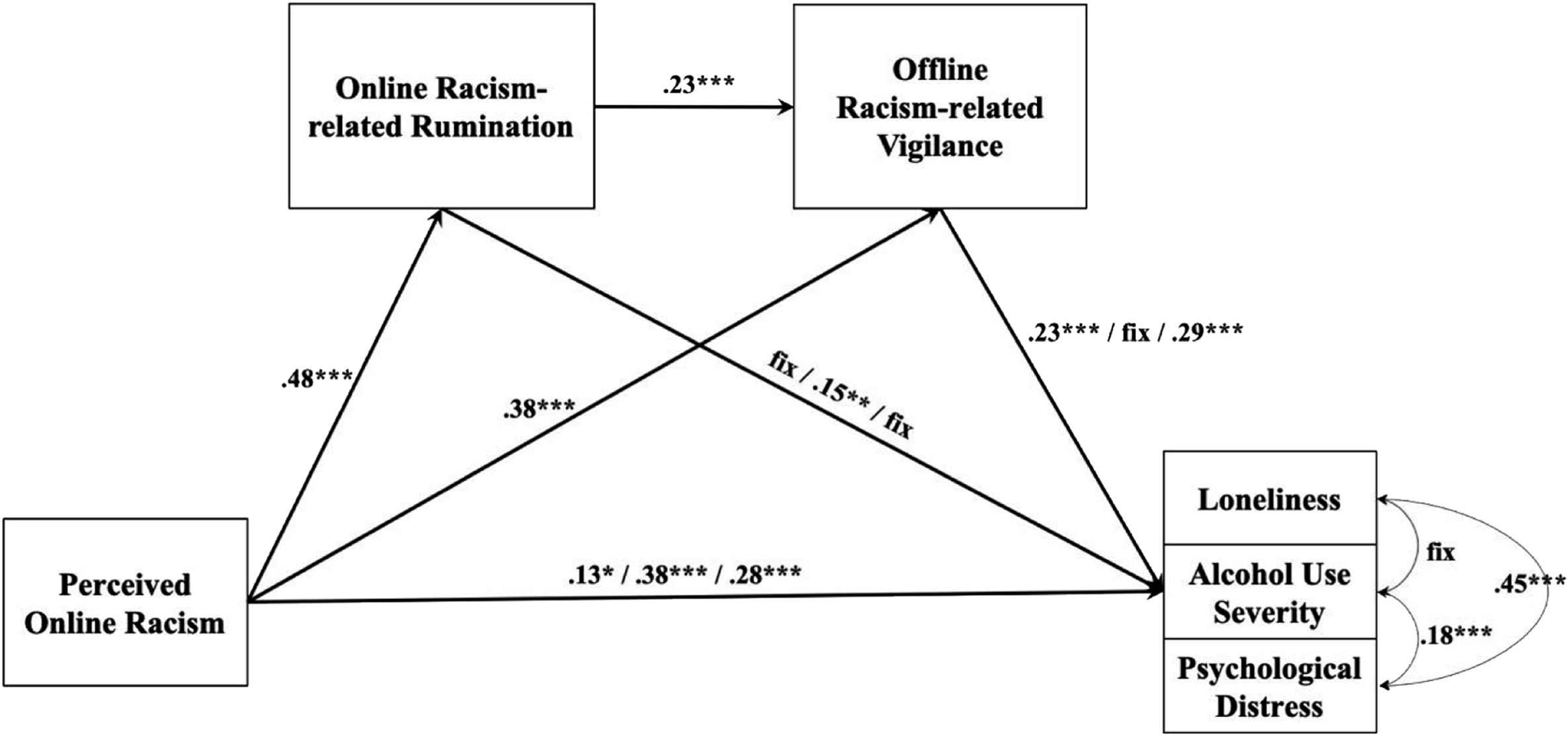
Examining the bivariate correlations in Table 1 and the specific path coefficients and mediation effects, results provided full support to our Hypothesis 1, that PORS, ORR, and ORV about racism were all significantly related to higher loneliness, increased alcohol use severity (AUDIT), and higher psychological distress (K6) with small to medium and medium to large effect sizes (Cohen, 1988).
In terms of the specific indirect pathways, our results supported Hypothesis 2 and revealed a significant overall association between PORS and ORV (standardized total effect β = .485, 95% bootstrapped CI = [.402, .560]) and a partial mediation effect of ORR (standardized indirect effect β = .109, 95% bootstrapped CI = [.058, .165]) in this relationship. Thus, greater PORS was associated with greater ORR, which in turn was associated with greater ORV.
Furthermore, our results provided partial support to Hypothesis 3 and suggested that the specific indirect pathways differed between the three dependent variables. For loneliness and psychological distress, we observed two significant indirect paths both involving ORV: PORS → ORV → Loneliness/K6 (standardized indirect effect βs = .088 and .110 respectively), and PORS → ORR → ORV → Loneliness/K6 (standardized indirect effect βs = .025 and .032 respectively). However, for AUDIT, we observed a different indirect pathway involving only ORR: PORS → ORR → AUDIT (standardized indirect effect βs = .072) and the path with ORV included was nonsignificant.
Based on the availability of adequate sample sizes, we compared whether the three racial groups (Black/African American, Asian/Asian American, Hispanic/Latinx American) in our study differed in their mean values of the six investigated variables. Analysis of variance (ANOVA) results are tabulated in Table 3. The three racial groups showed significant differences in their total scores of PORS, F(2, 329) = 3.240, p = .040, and ORR, F(2, 329) = 5.630, p = .004, but not on the other four variables. Posthoc pairwise comparisons with Tukey’s correction suggested that Black/African American participants reported PORS scores at significantly higher levels than Asians/Asian Americans did (mean difference = .231, p = .028), and at almost significantly higher levels than Hispanic/Latinx American participants (mean difference = .212, p = .050), whereas Asian/Asian American and Hispanic/Latinx American mean online racism scores did not differ significantly. A similar pattern was also found for ORR, where Black/African American participants reported significantly higher levels than Asian/Asian American (mean difference = .372, p = .035) and Hispanic/Latinx American (mean difference = .576, p = .002) respondents, while the mean scores for Asian/Asian American and Hispanic/Latinx American groups did not show significant differences. Given the significant differences in the mean levels of online racism and ORR between the three racial groups, we proceeded to further test whether the hypothesized model (i.e., the direct and indirect effects between online racism and psychosocial outcomes), would be equivalent or different across the three groups. Model fit indices showed that, for the unconstrained model, the hypothesized model was saturated and just identified: χ2 = 0, df = 0. The constrained model also showed good overall fit indices: χ2 = 11.982, df = 24, p = .980; RMSEA = .000; CFI = 1.000; TLI = 1.000; SRMR = .043. Because these two models were nested, we conducted a chi-square difference test: Δχ2 = 11.982, Δdf = 24, p = .980. This indicated that the overall fit for the constrained model did not differ from the unconstrained model, meaning that when we fixed the structural paths to be equal across the three racial groups, the overall model fit did not become worse compared with the unconstrained model. This suggested that, contrary to Hypothesis 4, our hypothesized structural path model did not show significant differences across the three groups and that our previous model estimates for the full sample applied equivalently to the three racial groups.
Comparison Between Racial Groups Regarding Mean Values of Study Variables
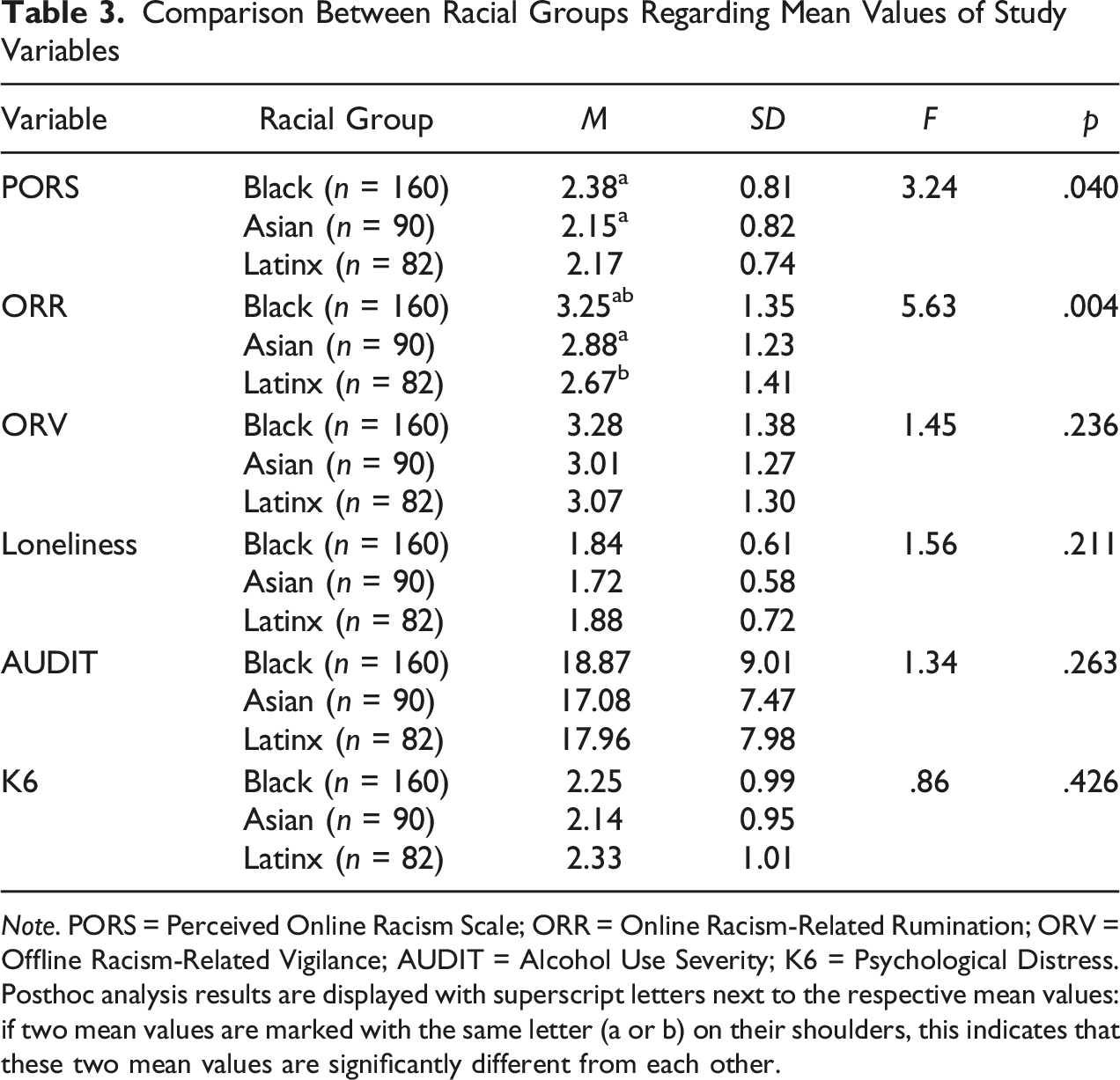
Note. PORS = Perceived Online Racism Scale; ORR = Online Racism-Related Rumination; ORV = Offline Racism-Related Vigilance; AUDIT = Alcohol Use Severity; K6 = Psychological Distress. Posthoc analysis results are displayed with superscript letters next to the respective mean values: if two mean values are marked with the same letter (a or b) on their shoulders, this indicates that these two mean values are significantly different from each other.
Discussion
In today’s digital era, the constant and explicit exposure to racism on the Internet carries a potential risk for racial minority individuals to develop heightened anticipation of discrimination in their surroundings and social interactions with others. Given the pervasive amplification of racism as a chronic stressor (Carter, 2007; Williams et al., 2018) in online spaces (Keum & Miller, 2017), rumination about online racism experiences and subsequent offline racism-related vigilance are likely salient responses contributing to poorer psychological well-being and risky coping approaches (e.g., substance use) among racial minority individuals (Hicken et al., 2013; Utsey et al., 2013; Watson-Singleton et al., 2021). We found partial initial evidence of this process, as online racism-related rumination and offline racism-related vigilance were significant serial mediators in the link between online racism and psychosocial costs with different pathways depending on the outcome; online racism predicted loneliness and distress via rumination and vigilance, whereas only rumination was a significant mediator in predicting alcohol use severity. The findings show the significant offline implications of online racism and the potential anticipatory factors in understanding the psychosocial costs.
As hypothesized (H1, H2, H3), greater online racism-related rumination was associated with greater offline racism-related vigilance, which, in turn, was associated with greater loneliness and psychological distress. The result on loneliness is particularly concerning, as mounting evidence in the literature (Holt-Lunstad et al., 2015; Valtorta et al., 2016) suggests loneliness is a risk factor for greater mortality rates and a host of detrimental psychological (e.g., depression) and health outcomes (e.g., heart disease). As most studies on loneliness and well-being have typically overlooked the role of racism (Holt-Lunstad et al., 2015; Valtorta et al., 2016), our findings suggest that online racism and the associated anticipatory attitudes and behaviors may be risk factors associated with loneliness among people of Color. For individuals exposed to online racism and engaged in racism-related vigilance as a coping strategy (Himmelstein et al., 2015), there is likely a cost of social isolation in their offline world. Collectively, findings portray the difficult reality of an unjust burden among racial minority individuals as their engagement in vigilance as a coping method may not be a choice but rather a method of survival potentially reinforced by exposure to online racism in a world where one can easily and readily encounter racist hate speeches, violent content, and information on systemic inequalities against racial minority individuals (Keum & Miller, 2018a).
Online racism was also significantly associated with alcohol use severity, however, only rumination about online racism experiences explained the significant indirect relation (H1, H2). Given that increased rumination resembles a stressful state (e.g., Hicken et al., 2013; 2018), greater alcohol use severity may reflect racial minority individuals’ efforts to cope with the psychological toll (Carter, 2007; Keum & Cano, 2021). Within the context of racial trauma (Carter, 2007; Williams et al., 2018), online racism likely adds an additional dimension of racism-related stress to people of Color navigating online spaces. Interestingly, the lack of significant indirect association via vigilance suggests that this may be a distinct pathway suggesting a psychologically motivated behavior (Watson-Singleton et al., 2021), whereas vigilance may be a socially motivated behavioral strategy to deal with the anticipation of discrimination (Hicken et al., 2018). Yet, both strategies likely incur costs of well-documented health risks among racial minority individuals, such as alcohol abuse, addiction, depression, and suicidal ideation associated with loneliness (Carter, 007; Salvo & Castro, 2013; Williams et al., 2018).
Finally, contrary to Hypothesis 4, our multigroup analysis suggests that the anticipatory pathway via online racism-related rumination and offline racism-related vigilance associated with online racism is likely similar across Black/African America, Asian/Asian American, and Hispanic/Latinx American groups. Although group differences exist in the context and frequency of racism experiences, the findings suggest a common pathway in how the anticipation of racism can affect these racial minority groups. For example, Hicken et al. (2013) found that greater racism-related vigilance was associated with sleep difficulty among Black and Hispanic adults (Hicken et al., 2013). Ong et al. (2017) found that greater stigma consciousness among Asian Americans exacerbated the impact of racial microaggressions on their sleep disturbances. It must be noted though, that the differences we found in scores of online racism and online racism-related rumination suggest that the findings may be most salient for Black/African American adults. The difference is not surprising given the persistent brutal and violent nature of anti-Black racism in the United States (Mosley et al., 2021) that translates to greater health disparities among Black individuals (Hicken et al., 2013). For instance, Hicken et al. (2013) found that racism-related vigilance played a greater role in explaining the sleep difficulty disparity between Black and White individuals compared to Latinx and White individuals. These findings reflect the nuanced challenges of online racism faced by Black/African Americans, as well as the equivalent applicability of the model tested for the three racial groups.
Limitations
Although we present much-needed initial evidence in understanding the costs associated with online racism, our findings need to be interpreted with caution given several limitations. First, the cross-sectional design of this study does not allow for the test of directionality or causality among the variables. Although we developed our path model based on the racism-related anticipatory responses noted in the existing empirical literature, the cross-sectional nature of our data precluded a direct test of the directionality and causality implied in the path model. Second, the generalizability of our results is limited given the use of convenience sampling and sample-dependent characteristics. For example, we conducted our multigroup analyses only on the Black/African American, Asian/Asian American, and Hispanic/Latinx American groups due to the sample size constraints. Other racial groups (e.g., Native American, biracial, or multiracial) were not included in the analysis. Although this was a statistical compromise, we recognize the limitation of not including specific racial minority groups that are least represented in the population. There is also the possibility of a selection bias as participants self-selected into the study survey which may have biased the results of our findings. For instance, those who are more exposed to the experiences of online racism may have elected to participate in the study. Third, although previous studies found that online racism accounts for a unique significant variance in psychological outcomes (Keum & Miller, 2017), offline-specific forms of racism were not controlled in our findings. Thus, our findings should be replicated and extended in future studies to illuminate the intricacies and interplay between online and offline racism. Fourth, the scale that was adapted to measure online racism-related rumination was not validated for use with a sample with multiple racial minority groups. The role of rumination associated with online racism should be replicated in future studies with a measure that is psychometrically rigorous.
Implications for Practice, Advocacy, Education, Training, and Research
Our findings suggest an initial direction on understanding how online racism may contribute to psychosocial costs among racial minority individuals. In continuing to build empirical evidence on this process, our tests of the anticipatory factors (online racism-related rumination and offline racism-related vigilance) as mediators must be replicated and extended using a more representative, longitudinal sample. A short-term (e.g., daily dairy) or long-term (e.g., multi-year data collection) longitudinal study would be necessary to discern the temporal cascade of online racism-related rumination, offline racism-related vigilance, and additional risk factors that can further exacerbate this process. For example, Miranda et al. (2013) found that the brooding subtype of rumination, but not the reflecting subtype, mediated the impact of perceived discrimination on depressive symptoms. It is likely that certain subtypes of rumination may contribute to the differences in the risk of rumination and vigilance associated with online racism. Examining gender and sexual orientation differences or employing intersectional measures of online oppression can also shed light on how this anticipatory pathway may differ or worsen for racial minority individuals who hold other marginalized identities (e.g., racial minority women) in addition to race (Keum et al., 2022). Future studies should also identify mediators and moderators of this pathway such as social support and organizational advocacy initiatives that can inform intervention development to mitigate the harmful costs of online racism at multiple levels (e.g., individual- or group-level).
We emphasize that system-level prevention and advocacy are needed in dismantling online racism and that it is never racial minority individuals’ responsibility to address this issue. Notably, policies that enforce organizations (e.g., social media platforms) to restrict the spread of online racism and hate speeches should be implemented, and critical education and awareness development must take place at multiple levels in society (e.g., schools, and workplaces) to collectively create a safe and just online world where there is zero tolerance for racism. Our findings suggest the harmful consequences of online racism toward racial minority individuals which can inform policymakers and social media platforms.
Although our findings are not based on data from clinical settings, there are several clinical implications that could be drawn for practice and training. Our findings suggest that online racism-related rumination and offline racism-related vigilance may be important to consider in mitigating the psychological costs associated with online racism. At the individual level, therapists and trainees could consider intentionally exploring the impact of online racism with their racial minority clients and whether they are engaging in any rumination and vigilance. Given the stressful state of engaging in rumination and vigilance, mental health professionals could help racial minority individuals counter online racism experiences before they are significantly internalized and lead to unhelpful or risky stress reduction behaviors such as alcohol use. It may be helpful to facilitate these individuals to develop critical media literacy to evaluate online racism experiences and racist content (Scharrer & Ramasubramanian, 2015) to externalize self-blame or disengage from internalization. At the group level, particularly regarding loneliness and psychological distress, online or offline support systems may be helpful to counter the perceptual influence of online racism on individuals’ offline experiences. Notably, it may be helpful for therapists and trainees to help their clients identify counterspaces, whether in online social media platforms or offline organizational settings such as workplaces, that validate the negative impact of online racism and provide a sense of communal support.
Footnotes
Declaration of Conflicting Interests
The author(s) declared no potential conflicts of interest with respect to the research, authorship, and/or publication of this article.
Funding
The author(s) received no financial support for the research, authorship, and/or publication of this article.
