




Abstract
In the context of Russia’s war in Ukraine, the status of neutrality or military non-alignment is facing deeper challenges since its expected demise in the post–Cold War period. This article explores the gendered and emotional politics of neutrality and its relationship to peace and security. Neutrality has consistently been conceived as an irrational security option for weak states that refuse to bandwagon. ‘Hegemonic’ or ‘disciplining’ discourses of neutrality have conditioned current debates about alliances and security threats, and are imbued with gendered binaries and logics. Such discourses – textual, visual and other – are important because they reveal how neutrality has been positioned in relation to war, peace, morality and agency, and how such positioning constrained the possibilities for thinking about the ‘peace potential’ of neutrality. However, the gendered and emotive history of neutrality also contains a complexity that can be overlooked if simply understood in terms of binary discourses of weakness and irrationality. Inverted gender and emotional codings are also at work in discourses about neutrality. Seeing this complexity in terms of gender and emotions is critically important for conceptualising peace and security beyond narrow confines.
Introduction
Russia’s war in Ukraine has revived debates about the value of neutrality. Ukraine, which adopted a permanent neutrality status upon gaining independence in 1990, pursued ambitions of European Union (EU) and North Atlantic Treaty Organization (NATO) membership at alternating times in the 2000s (Allison, 2022). In March 2022, President Volodomyr Zelensky offered to return Ukraine to a neutral status and not seek NATO membership. This brief revival of neutrality was debated as both naïve (Kuldkepp, 2022) and a potential pathway to restore peace (Charap, 2022). As the prospect of neutrality for Ukraine receded, in Finland and Sweden, revision was also taking place. After Finland initially insisted that its policy of military non-alignment 1 would withstand times of crisis (Teivainen, 2022) and Sweden reiterated its belief that joining NATO would ‘further destabilise . . . and increase tensions’ in Europe (Milne, 2022), both countries quickly changed their stance. As a result of renewed security assessments and in response to a marked shift in public opinion, Finland and Sweden both announced their intention to apply for NATO membership on 15 May 2022. Finland became the 31st member of NATO on 4 April 2023.
That neutrality was briefly considered a peace option for Ukraine and one that served Finnish and Swedish national security well until Russia’s invasion prompts pause for reflection amid the global focus on NATO’s now doubled border with Russia. The question of neutrality as a peace option is one that is often subsumed in debates about neutrality as a security option for states. International Relations theory largely ignores neutrality or predominantly theorises it in realpolitik terms as the choice left available to small or weak states that suffer the misfortunes of geography (Agius, 2013 [2006]; Joenniemi, 1988; Karsh, 1988b). Post–Cold War, it was expected that European neutrals would adapt to European security cooperation (Bailes et al., 2006; Bebler, 1992; Ojanen, 2003) or that neutrality would simply endure a ‘death by irrelevance’ (Cox and Macginty, 1996: 123). But during the Cold War, neutrality was briefly seen as a radical or peaceful option (Binter, 1985; Joenniemi, 1989), largely due to its ‘good offices’ and active internationalism (Goetschel, 2011; Karsh, 1988a), with some even proposing that there might be a ‘renaissance’ of neutrality in the post–Cold War era which could contribute to a peace order (Binter, 1992). Constructivist, interpretivist and post-structuralist analyses of neutrality emerged in the late 1990s to challenge some mainstream assumptions and explain neutrality’s persistence and its relation to identity (Agius, 2013 [2006]; Aunesluoma and Rainio-Niemi, 2016; Browning, 2008; Bukovansky, 1997; special issue Cooperation and Conflict, 2011; Devine, 2008; Ejdus, 2014; Goetschel, 1999; Steele, 2008). Yet neutrality continued to be edged out of official discourse as a foreign and security policy centrepiece. The widened security agenda of non-traditional threats and active engagement in security initiatives as part of NATO and the EU saw European neutrals transition into ‘post-neutrals’ (Agius, 2011; Möller and Bjereld, 2010). The ‘peace potential’ (Joenniemi, 1989) that was once briefly anticipated has especially diminished in the current context of Ukraine.
Amid the seemingly unproblematic glide from military non-alignment to NATO membership, this article aims to foreground the rationalities that underpin mainstream understandings of neutrality in relation to peace and security. It makes the argument that key claims and associations about that rationality and desirability of neutrality are threaded through with gendered logics and assumptions centred on weakness, emotionality and morality. Moreover, the gendered meanings that have shaped the ‘hegemonic discourses’ of neutrality (Agius, 2011) are emotionally framed (Koschut, 2020) in relation to ‘right behaviour’ or ‘appropriate’ understandings of sovereignty, war and peace. As such, they contain a productive ‘disciplinary power’ (Hagström, 2021a: 145). These ‘hegemonic discourses’ of neutrality set the parameters for war and peace, and how neutrality is viewed in the present.
This article will explore the emotional and gendered constructions of neutrality and ideas about peace and security that are embedded in these ‘hegemonic discourses’. It commences with a reflection of gendered approaches to international violence, peace and security, focusing on the gendered binaries and the emotional politics that construct ideas about neutrality. Drawing primarily on examples of western representations and discourses of neutrality – textual, visual and aural 2 – I then illustrate how neutrality has largely been portrayed as irrational and feminised in relation to peace and security. However, the gendered and emotional framings of ‘being neutral’ also exhibit a more complex relationship, at times confounding mainstream perceptions of neutral states and presenting alternative readings of neutrality and how it might produce peace and security. This complexity is important to analyse. While neutrality may be disappearing in the current context of the war in Ukraine – and this article does not suggest neutrality is unproblematic 3 – understanding what contributes to its demise is important in terms of what options for peace and security remain available and acceptable for states.
Discourses of peace and security: Neutrality, gender and emotions
Peace and security have been central concepts in the evolution of neutrality. 4 The refusal to join an alliance or participate in war has been justified in terms of promoting peace and maintaining security, but often the two concepts are inflated or seen as interchangeable. As Waever (2008: 101–103) observes in the western context, both peace and security entail negative and positive meanings, from the Roman pax which defined security as a ‘state of mind’ and the absence of violence guaranteed by hegemony, to Galtung’s (1964) negative (the absence of war or violence) and positive (the integration of human society) peace formulation. Both concepts competed or gained ascendancy at different times, but in the post-war era, national security dominated, and peace research was seen as ‘idealism’ pitted against realism (Lawler, 1995: 2). In the 1980s, Buzan (1984) argued that security as a concept was better placed than peace and power to apprehend anarchy and the arms race, and that ‘the peace view is vulnerable to emotional idealism’ in its focus on the individual and international level rather than the state level (p. 120). In the Cold War context, as security was increasingly tied to national security, states calibrated their positions in relation to ideas of security and peace often in these binary, hierarchical terms. Over time, security became attached to official statements about neutrality or ‘military non-alignment’, a less ideological or Cold War–associated label (Agius, 2011).
In mainstream accounts of neutrality, the narrowing of peace in relation to security tells a partial story and sets the parameters of how neutrality is conceptualised. Through a gender lens, feminist understandings of peace and security can open different ways of thinking about neutral states. To date, conceptualisations of neutrality have endured a curious gender ‘blind spot’, with only a small amount of literature analysing neutrality from a gender perspective (Agius, 2018; Åse, 2016; Kronsell, 2012; Löffler, 2019). Feminist scholarship and methodology have analysed how gender structures international politics and conditions mainstream theorising of war and peace, and narrows definitions of national security (Enloe, 2014; Peterson, 1992a; Tickner, 1988). In empirical analyses, feminist researchers have demonstrated that gender plays a role in understanding how war affects women differently, and how and where women play a role in peace and security. Feminist research has demonstrated the gender gap in support for war (Boulding, 1984; Brooks and Valentino, 2011; Eichenberg, 2003; Eichenberg and Stoll, 2012; Wagnsson et al., 2020) and how gender equality domestically relates to state violence and militarism (Caprioli, 2003; Caprioli and Boyer, 2001). Women also played a significant role in supporting peace and neutrality (Alonso, 1998; Andersson, 2009) and, in some surveys, tend to show stronger support for peace, diplomacy and neutrality/military non-alignment than men. 5
While cautious of essentialist claims about the relationship between gender, war and violence, feminist theories of peace aim to move beyond war and militarisation to include dynamic understandings of peace that are relational and evolving (Wibben et al., 2019: 87). In particular, feminists have argued that theories of peace can be strengthened by the inclusion of gender. Confortini has argued, for example, that Galtung’s theory of direct, structural and cultural violence omits gender as a category. This omission is consequential for understanding how gender works as a social construct in relation to understanding and embodying power relations and identities, making visible dichotomous categories that produce and reproduce violence and how language constitutes ideas of violence and peace (Confortini, 2006: 333). For Peterson (2010), gender is an analytical category, a ‘signifying system of masculine-feminine differentiation that constitutes a governing code’ (p. 18). Moreover, gender is socially constructed and productive – a ‘central organizing discourse’ – shaping the subjective identities through which we act in the world, but also ‘interweaves with other discourses and shapes them’ (Cohn, 1993: 228, italics in original Peterson, 1992a: 9).
Feminist theorising has shed light on how mainstream conceptualisations of International Relations are structured upon hierarchical binary relationships that are dependent upon each other (such as international/domestic; rational/irrational; strong states/weak states; order/anarchy; man/woman). These binaries are central to neutrality. In the foundational story of power politics in Thucydides’ account of the Melian Dialogue (416BC) in the Peloponnesian War, the meanings attached to neutrality are established along key binaries (weak/strong; rational/irrational; wise/naïve). Neutrality is presented as the naïve choice of the powerless Melians, who appeal to Athens to remain neutral in its war with Sparta. Athens rejects this position because allowing Melos to remain neutral makes Athens appear weak. Furthermore, Melos appeals to Athens on moral grounds and as equals, a position Athens refuses, and the ‘timeless’ lesson is given: ‘might is right’ and the ‘weak suffer what they must’ (Thucydides, 1951: 332). Neutrals are portrayed as naïve and irrational, relying on unwise statecraft and ‘hope, danger’s comforter’ (Thucydides, 1951: 333). This lesson is later echoed in Machiavelli’s (1995) caution that: ‘Princes who are irresolute usually follow the way of neutrality in order to escape immediate danger, and usually they come to grief’ (pp. 71–72). Peterson’s (1992b: 35–37) feminist analysis of the Athenian polis identifies the binaries between a masculine Athens and a feminised Melos, and that the subjectivity of each is relational. These ‘foundational dichotomies privilege the first term at the expense of the second, and their deployment implicitly or explicitly valorizes the attributes of the first term’ (Peterson, 2000: 12). Over time, such hierarchies allocate neutrality a specific role and category. When afforded some rights (in international law in trade and freedom of the seas) and recognition (Grotius acknowledged neutral ‘good offices’), these were second to belligerent rights (Raymond, 1997: 124; Walzer, 1992: 246).
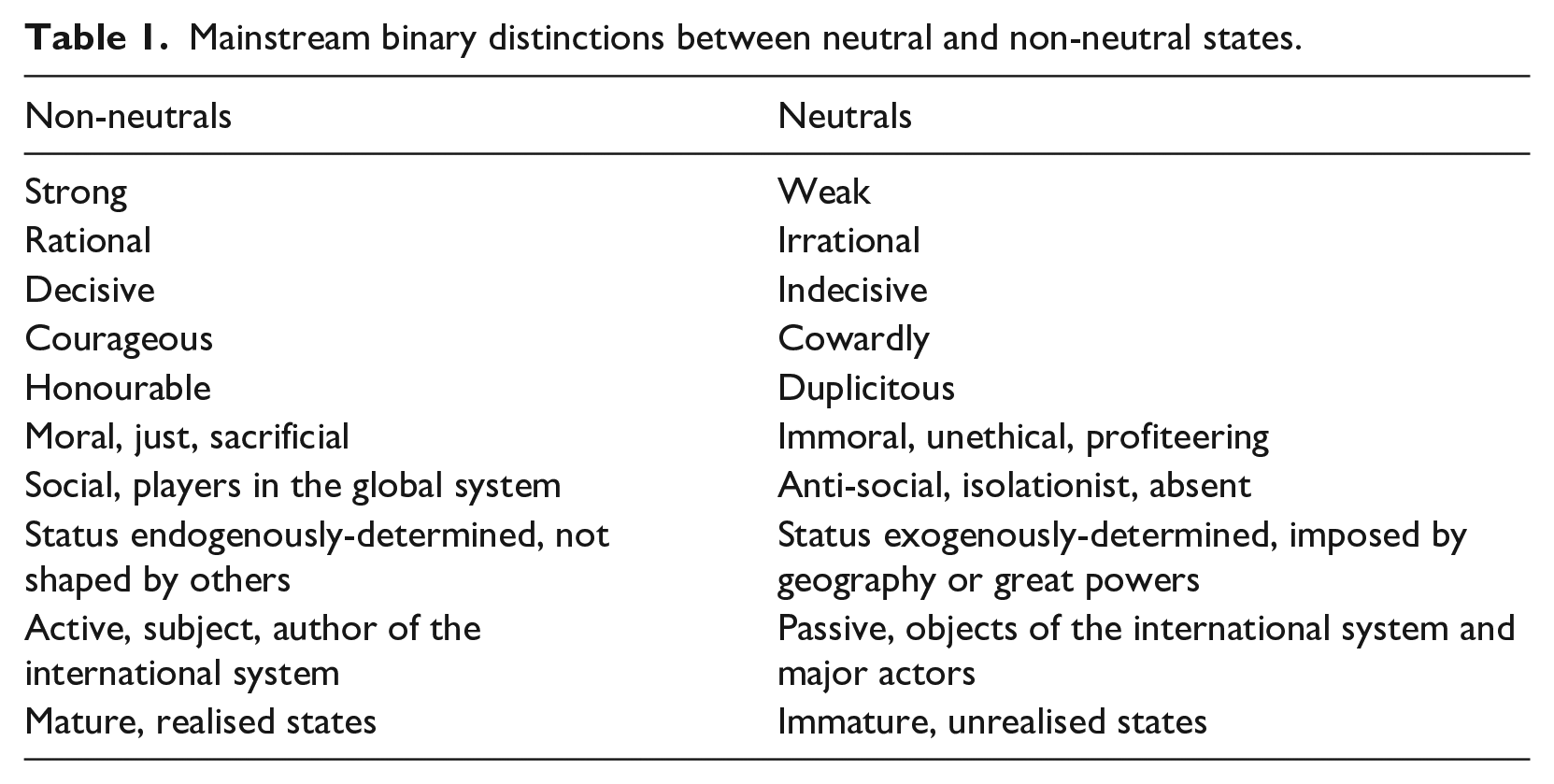
The agency and moral standing of neutral states is also hierarchically designated. Post-war Austria is often described as a ‘neutralised’ state, and ‘Finlandisation’ describes an imposed neutral status, relegating these countries to a submissive position with little agency (which is deeply contested, as discussed below). Neutral states have been understood in gendered terms as immature, childlike or duplicitous. The historian Roderick Ogley (1970) stated that ‘[n]eutrality is rather like virginity. Everybody starts off with it, but some lose it quicker than others, and some do not lose it at all’ (p. 1). Swiss author and dramatist Friedrich Dürrenmatt (1921–1990) said ‘[t]his passionate will [of Switzerland] to remain neutral makes me think of a virgin who earns her living in a bordello but wants to remain chaste’ (Tempest, 1991). During the First World War, Sweden was depicted as a degenerate and feminine ‘parasite’, profiteering from the war (Sturfelt, 2011: 111) and a ‘modern Jezebel’ for its wartime cooperation with Nazi Germany and the Allies at different stages of the Second World War (Joesten, cited in Steene, 1989: 170). Neutrals have been seen as ‘free-riders’ who do not contribute to security but selfishly benefit from war. As Helen Dexter (2019) argues, positions that reject war, such as pacifism, 6 are ‘largely invisible in the discipline of international relations’ (p. 245). To varying degrees, neutral states have been considered aberrations, outside the binary friend/enemy distinction (Schmitt, 1996) in International Relations. What Visoka and Lemay-Hébert (2022) identify as a process of ‘normalisation’ of world politics relies on different ‘normalization strategies as disciplinary techniques’ (p. 26). Reproducing the binaries that have come to define neutrality (see Table 1), it is possible to see how mainstream ideas of International Relations have relegated neutrality to subordinate positions, and how those associations are not simply hierarchical but are emotionally charged and constructed.
Mainstream binary distinctions between neutral and non-neutral states.
Feminist scholarship has long considered how emotions shape international politics, and importantly, ‘how emotions should enter our scholarship’ (Sylvester, 2011: 687). Crawford describes emotions at the most basic level as ‘inner states’ such as feelings, ‘. . . subjective experiences that also have physiological, intersubjective, and cultural components’ (Crawford, 2000: 125). While International Relations has until recently largely ignored the role of emotions, its major theoretical debates rely on emotions that ‘are not only attributes of agents, they are institutionalized in the structures and processes of world politics’ (Crawford, 2000: 116–120; see also Mercer, 2006). The idea of nationalism is founded on love of the nation or animosity towards other nations. ‘Love’, for example, as Hartnett (2023) claims, ‘performs the work of order . . . and is a form of productive power’. The Melian Dialogue is based on fear of loss of Athenian power (Crawford, 2000: 120). Realist theorising of human nature and insecurity is based on fear and long-standing paradigms like deterrence assume rationalist calculations of threats that are driven by uncertainty.
Emotions, as Koschut (2020) states, underpin social relations but ‘those relations are also power relations’ (p. 4). Hutchison and Bleiker (2014: 497) distinguish between macro (‘general theories of how emotions matter in world politics’) and micro (‘how specific emotions gain resonance in particular political circumstances’) approaches. These different levels of analysis not only can show how emotions function but also can argue how they are interconnected and organised hierarchically. Gustafsson and Hall (2021: 973) note the ‘distributive politics of emotion’ in International Relations takes on forms that include rights (to feel/not feel emotions), duties (emotional obligations) and hierarchies (whose emotions take precedence). In the case of neutrality and the emotive and disciplining debates that have governed it in specific cases, seeing how interpersonal or individual emotions structure the terms of discourse is revealing. In analysing Swedish debates and discourses on neutrality and NATO across social media, in editorials and in interviews with campaigners and influencers, Hagström (2021a; 2021b) identifies how emotions played a role in constructing threats as rational and shaming those (including himself) who question NATO as immature, naïve or pro-Putin and untrustworthy.
In this vein, it is important to grasp the significance of ‘what the emotional, however defined’, does (Åhäll, 2018: 43); emotions are productive and are part of the binaries that construct our understandings of security and peace. Hutchison (2019) states that ‘emotions are social phenomena that are shaped through cultural environments and the practices of representation and discourse that give meaning within those environments’ (p. 294). Moreover, emotions are not just associated with ‘the personal, the body, the feminine’ (Åhäll, 2018: 37), but are also embodied. During the Middle Ages and the Crusades, Christian unity demanded the individual to be one with the body politic; neutrality risked ‘castration’ from the order itself (Politis, 1935: 37). In Dante’s Inferno, naked ‘wretched souls’ of ‘neutral attitude’ are doomed to carry a banner depicting their indecision, while being stung by wasps and hornets (Aligheri, 1996 [1949]: 22). The figure of the neutral state is an emotionally laden one, often personified as an effeminate or weak individual, as the following section illustrates. Ideas of peace and security are inherently embodied: National territory is gendered and sexualised, as Åse (2016) illustrates in her work on Russian submarine incursions into Swedish sovereign waters during the Cold War, where metaphors of strength, weakness and masculinist protection defined national territory as a feminised body. Images ‘evoke, appeal to and generate emotions’ (Bleiker, 2015: 876), as do the images that accompany text. Embodiment is intricately tied to discourses – we cannot speak of representations or even bodies without considering the social, political and cultural context of the discourses that construct meanings about those bodies, and how they are represented (Smith and Agius, 2021). The body politic or the homeland is often imagined as corporeal and are ascribed emotions (e.g. the ‘public mood’) (Hutchison, 2019). As Hagström (2021a) notes, there is a ‘relationship between the way in which emotions circulate in discourses and dominant discourses resonate emotionally with audiences’ (p. 145). In doing so, they are productive: bodies perform, personify, write, speak and sing the nation – its embodiment and representation is emotional and gendered, as the following section explores with selected examples of representations of neutrality from both world wars.
Contrasting representations of neutrality in war: From strength/weakness to morality/immorality
The First World War provides a fascinating insight into perceptions of neutrality that draw on gender and emotional associations. As neutral states debated whether to join the war effort or maintain their neutrality, neutrality came to portray the moral standing and character of a state. Neutral states featured vividly in propaganda: postcards, cartoons, music and posters portrayed neutrality as peaceful, but also as weak and immoral. Among the most popular images were those of Dutch political satirist, Louis Raemaekers, who captured the brutality of Germany’s invasion and occupation of Belgium in cartoons such as ‘The Rape of Belgium’ (1917) (See Figure 1), which depicts a hand tearing through – or molesting – Belgian soil. Belgian neutrality was guaranteed by the Treaty of London (1839) but was violated by Germany in 1914. In ‘Seduction’ (1916), a leering German soldier, gun in one hand, caresses the face of a young woman, knelt, arms bound, breast exposed. According to Deswarte (2020), Raemaekers used images of brutalised women to represent ‘Europe, Humanity, Civilisation, Truth, Justice, and other abstract ideals’ (p. 206). Images of suffering women and children were used to appeal to Britain and the United States to ‘remember Belgium’ and join the war for a ‘noble’ cause (Green, 2014). The ‘Rape of Belgium’ was also a lesson that neutrality was not worth the paper that guaranteed its protection.
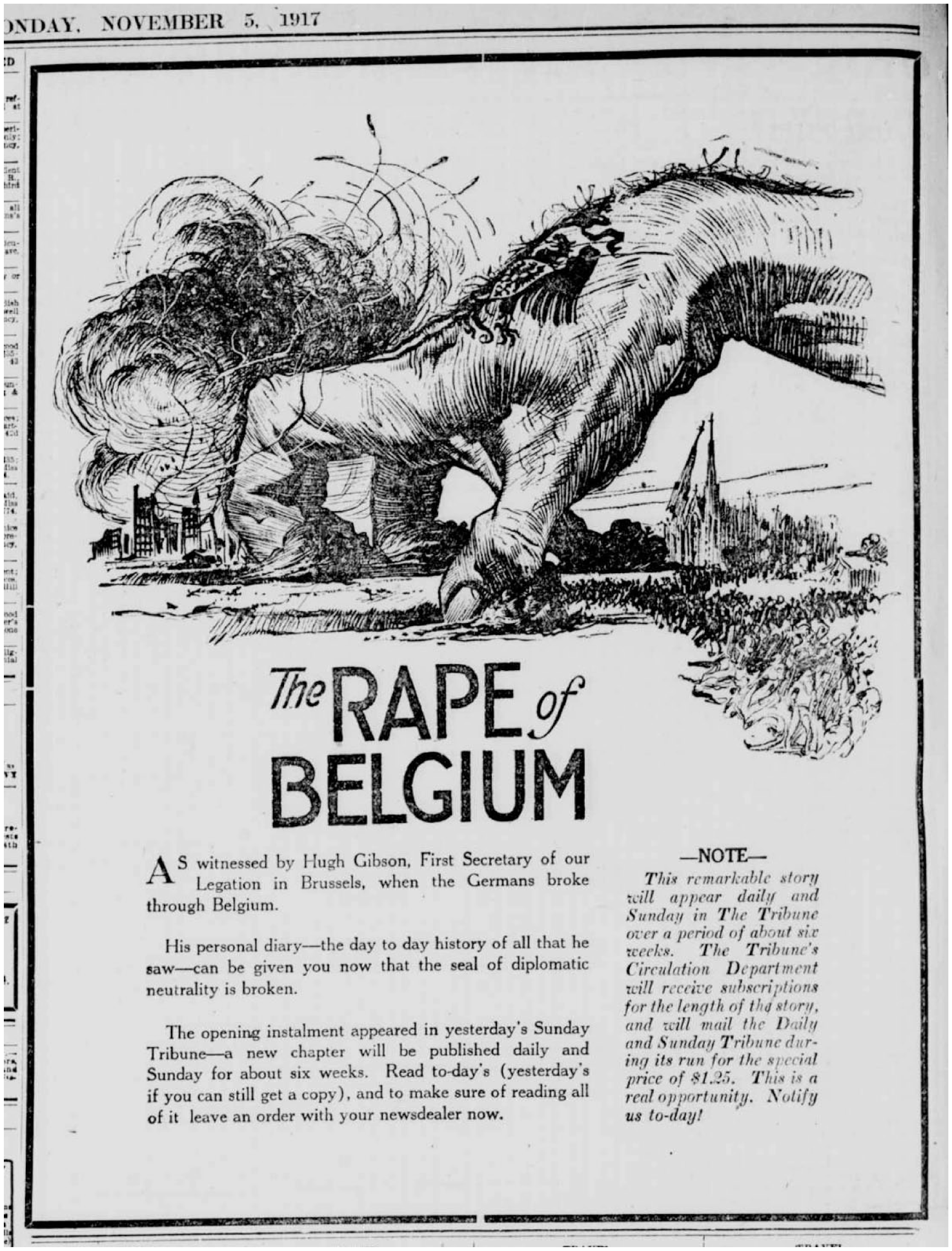
Louis Raemaekers, Rape of Belgium propaganda ad for series of articles in New York Tribune. Issue of Nov. 5, 1917, pg. 14. Public domain.
Internal struggles within neutral United States and Italy also relied on gendered and emotive coding to make the case for joining the war. The United States declared its neutrality at the outbreak of WWI, unwilling to become entangled in European wars. Yet by 1917, Woodrow Wilson abandoned armed neutrality, declaring it to be ‘worse than ineffectual’ and ‘unfeasible’ for achieving peace (Wilson, 1917). The debates around neutrality at the time centred upon whether neutrality ought to be abandoned so the United States could contribute to global peace (by going to war) or whether maintaining neutrality was the best chance for peace. While traditional binaries would associate neutrality with weakness, at times neutrality was portrayed as strength (See Figure 2).
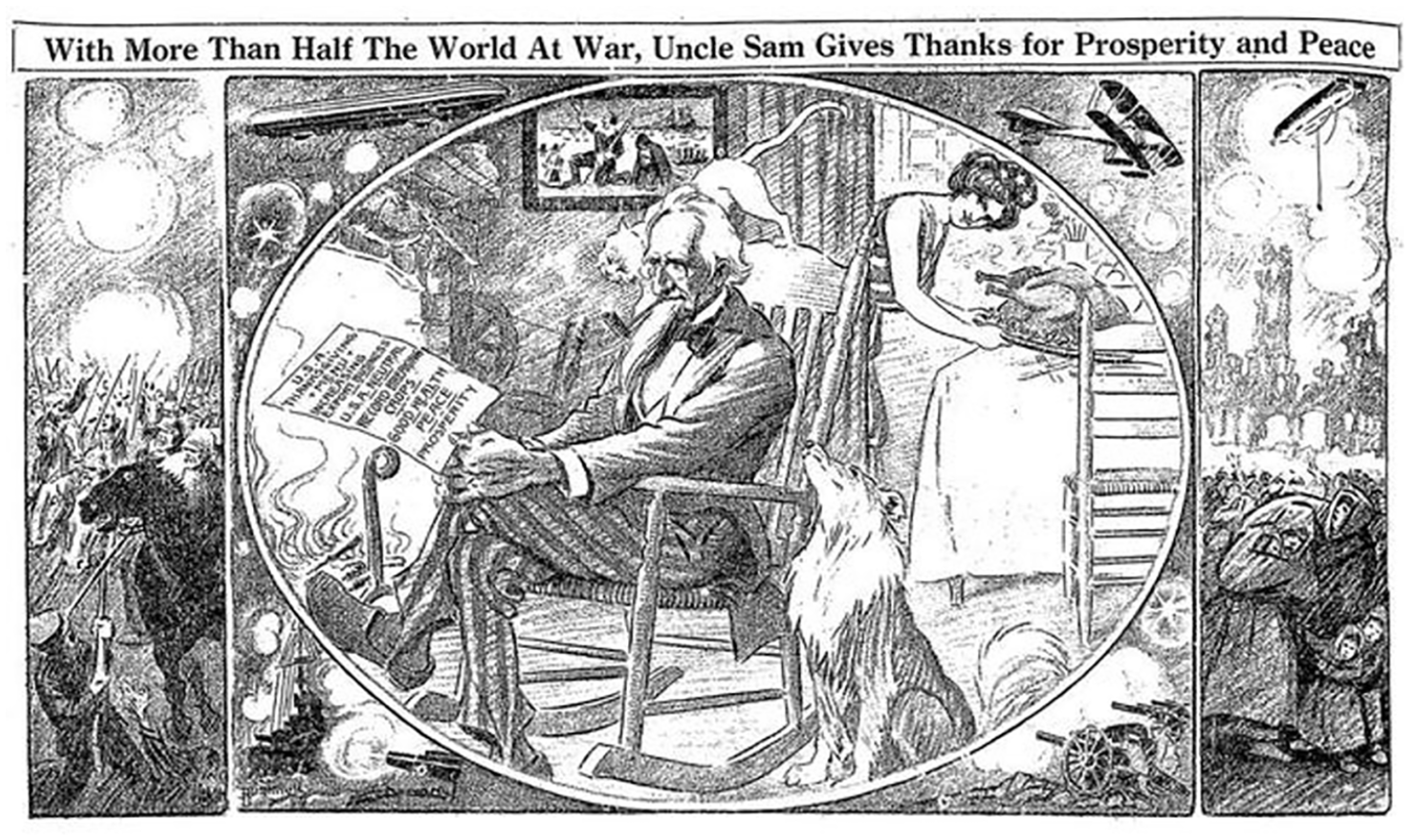
Cartoon published on editorial page of Thanksgiving Day’s Repository in 1914.
As the drive to join the war steadily grew, popular culture drew on moral and emotional levers which were highly gendered. Advertising, comics and music played a role in convincing the populace that America’s entry into the war was just and required. Ellsworth Young’s 1918 poster urging Americans to ‘Remember Belgium’ and buy war bonds showed a German soldier, resembling Bismarck, dragging a young girl through a burning backdrop. Life magazine showed women volunteers in the Red Cross and other organisations performing virtuous roles of saving the lives of soldiers or engaging in new adventures in Europe. A cartoon from 1918 depicted a ‘Mamma’s Boy’ heroically leading the fight in the trenches, while remembering the indulgences of his quiet life at home, reading books in comfort. Similarly, motion pictures joined the war effort to portray mothers as problematic, preventing their sons from going to war, or associating emotional or unnatural motherly love with producing weak sons unable to fight (Zeiger, 1996: 23). The theme of motherhood – whether it be patriotic or problematic – has been a constant one in peace and war. Åhäll argues that mothering and motherhood are sites of resistance to militarism (Åhäll, 2015: 16–17) as well as a discourse about how female agency in political violence can be enabled or denied (Åhäll, 2012: 108). As in the case of US mobilisation towards WW1 and implementation of military conscription for the first time, patriotic motherhood was valourised, and feminist pacificist or ‘unpatriotic’ forms of mothering were deemed problematic, part of a ‘“selfish”, overly emotional attachment to children’ (Zeiger, 1996: 8).
Music also became a battleground of positions in the debates around joining the war. In 1915, support for American neutrality was reflected in popular culture, with anti-war songs like ‘Don’t Take My Darling Boy Away’, ‘I Didn’t Raise my Boy to Be a Soldier’ and ‘The Neutrality Rag’, picking up the anti-war warning not to be dragged into European wars (Gustaitis, 2016: 35; Piantadosi and Bryan, 1915). In Irving Berlin’s 1914 pacifist song ‘Stay Down Here Where You Belong’, the devil tells his son to avoid entanglements in war ‘up above’ because those on Earth ‘do not know right from wrong’. Those supporting America’s entry into the war, such as Roosevelt, linked pacifism with feminism, arguing that the place for women who opposed the war was ‘in China – or by preference in a harem – and not in the United States’ (Roosevelt, 1916, cited in Flanagan, 2017: 433). Roosevelt said of the popular song ‘I Didn’t Raise my Boy to Be a Soldier’ – which sold 650,000 copies in 3 months (Monod, 2017: 439) – that ‘foolish people who applaud a song . . . are just the people who would also in their hearts applaud a song entitled “I Didn’t Raise my Girl to be a Mother”’ (cited in Buchanan, 1938: 784). Monod noted that the short-lived ‘pacifist craze’ of early 1915 soon gave way to more patriotic music and film celebrating war and masculinity. These included musical parodies like ‘I Didn’t Raise my Boy to be a Slacker’ and ‘I Did Not Raise My Boy to Be a Coward’. Jennifer Wingate (2005: 32) noted that 70% of all copyrighted songs in 1918 were war songs. Many homes had pianos and sheet music was the entertainment of the day, played in homes, theatres and places of food and entertainment. Pacifist or pro-neutral songs were associated with pro-German sentiment and radical politics, as well as unmanly or effeminate critiques of men (Monod, 2017: 441, 448–449). The feminization of dissent, as Peterson (2010: 23) claims, removes the right to participate in debates and discourses about security.
As Italy struggled between interventionist and anti-interventionist sentiments during WWI – Italy was a partner in the Triple Alliance at the start of the war, but remained neutral – satirical cartoons and illustrated postcards ‘were one of the most important means of shaping the collective imagination of Italians’ – important because newspapers represented ‘elite’ views in a country which had high levels of illiteracy (Marchioni, 2007: 4–5). The artist Virgilio Retrosi presented the negative case for neutrality in a series of postcards in 1915 as his position shifted towards support for the war. La Danza del Desiderio shows Trieste depicted as a seductress in red (‘Italia Turrita’, the national personification of Italy), tempting a soldier tied to the post of neutrality (see Figure 3). Trieste was ruled by Austria and part of Italia irredenta (‘unredeemed Italy’) – the foreign-ruled Italian-speaking territories which the Irredentist movement sought to reunite Italy wanted reunited with the nation. Neutralità (Neutrality) featured Italy as a naïve child, accepting a rosary where each bead represented a scourge of war (cholera, war, famine, taxes). Most striking is how he depicted neutrality as a straitjacket on the Italian state in Neutralità . . . armata (Armed . . . Neutrality), which is a vivid depiction of a knight made impotent by indecision and neutrality. Italy is armed (and armoured), limp-wristed 7 and chained, with a padlock firmly affixed to its groin. From the metal visor peers King Victor Emmanuel III, whose indecision is said to have allowed the rise of fascism in Italy under Mussolini (see Figure 4). These images of neutrality are arguably driven by masculine anxiety, where the idea of the nation is akin to the morality and standing of the individual. Ideas of impotence and weakness are clearly gendered and given urgency as nations made decisions to go to war or stand aside. As Sturfelt observed, in Italy at this time, debates about participation in the war were ‘fuelled by gender anxieties and fears of the nation’s increasingly “feminized” image’. In cultural terms, neutrality meant a ‘lack of character, cultural castration and national sterility . . . unmanly, a sign of national weakness and decay. . ..’ (Sturfelt, 2011: 105). By the time of the First World War, the nation was ‘measured by its male citizens’ perceived masculinity’. Modernisation and pacifism were equated with femininity, civilised Europe needed warrior values that war provided, and neutral states were not immune from such imaginings of the nation (Sturfelt, 2011: 107).
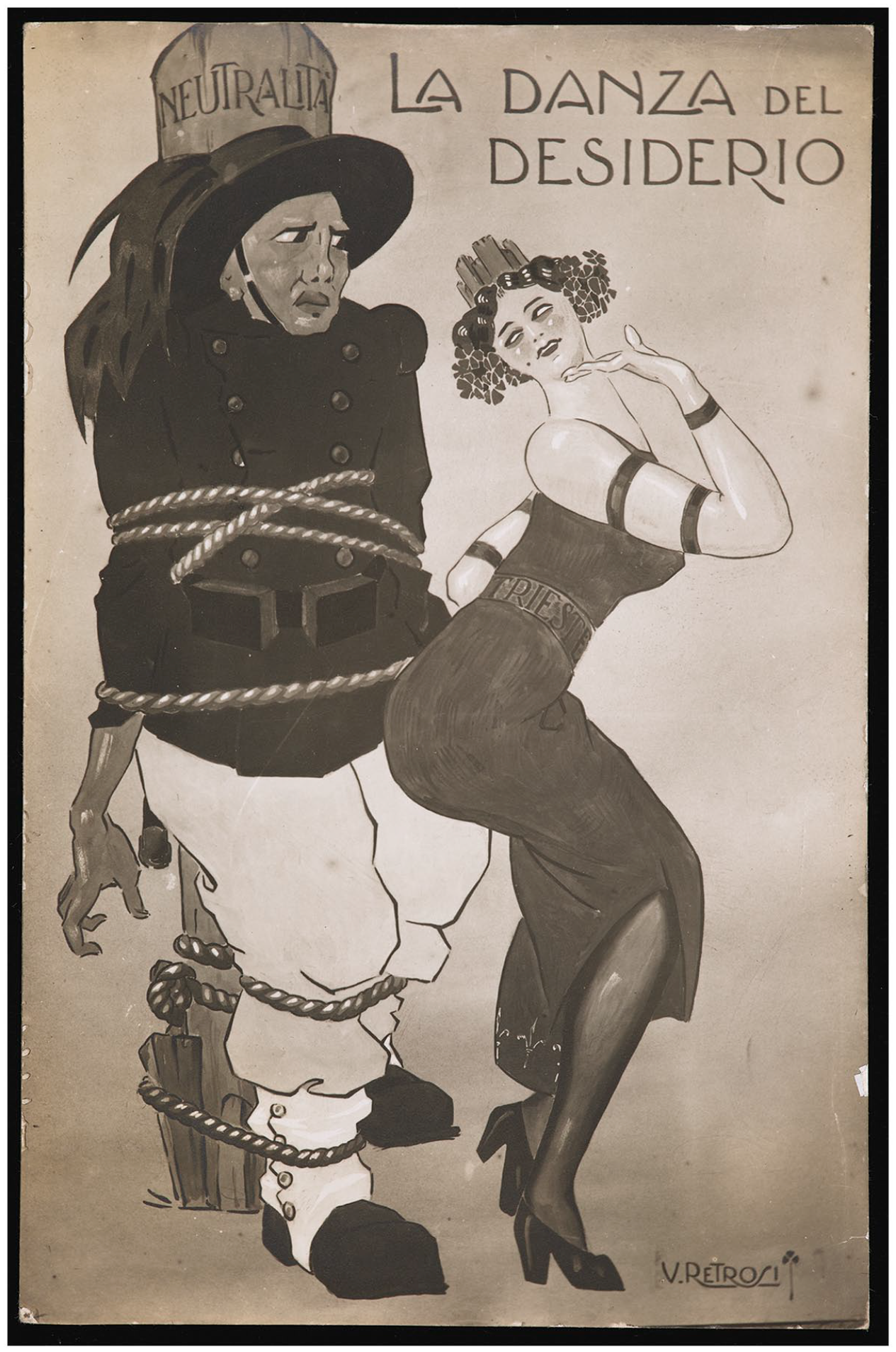
Virgilio Retrosi (1915) La Danza del Desiderio.
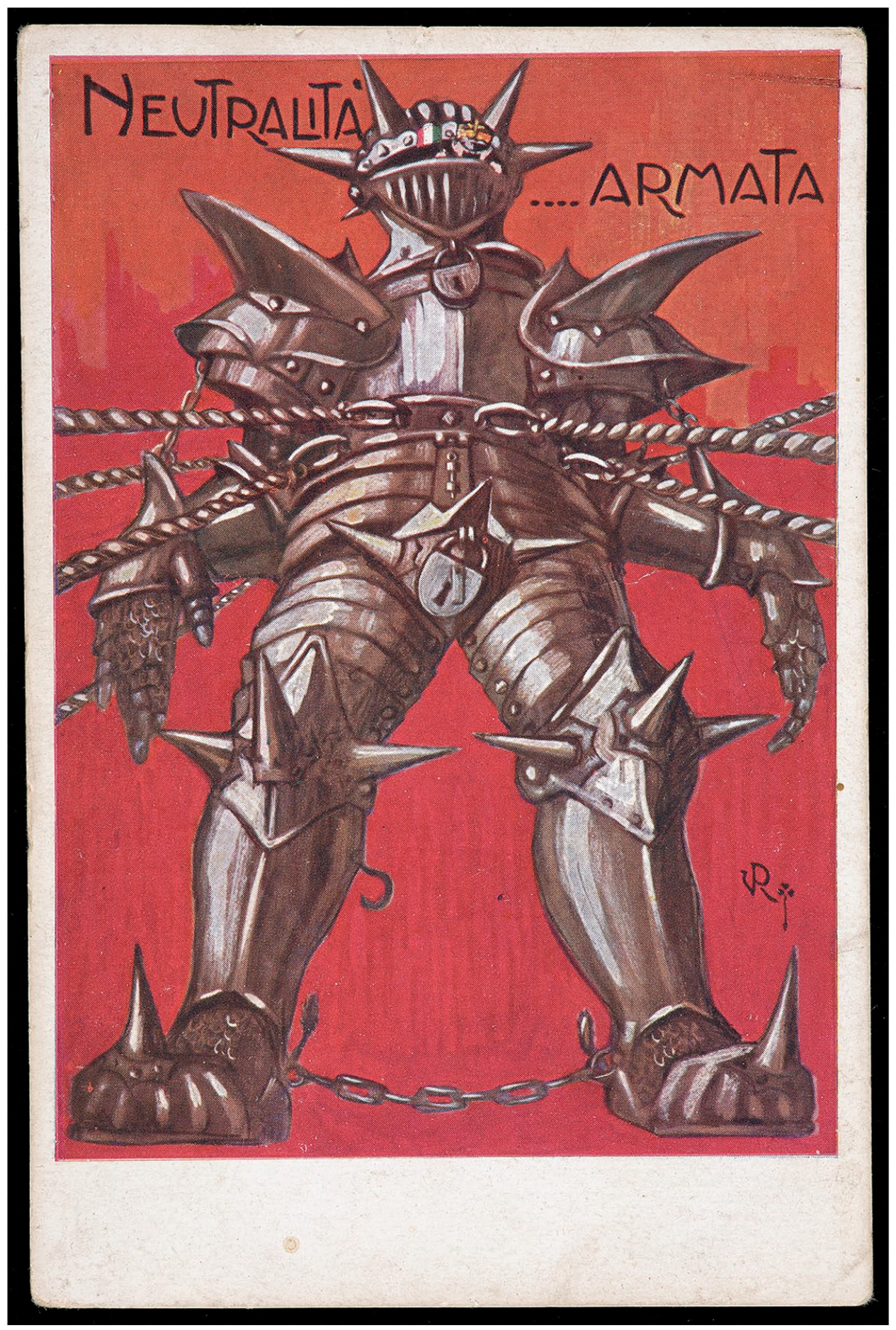
Virgilio Retrosi (1915) Neutralità . . . armata (Armed . . . Neutrality).
Similarly, in Sweden, neutrality was not always associated with peace. Sweden’s national rhetoric before the war associated neutrality and the peace that followed the death of King Charles XII (1682–1718) with weakness. The death of the king ended years of belligerency and foreign wars, which cost Sweden greatly and reduced its power in Europe, which it never recovered. Sweden’s past belligerency and its ‘warrior race’ was idealised, and the turn to neutrality and peace was interpreted by some not as a story of progress and civilisation but one of decay and humiliation. The ‘sleeping nation’ was a key narrative, where ‘[p]eace was said to have grown like a cancer in the Swedish national body, being far more lethal than the most devastating war’ (Sturfelt, 2011: 110). When the coffin of King Charles XII (the ‘Lion of the North’ as he was described by Voltaire) was opened in 1917 to carry out an autopsy to determine if he was murdered, press coverage hailed the exhumation as a ‘symbolic resurrection’ which contained dual meaning. The decayed body symbolised for some Sweden’s degeneration and feminisation; in one account, his sister, Ulrika Eleonora, who assumed power, was behind the assassination because Sweden had been at war for too long (Klein, 1971: 129). For others, it was a sign that war would restore the Swedish nation to its true warrior spirit (Sturfelt, 2011: 111) and that the king would ‘return and lead us to glory’; even in folk legends about his death, Charles was imagined as hård (‘hard’), ‘invulnerable to ordinary bullets, which in many tales just drop into his boots like blueberries’ (Klein, 1971: 144, 128).
Neutrality during the Second World War was further subjected to the preferences of belligerents, with only few neutral states surviving. Neutrality was revived in US debates as Congress passed three neutrality acts aimed at keeping the United States out of WWII. The debates of the time were reflected in arguments such as those in Congress that neutrality kept the peace and that collective security and intervention in the war could be ‘calamitous’ (Borchard, 1938: 781) and women’s support for neutrality splintered. The New York branch of the Women’s International League for Peace and Freedom (WILPF), with many Jewish members, saw neutrality as problematic in the context of Nazi Germany. The Bronx branch withdrew from the national organisation over neutrality, arguing that it supported the aggressor, and the Brooklyn branch resigned by 1939 (Alonso, 1998: 298–300). In this regard, peace and security required action to be maintained, so standing aside in wars also gained deeper moral and emotive purchase. As realism emerged as a dominant framework in international thought in the post-war era, and bipolarity shaped global relations, neutrality was seen as an improper use of sovereignty. While all nations were ‘like units’ and neutrals could play a mediating role in international affairs (Morgenthau, 1958: 198), realists regarded the right not to fight as outside the realm of acceptable statecraft and sovereignty (Agius, 2011: 373–374). Their stance disrupted the norms of the balance of power and the ‘underlying rationality’ of the international order (Joenniemi, 1993: 295). Post-war assessments of neutral states also returned to categories of immorality; being neutral in the context of Nazi fascism and the Holocaust meant an ‘indifference to the fate of others’ (Dulles, 1956: 549; Raymond, 1997: 124). Especially in the post-war era, there would be little space for a liminal or ambiguous stance (Folch-Serra, 2002: 178). While it seemed the binaries around neutrality and war returned, the following section attempts to read between the lines to find a more nuanced understanding.
Inverting neutrality for peace? The complexities of gendered coding
European neutrality after the Second World War adapted to the new realities of bipolarity and the nuclear arms race. Subsequently, several post-war neutrals tuned their neutrality to the logic of realism. Seeing how weakly armed neutrals risked having their neutrality violated by belligerents, states such as Sweden and Switzerland developed their arms industries and defence forces to support and protect their neutral status. Sweden’s ‘credible neutrality’ doctrine after the war was premised on the idea that belligerents would pay a heavy price for violating Sweden’s right to be neutral. Kronsell has argued that the defence of ‘Mother Svea’ produced a militarised home front, with conscription and a home guard. Furthermore the ‘neutral soldier’ not only protected the state but also was a ‘just warrior’ who enacted the values of neutrality on the international stage in peacekeeping (Kronsell, 2012: 25–32), notably while selling arms to belligerents.
While it is possible to read this as an adherence to realist precepts of (militarised) state sovereignty, another argument was at work. Post-war neutrality in Europe saw some states engage in ‘active internationalism’, playing an important role in peacekeeping, mediation and other ‘good offices’, providing a third space in bipolar relations, and contributing to regional security and conflict limitation. Neutral states could be effective ‘norm entrepreneurs’ or promoters of peacebuilding (Goetschel, 2011) and engaging in positive peace and adding ‘moral weight’ (Binter, 1985). This dislodged earlier associations of isolationism attached to neutrality. Some observed that rather than see neutrality as idealist or unrealistic in an anarchic world, encouraging great power acceptance of the status of neutrality was in fact the most realistic option for its legitimacy as a foreign policy (Kruzel, 1989: 310). McSweeney (1987) lamented the turn of some post-war neutrals, such as Switzerland, to isolationism and argued that European neutrals ‘failed to address the moral and international dimensions of their foreign policy in response to the myths about neutrality’, which meant a ‘lost opportunity to advance a new case for an independent foreign policy’ (pp. 33–34). The efforts by neutral states to find a place within the global anarchic structure of international politics could highlight the ‘invisible structures’ of international anarchy or even ‘circumvent’ the constraints of the international system through an alternative stance (Väyrynen, 1989: 53, original emphasis; Goetschel, 1999). This can either produce a ‘third’ way beyond gendered binaries or open the possibility of multiple orders (Sjoberg, 2017: 326).
Furthermore, in addition to active internationalism, neutrality also played a key role in domestic identity construction. In Sweden, the hegemony of the Social Democratic party’s post-war project of active internationalism and credible neutrality was tied to the ‘folkhem’ (the ‘People’s Home’), the Swedish Model and the welfare state, particularly under Olof Palme’s vision of consensual Swedish societal norms exported to the international level through its support for developing and small states (Agius, 2013 [2006]; Stern, 1991). As Rosengren (2022: 1234) writes, Sweden’s armed neutrality was seen domestically as modern, rational and peaceful. Neutrality was associated with national autonomy and sovereignty in Finland and Austria – in different contexts and degrees – and unity in Switzerland (Agius, 2013 [2006]). The label of ‘Finlandization’, for example, was a contentious one for Finns (Maude, 1982). Steele (2008) argues that Belgium made the decision to fight Germany despite the consequences, and that ‘honour’ and its sense of ontological security and identity guided its decision. Rather than accept neutrality as a subjugated, imposed status, neutrality became part of national identity and agency.
Still, overlapping and competing discourses of neutrality co-existed. These provided a more complex reading of what neutrality meant, and how historical narratives and gendered and emotional codes persisted. For some historians and critics, Sweden’s active internationalism concealed its wartime guilt and shame over the Holocaust and collaboration with the Nazi regime while neighbouring Nordic states were occupied (Sturfelt, 2011: 106). Despite efforts to portray Swedish neutrality as circumventing bipolar politics, hierarchies – even between neutrals – persisted. Efforts to codify Swedish neutrality were rejected because
[m]ilitary leaders and politicians looked upon internationally imposed or guaranteed neutrality as unmanly and pacifism as something for the weak and despicable . . . Belgium and Switzerland were not taken quite seriously, as countries destined in due course to be absorbed by the great nations. (af Malmborg, 2001: 106; see also Sturfelt, 2011: 107)
In the 1950s and 1960s in Sweden, questions of acquiring nuclear weapons were also framed in emotional and gendered terms. Those arguing for nuclear weapons portrayed Sweden as a rational and technically advanced state, unthreatening to others; those arguing for disarmament made the case for global peace but were seen as emotional. But according to Rosengren, ‘the nuclear weapon debate caused a gendered and nationalized split in Sweden’. Disarmament became the way to unite the nation and those arguing against nuclear weapons put forward the view that military arguments in favour were based on ‘emotional military thinking’ (Rosengren, 2022:1241).
Similarly, post-war debates about Austrian neutrality revealed a complex inversion of gendered codings of neutrality. In the parliamentary debates of 1955 over neutrality, two discourses of the nation were in play. One was that of Austria as victim, who could find its peaceful path through neutrality. The second was that neutrality endangered a ‘proper’ reading of sovereignty and agency, whereby neutrality was equated with conferring an unequal status as a state (Austria could not form a military defence and relied on the Allies for protection) (Löffler, 2019: 453–454). Even so, associating neutrality with peace 8 entailed a masculinist reading – that neutrality must be defended through conscription. This move displaced associations of a feminised, childish or emasculated politics and recovered neutrality to reinstall ‘traditional notions of masculinity’ (Löffler, 2019: 459).
As Charlotte Hooper elaborates, gendered dichotomies go beyond discreet, uniform roles in structuring relations. They obscure more complex relationships and overlaps. An example she refers to relates to emotions. Combat required male rage and aggressive behaviour, but militaries require men to be passive, follow orders, contain emotions (Hooper, 2012: 45). What Frevert refers to as ‘affect regulation’ shows how the relationship between gender and emotions can be inverted, as well as subverted. For example, gender modifies how ‘rage’ is understood differently – women expressing rage are seen as out of control and the rational (male) actor controls one’s emotions; yet ‘noble rage’ (moral indignation about injustice or evil or protecting the weak) can be interpreted as acceptable (Frevert, 2011: 97). Hegemonic ideas of masculinity in peacekeeping and the military are also changing to demonstrate compassion, restraint and vulnerability as strengths (Duncanson, 2015). Wadley (2010: 49) also argues that there are different and unequal types of masculinity and femininity, but differences are also ordered hierarchically. Overlap is also missed when ‘uncritical repetition’ of dichotomies ‘obscures diverse power relations . . . and how gender permeates these distinctions and their effects’ (Peterson, 2000: 16).
Concluding remarks: War as peace, peace as war
Although not unproblematic, neutrality offers an alternative path to understanding war and peace in the international system. Its decline should give scholars and policymakers pause for concern, not simply because it signifies the end of one way of thinking about security, but mostly because its full potential has been neglected. There are many discourses of neutrality, but the hegemonic or disciplinary discourses that have constructed it have authored its story, often to the detriment of other perspectives. In this article, I have sought to highlight how neutrality obtained specifically gendered and emotional associations and meanings over time. As such, neutrality occupies a negative or abnormal position in International Relations and peace and security discourses. Neutral states are primarily understood as weak, immoral and naïve and such emotive and gendered associations have shaped the meaning and utility of neutrality. The parameters of how we understand neutral states are narrowly pre-determined. Neutrality, and later, military non-alignment, has been increasingly difficult to maintain in the post-war era where bipolarity reinforced binary relations and European interdependence produced overlapping forms of cooperation. Post-9/11, room for neutrality decreased further in the global war on terrorism. While constructivist analyses in the 2000s examined neutrality as embedded in national identity and as an endogenous security stance to explain its persistence, the possibilities for reinterpreting neutrality as a kind of empty signifier meant that it could be shaped to new security situations and engagements. Nonetheless, while neutrality can be ‘interactionist’ or understood in positive terms (Stern, 1991) it is measured against dominant ontologies that structure international politics.
Considering this in the wake of Russia’s war in Ukraine and Finland and Sweden’s pursuit of NATO membership, the complexities of gendered codings persist. In the parliamentary debate in early June, Moderate Party Member of Parliament (MP) Hans Wallmark declared that Sweden would return to its ‘natural home’ in the western world by joining NATO (Swedish Parliament, 2022). Security through military alliance now seems to have restored these states to a ‘normal’ setting. NATO membership for both countries has been presented as a ‘rational’ choice, a consensual and settled decision that does not require a referendum, which could be risked by a Russian misinformation campaign. 9 Russia’s actions and unpredictability make neutrality less of a cloak of protection and risks the possibility of bringing the war to their doorstep. Joining NATO is argued to give these states agency – a place in NATO decision-making and protection. It also transforms these states from ‘security consumers’ – a label associated with free-riding and passivity – into proactive protectors (Agius, 2018) and ‘security providers to NATO as allies’ (Swedish Government, 2023). Protection is also conceived in gendered terms. NATO crafts its profile and purpose as that of ‘cosmopolitan defender of gender justice and human rights’ while maintaining a traditional ‘muscular masculinity’ (Hedling et al., 2022). Sweden sees itself representing a progressive, feminist order against a masculinist Russia that seeks to promote ‘traditional values’ (Agius and Edenborg, 2019). Finnish Prime Minister (PM) Sanna Marin also argued that support must be given to Ukraine, because ‘[t]hey are representing all of our values, European values, and they are fighting for all of us’ (CBS News, 2023).
The symbolism of two female leaders during this time – Swedish PM Magdalena Andersson and Marin – who took their countries into NATO bears mentioning in relation to discussions about gender and emotion. Some media reports have determined that hard-man Putin is no ‘strategic genius’ (Ward and Forgey, 2022) and scored an ‘own goal’ (Arnold, 2022), doubling Russia’s border with NATO. Furthermore, he is ‘humiliated’ (The Spectator Australia, 2022) by ‘two female powerbrokers’ (Carey, 2022). Finland has been blunt in its stand against Russia, stating that it is unafraid of Russian threats, drawing on its historical experience of resisting the Russians during the Winter War (1939-1940). Finland’s elevation as a small, brave country standing up to a more powerful, threatening neighbour by joining NATO has been widely hailed (‘that took balls’, in one observation) (Miklaucic, 2022). It may also be read as an inversion of ‘might is right’ to ‘right is might’. This inversion is important to note because it tells a complex story about neutrality. A gender perspective and analysis of neutrality is essential for not only understanding the binaries around which neutrality has been constructed, but to critically think through the silences – and silencing – such binaries produce (Kronsell, 2006). Before declaring the ends of neutrality, understanding it beyond narrow terms can reveal how gender and emotion have shaped its meaning and utility. Emotive and gendered coding conceal power relations. Feminist scholarship can awaken alternative modes and possibilities of peace once a masculinised perspective is not centralised or becomes the standard by which we measure security.
Footnotes
Acknowledgements
The author would like to thank the special issue guest editors, Katrin Travouillon, Nicolas Lemay-Hérbert and Joanne Wallis, for their guidance and inclusion in the 2021 Emotions and Peace workshop. Katrin especially endured numerous versions of this article and accompanying gifs and images that unfortunately never made it into the final version. The article has benefitted from excellent and thoughtful feedback from two anonymous reviewers, and discussions with Sanna Strand, Helen Dexter, Federica Caso, Annika Bergman-Rosamond, Linus Hagström and Emil Edenborg helped shape the author’s thinking. The 2021 Visual Politics Work-In-Progress Forum, organised by Roland Bleiker and Emma Hutchison, and the 2016 Gendering Neutrality Symposium, organised by Cecelia Åse, also helped develop this work. Any errors or omissions remain the author’s.
Funding
The author(s) received no financial support for the research, authorship, and/or publication of this article.
