




Abstract
Recent International Relations scholarship has emphasized the significance of ritual and emotion in international politics. Much less attention has been paid to instances of ritual failure. Ritual failure refers to the occurrence of deliberate mistakes, errors or sabotage to contest the sociocultural boundaries, hierarchies and structures underlying international rituals. In this article, I argue that ritual is an emotion transformer that generates a sense of community among North Atlantic Treaty Organization (NATO) members. Successful ritual makes community members experience ‘we-feeling’, which underpins peaceful change in a security community. NATO members carry the group-aroused emotions for a time and come out of the ritual encounter feeling strong and confident. Conversely, a failed ritual lowers the confidence of community members because they do not experience ‘we-feeling’. I suggest that this explains the internal divisions and anxieties when rituals go wrong, such as during Trump’s infamous speech in front of the new NATO headquarters in 2017.
Introduction
On 25 May 2017, North Atlantic Treaty Organization (NATO) leaders gathered for their first summit with newly elected US president Donald Trump in front of the new NATO headquarters. Standing next to a twisted piece of steel from the demolished World Trade Center in New York as well as a piece of the former Berlin wall US president Trump began to lash out at NATO allies for not paying enough for collective defence. Moreover, when Trump failed to reaffirm NATO’s mutual defence pledge during the official ceremony, he provoked a storm of outrage. How do we make sense of all this?
NATO summits resemble highly ritualized activity. The ritual ceremony opens with the arrival of the heads of states shaking hands and exchanging smiles or other bodily gestures of approval to create an aura of intimacy. Following these emotional sequences that open the ritual encounter, the summit leaders retreat into a sacred space: a secluded area that is guarded by local police, thus insulating NATO leaders from the profane ‘distractions’ of the outside world and from the performance of counter-rituals by protestors. Recently, there has been a growing interest in the study of ritual in International Relations (IR) (Aalberts et al., 2020; Baele and Balzacq, 2022; Charlesworth, 2010; Chase, 2005; Davies, 2018; Faizullaev, 2013; Holmes and Wheeler, 2019; Kustermans et al., 2022; Larking, 2017; Lee, 2013; Mälksoo, 2021; Neumann, 2011; Oren and Solomon, 2015; Pacher, 2018; Phillips, 2018; Rubinstein, 2005; Sending et al., 2015; Wong, 2021). The ensuing theoretical deliberations in IR can be said to revolve around two main research strands: liminal and bonding approaches.
Liminal approaches look at ritual as a source of ambiguity and transition and how this affects ritual participants. Accordingly, these IR scholars emphasize the creative function of ritual from which new ideas, identities and communities emerge and which may often be characteristic of revolutionary epochs (Aalberts et al., 2020; Fierke, 2013; Giesen, 2006; Mälksoo, 2012; Neuman, 2012; Ross, 2014; Solomon, 2019; Wydra, 2015). This creative function of ritual has manifested itself in the ritual tradition in social anthropology, which claims the sacred pivots on liminal processes. For example, in many parts of the colonial world, ancient ritual forms were resurrected and adapted in the uprisings of the oppressed against the European colonizers, such as during the ritual of Bois Caiman in Haiti in 1791 (Eddins, 2022). In these circumstances, ritual activity provided a basis for political change, a redefinition of political communities, and the delegitimating of the existing rule.
Bonding approaches focus on ritual as a source of trust and attachment in international politics. These IR scholars have studied the role of ritual bonding in face-to-face diplomacy, engaging with the sociological theories of Ervin Goffman and Randall Collins to widen the concept of interpersonal trust by exploring its emotional basis (Hall, 2015; Holmes, 2013; Holmes and Wheeler 2019; Keys and Yorke, 2019; Wong, 2016). They emphasize the re-creative function of ritual activity that serves as a vehicle for interpersonal reaffirmation and renewal. For example, the personal interactions between US and Soviet leaders Ronald Reagan and Mikhail Gorbachev can be seen as decisive in ending the Cold War (Wheeler, 2018). In this way, ritual functions to generate mutual trust, build collective identities and restore social cohesion after crises.
In this article, I make a conceptual contribution that provides a counterexample of a traditionally understood successful ritual. While the literature strands outlined above differ in many ways, they both presuppose the successful completion of ritual activity. By contrast, I look at what happens when rituals fail or go wrong. Failed rituals can be a powerful catalyst for producing social change and influencing ritual patterns. One way in which failed rituals can produce social change is by generating public awareness and debate around the issues or grievances that led to the ritual failure. Failed rituals can draw attention to systemic problems or injustices that may have otherwise gone unnoticed, and bring them to the forefront of public consciousness. This can lead to increased pressure on authorities to address these issues and make meaningful changes. Failed rituals can also lead to change in the ritual patterns themselves. When a ritual fails, it can prompt individuals or groups to re-evaluate the underlying values and assumptions that inform the ritual, and to consider alternative forms of expression or meaning. This can lead to the development of new rituals or modifications to existing ones, as people seek to create more meaningful and effective ways of expressing their beliefs and values. Finally, ritual failure can have a significant impact on the authority and power dynamics of a given social context. When a ritual fails, it can create a moment of rupture or crisis, in which the existing power structures are temporarily destabilized, and alternative forms of power and authority can emerge. This can create an opportunity for challengers to contest and potentially shift the existing power structures.
I conceptualize ritual failure as an integral part of ritual life in IR that incorporates the regular occurrence of deliberate mistakes, errors, or sabotage to contest the sociocultural boundaries, hierarchies, and structures underlying ritual activity. Empirically, I look at the case of NATO as a text-book case of peaceful change. The focus on ritual failure opens the door to thinking about how this article provides a new take on ritual’s potential for theorizing the international. It also ties in with and extends existing literature in Peace Studies on how and why some actors deliberately seek to ‘spoil’ peace building processes (Stedman, 1997). I believe that this enterprise is crucial if IR scholars and practitioners are to gain a more complete understanding of the importance of ritual in international politics. What I intend to do in this article is to salvage and make use of the role of ritual in generating ‘we-feeling’ among NATO members by showing what happens when ritual goes wrong. In doing so, the article picks up the central theme of this Special Issue to demonstrate how the emotions of individuals can be understood collectively and integrated into institutional structures that support peace. Moreover, the article links up with recent advances in peace research – and international relations more generally – that highlight the microdynamics of the politics of peace and how the diplomatic practice of peace inevitably involves interactions that are shaped by and are shaping emotions (Söderström et al., 2021; Söderström and Olivius, 2022).
My work is coming to positions that are shaped by, benefit from, and seek to contribute to the rapidly expanding literature on emotions in IR. One major trend investigates how emotions emerge in international politics at the social level (Fierke, 2013; Hall and Ross, 2015; Hutchison, 2016; Koschut, 2014). Building on a rich tradition of contributions from peace research and sociological as well as critical theories, these studies investigate how collective emotions structure and shape political identities and communities, conflict processes and resolution, and practices in and among groups. My own position can be summarized insofar as I establish and empirically apply a theoretical argument that takes into account the stabilizing role of collective emotions in the study of security communities and grounds them in paradigmatic assumptions about sociological theory concerning the study of ritual. I believe that this enterprise is crucial if IR scholars and practitioners are to gain a more complete understanding of the links between emotion, ritual and interstate peace.
In terms of method, I conducted 40 personal interviews with NATO officials and policymakers between 2019 and 2021 in addition to probing various primary sources. I selected officials from different levels and functions – permanent representatives (so-called ‘NATO ambassadors’) and members of the International Civilian and Military Staff at NATO – based on their professional knowledge and experience. My questionnaire focused on enquiring about the experts’ general knowledge about transatlantic conflict management as well as tapping into their emotional knowledge. 1 To increase reliability, I returned to several of my interview partners to discuss whether I had understood them correctly and I also cross-checked the data with actual dates and events. To ensure validity, I double-checked all accounts with insiders as well as through a survey of media reports. Fully aware that interviewees may wish to draw a very partial and selective picture that reflects how the individual may want to be perceived, I triangulated accounts and probed secondary sources of evidence. Given the highly sensitive nature of my subject matter, all of my sources requested that our conversations remain under the Chatham House Rule. 2 As a result, the article refrains from referring to individual names, official titles, and specific country affiliation.
The article is divided into three parts. In the first part, I explain and appraise the relevance of ritual in stabilizing social relations among NATO members. In the second part, I conceptualize ritual failure as a destabilizing factor that undermines social cohesion. Finally, I empirically illustrate ritual failure with Trump’s infamous speech in front of the new NATO headquarters in 2017.
What is a ritual?
Social cohesion among NATO members is greatly facilitated by ritual activity. In making this argument, I build on recent advances in the study of ritual in IR and develop some of them further. For example, Maria Mälksoo (2021) has shown how NATO members use deterrence as a ritualized strategy to avoid having to directly confront an adversary. A ritual is understood as ‘the performance of more or less invariant sequences of formal acts and utterances not entirely encoded by the performers’ (Rappaport, 1999: 24). As one of my interview partners at NATO explained, ‘rituals are helpful in creating cohesion. It’s a useful way to show that NATO is part of people’s everyday lives and to generate a sense of belonging among policymakers’ (Interview partner A). Another interview partner underlined that, ‘rituals are good because they create a feeling of security. They give NATO predictability: I know what my British or Italian colleagues will say tomorrow’ (Interview partner B). Repeated ritual performance sets the frame for meaningful interaction by maximizing mutual perception and group awareness but also social monitoring. Mutual perception and group awareness keep symbolic interaction on track and on topic. Social monitoring infuses a moral character that affirms unity and solidarity. NATO rituals are embedded in a thick context of symbols, myths, and notions of the sacred, and are subject to change over time (Bell, 1997: 210). In times of an outside attack, rituals may serve a stabilizing function through their repetition, performance and display. According to a statement made by a NATO diplomat I interviewed, when a country calls out Article 5, there is a ritual: Everyone has to come out in support by promising their help. Everyone during the Council meeting reads out almost the exact same statement. It seems a bit bizarre, but it is expected that you express this, that you show that you are standing in solidarity with this country (Interview C).
Emotion is a central element and outcome of ritual activity. In ritual, once the group physically assembles in the same place, there is a rhythmic synchronization of bodies and speech patterns, an arousal of participants nervous systems, a change of atmosphere, and the formation of a feeling of solidarity that gives rise to emotionally charged symbols and beliefs as markers of group identity. 3 (Durkheim, 2008 [1912]: 164, 171). I suggest that it is these ‘moments of effervescence’ or ‘we-feeling’, which give rise to a collective conscience, a sense of community, and which form the basis for solidarity within NATO. 4 One of my interview partners at NATO vividly described ‘we-feeling’ during summits in the following way: ‘There are moments when you believe that something bigger resonates than the day-to-day business. Personally, I was imbued with this feeling during my time at NATO – and I wasn’t the only one’ (Interview partner D). In a discussion with one of my interviewees at NATO, they mentioned that: ‘When we are in a group, we share the same values, identity, and goals’ (Interview partner E). And because members get a feeling of emotional strength and morality from this high point of collective experience, they want to repeat it. In another interview, one of my participants shared with me, ‘we meet again and again and again. The answer to everything is: we’ll meet and talk about it. And it is important because you can see people’s gestures, body language, and get to know how they feel’ (Interview partner F).
In this article, I am primarily concerned with what I call official ritual. Official rituals are extraordinary and emotionally charged high-level encounters or ceremonial events that serve the renewal and reproduction of ‘we-feeling’. The ritual performance of ‘we-feeling’ and a sense of community are necessary to assure peaceful change among NATO member states: that members of that community will not fight each other physically but will settle their disputes peacefully (Deutsch et al., 1957: 5; see also Adler and Barnett, 1998). NATO summits typically resemble official ritual activity, consisting of sequences of formal acts and utterances. During one of my interviews, I had the opportunity to learn from one of my participants that, ‘the summit meetings are ritualized and the script is almost never deviated from’ (Interview partner G). The ceremony commences with policymakers greeting each other by shaking hands and sharing smiles or other physical gestures of agreement to establish a collective emotional atmosphere. After these initial emotional exchanges, the summit leaders withdraw into a separate room, which shields NATO officials from external disturbances and the enactment of opposition rituals by demonstrators. Inside the meeting room, state representatives read out scripted statements based on previously agreed language with very little (if any) discussion while sharing a mutual focus of attention. The summit ritual typically concludes with the ‘family portrait’ of state leaders in symbolic unison along with a carefully crafted joint communiqué in which all members reaffirm the mantra of transatlantic solidarity before the ritual encounter is formally closed. NATO’s international staff puts a lot of work into making sure these ritual summits achieve we-feeling and a sense of community. As one of my interview partners told me, ‘One has to deal permanently with the value of the ritual, what significance it has for the cohesion of NATO’ (Interview partner H). According to a statement made by a participant I interviewed: ‘Every summit is a ritual. Everyone reads out their prepared speeches, often in bad English. Everything is ritualized beforehand. It is definitely an orchestrated procedure or ritual’ (Interview partner I).
To sum up, ritual activity among NATO members generates a collective feeling of solidarity, of individual moral reinforcement through the group, in short, a sense of community or ‘we-feeling’. In one of my conversations, a respondent shared with me that, ‘you can feel that one hundred percent. That stands above bilateral conflicts. That is something higher than the individual member states’ (Interview partner J). This collective feeling alters individual consciousness and gives rise to collective representations, such as symbols and myths. These collective representations are set apart and made sacred. I suggest that this self-sustaining process is what stabilizes NATO. 5
Ritual failure
Ritual is an elastic phenomenon that is dynamic and flux, not fixed. This makes rituals remarkably resilient. They can absorb mistakes and adapt to changing circumstances. Rituals generate opportunities for social cohesion and solidarity. Occasionally, however, rituals go wrong. Ritual failure can work against solidarity and cohesion by emphasizing different values, interests, perspectives and loyalties or reveal underlying power relations and hierarchies. In some cases, they may also create new attachments and alliances between various actors (Hüsken, 2007; McClymond, 2016). To be sure, ritual failures often occur without bad intentions. Here, I am not so much concerned with ritual mistakes, such as skipping a word or raising the wrong flag, but more with intentional acts to disrupt or sabotage ritual activity. Such deliberate ritual failures can be employed either by marginalized and oppositional groups or by political authorities and leaders who may misappropriate or manipulate ritual. By deliberately disrupting a ritual, actors contest what is supposed to be held sacred, politicizing what is supposed to be depoliticized. As noted above, NATO members tend to handle their collective symbols with high respect and defend them against the disrespect of outsiders, and even more importantly, renegade insiders. Deliberate violations against these sacred elements resemble the breaking of a taboo and give rise to strong negative feelings. Consider the following statement by one of my interview partners: The (NATO) Council meetings are very ritualized, that is definitely the case. Prepared national statements are read out in a tour de table. Open discussions are rather rare. But there are moments when a statement is challenged. Then it can also become emotional and there can be an exchange of verbal blows between the NATO ambassadors (Interview partner I).
What constitutes ritual failure? While failures of ritual interaction may vary in scope and intensity, there are a number of indicators that may point to a ritual gone wrong. The sociologist Randall Collins (2004: 48) has proposed four ingredients for successful ritual. These include bodily co-presence, the erection of barriers to outsiders, mutual focus of attention and shared mood. In a failed ritual, we should expect these elements to be weak or absent, thus disrupting the sequences of ritual performance and utterances. For example, ritual participants that lack shared attention will show little respect for the group’s symbols or members’ attention may be distracted to outside things. Individuals will drift away, embarking in perfunctory conversations, start making noises when there is supposed to be silence, remain silent when there is supposed to be something to be said, and refuse to engage in solidarity-enhancing group performances such as clapping or chanting. Participants in a failed ritual will lack initial emotions that can build up to feelings of group solidarity. Instead, there is a flat feeling or sense of drag, frustration and anxiety, and a desire to escape from the ritual encounter. 6
Ritual failures contain a number of implications that undermine, or have the potential to undermine, group solidarity. First, rituals symbolically frame the community in a way that transfigures actual power relations and hierarchies. Ritual incorporates its own mythology that specifies the group’s origin, purpose, and place in the world. For example, illiberal communities are often based on the ritually enacted myth that the divine or charismatic ruler somehow deserves to have power over others. In more liberal communities, such as NATO, there is the myth that all members are equal despite existing social and material inequalities (Kertzer, 1988: 48). While rituals also establish hierarchies within groups, for example, by assigning various roles and authorities to its participants, rituals conceal these power relationships. Ritual failures reveal power dynamics and create opportunities to change these power dynamics, empowering those who disrupt the smooth flow of ritual activity.
Second, ritual creates boundaries. By performing a ritual, participants not only physically separate their group from outsiders through the gathering in sacred locations or by erecting material boundaries around them. They also create moral boundaries between the sacred sphere of their community and the profane self-interests of individual members. In Durkheim’s description, the sacred becomes associated with community life, which is rendered ontologically distinct from the profane existence of individuals. The resulting moral boundaries of community are protected by taboos and moral proscriptions that prohibit the profane things from coming into contact with sacred things. By ritually constructing the transatlantic community as a secular-sacred entity, its core institutions and beliefs are depoliticized and thus at least temporally removed from mundane cost-benefit calculations and the profane political day-to-day business of its members. Ritual failures cloud these boundaries thereby undermining moral cohesion. When moral taboos are violated, the separation between the sacred and the profane becomes blurred and the community may destabilize or even disintegrate.
Third, ritual stabilizes communities through repetition and regularity, thus contributing to the ontological security of its members (Mitzen, 2006; Steele, 2008). Even though ritual may include strategic and deliberate elements, they often become routine. When ritual proceeds smoothly, community members will not notice the socially constructed nature of their relationship. But when ritual is disrupted, this draws attention to the constructed, imagined character of community identity. Ritual failure pushes the non-conscious elements to the level of consciousness, makes room for contestation, and thus opens the possibility for change. Conflicting understandings and previously unspoken expectations are voiced. This creates opportunities for various stakeholders to provide alternative interpretations and challenge political authority. This may lead to shifts in authorities: Members who are able to establish alternative interpretations may ultimately transform themselves into alternative authorities. By contrast those who are unable to control the interpretation of ritual may risk losing their authority.
Finally, rituals do not exist in isolation. There are usually multiple ritual systems that interact with and influence one another in complex ways (Schirch, 2005). Ritual failures can unsettle these systems, so that failures in one ritual can have negative consequences for others. Hence, failures within a particular ritual system can create collisions and discrepancies between various ritual systems. In the next section, I will provide an empirical example of what happens when ritual goes wrong.
Empirical illustration
At the heart of NATO lies its ‘most sacred promise’: that an armed attack against one of them shall be considered an attack against them all (NATO, 2020). Article 5 represents a pledge or oath undertaken in the present to fight together in the future. Rituals surrounding Article 5 stabilize NATO by evoking a collective feeling of confidence in its members. As former US president Barack Obama explained: (T)he NATO commitments that we’ve made under Article 5 are something that are not just items on a piece of paper, but are critically important to all NATO members. And we have to have the resources and preparation to make sure that every member of NATO feels confident in Article 5’s effect (emphasis added, The White House, 2014).
This section will reveal the destabilizing consequences when this sacred pledge is ‘desecrated’. An important part of the significance of Article 5 lies in its ritual value of caring for allies in need. NATO members have to feel confident that its allies will rush to their aid and protect them from outside harm in case of an outside attack. I argue that ritual activity produces this confidence. Conversely, ritual failure undermines this confidence and creates anxiety (see Figure 1). This is not to downplay the material dimension of that reassurance. A declaration about Article 5 being ‘ironclad’ can sound hollow to the protege states at the time of a mounting external crisis and the lack of defence plans or military protection. My point is that it is not so much the material backing per se but the ritual enactment of NATO’s material protection that shapes the confidence-boosting potential among its members in such a case.
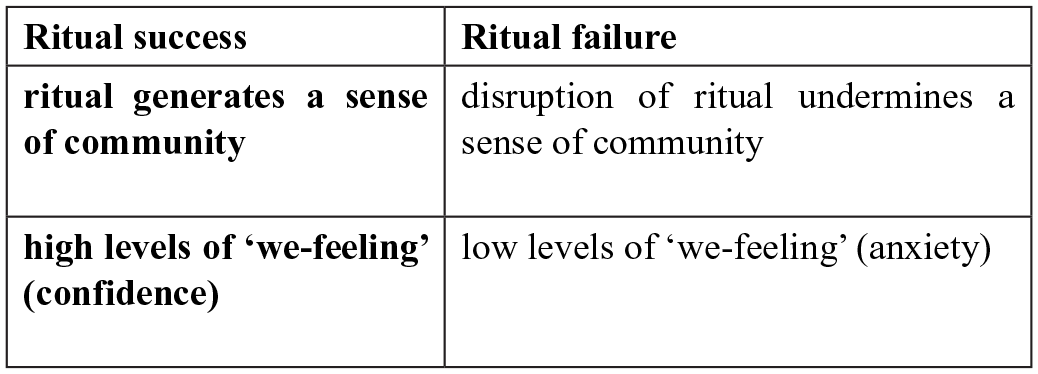
Ritual success and failure.
In addition, a qualifying statement is to avoid the impression that a lot is read into, and drawn from, a single instance without the broader contextualization of the chosen case. It is important to keep in mind that any analysis of a single instance or case study needs to be situated within a broader context to fully understand its significance and potential implications. While it is possible to draw insights and lessons from a specific empirical case, it is crucial to recognize that these findings may not be generalizable to other contexts or situations. Therefore, it is important to approach any analysis with caution, taking into account the limitations and context-specific factors that may have influenced the findings. Only by considering the broader context and multiple instances can we gain a more nuanced and comprehensive understanding of the phenomenon being studied.
The election of Donald Trump as president of the United States in 2016 sent shock waves across the North Atlantic area. During his presidential campaign, Trump had repeatedly portrayed NATO as a historical anachronism that, in his view, was simply ‘obsolete’. On 3 April 2016, he told supporters at a rally in Wisconsin that, (i)t’s possible that we’re going to have to let NATO go. When we’re paying and nobody else is really paying (. . .) you feel like a jerk. (. . .) I call upon those countries (. . .) and say ‘fellas you haven’t paid for years, give us the money or get the hell out. (. . .) Maybe NATO will dissolve, and that’s OK, not the worst thing in the world’ (Newsweek, 2016).
To underscore his point, Trump openly questioned US defence guarantees to NATO members, suggesting that NATO’s sacred pledge, that an attack on one member shall be regarded as an attack on all members, would in the future be conditional on members’ military and financial contributions. In an interview with the New York Times, he stated that, ‘if we cannot be properly reimbursed for the tremendous costs of or military protecting other (NATO) countries (. . .) (t)hen yes, I would be absolutely prepared to tell those countries, “Congratulations, you will be defending yourself”’ (New York Times, 2016).
Given his NATO bashing and recrimination against individual allies, particularly Germany, European leaders awaited the first NATO summit with Trump with grave concern. Given his previous remarks, the allies did everything they could to turn this inaugural ritual into a highly symbolic community-building event to underscore NATO’s continued relevance. The NATO summit was to become a ‘feel-good meeting (. . .) to remind Trump that he’s the leader of the free world’, as an unnamed NATO diplomat put it (Reuters, 2017). For this purpose, NATO staff adjusted the summit format to make it more accommodating for Trump by changing the date, shortening the summit’s long formal proceedings, telling NATO leaders to keep their speeches short and, most importantly, by adding more gravitas to evoke ‘we-feeling’. As the same NATO official boasted: ‘Gravitas is what the Alliance does best’. Indeed, NATO’s international staff puts a lot of work into making sure these ritualized summits produce ‘we-feeling’. In a discussion with one of my interview partners, they mentioned that, ‘one has to deal permanently with the value of the ritual, what significance it has for the cohesion of NATO’.
The NATO summit commenced on 25 May 2017 with the ceremonial opening of the new NATO headquarters as a symbolic linking of NATO’s past and future relevance. Donald Trump spoke in the shadow of the twisted steel beam from the North Tower of the former World Trade Centre, which silently towered above him as a moral and symbolic reminder of the emotion norm of sympathy when Europeans had invoked Article 5 for the first time in NATO’s history to aid in the defence of the United States on September 11. In fact, the entire NATO summit had been carefully designed to let this ‘we-feeling’ flare up again. Hence, what many feared most was that Trump would disrupt the ritual, so everything was arranged to keep the US president from doing so. As a senior NATO diplomat put it: ‘This is not about policy, it’s about political messaging (. . .) Let’s make Trump happy’ (Euractiv, 2017).
There were indeed encouraging signs that the US president might refrain from undermining this important community-building ritual. During a previous joint press conference with NATO’s Secretary General Stoltenberg, Trump had told a perplexed group of reporters about his sudden change of mind regarding NATO: ‘I said it was obsolete. It’s no longer obsolete’ (BBC, 2017). But even though Trump had backtracked on declaring NATO obsolete, most European allies remained anxious and had pressed him to make a symbolic ritual move: an outspoken and unequivocal verbal commitment to Article 5 at the NATO summit. As former US ambassador to NATO Ivo Daalder put it, I think they’re (European allies) a little uncertain to be frank (. . .) I think if the president comes to the meeting – as I expect he will – fully committed to NATO, making clear that the Americans will stand shoulder to shoulder with Europeans to deal with the threats we face, the kind of confidence and trust that is the basis of the alliance can be restored (Public Radio International, 2017).
Indeed, senior members of the Trump administration had signalled Trump’s willingness to emotionally conform to the allies’ expectations. On the day of the summit in Brussels, a senior administration official told the New York Times that the US president would publicly endorse NATO’s mutual defence clause in his speech during the ceremony of the opening of the new headquarters (New York Times, 2017a). A few hours later, White House spokesman Sean Spicer also announced that the US president ‘will reaffirm America’s commitment to the Alliance’ (Politico, 2017).
Yet, things would turn out very differently. Donald Trump had no intention to play by NATO’s ritual script, even though he initially appeared to do so. Standing in front of the September 11 memorial under a NATO banner that read ‘We are allies’, the speech turned into a roundhouse punch during which Trump lectured the heads of member states, standing right next to him like a group of unruly school children about to receive a tongue-lashing, about their alleged failings and shortcomings. The US president thundered against the 23 member states who were ‘still not paying what they should be paying and what they’re supposed to be paying for their defense’. Moreover, he lamented how these nations had treated the United States unfairly, owing ‘massive amounts of money from past years’. Most importantly, however, he failed to make the ritual pledge to explicitly reaffirm American commitment to NATO’s Article 5 that was supposed to be the key ingredient and cornerstone of this ritual ceremony (New York Times, 2017b).
During the speech, as TV cameras switched between Trump and the group of European and Canadian heads of states standing only a few feet next to him, one could not fail to read the emotional reaction in their faces. French president Macron’s face turned from a polite smile to an angry grimace. German Chancellor Merkel even rolled her eyes when Donald Trump reiterated his claim that NATO members owed ‘massive amounts of money’ to the United States (Elite Daily, 2017). Luxemburg’s prime minister Xavier Bettel visibly shook his head in disbelief and turned to his Belgian colleague, whispering something inaudible to him with a grim face. After the speech, NATO leaders mingled and chatted with each other leaving the US president standing isolated on the stage. Adding insult to injury, President Trump forced another ritual disruption during the traditional NATO family photo when he appeared to physically push aside the prime minister of Montenegro, Dusko Markovic, making the US president appear like a schoolyard bully (The Washington Post, 2017a). This draws attention to the power dynamics inherent in any ritual. Rituals often legitimize and reinforce power relations among its participants. Ritual disruptions reveal these power dynamics, causing anxiety and uncertainty. Consider how one of my interview partners remembered the summit: In the Council meeting, the Canadian prime minister Justin Trudeau reemphasized in his speech the emotional theme from a recent NATO ad campaign (#wearenato) and all the big members rehashed the same theme. The message was clear: We are a community. You can’t be ‘America First’. NATO is like a good family. When there is a dispute, you close the doors and windows, and you sort things out. But you don’t talk trash about family members in public (Interview partner L).
Given the fact that, following the invocation of Article 5 in 2001, thousands of European and Canadian soldiers had died fighting alongside American soldiers in NATO’s war in Afghanistan to defend US security, Trump’s performance must have come across as ungrateful at best and insulting at worst. As per the input from one of the individuals I interviewed and who had been involved in the summit: At the 2017 NATO summit, speaking time was limited to three minutes. Trump spoke for eight and a half minutes. Everyone was stunned. When the shit hit the fan (on September 11) for you, NATO countries stood by America’s side and the fact that Trump simply brushed that aside by saying, ‘I’m not sure if we will stand by you’, that didn’t go down well. It was something like hurt pride (Interview partner M).
Most importantly, Trump’s angry remarks about NATO allies’ defence spending were dwarfed by what Trump did not say. Despite earlier reassurances by senior US administration officials, including US Secretary of Defence James Mattis and Vice President Mike Pence, Trump had refused to pay his respect to NATO’s ritual symbol of allied solidarity: the mutual defence clause of the North Atlantic Treaty. As a result, what had been carefully planned as a community-building ritual turned into the exact opposite. The ritual ceremony in front of the new NATO headquarters had been staged to reaffirm emotional attachment to the sacred symbols holding the transatlantic community together and to generate ‘we-feeling’ among its participants. Instead, the summit served to further destabilize an already battered transatlantic security community. Thomas Wright from the Brookings Institution, a US think tank, was stunned about the US president’s silence on Article 5: ‘I was fully convinced he would do it because it’s very simple. It was the perfect time, standing aside the wreckage’ (Wright, 2017). And he went on to determine: ‘One can criticize President Obama’s Russia policy but he understood the sacred importance of Article 5’ (The Washington Post, 2017b). Former US ambassador to NATO Ivo Daalder seconded this viewpoint: This was a perfectly scripted ritual to deliver a very simple message that every president of the United States has delivered at the first possible opportunity, which is that the United States stands firmly behind its commitment to the defense of NATO (CNN, 2017).
Nicholas Burns, who had been the US ambassador to NATO during the September 11 attacks, lamented: This is the first (US) president since 1949 not to mention Article 5. Every (US) president has reaffirmed collective defense and today was the day for him to do it. It was really disappointing. I support him on asking allies to spend more on defense. But there is a time and place. And this wasn’t it. (. . .) The allies were looking for a tight embrace and they didn’t get it (CNN, 2017).
Instead of soothing European anxieties, Trump had publicly desecrated the most sacred symbol of the group during the summit ritual by raising profane allegations about military defence spending and the costs of a building. In one of my interviews, a diplomat from Eastern Europe put it, ‘there was an erosion of trust. We took it for granted that NATO would always be there’ (Interview partner N).
Indeed, Trump’s silence on Article 5 was deafening and eventually forced the Trump administration to reconsider its previous stance. In a speech in Warsaw a month later, President Trump finally endorsed the mutual defence clause: ‘The United States has demonstrated not merely with words, but with its actions, that we stand firmly behind Article 5, the mutual defense commitment’ (The White House, 2017). But this was too little too late because it took place outside NATO’s ritual framework. As I discussed with one of my interviewees, they mentioned: ‘The fact that he later acknowledged Article 5 was not decisive. It makes a huge difference if you say that in front of NATO headquarters and the heads of government of the member countries. That has a bigger impact’ (Interview partner O). Trump’s previous silence on Article 5 had already undermined ‘we-feeling’ between NATO members by disrupting the performance of the ritualized sequence.
Consider how Trump’s sabotaging of NATO’s summit ritual caused anxiety among the allies. According to a statement made by a participant I interviewed: ‘There is unquestionably an emotive element to Article 5 that became exposed by Trump’ (Interview partner P). Another interview partner spoke more bluntly: ‘Questioning Article 5 is a no-go’ (Interview partner Q). By deliberately misperforming the ritual, Trump drew attention to the power dynamics within NATO and debunked the transcendent image of equality and allied solidarity, challenging what was supposed to be held sacred. In one of my conversations, a respondent shared with me: There is a sacred principle: solidarity is not a matter of opinion, it is absolute. This is why Trump has created so much uncertainty: We can no longer rely on US solidarity. For the first time the basic trust, the sacred principle of solidarity within NATO was violated (Interview partner R).
Another interview partners confirmed this: ‘It was the “talk of the town” in NATO’s corridors. The questioning of Article 5 was pretty damaging because NATO is based on the belief that allies will come to help you and this belief was put into question’ (Interview partner S). One of the individuals I spoke with during an interview shared the following impression with me: ‘There was overall anxiety. We were really worried’ (Interview partner T). As the shadow foreign secretary of Britain’s Labour Party, Douglas Alexander, put it, (t)here’s very real concern in Europe over the language that President-elect Trump is using (. . .). There’s real anxiety (. . .). If you’re in Latvia, Lithuania, Estonia, there is deep fear as to whether he takes seriously the terms of collective security, which is the fundamental basis of the North Atlantic Treaty Organization (CNN, 2016).
Here is how a senior NATO diplomat described the situation to me: ‘The adrenaline level rose before every NATO summit with Trump and the nerves were on edge, so that even the otherwise so calm Secretary General Stoltenberg snapped at his aides’. In a discussion with one of my interviewees, they labelled Trump as ‘the great disrupter’ who had raised the level of anxiety among NATO members to unprecedented levels (Interview partner U). One interview partner described this anxiety in the following way: ‘Trump acted very disruptively and you could feel the tension’ (Interview partner V). As noted above, NATO summits provide the ritual frame for communal living and the attainment of ‘we-feeling’. Indeed, NATO’s international staff had worked very hard to employ NATO symbolism to attain a sense of community. In one interview, one of my participants recalled that, the flag-raising ceremony at the NATO summit was preceded by a long preparation. The International Staff tried to influence the sense of community. In the end, one man and one woman from each member state would march in and hoist the flag (Interview partner W).
But in the Trump era, NATO summits could no longer serve this purpose. As the New York Times put it: NATO summit meetings were once ritualistic events, with the member nations assembling to proclaim that the alliance had never been stronger and pledging to work together on the security issues of the day. In the Trump era, however, they have become anxiety-producing confrontations where the main object is to avoid long-term damage to the military alliance (New York Times, 2018a).
Former US ambassador to NATO, Douglas Lute, equally warned that: ‘(T)he only real deliverable for NATO summits is solidarity and cohesion. But that is at risk (. . .). And I fear that we will come out of this summit with symbols of division’ (New York Times, 2018b). As German Chancellor Angela Merkel put it: ‘The times in which we could rely fully on others – They are somewhat over. This is what I experienced in the last few days’ (New York Times, 2017c).
Conclusion
Rituals are not static and unchanging. They constantly undergo change, are adapted, updated or reinvented to fit changed circumstances. While rituals are often seen as infallible mechanisms which work irrespective of the individual motivations of the performers, it is clearly visible here that rituals can fail, and that improper performances do in fact matter. The article breaks new ground by introducing a new perspective to the study of emotion and ritual in IR. Theoretically, it introduced the concept of ritual failure to IR. Ritual failure refers to cases in which a ritual is imperfectly performed, giving rise to anxiety and disruption in relation to the ritual community’s developing identity. Empirically, the analysis explored ways in which ritual that has been instrumental in sustaining social cohesion among NATO members failed during the NATO summit in 2017. In line with the theme of the Special Issue, this contribution demonstrates how emotions shape the bounds and boundaries of actors and alliances during ritual committed to fostering peaceful change in a security community. It might be useful to note here that the notion of failure is always from one standpoint of the performance. The whole NATO summit was a failed ritual for the Canadians and Europeans (and for some Americans), but most likely seen as a proper performance and a ritual well performed for Trump. In that sense, Trump brought his own understanding of the ritual with him (Day and Wedderburn, 2022).
The study of ritual failure also holds more general theoretical implications for the study of IR. It offers a way to further unpack the Constructivist promise. A ritual perspective demonstrates how collective identities at the macro-level are ultimately built up and sustained (or undermined) by collective feelings elicited during ritual activity (or failure) at the micro-level. The ability of ritual to build social cohesion draws us away from thinking of peaceful change in a security community, such as NATO, as an inner belief to thinking of it as an outward form generated and sustained by ‘we-feeling’. Conversely, a failed ritual performance can destabilize collective identities from ‘below’, thus providing an important mechanism for (dis)continuities in international politics. In the end, it has been argued that rituals have a reinforcing function for maintaining social cohesion while ritual failure calls into question the sense of community within NATO.
Footnotes
Funding
The author(s) disclosed receipt of the following financial support for the research, authorship, and/or publication of this article: The Research for this study has been generously funded by the German Research Council (DFG).
