




Abstract
Why did transatlantic policymakers target Russia with economic sanctions in response to its actions during the Ukraine conflict? Commentators perceived these sanctions as highly unlikely because they would have high costs for several European countries, and were surprised when they were finally adopted. Constructivist scholars employed explanations based on common norms and trust to explain the European Union’s agreement on economic sanctions in this case. I argue that the mechanism of international emotional resonance played a decisive role in altering the course of the United States and core European Union powers’ cooperation. A framework that combines resonance with emotional influence mechanisms of persuasion and contagion explains the precise timing of the policy shift, why European policymakers accepted sanctions at a substantial cost to their economy and how norms affected policy when they were empowered by intense emotions.
Keywords
How did policymakers of core transatlantic states – United States (US), Germany, United Kingdom (UK) and France – cooperate in adopting economic sanctions against Russia over the 2014 crisis in Ukraine? Despite Moscow’s annexation of Crimea in March 2014, for four months transatlantic policymakers were unable to come together in imposing broader sectoral sanctions on Russia. Analysts resorted to a rationalist approach emphasizing economic interests to explain European powers’ reluctance in moving forward with economic sanctions. For example, Kanter (2014) attributed European resistance to their ‘deeper economic ties’ with Russia and he mentioned Germany’s import of natural gas, Britain’s banking ties and France’s arm deals with Moscow as key factors.
Nevertheless, policymakers agreed at the end of July on a sanctions package targeting Russia’s oil, arms and financial sectors. Surprised by these developments, European Union (EU) scholars wrote that the sanctions were ‘unexpected’ (Natorski and Pomorska, 2017: 58), and that cooperation on this issue reached a level of agreement ‘almost inconceivable before the crisis’ (Nitoiu and Sus, 2017: 76–77). Constructivists argued that European leaders responded to a clear breach of the norms of sovereignty and respect for territorial integrity, and felt a duty to show European unity (Sjursen and Rosén, 2017: 21, 31). Natorski and Pomorska (2017: 55–57) emphasized how the exceptional circumstances of the crisis increased trust among EU member states at the same time as distrust rose toward Russia.
Common norms and a high level of trust likely contributed to the common European response, but it does not explain why European policymakers rejected economic sanctions for four months before changing their minds, nor why they decided that norms mattered more than their economic interests. Recent studies have shown that in Europe sanctions cost billions of euros in terms of trade and millions of jobs (Austrian Institute for Economic Research (WIFO), 2015; Giumelli, 2017).
This article argues that international emotional resonance is a crucial causal mechanism explaining transatlantic cooperation on economic sanctions in this case. Neither the sole nor an independent cause, emotional resonance was the decisive factor in the US and the EU coming together on this issue at the end of July 2014. Differences in emotional resonance explain transatlantic policymakers’ initial divergences on how to handle the crisis, and their strong and united response after the shootdown of civilian aircraft MH17. In a theoretical framework that combines the mechanism of resonance with persuasion and emotional contagion, it becomes possible to explain how American policymakers used resonant emotions to increase pressure on Europeans, and how the broadly shared emotions in the community contributed in shifting German and French policymakers’ stance on economic sanctions.
Political researchers with a Lacanian perspective have explained that a discourse resonates emotionally with audiences because it provides meaning to address these audiences’ insecurities (Rythoven, 2015: 467; Skonieczny, 2018; Solomon, 2013: 104–105). The ‘affect turn’ in international relations (IR) considered affect as an unconscious bodily reaction, and has suggested that a flow of resonances illustrates how affect circulates between bodies (Holland and Solomon, 2014: 264–265; Solomon and Steele, 2017: 270, 280). However, the Lacanian approach is very narrow and avoids the issue that official discourses of security often spread destabilizing rather than reassuring emotions. The affect turn has been criticized for neglecting the social aspect of the transfer of emotions (Åhäll, 2019: 155), and it remains vague as to the mechanisms through which affect circulates.
This article builds on developments in sociology and social psychology, where resonance works through the reactivation of personal experience when people are confronted to current events. Emotions are embodied, but also subjective and intersubjective experiences. This is consistent with IR scholars who have shown that emotions motivate actors to act on their beliefs (Crawford, 2000; Mercer, 2010), and that they empower socially appropriate norms (Eznack, 2012; Koschut, 2014). Emotions contribute to the formation of affective communities, groups ‘constituted and bound by socially embedded feeling structures that attribute emotional meaning and values’ (Hutchison, 2016: 106). Scholars have emphasized how intense emotions, such as traumatic events (Fierke, 2004; Hutchison, 2016; Pace and Bilgic, 2018), bring communities together and structure the meaning that they give to their collective action. The specific mechanisms of emotional influence within such communities have been neglected in comparison.
The theoretical framework developed in this article focuses on the power of emotions to shape the specific process of cooperation where initially divergent stances eventually converge on the same policies. Instead of the structural level, it is concerned with more immediate causes of actor behavior; that is, how their emotions and beliefs become actualized, transferred and politically influential in the course of international interactions. This framework contributes to the constructivist literature by showing how norms activated by powerful emotions can take the foreground, narrow the focus of attention and override existing interests. Resonance matters, even for state policymakers in moments of international crisis.
This article first builds on previous research to construct a definition of the concept of resonance for international cooperation. It then discusses how it this concept is related to other mechanisms emphasizing the power of emotions, and how these mechanisms work their effect depending on their levels of emotional intensity. In the last section, the article examines how this framework sheds a new light on the case of western powers’ sanctions against Russia during the Ukraine conflict. The analysis integrates American policymakers, which have been left out of existing studies on EU cooperation. Swift transatlantic coordination on sanctions is important for the efficacy of these measures.
Conceptualizing resonance
The concept of resonance in social settings first originated from sociology. Although the origins of the concept could be traced all the way back to Durkheim, more recently interactionist sociologists argued that social movements elicit participation by aligning their frames to be congruent with the interests, values or beliefs of potential participants (Snow et al., 1986: 464). Frames are understood as ‘schematas of interpretation’ defining social situations, thus enabling people to organize their experience and give meaning to their action (Goffman, 1986: 10–11, 21). Sociologists conceptualized emotional resonance as ‘the emotional harmony and/or tension’ in the link between collective frames and the individual emotional lives of potential recruits (Shrock et al., 2004: 62). Emotional resonance is thus important for social cooperation: it can both explain why individuals mobilize for a social movement when the movement’s framing resonates with them, and why the movement as a whole is successful when its framing resonates with a sufficient number of participants.
In psychology, theories of embodied cognition used the concept of resonance in a more individual and interpersonal way. They found that perceiving emotional expression and thinking about emotions involves reactivating the embodied experiences associated with specific emotions (Niedenthal, 2007). Through the interconnection of neurons a re-enaction of experience is produced by high-level cognitive processes, and the most salient elements of this experience are preserved and reactivated (see Gallese and Lakoff, 2005). This means that emotionally charged memories and acquired frames of meaning – for example, as contained in language – are brought to the fore by events in the present. The retrieval of emotional memories thus depends both on the content of memories and the current situation (Buchanan, 2007). Appraisal theorists also use the concepts of resonance and framing. For example, Gross and D’Ambrosio (2004) show how frames interact with dispositions to shape emotional reactions and how they also affect the content of emotional responses.
Importantly, physical presence is not necessary for these processes, as the brain has the capacity to simulate emotions on the basis of information connected to emotional experiences. For example, neuroscientists find that the same areas of the brain are activated when watching facial expressions of disgust on a screen as when actually experiencing disgust (Wicker et al., 2003). Just like we are moved by movies, songs or books, in the right context the representation of an emotion-laden situation brings about an emotional response.
The sociological and psychological perspectives suggest that resonance depends on the meaning of a situation and people’s personal experience, and that it can serve for the basis of cooperation just as it can limit it when someone’s life experience does not resonate with how current issues are framed.
Defining international resonance
We often speak of emotions in terms of resonance when saying that someone was shaken or noticing that people are on the same wavelength. Resonance evokes the idea of sound or vibrations reverberating and traveling to different objects, in the same way that bodies of different people and organizations resonate to some emotional tune. This concept can be applied to policymakers of powerful states as well, when these policymakers share a sense of community, and resonate synchronously with current events. Policymakers resonate according to their own personal and national point of view, but also feel emotions in making sense of events through shared frames of meaning.
As not only state representatives but also as humans, policymakers who confront foreign wars have the capacity for emotional empathy, to be moved by what happens to others. IR researchers have extensively studied international political actors’ empathy (Head, 2016), including for the US President when he was involved in diplomatic negotiations (Holmes and Yarhi-Milo, 2017). This is especially relevant when community members, members firmly within the group, are affected or harmed by the conflict. In such cases, emotions such as the fear of escalation, sadness for the loss of life, or anger at the party accused of causing harm, resonate in similar ways for the policymakers who are part of the same community. A key finding of intergroup emotion theory is that emotions regarding the group are felt personally by members who identify as part of the community (Smith and Mackie, 2016).
International emotional resonance is thus when actors from different states independently and synchronously feel similar emotions in reaction to the same situation because it reactivates shared emotional beliefs. While beliefs are propositions that actors hold to be true, emotional beliefs are cases where ‘emotion constitutes and strengthens a belief’ (Mercer, 2010: 2). The beliefs are closely related to past emotional memories and often materialize as historical analogies to earlier events that can be used as a model of what should be done in the present.
Emotional beliefs relate to actors’ conception of their salient political identities, and the emotion norms associated with affective communities (Hutchison, 2016: 102). Emotions empower identity by creating a sense of belonging, shared perspectives and personal attachment to a group. These groups are structured around notions of what emotions are appropriate depending on a situation, which can be called emotion norms (Koschut, 2014: 533). Through these norms, emotions become institutionalized (Crawford, 2014: 547), and represent what is highly valued in international relationships and organizations (Eznack, 2012: 31). Authors who study the transatlantic security community have established how emotion norms and the ‘we-feeling’ of this community matter for its members (Eznack, 2012; Koschut, 2014).
Communities not only hold several beliefs and promote many, sometimes contradictory, norms, but the emotional experiences and dispositions of their members vary. As several constructivist authors have recognized (Finnemore and Sikkink, 1998: 914; Klotz, 1995: 461–462; see also Sending, 2002: 454), identity and normative structures are broad constraints on the actors’ possibilities, but the process of cooperation within such a structure vary substantially, so that more specific mechanisms are necessary to show how beliefs, identities and norms become actual behavior and policies. Emotional resonance drives people to act together on their shared ideas.
Resonance facilitates cooperation when many policymakers resonate with current events and coordinate their policies to match with broadly resonant emotions. Broad international resonance also helps cooperation because even individuals who do not feel a given emotion may be pressured in conforming to the dominant emotions resonating broadly in their community, including in their (trans)national societies. The lack of common resonance hinders cooperation when, despite agreeing on several of the same norms, individuals draw on different beliefs and experiences, and resonate emotionally in completely different ways.
Theoretical framework: emotional influence mechanisms
Emotional resonance is not the only mechanism that explains emotions’ social influence. Two other mechanisms interact with resonance so that emotions produce their effects.
The first is emotional contagion, a mechanism where emotions are quickly transmitted, where they leap from person to person and contaminate related objects. People influence each other because ‘we use how others feel as evidence of how we should feel’ (Mercer, 2014: 524). Ross defines emotional contagion as ‘the nonintentional transfer of an emotion or mood from one individual or group to another’ (2014: 22). In line with Ahmed (2004), he shows how contagion is a complex process where emotional meaning changes, attaches itself to new objects (stickiness) or creatively reconfigures emotional content.
Emotional beliefs shape expectations and the appropriate response to various situations. Two actors can have very different reactions to the same event depending on whether they expected it or not. I can experience anxiety in the presence of someone who is anxious, or feel annoyed if I judge that this anxiety is not justified. Someone else’s emotion may be immediately contagious, but you will laugh a lot more if you get the joke, otherwise it might even make you angry (see Ahmed, 2010: 44). This means that emotions often spread not through direct contagion, but on parallel tracks, through synchronous resonance to the same situation.
The second mechanism, which recognizes more agency for policymakers, is persuasion. Persuasion is when an actor intentionally attempts to transmit emotions and ideas related to a political issue directly to another actor with the goal to change his or her position. Persuasion attempts can be made in a direct interaction, when two policymakers meet, or indirectly when policymakers make public appeals that are heard beyond their states.
Persuasion has been studied for its importance in institution building (for example, Gheciu, 2005: 91–94), but not for how it relates to emotions in an actual instance of cooperation. This mechanism is distinct from both resonance and contagion in that it is intentional. Both the actors doing the persuading and targets of this strategy know that there is a persuasion attempt happening. Although persuasive ideas are almost always backed by intense emotions, other elements of the rhetoric, such as its logic and credibility, are also important for probability of successful persuasion.
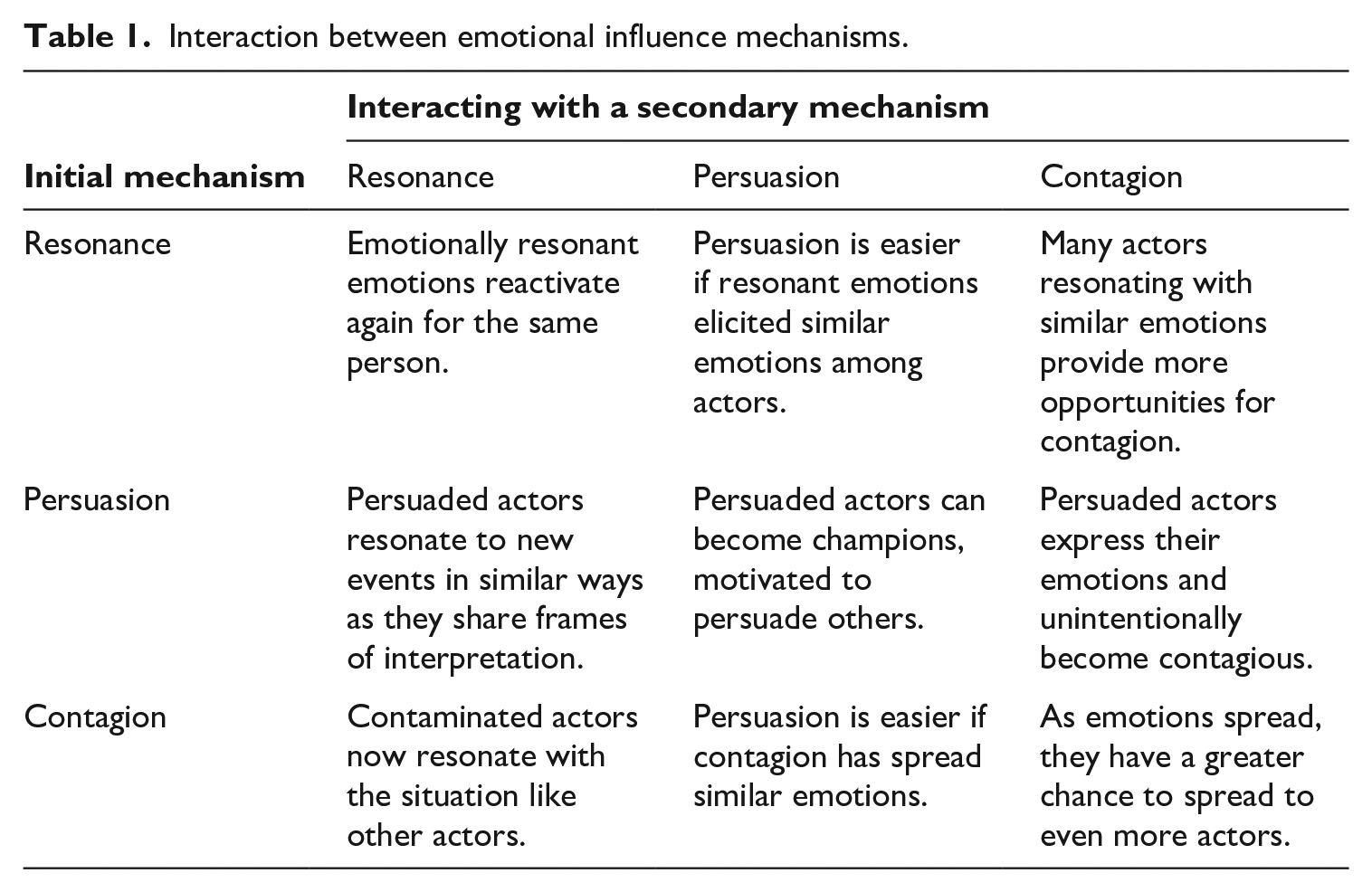
These mechanisms interact in complex ways. The activation of one mechanism can then facilitate the activation of any of the three mechanisms. For example, emotionally resonant events shift many actors’ emotions in the same direction, giving an opportunity for a skillful persuader to use this emotional alignment to push for their preferred policy. This can work with the same mechanism. The more a contagious emotion spreads, the more opportunity it has to contaminate other people and objects.
As one mechanism helps trigger another, the intensity and political power of emotions increase, making it more difficult for policymakers to resist shifting their policy positions in line with them. This understanding is consistent with Sasley’s (2010: 687–688) argument that emotional attachment to an object reduces flexibility and induces political leaders to focus on the emotion as a heuristic. This is also in line with research in psychology, which has found that persuasion is easier when the emotions of the persuader match the target (Fabrigar and Petty, 1999), so that a person is more easily persuaded if they already shared the persuader’s emotions because of resonance or contagion.
Table 1 summarizes the theoretical framework and details all the possible interactions between these mechanisms as they work their effects on international cooperation. Whether or not these mechanisms will activate depends on the intensity of emotions that they elicit.
Interaction between emotional influence mechanisms.
Emotional intensity
High-intensity moments have long been important in the study of international politics; for instance, in the concept of international crisis (Hermann, 1972: 13). ‘Emotional intensity’ is a multidimensional term that includes the duration of an emotion, the level of physiological arousal, constantly re-experiencing the emotion, strong action tendencies and drastic behavior (Sonnemans and Frijda, 1994).
High-intensity emotions are required for the mechanisms presented in this article to activate, so that resonance, contagion or persuasion are triggered and work their effects. Five factors influence the intensity of emotional responses. First, a key factor is the original intensity of an individual’s emotional beliefs, whether because of traumatic or highly emotional memories, or through strong identification with a community. Second, the perceived intensity of the current situation, especially how vivid, unexpected, consequential and relevant current events are appraised to be (Kaufmann, 1994: 563; see also Yarhi-Milo, 2014: 17–20). Third, intensity should also increase when the person is directly affected, or when members of a person’s ingroup are affected. Related to this point, emotions are expected to be more intense for events that can be attributed to a human agent, when an adversary or an outgroup is blameworthy (Sonnemans and Frijda, 1995: 503). Finally, negative and violent events often take the emotional foreground, and are associated with higher levels of intensity (Cacioppo and Gardner, 1999: 206).
Hall and Ross (2015: 859) have remarked that when highly intense emotional reactions occur, they can spread like ‘affective waves’, affecting many people and reorienting policy. The emotional influence mechanisms presented in this article’s theoretical framework explain how these waves spread and increase in intensity. An emotional event affects a limited number of actors who resonate on the same emotional wavelength. They then use these emotions to persuade other actors, and express these emotions intensely, making them more contagious. As more people feel these emotions and share them, it provides exponentially more opportunities for persuasion and contagion, turning into a wave that is impossible to ignore for policymakers.
Scholars with rational or constructivist perspectives may find evidence that economic interests and international norms influence international cooperation because both interests and the application of norms are influenced by a third factor: an event that emotionally resonates with both national groups and international leaders. These emotions empower certain norms to the detriment of others, and make it inappropriate for policymakers to publicly defend a narrow, economic conceptions of their interests when fellow community members are harmed or otherwise emotionally worked up. The next section applies this framework to the transatlantic economic sanctions against Russia in the Ukraine crisis.
Economic sanctions in the Ukraine crisis
Top policymakers of core transatlantic states are conventionally perceived as driven by their interests rather than their emotions. The case of core transatlantic powers’ shift toward the adoption of economic sanctions against Russia in 2014 during the Ukraine crisis is a good opportunity to analyze how emotional influence mechanisms work, and can bring about cooperation.
I systematically collected and analyzed public statements from heads of state and foreign ministers of the 4 core transatlantic powers (for a total of 571 declarations), as well as newspaper articles and secondary sources on the response to the Ukraine crisis, from February to August 2014. I focused on overt expressions of emotions and emotional metaphors as replaced in its context and chronology during the early months of the crisis. This means studying emotions from their representation in language (Hutchison, 2016: 18–19), as this is how emotions become collective and political (Hutchison and Bleiker, 2014: 506), but also inferring their presence from a careful consideration of the chronology of events, and triangulating information from policymakers’ emotions on both their public and private expression. This is why I completed my research with a few interviews to verify my findings and gather information from behind the scenes. 1 The goal is for the method to better grasp how emotions go beyond discourses, and also how official discourse can diverge from private emotional responses.
Emotional intensity cannot easily be measured as one measures temperature with a thermometer. Therefore, the current analysis is limited to inferring intensity from salient emotional beliefs during the crisis. In line with existing research, it demonstrates that politically powerful emotions are based on emotional memories, and often concern violent events that are blameworthy. It also reveals, when data is available, that policymakers often expressed the same emotions in private as they did in public, strengthening the case that emotional intensity is not mere rhetoric. Finally, emotional intensity is also found in the sudden shifts of international positioning in the wake of a particularly shocking event.
Escalation of the war and negotiations
In 2013, Ukrainian President Yanukovych’s rejection of an Association Agreement with the European Union caused a rift in Ukraine between its pro-EU western part and many citizens in the eastern part preferring closer ties to Russia. In February 2014, the conflict escalated, with demonstrators taking over Independence Square in Kiev and the government’s security forces shooting directly at the crowd. Despite German, French and Polish joint efforts to defuse the crisis, pro-EU forces took over the Ukrainian parliament as Yanukovych fled. In response, at the beginning of March, secessionists in Crimea, with the help of Russian forces, seized the parliament and organized a referendum to declare their independence, and integrate their peninsula to the Russian federation. Shortly after, the conflict broadened as secessionists in the Donbass region attempted to do the same in order to create their own independent states.
Transatlantic powers reacted as one to these events, defending Ukraine’s territorial integrity and announcing individual sanctions on the same days, 6 and 17 March. However, policymakers then disagreed on whether to punish Russia for its involvement in the Ukraine conflict or to engage with Moscow in order to negotiate a diplomatic resolution. The US took the lead early to advocate for sectoral sanctions, while the UK also strongly condemned Russia and publicly argued in favor of further measures. Germany and France launched a number of diplomatic initiatives targeted at implementing a ceasefire and resolving areas of conflict between Ukraine and Russia. How the conflict was framed and resonated differently with continental European powers explains this variation.
Feeling the Ukrainian conflict
All transatlantic powers reasoned by analogy with the Cold War, attributing to Russia the role of aggressor and to West Ukrainians the role of victims. This framing cemented cooperation in the West and opposition against Russia, but disagreements remained on how to engage the Russian power. These frames of interpretation were accompanied by different emotional resonances, depending on the policymakers’ personal and political experience. While angry resonance empowered Americans to take the lead against a foreign enemy and British policymakers to condemn Russia, fears of war drove French and German leaders to another approach.
Cold War analogies reinforced US assertiveness against a well-known enemy, at it brought back ideas of the struggle between the ‘free world’ and the Soviet Union. US President Barack Obama spoke of the events in Ukraine as ‘Russia’s aggression toward former Soviet states’ (2014b). In a visit to Poland, he presented Ukrainians as the heirs of Solidarity ‘who dared to challenge a bankrupt regime’ (Obama, 2014a). US Secretary of State Kerry spoke emotionally about his memories of the Cold War, drawing lessons from the time when, he recalled, ‘we would crouch under our desks at school and practice possible nuclear war’ (2014d). On the 70th anniversary of the Tatar Deportation, Kerry (2014a) spoke about how Russia’s current actions reopened old wounds of Stalin’s ‘horrific’ deportations.
British policymakers were content with being good followers, as had often been their role during the Cold War. They shared the strong US emotions against Russia, calling the clashes ‘the worst bloodshed in Ukraine since the fall of communism’ (Hague, 2014a), and drew analogies to what had happened to Poland and Czechoslovakia during and after the Second World War (Cameron, 2014b).
French and German policymakers, however, remembered the Cold War as a time of division and the constant danger of war in continental Europe. They charted an independent course and sought to engage Russia instead of antagonizing it. Fear rather than anger was the dominant emotion for them. German Foreign Minister Steinmeier (2014c) expressed his opinion that the Cold War is still casting its long shadow over the world . Steinmeier referenced the Cold War as ‘spectres from the past returning to haunt us’ (2014d). He presented Germany’s efforts for dialogue by saying that he ‘made every effort to abide by the spirit of Helsinki’ (Steinmeier, 2014e). In an interview for the Frankfurter Allgemeine Zeitung, Chancellor Merkel drew on other analogies and explained the position of her Foreign Minister and many other Germans:
There is a profound human desire that we should solve this conflict peacefully – and this desire I understand well. Especially in this year, in which we commemorate the beginning of the First and Second World War, people correctly expect that we act differently than we have back then, and that today, for example, we remain ready to talk with Russia. (2014)
The German position is consistent with their emotional beliefs, especially their focus on Annäherung durch Veflechtung – rapprochement through interlocking (Stelzenmüller, 2009: 94). It also aligns with the beliefs inherited from their past when a part of their country was under Soviet domination, the idea that a great power should be integrated rather than excluded or humiliated (Larsen, 2012: 111).
French decision makers expressed a similar fear of escalation, and a willingness to engage with Russia. The French Foreign Minister declared: ‘The situation is very worrisome and it is true that when populations have frayed nerves and when the incidents are multiplied, there can always be a skidding of incalculable consequences’ (Fabius, 2014d).
Confronted again and again by Russia’s refusal to change course and engage in serious talks, the French and German position was gradually undermined as the crisis progressed. Several months after the annexation of Crimea, in June 2014, the two powers still sought a diplomatic resolution in the Normandy talks, a format created after commemorations of the Normandy landing in France. Despite consistent persuasion attempts by US policymakers, including the US President going to Europe to directly attempt to persuade his counterparts, and with increasing destabilization in Eastern Ukraine fueled by the arrival of Russian volunteers and weapons, Paris and Berlin were reluctant to adopt economic sanctions and still partly resisted the ‘Russia as aggressor’ frame. Continental European policymakers were primarily responding to the resonant fear of war and escalating conflict with Russia, rather than the need to aggressively counter Russia as advocated by Washington. The resonance and intensity of aggressive emotions was limited and countered by feelings of fear, freezing the transatlantic disagreement.
The shootdown of MH17
On 17 July 2014, Malaysia Airlines flight MH17 was shot down over Eastern Ukraine killing all passengers on board, including many Europeans. Transatlantic policymakers suspected at the time that pro-Russia separatists had accidentally shot down the plane using Russian weapons. This event had major consequences for the crisis: policymakers all resonated with intense outrage, and French and German policymakers quickly moved to rally behind the American lead. Resonant emotions of anger suddenly increased in power as fear diminished in importance. Sensing the shifting emotional atmosphere, American policymakers took advantage of these newly resonant emotions to become more persuasive.
US Secretary of State Kerry declared that he was horrified and insulted when seeing that ‘drunken separatists are stacking bodies into the back of trucks’ (2014c). He labeled the events and Russian behavior as ‘grotesque’ (Kerry, 2014b), and held Moscow responsible for having inflamed and supplied the separatists. President Obama spoke of a ‘heartbreaking event’ which was ‘an outrage of unspeakable proportion’ (2014c). He suggested that Europeans were stepping up their effort for economic sanctions because MH17 made them recognize the importance of the Ukrainian crisis (Obama, 2014d). In several interviews on 20 July, the US Secretary of State declared that this event should be a ‘wakeup call for countries in Europe’, and restated that President Obama had taken the lead on 16 July in adopting ‘the toughest sanctions that have been put in place to date’ (Kerry, 2014c).
In the UK, the new Foreign Secretary, Philip Hammond, on the day of the downing of MH17, stated that he was ‘deeply shocked by this appalling incident’ (2014). British Prime Minister Cameron also stepped in. He labeled the crash an ‘absolutely appalling, shocking, horrific incident’ (2014c). In an opinion letter for the Sunday Times, he compared the crash of MH17 to the ‘horror of Lockerbie in 1988’, a reference to the attack of Libyan terrorists on a civilian airplane. He also expressed ‘anger at some in the West, [who] instead of finding the resolve to deal with this issue, have simply hoped it would go away’ (Cameron, 2014a).
These sudden feelings of anger clearly represent a shift from several declarations a few weeks earlier when the Prime Minister congratulated Europeans for their unity (Cameron, 2014e), and then British Foreign Secretary William Hague (2014b) spoke of the UK as standing ‘shoulder-to-shoulder with European partners’ in resolving the crisis. The Prime Minister emphasized in a speech to Parliament on 21 July that 10 British citizens and 80 children were killed in the crash, and declared: ‘There is anger that the murder of innocent men, women and children has been compounded by sickening reports of looting of victims’ possessions and interference with the evidence’ (Cameron, 2014d). He directly accused Russia of being responsible for this state of affairs. British policymakers, although they were already strongly condemning Russia like their American allies, thus moved even more intensely in the direction that accommodation and negotiation with Moscow was no longer appropriate.
The day after the crash of MH17, the French Foreign Minister declared that this catastrophe was ‘absolutely horrendous’ (Fabius, 2014b). He described his ‘terrible emotion’ in a meeting with his colleague from the Netherlands, and how the Netherlands’ Foreign Minister had told him of belongings that were stolen from the victims’ bodies, including wedding rings that were removed from their finger (Fabius, 2014c). This interpersonal persuasion, which Americans had been attempting for months, was successful now that they were empowered by broadly resonant and contagious emotions. Even before the investigation, Fabius (2014c) directly accused Russia by declaring that it was without question that the missile that hit the plane was a Russian missile.
The German Foreign Minister expressed how he was ‘utterly speechless that hundreds of innocent travelers lost their lives in this horrible way’ (Steinmeier, 2014b). Regarding the handling of the wreckage and access to the crash site, Steinmeier added that ‘[a]nyone who hampers or prevents this either has something to hide or is completely heartless, if not both’ (2014a). His emotions moved from fear to anger, as he declared he was furious that something like this could happen, and that it was ‘shocking and outrageous’ that even after the MH17 disaster ‘the separatists will not comply with the most fundamental rules of our civilization’ (Steinmeier, 2014a). The German Foreign Minister acknowledged that the situation had ‘radically changed’ following the tragedy, as the new resonating emotions called for a new policy.
The majority of the passengers on board MH17, 193 out of 298 people, were from the Netherlands (BBC, 2014). Emotional resonances of this event turned Dutch policymakers from being reluctant to impose strong sanctions on Moscow – according to some commentators, because they feared the possible economic costs (Erdbrink, 2014) – to powerful advocates for sectoral sanctions. A resolution adopted at the United Nations Security Council (UNSC) was championed by the Netherlands’s Minister of Foreign Affairs Frans Timmermans. At the UNSC, he delivered an emotional speech in which he asked diplomats to imagine what it would feel like to be told that your husband is dead and then see ‘images of some thugs removing a wedding band from their hand’ (Sengupta, 2014).
On 16 July, the day before the shootdown of MH17, the French Foreign Minister had indicated in Brussels that the text being prepared for the EU Council did not include sectoral sanctions, and that no arms embargo was on the cards (Fabius, 2014a). Yet, in the days following the incident, emotions shifted from fear to anger, wedding rings and bodies became highly emotional objects, and the intensity of emotions surrounding the issues increased several levels. Suddenly, policymakers who had argued before the shootdown that economic sanctions were not an option now quickly coordinated at the EU to adopt broader economic sanctions.
My interviews confirmed the US attempts at leadership on the issue of sectoral sanctions since March 2014, and how MH17 directly affected European policymakers’ international positions. An EU official well positioned to see the various stances of EU powers, even before I mentioned MH17 in the interview, described the incident as ‘the point of no-return’ which led to ‘sanctions which were unprecedented in their scope and most importantly in terms of target’. He described the event and their impact this way:
The big change is that, that was a finger in the eye of the Europeans. Most of the victims of the MH17 were Europeans, mostly Dutch okay, but it was clear that we were not speaking anymore about the security of a neighbor country that some consider a strong ally or future member of the European Union [. . .]. One thing is your ally, one thing is your wannabe ally, and one thing is when your citizens are affected by this. (Interview with EU official, 11 May 2018)
MH17 had all the ingredients to elicit intense emotions of anger, outrage and disgust. It disrupted emotional beliefs about the need to respect the norms of sovereignty, territorial integrity and non-harm to civilians. It directly affected members of the EU and the transatlantic security community. As a violent event which could be directly attributed to a foreign enemy, it reached peak intensity.
The resonance of MH17 empowered American persuasion attempts, becoming a ‘wakeup call’ and turned Netherland’s policymakers into champions for economic sanctions. Contagious emotions of outrage spread beyond policymakers to become broadly shared, relayed to the public through the media, making it difficult for any policymaker to oppose the tide of recriminations. Emotionally charged metaphors and concepts of ‘uncivilized’ ‘heartless’ behavior against ‘innocent’ people spread and intensified emotions on sanctions. This resonating outrage was best described as ‘a finger in the eye’. Actors either changed in their willingness to resist sanctions, or perceived this resistance as unacceptable in the new emotional atmosphere, a ‘radically changed’ situation.
Conclusion
Evidence in this article strongly suggests that arguments which ignore emotions lack a crucial part of the story. The liberal approach may explain some exclusions from the final sanctions package, such as existing arms deals. However, it does not explain why the US and the EU adopted sanctions costly to themselves, sometimes very costly for some European states. US policymakers took the lead despite their lower economic interests involved in the conflict. German Chancellor Merkel was one of the first European policymakers to seriously consider sanctions. Considering Germany’s trade and energy interdependence with Moscow, the liberal approach would predict that the Chancellor should have led against sanctions among transatlantic powers, not for them. As Giumelli (2017: 1077) has remarked, on the issue of economic sanctions, European states’ foreign policies did not match with their interests.
The constructivist approaches focused on international norms and trust cannot explain why it was at a specific moment, at the end of July, that economic sanctions were adopted while Russia had been violating important international norms for four months. Moreover, an escalation and slowly mounting normative pressure explanation where MH17 is just the last drop fails to account for the fact that the day before the plane was shot down, French policymakers were confident enough to say that sectoral sanctions would be delayed once more. The existence of the EU, the high level of trust and the preparation of potential sanctions already considered in the Committee of Permanent Representatives (COREPER) certainly influenced how cooperation came about in this case, but it is not sufficient to explain why policymakers from great powers accepted to move forward with sanctions at the end of July 2014.
After their initial division, the shocking event of MH17 resonated in similar ways, bringing transatlantic policymakers together. Emotional historical analogies (Cold War, Second World War, Lockerbie), metaphors (‘spirit of Helsinki’, ‘skidding’, ‘wakeup call’) and emotionally imbued objects (for example, a wedding ring) were employed to frame, express and spread intense emotions. Norms exerted their most powerful force when they were backed by intense emotions. Resonance explains why talking about jobs or economic interest was not appropriate anymore, as members of the ingroup had been directly killed and outrage resonated broadly.
The theoretical framework employed in this article shows both the strategic and the causal sides of emotions. Policymakers saw an emotionally resonant event as an opportunity for persuasion, while other actors were either strongly emotionally driven to respond to it, or at least recognized that they could not reasonably oppose the affective tide. Persuasion successfully worked its effect only when resonant emotions had altered French and German policymakers’ dominant emotions to bring them in line with their American and British allies, making resonance a crucial mechanism in this case.
Further research should aim to test the various factors that influence international emotional resonance and its associated intensity, develop methods to better assess it in comparison to other emotion mechanisms, and extend the study of resonance to other cases. Research on emotional persuasion is also very rare in international studies, which is another promising path for future research.
Footnotes
Acknowledgements
The work for this article was done as part of my PhD dissertation at Laval University and continued during my postdoctoral research at Frei Universität Berlin. I received the financial support of Canada’s Social Sciences and Humanities Research Council both for my PhD and my postdoctoral studies. I am very grateful to Francesco Cavatorta, Jonathan Mercer, Jonathan Paquin, Andrew Ross, Brent Sasley and Simon Koschut for their helpful comments and suggestions on earlier drafts of this article. I would also like to thank Frédéric Mérand and Antoine Rayroux for inviting me to the ‘Social power and the transatlantic space’ workshop at Concordia University in 2017. I also presented several versions of this article at scientific conferences where I received great feedback. Special thanks to Miroslava Kul’ková, Gerald Schneider and Fulvio Attina. Moreover, I am grateful to the participants who agreed to give me their time for interviews, and I want to thank the reviewers for their suggestions.
Funding
The author received no financial support for the research, authorship and/or publication of this article.
