



Abstract
Radical parties’ electoral surge has intensified debates about their inclusion in government coalitions. This article presents the most extensive analysis of ministry allocation to date, covering data from 555 coalitions from 33 OECD countries since World War II. While Gamson’s Law suggests coalition participants receive ministries proportional to their parliamentary seats, both coalition formation theory and ministry allocation theory imply that radicalism weakens bargaining power. Additionally, empirical research links radical parties to prioritisation of policy payoffs. I propose a theoretical model distinguishing between types of radicalism, identifying distinct mechanisms leading to ministry undercompensation. My findings show that radical parties systematically receive fewer ministries, primarily due to reduced bargaining power rather than because of payoff preferences. Moreover, I demonstrate that the factors facilitating coalition entry are closely linked to those shaping ministry allocation. Using selection bias-robust modeling, this study offers new insights into the constraints radical parties face in government formation.
Introduction
Radical parties, and radical right parties in particular, are on the rise. Until recently, the most visible form of their success was simply their arrival and growing strength in parliaments. As of late, they have also started stretching for government participation. Recent examples include Giorgia Meloni becoming Italy’s Prime Minister with the far-right FdI, the Dutch PVV leading government after its 2023 election victory, and the Austrian FPÖ winning the 2024 elections, receiving a mandate to form a government but ultimately failing to do so. Other radicals, like Viktor Orbán’s Fidesz in Hungary, have already governed for decades. Given their growing momentum, especially in the wake of Trump’s second term in office, this development is unlikely to stop anytime soon.
Thus, we are in acute need of further research into the role of radical parties in government. Governance in most Western democracies is not carried out by single parties. Coalitions have long been the norm, especially in countries following the consensus democratic model (Hobolt & Karp, 2010; Lijphart, 2012). In addition, increasing fragmentation has also made coalitions more common in traditionally more majoritarian states like Spain, Portugal, and even in the UK. Hence, who governs is a meaningful question and has always been of vital interest to political scientists and citizens alike.
Decades of academic engagement have led to strong expectations about who is included in government coalitions. More radical parties are usually found to face higher hurdles (Axelrod, 1970; Crombez, 1996). Yet, once in a coalition, the partners are expected to be treated equally. Gamson’s Law of Proportionality (Browne & Franklin, 1973; Gamson, 1961) asserts that a coalition member’s share of ministries proportionally reflects its share of seats. This principle remains one of the most robust findings in political science. Despite its academic acclaim and nigh mythical explanatory power, however, the law is not without challenge. Several theories present competing claims, often concerning the role of radical parties (Morelli, 1999; Schofield & Laver, 1985).
In this paper, I investigate how radicalism makes parties fare in the allocation of ministries. We lack a thorough investigation of this fundamental question—arguably because of the historical scarcity of radical parties in government, verifying popular claims of coalition formation theory. I argue that greater radicalism makes parties not only likely to participate in coalitions less frequently but also makes them receive fewer ministries. My research reflects this expectation and provides evidence of a negative effect on ministry compensation for more radical parties. My findings suggest that the well-documented overcompensation of small parties in coalition negotiations is more nuanced than previously assumed. While higher radicalism can offset this advantage, a more centrist placement can even exacerbate it.
Moreover, I present a theoretical model that is sensitive to different types of radicalism. Parties can be radical in absolute and relative terms. Absolute radicalism can be understood as an ideological stance that pursues a “purified” interpretation 1 of certain political values and seeks to establish a corresponding societal model (Mudde, 2006). It is not confined to a particular ideological direction. Spatially, it is usually found at the endpoints of ideological spectrums (see Arzheimer, 2011). Relative radicalism, in contrast, is characterised by a delineation from political opponents (Betz & Johnson, 2004) and system aspects (Ignazi, 2003). Defining these system aspects by concept depends on the respective system. I claim that we have reason to expect that both types of radicalism lead to the same outcome ministry-wise: undercompensation. The mechanism behind this result, though, differs based on the type of radicalism. Simultaneously testing both types, I approach the question of the actual mechanisms behind ministry compensation and provide case based evidence.
Investigating the impact of radicalism on the allocation of ministries is important from several perspectives. Radical parties have long been a focus in coalition formation research, yet their role in ministry allocation is under-studied. As their ability to participate in coalitions has certainly increased recently, this is a crucial gap. The significance of this analysis extends beyond academic merit; it also has strong implications for everyday politics. Given the importance of ministries for public policy (Alexiadou, 2015; Bäck et al., 2022; Garritzmann & Siderius, 2025), the number of ministries a party receives directly affects its ability to influence politics as it wishes.
Empirically, I provide the most extensive investigation of ministry allocations yet, analysing 4285 party cases participating in 555 government coalitions from 33 different OECD countries since the end of the Second World War. My findings indicate that more radical parties receive fewer ministries than the size of their mere parliamentary presence would predict. I argue that this is not a coincidence, but is due to their radical positions. More generally, the paper thus shows that ministerial allocation is not only shaped by parties’ electoral strength (as Gamson’s Law predicts), but also by substantive ideological positions.
The article is structured as follows: In the next section, I present my understanding of the key concept of this investigation: radicalism. By reviewing the role of radicalism in coalition formation theory and ministry allocation theory, I argue that more radical parties are likely to receive fewer ministries than proportionally expected. In the subsequent section, I explain my analytical strategy and present the data I use. In the results section, I provide evidence for my model. The final section concludes and points out implications and avenues for future work.
Radical Parties in Government and the Allocation of Ministries
The recent rise in electoral success of radical right parties (Mudde, 2013) has ignited a vigorous debate on how to address their efforts to join governments. Some argue that cooperating with radical parties is the best approach. They posit that this can either tie them to the system or reduce their appeal by de-mystifying them or exposing their weaknesses (Fallend & Heinisch, 2016; van Spanje & van Der Brug, 2007). Others contend that a cordon sanitaire should never be breached to prevent radical parties from threatening democracy or so that they are perceived as normalised. They argue that the success of these parties can only be curtailed if they remain isolated (Art, 2011; de Jonge, 2021; Heinze, 2018; van Spanje & de Graaf, 2018). In many cases, the argument centres on whether radical parties will succeed in government (Heinisch, 2003). 2
A review of popular party goal typologies helps in establishing a systematic framework to evaluate this. Strøm’s (1990) distinction of policy-, office-, and vote-seeking goals helps to explain why rational parties want to govern and what they expect from doing so. Of the three goals mentioned, electoral success is the most apparent odd one out. Although an incumbency bonus has been discussed (Gelman & Huang, 2008; Klašnja & Titiunik, 2017), electoral gains are neither an inherent aspect nor a necessary consequence of governing. Extensive research even links governing to electoral costs (Boyne et al., 2009; Hjermitslev, 2020; Paldam, 1986; van Spanje, 2011). These costs can affect radical parties particularly strongly (Allers et al., 2022; Riera & Pastor, 2022). This could potentially stem from their inability to claim a proportional amount of ministries, contributing to their governmental failure. The other two goals are nearly synonymous with governance and can be found in the partisan pursuit of policy influence and office control. Therefore, a party should evaluate its success in coalition negotiations based on the policy influence it achieves and the share of government positions it secures—and so can we. The focus of this study is on the share of government positions.
Before a party can claim a share of a coalition’s payoff, however, it must first become a part of that coalition. Thus, before analysing parties’ track records in ministry allocation, we need to address who passes the first stage and joins a coalition. Decades of coalition formation research offer strong expectations about this process. Since radicalism is the focus of this study, I will examine its role within coalition formation theory. Generally, there is little reason to expect parties’ performance in this area to increase with their radicalism. Axelrod (1970) suggests that Minimal Connected Winning Coalitions are the most likely outcome, implying that a party’s probability of inclusion declines with its radicalism. Crombez (1996) supports this view with a game-theoretical approach where a party’s non-centrality—akin to its radicalism—affects its power. The less central a party is, the harder it will be for it to form stable and favourable coalitions. Empirical evidence supports the idea that more radical parties are involved in coalitions less frequently (Akkerman & De Lange, 2012; Kayser et al., 2023). Often, radical parties are excluded from coalition formation entirely due to being targeted by a cordon sanitaire (van Spanje, 2018).
Although radicalism reduces the chances of coalition participation, Gamson’s Law of Proportionality still provides a robust framework for understanding the role of more radical parties in ministry allocation. This law helps us to predict how ministries are distributed, even for infrequent participants. Gamson’s (1961) proposal aligns closely with Riker’s (1962) claim that parties aim to maximise their share of a coalition’s utility. Both theories assume that coalitions offer benefits to their members, but that these benefits are scarce. As rational actors, parties seek to maximise their own share. Riker famously concluded that coalitions should be as small as possible, i.e., that they should be minimum winning. While Gamson agrees with this assessment, he extends it through an expectation that is central to what came to be known as Gamson’s Law. Gamson suggests that the utility an actor derives from a coalition should proportionally reflect its relative resources. Transferring this expectation to government coalitions by defining the relevant resources as the share of parliamentary seats and the desired benefit as the share of ministries a party receives, Browne and Franklin (1973) provide evidence of a near-perfect proportionality between the two, offering support to Gamson’s theory.
The general finding has been replicated numerous times. Yet, the law is not without challenge. A well-known deviation from the law is that smaller parties tend to be overcompensated (Bäck et al., 2009, 2011; Browne & Franklin, 1973; Raabe & Linhart, 2015; Warwick & Druckman, 2001, 2006). Besides this deviation, the law’s explanatory power has been linked to the existence of pre-election pacts (Carroll & Cox, 2007), temporal aspects of coalition formation (Falcó-Gimeno & Indridason, 2013), policy tensions (Martin & Vanberg, 2020b; Saijo, 2021), and institutional aspects (Cox, 2021). In general, these investigations lead us to expect some level of proportionality between parliamentary seats and ministries, depending on the respective predictors. There are also accounts that propose entirely different explanations. For instance, a formateur bonus has been discussed (see the application of Rubinstein (1982) by Baron and Ferejohn (1989)), although empirical evidence remains inconclusive at best (Ansolabehere et al., 2005; Browne & Franklin, 1973; Browne & Frendreis, 1980).
I focus here on the role of radicalism. Radicalism is a contested concept. I argue that, in order to understand how radicalism affects ministerial allocations, we need to understand what is meant by it. Distinguishing between different types of radicalism leads to different mechanisms as I show below. A major distinction relevant in this regard is between “absolute” and “relative” radicalism (Arzheimer, 2011; Mudde, 2007, p. 25). Absolute radicalism seeks to implement a “purified” version of political values (Mudde, 2006), appearing at the extremes of ideological spectrums (Arzheimer, 2011). Relative radicalism, on the other hand, is defined by opposition to political opponents (Betz & Johnson, 2004) and system aspects (Ignazi, 2003), which vary depending on the specific context.
Accordingly, what is relative about relative radicalism is that, unlike in the absolute understanding, the basis for its identification is not fixed. Relatively radical parties are radical towards specific political contexts, which can change over time. Most contemporary radical parties strongly conform to both types of radicalism.
However, there are cases where parties correspond more strongly or even exclusively to one type of radicalism. For example, the Hungarian Independent Smallholders Party (FKgP) is an instance of a party that was absolutely radical but not relatively radical. Experts classified it as far-right based on its programme before its liquidation (Rooduijn et al., 2023). Despite its radical positions, the FKgP held close relations to several different parties in Orbánist Hungary, illustrating its absolute but not relative radicalism.
In contrast, the Japan Socialist Party (JSP), serves as an example of the opposite constellation: a party that leans towards relative but not absolute radicalism. In 1993, it played a key role in ending the LDP’s 38-year rule by forming an ideologically diverse coalition. Perceiving its positions to be underrepresented in government policy, it came into conflict with its partners, ultimately leaving the coalition. The JSP’s initial motivation was to dethrone the LDP, and its departure from the coalition stemmed from opposition to its former allies. Thus, while the JSP’s overall positions were not radical, its temporary opposition 3 to nearly all other relevant parties made it a relatively radical party (Inoguchi, 1994).
Distinguishing these types of radicalism is crucial to understanding how exactly radicalism influences a party’s performance in ministry allocation. Popular alternatives to Gamson’s approach often circulate around the concept of pivotality (Morelli, 1999; Schofield & Laver, 1985; see also Laver & Schofield, 1990). Pivotal parties enjoy elevated bargaining positions as other parties struggle to exclude them from coalitions. Parties’ ideological positions (towards the other parties) have been acknowledged as a valid factor in parties’ ability to obtain ministries (Carroll & Cox, 2007, p. 301).
It is easy to see how especially more relatively radical parties should exhibit low pivotality. They are ideologically opposed to the political mainstream. Consequently, neither the radicals nor mainstream parties are likely to be very interested in cooperation. This conclusion mirrors expectations from coalition formation theory (Axelrod, 1970; Crombez, 1996). When parties with high levels of relative radicalism are included in negotiations, their blackmail potential (Sartori, 1976) is likely to be severely limited. This makes it difficult for them to credibly threaten potential partners with alternative coalitions if their demands are not met. As a result, parties that align more strongly with relatively radical positions should have lower bargaining power, leading to the following hypothesis:
I argue that the same expectation follows for parties that are (only) radical in absolute terms. Unlike relative radicalism, absolute radicalism cannot directly be linked to a low pivotality. To illustrate this, imagine a far-right party striving for the establishment of an ethnically homogeneous national state. This party is situated in a country where every other party in parliament is also severely sceptical about multi-culturalism. As a result, it would not merit classification as relatively radical. Without additional information about the other parties, it would also be challenging to explain why this party would struggle to credibly threaten potential coalition partners with defection, especially when it shares its ideology with all other parties in parliament. As absolute radicalism therefore does not necessarily lead to low pivotality, there are other reasons we should expect the same outcome.
These reasons are rooted in the relationship between the various goals or payoff types that parties pursue in governance. Parties are not solely motivated by office benefits when participating in coalitions (Strøm, 1990). They often face a choice between office and policy payoffs in these situations (Strøm & Müller, 1999).
4
Prior research indicates that parties with fringe ideological profiles, which corresponds to the concept of spatial and thus absolute radicalism, behave differently than centrist parties. Parties with stronger radical positions are empirically linked to prioritisation of policy over office payoffs, viewing the latter as a means to achieve their policy goals. In contrast, centrist parties are generally more office-seeking (see Bassi, 2021; Laver & Hunt, 1992; Pedersen, 2012). As far as control mechanisms, for instance, allow parties to differentiate between policy and office payoffs, they could strategically trade one for the other. It remains contentious whether or not this separation is valid (see Laver & Shepsle, 1990), but according to the guiding theorem of Strøm and Müller (1999) it is. If the according preferences shape outcomes, we should expect parties with higher levels of absolute radicalism to receive fewer ministries:
In sum, I propose a theoretical model which is sensitive to two different types of radicalism and links them to the same outcome of ministry undercompensation, offering specific and diverging explanations for these different types of radicalism. This model is depicted in Figure 1. While relative radicalism should lead to lower pivotality, absolute radicalism can be linked to a preference for policy over office payoffs. A wealth of research has already shown radical parties to struggle in coalition formation. A thorough investigation of radicalism’s impact on the allocation of ministries to date is lacking. Theoretical model.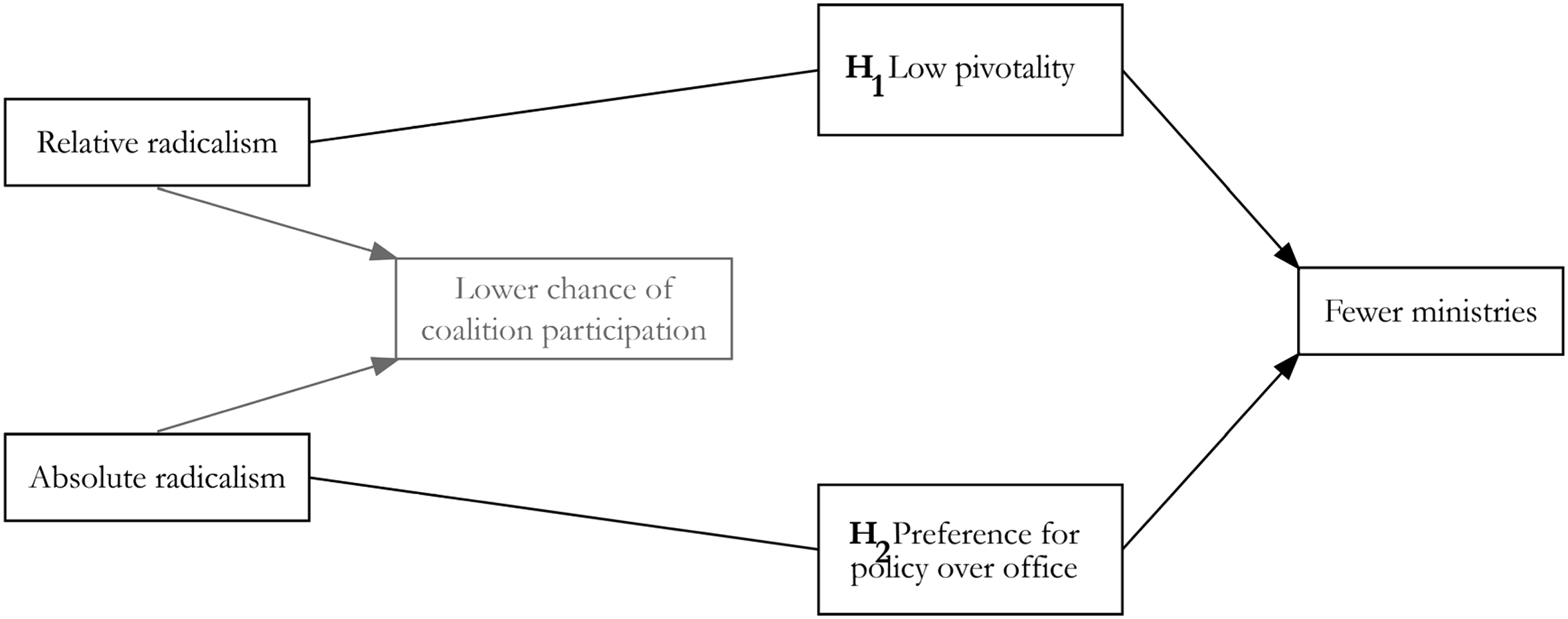
Testing this theoretical model contributes to the literature and our knowledge in multiple ways. Most importantly, it narrows the gap around the popular thesis that radicalism reduces the number of ministries a party receives. In addition, I differentiate between different types of radicalism, proposing distinct mechanisms that could lead to ministry undercompensation. Testing this model also allows for the evaluation of parties’ performances on a significant criterion. Important conclusions can be drawn from it for the debate around the inclusion of radical parties in coalitions. Ministerial implications for public policy are immense. Ministries have a crucial impact on implemented policy (Alexiadou, 2015, 2022; Bäck et al., 2022; Garritzmann & Siderius, 2025). The number of ministries a party receives is therefore critically important to public life.
Method
Empirically, I put my theoretical model that radical parties receive fewer ministries to a comprehensive test. I do this by collecting the broadest database on parties’ ministry compensation to this day. 5 I use the ParlGov database (Döring et al., 2023) in its cabinet-split version. It provides information on all parties present in parliament each time a new cabinet is inaugurated for a host of OECD countries. 6 I combine these data with information on the ministry allocation derived from the EJPR Political Data Yearbook (Gomez et al., 2022) and the Party Government in Europe Database (Hellström et al., 2021). All told, I can thus assess my model on data from 4285 party cases, participating in 555 different coalitions in 33 countries. 7 The data covers a maximum time span from the end of the Second World War until 2021 8 , providing the hitherto most extensive examination of ministry allocations both spatially and over time. As I am only interested in coalition governments, single party governments (majority and minority) were excluded from the analysis, as were pure caretaker governments.
To analyse the role of radicalism in a party’s performance in the allocation of ministries, I need data on when to consider parties radical. I argued that through different mechanisms, both understandings of radicalism should be linked to the same outcome: fewer ministries. While the absolute understanding of radicalism is based on a party’s ideological position regardless of other actors’ positions, the relative understanding is based on the distance towards the other actors. In both cases, I am therefore in need of data on parties’ positions as an independent variable. I retrieve this information from ParlGov.
Capturing a party’s absolute radicalism is made possible by using the measure of a party’s left-right placement. This provides a general idea of the party’s radicalism. Ranging from zero (left) to 10 (right), this variable aggregates several projects of party ideology measurement and is thereby able to offer a highly generalised metric for the largest possible number of parties. A party’s absolute radicalism is its distance from the absolute centre of this scale, i.e., from a left-right value of 5. Fringe left-right orientations are not the only conceivable purified characteristic of a radical ideology (see Pirro, 2023). At the same time, this is one of the most popular measurement variants (see Arzheimer, 2011). The left-right axis enjoys the reputation of adequately reflecting the most significant political issues and is therefore the most popular instrument of political ideology (Budge et al., 2001). It also corresponds with findings on the office preference of radical parties (Bassi, 2021; Pedersen, 2012). Crucially, this spatial measurement does not depend on political context.
The relative understanding, on the other hand, is measured by a party’s relationship to the other parties in parliament. Inspired by Crombez (1996, p. 13), I operationalise relative radicalism as the distance towards the seat-weighted mean of the parliament. Figure 2 illustrates this operationalisation. It depicts the ideological positions of four fictional parties: A, B, C and D (shown as triangles), and the ideological centroid of these parties (shown as a circle). Party B is closest to the parliamentary centroid and also the most centrist party in absolute terms, with a left-right value (LR) of 5. Both Party A and Party D are equally distant to the absolute ideological centre (i.e., a left-right value of 5). Yet, as Party A is closer to the parliamentary centroid, it is much less radical in relative terms. Relative radicalism. Note. Hypothetical parties on the left-right axis, depicting the operationalisation of the relative radicalism measure.
Generally, I do not expect the proposed effect to depend on the side of radicalism, i.e., whether we are investigating left- or right-wing radicalism. Thus, I standardise both variants to run from 0 to 5. A higher value indicates a more radical party. Empirically, the absolute and the relative understanding are closely related (r = 0.965; p < .001; n = 4, 285). 9 Yet, by providing analyses for both it is possible to approach the question of the underlying mechanism behind any effects. Differences can then be attributed either to bargaining power or to goal preferences.
My dependent variable must capture whether more radical parties perform worse in the allocation of ministries. A share proportional to seats in parliament is considered the baseline for this comparison. Consequently, I measure a party’s performance as its ability to conform to or even outperform Gamson’s Law. Underperformance can be identified when a party receives fewer ministries than its seat share would proportionally warrant. To construct the appropriate dependent variable, we first need to determine how many ministries a party i is expected to receive according to Gamson’s Law. This is achieved by multiplying a party’s share of seats among the coalition participants with the total number of ministries of the cabinet k. I treat the total number of cabinet ministries as fixed. This means that I calculate a party’s ministry share based on the number of ministries awarded when the cabinet first assumes office:

I round a party’s expected number of ministries to the next integer to reflect parties not being able to receive a share of a ministry. I then subtract this value from the number of ministries a party actually receives. By rounding the expected ministries, I also control for deviations that can only be explained by the size of the coalition. The number of parliamentary seats is regularly larger than the size of the government. As a result, the seat shares can often only be offset in ministries with deviations resulting solely from the smaller number of ministries. By finally dividing this number by the total number of ministries of the cabinet, I arrive at a robust dependent variable for cabinet size:
10

This variable can theoretically range from -100 for a party that should have received all ministries but got none, to +100, denoting a party whose seat share does not warrant claiming a ministry but ends up gaining all available ministries. 11 A value of zero indicates a perfectly Gamsonian number of ministries.
Gamson’s proportionality expectation is well-suited to serve as a baseline. Few other social scientific theorems apply as robustly, giving it paramount status for social scientists (see Ariotti & Golder, 2018). To showcase the almost universal applicability of this perspective, I specify the model described by Fréchette et al. (2005), which has become the most reputable way of testing Gamson’s law. I modify their model by introducing a country interaction with the cabinet seat share of a party.
Figure 3 displays the country-wise average marginal effects of the cabinet seat share on the ministry share. In this model, a coefficient of 1 indicates perfect validity of Gamson’s Law. Smaller coefficients represent a tendency of overcompensation of smaller parties et vice versa. As can be seen, there is a good deal of variation in the law’s applicability. Countries like Switzerland and Iceland show the lowest proportionality in ministry allocation. This is certainly unsurprising, considering that both countries have long-standing traditions of ministry allocation with limited consideration for the cabinet seat share (Indridason & Kristinsson, 2021; Wolff & Karagök, 2012). It is perhaps more surprising that there is still some proportionality visible with these traditions in place. Nevertheless, the key takeaway is that in the countries under investigation, the allocation of ministries strongly adheres to the norm of proportionality. In 13 of the 33 countries I investigate, the 95% confidence interval includes 1, indicating that ruling out perfect proportionality is inappropriate in the respective countries. In nearly all other countries, the observed factor of proportionality strongly approaches a value of 1. Deviations from proportional ministerial allocations are, hence, meaningful. The construction of the dependent variable is backed by empirical analysis. Proportionality of the allocation of ministries around the world. Note. Average marginal effect of seat share on ministry compensation depending on country. The closer to one, the more proportional the allocation of ministries.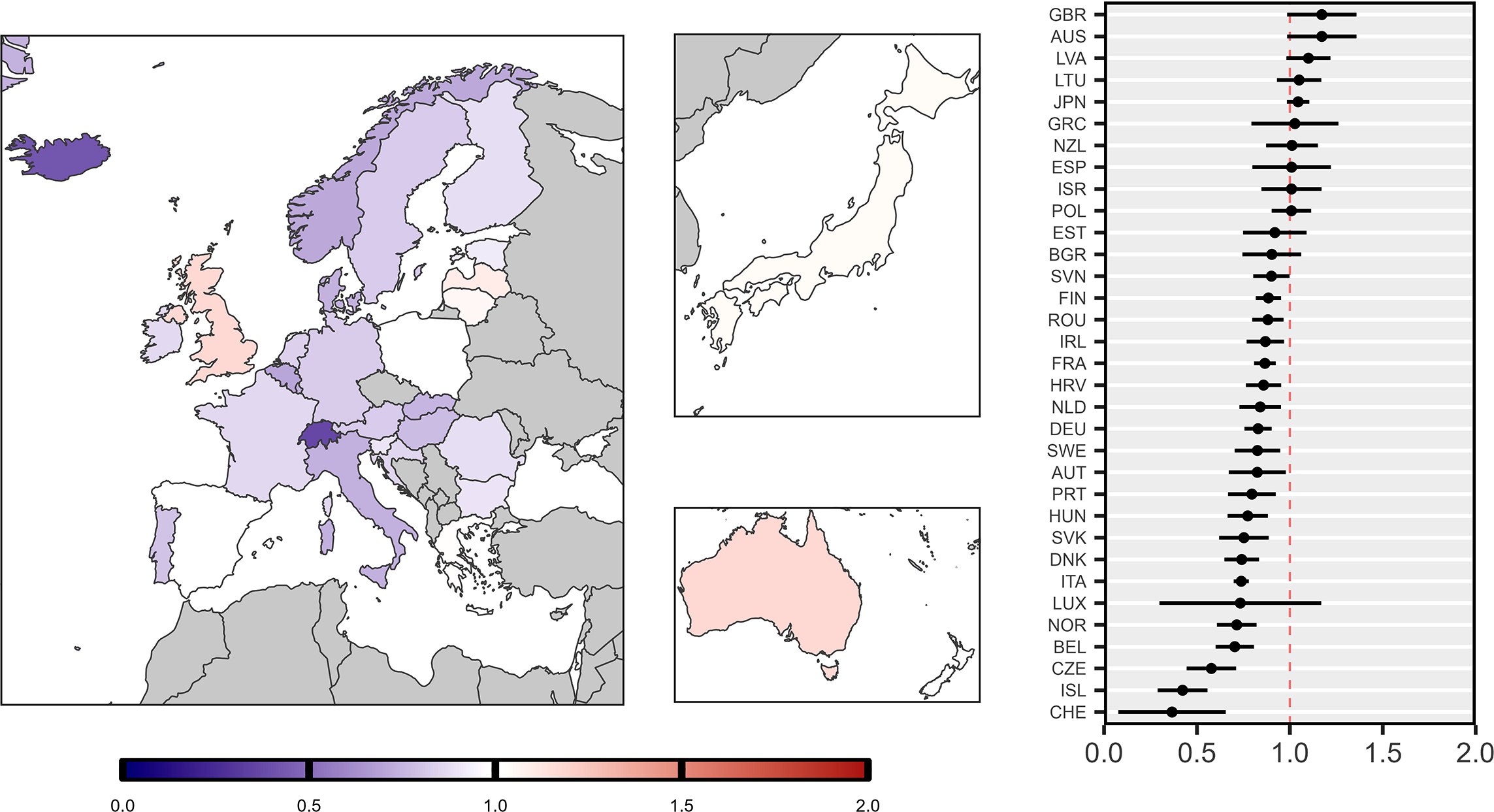
Is it enough to look at the mere number of ministries or should we not also look at the respective kind of ministry that parties receive? For different reasons my empirical study concentrates on the quantitative aspect of ministry allocation, i.e., on the relative number of ministries. First, by including qualitative aspects, my data would be narrowed down drastically. In addition, Gamson’s Law, which underpins my dependent variable, is typically applied with disregard to portfolio prestige. 12 The relevance of deviations from it should consequently not depend on it. Finally, it is again important to point out the significance ministries have for public policy, often in sectors that do not even fall directly into their profile (Garritzmann & Siderius, 2025). Missing out on a ministry will limit a party’s power.
Aside from my main expectation that a party’s radicalism negatively impacts its ministry compensation, I also control for the party’s seat share. As the undercompensation of larger parties is without a doubt the most well-known and robust deviation from perfect proportionality, omitting this variable would produce biased estimates. 13 Aside from this, I opt not to include any other controls in my main models because no other (partisan) feature has been reliably connected to disproportional results. In the additional models provided in the supplemental material, I do test several other possible influences, providing evidence for my findings’ robustness.
Finally, the modelling strategy deserves special attention, as it needs to adequately reflect the structure of my argument. In the previous section, I speculated that one possible reason for the research gap addressed by this article could be the rarity of radical parties participating in government (see Axelrod, 1970; Baron & Diermeier, 2001; Crombez, 1996). I assume a parallelism of radicalism’s influence in coalition formation and ministry allocation. To accurately detect this negative influence in the allocation of ministries, I need to account for when parties actually are radical. A look at coalition formation in Germany helps to illustrate this problem. Coalition formation at the national level is exclusively negotiated between the mainstream parties. Both the right-wing radical AfD as well as the (‘borderline’) far-left (Rooduijn et al., 2023) party The Left have thus far been isolated in this regard. If I do not account for the fact that the parties participating in the second stage, i.e. ministry allocation, are exclusively mainstream parties, a negative effect for the comparatively less centrist parties, the FDP and The Greens, would be the expected outcome. As they are in fact not radical this does not conform to my theory and, if anything, the opposite would be expected. If I do not correct for this, I am likely to find no effect, or even an effect in the opposite direction.
Fortunately, it is possible to account for this selection bias with a Heckman correction (Heckman, 1979). By correcting the outcome equation’s parameters through a selection equation that takes into account the different likelihood of parties’ government inclusion, bias should be minimised. As deviations from the law have been shown to be more common or larger in some of the countries under investigation, I employ country robust standard errors throughout. 14
I expect that both understandings of radicalism lead to ministry undercompensation through different mechanisms. I do not commit to either the coexistence of both mechanisms or the exclusive existence of a single mechanism. Therefore, I estimate models with separate assessments of the types of radicalism, as well as models that include both types simultaneously. This approach allows for testing each hypothesis individually and examining how they relate to one another.
Results
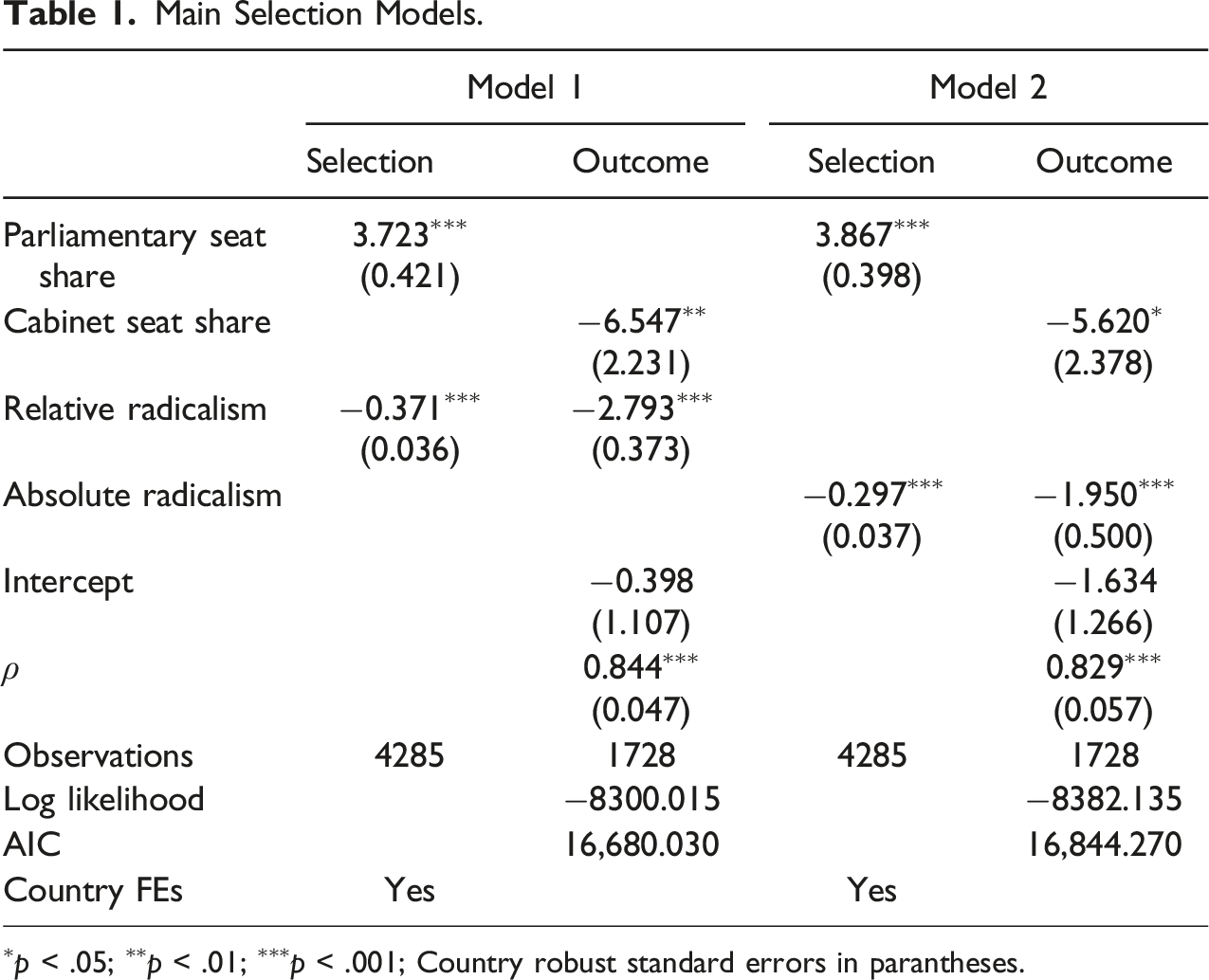
Main Selection Models.
∗p < .05; ∗∗p < .01; ∗∗∗p < .001; Country robust standard errors in parantheses.
The radicalism effect at hand is also quite substantive. The predicted difference between a party located radically distant to the parliamentary centroid (relative radicalism = 4) and a party located exactly at the centroid (relative radicalism = 0) amounts to −11.17% (95%-CI [−14.62; −7.72]) of the total cabinet size, ceteris paribus. In other words, in a cabinet with the observed median size of 17 ministries, the radical party is predicted to receive two fewer ministries than a centrist party with otherwise similar characteristics.
The Mechanism Behind Radical Parties’ Undercompensation
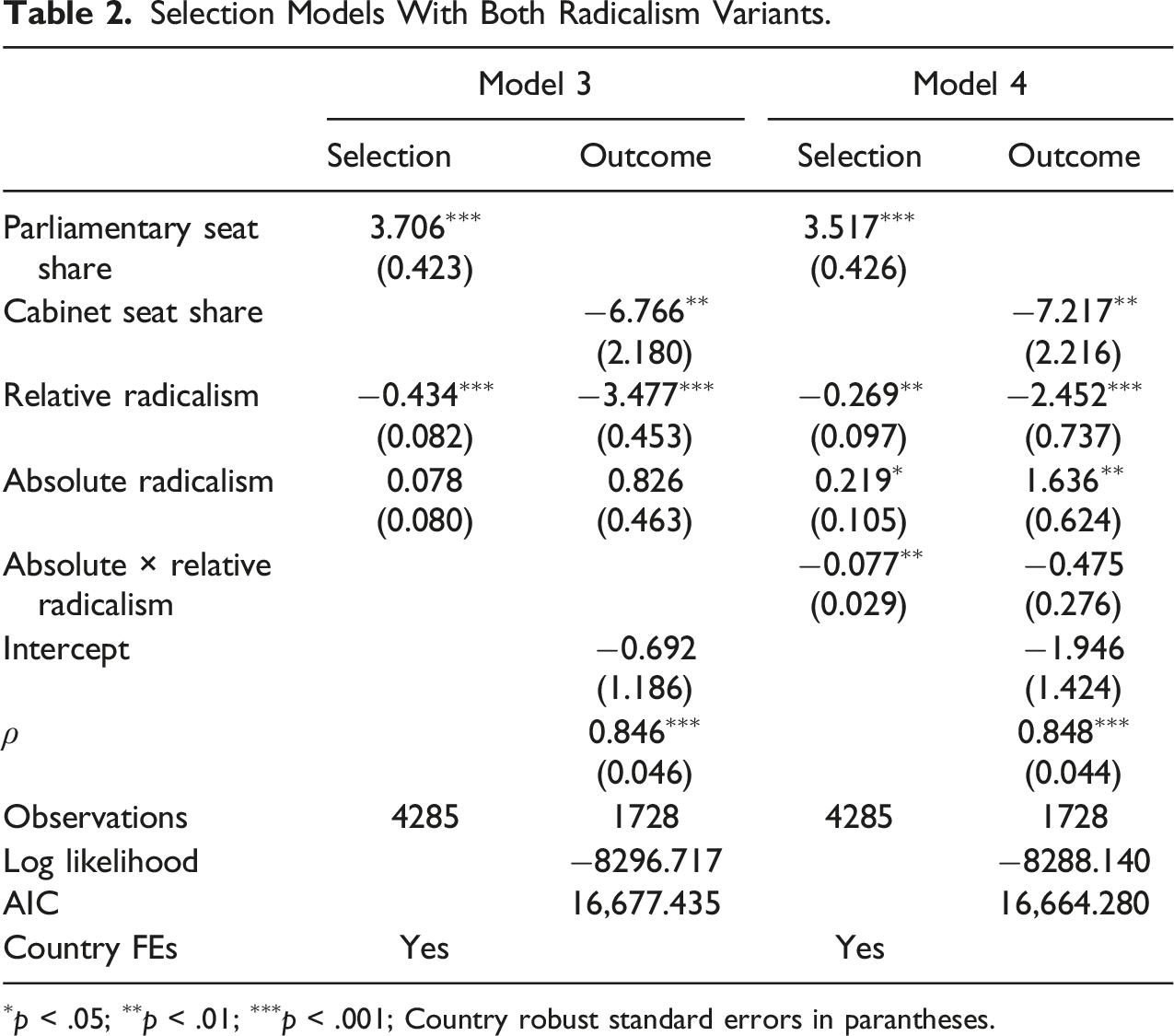
Selection Models With Both Radicalism Variants.
∗p < .05; ∗∗p < .01; ∗∗∗p < .001; Country robust standard errors in parantheses.
Models 3 and 4 strongly suggest that the effect is a result of a party’s relative radicalism rather than its absolute radicalism. In Model 3, the negative effect of relative radicalism remains evident and significant. Absolute radicalism no longer significantly influences a party’s performance in the allocation of ministries. This suggests that radical parties tend to be undercompensated only when their political positioning is distant from that of other parties in parliament. The idea that a general position at the ideological fringes results in a preference for policy over office payoffs that then translates into coalition negotiation results is not supported. The more rigorous test presented with the interaction in Model 4 supports this conclusion. Unlike before, absolute radicalism (under the condition of a total lack of relative radicalism) is even predicted to have a significantly positive effect on parties’ ministry compensation. This directly contradicts the notion that a party positioned on the ideological fringes but close to other parties in parliament would receive fewer ministries. Interaction effects are notoriously complex to interpret (see Brambor et al., 2006)—especially if the interaction is between two continuous variables, as is the case here. Accordingly, I estimate the marginal effects of both variables at different levels of the other respective radicalism measure. The predicted effects are shown in Figure 4. Marginal effects of radicalism. Note. Each panel depicts its title’s variable’s predicted effect on a party’s ministry compensation under different values of the other. 95% confidence interval shown as ribbon. Marks above x-axis represent observations at according level.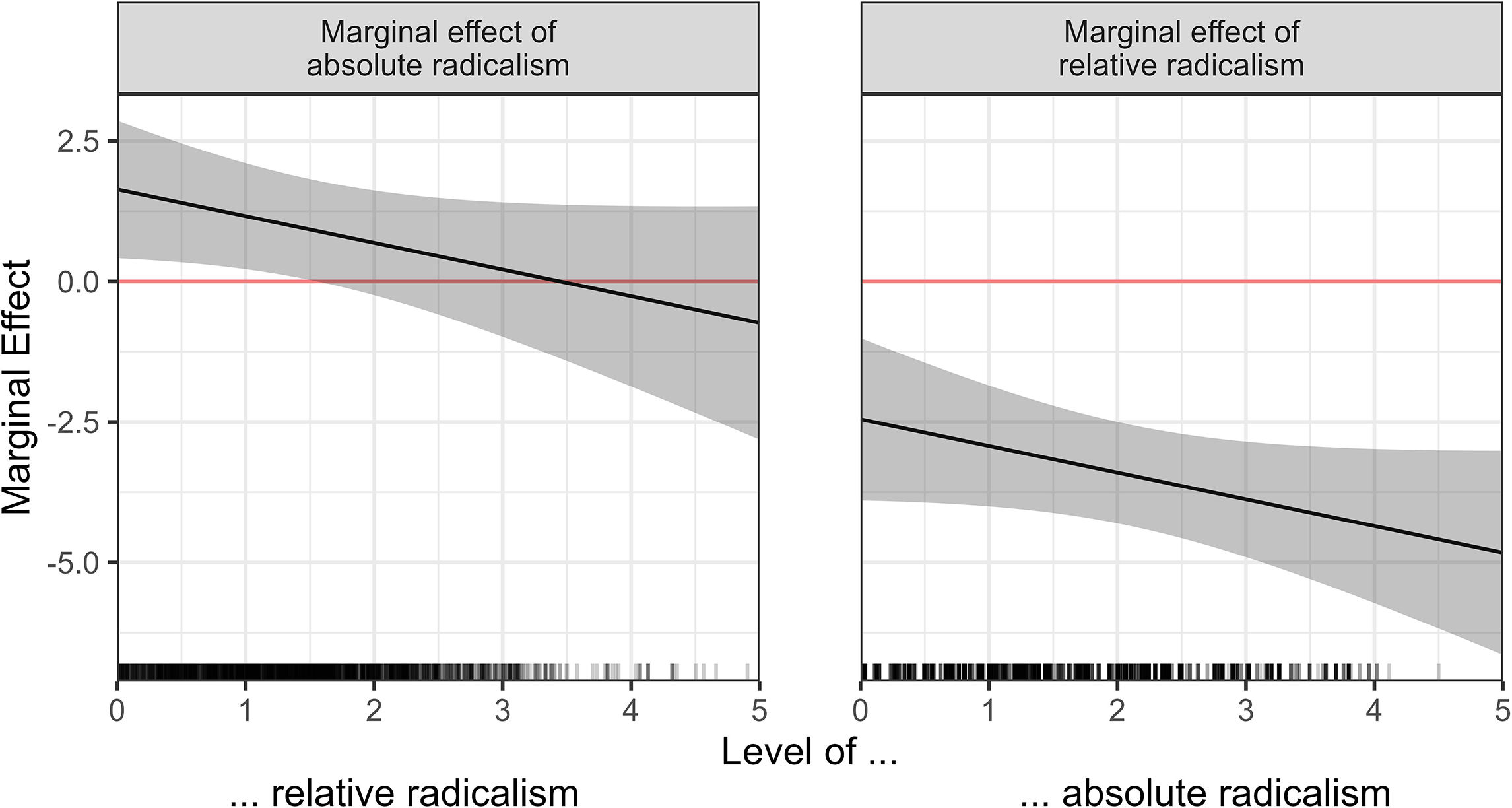
Only the effect of relative radicalism aligns with my theoretical expectation, supporting H1 but not H2. The left panel of Figure 4 depicts the predicted influence of absolute radicalism. We observe that a significant influence of absolute radicalism occurs only when a party is close to the parliamentary centroid. However, this effect is positive. This means that for absolutely radical parties in a system with ideologically similar parties, the model predicts more ministries. This directly contradicts the expectation that absolutely radical parties, being less office-oriented, would be undercompensated ministry-wise based on their goal preferences (H2). The right-hand panel of Figure 4 depicts the influence of relative radicalism conditioned by absolute radicalism. We find a robust and statistically significant negative effect across the entire theoretical range of absolute radicalism. This suggests that a party that is ideologically centrist is still expected to be more undercompensated if it is more distant from the parliamentary centroid.
Finding that absolute radicalism can even positively contribute to ministry allocation is intriguing for several reasons. First, it challenges the trade-off theory, as absolute radicals do not strategically sacrifice ministries to push for policy goals. Second, radicals’ ministerial penalisation is a result of their parliamentary marginalisation. As substantive radical positions like those of the radical right become more normalised (Valentim, 2024), the corresponding actors are increasingly embraced by other political norms, such as Gamson’s proportionality norm. Finally, the positive effect of absolute radicalism under low relative radicalism is plausible. In this context substantially radical views are widely shared, enabling these actors to focus on securing ministries for themselves. Nevertheless, given the empirical correlation between these concepts, these results should be interpreted with caution. In order to prove the robustness, I will carry out additional detailed analyses below. While these analyses nuance the pattern identified up to this point, they consistently reinforce the existing overall impression.
Case Analyses
To fortify against concerns of multicollinearity and investigate possible model misspecifications (Rohlfing, 2008), I examine the mechanisms by additionally looking at some specific cases in greater detail. Cases were selected following two complementing strategies. I initially choose some cases that can be classified as “typical” and some that qualify as “deviant” based on model 3, as suggested by Seawright and Gerring (2008). In a second step, I select parties with notable levels of radicalism. 15 This aspect is of focal importance to my hypotheses and the selected cases, accordingly, are theoretically significant. Specifically, I first filter my data for the five per cent of cases with the smallest and largest residuals. From each type, I then select two parties with a meaningful radical profile.
The Alleanza Nationale (AN) is the first typical case I analyse. It has been classified as neo-fascist and is closely linked to today’s Fratelli d’Italia (Puleo & Piccolino, 2022). After the dramatic erosions in Italy’s political landscape in 1994, the party formed a pre-electoral alliance with Silvio Berlusconi’s Forza Italia (FI). In parallel, the FI allied the Lega Nord (LN), which in many ways ought to be considered radical itself. Both alliances had to remain separate, as the AN firmly rejected the federalist to separatist stance of the LN. The importance of pre-electoral alliances was strongly reinforced by the reform of the electoral system before the 1994 election (Zucchini & Pedrazzani, 2021). As a consequence, the AN and the LN paid dearly for their ideological tensions, as they were unable to establish joint bargaining power vis-à-vis the leading FI. Due to the rising importance of bargaining power (Pritoni, 2012), both radical parties failed to claim a proportional share of ministries—as predicted by the model.
Next, the Latvian Nacionālā Apvienība (NA) is another case verifying the model’s expectations. The right-wing party alliance has repeatedly struggled to claim ministries in proportion to its seat share. It failed to do so in the 2011 Dombrovskis cabinet and in the subsequent cabinets of Straujuma and Kučinskis. Policy tensions were a usual feature of the respective coalitions. Its undercompensation can hardly be explained by a lack of interest for other portfolios. The NA was, for instance, unsuccesful in its pursuit of the ministry of education during the Straujuma cabinet formation, having been blocked from it by its more moderate partners (Ikstens, 2023).
These typical cases imply that more radical parties tend to receive fewer ministries not due to a lack of interest in them, but because they struggle to assert themselves in political alliances. This confirms and illustrates the patterns shown in the large-N analysis. As long as radical parties are fringe parties, only participating in coalitions at the mercy of more mainstream parties, ministerial undercompensation appears to be likely. Nevertheless, with radical parties’ rising electoral success and their coalition inclusion becoming less of an anomaly, repeating this analysis in the future is vital. Testing whether the findings also hold for situations in which the parties are ideologically distant to the other parties but are large enough to block (close to) all other coalition combinations is a crucial task for future research. The analyses at hand do imply that relative radicalism, if understood as a party’s (ideological) distance to other parties, is a powerful factor in its ability to claim ministries.
The deviant cases of the Nuovo Centrodestra (NCD) in Italy’s 2014 cabinet of Matteo Renzi and the Finnish Uusi Vaihtoehto (UV), which participated in Juha Sipilä’s second cabinet in 2017, illustrate that the proposed mechanisms might be subject to a specific condition. The NCD splintered from Silvio Berlusconi’s party alliance, which originally participated in the preceding coalition under Prime Minister Enrico Letta. Unlike the re-emerging FI, its members remained loyal to the government. The party can hardly be seen as absolutely radical and is better characterised as a mainstream conservative party. Nevertheless, the party was not too close to the (centre-) left dominance of the parliament and would obviously struggle to cooperate with the rightist factions from which it partially splintered. Accordingly, the NCD did conform more strongly to the concept of relative radicalism. In the newly formed cabinet, the small splinter group was overcompensated by two ministries, contradicting the model expectation. Ultimately its loyalty to the PD-led coalition was rewarded with three ministries and some important policy concessions (see Pasquino, 2016, p. 394).
The mechanism behind the UV’s overcompensation is an almost perfect reflection of this. After the right-wing Finns Party promoted an ideological hard-liner to party leader, the initial cabinet was dissolved by its former partners. Since a majority of 20 MPs also left the Finns Party as a consequence of the leadership change and offered their support to Sipilä, the cabinet’s (reshaped) survival was secured. Although to a degree more moderate, the UV continued the Finns Party’s right-wing tradition. Moreover, it avoided a cabinet reshuffle. The UV did only control about half of the originial Finns Party’s seats after the split, yet, it was rewarded all of the Finns Party’s ministries, defying Gamson’s Law and posing a challenge to the model (Arter, 2020; Raunio, 2021).
The deviant cases therefore imply that the models I estimate could be underfitted in a specific way (Rohlfing, 2008). More radical parties might be able to avoid ministerial penalisation and even get overcompensated as long as they invest in good relations with otherwise ideologically distant partners. Loyalty might be able to milden the negative effect of relative radicalism concerning party pivotality. These aspects are complex to model and deserve more detailed theoretical consideration than I can provide here. Of course, it would also be exceptionally difficult to adequately operationalise this aspect. I thus leave it to future research to test whether this is a systematic influence. 16
The Causal Impact of Radicalism on Coalition Participation and Ministry Allocation
Despite the complex data structure, the question of causality remains important. One way to approach it is by examining whether changes in a party’s ministry compensation between consecutive coalition participations are linked to (changes in) its radicalism. However, because a party must be selected not only for one coalition but also for the next, this introduces a new level of selection bias. To address this, I follow the procedure outlined by Windett (2011) and estimate three-step Heckman models. In the first selection stage, I regress whether a party was selected for the previous coalition on its radicalism and seat share at that time, emulating the selection stage from the previous models. In the second stage, I regress its inclusion in the subsequent coalition on the same predictors, while accounting for changes in these variables. In the final stage, I regress the change in the Gamson deviation between the two cabinets on these same variables, along with the Gamson deviation from the previous coalition.
While the static level of ministry miscompensation is negatively predicted by both radicalisation and static radicalism, no such effect is observed for the change in the Gamson deviation between cabinets. However, both radicalisation and static radicalism significantly decrease the likelihood of re-selection. To illustrate this, consider three parties, A, B, and C, each holding a fifth of the parliamentary seats. If successful, they become member of a coalition controlling 60% of parliament. We will assume initial ministry compensation based on Model 1.
Party A, being entirely centrist with a relative value of 0, does not undergo radicalisation. Its initial chance of coalition participation is predicted at 82%. After being initially selected, its predicted chance for reselection is 87% and its predicted change in the Gamson deviation is + 1.4, which is entirely neglectable. Consequently, its combined chance of being selected for both the initial and subsequent coalition is 71%.
B is relatively radical with a value of 4 but shows no further radicalisation. Its probability of being included in a first coalition is 26%. This probability rises to 52% for re-selection to participate in the subsequent coalition, where it is expected to have a change in the Gamson deviation of +3.8. Its combined chance of being chosen for both coalitions is thus 14%.
Party C starts with the same relative radicalism of 4 as Party B, but further radicalises to a level of 5 for the subsequent coalition. As a result, its initial inclusion probability is identical to that of B. Yet, for the little chance it passes the first selection stage, its predicted probability of re-selection is a mere 24%. In the second coalition, it is predicted to have a Gamson deviation change of +4.8. The positive effect here can be attributed to the fact that C is undercompensated in the first cabinet. Due to the significantly negative effect of the lag of the Gamson deviation, C can partially recover. However, this recovery is not contingent on how radical a party is and would apply similarly to an undercompensated centrist party. Its overall probability of being invited into both coalitions is predicted at 6%. The specific models behind these predictions can be found in the supplemental material.
These findings are consistent with the conclusions drawn from the case analyses. They emphasise that radicalism presents a considerable barrier at nearly every stage of coalition formation. Parties with greater radicalism or those undergoing radicalisation face a significantly lower likelihood of being selected for coalitions initially. Even if they do secure a place, they tend to be allocated fewer ministerial positions than comparable parties. Furthermore, their chances of participating in subsequent coalitions are substantially reduced. However, for those that manage to stay in a coalition, their reliability to coalition partners seems to be affirmed. What may be perceived as radical or radicalising by outsiders has, within the coalition, been reframed to be a dependable ally, warranting a more proportional share of ministerial responsibilities.
Additional Analyses and Robustness Checks
To gain a deeper understanding of the effect and test its robustness, I conducted several additional analyses. These are detailed in the supplemental material. So far, the analyses support the hypothesis that relatively radical parties will receive fewer ministries (H1), but not absolutely radical parties (H2). In this regard, my analyses have been side blind, as I did not test whether the effect is confined to one side of the political spectrum. By incorporating the untransformed radicalism variables with an additional squared term in the previous models from Table 1, it is possible to assess whether the effect can be found at both ends of the political spectrum.
The theoretical model offers little reason to expect that the effect of radicalism is inherently tied to one side of the political spectrum. However, certain conditions may influence how this effect plays out. One plausible moderator is the authoritarian legacy of a country. Dinas and Northmore-Ball (2020) provide evidence that the ideological foundations of past authoritarian regimes negatively predict identification with these ideologies in contemporary democracies. Similarly, parties aligned with the former authoritarian side may face harsher penalties in ministry allocation. Additionally, the collapse of the Soviet Union and the anticipated end of history (Fukuyama, 1989) may have shifted how leftist parties are perceived. This could suggest that the effect of radicalism may differ before and after the end of the Cold War. To test whether the proposed effect changes over time, I also include a linear time trend and time periods stretching twenty years each as moderators. EU membership also warrants consideration, as it constrains parties from focusing solely on national contexts, potentially altering the impact of radicalism in EU member states vs. non-EU states. Furthermore, parties represented in the European Parliament may face different treatment than those without such representation.
In Figure 5, I present the results from models estimated for each of these scenarios.
17
The thick line represents the unconditional model for each radicalism type, with the 95% confidence interval shown as a shaded area. Overall, the negative effect of radicalism is not restricted to one side of the political spectrum. The inverted-U shape observed in the estimations of both radicalism variants indicates that the estimated effect is not confined to poor performance on just one side of the political spectrum. Instead, it suggests that radicalism overall impairs a party’s ability to secure a proportional share of ministries, regardless of whether the party is radically left or right. Predicted ministry compensation. Note. Thick line represents unconditional estimation. Shaded area shows 95% confidence interval of this estimation. Other lines represent estimations accounting for one of the considered moderators. Marks above x-axis represent observations at according level.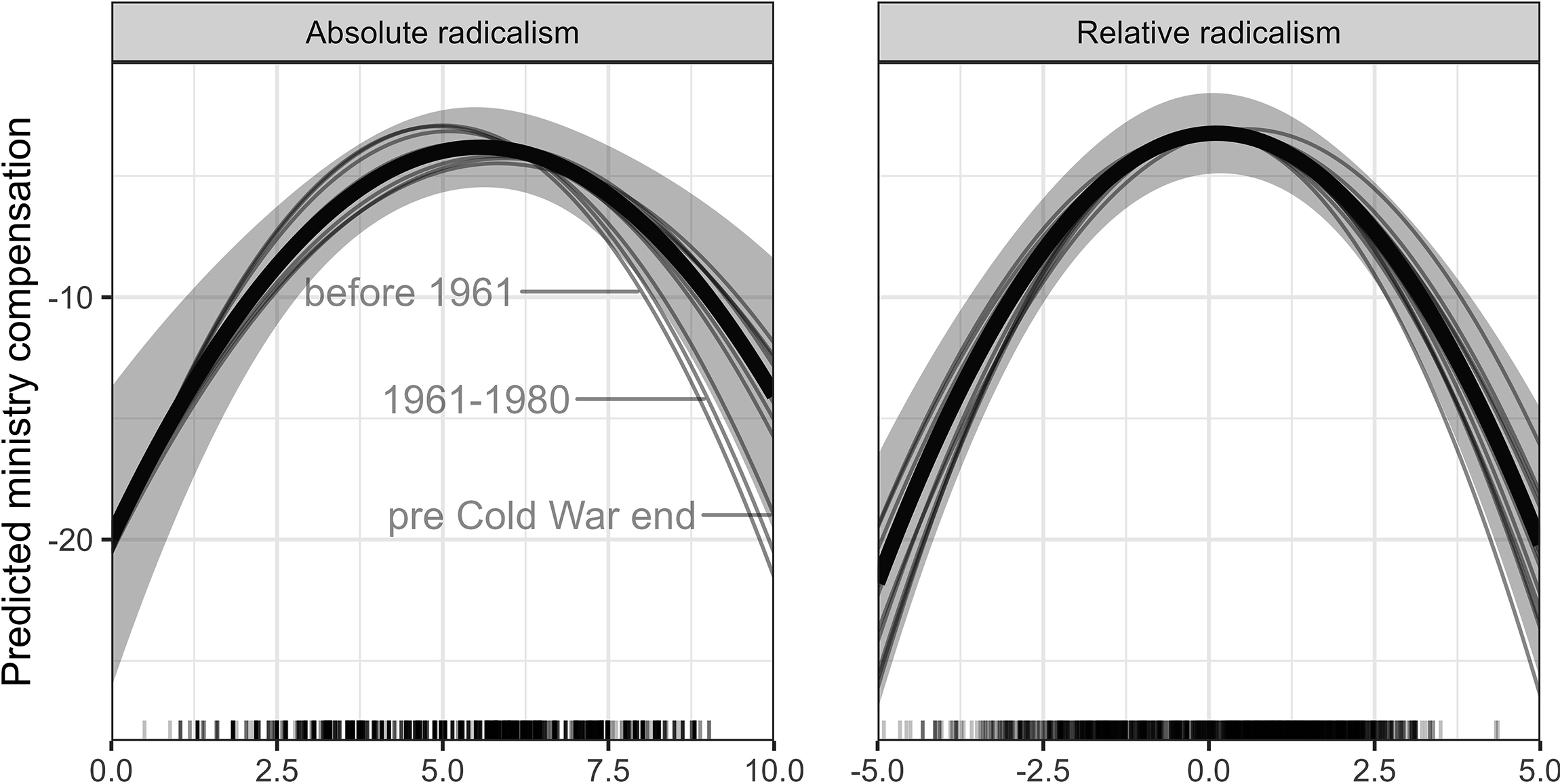
The thinner lines in each panel represent the predictions based on one of the previously introduced conditions. Evidently, the overall pattern is subject to no specific condition. Radicalism of either side reduces the number of ministries a party receives, regardless of whether we examine observations from countries with a leftist authoritarian history, parties also represented in the European Parliament, or any of the other conditions under consideration.
However, three prediction lines stand out in the plot for absolute radicalism. Crucially, they all lead to the same conclusion. The negative effect of absolute radicalism is more symmetrical in observations from (a) 1960 and earlier, (b) 1961–1980, and (c) before the end of the Cold War. Since the end of this greater period, a more pronounced radical right ideology has become less detrimental to the number of ministries compared to a leftist ideology. The normalisation of the radical right (Valentim, 2024) appears to extend beyond the ballot, influencing party strategies including ministry allocation. Two findings support this interpretation. First, the significantly positive effect of absolute radicalism under low levels of relative radicalism (see Figure 4) suggests that only marginalisation effectively limits the influence of radicals. Second, the lack of a comparable interaction pattern when analysing relative radicalism indicates that when the ideological fringes align with the parliamentary fringes, the penalisation in ministry allocation remains unaffected.
Besides this more detailed account of radicalism’s effect, I considered other operationalisations of it. Although ParlGov data on parties’ positions has great availability and allows for wide-ranging analyses, it has some crucial drawbacks. Most importantly, the extensive scope of ParlGov data comes at the cost of temporal invariance, meaning it does not capture shifts in party positions. Using Chapel Hill Expert Survey data (Jolly et al., 2022), I find the same effects as with the ParlGov data, suggesting that this does not introduce significant bias. Additionally, this data allows for analysis in a two-dimensional political space, which may better reflect contemporary party competition compared to a singular left-right axis (see Kitschelt, 1994; Marks et al., 2006). The analysis indicates that the effect is primarily driven by the economic axis, with no significant impact from the socio-cultural axis.
When using the Comparative Manifesto data (Lehmann et al., 2023) and its standard scaling of the left-right axis (Laver & Budge, 1992), the effect is no longer significant. However, standard Manifesto data is notorious for its lack of precision in capturing radical positions (see e.g., Ecker et al., 2022; Pelizzo, 2003). To safeguard against false rejection of my hypotheses, I ran models with Manifesto data using the scaling approach by Röth (2017). His data decisively outperforms the validity of the original approach when assessed against expert codings (see also Garritzmann et al., 2021; Röth et al., 2025). The results from the models based on his data converge with those using the expert data. So while some caution is appropriate, the single null finding does not warrant rejection of my hypotheses. Regarding the independent variable, I tested whether radicalism relative to the positions of previous governments (see Baron & Diermeier, 2001) also leads to ministry undercompensation. The corresponding models suggest that it does.
A categorical understanding of radicalism offers a viable alternative to the gradual approach taken here. Projects like PopuList (Rooduijn et al., 2023) adopt this perspective, providing clear classifications of which parties should be considered radical. Alternatively, statistical methods, such as identifying outliers based on standard deviation, can also determine radical status. Moreover, party family association also gives us an idea about the radicalism of a party. According models confirm that the effect remains robust when radicalism is treated as a (binary) category and that it is not restricted to one side of the political spectrum. 18
The observed effect also remains robust when accounting for other potential influences. In the supplemental material, I conducted analyses including various variables that capture a party’s bargaining experience. I hypothesise that parties with more experience in coalition negotiations might be better positioned to secure more favourable outcomes. I also explored the impact of a potential formateur bonus and whether parties joining a coalition for the first time receive fewer ministries, aligning with the operationalisation of challenger parties by de Vries and Hobolt (2020). The models support these expectations without altering the effect of radicalism.
Additionally, I re-estimated the models using an unrounded version of my dependent variable, which did not affect the results presented in this article. I argued that a Gamsonian allocation, meaning a proportional distribution of ministries based on seat share, is to be expected. The zero-inflated distribution of the rounded dependent variable confirms this. To avoid this fact altering the results and introducing bias, I estimated models accounting for zero-inflation.
The findings presented in the article are robust against this specification. If a party receives a disproportional share of ministries, this share will be lower the more radical it is. Finally, I tested whether the effect is driven by specific countries. Neither interactions between radicalism and country nor the exclusion of individual countries from the analysis indicate this. Summa summarum, the finding that more radical parties receive fewer ministries is highly robust and aligns with the expectation I formulated earlier, especially when thinking about radicalism in a relative sense.
Discussion and Conclusion
Radical parties’ rise to political power has been one of the defining features of the current political age. Radical parties are increasingly often not only entering parliaments but also seeking roles in government. 19 In response to this trend, this article investigates their performance in the allocation of ministries. Traditionally, it is assumed that these parties, like others, receive ministries in proportion to their share of parliamentary seats. Reviewing the literature on coalition formation and ministry allocation, I argued that there are reasons to believe radical parties may struggle to meet this expectation. I examined two different understandings of radicalism. According to the relative understanding, radical parties are more distant from other political parties, which leads to reduced bargaining power, and consequently, fewer ministries. In contrast, absolutely radical parties are associated with a preference for policy payoffs. This preference might lead them to sacrifice ministries in exchange for policy concessions from their coalition partners.
In the empirical analysis of data on 555 government coalitions from 33 countries, I found support for my initial expectation. A party’s radicalism negatively predicts its compensation with ministries. In exploring the mechanisms behind this effect, I provided evidence suggesting that relative radicalism, rather than absolute radicalism, is primarily responsible for diminishing a party’s ability to secure a proportional share of ministries. Unlike absolute radicalism, which is associated with a preference for policy payoffs, relative radicalism appears to act as a barrier to effective cooperation with other parties. While this study cannot definitively determine the exact mechanisms, it advances our understanding and brings us closer to identifying them.
An important contribution of this article is the choice of the appropriate modelling strategy. When researching the role of radical parties in government, it is crucial not to overlook the expectations set forth by various theories of coalition formation. For radical parties to underperform and deviate from Gamsonian expectations, they first need to be included in the elite circle of coalition-worthy parties. The improbability of this event should be accounted for in the according models to avoid selection bias. This can be achieved by using Heckman corrections.
What we make of these results is closely tied to their implications for the debate on how to handle radical parties seeking government participation. Given the larger electoral costs for radical junior partners, one strategic consideration could be to include radicals in government as long as they remain marginalised in parliament, undercompensate them in terms of ministerial positions 20 , and, if necessary and obtainable, remove them afterwards. However, once substantially radical positions have moved to the parliamentary center, this strategy is not viable anymore according to my findings. Generally, though, the relationship between ministry undercompensation and electoral costs warrants further investigation. Voters tend to expect a Gamsonian distribution of ministries (see Lin et al., 2017). It is plausible that parties deviating from this expectation might face electoral penalties (for salience-based effects see Greene et al., 2021), but further studies should be conducted before being overly enthusiastic.
Additionally, the theoretical foundations of this article caution against an overly optimistic perspective. Gamson’s (1961) main expectation is that coalition participants will receive a proportional share of the coalition’s payoffs. One possible conclusion is that ministerial undercompensation is not the whole story. This article has focused exclusively on the proportionality of the numerical allocation of ministries. Importantly, prior research suggests that undercompensated parties might be awarded more prestigious portfolios or those located in contentious areas within the coalition (Martin & Vanberg, 2020b; Warwick & Druckman, 2001, 2006).
In the supplemental material, I ran a simple ordinal logistic regression on WhoGov’s three-point classification of ministry value (Nyrup & Bramwell, 2020) but did not find a positive effect of ministry undercompensation. Radicalism also did not show an inherent link to higher portfolio value. The only significant tendency I observed was that larger parties were somewhat less likely to obtain higher value portfolios. In this regard, it remains crucial to maintain that ministries also influence policy areas beyond their immediate responsibilities (Garritzmann & Siderius, 2025), indicating that qualitative and quantitative aspects both matter for policy influence.
At the same time, another potential trade-off emerges from the policy preferences of absolutely radical parties. Although this article provides stronger support for the alternative mechanism—that of reduced bargaining power for relatively radical parties—I urge caution in drawing causal inferences from these analyses. Both relevant operationalisations are heavily correlated—as they should be empirically. For statistical modelling, this correlation can pose problems as it may lead to multicollinearity, potentially obscuring the coexistence of both mechanisms. Future research could address this issue by incorporating direct measures of parties’ preferences for office versus policy (see the data by Bassi, 2021; Laver & Hunt, 1992) and the number of credible coalitions they could form. These variables could be used in a mediation model to test the potential mechanisms more directly.
While systematic and quantitative research on the mechanisms behind the allocation of policy payoffs 21 in government coalitions is still sparse, there is little reason to expect an advantage for radical parties (see Albarello, 2024). However, this line of research could be significantly enriched by distinguishing between different types of radicalism as has been done here. Additionally, in the future the potential for policy trade-offs is likely to rise, as the increasing heterogeneity of coalitions makes parties more interested in introducing ex-ante control mechanisms like coalition agreements. These agreements could safeguard against overly ministerial policy determination, and the separation between policy and office payoffs might become more pronounced as a result. This shift could lead to more nuanced bargaining dynamics and impact how absolute radicalism is integrated into coalition governments. Alternatively, we might profit from a more qualitative research perspective.
Examining some radical parties that have been selected because they did not receive a proportional share of ministries, neither compensation with more valuable portfolios nor greater policy influence appear to be necessary consequences. For instance, the Latvian KPV LV (now known as Par cilvēcīgu Latviju) became the (shared) largest member of the 2018 Kariņš cabinet. It was, however, unable to claim the position of prime minister, as would be expected by conventional norm. The party, which has been associated with a ‘Trumpian approach to politics’ (Ijabs, 2018, p. 5), also missed out on proportional cabinet representation by two ministries. Dissolving over time, it was finally kicked out of the coalition, not even gaining parliamentary representation in the subsequent election (see Ikstens, 2022).
The Italian far-left Partito della Rifondazione Comunista (PRC), which played a crucial role in the formation of the second Prodi cabinet, illustrates similar conclusions. Undercompensated by one ministry, it was assigned with only the fitting Social Solidarity portfolio. Nevertheless, the party was rather unsuccessful in the realisation of its preferred ‘modern socialist society’ (Rooduijn et al., 2023). In addition, it also had to sacrifice its radical anti-war stance, enabling interventions in Afghanistan and Lebanon. Kate Hudson (2012) attributes the party’s 2008 electoral decline to these compromises. This case highlights how quantitative ministry undercompensation can have substantial qualitative repercussions, affecting a party’s ability to retain influence in areas critical to its platform.
Focusing on individual policy issues and areas, the track record of radical parties reveals an ambiguous picture. There is some indication that the radical right influences welfare policy (Rathgeb, 2024; Röth et al., 2018). Nevertheless, the overall assessment of radical parties’ policy impact tends to be more critical. In a general sense, investigating radical left parties in government, Dunphy and Bale (2011, p. 493) contend that ‘the concrete achievements chalked up by most left parties to date can still only be called modest.’ Examining the outcomes of immigration policy, Akkerman (2012) does not find a relevant influence of the radical right over their principal issue. In her study together with Sarah de Lange, she attributes radical parties’ electoral losses to internal conflict and poor government performance (see Akkerman & De Lange, 2012). Focussing again on a case because of its ministerial undercompensation, of the parties they investigated (n = 7), only the Lijst Pim Fortuyn (LPF) in the Dutch cabinet Balkenende I was undercompensated. 22 The party was lacking one ministry towards proportional representation. Tellingly, the LPF performed the worst out of the parties they investigated. It did not achieve any policy adjustments in its preferred direction. 23 Overall, there is substantial reason to be sceptical of the notion of cross-dimensional trade-offs. Radical parties may simply struggle to assert themselves effectively within coalitions. Systematising this tendency could offer valuable insights into the challenges faced by radical parties in government.
The desirability of including radical parties in government coalitions is inherently subjective. If the aim is to diminish their influence over the medium to long term, these findings might justify considering their inclusion under a specific set of circumstances. Until we develop a more systematic understanding of both the qualitative aspects of ministerial allocations and the broader policy implications, drawing definitive conclusions remains premature. Even minor successes by radical parties can have profound consequences. Mainstream parties must recognise the significant risks associated with the strategy of containment through inclusion. It is questionable whether the benefit of an additional ministry outweighs the potential danger of jeopardising democratic values. While radical parties do not invariably seek to dismantle democracy, the anti-system component of their ideology warrants caution. Geographical and institutional variation in the effects of radicalism have been documented (Berman, 2008; König & Swalve, 2023), and despite a mixed record, some level of concern is justified. Additionally, there is a lack of evidence supporting a moderation effect through inclusion. Instead, there is a tendency towards further radicalisation (see Akkerman & Rooduijn, 2015). The inclusion of radical parties in coalitions might even contribute to their normalisation among voters, potentially increasing their success in the future (see Valentim, 2021).
Moreover, the rationale for cooperating with radical parties while undercompensating them may hold only so long as their radicalism remains relative. The analyses of H1 and H2 indicate undercompensation is more a result of a weak bargaining position than of payoff preferences. Once the parliamentary centroid moves towards the ideologically radical, i.e. absolutely radical parties, undercompensation is no longer to be expected. With the surging seat shares of radical parties across Europe, the feasibility of including such parties in government coalitions becomes increasingly complex for office-seeking mainstream parties.
In this article, I investigated the fundamental question of how radicalism affects the allocation of ministries. The results indicate that radical parties tend to receive fewer ministries compared to mainstream parties. As radical parties increasingly seek government responsibilities (Bichay, 2023), understanding this dynamic becomes crucial. Including radical parties in a coalition as undercompensated partners might reveal their weaknesses, but it also places them in a position of power. In conclusion, the results presented here cannot serve as a final justification for the government inclusion of radical parties. Ideally, they should stimulate further investigation into the consequences of ministerial undercompensation. For instance, when does ministerial undercompensation lead to penalisation at the ballot box? Can it be traded for extended policy influence? These questions, among others, warrant further exploration and could significantly enhance our understanding of one of the central political developments of our time.
Supplemental Material
Supplemental Material - Radical Weakness—Do Radical Parties Receive Fewer Ministries?
Supplemental Material for Radical Weakness—Do Radical Parties Receive Fewer Ministries? by Timo Sprang in Comparative Political Studies.
Footnotes
Acknowledgments
I am greatly indebted to Julian Garritzmann, Armin Schäfer and Nils Steiner for their invaluable feedback. I also thank Kai Arzheimer, Konstantin Dulin and Katrijn Siderius for sharing important suggestions. The empirical analysis benefited from valuable data kindly provided by Leonce Röth. This paper has profited immensely from the many helpful comments at the Project Day of the Department of Political Science at University of Mainz. I am also grateful for the editors’ and anonymous reviewers’ constructive recommendations.
Declaration of Conflicting Interests
The author declared no potential conflicts of interest with respect to the research, authorship, and/or publication of this article.
Funding
The author received no financial support for the research, authorship, and/or publication of this article.

Data Availability Statement
Data is made available upon request to the author.
Supplemental Material
Supplemental material for this article is available online.
Notes
Author Biography
References
Supplementary Material
Please find the following supplemental material available below.
For Open Access articles published under a Creative Commons License, all supplemental material carries the same license as the article it is associated with.
For non-Open Access articles published, all supplemental material carries a non-exclusive license, and permission requests for re-use of supplemental material or any part of supplemental material shall be sent directly to the copyright owner as specified in the copyright notice associated with the article.
