




Abstract
Even though Prime Ministers (PMs) are the central actors in parliamentary democracies, little comparative research explores what makes them perform successfully in office. This article investigates how the political careers of PMs affect their performance. For this purpose, we make use of a unique expert survey covering 131 cabinets in 11 Central and Eastern European countries between 1990 and 2018. Performance is defined as a two-dimensional set of tasks PMs ought to fulfill: first, managing the cabinet and directing domestic affairs as tasks delegated to their office, second, ensuring support of parliament and their own party, who constitute the direct principals. The findings indicate that a simple political insider career is not sufficient to enhance prime-ministerial performance. Rather, PMs who served as party leaders have the best preconditions to succeed in office.
Keywords
Introduction
Prime Ministers (PMs) are the central actors in parliamentary democracies. Their performance in office is decisive for the political success of their cabinet and their countries’ development. As heads of party governments, they have different tasks to fulfill, such as managing a cabinet of ministers, providing direction for domestic policy-making, reacting to crises and serving as the voice of the executive at the national and international level (Strangio et al., 2013). Furthermore, PMs execute these tasks under the watchful eye of the citizenship, which holds the government parties accountable at the next elections (Lewis-Beck & Stegmaier, 2013; Shabad & Slomczynski, 2011).
What prepares PMs to master all these tasks successfully? The study of political elites points to career trajectories as a significant determinant of performance in executive office. Scholarly work engaging with ministerial careers finds that ministers in West European cabinets who held other executive or political positions before tend to survive longer in office, arguing that they are better prepared to meet their responsibilities (Bright et al., 2015; Fischer et al., 2012). Furthermore, past professional experience of ministers enhances their influence on the government’s policy agenda (Alexiadou, 2015). While the impact of career features is explored pretty well for cabinet ministers, surprisingly little is known about the heads of government in this respect. Even though it appears rational to expect a similar impact of political careers on performance in PM office, the research engaging with the power and leadership of individual PMs in different countries (Bennister, 2012; Helms, 2005; Weller, 1985) did not yet address this question from a comparative perspective (Müller-Rommel et al., 2020). Systematic answers to this question would not only contribute to a better understanding of how PMs fulfil their manifold tasks but also of the relevance that different recruitment paths to the chief executive position have for the functioning of parliamentary democracy.
Against this background, our paper investigates how political careers affect prime-ministerial performance in the new democracies of Central and Eastern Europe (CEE). This sample of cases is not only interesting in itself but also provides a particularly suitable context to examine the general relationships between career trajectories of heads of government and their performance in office. In contrast to established contemporary democracies, CEE has seen the formation of a new political elite after communist rule. Therefore, PMs in the region have been generally characterized by a “shortage of experience in democratic politics,” which is regarded as one reason why they “appear to have been relatively weak figures” (Baylis, 2007, p. 81, 91). At the same time, many political leaders in CEE have become career politicians after 1990, and several countries have seen extraordinarily strong PMs, like Václav Klaus in the Czech Republic, Vladimír Mečiar in Slovakia or Viktor Orbán in Hungary. Moreover, party governments in post-communist Europe have operated in extremely dynamic political and socioeconomic environments (Blondel et al., 2007; Grotz & Weber, 2012). Hence, CEE seems to be a “natural laboratory” for exploring how a variety of political careers influence prime-ministerial performance under heterogeneous contextual conditions.
By answering this question, our study contributes to redressing three major gaps in the extant literature. First, we develop a novel concept of prime-ministerial performance which is embedded in a principal-agent model of political delegation and accountability (Strøm, 2000; Strøm & Bergman, 2011). Accordingly, performance is defined as a two-dimensional set of prime-ministerial tasks: managing the cabinet and directing domestic affairs are the main tasks delegated to their office, while they have to ensure the support of parliament and their party as their direct principals. This theoretically grounded concept enhances our understanding of the core tasks any PM ought to fulfil for a proper functioning of parliamentary democracy, which previous research did list but not systematize in a manner applicable for cross-national analyses (Strangio et al., 2013; ‘t Hart & Schelfhout, 2016).
Second, we present a new argument about the impact of career trajectories on prime-ministerial performance. Starting from the general assumption that previous political positions provide executive elites with relevant knowledge and skills, we not only take up the standard differentiation between “insiders” and “outsiders” (De Winter, 1991) but also contend that PMs acquire distinct experiences for their job in three insider offices: as member of the national parliament, as cabinet member and, most importantly, as party leader. The results of this paper clearly confirm our theoretical expectation that a certain kind of insider performs especially well: PMs who were party leader before are most successful in securing the support of their own party, in settling cabinet conflicts and shaping government policies. Previous experiences as parliamentarian or cabinet minister do not unfold similarly consistent positive effects on prime-ministerial performance.
Third, our empirical analysis utilizes a unique data set covering 86 PMs in 131 cabinets that served in 11 CEE countries between 1990 and 2018. Our measure of prime-ministerial performance is based on an original expert survey that captures each of the delegation and accountability tasks by one or two questions respectively. Unlike earlier cross-national surveys of prime-ministerial performance that concentrated on one item only (O’Malley, 2007), our data allows for a nuanced analysis of how prior political offices influence the fulfillment of individual tasks and their aggregation, that is, overall performance.
The article is organized as follows. After explaining the concept of prime-ministerial performance in more detail, we elaborate on our theoretical argument about the impact of political careers. This is followed by the empirical analysis that tests the resulting hypotheses. The conclusion summarizes the main findings and reflects on their theoretical and empirical implications.
Prime-Ministerial Performance in Parliamentary Democracies
The literature on PMs offers a wide range of terminological choices to delineate the role and function of chief executives in parliamentary democracies, such as “prime-ministerial power” (O’Malley, 2007) or “prime-ministerial strength” (Baylis, 2007; Berz, 2019). For the following analysis, we take the notion of “prime-ministerial performance” (Azzi & Hillmer, 2013; Byrne et al., 2017; ‘t Hart & Schelfhout, 2016) because it brings attention to the different tasks that individual PMs have to fulfill as chief executives.
Our understanding of prime-ministerial tasks derives from a theoretical model, which conceives parliamentary democracy as a two-directional chain of principal-agent relationships (Strøm, 2000; Strøm & Bergman, 2011). In this perspective, the ultimate principal in all forms of representative democracy are the voters. However, unlike presidential democracies where the voters concurrently authorize the legislature (parliament) and the chief executive (president) in direct elections, parliamentary democracies exhibit a single chain of delegation as parliament delegates the executive tasks to the head of government (prime minister), who subsequently delegates certain tasks to the cabinet and the state administration. Therefore, the outstanding role of the PM in parliamentary democracy is a consequence of her unique position in the delegation chain, as she “connects the elected representatives of the people and the administrators of the state” (Strøm, 2000, p. 270).
In one direction of the principal-agent chain, the principal decides to transfer a task to an agent because her superior capacity and competences to resolve social choice and collective action problems make delegation an attractive solution. As chief executive in a parliamentary democracy, the PM is the agent to whom representatives delegate the responsibility to run the state affairs (Strøm, 2000, p. 270). The “delegation” dimension of our prime-ministerial performance concept includes four kinds of delegated tasks (sub-dimensions). First, the PM has to ensure the proper working of the cabinet by settling intra-cabinet conflicts that emerge when ambitious ministers work against her and by mediating intra-cabinet controversies in which she is not a side (Dowding, 2013, p. 65; Heffernan & Webb, 2005, p. 26). Second, the PM plays a key role in shaping government policies “by making and overseeing the implementation of policy on important issues” (Weller, 2014, p. 495), which gives her ample opportunity to align the substance of policy proposals with her preferences (O’Malley, 2007, p. 9). Furthermore, the PM shall manage exogenous crises that emerge outside the parliamentary system but seriously affect politics and policies, such as natural disasters or economic shocks (Laver & Shepsle, 1996, p. 29). Finally, the PM should also secure the national interests at the international level (Kaarbo, 2018; ‘t Hart & Schelfhout, 2016).
The chain of accountability runs in the opposite direction through which the principal retains the right to monitor, and if necessary, enforce the agent to comply with her goals. In parliamentary democracies, the PM is held accountable to voters as ultimate principals through two intermediaries. The first is the parliamentary majority, to which she is politically responsible because a no-confidence vote may bring down her cabinet at any time (Müller & Strøm, 1999, pp. 17–18). Second, the PM is usually nominated by one government party and thus relies on its backing even after office accession. As the PM is the most visible and the most important political actor and her party is exposed to a particularly strong voter control, it expects her to accurately implement its electoral manifesto (Samuels & Shugart, 2010, p. 36). In consequence, the two tasks (sub-dimensions) of the PM within the “accountability” dimension are to actively secure the support of the parliamentary majority for the overall government policies and maintain backing of her party for the fulfillment of her delegated tasks (Scarrow, 1994).
Explaining Prime-Ministerial Performance through Political Careers
To explain why individual PMs perform differently in fulfilling the various tasks as chief executive, we focus on their political careers. The comparative study of political elites has been particularly interested in career trajectories of top politicians because each political office may enable the holder to acquire specific knowledge and skills that also help her to perform well in future career positions (Blondel, 1991). While the general assumption that political experience gained in previous offices enhances the performance in ensuing offices has been confirmed for cabinet ministers (Alexiadou, 2015; Bright et al., 2015; Fischer et al., 2012), it has not been explored systematically for PMs. Despite some variation in the tasks associated to the PM office compared to ministers, experiences gathered in preceding positions should also provide an essential asset for PMs. Notably, PMs tend to hold at least three political offices during their preceding career in which they acquire such experiences: being a member of the national parliament, a cabinet member, and the head of a political party. Based on the logic that political careers are related to prime-ministerial performance through specific office experiences, we propose three hypotheses.
Our first hypothesis takes up the differentiation between political insiders and outsiders that features prominently in the literature on parliamentary and executive elites (De Winter, 1991; Martocchia Diodati & Verzichelli, 2017; Pinto et al., 2018; Samuels & Shugart, 2010). Insiders usually have long tenures in one or more political positions and, therefore, a considerable degree of relevant experience. Outsiders, in turn, have never served in any political office but became politically prominent outside the political stage. Although they may have a professional background from economics, law or business that might be beneficial in any leading position, they do not have genuine political experience that helps them to perform in a top political office. Applying this general rationale to the premiership we argue that PMs who held positions either in parliament, in cabinet or as party leader prior to entering the chief executive office (insiders) should perform better than their counterparts who had never held either of these offices before (outsiders).
Hypothesis 1: PMs who are political insiders perform better than PMs who are political outsiders.
The second hypothesis focuses on relevant differences within the group of political insiders. More concretely, we argue that PMs who held office as party leaders will perform more successfully than their colleagues who served as member of parliament or minister because being party leader enables PMs to acquire the most extensive and useful political experiences to fulfill their various tasks as chief executive.
Membership in parliament provides detailed knowledge of the formal and informal procedures of the legislative process. This may especially help PMs to organize the continued support of the parliamentary majority for their cabinet and their government policies. By contrast, a previous position as cabinet minister may help a PM to acquire skills for cabinet management. In particular, ministers gain firsthand expertise on the formal and informal processes of collective decision-making in cabinet and can also observe how PM dealt with intra-cabinet conflicts (Curtin, 2015; Fettelschoss & Nikolenyi, 2009; Thiébault, 1991). Through a previous position as party head, PMs can gain important political experience that is provided by neither of the other offices. Party heads develop leadership skills by managing their party, dealing with intra-party conflicts and organizing joint decisions concerning strategic issues. These cumulated experiences enable them to run their cabinet more successfully, shape government policy and increase their approval among their political principals, that is, their parliamentary group and their own party. In this way, the office of party head also bears some resemblance to the office of PM. Just like the head of government, a party head needs to know how to set the policy agenda and coordinate the decision-making in various political arenas where she has to enlist the support of various powerful individuals and groups. For these reasons, we expect that leading a party provides the most essential training for future PMs.
Hypothesis 2: PMs who previously held office as party leader perform better than PMs who held any other type of political position.
Finally, we hypothesize that the accumulation of multiple previous offices creates an additional advantage for successful prime-ministerial performance. As outlined above, the three career positions provide distinct political experiences. Members of parliament had the opportunity to gather detailed knowledge of the legislative process while ministers have acquired specific know-how in cabinet decision-making and running a department. By contrast, prior position as party head equips PMs with unique leadership skills to shape policies and organize support for them among the most influential party elites and groups. We therefore expect that the combination of all these experiences in previous offices creates synergies that will enable PMs to fulfil their various tasks as chief executive even better.
Hypothesis 3: PMs who held multiple political positions perform better than PMs who only held one political position prior to becoming PM.
Case Selection, Operationalization and Data
To test these hypotheses, we study prime-ministerial performance in 11 Central and Eastern European democracies that by now belong to the European Union (Bulgaria, Croatia, Czech Republic, Estonia, Hungary, Latvia, Lithuania, Poland, Romania, Slovakia, and Slovenia). We conducted an expert survey to observe performance of PMs in 131 cabinets that served between 1990 and 2018 and survived for more than six months (a complete list of all cabinets included can be found in Supplemental Appendix 1). 1 The minimum threshold is necessary to ensure that a PM had sufficient time to perform in office, but also to ensure that experts are able to gather sufficient information to judge the prime-ministerial performance. 2 While some researchers use a lower boundary of six months in office (Johansson & Levine, 2013; Sheppard, 1998), others request at least 200 days of visible performance (O’Malley, 2007). We follow the more conservative approach to ensure that experts do not make uncertain judgments based on short performances. 3
Dependent Variable: Prime-Ministerial Performance
Our measure of prime-ministerial performance is based on an original expert survey. While earlier studies had similar research interests and methodological approaches, their survey items measuring prime-ministerial performance were either superficial because they only ask whether a PM “gets her/his preferred policies enacted” (see for instance O’Malley, 2007) or have not specified the theoretical origin of their “performance” concept and the mutual inter-relationship of their assessment criteria (see for instance ‘t Hart & Schelfhout, 2016). Aiming at a differentiated analysis of prime-ministerial performance in CEE, we refer to assessment criteria from the extant literature, but systematically subsume them under a concept of prime-ministerial performance that refers to the tasks a PM is theoretically expected to fulfill for making parliamentary democracy work (see the section on prime-ministerial performance above).
We developed new survey items on these grounds, which are presented in Table 1. Our questionnaire included one to two questions for each of the six sub-dimensions, capturing different facets of prime-ministerial performance in these specific tasks. The order of the questionnaire follows the order presented in the table. The response options for experts included (0) Not at all successful; (1) Not very successful; (2) Moderately successful; (3) Fairly successful; and (4) Very successful. We further provided “Don’t know” and “Not applicable” options, to increase the validity of the responses. The questionnaire was translated into the dominant language of the 11 countries and pre-tested in several rounds.
Conceptualization and Survey Items of Prime-Ministerial Performance.
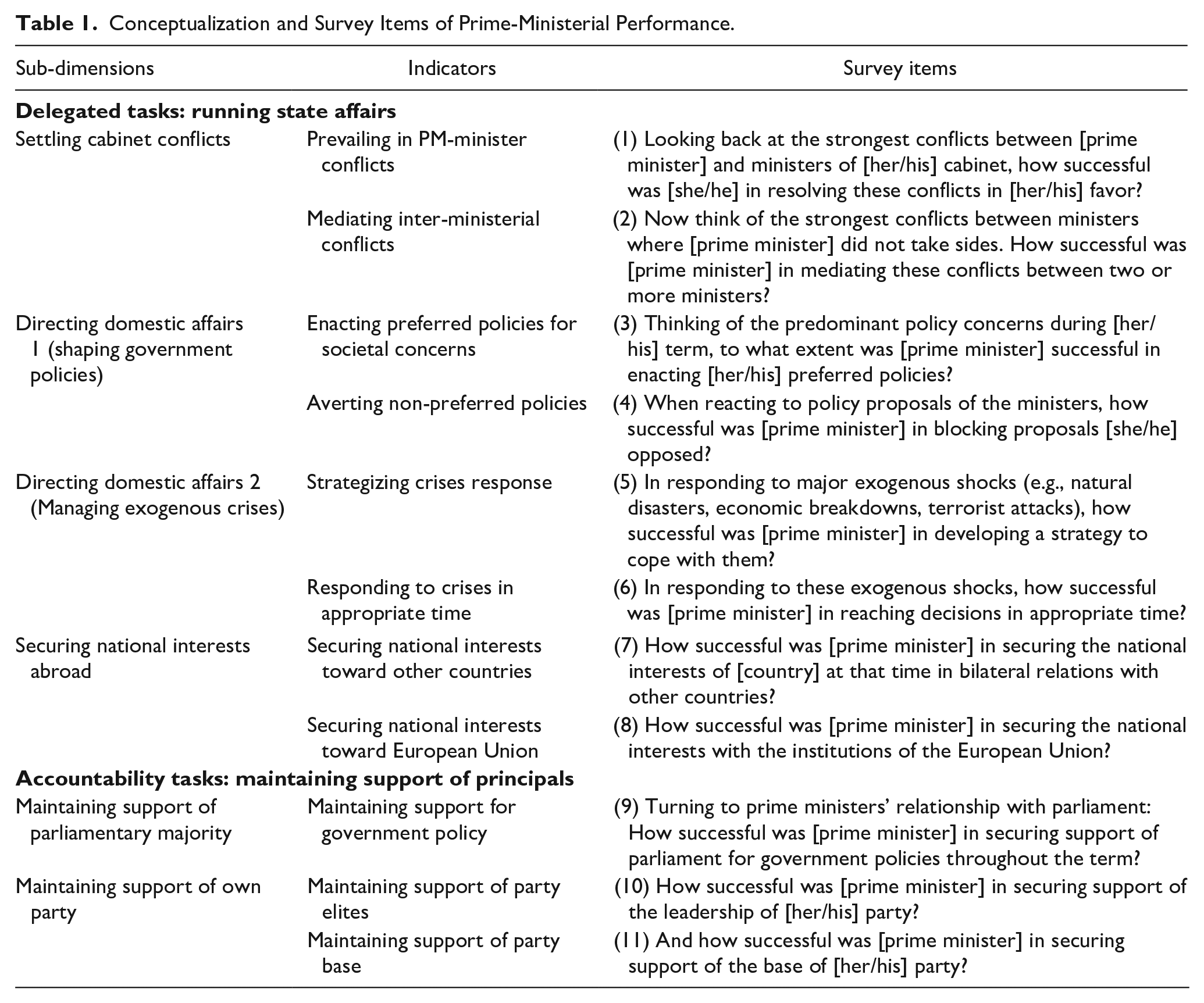
For each country under study, we asked about 20 country experts to answer these questions for all cabinets in an online survey. The survey was fielded between November 2018 and April 2019. We reached a total of 215 experts with a maximum of 22 in Slovakia and Romania and a minimum of 12 in Lithuania. 4 Most respondents worked in academia or as journalists and came from various academic disciplines (Political Science, History, Economics, and Sociology).
To reach a single measure of prime-ministerial performance, we created an aggregated index from the 11 items. In a first step, we averaged the two scores within a sub-dimension, then averaged the scores of sub-dimensions to obtain a score for the two respective dimensions (delegated and accountability tasks). The overall performance score is the average of the two dimensions. All sub-dimensions and dimensions had a uniform non-normalized 0-4 scale and were given equal weight in the aggregation process. This stepwise aggregation procedure follows the theoretical logic behind our prime-ministerial performance concept, but is also appropriate for the underlying structure of the data. The internal consistency of the resulting dimensions is extremely high (Supplemental Tables D1–D3), as their lower-level indicators/sub-dimensions are strongly correlated (Figure D1), confirming our distinction between different dimensions of prime-ministerial performance.
If an expert replied with “don’t know” or “not applicable,” we calculated the results based on the remaining items. For the two indicators related to crisis management, we excluded the sub-dimension for entire cabinets if less than 90% of all experts agreed that an item is applicable, assuming that this question really did not apply to the country context at that time. In this case, the score for the delegation dimension was calculated by averaging the scores of three remaining sub-dimensions.
Reliability checks indicate a moderate level of inter-expert agreement on the ratings. The validity was tested based on information from open-ended explanations that experts could voluntarily make use of and for which the responses indicate that most experts did indeed rate what we asked them for. Furthermore, the prime-ministerial performance scores are not highly correlated with the cabinet duration (R = 0.276), which implies that experts did not overly rely on longevity of PMs when evaluating their performance (Figure C1). Supplemental Tables C1 to C3 provide a brief overview on the key results of the validity and reliability test. 5 This index can thus take values from 0 if a PM is rated as “not at all successful” on all 11 indicators to four if a PM receives the highest possible value “very successful” for all items.
Looking at the empirical distribution of the overall performance of PMs in CEE, we observe that extremely low values are scarce compared to extremely high values, so that the distribution of all experts’ ratings of prime-ministerial performance is slightly skewed to the left (mean = 2.48, sk = −0.38). Five PMs received a null-rating by at least one expert (Berov [BG], Oresharski [BG]), Gyurcsany II & III [HU]), Slezevicius [LT]), while nine reached the highest possible average value of 4 (Fico II [SK], Kosor I [HR], Racan I [HR], Kostov [BG], Miller I [PL], Tusk I [PL], Nastase I & II [RO], Vacaroiu I [RO]). Figure 1 displays the average of all expert ratings for the highest and lowest performing PM per country with 95%-confidence intervals. The countries are ordered by the average performance value of all prime-ministerial cabinets. Figure 1 reveals considerable within-country variation. Estonian PMs were rated comparably high, given that it is the country with the highest average performance value for all prime-ministerial cabinets and a comparably good performance of the PM with the lowest average performance value. The gap between the highest and lowest average value is particularly pronounced in Hungary, indicating large variation in prime-ministerial performance in this country. 6
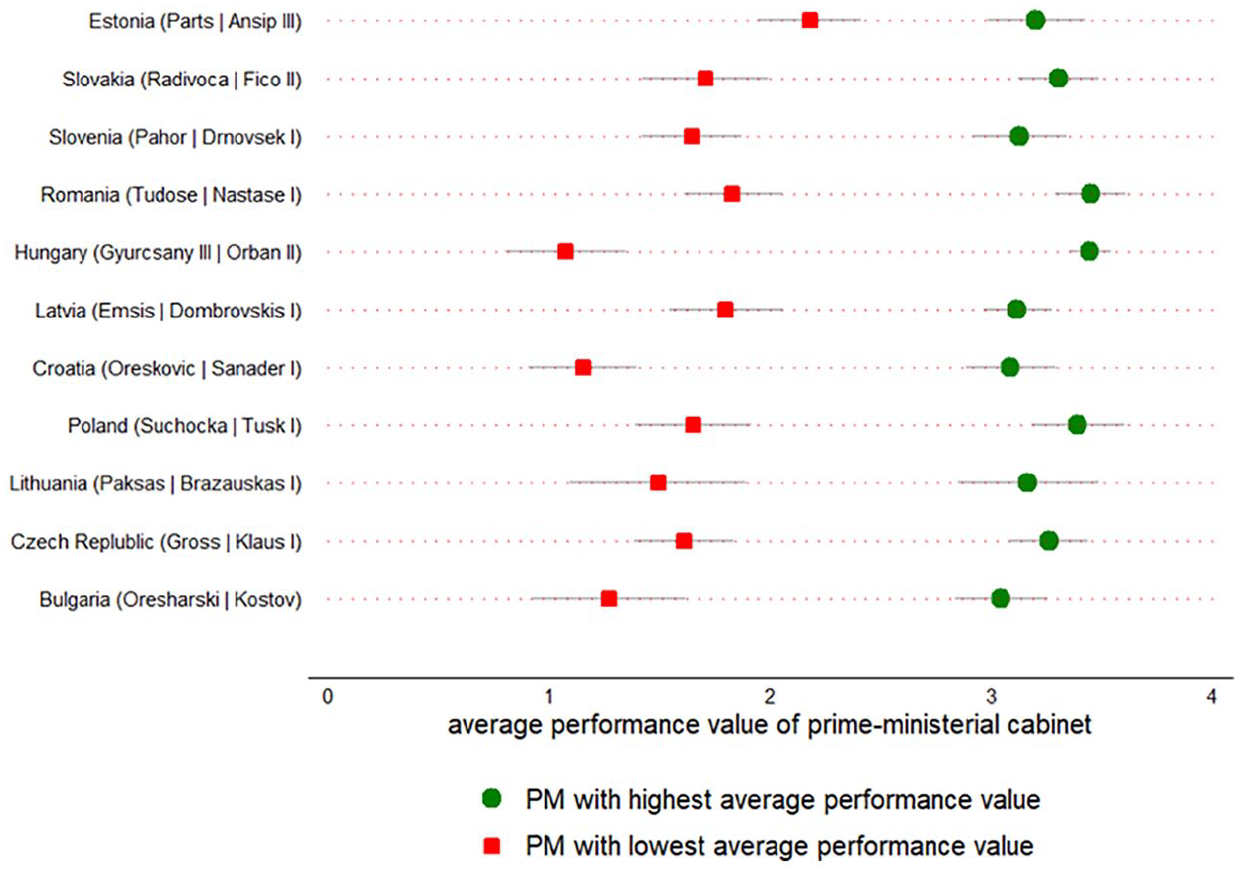
Highest and lowest average performance values of PMs with 95% confidence intervals.
Independent Variable: Political Experience
PMs’ political experience serves as explanatory variable. We assume that relevant experiences for PMs can be developed during office-holding as (1) member of parliament (MP), (2) minister in the national executive, or (3) head of party. We specify two types of dummy variables. The first one is a dummy variable for political outsiders, which are those PMs who never served in any of the aforementioned offices. The second one captures specific offices and takes the value “1” if a PM held position (as MP, minister or party head respectively) and “0” if not. Beyond, we conducted a robustness test including continuous measures for duration in office (in years). All data were gathered by the project team based on online sources and the ECPR Yearbook.
Of all 131 cabinets, only 11 were led by outsiders. As the extant literature considers chief executives in post-communist democracies to be “relative political neophytes in comparison to Western prime ministers” (Baylis, 2007, p. 91), it is remarkable that the vast majority of PMs in our sample brought some type of political experience to office. Most had served in parliament before (70.2%) or as head of party (64.9%), while only about half of all cabinets were led by PMs who held ministerial office before (50.4%). Experience in parliamentary office and party leadership also tends to appear together, meaning that PMs fulfilled both criteria (52.7% of all prime-ministerial cabinets). Another relevant observation is that many PMs were ministers without ever serving in parliament (Supplemental Tables D6 and D7), implying that parliamentary democracies in CEE permit the inclusion of technocrat ministers in party governments (Semenova, 2018).
Control Variables
We include a broad set of control variables to ensure that the relationship between political experience and performance is not driven by omitted variable bias. To begin with, we take into account particularities of the PM, by including a binary measure for sex (PM sex). 7 We use “female” as a reference category. Female PMs struggle with a double disadvantage that influences the relationship we aim to study: They are less likely to have gathered extensive political experience, because women at the top—in CEE like in Western European countries—are still scarce (Franceschet et al., 2019; Müller-Rommel & Vercesi, 2017). At the same time, they might be forced to resign more frequently between elections (as indicated by research on ministers by Bright et al., 2015), leaving them with little time and room to perform successfully.
Beyond this individual-level characteristic, our models take into account various factors that determine the level of uncertainty and complexity of PMs’ environments including variables related to the party constellation, institutional constraints and the socio-economic context. On the one hand, “difficult” circumstances make it less likely that PMs perform successfully, because they provide ample opportunity to fail. On the other hand, uncertain and complex set-ups might motivate selectors to choose more experienced PMs who are better prepared to handle the challenges ahead.
First, favorable party constellations might reduce complexity, while fragmented and polarized party systems and party governments severely restrict PMs’ political power and room for maneuver (Bergman et al., 2003, p. 191). A dummy variable for coalition governments (0 for single-party, 1 for coalition) captures the government format. We expect more difficult conditions under coalition governments compared to single-party governments, since they entail higher transactions costs of governing and higher complexity, as PMs are required to continuously negotiate with other coalition partners, rather than being dependent only on the support of their own parties (Grotz & Weber, 2012, p. 707). Another binary variable measures minority status taking the value 0 for majority governments and 1 for minority governments. Minority governments create high levels of uncertainty for those in power since the parliamentary opposition may coordinate on a certain number of issues, and form majorities to pass bills independently, or even depose individual ministers or the government as a whole (Schleiter & Morgan-Jones, 2009, p. 503; Somer-Topcu & Williams, 2008, p. 317). The ideological diversity of the cabinet, measured as the ideological range of the cabinet, is another control variable. Ideologically diversified cabinets create a more complex bargaining environment, given that the parties are less likely to reach compromises on major issues and reforms (Druckman & Thies, 2002, p. 761; Warwick, 1994, p. 61), and individual ministers are more likely to enter into conflict with the PM and attempt to place their alternative proposals on the cabinet agenda. We make use of ParlGov data (Döring & Manow, 2019) for all three variables.
Second, the institutional setting, such as weak prime-ministerial powers and powerful state presidents, impacts both performance and prime-ministerial career trajectories. We expect that institutional empowerment of multiple actors creates a more complex and uncertain environment (Baylis, 2007; Elgie, 2012). A first control variable in this regard are prime-ministerial powers toward cabinet or what Bairett (2015) labels as non-legislative powers. This variable is an additive index of various ordinal measures of prime-ministerial power resources toward the executive ranging between 0 and 12. Furthermore, we include an index measuring prime-ministerial powers toward the legislature. This variable contains again an additive index summarizing this time various competencies toward the assembly on a scale from 0 to 28 (e.g., capacity not to be censored by the assembly, to dissolve parliament, to set the legislative agenda, to control the budget, to regulate independently, to propose referenda). A last institutional factor determining the context under which a PM operates are presidential powers. We capture this in a final additive index that includes inter alia presidential veto powers for legislative initiatives (partial and full), the president’s right to enact degrees, to judicial review, to dissolve the parliament, as well as the origin of the presidential mandate and removal options for presidents (on a scale from 0 to 40). All data capturing the institutional factors were taken from Bairett (2015) and in few instances, updated to the latest scores which the author shared with us (Andrews & Bairett, 2019). Since the bivariate relationship between institutional powers and prime-ministerial performance is not linear (Figure B2), our models include quadratic terms of these variables to satisfy the linearity assumption.
Lastly, external constraints such as critical socioeconomic conditions having emerged in the course of post-communist transformation might create additional uncertainty and complexity. We therefore control for the change in GDP in the year in which a PM takes up office (based on the World Inequality Database). 8 Beyond, the models take into account the unemployment rate during the year of cabinet formation (from the International Labor Organization database). 9
Testing the Relationship between Career Patterns and Prime-Ministerial Performance
Figure 2 displays the distribution of experts’ prime-ministerial performance ratings of insiders and outsiders and by PMs’ prior experience in different political offices. 10 It shows that insiders, that is, those who did hold a position as parliamentarian, minister or party head before reaching the chief executive office, do a better job than outsiders for whom the prime-ministership is the first high-profile political post. The median performance scores of these two groups of PMs differ by about 0.4 points. This lends preliminary support to Hypothesis 1 that previous political office-holding increases the likelihood that PMs fulfill their tasks successfully.
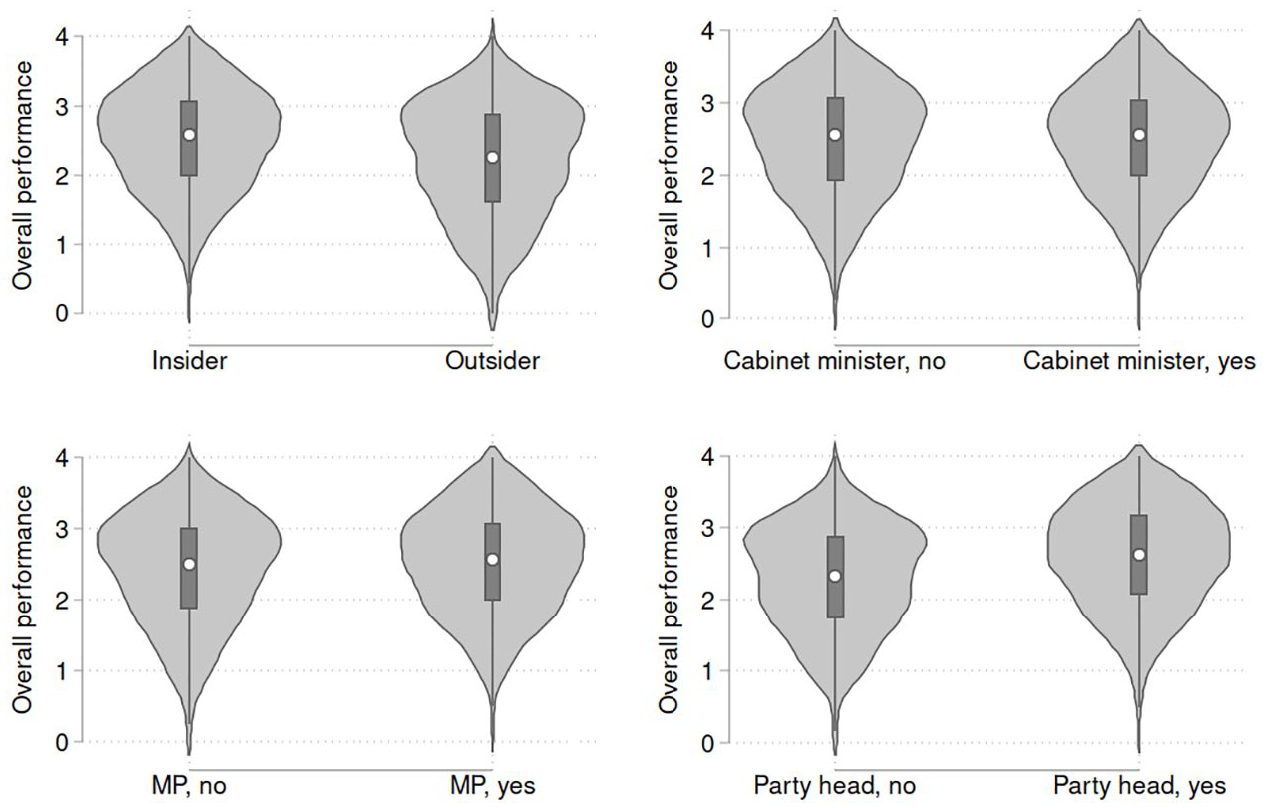
Distribution of prime-ministerial performance (0, low–4, high) by insider/outsider status and prior political offices.
Focusing on the impact of different types of previous offices, party leadership is the only one clearly linked to prime-ministerial performance in this bivariate analysis. As Figure 2 reveals, prior party heads perform better (median of 2.6 points) than PMs who have never been leaders of their party (median of 2.3 points). In contrast to this significant difference, PMs with and without previous experience as minister accomplish their governing tasks equally well (median of 2.4 each). Neither do former parliamentarians outperform those who never held a seat in the legislature before entering the highest executive office (median of 2.6 compared to 2.5). However, the distributions of performance ratings indicate that particularly low scores are more common for PMs without parliamentary experience. Overall, these results provide preliminary support for Hypothesis 2. Yet, substantial variation in performance within each of the analyzed groups persists, pointing to the role of PMs’ experience in multiple offices (H3).
To estimate the combined effects of these career characteristics and to include possible confounding variables (e.g., the degree of PM power or the impact of minority cabinets), we apply regression analysis. Following the recommendation for estimated dependent variables by Lewis and Linzer (2005), we calculate cluster-robust standard errors in which individual expert ratings (N = 2,572) are nested in cabinets (N = 131). This approach accounts for the uncertainty over the exact performance of PMs. By contrast, averaging over all experts for a cabinet would lead to an overestimation of the certainty about prime-ministerial performance. 11 Since career variables have to overcome substantial differences in experts’ judgments and interpretations to affect overall performance, the subsequent results provide a conservative test.
Additionally, all models include country- and decade-fixed effects to avoid biased estimates due to unobserved contextual characteristics. This specification ensures the comparability of the effect of prime-ministerial careers on performance within a country to the effect of careers within other countries during the same decade. The general form of the regressions is:

where Xitg is a matrix of covariates, γi are country fixed effects, δt represents decade (1990–2000, 2001–2010, 2011–2017) fixed effects, and g denotes our 131 cabinet clusters.
While we present figures highlighting the key findings in the main text, detailed tabulated results can be found in the Supplemental Appendix (see Supplemental Tables A2–A4). All non-dichotomous variables in the model are mean-centered and divided by two standard deviations as recommended by Gelman (2008) to simplify the interpretation of the substantial strength of the explanatory variables on prime-ministerial performance and to ensure that coefficients for different indicators are comparable. 12
To test whether outsiders reach lower performance scores than insiders (H1), we estimate a baseline model without controls and a main model taking the political and economic context into account (see Supplemental Table A2). 13 Figure 3 displays the coefficients of all variables of interest and reveals that being an outsider decreases performance by about 0.5 points. The effect is statistically significant at the 5% level once control variables are added. Insiders hence conduct the prime-ministerial tasks more successfully than outsiders.
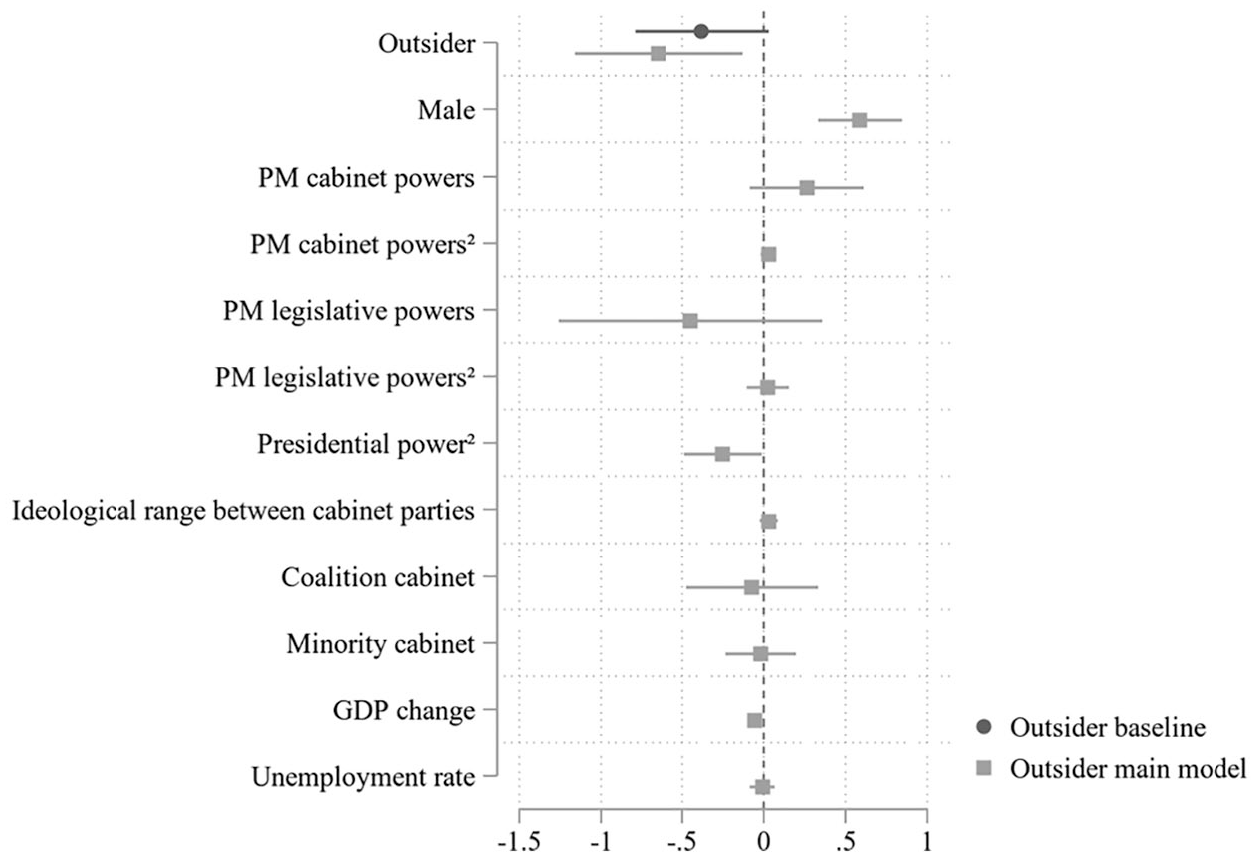
Effect of outsider status, sex and contextual factors on overall prime-ministerial performance, 95% confidence intervals.
Figure 3 also shows that most contextual factors do not affect prime-ministerial performance. The only significant institutional variable with a substantially weak impact is the degree of presidential powers, where one standard deviation increase in presidential powers leads to a decrease in prime-ministerial performance by 0.2 points. Whether PMs govern in coalition or single-party cabinets, in minority or majority cabinets unfolds no independent effect on the quality of their governing activities. Economic conditions such as unemployment rates and GDP growth neither impact PMs’ capacity to successfully fulfill their tasks. Throughout all models discussed below, the contextual variables continue to bear little explanatory power.
In a next step, we add variables for the individual offices (cabinet minister, party head, MP) to the previous model to test whether the aforementioned strong positive correlation between political experience as party head and performance holds in our multivariate analysis (H2) (see Supplemental Table A3). The coefficients of the career variables shown in Figure 4 highlight that PMs who have been party leader before perform about 0.25 points higher than those without party leadership experience. The effects of being an outsider, former member of parliament and cabinet minister, by contrast, are not statistically significantly different from zero. These findings indicate that entering the PMs’ office via the party leadership track provides the best precondition for doing a good job as chief executive.
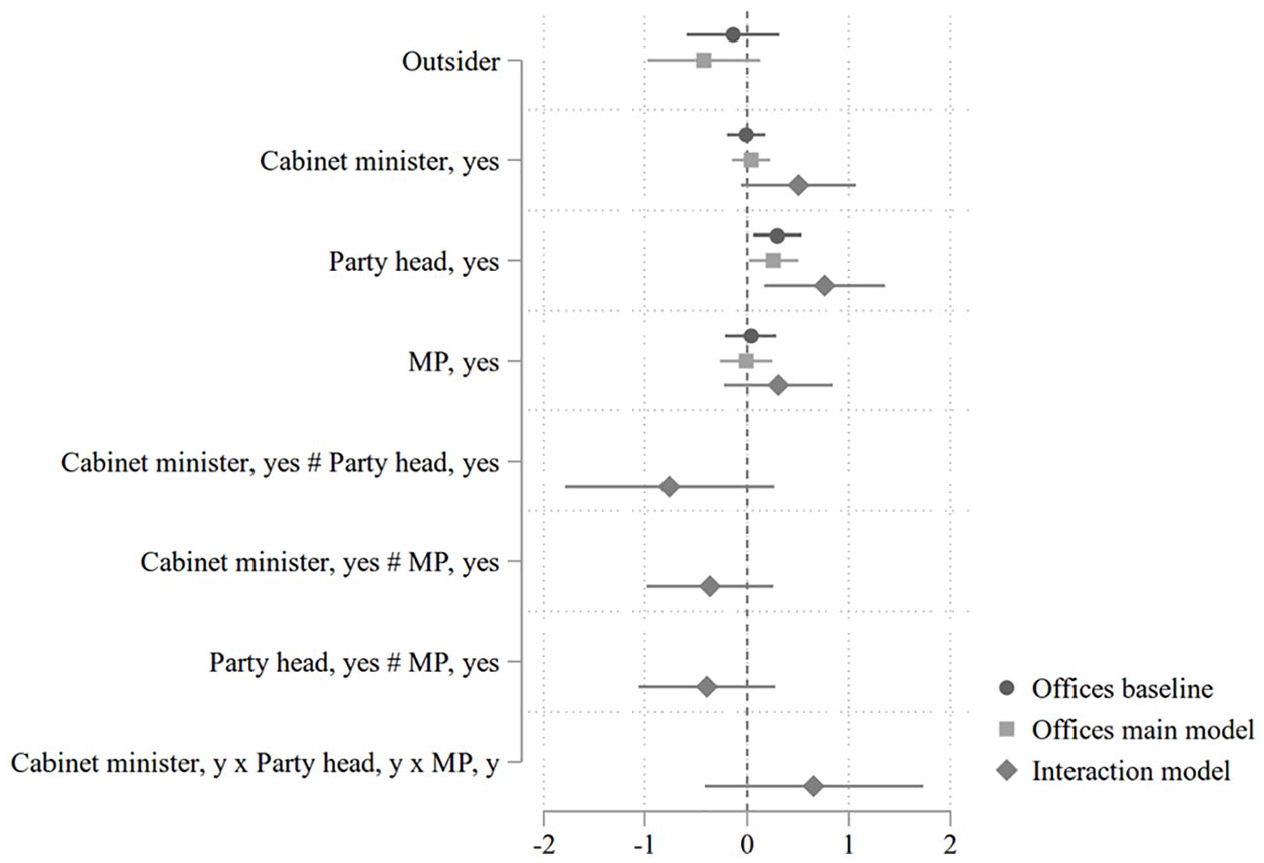
Effect of prior political offices and outsider status on prime-ministerial performance, 95% confidence intervals.
To test Hypothesis 3 that holding various political offices prior to becoming PM further enhances prime-ministerial performance, we include an interaction term (see Supplemental Table A3). Figure 4 displays the joint effects of previous experience in multiple positions. Neither of the interaction terms displays a statistically significant effect on prime-ministerial performance. Even positions held in addition to party leadership fail to impact PMs’ successful fulfillment of their delegated and accountability tasks, leading us to reject Hypothesis 3. This insight further clarifies Hypothesis 1: The difference between outsiders and insiders seems to be solely driven by one previous position. Only PMs who were party leaders before perform better than political outsiders (approximately 0.7 points in direct comparison).
We test whether the findings presented above hold after introducing alternative operationalizations of our variables of interest and additional control variables. In the following paragraphs we briefly discuss the main findings of these robustness tests, while a more detailed discussion can be found in the Supplemental Appendix.
To begin with, one might argue that PMs’ general political ability (e.g., charisma, strategic decision-making) will assist them both in entering national political offices and performing successfully as head of government. If this were the case, duration in the position as party leader should not impact the success of PMs in office, because reaching party leadership is merely a side effect of talent rather than a crucial development stage in their political career. If the causal mechanisms we propose are correct, and career variables indicate the development of important leadership skills, PMs’ time in national political offices prior to investiture should matter for performance, as political experiences develop gradually over time. Even more specifically, the first years in a position should create the steepest learning curve, with effects of additional years decreasing over time. The effect of duration in a specific position on performance should hence be curvilinear. 14 To test this alternative explanation, we add continuous measures for the duration of PMs’ parliamentary, cabinet and party head offices to our models (see Supplemental Table A4 and Figure 5). We estimate quadratic curvilinear relationships for the three political position variables (see notation after Supplemental Table A4).
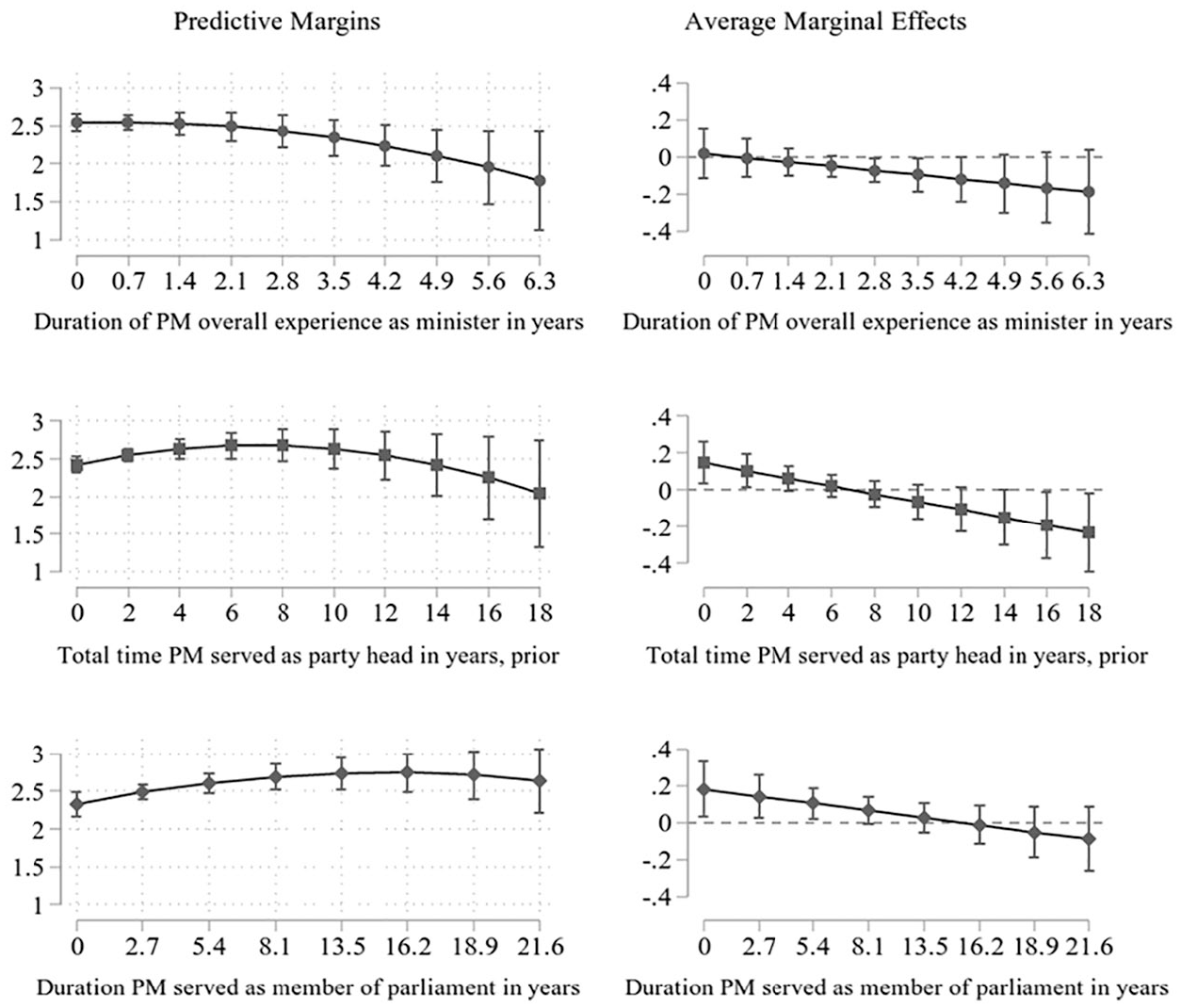
Predicted overall performance values and average marginal effects for duration in political positions prior to becoming PM (95% confidence intervals).
Figure 5 displays predicted values of overall performance as well as average marginal effects (AME). PMs with a duration as party head of 4 years perform slightly better than PMs with shorter party leadership. This average effect provides a good description of various real-world PMs in the data. For example, Ivan Kostov who served 3 years as party head and 5.5 years as MP prior to investiture is the best performing PM in Bulgaria with an average performance of about 3 points. A second case in point is Donald Tusk in his first cabinet, which performed best (3.4 points) among all studied Polish PMs. Tusk had served 4 years as party head and 8 years as MP before becoming PM. The figure also clearly indicates that the benefits of an additional year as party leader decrease after 8 years. However, due to low numbers of observations with such extremely long durations in highly prestigious political offices prior to becoming PM, uncertainty about the exact effects for these cases increases. This exploration confirms the distinctive value of party leadership experience for prime-ministerial performance, above and beyond the unobserved general political ability.
We observe a similar relationship among PMs with short legislative careers, as their performance increases about 0.2 points when they spent 5.4 years in parliament. After this time, any additional duration in parliament does not contribute to performance as PMs. This suggests that the position as MP provides experiences which are usually gathered relatively quickly, that is, within the first legislative term. This insight revises our finding that legislative experience unfolds no impact on performance as reported above. However, unlike previous party leadership experience, the effect of a prior position as MP on performance becomes only visible through the continuous operationalization. By contrast, we find a negative but not statistically significant effect between prior duration as cabinet minister and performance.
We furthermore examine the robustness of our findings to alternative model specifications, including additional control variables. First, we test whether party leadership affects prime-ministerial performance due to a prior career in this political office or because many PMs who hold the office are also party heads during their time as PM; both conditions are highly correlated (0.78) (see Supplemental Table B2). In addition, we leverage our alternative continuous operationalization of duration as party head prior to holding office to test whether prior experience as party head or holding the office during the term of the cabinet matter more. The results show that holding party leadership while serving as head of government has no statistically significant effect on performance, while party leadership prior to reaching prime-ministerial office does affect performance in all but one model specification (Supplemental Tables B2 and B4).
Second, we ensure that performance is driven by the presented political career variables before entering the highest executive office and not caused by the experience PMs have gathered during their time as chief executive (Supplemental Table B6). Clustering the standard errors by PMs in addition to clustering by cabinets also does not change our results substantively (Supplemental Table D5). Third, the party systems in CEE are characterized by frequent appearance of new parties (Tavits, 2008) whose weak organizations might limit the relevant political experience of their leaders compared to established parties. We test this possibility by distinguishing between new and established parties and interacting the distinction with the binary variable of party leadership. The results show that leading a new party has no direct effect on prime-ministerial performance but suggest that party leadership in established parties enhances performance more than in new parties. However, the effect does not reach conventional levels of statistical significance (Supplemental Table B7). These features support our proposition that established parties might be a slightly better training ground for future PMs, but even leading new parties helps them to develop the skills necessary to lead a cabinet in a successful manner.
Fourth, we employ a substantially different measure for presidential powers by Doyle and Elgie (2016), to ensure that our findings are robust to this influential institutional variable (see Supplemental Table B5). Fifth, we take the rate of inflation of consumer prices in the first year of PM term as additional economic control (Supplemental Table B8). Sixth, we consider that the electoral context could explain the limited effect of cabinet ministers on overall performance, because experienced cabinet ministers are often selected at the end of electoral cycles (Grotz & Weber, 2017) which may limit their opportunity to perform (Supplemental Tables B9 and B10). Furthermore, we specify our main model without decade fixed effects (Supplemental Table B11) and with linear specification of institutional variables (Supplemental Table B12). Finally, to check for the bias resulting from our method of aggregation of prime-ministerial performance, we replaced our dependent variable with the overall score obtained by directly averaging over all performance indicators (Supplemental Table D4). Neither of these modifications changes the results presented above.
Exploring the Mechanisms behind the Effects of Career Patterns
The theoretical mechanism behind the strong and robust effect of prior party leadership on overall prime-ministerial performance (H2) rests on the assumption that the experience of party leadership enhances performance on a broad variety of chief executive tasks, while the experience as cabinet minister or MP contributes to the fulfillment of specific tasks only (settling cabinet conflicts and securing support of parliamentary majority, respectively). We make use of the advantages of our differentiated concept of prime-ministerial performance to underpin this causal mechanism and to provide evidence that PMs do in fact learn specific skills in prior positions. For this purpose, we replicate the models with binary as well as continuous operationalization of prior political career presented above in Figures 4 and 5, but substitute the dependent variable of overall prime-ministerial performance with performance on six individual sub-dimensions. Table 2 provides a systematic overview of the results.
The Effect of Prior Political Offices on Sub-Dimensions of Prime-Ministerial Performance.
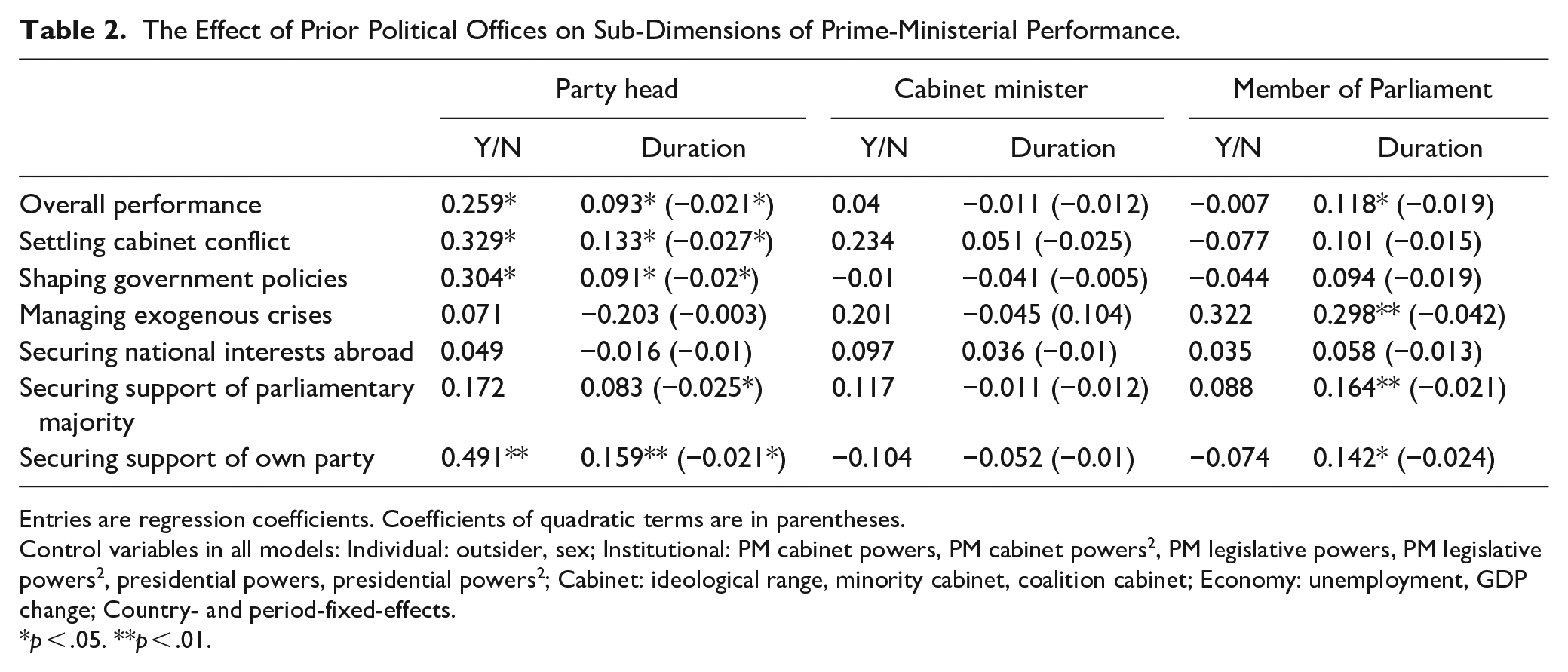
Entries are regression coefficients. Coefficients of quadratic terms are in parentheses.
Control variables in all models: Individual: outsider, sex; Institutional: PM cabinet powers, PM cabinet powers2, PM legislative powers, PM legislative powers2, presidential powers, presidential powers2; Cabinet: ideological range, minority cabinet, coalition cabinet; Economy: unemployment, GDP change; Country- and period-fixed-effects.
p < .05. **p < .01.
As indicated in the first two columns of Table 2, party leadership explains a considerable degree of the variation in PMs’ capacity to settle cabinet conflicts, shape government policies and secure support of own party. This finding corroborates the argument that party leadership provides a broad range of experiences that help PMs to fulfill their delegated tasks in the domestic policy-making process as well as their accountability tasks vis-à-vis their political principals. Concerning the finding that a short parliamentary career might also provide useful experiences for future PMs, these additional analysis reveals that the effect is a consequence of an enhanced performance at the accountability side, that is, the sub-dimensions of parliamentary and own party support. Serving at least one term in parliament appears to provide PMs with superior knowledge of the formal and informal legislative proceedings, which uniquely benefits them in securing the backing of the parliamentary majority. Such experiences also seem to be relevant for managing exogenous crises, but the precise mechanism behind this significant effect requires further clarification which is an interesting avenue for future research. Mirroring the findings for overall prime-ministerial performance, a ministerial career is inconsequential on each of the six sub-dimensions. Overall, these insights once more confirm the causal mechanisms outlined above which relate career paths to prime-ministerial performance through specific experiences. Other factors such as talent or powerful allies gathered in different stages of political careers might also enhance the chances of individuals to become party leader, minister or MP and later to perform successfully as PM, but there is no reason why such factors should be linked in such a clear, functionally distinct manner as previous political offices relate to the different sub-dimensions of prime-ministerial performance.
Finally, we find no evidence that previous career experience is related to performance of PMs in securing national interests abroad. A successful conduct of international affairs may require knowledge and skills which are specific to this arena, given that actor constellations and institutional context are different compared to domestic politics. Since the positions of party leader, cabinet minister and MP are strongly linked to national politics, it appears to be rational that the experience they provide for conducting international affairs is likely limited.
Conclusion
Political career experience helps to perform successfully in executive office. This general assumption has been systematically examined for cabinet ministers but not for PMs as the cabinet heads who are assigned a variety of tasks to make parliamentary democracy work. Therefore, it is essential to know which previous offices provide PMs with the knowledge and skills to fulfill their tasks successfully. This article has explored the relationship between political career positions of PMs and their performance in the post-communist democracies of CEE. Our findings reveal that experience as party leader is decisive, because it allows for attaining a comprehensive set of political knowledge and skills that are required to fulfill the chief executive tasks in a proper way. While prior parliamentary membership particularly enhances PMs’ capacity to secure the support of the parliamentary majority, previous ministerial experience does not significantly affect the performance of heads of government in CEE democracies.
These results have several important implications. First, while the literature on parliamentary and ministerial elites led us to expect that political insiders generally outperform outsiders (De Winter, 1991; Verzichelli, 1998), prime-ministerial performance in CEE varies most substantially within the group of insiders. This means that neither self-made men from outside politics nor standard career politicians fulfill the distinguished tasks of a chief executive particularly well in the post-communist context. To perform successfully, PMs rather require a specific qualification that is best achieved in a preceding position as party leader.
A second implication relates to the recruitment of qualified personnel for representative and government offices, which is a key function of political parties and considered particularly important in new democracies (Dalton et al., 2011, p. 18). While most of the literature deals with the intraparty selection of candidates, this study sheds light on a somewhat neglected but equally relevant aspect of elite recruitment, that is, that parties are agencies for the “training of political leaders” (Saalfeld & Strøm, 2014, p. 381). More concretely, PM parties in CEE provide an organizational framework which helps their leaders to acquire specific knowledge and skills to successfully fulfill the various tasks as chief executive. This way, parties strengthen the link between parliaments and governments in the chain of delegation and accountability and thus contribute to the democratic quality of executive governance.
Third, our analysis of the sub-dimensions of prime-ministerial performance also points to potential imbalances that very “partisan” PMs might bring about for the representative quality of party governments. While PMs with long party leadership experience are very well socialized and trained to secure their own party’s support, they are less successful in organizing their backing by the parliamentary majority which in most CEE cases also consists of other coalition parties (Bergman et al., 2019). Since such PMs are particularly successful in shaping their government policies at the same time, their party might be disproportionally advantaged in the government’s record and thus profit more at the next election than their (usually smaller) coalition partners. However, as we have neither dealt with coalition governance nor with electoral mechanisms, this aspect would need a separated empirical investigation.
Apart from the latter issue, our study might also inspire other avenues of research. For instance, future studies might explore the performance of PMs in the international arena which is not explained by their domestic careers but could be affected by other career experience, like positions at the EU level or diplomatic services. Furthermore, one could investigate how the effects of political careers might differ depending on contextual conditions (Elgie, 1995). More precisely, the experience accumulated throughout their previous careers might assist PMs in performing their tasks under more “difficult” conditions, while the effect could be less pronounced in favorable institutional and political environments. Lastly, as the concept of prime-ministerial performance and the theoretical framework outlined in this paper are generally applicable, future studies might widen the scope to parliamentary democracies beyond CEE to observe whether the results also hold in other contexts.
Supplemental Material
sj-pdf-1-cps-10.1177_0010414021997174 – Supplemental material for How Political Careers affect Prime-Ministerial Performance: Evidence from Central and Eastern Europe
Supplemental material, sj-pdf-1-cps-10.1177_0010414021997174 for How Political Careers affect Prime-Ministerial Performance: Evidence from Central and Eastern Europe by Florian Grotz, Ferdinand Müller-Rommel, Jan Berz, Corinna Kroeber and Marko Kukec in Comparative Political Studies
Supplemental Material
sj-pdf-2-cps-10.1177_0010414021997174 – Supplemental material for How Political Careers affect Prime-Ministerial Performance: Evidence from Central and Eastern Europe
Supplemental material, sj-pdf-2-cps-10.1177_0010414021997174 for How Political Careers affect Prime-Ministerial Performance: Evidence from Central and Eastern Europe by Florian Grotz, Ferdinand Müller-Rommel, Jan Berz, Corinna Kroeber and Marko Kukec in Comparative Political Studies
Footnotes
Acknowledgements
We are grateful to the anonymous reviewers, Despina Alexiadou, Kaare Strøm, Eoin O’Malley, the participants, and audiences of the panel “Legislatures and Leaders: New Perspectives on Political Institutions” at the 2019 Annual Meeting of the American Political Science Association in Washington, D.C. and the panel “Performance and Political Elites” at the 2019 General Conference of the European Consortium for Political Research in Wrocław. We would like to express our gratitude to Jānis Ikstens, Daniel Kovarek, Alenka Krašovec, Darina Malová, Zdenka Mansfeldová, Dario Nikić Čakar, Vello Pettai, Lukas Pukelis, Laurentiu Stefan, Radostina Sharenkova, Maria Spirova, and Anna Sroka, who helped us in identifying and contacting the experts. We also thank the experts for the time and effort they put into responding to the questionnaire.
Declaration of Conflicting Interests
The authors declared no potential conflicts of interest with respect to the research, authorship, and/or publication of this article.
Funding
The authors disclosed receipt of the following financial support for the research, authorship, and/or publication of this article: Research for this article was generously supported by the German Research Foundation (DFG) (Grants GR3311/3-1 and MU618/18-1).

Supplemental Material
Supplemental material for this article is available online.
Notes
Author Biographies
References
Supplementary Material
Please find the following supplemental material available below.
For Open Access articles published under a Creative Commons License, all supplemental material carries the same license as the article it is associated with.
For non-Open Access articles published, all supplemental material carries a non-exclusive license, and permission requests for re-use of supplemental material or any part of supplemental material shall be sent directly to the copyright owner as specified in the copyright notice associated with the article.
