




Abstract
Scholars acknowledge the existence of intra-party divisions and the potentially negative electoral effects of disunity. Some assume that intra-party divides are between professional politicians and grassroots members, others highlight the importance of ideological blocs. Yet, precisely mapping factional structures, especially ideological factions, is difficult because of the “black box of intra-party politics.” Based on theories of party change and spatial competition, we argue for the existence of two distinct ideological factional dimensions that may differ from hierarchical factions. We test our expectations by triangulating evidence from three unique datasets from Sweden: a survey of party members, a media content analysis, and interviews with politicians. Our mixed-methods approach allows identifying the number, structure, content, sizes, and ideological positions of factions. The results show substantial variation in all aspects and that hierarchical and ideological factions rarely coincide. These findings have important theoretical, conceptual, and methodological implications for comparative politics.
Introduction
The literature on electoral behavior and party politics provides ample reasons for why political parties should act in unison. Unity or appearing united has positive effects on parties’ ability to implement their policy program, voters’ party competence perceptions and their vote probabilities (e.g., APSA, 1950; Greene & Haber, 2015; Thomassen, 1994, p. 251). Nonetheless, most research agrees that factions are “a fact of life within most political parties” (Harmel et al., 1995, p. 7). For example, research on party organizations suggests the relevance of hierarchical groups within parties, separated by levels of activity or power (e.g., Bolin et al., 2017; Giger & Schumacher, 2020; Michels, 1911; Schumacher et al., 2013). Work on party behavior emphasizes, in contrast, the importance of ideological factions within a political party (Boucek, 2009; Budge et al., 2010, 2012; Ceron, 2019; Emanuele et al., 2022; Harmel & Tan, 2003). However, the so-called “black box of intra-party politics” has made systematic and comprehensive analysis of the existence and contours of factions highly difficult (Ceron & Greene, 2019; Greene & Haber, 2016; Kitschelt, 1989).
In this article, our central goal is to theorize, identify, and measure factional structures in contemporary parties. Our point of departure are classics on power relationships in parties (Michels, 1911; Weber, 1992 [1919]), proposing a basic distinction of intra-party actors between those living from politics, such as political or administrative leaders, and those living for politics, such as members and supporters. These hierarchical groups predominantly serve as vehicles in a struggle over the allocation of intra-organizational spoils such as financial resources, career advancement or leadership positions. Their dominant “currency” is power and intra-organizational control. Contemporary research echoes such a two-layer structure of hierarchical intra-party groups and regularly reports differences in their respective party goals (e.g., Giger & Schumacher, 2020; May, 1973; Schumacher et al., 2013). However, the major challenge for opening the black box of intra-party politics lies in theorizing and measuring ideological factions and their relationship with hierarchical factions. Unlike hierarchical factions, they are characterized predominantly by representing policy differences within a party, and their main “currency” is control over the policy positions taken by the overall party organization. Party members’ belonging to such ideological factions is often unknown or, at best, less obvious.
We solve this problem by first adopting a common definition of factions as any group of intra-party actors sharing an interest, which it pursues through collective action (see Boucek, 2009; Zariski, 1960). In contrast with existing work which focuses on a subset, namely, established factions with an internal structure, a name, or even a program (see e.g., Ceron, 2019), we argue that both hierarchical and non-formalized ideological factions fit this definition because both further their joint (ideological or party goals) interests through common or coordinated initiatives within the party. Applying this definition to theories of party change and spatial competition allows us to derive expectations about the number of ideological factions as well as their relationship with hierarchical factions.
First, we propose that all parties have at least two ideological factions because intra-party divisions work analogous to inter-party divisions, namely, along ideological dimensions. Politics in Western Europe is largely structured along ideological dimensions, ranging from left to right and from progressive to conservative (Hooghe et al., 2002; Kitschelt, 1994; Kriesi et al., 2006) on which political parties need to position themselves. Based on party change and spatial theory (see e.g. Budge et al., 2010, 2012; Harmel et al., 1995; Harmel & Janda, 1994), we argue that position-taking on ideological dimensions is part of an intra-party process in which some intra-party actors tend more toward one ideological position and others more toward another, thus establishing multiple ideological factions in most cases.
Second, in further theorizing factional structures, we suggest that ideological and hierarchical factions may not necessarily coincide within the party because they are often described as motivated by different interests (cf. May, 1973; see Strøm, 1990). Based in theories on party goals and intra-party power, we suggest that there are no clear expectations as to how interwoven ideological and hierarchical factions are. While ideological factions should more likely be policy-seeking, different types of hierarchical factions (those living for or living from politics) may be guided by either office- or policy-seeking goals, depending on the type of party, the historical role of the party in the party system, or its recent electoral track-record. It means that hierarchical factions’ goals may not always align with those of ideological factions and that the two types of factions may not always overlap within contemporary parties.
Empirically, we first identify and map ideological factions before exploring their relationship with hierarchical factions. Given the substantial difficulties of observing ideological factions, especially the less established ones (Ceron, 2019, p. 5), we use two new strategies in the study of ideological factions. First, we employ a mixed-methods approach and triangulate quantitative and qualitative evidence from three datasets collected in the same context (Sweden): a large-scale party membership survey (N = 20,041), a media content analysis of more than 980 sources, and elite interviews with politicians (N = 28). While previous work was either primarily quantitative or qualitative in kind, our integrated approach allows us to obtain a rich, nuanced, and more comprehensive understanding of factions (see Tarrow, 1995). Second, in contrast to much existing work on the topic (see Belloni & Beller, 1978; Ceron, 2019; Emanuele et al., 2022), we employ an inductive approach to also identify less established factions within parties. We operationalize ideological factions through party members’ shared ideological leanings and apply cluster analysis to identify and measure the number, content, size, and position of ideological factions within parties. With both innovations on existing methods, we provide the first comprehensive analysis of factional structures within seven diverse parties from a case representative of multiparty proportional European countries.
Our triangulated results strongly suggest heterogeneity in the level of intra-party divisions. We find evidence for the existence of different numbers, structures, content, sizes, and positions of factions, as well as their relationship with hierarchical factions. First, on both the ideological left-right and cultural dimension, we identify between two and three factions per party, but in one case (the cultural dimension in the Center Party) also just one. In addition, ideological factionalism appears to be multidimensional because factions on the two ideological dimensions never coincide entirely. Second, we show that income distribution, private healthcare, and economic interventions by the state are systematically dividing issues for factions along the left-right dimension, whereas factional differences along a cultural dimension consistently pertain to issues of integration, law and order, and refugees. Third, we estimate factions’ sizes to range from 12% (culturally conservative faction, Green Party) to 66% of the members (culturally progressive faction, Left Party), and their ideological distances range between two units on an 11-point scale (left-right factions, Moderates) to almost six units (cultural factions, Liberals). Finally, we demonstrate that ideological and hierarchical factions regularly pose distinct lines of intra-party conflict. Those party members living from politics are most often not systematically overrepresented in a certain ideological faction. Jointly, these results indicate that uniform assumptions about the number, sizes, positions, and the interrelationship of factions are difficult to uphold and that factional structures are highly complex.
This is surprising in a country context in which political parties span a full range of both the economic and cultural dimensions, providing members a variety of ideological exit strategies in the form of other, relatively similarly positioned parties (Polk & Kölln, 2018). Yet our analysis consistently supports the existence of factions on multiple dimensions, even in the face of these alternatives. This means that factional structures should be at least as complex in other European democracies with similar or fewer numbers of parties.
Our approach and findings have important implications for research in comparative politics. First, our results challenge common assumptions about the existence and number of factions across parties, and they give scholars first but concrete evidence to further theorize and analyze internal struggles over personnel, programs, or individual policy decisions. Especially the combination of the estimated number, structure, size of a faction, relative positions, and relationships with hierarchical factions provide researchers with new insights about the dynamics of intra-party politics. It may spur new, more precise theories about the origins and effects of factional structures on party positions, coalition-formation, legislative behavior, voters’ evaluations of parties, and political representation. Second, we depart from existing conceptions of intra-organizational politics, which have focused on the individuals or the structures governing them. Our approach turns to group-based aspects where the (sub-)collective gains center stage over individuals. This widens the conceptual reach of intra-organizational (parties, interest groups, social movements) dynamics. Third, with the help of our novel approach, using a mix of data sources and methods as well as an inductive empirical strategy, we were able to enter the black box of intra-party politics. Other researchers may find inspiration in this approach and apply it in other difficult-to-research topics in comparative politics, such as studies of large-scale social movements or analyses of interest groups.
Theorizing Factional Structures
Normative accounts of political parties highlight the importance of unity (APSA, 1950; Blondel, 1978; Thomassen, 1994). Empirical research indicates at least three ways that factionalism can have negative consequences for the policies and electoral performance of a party. First, independent of a party’s issue ownership or perceived competence, voters are more willing to support a party when they perceive it to be unified because they see it as more likely to deliver on policy (Greene & Haber, 2015). Second, strong factions act as a constraint on the flexibility of party leaders in setting the party platform, particularly as elections draw near (Ceron, 2012). Third, the ability of a party to successfully pursue certain electoral strategies is contingent on internal unity (Lehrer & Lin, 2020; Spoon & Williams, 2017). In other words, factionalism can have important negative effects on voter preferences and parties’ strategic behavior. Despite the desirability of party unity, scholars also acknowledge the empirical reality of intra-party divisions.
Starting with the work of Michels (1911), party organization researchers have long theorized intra-party divisions. According to this literature, virtually all parties are hierarchically structured with leaders at the top and members or activists as a less influential but larger layer of the organization (Bolin et al., 2017; Giger & Schumacher, 2020; May, 1973). Michels’ (1911) “Iron Law of Oligarchy” explains that this internal structure is almost inevitable once parties organize themselves more professionally. Other work on party organizations also demonstrates that many parties have different organizational sub-units, defined by sociological commonalities, such as youth wings and women’s organizations, that also fit the general logic of hierarchically organized parties (André & Depauw, 2013; Belloni & Beller, 1978; Hine, 1982).
Although it is clear that parties have multiple hierarchical layers—ordinary members, activists, candidates, elected politicians, and politicians in a leadership role—a major distinction in the literature exists between those party members living from politics and those living for politics (Giger & Schumacher, 2020; May, 1973; Strøm, 1990; Schumacher et al., 2013; Weber, 1992 [1919]). While the former group is economically dependent on the party, the latter only has a motivational connection to the party (Weber, 1992 [1919], p. 16). Both types of hierarchical groups predominantly serve as vehicles in the struggle over the allocation of intra-organizational spoils such as financial resources, career advancement or leadership positions. The dominant “currency” of hierarchical groups is power and intra-organizational control. Despite the diverse roles fulfilled by these different intra-party groups, this simple distinction is helpful for explaining their underlying motives and consequently differences in attitudes and behavior. For, on the most basic level, the stakes are higher for those living from politics compared to those living for politics.
Strøm’s (1990) work on the trade-offs between office, vote, and policy-seeking strategies explains this point. According to him, the party leaders, living from politics, “are primarily motivated by their expected office benefits” (Strøm, 1990, p. 574). It implies that this group promotes ideological positions that align with this goal (see also Koedam, 2022; May, 1973; Pedersen, 2012; Schumacher et al., 2013). Party activists and members, on the other hand, are those that live for politics—ideologues who “can often be satisfied by nonmonetary compensation such as public policy or spoils” (Strøm, 1990, p. 575). It suggests that they will promote more spatially extreme ideological positions compared to the group living from politics (see also Bäck, 2008; Pedersen, 2010; Strøm, 1990). With this reasoning, Strøm (1990) provides a plausible explanation, grounded in rational choice theory, for why different hierarchical groups in a party may hold distinctive ideological positions.
This work on the relationship between intra-party actors’ hierarchical position and their ideological positions follows an underlying opinion formation model in which opinions flow from sociological group membership. However, ideological preferences could also be exogenous to group membership, that is, ideologically like-minded party members join to form a group, an ideological faction. Indeed, our overarching contention is that both kinds of models coexist and that hierarchical groups do not necessarily overlap with ideological factions.
The major challenge for studying this, however, lies in theorizing ideological factions and their relationship with hierarchical groups because party members’ belonging to ideological factions is often unknown or, at best, less obvious. Ideological factions are characterized by predominantly representing policy differences within a party. Unlike hierarchical groups, their main “currency” is control over the policy positions taken on by the overall party organization.
We solve the problem by first adopting a common definition of factions, grounded in the literature, with three distinct components: (a) any group of intra-party actors (b) sharing an interest, (c) pursued through collective action. The study of factions follows a long history and has used various labels (e.g., factions, wings, ancillary organizations, tendencies, echelons, groups, or divisions), definitions, classifications, and taxonomies (for recent overviews, see Boucek, 2009; Ceron, 2019). Indeed, Boucek (2009, p. 468) bemoans “the weakness of categories and typologies” and concludes that Zariski’s (1960) definition “is still valid today”. Following her view, we define factions as “any intra-party combination, clique, or grouping whose members share a sense of common identity and common purpose and are organized to act collectively—as a distinct bloc within the party—to achieve their goals” (Zariski, 1960, p. 33). According to this definition, members of a faction share ideological traits or sociological traits. However, a faction must present a distinct sub-unit within the party based on shared interests, where formal membership is not a defining criterion. This is true for both hierarchical groups and ideological factions. Conceptually, both are characterized by higher homogeneity in shared interests, while at the same time showing higher heterogeneity in interests with other members of the party. For hierarchical factions, these shared interests can often be found in the kind of party goal (office, vote, or policy) that such factions prioritize, while for ideological factions, common interests are a set of shared policy preferences (see Bettcher, 2005; Boucek, 2009; Ceron, 2019). This conceptual understanding of faction types allows us, for the first time, to study them within one common framework that is neutral between the factions’ underlying opinion formation model, while stressing their common defining features. Based on this framework, we derive expectations about (1) the number of ideological factions and (2) their relationship with hierarchical factions.
First, we propose that all parties have at least two ideological factions because intra-party divisions work analogous to inter-party divisions, namely, along one or more ideological dimensions with two end points between which factions are located. Politics in Western Europe is structured along ideological dimensions, ranging from left to right and from progressive to conservative on which political parties position themselves (Hooghe et al., 2002; Kitschelt, 1994; Kriesi et al., 2006). Parties’ position-taking on political issues is an intra-party decision, subject to intense power struggles between groups (see, e.g., Budge et al., 2010, 2012; Harmel & Janda, 1994; Harmel et al., 1995). As Harmel et al. (1995) explain, “[t]hese struggles typically involve conflicts arising from competing demands, and in those producing a new dominant coalition/faction, may ultimately result in changes in the party’s […] direction” (p. 7). In combination with the spatial dimensionality of contemporary politics, this suggests that position-taking on ideological dimensions is part of an intra-party process in which some intra-party actors tend more toward one ideological position and others more to another, thus establishing two ideological factions, per ideological dimension, in most cases.
Prominent applications of this reasoning include the studies of Budge and co-authors (2010, 2012) on the relevance of intra-party factions for policy change. They argue that party policy is affected by intra-party competition between various factions that are empowered or weakened by the performance of the party at the last election. Alternations in power between intra-party factions produce zig-zag movements in parties’ positions detectable in analyses of party manifestos. While the authors are not specific on the number of factions within a party, they emphasize the existence of two ideological factions (e.g., Budge et al., 2010, p. 791). More recently, Ceron (2019) found more than two ideological factions within each of the parties in France, Germany, and Italy. Other work also suggests the existence of several publicly visible factions (e.g., Emanuele et al., 2022; Giannetti & Benoit, 2009; Harmel & Tan, 2003; Sältzer, 2022). Taken together, we expect at least two ideologically based factions to exist, per dimension, that make competing demands in the pursuit of influencing the party’s position, within most contemporary political parties in advanced democracies.
Second, we anticipate that ideological and hierarchical factions may not necessarily coincide within the party at all times because they are often described to be motivated by different interests (see Strøm, 1990; cf. May, 1973). As Boucek (2009) states “[t]he main problem with operationalizing factionalism by identifying different features and forms of subparty groups is that many of the selected variables turn out to be interactive rather than separate” (p. 465). And indeed, some draw a connection between the most powerful hierarchical layer and the kinds of goals a party pursues (Koedam, 2022; Schumacher et al., 2013). Others show that party activists tend to be less flexible and less willing to concede policy for office or votes (Bäck, 2008; Pedersen, 2010; Strøm, 1990), while party leaders and office holders are likely to display more flexibility in their policy positions, having experienced the necessity of compromise in legislatures (Pedersen, 2012). Yet, there is mixed direct support for the core claim of ideological disagreement between a party’s leadership, intermediate activists, and supporters in the electorate (Kitschelt, 1989; Norris, 1995). Tests of May’s (1973) law of curvilinear disparity report little support in multiparty, proportional systems (Van Holsteyn et al., 2017), and only highly contingent support in Scandinavia (e.g., Bäckersten, 2022; Narud & Skare, 1999). In addition, leadership contests often expose ideological diversity within the top layer of a party (e.g., Aylott & Bolin, 2021; Emanuele et al., 2022; Quinn, 2012), and party members are not uniform in their ideology either (Kölln & Polk, 2019; Van Haute & Carty, 2012).
Strøm’s (1990) account suggests that ideological factions are most likely policy-seeking because their ideological leaning constitutes their joint interest. If true, such factions will pursue the goal of advocating a particular (set of) ideological position(s). In contrast, the shared interests of hierarchical factions of members living from or for politics might be more dynamic. They can be either policy-seeking or more interested in office, depending on the role of the party in the party system and its recent electoral track-record. It might be that those living from politics are more often guided by office-seeking goals out of self-interest for maintaining power or income. For that reason, such a faction might advocate ideological positions opposite to that of one or the other ideological factions or attempt to position itself between the two. At the same time, even the party leadership might at times be composed of ideologues, especially in niche parties, and could be less interested in the compromises that office-seeking behavior entails and more interested in policy purity (Fortunato, 2019; Strøm, 1990). Similarly, a hierarchical faction living for politics might either strive for policy purity because such members strongly identify with the ideological core of the party at the time or for office because of the historical role of the party in the system or its recent electoral track-record. This again suggests that the substance of this faction’s shared interests (policy- or office-seeking) might change over time. Taking a snap-shot perspective, the former view on policy-seeking members living for politics would be in line with existing literature on activist-dominated parties (see, e.g., Schumacher et al., 2013), and it would imply a larger overlap with ideological factions. In contrast, the latter view on office-seeking members living for politics would mean that this faction could have little or no overlaps with ideological factions.
This overview suggests that whether hierarchical and ideological factions overlap may depend on specific party-level factors. Given the limited literature on this point and their strong assumptions about differences in party members’ goals, we do not formulate a specific expectation. But we observe that there are important arguments to suggest that hierarchical and ideological factions may not always coincide. In line with our research goal of identifying and measuring factional structures, we will explore the relationship between hierarchical and ideological factions more fully below.
Empirical Strategy
Scholars agree on the “tremendous difficulty in identifying” factions and an “even greater difficulty” in identifying their preferences (see also Bale, 2012; Giannetti & Benoit, 2009; Harmel et al., 1995, p. 8). But these difficulties primarily relate to ideological factions because it is easier to identify those living from and for politics. Our empirical aim is therefore to identify and measure ideological factions before exploring their relationship with hierarchical factions.
Previous work on factions has used either quantitative or qualitative data (see e.g. Belloni & Beller, 1978; Ceron, 2019; DiSalvo, 2012; Emanuele et al., 2022), always with a focus on established factions with an internal structure, a name, or even a program. Aiming at a comprehensive picture that may also include loose networks, we approach the study of factions differently and combine quantitative and qualitative data in a mixed-methods approach. It allows offsetting the data sources’ relative strengths and weakness and triangulating the evidence to converge on a likely factional structure that is richer, more nuanced, and more comprehensive than previous approaches (see Bryman, 2006; Tarrow, 1995). We employ three datasets from the same context (Sweden): a large-scale party membership survey (N = 20,041), a media content analysis of more than 980 sources, and elite interviews with politicians (N = 28).
Our quantitative source of data is a survey of party members. Despite the growth of creative ways to identify and measure intra-party divisions, party membership surveys are rarely used (Polk & Kölln, 2018; but see Van Haute & Carty, 2012). They are, however, a good source of data because they allow us to study sub-groups of party members and their shared preferences. Since anyone, even the party leader is a member of a party, membership surveys cut across hierarchical levels and contain more respondents per layer in comparison to other surveys. With the party membership survey, we can thus study the hierarchical level as well as the ideological leaning of party members to explore factional structures within and across parties. However, such cross-party data are limited in nuance and detail, not least because they do not reveal information about the collective actions of potential factions.
We therefore triangulate our quantitative analysis with qualitative data, obtained from media reports and interviews with politicians. These two qualitative sources are an excellent pair because they offset each other’s imperfections. For journalists, internal party disputes make for interesting copy, potentially biasing coverage toward more emphasis on party divisions. This is because of the underlying media logic in which “the news values and the storytelling techniques the media make use of to take advantage of their own medium and its format, and to be competitive in the ongoing struggle to capture people’s attention” (Strömbäck, 2008, p. 233). Compared to journalists, politicians have the opposite interest of down-playing internal divisions, given the potentially negative consequences of disunity for a party’s electoral result or competence evaluations (see Greene & Haber, 2015). However, politicians have deeper insights into the organization and its internal workings (formal and informal) because they attend meetings, congresses, and receive internal information. It means that using politicians as informants can compensate for the potential upward bias in the media. Therefore, these two qualitative sources are not only two additional sources of information useful for triangulating; they jointly promise to present a holistic picture of factions.
Beyond validation, the qualitative interview material is also valuable because it is custom-made for our purpose, allowing us to gather information that other sources do not contain. This advantage plays out when validating the existence of factions in parties, defined as above, as sub-groups of party members with a shared interest, which they pursue through collective action. In making up for the limitations of the survey data to identify the collective action of potential factions, we asked detailed questions in the interviews about this aspect of factional belonging.
The in-depth study of a single context complicates generalizability to other contexts. However, the parties in Sweden are representative of many other Western European parties in that they reflect a wide spectrum of different ideologies and have stable party organizations. In that sense, our cases are “typical” (Gerring, 2007, p. 89). Sweden’s party members and politicians are not unique in their patterns of opinions or behaviors, as these resemble their counterparts in other Western European countries (e.g., Cordero et al., 2018; Kölln & Polk, 2019; Polk & Kölln, 2018, 2019; Sieberer, 2006). Our findings will be specific to Swedish political parties, but our general conclusions are relevant for many other Western European countries.
We first present our data and measures (quantitative and qualitative) before describing how we analyzed them.
Quantitative Data and Measures
Our dataset on the 2019 Swedish Party Membership survey includes responses from members of seven parties, represented in the national parliament—the Riksdag (N = 20,041). 1 For more information on the sampling procedure, the final sample, and generalizability, see Appendix A.
The survey includes several questions needed for building our measures of hierarchical and ideological factions. It is relatively straightforward to measure belonging to a hierarchical group, given the theoretical distinction between living from and living for politics. We use two survey questions asking members (a) whether or not they currently hold a political office within the party and (b) whether or not they currently hold an administrative office within the party organization. The combined responses to both questions create a variable that distinguishes between those respondents that claim to hold office (political or administrative) and those that do not. The share of partisans in our sample belonging to the first group ranges between 18% (Left Party) and 32% (Green Party). This is our variable for measuring hierarchical factions. Appendix A provides the question wording and validates our measure using additional survey material.
It is more difficult to measure ideological factions because some ideological factions may only be based on loose networks that are “not directly observable” (Ceron, 2019, p. 5). This renders asking a direct survey question about factional belonging impossible. Our solution is to operationalize factions through their shared policy preferences, in line with our definition. In practice, it means that members of an ideological faction should be characterized by high similarities in ideological positions (Boucek, 2009, p. 463; Budge et al., 2010; Harmel & Tan, 2003).
A priori, we have no expectation that ideological factions should be confined to a left-right dimension. To increase the content validity of our measure of ideological factions and our analytical leverage, we measure party members’ ideological leaning using (a) general left-right and (b) cultural ideological self-placement on 11-point scales with labeled end points. The left-right dimension remains of primary importance to Swedish politics (Oscarsson & Holmberg, 2016). Yet, across Europe (Sweden included) the left-right dimension also faces criticism as a measure of ideology, and the contemporary political space is multidimensional with a supplementary cultural dimension, often referred to as GAL-TAN (Hooghe et al., 2002; Hooghe & Marks, 2009). It measures cultural ideology on a spectrum from Green-Alternative-Liberal (GAL) views to Traditional-Authoritarian-Nationalist (TAN). Unlike left-right ideology, surveys usually only include the GAL-TAN question for political elites or experts when placing political parties, and it is rare in citizen surveys. An additional measure of GAL-TAN positions is important in Sweden because this dimension features prominently in contemporary election campaigns and recent journalistic coverage of Swedish politics (Aylott & Bolin, 2019). Appendix A shows the exact wordings of the survey questions and the distribution of responses per party and dimension.
These two survey items form the basis for our measure of ideological factions, and we treat them separately for theoretical and empirical reasons. Theoretically, we are interested in identifying factional structures as comprehensively as possible. Using both ideological dimensions that also form distinct lines of party competition in Sweden therefore maximizes the probability of identifying factions. The survey data also indicates that party members see them as separable lines of political conflict. Pearson’s r correlations on the party-level only vary at low to moderate levels (.22–.46; p < .05). In line with our goal of identifying and measuring factional structures, we systematically explore the empirical relationship between factions on the two dimensions in our analysis.
Qualitative Data
Our qualitative datasets are tailormade to triangulate with the quantitative analysis. In Spring 2022, we interviewed four politicians from each Riksdag party we have quantitative data on, two Riksdag politicians and two sub-national politicians (N = 28). From the pool of national politicians, we excluded group leaders, party leaders/spokespersons and ministers in order to speak to those that are less organizationally, politically, and personally invested in the party and could therefore be more likely to speak about dividing groups. Respondents were otherwise randomly selected from a list of parliamentarians and sub-national politicians, respectively, and recruited via email. Appendix B provides details about ethical considerations.
To avoid biases, our semi-structured interviews first contained a set of questions phrased openly about the existence of factions within interviewees’ parties. In follow-up questions, we probed interviewees about the number, size, content, ideological leaning, and how they show themselves (see Appendix B for the interview guide). The interviews took between 15 and 36 minutes and were anonymized and transcribed verbatim.
As a final source of information, we conducted a media content analysis. We searched the database Mediearkivet, based on more than 980 newspapers, for the word faction and its synonyms during the period 2019–2022 (see Appendix C for more details). We chose this time period because it stretches over our other two data sources, the 2019 Swedish Party Membership survey and the interviews with politicians in 2022. This allows us to cross-validate and to capture continuity in factional structures.
Method
Next to triangulating quantitative and different qualitative data, the use of an inductive research strategy is our second innovation on existing work on factions. Applied to all three data sources it is, in principle, also able to detect less established ideological factions, such as networks. Beginning with the qualitative data, this meant for the media content analysis that we read each of the articles to identify those mentioning factional conflicts (N = 274). We subsequently counted the number of relevant articles per party and identified what the factional conflict was about. The resulting information informs us about the frequency with which the media report on factional conflicts per party and year. As is clear in Table C2 in Appendix C, despite variation, the media reported about factions within all the parties in almost each of the years. The largest number of articles appeared in the years 2020 and 2021, the period most important for bridging between the survey and elite interviews, which took place in early 2022. 2 This indicates that factionalism is not confined to 2019 or 2022 when we gathered the survey and interview data, respectively, but is a continuous phenomenon in Swedish parties, stretching over the entire period of 2019–2022. Besides showing numerically the continuous existence of factions, the news articles regularly include information about the rough content of the conflict or the number of factions.
We also applied an inductive research strategy to our interview material because we first used an open and then a closed coding scheme (see Appendix B for the closed coding scheme). Since we collected the interview data specifically for this project, the resulting material is richer than the media content analysis. For example, on a conceptual level, most politicians provided concrete and detailed validation for all three parts of our conceptualization of factions: sub-groups of party members, shared interests, engagement in collective action. As mentioned, the last of these is particularly important because this is what the survey data cannot show. Specifically, the interviewees reported that the factions they talked about coordinate their efforts in noticeable ways. Politicians’ accounts included different online or offline groups as well as various internal and external types of engagement (see Appendix B for more details). Motions at party congress were the most mentioned type of action. Almost half of the interviewees mentioned that writing and/or voting on motions at party congress is a typical way for factions to make their demands heard. This suggests that factions are not only visible to our knowledgeable intra-party actors but also that they are active. Beyond that, the interviews inform us about the rough number, kinds, goals, and sizes of factions from the perspective of knowledgeable intra-party actors.
For our quantitative data, an inductive approach implied the use of cluster analysis. Cluster analysis is a variance-based approach that aims at creating high homogeneity of cases within the same cluster (here ideology of members) and large heterogeneity of cases between clusters (Waggoner, 2020). As such, cluster analysis is a popular tool for creating typologies of cases, with several applications in political science (Carlin & Singer, 2011; Humprecht et al., 2020; Rudra, 2007). Cluster analysis is an ideal tool for our purposes because it allows us to identify, construct, and measure the number of ideological factions within a party, using party members’ shared ideological positions measured on the two ideological dimensions as the defining criterion.
Our analysis of the qualitative and quantitative data proceeded in four steps, the first two were preparatory and the latter two served to test our expectations. In a first step, we analyzed our quantitative material and used the clustering method of hierarchical agglomerative linkages with Euclidean distances and Ward’s algorithm to uncover the number of ideological factions (see also Rudra, 2007). This clustering method stays close to the data and does not require making assumptions about the number of factions. We determined the precise cluster solution by following Duda and Hart’s (1973) stopping rule (see also Carlin & Singer, 2011; Rudra, 2007) as implemented in the NbClust() function in R (Charrad et al., 2014). 3 From this step, we obtained information about the number of factions per party, based on inductive methodology.
In a second step, we triangulated these results with the qualitative material from the media content analysis and, above all, our interviews with politicians. We interpreted the cumulative evidence from all three data sources to conclude a particular factional structure per party and per ideological dimension. In some cases, the evidence was clearer than in others because interviewees from the same party did not agree with one another or because the qualitative material suggested a different factional structure than the quantitative results. Whenever we encountered disagreement, we interpreted the results with great care, being aware of and transparent about the uncertainties. Although there is no clear methodology on how to exactly aggregate information from multiple sources (Leuffen et al., 2013; Wagner et al., 2010), we followed Leuffen et al.’s (2013, p. 41) recommendation and gave greater credence to detailed and more certain accounts from knowledgeable sources. With this, the outcome of step two is already part of the main findings because it specifies the number of ideological factions per party and ideological dimension. It allows us to evaluate our first expectation on the number of factions. Appendix D documents the processes for step one and two in detail.
After determining the number of ideological factions per party, we used this information in a third step to return to cluster analysis and our quantitative data. Using K-means clustering methods, we partitioned party members into factions. This method requires determining the number of clusters a priori and is thus better suited after using inductive approaches (Waggoner, 2020). The classification of individual respondents to ideological factions based on similarities in ideological positions allows us to also identify the sizes and ideological positions, that is, centroids (= mid-points), of the ideological factions.
Generally, K-means clustering is based on the sequential improvement of all observations’ group belongings until no further re-classification leads to improvements. According to K-means clustering, a good clustering of observations (here party members and their ideological positions) follows the same logic as hierarchical agglomerative methods: the within-cluster variation should be as small as possible while the between-cluster variation should be as large as possible. In other words, members of a group (here faction) have more in common with each other in a particular characteristic than they have with members of another group. We use the function kmeans() in R that applies the Hartigan and Wong (1979) algorithm.
In a final step, we explore the relationship between hierarchical and ideological factions within parties. If hierarchical and ideological factions do not coincide and are distinct intra-party divisions, we should see that party members living from politics are equally distributed across ideological factions. If, however, hierarchical and ideological factions coincide, then party members living from politics should be systematically overrepresented in one of the ideological factions. We rely on chi-square statistics to explore the (in)dependence of the joint frequencies. We calculate lambda values to evaluate the strength of the association. Replication materials and code for the quantitative analysis can be found at Kölln & Polk (2023).
Results
In our empirical discussion, we, first, identify the number of factions per party and ideological dimensions and explore their structure and content, showing large heterogeneity across parties and dimensions in the number and structure of factions but consistent divisions between factions on key political issues; second, we specify factions’ sizes and ideological positions, demonstrating that Swedish parties are under considerable ideological strain; third, we explore the possible interdependence between hierarchical and ideological factions and find that these lines of conflict work largely independently.
The Number, Structure, and Content of Ideological Factions
Suggested Number of Factions Per Party and Ideological Dimensions after Triangulation.
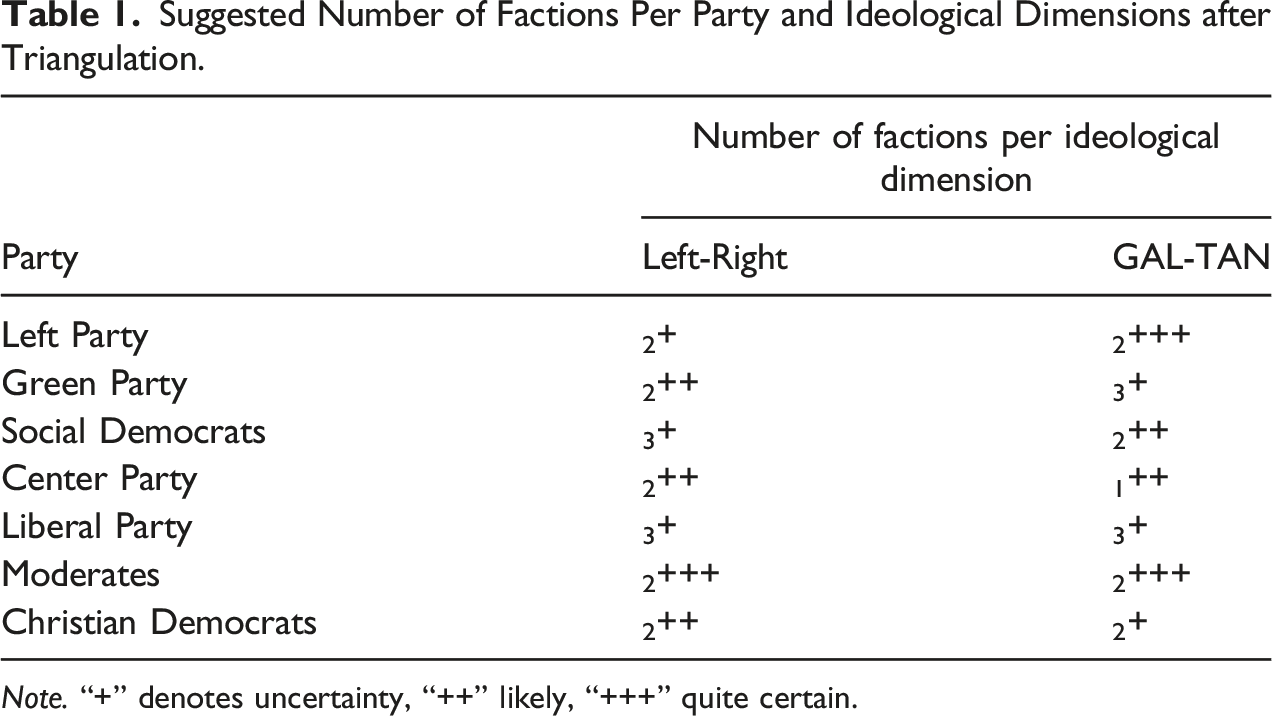
Note. “+” denotes uncertainty, “++” likely, “+++” quite certain.
Overall, our analysis identified ideological factions in all parliamentary parties. While our findings support the assumption in the literature on the existence of two factions per dimension, per party for most parties, they clearly speak against accounts of factional structures that assume homogeneity. Our findings also show that the number of factions within a party is more often the same on both dimensions, but not always.
The complexity of factional structures is further underscored by the relationship between identified factions on the two ideological dimensions. As detailed in Table E1 in Appendix E, we find tendencies that members more often belong to the left (right) and GAL (TAN) faction than to the left (right) and TAN (GAL) faction. At the same time, the overlap is far from perfect. Our results show the strongest of such tendencies for the Christian Democrats and Moderates. Within the former, 17% of those who belong to the right faction also belong to the GAL faction, while 83% belong to the TAN faction. For the Moderates, the overlap between ideological factions is weaker because 30% of those belonging to the right faction also belong to the GAL faction, while 70% belong to the TAN faction. Although it is impossible to say with certainty, the stronger tendencies for overlapping ideological factions within these two parties might be due to the heightened salience of the GAL-TAN dimension at the time of the survey, when a possible collaboration with the far-right Sweden Democrats gained political relevance. Importantly, there is not a one-to-one match between different ideological factions within any of these parties, which is further corroborated by the lambda values. They indicate the reduction in error, expressed as a proportion, when using one factional dimension to predict belonging to the other. Lambda is only moderately high for the Christian Democrats (= .34) and the Moderates (= .26). This strongly suggests that ideological factionalism is multidimensional.
In additional analyses, we further exploit our quantitative survey material to explore the content of our identified ideological factions. We used responses to positional issue statements that are often related to each of the two ideological dimensions (Benoit & Laver, 2006), and we compared factions’ positional distributions within parties. The items were about the government’s intervention in the economy and its responsibility to reduce income inequalities, the role of the private sector in healthcare, immigrant’s integration, acceptance of refugees, and stiffer sentences. Detailed information is in Appendix A.
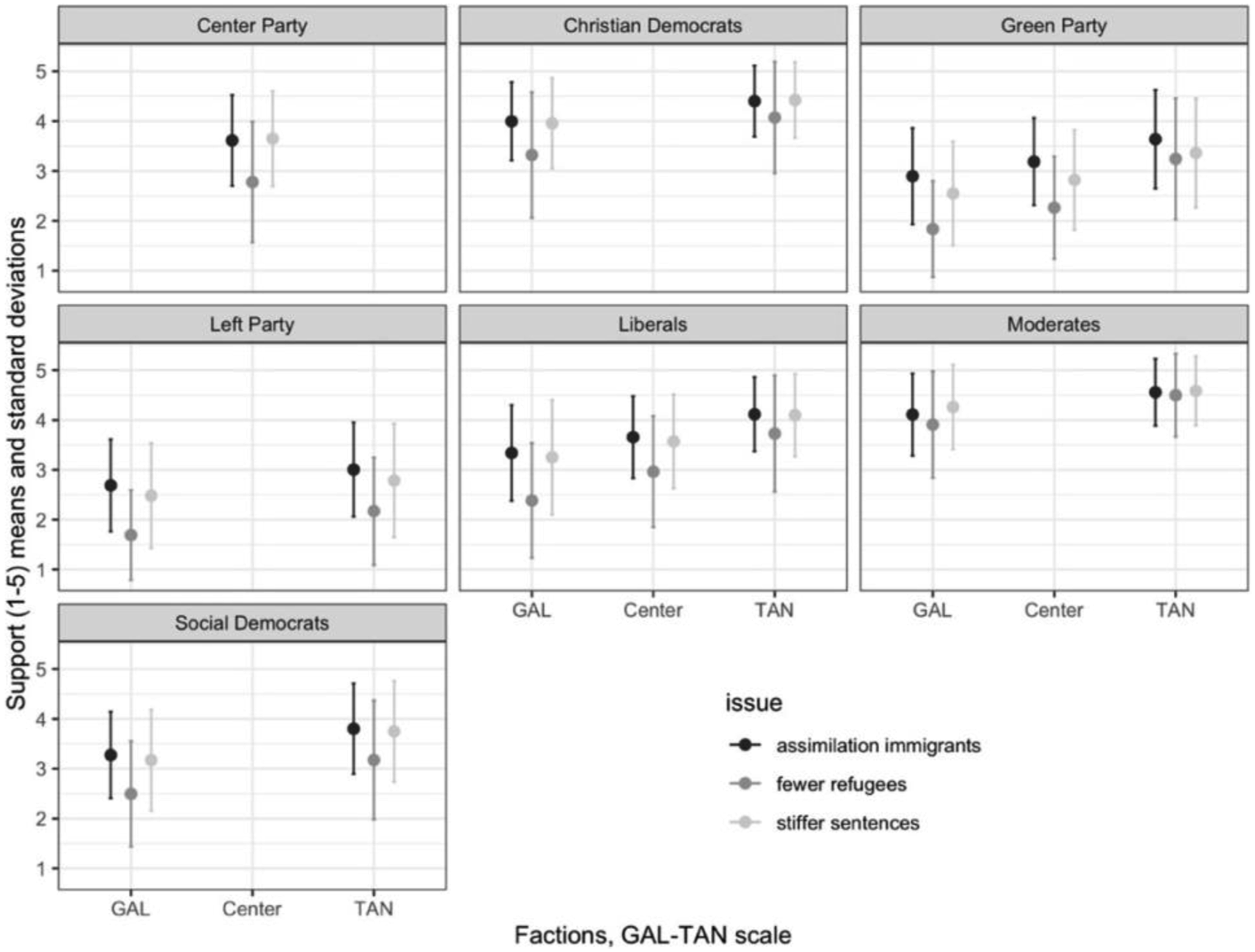
Figures 1 and 2 report the means and standard deviations of party members’ issue attitudes across factions, grouped by party, revealing at least parts of factions’ ideological content (see also Table E3 in Appendix E). Figure 1 demonstrates a consistent pattern that left-leaning factions within parties are, on average, more supportive of reductions in income inequalities or of economic interventions by the state and less supportive of a further privatization of the healthcare sector than their centrist (where applicable) or right-leaning factions, as indicated by the faction means. This is true for all parties, from the Left Party to the Moderates. The pattern is echoed in Figure 2, where TAN-leaning factions within the parties want immigrants to adapt to Swedish customs, the state to be tougher on law and order as well as on refugee admittance into the country more than their centrist (where applicable) or their GAL-leaning factions. Because all differences between factions, and across all six issues, are also statistically significant (p < .05), the findings show more than consistency in party members’ attitudes. Instead, the results indicate high levels of consistency in members’ factional belonging across ideological dimensions and their issue attitudes. These findings thus provide first ideas about the specific ideological content of our identified factions and lend further evidence for their plausibility. Left-right issue positions and factional belonging: means and standard deviations. Note: all differences in means are statistically significant (p < .05). GAL-TAN issue positions and factional belonging: means and standard deviations. Note: all differences in means are statistically significant (p < .05).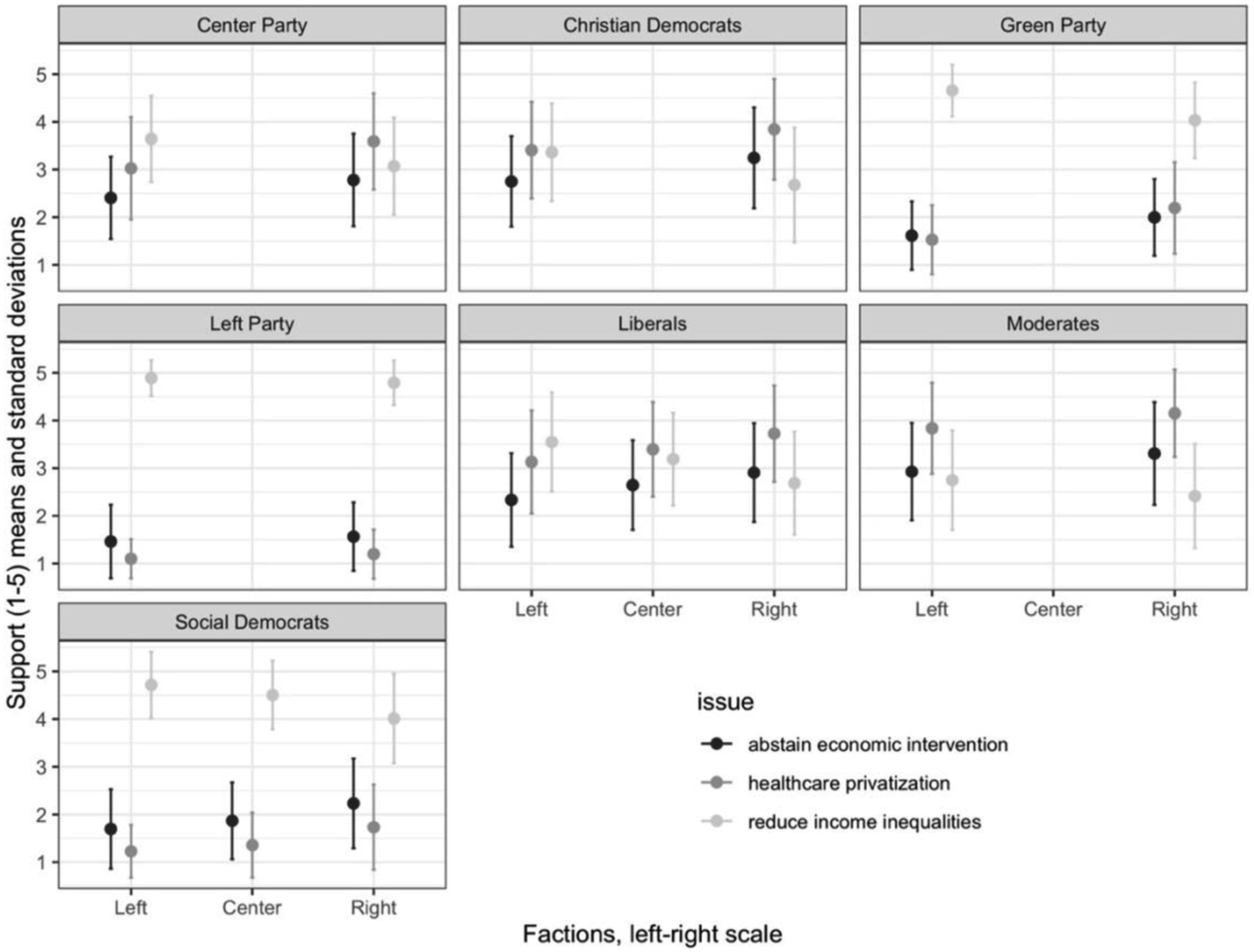
The Size and Position of Factions
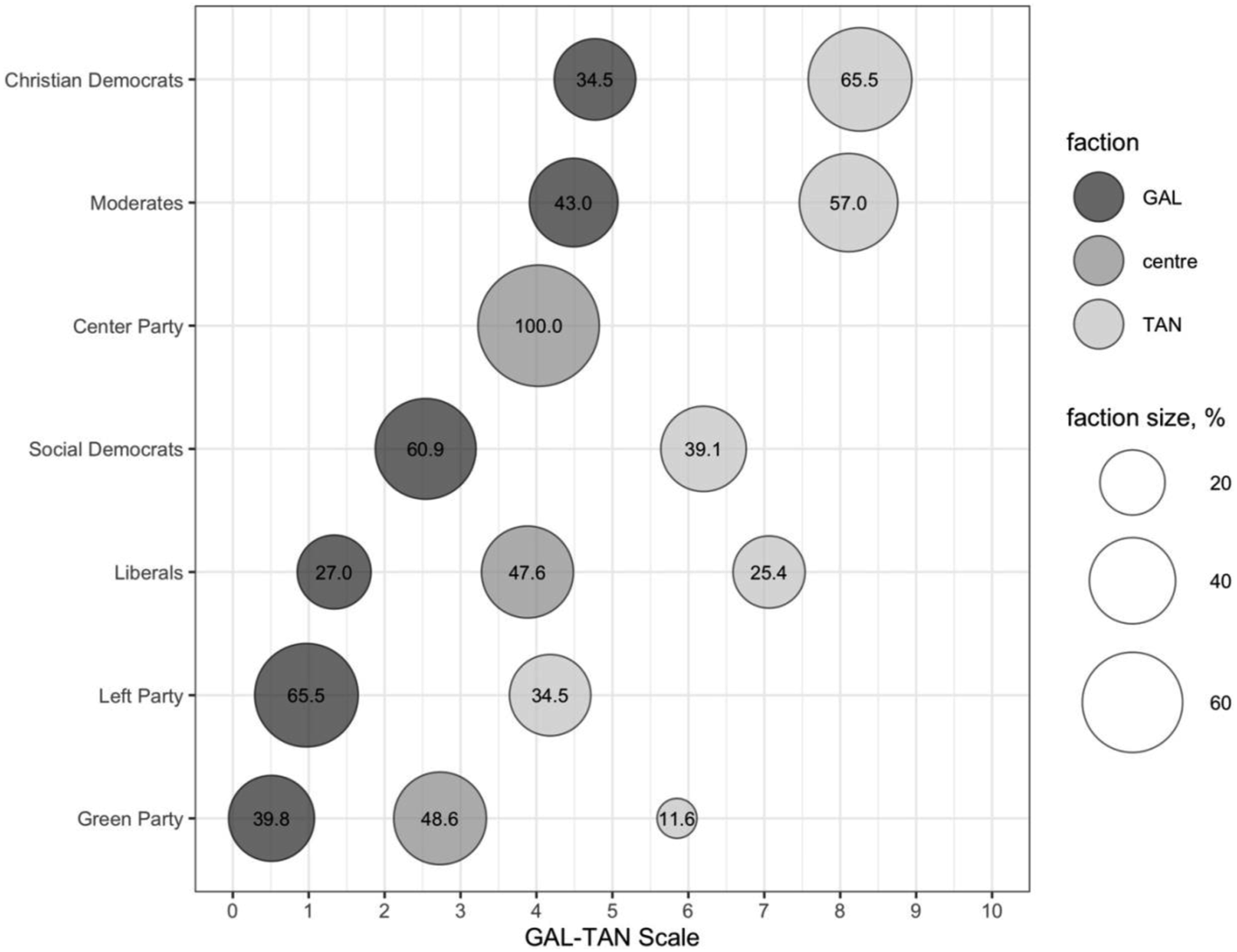
Using the triangulated evidence on the likely number of factions per party, we next estimated the relative sizes of factions and positions on the ideological dimensions, via K-means clustering methods. Results are shown in Figure 3 for the left-right dimension and in Figure 4 for the GAL-TAN dimension (see also Appendix E, Table E2 for descriptive information about all factions). Most generally, they illustrate that parties differ in the positions of factions and their relative sizes. Ideological factions in parties along the left-right dimension: estimated positions and sizes (printed in %). Note: results obtained through k-mean clustering, considering qualitative results. Ideological factions in parties along the GAL-TAN dimension: positions and sizes (printed in %). Note: results obtained through k-mean clustering considering qualitative results.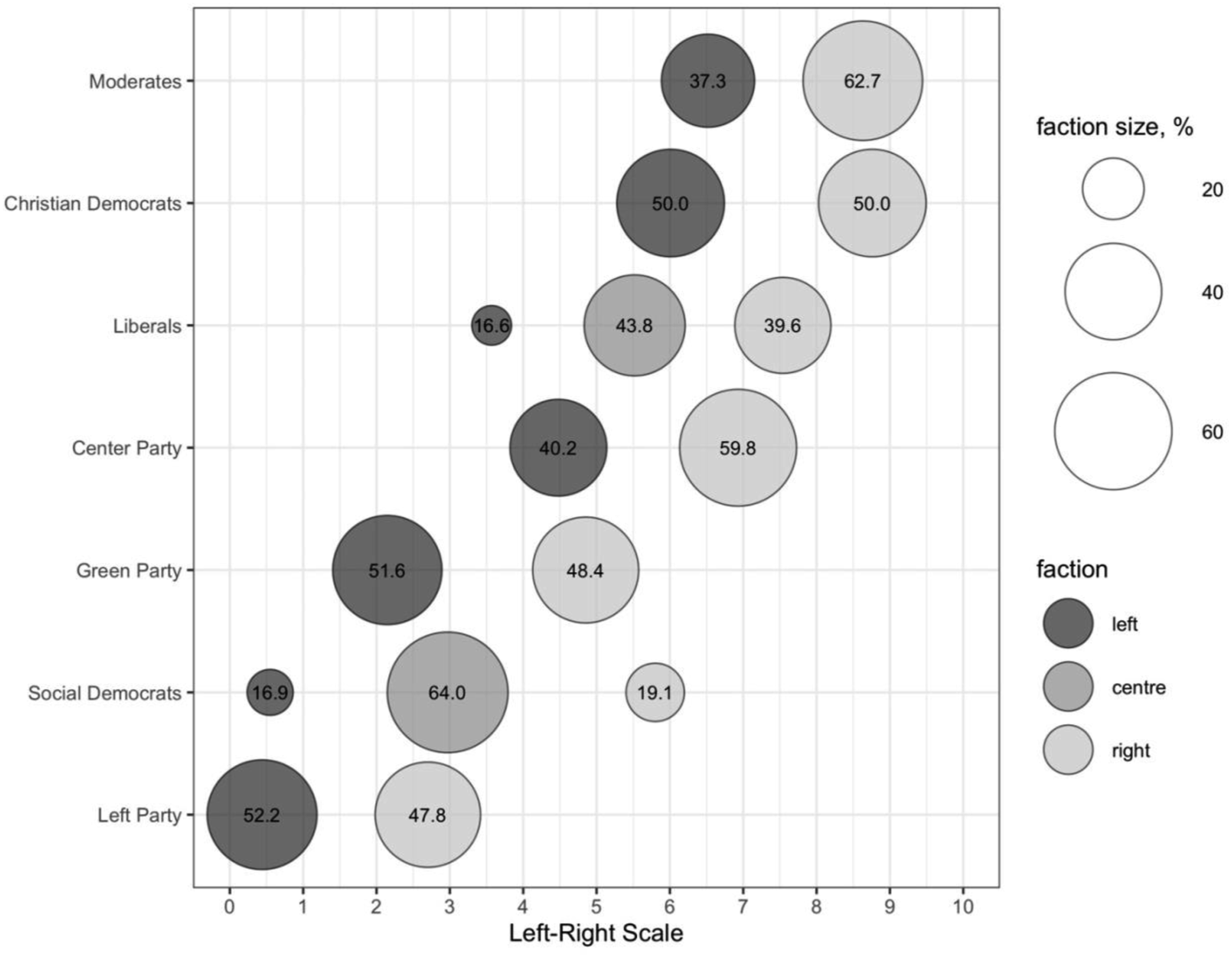
More specifically, the results on the left-right dimension (Figure 3) show face validity because, as one would expect, the parties of the former center-right Alliance (Moderates, Christian Democrats, Liberals, and Center Party) reside on the right side of the left-right dimension. Moreover, the Left Party is farthest to the left, and the leftist faction is the larger group. According to our analysis above (see also Table E3 of Appendix E), members of this faction highly support the reduction of income inequalities (mean = 4.9) and are highly critical of a further privatization of the healthcare sector (mean = 1.1). They also strongly disagree with the idea that the state should abstain from intervening in the economy (mean = 1.5). While factions within the Green Party are roughly equal in size, according to our estimation, the centrist faction within the Social Democrats is much larger than the other factions and is the largest faction of all. Our analyses show that members of this faction are highly supportive of measures to reduce income inequalities (mean = 4.5) and very critical of the privatization of healthcare (mean = 1.4). They also disagree with the idea of the state abstaining from economic intervention (mean = 1.9). Looking across parties, the comparison of factions’ positions on the left-right dimension also points at the electoral and coalitional potential of the parties. For example, the high positional similarity between the centrist (and largest) faction of the Social Democrats and the right-leaning (and sizeable) faction with the Left Party suggests tight competition but also potential collaboration because they can reach out to similar voters.
Among parties on the ideological right, we find that right-leaning factions are larger or equal to more moderate factions in the Center Party, the Christian Democrats, and the Moderates. The largest right-leaning faction among these parties—the right-leaning faction of the Moderates—is not only market liberal, in general, with an estimated position of 8.6 on the left-right dimension, but also on specific issues. Our analysis shows that members of this faction are more critical toward the reduction of income inequalities (mean = 2.4), supportive of more privately driven healthcare (mean = 4.2), and—for Nordic standards—quite supportive of the state abstaining from intervention in the economy (mean = 3.3). This large faction within the Moderates with an estimated size of 63% of the members is likely trying to push the party into economic liberalism.
However, in other parties of the former Alliance, differences in opinion are not only stronger but also equally large, potentially leading to more ideological in-fighting. For example, within the Christian Democrats we identify two factions of equal sizes that seemingly hold rather different ideological views on the left-right dimension. While the left-leaning faction has an estimated ideological left-right position of 6.0, the right-leaning faction is positioned at 8.7. This ideological difference is also reflected in factions’ issue positions. On the issues of reducing income inequalities and abstention from economic interventions, factions are on opposite sides of the response scales mid-points (see Figure 1), whereas they both support more healthcare privatization. It suggests that factional conflict might be less likely about healthcare privatization and more likely about the other two left-right issues.
We find even stronger patterns of ideological strain due to factions’ relative positions and sizes on the GAL-TAN dimension. Figure 4 illustrates the factions’ relative sizes and positions on GAL-TAN with two interesting patterns. Here, the ideological divisions are larger in both the Moderates and the Christian Democrats. TAN-leaning factions of both parties are estimated to be at 8.1 and 8.3, respectively, while their more progressive counterparts are at 4.5 and 4.8, respectively. These are no small differences on an ideological spectrum ranging from 0 to 10, and they are not fully captured by our issue attitudes. Although the differences in factions’ mean issue positions are always statistically significant (Figure 2, Table E3), they are substantively not that different to explain this large division on the general level. Only the issue of admitting fewer refugees seems to come close to explaining the ideological strain within the Christian Democrats. Here, the TAN-leaning faction is rather supportive of fewer refugees (mean = 4.1), whereas the more progressive faction seemingly holds a more centrist view (mean = 3.3). Even though this finding comports well with debates within the Christian Democrats at the time (see our detailed discussion in Appendix D), it also shows that the issue positions available only take us so far in explaining factions’ ideological differences.
Looking at the other side of the ideological spectrum, we see large progressive factions within the Green Party, Left Party, and the Social Democrats, which highlights the polarization of Swedish politics on the cultural dimension in recent years. These progressive factions are also the largest group within the latter two parties. Some of the parties on this side of the spectrum (Social Democrats, Green Party, Liberal Party) also host factions on the relatively TAN side, albeit of varying sizes.
Inspecting some of these factional groupings more closely reveals the importance of the issue of refugee admittance. According to our results, the Liberals have a TAN-leaning faction located at a 7.1 on the ideological GAL-TAN dimension, making up about a quarter of the members who responded to the survey. Our issue-level analyses suggest that these members are quite supportive of assimilating immigrants and tougher sentences for criminals (means = 4.1) and also somewhat supportive of fewer refugees (mean = 3.7). On the other hand, the party’s more progressive faction holds more mid-range positions on immigrants and sentences (means = 3.3) and is on the other side of the mid-point when it comes to the admittance of fewer refugees (mean = 2.4). This suggests that the issue of refugees could be a more conflictual point of discussion within the party, compared to the other cultural issues, not least because both factions are also roughly equal in size. The same can be said for the Social Democrats because, although their factions hold different general positions on the ideological dimension (Figure 4), our analysis shows that the GAL- and TAN-leaning faction only hold positions on opposite sides of the mid-point on the issue of refugee admittance (GAL = 2.5; TAN = 3.2). On the other two issues, factions hold opinions that are statistically significantly different, but they are still in the same direction, namely, just above the mid-point on the scale. These findings again assign a special role to the issue of refugee admittance but also suggest that some of the factional divisions on the GAL-TAN dimension may have to do with issues other than the assimilation of immigrants or tougher sentences.
Overall, our analyses of factions’ positions imply different levels of ideological intra-party conflict across parties. The differences in mean positions of the two most extreme factions illustrate this point most concisely (see also Table E1 of Appendix E). Left-right factions within the Social Democrats (the biggest party in Sweden) span the largest ideological space of 5.2 units on the 11-point scale, whereas the Moderates—the direct competitor—need only to handle factions covering an ideological breadth of less than half that magnitude (2.2 units). In comparison, the ideological stress implied by factional positions on the GAL-TAN dimension is somewhat larger, ranging between a 3.1-unit difference in mean positions within the Left Party and 5.8 within the Liberals. These variations in ideological strain on either dimension indicate that parties’ internal ideological dynamics may be more or less conflictual, especially in combination with differences in factional sizes.
Exploring the Relationship Between Ideological and Hierarchical Factions
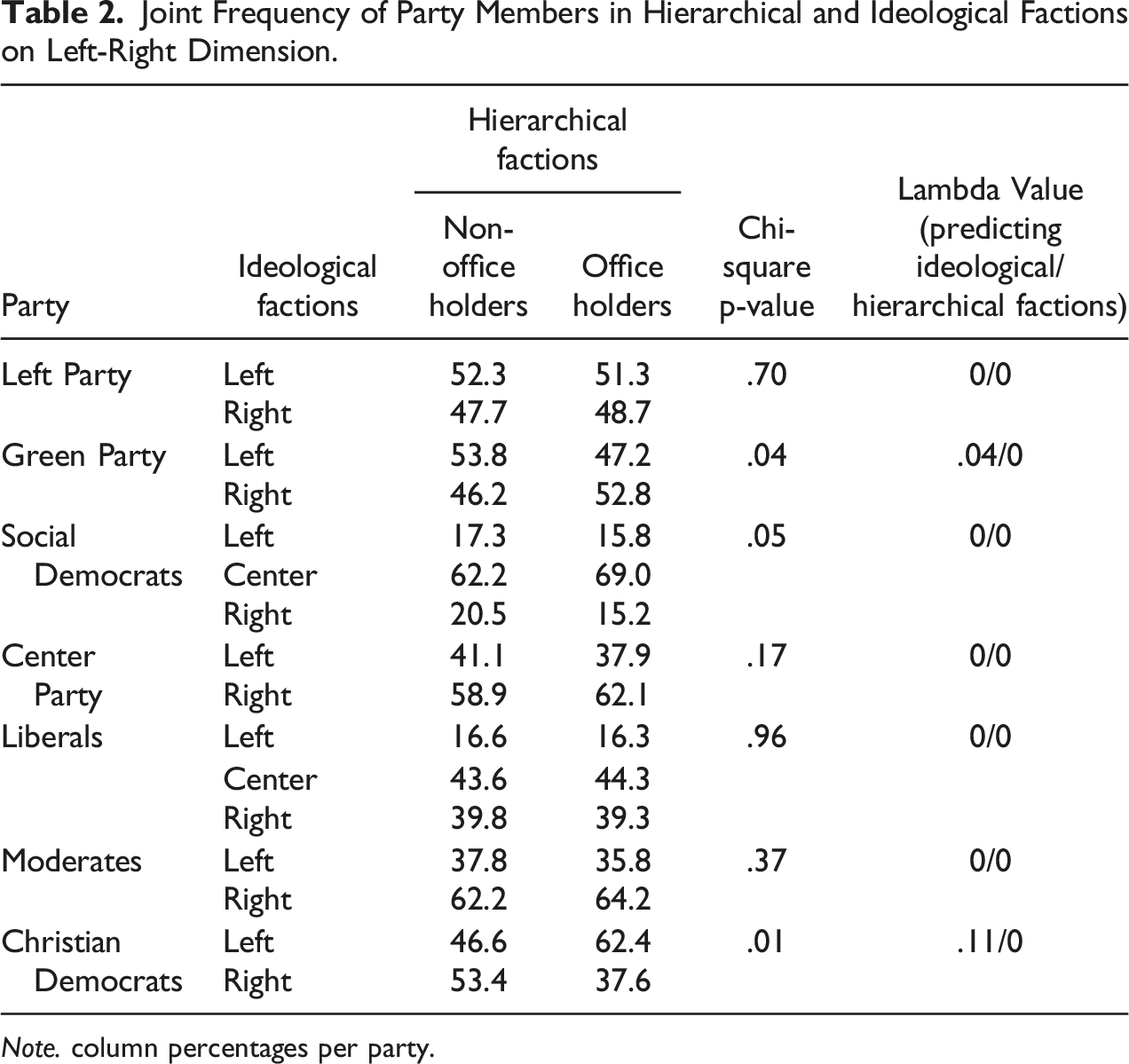
Joint Frequency of Party Members in Hierarchical and Ideological Factions on Left-Right Dimension.
Note. column percentages per party.
The results show that hierarchical and ideological factions on the left-right dimension are systematically related in some parties (Green Party and Christian Democrats) while not in most (Social Democrats, Moderates, Left Party, Liberals, and Center Party). Or put differently, there is a systematic difference to which ideological faction those living from politics (office holders) belong compared to those living for politics (non-office-holding members) within the Green Party and Christian Democrats. For example, office holders within the Green Party appear to be systematically more represented in the right faction (52.8% compared to 46.2% of non-office holders) and the left faction (see Table 2). Within the Greens, non-office holders are more often represented in the more ideologically extreme faction than office holders. A similar pattern can be observed within the Christian Democrats, but on the other side of the ideological spectrum. Office holders tend to be more represented in the party’s left faction and less represented in the party’s right faction. According to the lambda values, these associations are, however, very weak. When belonging to hierarchical factions is used to predict belonging to ideological factions, there is only a 4% (Green Party) and 11% (Christian Democrats) reduction in errors. As for the other parties, there is no systematic pattern between hierarchical and ideological factions on the left-right dimension, indicating that the two lines of conflict do not coincide.
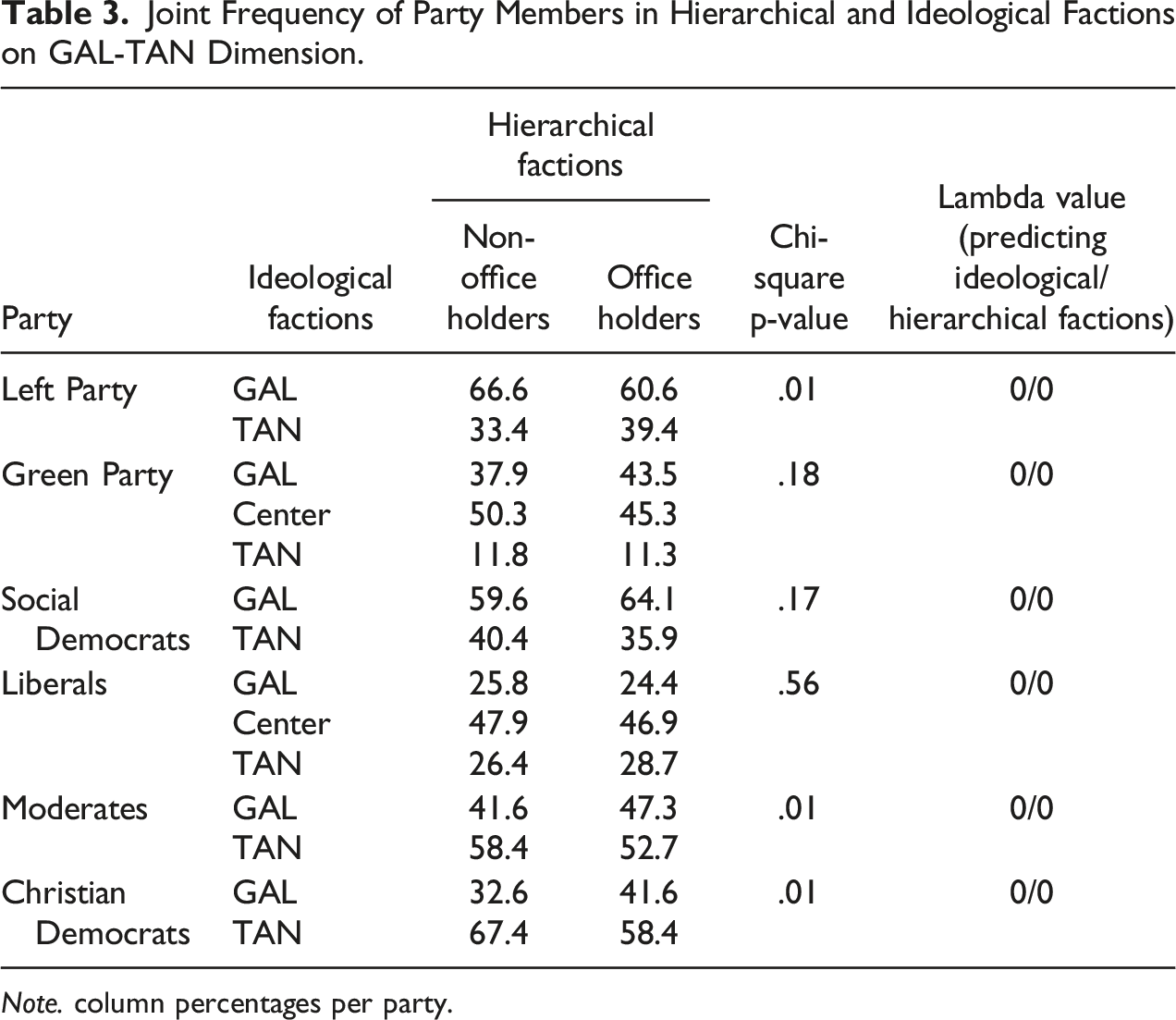
Joint Frequency of Party Members in Hierarchical and Ideological Factions on GAL-TAN Dimension.
Note. column percentages per party.
Conclusion
In this article, we contribute to the intra-party politics literature theoretically, methodologically, as well as empirically. Theoretically, we argue for a conceptualization of hierarchical factions that is similar to ideological factions because both further their joint interests through collective action within the party. This commonality allowed us to define the contours of intra-party factions in European parties under a common theoretical framework that incorporates several important literatures on intra-party politics. Based on spatial and party change theory, we expected to find at least two ideological factions in each of the parties, per ideological dimension, and we also suggested that those ideological factions may not coincide with hierarchical factions. Our methodological novelty is to apply an inductive research strategy to quantitative and qualitative data, which allowed us to arrive at a broad in scope, but detailed and nuanced picture of factional structures. Although the triangulation of the results proved to be valuable in this case, it deserves stressing that the final structure after triangulation was identical to the initial structure for ten out of 14 possible ideological factional structures (2 ideological dimensions times 7 parties). This suggests that the cluster analysis approach using hierarchical linkage methods picked up ideological faction well in this instance; only for the Liberals the qualitative material was systematically needed.
Empirically, this article contributes by providing the most comprehensive and detailed account of factions within parties of the same context with three main results. First, our findings somewhat corroborate extant assumptions because we found that most parties host two factions on the left-right dimension and many also host two factions on the cultural dimension. At the same time, our results also deviate from this regularly, pointing at heterogeneity in factional structures and more generally at multidimensionality in factional structures. Second, our estimates of the relative positions and sizes of parties’ factions indicate substantial variation between parties. Factional conflict is likely harsher for parties on the GAL-TAN than on the left-right dimension because factions on the GAL-TAN dimension are typically further apart from one another, while being similarly large. Third, we also showed that ideological factions are largely independent of hierarchical factions. Whenever there is a systematic relationship, it is small and tends to be that members living from politics are disproportionality represented in the moderate faction of a party.
Moving beyond the Swedish case, our results have larger implications for similar countries. If ideological factions are present even in a party system with eight parliamentary parties that together span nearly the full range of the left-right dimension, ideological factions should be even more likely to exist in party systems with fewer parties because this induces ideological diversity within parties. What is more, the increased instability and weakness of governments in Sweden, brought about by increases in party system fragmentation, the electoral rise of the far-right, and a multidimensional political environment, are trends that exist across Europe and usually have been present in these other countries before Sweden. There is thus much in our article that travels across the continent.
Our findings provide new details about factional structures within parties to be explored in future research, not least the need for more dynamic analyses spanning longer periods of time and theorization of when intra-party divisions can have desirable qualities for a party. For example, although many politicians we interviewed seemed intent to play down intra-party disagreement, several others eagerly indicated that “I do not see it as negative but it is like the strength of the party that there are different entrances” (M2R).
Our findings also have larger implications for research in comparative politics, more generally. First, they challenge common assumptions about the existence and number of factions across parties, and they give scholars first but concrete evidence to further theorize and analyze internal struggles over personnel, programs, or individual policy decisions. Our results suggest complexity in intra-party coalition-building; not only do sizable factions exist on both ideological dimensions, but they also usually do not coincide with hierarchical divisions within these parties. This complexity in factional structures invites anew future work that re-examines the relationships between factional belonging and the tension between various party goals (Kitschelt, 1989; cf. May, 1973; Strøm, 1990). Another productive and important avenue for additional research is to understand the dynamics of intra-party competition in an era of personalization of politics and increasing clout of party leaders (Lobo & Curtice, 2015). We think, especially the combination of the estimated number, structure, size of a faction, relative positions, and relationships with hierarchical factions provide researchers with new insights about the dynamics of intra-party politics. It may spur new and more precise theories about the origins and effects of factional structures on party positions, coalition-formation, legislative behavior, voters’ evaluations of parties, and political representation.
Second, we depart from existing conceptions of intra-organizational politics, which have focused on individuals or the structures governing them. One example of this is the large literature on party membership decline and parties’ organizational responses (e.g., Kölln, 2015; Scarrow, 2015; van Biezen et al., 2012). In contrast, our approach turns to group-based aspects where the (sub-)collective gains center stage over individuals. This widens the conceptual reach of intra-organizational dynamics, which is also important for comparative research in other areas.
Third, with the help of our novel approach, using a mix of data sources and methods as well as an inductive empirical strategy, we were able to enter the black box of intra-party politics. Researchers may find inspiration in this approach and apply it in other difficult-to-research topics in comparative politics, such as studies of large-scale social movements or analyses of interest groups.
Supplemental Material
Supplemental Material - Structuring Intra-Party Politics: A Mixed-Method Study of Ideological and Hierarchical Factions in Parties
Supplemental Material for Structuring Intra-Party Politics: A Mixed-Method Study of Ideological and Hierarchical Factions in Parties by Ann-Kristin Kölln and Jonathan Polk in Comparative Political Studies
Footnotes
Acknowledgments
“Earlier versions of this article were presented at Midwest Political Science Association in Chicago and American Political Science Association in Washington, DC, in 2019, at the Nordic Political Science Association in 2021, and at research seminars at Lund University in 2021 and Stockholm University in 2022. We thank all discussants, participants, and numerous colleagues for comments on earlier versions of this article, and we are especially grateful to Elin Alfredsson Malmros for excellent research assistance on the qualitative parts of the article.”
Declaration of Conflicting Interests
The author(s) declared no potential conflicts of interest with respect to the research, authorship, and/or publication of this article.
Funding
The author(s) disclosed receipt of the following financial support for the research, authorship, and/or publication of this article: This work was supported by Vetenskapsrådet (2016-01810).

Data Availability Statement
The data that support the findings of this study are available from the corresponding author, upon reasonable request (Kölln & Polk, 2023).
Supplemental Material
Supplemental material for this article is available online.
Notes
Author Biographies
References
Supplementary Material
Please find the following supplemental material available below.
For Open Access articles published under a Creative Commons License, all supplemental material carries the same license as the article it is associated with.
For non-Open Access articles published, all supplemental material carries a non-exclusive license, and permission requests for re-use of supplemental material or any part of supplemental material shall be sent directly to the copyright owner as specified in the copyright notice associated with the article.
