




Abstract
Political scientists confront serious ethical dilemmas when deciding whether and how to compensate research participants, without clear disciplinary guidelines or shared norms. Our paper presents a systematic framework for developing and refining compensation plans and contributes to the political methodology and research ethics literature. The analysis draws on published methodological and empirical research across subfields, and the authors’ original data collection in a range of political regimes across urban and rural contexts in the Global North and Global South. We argue that researchers must confront seven types of compensation decisions, and we detail specific criteria that should guide their choices. We highlight the wide range of monetary and non-monetary compensation options available to researchers and offer strategies to navigate complex ethical dilemmas. Our findings demonstrate the value of contextual knowledge and relationships when creating and updating compensation plans and offer researchers a rigorous framework to guide difficult ethical compensation choices.
Introduction
Political scientists often provide compensation to research participants. This compensation varies widely – from money to food to gifts to other non-material forms of gratitude. However, compensation decisions are never straightforward. They are frequently made in the moment and with deep uncertainty over their appropriateness or their effects on the research process. For both authors, the complexities and uncertainties of compensation decisions presented ethical and logistical challenges that we continue to grapple with in our work. For example, after providing focus group participants from a low-income neighborhood a small envelope of cash for “T&T” (time and transportation) and a snack, one author’s research team debated yet again whether it was fair to give the next focus group participants, this time from a middle-income neighborhood, a larger envelope of cash and a fancier hot lunch. In another research project in suburban Seattle, after a long day of note-taking and informal conversations as a participant observer at a stakeholder consultation meeting, one author deliberated whether it would be acceptable to invite a federal government official to dinner as a gesture of gratitude. In each of these instances, the author struggled with how to respond – was compensation ethically appropriate?
Discussions about compensation within the political science literature remain peripheral, even within the literature on fieldwork. Despite recognition in the discipline that reflexivity is key to maintaining our ethical commitments in working with human participants, issues of compensation have largely been sidelined or siloed (Kapiszewski & Wood, 2022; MacLean et al., 2023; Thomson, 2021). Notwithstanding significant attention paid to positionality within the interpretive literature (Fujii, 2017; Mwambari, 2019; Schatz 2009; Soedirgo & Glas, 2020; Yanow & Schwartz-Shea, 2014) and interviewer effects within the positivist literature (Adida et al., 2016; Davis, 1997; Dionne, 2014), compensation is rarely addressed in these texts. Even the field research literature (Kapiszewski et al., 2015; Morton & Williams, 2010; Sriram et al., 2009), including the growing literature on the ethical challenges of field research (Cronin-Furman & Lake, 2018; Davis & Wilfahrt, 2023; Kaplan et al., 2020), often considers compensation only in passing. Furthermore, when compensation is addressed, the literature contains competing claims about whether to compensate and how commonplace these practices are in social science research (Head, 2009). While an emerging literature on ‘giving back’ highlights the overarching moral imperative of reciprocity in research (Field & Johar, 2021; Lederach, 2016; Russell, 2024), there is limited guidance for researchers on how to manage compensation decisions and address challenges as they arise.
This paper explores the ethical dilemmas raised by such compensation decisions by asking whether and how research participants and interlocutors should be compensated for taking part in political science research. In doing so we offer an important contribution to the growing literature on research ethics and working with human participants within political science. First, rooted in our own fieldwork experiences in a wide range of research contexts and with a diverse group of participants, 1 we explore how both compensation and non-compensation of research participants and interlocutors present a knotty set of ethical dilemmas related to the Belmont principles of beneficence, justice, and respect for persons. 2 We contend that scholars should expand their working definition of compensation to include not only short-term material benefits but long-term reciprocity with research communities. Taking this broader view of compensation, we further encourage scholars to view compensation as an important cornerstone of creating respectful and mutually beneficial research relationships with study participants. 3 Second, we offer a framework that guides critical thinking about how to make contextually appropriate compensation decisions throughout the research process. Given that compensation decisions are shaped by multiple factors - including the political and economic context of each fieldsite or target population, 4 the identities and roles of the researchers and research participants, and the type of research interactions involved – the framework does not offer a one-size-fits-all solution to compensation decisions. Rather, it is designed to guide scholars through the process of making ethical compensation decisions that are appropriate for their particular research design and context. As Russell (2024, p. 172) argues, “to engage in fieldwork is to enter into a shifting ethical labyrinth.” Throughout the paper, our goal is to bring conversations about compensation into the mainstream of political science research and ensure that scholars have the tools to make systematic, contextualized and ethical decisions about compensation, rather than ad-hoc ones. In doing so we hope to remove some of the ambiguity from compensation decisions, while acknowledging that this paper is a starting point for these broader conversations.
Minimalist Compensation Guidelines Within the Discipline of Political Science
Compensation guidance in political science is limited, and where conversations about compensation have emerged, they are often siloed within subfields such as comparative politics, peace research, or security studies where discussions about fieldwork ethics are particularly salient (Campbell, 2017; Field & Johar, 2021; Lederach, 2016; Munck & Snyder, 2007). Even if the ethics of compensation are keenly relevant for scholars who traditionally engage in extensive face-to-face field research in politically unsettled contexts around the world, these issues are also important for scholars in all subfields of the discipline conducting both in-person and digital data collection.
While researchers must justify compensation decisions to Institutional Review Boards (IRB), there is no single set of clear compensation guidelines, but rather a broad recognition that compensation decisions should not violate the Belmont Principles in the U.S., 5 or national guidelines in either the researcher’s institutional home country or country of research. Thus, while U.S. federal guidelines stipulate that compensation should be “just and fair” 6 there is little agreement about what this means across diverse contexts. Rather, compensation decisions are often viewed as highly contextual – dependent on the research site, the participants, and the type of research methods used. Scholars are usually required to describe any compensation given to study participants during the relevant IRB process, but this often involves only a brief conversation or ready approval by a campus administrator outside of the discipline. Meanwhile, while the overarching principles and ethics are similar, the guidance from the literature on bioethics, public health and medical research often differs given the distinctive issues and dynamics faced by different disciplines. Thus, while there is a broad mandate that compensation should, at minimum, do no harm, and a growing commitment to reciprocity amongst some circles (Russell, 2024), there is as Campbell (2017, p. 98) succinctly states, “no agreement in the literature as to how researchers can or should give back to their research subjects.”
What this means in practice is that most political science researchers tend to make compensation decisions with minimal and inconsistent guidance. This lack of consensus on compensation is revealed in the wide variety of compensation practices even in large-scale surveys in political science. None of the large-scale regional “Barometer” surveys explicitly describe their compensation practices, and according to Afrobarometer project leaders, Afrobarometer does not compensate anyone for face-to-face surveys. 7 In contrast, other longstanding surveys such as the American National Election Study or General Social Survey provide a small ($5-$10) pre-paid incentive to begin, and then a larger compensation amount to complete an interview, which can range from $25-50. Crowdsourced participants in online surveys for Amazon Mechanical Turk or Qualtrics platforms typically receive a smaller payment for completing a survey (often less than $10), but the exact amount is determined by the individual researcher. 8
Meanwhile, scholars who conduct original face-to-face fieldwork confront highly variable research contexts in terms of sites, participants, methods, and accepted norms. These researchers often reevaluate their compensation plans in the field under intense professional, physical, and emotional pressures. While the growing literature on fieldwork ethics and ‘giving back’ have highlighted the centrality of compensation decisions to the ethical conduct of fieldwork across diverse contexts and some of the potential ethical dilemmas posed by compensation (Cronin-Furman & Lake, 2018; Field & Johar, 2021; Russell, 2024), there remains a dearth of clear guidelines about how to navigate those ethical challenges. This lack of transparency is compounded by the fact that political scientists rarely make public their compensation decisions, and so opportunities to learn from others’ compensation decisions are limited. As a result, scholars may make imperfect decisions, with a wide range of downstream implications for their research participants, the communities, and populations with whom they conduct research, the integrity of their project, as well as future researchers operating in the same contexts.
The lack of guidance on issues of compensation is reinforced from a review of both disciplinary guidelines and the existing literature in political science research methods. First, the American Political Science Association (APSA) does not provide explicit guidelines on disciplinary norms for compensation. Relatively recently, APSA did spotlight the importance of research ethics when working with human participants by establishing the Ad Hoc Committee on Human Subjects in 2017 to review the APSA Guide to Professional Ethics, Rights, and Freedoms, Section H (on the Protection of Human Subjects). The APSA Council then approved and adopted the “Principles and Guidance for Human Subjects Research” in April 2020. 9 This document importantly highlights how power differentials can adversely affect the voluntariness of consent, and the idea that researchers should not employ coercion or undue influence to obtain consent. Still, no guidance is offered on the issue of compensation for human subjects.
Within the empirical and methodological literature in political science, discussions of compensation tend to be relegated to the margins – a few lines or a single paragraph amidst discussions of larger methodological debates. In empirical studies, compensation may be described minimally as incentives for participation in a study rather than an integral part of the informed consent process and research ethics for the project. The methodological literature tends to agree that compensation raises knotty ethical dilemmas and problems for researchers. The literature on fieldwork in violent and conflict-affected contexts recognizes that compensation decisions are an integral component of ethical fieldwork (Cronin-Furman & Lake, 2018; Field & Johar, 2021; Lederach, 2016) and the literature on ‘giving back’ highlights that compensation entails sustained reciprocal engagement with research communities as part of a commitment to the principle of beneficence (Knott, 2019; Russell, 2024). Yet, while these literatures underscore some of the complexities of compensation and ‘giving back’ they rarely provide a framework for navigating those challenges. Four key issues are highlighted in the literature.
First, the literature emphasizes how compensation can exacerbate existing power inequalities between the researcher and the participants and lead to negative outcomes. As MacLean (2013, p. 75) argues “compensation is one of the most obvious ways that researchers have more power than their subjects and may create more inequalities through their actions.” Russell (2024, p. 173) argues that ‘giving back’ to research communities is driven by three interrelated factors: a need to offer something in exchange for the information provided by interlocutors, an ideological commitment to transformative research, and a “concern with avoiding engendering or exacerbating hierarchies, exploitation and situations of poverty or distress.” The literature cautions scholars that the possibility of compensation or the amount of compensation should never be used to compel or induce participation. In a chapter focused on interview research and the IRB, Brooks (2013, p. 66) briefly points out that compensation should never be contingent on participation, and compensation levels should be “reasonable enough not to be viewed as coercive.” Phillips (2011, p. 243) agrees that excessively large compensation could result in “undue inducement” but also highlights concerns that excessively small payments might exploit participants. She argues for a “living wage” payment model: the lowest possible payment, which neither induces participation, nor exploits human subjects (Phillips, 2011, p. 209 and 250-1). Atwell and Nathan (2022, p. 703) explain how they provided study participants in a rural community with “an amount that would fairly compensate for the interview time relative to local wages…but also not coerce participation.” Of course, vulnerability is not limited to economic status but may also include other types of social and political vulnerability. In a recent piece focused on audit studies, Butler and Desposato (2022, p. 203) make a novel argument that scholars conducting audit studies 10 should be required to pay compensation in time or money to communities to offset the potential harms of such studies and force scholars to “self monitor” when making decisions about the scope and size of such studies. Moreover, relational power dynamics are immensely nuanced and complex. Power differentials between the researcher and respondent may be minimal or, particularly in the context of elite interactions, the researcher may be in a position of less power, influence or resources than their participants. As Glas (2021, p. 440) highlights, in the context of elite interviews the interviewer is often assumed to be “relatively powerless within interactions.” Compensation and reciprocity are contingent “on the economic or social power of the group studied in relation to the researcher” (Adams, 1998, p. 228). Ultimately, attention to potential inequalities within a fieldsite demands reflexivity on the part of the researcher (Soedirgo & Glas, 2020) and awareness of how reciprocity might alter or emphasize asymmetries in power (Adams, 1998).
A second issue raised in the literature is the equality of compensation across participants in a single study. The expansion of experimental studies that randomize monetary compensation or other benefit has led to an increasing recognition that inequities in compensation among participants can create conflict within communities. 11 For example, experiments may offer a “chance” at winning cash, a gift card, or a subscription to Netflix (Finkel et al., 2024). Davis (2020), in her discussion of the challenges of field experiments, argues that the random selection of study participants who receive compensation can exacerbate local tensions, thus potentially “thwarting randomization” and undermining the field experiment (464). Similarly, Dionne et al. (2016, p. 29) found that experimental studies that provided differential cash awards through a lottery drawing “created discord in the community” and ultimately generated angry mistrust of the researchers, making it difficult to find willing study participants. Rumors even began to circulate in the fieldsites that the researchers belonged to a Satanic group, and some residents threatened violence to the team (Dionne et al., 2016, pp. 31–33). In her critical analysis of the downstream consequences and ethical challenges associated with information experiments, Seim (2016, 189–91) contends that researchers must conduct an expansive and nuanced cost-benefit analysis, guided by the Belmont principles, even including non-participants affected by the research. Despite these concerns, Desposato concludes in his book on field experiments that researchers should always compensate their subjects. He argues that paying subjects for their time shows them respect and acknowledges the value of their time (Desposato, 2016, p. 283). Scholars conducting field experiments thus frequently offer some form of monetary or in-kind compensation, such as mobile phone vouchers (see Adida et al., 2019; Arriola et al., 2022; Xu & Cao, 2022).
Third, the literature has also highlighted that compensation can take diverse forms and should not be limited to cash and in-kind payments to individuals. Some scholars have shared publicly available but hard-to-access information about relevant services and programs available to them (MacLean, 2013), others have donated to community projects in lieu of individual compensation (Gottlieb & Graham, 1994), while others have provided training or engaged in community advocacy (Field & Johar, 2021; Russell, 2024). Scholars have also seen the dissemination of research results as an integral part of compensation, particularly when “research findings are accessible and useful for research participants as well as communities most impacted by the research findings” (Lederach, 2016, p. 117). However, the hopes that “sharing stories” might have a broader impact are often overstated (Cronin-Furman & Lake, 2018, p. 609), as are the claims researchers make about policy impact and relevance (Gleditsch, 2023). Goduka (1990) and Fujii (2012) both emphasize that even when participants understood that there was no cash payment, they nevertheless maintained expectations of gaining benefits from developing a relationship with the researcher. Fujii (2012, p. 719) points out that this dynamic is especially pronounced in extremely poor and marginalized communities where the researcher is seen as a powerful broker of expertise, contacts, jobs, and support. In her book on interviewing, Fujii (2017, pp. 51, 95) explores the difficult conversations she had with prisoners who had already been interviewed in 2004 for her first book and who were asking for her to give something back in return before they spoke to her again. She describes how one man made a distinction between payment, which he understood was not involved, and reciprocity or assistance, which he felt was overdue. This raises the important issue of non-monetary compensation and how this can sometimes take the form of long-term generalized reciprocity, where boundaries of professional and personal are blurred. The rise of social media has also facilitated ongoing contact with interlocutors and participants, highlighting our ongoing ethical obligations to research communities as researchers (Knott, 2019). The ethnographic literature has also highlighted the challenges of navigating mutual understandings of compensation as relationships deepen over time (Fujii, 2017; Schatz 2009; Wolf, 1996).
Fourth, and relatedly, the literature highlights the importance of and difficulties of informed consent about the potential risks and benefits of participating in research. While informed consent is an important pillar of ethical engagement, efforts at informed consent can often be undermined by widespread assumptions within field sites that research may result in downstream benefits even if the benefits of the research are clearly outlined and reiterated from the start. Cronin-Furman and Lake (2018, p. 609) highlight how in fragile contexts researchers are often associated with “aid agencies and service providers” which often engenders speculation that deferred compensation or assistance may be possible. They further emphasize that respondents often hoped that participating in research would result in future support even though the audiences for academic work are most often narrow. Researchers’ efforts to communicate the realities and limits of compensation and the low likelihood of future support were, particularly in low-income and fragile contexts, insufficient to dissuade respondents of their hope for ongoing or future support, including requests for “money to feed and clothe their children, assistance seeking visas or refugee status, and help obtaining medical care” (Cronin-Furman & Lake, 2018, p. 609). In fragile contexts, the potentially extractive nature of research and the difficulties of ensuring truly informed consent may be particularly acute given the moral complexities of conducting research conflict-affected and low-income contexts.
These ongoing debates and controversies in the literature highlight how many political scientists continue to struggle with thorny compensation dilemmas. A disciplinary discussion is long overdue. Our goal in the next section is to provide researchers with a framework that guides reflexive thinking about whether and how to compensate study participants as they design and carry out their research.
A Framework for Navigating the Ethical Dilemmas Posed by Compensation
Drawing on the existing disciplinary guidelines, scholarly literature, and our own research experiences, this section introduces a framework for navigating the complex ethical dilemmas posed by compensation. We begin by emphasizing that every scholar’s first and primary obligation is to protect the participants affected by their study (MacLean et al., 2023). Compensation decisions should be made based on scholars’ ethical commitments, rather than financial capacity, expediency or other criteria. Scholars typically agree that the three Belmont principles of respect, beneficence, and justice provide the foundation for ethical practice. The problem is putting these general principles into action. 12
The following framework is designed as a tool to guide scholars through the process of making ethical compensation decisions. It does not provide scholars with clear-cut answers about the type or amount of compensation they should take in specific circumstances, but it does provide them with a tool to consult while making those decisions. Given the diversity of epistemological and methodological approaches in political science, scholars are likely to make different compensation decisions even when conducting similar research across similar contexts. Our goal is not to guide them towards the same compensation practices but rather highlight the wide range of compensation options available to them, how they should reflexively build compensation into their research design and emphasize the ethical commitments they have to their research participants. Thus, while scholars undertaking their own survey and those engaged in participant observation may make different choices when it comes to compensation, this framework can usefully guide scholars employing a wide range of epistemological and methodological approaches to make ethical compensation decisions. Importantly, the framework is relevant for all political scientists involved in research with human subjects, regardless of whether they are engaged in in-person fieldwork or online research. The subsequent section highlights seven key compensation decisions scholars must make when integrating compensation into their research design: the type, amount, participant awareness, variability, timing and duration, inclusiveness, and transparency of compensation. We then outline five key criteria that influence researchers’ decision-making process, including the role of the participants within the fieldsite; participation costs, including time and convenience; direct expenses associated with participation; history of compensation in the fieldsite; and local rules and norms of reciprocity. Finally, we address common compensation dilemmas faced by researchers, and potential solutions to those dilemmas.
Seven Compensation Decisions to Consider
Unpacking the Seven Compensation Decisions.
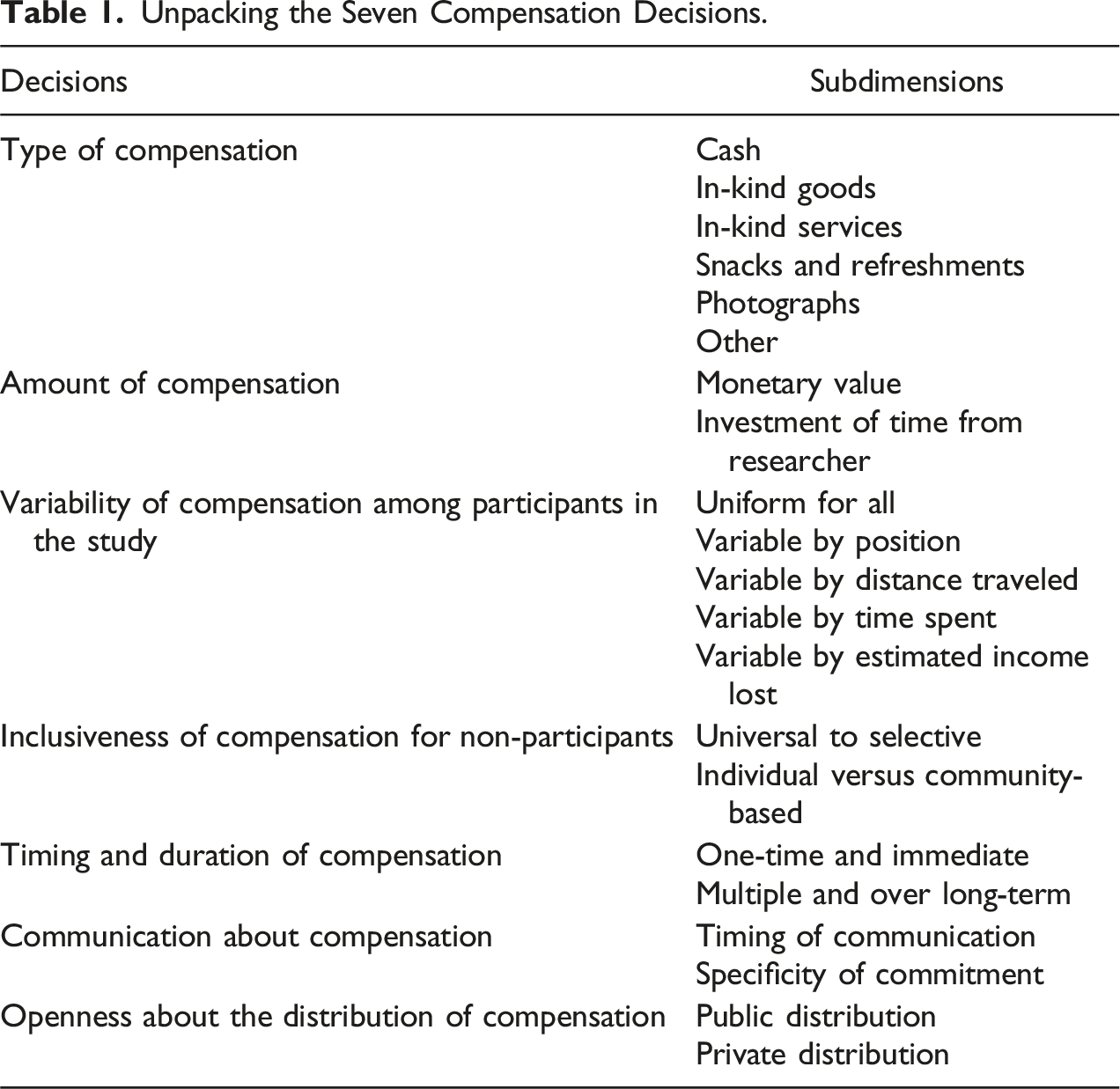
The first decision is the type of compensation. Researchers need to determine whether participants should be given cash or a cash equivalent (i.e., gift card or mobile phone credit, etc.), in-kind gifts (i.e., university swag such as pens, stickers, key rings, water bottles, t-shirts or chargers, small luxuries such as a bottle of alcohol, candy, or chocolate, or a book, etc.), in-kind services (i.e., translation, grant-writing, research, archiving, mentoring, contacts and referrals, sharing of research results in a variety of formats (e.g., full or partial datasets, data analysis, working papers, articles, books, executive summaries, short text or video summaries to post on social media, cartoons, etc.), snacks and refreshments, photographs, or some other small thank you. For example, scholars conducting elite interviews may choose to pay for coffee if the interview is held outside the office, or they may choose to engage in long-term reciprocity through the sharing of research publications. On the other hand, participants who are extremely marginalized or living in conflict zones may have such basic livelihood needs that any non-monetary compensation seems completely out of touch with the reality on the ground (Kapiszewski et al., 2015). Relatedly, in the past, scholars were often inclined to give in-kind compensation of basic staples such as sugar, flour or soap in marginalized communities. However, cash or cash equivalents are now used more frequently as they offer participants greater agency, dignity, and control over decision-making (Blattman & Niehaus, 2014; Standing, 2008). Moreover, cash is often easier and less expensive to deliver and, given the rise in mobile money platforms, easier to distribute when using virtual methods, such as phone surveys, online focus groups or virtual interviews. While in-kind transfers may be preferable in certain contexts, including fragile or conflict-affected areas where local food supplies may be limited or unavailable, cash can be empowering for recipients. 13
Examples of Non-monetary Compensation.
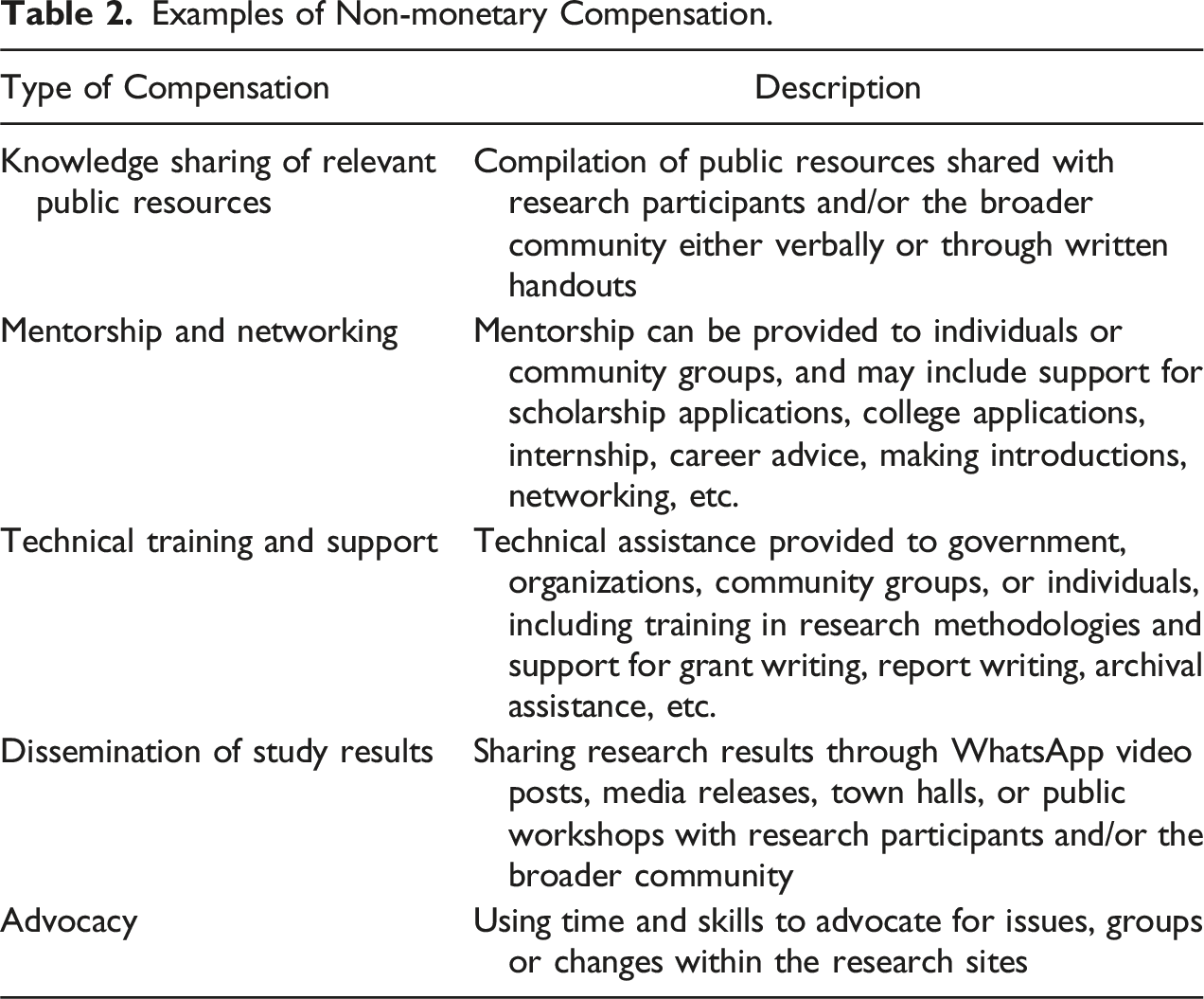
Furthermore, while many research projects within political science claim to generate policy-relevant knowledge which could have positive impacts for local communities these benefits are, at best, very diffuse and hard to track. Gleditsch (2023) argues that researchers who want to engage in policy-relevant research are best situated to offer description rather than prescription. However, there are steps scholars can take to increase the likelihood that their research is seen by and relevant both to their research communities and to policymakers: holding dissemination seminars both in fieldsites and for relevant decision-makers, writing policy briefs, short reports, or brief WhatsApp video summaries that are made available to fieldsites and relevant officials, organizing presentations with relevant policy actors and practitioners, giving interviews to local journalists, providing copies of written outputs (articles, books, reports), etc. (see Michelitch, 2018; Morse, 2024). For example, Porisky held local dissemination workshops in the communities where she conducted research in Tanzania and Kenya during which she provided a two-page report, in both English and Swahili, which provided preliminary research findings, including descriptive data detailing citizens’ views on local community development issues. The report was also provided to local government officials. Five years after the research had concluded, Porisky’s former research assistant, Kennedy Miduda, wrote to explain that he had recently run into one of the local government officials who explained that there had been recent improvements in the cash transfer programs. Miduda wrote that “[the government official] credited [some of] these improvements to the research and report you did. He said he knew it was your report because the facilitator at a training program they undertook in preparation for the new [program] changes cited a report and quotes in the preliminary report you made and presented to them…when we completed research work.“ 14 However, researchers need to be cognizant that once they publish their research they can lose control over the narratives and its impacts (Fujii, 2012; Knott, 2019). While researchers cannot predict the downstream effects of their work, they need to be continually aware of their ethical obligations to their research communities as they navigate dissemination.
Importantly, monetary and non-monetary compensation are not mutually exclusive, and scholars should consider the wide range of complementary compensation options available (see Table 2). For example, a scholar conducting a survey may choose to compensate individual survey respondents using cash or in-kind goods and hold dissemination seminars for the broader community, while a scholar conducting long-term ethnographic observation may choose to engage in generalized reciprocity through grant-writing, mentorship, knowledge-sharing and/or engagement with community projects rather than direct monetary compensation.
The second decision is the amount of compensation to be given. Depending on the type of compensation, this may be a monetary value or may involve the amount of time invested by the researcher. As outlined further in the next section, when making decisions about the amount of monetary compensation to provide, scholars should consider the history of compensation within the fieldsite which requires, at minimum, consultation with local interlocutors such as community leaders, research assistants, survey enumerators and community members. Some government agencies or private sector firms have clear policies about the maximum amount for any allowable gift. If there is a well-established norm of compensation within the fieldsite or among the target participant population, researchers should strive to adhere to that norm and provide compensation that is in line with local expectations. As discussed further in Table 4, compensation that exceeds local norms risks undermining the work of local organizations and researchers that may offer lower compensation, while compensation that does not meet local norms may be unfair to participants and pose risks to the integrity of the research (Dionne et al., 2016). Similarly, decisions about non-monetary forms of compensation should be made in consultation with local communities where the research is being conducted to ensure that they align with community needs and adhere to local norms of reciprocity.
Important here is that compensation decisions can have reverberating impacts for future researchers. Researchers working for well-endowed organizations or universities should be thoughtful about balancing their ethical obligations to their research respondents and the resounding implications of their compensation decisions for other organizations and researchers working in the area. For example, when Porisky consulted community leaders about compensation while conducting research in Tanzania and Kenya, they frequently raised concerns that monetary compensation would impact research participants’ willingness to attend community meetings without compensation. This concern was compounded by certain NGOs in the area paying per diems for participation in meetings and workshops. High levels of compensation can hinder the work of local community organizations or local researchers by altering expectations of compensation in the future. In such cases, when making compensation decisions, there is a need to weigh both the local norms of compensation but also ensure that research does not contribute to a system that consistently undervalues participants’ time.
The third decision is the variability of the compensation among participants in the study. The researcher must decide whether every participant in the study will receive uniform compensation or whether there are legitimate differences among participants that should be recognized with variable levels of compensation. There are several salient differences that may influence this decision. Scholars may offer variable compensation for elite and non-elite interviews. For instance, a scholar conducting both elite and non-elite interviews may decide to offer public officials a small token of gratitude, such as a pen or folder embossed with their institution’s logo, or share research results, while at the same time opting to provide monetary compensation to all non-elite interview respondents. In other instances, some participants may have traveled a longer distance and incurred significantly greater costs to participate than others. The time spent with respondents may also vary significantly. For example, participation in an open-ended interview may take more time than participation in a short survey. More contentious is whether to give more compensation to higher-income participants because of the greater opportunity costs faced when investing their time. For example, participants who were middle or upper-class and took time off from high-paying jobs might be given a slightly larger cash payment or fancier refreshments to participate in a focus group than participants who were subsistence farmers in a remote, rural area. When faced with situations where elite actors – and, in particular, public officials – may expect compensation from researchers there is a need to be aware of compensation norms and how to address such requests. Compensation should not serve as a ‘bribe’ for political actors or other elites and, in such cases, monetary compensation may not be appropriate. However, paying for a coffee when an interview takes place outside the office, offering a pen, or sharing published research results are all examples of non-monetary compensation that can serve as a token of gratitude for the time an elite actor takes to participate in the research. Nonetheless, as discussed further below, researchers need to be cognizant of the ways in which participation in research can place undue pressures on the limited time and resources of civil servants, NGO workers, and other actors, particularly those working at the local level with limited resources.
The fourth decision concerns the inclusiveness of compensation for non-participants. The researcher should consider whether and how to compensate non-participants or the broader residents of a particular fieldsite community. Broader compensation to the community or a particular pool of non-participants may be particularly salient when conducting research in small, marginalized communities where the entire community is likely aware of the presence of researchers, basic needs are high, and knowledge of compensation is more likely to be publicly shared and thus sow discord. In MacLean’s dissertation project, she took Polaroid photographs of survey respondents and ordinary film photographs of other research participants in the village community. This provided a distinctive gift for the extensive dedication of time given the length of her survey questionnaire but was not that different from what was shared more broadly. Similarly, in Bleck and Michelitch’s field experiment in Mali, they distributed radios to the “treatment group” and flashlights to the “control group” so that everyone in the community gained some benefit from the study (Bleck & Michelitch, 2017). Thus, depending on the study population, scholars must decide whether to compensate individual participants and/or the entire community through contributions to community funds or public services.
The fifth decision is the timing and duration of the compensation. The researcher needs to choose whether to give the compensation in one lump sum or in multiple amounts, and whether they give it immediately or at the end of a longer-term study. These decisions may be impacted by the target of the compensation provided (i.e., to the individual or the entire community), the amount of compensation provided, and the design of the research. One-time compensation may be most appropriate for researchers conducting a single survey round or set of interviews with no expectation of follow-up. On the other end of the spectrum, long-term generalized reciprocity is likely to be most relevant for scholars who plan repeated research interactions with communities over a long period of time. Whether compensation is a one-off payment made to participating individuals, or takes the form of long-term advocacy, training or mentorships, compensation decisions need to be clearly communicated to research communities ahead of time. When making and communicating compensation decisions, researchers should also be cognizant of the ongoing requests for compensation that may be placed on local interlocutors. Study participants may speak more openly and directly to research assistants from the area about their needs due to the perception of cultural affinity, linguistic ability, or geographic proximity. Long after finishing the data collection, research assistants may continue to receive requests for monetary support and rarely do they communicate this to the PI. For example, Porisky employed a research assistant who lives and works in one of the communities where they conducted research. Over the course of four years that research assistant recounted receiving “more than a hundred requests” for monetary support from community members, only a handful of which have been communicated to Porisky. 15
The sixth decision relates to the communication about compensation. The researcher must decide whether to communicate the type and amount of compensation before or after the participant’s involvement in the study. They also need to craft the specificity of that communication, whether they are making a very vague commitment of general reciprocity or laying out concrete details related to the type and amount of compensation provided. Decisions over the timing of the communication may be influenced by the choice of research design, particularly where compensation is an integral part of the research, such as is the case for some field experiments. It may also be influenced by the type of compensation provided. For example, when Porisky provided information sheets about public cash transfer programs and scholarships to interview respondents, she chose to distribute them at the end of the interview to ensure respondents’ responses were not influenced by the information provided. However, when conducting focus group discussions, Porisky clearly communicated the compensation provided to participants – refreshments and a flat fee for transport costs – upfront during the recruitment process. In making these decisions, researchers need to be cognizant of the implications of their decisions for participants’ informed consent. Decisions to withhold information about compensation mean that participants do not have complete information about the study benefits prior to deciding whether to participate and, unless integral to the research design and guided by an IRB, researchers should provide complete information about the form, amount and timing of the compensation. Moreover, compensation should not be contingent on the completion of the research interaction and, as part of the process of informed consent, participants should be made aware that they have the right to refuse to answer questions or stop participating at any point and that the type and amount of compensation will not be impacted by any refusals.
Finally, the seventh decision relates to openness about the distribution of compensation. Compensation could be fully public and open for observation, or it might be handled more privately. Even when tucking cash payments inside white envelopes, researchers could decide to announce the amounts publicly, or for accounting purposes may need to make and give receipts. These decisions may be informed by IRB rules, but also by the inclusivity of compensation and the specific norms around compensation in a particular place or targeted population. For example, in March 2019 in Ghana, MacLean’s research team visited the local chief of a rural community in Northern region immediately upon arriving in the village. After a formal exchange of greetings and discussion of the purpose of the visit, the team presented a small amount of cash in an envelope to the chief to thank him for facilitating the focus group discussions. This was presented publicly so that everyone was aware of the approval and mutual reciprocity between the team and the chief. Then, at the end of the afternoon, the chief insisted that the whole team and many other village residents enjoy fish soup that his wife had prepared. Kelly (2014) similarly reported cooking and sharing food with village chiefs who hosted their research team which was reportedly well-received by the community as it demonstrated “respect for their leaders and their cultures” (5). While the above examples involved traditional authorities in Africa, they invoke dilemmas that are also faced by scholars working in advanced industrialized countries who may similarly be expected to offer gestures of appreciate to respondents (such as buying a respondent a coffee or drink, offering pens and folders inscribed with university logos, etc.). All of these examples reveal the importance of local norms paying respect to relevant leaders, and how appropriate compensation was given in public settings to highlight the transparency and reciprocity of the exchange. In some contexts, national regulatory bodies governing research may dictate whether and how scholars can compensate participants. Disciplinary differences and institutional variation among IRBs will also shape the kinds of compensation that is deemed ethically appropriate.
Criteria for Making Compensation Decisions
Already we can see that compensation requires careful thought and deliberation to make multiple and overlapping decisions, which each carry potentially significant ethical implications for the participants and broader fieldsite communities. The next subsection of the framework below describes the criteria that should be considered when making these compensation decisions.
The first set of criteria that should be considered is the role played by the participant in the fieldsite. Scholars often treat government officials who are consenting to an interview in the scope of their public office differently than an individual citizen who takes time off from their work or care duties to participate in a study. In many political systems, government officials are not allowed to accept monetary compensation for any interactions based on their official role. 16 Similarly, if an individual is a neighborhood or community leader, or a local religious leader in a particular fieldsite they may consider their participation to be a requisite part of their role, rather than an extraordinary duty that should be compensated. Likewise, individuals who are representatives of private sector businesses or non-profit organizations may themselves have strict rules governing whether they are allowed to accept compensation. For example, when conducting elite interviews with officials of local, national, and intergovernmental organizations, etc., most scholars do not offer monetary compensation. 17 However, they may buy the respondent a coffee if they request to meet outside their office and they will engage in longer-term generalized reciprocity, including invitations to public dissemination seminars and sharing of research outputs.
The second set of criteria is the real and opportunity costs of participation in the research. First, researchers should consider the length of time participants invest in the study, as well as the opportunity cost of that time for the individual and the convenience of their participation. For example, a participant who only spends a half hour for an online survey or in-person interview may merit different compensation compared to someone who spent over 2 hours in a focus group. Depending on the context, compensation may be more of a token of appreciation – a small gift card or a cup of tea, for example – than direct compensation for time lost. Moreover, scholars should consciously try to minimize the opportunity costs faced by individual respondents, which may be higher during certain times. For example, civil servants may face higher opportunity costs during certain times of the month when demands on their time are highest, parents with young children may have greater demands for caregiving before and after school, and rural respondents in agrarian communities may face higher opportunity costs on market days and during harvest. Researchers should also consider the direct costs of participating in the research, which may include the costs of travel, hosting, and airtime. If the participant must travel to participate in the research, both the costs of travel as well as the opportunity cost of the travel time should be compensated. If research is being conducted with ordinary citizens in their homes and hosts feel obligated by social norms to offer refreshments to guests, the researchers should consider offering compensation equal to the cost of refreshments and the opportunity costs of the time lost. If a participant didn’t change their routine and agreed to an interview in their own office during work hours, that is different than a participant who had to take three different legs of public transport from a remote community to participate in an interview or focus group discussion. Researchers must consider direct and indirect costs participants face when participating in research – time, travel costs, food, or drinks when hosting – but also the demands that might be made of respondents or interlocutors from the broader community as a result of participation in research.
The third set of criteria to be weighed is the history of compensation in the fieldsite area or target population. It is important to consider whether other research projects have established expectations or norms around the issue of compensation. For example, some urban neighborhoods have been extensively surveyed over the years, and residents have begun to expect gift cards. Similarly, in other areas, international donors, government agencies, or community organizations may have histories of interactions that have generated local expectations about compensation for participation in town hall meetings or stakeholder consultations.
The fourth set of criteria to be evaluated are the contemporary rules and norms of reciprocity in the fieldsites as well as the scholar’s home institution. Compensation should be culturally appropriate for the local political economy and consider the wide-ranging impacts that compensation may have on relationships within the community. Navigating these dynamics will often require consultation with a variety of people in the fieldsite. In some instances, monetary compensation may be culturally inappropriate – for example, Madriz (1998) offered the equivalent of US$10 to focus group participants, however she found that her research participants were not comfortable accepting compensation because it contravened community perceptions of appropriateness. Researchers should also consider the long-term impacts of compensation decisions for research teams and the communities where they conduct research. Compensation should not introduce inequalities into a fieldsite, and researchers need to be cognizant of the ways in which compensation may create tensions or resentments between participants and non-participants within a community. These dynamics were raised during a recent project of MacLean’s where a research team member was reluctant to provide cash compensation to residents of his hometown. They provided prepared food and cold drinks instead to avoid creating bitter resentments and possibly long-term hostilities with extended family members, friends and neighbors that were not selected to participate in the focus groups.
The fifth set of criteria to be considered is researcher positionality and resources. Some researchers, including but not limited to doctoral students, researchers from under resourced institutions and some early career researchers may face significant budgetary constraints which shape their compensation decisions. First and foremost, researchers must center the Belmont principles in their decision-making to ensure ethical engagement with the communities where they conduct research. This may mean reducing, for example, the size of their survey or interview sample to safeguard compensation for participants. However, more than one type of compensation may be appropriate in a given context. Researchers with limited resources for compensation should thus consider the range of non-monetary compensation options available (see Table 2) and whether any is appropriate for their project, participants and the context where they are conducting research. Moreover, when making decisions about the type, duration and inclusivity of compensation researchers must consider their own relationship with the communities where they conduct research.
Systematic and Iterative Process for Making and Updating Compensation Decisions
Guiding Questions for Researchers.
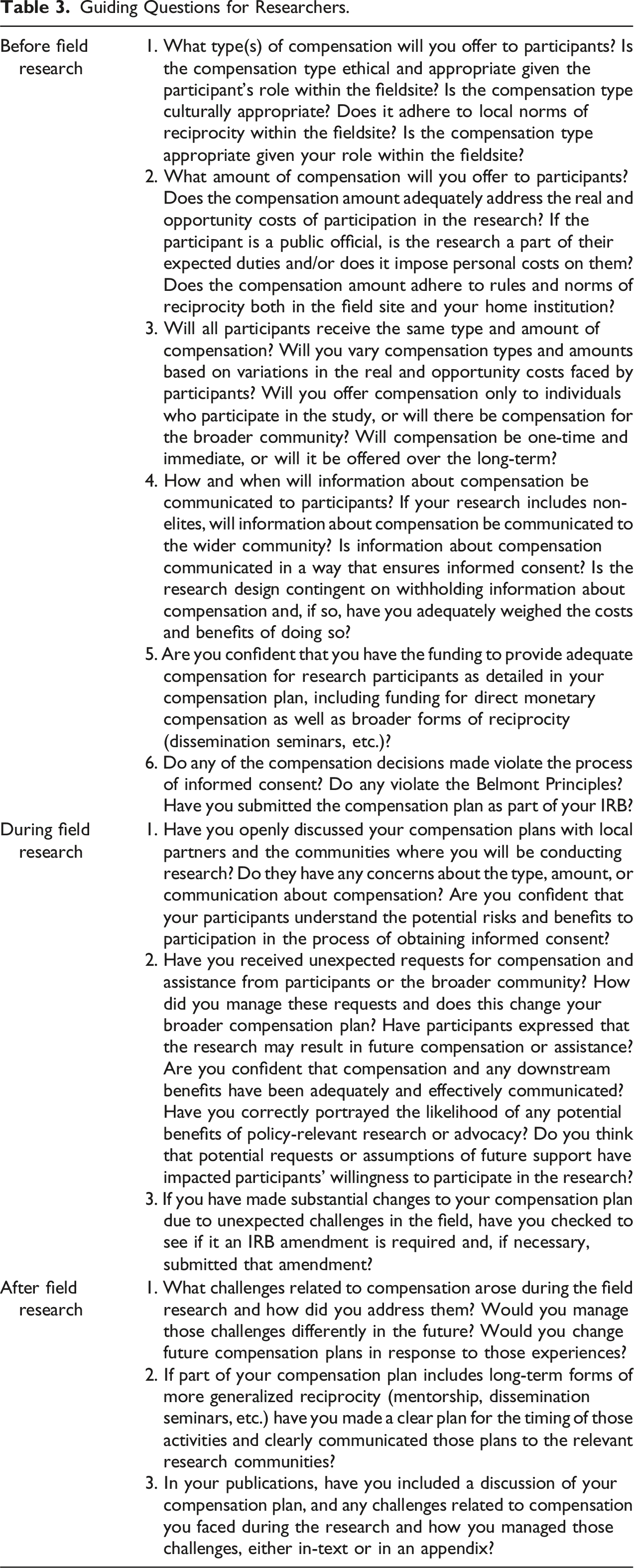
This process of making compensation decisions is systematic and iterative. It should start early but be repeatedly updated as new information or conditions become known (Kapiszewski et al., 2022). The design of compensation decisions certainly does not begin and end with the one-time submission of the compensation plan to the home institution’s IRB. Compensation plans often need to be recalibrated as the project design takes shape and then renegotiated again in the field. For this reason, IRB applications should include a range of potential compensation options, and the ethical logic used to justify a higher or lower level within the locally acceptable range. This kind of systematic approach to mid-stream adjustments, anticipating and building in permissible flexibility, is especially critical for projects that are pre-registered (Kapiszewski et al., 2022).
Figure 1 below is a flow diagram that highlights how scholars repeatedly loop back to consult and gather more information to iteratively update and revise the plan. Notably, if the project has a tight budget, this process of gathering information and iteratively updating compensation plans may take place in a very compressed period of time – within even hours in a single day. Dependent on the IRB requirements at their institution, if the updated compensation plan falls within the initial parameters approved by the IRB, scholars may not have to submit an IRB revision. Flow diagram for iterative updating of compensation plans during a research project.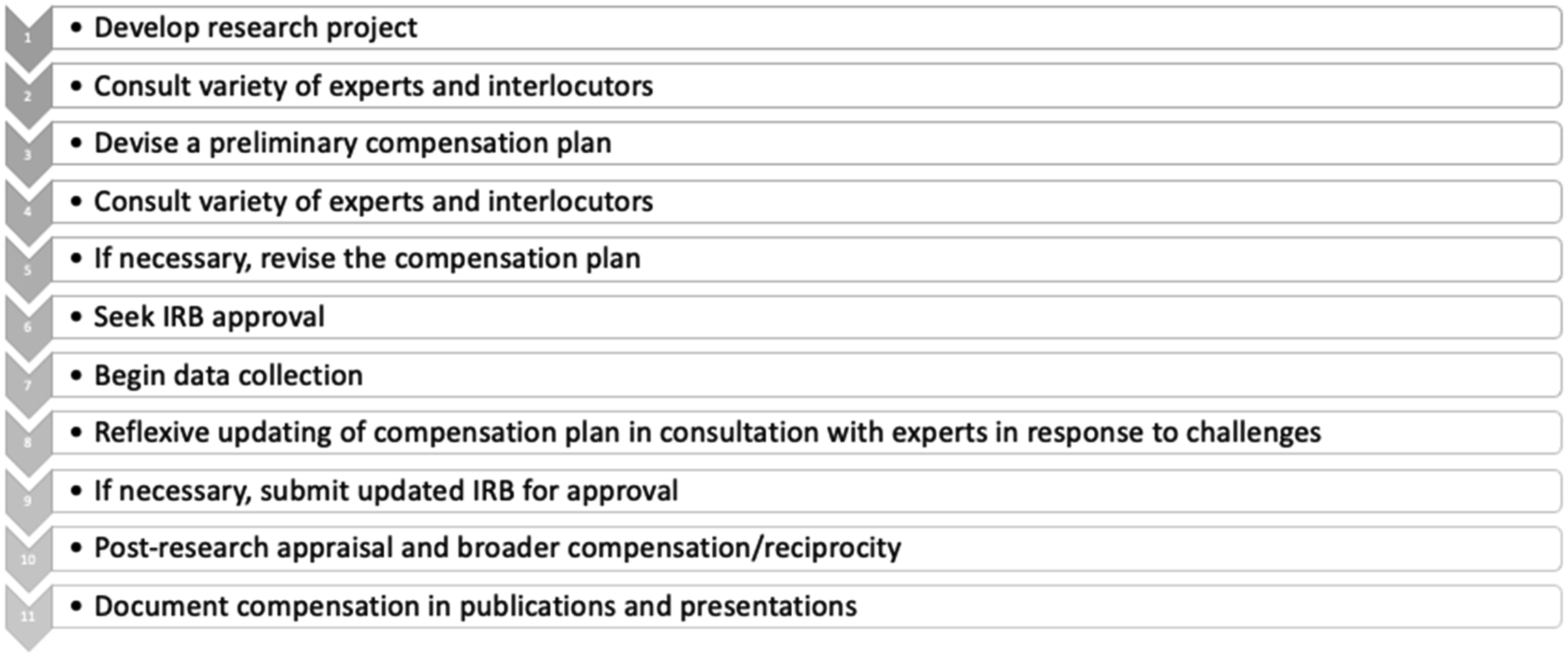
To be sure, the above iterative updating of the compensation plans requires flexibility, creativity, and attention to process. Even after consulting with other experts in their subfield, who have experience in the field site or with the targeted participant population, researchers may still feel like they are making the final call on very tricky decisions in isolation. Moreover, the decisions not only affect the viability of the project but, even more importantly, have real implications for people’s lives in the communities where research is conducted.
Even when researchers do everything possible to identify compensation problems in advance, consult widely, reflect carefully, and continue to update their compensation plans with care, they may still confront unexpected dilemmas that necessitate difficult on-the-spot decisions. For example, while preparing to conduct interviews in rural communities in Kenya, Porisky found that local chiefs, who are gatekeepers to their communities and government employees, often indicated they required “motivation” to help organize community meetings. 19 Response to such situations requires reflexivity on the part of the researcher and may require consultation with a local research team to ensure the response is culturally appropriate. Researchers must reflect on whether the activity is part of the normal scope of the official’s duties. Providing information or signing a permission letter may fall within the scope of an official’s expected duties. However, organizing community meetings – even if the official is a necessary gatekeeper to accessing the community – may impose unexpected costs on officials and justify compensation, perhaps in mobile credit for phone calls and time spent contacting participants on a scholar’s behalf. Researchers may also choose, in such cases, to offer payment a posteriori rather than a priori to make clear that compensation is a part of a thank you for services rendered. 20 Regardless, especially in low-income countries and communities, scholars should be wary of placing undue pressures on the limited time and budgets of civil servants, NGO workers, business owners, traditional or religious leaders, etc. Researchers may be concerned that the line between an unethical bribe and justified compensation is blurry. The solution is not always clear, but consultation with local actors – while certainly not a failsafe – can help researchers determine a culturally appropriate and contextualized ethical response that accounts for the local political economy and cultural norms.
Despite numerous in-depth discussions about compensation plans for “formal” participants within a research group, team members may disagree when confronted with a snap decision about whether and how to thank someone for their “informal” assistance. For example, MacLean encountered puzzled facial expressions and hastily whispered exchanges in an awkward public moment and found that the decision made in the moment still had not satisfied the entire team. When snap-decisions must be made, the core issues at stake should be discussed later to resolve any lingering conflict among the research team and to formulate the most appropriate strategy for the future.
Our goal is for the framework provided here to lighten this load somewhat by providing systematic guidance for the kinds of decisions to be made and the criteria to be used. In other words, to provide a guiding framework for scholars to plan compensation decisions but also offer guidance for responding to unexpected ethical dilemmas as they arise. Of course, the initial rationale and iterative implementation of compensation decisions and the implications for the ethical treatment of the human participants in our research should be highlighted consistently in all published writing and presentations. Documenting and revealing the evolution of thinking behind our compensation decisions will strengthen the practice of research ethics in the discipline. 21 In the next subsection, we discuss some potential problems that can be encountered in the field and how to assess the tradeoffs.
Persistence of Ethical Dilemmas and Potential Solutions for Compensation Problems
Evaluating Common Ethical Dilemmas and Resolving Compensation Issues.
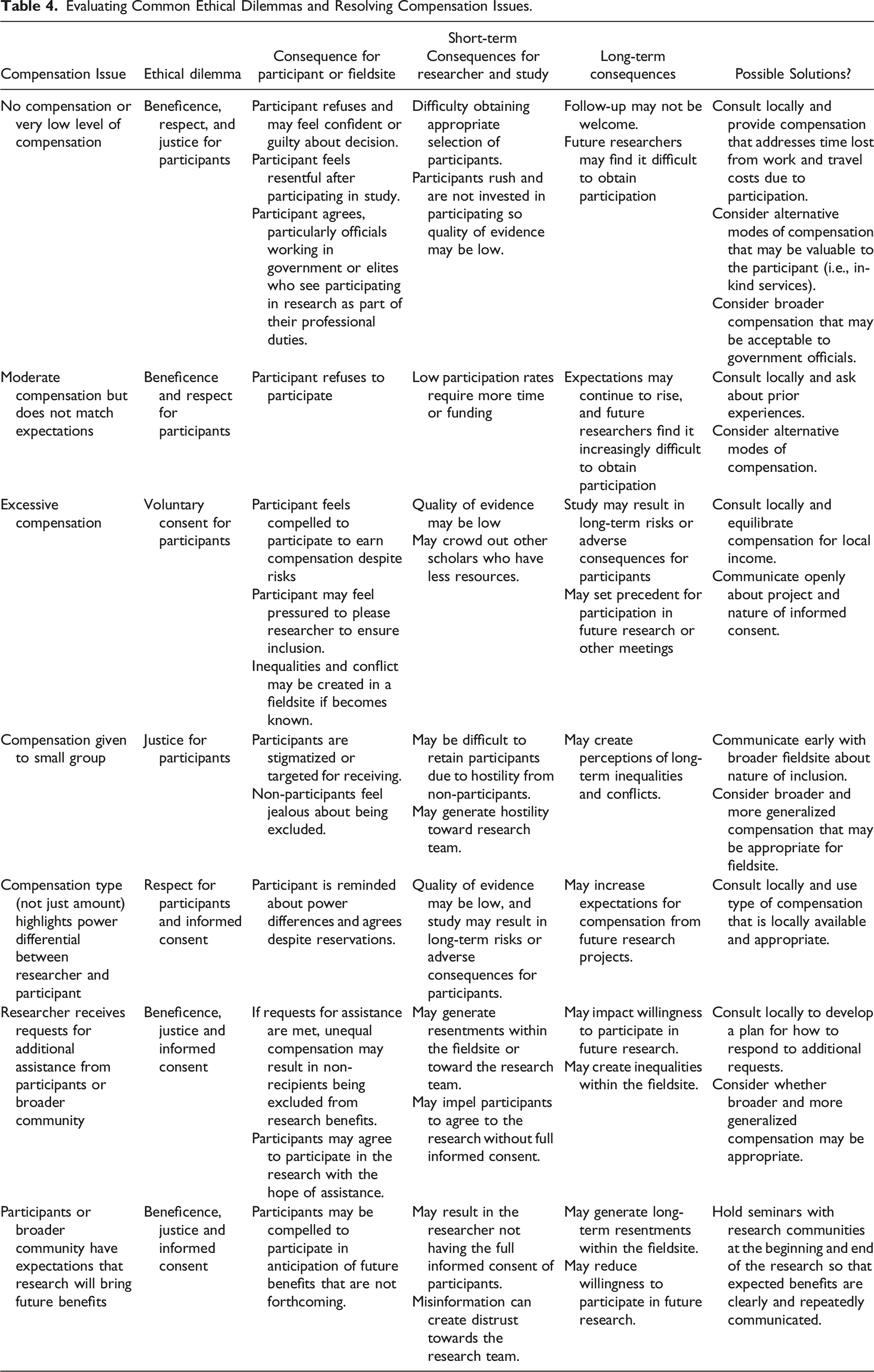
First, researchers may face issues related to the level of compensation. Low levels of compensation or compensation that is seen as insufficient or inappropriate for the fieldsite may result in refusal or resentment, which can lead to issues with data quality (particularly if a participant rushes through the interaction) or low response rates. This can also carry downstream effects for future researchers who may encounter reservations about participation in research. High levels of compensation can induce participation despite risks and may create resentments and conflict within a fieldsite if not everyone is selected to participate in the research. Over the long term, excessive compensation has the potential to crowd out researchers with fewer resources or unintentionally reduce participation within the broader community. To address such issues, open consultation with local actors (the research team, community members, local scholars, etc.) can help to establish appropriate thresholds for compensation. If faced with limited resources, researchers can also think creatively about alternative modes of compensation that can be beneficial to participants and the community.
Second, compensation given to a small group may create conflicts within the fieldsite, particularly if research communities are not included in compensation decisions. Selective compensation may create jealousies amongst non-participants and stigmatize participants (see Kelly, 2014). To address this challenge, researchers should ensure that they are clearly communicating their compensation plans to their research communities so that any issues can be addressed and adjustments made, if necessary. Early on, researchers should also consider whether compensation for the broader community, such as a contribution to a community project or NGO, is both judicious and possible.
Third, researchers may also encounter misinformation related to their compensation plans. This may result from insufficient communication about compensation or from widespread assumptions about the potential benefits of research drawn from prior encounters with research teams. Saleh et al. (2020), for example, frequently experienced the association of research with “‘good things coming’” (527). Important in such cases is clear communication about the immediate and downstream benefits from the research. It is crucial to be realistic about the limits and unpredictability of downstream benefits, including the limits of advocacy and policy relevant research.
Finally, researchers may encounter ongoing requests for assistance from both participants and the broader community. Such requests may be particularly common when research is conducted in low-income and/or marginalized communities. Porisky, for example, found that new situations sometimes forced her research team to alter their initial compensation plans. When conducting interviews with mostly elderly or female-headed households with no secure income source, Porisky and her research team often encountered households without food or children who had been sent home from school because they lacked a pencil. At the time, Porisky was ethically torn: on one hand, these gestures of aid seemed like both the moral and necessary course of action, yet, on the other hand, Porisky was conscious that such decisions could potentially have negative impacts on wider community relations and that they had implications for informed consent. Such experiences are not outliers when conducting research. Cronin-Furman and Lake (2018) similarly highlight how “many colleagues reported transgressing their defined interviewer-interviewee boundaries by offering compensation or accompanying research subjects to hospitals or clinics after interviews were completed” and while researchers frequently expressed was “‘the least they could do’” they also recognized that such actions tended to “perpetuate the expectation that benefits accrue from consenting to be interviewed” (609). Researchers need to prepare for such challenging situations and do so in consultation with both their research teams and local communities so that they can respond appropriately. However, this requires reflexivity and open conversation about compensation and the ethical dilemmas that arise from compensation and non-compensation.
Table 4 reveals several different types of compensation issues that raise distinct ethical dilemmas. All three of the Belmont principles are invoked. Moreover, one take-away point from the table is that all these issues pose both short and long-term consequences for the participant and for the researcher. These problems can not only result in shoddy data and project outcomes, but long-term inequalities and even the potential for conflict.
Notably, the first step to formulate a possible solution is almost always to consult locally and consult widely. Even if scholars carefully consider the decisions to be made and evaluate the sets of criteria that we have laid out in the framework, there will undoubtedly be some in-the-field adaptations to the original plan that require thoughtful consideration of the specific research context. While different researchers may make different compensation decisions, and respond to compensation issues in different ways, all decisions should be culturally embedded and locally appropriate. This requires consultation with a wide range of actors (scholars, communities, interlocutors, research teams, etc.) because there is rarely a unified “local” perspective. This necessitates an intimate knowledge of the local context and thoughtful consideration of the power dynamics, both within the community of study and between the researcher and interlocutors.
However, researchers have varying levels of immersion within their fieldsites and targeted research communities, which will shape their approach to consultation. Some researchers utilize long periods of immersion and ongoing in-person relationships with local interlocutors, while others utilize research firms or enumerators to carry out research. Active reflexivity about compensation practices may look different in each case. The in-person researcher is likely in a position to evaluate compensation practices on an ongoing and iterative basis, whereas the remote researcher may have to build in reflection checkpoints throughout the research process to reflect on the compensation practices. This may include conversations with local research partners during the research design process to draw on their knowledge of local norms and practices of compensation and building in questions about compensation, either with community members or members of the researcher team depending on the research design, during the pilot project. Reflexivity about compensation is thus possible and necessary for scholars with a wide range of immersion within their fieldwork sites. Finally, equally important is transparency about compensation in publications, either in-text or in an appendix. Normalizing the inclusion of comprehensive discussions about compensation decisions, challenges encountered during the research and how those challenges were addressed can empower other researchers to respond critically and reflexively to similar challenges in their own research.
Conclusion
The practices of compensation for research participants are an increasingly important set of ethical questions for scholars in political science and the social sciences more broadly. Compensation is central to ethical research and demands ongoing reflexivity and a moral commitment to reciprocity (Lederach, 2016; Russell, 2024). To-date, compensation has been inadequately addressed in the political science literature on research ethics and fieldwork. This paper offers a starting point for broader disciplinary conversations about compensation by exploring the factors that shape compensation decisions and offering some considerations and strategies for navigating the ethical challenges associated with compensation. The paper also discussed common compensation challenges that scholars might face in the field and offered an array of potential solutions.
We emphasize that compensation – broadly construed - is an important component of creating respectful and mutually beneficial research relationships. Political scientists should consider the wide range of compensation options, which go beyond the provision of cash or physical goods to include sharing research results, facilitating connections, and providing information to research participants. Ethical engagement with compensation requires scholars to think critically while preparing research plans and reflexively while in the field to be able to best understand the particular fieldsite context and negotiate ethical dilemmas effectively. This type of engagement depends on ongoing, active reflexivity, with a deep examination of power and positionality. There is no simple and straightforward answer for all cases. The resolution of these problems depends greatly on the political and economic context of each fieldsite, the identities and roles of the researchers and research participants, and the type of research interactions involved. Thus, regardless of their theoretical and methodological orientation, scholars must engage in active reflection and appraisal of their positionality to make thoughtful compensation decisions.
It’s important to recognize however, that compensation decisions are not simply the result of individual scholars making stronger or weaker methodological choices or choosing good or bad ethical practices; compensation is part of a broader politics of knowledge production. Historically, many predominantly white and wealthier researchers from the Global North have traveled to under-resourced communities and urban neighborhoods in their home countries or countries across the Global South to ask for people’s time and participation in their research projects (Briggs & Weathers, 2016). We need to be more aware of the political economy of knowledge production and how race, gender, and class intersect in our data collection and afford more agency to those whose perspectives and experiences we study and then build our careers on. More collaborative approaches to research can contribute to the decolonization of knowledge production (Firchow & Gellman, 2021). As such we also need to be attentive to the implications for the compensation of research team members who do translation, enumeration, facilitation of focus groups, observation, data entry, etc. (Cammett, 2013).
Whether one is conducting an interview with an ordinary citizen in a rural home in midwestern USA or an apartment building in bustling Nairobi, compensation decisions shape the researchers’ relationship with individual respondents and larger communities in important ways. Compensation decisions are an essential aspect of scholars’ adherence to basic ethical research principles; and they have important downstream effects for individual and community well-being, future research, and ongoing knowledge production.
One of the larger goals of this paper has been to start a disciplinary dialogue on how to approach these challenging issues in a way that upholds justice, respect, and beneficence to all our study participants. We hope to stimulate broader discussions and critical reflection within the discipline that transcend methodological divides. Public discussions about compensation decisions can help to ensure that researchers have the necessary support to make and adjust compensation decisions through their research projects and thus help to ensure that we meet our ethical commitments to the individuals and communities where we conduct research.
There are several small, but critical actions that scholars can take. First, scholars should include transparent discussions about their compensation practices in their publications. Second, reviewers and editors should support these norms by requiring authors to include such details in, at minimum, an online appendix. Ethical compliance should be more than a ‘box-checking’ exercise that confirms the research has been subject to IRB review (Rodehau-Noack et al., 2024). Third, there is a need to support graduate students by including discussions about compensation as part of research methods and fieldwork seminars. As Schwartz and Cronin-Furman (2023, p. 1) detail, graduate students frequently “enter the field feeling anxious and underprepared, with limited advance consideration of the type of ethical issues likely to emerge through their work or how to manage them as they arise.” Graduate training is essential to reducing the ‘trial and error’ approach to managing complex compensation issues as they arise. Preparation is key to reducing anxieties and ensuring that scholars have the tools to implement ethical solutions to complex problems in the field. Finally, because there are immense inequalities in formalized graduate training for field research (Schwartz & Cronin-Furman, 2023), graduate supervisors also have an ethical imperative to ensure students are prepared to compose thoughtful compensation plans and respond to challenges as they arise.
In practice, we hope our framework helps guide researchers through thorny ethical decisions related to compensation; but we also hope that it leads to broader, public dialogues about compensation that help to improve our collective knowledge and reduce the isolation, stress, and uncertainty individual researchers may encounter in the field when faced with complex ethical dilemmas that have real implications for the viability of our scholarship and for the communities where we conduct research. Ongoing and critical reflection about compensation practices is thus an ethical imperative for any scholar conducting field research in political science.
Footnotes
Acknowledgments
The authors would like to thank the three anonymous reviewers at Comparative Political Studies for their constructive and in-depth feedback on the manuscript. This paper has gone through multiple iterations and benefitted from valuable comments from earlier anonymous reviewers. Prior versions of the article also drew on an original survey, and we wish to thank all the political science scholars who shared their experiences with us by completing that survey. We are grateful for comments received at the Southwest Workshop on Mixed Methods Research, MPSA, APSA, and the Ghana Center for Democratic Development. We also wish to thank Aarie Glas for his feedback on the manuscript.
Declaration of Conflicting Interests
The author(s) declared no potential conflicts of interest with respect to the research, authorship, and/or publication of this article.
Funding
The author(s) received no financial support for the research, authorship, and/or publication of this article.
