




Abstract
Transitioning away from carbon-intensive to renewable energy sources is one key lever through which countries can mitigate climate change. Governments have implemented interventionist policies that simultaneously seek to promote a transition to greener energy sources and shield producers and consumers from the costs of this change. We examine the impact of this enhanced role of the state on public opinion about environmental reforms. Using data from a survey containing multiple experiments fielded during the 2021 federal election in Germany, we show that policies of compensation that target households rather than firms and that have a progressive design increase support for electoral candidates who run on a pro-energy transition platform and for climate policy plans. We also show that beliefs in state intervention in the market have emerged as an important cleavage within the German mass public concerning environmental reforms because they shape assessments of the effectiveness and appropriateness of compensation.
Introduction
During the past decades, governments in advanced industrialized countries have begun to adopt a number of reforms that seek to address the environmental challenges of our times. By steering inputs away from the carbon-intensive sectors of the economy towards renewable energy, environmental reforms intend to bring about a far-reaching reorganization of economic activity. The umbrella term ‘energy transition’ – referring to a replacement of fossil fuels with renewable sources of energy – summarizes the intentions of these encompassing reforms.
In many advanced industrialized economies, the energy transition has gone hand in hand with an increase in the state’s role in the management of the economy. To engineer the environmental transition, governments have set in place multi-year developmental goals reminiscent of the institutions of planning established during the immediate postwar period. As part of these policies of planning, governments promote specific strategic sectors (usually in renewables or cleantech manufacturing), while also seeking disinvestments in other sectors. Governments now manage the environmental transition by introducing a series of targets that limit coal production, thereby reducing employment in the carbon-intensive sectors of the economy. These interventions are complemented by policies that regulate inputs and outputs in a variety of sectors. Some states have also enlisted their monetary authorities as part of these initiatives of green industrial upgrading. States have mobilized significant financial resources and have deployed a wide array of programs that seek to compensate firms, workers and consumers for the economic cost of the green transition. In short, energy policies adopted in recent years went hand in hand with a resurgent role of the state in the economy.
In this paper, we argue that citizens’ views about the appropriate role of the state in the economy moderate the effectiveness of different forms of compensation in building coalitions for climate polices and explain variation in the level of support for the green transition. We point to a predetermined, standing disposition regarding whether the state can and should correct market failures and manage distributional conflict as essential for understanding divisions in public opinion about climate policy. Citizens who believe that the state has the necessary resources, information and incentives to play an effective political role and that it is appropriate for the state to do so are more likely to respond positively to information about different forms of compensation and support the energy transition. By contrast, citizens who mistrust the state are less likely to respond positively to information about policy compensation and are less likely to support the green transition. We argue that beliefs about the effectiveness and appropriateness of the state in managing the economy more broadly are a key and hitherto overlooked component of public opinion about climate policy. This argument extends a large and distinguished literature on the role of interests and ideas in shaping political conflict over the role of government in allocating resources in market economies (see e.g. Schumpeter, 1942; Alt and Chrystal, 1983; Hall, 1986; Roemer, 1994; Franzese, 2002; Przeworski, 2003) to the problem of mass support for climate and energy transition policies. In this paper, we investigate how these beliefs moderate the effect of various types of compensation policies designed to increase support for the energy transition. While compensation to households and workers on average increases support for the transition, such compensation is more consequential for citizens who have positive beliefs about state intervention in the economy.
To test these hypotheses, we conducted three original survey experiments embedded in a nationally representative survey in Germany fielded in the week prior to the 2021 German Federal election. We examine citizens’ support for the continuation of policies transitioning away from fossil fuels to more renewable energy sources, known also as die Energiewende, that have been implemented by various German governments beginning in the late 1990s. In each of the experiments, we examine forms of compensation and energy policy alternatives that reflect contemporary debates in Germany.
Experiment 1 is a candidate conjoint experiment in which energy policy is one of three issue domains that differentiate the candidates. We find that compared to a baseline of continuing the energy transition at its current speed, a policy that supports the transition at its current high speed and increases subsidies for energy costs to households with low incomes increases the probability of selecting a candidate by about 5 percentage points. The magnitude of this estimate is as large as any of the policy alternatives across migration and social policy. Before any of the experiments, we measured each respondent’s beliefs in state intervention in the economy by combining a battery of questions about non-environmental economic policies. We re-estimate the candidate conjoint by respondents with high and low beliefs in state intervention and find that respondents with above median beliefs in state intervention reacted more positively to the low-income household compensation proposal than those with below median beliefs.
Experiment 2 is an experimental conjoint that asks respondents to choose between policy plans that vary in the extent to which they increase household costs, their effectiveness in reducing German greenhouse gas emissions, whether and how they compensate consumers, and whether and how they mitigate any competitiveness consequences for firms of the transition. Our results indicate that the presence of compensation policies increases the probability that a respondent supports a plan by 10 to 20 percentage points and more generous and more progressive compensation have the largest estimates. The effect of compensation is strongly moderated by beliefs in state intervention. For example, the difference between the impact of the generous progressive plan on policy plan support between individuals with above and below median beliefs in state intervention is about 10 percentage points.
Finally, experiment 3 focused on one of the most salient aspects of the German energy debate—the exit from coal energy. This vignette experiment used short videos to provide respondents with different types of information about government policy and the coal exit. All respondents received an explanation that the coal exit would reduce greenhouse gas emissions and that there would be negative consequences of the exit for some groups. The control group just saw this video, while four treatment groups saw videos that continued with further information about compensation for workers in the coal industry, policies to help coal regions diversify their economies, compensation for investors, and finally, compensation for consumers. The baseline experimental results indicated that compensation for workers and regions significantly increased support for a full coal exit while compensation for investors and consumers did not.
Overall, our experiments highlight several important regularities in public support for climate policies. First, we show that some of the policies of compensation that have been adopted in recent years play an important role in increasing public support for the continuation of reform. We also show how the design of different forms of compensation affects support for environmental reforms, documenting that policy measures that target low-income consumers are more likely to positively affect voters’ support for climate policy. Second, we show that beliefs about the effectiveness and appropriateness of the state in economic management moderate the effect of compensation on policy opinions. Citizens holding more positive beliefs about state intervention are more likely to respond positively to information about policy compensation.
Our paper makes two contributions to the recent literature examining public opinion support for environmental reforms. First, we provide new evidence on how the design of compensation schemes shapes the effect of compensation on support for the energy transition. Our paper goes beyond the assertion that compensation matters and seeks to examine which forms of compensation exert the most significant effect on public opinion. We manipulate the design of different compensation policies that differ in their level of targeting in terms of whether consumers, workers, firms or regions are the focus of support and the progressivity of benefits. Our evidence suggests that compensation policies that target benefits to low-income consumers and workers are likely to bring about the largest increase in support for environmental policies. Second, our paper provides a theoretical explanation for why compensation seems to generate support for some voters and not others. Beliefs about state intervention in the economy moderate voter responsiveness. The ideas that individuals have about the role of the state inform how they think about climate problems because these problems have many of the same features as those economic issues that have shaped political conflict broadly in advanced industrial democracies. We show that in the German case, these beliefs are distinct from partisanship and ideology and explain more robustly why compensation increases support among some voters more than others. A key contribution of the study is that the German case and our research design allow us to unbundle the importance of beliefs about state intervention from partisanship and ideology more broadly. While our paper focuses on how beliefs about state intervention influence the impact of compensation, our argument is more general in that state intervention is a key feature of many dimensions of climate policy and the energy transition. We argue that in studying preferences of mass publics towards environmental reforms, scholars need to pay attention to political responses to the growing presence of the state in the economy in addition to the economic costs and physical risks faced by voters.
The remaining part of the paper is organized as follows. We begin by presenting our hypotheses about the role of compensation and beliefs about state intervention in shaping public attitudes toward environmental reforms. We then outline the survey experiments designed to test these hypotheses. The following section presents and discusses the experiments’ findings. The final section concludes. 1
Compensation, Beliefs in State Intervention, and Climate Policy Preferences
Environmental and energy reforms have become some of the most pressing policy challenges of our time. Voters’ preferences towards these reforms vary significantly both across and within countries. A rapidly growing literature has examined the preferences of mass publics towards these policies in an effort to shed light on how governments can forge stable and enduring political majorities supporting sustainable climate policies. 2
This research emphasizes two key themes. First, exposure to climate risks is an important factor affecting support for climate policies (Bergquist & Warshaw, 2019; Hazlett & Mildenberger, 2020; Hoffmann et al., 2021; Hoffmann et al., 2021; Marple & Post, 2021; McDonald et al., 2015; Schuldt et al., 2018). Second, economic losses resulting from environmental transitions shape preferences for climate policy reforms (Bechtel et al., 2019; Bechtel & Scheve, 2012; Kono, 2020; Pianta & Rettl, 2022). These findings raise the question of whether and under what conditions compensation for losses associated with climate change or climate policy can increase support for environmental and energy policy reforms. Using survey data from the United States and Switzerland, Fremstad and collaborators show that rebates increase public support for carbon taxes in both countries by increasing levels of support among lower-income groups (Fremstad et al., 2022). Beiser-McGrath and Bernauer examine public support for carbon taxing in a range of advanced industrialized countries and document that different proposals to ‘recycle’ this revenue by using it to fund other governmental priorities increase public support for the new tax (Beiser-McGrath & Bernauer, 2019). This echoes a number of other studies that find that revenue recycling in the form of compensation for households or workers improves public acceptance of green taxes (Bachus et al., 2019; Carattini et al., 2017; Carattini et al., 2019; DolÅ¡ak, Adolph, & Prakash, 2020). Bergquist et al. (2020) focus on the impact of bundling climate and social policies, some of which compensate for the costs of climate policy and some which are not directly related and also find the potential for policy bundles to increase support for reforms. Gazmararian and Tingley (2023) present a wide-ranging assessment of why compensation isn’t more effective than it is in building policy coalitions to address climate change, arguing that often promises of compensation are either inadequate or lack credibility. 3
One limitation of many of these studies is that they do not consider the broader political context within which environmental and energy reforms take place. The policy environment shapes voters’ beliefs about the ability and appropriateness of governments to implement these transitions (and the associated policies of compensation) and the overall efficacy of these policy interventions. Climate policy is inextricably linked to the relative role of the market and state in structuring production and consumption. Political economists from Smith to Marx to Hayek to Pigou to Friedman to Piketty have debated what the proper role of government is in the economy. Those debates entertain many possible arguments for and against intervention but in contemporary deliberations they might be usefully summarized as falling into two broad categories: correcting market failures and distribution. Climate policy and compensation related to these policies are fundamentally about identifying and correcting market failures in production and consumption activities that produce greenhouse gas emissions and addressing the distributional consequences of both climate change and the policies to mitigate it. As such, the same considerations that animate debates about the size of the state, private versus public ownership of industry, the regulation of monopolies, and activist macroeconomic policymaking inform political divisions over climate policy and compensation. Building on studies such as Hall (1986), Franzese (2002), Jacobs and Matthews (2017), and Marple and Post (2021) in other economic policy areas, we advance the argument that beliefs about the appropriateness of state intervention are an important component of public opinion towards environmental policy.
The closest previous work on mass support for climate policies are studies that estimate the impact of some form of compensation by ideology or partisanship. For example, Bergquist et al. (2020) show that, for the most part, combining social policies with climate policies has a more positive impact on support for Democratic partisans in the United States than Republican partisans. To the extent that Democrats have more positive beliefs in state intervention, this result resonates with the expectations of our argument. But partisanship, especially in the U.S. context, bundles together many other beliefs and identities such as an underlying belief in man-made climate change itself that may be correlated with climate and energy policy opinions. Their result may be about a standing disposition about the effectiveness and appropriateness of state intervention in the economy but it could be much else. Our study makes a theoretical argument about the importance of these beliefs and tests it specifically. We will show below that in Germany beliefs about state intervention vary within partisan and ideological groups and these groups do not robustly explain differences in the effect of compensation across respondents.
Gazamararian and Tingley’s book (2023) also relates to our argument in that they suggest that compensation proposals that do not seem credible for whatever reason including low trust in government, state capacity, or partisan polarization do not increase support for climate policies. This is clearly related because they, like us, are considering the broader political context within which environmental and energy reforms take place. Different assessments across individuals of the credibility of government promises to enact any policies could be one reason that individuals have different standing dispositions about the effectiveness and appropriateness of government intervention. Our framework, however, emphasizes the standing set of beliefs about state intervention rather than any one cause of them and our paper focuses empirically on investigating how these beliefs shape differential responses to compensation.
In this paper, we investigate the role of beliefs in state intervention in the formation of energy transition policy opinions in Germany. Germany provides a fruitful case for a number of reasons. First, the German government has implemented and discussed climate policies, including a variety of compensation measures, which allows us to draw on realistic policy examples for our experiments. Second, Germany, as a wealthy country with relatively low levels of political polarization and a long history of government intervention, presents a least likely case to test our theory. Low polarization minimizes credibility concerns, which can erode trust in government, as highlighted by Gazmararian and Tingley (2023). Further, the long history of government intervention might make the belief that the state can and should intervene a consensus view that does not explain variation across citizens. If concern about the effectiveness and appropriateness of government intervention moderates public preferences even in Germany, it is likely to moderate them elsewhere, too. Lastly, Germany, as the world’s 4th largest economy and one of the world’s top 10 emitters of CO2 is an important case in and of itself. 4
Recent years have been characterized by an increase in the role of the state in the policy-making process of environmental reforms in Germany and elsewhere. To accelerate the transition towards renewable energies, the German government has formulated clear developmental goals involving multi-year and even decade-long projects. In the case of the development of renewable energies, the government has provided purchase guarantees of twenty years to firms that invest in electricity generation (Bechberger & Reiche, 2004, p. 55). The goal of these multi-year programs is to lengthen the planning horizons of private actors and induce them to invest. Policies of coal exit also benefit from a long-term approach to economic planning. To this end, government formulated long-term developmental budgets (Bundesministerium für Wirtschaft und Energie, 2019, p. 95). For example, to aid regions affected by the exit from coal (Nordrhein-Westfalen, Brandenburg, Sachsen and Sachsen-Anhalt), the German government has formulated 20-year budgets for fiscal transfers to these regions. In its report, the coal commission noted that “planning dependability is of paramount importance given the long investment cycles and large investment volumes”, giving “certainty to the market participants” (Coal Commission, 2019). These broader set of climate policies—an increase in the scope of state intervention—are what make beliefs about state intervention in the economy relevant for understanding public support for climate policy, the responsiveness of public opinion to different types of compensation, and enduring political cleavages over environmental and energy issues.
At the same time, the negotiation of the energy transition has been accompanied by a considerable increase in the level and types of compensation devoted to firms and workers adversely affected by the transition. In the German context, the cost of compensation of the coal exit alone is estimated at 90 billion Euros yearly (Schlandt & Zaremba, 2019). On the one hand, governments have designed compensation in order to target industries and workers adversely impacted by the environmental transition. Governments have not only provided incentives to switch to cleaner energy in the form of subsidies, government regulation, and loans, they have also tried to shield domestic industry from the worst economic repercussions of the energy transition. In Germany, energy-intensive companies that face international competition are currently enjoying large discounts for the Erneue Energien Gesetz Umlage, which is an energy surcharge paid to fund the energy transition. In 2021, 2708 companies, ranging from aluminum producers to breweries, made use of the discount. In the European Emissions Trading System, which Germany takes part in, energy-intensive companies at risk of import competition receive free CO2 allowances. Further, the European Green Deal, announced in 2019, includes carbon border taxes for imports from less climate-friendly countries. Discussions about the design of compensation aimed to lower the cost of the energy transition for domestic industry were significant during the 2021 election campaign. In its election manifesto, the Social Democratic Party pledged to support industry to stop companies from moving abroad in response to climate policies.
In addition to compensation to firms, questions about compensation for households have been a prominent part of the recent climate policy debate. For example, during the 2021 election campaign, the Social Democrats, who ultimately won the election, promised to ensure that low-income households are not left behind and to evaluate a potential payment to households financed by a CO2 price. What form such redistribution to households should take is contested. While much political debate has focused on targeted help for low-income households, prominent German economic studies have drawn on the example of Swiss climate policy and suggested the potential efficacy of lump sum payments to all households (Preuss et al., 2019; Venjakob & Wagner, 2021).
Our paper argues that citizens draw on beliefs about the appropriateness of state intervention in evaluating different policies of compensation. Citizens who have a predetermined, standing disposition that the state can and should identify market failures and manage distributional conflict are likely to evaluate proposals for compensation more positively. By contrast, citizens who believe that the state lacks the information or resources to manage the economy or that it is unfair for it to do so are likely to evaluate such proposals negatively. Beliefs about state intervention in the economy are thus a lens by which citizens evaluate different proposals for environmental reforms. Previous studies that have explained preferences for environmental reforms by considering the economic and environmental vulnerability of voters only have overlooked the importance of these ideational factors. Figure 1 summarizes our expectations. The role of beliefs about state intervention in explaining individual level support for environmental policies.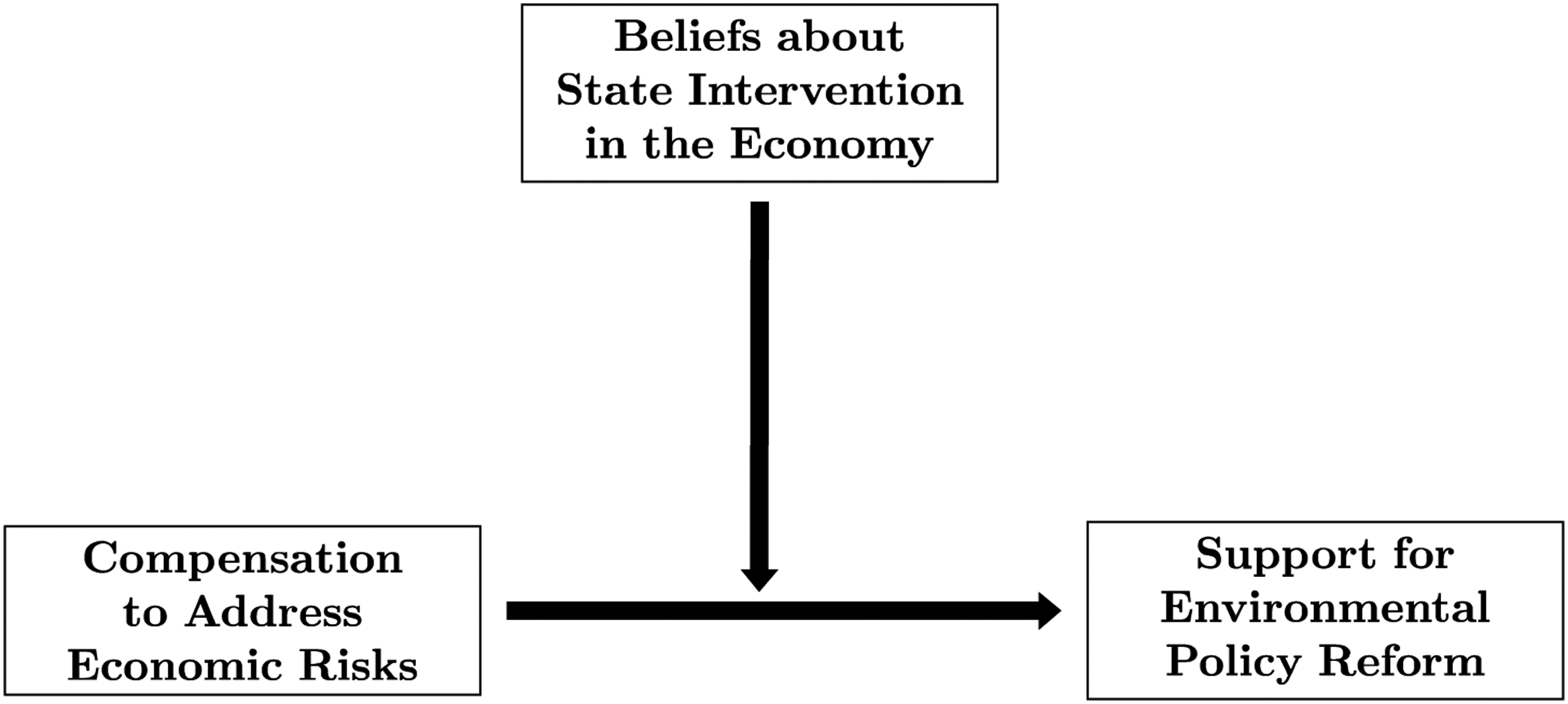
Various types of compensation are likely to increase the public’s acceptance of the energy transition. The adoption of subsidies for households is likely to increase the public’s acceptance of the energy transition. Similarly, compensating energy-intensive companies will, on average, increase the public’s acceptance of the energy transition by alleviating concerns about the potential negative effects of the energy transition on growth and employment. The design of these policies, however, is likely to matter with policies that minimize economic inefficiencies and resonate with voters’ distributional values receiving more support. Thus, in our experiments, we vary the nature of compensation, including the target and level of redistribution, to explore what types of compensation the public generally prefers.
In the remainder of the paper, we will enumerate the general hypotheses as: H1: Compensation to households increases support for climate policy reforms. H2: Compensation to companies increases support for climate policy reforms.
However, in a policy landscape characterized by increased activism of the state, beliefs in state intervention become an important source of heterogeneity in voters’ support for climate policies and how it is shaped by compensation. Citizens holding positive beliefs about state intervention in the economy are likely to assess compensation proposals more positively. By contrast, citizens holding negative beliefs about state intervention are likely to be unpersuaded. As such, we expect that beliefs in a greater role of the state in economic management moderate the effects of compensation for households and companies. Information about compensation is likely to lead to greater support for environmental reforms among citizens believing that the state can and should play a large role in managing the economy. Notice that a key feature in this argument is that belief in government intervention is a general, predetermined belief orientation that informs opinion formation about specific policy issues. Our measurement strategy for capturing individual beliefs about government intervention, presented below, reflects this perspective by using responses to questions about the desirability of government economic intervention in non-environmental and non-energy contexts and recording these responses prior to the presentation of any of our experimental treatments.
We will enumerate these hypotheses as: H1a: The effect of compensation to households on support for climate policy reforms is higher for respondents who believe more strongly in state intervention in the economy. H2a: The effect of compensation to companies on support for climate policy reforms is higher for respondents who believe more strongly in state intervention in the economy.
Methodology and Data
To test these hypotheses, we fielded a survey among a representative sample of over 2000 adults, 18 years and older (n = 2191) living in Germany. 5 The survey was fielded between September 20 and September 24 2021 and completed before the German Federal election in September 2021. The respondents were sampled on age, gender, region and income, using a sample provided by the survey-firm Respondi. The survey included three experiments and a mock vignette experiment to test participants’ attention. We randomized the order in which participants were presented with the different experiments.
The experiments measured the effect of government compensation on support for political candidates and support for climate policy plans. They focused on two forms of intervention: redistribution to households and measures that support energy-intensive industry. Both are salient components of the German energy policy debate. These two types of compensation also allow us to compare which government interventions have a larger impact on support and whether belief in state intervention in the economy moderates preferences on specific forms of government compensation.
Experiment 1: Candidate Conjoint Experiment
Candidate Conjoint Experiment, Levels of Candidate Attributes.
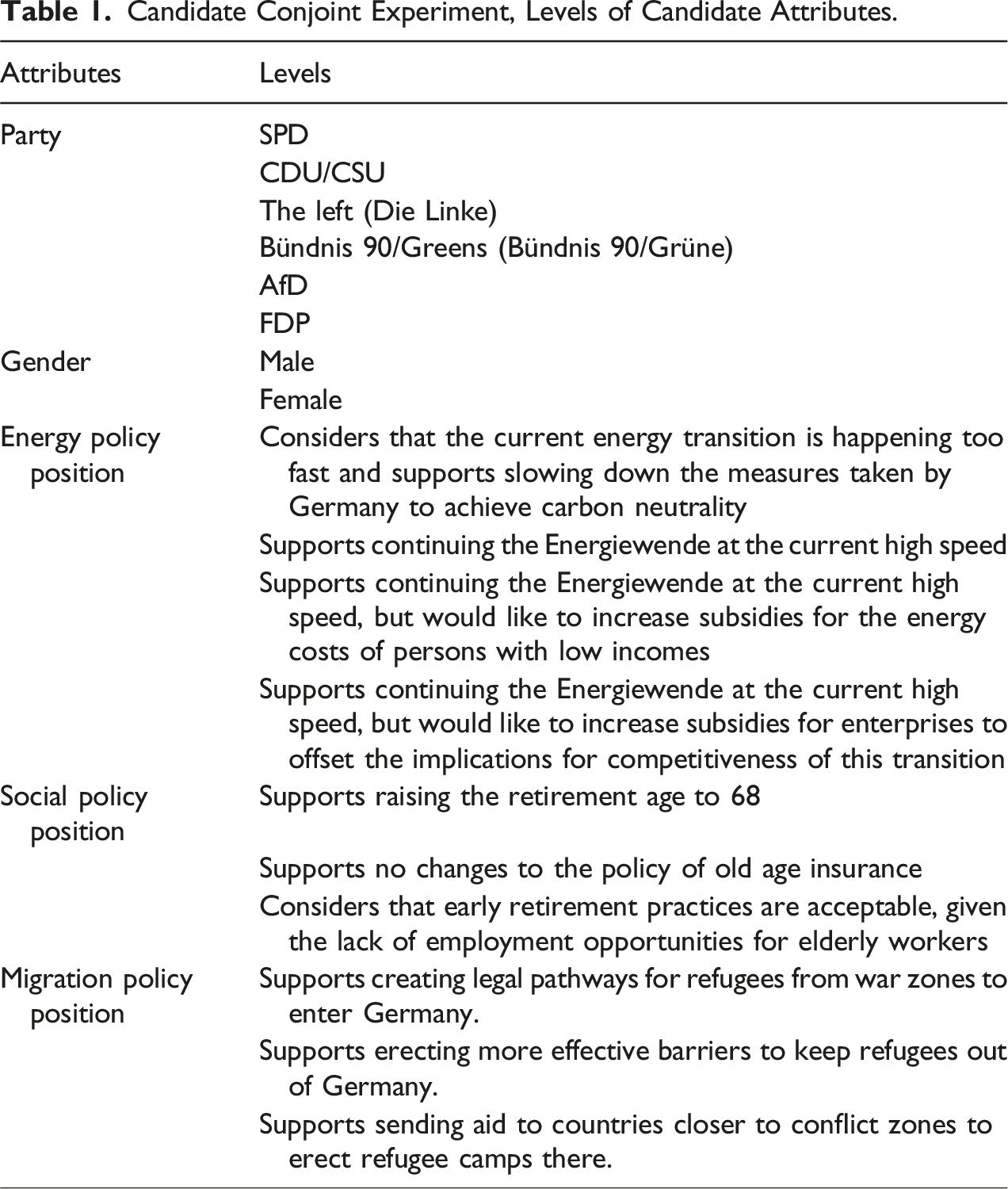
Most importantly for this study, the candidate conjoint experiment varied the candidates’ positions on the green energy transition. As the baseline for comparison, we included candidates who favored the current policy status quo. We also introduced candidates who wanted to slow down the energy transition. Two additional conjoint levels described candidates who wanted to maintain the speed of the energy transition and either subsidize energy costs for low-income households or subsidize energy costs for energy-intensive companies. These policy options capture key elements of the contemporary German policy debate.
We estimate an ordinary least squares regression of Candidate Support on dichotomous indicator variables for all treatment categories, with the exception of the baseline for each conjoint dimension. This estimation yields the average marginal component-specific effect (AMCE) for each treatment group relative to the baseline. 6 Standard errors are clustered at the respondent level. Substantively, the coefficients give the average change in probability of selecting a candidate with the specific characteristic over a candidate who holds the baseline feature in that dimension. Positive coefficients thus indicate that a given characteristic increases support for a candidate, relative to the baseline. 7
Experiment 2: Policy Plan Vignette Conjoint Experiment
The second experiment combined vignette texts with a conjoint experiment to measure support for different policy plans. For the vignette texts, the survey randomly assigned respondents to a control group (C) or one of two treatment groups: the compensation treatment (T1) or the competitiveness treatment (T2). All respondents were asked to read a short text on carbon pricing, and the treatment groups read additional paragraphs. The treatment and control read as follows.
Policy Plan Conjoint Experiment, Levels of Plan Attributes.
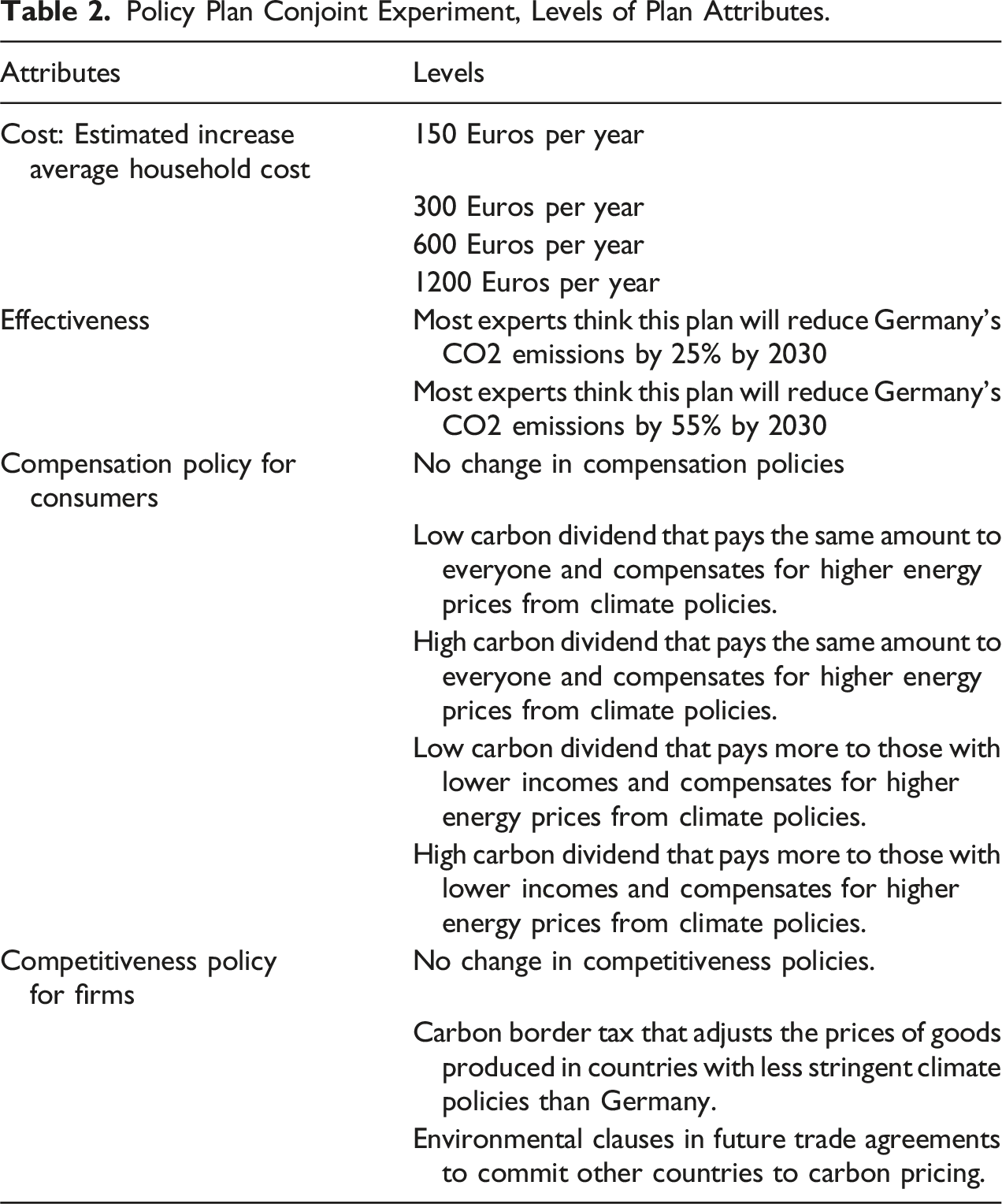
Again, all forms of government compensation and measures to enhance international competitiveness described in the vignette and conjoint texts are salient components of the German and European climate policy debates. The two measures aimed at increasing domestic firms’ competitiveness mentioned in the conjoint experiment - environmental clauses in preferential trade agreements and a CO2 border tax - are elements of the European Union’s climate policy. As described in the previous section, the possible redistribution of money raised through a carbon price to households and its optimal design is also a prominent component of the policy debate. With the conjoint levels in this experiment, we test whether lump-sum payments or a more progressive redistribution to households has a bigger impact on the probability of supporting a plan. 8
We follow the same procedures for estimating the average marginal component-specific effect for each treatment group relative to the baseline as described for the candidate experiment. We again cluster standard errors at the respondent level. The main results that we report in the paper pool all respondents across the vignette treatments groups (control group (C), the compensation treatment (T1), and the competitiveness treatment (T2)). We then discuss estimates across these groups.
Experiment 3: Coal Exit Vignette Experiment
The third experiment randomly varied information participants received on the German exit from coal and related compensation measures. As the information presented in this vignette experiment was relatively complex, it was presented in the form of animated short videos, rather than text. All treatment groups, including the control group, were first told about the planned full shut-down of all coal-fired power plants in Germany no later than 2038. The baseline video explained that the coal exit will reduce German CO2 emissions, but that some groups may experience negative consequences. The video went on to list investors, who invested money in coal companies, workers in the coal industry, coal regions as a whole, as well as consumers facing potentially higher prices as potential losers from the coal exit. Therefore, all groups, including the control group, were primed to consider the potential negative consequences of a coal exit.
Coal Vignette Experiment, Video Scripts.
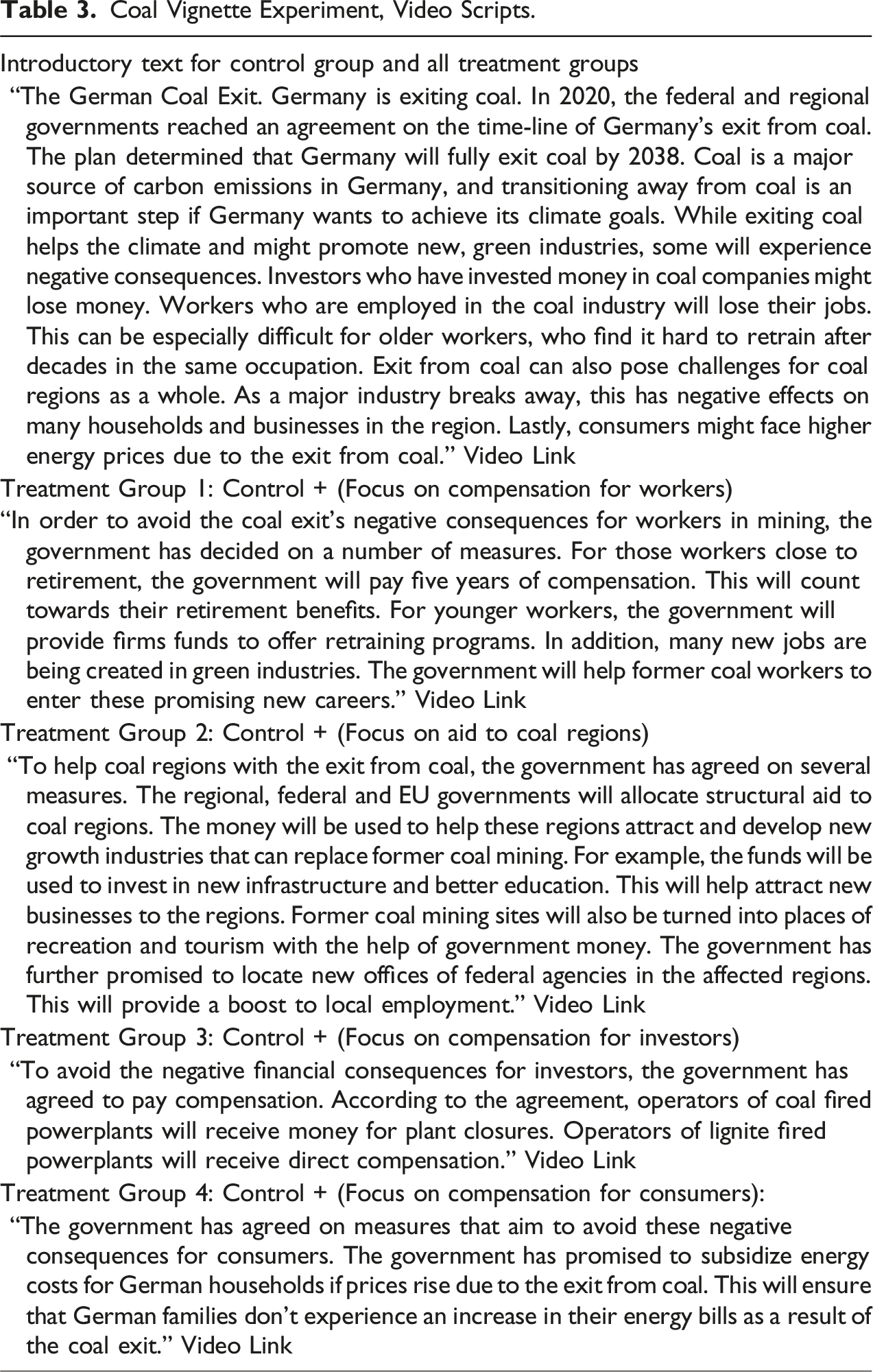
After watching the vignette videos, participants were asked two outcome questions to measure their support for a full and rapid exit from coal. Individuals were asked to rate their support for a complete exit from coal on a five-point Likert scale. We code a dichotomous variable, Support for Coal Exit equal to one if responses on the Likert score were “somewhat support” or “fully support” and zero otherwise. Our main reported results are from ordinary least square regressions of Support for Coal Exit on dichotomous indicator variables for the four treatment categories described above. Participants were also prompted to indicate their “ideal” year for a coal exit on a sliding scale ranging from 2021 (the year of the survey) to 2050.
Belief in State Intervention
The core theoretical claim in the paper is that whether and how individuals respond to different types of compensation depends on their predetermined beliefs about whether the state can and should manage economic outcomes. We argue that these general beliefs about state intervention in the economy inform policy opinions about climate change and whether compensation proposals increase support for climate policies. To measure belief in state intervention, we use a battery of questions originally developed for the German General Social Survey - ALLBUS 2016 (Wasmer & Horst, 2018). These questions ask about individuals’ support for six different types of government intervention in domains other than the environment. These questions are asked at the beginning of the survey, along with a number of other pre-treatment measures, before any experimental modules are presented to the respondents.
The questions ask respondents whether the government should: 1. Provide jobs for those willing to work 2. Provide an adequate standard of living for the unemployed 3. Keep prices under control 4. Support industry to ensure economic growth 5. Provide healthcare for the sick 6. Secure an appropriate standard of living for the elderly
Support for each of these interventions was measured on a five-point Likert scale. We first take the mean score of all six battery items for our primary measure of support for state management of the economy. The average respondent in our sample shows a moderate belief in the appropriateness of state management of the economy, averaging three on a five point Likert scale. We then define the variable Belief in State Intervention equal to one for respondents with a median or above-median average and zero for respondents with a below-median score. To ensure that the results are not driven by an arbitrary cut-off, we additionally use the continuous mean score of all items as an alternative measure for our analyses and present these supplementary results in the appendix. Further, in the appendix, we provide results that disaggregate the measure into mean support for (1) intervention on behalf of workers (items 1 & 2), (2) managing the economy (items 3 & 4), and (3) support for the sick and elderly (items 5 & 6).
In addition to our core variable of interest, we ask pre-treatment questions on participants’ climate policy attitudes, their positioning on a left-right political spectrum, and party vote intentions in the upcoming federal elections. Appendix Table C.1 presents multivariate regressions that regress Belief in State Intervention on responses to these questions as well as demographic variables. Table C.2 and Figures C.1 through C.4 show the coefficients of bivariate regressions that regress Belief in State Intervention on each of these variables separately. All show that belief in state intervention is negatively associated with higher incomes, higher age, male gender, and living in West Germany. Further, belief in state intervention is positively associated with belief in man-made climate change and weakly positively associated with general support for climate policy. Unsurprisingly, on average, those who identify as more right-wing and those who vote for the economically liberal FDP are less likely to believe in and support state management of the economy. Yet, the association between these variables should not be overstated. While the association is significantly different from 0, party and ideology explain very little of the variation in our measure of belief in state intervention, as the very low R2 values in Appendix Table C.2 and Appendix Figures C.8 and C.7 demonstrate. Nontheless, given the significant correlations, we include demographic control variables for age, gender, income, and home region in all analyses. We further conduct robustness checks that control for and interact respondents’ pre-treatment belief in climate change, support for climate policy, left-right leaning, and party vote with our experimental treatments. This gives us increased confidence that our measure of belief in state intervention is picking up a related but distinct belief dimension.
In addition, we used two types of attention checks: First, we presented individuals with a mock vignette text, which was the same for all participants. Respondents were asked to answer three factual questions about the vignette text. The mock vignette we employed was initially developed and tested by Kane et al. (2020). We translate the mock vignette text into German and replace American organizations referred to in the questions with their German/European counterparts. The English text and vignette questions are listed in the Appendix. We also use a traditional attention check question at the end of our experimental modules. Individuals who did not answer this question correctly were excluded from our survey. To ensure that our final sample remained representative, we employed quotas for age, income, region, and gender that matched the makeup of the German adult population.
Results
Candidate Conjoint Experiment
The first experiment reveals that the German adult population generally supports the green energy transition. As shown in Figure 2, respondents were, on average, 4.9 percentage points less likely to choose candidates who wanted to slow down the energy transition (p < .01) compared to candidates who supported the energy policy status quo. Meanwhile, subsidies for poor households as part of the energy transition increased candidates’ propensity to be chosen by 4.6 percentage points (p < .01). Progressive redistribution rendered energy policy more politically palatable. In contrast, we find no statistically significant effect of compensation for companies on candidate support. The underlying regression results can be found in Appendix Table D.2, Model 1. Overall results, candidate conjoint experiment. Note: Figure shows the average marginal component effects of the candidate conjoint experiment with 95% confidence intervals. Results are based on unweighted OLS-regressions. Standard errors are clustered at the respondent-level.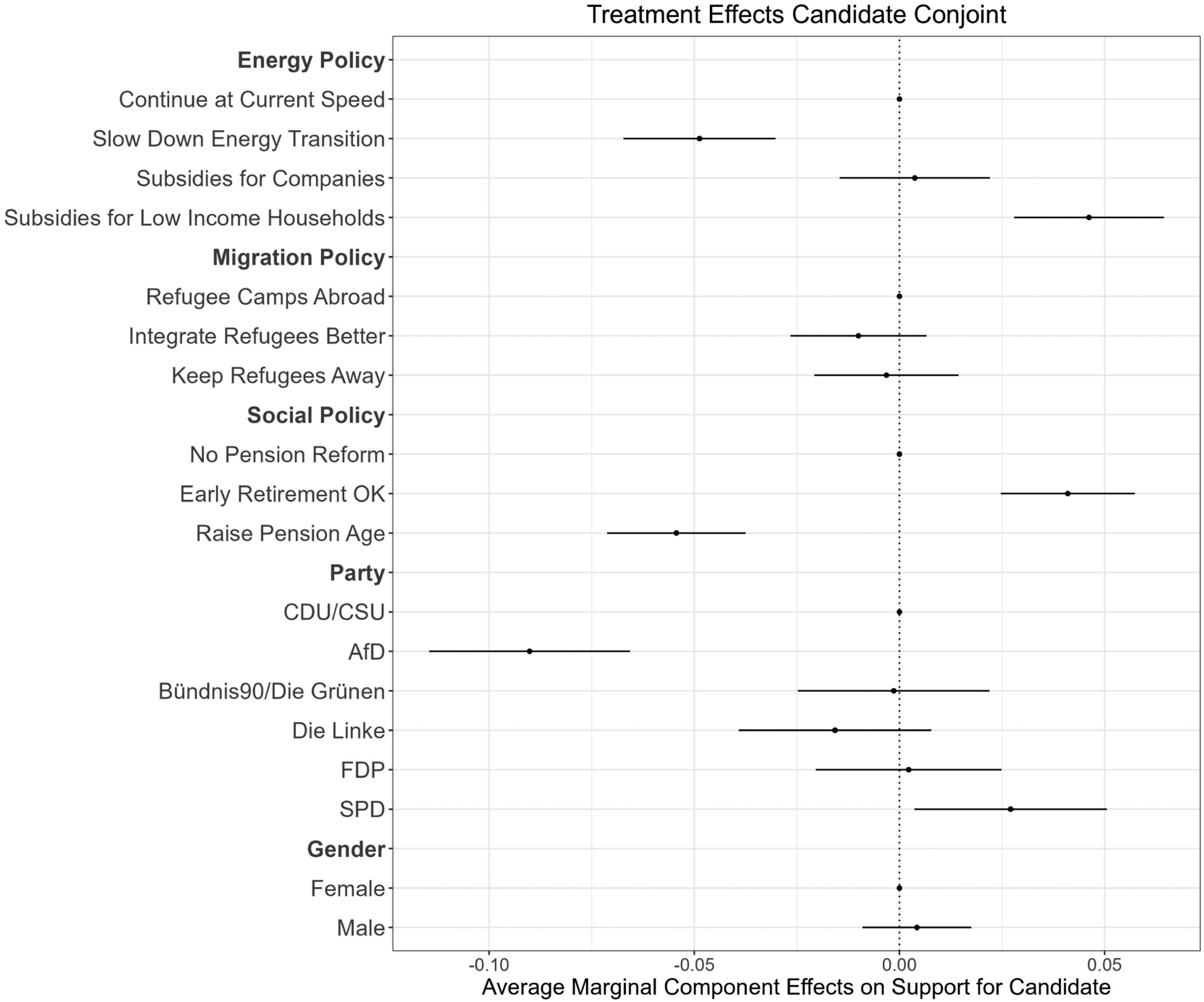
Unlike energy policy positions, positions on migration policy did not significantly change respondents’ choice of candidates. Pension policies had average marginal component effects (AMCEs) that mirrored the magnitude of energy policy’s AMCEs. Compared to the pension status quo, respondents were 4.1 percentage points more likely to choose a candidate who supported early retirement and 5.4 percentage points less likely to choose a candidate who wanted to raise the pension age (p < .01). Unsurprisingly, the average marginal component effect of candidates belonging to the far-right AfD was negative and highly significant at 9 percentage points (p < .01). In light of the SPD’s election victory, the positive AMCE of the SPD (2.7 percentage points, p < .05) is also unsurprising. Other party affiliations or the candidate’s gender had no significant effect on candidate choice.
Having evaluated the impact of compensation on candidate support, we want to understand if pre-determined beliefs about the role of the state in the economy shape responsiveness to compensation schemes. Figure 3 shows results from a split-sample analysis, where we repeat the analysis of conjoint AMCEs separately for respondents with a below-median level of belief in state intervention and respondents with above-median values. The underlying regression models can be found in models 1 and 2 of Appendix Table D.1. For the first group, subsidies for low-income households had no statistically significant effect on the choice between candidates. Among those with an above-median belief in state intervention, subsidies for low-income households had an AMCE of 6.5 percentage points (p < .01). However, beliefs in state intervention did not moderate respondents’ reaction to compensation paid to companies. Neither sub-group of participants had a statistically significant reaction to compensation for companies. The AMCE of slowing down the energy transition was also not moderated by beliefs in state intervention. A slowing of the transition to greener energy sources was similarly unpopular among both subgroups. As these results show, the measure of belief in government intervention is distinct from participants’ mitigation preferences. Further, the subgroups do not differ significantly in their partisan preferences, indicating that the measure is not simply picking up broader differences in partisan ideology. Taken together, these results indicate that Belief in State Intervention moderates the effect of including compensation for households as a part of the energy transition on Candidate Support. Candidate conjoint results, by belief in state intervention. Note: Figure shows the average marginal component effects of the candidate conjoint experiment with 95% confidence intervals. Results are based on unweighted OLS-regressions. Standard errors are clustered at the respondent-level. Sample is split by the variable Belief in State Intervention with low belief - below median-level belief, high belief - median-belief in state intervention in managing the economy or above.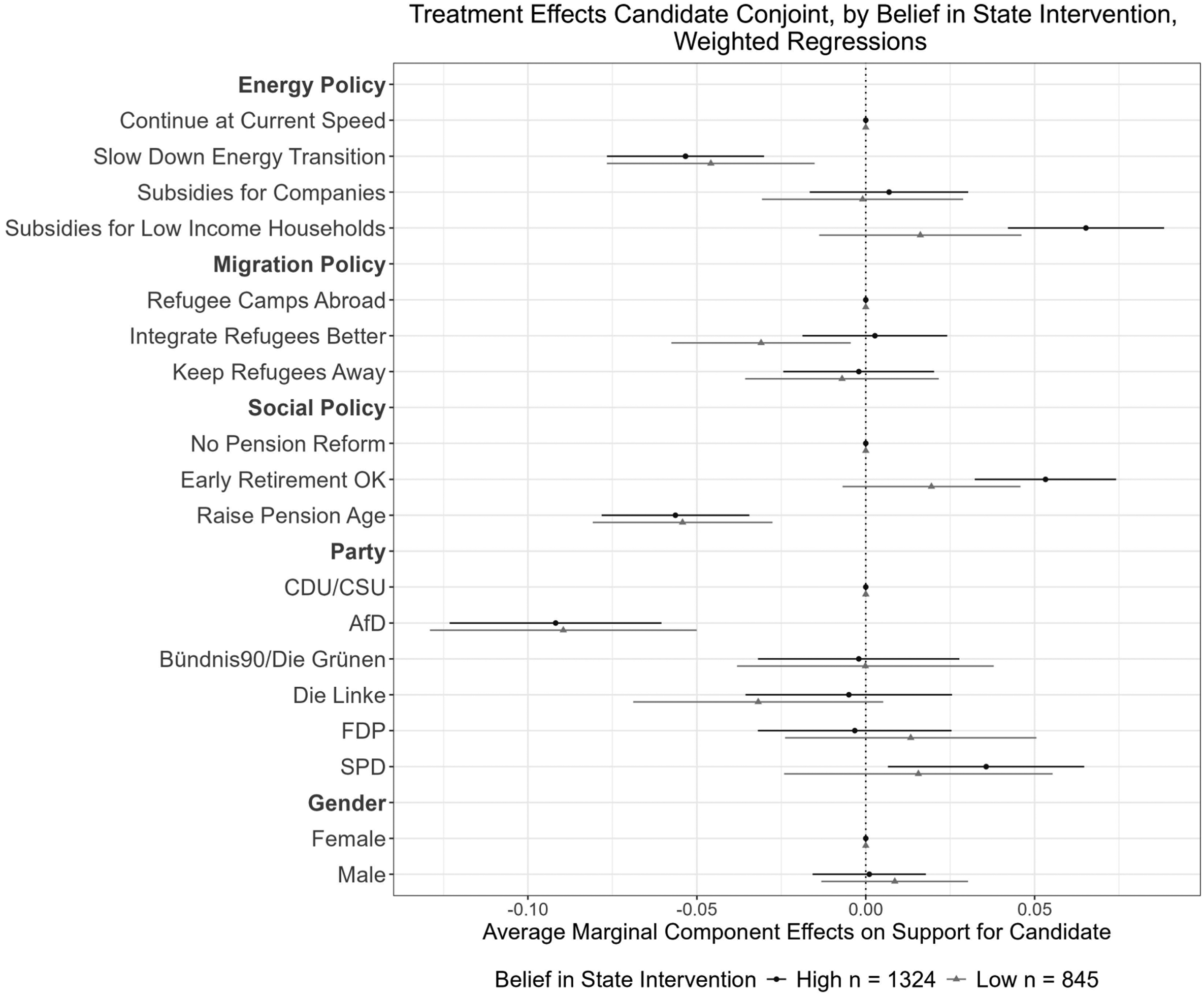
These findings are replicated in additional regression analyses, presented in Appendix Table D.2, models 2 and 3. Here, we rerun OLS regressions to estimate AMCEs and include interaction terms between our measure of belief in state intervention and candidates’ energy policy. The finding that belief in state intervention in managing the economy moderates support for compensating households, but not companies, is replicated across both regression specifications.
One might worry that the moderating effect of belief in state management of the economy is driven by a preference for a specific subset of government policies. To test this possibility, we divide the battery of questions into three categories: questions on supporting the economy, supporting workers, and supporting the sick and elderly. We then repeat the regression analyses for each category. Appendix Table D.6 presents the results. The finding that support for government compensation of low-income households is moderated by support for belief in state intervention is replicated across all three sub-groups. The effects of our measure of belief in the state management of the economy are not simply driven by a preference for social welfare or redistribution. Even when we only use questions on price stability and economic growth, high support for government intervention still moderates support for compensation for low-income households.
In contrast, even when we subset to specific questions in our belief in state intervention in managing the economy battery, we find no support for the conjecture that these beliefs moderates support for compensation paid to companies. Even among individuals who strongly support government intervention to ensure price stability and economic growth, compensating companies for high energy costs does not increase support for political candidates.
We conduct a number of robustness checks for these results. First, Appendix Figure D.3 replicates our main results using marginal means, which we had not preregistered. The results remain substantively unchanged. Second, while our sample of respondents is relatively representative of the German population thanks to quota sampling, one might still worry about slight imbalances that could impact the representativeness of our results. We thus repeat all analyses in this paper with demographic weights that rebalance our sample to fully reflect the age, gender, and income composition of the German population. None of our results change in magnitude or significance when using such weights. Results from weighted regressions are shown in Appendix Section D.2. Third, one may worry that the results are driven by inattentive respondents. We repeat all analyses for the subset of participants who answered at least two questions in the mock-vignette correctly before they were presented with the candidate experiment. For this subgroup, the results are consistent with our overall findings and stronger in magnitude and statistical significance, as presented in Appendix Table D.3, Appendix Figure D.1, and Models 3 and 4 in Appendix Table D.1. Fourth, our measure of belief in state intervention might simply be picking up the effects of other preferences correlated with belief in a strong role for the state in economic management. To test whether this is the case, we re-run all analyses with interactions between conjoint energy policy levels and four possible alternative drivers of preferences: belief in man-made climate change, pre-treatment support for strong mitigation policies, left-right political leaning, and party vote in 2021. Results are shown in Appendix Tables D.4 and D.5. After including these additional interaction terms, the interaction effects between energy policy and belief in state intervention remain unchanged in magnitude and increase in their statistical significance. This result increases our confidence that we are measuring a distinct driver of preference heterogeneity.
To summarize, in the candidate conjoint experiment, we find support for Hypotheses 1 and 1a: Compensation for households - in this case targeting low-income households - that supplement energy transition policies increases support for political candidates. This effect is moderated by individuals’ belief in state intervention in the economy. Those who have high support for state management of the economy react more positively to compensation for households. The first experiment finds no support for Hypotheses 2 and 2a. Compensation for energy-intensive companies did not seem to move voters, regardless of their beliefs in state management of the economy. One possible reason for this null finding is that the potential economic benefits of compensating energy-intensive industries, as specified in this conjoint experiment, might be counteracted by a worry that compensation for businesses disincentivizes decarbonization.
Results Policy Plan Vignette and Conjoint Experiment
As in the candidate conjoint experiment, respondents reacted strongly to the proposal to compensate households presented in the policy plan conjoint experiment. Figure 4 shows the pooled average marginal component effects across all vignette treatments. The underlying regression results are shown in Appendix Table E.2, Model 1. Respondents strongly preferred plans that included compensation for households. Compared to the baseline of no compensation, a low lump sum payment to all households increased support for a policy plan by 9.8 percentage points (p < .01). The most impactful form of compensation, high progressive payments to households, increased support for a policy plan by 18.6 percentage points (p < .01). As the AMCE plots reveal, respondents, on average, preferred high to low payments and progressive to lump-sum payments. The preference for progressive payments trumped the preference for higher payments: Respondents preferred the low progressive dividend to the high lump sum dividend by around 3 percentage points (p < .01). Policy plan conjoint results, all vignette treatments pooled. Note: Figure shows the average marginal component effects for the policy plan conjoint experiment with 95% confidence intervals. Results are based on unweighted OLS-regressions. Standard errors are clustered at the respondent-level.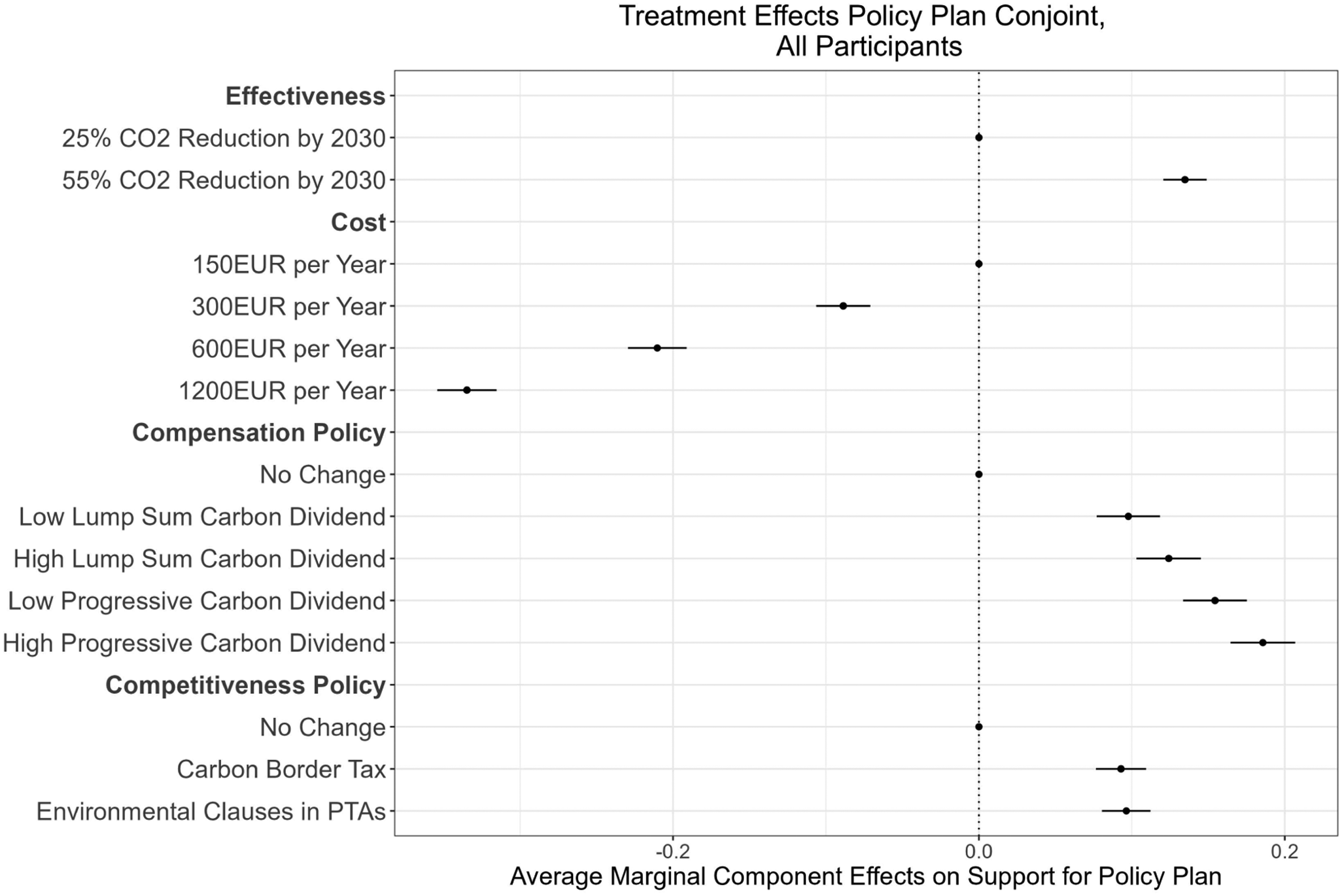
The average respondent also preferred plans that included measures that boost the competitiveness of domestic companies. The carbon border tax and environmental clauses in preferential trade agreements increased support for a plan by around 9.5 percentage points (p < .01). There was no significant difference between respondents’ reactions to the two measures.
The cost and effectiveness of the policy plan also strongly affected respondents’ choices. In line with the results of earlier studies, participants preferred plans that cost less and are more effective. Respondents were 33.5 percentage points less likely to choose a plan that costs households 1200 Euros per year compared to a plan that only costs 150 Euros. They were also 13.5 percentage points more likely to choose a plan that reduces CO2 emissions by 55% compared to 25%.
Figure 5 presents the results of analyses of the policy plan conjoint experiment by Belief in State Intervention using split samples. The underlying regression results are presented in Appendix Table E.1. Again, the average marginal component effects of compensation for households were strongly moderated by respondents’ belief in state intervention in managing the economy. Those with above-median beliefs in state intervention reacted more positively to all forms of compensation in the conjoint experiment. Respondents with above-median beliefs increased their support for policy plans by 22.1 percentage points in reaction to high progressive payments to households. In contrast, respondents with below-median beliefs in government intervention increased their support for policy plans by 13.3 percentage points in reaction to high progressive compensation. Appendix Table E.2 Models 2 through 3 show the results for OLS regressions that interact compensation and competitiveness measures in the conjoint tables with respondents’ level of belief in government intervention. These interaction terms confirm the findings in Figure 5. Policy plan conjoint results, by belief in state intervention. Note: Figure shows the average marginal component effects for the policy plan conjoint experiment with 95% confidence intervals. Sample is split by the variable Belief in State Intervention with low belief - below median-level belief, high belief - median-belief in state intervention in managing the economy or above.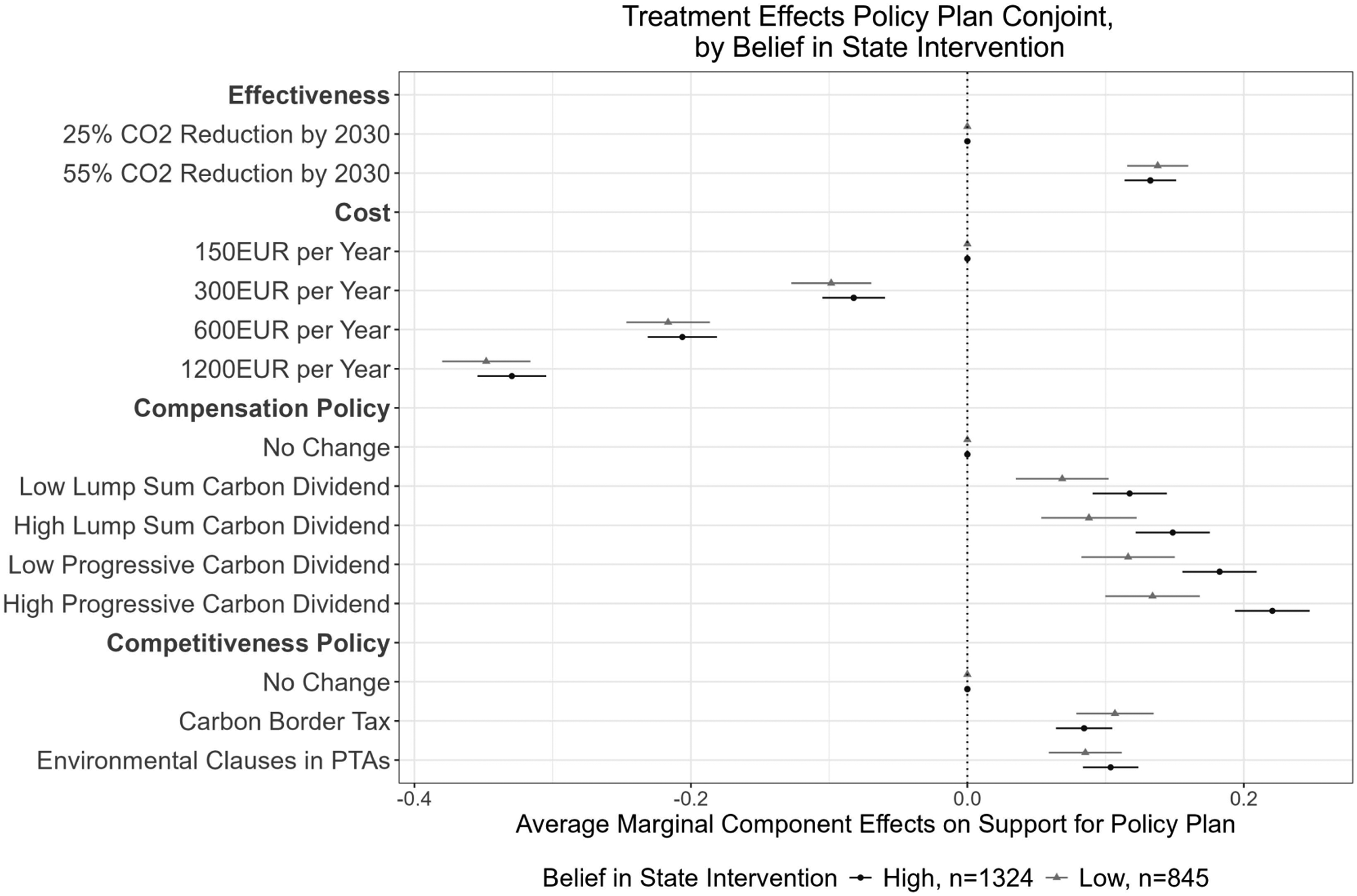
Beliefs in a more important role of the state was a much weaker moderator for respondents’ reactions to competitiveness measures. We find no significant difference between the two subgroups of participants in the split-sample analysis and binary regression specifications. When we measure belief in state intervention as a continuous linear variable, we find a slightly significant negative interaction term between support for government intervention and the carbon border tax (p < .1). While participants who believe in state management of the economy prefer plans with carbon border taxes to plans without competitiveness measures, their positive reaction is smaller in magnitude.
As before, we disaggregate the measure of belief in state intervention into support for different types of government intervention. Results are presented in Appendix Table E.3. Unlike in the candidate conjoint experiment, we do find some differences. Support for intervention on behalf of the sick and elderly and workers appears to be driving the positive interaction effect between beliefs in state intervention and compensation policies for households. A measure of just support for government intervention for price stability and economic growth does not moderate respondents’ reaction to compensation for households. In contrast, the negative interaction between beliefs in state intervention and carbon border taxes is largest and most significant when we subset our measure to only beliefs about economic management. Respondents with a high level of support for economic government intervention still prefer plans with carbon border taxes, but the magnitude of carbon taxes’ positive AMCE is smaller.
The vignette texts shown to respondents ahead of the policy plan conjoint had limited effects and our analyses by vignette treatment are presented in Appendix Table E.7. Priming respondents on compensation for households slightly reduced the positive effect of low lump sum carbon dividends on policy support in the conjoint experiment. Otherwise, the vignette treatments had no significant effect on the AMCEs of compensation measures. For competitiveness measures, the vignette treatment that explained carbon border taxes significantly increased the positive average marginal component effect of both measures on policy plan support. One potential explanation is that this vignette treatment increased participants’ understanding of policies aimed at maintaining companies’ competitiveness.
We also examine the heterogeneity of vignette treatment effects by Beliefs in State Intervention, as presented in Appendix Table E.8. The finding that the compensation treatment slightly decreases the AMCE of low lump sum carbon dividends is driven by those who believe in state intervention. One plausible interpretation is that those who believe that government intervention is effective and appropriate came to expect more than a low lump sum payment after being told about government compensation in the vignette text. We find no heterogeneity by belief in state intervention for vignette treatment effects’ impact on competitiveness policies’ AMCEs.
We conduct a number of robustness checks to confirm our main findings for this experiment. As before, we re-estimate our results using marginal means, as shown in Appendix Figure E.5. The results are substantively the same with this alternative estimation strategy, which we had not preregistered. As in the previous experiment, one might also worry that results are driven by inattentive respondents. We, therefore, repeat all analyses for the subset of respondents who answered at least two questions in the mock vignette correctly before they were presented with the policy plan experiment. The results for this subgroup are consistent with our overall findings and stronger in magnitude and statistical significance, as shown in columns 3 and 4 of Appendix Table E.1, Appendix Table E.4, and Appendix Figure E.1. To ensure that our results are not driven by correlations between beliefs in state management of the economy and other potential sources of heterogeneity, we again re-run our analyses including interaction effects between compensation and competition attribute levels in the policy plan conjoint and four potentially salient variables: belief in man-made climate change, pre-treatment support for strong mitigation policies, left-right political leaning, and party vote in 2021. Results are shown in Appendix Tables E.5 and E.6. The magnitude and statistical significance of the interaction effects between policy design and beliefs in state intervention remain unchanged after the inclusion of these additional interaction terms. This provides evidence consistent with the claim we are measuring a distinct driver of preference heterogeneity. Further, we repeat all of the analyses of conjoint variables separately for the three vignette treatment conditions to make sure that the effects we describe are not conditional on reading a vignette treatment text. While estimates are slightly less precise due to the smaller sample sizes, the conjoint experiments’ AMCEs among just the individual vignette treatment groups are consistent with our pooled findings for the entire sample, as shown in Appendix Tables E.7 and E.8, and Appendix Figures E.3 and E.4. Lastly, as before, we repeat all main analyses using demographic weights. Including demographic weights does not alter any of the findings, as shown in Appendix Tables E.13 and E.14, as well as Appendix Figure E.6.
To summarize our findings from the policy plan experiment, we again find support for Hypotheses 1 and 1a. Compensation for households in all forms increases support for climate policy plans. Generally, voters prefer higher to lower payment amounts and progressive to lump sum compensation payments. These effects are moderated by individuals’ belief in state intervention in the economy. Those who believe that the state can and should intervene in markets react more positively to compensation policies, especially progressive compensation policies. We also find that policies designed to maintain the competitiveness of domestic industry increased support for policy plans, especially after vignette texts explained the role of such policies to participants. However, this effect was not positively moderated by participants’ beliefs about the role of the state in the economy. In some specifications, the interaction was even negative.
This result suggests that whether underlying beliefs in state management positively moderate preferences depends on the details of policies designed to help companies. Note that the two competitiveness measures tested here - carbon border taxes and trade agreements - are not targeted forms of compensation and emphasize free markets over direct government intervention. In comparison to other regulations of foreign products and more direct forms of subsidies for domestic companies, a carbon border tax is a less interventionist policy option. It allows market actors to adjust freely to a new price signal. Further, while some clauses in free trade agreements add new regulations, trade agreements are generally associated with the liberalization of trade and, thus, potentially an overall smaller role of the state in regulating the economy. Thus, one interpretation of our results is that those who support state management of the economy may react more positively to very direct forms of government intervention but do not react more positively to more indirect forms of support that assign a prominent role to economic actors and free market forces.
Results Coal Exit Vignette Experiment
In our final experiment, we seek to replicate the policy environment of the coal exit, which was one of the most significant policy interventions of the outgoing Merkel administration. This vignette differs in two ways from the previous two experimental interventions. First, the common introduction presented to respondents in both the treatment and the control group discusses both the advantages, but also the costs associated with exit from coal. Secondly, the vignette considers additional variation in the design of policies of compensation as compared to the earlier experiments. In the first treatment arm, workers who are likely to suffer loss of employment as a result of the coal exit receive either early retirement benefits or benefits for retraining. In the second vignette, compensation is provided as regional structural aid to former coal regions to boost levels of local employment. In the third treatment arm, compensation is provided as aid to coal producers. In the fourth treatment, compensation is provided to consumers in the form of subsidies for higher electricity prices. Following these vignettes, we asked respondents for their support of the coal exit.
Figure 6 displays the main results of the different compensation treatments. Both compensation for regions and workers have significant effects on the Support for Coal Exit outcome variable. The underlying regression results are shown in Appendix Table F.2 Model 1. The compensation for regions treatment increases the level of support by 8.4 percentage points (p < .01). Similarly, the compensation for workers increases the level of support by 10.4 percentage points (p < .01). By contrast, neither compensation for firms nor compensation for consumers affect the willingness of respondents to support the coal exit. The result on compensation for coal firms suggests that transfers targeted to carbon-intensive firms are unlikely to increase public support for the energy transition. Coal exit vignette results. Note: Figure shows the average treatment effects for the coal exit vignette treatments with 95% confidence intervals. The outcome variable is Support for Coal Exit, a binary measure of support for a full coal exit. Results are based on unweighted OLS-regressions.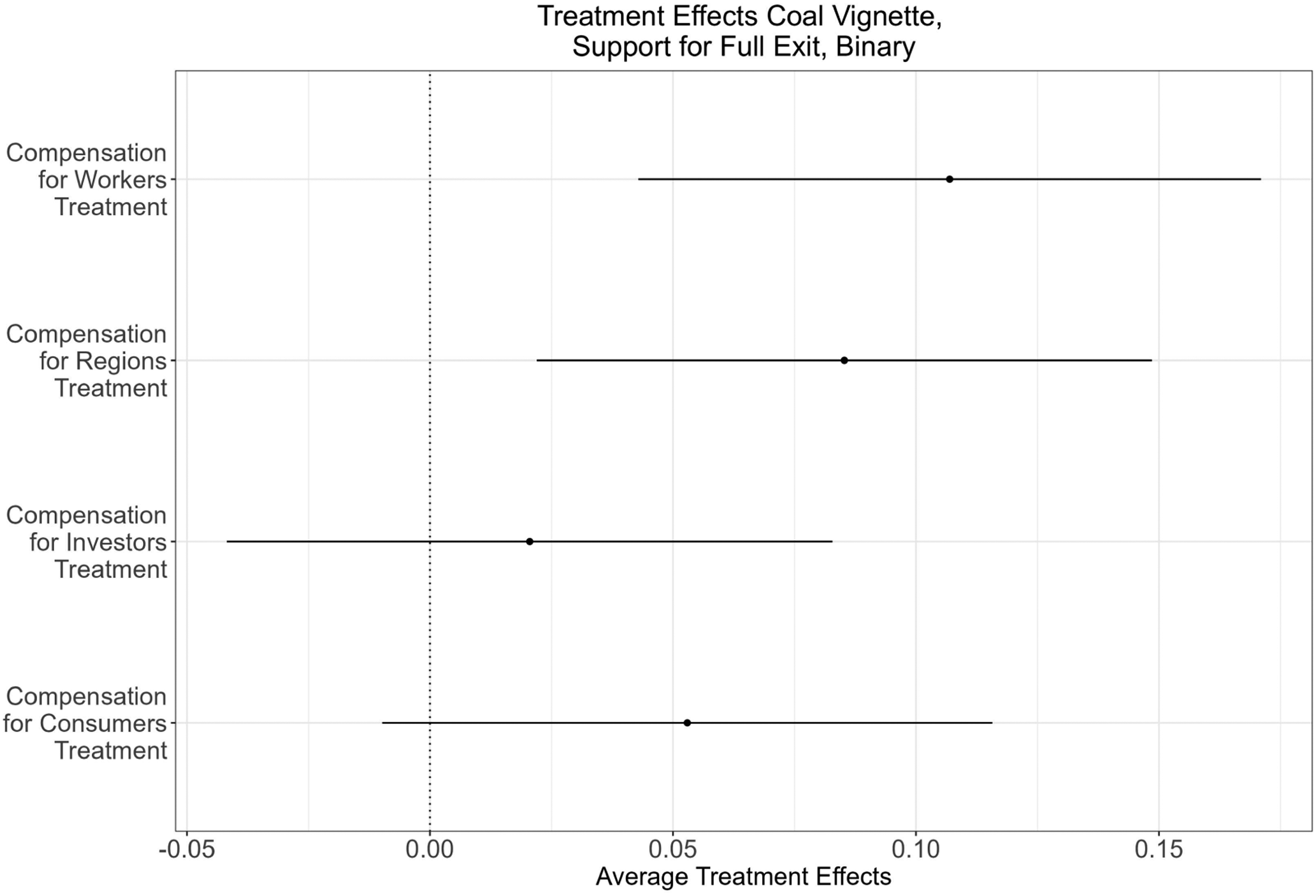
The results presented in Figure 7 explore heterogeneity among respondents with different beliefs about the role of the state in managing the economy. Underlying regression results are shown in Appendix Table F.1. In our main specification, Beliefs in State Intervention does not positively moderate compensation treatments’ effects on support for the coal exit. In all specifications, the interaction term is either null or even negative. Coal exit vignette results, by belief in state intervention. Note: Figure shows the average treatment effects for the coal exit vignette experiment with 95% confidence intervals. The outcome variable is Support for Coal Exit, a binary measure of support for a full coal exit. Results are based on unweighted OLS-regressions. Sample is split by the variable Belief in State Intervention with low belief - below median-level belief, high belief - median-belief in state intervention in managing the economy or above.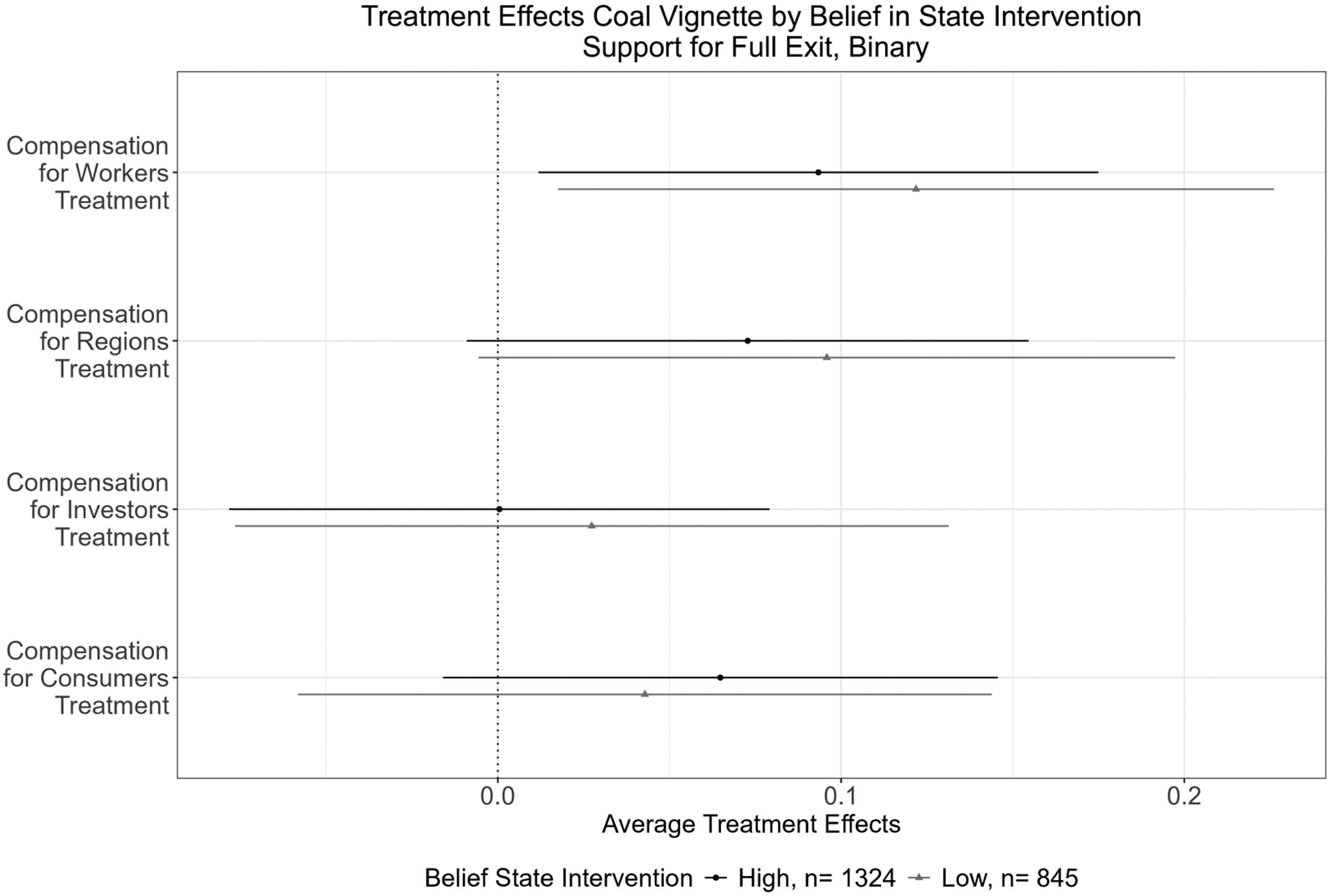
As in the second experiment, these results suggest that the moderating effect of underlying beliefs in the appropriateness of state intervention depends on the directness and intrusiveness of the suggested government intervention. For example, the described compensation for workers affected by the coal exit relies on companies retraining workers with the help of government money. Thus, the policy gives a prominent role to free market actors. Similarly, regional compensation emphasizes measures that make regions more attractive for companies, which then freely decide where to locate. The prominent role of companies and market forces in these measures may explain why those who support a more active role of the state in managing the economy do not react more positively than those who don’t.
As before, we conduct a number of robustness checks. First, to ensure that results are not driven by inattentive respondents, we subset our analysis to only those who passed the mock vignette before the coal vignette experiment. Results for this subset mirror results for the entire respondent pool, as shown in Appendix Table F.3. We further repeat our regression analyses, including interaction terms between treatment and belief in state intervention variables, shown in Appendix Table F.2. The interactions between Belief in State Intervention and the vignette treatments remain statistically insignificant in these specifications. Lastly, we repeat all analyses using three alternative dependent variables. First, we use a continuous measure of support for a full coal exit that ranges from 1 to 5 on the Likert scale. Results are shown in Appendix F.2 and confirm all of the findings from our main specifications. In addition, we repeat all analyses with two dependent variables that are based on an alternative outcome question, which asked respondents for their preferred year of a full coal exit. A continuous dependent variable captures how many years before 2050 respondents’ preferred coal exit date occurs. A second, binary measure takes a value of 1 if the preferred year is before the government’s planned exit year at the time of the survey - 2038 - and 0 otherwise. Results for these alternative measures are shown in Appendices F3 and F4. They replicate the positive direction of the effect of compensation for workers and regions, although results using these alternative measures are less precise and do not reach statistical significance in most specifications.
Table Summarizing Experimental Results.
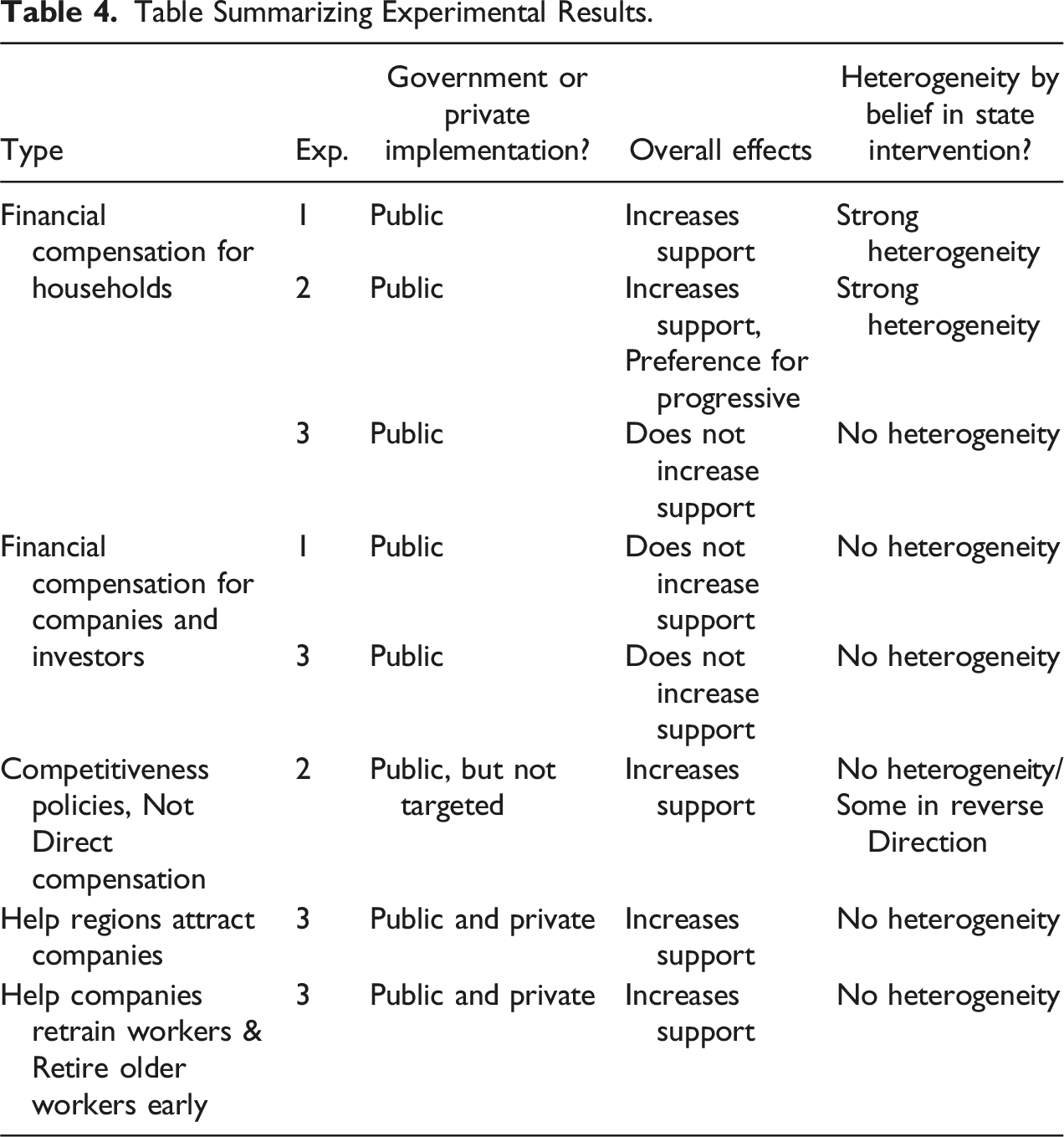
One result that emerges, which goes against our initial expectations, is that respondents, regardless of their general beliefs in state intervention, do not react positively to direct compensation to companies and investors. This could be due to a variety of reasons. First, participants might not believe that the state is effective in regulating business and thus oppose compensation given directly to companies. Yet, as Appendix Table F.15 shows, we find no positive reaction to compensation for companies and investors, even among the sub-sample of respondents who stated that the government should support industry to ensure growth. These participants should be more likely to believe that government can regulate business effectively. Two other explanations are also plausible: First, participants might worry that compensation to energy-intensive companies and investors in the coal industry distorts incentives to decarbonize. Second, as we see a general preference for progressive forms of compensation in our survey, the lack of support for direct compensation to businesses may be driven by a concern over distributive justice. Examining which of these reasons is driving our results remains a topic of future research.
In contrast to direct forms of compensation for companies and investors, more indirect forms of support that aim to increase the overall competitiveness of the domestic economy, such as a Carbon Border Adjustment Mechanism, do increase support for energy transition policies. Further, unlike our findings on firms, we find that the German public increases their support for energy transition policies in reaction to compensation to households, especially when such compensation is progressive, as well as workers. As hypothesized, targeted compensation policies implemented directly by the government that are generally popular lead to a stronger positive reaction among those with a generally higher belief in the effectiveness and appropriateness of state intervention. For policies that heavily involve private actors or market forces, this is not the case.
Conclusion
Transitioning away from carbon-intensive to more renewable energy sources is one key lever through which countries can mitigate climate change. Such transitions, however, create costs in terms of energy prices, jobs, and economic activity across consumers, regions, workers, and firms. These costs have the potential to generate substantial political opposition to mitigation policies even in a setting where there is general support for combating climate change. In this study, we investigate whether the design of climate policies can address these cost concerns and increase support for climate mitigation policy and what factors explain variation in the impact of compensatory policies.
We present three survey experiments designed to test how compensation and trade competition measures tied to climate policy affect public support for a transition to greener energy sources. The survey was fielded in Germany during the 2021 federal election campaign, with each experiment designed to explore the effects of policy design in the context of active policy debates in Germany. We find that compensation measures do raise support for electoral candidates who run on a pro-energy transition platform, and such policies further raise support for costly climate policy plans. Compensation policies have a larger impact on public support when they target consumers rather than producers, and when they are more progressive. Policies designed to ensure the competitiveness of domestic firms despite higher energy costs—specifically carbon border taxes and the diffusion of environmental rules through trade policy—can also raise support for mitigation policies. However, we find this effect to be small unless the logic of such interventions is explained. Other forms of support for domestic industry that go beyond “leveling the international playing field”—like direct subsidies to energy-intensive industry—do not increase support for policy plans. One implication is that current EU plans to replace direct compensation in the form of free carbon allowances for energy-intensive companies under the Emissions Trading System (ETS), which is substantively similar to the subsidies to energy-intensive companies we tested in experiment 1, with a more indirect Carbon Border Adjustment mechanism, as tested in experiment 2, may increase public support for the ETS. As our results in experiment 2 demonstrate, this is especially likely if the EU can successfully explain how the CBAM functions to the public.
We further argue that variation in beliefs about state intervention in the economy shapes differences across citizens in the extent to which compensation matters for their support for climate policy. We find significant differences in sensitivity to compensation for consumers in both the candidate conjoint experiment and the climate policy plan conjoint experiment. Respondents who more broadly think the government can and should intervene in the economy are more likely to be moved by climate policies with explicit compensatory design provisions. This finding connects longstanding differences in the public about the role of the state to conflict over climate policy.
Taken together, our study indicates numerous policy design approaches that have the potential to substantially increase support for climate mitigation policy. Our analysis also suggests that to the extent that compensation is necessary to design resilient support for the energy transition, political conflict over that transition is likely to overlap with political differences about the role of the state in the economy. In addition to providing a better lens for understanding political conflict over the energy transition, this phenomenon suggests the possibility of a trade-off that faces policymakers. For some combinations of compensation policy and the distribution of voter beliefs in state intervention, more compensation may lose as many supporters of climate reforms as it gains. The treatments in our experiments do not reveal such a combination in Germany but it is a logical implication of the cleavage. 9
As our study focused on public opinion in Germany, it is important to highlight the scope conditions of our findings. First, Germany has a high baseline level of diffuse support for climate action. As such, conflict should be more likely to center around details of policy design rather than the existence of and necessity to combat climate change. Further, Germany is a wealthy country with high state capacity and a long history of state intervention to steer the economy and ensure citizens’ welfare. This is reflected in the fact that, on average, support for state intervention is relatively high. Future research should investigate whether our findings hold in societies with higher levels of polarization around climate change and lower levels of state capacity. Another potentially fruitful area of future research is that of public support for EU-level climate policies. For example, future research might investigate whether our findings regarding support for government intervention hold when the government in question is the EU rather than the national government.
Supplemental Material
Supplemental Material - Compensation, Beliefs in State Intervention, and Support for the Energy Transition
Supplemental Material for Compensation, Beliefs in State Intervention, and Support for the Energy Transition by Isabela Mares, Kenneth Scheve, and Christina Toenshoff in Comparative Political Studies.
Footnotes
Acknowledgements
We thank Matto Mildenberger, Jared Finnegan, Reto Bürgisser and participants at the 2022 Annual Meeting of the American Political Science Association as well as the 2023 workshop “How People Think About the Economy” at UCL and three anonymous reviewers for their insightful comments. We thank Yale University for financial support.
Declaration of Conflicting Interests
The author(s) declared no potential conflicts of interest with respect to the research, authorship, and/or publication of this article.
Funding
The authors received financial support for the research in this article from Yale University.

Data Availability Statement
Replication materials, including all datasets and replication code can be found at (Toenshoff et al., 2025).
Supplemental Material
Supplemental material for this article is available online.
Notes
Author Biographies
References
Supplementary Material
Please find the following supplemental material available below.
For Open Access articles published under a Creative Commons License, all supplemental material carries the same license as the article it is associated with.
For non-Open Access articles published, all supplemental material carries a non-exclusive license, and permission requests for re-use of supplemental material or any part of supplemental material shall be sent directly to the copyright owner as specified in the copyright notice associated with the article.
