



Abstract
How do core principles of modern democracy impact the development of state spending? Drawing on Dahl’s (1971) conceptualization of polyarchy, we explain that public budgets in modern states evolved according to how electoral competition and suffrage incorporated key actors within societies. Before contestation and suffrage, land-owning elites led states that focused spending on repressive capacity to maintain regime security. Contestation without broad participation incorporated urban elites who benefited from spending on economic development. Extending suffrage to the masses expanded spending on social welfare but only when regimes allowed for political competition. To test the hypotheses, we collect data on patterns of government finance for over thirty countries across the globe between the early 19th and mid-20th centuries. Two-way fixed effects models and multiple sensitivity analyses offer strong evidence for the theoretical expectations. The findings expand on a substantial literature to form a more complete understanding of democracy and public budgets.
How do democratic institutions influence state spending? Scholars argue that democracy led to a decline in spending on the military and a rise in social welfare spending (Ansell & Lindvall, 2020; Ansell & Samuels, 2014; Lindert, 2004; Mann, 2012). Prior research has employed social group theory to explain that democracies increased spending on social policies and social welfare because suffrage rights institutionalized the interests of the masses (Esping-Andersen, 1990; Haggard & Kaufman, 2009; Skocpol, 1992). But research has generally overlooked whether democracy impacted spending on economic development, which was another highly important form of spending especially during industrialization (Mitchell, 2022; Morales-Arilla et al., 2023). State-based investments in transportation, communication, infrastructure, and industrial production emerged during the late modern period which contributed to economic development (Chenery, 1960; Rogowski et al., 2022). Early democratic states were also first-movers in industrial production, and scholars have argued this was due to democratic institutions (Abramson & Montero, 2020; Khan & Sokoloff, 2004). Did political institutions encourage spending on economic development? Moreover, if democracy did in fact encourage development spending then how do we rectify that one single concept – democracy – explains the growth of both economic development and social welfare spending, which are very different forms of spending that occurred at different time periods?
In this paper, we suggest that the key to solve this puzzle is to understand that modern democracy is a multidimensional concept that experienced a sequence in its development. Drawing on Dahl’s (1971) path-breaking conceptualization of polyarchy, we argue that the two core elements of modern representative democracy – contestation (electoral competition) and participation (suffrage) – explain the evolution of state budgets in modern history. We show that embedding Dahl’s framework of political institutions within social group theory explains how democracy influenced spending on the military, economic development, and social welfare. By building upon our common understanding of how socioeconomic classes obtained new democratic institutions at different points in history, our argument explains why the creation of different political institutions led to new forms of state spending.
According to Dahl (1971), the actors who obtained contestation and participation are distinguished by their economic classes. A rising middle class of urban economic elites obtained political rights of contestation to constrain executive power in order to protect their property (Ansell & Samuels, 2014; Bates & Donald Lien, 1985; Moore, 1966; North & Weingast, 1989). 1 But these elites did not want to extend to the lower classes the rights of participation in selecting the government. During late industrialization labor, women, and minorities used opportunities created by economic concentration to conquer their voting rights by holding strikes, boycotts, and riots (Collier & Collier, 1991; Przeworski, 2009).
Our argument for state spending explains three distinct stages of political development according to how political institutions empower particular socioeconomic classes. When regimes were led by landed elites, institutions for both contestation and participation were very low. Regimes only needed to spend on repressive capacity to appease their military constituents but also to enforce order and security through coercion. When urban elites obtained rights of contestation but without broad participation, regimes increased economic spending that protected and promoted investments. When regimes expanded suffrage to incorporate the masses, political parties had to supply social services and welfare to compete for their support to win office.
The evolution of state budgets during the late 19th and early 20th centuries appears consistent with the implications of the argument for how democratic institutions emerged. Based on our newly collected cross-national data on spending items, which we discuss in the Research Design section, Figure 1 below presents time-series averages of state investments in security, bureaucratic administration, economic development, and social welfare. Initial declines in security spending gave rise to spending on administration and development at a time when countries were transitioning to competitive oligarchy. Later when mass publics obtained their suffrage rights, governments began expanding social welfare programs. Average shares of spending on security, administration, economic development, and social welfare between 1800–1975.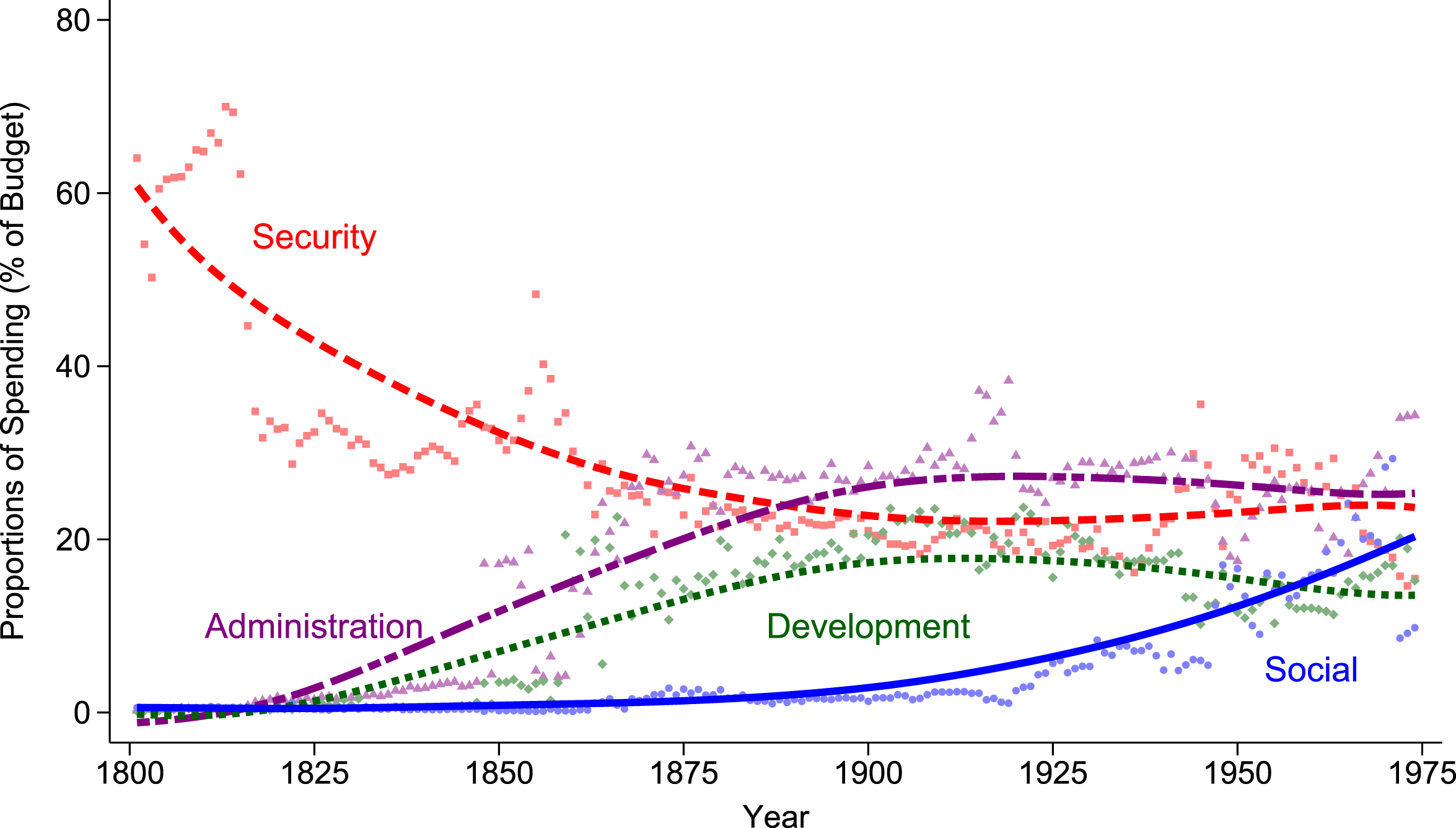
By utilizing new cross-national data on regime budgets in the late modern and contemporary periods, it becomes possible to shed light on how the development of modern democracy went hand in hand with varying allocations of state budgets across time and space. Our sample includes 36 countries at different stages of development across the globe between 1800–1975. We test the hypotheses by estimating regressions with two-way fixed effects and additionally test a battery of robustness checks including multiple imputation, truncated regression, possible omitted variables biases, alternative data and measurement, and the conditional effects of social groups.
The findings build upon the existing but incomplete understanding of class politics, political institutions, and state spending. Consistent with the prior literature, we find that democratic institutions reduce the proportion of spending on the military (Goldsmith, 2003; Mann, 2012). But we find this is only the case under conditions of widespread suffrage. Also consistent with the prior literature, we find that the expansion of suffrage increased social spending (Esping-Andersen, 1990; Lindert, 2004). But more specifically, we find that the effect of suffrage on social spending is greater when institutions for democratic contestation are higher, which is consistent with our argument for political institutions. We also find novel evidence that spending on economic development increased when urban elites created early institutions of political competition but before suffrage was widespread. Together, these findings provide a more complete understanding for how class politics have influenced government policy through democratic institutions. However, we do not find systematic evidence that political institutions predict administrative spending, which suggests a revision to the literature on bureaucratic growth and state capacity (Besley & Persson, 2011; Boix, 2001).
Our argument builds on existing models of political survival by considering the implications of different democratic institutions that determine the extent of political competition and participation in society (Bueno de Mesquita et al., 2003; Paine, 2021). Authoritarian regimes have created innovative institutions to manage relationships between their rulers and their winning coalitions (Gandhi, 2008; Higashijima, 2022; Meng, 2020; Mitchell, 2023; Svolik, 2012; Wright, 2008). Our argument and findings build on this literature by incorporating socioeconomic actors into a model of multidimensional democratic institutions. We draw on Dahl’s (1971) conceptualization of democratic institutions to explain how broadening the regime to incorporate various socioeconomic groups changes government budgets. 2
This study also contributes to the literature on state capacity by providing a more general framework of political development as a basis to explain the evolution of various forms of government expenditures. The existing literature has focused on the development of specific aspects of state capacity. For instance, how conflict and political institutions influenced fiscal capacity (Besley & Persson, 2009; Dincecco, 2011; Ricciuti et al., 2019; Tilly, 1992), why governments invest in legal capacity (Besley & Persson, 2011), and how the expansion of suffrage increased social services and welfare (Abrams and Settle 1999; Aidt & Dallal, 2008; Lindert, 2004). But the literature has only focused on each of these aspects of state capacity as separate phenomena. Our study builds on this literature by constructing an argument that incorporates how changes in the different dimensions of democratic institutions impact government budget allocations, with implications for different state capacities.
In addition to the theoretical contributions, this paper tests the implications of the argument with a new global data set on budget allocations in historical regimes. Scholars have collected data on regime finance during the late modern period (Flora et al., 1987; Mann, 2012; A.M. Mitchell, 2022; B.R. Mitchell, 1975). However, prior studies do not account for the various components of budgets or lack global temporal coverage in their samples. Existing data do not account for specific budget categories or they operationalize their own variables of interest which may not be theoretically relevant to other studies. We collect new data for individual ministries and government functions which allow the operationalization of variables according to the conceptual definitions in our theory. The new data allow a more comprehensive empirical analysis of state development. Our new data also expand the historical cases of regime finance across regions of the globe including North, Central, and South America; North Africa; West, South, and East Asia; and across Europe.
Institutions, Budgets, and State-Building
Before explaining how political institutions impact the development of state spending, it is necessary to first define what a state is. A good starting point is the Dictionary of Sociology that defines a state as “A distinct set of institutions that has the authority to make the rules which govern a society…. It is, rather, a set of institutions which describe the terrain and parameters for political conflicts between various interests over the use of resources and the direction of public policy.” This definition does not require that states are entities separate from society which may have their own interests (Scott, 2020), yet this definition is flexible enough to allow states to reflect societal interests (Mann, 1977). We argue below that democratic political institutions incorporated the interests of different socioeconomic groups with implications for state spending.
A major accomplishment in our understanding of the political economy of democracy and dictatorship has been the explanation for why democratic institutions encourage spending on public goods. Democratic institutions link leader survival to broader societal interests through the expansion of a winning coalition (Bueno de Mesquita et al., 2003). Authoritarian governments are more inclined to distribute rents for elites while more democratic governments provide higher spending on public goods (Brown & Hunter, 1999; Deacon, 2009; Min, 2015; Plümper & Martin, 2003; Stasavage, 2005). These findings are significant but are also limited in a few ways. 3
Categories of Spending.
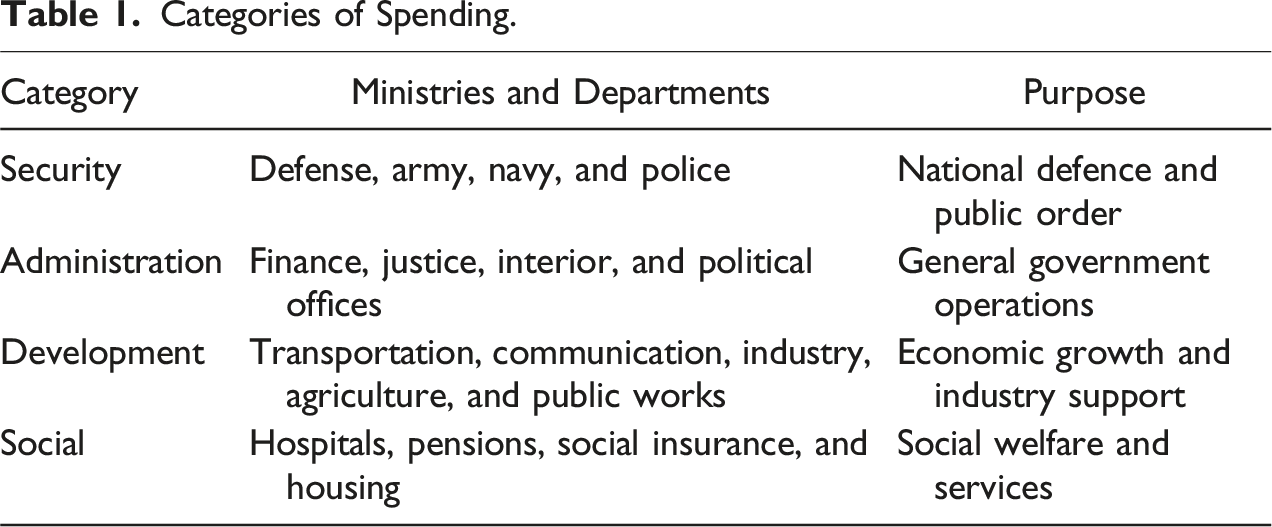
Security spending regards the expenditures devoted to maintaining the stability of the regime, defense from foreign aggression, and order within the population through the threat or use of violence. Security spending includes expenditures on the departments of the army and navy, as well as public security and policing. In some states, such as France, the police were nationally organized within the military. In other states, such as Germany, the police were decentralized at the subnational level.
Administration spending regards the portion of the budget devoted to bureaucratic functions, the operation of political institutions, and resolving disputes. While any agency is technically part of the bureaucracy, those agencies whose functions are for the operation of the government such as finance, justice, and interior, are within the category of administration spending. This category also includes political offices such as for monarchs, councils, and elected representatives.
Economic development spending is for the purpose of growing the economy and supporting industries. Economic development spending includes departments of commerce, agriculture, and industry, as well as infrastructure, communication, and transportation. Development spending is broadly conceptualized to include market interventions such as subsidies as well as government organizations such as post offices.
Social spending is defined to include social services such as housing but also social welfare such as unemployment insurance and public health expenditures. Note that education and religion are not included in this conception of social spending. During the late modern period education was often used as propaganda to manage the public (Paglayan, 2021, 2022), even though education played a crucial role in state and economic development. Education programs were also often administered by religious organizations with the purpose of augmenting state authority. For these reasons, education and religion are omitted to assure a more coherent conceptual definition of social spending.
Many studies have focused on individual types of government spending, such as spending on the military (Mann, 2012; Rosh, 1988), the bureaucracy (Boix, 2001), and social services such as welfare and education (Aidt & Dallal, 2008; Ansell, 2010; Rudra & Haggard, 2005). However, prior research has not considered how these forms of spending are interrelated through a single comprehensive model of democracy and state development. A comprehensive, nuanced understanding of public spending patterns is necessary because such a theory predicts multiple items of state spending rather than only one spending item. For example, the literature finds that democracies have lower proportions of military spending compared to dictatorships (Albalate et al., 2012; Brauner, 2015; Goldsmith, 2003). Also, democracies increased social spending when suffrage was extended to labor and women (Esping-Andersen, 1990; Skocpol, 1992). This literature argues that democratic institutions require leaders to allocate more of their resources towards public purposes than do authoritarian institutions. But this literature is unable to theoretically distinguish between various types of public spending because the explanations are based on a uni-dimensional concept of democracy. Moreover, spending on economic development is overlooked in this literature.
Another limitation of the prior literature is that political regimes are defined too narrowly, which is in part due to the temporal scope of prior studies. Put differently, cross-national studies of political institutions and budget allocations have typically investigated government expenditures since the beginning of the third wave of democratization during the mid-1970s, with only a few exceptions (Goldsmith, 2003; Lindert, 2004; Mann, 2012). This temporal limitation is understandable for practical and substantive reasons. However, focusing our efforts only on the third wave risks neglecting a fundamental question in the study of democracy and spending: do different aspects of democratic institutions (i.e., contestation and participation) have identical implications for patterns of public spending?
Studying the first and second waves of democratization allows us to answer this question because of the greater variation in levels of inclusiveness and competitiveness during these periods. Regimes initially allowed only limited forms of government contestation and suffrage was highly exclusive. During this time period, countries created strikingly different institutions for both their competitiveness of elections and their extent of suffrage. By 1975 when the third wave of democratization started, global standards helped domestic and international actors pressure even autocratic governments to formally confer voting rights to all adults. 4 From then on, rights of contestation became the main dimension by which we distinguish different democracies. However, investigating the independent effects of contestation and participation remains an important research agenda to fully understand the overall impact of democratic institutions on patterns of public spending.
We argue that different combinations of these democratic institutions throughout the first two waves had implications for socioeconomic groups who had heterogeneous preferences for government policy. Using new historical data on patterns of budget allocations during those periods helps us better understand how the development of modern democracy relates to processes of state development. In the next section, we provide our argument for how distinct compositions of democratic institutions influenced spending on different substantive government functions.
How Political Institutions Incentivize Regime Spending
In order to stay in power, a political leader must spend the resources of the regime to satisfy constituents and maintain a willing coalition. The political institutions of a regime determine which groups in society are permitted to participate in the politics of the government. We argue that regimes create institutions to maintain political stability against threats from specific societal groups. The actors whose support the regime seeks to gain incentivize the regime’s allocation of budgetary resources. These actors, which are distinguishable by socioeconomic class, have particular interests in government policies to benefit themselves.
We assume four socioeconomic actors including landed elites, the military, urban elites, and the masses. Following major works on this subject, the argument begins with a closed dictatorship that is ruled by landed elites (Ansell & Samuels, 2014; Dahl, 1971; Moore, 1966). As a general assumption, a regime’s constituents prefer to rule without the regime being pressured or overthrown by a challenger group who wants to expand government policies. Each of the socioeconomic groups prefer that the government allocate funds in support of their interests. The landed elite and military prefer spending to maintain security, urban elites prefer spending to support economic markets, and the masses prefer spending on social welfare and social services.
The political institutions in our model follow Dahl’s conceptual definitions of liberalization and inclusiveness (Dahl, 1971), which are also known as public contestation and participation. Institutions for public contestation allow a political opposition to organize, have voice, and contest regime policies typically through elections. Institutions for participation allow the right to participate in the government, which is typically represented by suffrage. These institutions provide distinct but related rights, and expansion of contestation and participation often occurred separately. 5 While aspects of democracy and collective governance have existed for millennia, the growth of public contestation during the late modern period arose especially in Europe and spread throughout the world (Stasavage, 2020). Before 1940, these contestation institutions emerged and matured before institutions that governed participation expanded. But after 1940, most of the remaining closed regimes created broad participatory institutions while limiting institutions for contestation (Miller, 2015a). 6
Contestation and Participation Reduce Spending for Landed Elites and the Military
A state’s first priority is to obtain a monopoly on violence over a given territory (Weber et al., 2004). A monopoly on violence allows a ruler to provide internal order and external security which benefits the citizenry (Tilly, 1992) but also the ability to use the state to enrich themselves (Olson, 1993). Our common understanding is that landed elites tended to rule closed regimes through a monopoly on violence rather than power-sharing with other socioeconomic classes. This was because fixed capital does not have an exit option if threatened (Clark et al., 2017), which encouraged the landed aristocracy to protect their property through the use of state violence (Ansell & Samuels, 2014; Moore, 1966; Ziblatt, 2017). The state institution that obtains this monopoly is the military, and especially the terrestrial forces. A ruler and their regime must invest in an army to maintain order through the threat of repression. In historical regimes, when a rebellion occurred and the ruler did not want to negotiate or succumb to the demands, the ruler sent the army to end the uprising. 7
It is often the threat of violence and not necessarily the actual use of violence which keeps order. The threat of the use of violence is created through investments in repressive capacity, which correspond to spending on the military. The ruler not only has the incentive to fund the military to maintain a monopoly on violence to keep order but also to maintain the loyalty of the military. By funding the military, the ruler creates a source of power that could be used to overthrow the regime. This creates the so-called guardianship dilemma for the ruler (Meng & Paine, 2022; Svolik, 2012). If the ruler does not fund the military, then other societal actors may rise up to take over the government. But if the ruler does fund the military then disgruntled individuals within the military might use the power of the organization to overthrow the regime.
Examples of governments failing to appease their militaries through budgetary allocations have been common throughout history. For example, the Brazilian Empire under Dom Pedro II did not maintain a large budget for the army but instead focused much of the state’s revenues on the economy, infrastructure, and public works. The army was furious at the lack of funding, seized power in a coup, and installed a military dictator (who subsequently increased the army’s funding but also ruined the country’s finances, Dudley, 1976). In another example early in Japan’s Taisho Period, military leader Aritomo Yamagata successfully removed Prime Minister Kinmochi Saionji from office for reducing the military’s budget. Yamagata’s successful legal coup set a pre-war precedent in Japan that the military maintained veto power over budgetary allocations (Orbach, 2017, Ch 7).
In regimes with both limited contestation and participation, a ruler may find it useful to mitigate the guardianship dilemma by funding the military for both purposes of building repressive capacity but also appeasing potential challengers. Since both contestation and participation are limited, the ruler can credibly commit to protecting military interests because there is little pressure on the dictator to fund the interests of other socioeconomic groups. Dictators often create policy in conjunction with elites. However, when a closed regime is secure, the ruler faces less pressure to meet the demands of the urban elites or the masses when their interests do not align. In closed regimes, budgetary allocations to create a loyal military with a repressive capacity are often sufficient to impose order on the citizenry while also allowing the regime to benefit from the remainder of funding without significant spending on other activities such as administration, economic development, or social protections.
When a closed regime creates new political institutions, it enables pressure from other social classes to allocate the budget for other functions beyond repressive capacity. A regime that builds political institutions to target the support of other socioeconomic groups decreases the proportion of the budget spent on repressive capacity. This is a testable empirical implication.
Institutions that allow contestation and participation decrease shares of security spending.
Contestation Without Participation Increases Spending for Urban Elites
As economies grew during the late modern period, urban elites were substantially rewarded with profits from industries that thrived on new technological innovations, oligarchic markets, cheap resource extraction from foreign sources, and low costs of production due to low wages and labor protections. As the economic resources of urban elites increased, so did their political demands as well as the dependence of the state on their capital (Przeworski & Wallerstein, 1988). This resource dependence led to urban elites being able to demand political rights to protect their economic interests from the regime which gave them voice for how the regime’s resources were spent (North & Weingast, 1989). 8
Historical regimes were often ruled by a land-owning elite that restricted other social classes from participating in choosing the government or government policies. These regimes only yielded rights of contestation once industrialization raised the ability for urban elites to challenge the stability of their governments (Ansell & Samuels, 2010, 2014). The new political institutions that regimes created allowed for public contestation but did not allow for widespread participation. Rulers initially only extended the rights of contestation to economic elites and excluded the masses through rules on property ownership, literacy, gender, and non-secret ballots (Sokoloff & Engerman, 2000). This was preferable to the economic elites since their interests differed from those of women, minorities, and labor. Limited rights of participation meant that the economic elites did not have to share the allocation of regime budgets with the interests of the masses.
The incorporation of urban elites into the regime to maintain stability is also consistent with the preferences of the ruler’s other constituent, the military. If elites have sufficient economic and political power to pose a threat to the stability of the regime then the military has reason to accept the ruler’s negotiated outcome rather than fight a civil conflict. The reason is simply that bargaining is often less costly than conflict (Fearon, 1995). Since the rights of contestation were initially only extended to elites, the impact on the military’s budget was also limited. Moreover, the interests of military leaders and economic elites can at times overlap within policies such as industries that produce war machines, and overlap by the interests of powerful families within society.
Urban elites prefer administrative and economic spending that protects their investments and improves their profitability. This argument builds on existing theory that elites in government created fiscal and legal capacities to pursue development goals and protect property ownership (Besley & Persson, 2009). Fiscal and legal capacities require bureaucratic administrations, which require investments from government budgets. As urban elites are better able to influence government policies, the argument suggests that governments will spend more on administrative functions. 9
Economic elites as holders of capital also benefited from investments in agriculture, industry, and infrastructure that developed markets and provided goods that private actors alone were not able to supply. Government monopolies or publicly funded subsidies to support the provision of important economic functions were necessary for industrialization, as was a bureaucracy capable of regulating new industrial markets (Vogler, 2022, 2023). For example, railroads historically began as public enterprises but even private rail lines eventually required public administration and regulation. 10 Post offices are another example of economically important services that states provide to boost business activities (Rogowski et al., 2022). Moreover, dictators often lacked incentives to invest in their economies out of fear that it could empower other socioeconomic actors (Acemoglu & Robinson, 2006; Schmid & Huang, 2017).
When regimes were closed to political contestation, dictators had limited incentives to fund the bureaucracy and economic development. Once urban elites had successfully gained access to contesting government policies, regimes were pressured to increase spending for these purposes. The argument suggests that political institutions of contestation that incorporated economic elites, but excluded the masses, led to more administrative and economic development spending.
Institutions for contestation increase shares of administrative spending when participation is limited.
Institutions for contestation increase shares of economic development spending when participation is limited.
Participation With Contestation Increases Spending for the Masses
Governments did not willingly expand political institutions to incorporate the masses. Rather, governments merely acquiesced because of the political threats of the masses to overthrow their regimes, particularly after they had fought foreign conflicts (Przeworski, 2009) but also in societies with more equal income distributions (Engerman & Sokoloff, 2005). Women, minorities, and labor organized strikes and protests effectively, which resulted in regimes expanding institutions that allowed these groups to contest their governments. Once suffrage was granted to the masses, governments in the form of parties had to compete to win votes which meant that government policies needed to account for the budgetary preferences of the masses.
The constituents who had already obtained incorporation into the regime, which were the landed elites, the military, and urban elites, had reason to exclude the masses from participating in contesting the government. The masses are the most populous socioeconomic class and their participation in choosing governments threatened a significant shift in government priorities that would force the military and elites to divert funds toward the interests of the masses. Nevertheless, just as economic elites’ threats to overthrow their regimes forced rulers to expand institutions for political contestation, the revolutionary threats of the masses forced regimes to expand institutions for political participation.
For example, in the 19th century the masses in various countries attempted to obtain better political and economic rights, which governments resisted. Industrialization improved transportation and communication technology which enabled protests to organize and spread much more easily. In 1848, protests spread across Europe however governments repressed these protests and resisted making major political or economic concessions (Weyland, 2014).
Decades later, protests were much more effective at obtaining political reforms that expanded suffrage. These revolts were successful in part because governments had been weakened by international conflicts that had reduced regimes’ financial resources and strained their repressive capacities. For instance, the Russian Revolutions in 1905 after the Russo-Japanese War and then in 1917 during WWI together created a multiparty legislature and abolished the monarchy. In Germany, protests for democracy had been ongoing during WWI yet the monarchy did not acquiesce until it became clear that the country was going to lose the war and face financial ruin. In the US, despite the country having been on the winning side of WWI, an economic recession helped women’s protests succeed in obtaining their suffrage.
The result of these extensions of suffrage meant that the masses were now able to participate in contesting their governments. For incumbents to keep office or for challengers to win office, candidates and parties had to appeal to much broader constituencies in their societies. The portion of the argument regarding suffrage has already been cogently formulated within the Logic of Political Survival (Bueno de Mesquita et al., 2003) as well as in Pillars of Prosperity (Besley & Persson, 2011). Additionally, social group theory has explained how labor and women obtained social protections through expansions of suffrage (Esping-Andersen, 1990; Skocpol, 1992). The empirical implications of these arguments have also been widely observed since spending on social services and social welfare unquestionably increased during the 20th century (Lindert, 2004) and these increases are associated with the development of democratic institutions (Kwon, 2005; Peng & Wong, 2008; Wong, 2018), especially extensions of suffrage (Abrams & Settle, 1999; Aidt & Dallal, 2008).
Our argument utilizes Dahl’s (1971) multidimensional framework to build upon this previous literature, which creates an opportunity for a new test. By disaggregating political institutions into competition and participation, the argument predicts which specific mix of institutions leads to greater spending on social welfare and social services. The argument suggests a conditional hypothesis. Spending on social services and social welfare occurs when the government has extended the right of participation to the masses, but the government has a greater incentive to provide this spending when suffrage is meaningful. In other words, the regime must appeal to the masses when political institutions allow for suffrage and public contestation of the government.
Institutions for participation increase shares of social spending when contestation is high.
This section established hypotheses for how the historical political development of modern democracy has led to various types of state spending. In the next section, we discuss our data collection and estimation procedure to test the hypotheses of the argument.
Research Design
To test the hypotheses discussed above, we conduct cross-national statistical analyses with an original finance data set that covers 36 countries in the 19th and 20th centuries up to the beginning of the third wave of democratization (1800–1975).
11
All of the countries in the analysis are either not colonized or are post-colonial. During these time periods, countries developed various aspects of state capacity, such as military strength, bureaucratic functions, legal and regulatory powers, and the social penetration of states via provisions of social services and welfare. Importantly, the two dimensions of democracy (i.e., contestation and participation) also significantly varied across these periods. Rich heterogeneity in both conceptual dimensions of electoral democracy enable us to clearly untangle the effects of contestation and participation, which is not possible if we use conventional data covering more recent time periods (i.e., after the third wave of democratization) when suffrage had been mostly fully guaranteed in most countries. Corroborating this observation, Figure 2 shows the yearly global means of suffrage as shares of population for each country between 1800 and 1975. As shown, suffrage dramatically extended at several critical phases such as the end of the two World Wars, and then continued to extend all the way up to the middle of the 1970s. By 1975 almost every adult in the world had formal voting rights. Time-series annual mean share of population with suffrage.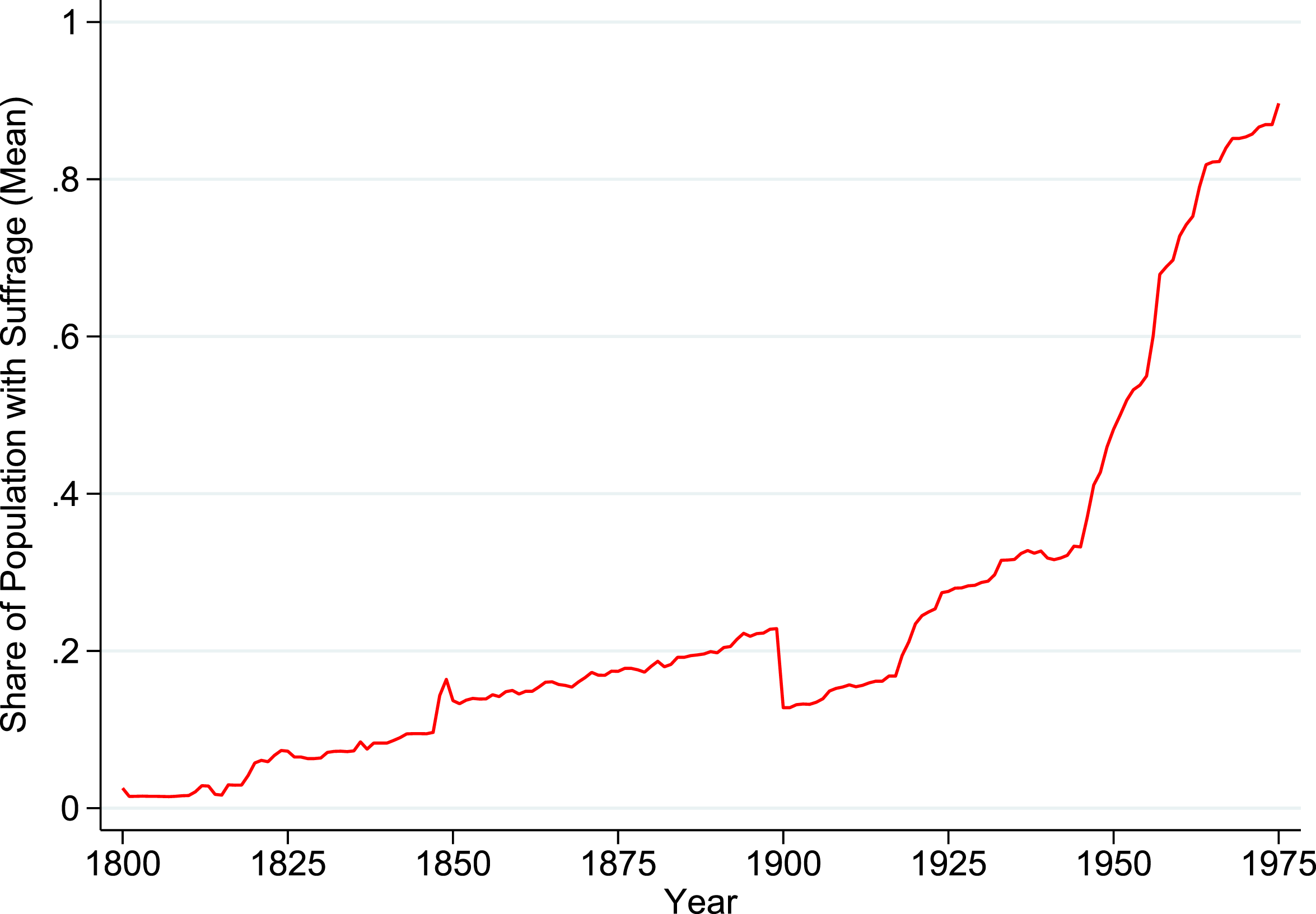
Outcome Variables
To capture different aspects of state spending, we investigate how national governments allocate their budgets on four indicators of budget items: (1) security spending, (2) administrative spending, (3) economic development spending, and (4) social spending. We collected data for these categories by publicly available national government budgets from primary and secondary sources. 12 The data prioritize ordinary expenditures since those are the routine, planned budget allocations as opposed to extraordinary expenditures which often occur due to shocks such as war. Ordinary expenditures also constitute the majority of spending for any country. Where ordinary and extraordinary expenditures are not distinguished, simple total expenditure categories are collected.
Security spending refers to government expenditures on military and other security apparatuses, including spending for the army, navy, and police. 13 Administrative spending refers to funding for state agencies that provide legal and bureaucratic services for the government and society. This consists of allocations to political offices and ministries including interior, justice, and finance. 14 Development spending constitutes investments in state enterprises, infrastructure, transportation, communication, industry, agriculture, and public works. 15 Social spending consists of investments that support social services and social welfare within society. Social services include budget allocations for hospitals, pensions, and social insurance to any group including bureaucrats, military members, laborers, disabled citizens, the elderly, and the poor. These four categories do not include all government spending, such as ministries of foreign affairs, education, 16 religion, debt payments, and other types of spending. Other regime funds include items listed as sundries, generic subventions, dotations, extraordinary expenses, or any other exceptional allocations that do not otherwise fit into the main categories.
We measure the four shares of spending categories as percentages of total spending. Shares of spending are preferable to levels or amounts of spending because shares are indicators of the relative priorities of governments (Han, 2022; Rudra & Haggard, 2005). Totals or levels of spending are less informative because as economies grow, governments tend to increase the size of their bureaucracies in both the late modern (Wagner, 1890) and contemporary periods (Boix, 2001). This means that funding for each agency is likely to increase over time. It is more informative to operationalize budget allocations according to the government’s priorities which are reflected in shares of spending. This way, even if spending for an individual agency is growing due to increases in revenue and total expenditures, but the growth is lower than in other agencies, then the shares of spending represent the decline in that agency as a priority for the government. 17
Explanatory Variables
Our main explanatory variables are two dimensions of electoral democracy: contestation and participation (Dahl, 1971). Following the Varieties of Democracy project (Coppedge et al., 2024, Version 14), we use the Polyarchy index, which includes the following five components of electoral democracy: (1) elected officials (elecoff), (2) freedom of expression (freexp_altinf), (3) freedom of association (frassoc), (4) free and fair elections (clean election index, frefair), and (5) population share with suffrage (suffr). The first four subcomponents are associated with contestation, whereas the last component refers to participation. To measure the latent variable, contestation, we construct a multiplicative index, following Coppedge et al. (2024) according to:
The multiplicative index is useful because it collapses to zero when any of the subcomponents are zero. The only subcomponents that are ever zero are frefair (free and fair elections) or elecoff (elected officials). The multiplicative approach to operationalizing contestation is useful because when elections are meaningless the measure represents no ability for an opposition to contest policies, even if a government allows for media or political organizations. The measure of contestation is also distinct from the measure of the share of suffrage. Figure 3 shows a scatter plot between contestation and participation. Although the measures are positively correlated (r. = 0.485), there remains substantial variation in the degree of contestation across different levels of suffrage. This indicates that they are not only theoretically distinct concepts but also empirically distinct variables.
18
Scatter plot of contestation and participation.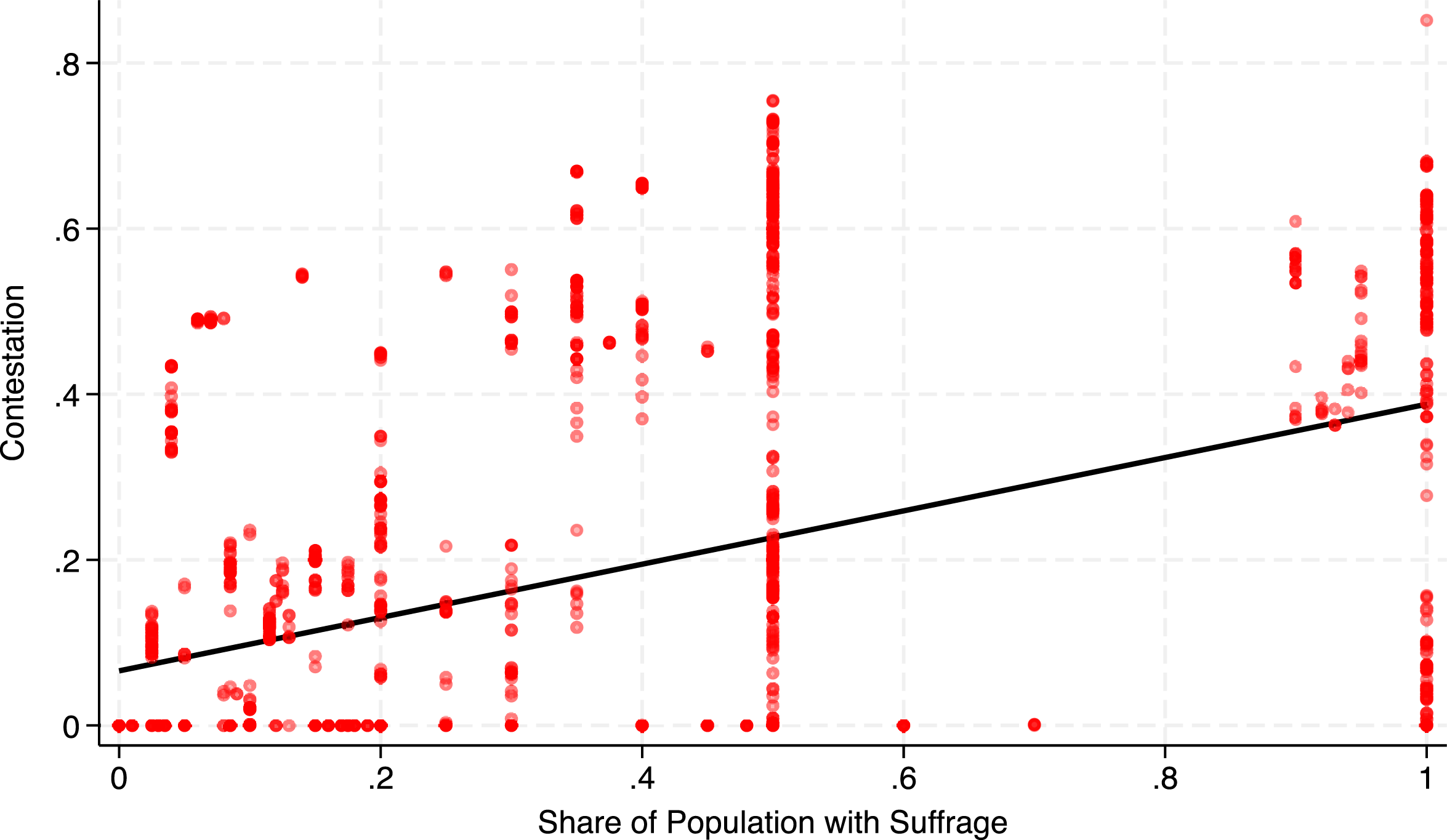
Since the operationalization of the explanatory variables identifies distinct institutional concepts, we can employ these variables to test our hypotheses. To test the hypotheses, we construct multiplicative interactions between contestation and participation. Hypothesis 1 suggests that contestation and participation will be negatively associated with security spending. Hypotheses 2 and 3 suggest that administrative and development spending increase with higher levels of contestation but only under limited suffrage. Hypothesis 4 suggests that social spending increases with extensions of suffrage when contestation is high.
Estimator and Control Variables
It is not difficult to imagine numerous country and time-specific confounding factors for the research design. Therefore, to test our hypotheses we estimate models using ordinary least squares (OLS) with two-way fixed effects (TWFE) by introducing both country and year dummies. 19 Since errors are possibly correlated for each country, we compute robust standard errors clustered by country.
Although the TWFE model enables us to effectively control for confounding factors that are specific to particular countries and years by approximating the difference-in-differences estimator, there are other important factors that are likely to be correlated with both the outcome and explanatory variables of interest. Levels of economic development may increase the prospect of democratization and also inflate the revenue available for budget allocations. To consider levels of economic prosperity, we introduce GDP per capita (logged) (Fariss et al., 2022). Population is another factor that may be correlated with both levels of democracy and spending, and we control for (logged) total population (Fariss et al., 2022). As the resource curse discussion suggests, natural resource endowments may inhibit political liberalization and strengthen autocratic regimes by making it possible to increase levels of military and social spending (Paine, 2016; Ross, 2012). Our model thus includes the value of oil and gas per capita (logged, Haber & Menaldo, 2011). Military conflict may also affect both political regimes and spending efforts. Dummy variables of both civil war and international conflict are included (Brecke, 2015a, 2015b). Data for these controls are obtained from Coppedge et al. (2024, Version 14) except oil and gas per capita are from Haber and Menaldo (2011). We also control for budgetary factors including other spending (discussed above), the log of total expenditures in local current values, and the surplus or deficit as a percent of revenue.
Results
Democratic Institutions Predict Budget Allocations.
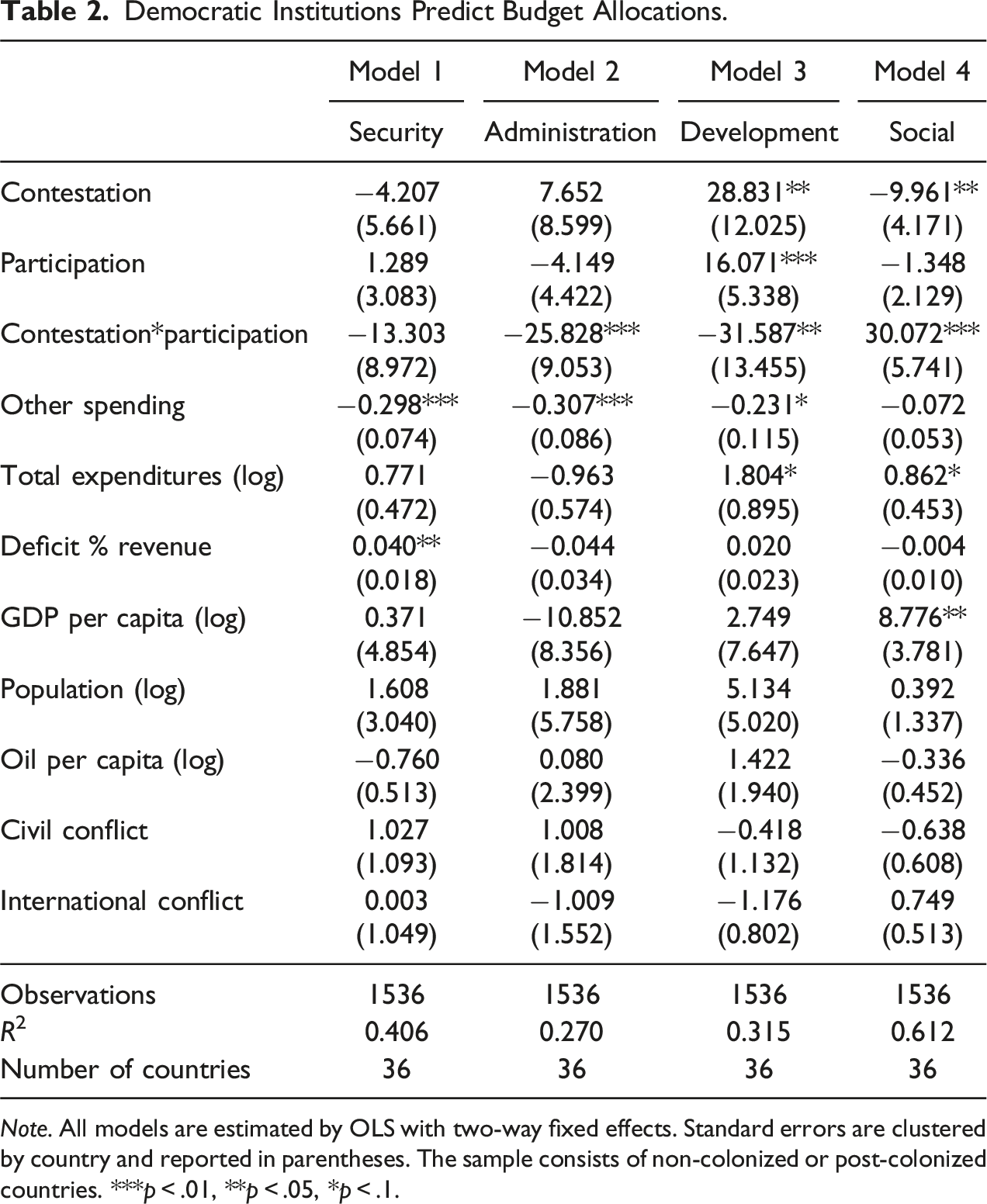
Note. All models are estimated by OLS with two-way fixed effects. Standard errors are clustered by country and reported in parentheses. The sample consists of non-colonized or post-colonized countries. ***p
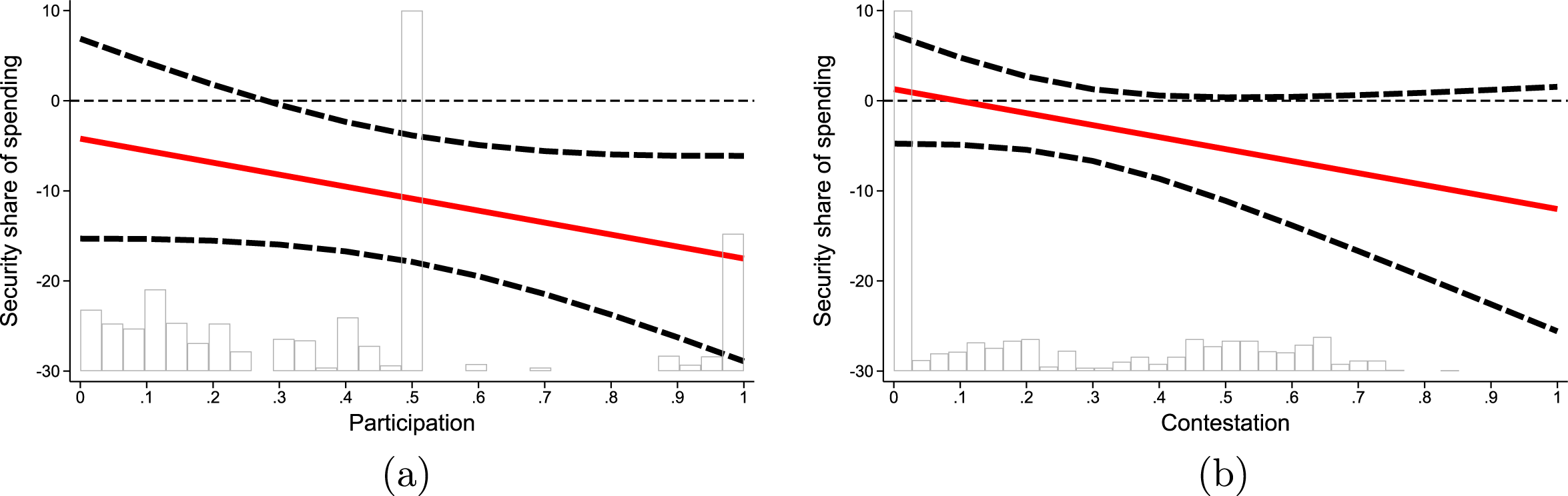
Marginal effects plots of Hypothesis 1 for security spending. (a) ME of contestation on security spending (b) ME of participation on security spending. Note. The vertical axis represents shares of security spending whereas the horizontal axis represents participation levels in 4a and contestation levels in 4b. The red straight line represents the marginal effect of the other institutions and the black dashed lines are the 95% confidence intervals.
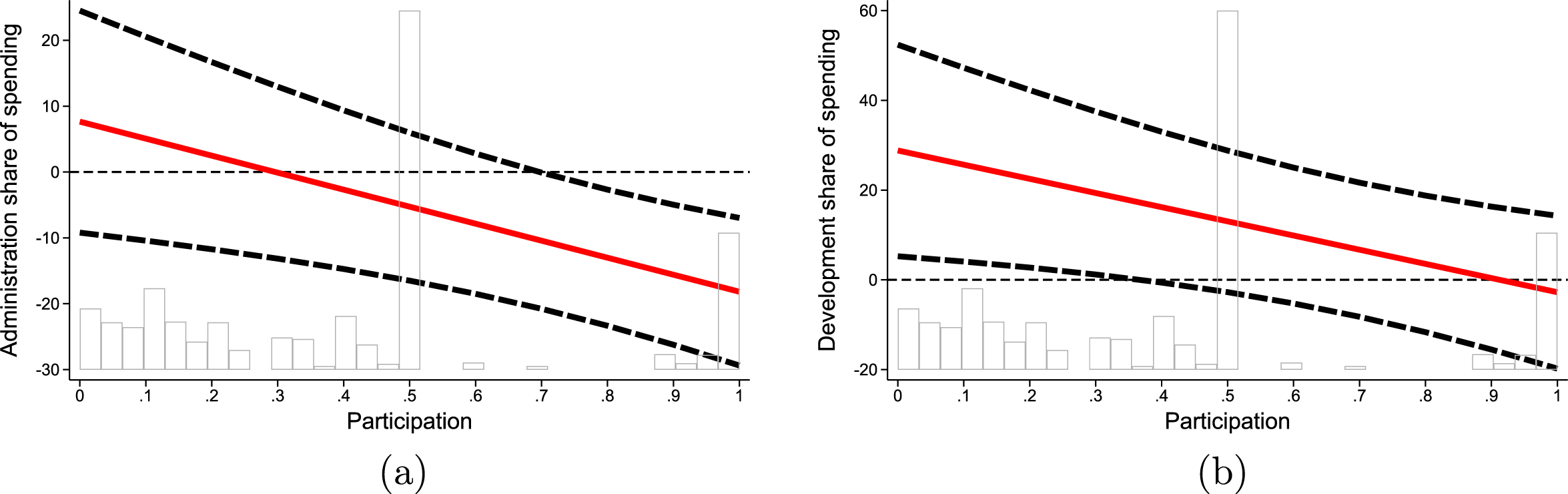
Marginal effects plots of Hypotheses 2 and 3 for administrative and development spending. (a) ME of contestation on administration spending (b) ME of contestation on development spending. Note. The vertical axis in 5a (5b) represents shares of administrative (development) spending whereas the horizontal axis represents the participation levels. The red straight line represents the marginal effect of contestation and the black dashed lines are the 95% confidence intervals.
Contestation and participation each predict decreases in shares of spending on security. In Figure 4(a), the marginal effect of increasing contestation decreases the budget share of security spending at high levels of participation. As participation increases at higher levels, the marginal effect of contestation becomes greater in magnitude (more negative). The marginal effect becomes statistically significant at the 95% level when more than 30% of the population enjoys voting rights. When participation increases from 30% to 100%, the marginal effect of contestation decreases shares of security spending from −8.2 to −17.5 percentage points. Given that a standard deviation (SD) of security spending is 12.3 percentage points, the marginal effect of contestation in this range of participation is substantively large (i.e., from two-thirds of SD to 1.4 times of SD).
The result for Figure 4(b) is similar but statistically significant only at the 90% level. The marginal effect of participation decreases the share of security spending by −9.3 percentage points at the highest observed level of contestation (0.85). 20 These results are consistent with Hypothesis 1. For a contextual example, the creation of the Second Spanish Republic in 1932 extended suffrage to women and coincided with a three percentage point decrease in the share of security spending.
The argument also suggests that institutions for contestation impact administrative and development spending. The tests of Hypotheses 2 and 3 are in Figure 5(a) and (b). These hypotheses suggest that an increase in contestation when participation is low increases shares of spending on administration (H2) and development (H3). The results are consistent with the hypothesis for development spending but not administration spending.
Administration spending is represented in Figure 5(a) which plots the marginal effect of contestation conditional upon levels of participation. Hypothesis 2 suggested that the marginal effect increases shares of administration spending when participation is low. We find that the marginal effect of contestation is not statistically differentiable from zero when participation is low. The plot also indicates that the marginal effect of contestation is negative and statistically significant at higher levels of participation. The evidence does not support Hypothesis 2. Administrative spending does not increase under the conditions of high contestation and low participation. However, the results suggest that when participation becomes open to the masses then administrative spending, which is theoretically preferred by economic elites, tends to be reduced in statistically significant ways. For instance, when participation is full, the marginal effect of contestation on reducing shares of administrative spending is −18.2 percentage points, which is substantively very large given that the SD of administrative spending is 16.2 percentage points.
Figure 5(b) plots the results for the test of Hypothesis 3 for development spending. The marginal effect of an increase in contestation in Figure 5(b) is positive when participation is low and becomes indistinguishable from zero at higher levels of participation. Specifically, when participation is at about 0.1 on the 0-1 scale, then the marginal effect of full contestation compared to no contestation is a 25.6 percentage point increase in the share of development spending, statistically significant above the 95% level. Given that the SD of development spending is 14.4, the effect is substantively very large (i.e., 1.7 times the SD). This evidence for development spending is consistent with Hypothesis 3. Public contestation under limited participation increases spending on public goods for economic activities, which benefits economic elites.
The marginal effect of contestation on development spending is not statistically significant at higher levels of participation. This is consistent with the hypothesis and highlights that the mechanism is specific to the interests of economic elites rather than the masses. For example, the Greek Constitution of 1927 created a parliamentary republic and raised Greece’s contestation measure by 20 percentage points but did not grant universal suffrage. In that same year, Greece’s share of spending on economic development increased by nearly three percentage points.
Hypothesis 4 for social spending is tested in Figure 6. Hypothesis 4 pertains to the marginal effect of an increase in participation when contestation is high. Figure 6 indicates that when contestation is 0.2 the marginal effect is a 4.7 percentage point increase and becomes statistically significant at the 95% level. The effect size grows to a 22.7 percentage point increase when contestation is at 0.8. Since the SD of social spending is only 7.6 percentage points, the effect sizes across this range of contestation are substantively large (i.e., the effect size changes from two-thirds the SD to 3.8 times the SD). The evidence for social spending is consistent with Hypothesis 4: suffrage expansion under high levels of public contestation incentivizes the government to incorporate the interests of the masses by increasing spending on welfare and social services. Allowing participation without contestation has no impact on social services, which is also consistent with the argument. Marginal effects plots of Hypothesis 4 for social spending. Note. The vertical axis represents shares of social spending whereas the horizontal axis represents contestation levels. The red straight line represents the marginal effect of participation and the black dashed lines are the 95% confidence intervals.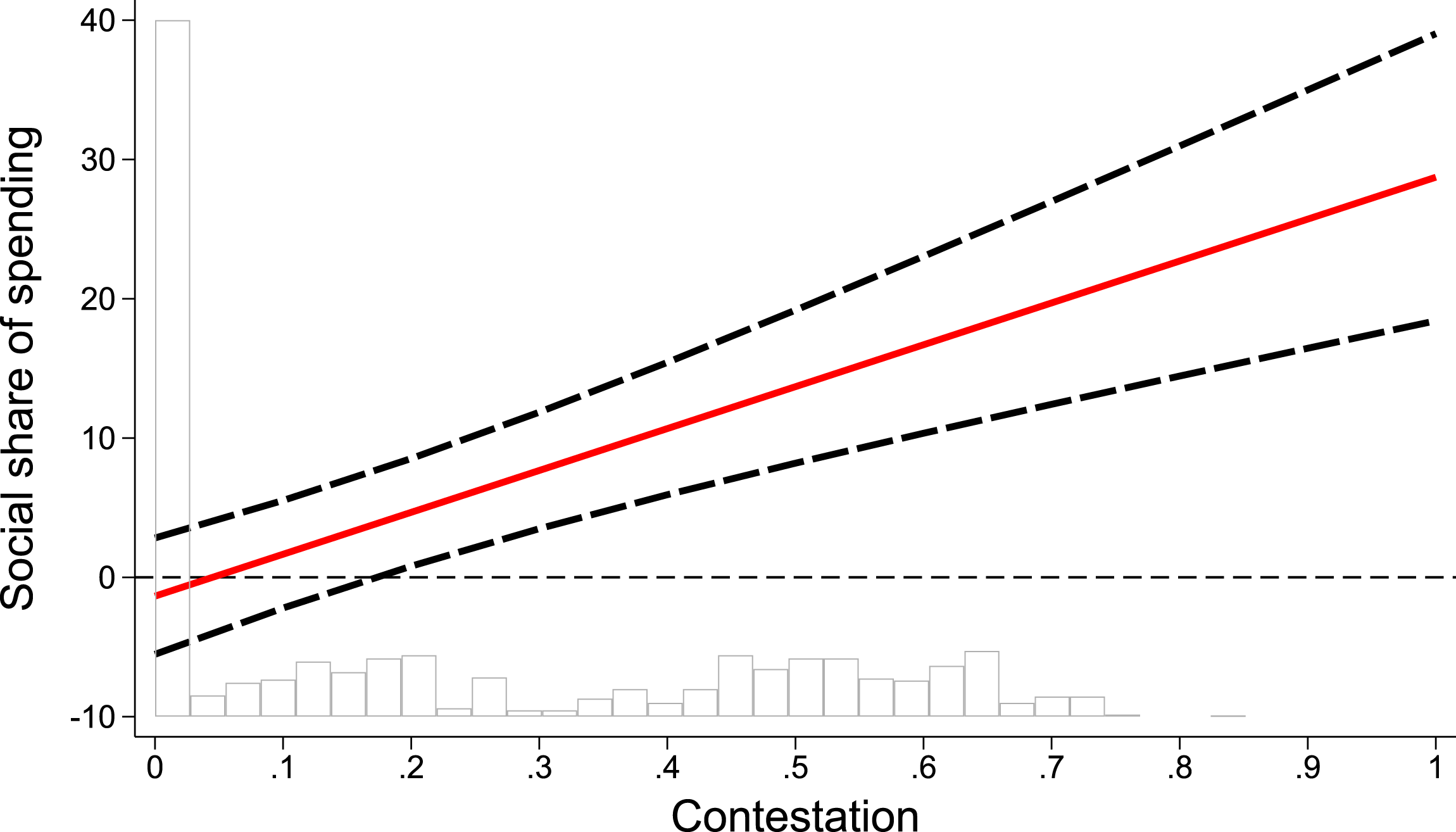
There are many examples of countries expanding their social welfare programs in the early 20th century. Moreover, existing scholarship already understands that labor classes and women played a significant role in obtaining social protections (Esping-Andersen, 1990; Haggard & Kaufman, 1995; Skocpol, 1992). However, a couple case comparisons highlights the utility of considering democracy as a multidimensional concept. For example, in 1919 the Netherlands granted women’s suffrage and in the same year the government passed the Old Age Pensions Act. These programs increased social spending in the country by 13 percentage points between 1919 and 2020. By comparison, Russia in 1906 allowed legislative elections without political competition in which nearly half of the population was allowed to vote yet there was no measurable increase in social spending. The difference between these two cases indicates how our argument expands on the existing understanding of participation and social spending. The impact of the expansion of voting rights on social policy depends upon the level of political contestation.
Sensitivity Analyses
To confirm the robustness of our analysis, we conduct additional tests to address the issues of (1) missing data, (2) truncated data, (3) alternative measures and data for political regimes, (4) influences of key social classes, and (5) possible omitted variables biases. We will discuss each below.
The first important issue is whether the main results are sensitive to missing values. Since the historical budget data that we collected has numerous missing values, 21 such missingness of the data may induce selection bias for the estimation results. To address this problem, we use a data imputation technique to fill out those missing values. Specifically, the multiple imputation (MI) method enables us to fill out missing data in the following ways. 22 We first perform multivariate normal regressions to simulate a dataset without missing values based on the information from the original data and iterate this process five times. The MI then tests our hypotheses and compiles the results of the five simulated datasets while taking into account the statistical uncertainty of imputed values. The MI boosts the number of observations up to 1,842, which is a 19% increase from the original dataset. Appendix Section C.1 presents the results of the multiple data imputation. The results remain largely unchanged and all spending items – security, administrative, development, and social spending – have expected signs on the interaction terms, and the conditional effects are statistically significant at the 90%–99% levels.
Second, our dependent variables of spending items may be truncated for several plausible reasons. For instance, a government may spend on a particular purpose, such as the military or social welfare, by making investments in the form of loans but account for this in debt rather than the state budget. If this is the case, spending values in a given year are right censored. Conversely, even if the government raises particular expenditures, the state budget does not usually account for negative values. This leads to left censored data. To consider the issue of truncation, we estimated tobit regressions while setting maximum (minimum) values of each spending outcome variable as the upper (lower) limit. Our results remain unchanged (Appendix Section C.2).
Third, we believe that continuous measures of contestation and participation from V-Dem are the best available measures for our research design because they enable us to capture the effects of gradual changes in the two aspects of political regimes. That said, it is also important to check the robustness of our results with alternative measures of political regimes. In particular, categorical classifications of political regimes are a relevant, useful way to capture Dahl (1971)’s conceptualizations of closed autocracy (hegemony), competitive oligarchy, and electoral democracy (polyarchy).
To categorize political regimes, we rely on Skaaning et al. (2015)’s Lexical Index of Democracy to classify political regimes into four types along the dimensions of electoral competition and suffrage: closed autocracy, competitive oligarchy, electoral autocracy, and electoral democracy. 23 Then, we use the four dummy variables to predict spending patterns. We find that security spending is higher in closed autocracies, development spending is higher in competitive oligarchies, and social spending is higher in democracies. The results are consistent with our theoretical expectations (Appendix Section C.3).
Fourth, our theory builds upon the insight of previous studies (Ansell & Samuels, 2014; Esping-Andersen, 1990; Moore, 1966) which suggest that the strengths of key social classes lead to particular sets of political institutions as well as spending decisions. Strong landed elites maintained closed autocracies with security spending. Powerful industrial elites and middle classes obtained competitive oligarchy with administrative and development spending. Strong working classes lead to democracy with increases in social spending. To consider the influences of these social classes, we use a V-Dem measure of “regime support group” (v2regsupgroups) to capture the strengths of landed elites, the urban middle class, and the working class (or the masses) within the supporting coalitions of governments. 24 We find that the political influences of social classes boost the impact of both contestation and participation on security, development, and social spending, which is in line with our expectations as well as those of existing studies (Appendix Section C.4).
Fifth, to further account for possible omitted variables biases, we included additional control variables in the following three ways. Market values of natural resource wealth significantly changed over time throughout the 19th and early 20th centuries, which was likely to influence a government’s decisions on spending. To consider the temporal heterogeneous effects of natural resource endowments, we introduced interaction terms of the natural resource variable and year dummies. We find the results are robust (Appendix Section C.5, Table C7).
Besides whether violent conflicts occur, the intensity of war should also impact spending patterns. To measure war intensity from the early 19th century until the 1970s, we employed battle death data from the Correlates of War project. We calculated the proportions of battle deaths relative to the total population for both international and civil conflicts. Even after controlling for these battle deaths variables, the main results remain unchanged (Appendix Section C.5, Table C8).
Lastly, we conducted instrumental variables (IV) estimation to mitigate endogeneity concerns by using neighboring countries’ contestation and participation while controlling for levels of spending. The results of the IV estimator are consistent with our main findings (Appendix Section C.6).
Discussion: Political Institutions and Bureaucratic Development
The results of the statistical tests indicate that spending on security, economic development, and social welfare conformed to the expectations of our theoretical argument. Surprisingly, the statistical analysis for administrative spending was not exactly in line with our theoretical expectation and was sensitive to different tests, despite that it was partially built from a prominent existing argument. These findings provide an opportunity to clarify how political institutions relate to state-building and bureaucratic development.
The long arc of state-building bends toward public goods and public services. Existing historical research has found that in the long term, states focus more on public goods and less on repressive capacity (Lindert, 2004; Mann, 2012; Mitchell, 2022). Our research indicates that political development is also part of this story. Political institutions predict decreases in military spending and increases in spending for economic development and social welfare at different stages of political development (i.e., contestation with limited suffrage for development spending and contestation with mass franchise for social spending). These institutional sources of budget allocations are distinct from budgetary growth and temporal dynamics. In other words, our analysis indicates that political development has historically impacted state-building independently of economic growth, fiscal resources, and time periods.
However, the statistical analysis also finds that the development of democratic institutions predict decreases in administrative spending, which is counter to the theoretical expectations of the argument. We built our argument in part by borrowing from Besley and Persson (2011). They argue that since political institutions create incentives for spending on public goods, then political institutions lead officials to build greater fiscal and legal capacities to benefit from public goods spending. While the mechanisms in their theoretical argument differ from ours, the hypothesis is consistent across arguments: democratic political institutions should predict more resources for bureaucratic administration. But we find that shares of administrative spending, which consist of budget allocations to the ministries of interior, justice, and finance, actually decreased when suffrage was fully extended.
Our finding for administrative spending provides an opportunity to better understand how democratic political institutions relate to state development. Besley and Persson (2011) find that taxes as a share of the economy and property rights protections increase along with executive constraints. They interpret these data as suggesting that political institutions improve fiscal and legal capacities. However, our analysis reveals that these developments do not occur through the budgets of core ministries of interior, justice, and finance. Instead, our results suggest that political institutions may have induced fiscal and legal capacities through spending on economic development rather than bureaucratic administration. In addition, the results for administrative spending are quite similar to the results for security spending. This suggests that military demands may have driven non-military bureaucratic growth (Dincecco et al., 2011; Tilly, 1992). Or perhaps late modern regimes created security not only through the military but also through hiring personnel in core bureaucratic agencies. Further theorization and analysis are required to sufficiently untangle this puzzle.
In summary, our results indicate that states developed first by focusing on building repressive capacity along with core state ministries. Once elites obtained institutions for public contestation of government policies, states began investing in their economies. These budget allocations for economic development, rather than the further expansion of core ministries, may have improved state capacities during the late 19th and early 20th centuries. Once the masses obtained full suffrage then states also began allocating resources for social welfare.
Conclusion
This project has advanced the study of state-building by explaining how specific political institutions and socioeconomic groups impact multiple categories of historical budgets. The project builds on foundational models of how institutions that incorporate broader interests in society impact regime spending. However, there are additional questions to be answered regarding how other political institutions not covered in our analysis may impact state capacities, such as contemporary electoral authoritarianism and power-sharing agreements among elites. Additionally, the limitations of this study provide opportunities for future research to incorporate patronage and to distinguish between specific public goods.
Our theoretical framework utilized Dahl’s (1971) concepts of institutions for contestation and participation. Within the last one to two hundred years, regimes used mixes of these institutions to target specific socioeconomic groups for inclusion within the regime. How these different institutional arrangements led to changes in government spending policies is this paper’s contribution to the prior literature, but there are important questions that remain unresolved.
Our study explains aspects of regime spending in three of the four quadrants of Dahl’s framework. The fourth quadrant, which relates to electoral authoritarianism (or inclusive hegemonies by Dahl’s term), is beyond the theoretical and temporal scope of our current analysis. The mix of institutions in which participation is high but contestation is low creates ambiguous expectations for government spending. On one hand, if a dictator extends the right to vote to the entire adult mass public, then it would seem reasonable that a dictator also has an incentive to allocate spending for social and redistributive purposes. This appears to be consistent with existing empirical findings (Higashijima, 2022; Miller, 2015b). However, the restriction of the ability of the opposition to contest the government means that a regime is not necessarily bound by the demands of the voting public. This may suggest that the suffrage impact on social spending is lower when institutions for contestation are weaker, which is consistent with our findings for the marginal effect of participation on social spending conditional upon levels of contestation (Figure 6).
There are also other ways of conceiving of political institutions beyond contestation and participation, particularly within authoritarian regimes. Dictators that create institutions for executive selection and succession tend to result in peaceful transitions of leadership (Meng, 2020). In monarchies, a dictator may facilitate stability against elite coups and mass revolts (Inata, 2021). The stability benefits of institutionalized regimes may reduce the pressure for dictators to focus on repressive capacity and possibly pursue other aspects of state development. Or the stability benefit may empower a dictator to reduce spending that elites and the masses prefer. Future research should consider these questions for alternative institutional settings.
Lastly, legislatures in dictatorships can also be conceptualized as constraints on a dictator’s ability to expropriate thereby supporting economic development but also as a means of distributing patronage (Wilson & Wright, 2017; Wright, 2008). These functions of legislatures may be conditioned by economic structures, which determine regime incentives that distinguish between more public versus private types of budget allocations. Such theoretical extensions would dovetail back to the prior literature on political institutions and regime spending (Besley & Persson, 2011; Bueno de Mesquita et al., 2003) but could potentially incorporate both public-private distinctions along with specific substantive purposes for budget allocations.
Supplemental Material
Supplemental Material - Democracy and State Development: Patterns of Public Spending in the First Two Waves of Democratization
Supplemental Material for Democracy and State Development: Patterns of Public Spending in the First Two Waves of Democratization by Masaaki Higashijima, and Austin M. Mitchell in Comparative Political Studies
Footnotes
Authors’ Note
This paper was presented at the 2022 Summer Meeting of the Japanese Society for Quantitative Political Science at Waseda University, the 2022 and 2023 Workshops on Autocratic Politics at Tohoku University, and the 2023 Midwest Political Science Association Annual Conference. This research was primarily conducted at the Graduate School of Information Sciences at Tohoku University where Higashijima was an Associate Professor and Mitchell was a JSPS Postdoctoral Fellow.
Acknowledgments
The authors thank Paul Schuler, Matthew Wilson, Jean Hong, Erik Wang, Elvin Ong, Yu Jin Woo, Wen-Chin Wu, Naosuke Mukoyama, Daniel Goldstein, Jan Vogler, Daniel Gingerich, Pau Vall-Prat, Mark Dincecco, Tine Paulsen, and Yuki Shiraito for generous feedback. The authors especially thank Salma Rahmouni, Sora Konno, Shiori Fujiwara, Eito Umino, and Mikihiro Konno for excellent research assistance. The authors also thank Sumie Shikoda for helpful administrative assistance.
Declaration of Conflicting Interests
The author(s) declared no potential conflicts of interest with respect to the research, authorship, and/or publication of this article.
Funding
The author(s) disclosed receipt of the following financial support for the research, authorship, and/or publication of this article: This work was supported by a Japan Society for the Promotion of Science Grant-in-Aid (Grant Number 21F21008).

Data Availability Statement
Supplemental Material
Supplemental material for this article is available online.
Notes
Author Biographies
References
Supplementary Material
Please find the following supplemental material available below.
For Open Access articles published under a Creative Commons License, all supplemental material carries the same license as the article it is associated with.
For non-Open Access articles published, all supplemental material carries a non-exclusive license, and permission requests for re-use of supplemental material or any part of supplemental material shall be sent directly to the copyright owner as specified in the copyright notice associated with the article.
