




Abstract
While much research has been devoted to the institutional determinants of corruption in democracies, debates continue regarding the merits of distributing executive power horizontally (presidentialism vs. parliamentarism) and vertically (federalism vs. unitarism). Taking advantage of the rich empirical literature on the subject, we investigate the effects of institutional features on corruption applying a meta-analytical framework to over 1000 estimates across 71 studies conducted over three decades. Results show a consistent positive association between presidentialism and corruption and that much of the confusion around decentralization can be explained by the distinction between its fiscal and political forms; political decentralization has a marginal positive association, while fiscal decentralization has a negative effect. A series of moderator analyses reveal the sensitivity of many of these findings to research design choices made in conducting the studies, such as the temporal and spatial coverage of the sample and the selection of co-parameters in statistical tests.
Introduction
Governmental corruption, the misuse of public office for private gain, poses a significant challenge to democracy. It is commonly associated with lower economic growth (Besley & Persson, 2014; Lambsdorff, 2003; Mauro, 1995), higher child-mortality rates (Kaufmann et al., 1999), and lower social and institutional trust (Hakhverdian & Mayne, 2012; Rothstein, 2013; Solé-Ollé & Sorribas-Navarro, 2018). Given the dire consequences of corruption, it comes as no surprise that research has focused on the sources of corruption and factors that can mitigate it. Among the most commonly studied causes of corruption are the constitutional features of countries. Yet – despite a plethora of research on the effect of political institutions, there remains a significant debate as to which are the most effective for mitigating corruption risks.
The relationship between constitutional features and corruption has been empirically investigated in over thirty years of research. Analysing the contradictions in quantitative scholarship on the relationship between electoral institutions and the quality of government, a recent review establishes that it is systems that emphasize a personal vote (including both majoritarian and open-list PR) that are most commonly associated with lower corruption levels (Xezonakis & Dawson, 2021). Meanwhile, an equally large part of that body of research has focused on two further quintessential features of institutional design: the horizontal division of power (presidentialism vs. parliamentarism) and the vertical division of power (federalism vs. unitarianism). However, to this point, research has produced competing theories and largely inconclusive results along both dimensions. Theories of accountability dynamics in horizontal power distributions divert regarding the primacy of checks and balances and the direct election of executives (Persson et al., 1997; Persson & Tabellini, 2005) vis-à-vis legislative scrutiny (Gerring & Thacker, 2004; Lederman et al., 2005). Debates over the vertical distribution of power contrast increased opportunities to extract rents with more layers of government (Shleifer & Vishny, 1993) with increased local electoral accountability (Faguet, 2014) as a means of reducing corruption.
In this study, we make use of the rich quantitative literature written on the effect of institutional design on corruption and apply a meta-analytical framework to investigate the reported effect of distributions of executive power on corruption. As such, we aim to synthesize and summarize the large body of research conducted on the effects of these constitutional designs on corruption, in a similar vein to recent efforts in the field of democratization Colagrossi et al. (2020); Gerring et al. (2022). While research also increasingly pays attention to the actors that populate institutions, and particularly to the role of female representation, our study concerns itself mainly with the rules that govern the constitutional designs. 1 A comprehensive systematic search process was conducted to create a database of previous results. In total, we collected data for 1012 estimates across 770 statistical models from 71 studies. We then proceed to explore the heterogeneity of previous findings by empirically testing the impact of various characteristics of the study, such as the years data was collected, the coverage of sample, and model co-parameters. 2
Our findings demonstrate the considerable heterogeneity in previous attempts to estimate the relationship between constitutional features and corruption. We find that presidentialism has a relatively consistent positive effect, suggesting that systems in which power is more divided among legislative and executive bodies tend to be associated with higher corruption. However, these results are often sensitive to the inclusion of features of the electoral system and model specifications in terms of the underlying sample.
As for decentralization, we argue that previous contradicting findings can be partially attributed to a lack of disentangling the concepts of fiscal and political decentralization. Once this disaggregation is made, this analysis finds a negative effect of fiscal decentralization and a marginal positive association between political decentralization (i.e., federalism) and corruption. The effects of political and fiscal forms of decentralization are, however, similarly sensitive to the inclusion of certain model co-parameters relating to other political institutions as well as the temporal coverage of data, with stronger effects identified in studies that use data from after 2000.
We contribute to the literature on constitutional designs and corruption in several ways. First, by systematically investigating the results of three decades of research on the effect of constitutional features, we contribute theoretically to this research field. By doing so, we are able to highlight the overall conclusions to be drawn from this literature so far. Second, by demonstrating the need to separate fiscal and political decentralization, we contribute to the debate on the effects of federalism. Finally, empirically, this study contributes by exploring the potential sources of the heterogeneity of results and demonstrates how estimates vary considerably based on study features and co-parameters included in the study, which future research should consider when designing studies and interpreting results.
Theory and Evidence
The question of whether and how constitutional design matters for corruption has been the subject of extensive research in political science and economics. The academic debate is concerned with three main constitutional dimensions: the horizontal division of power (Gerring & Thacker, 2004; Persson et al., 1997, 2003; Persson & Tabellini, 1999) the vertical division of power (Gerring et al., 2005; Gerring & Thacker, 2004) and the rules that govern elections (Chang, 2005; Kunicova and Rose-Ackerman, 2005; Persson et al., 2003)). In this review, we focus on the dimensions of horizontal and vertical divisions of power before reflecting on how certain constellations of these factors may be conducive or disruptive to corruption, given the empirical evidence established in the field.
Theoretical Arguments
The theoretical arguments on both horizontal and vertical division of power largely center around two lines of argument: whether the concentration of power in a single unit (e.g., a parliament or a centralized decision-making entity) is more conducive to lower levels of corruption or whether a division of power over several institutions (as e.g., under presidentialism and decentralization) results in lower levels of corruption.
While there is, of course, a lot of nuance in the literature, the conceptual distinction between presidential and parliamentary systems is based mainly on two important features: a) the ’origin’ and ’survival’ of the executive (Carey, 2005, p.92) and b) the decision-making power distribution between the executive and the legislature. In the former case, Prime Ministers are indirectly elected by the legislature and subject to its confidence for the duration of their term. Presidents, on the other hand, are directly elected and cannot be dismissed by a ‘simple’ vote of no confidence (that is not to say they cannot be dismissed at all). In the latter case, policy-making power tends to be divided (to various degrees) between the executive and the legislature in presidential systems while Prime Ministers are less constrained by the legislature and retain a lot of room to maneuver in advancing their own legislative agenda (again with some caveats in case of coalition, minority governments etc).
These two crucial distinctions between the two systems form the backbone of the theories concerned with constitutional design effects on corruption. More specifically, these features are integrated into the theories as facilitators or barriers to effective accountability under a principal-agent and/or collective action type of theoretical framework. However, while theories lock on to the same defining characteristics, they provide causal narratives that frequently lead to diametrically opposed predictions regarding the direction of the effects. This is unsurprising as these theories are not novel approaches but are based on long-existing theoretical models regarding effective accountability. As such, they depend a lot on the intellectual tradition regarding democratic governance that scholars subscribe to. These intellectual camps propose distinct causal stories regarding the way constitutional design affects democratic governance, based on the defining characteristics of the two systems. For some, the strong dispersion of power between the executive, legislative and judiciary (horizontally) coupled with federalism (vertically) creates the necessary incentives and constraints to avoid abuses of power. In this case, the ideal type constitutional design of the US with a directly elected president, strong bicameralism and federalism should work as the framers intended. For others, it is precisely the asymmetric distribution of power in favor of the executive in a Westminster type of parliamentary system that creates the conditions for effective accountability and therefore virtuous governmental outcomes. To simplify a complex debate, the opposing perspectives are a ‘Madisonian’ approach based on checks and balances (presidentialism) versus a responsible party government approach with strong parties and centralization of decision-making power (parliamentarism) (Gerring & Thacker, 2004; Persson et al., 1997).
For the former camp, intergovernmental competition in presidential systems a) creates conflicts of interest between the executive and legislature addressing possibilities of abuses of power and b) remedies ingrained informational asymmetries giving voters the opportunity to extract information from their agents (Adsera, 2003; Persson et al., 1997). Furthermore, direct elections of the executive increase accountability by minimizing the danger of collusion with the legislature over the reappointment of the former (Persson et al., 1997). For the latter camp, the inter-institutional competition in presidential systems a) does not address informational asymmetries since it increases information costs for voters and b) blurs lines of responsibility for policy making, hindering effective accountability (Gerring & Thacker, 2004). Competition is important but only as “ex post facto competition (elections at fixed intervals at which past performance is judged) among relatively centralized political parties” (Gerring & Thacker, 2004, p.315). In addition, the indirect election of the executive and the confidence requirement in parliamentary systems is precisely what allows for more effective monitoring of abuses of power by incumbents as the legislature ultimately has the power to dismiss them (Lederman et al., 2005). Finally, in reality, most presidential systems do not successfully replicate the checks and balances implied in the Madisonian conceptualization of government (Kunicova and Rose-Ackerman, 2005).
While scholarship goes into significant detail regarding the benefits from each form of government (c.f. Persson et al., 2003; Gerring et al., 2005; Kunicova and Rose-Ackerman, 2005) reviewing, as above, the flagship theoretical arguments, one comes across plausible mechanisms that offer contradictory predictions and ambiguity. When reviewing the actual evidence, the puzzle moves from a theoretical to an empirical one. Years of work on these issues by Persson and associates culminating in the seminal study of ‘The Economic Effects of Constitutions’ (Persson & Tabellini, 2005) find that presidential systems do indeed have lower levels of corruption than parliamentary systems. Their findings go against previous research by Panizza (2001) who, with admittedly significant caveats, show that presidentialism is correlated with higher corruption. A replication and extension of the Persson and Tabellini study by Blume et al. (2009) finds that the presidentialism effect vanishes entirely while extensive research by Kunicova and Rose-Ackerman (2005), Lederman et al. (2005), Gerring and Thacker (2004), Gerring et al. (2005) all point towards the primacy of parliamentarism as regards reducing corruption. 3
Turning to the vertical division of power, the basic distinction here relies on the difference between the centralization of power in a single level of government, and the decentralization of power across government bodies on different levels of government. Under centralization, decisions are taken and implemented on a single level of government which also exerts control over the bureaucracy implementing politics. Under decentralization, different levels of government receive varying powers and influence over decision-making and implementation, with control of the bureaucracy being more layered.
Based on this distinction, two lines of arguments can be found in the literature on the effects of centralization on corruption. First, similar to arguments on parliamentarism, theoretical arguments around centralization center around the idea that centralization of power in a single layer of government reduces information asymmetries, effectively lowering the transaction costs of controlling bureaucrats (Gerring et al., 2005, 2009; Gerring & Thacker, 2004). Especially in combination with unicameralism and generally higher concentration of power, centralization is expected to result in fewer veto-points, allowing governments to act more efficiently and combat corruption (Gerring et al., 2005; Golden & Mahdavi, 2015). Decentralization, in contrast, is argued to result in over-exertion of rents, as several bureaucrats control a common good and rents are expected to be collected on all levels (Shleifer & Vishny, 1993).
The second line proposes contradicting arguments, such that the increase of political competition introduced by decentralization should benefit public goods provision (Faguet, 2014; Persson & Tabellini, 2005; Seabright, 1996). Further, as decentralization allows citizens to identify the local officials accountable for public good provision, voters are assumed to be more capable of punishing corrupt officials accordingly.
Mirroring the debate on parliamentarism and presidentialism, the theoretical claims made in regard to centralization and corruption result in contradicting expectations and claims. The contradiction in arguments is not only found in the theoretical aspects but also in the empirical results. Several studies find a positive effect of political centralization on lower levels of corruption, such as, e.g., Gerring and Thacker (2004), Goldsmith (1999), and Treisman (2000). However, a similarly large number of studies find evidence to the contrary that decentralization results in lower levels of corruption, such as e.g., Fisman and Gatti (2002); Garman et al. (2001); Lederman et al. (2005).
Given the contradicting theoretical arguments and findings in the existent literature on both the vertical and horizontal division of power, we proceed to consider the differences in measurements and methods employed in the studies to highlight the potential sources of heterogeneity in results.
Differences in Empirical Approaches
Studies on constitutional features differ on a number of indicators in their empirical approach, such as the operationalization of concepts, the sample coverage, and the methods employed. Figure 1 introduces the sample of collected studies and demonstrates the variation in some of these factors. Summary of data included in the meta-analytical framework.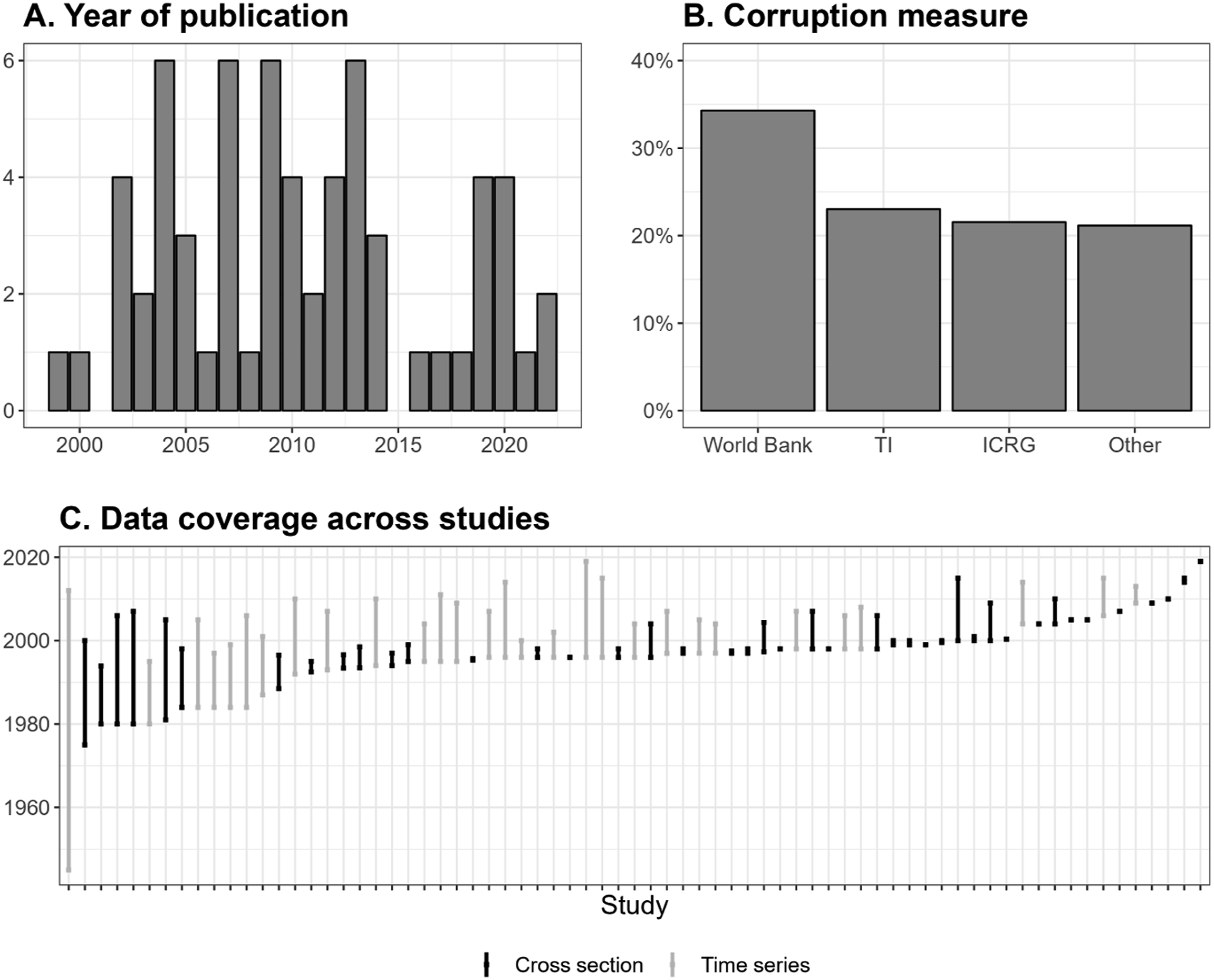
Starting with the measurement of corruption, most studies employ common expert-assessment indicators such as the World Bank’s Governance Index (WBGI), Transparency International Corruption Perception Index (CPI), or the International Country Risk Guide (ICRG), as becomes apparent from Panel B in Figure 1. These three measures – each a measure of public sector corruption or the control of corruption at the national level – collectively account for 78.9% of estimates in the sample and were introduced in 1996, 1995, and 1980, respectively. The corruption indicators are highly correlated – a recent study established that the correlation between any of these measures and either of the other two to be over 0.9 (Charron, 2021) – and are, therefore, unlikely to lead to the contradicting evidence found in previous studies.
Many studies also employ at least one of the other indicators in robustness tests. Of the studies that employ other indicators than the three main indicators, most studies focus on either fiscal or political decentralization as the explanatory factors (e.g. Alfada, 2019; Choudhury, 2015; Dong & Torgler, 2013). Most of these studies rely on corruption experiences of businesses, by either studying convictions of businesses of corruption (Escresa & Picci, 2020), or corruption experiences reported in surveys by businesses (Choudhury, 2015; Fan et al., 2009). However, as only a small subset of studies employs these indicators, while the majority of studies use the highly correlated main indicators, there is little reason to believe that the choice of dependent variable operationalization is the cause of the observed effect heterogeneity.
While the measurement of corruption is relatively uniform across studies, the same cannot be said about the measurements of the predictor variables. In terms of decentralization, differences are both theoretical and methodological. While a number of studies focuses empirically on fiscal decentralization, often understood as the share of taxes collected on subnational levels and the share of spending on subnational levels (e.g. Fisman & Gatti, 2002; Lessmann & Markwardt, 2010; Treisman, 2007), a second strand focusing on decentralization is concerned with political decentralization in the form of federalism, often captured as either a dummy variable or the number of subnational territorial units (e.g. Enikolopov & Zhuravskaya, 2007; Kolstad et al., 2014; Kunicova and Rose-Ackerman, 2005). 4 Given the different focus on fiscal and political decentralization and their theoretical difference, we treat the concepts as two different explanatory factors to investigate whether contradictory empirical findings can be attributed to different conceptualizations.
For the second constitutional feature of interest, the centralization of power on the horizontal level, most studies either operationalize presidentialism as a two- or three-level variable, aiming to capture the degree of separation in terms of origin and survival as well as the relative power of parliament and president (Gerring & Thacker, 2004). This either results in a classification of political systems as presidential or parliamentary (e.g. Bäck & Hadenius, 2008; Kunicova and Rose-Ackerman, 2005; Lederman et al., 2005), or in a classification as presidential, parliamentary or semi-presidential (e.g. Adsera, 2003; Chang & Golden, 2007; Gerring & Thacker, 2004; Treisman, 2007).
Besides conceptualization and operationalization of constitutional features, studies also differ largely in their samples in spatial and temporal terms. As Panel C in Figure 1 shows, data coverage in the sample of studies covers a time frame between 1950 and 2020, with a large margin of studies using data from the 1990s. The temporal difference in studies was also identified by Treisman (2007) as a potential driver of differences in effect direction for decentralization, such that data availability largely improved after the 1990s. Additionally, large variation exists between whether a study makes use of a cross-sectional or panel data structure. For those that use cross-sectional data, a common approach is to pool entire time periods into a single average for a given cross-section unit (usually country). This is typically done as orthodox corruption measures and institutional right-hand side variables are generally ”sluggish” and vary little from year to year (Wilson & Butler, 2007). For the studies that use panel data, this is problematic for implementing cross-sectional fixed effects since corruption varies much more between countries than within countries over time. While a few studies do include analyses that include country-fixed effects – and hence focus on the plausibly smaller within-country variation – most panel studies in the sample either try to address this kind of spatial endogeneity at the regional level (such as continental fixed effects) or use panel-corrected standard errors along with temporal fixed effects. Of the 30 studies to use panel data, 6 navigate this issue by using subnational data. Studies also differ in whether they employ data covering a global scope or focus on developed or developing contexts. This variation in data coverage might further contribute to the variation in effect magnitudes and directions.
Another difference that might explain heterogeneity in effects lies in the methods that studies apply. Differences in magnitude and directions of effects might not only stem from differences in the data structure and how the data is used (Golden & Mahdavi, 2015, c.f. also). In the sample of studies underlying this manuscript, both non-causal and causal estimation strategies are used, ranging from cross-sectional ordinary and weighted least squares methods to instrumental variable approaches.
Finally, it is also possible that heterogeneity in effects is due to conditionalities and interactions between constitutional factors. To illustrate, theoretical arguments have been put forward that decentralization is the most effective when combined with overall centralization in power, i.e., parliamentarism and unicameralism (Gerring et al., 2005; Golden & Mahdavi, 2015), while Kyriacou and Roca-Sagalés (2011) finds that fiscal decentralization has the strongest effect on reducing corruption when combined with political decentralization. Furthermore, the combination of vertical and horizontal division of power might interact with another constitutional feature we have not revised here in detail: electoral system features. Namely, the personalization of the electoral system and its emphasis on competition between parties versus candidates might exacerbate or diminish the effects that other constitutional features have (Golden & Mahdavi, 2015). Thus, another potential explanatory factor in the effect heterogeneity is the inclusion of other constitutional features in models.
In sum, answers to the question of the effects of forms of constitutional design on corruption offer significant theoretical and empirical puzzles that are not easily resolved through a conventional reading of the relevant literature. We still lack clarity on the effects of the core dimensions of constitutional design: the horizontal distribution of power and the vertical distribution of power, and lack an understanding of the drivers of the heterogeneity of findings.
Meta-Analytical Framework
Previously referred to as an analysis of analyses (Glass, 1976), meta-analyses are useful not only in synthesizing the findings of previous research but also in helping us to understand some of the reasons for their heterogeneity, both in terms of the magnitude of the relationship and its direction. While one might argue that we do not conduct a meta-analysis in the strict sense, as our data does not stem from perfectly independent underlying data sources but rather from pooling results based on similar or the same samples, we follow the likes of e.g. Doucouliagos and Ulubaşoğlu (2008) and Colagrossi et al. (2020) in referring to our analysis as a meta-analytical framework, as the analytical approach applied follows the approach of a meta-analysis. We do, however, acknowledge that the estimates resulting out of our analysis should not be perceived as causal estimates of effects but rather as estimates of causal effects. Here, a meta-analytical approach will help us answer two primary questions: (a) what are the overall effects of vertical and horizontal distributions of executive power on corruption? and (b) what explains the heterogeneity of findings in previous research? Previous implementations of this and similar methodologies in social science have been used to clarify the effect of a single independent variable on multiple outcomes, such as the effects of terrorism on political attitudes (Godefroidt, 2022), while others have considered a specific input and outcome, such as democracy and growth (Doucouliagos & Ulubaşoğlu, 2008). On the other hand, our approach seeks to clarify the relationship between several independent variables – horizontal and vertical distributions of executive power – and a single outcome: corruption.
Data Collection Procedure
To be eligible for inclusion in the meta-analysis, studies needed to satisfy each of four criteria: (1) contain a quantitative empirical analysis which (2) included corruption or a related concept as a dependent variable, and (3) included one or both of vertical and horizontal distributions of executive power as an explanatory variable and (4) reported the direct relationship between these two variables. The studies fulfilling these criteria were identified through a comprehensive systematic search process of the Web of Science and JSTOR databases. A search string consisting of relevant key terms was constructed for each of the three criteria. Each search string was combined using Boolean operators such that a study returned as a hit if it contained at least one key term from each of the three search strings. The key terms used in each string were based upon – to our knowledge – the most frequently used terms relating to each of our concepts of interest. For corruption-related terms, we took inspiration from the terms used in a similar process by Ugur and Dasgupta (2011) and — besides corruption — included terms such as quality of government, rent-seeking, and good governance. For the distributions of executive power, decentralization, and federalism were used as the key terms, whereas presidentialism and parliamentarism were the main focuses for the horizontal dimension. Variable, regression, and quantitative were the three key terms used to restrict the search to the appropriate research designs. 5 To attempt to mitigate a ‘file drawer problem’ – whereby statistically significant results are more likely to be published than null results – we extend our search to include working papers, conference papers, unpublished manuscripts, and doctoral theses. As an additional approach to mitigate publication bias, we also try to identify cases where the distribution of power is included as a control rather than being the focal variable. Hits for the search process therefore needed to include the corruption-related term in the abstract while terms relating to the other two dimensions could be found anywhere in the full text of the report. 6 This process produced a total of 1381 studies for further examination.
The next step in the process was to screen the abstracts of each of these studies to determine their suitability concerning the three criteria. At this stage, studies were coded on a scale from 0-5 regarding their apparent relevance (0 = completely irrelevant, 5 = definitely relevant). Cases in which there was some ambiguity regarding their relevance were then subjected to further screening of the full text of the study. For example, in many cases, our constitutional variables are employed as control variables rather than the focal relationship of the study. In such cases, full papers were scanned because they appeared to use corruption as a dependent variable, and a relevant independent variable was plausible. Most abstracts are also explicit with regard to their research design. At the culmination of this stage of the data collection process, 71 studies were identified to have used a quantitative empirical analysis to measure the impact of the distribution of power on corruption.
From these 71 studies, we extracted data relating to 1012 estimates across 770 statistical models. Data was collected at each level. Study-level factors include the author(s), publication year, and publication outlet. On the level of the statistical model, we collected information on the measurement of the dependent variable, the scope and size of the sample, and the other parameters specified in the model. On the estimate level, data was collected for the independent variable and, of course, the relationship’s reported magnitude (coefficient) and significance (standard error, p-value, or t-statistic). The result is a three-level dataset with a nested structure: estimates within models within studies. The intermediate level is important here since in many cases, there are several estimates (i.e., the coefficients of two separate variables relating to, e.g., presidentialism and political decentralization) taken from the same model, and there may be several such instances across a study.
Dependent Variable
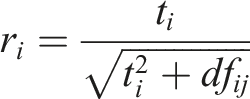
Given that the estimates included in the sample refer to a range of variables, operationalizations, and scales on both sides of the equation, the standardized effect size was obtained by using the partial correlation coefficient, defined as:
Analytical Approach
Our analysis consists of two stages that address the two fundamental issues confronted by this study: the overall effects and the heterogeneity of previous findings. To address the former, a three-level random effects meta-analysis is conducted for each of three independent variable categories 7 : (a) the horizontal distribution of power, (b) the vertical distribution of political power and (c) the vertical distribution of fiscal power. We opt to separate political and fiscal decentralization at this stage as while much of the literature fails to distinguish between these two conceptually, this is always done in measurement, with the former often referring to the number of elected tiers of government and the latter referring to subnational revenues or expenditure. There also exists a considerable vein of research that studies precisely the effects of political decentralization relative to fiscal decentralization (and vice versa) with regard to a range of institutional outcomes not limited to corruption and government quality (e.g.,Bjørnskov et al. (2008); Kyriacou and Roca-Sagalés (2011)). To investigate the heterogeneity of previous findings across these dimensions, a second stage will consist of a moderator analysis that investigates the conditional effect of the distribution of executive power on corruption subject to a range of research design choices made.
Results
An illustration of the three-stage-meta-analyses is provided by three forest plots presented in Figure 2. For each category, the dependent variable (in this instance, on the horizontal axis) is the derived partial correlation (r) between the independent variable of that category and corruption. As some measures included are discrete while others are continuous, the interpretation of the horizontal axis in each case is relative (i.e., more presidential or more decentralized systems). The partial correlation is represented by black points, and the horizontal grey lines represent their derived confidence intervals. Positive values (to the right of center) indicate more corruption. The solid red vertical line represents the overall reported effect size as estimated by the meta-regression coefficient (also listed in the lower right quadrant of the figure), and the dotted red lines indicate 95% confidence intervals. It should be noted at this point that the effects displayed here are not causal effects, rather estimates of causal effects. As expected, the plots display considerable heterogeneity across categories.
8
Forest plots of partial correlations across three dimensions of the distribution of power. Darker shaded confidence intervals indicate a higher density of estimates of this magnitude, while lighter shading indicates a lower density of estimates at a given magnitude. Positive correlations (estimates to the right-hand side of the figures) indicate more corruption for (a) more presidential systems, (b) greater political decentralization, and (c) greater fiscal decentralization.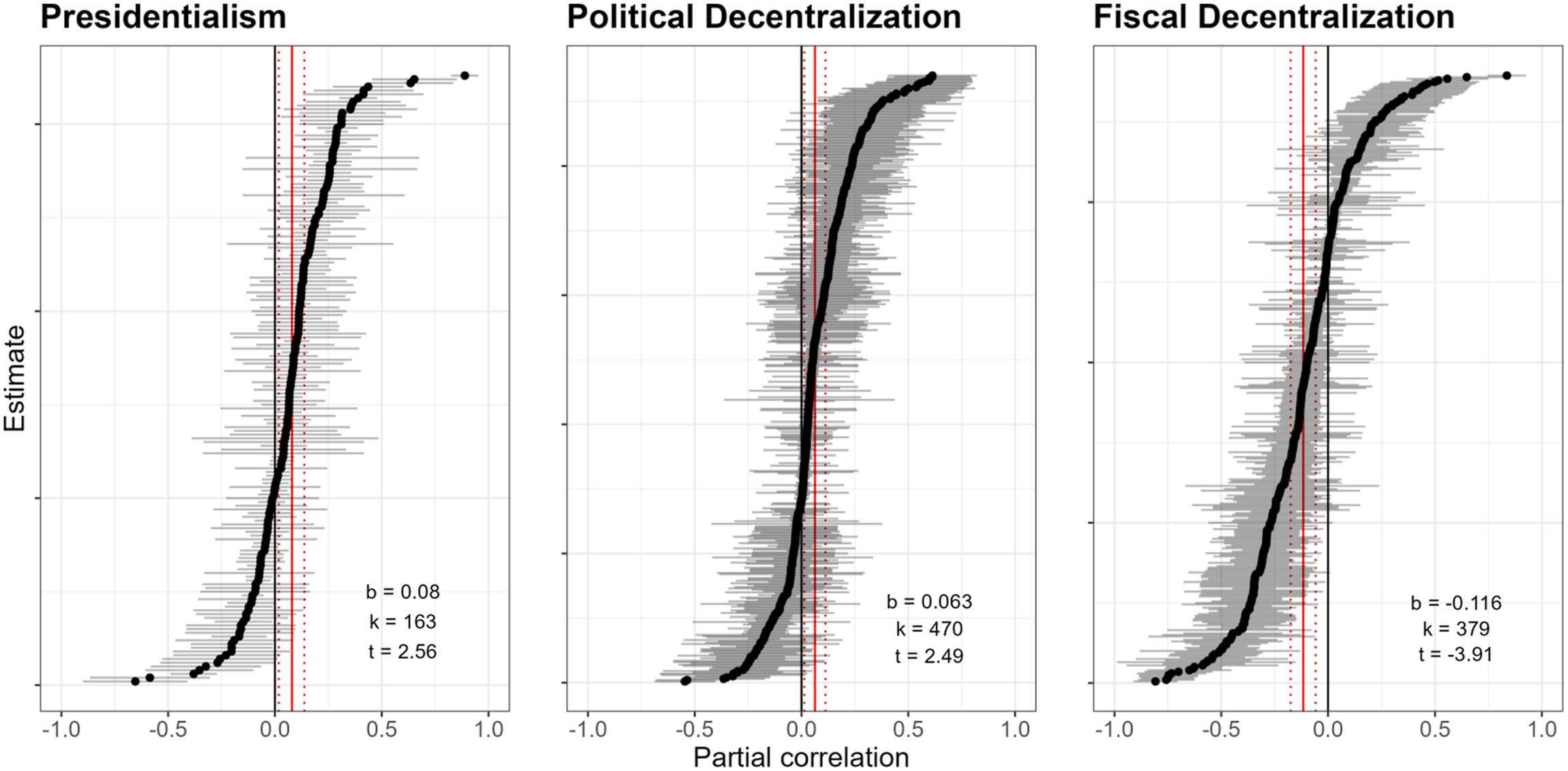
In the case of presidentialism, the left-hand plot reflects the contradictory findings and theoretical explanations elaborated in the preceding discussion. Overall, however, we find that more presidential systems are associated with higher levels of corruption (r = 0.08). Statistically significant (at α = 95%) positive associations in this category account for 55 out of 163 results (34%). Otherwise, the majority (57%) of results were statistically indistinguishable from 0, and less than 10% of results showed a significant negative association. In sum, while there is significant heterogeneity across reports, we find substantial evidence of an (albeit relatively weak) significant relationship between presidential systems and corruption.
With regard to decentralization, an important distinction emerges when comparing the plots for political and fiscal decentralization. While more politically decentralized states appear to be more corrupt, increased fiscal decentralization appears to have the opposite effect. In the strongest results across all three categories, greater fiscal decentralization is associated with less corruption (r = −0.12). This clear result reinforces the need to study these two factors separately with regard to their implications for policy and the behaviors of political elites. Across 470 attempts to estimate the effect of political decentralization - the most frequently tested category - a substantial majority of estimates (292, or 62%) were statistically insignificant, compared to 145 (31%) and just 33 (7%) estimates that found positive and negative associations with corruption, respectively. This contrasts strongly with fiscal decentralization, where 57 (15%) are positive and statistically significant, 177 (47%) are insignificant, and 145 (38%) are negative and significant.
Overall, these results suggest a marginal positive association between political decentralization and corruption on the one hand and a larger negative impact of fiscal decentralization on corruption on the other. Thus, countries benefit from revenue creation and spending on multiple layers of government in terms of lowering corruption, but the introduction of political competition across levels of government and in multiple subnational units increases corruption. In this context, our findings also demonstrate a potential pitfall of using a broad decentralization index encompassing both fiscal and political elements when estimating effects on outcomes such as corruption, as potentially valuable nuance can be overlooked.
However, while separating findings between political and fiscal forms of decentralization can account for heterogeneity in studies that are perhaps not so conceptually precise here, there is still a significant amount of variation in effect directions and sizes even within these categories. The same is also true for the presidential arm of the analysis. This suggests the presence of further factors within studies and statistical models that may contribute to these inconsistent results.
Moderator Analyses
The second half of the analysis now turns to attempting to find explanations for the nature and level of heterogeneity in the results of each of the three categories, which is evident in Figure 2. This will be accomplished by taking various observable characteristics of the studies in the sample and assessing these as moderators in the relationship between each category and corruption, as outlined in the discussion about potential sources of heterogeneity. In a first step, Figure 3 includes a series of coefficient plots that consider the role of several key research design choices. Specifically, Figure 3 considers the impact of the structure and temporal origin of data, the statistical method used, and the spatial coverage of the sample. Each of these factors is measured at the model level, as numerous studies include tests that use several of these approaches. Moderator analysis of research design characteristics. The shaded area indicates the 95% confidence intervals for the overall effect reported in Figure 2. Plotted estimates indicate the conditional overall effect of each dimension when the sample is restricted by time coverage of the data, the research design, and the underlying geographical sample, respectively. Whiskers indicate 95% confidence intervals. See Appendix for numerical results.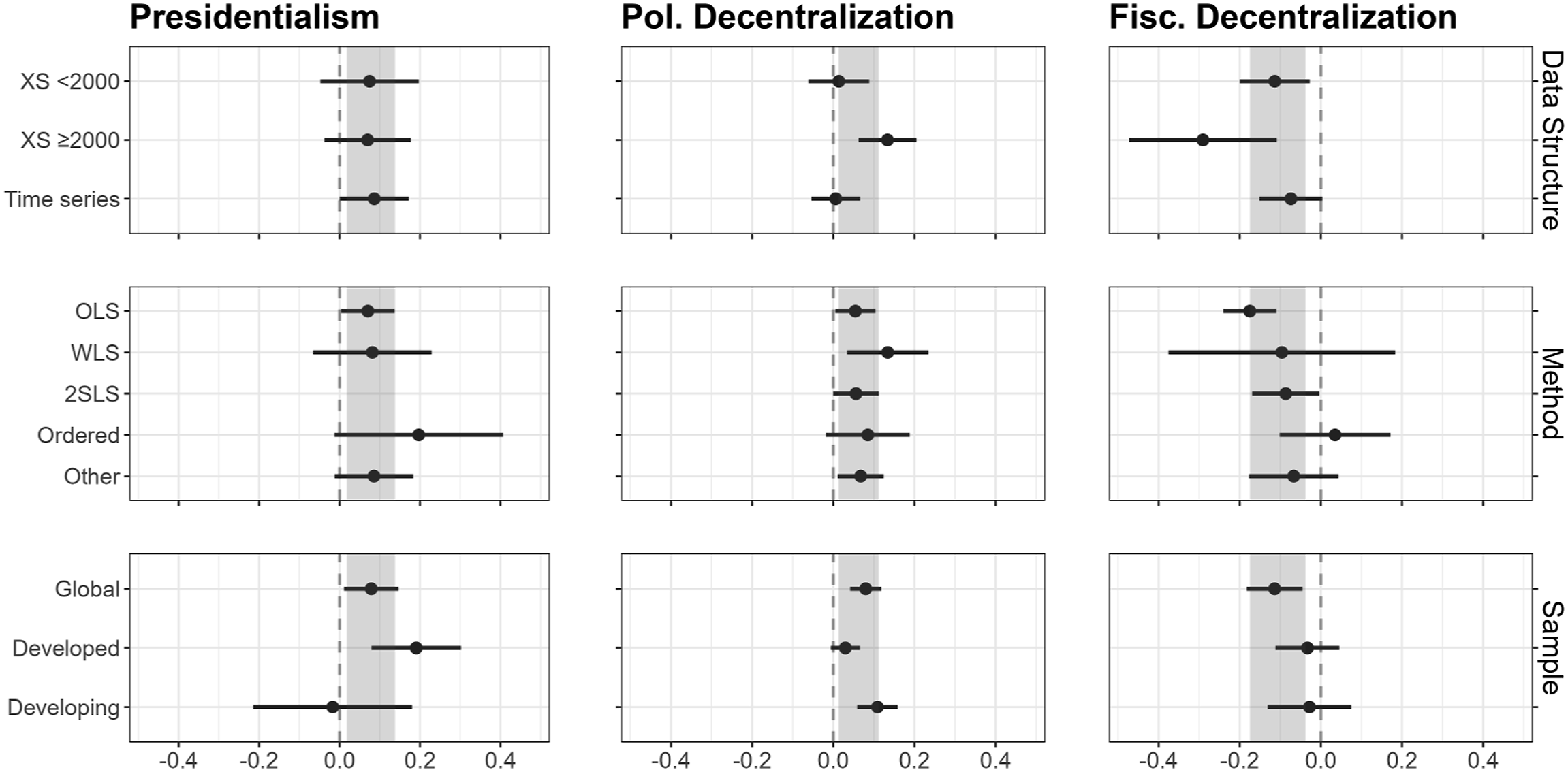
Perhaps surprisingly, results relating to the effect of presidentialism seem relatively impervious to alterations in these research design choices. In one exception, the overall positive effect of presidentialism on corruption is strongest in tests run of samples consisting of only developed countries, and is insignificant in the case of developing countries. This suggests that the overall association is largely driven by this subsample. In other words, presidentialism appears to be conducive to corruption, but the robustness of this finding appears to be limited to developed contexts.
Fiscal decentralization is also comparatively consistent with regard to the low impact of research design choices on the association with corruption, though with two notable exceptions in this case. First, cross-sectional studies conducted on data after 2000 tend to find a stronger negative effect of fiscal decentralization than those conducted on earlier data or studies that use panel data. Relatedly, estimates produced through Ordinary Least Squares (OLS) analysis lie on the upper bound of the negative effect.
Similarly to fiscal decentralization (though in the opposite direction), effect sizes in the political decentralization dimension tend to be larger in cross-sectional studies using data collected after 1999. This runs contrary to Treisman (2007)’s finding that political decentralization tends not to be significantly related to corruption after 2000 because of wider data coverage. However, Treisman (2007) relied on a relatively small sample regarding observations after 2000, while the underlying studies in our sample cover much more of the post-2000 period to date. Studies that use Weighted Least Squares (WLS) also tend to report larger effect sizes than other methodologies.
In a further step, Figure 4 investigates whether the various measurement approaches for each category and for corruption contribute to significant differences in reported findings. In the first case, there is far more variation in the way both forms of decentralization are measured than horizontal distributions of power, which tends to be measured as a dummy variable, which (typically) groups parliamentary systems together with semi-presidential systems. Otherwise, a categorical variable (presidential, semi-presidential, and parliamentary) is used, but these approaches typically only report a single estimate, treating the variable as a linear measure, rather than categorical. Nonetheless, there is no significant difference between the two approaches with regard to their reported relationship with corruption. There may well be an overlooked nuance with regard to semi-presidential systems, but we are unable to decipher this here given how the field has operationalized this dimension. Moderator analysis of independent and dependent variable operationalizations. The shaded area indicates the 95% confidence intervals for the overall effect reported in Figure 2. Plotted estimates in the top row indicate the conditional overall effect of different measurements of each dimension. The bottom row shows results for alternative data sources for measures of corruption. Whiskers indicate 95% confidence intervals. See Appendix for numerical results.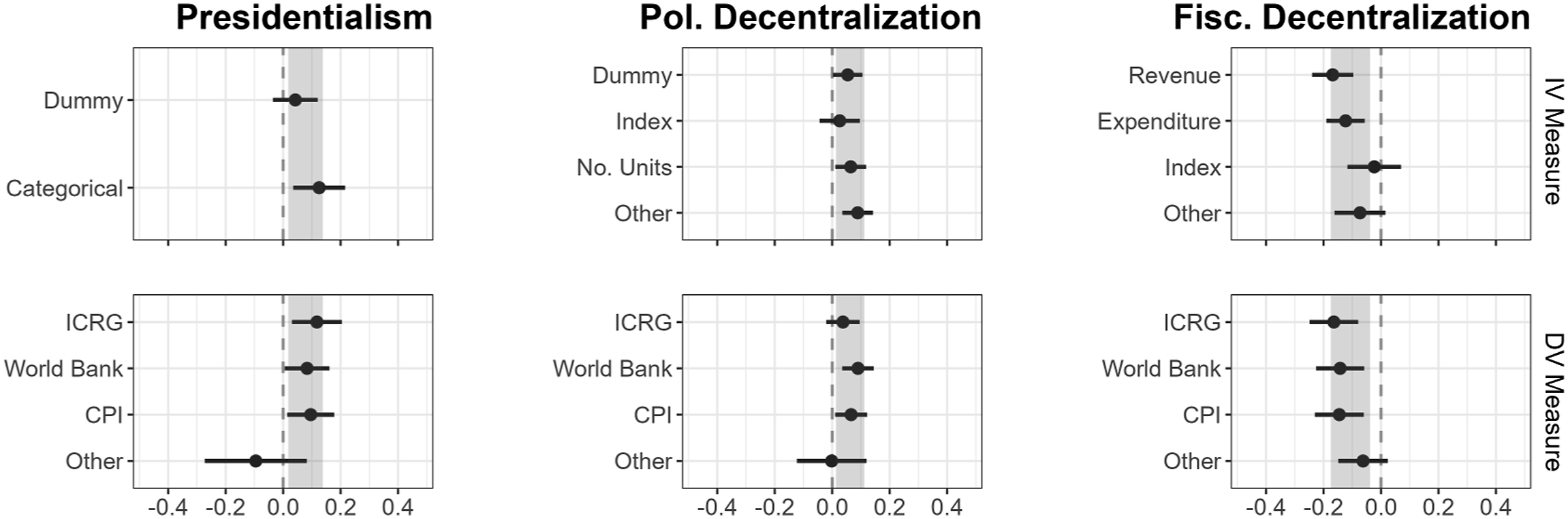
Political decentralization is frequently operationalized as a dummy variable indicating whether or not a country has a federal constitution, and this is especially true when being treated as a control variable. Otherwise, this concept has been measured through aggregate indices such as that the power of different levels of government vis-à-vis each other is considered (Fisman & Gatti, 2002; Kolstad et al., 2014), or the number of decentralized political units (such as e.g. in Arikan, 2004; Fisman & Gatti, 2002), with the intuition being that a greater number of unit or tiers indicates more decentralized decision-making procedures. 9
There is also some variation in the way fiscal decentralization is measured in the sample, though the predominant two measures are total subnational government revenue or expenditure as a percentage of total government revenue or expenditure, or combinations thereof. Across measurements and across all three categories, we see relatively little moderation effects of independent variable measurement approaches on the estimated impact on corruption. Interestingly, the most imprecise findings of both the political and fiscal decentralization dimensions are when they are measured using indexes. This is understandable given that there may be some overlap between between political, fiscal, and administrative aspects of decentralization in these indexes. The differences in magnitudes of effects of presidentialism and political decentralization are negligible. It should also be noted that many studies employ several different measures across their tests, and it is likely that more robust results have a greater tendency to be published. 10
The bottom row of Figure 4 shows the moderation effects of alternative methods of measuring corruption. As discussed at greater length above, the vast majority of studies in the sample employ one or several of three predominant sources of country-level data on corruption: the International Countries at Risk Guide’s Corruption Index (ICRG), the World Bank’s Control of Corruption Index, and Transparency International’s (CPI) Corruption Perceptions Index. We also illustrate the results for alternative measures of corruption, which include citizen and business survey responses and measures related to corruption-related prosecutions, among others. With regard to the three primary measurements, we find very little variation across any dimension, suggesting that effect heterogeneity is not driven by the selection of corruption measurements.
Several studies in the sample test for some degree of conditionality or interaction between distributions of executive power and corruption. Though the number of empirical tests of an interaction between our categories of interest and other constitutional features is not high enough – or evenly spread across several studies – to warrant an independent analysis, in Figure 5 we investigate the conditionality effect through model co-parameters. Put simply, the plots in Figure 5 show the reported relationship between each of our three categories of interest and corruption when one of the other categories is or is not also included in the model as an input variable. We also include the presence (absence) of three aspects of the electoral system, the ballot structure, district magnitude, and electoral formula, as electoral institutions are frequently linked to conditional effects of distributions of executive power (Johnson, 2014; Kunicova and Rose-Ackerman, 2005; Xezonakis & Dawson, 2021). Moderator analysis of model co-parameters. The shaded area indicates the 95% confidence intervals for the overall effect reported in Figure 2. Plotted estimates indicate the conditional overall effect of each dimension when the sample is restricted in accordance with the inclusion of each of the other focal or electoral system dimensions in the same model. Whiskers indicate 95% confidence intervals. See Appendix for numerical results.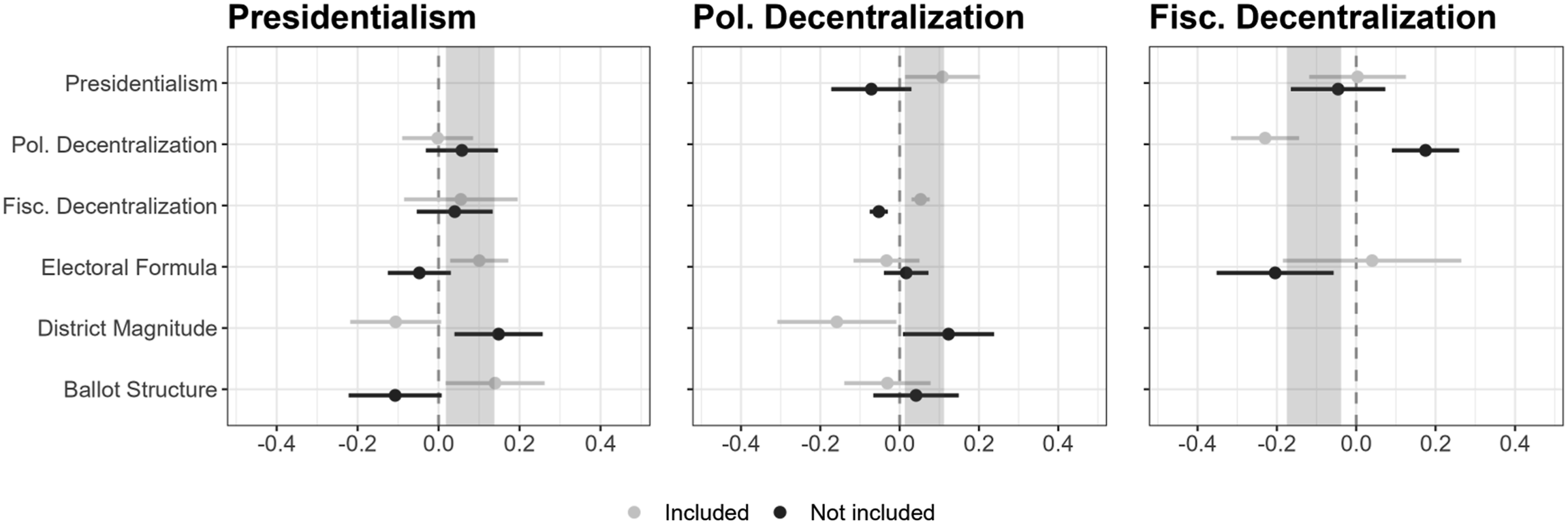
The results indicate some considerable conditionalities across all three categories. The effect of presidentialism, for instance, appears relatively consistent regardless of whether either variety of decentralization is included in a given model. This suggests that the association between presidential systems and corruption identified in these studies may exist largely independently of the horizontal distribution of executive power. However, the effect of presidentialism does appear to be highly contingent on the inclusion of variable relating to the electoral system. This is true not only in terms of effect magnitude, but also direction. Failing to account for proportional or majoritarian electoral rules and ballot structure (i.e., party-controlled or candidate-centered), for instance, leads to a negative association between presidentialism and corruption, suggesting that these factors may mitigate presidentialism’s negative consequences. A flipped sign is also revealed when district magnitude is accounted for. We are, however, unable to estimate the direction of these effects (i.e., larger district magnitude or more candidate-centered ballot structures) as this is measured only as a dummy variable indicating whether these concepts are included in statistical models or not. Nevertheless, it is clear that findings relating to the relationship between presidentialism and corruption are highly contingent on the consideration of the electoral system. This result has significant implications for how we should think about the possible confounding effects of omitting electoral systems in particular when considering the relationship between distributions of executive power and corruption.
The effect of political and fiscal decentralization also appears contingent on some important model parameters. A similar effect regarding district magnitude is found in the case of political decentralization, where the overall positive association with corruption becomes negative when the size of electoral districts is accounted for. Otherwise, the inclusion of presidentialism strengthens the reported positive effect of political decentralization, while the negative effect of fiscal decentralization is even stronger in cases where electoral rules are not accounted for. This figure also reveals more on the relationship between the political and fiscal varieties of decentralization with regard to their effects on corruption: when fiscal decentralization is not included in the model, the effect of political decentralization is rather negative (reducing corruption). This is in contrast to the overall effect reported in Figure 5 as well as the estimate reported here when fiscal decentralization is omitted. Likewise, the effect of fiscal decentralization is strong and negative when its political counterpart is included, and strong and positive when it is omitted. This suggests that measures relating to these two concepts cover much of the same variation with regard to cross-country corruption measures. However, when both are measured independently, important distinctions are made between the two. This also suggests that higher fiscal decentralization seems to decrease corruption to the greatest extent in unitary or otherwise more politically centralized polities – a finding similar to that highlighted by Kyriacou and Roca-Sagales (2009). 11
Concluding remarks
Research on corruption and institutional design has developed multiple arguments on how constitutional features such as the horizontal and vertical division of power could affect officials’ incentive structures and accountability. However, the empirical results produced by the studies related to these factors are inconclusive and in some cases contradictory. Making use of thirty years of research, in this study, we use a meta-analytical approach to consider previous findings regarding presidentialism versus parliamentarianism, and fiscal and political decentralization, and identify factors that could explain the heterogeneity in the findings.
Our results suggest that, overall, previous scholarship has found the decentralization of power in presidentialism and to a lesser extent political decentralization seem to lead to higher corruption levels, although the coefficients show considerable heterogeneity in terms of model specifications. The findings are relatively robust to alternative operationalizations of corruption and each dimension of power distribution but are particularly sensitive to the inclusion of other formal political institutions in the models.
While we do present estimates of the causal effect between these dimensions of power distribution and corruption, it is important to note that these are based on the findings and specifications of previous studies, each of which being prone to endogeneity issues to varying extents. In addition to the obvious issue of omitted variable bias in predominantly cross-sectional research, factors such as fiscal decentralization may be more feasibly introduced in some states than others, precisely because of the nature of corruption in a given country context.Thus, one should also be careful when interpreting our results, as they do not establish a causal effect but rather provide an estimate of the causal effect.
By splitting fiscal and political decentralization into two separate analyses, we can shed light on some of the previously contradicting findings, as political decentralization shows a small positive effect on corruption levels, while fiscal decentralization on average is associated with lower levels of corruption. Thus, some heterogeneity in previous findings can be attributed to an oversimplification of the concepts employed in previous studies. When exploring the still considerable heterogeneity in the effects of fiscal and political decentralization, we find that especially the effect of political decentralization is affected by a number of model- and study-specific considerations. Political decentralization has a considerably stronger positive effect after the turn of the century, and weaker effects in developed versus developing countries. Similarly, the inclusion of district magnitude in models results in opposing effects: in models in which district magnitude is included, both presidentialism and political decentralization have a negative effect on corruption, whereas the effect in both cases is positive when district magnitude is not included. This is indicative that district magnitude might be a relevant confounding factor in the effect of horizontal division of power, which future research should be investigating more closely.
Fiscal decentralization, the extent to which revenues and expenditures of governments are spread across levels of government, initially expresses the strongest magnitude in effect size in our analysis, indicating that countries with fiscal decentralization tend to have lower levels of corruption. Again, this effect is found to be strongest if data from past 2000 is employed, while the estimate otherwise is largely robust to model specifications. Interestingly, we find that fiscal decentralization also expresses opposing effects depending on whether political decentralization is accounted for or not. The results indicate that in the presence of political decentralization fiscal decentralization reduces corruption, while the opposite holds true in its absence.
Thus, while our analysis can account for some heterogeneity in effects, and reveals some interesting patterns, considerable variation persists. Furthermore, it must be noted that this analysis does not claim to provide the correct or proper way to best model the association between these constitutional features and corruption. Rather, this meta-analytical approach has synthesized findings relating to the effects of these institutions and provided some explanations for why many of these findings differ. In doing so, this study has attempted to make sense of some results that seem at first to be empirical contradictions. Taken together, these results highlight the importance of taking into account characteristics of studies and underlying data when assessing heterogeneity in previous findings on the relationship between constitutional features and quality of government. By systematically investigating the results of previous research and the causes of heterogeneity in results, this study makes an important theoretical and empirical contribution to the field.
We also note that while our review focuses on two key constitutional designs, vertical and horizontal division of power, other aspects are of similar interest to fully understand the relationship between political institutions and corruption. First, in this study we only consider electoral institutions as potential moderators, but these institutions are likely to also significant consequences for mechanisms relating to the control of corruption (see for example Kunicova and Rose-Ackerman (2005) and Xezonakis and Dawson (2021)). Second, the approach taken here only investigates the effects of the constitutional design, and thus neglects the role of the actors that populate institutions, and particularly the importance of female representation that has been widely researched (Barnes & Beaulieu, 2024; Esarey & Schwindt-Bayer, 2018). We thus call on future research to broaden the focus of factors studied in a systematic manner as done here exemplary for constitutional designs.
Supplemental Material
Supplemental Material - The Distribution of Executive Power and Corruption: A Meta-Analytical Review
Supplemental Material for The Distribution of Executive Power and Corruption: A Meta-Analytical Review by Stephen Graeme Dawson, Jana Schwenk, and Georgios Xezonakis in Comparative Political Studies
Footnotes
Acknowledgments
The authors would like to acknowledge the input of the anonymous reviewers as well as the team at the Quality of Government Institute, University of Gothenburg at numerous stages of the production of this project.
Declaration of Conflicting Interests
The author(s) declared no potential conflicts of interest with respect to the research, authorship, and/or publication of this article.
Funding
The author(s) received no financial support for the research, authorship, and/or publication of this article.

Supplemental Material
Supplemental material for this article is available online.
Notes
Author Biographies
References
Supplementary Material
Please find the following supplemental material available below.
For Open Access articles published under a Creative Commons License, all supplemental material carries the same license as the article it is associated with.
For non-Open Access articles published, all supplemental material carries a non-exclusive license, and permission requests for re-use of supplemental material or any part of supplemental material shall be sent directly to the copyright owner as specified in the copyright notice associated with the article.
