



Abstract
Do narratives about the causes of inequality influence support for redistribution? Scholarship suggests that information about levels of inequality does not easily shift redistributive attitudes. We embed information about inequality within a commentary article depicting the economy as being rigged to advantage elites, a common populist narrative of both the left and right. Drawing on the media effects and political economy literature, we expect articles employing narratives that portray inequality as the consequence of systemic unfairness to increase demands for redistribution. We test this proposition via an online survey experiment with 7426 respondents in Australia, France, Germany, Switzerland, the United Kingdom, and the United States. Our narrative treatment significantly increases attitudes favoring redistribution in five of the countries. In the US the treatment has no effect. We consider several reasons for the non-result in the US – highlighting beliefs about government inefficiency – and conclude by discussing general implications of our findings.
Inequality is a salient political issue in many of the world’s richest countries, and it generates abundant media coverage. The media does much more than merely report data about inequality – it builds narratives around that coverage, through which people understand the way in which the economy generates inequality (Champlin & Knoedler, 2008; Grisold & Preston, 2020; Schröder & Vietze, 2015). A prominent and recurring media narrative, embraced by populist parties of both left and right, is that inequality is the product of a system rigged in favor of economic elites and against “the people” (Baldwin & Mares, 2023; Berman, 2021; Gidron & Hall, 2020; Müller, 2017; Norris & Inglehart, 2018). Mainstream parties from the right and left also tell versions of this story, emphasizing the theme of unfairness. Parties of the right discuss the unfairness of governments taking hard-earned tax US dollars from working people, while leftist parties decry the lack of fairness in workers having two jobs and still not being able to take care of their families (Ballard-Rosa et al., 2017).
In this paper, we examine whether fairness narratives about systemic economic inequality can influence the public’s views on redistributive policies. Intuitively, media coverage built on such narratives should be a powerful tool to stimulate public interest in inequality and generate support for redistributive policy proposals. Whether through priming (Scheufele & Tewksbury, 2007), learning (Lenz, 2009), or framing effects (Lecheler & De Vreese, 2019), generations of studies of media coverage suggest that exposure to media stories should trigger at least short-term effects on attitudes. Yet the preponderance of social science research, across various country contexts, has found that providing people with information on inequality does not easily shift redistributive preferences (Alesina et al., 2018; Kuziemko et al., 2015; Trump, 2018; cf. Chow & Galak, 2012). Nevertheless, most of these past studies focus on information on levels of inequality, and it remains to be seen whether media narratives about the sources of economic inequality affect attitudes toward redistribution.
We investigate empirically and cross-nationally whether a media treatment featuring a narrative about inequality as the result of a system rigged in favor of the rich increases preferences for redistribution. We administer this “rigged system” treatment to 7426 online survey respondents in six countries: Australia, France, Germany, Switzerland, the United States, and the United Kingdom. Our experimental treatments include indicators of inequality in the six countries – including the ratio of CEO pay to average worker pay and the assets of the wealthiest one percent of the population – nested within a common media frame that emphasizes these facts as indicative of a fundamentally unfair system that favors the rich. We then probe respondents’ views on a variety of redistributive policies, which we combine into a single indicator of redistributive attitudes.
Consistent with our pre-registered expectation, we find that the rigged system treatment significantly increases redistributive preferences in five of the countries. In the sixth – the United States – our treatment has no effect. Our work shows further – again, as pre-registered – that the effect in most of the countries in our sample occurs through the extent to which people believe, after reading the article, that the political system is dominated by elites without meaningful public input (a battery of indicators we loosely entitle elite domination). In other words, views about redistribution in most of our countries change as a result of exposure to our article, and that change occurs at least in part through the mechanism of believing the system is rigged in favor of elites.
We also consider the glaring exception to our general finding. The political economy literature has long held that economic preferences in the United States are dissimilar from the rest of the world (Hacker et al., 2021). In the United States, there are deep partisan divides surrounding redistributive issues (Bartels, 2005; Peyton, 2020), and extensive racial biases influence attitudes towards social policy (Federico, 2004; Gilens, 2009; Winter, 2006). Moreover, Americans and Europeans tend to think differently about inequality and its implications for government action because they think differently about the possibility for individual effort to be rewarded through the market (Benabou & Tirole, 2006; Boudreau & MacKenzie, 2018; Hochschild, 1981; Lane, 1986). Because our survey included a pre-treatment wave that gathered data on baseline attitudes, we are able to evaluate whether any of these usual suspects can explain why American redistributive views are uniquely unresponsive to treatments that frame inequality as the consequence of a system rigged in favor of the rich.
We find no evidence that political orientation or partisanship explains the result in the US. Instead, we find that American attitudes towards redistribution are swamped by beliefs about government inefficiency. Only the small minority of US respondents who believe that the government is competent to deliver results are persuaded by the media treatments. There are of course respondents who are highly skeptical of the government in the other countries. However, the key difference between the US and the other countries seems to be that respondents in the US do not see greater redistribution via the government as a solution to the problem of systemic inequality, while respondents in the other countries do.
These findings demonstrate that narratives about the sources of inequality, particularly those the highlight unfairness in favor of the wealthy, can increase demands for redistribution. This runs contrary to the results of previous studies that show null or weak effects of simple information treatments about inequality. Our findings further reinforce the intellectual payoff to studying the American political economy in comparative perspective (Hacker et al., 2021). When it comes to economic inequality, an issue of salient political concern worldwide, American citizens appear not to be as responsive to the same narratives as citizens in other countries. This provides an important cautionary note for research that attempts to generalize findings about inequality and redistributive preferences based only on American evidence. On a more practical level, our findings speak to the effectiveness of attempts to spur public support for progressive redistributive measures through information campaigns and media coverage. Appeals based on the capture of government and the economy by a privileged elite constitute a persuasive lever in many countries– but on this evidence, not in the United States.
Inequality and Redistributive Attitudes
The weight of political economy scholarship suggests that support for redistribution does not easily change (Stantcheva, 2021). Among the studies reaching this conclusion, Kuziemko et al. (2015) exposed participants to information about the unequal income distribution in the United States, eliciting little effect on support for redistributive policies. In a similar vein, Alesina et al. (2018) ran survey experiments in multiple countries emphasizing how poor children are likely to remain stuck in poverty, while children from wealthy families are likely to maintain their wealth. This treatment caused only left-wing respondents, who were already predisposed to support redistribution, to increase their pro-redistributive attitudes. Trump (2018) ran a series of four experiments, concluding that public exposure to inequality information does not lead to increased demands for redistribution. Meanwhile, Kuklinski et al. (2000) observed that providing correct information about the minute share of the federal budget for welfare payments had no effect on respondents’ policy preferences. 1
There are three reasons that information about inequality might not easily increase demands for redistribution. First, many studies suggest that attitudes about redistribution in response to inequality are conditioned by fairness considerations (Almås et al., 2020; Cavaillé, 2023). 2 Indeed, some psychologists have argued that people are from a young age willing to accept economic inequality, so long as that inequality is viewed as being fair (Starmans et al., 2017). Put another way, people are unmoved by information on inequality when they hold values and predispositions that legitimize inequality on the grounds that hard work pays off (Shariff et al., 2016). If inequality is primarily perceived as a consequence of individual differences in effort, and everyone has a shot – through education and hard work – to earn a place in the upper reaches of the income distribution, then voters are less likely to favor government redistribution. Where, by contrast, high salaries are perceived as a birth right available only to those privileged few whose parents are well off, voters are more likely to favor a larger redistributive role for the government (Alesina & Angeletos, 2005).
From a comparative perspective, this research stream hints at an American equilibrium, where the widespread belief in high mobility corresponds with low support for redistribution, and a European equilibrium, where perceptions of low social mobility correspond with a willingness to redistribute more (Alesina & Angeletos, 2005). These cross-national differences in beliefs are also consistent with the large literature on the divergent origins and evolutions of welfare states (Esping-Andersen, 1990; Pontusson, 2005).
A second reason that may explain the difficulty of shifting redistributive attitudes is motivated reasoning. The mounting political prominence of wealth and income inequality as electoral issues means that political parties have clear positions on inequality, and voters commonly relate to wealth redistribution as a partisan issue (Bartels, 2005). In such cases, where partisan cues are easily accessible, voters tend to form an opinion in line with their partisan priors in lieu of independently evaluating the merits of the policy (Kirkland & Coppock, 2018; Slothuus & Bisgaard, 2021).
A third reason that attitudes about social policy may be resistant to change is because people view the policies through the lens of their underlying racial bias (Gilens, 2009; Harell et al., 2016). This resistance is particularly salient in the eyes of majoritarian group when they perceive racial and ethnic minorities as disproportionate or undeserving beneficiaries of such policies (Bobo & Kluegel, 1993; Neubeck & Cazanave, 2001). Such perspectives are particularly prominent in debates in American politics (Banks & Valentino, 2012; Sears et al., 2000), though they also find support in recent comparative research on immigration (Alesina et al., 2023).
Fairness, the Rich, and Inequality Narratives
Much existing scholarship starts from the premise that if only people understood the real extent of inequality and their actual position in the income distribution, then they would increase their demand for government redistribution (Meltzer & Richard, 1981). Yet the research cited in the previous section does not bear out this intuitive claim. Therefore, we begin from a different premise that looks beyond the fact of inequality and focuses on its origins. Namely, we argue that the causal attributions of outcomes, not just facts related to those outcomes, are important (Heider, 1958; Weiner, 1986). We expect that people will increase their support for redistributive policies if they believe that inequality is the product a political system that is unfairly biased in favor of the rich.
This claim is currently prominent in the politics of many countries (Berman, 2021; Carpenter & Moss, 2013; Hacker & Pierson, 2020; Hertel-Fernandez et al., 2019), and there are several features that make this story especially likely to affect popular attitudes about social policies. First, it comes in the form of a causal narrative, which is how media coverage of inequality is frequently structured. Narratives change policy attitudes because they tell a story about why inequality is high, not merely that it is high (Dahlstrom, 2014; Shiller, 2017). 3 In fact, most people learn about inequality not by brushing up on the latest data from a government statistical office, but by consuming media coverage of this type. This sort of media coverage is not a story per se, but it has a villain (the rich), a victim (ordinary people), and a narrative arc (inequality being high and increasing over time). Such coverage uses statistics about inequality to illustrate the underlying unfairness of a system of resource allocation. 4
Narratives about ‘the system being rigged’ portray the issue of inequality as being fundamentally about fairness. They are couched in a specific conception of fairness that has substantial cross-national resonance: that the rich have acquired their resources through unfair means, a belief which leads people in different countries to favor redistribution through the state (Almås et al., 2022; Alvarado, 2021). Scheve and Stasavage (2016) argue that crucial steps in advancing progressive tax policies were achieved as a way to equalize the contribution of the rich toward state coffers following wars that involved mass mobilization. Limberg (2020) claims the recession that followed the financial crisis of 2008 had a similarly positive impact on progressive tax policy preferences. The financial crisis was a product of light-touch regulation regime that favored the rich and disproportionately hurt the poor. Fairness requires that the state compensate for errors for which it was responsible, and that it do so by drawing more heavily from the group who disproportionately benefited from light-touch regulation: the rich.
This sort of narrative is politically neutral, because it speaks to fairness perceptions that cross the political divide. Leftist ideology often equates fairness with equality, whereas rightist ideology is more likely to focus on the idea of proportionality (Haidt, 2012). A causal narrative about a political system unfairly biased in favor of the rich does not clearly prioritize one of these conceptions of fairness above the other. It is unlikely, therefore, to cue political partisanship. The notion that the system is fundamentally rigged is upsetting information regardless of whether one believes in equality of opportunity or outcomes. An elite capture narrative grounded in fairness considerations thus forms a strong frame that transcends partisan boundaries (Chong & Druckman, 2007).
Similarly, this type of fairness narrative does not divide people along racial or ethnic lines. Populists of both left and right are prone to attack elites. Rises in inequality that promote status anxiety are associated with an increase in support for radical right parties (Engler & Weisstanner, 2021). Yet unlike some populist stories, the narrative of a rigged economy does not cue racial associations, either overtly or via a dog whistle that only those harboring racial resentment will be able to perceive. We therefore expect exposure to such a narrative to change redistributive attitudes, just as other work on framing has observed changes in related policy attitudes (Lecheler & De Vreese, 2019).
In terms of mechanisms, when narratives present elites as deliberate authors of inequality, we expect that reactions against elite domination will contribute to driving change in redistributive attitudes. We expect views about elite domination to mediate the effects of a fairness narrative of inequality on redistributive attitudes. The logic is not complicated: if inequality is driven by the elite rigging the system, then those who believe the narrative will respond by adopting views that elites dominate. We do not exclude that other sentiments – in particular, other notions of unfairness that are not focused on elite domination but that are still related to views about redistribution – may also contribute to the effect that reading the article has on attitudes. Nonetheless, elite-domination views seem to be a particularly relevant mechanism due to the tight conceptual connection with a narrative about a rigged system.
Research Design
Our empirical strategy incorporates a between-subjects experimental design to test causal effects and a multi-country framework to allow for a comparative analysis. 5 We place a premium on testing the effects of the stories about inequality in the economy that people are likely to encounter in the media. As such, we adapted a 2018 article published by Nobel-prize winning economist Joseph Stiglitz entitled: “The American Economy is Rigged.” The adapted Stiglitz (2018) article served as the template for an article about inequality and politics in Australia, France, Germany, Switzerland, the United Kingdom, and the United States. 6 We adjusted the first paragraph in our treatment articles to reflect country circumstances and incorporated data on executive pay and survey results specific to each country. Otherwise, the articles are identical. A second set of participants in each country were randomly allocated to receive a neutral control article. We discuss further details of both articles below.
We conducted the experiment with a sample of 7426 participants in six countries.
7
Established survey firms (YouGov and LINK) disseminated the surveys. The countries have varying levels of inequality. Comparing Gini coefficients, Figure 1 shows that the US and UK appear in the highest quartile for income inequality among OECD members, Australia appears in the second-highest quartile, and Switzerland, France and Germany are in the second-lowest quartile (OECD, 2022). Furthermore, the countries vary in the extent to which inequality is a politically salient issue (Benson et al., 2021). Comparison of economic inequality across countries. Note: Source data from OECD (2022) report on economic inequality. The Gini coefficient scores are based on income after taxes and transfers between the years 2016–2021. The six countries in our sample are highlighted.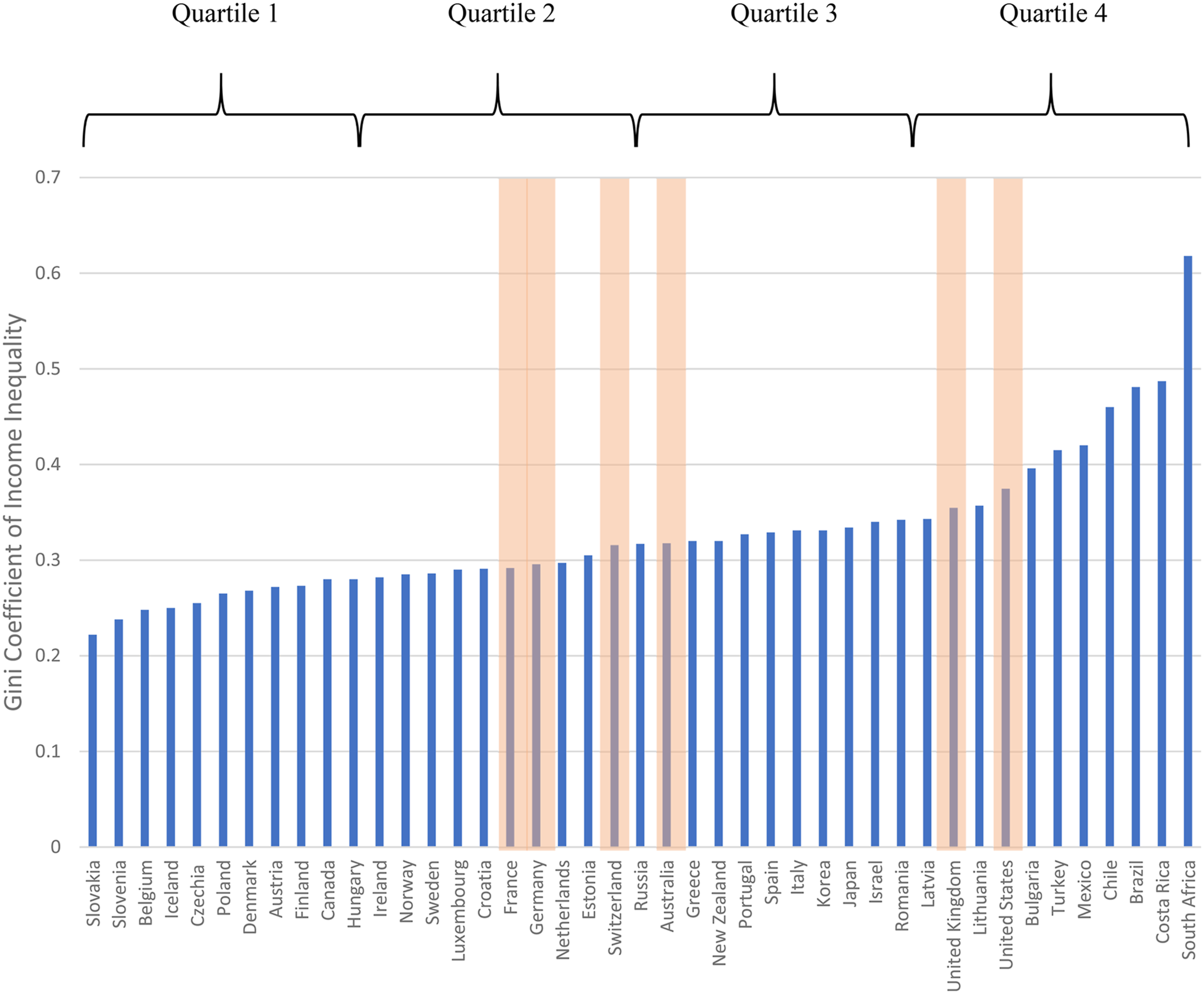
In each of these countries we obtain nationally representative samples. Respondent pools are constructed using a quota system that matched the sample demographics to the national population on the basis of gender, age, income, and ethnicity. Full demographic breakdowns and balance tests appear in Online Appendix A.
All participants were randomly allocated to read either the rigged system article (the treatment group) or a neutral article (the control group). The rigged system article reports on the growing wealth gap between a small elite and the rest of society. By pointing to the stream of bailouts for bankers and tax cuts for companies that avoid paying taxes, the article makes the case that the rules of the economic game are tailored to advantage the rich and powerful, leaving everyone else behind. The article includes both emotional appeals and information about inequality, such as the fact that chief executives are paid 361 times more than the average worker (this statistic is from the US article). The article mimics the style and content of the typical reporting to which people are exposed.
The treatment article refrains from inserting any political or partisan cues, such as the name of a political party or a prominent politician. Some readers may object that an article focused on inequality, using rigged system language, seems slanted to the left. Yet our treatment embeds fairness considerations that resonate with a progressive interpretation (the growing wealth gap between a small elite and the rest of society) as well as conservative perspectives (bailouts for bankers that cheat) (DeScioli et al., 2014; Haidt, 2012). As an example of real-world coverage of this sort, we provide an excerpt from a 2021 article that appeared on the website of Fox News, an outlet seen as right-wing in the US: Our entire economy is now, in large part, rigged, as it has been moved further away from free market capitalism to a cronyist nightmare where central planners and big companies work together to consolidate power… Small businesses and small individuals, which make up the backbone of the economy… are fighting for free market capitalism. They want a fair game. They want transparency and their movement is … about having a level playing field. They, in large part, don’t have a problem with the rich; they have a problem with the rich getting to play by a different set of rules (Roth, 2021).
Articles from the political right tend to emphasize the challenges of small business faced with large corporations and crony capitalism, rather than the poor versus the wealthy in neoliberal capitalism, but they echo the idea that a rigged system allows the rich to play by “a different set of rules” (Ahmari, 2023).
The neutral article reports about the generic business practices of a large company (e.g., Office Depot in the US). We chose this neutral information about a well-known corporation and its business strategy as the content of the control because the treatment article mentions chief executives, the financial sector, banks, and companies as the economic elite benefitting from systemic inequality, and we wanted to make sure that it is the rigged system narrative driving opinions, not the mere mention of businesses. An example of a rigged system article appears in Figure 2, and copies of the articles used in all six countries appears in Online Appendix B. Screenshot of the rigged system article. Note: This is the version of the experimental treatment used in the US. Copies of articles from all countries appear in Online Appendix B.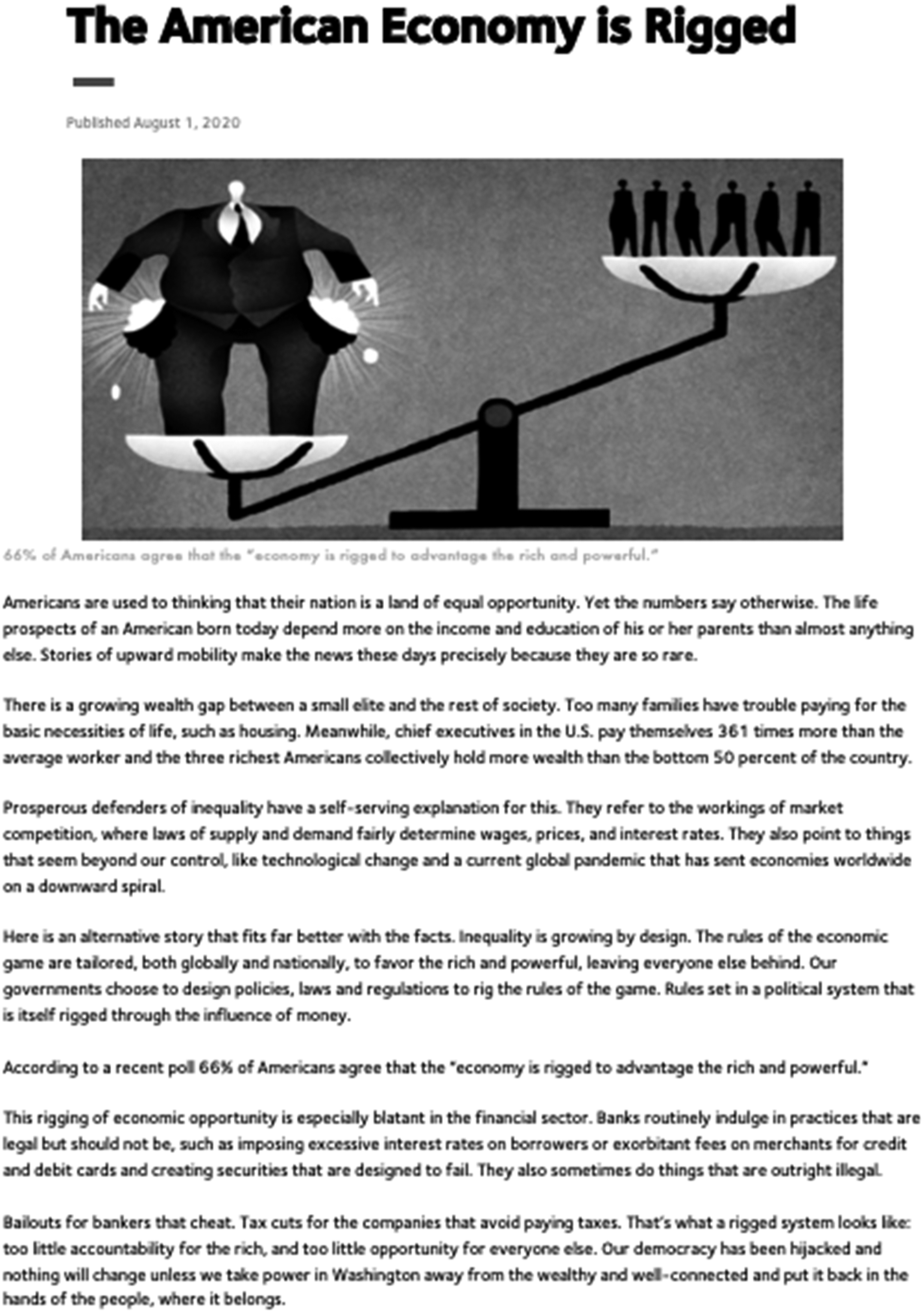
Redistribution Scale Items.
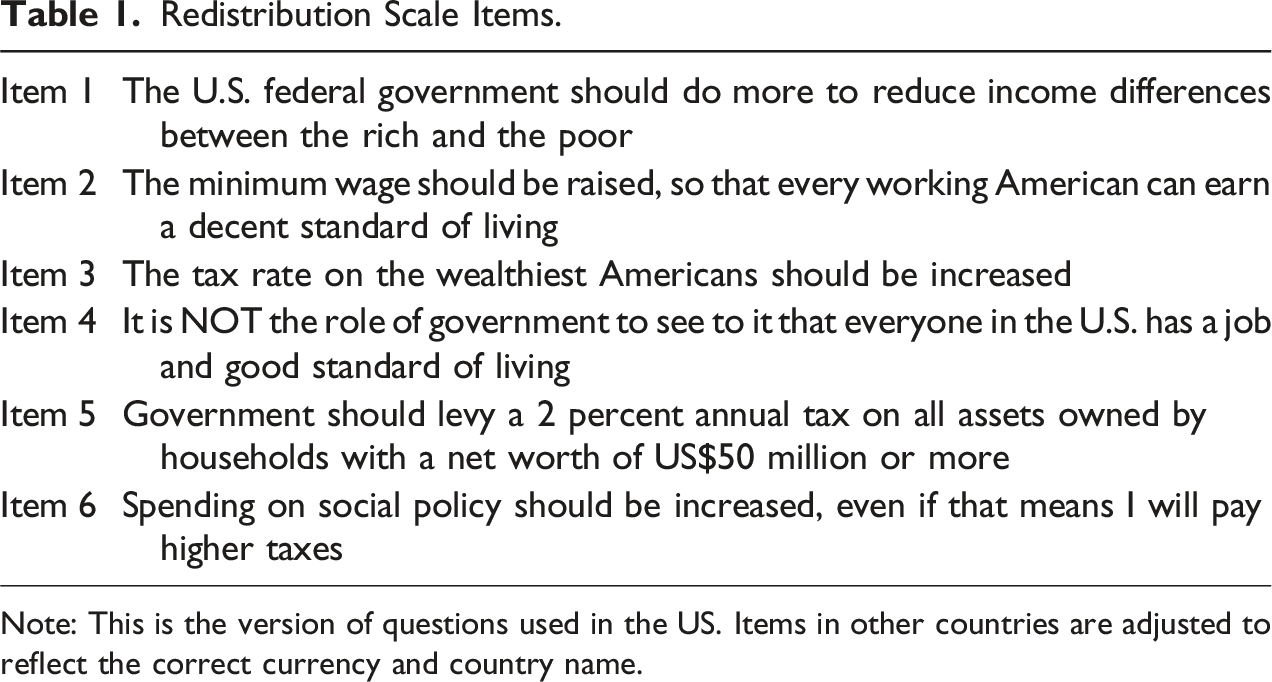
Note: This is the version of questions used in the US. Items in other countries are adjusted to reflect the correct currency and country name.
Elite Domination Scale Items.
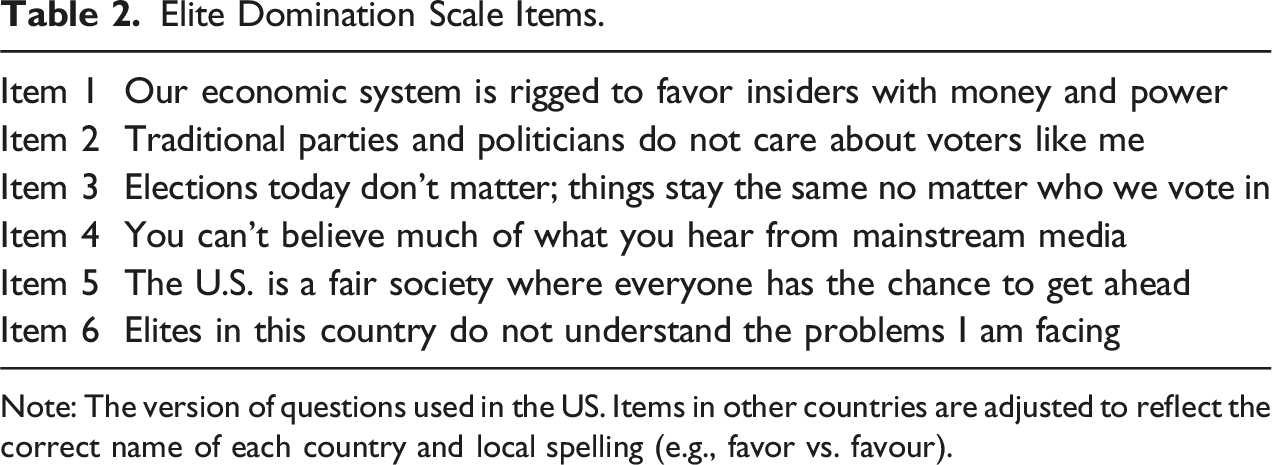
Note: The version of questions used in the US. Items in other countries are adjusted to reflect the correct name of each country and local spelling (e.g., favor vs. favour).
The items in the elite domination scale tap into a general anti-establishment orientation that some scholars argue represents a second dimension of opinion that is distinct from the traditional dimension captured by left-right ideology (Uscinski et al., 2021; see also Mudde & Rovira Kaltwasser, 2018). Specifically, we measure two elements of anti-elite discourse. The first gets at the issue of mobility and fairness (is the system fundamentally unfair?), and is touched on by items 1, 5, and 6 (cf. Müller, 2017). The second refers to disaffection with traditional elite-dominated institutions of representative democracy such as mainstream political parties and the press (items 2, 3, and 4) (cf. Gidron & Hall, 2020; Norris & Inglehart, 2018). Our objective with this scale was to tap into this anti-elite dimension. We believe the rigged system article will have part of its effect through the mechanism of this anti-elite sentiment, but we do not think that this is the only causal pathway through which the rigged system article will affect redistributive attitudes.
In addition to redistributive attitudes and the elite domination scale, we measured an array of relevant covariates, which were collected during a previous wave of data collection with the same respondents. 9 Information on the scales and sources of all collected measures appears in Online Appendix D.
Results
Figure 3 presents weighted t-tests comparing redistributive attitudes among treatment and control groups in each country.
10
Figure 3(a) shows differences in means and their 90% confidence intervals.
11
A positive effect indicates that reading the rigged system news article increased support for redistributive policies, while a negative effect denotes the opposite.
12
Figure 3(b) shows the mean levels of support for redistribution in the experimental and control conditions, along with their standard errors. Treatment effect on support for redistribution by country. Note: In Figure 3(a), dots indicate differences in mean scores, and bars depict 90% confidence intervals. Point estimates and confidence intervals are detailed in Online Appendix E. In Figure 3(b), the bar graph depicts mean levels of support for redistribution in experimental and control conditions, as well as their standard errors.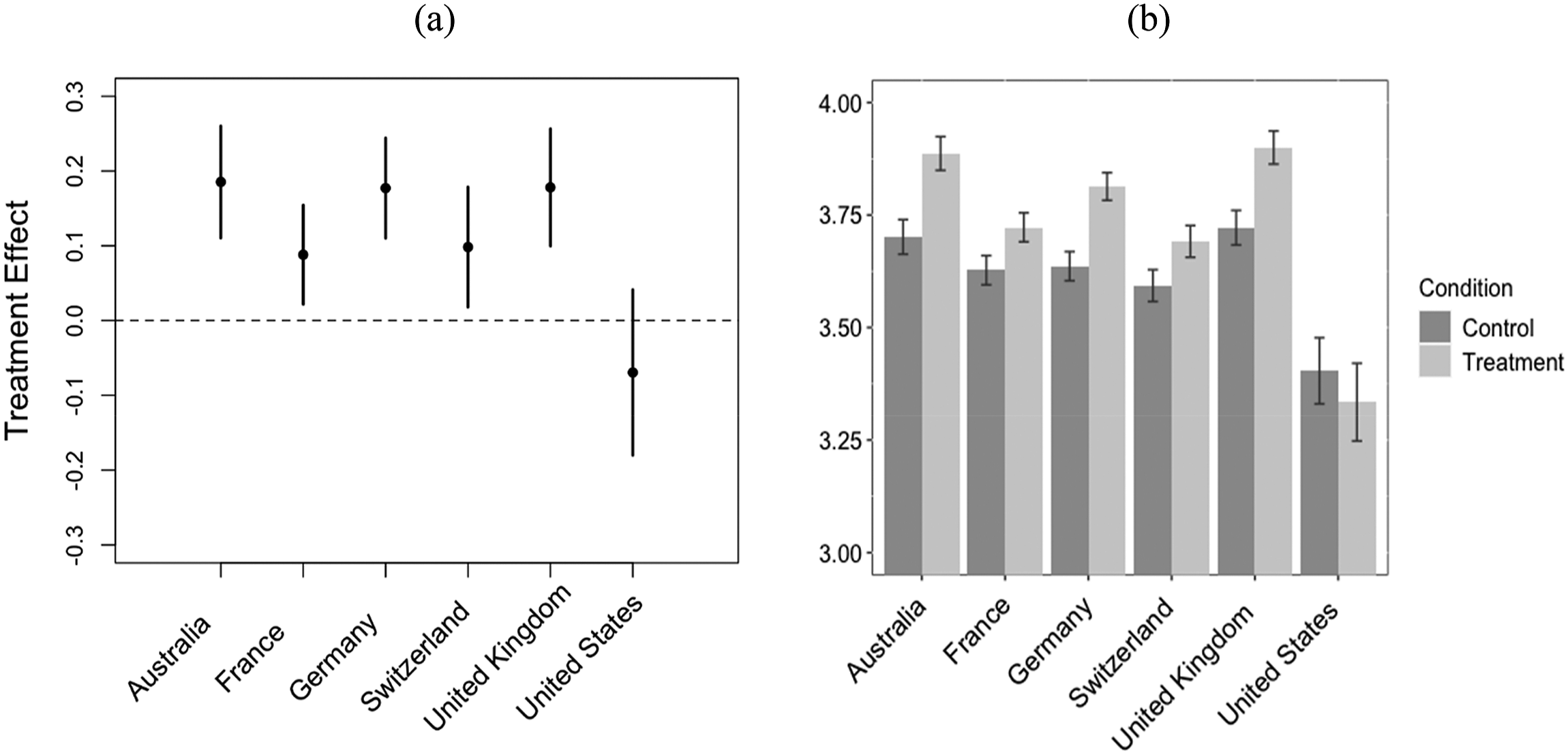
In Australia, France, Germany, Switzerland, and the UK, our rigged system treatment significantly increases support for redistributive policies by between 0.09 and 0.19 units. The average effect size corresponds to 18% of the standard deviation of the outcome. This effect size is comparable to that of a one-unit shift in left-right political orientation on an 11-point scale. This outcome, within and across countries, is robust to alternative specifications, including the use of unweighted analyses and the use of an alternatively constructed dependent variable (see Online Appendix F). 13
However, we can immediately see that the US is a clear outlier – with the rigged system article having no substantive effect on redistributive attitudes, and the direction of that effect being negative (ß = −.07, p = n.s.). 14 According to our theoretical expectations, an important mechanism behind the treatment effect is that the articles encourage a belief that the system is dominated by elites. To test this expectation, we conduct a mediation analysis. Following Imai et al. (2010) and Imai et al. (2011), we calculate the average causal mediation effect (ACME), which is the effect of the experimental treatment (T) on support for redistribution (Y) through the elite domination variable (M). 15 To understand the null treatment effect in the US, we disaggregate the results between the US and the five-country bloc.
In the five-country bloc, the top panel of Figure 4 reveals a small but statistically significant mediation effect. Exposure to the rigged system article generates a substantial increase in elite domination views (ß = .087, p = .000), high elite domination views correspond with stronger redistributive attitudes (ß = .324, p = .000), and the ACME is statistically significant (ACME = .028, p = .000).
16
The mediation explains 17% of the total effect, suggesting that elite domination views constitute at least part of the underlying mechanism. The sensitivity parameter of 0.34 suggests that the results are fairly robust to violations of the sequential ignorability assumption (cf. Imai & Yamamoto, 2013).
17
By way of contrast, our experimental treatment does not provoke any change in the elite domination scale in the US sample (ß = .002, p = n.s.), and so there is no significant mediation effect. Mediation analyses for five-country bloc and United States. Note: Estimates of ACME, ADE and Total Effect with 95% confidence intervals. ACME: Average Causal Mediation Effect. ADE: Average Direct Effect. Figures are based on regression analyses that are produced in full in Online Appendix G.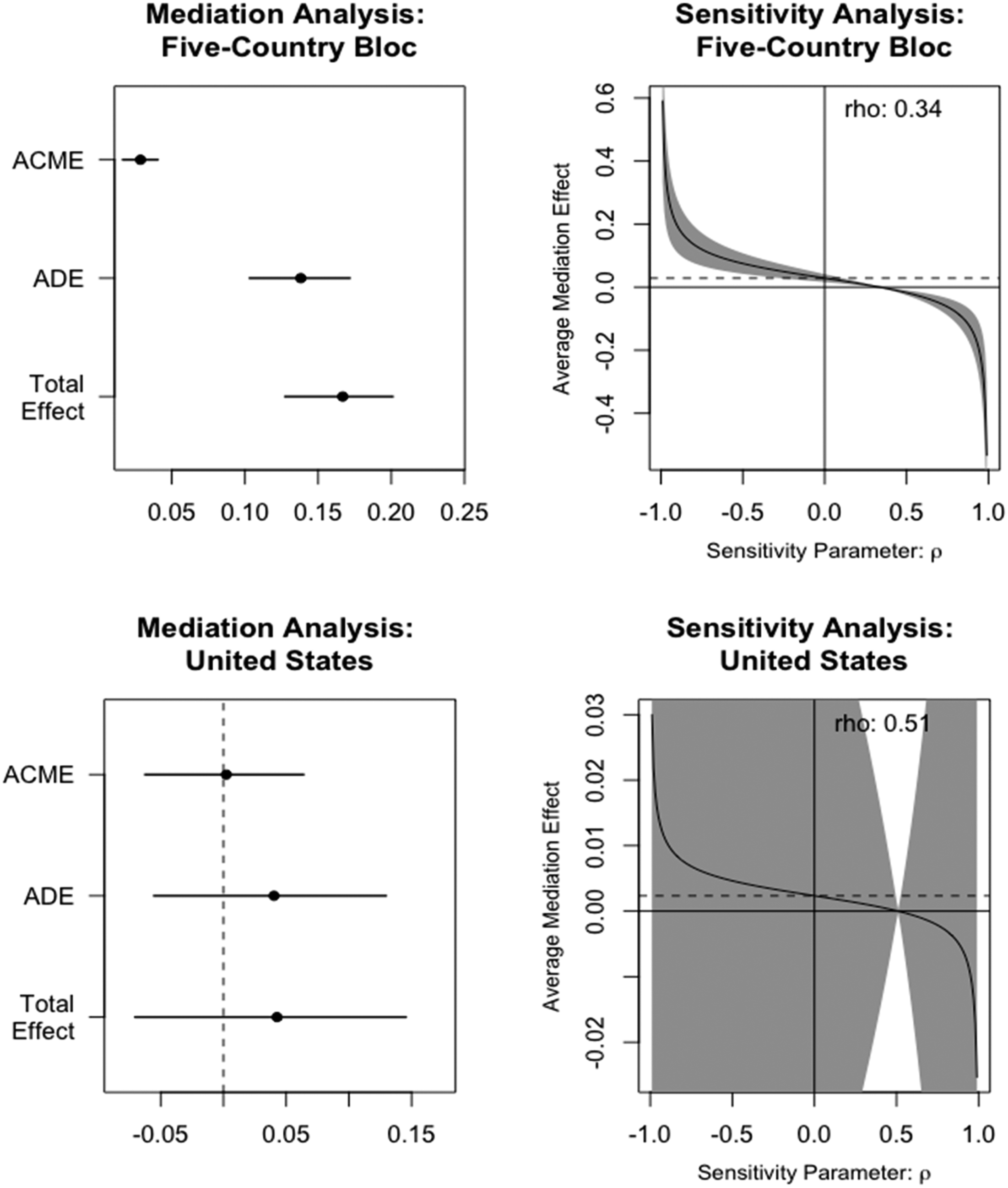
Even if one rejects mediation analyses because of their demanding assumptions (see also Green et al., 2010 for a discussion of the difficulty of unpacking the “black box” in social science studies), it is revealing that the rigged system article increases elite domination views in the five-country bloc but not in the US. To further bolster confidence in our mediation results, we re-run the analysis in Online Appendix H using an alternative causal IV analytical framework, which uses instrumental variables regression to examine the effects of mediators on outcomes. (Bullock & Green, 2021; Kuziemko et al., 2015; Peyton, 2020). These alternative mediation results mirror the results presented here, with a significant mediation effect emerging in the non-US bloc, but not in the US.
In short, our results indicate that across countries with different levels of inequality, the rigged system treatment – with its combination of information about inequality and the narrative of a structurally unfair economic system – generally increases demands for redistribution. A part of that increase is due to changes to the set of views we have grouped together under the heading of elite domination. Our results stand in contrast to work that finds redistributive preferences are resistant to change (Stantcheva, 2021; Trump, 2018).
However, our results do not hold in the United States. In the next section, we turn to a consideration of the American results.
Understanding the American Exception
The literature has established clearly that the United States is an outlier in its redistributive attitudes and the limited extent of its welfare policies (Pontusson, 2005). Should we be surprised that respondents in our US sample react differently to media stories that portray inequality as a game rigged in favor of the economic elite?
We first consider the most obvious explanation that flows from our mediation analysis: that our treatment failed to elicit any changes in attitudes towards redistribution among our American respondents because the rigged system media article failed to amplify their views about elite domination. We expect that this is indeed part of the explanation. Our treatment does significantly affect some elements of the elite domination scale in the United States in the expected direction, specifically the item about the US having a fair economy. But it affects only half the items, and notably it does not affect the item that says, “Our economic system is rigged to favor insiders with money and power.” It might be reasonable not to expect a “rigged system” effect if, after reading the article, readers don’t agree that the system is rigged. Reading the article stimulates beliefs that American society is unfair, but it does not convince readers in the United States that the system is rigged in favor of the rich.
Given that the elite domination scale only partially mediates the effect of reading the rigged system article in the five countries where we do observe an effect on redistributive attitudes, it is apparent that there are other aspects of the treatment, perhaps tied up with systemic unfairness but not deliberately tied to views of control by economic elites, that also have an effect on support of redistribution. Why then do these other aspects not nudge American attitudes in favor of redistribution?
For political scientists observing a highly polarized United States, the obvious expectation is that this exceptional result must be driven by differences in responses between partisans of the left and the right. Yet that expectation is not borne out by the data. We find no evidence to support a partisan treatment effect in the United States, nor do we find such an effect in the other five countries. In Figure 5, we present the results of a conditional analysis that interacts our treatment effect with political orientation (measured on an 11-point scale). We find that left-right self-placement entirely fails to moderate the effect of our media treatment. Put simply, in the United States, the rigged system treatment does not shift redistributive attitudes at any point on the spectrum of political orientation; in the other countries, all respondents at all levels of political orientation are equally moved by the media treatment to adopt more pro-redistribution positions.
18
Treatment Effect Conditional on Political Orientation. Note: The panels show marginal effects of our experimental treatment (with 95% confidence intervals) on redistributive attitudes along the values of political orientation. Histograms at the bottom of the plots reflect the distributions of political orientation (0 = left, 10 = right) for each of the two samples. The regression analyses for each model are produced in full in Online Appendix J.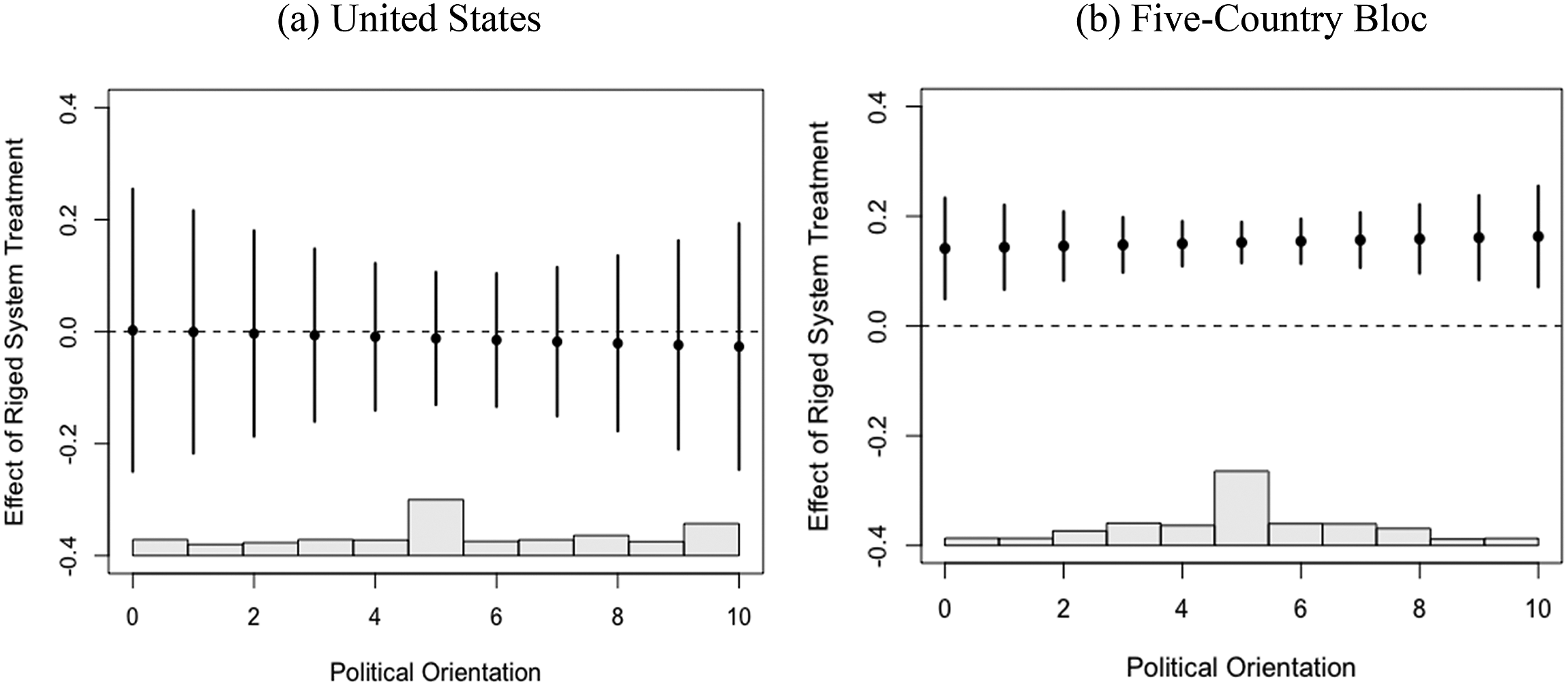
Given the failure of the most obvious culprit to explain why American reactions to the rigged system treatment differ so strongly from those elsewhere, we examine how American support for redistribution differs from the other countries. We are able to do so thanks to a pre-treatment set of data that recorded baseline demographic and attitudinal information from the participants in our treatment and control groups. 19 The predictors of redistributive attitudes start with background demographics as conventional “controls,” which aim to ensure that the effects of age groups, education, income levels, and gender are taken into account. Demographic factors also proxy for the group bases of mass opinion that form the basis for organizing and mobilizing political interests (Achen & Bartels, 2017; Kinder, 1998; Nelson & Kinder, 1996). To these foundations, we also add several factors that often orient a person’s political views: their general news consumption, political efficacy, and trust in government. These political background factors correlate with policy views with regularity, especially for a relatively well-formed issue domain like redistributive politics (Kinder, 1998). Another set of factors that commonly orient policy views are political predispositions – “values” that are typically acquired in one’s pre-adult years and remain stable throughout one’s life course (Zaller, 1992). Here we include left-right ideological orientation, an economic individualism scale, a limited government or government inefficiency scale, and a racial resentment scale (Kinder & Sanders, 1996; Zaller, 1992; Zaller & Feldman, 1992). The latter three scales are workhorses in the American National Election Studies time series that have been tested and repeatedly re-used. 20
In Figure 6, we regress baseline redistributive attitudes on the list of demographic and attitudinal variables discussed above that are traditionally incorporated into models of policy views. We disaggregate this analysis by country and all predictor variables are normalized on a 0-1 scale to ease the comparison of effect sizes. Notwithstanding a long tradition of scholarship on American exceptionalism (Lipset, 1996; Shafer, 1999), Figure 6 shows extensive similarity in the predictors of redistributive attitudes between the United States and other countries. Broadly speaking, support for redistribution is based upon a similar set of demographic characteristics, political predispositions, and core values across all our six countries. Age uniformly predicts greater support for redistribution, and economic individualism and conservative ideological views are associated with lower support for redistribution. The data also corroborate recent research arguing that support for redistribution is viewed through a racial lens in most national contexts, and not just in the United States (Harell et al., 2016). Predicting support for redistribution by country. Note: Values reflect coefficient estimates based on OLS models with normalized predictor variables. Lines indicate 95% confidence intervals. The regression analyses for each country are produced in full in Online Appendix I. The descriptions of the survey items from which the predictor variables are constructed appear in Online Appendix D.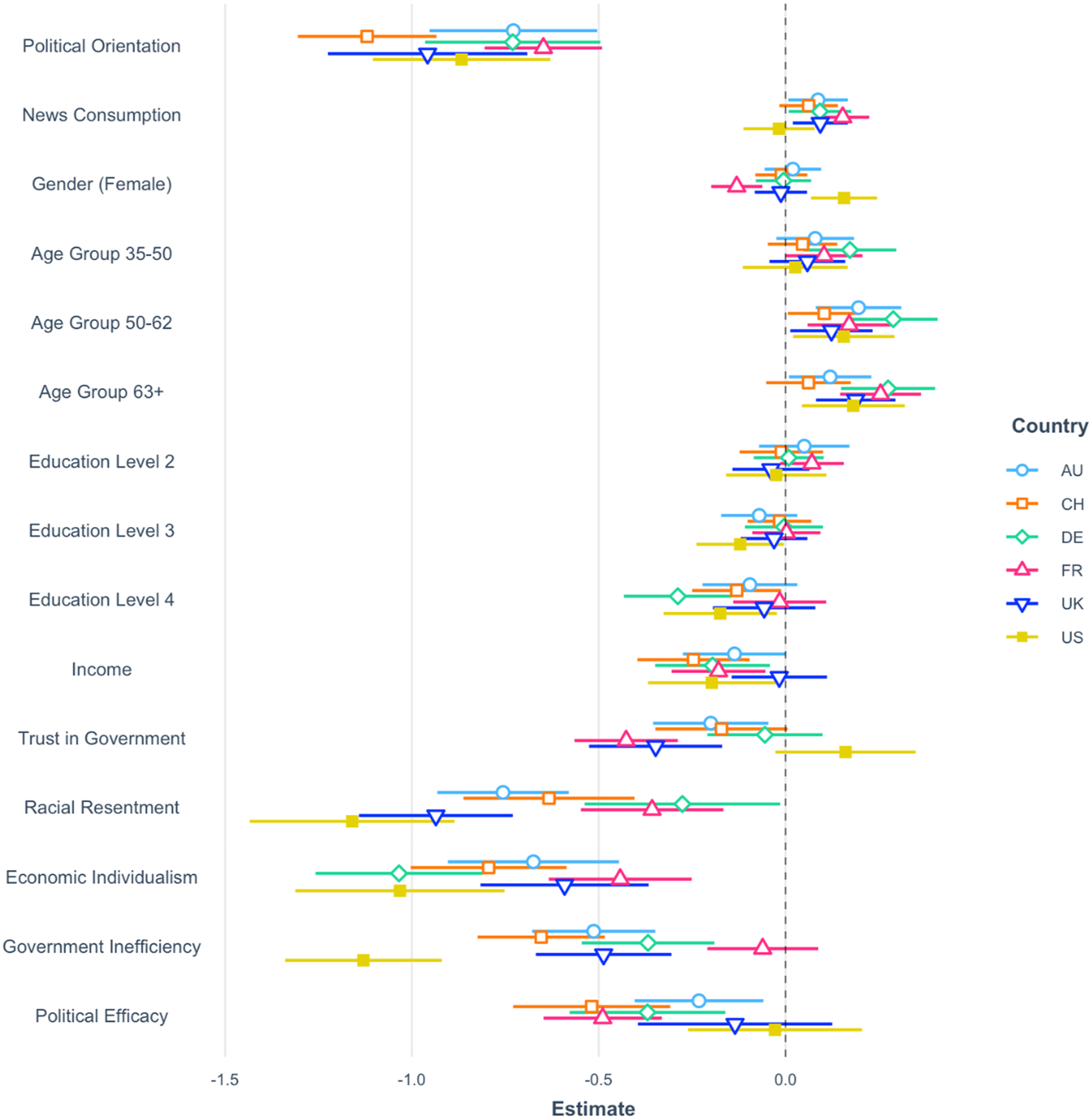
The clearest exception to this pattern of cross-national similarity is the item on government inefficiency. This item taps into views regarding the role of the state and free enterprise that have long been distinctive in the United States (McClosky & Zaller, 1984). 21 Specifically, the item asks whether respondents agree with the proposition that “government intervention leads to too much red tape and creates new problems.” 22 Figure 6 shows that perceptions of government inefficiency have a large negative relationship with redistributive attitudes in the US, far more than in the other five countries.
We therefore explore whether this outlier variable moderates the effect of the rigged system treatment on redistributive attitudes, and so helps explain the anomaly of our findings for the United States. We begin by presenting a set of interaction analyses in Figures 7(a) and (b), which interact our media treatment effect with views of government inefficiency, a pre-treatment variable that was collected during an earlier wave of data collection. Higher scores on the x-axis signify a stronger belief in the government’s inability to distribute resources efficiently, and the bars represent the number of respondents choosing each answer option. First, comparing the bars on the bottom of the two figures, we can see that the distribution of the government inefficiency variable is more skewed in the US: more American respondents believe that government intervention is inefficient than do people in other countries. With this backdrop, the interaction results reveal that this variable significantly moderates the effectiveness of our media treatments only in the US (interaction effect: ß = −.183, p = .000). There, only those few people who believe that the government is capable and efficient are positively influenced by the treatment to support redistributive policies. Respondents who view the government as highly inefficient in fact become less favorable toward redistribution.
23
Treatment Effect Conditional on Perceptions of Government Inefficiency. Note: The panels show marginal effects of our experimental treatment (with 95% confidence intervals) on redistributive attitudes along the values of perceptions of government inefficiency. Histograms at the bottom of the plots reflect the distributions of perceptions of government efficiency in the data. The regression analyses for each model are produced in full in Online Appendix J.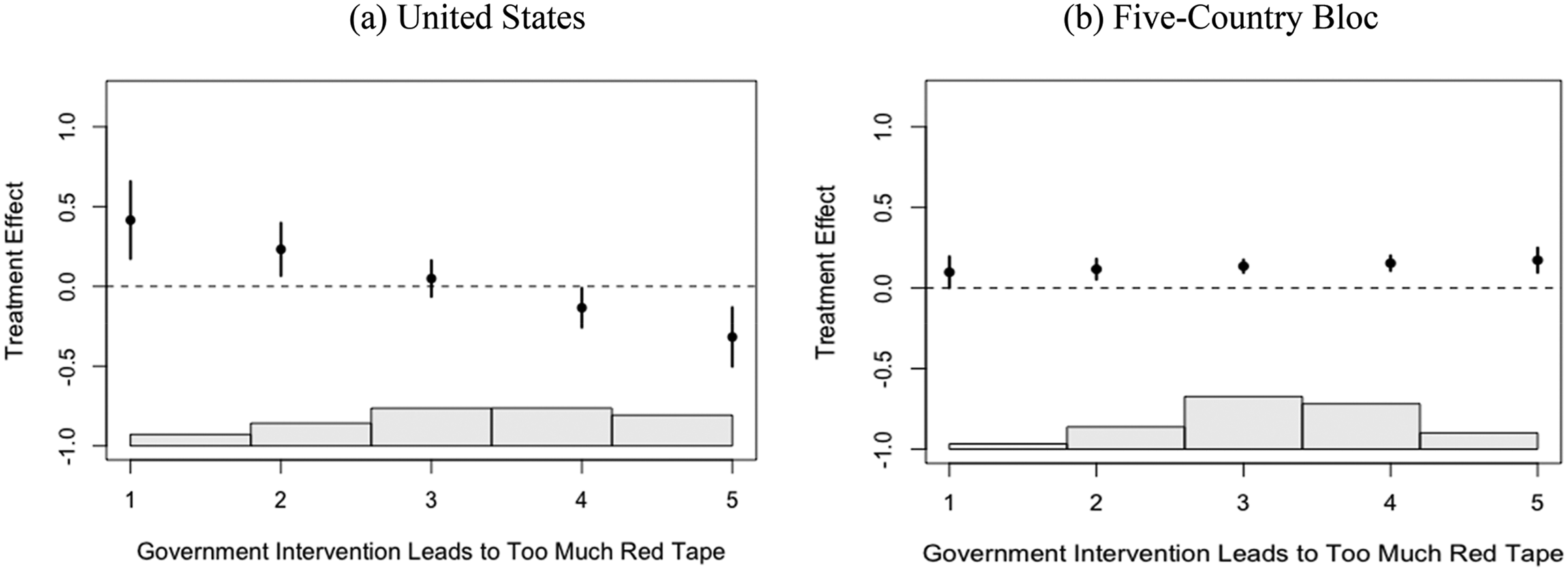
In other words, alongside the lack of response of American views on elite domination to our treatment, these diverging responses are an important driver of the overall null effect in the US. Outside the US, the concern with government as a source of red tape is irrelevant to the way that people respond to the rigged system article. To confirm that these cross-national interaction effects are statistically distinct, we run a three-way interaction test (involving the original interaction of the treatment x government inefficiency views, and a binary indicator for whether the respondent is from the five-country bloc or not). The analysis yields a statistically significant coefficient estimate (three-way interaction effect: ß = .201, p = .000).
In Online Appendix K, we explore and dismiss several other factors that might be responsible for the American exception: party identification, racial resentment, racial identity, and economic individualism. 24
Conclusion
Using a six-country survey experiment with 7426 participants, we asked whether exposure to a narrative of an economic system that is rigged in favor of elites changes attitudes towards redistribution. We find that this sort of narrative does indeed shift voters’ attitudes toward redistributive policies in five of the six countries we study: Australia, France, Germany, Switzerland, and the United Kingdom. With a diversity of political cultures and welfare state traditions, we nevertheless find a uniformly positive effect of our treatment in these five countries. Moreover, we measure attitudes consistent with a latent variable of elite domination, and we find that those attitudes are one mechanism through which redistributive attitudes change.
Our headline finding in these different countries lays down an important challenge to social scientists who have found expressions of support for redistribution largely unresponsive to information about the extent of inequality. We have presented people with a specific narrative about systemic inequality, including indicators about its extent, tying those outcomes to disproportionate influence on the political system by the rich. Citizens often learn about politics through narratives they encounter in the media, and ours is a causal narrative that appears in media of both the left and the right. We cannot, on the basis of this single experiment, generalize our findings to all causal narratives and their impact on attitudes towards inequality. But we think this evidence certainly justifies more inquiry into the way in which economic narratives, grounded in fairness considerations, can change views about the desirability of state-led redistribution.
We have focused on the sort of causal narrative that appears in commentary articles about inequality. But narratives are not restricted to, or potentially even most effective in, news environments. Kim (2023) combines experimental and observational evidence to show that the American consumption of entertainment programs built around “rags-to-riches” narratives increases their belief in upward economic mobility. Those narratives, in Kim’s work as in ours, have an effect on attitudes that are politically consequential.
Our contribution has been to highlight the potential role of inequality narratives as sources of attitudinal change. We do not challenge the repeated finding in prior research that exposure to information about inequality alone does not easily change support for redistribution. We do, though, emphasize that people do not form political beliefs simply by acquiring dry information about levels of inequality. They consume news and commentary, which contain strong narratives regarding the causes of inequality. The fact that redistributive attitudes are malleable in response to our rigged system treatment suggests that it may well be worth inquiring about the broader frames that discuss inequality in the media, just as it has proved to be fruitful to inquire about media coverage of macroeconomic narratives (Barnes & Hicks, 2018; Jacobs et al., 2021).
However, our findings do not hold up in the sixth county in our study: the United States. In the US, our treatment does not have a significant effect on support for redistribution, and reading the article has no effect on perceptions of elite domination, which formed an important pathway by which the treatment influenced attitudes in the other countries. Our analysis pinpoints the discordance between the US and the other countries as originating, at least in part, in beliefs about the inefficiency of government. Americans are far likelier to believe that government is inefficient than other respondents in our sample, and those Americans who believe government is inefficient do not become favorable to redistribution after reading the article. The few Americans who believe in government efficiency are in fact responsive to our rigged system treatment.
At the same time, we hasten to underline the limitations of our experiment. Despite our attempts to create a naturalistic setting, some of our design choices hinder our ability to generalize from these results to media effects more generally. First, our treatment was deliberately not identified with any media outlet, which is inconsistent with the real-world information environment. Peterson and Allamong (2022) show that people prefer to select news from known sources, but that the effect magnitudes of consuming news from an unknown source (like ours) are similar to those observed from mainstream media. Second, our respondents had no ability to choose what they wanted to read in our experiment, as it was randomly assigned (cf. de Benedictis-Kessner et al., 2019). Perhaps some of the people whose views were changed by this article would never choose to read such an article in reality. When it comes to the related questions of partisan self-sorting (Tyler et al., 2022), we are somewhat reassured that our findings are not irrelevant, given that such articles appear in outlets of both left and right. Moreover, recent work by Guess (2021) suggests that much of the American public – differently from a hyper-partisan elite – consumes a broad media diet, with substantial overlap between the news consumption of Democrats and Republicans.
Notwithstanding these limitations, the comparative sweep of our work holds a broader cautionary tale for the study of politics through survey experiments, including the excellent work cited in the previous paragraph, all of which is about the United States. Political scientists should be wary of generalizing findings based on American survey respondents to the rest of the world. Our comparative results show the US is a stark outlier in terms of the public responsiveness to narratives about inequality. Research on social policy attitudes, as on many other topics, has been dominated by surveys carried out in the United States. With a comparative perspective, we conclude that a narrative about fairness and structural economic inequality can substantively shape people’s support for redistributive policies.
In his first inaugural address in 1980, American president Ronald Reagan famously said, “government is not the solution to our problem; government is our problem.” Consistent with this declaration, our answer to the puzzle of why respondents in the US do not demand more redistribution when they read a media treatment describing inequality as the result of a system rigged in favor of elites is because they are not convinced by the article that the system is rigged, and because a cross-cutting segment of the American population – not just Whites or Republicans or rugged individualists – believes that the sentiment expressed by Reagan in 1980 is apt today. Those who think that government intervention is ineffective believe that solution to a system rigged by elites is to have the government distribute less, not more. These views are strikingly different from what we observe in the other countries in our sample, and we believe they establish a strong foundation for further comparative research into how voters respond politically to the narratives they encounter in the media.
For comparativists, we suggest a research agenda that doubles down on understanding which parts of the rigged system treatment are most compelling, and how they fare when faced with countervailing messages (Chong & Druckman, 2007). For Americanists, many of whom inveigh against the unfairness of the American political system (Hacker & Pierson, 2020), the challenge is considerably greater: if narratives describing an economic system rigged against fair play are unable to move support for redistribution, what other appeals might break through ingrained American suspicion about the capacity of the state?
Supplemental Material
Supplemental Material - ‘The Economy is Rigged’: Inequality Narratives, Fairness, and Support for Redistribution in Six Countries
Supplemental Material for ‘The Economy is Rigged’: Inequality Narratives, Fairness, and Support for Redistribution in Six Countries by Pepper D. Culpepper, Jae-Hee Jung, Ryan Shandler, and Taeku Lee in Comparative Political Studies
Footnotes
Acknowledgments
We are grateful for insightful comments from Peter Hall, Melissa Sands, Jamie Walsh, three anonymous reviewers, and the editors of CPS, as well as for useful feedback from presentations at Brown University, Nuffield College, and the European Politics Online Workshop. Thanks to Clemence Hautefort, Robin Hsieh, Hayley Pring, and David Weisstanner for amazing research assistance. This project has received funding from the European Research Council (ERC) under the European Union’s Horizon 2020 research and innovation program (grant agreement no. 787887). This paper reflects only the authors’ views and not that of the ERC. This project received ethics approval from the University of Oxford (BSG_C1A-19-10).
Declaration of Conflicting Interests
The author(s) declared no potential conflicts of interest with respect to the research, authorship, and/or publication of this article.
Funding
The author(s) disclosed receipt of the following financial support for the research, authorship, and/or publication of this article: This research is funded by the European Research Council (ERC) Advanced Grant 787887 (Principal Investigator: Pepper Culpepper).

Data Availability Statement
Data and replication files are available at Culpepper et al. (2024).
Supplemental Material
Supplemental material for this article is available online.
Notes
Author Biographies
References
Supplementary Material
Please find the following supplemental material available below.
For Open Access articles published under a Creative Commons License, all supplemental material carries the same license as the article it is associated with.
For non-Open Access articles published, all supplemental material carries a non-exclusive license, and permission requests for re-use of supplemental material or any part of supplemental material shall be sent directly to the copyright owner as specified in the copyright notice associated with the article.
