




Abstract
Although extensive research indicates that economic inequality drives public demand for redistribution, longitudinal evidence of this association in unequal contexts remains scarce. Using pooled cross-sections of surveys from over 140,000 individuals consistently observed between 2008 and 2019, this study tests the inequality-redistribution nexus in Latin America. I examine both the general association between inequality and public demand for redistribution as well as the conditional effect of individual-level income. Main results suggest that public preferences over redistribution systematically react to rising inequality. Findings further indicate that this effect is consistent across income groups. In line with a growing body of work, public demand for state-led redistribution increases as inequality grows, holding household income constant, suggesting that individuals tend to update their redistributive preferences in parallel and the gap in support for redistribution among income groups is small given the region’s sharp levels of economic inequality.
Introduction
Extant research has emphasised the importance of examining the existence of a self-regulating mechanism that prevents income inequality from rising to too high a level in a society. From a self-interest framework, the Romer–Meltzer–Richard (RMR) model (Meltzer and Richard, 1981; Romer, 1975) expects that citizens demand more redistribution as inequality increases. Although some studies have offered evidence consistent with this hypothesis (e.g., Finseraas, 2009; Franko, 2016; Kenworthy and Pontusson, 2005), scholarship yields conflicting results. Some scholars argue that since citizens are unlikely to know where they fall in the income distribution, people’s understanding of the level of inequality tends to be biased (e.g., Becker, 2024; Bobzien, 2020; Cruces et al., 2013; Gimpelson and Treisman, 2018). Others show, however, that exposure to unequal contexts can increase the awareness of objective levels of inequality (e.g., Minkoff and Lyons, 2019; Sprong et al., 2019) and that people can react to macroeconomic changes by updating their opinion and signalling their relative preference towards a desired policy (e.g., Enns and Kellstedt, 2008; Wlezien, 1995, 2004; Wlezien and Soroka 2011, 2012).
Given that recent evidence suggests that income inequality is on the rise in most countries (Piketty and Sáez, 2014; Zucman, 2019) and that regions including Latin America have comparatively high levels of income inequality (Alvaredo and Gasparini, 2015; Amarante et al., 2016; Sánchez-Ancochea, 2020), testing the proposition underlying the RMR model remains crucial. Yet, to do so, most studies employ either non-random samples or samples from countries with comparatively low levels of inequality (e.g., Breznau and Hommerich, 2019; Hillen and Steiner, 2024; Schmidt-Catran, 2016), or test their expectations by relying on cross-sectional or aggregate longitudinal data (e.g., Dallinger, 2010; Finseraas, 2009; Lübker, 2007), which makes it harder to validate whether this relationship is spurious or not (Fairbrother, 2014).
To contribute to filling this gap, this article explores the inequality-redistribution nexus in Latin America, using pooled cross-sections of surveys from over 140,000 individuals consistently observed in 18 countries during a period spanning over a decade (2008–2019). In order to test the general relationship between income inequality and public demand for redistribution, I first fit fixed effects (FE) and random effects within and between (REWB) models. To further assess the extent to which this relationship is conditioned by individuals’ positions in the income distribution, I test the interaction effect between country-level inequality and individual-level income.
Main results indicate a strong positive and sizeable longitudinal effect of income inequality on public demand for redistribution. Firstly, echoing Wlezien’s (1995, 2004) thermostatic model, findings suggest that public preferences regarding redistribution systematically react to rising levels of income inequality. In line with a growing scholarship (e.g., Andersen et al., 2021; Hillen and Steiner, 2024; Schmidt-Catran, 2016), this result suggests that when inequality is comparatively high in a country, public demand for redistribution tends to increase. Secondly, the conditional relationship suggests that this positive within effect is consistent across income groups. That is, people tend to demand more state-led economic redistribution as inequality increases, regardless of where they fall within the income distribution. These results provide evidence that in highly unequal contexts, the gap in support for redistribution among income groups tends to be small. In line with previous research indicating that income groups often change their redistributive preferences in parallel (e.g., Enns and Kellstedt, 2008; Gonthier, 2017; Soroka and Wlezien, 2009), findings suggest that all income groups update their preferences towards more redistribution as inequality rises, with a slightly weaker effect among the well-off. Implications and limitations of these findings are further discussed in the conclusions section.
Income inequality and public demand for redistribution: The Romer–Meltzer–Richard model and beyond
An abundant body of research analyses the existence of a self-regulating mechanism that prevents income inequality from rising too high in a society. The RMR model, a pioneering theory in the study of redistributive preferences (originally proposed by Romer (1975) and developed by Meltzer and Richard (1981)), expects public demand for redistribution to be stronger in countries with higher levels of economic inequality. Under a basic tax assumption, this theory expects the median voter to demand more redistribution as long as that voter’s income is smaller than the average income. From a self-interest approach, preferences over redistribution will depend on the effect of redistribution on an individual’s net income. As inequality increases, the median voter will have more incentives to benefit from, and thus support, redistribution (Franko, 2016; Kevins et al., 2018; Meltzer and Richard, 1981).
Scholars have offered some evidence in support of the RMR model. Using cross-sectional individual-level data from the European Social Survey (ESS) and the International Social Survey Program (ISSP), Dallinger (2010) and Finseraas (2009) find a positive effect of economic inequality on public demand for redistribution. Using panel data, Jæger (2013) finds that economic growth generates a lower demand for redistribution, but the opposite is true for income inequality. Analysing both differences across countries and over time, Schmidt-Catran (2016) finds a strong positive longitudinal effect of inequality on public demand for redistribution in 27 European countries.
Despite its importance as a pioneering theory in the study of redistributive preferences, an important body of research has questioned the RMR model, yielding conflicting results. Analysing the USA, Bénabou (2000) initially found that income inequality could actually depress support for redistribution across all income groups, showing that the relationship can be negative depending largely on welfare-enhancing benefits. This finding has been supported by most American scholarship (e.g., Erikson et al., 2002; Kelly, 2009; see Romero Vidal, 2021, for a detailed explanation), suggesting that increasing inequality can trigger conservative preferences among both the rich and the poor (Luttig, 2013).
Several cross-national studies also claim that public demand for redistribution can largely depend on persistent differences in values and cultural understandings or beliefs about inequality (e.g., Breznau and Hommerich, 2019; Gimpelson and Treisman, 2018). For example, support for redistribution can depend on which is social group is considered the main beneficiary of these redistributive policies (i.e., redistribution is conceived of as either ‘taking’ from the rich or ‘giving’ to the poor; see Cavaillé and Trump, 2015), or simply whether people are more or less averse to inequality (Fehr and Schmidt, 1999). Furthermore, against the expectations of the RMR model, some studies find a positive interaction effect between individual- and country-level income inequality (e.g., Dion and Birchfield, 2010; Finseraas, 2009), indicating that the negative effect of individual-level income can become weaker in contexts of sharp inequality. Thus, although demand for redistribution is expected to decline for individuals located at the highest income deciles, this effect can be highly dependent on the macrolevel of inequality. Under certain circumstances (e.g., when they acknowledge the negative externalities of inequality, such as violent crime; see Rueda and Stegmueller, 2016), even affluent individuals can be prone to supporting redistribution. Hence, the structure of inequality (i.e., the relative distance between the rich and the poor and thus the level of stratification of a society) can be a more important predictor of demand for redistribution than the absolute level of inequality (Lupu and Pontusson, 2011).
One of the main shortcomings of the RMR model is that it assumes individuals are aware of their exact positions relative to the median income. Yet, knowing where one falls within the income distribution requires both access to information and abilities to process it (i.e., to compare their current situation with that of someone earning the median income). Since this information can be costly to acquire—and the advantages of doing so not always evident—people tend to develop biased perceptions of the overall income distribution (Cruces et al., 2013). Recent research shows that, since people are not aware of their exact position in the income distribution, this makes them more prone to underestimating the objective levels of inequality (e.g., Becker, 2024; Bobzien, 2020; Cruces et al., 2013; Gimpelson and Treisman, 2018).
Going beyond the expectations of the RMR model, an important body of work suggests that demand for redistribution can depend not only on the net tax benefits or disadvantages of redistribution, but also on the extent to which people are uncertain about their future income (Drazen, 2000; Rehm, 2009). This approach echoes Rawls’ (1971) ‘veil of ignorance’, suggesting that so long as people are uncertain about their societal position in the future, they will have incentives to support policies in favour of the most disadvantaged. Given that people can be risk averse, demand for redistribution can largely depend on peoples’ risk exposure, that is, the extent to which they think that they will need redistributive support given the possibility of being poor in the future (Moene and Wallerstein, 2001). The expectation here is straightforward: The higher the risk exposure, the more individuals will be in favour of redistribution (Rehm, 2009).
The underlying expectation of the risk aversion framework is that both rich and poor citizens can support redistribution given that it ‘smooths the income stream of individuals and shares the risk of income shocks across society’ (Rehm, 2009: 858). In this vein, an alternative salient explanation of why macroeconomic changes can be a driving force of changes in people’s support of redistribution builds upon Wlezien and Soroka’s (2011, 2012) ‘thermostatic feedback’. The thermostatic feedback model illustrates the evolution of public preferences by measuring how policy and public preferences adjust to each other. For instance, people can support government intervention when unemployment is rising, update their preferences towards a desired level of taxation or react to incumbents by shifting ideologically (Bartle et al., 2011, 2020; Weiss, 2012). In a nutshell, the ‘thermostat’ effect measures how members of the public signal their position towards a desired policy direction in respect to current policy (Romero-Vidal, 2020). Thus, while people might not be aware of their exact position in the income distribution, nor of the exact amount of governmental spending required, they can react and signal their relative preferences about the extent to which they believe government should implement policies to reduce the gap between the rich and the poor. Echoing the long-standing argument that claims macroeconomic fundamentals affect individual preferences and behaviour, I expect economic inequality to be a driving force of changes in mass-policy attitudes and, more specifically, that public preferences react to rising levels of income inequality.
To examine the association between income inequality and support for redistribution, scholarship relies either on cross-sectional or aggregate-level longitudinal data (e.g., Dallinger, 2010; Dion and Birchfield, 2010; Finseraas, 2009; Jæger, 2013; Kenworthy and Pontusson, 2005; Lübker, 2007) or tests expectations using non-random samples or samples from economically developed countries (e.g., Breznau and Hommerich, 2019; Hillen and Steiner, 2024; Schmidt-Catran, 2016) with comparatively low levels of income inequality (Theyson and Heller, 2015). Yet, static survey data makes it more difficult to validate whether a relationship is spurious or note and survey data considered in aggregated form are exposed to the risk of committing an ecological fallacy (Fairbrother, 2014). Furthermore, considering that demand for redistribution can depend largely on the macrolevel of inequality and thus the degree of stratification in a society, income differences can be less relevant in explaining support for redistribution in high-inequality contexts (Dion and Birchfield, 2010; Rueda and Stegmueller, 2016). An exception to this research agenda is Franetovic and Castillo (2022). The authors assess the longitudinal effect of inequality on support for redistribution in 17 Latin American countries. 1 However, the authors do not find statistically significant associations between income inequality and economic redistribution, concluding that ‘in contrast to the evidence from studies conducted in other regions, the results reveal that in Latin America it is not possible to detect a clear association between income and redistributive preferences at specific times’ (Franetovic and Castillo, 2022: 1). As I will show below, the results presented here differ substantively from those presented in their study.
Building on this literature, I establish three hypotheses. Firstly, I expect a positive cross-sectional relationship between income inequality and public demand for economic redistribution (H1). Secondly, since not only persistent levels but also changes in macrolevels of inequality affect redistributive preferences, I also expect a positive longitudinal relationship between income inequality and public demand for economic redistribution (H2). Acknowledging that, particularly in highly unequal contexts, exposure to inequality can affect individuals from different income groups (Dimick et al., 2018; Minkoff and Lyons, 2019; Rueda and Stegmueller, 2016), I expect the positive association between income inequality and public demand for economic redistribution to be consistent across income levels. In other words, the redistributive preferences gap among income groups should be smaller when and where inequality is comparatively higher (H3).
Data
This study uses data from six survey waves of the Americas Barometer from the Latin American Public Opinion Project (LAPOP Lab, 2021), 2 which has gathered data on the policy preferences of citizens within the region every two years since 2004. Each survey wave typically includes between 25,000 and 30,000 respondents from all Latin American countries. These data are gathered in face-to-face interviews and the final sample is representative at the national level. 3
LAPOP data allows us to study the evolution of citizens’ public demand for economic redistribution, using pooled cross-sections of surveys (non-repeated observations on a large random sample of micro-level units, nested in a repeated set of observations from a non-random sample of macro-level units; see Fairbrother, 2014), consistently collected every two years for over a decade (2008–2019). Combining data from six survey waves strongly increases the number of cases, making results less dependent on specific survey-wave peculiarities (Duijndam and van Beukering, 2021). After listwise deletion of missing values, pooling six survey waves in which citizens were asked about their preferences towards economic redistribution results in a sample of 140,001 respondents, 101 country-years and 18 countries. 4
The dependent variable in my analysis is measured with a question asking citizens the extent to which they believe the government should implement policies to reduce income inequality on a 7-point Likert scale (1—strongly disagree, 7—strongly agree). 5 This survey item has been validated and used in previous studies that measure public demand for economic redistribution (e.g., Finseraas, 2009; Luttmer and Singhal, 2011; Schmidt-Catran, 2016). For descriptive statistics of the dependent variable, see the online appendix (Table A2, supplementary materials).
The independent variables of my analysis are country-level economic inequality and individual-level income. To measure country-level economic inequality I rely on the Gini index, based on disposable (post-tax, post-transfer) household income distributions, from the Standardized World Income Inequality Database (SWIID) (Solt, 2020). To account for potential confounding, considering that disposable income partially measures how much the government is currently redistributing via policies and outlays, I also present additional models, including the pre-tax Gini measure (see Table A5, supplementary materials).
Individual-level income is measured using the item from the Americas Barometer: ‘And into which of the following ranges does the total monthly income of this household fit, including remittances from abroad and the income of all the working adults and children?’. Given that the LAPOP’s income measure was introduced with a scale that ranges between 0 and 10 in waves 2008 and 2010, yet between 0 and 16 afterwards, I recoded the 17-point scale into an 11-point scale, following Franetovic and Castillo (2022: 5).
At the country level, previous research suggests that it is necessary to control for a country’s level of economic prosperity to ensure that the effect of the Gini index is not spurious (e.g., Finseraas, 2009; Heston et al., 2002; Schmidt-Catran, 2016). Although the relationship might not always be linear and it may be more pervasive in some countries than others, economic prosperity can be a potential confounder when growth produces more inequality. Although some studies have found this association to be positive (e.g., Forbes, 2000; Li and Fu Zou, 1998) and others negative (e.g., Alesina and Rodrik, 1994; Persson and Tabellini, 1994), an important body of work has offered evidence of this relationship (see Van der Weide and Milanovic, 2018, for a discussion). To account for this, I include the logged annual national real gross domestic product (GDP) per capita, drawn from the Penn World Table (PWT) (Feenstra et al., 2015). Finally, at the individual level, I control for a set of standard socio-demographic variables: gender (1 = female), age (a continuous variable with a mean of 39), years of schooling (19-point scale, from 0—none to 18—university or more), location (1 = urban) and employment (1 = employed). For descriptive statistics of all variables, see the online appendix (Table A3, supplementary materials).
Method
To examine whether public demand for redistribution is affected by a country’s level of economic inequality, I fit FE and REWB models. Firstly, since economic inequality is a property of the context in which individuals are socially embedded, not accounting statistically for this dependency between observations would violate the independent errors assumption (Bell and Jones, 2015; Moulton, 1986). Secondly, given that including the Gini index in a random effects framework without decomposing it into within and between components would provide an uninterpreted weighted average of both (see Schmidt-Catran and Fairbrother, 2016), I calculate and separately introduce the group-mean of economic inequality for each country, pooling across all available years and then subtracting each overall average from each country-year. The latter procedure, also known as ‘demeaning’, has the important advantage of allowing researchers to relax the assumption of omitted variable bias caused by any time-invariant, unit-specific differences (Jordan and Philips, 2023). This is the standard procedure used in FE or within-group models. Thus, the so-called ‘within transformation’ should make the resulting coefficient and standard error similar in the within portion of both the REWB and the FE models (Bell et al., 2019). The model can be specified as follows:

The model treats respondents (
Results: Descriptive
At the individual level, the grand-mean of citizens’ support for redistribution is 5.57, indicating that Latin Americans tend to endorse the implementation of policies to reduce income inequality between the rich and the poor. 6 However, demand for redistribution in the region has declined during the last decade (see Figure A1, supplementary materials). As Figure 1 shows, this pattern is consistent overall within countries.
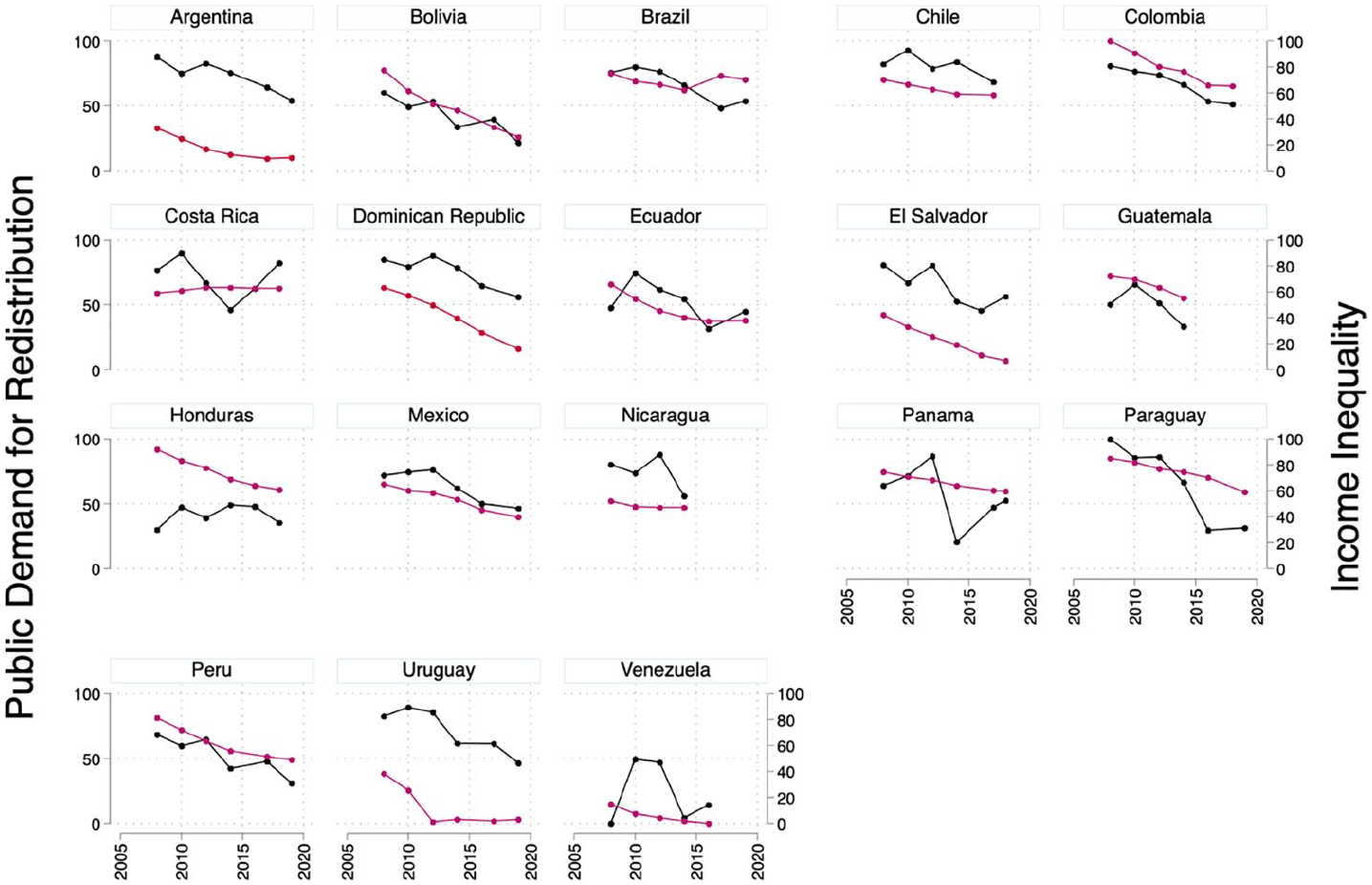
Public demand for redistribution in Latin America.
At the contextual level, preliminary results indicate a positive association between citizens’ demand for redistribution and the level of income inequality in their countries. Yet, the correlation between the cross-sectional portion of the Gini index and the average levels of public demand for redistribution across all years is only 0.09 (p < 0.001) (Figure 2(a)). Instead, the longitudinal component suggests a stronger association between income inequality and public demand for redistribution within countries, with a correlation of 0.54 (p < 0.001) (Figure 2(b)). To assess whether this this association holds when both individual- and country-level controls are included, the next section presents the multivariate results.
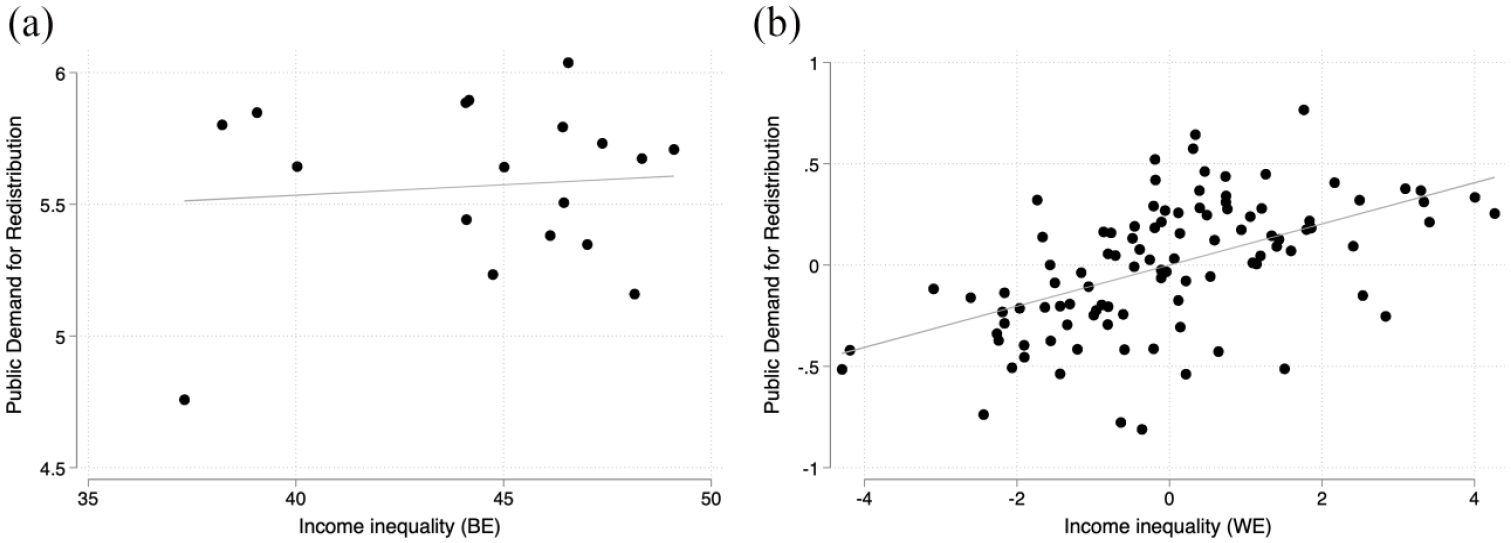
(a) Income inequality and public demand for redistribution in Latin America. (b) Income inequality and public demand for redistribution in Latin America.
Results: Multivariate
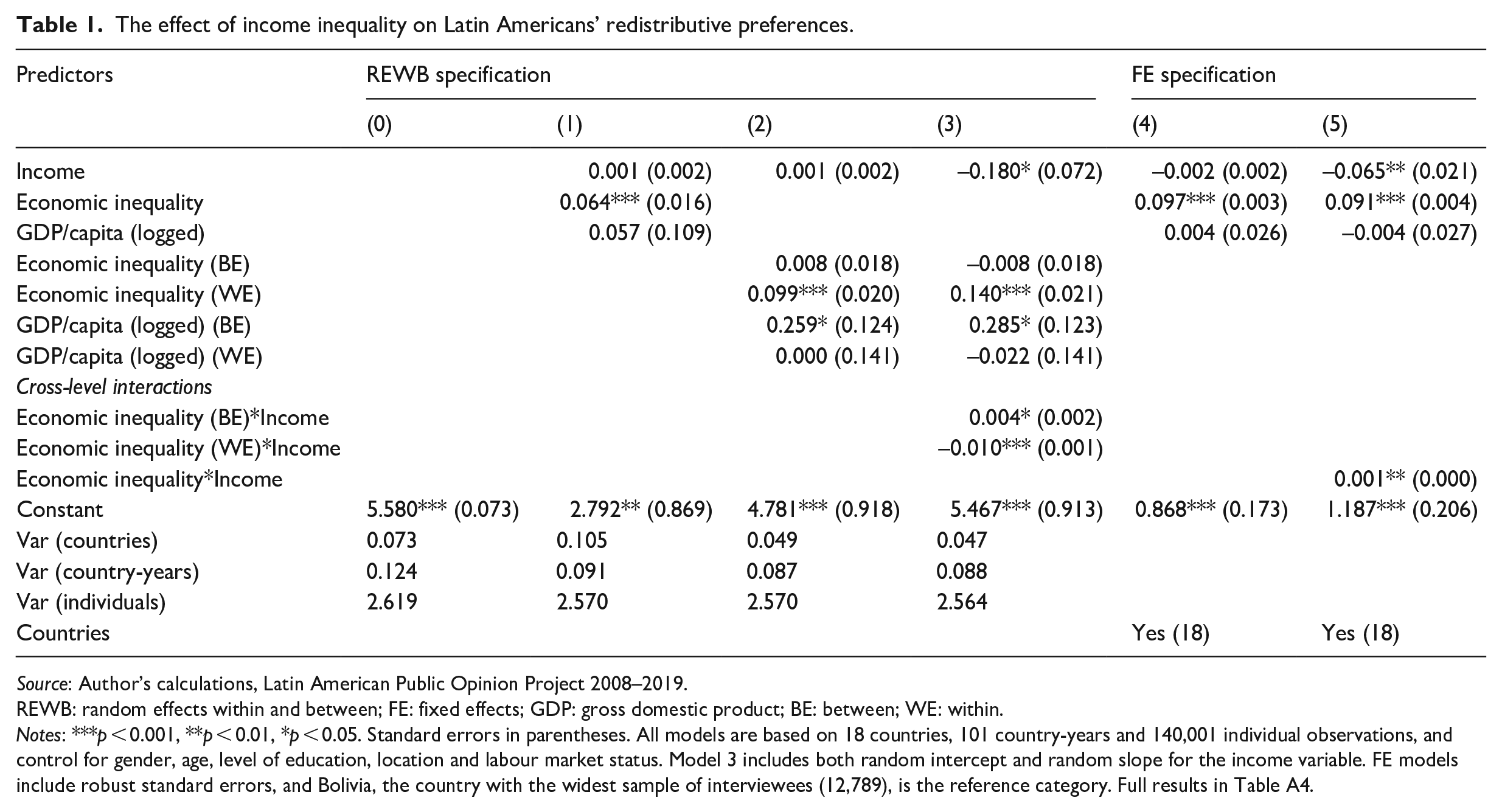
Table 1 presents the results. Models 1–3 introduce the REWB specification, and Models 4 and 5 the FE specification. Model 1 includes the Gini index, without decomposing into its cross-sectional and longitudinal components. Model 2 introduces separate cross-sectional and longitudinal effects of economic inequality on public demand for redistribution. Models 3 and 5 include interaction terms between inequality and individual-level income.
The effect of income inequality on Latin Americans’ redistributive preferences.
Source: Author’s calculations, Latin American Public Opinion Project 2008–2019.
REWB: random effects within and between; FE: fixed effects; GDP: gross domestic product; BE: between; WE: within.
Notes: ***p < 0.001, **p < 0.01, *p < 0.05. Standard errors in parentheses. All models are based on 18 countries, 101 country-years and 140,001 individual observations, and control for gender, age, level of education, location and labour market status. Model 3 includes both random intercept and random slope for the income variable. FE models include robust standard errors, and Bolivia, the country with the widest sample of interviewees (12,789), is the reference category. Full results in Table A4.
Model 1 suggests that the Gini index is positively and significantly associated with public demand for redistribution, indicating that citizens’ support for redistribution is stronger in countries with higher inequality. Nevertheless, Model 2 shows that when decomposing into the within and between portions of inequality, the association only reaches statistical significance within countries. This clear positive association is statistically significant both in the main (β = 0.099, p < 0.001) (Model 2) and the interactive model (β = 0.140, p < 0.001) (Model 3). As Models 2 and 4 show, the coefficient is similar in the REWB and the FE specifications.
These results suggest that, opposite to what was expected in H1, there is no evidence of a cross-sectional association between economic inequality and public demand for redistribution. Instead, as hypothesised in H2, these results indicate a clear positive longitudinal relationship between income inequality and public demand for redistribution. Thus, while we cannot reject the null hypothesis that countries with greater inequality tend to have higher levels of support for redistribution, results are consistent with the hypothesis that, as inequality grows within a country, public preferences regarding redistribution tend to increase. The coefficient indicates than a 1-unit increase on the Gini index produces an average increase of 0.10 points on the 7-point public support for redistribution scale. In other words, support for redistribution should increase (or decrease) by 1 percent for each 1-unit change in the Gini index. For example, in Argentina, where inequality declined from 41.6 to 37.9 between 2008 and 2019, the model predicts a decrease in support for redistribution of about 4 percentage points. In Bolivia, where inequality declined from 48.8 to 40.5 during the same period, the model predicts a decrease in demand for redistribution of about 8 percentage points.
In order to test H3, Figure 3 presents the association between economic inequality and demand for redistribution over time, conditional on individual-level income differences. The figure shows an overall positive relationship between income inequality and public demand for redistribution, which holds across income groups. As hypothesised in H3, individuals tend to support income redistribution as inequality increases, regardless of where they are located within the income distribution. The slope, however, is less steep for individuals located at the highest income levels, indicating that although there are no significant differences between income groups (i.e., the association remains positive for both more and less advantaged individuals), the relationship between inequality and demand for redistribution becomes slightly weaker as household income increases. In other words, these results suggest that all income groups tend to update their preferences towards more redistribution with rising inequality, with a marginally weaker effect among the well-off. The positive association, however, is consistent across income levels overall, within yet not between countries (see also Figure A2, supplementary materials). This result suggests that the redistributive preferences gap between income groups is consistently low when but not where income inequality is comparatively higher.
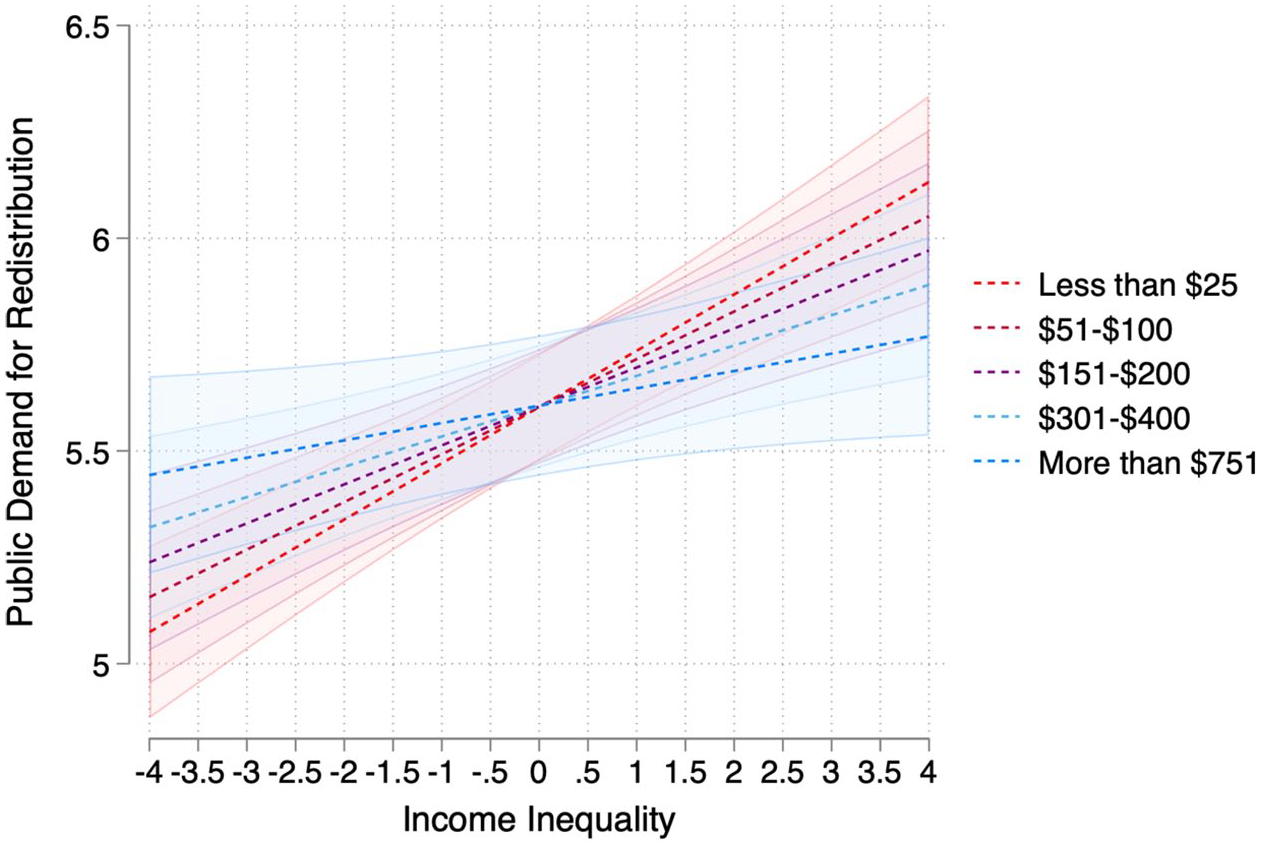
Public demand for redistribution, conditional on levels of income inequality and individual-level income (95% confidence interval).
To further assess the consistency of these results, I conducted a series of additional tests. Firstly, considering the Gini index of disposable incomes makes theoretical sense but can also introduce potential confounding, I re-estimated the model, including the market Gini index. Introducing both measures yields similar results (see Table A5, supplementary materials). Secondly, to assess the extent to which this result is driven by some countries more than others—and hence to confirm whether this association is robust to potential outlier cases—I conducted jackknife estimations, re-estimating the model while excluding each country at a time. All models yield positive and statistically significant coefficients (p < 0.001), which range from 0.066 when excluding Venezuela to 0.109 when excluding Honduras (see full results in Table A6, supplementary materials). Thirdly, these jackknife estimations shed light on the absence of a relationship across countries. As Table A6 shows, except when Venezuela is excluded from the sample, the coefficient of the cross-sectional portion of the Gini index is always positive, yet insignificant (with a modest effect size, ranging from 0.003 when excluding Paraguay to 0.020 when excluding Uruguay). While this result yields further support for H2 and against H1, it also shows how both coefficients consistently point in the same direction. Substantively, this suggests a relationship both across countries and over time, which can be potentially explained due to constraints in the available sample. These limitations and their implications are further discussed in the next section.
Discussion and conclusion
This article has reassessed the association between income inequality and public demand for redistribution, taking into account the direct effect higher macrolevels of inequality as well as changes in the conditional effect of individual-level income. Building on the political economy scholarship that explains the relationship between inequality and public demand for redistribution across time and space, I fitted FE and REWB models to a sample of over 140,000 individuals in 18 Latin American countries, surveyed every two years between 2008 and 2019.
Two main findings emerge from the analysis. Firstly, both using disposable and pre-tax Gini measures, results indicate a clear longitudinal association between economic inequality and public demand for redistribution. That is, while there is no evidence to substantiate that countries with higher levels of income inequality tend to have higher levels of support for redistribution, results show that Latin Americans demand more redistribution as inequality grows. This finding stands in contrast with comparative studies that suggest demand for redistribution does not change as a function of levels of inequality (e.g., Breznau and Hommerich, 2019; Gimpelson and Treisman, 2018). It also points in the opposite direction of the work of Franetovic and Castillo (2022: 12), who conclude that, ‘unlike what has tended to be stated in other contexts, such as Europe, in Latin America it is possible to observe an absence of a relationship between people’s income and their agreement with the application of public policies to reduce inequalities’.
Instead, the results are in line with comparative studies that provide evidence of a longitudinal effect of income inequality on public demand for redistribution (e.g., Andersen et al., 2021; Hillen and Steiner, 2024; Jæger, 2013; Schmidt-Catran, 2016). A longitudinal effect—net of countries’ levels of economic prosperity and controlling for compositional effects at the individual level—is more robust evidence to ensure this relationship is not spurious. Still, it is theoretically reasonable to expect cross-sectional and longitudinal effects to converge over the long run (i.e., that increases in demand for redistribution within countries translate into countries with higher levels of demand for redistribution). In this vein, as Table A6 shows, the coefficient of the cross-sectional portion of the Gini index is very consistent with the longitudinal portion. This consistently positive coefficient, although insignificant, suggests a potential effect across countries. Therefore, these results should be taken carefully, considering that this study is constrained by limitations given the available sample of Latin American countries. While the study benefits from including representative samples from all Latin American countries, reducing case selection bias or due to non-random samples of countries (Beck, 2001; Schmidt-Catran et al., 2019), it is also constrained by limited statistical power (see Britt and Weisburd, 2010) given the available number of units (N = 18) and time points (T = 6). With these caveats in mind, there is also no contradiction if within and between effects point in substantively different directions. In turn, ‘it is a big leap to interpret differences between countries as a potential effect of a change within a country’ (Gelman, 2005: 461).
Secondly, the longitudinal effect of income inequality on public demand for redistribution appears robust when accounting for individual-level income differences. That is, Latin Americans tend to demand more redistribution when inequality is comparatively higher, regardless of where they are located within their country’s mean income. This finding stands in line with scholarship that argues household income differences are less relevant in explaining redistributive preferences in contexts of sharp inequality (e.g., Dimick et al., 2018; Dion and Birchfield, 2010; Romero-Vidal, 2021; Rueda and Stegmueller, 2016). Notably, however, the results show that the slope is less steep for higher income individuals. This suggests that this positive association becomes weaker as an individual’s household income increases and, more specifically, that the effect is marginally weaker for the well-off (as the RMR model would expect). Nevertheless, a clear positive association across different income groups suggests that even individuals not located at the lowest income levels tend to support economic redistribution in the long run (also in line with the risk exposure framework; Drazen, 2000; Moene and Wallerstein, 2001; Rehm, 2009). All in all, these findings provide empirical evidence in line with the scholarship arguing that individuals tend to update their levels of support for redistribution with rising inequality, often experiencing parallel shifts in their redistributive preferences (e.g., Enns and Kellstedt, 2008; Gonthier, 2017; Soroka and Wlezien 2009).
This study contributes to a growing body of work that explores the association between inequality and redistribution across countries and over time. Delving into the implications of these results, further studies should go beyond the first proposition of the RMR model (i.e., that public demand for redistribution should increase as inequality rises) in order to assess the extent to which demand for redistribution is in fact being expressed in votes (proposition 2) and supplied by incumbent parties that implement redistributive policies (proposition 3). Differently put, in contexts where increases in income inequality do seem to translate into higher demand for redistributive policies, researchers should start focusing less on the demand and more on the supply side of redistribution; that is, the extent to which public demands are in fact being translated into public policy (see Hillen and Steiner, 2024). Following propositions 2 and 3 from the RMR model, the often-puzzling absence of redistributive policies may be more about political parties and elites being reluctant to implement them than about people not reacting and demanding more redistribution. In fact, recent studies have shown how policy-makers can become less supportive of redistribution with growing inequality (e.g., Márquez Romo and Marcos-Marne, 2023), and that higher inequality tends to produce wider gaps and more disparity in redistributive preferences between political elites and the public (e.g., Weihua and Maoliang, 2017). These considerations should be analysed taking into account both levels and changes in inequality on a particular set of cases, or comparative studies from countries with historical similarities. Despite its being well known that Latin America is one of the regions with one of the highest levels of inequality in the world (Alvaredo and Gasparini, 2015; CEPAL, 2016; Sánchez-Ancochea, 2020), history evidences important periods of decrease in income inequality under specific circumstances (Kapiszewski et al., 2021; Lustig, 2011). Therefore, offering robust empirical evidence to examine the extent to which public preferences for redistribution lead to governmental action to tackle inequality is key to understanding both the structural levels of inequality in the region as well as specific trends towards increasing or decreasing inequality over the last decades.
Supplemental Material
sj-docx-1-ips-10.1177_01925121241309929 – Supplemental material for Moving in parallel? Economic inequality and public demand for redistribution in unequal societies
Supplemental material, sj-docx-1-ips-10.1177_01925121241309929 for Moving in parallel? Economic inequality and public demand for redistribution in unequal societies by Cristian Márquez Romo in International Political Science Review
Footnotes
Acknowledgements
The author is indebted to two anonymous reviewers of this journal for their helpful comments and suggestions. All remaining errors are the author’s own.
Data availability statement
The necessary materials to replicate the analyses in the study are available in the online supplementary materials.
Declaration of conflicting interests
The author declares no conflict of interest with respect to the research, authorship and/or publication of this article.
Funding
The author disclosed receipt of the following financial support for the research, authorship and/or publication of this article: This study is part of the project POLAR (‘Polarization and its discontents: does rising economic inequality undermine the foundations of liberal societies?’) that has received funding from the European Research Council (ERC) under the European Union’s Horizon 2020 Research and Innovation Programme (Grant agreement n° 833196). Neither the European Research Council nor the primary data collectors or the providers of the data used in this research bear any responsibility for the analysis or the conclusions of this paper.
Ethical considerations
Ethical approval is not applicable to this article.

Supplemental material
Supplemental material for this article is available online.
Notes
Author biography
References
Supplementary Material
Please find the following supplemental material available below.
For Open Access articles published under a Creative Commons License, all supplemental material carries the same license as the article it is associated with.
For non-Open Access articles published, all supplemental material carries a non-exclusive license, and permission requests for re-use of supplemental material or any part of supplemental material shall be sent directly to the copyright owner as specified in the copyright notice associated with the article.
