




Abstract
Several nations have enacted gender reforms in policing, many of which are premised on the notion that women favor female officers, especially in the context of tackling violence against women (VAW). We investigate this topic in India. Evidence from the first nationally representative survey on policing (N ≈ 15,000) demonstrates high levels of bias against policewomen, including among women and VAW complainants. To estimate the causal effect of police gender on officer evaluations, we design an unusual video experiment with assistance from the news corporation New Delhi Television (N ≈ 1000). We find that policewomen are not generally preferred to policemen, and citizens have significantly unfavorable attitudes toward female officers when seen tackling VAW rather than non-VAW cases. These negative ratings are driven by female respondents. We highlight certain context-specific explanations and note that the manner in which policewomen are typecast may undercut the positive implications associated with representation. Our study is an example of shared identity increasing mistrust, and it expands the discussion about citizens using ascriptive characteristics to make inferences about politicians to include front-line bureaucrats like police officers.
Do women favor female police officers, especially for handling violence against women (VAW)? This topic remains understudied outside the advanced industrialized democracies, despite the fact that countries in the Global South have enacted bold reforms to promote gender representation in their criminal justice institutions (Sukhtankar et al., 2022), partly in an effort to heighten women’s trust in and comfort with law enforcement for complaints involving domestic violence and sexual assault (Jassal, 2020). In Latin America and South Asia, reforms have included gender quotas in police hiring, women police help desks, women-only stations, special women’s courts, and even legal mandates that VAW be exclusively tackled by female officers (Blair & Jassal, 2022; Córdova & Kras, 2020; Perova & Reynolds, 2017). 1
In the United States, the presence of women in policing is thought to improve citizen attitudes toward officers and law enforcement, more broadly. 2 Perhaps similar to (general) voter preferences for female candidates (Schwarz & Coppock, 2022), U.S. scholarship shows that citizens perceive policewomen as more trustworthy, compassionate, and approachable than policemen (Barnes et al., 2018; Riccucci et al., 2014), which has implications for reporting and registration rates of VAW cases (Miller & Segal, 2019).
Nonetheless, it is unclear how policewomen would be perceived in patriarchal settings where gender representation in male-dominated security agencies is a newer phenomenon than women’s electoral participation (Dahl et al., 2021). Citizens, especially women, may prefer policewomen who might be seen as less dismissive of and more likely to take action against VAW, that is, cases that the justice system otherwise fails to adequately address. Then again, seeing women carry out law-and-order duties could violate stereotypical assumptions of feminine traits (Cassese & Holman, 2018). Unlike in politics, citizens cannot rely on party labels to make judgments when evaluating officers, and so they may revert to stereotypes or regressive beliefs about female officers’ abilities (Hayes et al., 2020; Saha & Weeks, 2020; Ono & Burden, 2019), which could be shared by women too (Beaman et al., 2009; Jayachandran, 2015).
Our study is situated in India, a country often in the news for gruesome cases of VAW. The nation also stands at the forefront of a swath of police reforms, many of which are premised on the notion that—separate from pursuing representation for its own sake—women should be hired in law enforcement because they are preferred by female complainants for tackling VAW and that policewomen are innately suited for such cases (Jassal, 2021). Upon analyzing a representative survey on policing—the first carried out in the country with ≈ 15,000 respondents—we show that citizens, even complainants of VAW, are likely to affirm negative stereotypes about female officers. Then, we experimentally test if female officers are seen as more “legitimate” or preferred to male officers by presenting a large sample (N ≈ 1000) from Maharashtra with video bulletins adapted for us by the news corporation New Delhi Television (NDTV) in which the officer gender and case type are manipulated. The experiment allows us to parse out not only the effect of gender on officer evaluations but also if ratings increase (decrease) in the context of VAW. Because gender is likely to be communicated via dress or appearance (Butler & Tavits, 2017; Teele et al., 2018), our design subtly probes preferences using images and video. Unlike typical survey experiments that vary text or attributes of a vignette, a feature of our study is that it utilizes highly realistic visual cues of representation. Moreover, the self-administered, tablet-based survey instrument deployed in the local language sought to mitigate social desirability bias while simultaneously accounting for illiteracy.
Our experimental results do not indicate that policewomen are, on average, preferred to policemen, including by female respondents. We show that female officers are also less favored when seen tackling VAW versus non-VAW, an effect driven by women respondents. Our study is an example of how common identities can at times increase mistrust (Klar, 2018), especially when groups are typecast in specific roles. While we do not find robust evidence for taste-based discrimination (Becker, 2010), the data disallow us from ruling out any mechanism entirely. Nevertheless, in terms of policy, we do argue for fewer downsides of ensuring representation corresponds with distributional equity in assignments such that female officials are not relegated to stereotypically gendered tasks at the expense of diverse roles within an organization; “seeing women” in contexts that challenge expectations or norms could signal talent and promote citizen acceptance of newly represented groups (Hinojosa & Kittilson, 2020; Michelle Heath et al., 2005; Schwindt-Bayer, 2006).
The study proceeds thusly: after reviewing theories about why women may be evaluated differently according to the roles that they are seen to perform, we contextualize law enforcement in India and the mandate that VAW be addressed by policewomen. Then, using a nationally representative survey, we explore biases against policewomen, including among VAW complainants. After explaining the design of our video-based experiment, electronic survey instrument, and sample, we present our results and sub-group analyses. We return to a discussion of plausible mechanisms, and conclude by underscoring the implications of our work, including for policy.
Perceptions of Women in Law Enforcement
We synthesize research from the gender and politics literature, psychology, economics, and criminology to theorize why perceptions about women in uniform could vary. A rich scholarship has explored how female politicians are perceived (Clayton et al., 2020; De Paola et al., 2010; Lawless, 2015; Clayton et al., 2019; Dassonneville & McAllister, 2018). In the United States, polls reflect support for a female president (Burden et al., 2017; Streb et al., 2008), and a meta-analysis suggests citizens gravitate toward women candidates (Schwarz & Coppock, 2022). While sexism continues to shape citizens’ votes (Bauer, 2015, 2019; Bracic et al., 2019; Claassen & Ryan, 2016; Dolan, 2010), and only the most qualified women candidates succeed (Anzia & Berry, 2011), female politicians are generally seen as fair, honest, and compassionate (Barnes & Beaulieu, 2019; Eagly & Karau, 2002; Esarey & Schwindt-Bayer, 2019; Hutchings et al., 2004; Schwindt-Bayer, 2006; Swamy et al., 2001). This “character valence” can advantage female candidates (Adams et al., 2011; Fulton, 2014). 3
Scholarship on “representative bureaucracy” suggests a similar dynamic vis-à-vis women’s participation in administrative agencies, for example, education, civil service, and policing (Andrews & Ashworth, 2015; Keiser et al., 2002; Meier & Nicholson-Crotty, 2006; Riccucci et al., 2016). In law enforcement, U.S. policewomen may be preferred to policemen (Barnes et al., 2018; Meier & Nicholson-Crotty, 2006; Riccucci et al., 2014). They are perceived as more honest (less corrupt), trustworthy (Barnes et al., 2018; Riccucci et al., 2014), and approachable (Meier & Nicholson-Crotty, 2006; Singer & Singer, 1985). Policewomen may also be seen as cooperative and compassionate, that is, characteristics associated with a more legitimate police force (McCarthy, 2013).
Nonetheless, biases against women can be pronounced outside the advanced democracies (Beaman et al., 2009; Bernhardt et al., 2018; Brulé, 2020; Jayachandran & Pande, 2017). Politically, as descriptive representation for women increases, women’s political engagement intensifies (Barnes & Burchard, 2013). 4 Nevertheless, female leaders might still be rated unfavorably despite doing the same or better on policy than men (Beaman et al., 2009). Therefore, it is important to distinguish between support for gender representation as a broader concept, versus preference for women leaders when presented with a choice (Morgan & Buice, 2013). Compared to support for gender equality, negative attitudes toward women in power may be difficult to change or erode slowly (Beaman et al., 2009; Duflo, 2012; Goyal, 2019; Sanbonmatsu, 2002).
Moreover, while perceptions of women as affectionate, sympathetic, sensitive, nurturing, and gentle (Eagly & Karau, 2002, p. 574) may be seen as asset in politics (Funk et al., 2019; Herrnson et al., 2003), these could be construed as a liability in “regulation-oriented” 5 agencies like law enforcement associated with “masculine” traits (Boer, 2020; Huddy & Terkildsen, 1993; Lawless, 2004). 6 Indeed, research from the Global South presents a complicated picture about gender representation in policing. Gender-based police initiatives have been shown to positively change attitudes in settings like Brazil or Peru (Córdova & Kras, 2020; Sviatschi & Trako, 2021), but less so in Liberia or India (Jassal, 2020; Karim, 2020). Sukhtankar et al., (2022) show that police desks staffed by women increase neither the likelihood that female complainants come forward to report VAW nor arrest rates. Policewomen serving in such institutions often prioritize (or are told to prioritize) informal resolution for VAW (Hautzinger, 2007; Jassal, 2021; Nelson, 1996; Santos, 2004); such perceived “soft” approaches to crime could be thought of as giving leeway to offenders (Lizotte, 2017; Martin, 1982; McCarthy, 2013).
If policewomen are discriminated against by citizens, there are several mechanisms by which this might occur, for example, statistical discrimination, taste-based preferences, and paternalism. First, because representation in law enforcement remains low, and policewomen are less visible, citizens may hold imperfect information (Arnold et al., 2018; Arrow, 2015; Phelps, 1972; Rehavi & Starr, 2014). Discrimination may be based on “inaccurate” or “accurate” assumptions, for example, women police officers could, in reality, be less likely to use force (Schuck & Rabe-Hemp, 2005), which might reduce preferences for policewomen, especially among citizens that support extrajudicial tactics. In settings like India or Brazil, where policewomen are disproportionately assigned cases involving domestic violence (Hautzinger, 2007; Santos, 2005; Satyogi, 2019), female officers could have few opportunities to display ability. Second, citizens could hold animus toward women or reject women’s participation in law-and-order (Becker, 2010; Hainmueller & Hangartner, 2013). Third, paternalistic discrimination (or paternalism) would imply that, rather than because of distaste or lack of information, citizens discriminate against women in policing to “protect” them from such perceived dangerous occupations (Bindler & Hjalmarsson, 2020).
Policewomen and Crime Type
For the aforementioned mechanisms, there is no a priori reason to assume that the crimes policewomen tackle should matter. Consequently, exploring whether preferences for policewomen vary depending on the roles that they perform can be informative, for example, finding that policewomen are seen favorably whilst tackling VAW may call into question the notion of pure animus or distaste. There are also additional reasons to believe that crime type serves as a moderator.
First, scholarship shows that female politicians may be steered into working on gendered issues (Kerevel & Atkeson, 2013), or assigned committees focused on women (Michelle Heath et al., 2005). Women working in bureaucracies can also be associated with gendered tasks or “women’s work” (Kerr et al., 2002), including non-physical and clerical assignments (Bielby & Baron, 1986). This occupational segregation—which in law enforcement might manifest in the assignment of, say, domestic violence to policewomen (Martin, 1999; Hochschild, 2012)—could have implications for citizen attitudes and stereotypes.
Second, on the one hand, if there is an interaction between gender representation and registration of VAW (Iyer et al., 2012; Meier & Nicholson-Crotty, 2006; Miller & Segal, 2019), citizens may prefer policewomen over policemen for such cases. On the other hand, the arrow could point in the other direction: citizens may suspect policewomen of being biased when tackling VAW, for example, men could perceive policewomen to be in favor of complainants who allege sexual assault (Wentz & Archbold, 2012). Relatedly, qualitative research shows that policewomen sometimes subscribe to rape myths or victim blaming as a result of socialization into a masculine sub-culture or desire to be seen as worthy by colleagues (Hautzinger, 2007; Nelson, 1996; Wentz & Archbold, 2012). In the same way that female judges in the United States may be perceived as procedurally unfair or biased in abortion cases (Ono & Zilis, 2022), women could be just as skeptical as men when seeing policewomen investigating VAW about their impartiality or ability. 7
Consequently, we explore two additional possibilities: role congruity and typecasting. Role congruity posits that upon seeing an incongruity between a powerful woman and a role, citizens choose to discriminate (Eagly, 2013; Eagly & Karau, 2002), for example, policewomen engaged in tackling VAW could be seen as an endorsement of traditional norms about the suitability of women doing “women’s work” (Beaman et al., 2012b), whereas anxieties may come to fore if they serve in non-gendered contexts that violate norms or expectations (Ono & Yamada, 2020; Schneider & Bos, 2014). Broadly, role congruity would predict that policewomen are rated favorably, but only whilst engaged in certain stereotypically “gendered” tasks like tackling VAW.
Another potentiality is typecasting, which would suggest that evaluations of policewomen will decline when seen carrying out gendered assignments. Steele (1997) argues that minorities are sometimes typecast in ways that they are frustrated by or seek to overcome; seeing policewomen tackle VAW could be a norm that citizens reject. The juxtaposition of policewomen with VAW or cases settled informally might affirm stereotypes about female officers as less “tough” (Carlin et al., 2019; Holman et al., 2016; Huddy & Terkildsen, 1993; Lizotte, 2017; Rabe-Hemp, 2009; Schuck & Rabe-Hemp, 2005). 8 Because policing can be equated with utilizing brute force (Aaldering & Van Der Pas, 2020; Tankebe & Asif, 2016; Wahl, 2017), women may hold female officers to a higher standard in terms of being able to deploy “justice” against perpetrators of VAW (Belur, 2010; Jauregui, 2013; Tankebe & Asif, 2016). 9 Since security has been shown to activate women voters in India (Hankla et al., 2022), priming citizens for policewomen and VAW—complaints not only settled but also coerced into withdrawal by the criminal justice system (Jassal, 2020)—could call attention to “feminine” approaches to crime control such as mediation and counseling (Farmer & Tiefenthaler, 1996; Martin, 1999). Instead, seeing policewomen serve in settings that challenge typecasting could signal exceptional talent (e.g., at arrest or interrogation) for being assigned to such an unusual role in the first place (Bauer, 2017; Blackman & Jackson, 2019; Schwartz & Blair, 2020).
Police Legitimacy and Evaluation of Officers
To understand how policewomen are evaluated, we use the framework of police legitimacy (Tyler, 2004, 1990). The concept of legitimacy is central in political science (Blair & Roessler, 2021; Levi et al., 2009; Scherer & Curry, 2010), and research shows that the presence of women in politics affects democratic legitimacy (Clayton et al., 2019; Dollar et al., 2001; Hinojosa & Kittilson, 2020). Legitimacy can be split along instrumental versus procedural outcomes, for example, perceptions of service delivery versus fairness or equity (Fisk & Cherney, 2017; Risse & Stollenwerk, 2018; Weatherford, 1992). 10 Social acceptance of authority figures like law enforcement officers is important because it signals whether citizens will turn to the state for help when in distress (Risse & Stollenwerk, 2018).
There are three paths toward police legitimacy (Tyler, 2004). The first is “procedural fairness” (Jonathan-Zamir & Weisburd, 2013), that is, officers should be neutral and transparent in their decision-making (Sunshine & Tyler, 2003), and should have high ratings in terms of honesty or impartiality. In the United States, there is general consensus that the fairness of officers (and judges) is the primary route toward augmenting their perceived legitimacy in the eyes of citizens (Mazerolle et al., 2013; Ono & Zilis, 2022; Wood et al., 2020).
A second route toward legitimacy is police “efficacy.” Officer legitimacy may not necessarily be related to police treating others fairly or “being nice” (Mazerolle et al., 2013, p. 55), but in their ability to act, for example by (a) creating credible threats and (b) controlling crime (Sunshine & Tyler, 2003). Some argue that these instrumental outcomes are particularly salient outside the advanced industrialized democracies (Blair et al., 2019; Bradford et al., 2014; Jackson et al., 2014; Lee & Cho, 2020), where performing tasks (e.g., solving cases, arresting suspects, promptly answering distress calls) are most relevant for evaluating agents. In this way, the legitimacy of police officers may be less dependent on following a rule-book compared to be seen tackling crime and utilizing any method—fair or unfair—to do so (Tankebe & Asif, 2016).
A third antecedent of legitimacy is “trust.” Generally, trust is an outcome, for example, citizens trust an individual that is competent or has integrity (Tyler, 2004). However, others argue that trust is a distinct antecedent. Levi and Stoker (2000, p. 476) note that, “Trust is relational; it involves an individual making herself vulnerable to another individual, group, or institution that has the capacity to do her harm or betray her.” Citizens may distinguish between trust in officers versus trust in the police, for example, trust in authorities and trust in the regime (Citrin & Stoker, 2018). In other words, even if officials are rated unfavorably on procedural fairness or efficacy, citizens may still be willing to forgo personal preferences out of a general belief that police officers are better able to make judgments about crime and security. Broadly, if agencies are staffed with officers rated highly on these multiple dimensions, then even the broader institution in which the officials work can be said to have a “reservoir of goodwill” and “legitimate” (Easton, 1979). In this study, we utilize all three established antecedents of police legitimacy to understand how female officers are rated compared to their male counterparts.
Context: Policewomen and Violence Against Women in India
Indian police stations have been known to be inhospitable toward women. VAW victims rarely turn to law enforcement (DHS, 2017), and officers have been known to display a cavalier attitude toward such crime (Shah, 2009). 11 Since 2009, the federal government has pushed states to implement a 33% gender quota for incoming cadets to make the force more representative and accommodating (Home Secretary, 2009). 12 Most have approved this measure, and there have been improvements in representation since 2007 (Appendix Figure A1), with a state like Maharashtra maintaining upwards of 12% of its force comprised of female officers. Several states have established policewomen-run help-desks for VAW complainants as well as all-women stations, that is, segregated institutions run by female officers to exclusively tackle VAW.
Politicians have normatively tied representation to gains vis-à-vis trust in and comfort with officers (Khanikar, 2016), and argued that female officers are innately suited for accomodating women’s complaints. The Ministry of Home Affairs notes that, “recruitment of women in the police forces will inevitably lead to the improvement of the image of the force and make the police station a gender sensitive place for grievance redressal and a catalyst for an improved community” (Home Secretary, 2013). Others contend that, “The visibility of women police would dispel negative sentiment or distrust against the police force and would boost public confidence” (Loksabha, 2012, p. 25), or that “The presence and increased number of women in the police force will help in enhancing the image of the police in society as a friend and protector and will encourage women to access the services…” (Loksabha, 2012). Policymakers argue that, “The presence of women in police stations would help in creating confidence and trust in the police…[policewomen] should be able to perform their special role in relation to women and children” (Vira & Krishnaswamy Reddy, 1980, 58), and, “In practice…police women are frequently used for ‘specialized’ or select tasks for which they are considered to be more suited by nature than man” (Loksabha, 2012, p. 25).
India has a variety of “gendered” crimes, which are classified as “crimes against women” or VAW in government reports (See Appendix Table A1 for a list). “Gendered” crimes or VAW under the Indian Penal Code include acid attacks, rape, sexual harassment, dowry harassment, and others; the laws are phrased in a way that they often include words such as “women,” “girls,” or “marriage.” Dowry harassment refers to a husband or his family members harassing a woman for dowry with the threat of abandonment/divorce; abuse goes together with emotional and physical violence (Srinivasan & Bedi, 2007). Dowry has a long cultural history in India (Anderson, 2003). It is a crime wherein the victim’s mother-in-law is often implicated as a perpetrator (Oldenburg, 2002), and it is among the most common registered cases brought forward by women. Dowry accounted for the highest percentage of VAW in Maharashtra in 2016; as shown in Appendix Table A2, it was listed as the most serious offense in at least 23% of filed VAW cases. The law states that when various types of VAW are brought before the police, “then such information shall be recorded, as far as possible, by a woman police officer” (GOI, 2013).
Numerous states have created “counseling” centers staffed by policewomen whose purpose is to reconcile victims of crimes like dowry and domestic abuse with perpetrators rather than pursue charges against male suspects (GOI, 2013; Satyogi, 2019; TISS, 2015). In Mumbai, law enforcement has opened counseling centers and “cells” where officers may dissuade female victims from escalating cases. 13 Maharashtra, like other states, appoints policewomen to run these institutions; 14 anecdotal evidence suggests that police attempts at reconciling victims of VAW through counseling can be coercive and reflect “forced moralizing.” 15 The advantages for law enforcement in having VAW settled informally include de-clogging an overburdened justice system. Even the nation’s Supreme Court has suggested that complaints such as dowry or Section 498A of India’s Penal Code should avoid being filed formally because such cases are allegedly brought forward by “disgruntled wives,” and instead complainants should settle with help from policewomen or “family welfare committees” (Supreme Court, 2014, 2017). The occupational segregation of policewomen in responding to certain types of VAW may create binaries whereby female officers become responsible with policing the “private sphere” (e.g., arbitrating marital disputes) and policemen take-charge of “mainstream” duties (Khanikar, 2016; Jassal, 2021). This system that prioritizes female officers for non-punitive measures raises theoretical puzzles as to whether women do perceive in-group officers as more legitimate and the implications of state attempts to match agents to tasks based on identity such that policewomen may be asked to leverage that identity to enforce social values while policemen carry out diverse, front-line responsibilities.
Descriptive Evidence from a Large-Scale Survey
We begin our analyses by drawing on the first large-scale survey on policing carried out across 22 Indian states. The 2017 CSDS-Common Cause (hereafter CSDS) survey adopted the sampling strategy used for the country’s National Election Studies (Lokniti, 2004). 15,563 respondents were sampled across 188 assembly constituencies representative of the country’s voters. 16 The interviews were carried out face-to-face in regional languages by trained local enumerators. 17
The CSDS survey presented statements conceived of by policy experts and retired officers about women in uniform to respondents. After being read out, respondents were asked whether they believed that the statements were “justified” or “unjustified” on a 4-point scale (Figure 1). Crucially, the phrasing of the questions legitimated an otherwise socially unacceptable answer by presenting it as a statement (Krosnick & Presser, 2010), because research shows that when citizens are confronted with an assertion made by someone else in the local vernacular, they may feel less reluctant about sharing their true preferences (Chauchard, 2013, 2014). Attitudes Toward Women in Police [CSDS-Common Cause Survey 2017]. Note. Responses to statements gauging attitudes toward women in policing, split by respondent gender [Male = 8468; Female = 7080]. ‘Somewhat’ responses collapsed as justified (agree) or unjustified (disagree). 95% confidence intervals included. Women’s responses are generally comparable to those of men.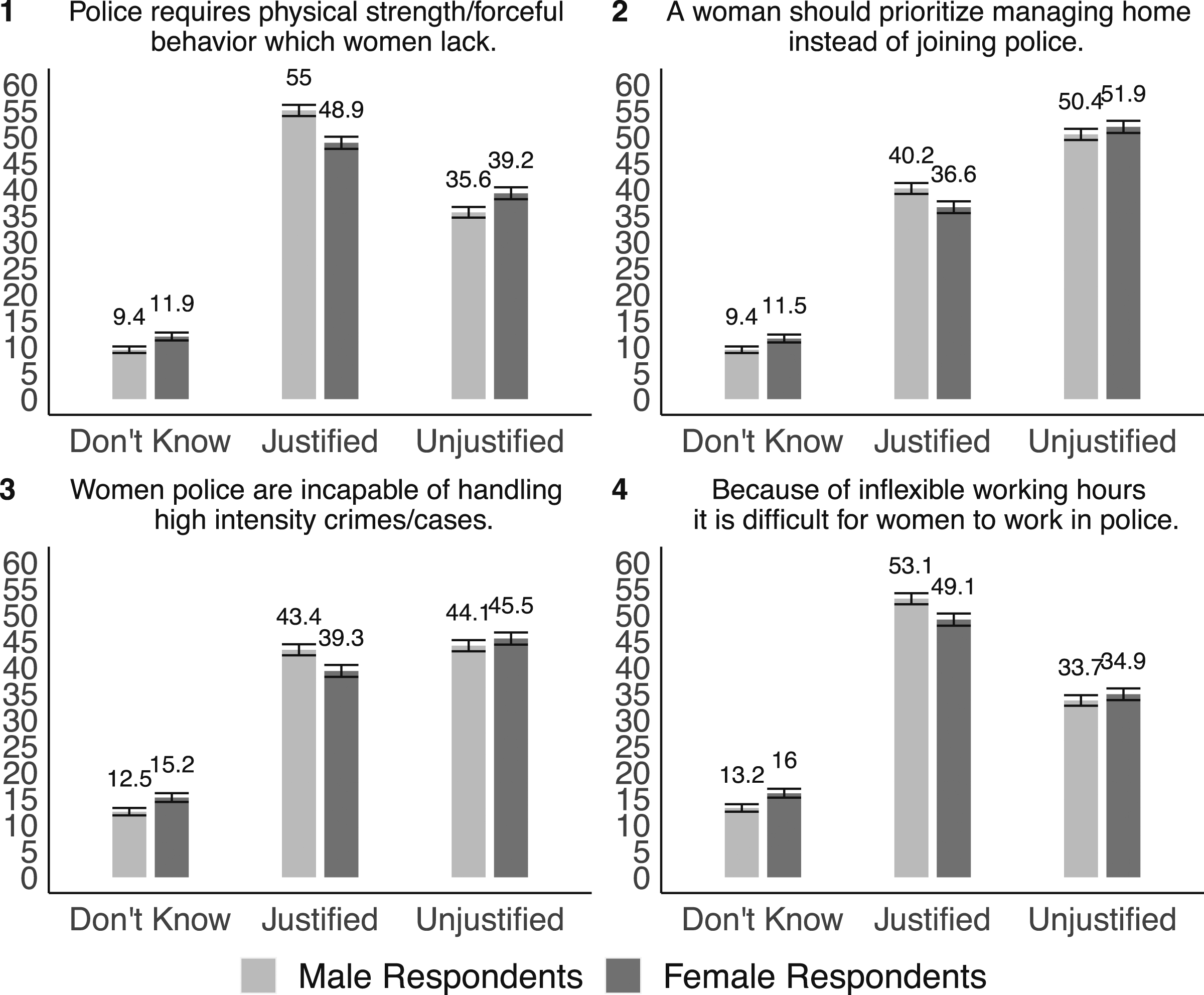
In Figure 1, while men appear more likely to agree or say “justified” to all four negative statements, women’s responses appear similar. In Panel 1, 49%–55% or roughly half of men and women affirm that women do not have the physical characteristics for the role. 18 Similarly, in Panel 4, 49%–53% or approximately half of male and female respondents believe that the hours would make it difficult for women to work in the agency. 19 While the level of agreement with the more overtly negative statement in Panel 2 is lower compared to 1 and 4, between 37% and 39% of Indian women agree that women should focus on home-life or are incapable of tackling difficult cases. Indeed, the fact that 39% of women believe that female officers are unable to tackle “high intensity” crimes suggests that the assignments citizens see policewomen carry out is likely to have a bearing on how they are perceived. Appendix Table A4 presents descriptive statistics and an additive index where each response of “justified” is coded as 1 and summed [Chronbach’s α = .75; mean = 1.84; SD = 1.49]. Female respondents appear only marginally less likely to affirm the statements about women in policing compared to their male counterparts. 20 The survey sample size is unusually large, and the difference between male and female respondents is .11–.12 in standard deviation units. Appendix Figure A2 shows that while women are more likely not to justify any statements (31.1%–26.2%), a majority of female respondents or 52.8% justify at least two. Moreover, in almost half of India’s states, there appear to be no significant differences between male and female respondents’ opinions about women in policing (Appendix Figure A4), including in areas where the overall justification of the negative statements is high (over 3), for example, Assam, Andhra Pradesh, Telangana, Bihar, and Madhya Pradesh (Appendix Figure A3).
Because we are particularly interested in how policewomen are perceived in contexts of VAW, we look at an open-ended question. The survey asks if respondents had contact with law enforcement in the past 4–5 years. For those who did, enumerators elicited up to two reasons for having done so and classified responses in 11 categories (Appendix Table A5). If women expressed having contacted the police for assault or domestic/sexual violence, we coded it as VAW. Figure 2 (and Appendix Figure A5) reveals that VAW complainants are less likely to have favorable opinions about women in policing compared to those that have contacted law enforcement for another reason or even those that have had no contact. 65% of (female) VAW complainants justify the statement in Panel 1, and 51% affirm that female officers are incapable of handling challenging cases. VAW complainants also justify a greater number of negative statements about women in policing with 73% affirming at least two (Appendix Figure A6). VAW & Attitudes Toward Women in Police (Female Only) [CSDS-Common Cause Survey, 2017]. Note. Responses among female respondents gauging attitudes toward women in policing, split by whether they contacted law enforcement for VAW [N = 260], another reason [N = 1346], or have never contacted the police [N = 5474]. ‘Somewhat’ responses collapsed as justified (agree) or unjustified (disagree). 95% confidence intervals included. VAW complainants appear more likely to justify negative statements about women in policing.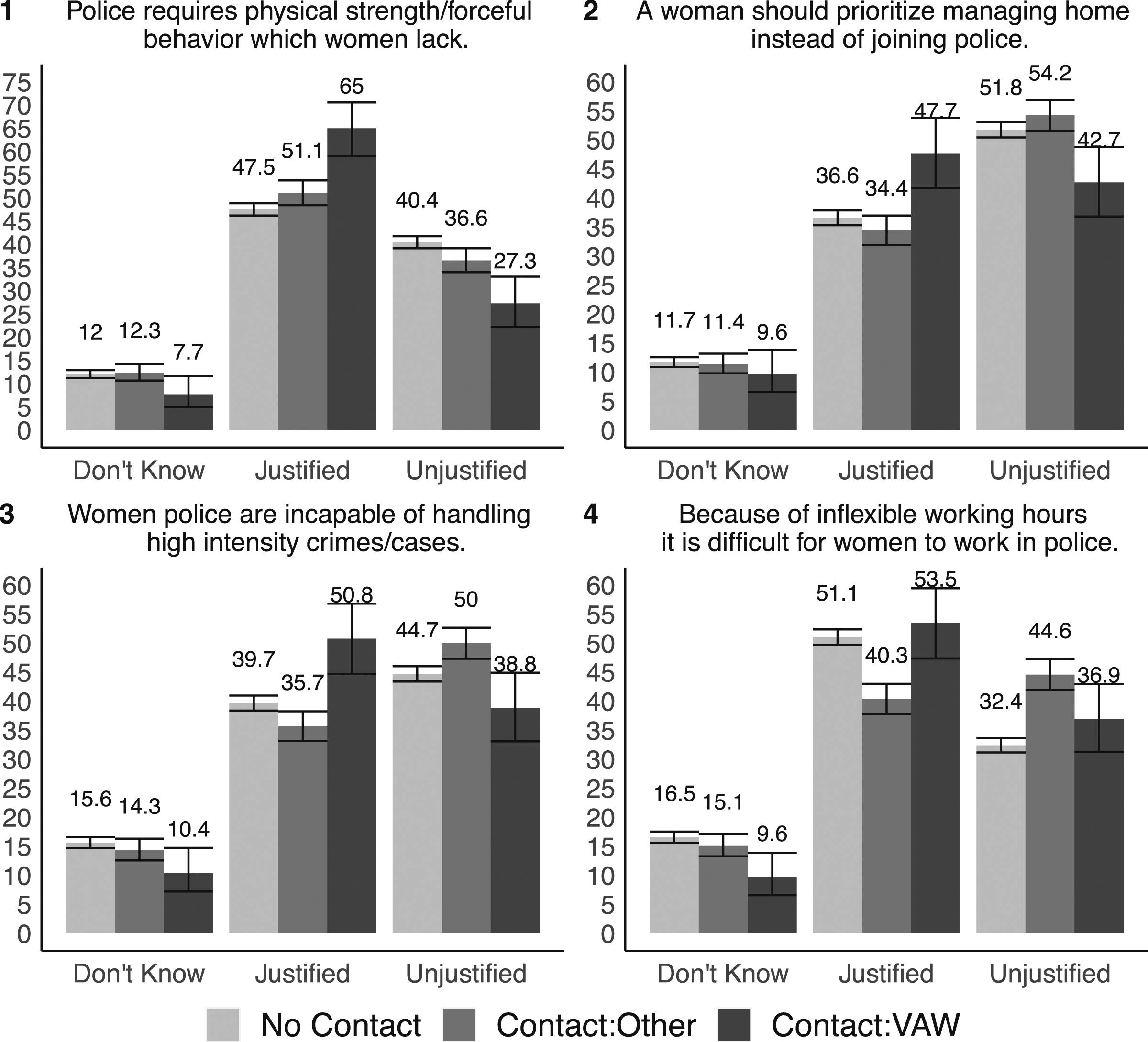
While purely descriptive, the survey sheds light on a high bar for eliciting support for policewomen, even among women, and especially VAW complainants, that is, those most likely to have had interaction with female officers because of the legal guidelines and specialized police institutions in place. Of course, women who contact the police for VAW (and admit to doing so in a face-to-face survey) may be a very select group, 21 for example, potentially dissatisfied with a service they received or the case’s handling and judicial outcome. When asked why women are reluctant about approaching law enforcement, only 4% of female respondents noted that the absence of a woman officer at stations is the main reason for avoiding the police (Appendix Table A8). Most articulated other reasons, for example, social stigma and difficulty in gaining permission from family members. Put differently, women’s preference for female officers at stations is not necessarily—as some policymakers have implied—at the forefront of citizens’ minds in terms of making the police approachable. Broadly, the correlations underscore the importance of more rigorously testing whether women in general do gravitate toward in-group officers, and how the roles that policewomen are seen in, such as taking-on “crimes against women,” affect evaluations.
Experiment on Gender and Officer Legitimacy
We designed a Goldberg-style experiment. 22 With help from affiliates of New Delhi Television (NDTV), we created video bulletins in which a news anchor reports on a crime from a fictional channel called “KDTV.” 23 We intended to use a video-based design because TV is popular in India, and the country is unique in the multitude of 24-h news channels that operate (Mehta, 2015). Because the literacy rate is 74% (and, based on the 2011 census, drops to 59% for rural women), video enables us to reach a diverse sample by including the educationally disadvantaged. Such designs remain uncommon not least because of the resources required to produce content. Fortunately, NDTV shared their video archive and used prior broadcast footage to create clips that are virtually identical to what would have appeared on TV or a news website. 24
While other image- or video-based experiments have been used to test the impact of factors from ethnicity to skin tone, they may not always strive to attain near complete symmetry in the primes utilized. In our design, with the help of make-up artists and theater troupe, we took photographs of a single actor in the costumes of a policeman/woman (Figure 3).
25
Documentarians from NDTV then created videos for us inspired by real broadcasts which featured murder or kidnapping and dowry harassment or rape; we pooled these as non-VAW and VAW cases. In every video, the victim is a woman; and so, our treatment is an explicit form of VAW versus not because the murder and kidnapping of women are obviously forms of gender-based violence (UN, 1994). Nonetheless, in India, murder and kidnapping by themselves are not classified as “crimes against women.”
26
The subtle distinction between explicit “crimes against women” in India (and cases formally associated with policewomen) versus not, biases us against finding any effect because all the conditions in our study objectively involve VAW. Photographs of policeman and policewoman used in video experiment.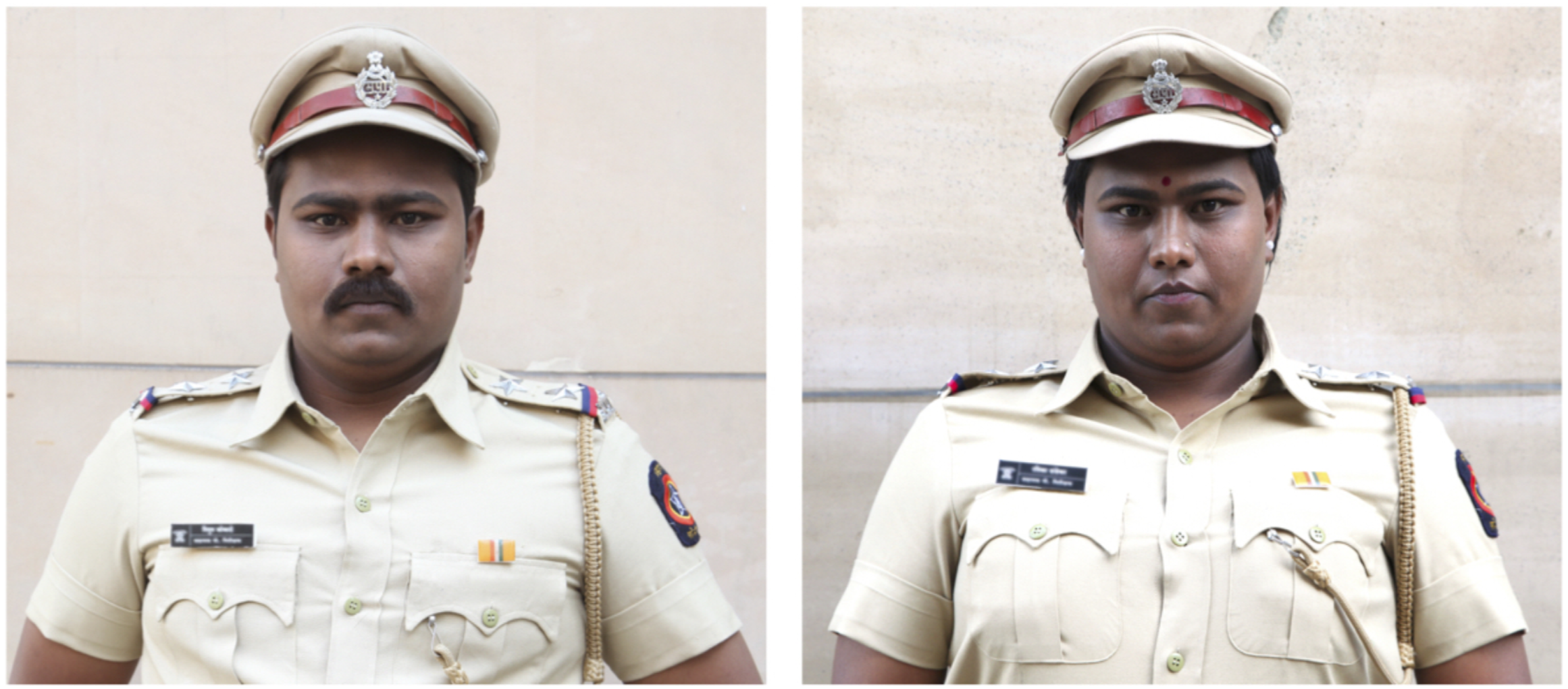
A respondent would randomly be shown one of eight 2-min videos. In each, an anchor appears on the screen and recites the script (Figure 4) in Marathi. Interspersed with the commentary are B-roll of police investigations, photographs of the officer, and a news ticker—all characteristics of Indian news bulletins. Gender is manipulated not only by presenting photos, but also by referring to the officer as Shri/Shrimati (Mr./Ms.). The last name of the officer (Kumar) was selected because it does not connote caste, and the place where the crime occurs (Ramnagar) is a generic town found across the country. The video refers to a Station Officer, a powerful position at the local level that heads police stations and investigates crimes.
27
Viewers are not only primed for gender, but also reminded of the multiple steps involved in investigation. Script and video screenshots.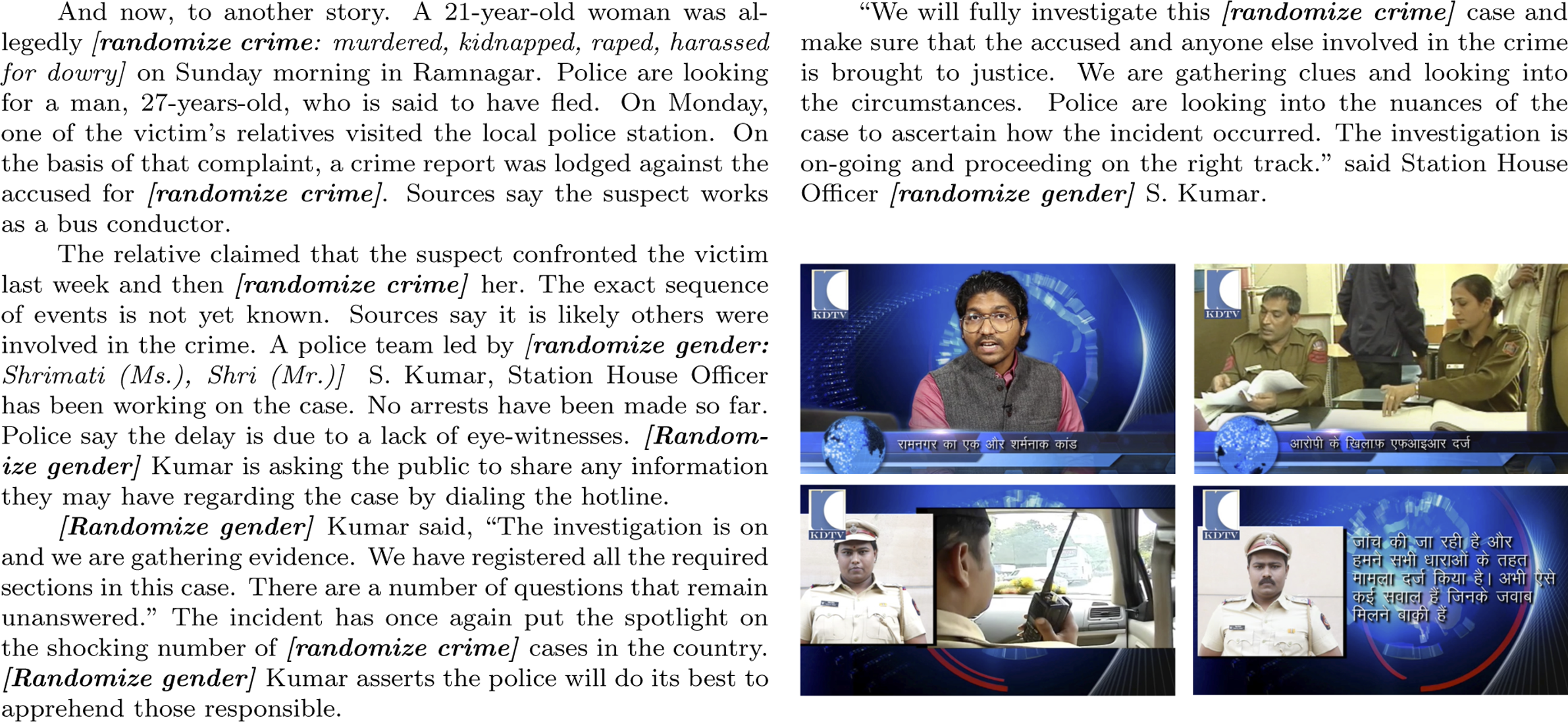
Following the video, respondents would be asked a series of questions. In designing our instrument, we took several steps to minimize social desirability bias, enumerator/demand effects, and satisficing. We embedded the bulletins in a self-administered questionnaire (Chauchard, 2017). Enumerators provided respondents with basic instructions about how to use a smartphone/headphones, after which they would walk 6 ft. away to generate privacy. 28 While available for technical questions, enumerators were not allowed to edit/see answers. The goal was not only to minimize the interaction between surveyor and respondent, but also take into account illiteracy. Specifically, we incorporated audio such that the instructions and pre-recorded questions were automatically read out in the headphones. Answer choices were also in audio, and associated with figures/emojis of thumbs up/down (agree/disagree) so that respondents simply had to click an image to indicate preference (Appendix Figure A7). We believed that the privacy generated, and the ability to hear statements in the local vernacular, would potentially serve to minimize anxiety about expressing choices. To diminish satisficing, we had some statements recorded in the negative, that is, preempt respondents who may be more likely to select “agree.” 29 The pre-recorded voice heard on the tablet was male such that the only primes for gender were the photographs and pronouns. Our manipulation checks asked respondents to identify the officer gender and crime type; these were put forward only after the primary outcome questions were answered. We mitigated deception by informing respondents beforehand that the videos may have been adapted and were based on recent news reports; respondents were unaware about what aspects might have been changed. We relied on the videos’ realism to make the process engaging as well as ensure respondents took participation seriously.
The outcome questions, which appeared randomly on the device, related to the officer’s procedural fairness, efficacy, and trustworthiness. (For the full list of pre-registered outcomes/sub-indices, see Appendix Table A9). In particular, respondents were asked to react to statements prefaced with the line, “People like you in earlier conversations with the research team have said…” pre-recorded on the device (Chauchard, 2014). The statements were inspired from a scale established in the U.S. policing literature (Sunshine & Tyler, 2003). The Sunshine-Tyler scale asks respondents to agree/disagree with the statement, “I have confidence that the NYPD can do its job well” or “I trust the NYPD.” In our setting, we altered this to read, “If I was personally affected, I would trust SHO Kumar as the investigating officer.” 30 Similarly, for efficacy, the Sunshine-Tyler scale asks, “How quickly do the police respond when called in for help,” which we adapted to refer to delaying/stalling the process of investigation. Broadly, we use standard measures about perceptions of corruption, impartiality, lawfulness, and prompt action; additions to the scale were based on our knowledge of the Indian context. As an example, we included a measure of fear associated with the officer, as it has been shown to be a crucial characteristic to elicit in order to be seen as effective in South Asia (Wahl, 2017). We also added a statement about “compromise” or settlement because many crimes in India, especially VAW, are counseled or mediated informally at a station-house in place of registration and investigation (Jassal, 2021).
Ethics
Carrying out research on policing and VAW or citizen perceptions on this topic could introduce risk or activate trauma. First, asking questions about police responses to sexual assault could inadvertently prime survivors to past violence. Second, participating in a survey on policing could be intimidating if citizens perceive enumerators to be affiliated with a state agency. Third, respondents may be anxious that their responses will not be kept confidential.
We took several steps to minimize these potential harms to respondents. Prospective subjects were informed that participation was completely optional; in our consent form, respondents were told that their answers would be anonymous, that they were free to skip any/every part of the survey, and even decline to participate mid-way. We alerted respondents to the possibility that the bulletin and questions could make them uncomfortable, but that absolutely no identifying information would be collected. A reason why we ensured our instrument was entirely electronic and user-friendly was to allow respondents to easily opt-out of answering questions or watching the video, thereby eliminating the possibility of feeling pressure to verbalize such requests to an enumerator. We also reminded respondents that the survey was being undertaken by a university, independent of any state agency. The survey was carried out only after obtaining consent verbally and then electronically on the tablet. Because the news bulletins were purposefully crafted to be comparable to those featured on television, the psychological risks posed would not have been greater than those encountered in daily life.
Sample and Analytical Methods
We fielded the experiment in Maharashtra. We chose this state because it has the largest number of serving policewomen in the country,
31
and if we were to see any effect of policewomen, it should be in this state where they are most visible. In order to closely approximate a representative sample of Maharashtra’s six divisions (Figure 5), the overall urban/rural divide, and ensure that our sample comprised roughly equally of men and women, we sampled more than 1000 individuals (Appendix Table A10).
32
We chose the largest city in each division
33
as the location for our urban sampling (Appendix Table A11). For rural locations, we employed a three-stage procedure. Specifically, we (a) excluded the districts where the urban survey would be carried out (to increase geographic spread), (b) selected the median population district in each division, and (c) calculated the median household population for villages in the district, then identified those whose household population was +/− 5 households from two times this median.
34
We randomly selected one of these villages per district as the primary survey location, and included another as a backup (Appendix Table A12 and A13). Locations Where Respondents Sampled [Video Experiment]. Note. The areas where the firm sampled respondents across Maharashtra’s six divisions. The districts included are Amravati, Aurangabad, Mumbai, Nagpur, Nashik, Pune, Akola, Latur, Raigarh, Wardha, Jalgaon, and Kolhapur.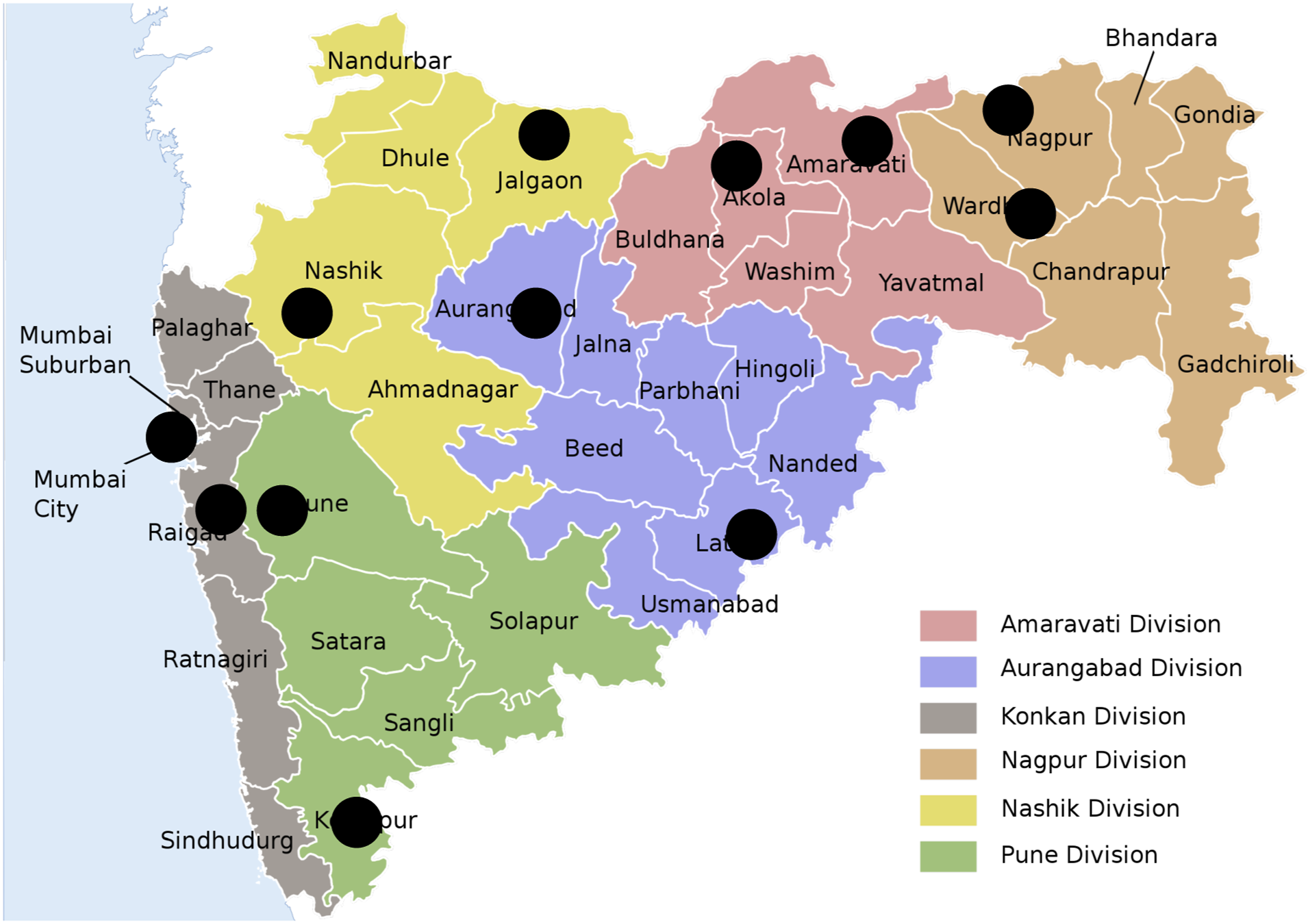
Households were selected using a quasi-random sampling procedure. We printed a satellite view of villages using Google Maps, and located hamlets where different communities/caste groups reside. We selected three starting points for each village, covering low-caste, upper-caste, and non-Hindu communities. 35 We drew a path along roads from each staring point within the hamlet to ensure all the buildings were covered, and that none was covered by more than one path (Appendix Figure A9). For each household, we asked to speak, alternately, to the male or female head, 36 and only one individual was surveyed (shown a video and asked questions). 37
For the dependent variable, the responses to the 14 statements in Appendix Table A9 (where a “4” would mean the officer is viewed favorably, for example, more prompt, less corrupt), were summed and divided by the number of questions for a “legitimacy” index (α = .68). Utilizing such an index decreases measurement error, heightens precision, limits the potential for multiple hypothesis testing, and summarizes the overall effects (Broockman et al., 2017). In the Appendix, we disaggregate our pre-registered sub-indices of trust, procedural fairness, and efficacy. We adopt an intention-to-treat approach that compares responses by treatment assignment, that is, include those that may not have complied or received our manipulation as intended.
38
Our models focus on the experimental manipulations of officer gender and crime type:


Experimental Results
Appendix Figure A10 details the sample achieved across conditions. Appendix Table A14 shows that it is reflective of the state’s divisions, and includes respondents from disparate religious/caste communities (e.g., Buddhist, Muslim, Scheduled Caste/Tribe), rural areas, and the educationally disadvantaged. Appendix Table A15 presents summary statistics on the outcome and its individual components, while Appendix Table A16 presents balance tables. We find balance on observable characteristics for officer gender; for crime category, viewers of VAW had a higher likelihood of being Hindu, from the Other Backward Class community, and rural. Out of 1031 respondents, 5.5% said they were “not sure” about what crime was featured in the video, and 5.7% failed to identify a gender for the officer when asked.
Figure 6 graphically depicts the average officer evaluations according to crime type, and Appendix Table A17 presents the mean and standard deviation for each individual survey item. Figure 6 shows that officer ratings are indeed moderated by the category of crime that they are seen investigating. The effects are stark among female respondents. For instance, seeing a policewoman investigate non-VAW (or even a policeman investigate VAW) yields a mean score of about 2.88 among all respondents. However, this figure is 2.796 when respondents see a policewoman investigate VAW, a percentage reduction of 2.85–2.88. As Figure 6 and Appendix Figure A11 show, this decline is more striking among female respondents for whom the score has a percent change of 4.72–5.48 when female respondents see a policewoman investigate “crimes against women.”
39
Mean Officer Evaluations by Crime Category [Video Experiment]. Note. Left: Mean score for officers by crime category. Right: Female only. See Appendix Figure A10 for total N.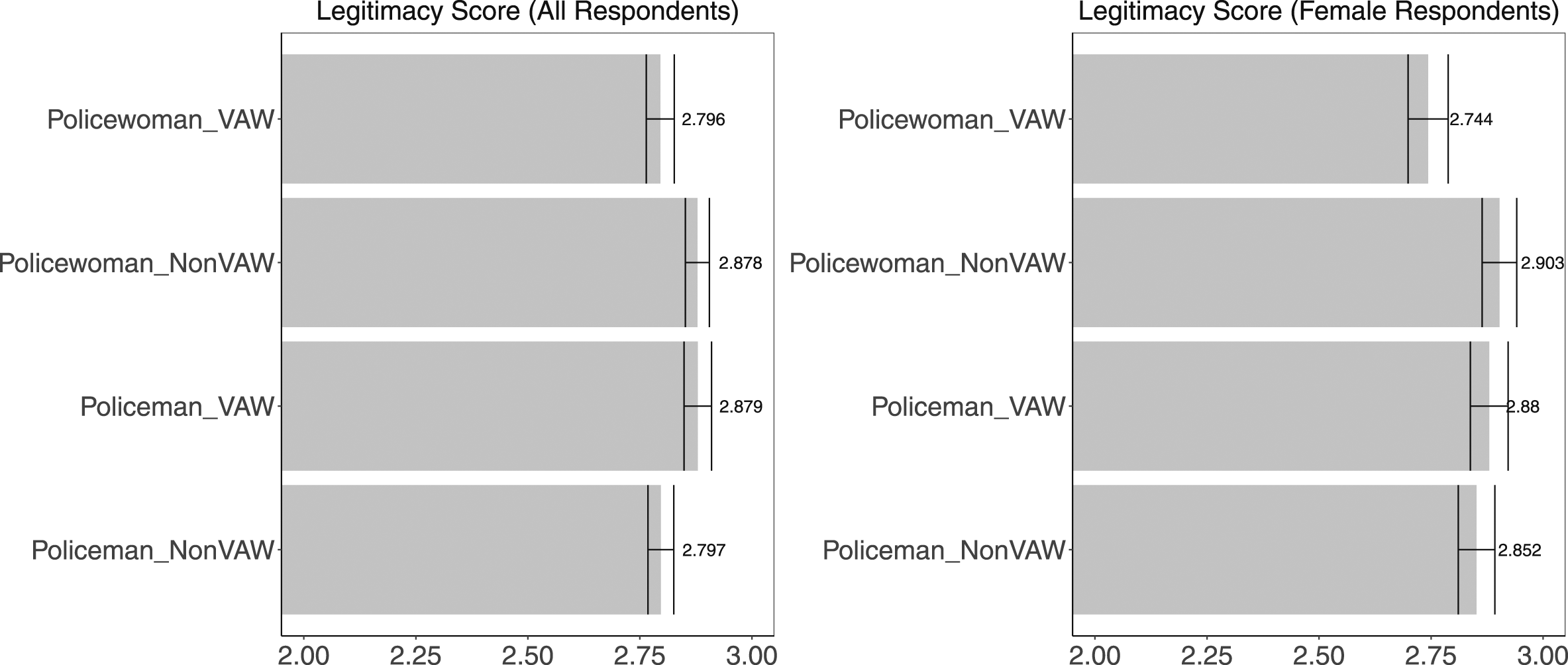
Main results [video experiment].
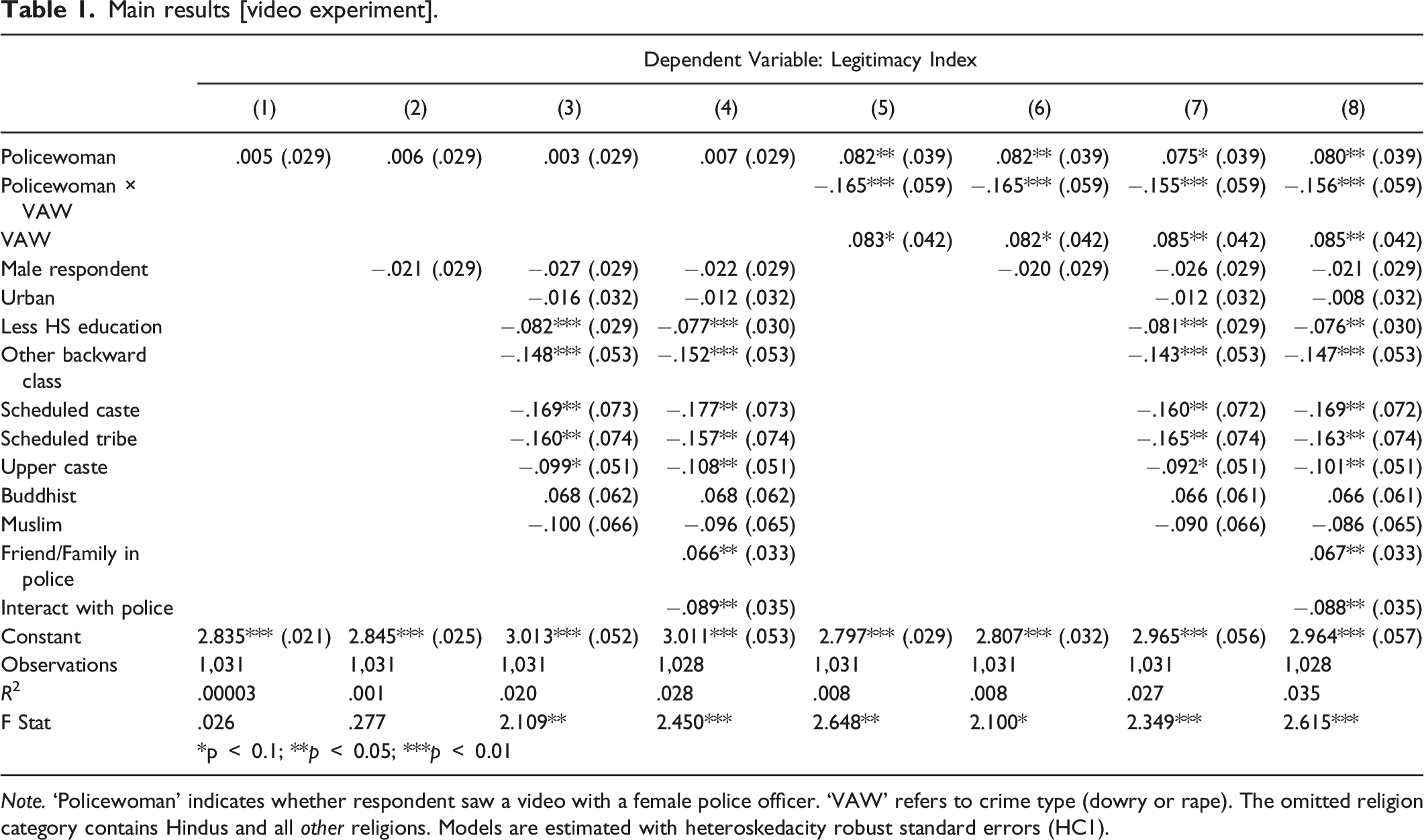
Note. ‘Policewoman’ indicates whether respondent saw a video with a female police officer. ‘VAW’ refers to crime type (dowry or rape). The omitted religion category contains Hindus and all other religions. Models are estimated with heteroskedacity robust standard errors (HC1).
As the coefficients on “Policewoman” reveal in columns 5–8, citizens express the most favorable ratings for female officers in contexts of non-VAW rather than VAW. Indeed, seeing a policewoman investigate VAW cases significantly lowers the ratings of officer legitimacy by roughly .08 on our index; the mean of the dependent variable is 2.84 with a standard deviation of .47. In column 7, the p-value when testing the joint significance of “Policewoman” and “Policewoman × VAW” or “VAW” and “Policewoman × VAW” is .01 and .009, respectively. 41
Aside from heterogeneity by respondent gender, we expected to see variation by education level and as a function of where the respondent lived (urban/rural). Low levels of education have been shown to be correlated with more regressive views on gender in South Asia (Beaman et al., 2012a; Dhar et al., 2022). Relatedly, seeing women in law enforcement may be more likely in urban locales such as the district headquarters of a state, as opposed to remote or far-flung areas where the police bureaucracy may be loath to post female officers. Figure 7 displays the results in difference-in-means plot, and Appendix Table A20 and A21 highlight the effects by respondent gender in a regression framework. Even though Table 1 suggests that policewomen are seen favorably in cases of non-VAW, Appendix Table A20 and A21 reveal that these positive effects are largely driven by male respondents. We do not find any evidence that women perceive female officers as more legitimate or preferable to male officers (Appendix A22). Moreover, whether compared to policewomen investigating non-VAW cases or even policemen investigating VAW, it is primarily female respondents who, upon seeing a policewoman tackle VAW, express significantly unfavorable scores for the officer. We find limited evidence that female officers are evaluated favorably depending on whether the respondent is from an urban locality or has a greater than high school level of education (Figure 7). Effects by Sub-Groups [Video Experiment]. Note. Difference in means from two-tailed t.tests with officer legitimacy as the outcome. 95% confidence intervals displayed. Policewomen are seen least favorably among female respondents.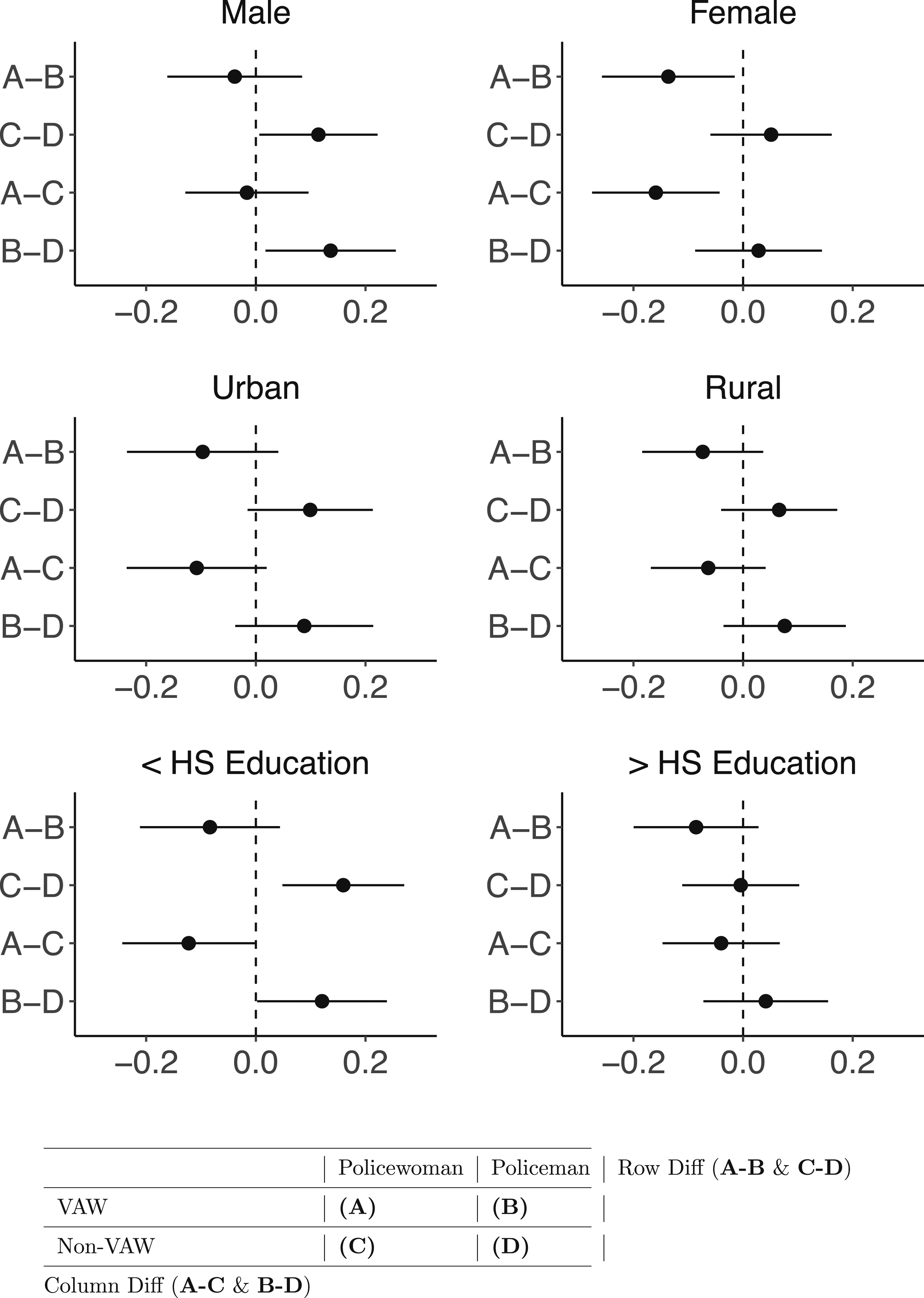
The results are robust to alternate tests, e.g., nonparametric two-sample Wilcoxon rank-sum tests (Appendix A18). In our instrument, we included manipulation checks that asked respondents whether they could recall the crime featured and the gender of the station officer. 42 Appendix Tables A23 and A24 reveal that the pattern is consistent when we define the treatment variables as being assigned and recalling watching a video with VAW or a video with a female officer. This also assuages concerns about the problem of “attractiveness” (Baert & Decuypere, 2014; Herrmann & Shikano, 2016). In other words, because we utilized the same actor, the officer may have been seen as more attractive/appealing in one costume’s garb than another. Even though we exerted effort to ensure that our visual primes convincingly communicated gender, and chose our actor/photographs from a diverse selection, it is plausible that we were unsuccessful or inadvertently primed for an individual belonging to the transgender community. We believe this is unlikely because a particular photo would consistently have received poor ratings across conditions; 43 instead, respondents’ evaluations of a particular photo of an officer vary by the type of crime, and we have no reason to assume that seeing, say, a male officer image would be perceived as “attractive” in the context of sexual assault but not murder. The findings are also notable considering respondents always saw a video in which the victim was a woman; the case type was simply altered to a particular subset of cases that, in India, are categorized as “crimes against women” and associated with female officers through legal guidelines, specialized institutions, and norms. 44 From a policy perspective, the findings seem relevant given lawmakers’ intuitions that enshrining in law that VAW be accommodated by policewomen will improve perceptions of the police or its agents, especially among women.
Discussion
We propose that taste-based, statistical, and paternalistic discrimination are unlikely to drive our results. If citizens were motivated by animus, then distaste would likely be exhibited across all crime types, rather than fall specifically when policewomen tackle VAW. 45 Similarly, if the mechanism was statistical discrimination, either crime type would not matter, or ratings for policewomen would be low for non-VAW, that is, roles for which citizens would likely have imperfect information about female officers’ ability. If paternalistic discrimination was the primary mechanism, then presumably male respondents would express unfavorable ratings of policewomen tackling non-VAW than female respondents. Indeed, existing research would suggest that factors like animus, lack of information about women’s capabilities, and eagerness to “protect” women from danger would primarily motivate male respondents; instead, we show that the ratings are driven by female respondents. We also set aside “role congruity” because it predicts that discrimination would be heightened against female officers in non-gendered roles.
Instead, we believe that the results are consistent with typecasting. Citizens, especially women, disfavor policewomen investigating VAW either because they reject law enforcement’s occupational segregation of female officers (i.e., want policewomen to tackle all types of cases rather than exclusively VAW) – or because seeing policewomen tackle VAW primes respondents for “soft” or lenient approaches (e.g., counseling rather than arrest) and inefficacy in terms of case dismissals or delayed inquiries for “crimes against women.”
If typecasting has validity, we should see the lowest legitimacy scores for policewomen in the context of dowry harassment. Among cases of VAW, 46 the case most likely to be assigned to female officers is dowry harassment or Section 498A of India’s Penal Code, 47 more so than sexual assault. In Appendix Table A25, we show that compared to the reference category, 48 policewomen are seen significantly unfavorably for dowry, that is, cases not only disproportionately assigned to policewomen but also, since 2013, among the four cases of the country’s Penal Code that are most likely to be dropped by law enforcement or fail to see suspects arrested (Pavithra, 2020). 49
The assignment of VAW to policewomen may prime respondents for “soft” approaches to crime. While dowry is, like rape, brought forward by female complainants, the case is also likely to have a woman suspect associated with it, that is, mother-in-law (Jassal, 2023). Seeing policewomen handling such female-on-female cases (between a young woman and a matriarch) may signal compromise rather than suspect arrest.
50
To test for evidence of this, we study variation along the pre-registered sub-indices of legitimacy. If female respondents are anxious about policewomen delaying cases or being “soft” on VAW, then we should see low scores for female officers along instrumental dimensions rather than procedural ones. As Appendix Table A26 demonstrates, policewomen’s low ratings are indeed along instrumental axes (e.g., compromise, promptness, interrogation) or “taking action” rather than fairness or character (Flores-Macías & Zarkin, 2021). Figure 8 presents this graphically. Difference in Means Along Sub-indices [Video Experiment]. Note. Difference in means from two tailed t.tests. The bottom two panels focus on female respondents only. Along the sub-indices of officer legitimacy, policewomen investigating VAW are rated the lowest in terms of instrumental outcomes associated with police “efficacy” compared to measures of fairness or character.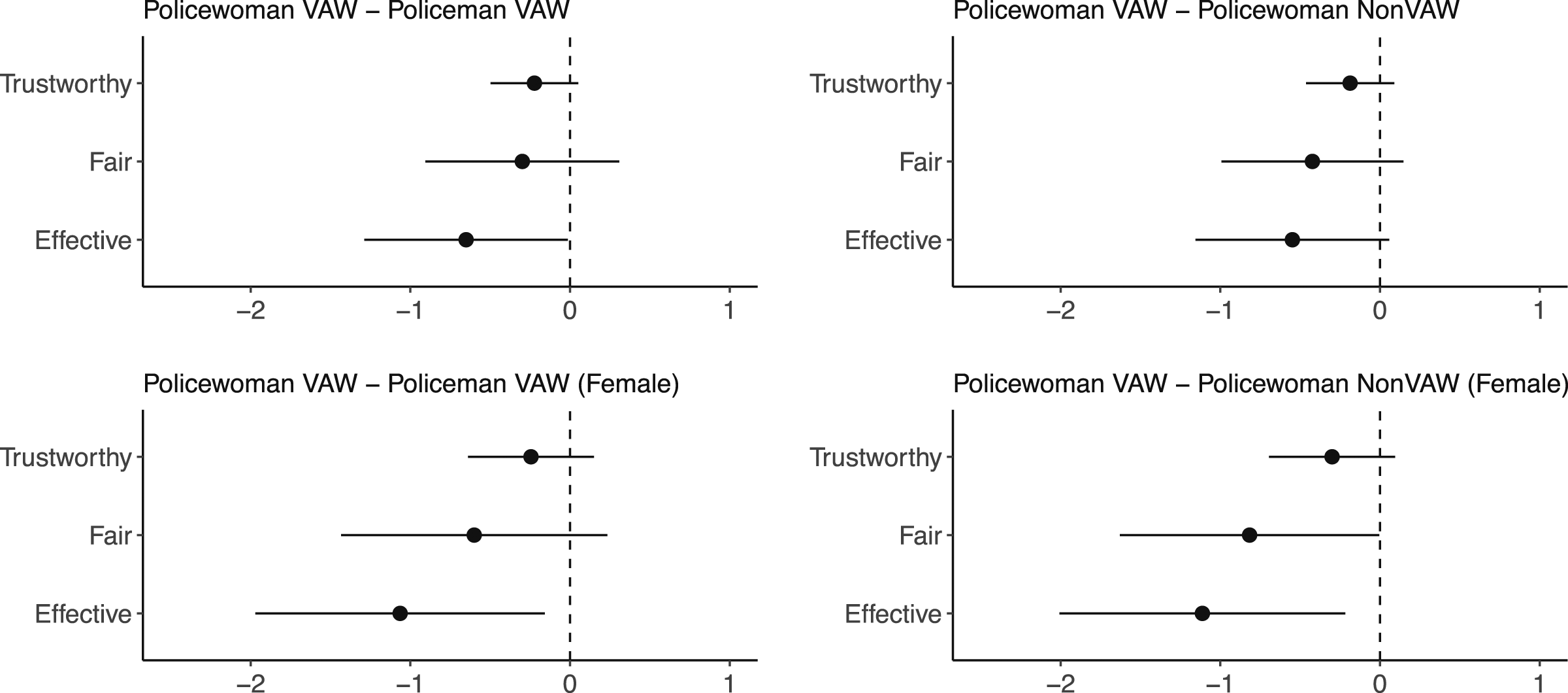
We explore two alternate explanations and find less evidence for them. Policewomen may be viewed negatively for VAW because such cases, and especially dowry, may not be considered a serious offense, and respondents may believe the suspect will be unfairly punished by female officers. Relatedly, perhaps citizens prefer customary institutions rather than the police for resolving VAW (Blair et al., 2019). We find that for both VAW and non-VAW, 98%–99% of respondents believe that the suspect should be arrested (Appendix Figure A12), and between 62% and 65% believe that the police should handle the cases; in other words, we do not find support for the idea that VAW cases are perceived as less worthy of formal punishment than non-VAW.
Conclusion
Citizen evaluations of officers have implications for whether they turn to the police when in distress (Tyler, 1990). Partly because law enforcement officers are often seen to lack legitimacy, several nations have reformed hiring practices and promoted measures to make security agencies more representative (McCrary, 2007). We probe whether “seeing” policewomen in law enforcement affects evaluations of officers, including among women (Hinojosa & Kittilson, 2020).
Based on an all-India survey, we find high levels of bias against policewomen, which are generally shared by female respondents. We point to a noteworthy correlation where those with the least favorable attitudes toward women in law enforcement are complainants of VAW. Then, we implement a video-based experiment that integrates video and images to test whether citizens (especially women) prefer policewomen, including for handling VAW. Our design affords us a level of realism which a standard vignette-based survey experiment may not. The self-administered instrument—aimed at minimizing enumerator effects and reaching a diverse sample—could easily be adapted in other low-literacy settings by other researchers. We find scant evidence that women prefer policewomen, including for VAW.
To be sure, we are cautious about overextrapolating our findings. First, we interpret the results as the marginal effect of exposure to policewomen on the legitimacy of officers because, even though policewomen are disfavored in certain respects, representation in law enforcement might have improved evaluations of the police over time. Second, while our findings go against U.S. literature about women preferring in-group officers, they do not imply that this need always be true. With all such designs, external validity remains a question, and we acknowledge that VAW in India—and the way, say, dowry harassment is perpetrated—is context-specific, as may be the mandate assigning policewomen to certain roles. Even the concept of policing may have a distinct meaning in India that does not exist in the United States, where much of the literature on this theme is situated; citizens may view officers through the prism of a colonial institution established for imposing order rather than a public service (Tellez et al., 2020). Third, the CSDS survey and our experiment are snapshots; the effects are unlikely to be static and may evolve with greater exposure to and contact with policewomen.
Nevertheless, our findings hold relevance for social science and policy. The representative survey of India’s voters, and experimental sample from a state of 120 million individuals, are reflective of significant populations of the world. “Seeing women” in policing, while important, may not be a one-stop solution toward improved ratings of officers or law enforcement; from a demand-side perspective, shared identity does not appear to be a straightforward route toward increased faith in police officers (Karim, 2020; Klar, 2018). Even though the result that female officers are, on average, seen as just as legitimate as male officers could be interpreted as a positive finding, the real-world implications encourage deeper reflection. In particular, if women police officers are seen as illegitimate or evaluated unfavorably by in-groups for precisely the cases that they are most likely to be assigned by the agency, this could affect whether citizens, especially victims of VAW, gravitate toward female officers when in distress or when presented with a choice (e.g., reporting to a standard station or women-run help desk). The findings serve as a mechanism for research showing that women, and victims of VAW, may not always voluntarily travel to or report crime at police stations run exclusively by female officers (Jassal, 2020). In this way, our results contribute to the literature about citizens utilizing gender and other ascriptive characteristics to make inferences about administrators (Eagly & Karau, 2002; Lawless, 2004), by focusing attention on criminal justice officials (Ono & Zilis, 2022). We hope that the study not only contributes to the wave of research exploring the intersection between gender and criminal justice in the Global South (Córdova & Kras, 2020; Karim, 2020; Sukhtankar et al., 2022), but also scholarship on VAW disclosure to the authorities (Green et al., 2020; Iyer et al., 2012). Our research opens a door for future work too. For instance, India has established group-specific police stations run by the Scheduled Caste/Tribe (SC/ST) that not only segregate minority officers but also exclusively assign them cases filed by in-group complainants; the intuition behind such bodies is that victims will perceive in-group officers as legitimate, especially when reporting hate-crime. 51 Social science may benefit from testing the assumptions that underpin policies that explicitly match agents to tasks or roles based on identity and explore variation along the dimensions of gender and ethnicity.
Finally, the Indian context highlights a potential hurdle for female public officials, more generally: they can face occupational segregation in terms of being disproportionately assigned or typecast in “gendered” roles (Michelle Heath et al., 2005; Dahl et al., 2021), yet at the same time evaluated at a different standard when placed in those very positions. Even though our intention in this study was not to isolate mechanisms but evaluate whether a theoretical assumption that undergirds policies in the Global South associating VAW with female officers has empirical ground, we believe our findings are consistent with women expressing skepticism about the efficacy of “soft” approaches to tackle cases that are typically accommodated in such a fashion. If, as the CSDS survey suggests, complainants of VAW harbor negative attitudes toward female officers or, as our experimental results indicate, women disfavor policewomen investigating VAW, then more research is needed to explore measures that can increase women’s trust in law enforcement and specifically encourage victims of abuse to come forward. We infer from our results about the advantages for representation combined with an equitable division of labor within security institutions; this may not only provide female officials opportunity to develop broad-based capacity, but also attenuate typecasting whereby faith in newly represented groups is inadvertently undermined in the eyes of citizens.
Supplemental Material
Supplemental Material - Do Women Prefer In-Group Police Officers? Survey and Experimental Evidence From India
Supplemental Material for Do Women Prefer In-Group Police Officers? Survey and Experimental Evidence From India by Nirvikar Jassal and Sharon Barnhardt in Comparative Political Studies.
Footnotes
Acknowledgments
We thank Laura Stoker, Supreet Kaur, Jasjeet Sekhon, Joshua Kalla, Joel Middleton, Alison Post, Tanu Kumar, Pradeep Chhibber, Emmy Lindstam, Pavan Mamidi, Rachel Brule, Ashutosh Varshney, Sarah Khan, and Pascaline Dupas. For the CSDS-Common Cause Survey, we express our appreciation for Vipul Mudgal and Sanjay Kumar. For help with the design and editing of the videos, we thank Ayesha Kagal, Priya Thuvassery, and the New Delhi Television (NDTV) news organization. For assistance with the Marathi version of the study, we are grateful to the CESS team at FLAME University: Tirtha Patel, Harshada Yadav, Shardul Vaidya, Vijeta Pamnani, and Andres Parado. We thank Morsel for helping to field the study in Maharashtra.
Declaration of Conflicting Interests
The author(s) declared no potential conflicts of interest with respect to the research, authorship, and/or publication of this article.
Funding
The author(s) disclosed receipt of the following financial support for the research, authorship, and/or publication of this article: The research was made possible with the help of grants from the Poverty Action Lab at MIT, a Minerva Peace and Security Fellowship from the US Institute of Peace, an Allan Sharlin Award from the Institute for International Studies, the UC Berkeley Department of Economics, and CESS Nuffield-FLAME University.
Ethical Approval
This research has been reviewed and approved by UC Berkeley’s Committee for Protection of Human Subjects (IRB Protocol # 2018-02-10767) and was pre-registered with Evidence in Governance and Politics (EGAP) 20180325AA.

Data Availability Statement
The citation for replication materials and code is Jassal & Barnhardt (2023).
Supplemental Material
Supplemental material for this article is available online.
Notes
Author Biographies
References
Supplementary Material
Please find the following supplemental material available below.
For Open Access articles published under a Creative Commons License, all supplemental material carries the same license as the article it is associated with.
For non-Open Access articles published, all supplemental material carries a non-exclusive license, and permission requests for re-use of supplemental material or any part of supplemental material shall be sent directly to the copyright owner as specified in the copyright notice associated with the article.
