



Abstract
Electoral disinformation is feared to variously undermine democratic trust by inflaming incorrect negative beliefs about the fairness of elections, or to shore up dictators by creating falsely positive ones. Recent studies of political misperceptions, however, suggest that disinformation has at best minimal effects on beliefs. In this article, we investigate the drivers of public perceptions and misperceptions of election fairness. We build on theories of rational belief updating and motivated reasoning, and link public opinion data from 82 national elections with expert survey data on disinformation and de facto electoral integrity. We show that, overall, people arrive at largely accurate perceptions, but that disinformation campaigns are indeed associated with less accurate and more polarized beliefs about election fairness. This contributes a cross-nationally comparative perspective to studies of (dis)information processing and belief updating, as well as attitude formation and trust surrounding highly salient political institutions such as elections.
Introduction
In explaining his refusal to certify the 2020 presidential election outcome, U.S. Senator Ted Cruz cited polls that 39% of Americans believed the contest was rigged. “You may not agree with that assessment. But it is nonetheless a reality for nearly half the country”, 1 he said. The Senator was on the money. By using erroneous beliefs (which he himself had previously encouraged) as justification for his actions, he materialized some of the potential consequences of popular misperceptions about politics. They skew public opinion on important policies and hamper informed decision-making (Achen and Bartels, 2016), undercut participation and interest representation (Delli Carpini and Keeter, 1996), and are stubbornly sticky, because the misinformed – different from the uninformed – are more confident about their beliefs than the average citizen (Kuklinski et al., 2000). Misperceptions about the quality of elections are particularly alarming, as any doubts about the procedural fairness of this institution, whether accurate or not, strike at the heart of citizens’ trust in their political system, with possible ripple effects for legitimacy, stability, and participation (Birch, 2010; Mauk, 2022; Norris, 2014).
It may therefore give cause for worry that election losers – and sometimes winners – spread false claims of election fraud in democracies as different as Indonesia, 2 Australia, 3 or Brazil. 4 In contrast, autocrats from Azerbaijan 5 to Cambodia6 whitewash deeply fraudulent contests. This is part and parcel of the new “disinformation order” characterized by simultaneous declines of authoritative information and of trust in social and political institutions (Bennett and Livingston, 2018). If efficacious, such disinformation may decouple beliefs about the quality of institutions from their de facto quality, with potentially grave consequences. In the US, for instance, falsely negative perceptions about electoral integrity fomented violent insurrection despite the demonstrable absence of rigging (Persily & Stewart III, 2021). And in electoral autocracies, where citizens should indeed be concerned about fraud, falsely positive beliefs in election quality help autocrats survive (Reuter and Szakonyi, 2021). There is a disconnect, however, between these plausible accounts of disinformation’s deleterious effects, and persistent findings from experiments or digital trace data that average exposure to disinformation is small and its effects on beliefs minimal (Grinberg et al., 2019; Guess et al., 2019; Valenzuela et al., 2022). Is disinformation truly to blame for misperceptions and their negative effects, or are such accounts too alarmist?
In this article, we ask whether and how online disinformation 7 relates to public perceptions and misperceptions of election fairness. 8 Two arguments are prominent in the growing empirical research literature on this subject. On the one hand, scholars pursuing informational approaches to understanding belief formation hold that perceptions of election fairness are by and large accurate and responsive to de facto variations in electoral integrity, provided an unbiased information environment (Birch, 2008; Coffé, 2017; Kerr, 2014, 2018; Kerr and Lührmann, 2017). Others draw on motivational approaches to information processing, arguing that fairness beliefs are driven rather by deep-seated psychological predispositions such as conspiratorial thinking or authoritarian values (Edelson et al., 2017; Flesken and Hartl, 2018; Norris et al., 2020), or by partisanship, elite cues, and winner/loser dynamics (Beaulieu, 2014; Cantú and Garcia-Ponce, 2015; Hernández-Huerta and Cantú, 2021; Kernell and Mullinix, 2019; Mochtak et al., 2021; Sances & Stewart III, 2015).
We engage with and expand on this literature by combining theories of rational belief updating and motivated reasoning. We argue that both informational and motivational explanations have bearing on how we understand the formation of beliefs about institutional performance, but that they are both conditional on structural characteristics of the information environment in which learning takes place. The specific implications of this are that disinformation (a) predicts lapses in the accuracy of perceptions of election fairness; and (b) amplifies the winner-loser gap in perceptions of election fairness, thereby inflaming dynamics of political polarization.
We test our propositions empirically by joining survey data from three waves of the World Values Survey (WVS) and European Values Study (EVS) with macro data from the Perceptions of Electoral Integrity (PEI) expert survey (Norris and Grömping, 2019), and the Varieties-of-Democracy Project (V-Dem) (Coppedge et al., 2021). 9 This data covers more than 80,000 respondents in 74 democracies and autocracies around the globe. Multi-level models broadly confirm our expectations that fairness beliefs are related to de facto variation in election integrity, except where disinformation is prevalent. The findings are also consistent with motivated reasoning and demonstrate that the winner-loser gap in perceptions of election fairness is larger where disinformation is more widespread. They further show that disinformation has an equally deleterious effect on the accuracy of perceptions among both winners and losers, thus compromising belief accuracy across the board. We show that our findings are not an artifact of measurement error or systematic bias.
Our study contributes to previous efforts linking the information environment to trust surrounding highly salient political institutions such as elections (Coffé, 2017; Kerr and Lührmann, 2017) by explicitly considering inaccurate information in the media ecology. This may help explain the disjuncture found in some studies between observable patterns of election fraud and the beliefs about fraud held by people (Daxecker et al., 2019). We also contribute to research on (dis)information processing more broadly by adding a rare comparative perspective leveraging observational variation in disinformation, whereas most existing studies draw on experiments, which are somewhat artificial and fielded on populations already exposed to disinformation. Contrary to the prevailing body of experimental evidence and digital trace data (e.g. Allen et al., 2020; Grinberg et al., 2019; Guess et al., 2019; Valenzuela et al., 2022), our cross-national study strongly suggests that, at the aggregate, disinformation in fact does have pernicious effects. We therefore join calls for a “comprehensive misinformation research agenda” (Watts et al., 2021, p. 2), in particular efforts of triangulation with a diverse set of analytical tools and a broader, cross-national scope (Seo and Faris, 2021). Substantively, our finding that disinformation undermines belief accuracy across the board, irrespective of directional goals in information processing, suggests that fears of the disinformation order are not misplaced. In reverse, however, it also means that a high-quality information environment, in which accurate information dominates, can potentially offset some biases in the public’s learning about institutions.
The article proceeds with a section discussing existing scholarship on how beliefs about election fairness form. We then lay out our theoretical framework, and present our research design and data, followed by a section discussing the empirical results. The article concludes by drawing out wider implications of the findings.
Approaches to Explaining Public Perceptions of Election Fairness
Peoples’ beliefs about the functioning of their political institutions and processes may differ substantially from reality (Flynn et al., 2017; Nyhan, 2020). While some disagreement exists as to how consequential misperceptions are, most accounts would hold that accurate perceptions about politics are preferable for normative and instrumental reasons (Achen and Bartels, 2016; Delli Carpini and Keeter, 1996). Elections are a particularly important institution as they distribute access to power. At the same time, the procedures involved are complex to understand and evaluate. Although much attention is placed on election-day issues such as ballot box stuffing, voter fraud, or miscounting, problems may emerge at any step in the electoral cycle (Norris, 2014). For instance, the geography of voting districts may be gerrymandered or their size malapportioned for partisan gain; registration requirements may disproportionately exclude certain population groups; the regulation of campaign media and political donations may be inadequate to guarantee a level playing field; voters may be threatened with violence; or election management bodies (EMBs) may apply rules selectively. The procedural quality of elections may be judged by comparison to international norms (Norris, 2014), theories of democratic representation (Birch, 2011), domestic laws (Lehoucq, 2003), or managerial standards (James, 2019). Citizens’ judgements, however, could make recourse to altogether different standards, and, for a variety of reasons explored below, may or may not move in tandem with the de facto extent of electoral malpractice or levels of electoral integrity.
Research in this field has proceeded to explain perceptions of election fairness from different angles. On the one hand, informational approaches hold that public levels of trust in the electoral process are primarily predicated upon observable characteristics of the election environment such as the proportionality of the electoral system or public funding of political parties (Birch, 2008), polling procedures and technologies (Atkeson and Saunders, 2007), or EMB performance (Kerr, 2014). There is indeed some indication that public perceptions of election integrity correlate well with the evaluations of experts and electoral practitioners (Garnett and James, 2020; Norris, 2014). This perspective therefore expects that beliefs about election conduct are more or less accurate.
On the other hand, motivational approaches explore how individuals’ predispositions or goals of information seeking and processing superimpose directional bias onto their beliefs. Partisanship, for instance, colors assessments of the legitimacy of elections, reflecting the way political elites cue their followership (Beaulieu, 2014). Authoritarian values depress beliefs in election fairness (Flesken and Hartl, 2018). And individuals prone to conspiratorial thinking tend to perceive intentional “election rigging” where, in reality, innocent mistakes or unintended errors occur (Edelson et al., 2017; Norris et al., 2020). This second approach consequently posits that negative perceptions of election integrity cluster among people with similar psychological traits, values, or partisan identities, independent of the de facto quality of elections.
Updating on Biased Information?
Building on these important contributions, we shift focus to the interaction of directional goals in individuals’ information processing and the structural characteristics of the information environment in which perceptions about election fairness form, thus combining informational and motivational approaches. We can build on a general theory of attitude-formation and distinguish two basic mechanisms which may establish perceptions of the quality of political institutions or processes: direct experiences and indirect communications (Fishbein and Ajzen, 1975; Wyer Jr & Albarracín, 2005). Theories of Bayesian updating maintain that people rationally adjust their beliefs in ways consistent with newly learned information (Achen, 1992). Even if such updating is imperfect (Huber et al., 2012), beliefs about the functioning of political institutions and processes should nevertheless depend heavily on the accuracy of the information citizens receive about these institutions: the more accurate the information is, the more closely public perceptions should, ceteris paribus, reflect the actual working of an institution. In addition, however, citizens process information received, whether accurate or not, in different ways due to differential epistemic needs, selective attention, and a number of cognitive biases (Bartels, 2002; Bullock, 2009). To compare macro-trends in belief formation about the fairness of any political institution or process one should thus take stock of variation in (a) the de facto quality of that institution/process according to some agreed-upon benchmark; (b) the motivations underlying people’s evaluations of that institution/process; and (c) the factual accuracy of mediated information about the quality of the institution/process. In the following, we unpack our expectations in more detail.
Rational Updating
Different from other political institutions that remain opaque to citizens, there are many points of contact between citizens and elections where the former can learn about election conduct through first-hand experiences. Voters may witness intimidation or vote buying with their own eyes. Even people who do not turn out may bear witness to suppression of political rallies, jailing of candidates, or mundane things such as long queues or people being turned away at polling places. Successive research has shown that personal experience of or close proximity to instances of electoral malpractice allows people to rationally update their assessment of the process, leading to more negative perceptions of election fairness (Atkeson and Saunders, 2007; Kerr, 2018; King, 2020). While the information citizens receive through direct experience will be reasonably accurate – though arguably rather localized – it is also plausible that individuals will receive more second-hand information corroborating the integrity of an electoral process if the election was indeed well managed and fair, since reports from other voters and the media are likely to reflect this. 10 Given “defensive” mainstream news routines around fact-checking and objectivity (Schudson, 1978), it stands to reason that most reporting would reflect the good working of a fair election, unless there were in fact problems of malpractice. And indeed, at the aggregate level of the information ecosystem, factually correct news make up the overwhelming majority of people’s information diet (Allen et al., 2020). This is corroborated by studies showing that betterments in election administration translate into positive beliefs about election quality if and when there is a modicum of media freedom (Kerr and Lührmann, 2017), and that the use of traditional media correlates with the accuracy of citizens’ integrity perceptions (Coffé, 2017). This line of reasoning thus holds that public perceptions of institutions will, in the first instance, reflect de facto variation in how these institutions perform in such a way that all else being equal, the de facto integrity of an election is positively associated with public perceptions of election fairness (H1).
Motivated Reasoning
At the same time, however, perceptions of election fairness often diverge from de facto election integrity, even if citizens have direct experience to draw on, for instance from being exposed to instances of fraud (Daxecker et al., 2019). Scholarship mostly explains such lapses of belief updating as a product of politically motivated reasoning (Kunda, 1990). Being politically invested in specific outcomes, for instance via partisan identifications, may affect individuals’ epistemic needs. Specifically, “accuracy goals” that drive people to “seek out and carefully consider relevant evidence so as to reach a correct or otherwise best conclusion” (Taber and Lodge, 2006, p. 756) may recede among strong partisans, whereas “directional goals” are elevated. This may exacerbate people’s propensity “to apply their reasoning powers in defense of a prior, specific conclusion” (Kunda, 1990). This could affect individuals’ beliefs in electoral fairness in at least two ways: through biased information acquisition and biased information processing.
Firstly, politically motivated individuals search information that corresponds better with their prior beliefs while actively avoiding countervailing information. Rather than looking for the most accurate source on a given question, they seek out sources with a known partisan slant (Peterson and Iyengar, 2021). Contemporary high-choice media environments present more opportunities for such information seeking behavior, due to the fragmentation into partisan niches and audiences (van Aelst et al., 2017). In the context of electoral integrity, this may lead politically motivated individuals to disregard independent sources of information on election misconduct (Robertson, 2017). Secondly, directional goals may also lead people to evaluate information received in different ways, specifically by disregarding countervailing information they encounter (Lodge and Taber, 2013). Strong partisans may therefore even update their perceptions about election conduct in the wrong direction, for instance by discounting information about electoral violence committed by co-partisans, arriving at even less accurate beliefs (Daxecker and Fjelde, 2022). 11
Whether or not rational updating based on (factual) information about electoral quality serves or conflicts with partisans’ directional goals depends not only on those directional goals themselves but also on the de facto integrity of the election: In high-integrity contexts, updating serves the directional goals of those satisfied with the outcome of the election (‘winners’) but conflicts with the goals of those dissatisfied with the outcome (‘losers’). In low-integrity contexts, however, this relationship is reversed: now updating serves the goals of losers better than winners. Therefore, losers are more likely to disregard information about a high-quality election, and winners are more likely to disregard information about a low-quality election. 12
Since the directional goals of winners and losers lie in opposite directions, motivated reasoning breeds one of the most consistent findings in the literature: the winner-loser gap. Disappointment with an election outcome may give partisans of the losing side a prior that the contest must have been rigged, which may persist even if they have direct experience or receive mediated information suggesting the contrary. At the same time, partisans on the winning side tend to wear rose-tinted glasses enticing them to overlook or discount evidence of electoral malpractice, or simply hold on to their foregone conclusion that the election was fair (Cantú and Garcia-Ponce, 2015; Kernell and Mullinix, 2019; Mochtak et al., 2021; Nadeau et al., 2021).
Taken together, this suggests that public perceptions of institutions will reflect people’s political motivations regardless of the de facto functioning of the institution, biasing perceptions of electoral fairness upwards for winners and downwards for losers, so that, all else being equal, being a supporter of the winning side in a given election is positively associated with public perceptions of election fairness, while being a supporter of the losing side is negatively associated with public perceptions of election fairness (H2).
Disinformation
Recent structural transformations of media ecologies have seen increased volumes of false information mimicking journalistic formats circulate, giving rise to what some call a new “disinformation order” (Bennett and Livingston, 2018). Disinformation in elections has a long Cold War pedigree, and as the examples from around the world cited in the introduction suggest, governments and political parties in democracies and autocracies alike are actively engaged in its dissemination (Bradshaw and Howard, 2018). Given that most people in mass society learn about politics via mediated information, this may well affect the way people form beliefs about election fairness. Specifically, it may deteriorate the aggregate accuracy of information available for people to update their beliefs and exacerbate tendencies of politically motivated information search and processing.
For one, disinformation may siphon off attention from accurate information. This is not so much about the volume and spread of disinformation – which may be less than we think, at least in established democracies (Allcott and Gentzkow, 2017; Guess et al., 2019) 13 – but more due to the cognitive attractiveness of pervasive negativity, focus on threats, arousal of disgust, and other features that make disinformation psychologically “efficient” in focusing attention (Acerbi, 2019). What is more, just one false story may draw into doubt the things learned from many more accurate ones. Encountering a falsehood, or even just knowing about its existence increases its perceived accuracy (Pennycook et al., 2018), therefore also affecting individuals with high epistemic needs for accuracy – those that are most likely to update in line with newly learned information. Comparative research, too, suggests that beliefs in the accuracy of disinformation, once encountered, are high (Roozenbeek et al., 2020). Such effects on misperceptions of facts are likely to be long-lasting even if corrected, leaving an “echo” in people’s beliefs (Thorson, 2016). Disinformation disseminated by agenda-setting elites – including for instance presidents – is particularly sticky and has substantial impact on citizens’ evaluation of electoral conduct (Arceneaux and Truex, 2022). Finally, the very fact that public commentary about an “infodemic” is so widespread may lead some people to the cynical conclusion that nothing and no one can be trusted anymore, undermining beliefs in the fairness of institutions because of its presumed influence on others (Nisbet et al., 2021) or via priming through elite discourse about disinformation (Van Duyn and Collier, 2019). In summary, we have some reason to believe that the quality of mediated information people receive will intersect with the updating process; that this may result in unfounded beliefs that are either too negative or too positive, depending on the nature of said information; and that this effect is likely stronger the more flooded with disinformation the media environment is. We thus expect, all else being equal, that a higher volume of online disinformation in the media ecology decreases the effect of de facto electoral integrity on public perceptions of election fairness (H3).
In addition, disinformation is exceptionally well-suited to satisfy the needs of politically motivated individuals. Most studies conclude that its consumption is overall low compared to accurate information (see above). However, the same studies also show that disinformation clusters among older, politically more engaged segments of society, and, crucially, among ideologically homogeneous networks of strong partisans (Allcott and Gentzkow, 2017; Grinberg et al., 2019; Guess et al., 2019). This is important, since it means that congenial information will be more readily available for politically motivated individuals where disinformation is widespread. Survey-based research indeed suggests that, while effects are on average likely small, exposure to disinformation strengthens misperceptions among those audiences that already have strong priors or are already motivated more by directional rather than accuracy goals (Nyhan, 2020; Nyhan and Reifler, 2010). In this way, disinformation may unfold significant effects on beliefs through a two-step flow-like mechanism as it propagates in networks of trusted co-partisan peers online and offline, reinforcing their prior conceptions about the functioning of institutions, be they too positive or too negative. This leads to the expectation that, all else being equal, a higher volume of online disinformation in the media ecology increases the effect of being a supporter of the winning side in a given election on public perceptions of election fairness (H4).
Bringing together the above arguments leads to the prediction that disinformation undermines belief accuracy among politically motivated individuals across the board. A higher volume of disinformation in the media environment increases the accessibility of exemplars – illustrations of events in media content that represent broader categories (Zillmann and Brosius, 2000) – for instance concrete depictions of good or bad electoral conduct. The ease of retrieving exemplars in line with prior expectations in turn feeds into biased belief formation. For supporters of the winning party, it is easier to arrive at falsely positive beliefs about election quality when there are more falsely positive stories about its functioning. The reverse is true for partisans of the losing side: As congenial exemplars that an election was stolen are more accessible where disinformation is more prevalent, we should see an even stronger sore loser effect in conditions of high disinformation. Overall, we thus expect disinformation to warp public perceptions of election fairness among both winners and losers, so that, all else being equal, disinformation has a similarly deleterious effect on the association between de facto electoral integrity and public perceptions of election fairness for supporters of the winning and the losing side (H5).
Research Design
We assess the merit of these expectations with a cross-sectional research design, combining survey data from the World Values Survey (Round 6, 2010–2014, and Round 7, 2017–2020) and the European Values Study (Round 5, 2017–2020) with macro data from the Electoral Integrity Project (Norris and Grömping, 2019), the Varieties-of-Democracy Project (Coppedge et al., 2021), and World Development Indicators (World Bank, 2023). In this design, potential drivers of beliefs about election fairness are located at the election-level (de facto election integrity, and disinformation), as well as the individual-level (political partisanship). The data cover more than 80,000 respondents within 82 elections in 74 democracies and electoral autocracies across all world regions (Online Appendix A).
Dependent Variable
To measure public perceptions of election fairness, we employ five different items gauging trust in electoral processes from the WVS/EVS data, which asked respondents’ agreement on a 4-point Likert scale to the following prompts: “Votes were counted fairly”, “Some opposition candidates were prevented from running”, “Election officials were fair”, “Rich people buy elections”, and “Some voters were threatened with violence at the polls”. 14 Taken together, these five items account for the multidimensional character of electoral integrity, reflecting different stages of the electoral cycle (Norris, 2014). All five items load highly on a single factor (Online Appendix B). Accordingly, we model public perceptions of election fairness latently from these five items in all analyses. The resulting dependent variable is a continuous variable indicating respondents’ perception of electoral integrity, ranging from perceptions of very low electoral integrity to perceptions of full electoral integrity. 15
Independent Variables
We measure de facto electoral integrity via a factor covering the same five questions as above in the Perceptions of Electoral Integrity (PEI) expert survey (Norris and Grömping, 2019). 16 The extracted factor scores of de facto electoral integrity range from 0 (no electoral integrity) to 1 (full electoral integrity). Among our 82 elections, the lowest-quality contest is the Ethiopian election of 2015 (de facto electoral integrity of .08), and the highest quality one is the Finnish election of 2015 (.99). Using an expert-derived measure to judge any political phenomenon is not uncontroversial. For one, there is no scientific consensus on how to recognize an integrous election in the same way as there is with issues in the natural or life sciences such as climate change or the effects of smoking. What is more, electoral integrity is a highly politicized issue almost everywhere, and the best available evidence about the phenomenon may be speculative or contradictory, making it harder to differentiate accurate from false information (Vraga and Bode, 2020). Still, there is some agreement on the standards by which to evaluate election integrity (Norris, 2014, p. 107; van Ham, 2015), and empirically, our indicator converges with other measures of election quality. 17
To account for politically motivated reasoning, we make use of the question on (prospective) vote choice (WVS) and preferred party (EVS), respectively. We recode this variable to winner/loser status (1 = support for the winning side; 0 = support for losing side) using government composition data from the WhoGov dataset (Nyrup and Bramwell, 2020) cross-checked with a number of other sources like government websites and Wikipedia. 18
For online disinformation, we construct a proxy indicator by combining three items from the Digital Society Survey (Mechkova et al., 2020) included in V-Dem tracking government, foreign, and partisan dissemination of false information online. In particular, the items ask “How often do the government and its agents use social media to disseminate misleading viewpoints or false information to influence its own population?”, “How routinely do foreign governments and their agents use social media to disseminate misleading viewpoints or false information to influence domestic politics in this country?”, and “How often do major political parties and candidates for office use social media to disseminate misleading viewpoints or false information to influence their own population?”, respectively. For the analysis, the variables are reversed, standardized to range from zero (“never”) to one (“extremely often”), and combined into a factor score that captures online disinformation. 19 We opted for including all three of these measures because disinformation is not always driven by the same actor(s) everywhere (Bradshaw and Howard, 2018); yet all three types of disinformation are likely to distort citizens’ perceptions of the electoral process. Although our measure only proxies for the concept of interest (it captures only online disinformation, and furthermore does not tap disinformation specifically about elections) we are confident that this does not pose a serious validity problem. First, regarding online-only, the hybrid nature of contemporary media systems means propagation depends on both virality and broadcasting, and broadcasting occurs both online and offline (Starr, 2020, p. 74), and models dropping countries with low Internet penetration lead to the same results. Second, regarding its generic nature, the measure converges with two items from PEI which measure disinformation in the explicit context of elections but are available for only a limited number of elections. 20
Controls
The empirical models include several variables controlling for individual-level determinants of perceptions of election fairness identified in previous research. Better informed, more engaged, and more partisan individuals are more likely to have misperceptions (Kuklinski et al., 2000; Nyhan and Reifler, 2010), which is why we control for education, political interest, social trust, income, and satisfaction with democracy. Since digital literacy is lower among older cohorts, who are thus more likely to share and believe disinformation (Guess et al., 2019), we also control for respondents’ age. These variables are directly queried in the WVS/EVS data. Education was recoded into low (up to lower secondary), middle (higher secondary), and high (tertiary) categories.
On the macro level, the models control for annual GDP growth, sourced from the World Development Indicators (WDI) (World Bank, 2023) based on the assumption that economic downturns tend to affect satisfaction with democracy including democratic procedures (Quaranta and Martini, 2016). Additionally, we include internet penetration rates (WDI) to assess the potential audience for online disinformation, and V-Dem’s alternative sources of information index to gauge media pluralism, which may relate to fairness perceptions (Kerr and Lührmann, 2017). To account for potential differences between democracies and autocracies, we include a binary measure of democracy-autocracy based on V-Dem’s Regimes-of-the-World index (Lührmann et al., 2018). The empirical models also control for four more election-level variables: turnout (V-Dem), whether election losers accepted the results (V-Dem), and the freedom of operation for domestic and international election monitors, respectively (PEI). While turnout approximates how many citizens had direct experiences with the voting process, whether election losers accepted the results measures important elite cues that may affect public sentiment towards the contest (Hernández-Huerta and Cantú, 2021). Finally, the operation of domestic and international election monitors may give informational cues about election conduct (Hyde & Marinov, 2014).
All macro data are matched to the survey data according to the year of the last national election that took place before the respective survey was fielded. Even though WVS/EVS ask about elections in general rather than the most recent election, we still assume that respondents will primarily evaluate the most recent (national) election when confronted with this question. As neither WVS nor EVS are election studies, fieldwork periods are not aligned with election cycles. Whenever national elections were held during the survey fieldwork period, we split the sample so that respondents that were surveyed before this election were matched to the previous election, while respondents surveyed after the election were matched to the current election. 21 Summary statistics for all model variables can be found in Online Appendix F.
Analysis
Our analysis proceeds in five steps. We first briefly describe the data at the aggregate level. Second, we investigate the association between de facto integrity, winner/loser status, and public perceptions of election fairness. Third, we examine how disinformation conditions the accuracy of beliefs overall, and fourth, how it conditions it when taking into account partisan motivations. Finally, we discuss alternative specifications, different measurement strategies, and other robustness checks. Throughout the analysis, we employ multilevel models, with individual observations nested within elections.
Aggregate Perceptions Track De Facto Integrity
Figure 1 plots de facto electoral integrity of all 82 elections, as measured from the PEI expert survey, against citizens’ perceptions of electoral fairness, averaged for the election.
22
Higher de facto integrity generally correlates with more positive public perceptions, and there is a relatively strong linear fit. This lends some initial support to hypothesis H1 in that mass publics are often not far off the mark when evaluating the quality of elections in their countries. At the same time, there are also many countries where public perceptions deviate considerably from expert assessments. For instance, Nigerians and Colombians view their elections as much more unfair than they were in the eyes of experts, whereas Tajiks and Vietnamese, for example, appear to have far too rosy perceptions of the electoral process in their countries. De facto electoral integrity and public perceptions of election fairness. Note: Linear fit with 95% confidence interval depicted (r = .59, p < .001).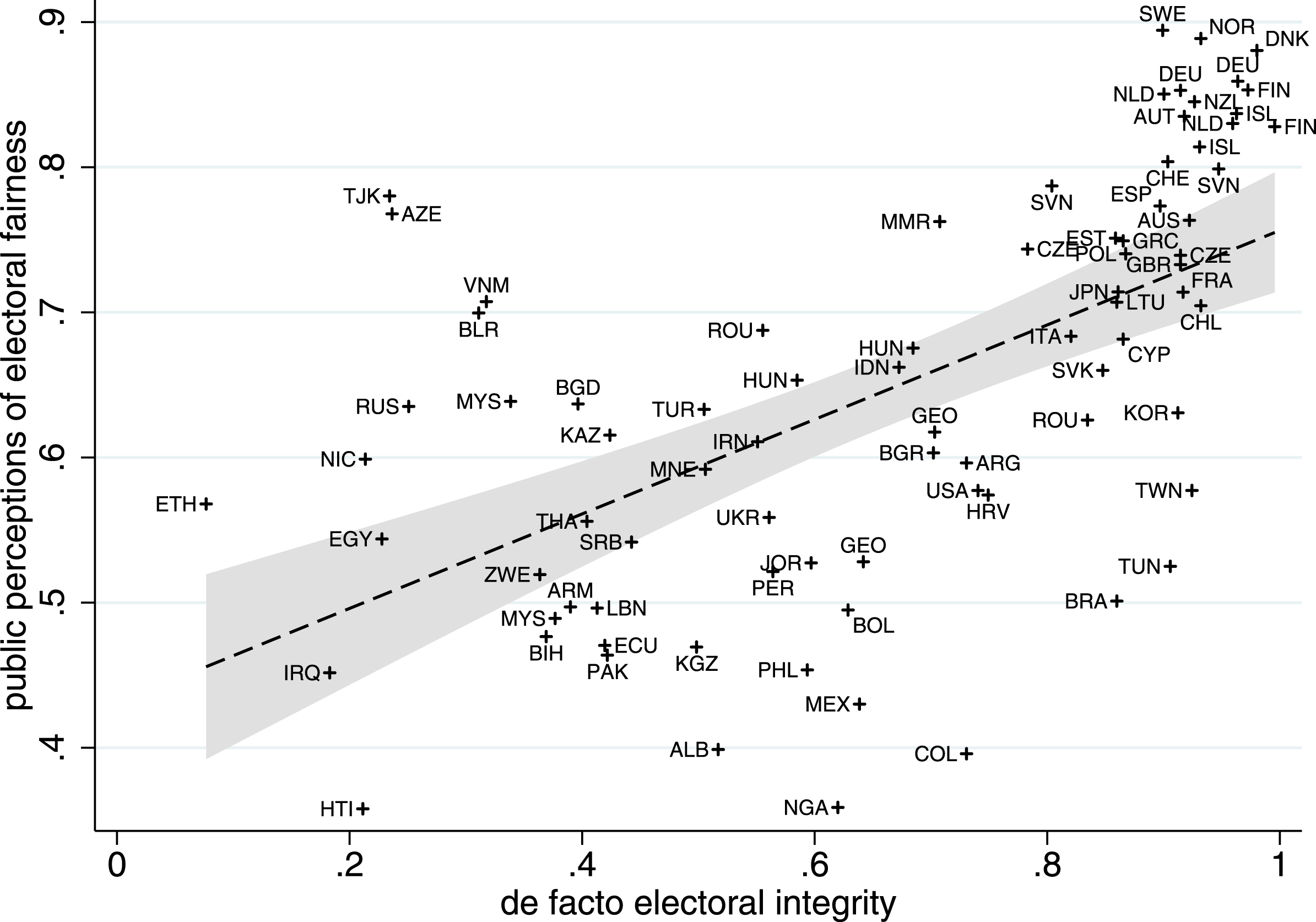
It is possible that such skews derive from individual characteristics of respondents in these countries, from macro characteristics of these countries’ elections or information environments, or both. Another important caveat is, of course, that these aggregate numbers obscure within-country variance. A close correspondence of public perceptions with de facto integrity in an election may be because most respondents agree about the quality of the contest – and in turn agree with the expert assessment (“de facto integrity”) – or it may be because many respondents are equally far off the mark, either too positive or too negative.
Rational Updating Despite Directional Goals
Explaining Public Perceptions of Electoral Fairness.
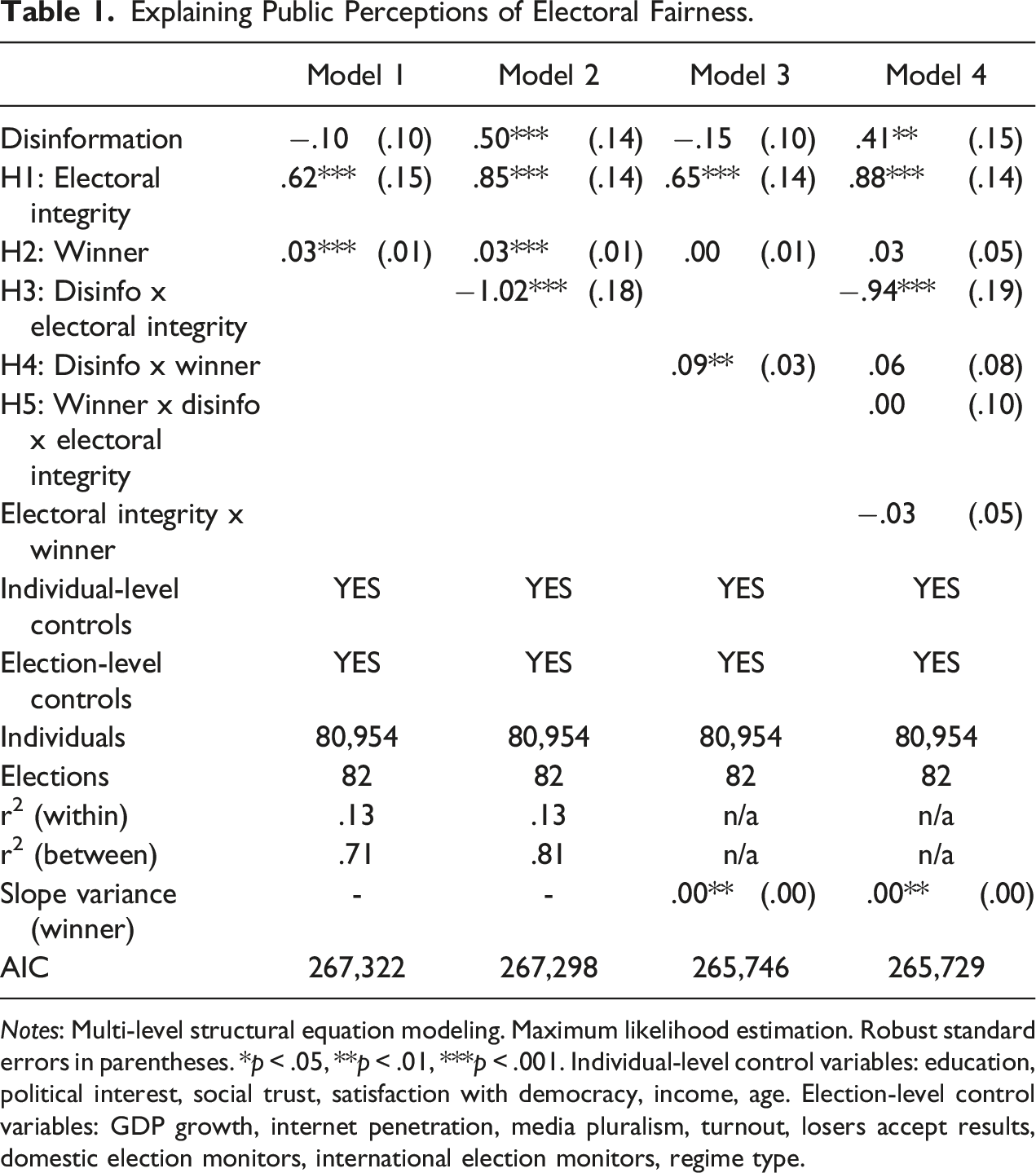
Notes: Multi-level structural equation modeling. Maximum likelihood estimation. Robust standard errors in parentheses. *p < .05, **p < .01, ***p < .001. Individual-level control variables: education, political interest, social trust, satisfaction with democracy, income, age. Election-level control variables: GDP growth, internet penetration, media pluralism, turnout, losers accept results, domestic election monitors, international election monitors, regime type.
Model 1 lends support for the first two hypotheses. There is a strong main effect of de facto integrity on public perceptions of electoral fairness, other things being equal, corroborating the general trend in Figure 1. Higher electoral integrity is associated with respondents perceiving these elections as fairer, indicating that citizens have a good grasp of how fairly elections in their country are conducted. This is consistent with rational updating. At the same time, those who voted for or support a governing party, ceteris paribus, perceive the elections as fairer than those who voted for or support an opposition party. This winner-loser gap is consistent with expectations derived from the motivated reasoning literature. In substantive terms, however, the association of de facto integrity with perceptions thereof is considerably stronger than the association of winner/loser status with more positive/negative fairness beliefs. This is suggestive of citizens’ ability to adjust their beliefs about institutional performance in line with these institutions’ true functioning, notwithstanding political motivations for their evaluations. This result holds when controlling for common explanations of beliefs about democratic institutions, such as political interest, social trust, satisfaction with democracy, or socio-demographic factors around education, income, or age. Importantly, the result also holds when controlling for media pluralism. This suggests that largely accurate beliefs about the functioning of elections can arise even in less free or more highly concentrated media environments.
Disinformation Undermines Belief Accuracy
What happens, though, when false information gains prominence in a media ecology? First, higher volumes of disinformation correlate somewhat with more negative perceptions of election integrity. But our confidence in this finding is relatively low, given that the negative coefficient for our disinformation indicator in Model 1 is not statistically significant, and, theoretically, we would expect disinformation to foster both overly negative and overly positive fairness beliefs. What about the accuracy of beliefs? Our third hypothesis predicted that disinformation undermines belief accuracy, which turns out to be consistent with our estimations (Model 2, Table 1). There is a substantial and significant moderating effect of disinformation campaigns: The more disinformation citizens are exposed to, the weaker the effect of de facto integrity on perceptions of fairness becomes; in other words: the less accurate perceptions are. We explore this interaction in Figure 2, which plots the average marginal effects of de facto integrity on public perceptions of election fairness at various levels of online disinformation, ranging from the least, with a disinformation score of zero (Denmark 2015; or Germany 2013) to the highest (.9, Russia 2016; or 1.0, Azerbaijan 2018). The graph demonstrates that perceptions closely reflect de facto integrity in contexts with little disinformation. The more prevalent online disinformation is, the weaker this link becomes, up to a complete detachment at very high volumes of disinformation. This disconnect starts becoming apparent from about medium levels of disinformation (about .5), corresponding to a situation where, according to the V-Dem coding of the disinformation variables, the government/foreign/partisan entities disseminate disinformation “about half the time” and “on some key political issues, but not others”. The interpretation of this strong and significant interaction effect is that disinformation appears to be efficacious in undermining belief accuracy. Or, turned on its head, that rational updating of beliefs rests on the assumption that accurate information is more readily available than inaccurate one. Again, it is noteworthy that these results are robust to variations in media pluralism: a free media environment is not the same as a media environment free of false information. How disinformation conditions the relationship between de facto electoral integrity and public perceptions of electoral fairness. Notes: Model specifications according to Model 2 in Table 1. Unstandardized estimates and 95% confidence intervals of conditional effect of electoral integrity for varying degrees of disinformation (.05 scale points intervals). Bars show frequency distribution of online disinformation as indicated by the left y-axis.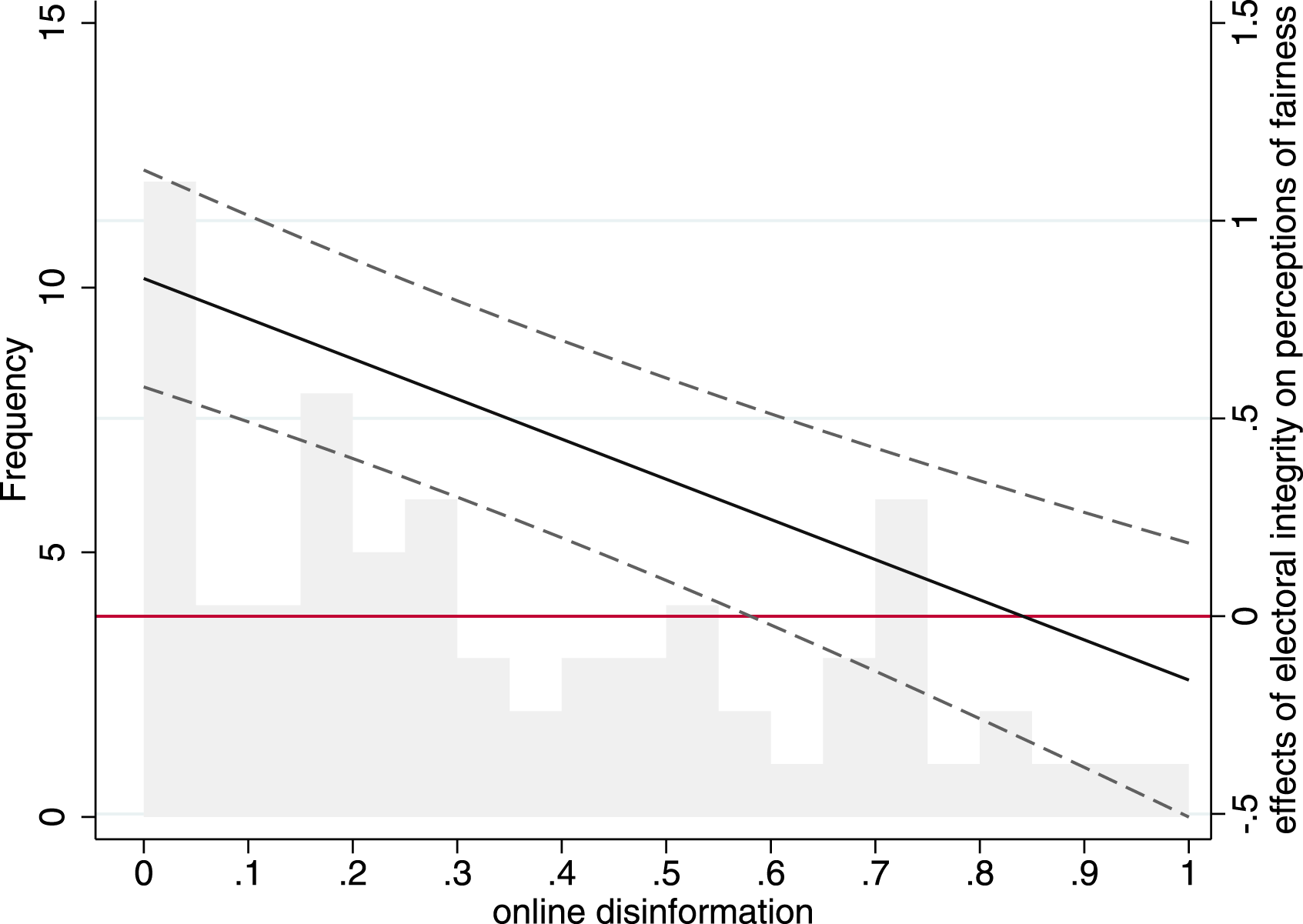
As we have to rely on observational, cross-sectional data only, we cannot entirely dismiss the potential for endogeneity: Theoretically, our results could also be due to disinformation actors deliberately targeting countries where public perceptions of electoral fairness are already less accurate, presumably increasing their chances of successfully penetrating citizens’ minds with their disinformation. We do, however, deem it rather unlikely that disinformation actors strategically choose countries (rather than, e.g., platforms) in which to become active. Both government and partisan disinformation actors are by definition active in their own country only, and comparative research suggests this to be the case pretty much everywhere (Bradshaw and Howard, 2018); this leaves foreign disinformation actors, who might well consider where to most efficiently allocate their resources. Reassuringly, our results for the distorting effects of disinformation also hold when looking at only government or only partisan disinformation (see Robustness Checks section below), supporting our notion that the level of disinformation in a given country is exogenous to how accurate its citizens’ beliefs about electoral fairness are.
Disinformation Exacerbates the Winner-Loser Gap
Once the assumption of accurate information is not met anymore, beliefs thus appear to decouple from facts more and more, potentially elevating other drivers of perceptions about political institutions – such as partisan identities and cues. Is this borne out in the data? Our fourth hypothesis predicted that disinformation amplifies the winner/loser effect. Model 3 in Table 1 supports this conjecture: it finds a significant positive interaction effect between disinformation and winner status. This means that when online disinformation is more prevalent, the gap between how winners and losers perceive the electoral process increases substantially. In fact, as Figure 3 demonstrates, election losers only view the elections as less fair than winners when there is at least a small amount of disinformation. Put differently, the “sore loser” effect is worse under conditions of disinformation, and the more disinformation there is, the larger the winner-loser gap in perceptions becomes, increasing more than five-fold in conditions of strong disinformation compared to conditions of low disinformation. On the other hand, in total absence of disinformation, winners and losers barely deviate from one another in their fairness beliefs. And as the positive and statistically significant coefficient for our indicator of de facto electoral integrity in Model 3 suggests, this means that all else equal, public perceptions trend toward being accurate. These findings are again consistent with our general expectation that disinformation is efficacious in undermining belief accuracy. Recall that the winner-loser gap, although substantively small (see above), will lead partisans of the losing side to doubt the fairness of a contest even in a de facto free and fair election. According to our model results, disinformation is a crucial conditioning factor for this to occur. How disinformation conditions the relationship between winner/loser status and public perceptions of electoral fairness. Notes: Model specifications according to Model 3 in Table 1. Unstandardized estimates and 95% confidence intervals of conditional effect of electoral integrity for varying degrees of disinformation (.05 scale points intervals). Bars show frequency distribution of online disinformation as indicated by the left y-axis. How disinformation affects both winners and losers. Notes: Model specifications according to Model 4 in Table 1. Unstandardized estimates and 95% confidence intervals of conditional effect of electoral integrity for varying degrees of disinformation (.05 scale points intervals), for winners (solid line) and losers (dashed line). Bars show frequency distribution of online disinformation as indicated by the left y-axis.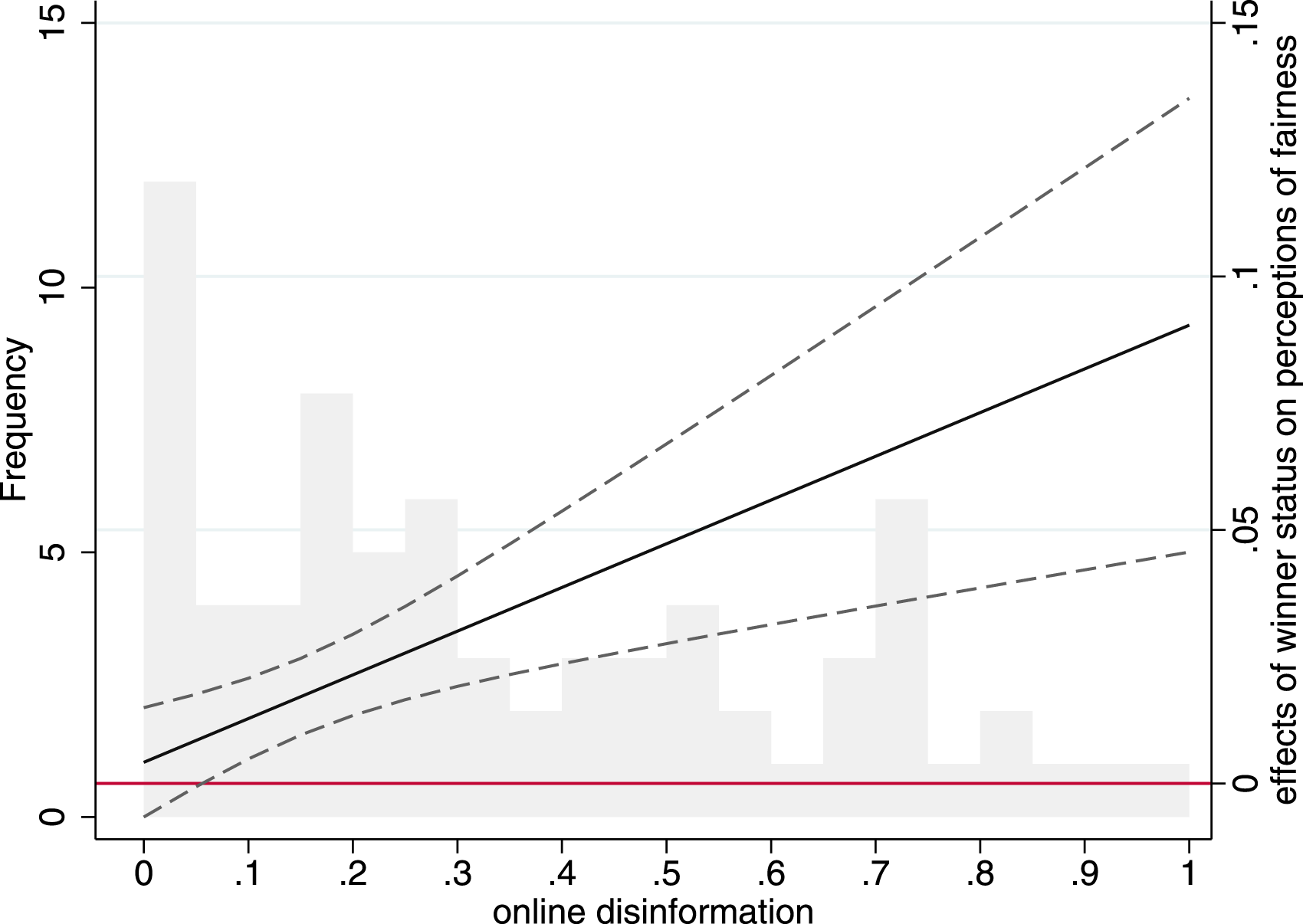
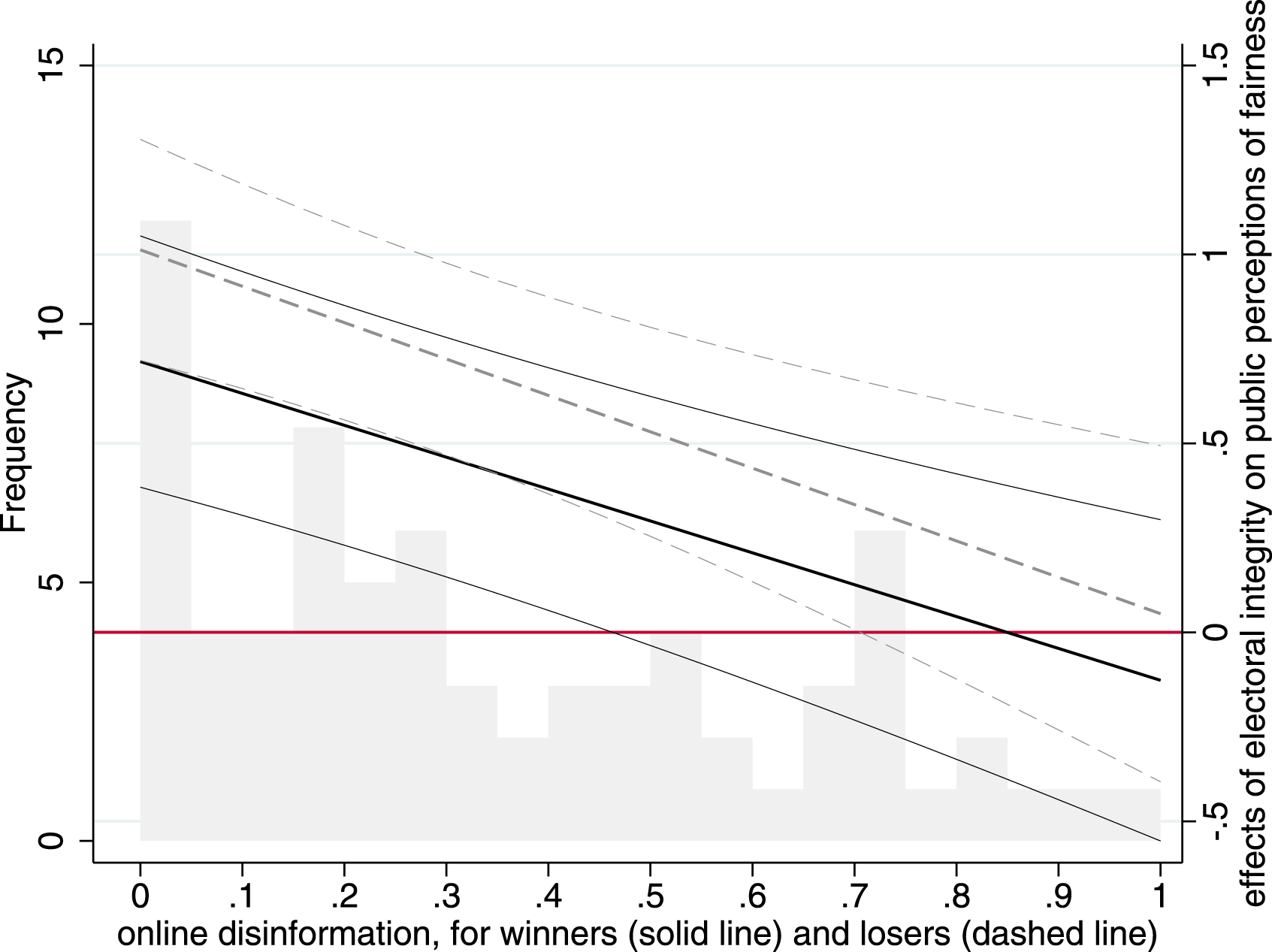
Finally, to investigate whether disinformation affects winners and losers equally (H5), we estimate a three-way interaction between winner status, disinformation, and electoral integrity (Model 4, Table 1). This can be seen as a direct test of the overall effects of disinformation on belief accuracy, taking into account simultaneously rational updating and motivated reasoning. The coefficient for the three-way interaction is miniscule and far from statistically significant. This indicates that whether or not an individual is part of the winning or the losing camp does not change how disinformation distorts the relationship between de facto electoral integrity and citizens’ perceptions of electoral fairness. This lends support to H5. Figure 4 provides further evidence for this conjecture. It plots the regular two-way interaction between online disinformation and de facto electoral integrity for two groups of individuals: those who voted for or support a governing party (winners, solid line) and those who voted for or support an opposition party (losers, dashed line). While we find an overall slightly stronger effect of de facto electoral integrity on public perceptions of election fairness for those in the losing camp, disinformation has a very similar deleterious effect for both groups of citizens: the more prevalent online disinformation is in a country, the more detached are both winners’ and losers’ perceptions of the electoral process from expert assessments of electoral integrity.
Overall, the results of our statistical analysis lend strong support to the argument that online disinformation is detrimental for the accuracy of public perceptions of election fairness. Not only is disinformation associated with a weakened link between de facto electoral integrity and public perceptions thereof (H3), it also amplifies the gap between winners’ and losers’ perceptions of the electoral process (H4), and exerts its deleterious effect equally on both partisans of the winning and of the losing camp (H5).
Robustness Checks
The main results of our analysis line up with our theoretical expectations, but this may be due to measurement bias, sampling bias, model specifications, or all three. We undertake some efforts to investigate the robustness of our results, detailed in the Online Supplementary Materials (Online Appendix G). Figure 5 reports the coefficient estimates of interest for all our hypotheses, according to different model specifications, operationalizations, or samples. Robustness checks. Notes: Based on models reported in Online Appendix G. Unstandardized estimates and 95% confidence intervals. Elect Integrity = De facto electoral integrity; Disinfo = Disinformation; Main = Main models reported in Table 1; Alt DV = Alternative Dependent Variable Operationalization; Alt IV = Alternative Independent Variable Operationalization; Model Spec = Alternative Model Specification; Sample = Alternative Sample.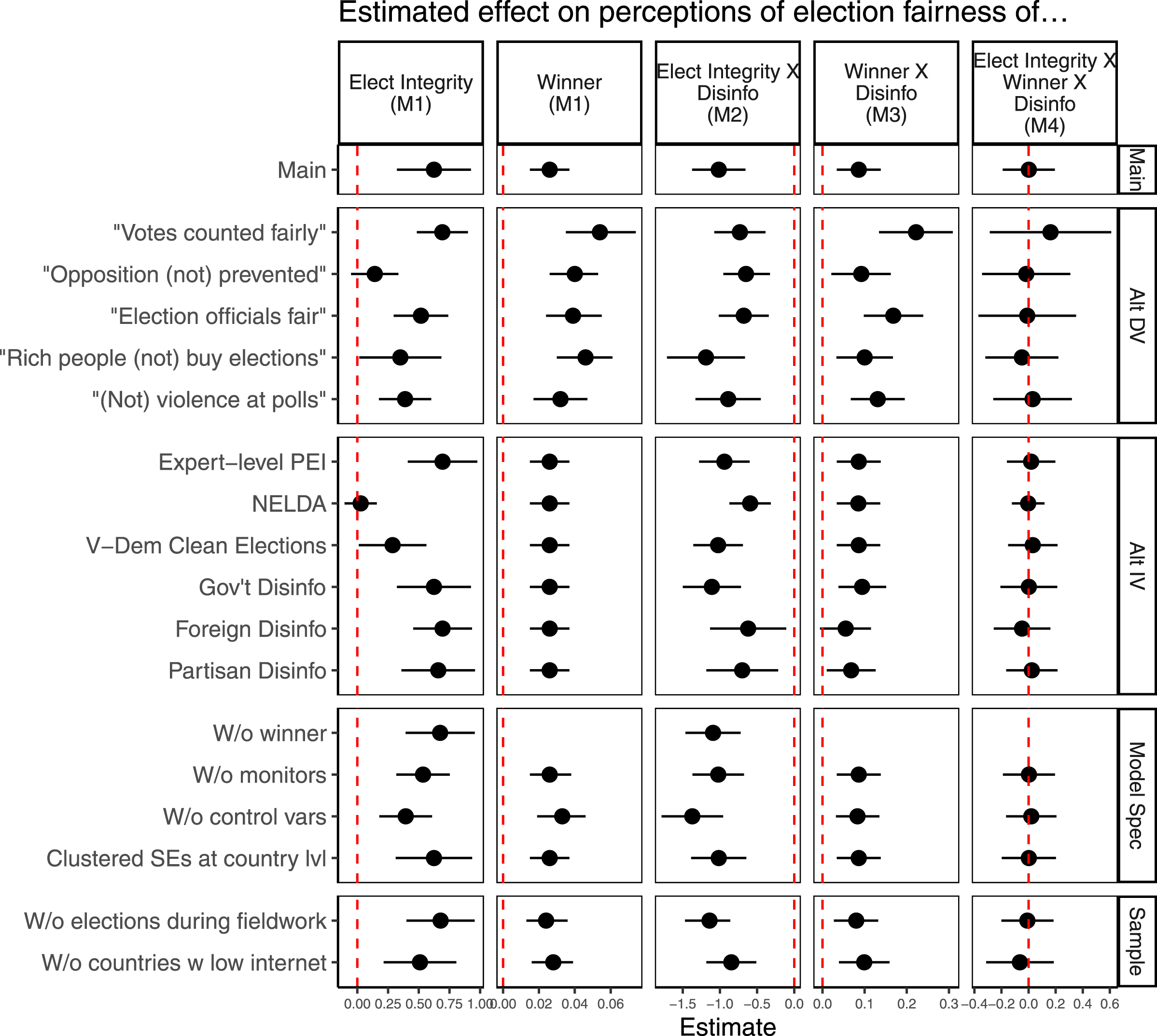
Firstly, almost all coefficient estimates retain both their sign and statistical significance when we replicate the analysis with alternative measures for our dependent variable. Specifically, we use the five individual survey items on perceptions of election fairness from WVS/EVS, which line up exactly with the correspondent expert indicators. The main effect of de facto electoral integrity shows some sensitivity to measurement specification in terms of statistical significance, but in all models still points in the expected direction. All other effects are exactly in line with our main model. Importantly, our key effects of interest, the interactions with disinformation, are robust in all models.
Secondly, we replace the measure for de facto electoral integrity with a factor score derived from the expert-level (instead of election-level) PEI data (see Online Appendix C), another expert indicator from V-Dem (“Clean Elections Index”), and an observational measure from the National Elections Across Democracy and Autocracy Dataset (NELDA) (nelda11 – “Pre-election concerns”). Our findings for hypotheses H2-H5 are robust to this alternative approach. For the NELDA operationalization, the main effect of de facto electoral integrity does not reach conventional thresholds of statistical significance. We suspect this has to do with those measurements aligning less closely with our outcome variable (public perceptions of electoral fairness). 23 Nonetheless, the interaction effects remain significant and substantial. Given that our key interest is in disinformation we do not see this as a major threat to our overall results.
Thirdly, we explore the possibility that different dimensions of disinformation relate to differential outcomes – for instance that foreign disinformation is associated with more negative perceptions and governmental disinformation (propaganda) with more positive ones. Again, the results are robust to these alternative operationalizations, and the deleterious effects of disinformation on belief accuracy persist, no matter which type of disinformation we use in the model. 24
Fourthly, when using alternative model specifications, specifically dropping the “winner” variable (due to high non-response), dropping both election monitor variables (due to potential multicollinearity issues), and dropping all control variables to test for potential suppression effects (cf. Lenz and Sahn, 2021), using clustered standard errors at the country level, or when modifying the sample by excluding those elections that took place during field work or in countries with a low internet penetration rate, results do not change. We also do not find any strong indication that the interaction effects we are interested in are non-linear (cf. Hainmueller et al., 2019). Finally, we find no evidence of systematic non-response bias induced by political fear effects, as respondents in authoritarian and democratic settings are equally likely to disclose their views on potentially sensitive survey items (Online Appendix G).
Overall, then, the key results of our analysis are robust to alternative measurements of both the dependent and key independent variables, model specifications, and sample selections, increasing our confidence in the substantive findings.
Conclusion
Political misperceptions undermine political participation, reduce citizens’ ability to discern their own interests, and hamper political responsiveness (Achen and Bartels, 2016; Delli Carpini and Keeter, 1996). In this article we investigated the drivers of popular perceptions and misperceptions about the fairness of elections. We presented an argument drawing on both informational and motivational explanations of belief formation, proposing that both are conditional on structural characteristics of the information environment in which learning takes place. The empirical evidence drawn from a globally comparative sample of elections and public opinion surveys was highly consistent with this argument. Ceteris paribus, people around the world update their beliefs about election fairness in the right direction, although politically motivated individuals deviate slightly from this general trend, such that supporters of the losing side have less positive beliefs irrespective of the de facto integrity of a contest, and supporters of the winning side have more positive beliefs. However, disinformation interacts with these dynamics in two ways. Firstly, rational updating fails where the informational base for it is biased through disinformation, and secondly biases in information processing, for instance the winner-loser gap, become more potent. What is more, the failure of rational updating affects both supporters of the winning and the losing side. These results control for several alternative explanations at the individual and election level, such as socio-economic factors, dissatisfaction with democracy, economic downturns, or elite cues.
Some limitations of the research must be acknowledged. First, our measure for disinformation is an imperfect one. It merely taps into the general prevalence of disinformation in the media system, rather than campaigns about the quality of elections specifically. Second, countries with relatively fair elections and relatively small volumes of disinformation are overrepresented in our sample, due to the European focus of EVS data. The analysis may therefore underestimate the effects of disinformation. Third, our observational design is suggestive of certain trends, but cannot identify causal relationships among the factors observed.
Keeping in mind these limitations, the study contributes to several existing research programs, drawing strength from its globally comparative design. First, we join research into public perceptions of election fairness that attest to the public an ability to assess the functioning of elections accurately (Garnett and James, 2020; Kerr, 2018; Norris, 2014). Our findings also support the established scholarship on the winner-loser difference in public evaluations of election fairness. While we do not test directly for other forms of politically motivated reasoning, we do see, as for instance Mochtak et al. (2021), that subjective perceptions of being on the losing side depress trust in elections. But we add nuance, by showing that this dynamic is fed by a biased information environment. In such circumstances, elite cues and misleading exemplars about fraudulent elections are much more readily available, inflaming the sore loser effect (see also Hernández-Huerta and Cantú, 2021). Concerns about electoral disinformation, widespread in public commentary, is therefore likely warranted. Accurate perceptions about election fairness shore up accountability, and a narrow winner-loser gap is a key feature of democratic consolidation (Nadeau et al., 2021). Both conditions are under threat from disinformation campaigns. Winners will deviate towards rosier-than-warranted beliefs where there is a lot of disinformation, while losers’ beliefs will deviate in the opposite direction. Disinformation is thus an important factor in explaining polarization of beliefs about electoral integrity, a worrying trend observed in the U.S. and elsewhere (Grant et al., 2021).
Second, these insights developed within the particular topic area of elections speak to seminal debates in communication studies about Bayes’ theorem and biases in information processing. We find that, overall, the indicator tapping the de facto fairness of the institution has the strongest effect on its perceived fairness, notwithstanding possible cognitive or affective biases. As such, our study concurs with those characterizing people as “cautious Bayesians” (Hill, 2017), meaning that they by and large update their perceptions correctly, albeit slowly and with less than perfect efficiency, even when newly acquired information contradicts their prior beliefs. Our findings add the important caveat that such updating relies on a basis of factually correct information. Faced with information disorders, even (cautious) Bayesians update in the wrong direction. And fallbacks like heuristics and other reasoning devices will likely result in misperceptions. Nevertheless, given that the effects of partisan reasoning disappear where there is no disinformation, our study suggests that high-quality media systems, those resilient to information disorders due to, for instance, public service broadcasting, high trust in media, or strong journalistic norms (Humprecht et al., 2020), might compensate for biases in information processing. In such resilient information environments beliefs therefore would tend to “converge on truth” (Stimson and Wager, 2020) over time as facts prevail and falsehoods recede in interpersonal communications and through societal gatekeeping by media and political elites.
Third, the paper intervenes in debates on the effects of disinformation on attitudes by adding a rare cross-national perspective. We find statistical significance for the predictive power of information disorders at the contextual level when controlling for individual-level determinants of beliefs. Contrary to persistent findings through experiments or digital trace data that exposure to disinformation is small and its effects on perceptions hard to identify (Guess et al., 2019; Guess and Lyons, 2020; Valenzuela et al., 2022), our study strongly suggests that disinformation in fact does undermine belief accuracy. We can speculate why our findings differ so much from this body of research. For one, laboratory experiments, or even field experiments, may systematically underestimate how much disinformation people actually consume. They parse out a small snapshot, for instance exposing respondents to discrete messages, while our cross-national design approximates the whole information diet. Different methods often lead researchers to quite different conclusions, in various research areas from poverty reduction (Laderchi et al., 2003), or political agenda-setting (van Aelst and Walgrave, 2011), to democratic preferences (König et al., 2022), to name but a few. This suggests, at the very least, that further efforts of triangulation with a diverse set of analytical tools are called for in disinformation research. It may also be the case that election fairness as a referent object is different from other issue areas which are often the focus of disinformation studies, such as public health, or climate science. There is no scientific consensus about the “true” extent of electoral integrity in a given contest, providing potentially more inroads for false information.
In conclusion, the present research has shown that there is merit in expanding the empirical scope of disinformation research to include cross-national perspectives, and that there is still much to learn about the nature of belief formation. It has necessarily left many questions unanswered. For instance, how does the obtrusiveness of different types of electoral malpractices – ranging from outright violence to obscure changes in electoral regulations – moderate how citizens perceive election fairness? Do our findings bear out for beliefs about other institutions or in other issue areas? And which policy interventions, for instance election monitors or media fact checkers, are suited to correct for disinformation? All this provides fertile ground for future research.
Supplemental Material
Supplementary Material - Online Disinformation Predicts Inaccurate Beliefs About Election Fairness Among Both Winners and Losers
Supplementary Material for Online Disinformation Predicts Inaccurate Beliefs About Election Fairness Among Both Winners and Losers by Marlene Mauk, Max Grömping in Comparative Political Studies.
Footnotes
Acknowledgements
We owe a debt of gratitude to Munir Adi and Philipp Lutz for excellent research assistance. Earlier versions of this paper were presented at the European Political Science Association’s 2019 and 2022 annual meetings, at the Australian National University’s School of Politics and International Relations research seminar series, the University of Helsinki’s Aleksanteri Institute, and Griffith University’s Centre for Governance and Public Policy working group on People, Elections, and Parties. We thank participants for their generous and very helpful feedback. We would also like to thank CPS’s two anonymous reviewers for their insightful comments, which greatly helped improve the paper.
Declaration of Conflicting Interests
The author(s) declared no potential conflicts of interest with respect to the research, authorship, and/or publication of this article.
Funding
The author(s) disclosed receipt of the following financial support for the research, authorship, and/or publication of this article: Open access publishing facilitated by Griffith University, as part of the Sage - Griffith University agreement via the Council of Australian University Librarians.

Data Availability Statement
The data used in this article are publicly available from their respective providers. Replication code is available at Harvard Dataverse, https://doi.org/10.7910/DVN/WTNZQN (Mauk & Grömping 2023).
Supplementary Material
Supplementary material for this article is available online.
Notes
Author Biographies
References
Supplementary Material
Please find the following supplemental material available below.
For Open Access articles published under a Creative Commons License, all supplemental material carries the same license as the article it is associated with.
For non-Open Access articles published, all supplemental material carries a non-exclusive license, and permission requests for re-use of supplemental material or any part of supplemental material shall be sent directly to the copyright owner as specified in the copyright notice associated with the article.
