




Abstract
Citizens in multiple crime-ridden countries strongly support the militarization of security—that is, placing the military in charge of traditional policing duties. Yet, we know little about the determinants of such support. Do people approve of militarization even in the face of human fatalities? We explore this question in the context of Mexico’s “war on drugs.” In three experimental studies, we manipulate the presence of human costs in a military operation against a drug lord and present arguments either justifying or condemning these costs. We consistently find that, even in successful operations, support for militarization decreases when military operations cause civilian casualties, but not when the victims are members of drug cartels. This finding holds for both respondents who have been victims of cartel-related violence and those who have not. Arguments that justify these costs as helping to achieve the end goal of eradicating organized crime increase support. These findings shed light on the public opinion side of the militarization of security debate, and have important implications for security policy reform and democratic politics.
Keywords
Introduction
On January 8, 2016, the Mexican army conducted “Operation Black Swan” in Los Mochis, in the state of Sinaloa. The operation resulted in the third and final capture of “El Chapo” Guzman, one of the most powerful drug traffickers in the world. In a deadly firefight between marines and hitmen, one army officer was wounded and five members of the Sinaloa Cartel were killed. Less than 2 years earlier, on June 30, 2014, during another military operation against organized crime, the 102nd Infantry Battalion attacked an empty warehouse in Tlatlaya, in the state of Mexico, to disband a drug gang suspected of hiding there. In what the armed forces described as a shoot-out, 22 alleged criminals died. Investigations later revealed, however, that over half of the victims were arbitrarily executed, including a 15-year-old girl who had allegedly been kidnapped by the drug gang.
These are just two vivid examples of Mexico’s militarized strategy to combat organized crime and the human costs commonly associated with military operations against criminal organizations. Many other countries, from the Philippines to the United States, also take militarized approaches to public security, either by giving the military law enforcement tasks commonly restricted to civilian police forces or by transferring military equipment and tactics to the police (Flores-Macias and Zarkin, 2021). A growing body of research suggests that the militarization of public security is ineffective and even counterproductive. Evidence from several Latin American countries, and in particular from Mexico, has shown that military crackdowns on criminal organizations can increase violence, from homicides to torture (Lessing, 2017; Dell, 2015; Calderon, 2015; Trejo and Ley, 2020; Phillips, 2015; Flores-Macias, 2018; Flores-Macias and Zarkin, 2021; Osorio, 2015; Magaloni and Franco-Vivanco, 2020). 1 Moreover, as the two vignettes above show, even when military operations against organized criminal organizations are successful in capturing criminals, they often generate high human costs.
The general public is aware of these costs. The media regularly reports the human tally they leave behind, and national and international non-governmental organizations (NGOs) routinely denounce and condemn the military’s role in widespread human rights abuses, openly linking increasing levels of violence to militarization. Yet, public opinion surveys routinely indicate that a majority of Latin Americans favor a more prominent role for the military in combating organized crime and guaranteeing public security. This is the case both in countries deeply affected by crime, such as Mexico and El Salvador, and in safer ones, including Uruguay and Argentina (see Online Appendix E and Bailey et al, 2013).
Why do people support militarization when so often military operations produce victims and fail to improve security? Survey-based and ethnographic research on attitudes towards violence and its victims in the context of the “war on drugs” suggests that how people make sense of the violence around them helps explain their sustained support despite the high human costs. Narratives of violence in Mexico, for example, tend to portray violence as distant from ordinary citizens and resulting from a self-contained war between criminals, often buttressed by victim blaming and a deservingness discourse (Zizumbo-Colunga, 2020; Schedler, 2016; Bell-Martin, 2019; Madrazo, 2016). However, the factors shaping peoples’ attitudes towards the militarization of security only recently began to capture steady scholarly attention (Flores-Macias and Zarkin, 2022; Blair and Weintraub, 2023; Gonzalez, 2020; Visconti, 2020). Given the strong influence public opinion has on security issues in the region, the centrality of societal preferences for security reform, and the potential implications of militarization for democratic politics in countries affected by criminal violence (Gonzalez, 2020; Visconti, 2020; Trejo and Ley, 2020), it is important to improve our understanding of the determinants of public support for militarization.
We contribute to this emerging body of literature by examining public attitudes towards the militarization of security in the context of Mexico’s “war on drugs.” Concretely, we investigate how the human costs of militarization may affect public support. Do Mexicans care about the many deaths caused by military operations? Are they unaware of these human costs or, as dominant narratives of violence suggest, do they believe only people associated with criminal organizations are generally killed? Do they believe the end goal—eradicating organized crime—justifies these costs?
To address these questions, we conducted three studies between 2018 and 2020: a laboratory experiment with a convenience sample (Study 1, N = 637); a survey experiment administered face-to-face with a nationally representative sample (Study 2, N = 1,078); and an online experiment with a quota sample mirroring the national distribution (Study 3, N = 949). 2 We presented respondents with a fictional—yet realistic—scenario of a successful military operation against a drug lord and manipulated the presence of civilian and cartel-related casualties. In addition, we provided respondents with arguments that either justified these casualties by highlighting the effectiveness of military operations (consequentialist arguments) or opposed them on the basis of the principle that killing people is never acceptable (deontological arguments).
Our findings consistently show that even when military operations succeed in capturing criminals, Mexicans are less supportive of militarization when they are made aware that civilians can be killed in these operations. In contrast, cartel casualties do not affect support for militarization. This is consistent with the interpretation that dominant narratives of violence, stating that only people associated with criminal activity are the victims of violence, help sustain support. We also find that the effects of human costs on support for militarization do not differ between Mexicans who have been exposed to criminal violence and those who have not, suggesting that the effects of awareness of human costs do not depend on victimization experiences. While recent studies show that features of militarization associated with greater violence (such as military weapons) can help explain favorable attitudes towards militarization (Flores-Macias and Zarkin, 2022), our findings demonstrate that awareness of the human costs of militarization can reduce support. Furthermore, we find that Mexicans are willing to accept these costs when they are justified by emphasizing the end goal of eradicating organized crime, while moral considerations (the notion that killing is never acceptable) do not influence public opinion.
This study advances the literature in three ways. First, while a large portion of research on militarization has focused on the militarization of the police (i.e., civilian police operating like armed forces or transferring military equipment to police units), with a strong emphasis on the United States, we join recent works (Flores-Macias and Zarkin, 2022; Blair and Weintraub, 2023) in examining a different form of militarization that is widespread in the Global South and has received comparatively less attention: armed forces taking on civilian policing tasks. Second, we contribute to work exploring the relationship between militarization and public opinion (Fox et al., 2018; Lockwood et al., 2018; Visconti, 2020; Flores-Macias and Zarkin, 2022) by focusing on an empirically and theoretically relevant potential determinant of attitudes—human costs—and leverage experimental designs to test its causal effect. 3 Third, we add to a long-standing tradition of foreign policy research on public support for the use of force by empirically examining, in the realm of domestic politics and outside the United States, the argument that public support is sensitive to casualties. 4
In the next section, we draw on both narratives of violence in Mexico and scholarship in international relations, comparative politics and social psychology to derive a set of hypotheses linking human costs to public support for militarization. Section 3 provides background information on Mexico’s “war on drugs.” Section 4 describes the research design of Studies 1 and 2 and presents their results, while Section 5 does so for Study 3. We conclude by summarizing our main findings and discussing their implications.
Human Costs and Support for Militarization
Following Muelle’s (1973) pioneering work examining public attitudes towards military action abroad, scholars of American politics and international relations have established that war-induced casualties decrease public support for war involvement – an argument referred to as “casualty sensitivity” or the “body bag effect.” 5 While such studies have advanced multiple explanations of this finding, including utilitarian and social psychological models, most describe the public as having a “casualty aversion.” Moreover, some studies have found that this aversion extends beyond military casualties to foreign civilians. (Johns and Davies, 2019).
If there is indeed some sort of generalized aversion to casualties, there are reasons to expect the effect on public attitudes to also hold for at-home casualties associated with domestic military operations to combat crime. This leads us to our first hypothesis:
Awareness of the human costs associated with military operations to combat organized crime decreases support for the militarization of security. It is conceivable that raising awareness of the human costs of military operations in general has little effect on support for militarization in settings like Mexico, where people are cognitively and emotionally detached from victims and victim blaming is frequent (Zizumbo-Colunga, 2020; Schedler, 2016; Bell-Martin, 2019; Madrazo, 2016). Violence is often portrayed as distant from ordinary citizens and resulting from a self-contained war between criminals. In fact, many Mexicans believe that “both perpetrators and victims belong to a community separate from their own” (Schedler, 2016). Expressions such as “Algo tuvieron que haber hecho” (they must have done something) or “se lo buscó” (he brought it upon himself) are common among Mexicans trying to make sense of violent events. The official discourse has reinforced these narratives. High-level politicians, such as former President Felipe Calderón – the architect of Mexico’s “war on drugs”—, have asserted that “more than 90% of the people who have died had a connection with one or the other band.”
6
While victim–blaming might be frequent and widespread, there are reasons to believe the “identity” of the victims matters. Several studies have found that military casualties from one’s own country have a greater negative effect on public support than the deaths of foreign civilians (Johns & Davies, 2019; Press et al., 2013; Sagan & Valentino, 2017), while others have found that public approval depends on whether the targets are civilian or military (Lupu and Wallace, 2022).
7
These findings are largely consistent with the evidence presented in the social psychology literature that people tend to be less concerned about harm to an out-group or an “other” who is less proximate to themselves (Cikara et al., 2011; Pratto and Glasford, 2008; Boettcher, 2004; Press et al., 2013; Castano and Giner-Sorolla, 2006). In the context we study, these insights suggest that we should expect awareness of human costs to influence support for militarization more when the casualties are civilian (the in-group) than when they are cartel members (the out-group). Making the public aware that military operations may affect ordinary civilians not associated with criminal activity challenges dominant narratives of violence in the country. Information of this sort can activate a “social proximity” mechanism that undermines indifference and triggers empathy, making people believe that what happened to other ordinary citizens could also happen to them (Schedler, 2016; Bell-Martin, 2019).
8
This process is less likely to unfold when the victims of military operations are cartel-related, as information about these casualties would confirm beliefs that prevalent narratives of violence promote and reinforce. Building on this background, we advance our second hypothesis:
The decreasing effect of awareness of the human costs associated with military operations to combat organized crime is larger when the casualties are civilians rather than cartel members.
Crime Victimization and Support for Militarization
In addition to the effect of human costs on attitudes, we examine whether these effects vary depending on people’s exposure to criminal violence in terms of both self-reported victimization and “contextual” exposure. A growing body of research on the “politics of crime” has shown that experiences of crime can affect citizens’ political preferences in consequential ways. In the concrete realm of fighting crime in Latin America, this research has found that victims are more likely to favor iron-fist policies (Visconti, 2020), accept that authorities engage in actions at the margin of the law to catch criminals (Bateson, 2012), support the creation of vigilante groups to protect communities (Malone, 2010; Briceno-Leon and Avila, 2002), justify coups d’état to deal with crime (Bateson, 2012; Perez, 2015), and even back the death penalty to punish criminals (Garcia-Ponce et al., 2022). 9
Insights from this literature therefore suggest that victims and non-victims of (cartel-related) crime would process information about the human costs of military operations differently. Awareness of these human costs—particularly when the victims have no criminal affiliations—should be more likely to shape the attitudes of non-victims than victims. On the one hand, the “social proximity” mechanism outlined above should operate especially among non-victims, as this segment of the population is more likely to believe that the violence involved in military operations only affects people who are associated with criminal activity and will therefore not affect them. On the other hand, if victims are more likely to develop authoritarian preferences, they might also be more willing to accept the potential human costs generated by military operations. Anger and revenge—two emotional mechanisms that drive support for harsh punishment (Garcia-Ponce et al., 2022; Stein, 2015)—may also be reasonably expected to be stronger among victims, making their support either indifferent to human costs or even stronger when military operations involve cartel casualties.
This reasoning leads us to our second hypothesis:
Awareness of the human costs associated with military operations to combat organized crime decreases support for the militarization of security, especially among those who have not been a victim of crime. In addition to measuring (self-reported) crime victimization at the individual level, we also consider “contextual” exposure to crime by measuring the homicide rate and presence of drug cartels in each respondent’s municipality of residence. Although these measures differ from personal, direct experience of crime, they serve as proxies for general exposure. We therefore expect that, similar to non-victims of crimes, those who live in areas with a low homicide rate and low presence of drug cartels should be particularly likely to reduce their support for militarization after they become aware of the human costs associated with military operations to combat organized crime.
Consequentialist and Deontological Considerations
We also investigate whether policy arguments that condemn or justify these costs sway public opinion on militarization. According to prior research, when deciding whether to support a given policy, individuals tend to either focus on its possible consequences (i.e., consequentialist reasoning) or subsume their choice under fixed categories of what is right and wrong (i.e., deontological reasoning) (Mikhail, 2011; Ryan, 2019). While consequentialist reasoning essentially builds on the idea that “the end justifies the means,” deontological reasoning is largely “insensitive to consequences” (Ryan, 2019) and does not depend on the aim of a specific action (Nagel, 1986; Yemini, 2014).
The public debate about militarization often invokes both consequentialist and deontological considerations. Public authorities and supporters of militarization frequently justify this security strategy as necessary to eradicate organized crime, which sends the indirect message that the casualties of military operations should be tolerated. Opponents of militarization—particularly human rights defenders and NGOs—instead often maintain that killing people is never acceptable. As such, the militarization of security poses a complex policy dilemma, since achieving the purported goal of curbing crime could restrict civil liberties and even injure or kill people. Evidence of the effects of these different forms of reasoning is mixed. Some studies confirm that public approval of the use of force and war involvement follows a consequentialist reasoning. For example, Dill and colleagues (2022) found that residents of four Western democracies were more likely to support using nuclear weapons when they are told that, relative to conventional options, they are more effective at destroying a terrorist target (a consequentialist logic). Moreover, their study also shows that categorical prohibitions have little effect on public opinion in all four countries. Other studies indicate that people integrate different types of considerations when deciding whether to support the use of force (Dill and Schubiger, 2021), or even deviate from consequentialist considerations when making decisions that should maximize aggregate welfare (Sheskin and Baumard, 2016). Moral reasoning has been found to have a considerable impact on how people think about military action—shaping, for example, support for humanitarian intervention (Kreps and Maxey, 2018). Similarly, research has shown that citizens often reward politicians who make deontological decisions (Hernández, 2018). In light of this mixed background, we test the following hypotheses:
Arguments that justify the human costs of military operations from a consequentialist standpoint increase support for militarization.
Arguments that condemn the human costs of military operations from a deontological standpoint reduce support for militarization.
The Mexican Case
Since Felipe Calderón was elected president in 2006, Mexico has pursued a militarized security strategy to combat organized crime under the banner of the “war on drugs.” He announced the deployment of thousands of federal troops to his home state of Michoacán soon after taking office, and military troops have since performed police functions across the country. Although intended as a short-term solution to a public security crisis, more than 15 years later, the army is still in the streets of several Mexican states and plays a pivotal role in the security strategy of current President Andrés Manuel López Obrador. 10
These developments have taken place alongside record-high levels of violence. In 2020 over 34,500 homicides were recorded – the country’s highest rate in two decades. According to the government’s National Institute of Statistics and Geography (INEGI), around 250,000 Mexicans have been murdered since the launch of the “war on drugs” in 2006, more than half of whom (almost 175,000) are estimated to be civilians. 11 According to the Ministry of Interior, more than 40,000 people are missing and over 1,000 unmarked burial sites are hidden throughout the country (Pardo and Gonzalez, 2019). In one of the most shocking developments of this war, drug cartels have killed over 150 politicians, including mayors, municipal government officials, and party candidates (Trejo and Ley, 2019).
To be sure, this highly militarized strategy has yielded some results. Over 100 top drug lords have been captured or killed—including bosses of the most powerful organizations, such as “El Chapo” Guzmán of the Sinaloa Cartel, “La Tuta” Gomez of the Knights Templar and “El Lazca” of Los Zetas. However, rather than dismantling cartels, it has stimulated fragmentation into more and smaller groups and violence has spread into new geographical areas. 12 Although it is hard to establish a causal link between the “war on drugs” and the post-2006 increase in criminal violence, homicides have increased especially where the federal government has deployed larger militarized operations (Escalante, 2011; Merino, 2011; Osorio, 2015). There is compelling evidence that unconditional crackdowns on cartels have directly increased homicide rates (Dell, 2015), that capturing or killing drug lords exacerbates violence (Calderon et al., 2015; Phillips, 2015), and that homicide rates would be lower if the military had not taken on the responsibilities of civilian law enforcement agencies (Flores-Macias, 2018). Moreover, recent research shows that military deployments lead to a substantial increase in serious human rights abuse complaints against federal security forces (Flores-Macías & Zarkin, 2023).
Despite increasing levels of criminal violence, Mexicans strongly support militarization. During the period 2004–2018, 65%–72% of the population trusted the military, 76% agreed that the armed forces should combat crime, and almost 50% believed a military coup would be justified on the basis of high crime levels (see Online Appendix Figures E1–E4 based on LAPOP data). Recent polls indicate that 64% of the population supported the creation of López Obrador’s overly militarized National Guard. 13
Mexico thus constitutes a particularly relevant case for examining the determinants of support for militarization: the strategy is widely employed, it has been in place for several years, and the population is highly supportive of it. At the same time, it constitutes a hard test of our hypotheses for two reasons. First, high levels of violence are no secret to the average citizen, the media has regularly linked this violence to the “war on drugs,” and human rights organizations have publicized the military’s role in human rights abuses. 14 Therefore, it is difficult for a short vignette that presents information about casualties associated with military operations to sway peoples’ attitudes. Second, for decades the military has been one of the most highly trusted and well-regarded institutions in Mexico (see Online Appendix Figure E3). Thus, given our focus on military operations, it is reasonable to expect that if awareness of human costs matters in this context, it would also matter in “less hard” cases.
Research Design: Studies 1 and 2
In collaboration with the Mexican Center for Research and Teaching in Economics (CIDE), we conducted an experiment (Study 1) in two separate laboratories in Mexico City and Aguascalientes (a city in Central Mexico) between May and June 2018. The 637 participants were mostly young (median age = 20), highly educated (51% with a university degree), and male (54%).
Study 2 replicated and expanded Study 1 using a population-based survey. Between August and October 2018, we included an extended version of our first experiment in a national omnibus survey conducted by the Mexican firm DATA OPM. The survey was administered in person using computer-assisted technology with in-built randomizers. Interviews were conducted in 113 municipalities across all 32 Mexican states. A probabilistic sampling method was used to obtain a sample that is representative of Mexican citizens aged 18 or above (N = 1,078). The sample differs substantially from that of Study 1, since the median age was 40, only a small share of individuals had a university degree (12%), and a slight majority of respondents were female (53%).
Studies 1 and 2 complement each other in several respects. While Study 2’s representative sample provides strong external validity, Study 1’s setting provides strong internal validity. All the participants in Study 1 spent a reasonable amount of time reading the information stimuli and almost everyone correctly replied to an attention check, indicating a high level of compliance with the experimental setting. In addition, the setting of Study 1—a laboratory experiment in which participants took the survey individually on a computer—addresses potential concerns of social desirability bias related to the presence of an interviewer in Study 2. Furthermore, since students are overrepresented in Study 1, this study provides an indication of whether our treatments influence a particular segment of young citizens who might be skeptical about using the military to guarantee security (as our data suggest, see Online Appendix Tables A1, B1 and B2).
Experimental Manipulations
Participants in both studies were randomly assigned to different experimental conditions, in which they read a short vignette describing a hypothetical—yet realistic—successful military operation against a prominent member of a drug cartel. The texts of the vignettes were equivalent across studies.
15
The vignette for the control group (Group 1) did not mention any human costs associated with the operation, while in Groups 2 and 3 it mentioned that during the operation either civilians (Group 2) or members of a cartel (Group 3) were seriously injured and killed. The following is the translation of the vignette from Study 2. The text in bold was displayed only to those in Group 2, and the text in italics only to those in Group 3. The drug trafficker Daniel Pérez, alias “El Bolillo”, one of the main figures of Los Zetas Cartel, was captured yesterday in the north of the country. He was caught by the army while shopping in a mall. Escorted by members of the PGR, he was transferred to the district attorney’s office.
Among those who read the vignette mentioning civilian casualties (Group 2), some were then assigned to read either a consequentialist (Group 4) or a deontological argument (Group 5). We presented these arguments in combination with the scenario of an operation involving civilian casualties (Group 2) to test the effects of arguments in the context of a “dilemma” between a successful operation and its consequences for civilians. The texts read as follows: [Consequentialist] Some argue that these military operations must be supported regardless of the human costs they may have. The ultimate goal of ending organized crime justifies these costs. In the last 5 years, 107 of the 122 priority targets in the fight against organized crime have been neutralized in the country. [Deontological] Some argue that these military operations should not be supported given the human costs they may have. Regardless of the ultimate goal, human costs are immoral and unacceptable. In 2017 the country registered more than 25,000 deaths, the highest homicide rate in the last two decades.
In Study 2, we added three additional experimental conditions. First, we combined the scenario of a successful military operation with no human costs (control) with either the consequentialist (Group 6) or the deontological argument (Group 7) to test whether the arguments had an effect independently of the presence of human costs. Second, we included an “empty” condition (Group 8) in which participants did not read a vignette. This condition allowed us to measure general support for militarization among untreated respondents and to test whether receiving information about a successful military operation with no human costs (our control condition, Group 1) increases support for militarization compared to an empty condition.
Figure 1 summarizes the experimental conditions in Studies 1 and 2. Design of Studies 1 and 2. Note. Gray cells indicate the conditions included in both studies.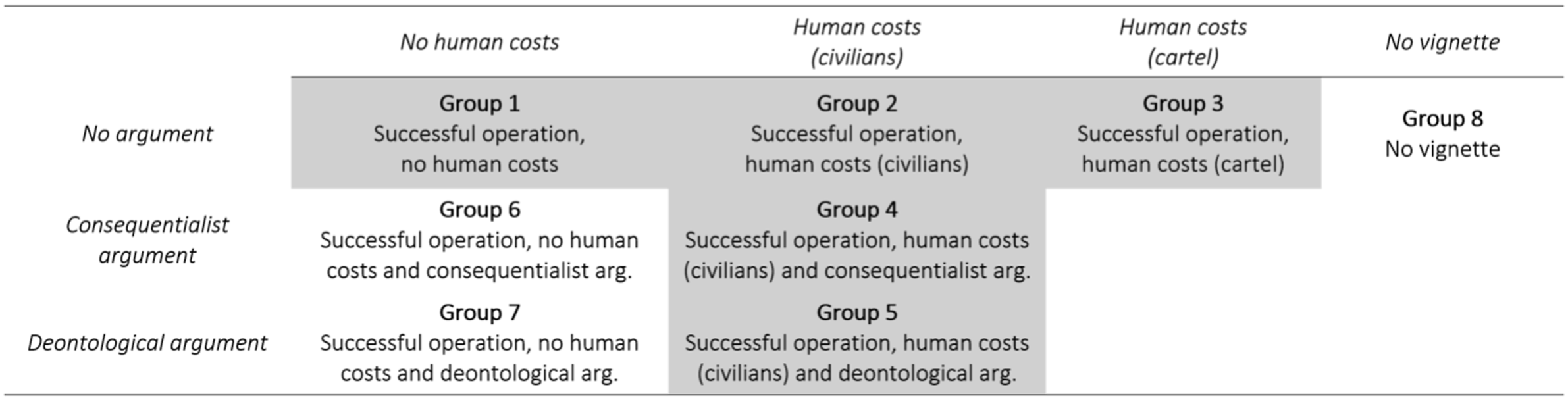
After participants completed the study, we debriefed them by informing them that the drug trafficker and military operation they read about were fictional.
The vignette we used, while hypothetical, is realistic in at least four ways. First, although “El Bolillo” does not exist, Los Zetas is a real drug cartel that has operated for more than two decades and is regarded as one of the country’s most powerful, logistically sophisticated and militarily deadly cartels. 16 Second, the operation takes place in northern Mexico, where Los Zetas has a strong presence, a large number of cartel–state armed encounters have taken place, and the highest casualties related to military operations have been reported. Third, the basic procedure described, including the state institutions involved (e.g., the Procuraduría General de la República, PGR), is an accurate depiction of a standard military operation. Finally, the language used is based on descriptions of similar operations taken from main Mexican newspapers. Our vignette therefore realistically reflects how the human costs of militarization are commonly presented and received by the Mexican public. Furthermore, we staged the military operation in a shopping mall (rather than, for example, in a remote area or the private house of a drug lord) to prompt respondents to think that they could have been the person mentioned in the vignette, thus increasing the possibility of activating the “social proximity” mechanism.
While our analysis rests on a clear identification of who is associated with drug cartels and who is not across experimental conditions, we purposely avoided language that could potentially cue participants. We refer to casualties as either “bodyguards” or “persons” instead of “criminals” or “innocent bystanders.” While this language should minimize the type of demand effects that might help explain large effects in prior studies (Walsh, 2015), we are confident that participants understood this distinction because bodyguards are indisputably associated with cartels, and there is no reason to believe that someone who happens to be in a place as common as a shopping mall that is often visited by ordinary people is associated with drug cartels or criminal activity more generally.
Our scenario represents a “conservative” test of our hypotheses, since we asked participants to consider a clearly successful operation against a powerful cartel. Previous research on public attitudes towards war involvement has shown that skepticism about the success of military action is likely to make the public less tolerant of casualties (Gelpi et al., 2006). Similarly, this literature has found that the objective for which military force is used is an important determinant of the base level of support: the public is more supportive when the stakes are high (Jentleson, 1992; Eichenberg, 2005). Thus, if we observe that human costs reduce support for militarization in this scenario, we have good reasons to expect a stronger effect for a less successful or less salient operation.
The experimental conditions presenting participants with the consequentialist and deontological arguments in both studies use the term “human costs.” While this term (costos humanos or péridas humanas, in Spanish) is commonly used in the Mexican press and the rhetoric on militarization, it is possible that participants could interpret this term differently: some may limit it to civilian casualties, while others may include criminal or even military casualties. To avoid overburdening participants, we opted not to explicitly define this term in the vignette. This is a limitation of our study that we partially address in the analysis by focusing on Groups 4 and 5 versus Group 2, in which all participants received information about civilian casualties. Thus, it is reasonable to assume that they understood “human costs” as civilian casualties.
Measures and Methods
Immediately after treatment assignment, all participants reported their attitudes towards militarization on an ordinal scale. We asked, “How favorable is your opinion about using military forces to combat organized crime?” In Study 1, respondents replied on a scale from 0 (very unfavorable) to 10 (very favorable), while in Study 2 the scale ranged from 1 to 7 (for consistency with other ordinal scales included in the survey). We rescaled responses from 0 to 1 to facilitate comparison, and treat the variables as continuous measures.
To test our hypotheses related to victimization, we included pre-treatment questions about experiences of different types of crime over the last 12 months. We focus on cartel-related crime because the experience of this type of violence (as opposed to crime in general) should be more relevant to individuals’ reactions to the human costs of military operations against drug cartels. In Study 1, we took victims of crimes that could plausibly be related to organized crime as those who answered “yes” either to a question about whether they had been the victim of crime in general or to at least one question on whether the respondent, a family member or a close friend, had been the victim of one of five types of crimes that in Mexico are commonly linked to drug cartels (extortion, kidnapping, armed robbery, forced disappearance, or murder by a cartel member). 17 In Study 2, we considered victims of cartel-related violence to be those who reported being a victim of extortion, kidnapping, or armed robbery themselves, or who reported having a family member or friend who had been murdered. A total of 18% of the respondents in Study 1 and 12% in Study 2 had been the victim of a cartel-related crime.
In addition to this self-reported measure of individual victimization, in Study 2 we included two measures of “contextual victimization”: the homicide rate and the presence of drug cartels in the respondent’s municipality of residence. We retrieved homicide data from INEGI for a 5-year period (2013–2017), and combined it with population data from the latest available census (2010) to calculate the homicide rate in each respondent’s municipality. The rates range from 0 to 14.6 homicides per 10,000 inhabitants per year (median of 1.6). Due to the presence of clear outliers, we winsorized the variable at the 95th percentile. Our measure of cartel presence indicates how many of the nine major drug cartels were present in the respondent’s municipality in 2017. 18 The variable ranges from 0 to 9 and we treat it as a continuous measure. 19 The data come from one of the most comprehensive datasets on cartel presence in Mexico to date, collected by Sobrino (2020). 20
We analyze the data using standard ordinary least squares (OLS) regressions controlling for socio-demographic covariates (gender, age, education, and region of residence) to increase the precision of the estimates (Angrist and Pischke, 2009; Kam and Trussler, 2017; Gelman et al., 2021). In regression models, we also include a pre-treatment measure of trust in the army to increase our confidence that the treatment effects we identify do not depend on imbalanced distributions of trust levels across conditions. 21 In the appendix, we include models without covariates, which yield results that are substantially similar to those reported below. Lastly, the questionnaire in Study 2 included two standard questions on left–right self-placement and party identification that we use in our observational analysis of the factors that correlate with support for militarization.
Attention Checks
In each study, at the end of the questionnaires, we asked the participants to recall the name of the drug trafficker presented in the vignette using a multiple-choice question (see Online Appendix D). This question represents a general attention check, since all the respondents – including those assigned to the control condition – were asked this question. In Study 1, 97% of the participants correctly recalled the name of the fictional character, while 68% did so in Study 2. This discrepancy might be due to the different experimental settings – a lab experiment in Study 1 versus a shorter face-to-face interview in Study 2—and the fact that the slightly simplified vignette in Study 2 included the name of the drug trafficker only once, while in Study 1 the name was repeated twice. In addition, Study 2 includes a larger share of respondents with low education, who may have found it more difficult to remember the details of the vignette, as confirmed by our analysis. 22
To examine whether the treatment effects are larger among those who recalled the name correctly, in the analysis of Study 2, we introduced an interaction between treatment assignment and correct recall. We opted for this type of analysis because our attention check does not measure reception of the treatment – i.e., mentioning the human costs – but a general reception of the entire vignette. In addition, it does not provide a strict indication of compliance with our study, since those who did not remember the name of the drug lord might have still understood the gist of the vignette, and thus provided meaningful replies. 23
Results: Studies 1 and 2
Data representative of the Mexican population confirm that support for militarization is strong and widespread. In the untreated Group 8 (N = 147, Study 2), support for military operations against crime was high: 41% of the respondents chose the highest value (7) and the average value was 5.4 (SD = 1.83) on a scale from 1 to 7. Our regression analysis, which controlled for treatment assignment and included region fixed effects, indicates that highly educated respondents are less likely to support military interventions than those with only a primary school education, while there are no differences related to gender or age. Besides a clear correlation between trust in the army and support for militarization, we do not find statistically significant differences based on crime victimization, homicide rate, political ideology or party identification. These findings indicate across-the-board support for military operations in Mexico (see Online Appendix Table B2).
Yet, our experimental findings reveal that Mexicans are not insensitive to the human toll of militarized security strategies. We find that support for militarization decreases when military operations involve civilian casualties, even when they succeed in capturing a prominent member of a drug cartel (Figure 2, left-hand plot). This finding is consistent across both studies. In Study 1, the presence of human costs among civilians reduces support for militarization by 14 points on a scale from 0 to 100 (corresponding to .46 standard deviations, SD). In Study 2 the effect is smaller (6 points, .20 SD) and just statistically significant at the .1 level. However, when we calculate the average marginal effect for those who correctly replied to the attention check, both effect size and statistical significance increase: support for militarization decreases by 10 points (corresponding to .37 SD). Effects of human costs on support for militarization. Note. Effects of human costs among civilians (Group (2) and cartel members (Group (3) versus control (Group 1), equal to the value of 0 on the Y-axis. Study 1: estimates based on OLS regression Models 2 in Online Appendix Tables A3 and A4; Study 2: estimates based on Models 2 in Online Appendix Tables B4 and B6; Study 2 (correct): respondents who correctly recalled the name of the drug lord in the vignette, estimates based on Models 4 in Online Appendix Tables B4 and B6. Dependent variable rescaled from 0 (against militarization) to 1 (in favor of militarization). Thick/thin vertical bars are 90%/95% confidence intervals.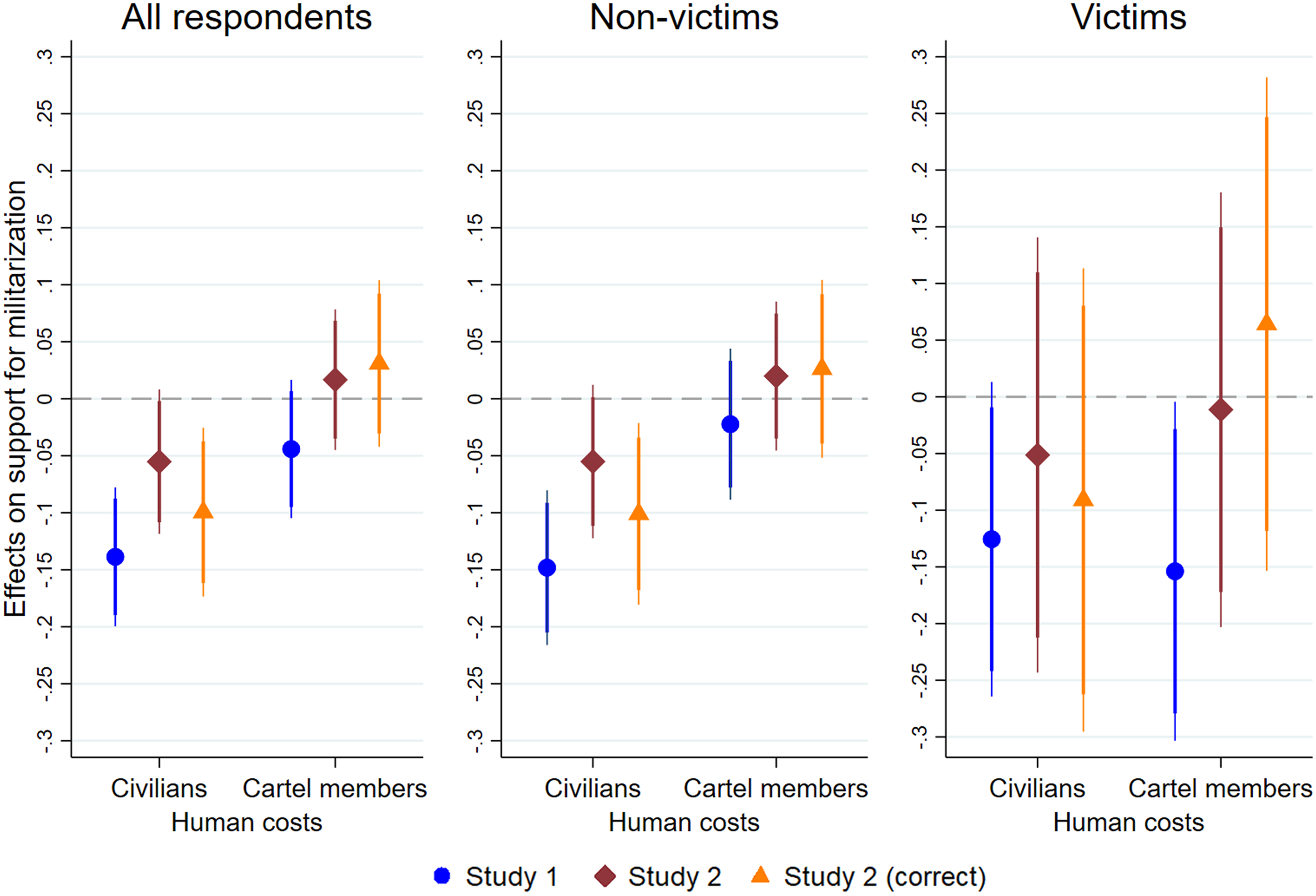
At the same time, both studies consistently show that cartel casualties do not affect support for militarization. This somewhat unexpected finding runs counter to the notion of generalized casualty adversity proposed in the literature. One plausible interpretation is that information about cartel casualties does not sway attitudes because it reflects what most Mexicans already expect from military operations and conforms to the idea that prevalent narratives of violence promote—that victims are always linked to criminal activity. This possibility is especially likely among a public that strongly supports the military, as is the case in Mexico. 24
These results provide partial support for Hypothesis 1A—human costs reduce support for militarization, but only when the casualties are civilians – and solid support for Hypothesis 1B, since the effect is indeed larger when military operations involve civilian casualties. While one might interpret the effect size as “moderate,” it is important to recall that this is a “hard case”: civilian casualties influenced attitudes regarding a successful military operation and in the context of a prolonged militarized strategy against crime that has led to numerous civilian casualties. When we compare the effect of the successful operation with no human costs (Group 1) to the group that did not read a vignette (Group 8), we find some evidence that support increases when the army captures a drug lord without any casualties (see Online Appendix Table B4). This suggests that Mexicans support a strong role for the military because they perceive it to be effective at dismantling criminal organizations—an interpretation that is consistent with the reported high levels of trust in this institution.
We subsequently test whether those who have been exposed to crime react differently to being made aware of the human costs associated with militarization. We first examine self-reported victimization. In line with our expectations, we find that vignettes that mention civilian (but not cartel) casualties reduce support for militarization among those who report not having been exposed to cartel-related crime (Figure 2, center plot). Those who report having been victims of crime, however, react to the presence of human costs in a similar way (Figure 2, right-hand plot). We do not find a statistically significant difference between victims and non-victims in either study (see interaction coefficients in Online Appendix Tables A4 and B6). In other words, those who report having experienced cartel-related crime and those who don’t seem to be equally sensitive to the presence of civilian casualties in military operations. 25
We then explore “contextual” exposure to violence (Study 2), measured by both homicide rates and cartel presence at the municipality level. In line with our expectations, we find that being made aware of civilian casualties reduces support for militarization among those who lived in municipalities with low homicide rates in 2013–2017 (top left plot of Figure 3).
34
However, as with self-reported victimization, the effect does not differ significantly from that of people who live in areas with high homicide rates (see interaction models in Online Appendix Table B7). Effects of human costs by homicide rate and presence of cartels in municipality of residence (Study 2). Note: Effects of human costs among civilians (Group (2) and cartel members (Group (3) versus control (Group 1, equal to the value of 0 on the Y-axis) by homicide rate per 10,000 inhabitants (top panel) and the presence of drug cartels (bottom panel) in the respondents’ municipality of residence. Solid lines: estimates based on entire sample (interaction Models 2 in Online Appendix Tables B7 and B8), with 90% confidence intervals (external lines). Dashed lines: estimates based on respondents who correctly recalled the name of the drug lord, with 90% confidence intervals (external lines).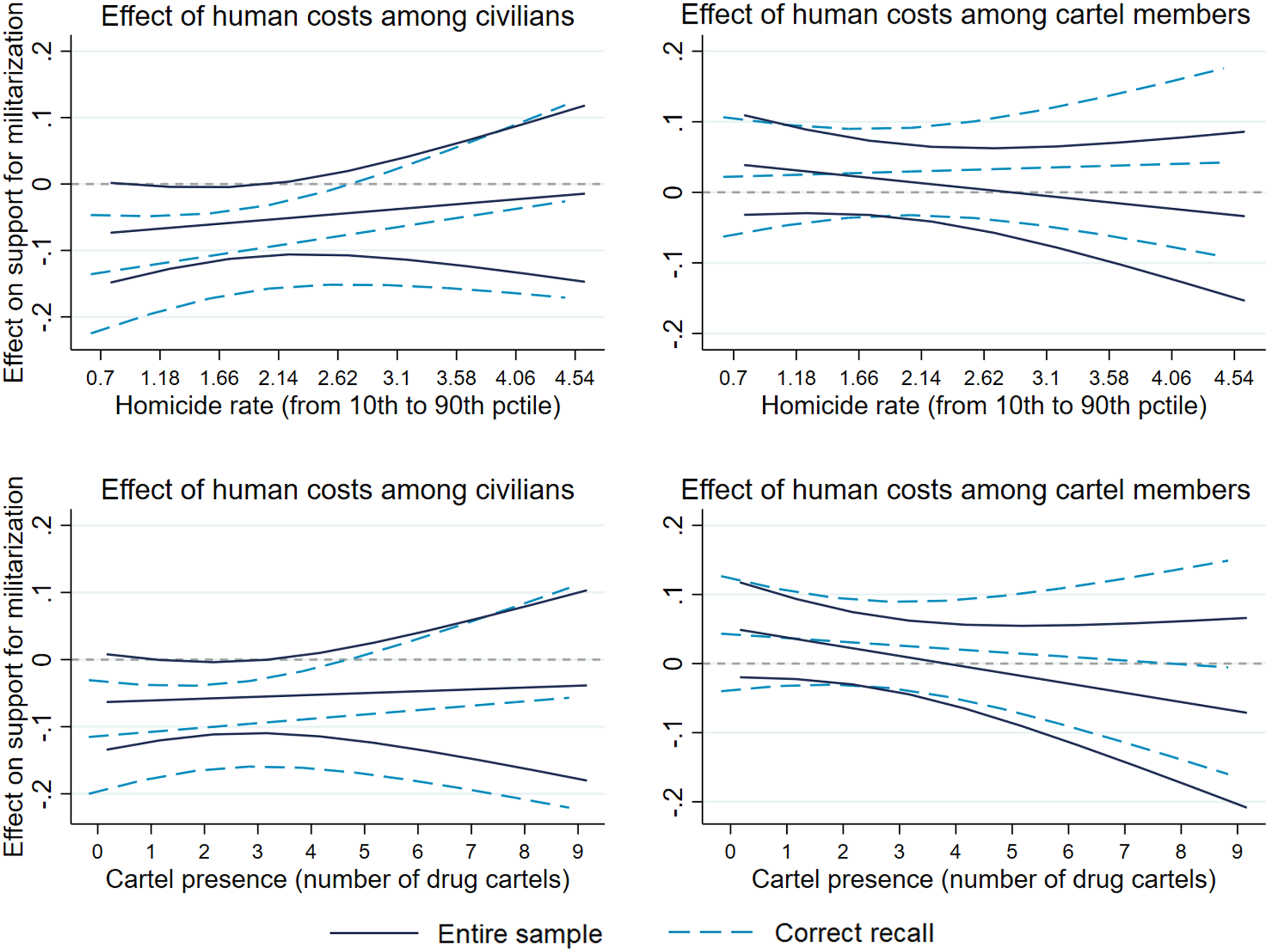
Following a body of literature showing that the presence of multiple criminal organizations in a given territory is likely to lead to territorial competition—and higher levels of violence (Magaloni and Robles, 2020; Magaloni and Rodriguez, 2020; Osorio, 2015; Calderon, 2015)—we also measure “contextual” exposure as the number of drug cartels present in a given municipality. The findings are consistent: civilian (but not cartel) casualties caused by military operations decrease support, especially among those who live in areas with a low presence of drug cartels—although the effect reaches statistical significance only among those who passed the attention check (bottom left plot of Figure 3). However, respondents living in municipalities with multiple drug cartels are similarly sensitive to the presence of civilian casualties. 26
It could be argued that “adding” one drug cartel to an area that is already experiencing inter-cartel competition might not have a sizable effect on violence, or that the marginal effect of an additional group decreases as the number of groups increases. To address this possibility, we recoded the presence of drug cartels as a categorical measure and compared areas with no drug cartels, one cartel (monopoly), and two or more cartels (competition). The results are substantially the same (for complete results, see Online Appendix Table B8 and Figure B1). Lastly, since the fictional military operation takes place in the North of the country against a member of Los Zetas, we also tested whether respondents in Study 2 who live in the North or in states where Los Zetas had a predominant presence reacted differently to being exposed to the human costs of militarization. 27 We find no statistically significant differences (see Online Appendix Tables B9 and B10).
In conclusion, we do not find support for our second hypothesis. These findings indicate that support for militarization decreases when military operations affect people with no association with criminal activity regardless of direct (self-reported) or contextual exposure to cartel-related violence. This finding is meaningful, as not finding statistically significant differences between victims and non-victims of crime runs contrary to existing arguments in the literature on the politics of crime. In doing so, it backs the claim that the relationship between victimization and political outcomes is more complex and contentious than what some studies on the politics of crime suggest (Romero et al., 2016). Yet, despite consistency across models and measurements, we treat these results with caution, especially those based on self-reported victimization, as the small number of victims in our sample makes it hard to find statistically significant effects.
If raising awareness of civilian casualties reduces support for militarization, do arguments that justify or condemn these deaths also sway attitudes? Figure 4 shows how consequentialist and deontological arguments influence support for militarization when respondents are presented with a scenario involving civilian casualties (Groups 4 and 5 versus Group 2). Effects of consequentialist and deontological arguments. Note. Effects of consequentialist (Group 4) and deontological (Group 5) arguments in the presence of civilian casualties versus a condition with civilian casualties but no arguments (Group 2, equal to the value of 0 on the Y-axis). Estimates based on OLS regression Model 2 in Online Appendix Table A3 (Study 1), and Models 2 and 4 in Online Appendix Table B4 (Study 2). Study 2 (correct): respondents who passed the attention check. Dependent variable rescaled from 0 (against militarization) to 1 (in favor of militarization). Thick/thin vertical bars are 90%/95% confidence intervals.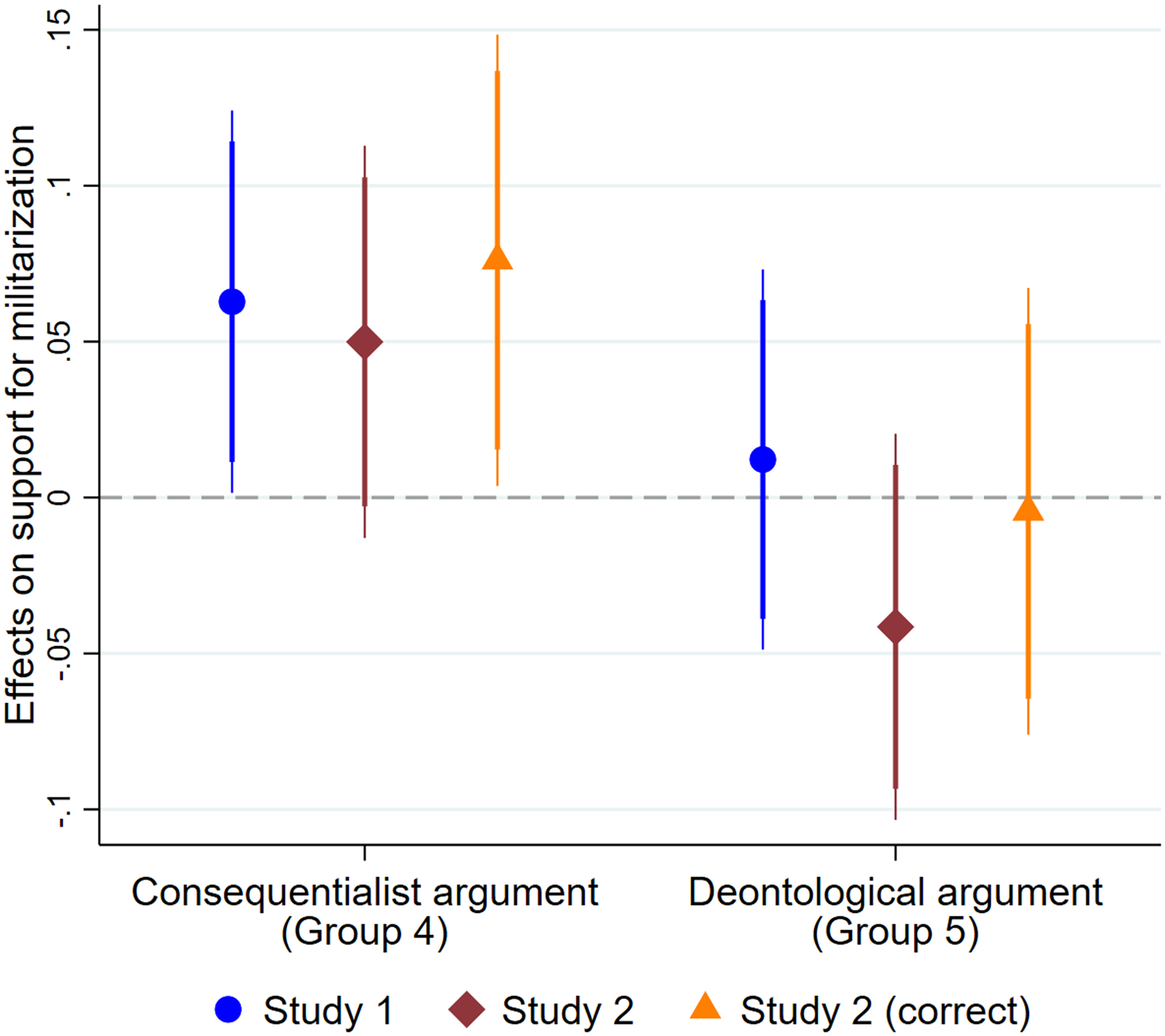
In line with Hypothesis 3A, both studies reveal that telling respondents that the goal of eradicating organized crime justifies the human costs of military operations increases support for militarization. Consequentialist arguments increased support for militarization by 6 points (.21 SD) in Study 1, and by 5 and 8 points (.18 and .28 SD, respectively) in Study 2, although the effect reaches standard levels of statistical significance only among those who passed the attention check. 28 However, contrary to Hypothesis 3B, emphasizing that killing is always unacceptable (a deontological argument) does not affect support for militarization. 29 These findings suggest that a consequentialist rhetoric stressing that the goal of militarization justifies the means might be effective at swaying public opinion, while moral considerations about the “sanctity” of human lives do not seem to affect support for militarization. We further explore the effect of these arguments in Study 3.
Research Design: Study 3
Experimental Manipulations
Between August 25 and September 2, 2020 we conducted a third study with an online quota sample that resembles the national distribution of the adult Mexican population by gender, age and geographical area of residence. In addition, we recruited a relatively large share of respondents with a low level of education to approximate the distribution of the education level registered in Study 2 (for summary statistics, see Online Appendix Table C1). Netquest recruited the respondents through their online opt-in panel. A total of 949 respondents completed our study. 30
The main purpose of Study 3 was to further test the effect of consequentialist and deontological arguments using a more essential formulation of these arguments. A potential concern with the formulation employed in Studies 1 and 2 is that the deontological argument included information about the homicide rate – which could be interpreted as a “consequence” of militarization—and the consequentialist argument included information about the positive results of the militarized strategy. To overcome potential issues related to these formulations, we designed a different survey experiment in which all participants first read a basic and largely neutral description of the country’s militarization strategy (instead of a hypothetical military operation) and then some were presented with an essential formulation of either argument, with no additional information. The short description read as follows: Since 2006 the Mexican army has played a central role in the country’s strategy to combat organized crime. According to some statistics, between 2006 and 2018, 540,000 soldiers took to the streets, participating in over 4000 military operations against drug cartels. Since these military operations became a central part of the strategy to combat organized crime, official data have registered more than 250,000 people killed and 40,000 disappeared.
This introductory paragraph differs from the control condition in Studies 1 and 2 since it presents all respondents with basic information about human costs that are potentially related to the militarization strategy. This information represents the necessary background against which supporters or opponents of militarization frequently voice arguments either justifying or condemning human costs. Consequently, while participants in the control group only read the paragraph above (Group 1, N = 241), other participants also read the following consequentialist (Group 2, N = 240) or deontological arguments (Group 3, N = 232): [Consequentialist] Some argue that the loss of these lives should be tolerated given the importance of fighting organized crime. The ultimate goal of ending organized crime justifies the human costs of military operations. [Deontological] Some argue that the loss of these lives should not be tolerated given the principle that life is sacred. The human costs of military operations are immoral and unacceptable.
Lastly, we included a fourth condition (Group 4, N = 236), in which the participants read the same introductory paragraph followed by a sentence specifying that “A considerable number of these dead and missing persons are civilians with no affiliation with organized crime.” We included this condition to test whether re-emphasizing that some of the victims of military operations are civilians further reduces support for militarization.
Measures and Methods
We measure support for militarization using the same question used in Studies 1 and 2, with responses ranging from 0 to 10 and values rescaled from zero to 1. We also included an attention check, in which we asked the respondents to recall the approximate number of soldiers that took to the streets between 2006 and 2018 mentioned in the vignette. Two-thirds of the sample (66%) passed this check.
In line with Studies 1 and 2, we analyze the data using standard OLS regressions, controlling for socio-demographic covariates (gender, age, education, and region of residence). 31 The results are largely the same if we exclude covariates (see Online Appendix Table C3). As in Study 2, we introduce an interaction between treatment assignment and those who passed the attention check to identify the treatment effects among this group of respondents.
Results: Study 3
If we first focus on the correlates of support for militarization, we again find that, on average, Mexicans are very much in favor of using military forces to combat organized crime (an average value of 7 on a 0–10 scale, SD = 2.6). The regression analyses, which control for treatment assignment and include region fixed effects, indicate that women and highly educated respondents are less likely to support military interventions than their counterparts, while trust in the army positively correlates with support for militarization.
When we examine the effects of the treatments, in line with Studies 1 and 2, we find further confirmation of Hypothesis 3A stating that support for militarization increases when participants are told that the end goal of eradicating crime justifies the presence of human costs (Figure 5). A very short consequentialist argument increased support for militarization by 5 points on a scale from 0 to 100 (.18 SD). The effect is essentially the same when we focus only on those who passed the attention check, although for this subset it is statistically significant only at the 90% level (for complete results, see Online Appendix Table C3). As in the first two studies, we do not find support for Hypothesis 3B concerning the negative effect of arguments condemning human costs on moral grounds. As shown in Figure 5, a deontological argument, if anything, increases support for militarization—although the effect disappears when we consider only those who passed the attention check. Effects of arguments (Study 3). Note. Average marginal effects versus control condition (value 0 on Y-axis) based on Models 2 and 4 in Table C3. Dependent variable rescaled from 0 (against militarization) to 1 (in favor of militarization). Thick/thin vertical bars are 90%/95% confidence intervals.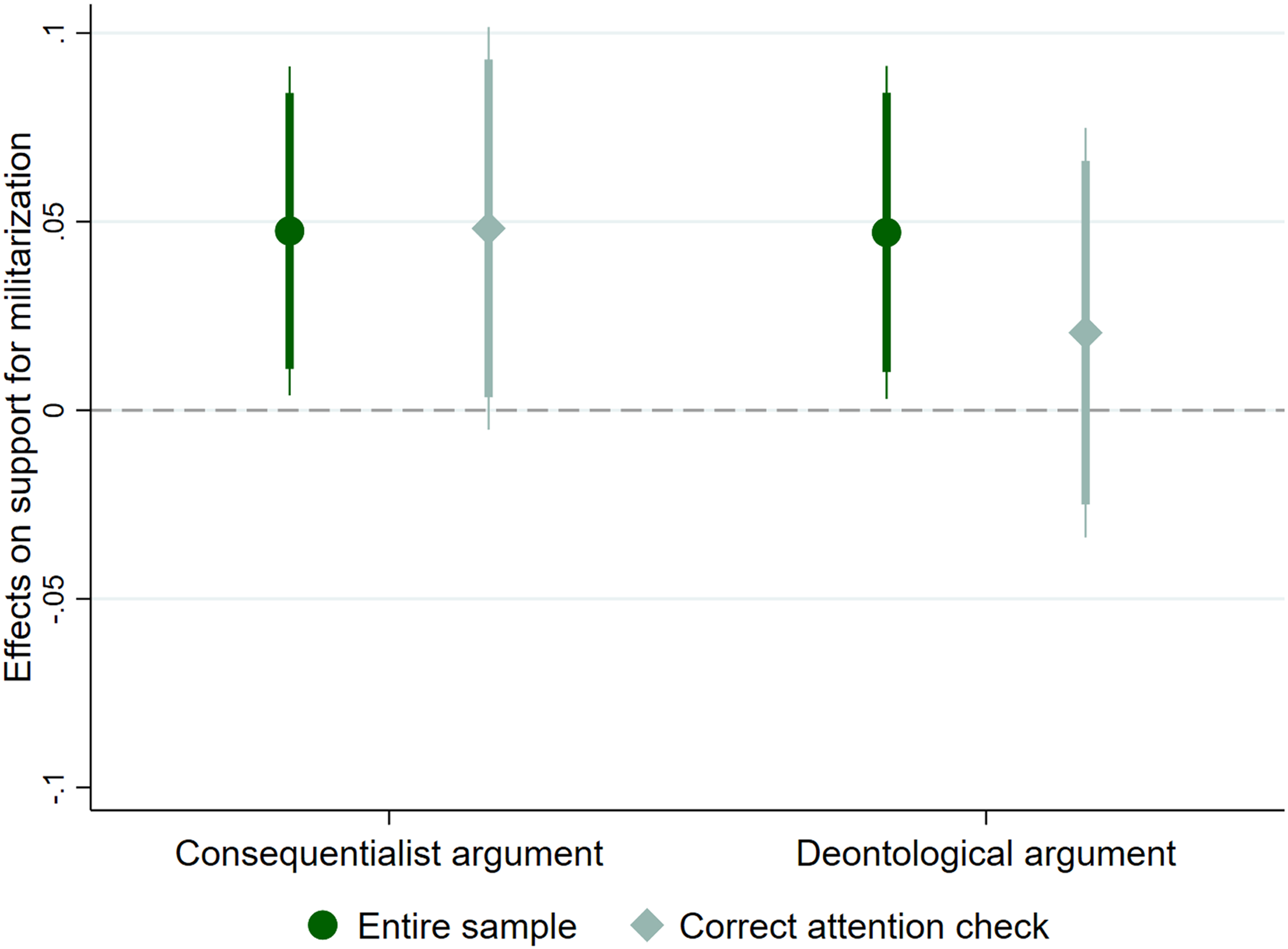
In contrast to all the other instances in which we found that civilian casualties decreased support for militarization, here we found that re-emphasizing that some of the casualties of military operations are civilians (Group 4) does not affect support for militarization. We believe this null effect reflects the fact that participants in Group 4 had already received information about the human costs of militarization in the introductory paragraph. While we did not explicitly include the word “civilians” in that paragraph, the fact that we used the neutral term “people” and cited figures related to killings as well as disappearances gives us reason to believe that participants interpreted at least some of these figures as civilian casualties. In Mexico, as in much of Latin America, the discourse around “the disappeared” has almost always referred to innocent civilians. Moreover, citizen protests, NGO campaigns and investigation requests by international organizations like the UN regularly reinforce the idea that “the disappeared” are not associated with criminal activity. Thus, re-emphasizing in the treatment that many of the victims are civilians is likely to make little or no difference—in other words, we can think of participants in Group 4 as being “double treated.” 32
In sum, Study 3 provides further evidence that Mexicans might be willing to accept the casualties involved in military operations as long as these costs are justified in light of the end goal of militarization. In contrast, deontological arguments stressing that the human costs of militarization are immoral and unacceptable do not affect Mexicans’ attitudes toward militarization.
Conclusion
In this study, we empirically explored public support for the militarization of security, a prevalent approach to public security in crime-affected contexts. Our findings demonstrate that support for militarization is partly based on people being unaware of the potential negative consequences that military operations—a staple of the “war on drugs”—can have on ordinary civilians. In both low- and high-violence areas, and among victims and non-victims of crime, we found that support for militarization drops when the public is made aware that military operations can harm people not associated with drug cartels and criminal activity. This is the case even when these operations are successful in capturing high-level criminals. Making people aware of the human costs of military operations can challenge common narratives of violence as a self-contained war between criminals (Schedler, 2016; Bell-Martin, 2019) and can thus undermine support for militarization. Recent research suggests that certain features of militarization linked to greater violence, such as the use of military weapons, may help explain support for military operations (Flores-macias and Zarkin, 2022). We provide evidence, however, that Mexicans are sensitive to the human costs of that greater violence.
Yet, our findings also indicate that Mexicans are willing to accept these costs when these are explicitly justified as necessary to eradicate organized crime. A consequentialist rhetoric stressing that the end goal of militarization justifies its means, not uncommon in Mexico’s public discourse, helps explain favorable attitudes towards militarization. This result suggests that politicians and policy-makers may garner support for militarization by using a consequentialist (“the end justify the means”) rhetoric, even if militarization comes with human costs. This is consistent with prior research which has found that strong positioning on complex issues like security is highly rewarded by the public, even more than performance or outcomes (Romero et al., 2016). By contrast, arguments condemning the human costs on moral grounds—an approach often used by national and international NGOs to achieve a consensus on demilitarization—do not seem to affect public opinion. Taken together, our findings suggest that a “social proximity” mechanism by which ordinary Mexicans realize they can also be a victim of military operations, rather than a normative mechanism based on the internalization of norms of civilian immunity/protection or respect for human rights, might explain why awareness of civilian casualties reduces support for militarization. 33
Exploring the public opinion side of militarization is key to current debates on security policy reform. Research on countries affected by large-scale criminal violence suggests that transforming societal preferences is a fundamental step towards the implementation of security frameworks that are in line with the precepts of democracy and the rule of law (Gonzalez, 2020; Arias and Goldstein, 2010). Several analysts, human rights defenders and scholars have argued that Mexico’s best hope for combating organized crime is simultaneous demilitarization and strengthening of civilian institutions. Yet, given the current levels of criminal violence there, demilitarizing public security is likely to be politically unattractive. While our research does not explore concrete alternatives to militarization, it does provide evidence-based insights into how governments and advocacy groups can work towards creating the social and political conditions that would help harness support for a policy shift. More and better information that highlights the human costs of the “war on drugs,” which stresses that ordinary civilians not associated with criminal activity can also be killed, is likely to be a key ingredient of a successful campaign for more effective and sustainable approaches to public security.
Future research should address our study’s limitations. For example, replicating it using a larger sample might reduce the uncertainty associated with the effect size of our manipulations. A larger sample would also address issues of statistical power related to detecting heterogeneous treatment effects in small sub-samples (such as victims of crime) that are only marginally represented in our samples. In addition, further research using similar vignette experiments could more explicitly state what categories of people are included in “human costs.” It would also be worth exploring whether (and how) the public reacts to casualties in the military, which our study did not address.
The militarization of security has been widely used to combat crime in various countries in Latin America and beyond—including South Africa, the Philippines, Indonesia, and the United States—with high human costs and debatable effectiveness. Yet, this approach enjoys broad popular support (Flores-Macias, 2018; Pion-Berlin and Carreras, 2017; Mummolo, 2018). Mexico’s security challenges, dictated by the coexistence of large power voids filled by criminal organizations and a consolidating democracy with weak state institutions, resemble those in many “violent democracies” in Latin America (Arias and Goldstein, 2010). Thus, our findings are of relevance beyond the Mexican case.
If being reminded of the human costs generated by military operations sways attitudes in a context in which the military is deeply trusted, the public is aware of the costs of military operations, and the military has effectively hit powerful criminal organizations, there are good reasons to believe it could also shape attitudes where the population is less supportive of the military, information about the negative impact of militarization is less available, and military operations have not successfully dismantled criminal organizations. Proving that these findings apply to other countries is relevant and urgent, as politicians have increasingly exploited voter preferences for mano dura (iron-fist) policies to improve their electoral performance (Seligson, 2002; Visconti, 2020; Holland, 2013). Popular political slogans such as Álvaro Uribe’s “Mano firme, Corazón grande” [Firm Hand, Big Heart] in Colombia and Jair Bolsonaro’s “um bandido bom é bandido morto” [a good thug is a dead thug] in Brazil provide two recent examples.
Supplemental Material
Supplemental Material - The Human Costs of the War on Drugs. Attitudes Towards Militarization of Security in Mexico
Supplemental Material for The Human Costs of the War on Drugs. Attitudes Towards Militarization of Security in Mexico by Juan Masullo J, Davide Morisi in Comparative Political Studies.
Footnotes
Acknowledgments
The authors gratefully acknowledge CIDE’s Social Science Experimentation Unit, and Daniel Zizumbo in particular, for supporting and funding an important part of this project. For valuable feedback we especially thank Moshe Ben Hamo Yeger, Michelle Degli Esposti, Janina Dill, Ezequiel González-Ocantos, Alberto Guevara, Krzysztof Krakowski, Juan Morales, Mariano Sánchez-Talanquer, Aron Szekely, Jonah Schulhofer-Wohl, three anonymous reviewers, and participants at the CIDE Omnibus Workshop; 5th BGB Workshop on Experimental Political Science; Oxford’s Nuffield College IR Research Group; Oxford’s All Souls College Conflict Workshop; 2019 ISPP Annual Meeting; British Academy Governance, Crime and International Security Workshop; UCL Conflict & Change Seminar; Collegio Carlo Alberto Seminar in Politics and Society; Leiden Political Science Seminar; 2021 LAPS Annual Meeting; 2021 NEPS Annual Conference, and University of Amsterdam’s CEDLA Lectures.
Declaration of Conflicting Interests
The author(s) declared no potential conflicts of interest with respect to the research, authorship, and/or publication of this article.
Funding
The author(s) disclosed receipt of the following financial support for the research, authorship, and/or publication of this article: This study was supported by the Social Science Experimentation Unit of the Centro de Investigación y Docencia Económicas (CIDE) in Mexico through an open call for proposals for its 2018 Experimental Omnibus Survey, and PROMEX, a research project supported by the Spanish Ministry of Science and Innovation through its Generation of Knowledge initiative (Grant Number PID2020-115145GA-I00).
Correction (October 2023):
Funding statement and data availability statement has been updated in the article.

Data Availability Statement
Supplemental Material
Supplemental material for this article is available online.
Notes
Author Biographies
References
Supplementary Material
Please find the following supplemental material available below.
For Open Access articles published under a Creative Commons License, all supplemental material carries the same license as the article it is associated with.
For non-Open Access articles published, all supplemental material carries a non-exclusive license, and permission requests for re-use of supplemental material or any part of supplemental material shall be sent directly to the copyright owner as specified in the copyright notice associated with the article.
