




Abstract
In coalition governments, parties invest much effort to manage delegation costs to individual ministers. In this article, we examine an intra-executive mechanism for managing delegation costs: Assigning ministerial co-responsibility in cabinet decisions. Using data of cabinet decisions in Israel, we test when and under what conditions co-responsibility is assigned. We find that co-responsibility is assigned strategically by cabinet members weighing the risk of a drift against the costs of imposing co-responsibility. These findings demonstrate an understudied mechanism through which coalition governments narrow ministerial autonomy and informational advantage once policies reach the cabinet. In doing so, this research contributes to a better understanding of policymaking in coalition governments.
In coalition governments, the cabinet, which is collectively responsible to the parliament for its policymaking, delegates its authority to individual cabinet ministers. However, delegation imposes risks. Coalition governments are composed of several parties with different and, in some cases, contradicting preferences. When authority is delegated to them, cabinet ministers receive significant autonomy and agenda setting power and gain an informational advantage on the policies under the jurisdiction of their department (Laver & Shepsle, 1994). Ministers are induced to use their autonomy and informational advantage to advance the policy preferences of their parties and, hence, meet their policy and electoral goals. In some cases, the actions of these ministers might be at odds with the preferences of other members in the coalition or with the coalition compromise. Coalition partners will, therefore, try to manage the delegation costs by limiting the ministers’ autonomy and informational advantage (Andeweg, 2000).
How delegation costs are managed is key for understanding policymaking in coalition governments. A rich body of research addresses the use of various ex-ante and ex-post mechanisms that limit the cabinet minister’s autonomy. Such mechanisms can involve parliament (Carroll & Cox, 2012; Martin & Vanberg, 2011) or can be intra-executive (Andeweg, 2000; Fernandes et al., 2016; Lipsmeyer & Pierce, 2011; Thies, 2001). Most of these mechanisms, however, have political opportunity and enforcement costs (Müller & Meyer, 2011). Consequently, coalition partners use these mechanisms strategically, assessing the possible risk of a minister to drift from the coalition compromise against the costs of overseeing her and preventing or minimizing the drift. Contributing to the existing literature on policymaking in coalition governments and, particularly, to research on intra-executive mechanisms for managing delegation costs (Fernandes et al., 2016; Klüser, 2022; Lipsmeyer & Pierce, 2011), we explore an understudied intra-executive mechanism that is based on institutional checks (Müller & Meyer., 2011): Assigning co-responsibility in cabinet decisions.
Cabinet decisions are the main output of cabinet meetings. They include decisions about bills, decrees, regulations, programs, nominations, and other policy outputs. In many cases, the cabinet decides to assign more than one minister as responsible for the implementation of a decision. This will be termed co-responsibility. Co-responsibility provides the co-responsible minister with an opportunity to gain information and affect the implementation of a policy that is handled in a different ministry (we term this the primary responsible minister). Because cabinet decisions are made frequently and address various policy problems, co-responsibility makes it possible to keep tabs on ministers on various issues and respond to changing political interests. Along with these advantages, co-responsibility is also a direct interference in ministerial autonomy. Therefore, cabinet ministers, in most cases, object to having a co-responsible minister assigned. This might lead to a conflict between the coalition partners. Consequently, coalition partners assign co-responsibility strategically, weighing the risks from a possible drift and the risk of a coalitional conflict.
Based on an analysis of cabinet decisions in Israel, we examine under what conditions the cabinet is more likely to assign co-responsibility to two (or more) ministers. Israel is a typical case for studying co-responsibility in cabinet decisions. All governments in Israel have been coalition governments. The Israeli cabinet is central to policymaking and is relatively collegial (Arian et al., 2001). In contrast, the parliamentary committee system is considered weak (Hazan, 2001), and there is coalition discipline on parliamentary affairs, both of which increase the likelihood of using intra-executive mechanisms such as co-responsibility to manage delegation costs (Bergman et al., 2021). Adding to these institutional advantages for using Israel as a case study to study co-responsibility in cabinet decisions, Israel also provides an opportunity to examine co-responsibility because of the availability of a unique longitudinal dataset of cabinet decisions from 1988 to 2019.
Analyzing co-responsibility in cabinet decisions in Israel, we find that co-responsibility is assigned more frequently when coalition partners believe that there is a higher risk that ministers will drift from the coalition compromise. This takes place (1) when the decision appropriates funds because the minister can use them for allocating targeted benefits (Martin, 2016); (2) when the decision addresses a complex policy which increases the informational advantage of the minister, providing her with more opportunities to drift without being noticed by the other partners (Martin & Vanberg, 2011); and (3) when the primary responsible minister holds a portfolio which is the most salient to her party because the audience costs of the party for compromising is high (Alexiadou & Hoepfner, 2019). We further find that co-responsibility will be assigned less frequently when the political cost of imposing co-responsibility is high: (1) when the primary responsible minister is a party leader and therefore has more bargaining power than other ministers and (2) when the cabinet is less ideologically cohesive, making the parties less inclined to compromise and therefore the costs of imposing co-responsibility are higher (Greene, 2017; Greene & Jensen, 2018).
The rest of the paper continues as follows. First, we present the problem of delegation in coalition government and the mechanisms used to manage delegation costs, emphasizing intra-executive mechanisms. Next, we discuss the mechanism of co-responsibility along with our expectations regarding the conditions for its use. Then, we present the Israeli cabinet and the benefits of studying the mechanism of co-responsibility through the Israeli case. In the empirical sections, we present our data, method, models, and results. In the last sections, we discuss alternative explanations to our argument that co-responsibility is a mechanism for managing delegation costs and conclude with suggestions for further research.
Managing Delegation Costs in Coalition Government
In parliamentary democracies, the cabinet is collectively responsible to the parliament for the policymaking of the government. Due to policy complexity, the cabinet delegates the authority to make policy to individual ministers. Ministers, therefore, have broad autonomy and agenda setting power in their ministries on issues that are under their jurisdiction (Laver & Shepsle, 1994). When all members of the cabinet agree on a certain policy, the autonomy of ministers is not problematic because the policy set by a minister is in line with the interest of the government. But, when there are disagreements, there is a risk that ministers will act to promote their party’s preferences at the expense of the coalition (Thies, 2001). This is because in coalition governments, although parties govern jointly, they compete separately for votes. Parties in the coalition are judged by their constituency on their record in government. Every compromise that the parties make in the coalition might make them look as unaccountable. As a result, parties entering a government often suffer an electoral loss (Andeweg & Timmermans, 2000).
Coalition parties must convince their supporters that they are representing constituency concerns as effectively as possible, given the existing coalitional constraints (Martin & Vanberg, 2005, 2011). Parties do so by trying to utilize their government work to make policies that satisfy their supporters, which in some cases might contradict the coalition compromise (Müller and Storm, 2003).
Parties not only have the incentive to drift from the coalition compromise but also can do so through the cabinet ministries. Ministers have broad autonomy in their departments, and they are familiar with their affairs. Therefore, ministers in coalition government enjoy an informational advantage over other ministers regarding policies that fall under their jurisdictions (Laver & Shepsle, 1994). They can use this informational advantage to promote their party’s interests without other cabinet members knowing about it (Andeweg, 2000). In order to sustain the coalition, its partners need to make sure that other partners will not drift from the coalition compromise (Müller & Meyer, 2011). To this end, coalition partners use various mechanisms to manage delegation costs. For a mechanism to be effective, it should reduce the minister’s informational advantage and provide the coalition partners with tools to amend the policy if a drift is revealed (Martin & Vanberg, 2011). The various mechanisms are costly. Each mechanism has opportunity costs and costs of obtaining information and enforcing the coalition compromise. As a result, coalition partners act strategically, applying a mechanism when its benefits outweigh the costs (Müller & Meyer, 2011).
Existing mechanisms for managing delegation costs can be classified into three groups. (1) Political Agreements: At the beginning of a government term, political parties sign a coalition agreement that limits the ministers’ ability to maneuver (Klüver & Bäck, 2019; Moury, 2011; Timmermans, 2006). (2) Reporting: Ministers are obliged to report their activities to the cabinet or the parliament. This reduces the informational advantage and provides opportunities for other partners to amend the policy (Bäck et al., 2021; Bergman et al., 2021; Martin & Vanberg, 2005). (3) Institutional Checks: Delegating a government task to two or more agents who control (or oversee) each other’s performance. In this paper, we focus on the latter category.
There are several mechanisms that are based on institutional checks. First, coalition partners can assign a watchdog junior minister to monitor the activities of a minister from another party. Rival junior ministers can provide their party with information about the minister’s activities. This knowledge can be used to enforce the coalition bargain if the minister is not implementing it (Thies, 2001). This mechanism has high opportunity costs, however, because junior ministers cannot be active parliamentarians, and adding a junior minister to one’s ministry increases rivalry between coalition partners (Lipsmeyer & Pierce, 2011). More importantly, junior ministers cannot change the policy but only set off an alarm when they identify a drift.
A more effective mechanism is when forming government to assign strategically ministers from different coalition parties to ministries with neighboring or overlapping jurisdictions. Between such ministries, there are regular consultations and information sharing. This provides opportunities to gather information and affect policy (Fernandes et al., 2016). At the same time, this mechanism has high opportunity costs because parties give up on their most important portfolios (Greene et al., 2021). Furthermore, the monitoring of each party is limited to the neighboring ministries.
An intra-executive mechanism with lower opportunity costs and broader jurisdictions is to allocate responsibilities for similar policy issues to two or more ministries. This, in turn, forces collaboration between the parties during the policy formulation stage (Klüser, 2022). Using this mechanism entails administrative costs and risks of reducing trust between the partners. The collaboration and coordination are limited to the allocation of responsibilities that are set at the beginning of the government term. Hence, it does not apply if a drift takes place in jurisdictions on which there was no collaboration assigned.
We take the idea of institutional checks a step forward by examining an additional intra-executive mechanism that offers lower opportunity costs and more flexibility throughout the term of government: Assigning co-responsibility in cabinet decisions.
An Intra-Cabinet Mechanism for Managing Delegation Costs: Assigning Co-Responsibility in Cabinet Decisions
A cabinet is an institution composed of ministers who can make collective government decisions (Barbieri & Vercesi, 2013). The main output of the cabinet is cabinet decisions (Blondel & Müller-Rommel, 1993). These decisions can be regulatory outputs, decisions on launching specific programs or establishing committees, or decisions to promote government legislation. In making decisions, cabinets vary by their collegiality—the degree to which all votes are equal—and their collectivity—the degree to which important decisions are brought to the cabinet. The more collegial and collective the cabinet is, the more the decisions are brought to the cabinet for deliberation, and the more the opportunities ministers from different departments have to affect the policy (Andeweg, 1993; Barbieri & Vercesi, 2013; Blondel, 1993; Blondel & Manning, 2002; Vercesi, 2012, 2020).
Like government legislation, the decisions that are brought to the cabinet are drafted by the ministry which is responsible for the subject matter. This provides the minister opportunities to use her informational advantage to promote her party’s preferences at the expense of the coalition. And yet, once a decision is brought to the cabinet, the minister’s autonomy decreases. Ministers are often required to consult with other ministers who have an interest in the decision before introducing it to the entire cabinet. They need to get the approval of the prime minister to place the decision on the cabinet’s agenda and they need to gain the required majority in the cabinet to pass the decision (Barry et al., 2022).
Moreover, the assignment of responsibility over policies is often political and strategic (Klüser & Breunig, 2022). This is also true for cabinet decisions that do not necessarily fall under the jurisdiction of a specific ministry (Timmermans & Moury, 2006). During the deliberation over the cabinet decisions before they are brought to the cabinet for approval, ministers can be formally assigned as co-responsible for a decision’s implementation. For instance, the minister responsible for the police department could be added as co-responsible for implementing a policy of the Ministry of Welfare aimed at handling youth at risk, or the Ministry of Economy and the Ministry of Agriculture could be co-responsible for implementing regulations on food exportation.
Co-responsibility provides an opportunity for ministers to be involved in the affairs of other ministers, is not bound to specific ministries or policy issues, and is limited to the specific decision. As such, it offers flexibility in managing delegation costs when a new problem is placed on the agenda or when political circumstances demand it within a specific issue. In addition, the co-responsible minister is equal to the minister introducing the decision, which gives the former a significant authority in policy implementation. Hence, co-responsible ministers can affect the policy implementation if a drift is revealed. By that, this mechanism fulfills both conditions for effective management of delegation costs: reducing the informational advantage of the primary minister and enabling the monitoring minister to affect policy.
Co-responsibility has lower opportunity costs than other intra-executive mechanisms because it does not require the ministers to give up on their preferred portfolios or on parliament members. Some opportunity costs still exist because the co-responsible ministry’s administration is responsible for the policy implementation. The higher costs, however, are those of imposing co-responsibility. Assigning co-responsibility entails a direct intervention in the minister’s autonomy within her department. Therefore, the primary responsible minister (the minister who heads the ministry with the institutional responsibility) is likely to oppose having a co-responsible minister assigned. This may lead to a conflict.
Correspondingly, we expect that, like other mechanisms for managing delegation costs, co-responsibility will be used strategically, weighing the risk that the minister might drift from the coalition compromise and the costs of imposing it on the minister’s autonomy. These considerations generate a set of expectations for the use of this mechanism.
The first set of expectations refers to the perceived danger (by the cabinet) from drift. First, the incentive of a minister to drift increases when the adoption of the policy can promote the party’s policy and vote goals. Parties entering government can decrease the electoral loss by engaging in vote buying—providing targeted benefits to their constituency—and, in doing so, maintain or expand their electoral support (Kopecký et al., 2012; Martin, 2016). We, therefore, expect that when a minister introduces a cabinet decision that includes budget appropriation, coalition partners may be more suspicious of the policy and impose co-responsibility.
H1. Co-responsibility is more likely in decisions that include budget appropriations. Second, the more complex the policy is, the more expertise and information are needed, which makes it more difficult for other cabinet members to challenge the policy and its implementation (Martin & Vanberg, 2011). Correspondingly, in complex policy proposals, the minister can drift more easily from the coalition compromise without being noticed. Coalition partners can overcome this problem by monitoring and affecting the policy during the implementation stage by assigning co-responsibility, which provides them with access through civil servants involved in the implementation. We, therefore, expect that there will be higher rates of assigning co-responsibility for decisions involving complex issues.
H2. Co-responsibility is more likely in decisions introducing complex policy proposals. Third, the risk of drift increases when there are higher audience costs for the party. Portfolios differ in their importance to the party. Parties often try to negotiate responsibility over portfolios that have to do with issues the party cares most about (Bäck et al., 2011). Voters, and especially party activists, pay more attention to the policies made in the ministries the party cares most about (Greene & Jensen, 2016). Voters hold a minister more responsible for adopting policies that go against their electoral promises when the minister is formally responsible for these issues. Therefore, parties find it more important to keep their electoral promises when they hold their most salient portfolio (Alexiadou & Hoepfner, 2019). This, in turn, might lead to a drift from the coalition compromise. To limit such drift, cabinet members may impose co-responsibility on the mister holding that most salient portfolio.
H3. Co-responsibility is more likely assigned in decisions that fall under the jurisdiction of a portfolio that is the most salient to the party of the primary responsible minister. The second set of expectations refers to the costs of imposing co-responsibility. The efforts of coalition partners to assign co-responsibility might lead to a conflict. When the primary responsible minister has high bargaining power, she may use it to avoid any limit on her authority and independence (Lupia & Strom, 2008; Lupia & Strøm, 2006). The amount of party resources a minister has affects her role in the cabinet’s decision-making process (Vercesi, 2012). In coalition governments, this includes two primary positions: Minsters, who are party leaders, and ministers from the Formateur Party. Ministers who are party leaders are very powerful because they have high walk-away value, which allows them to avoid co-responsibility. We, therefore, expect that co-responsibility will be assigned less frequently to party leaders.
H4. Co-responsibility is less likely when a party leader is the primary responsible for the decision. In addition, ministers from the prime minister’s party are more likely to avoid oversight (Lipsmeyer & Pierce, 2011). This is due to the power of the prime minister, who is often involved in conflict resolutions (Müller et al., 1993), and has the power to set the cabinet’s agenda (Vercesi, 2012). Hence, she also might have the power to shield her ministers from co-responsibility.
H5. Co-responsibility is less likely when the primary responsible minister is from the prime minister’s party. The coalition conflict might also lead to government termination. Parties entering government are risking electoral loss because coalition politics requires compromise, and, therefore, they may fail to fulfill their promises to their voters. Parties which are closer to each other ideologically find it easier to compromise on issues than distant parties. The more divergent the preferences are, the more costly a compromise might be in terms of audience costs. Assigning co-responsible ministers might lead to a policy compromise. Ideologically distant parties are willing to keep their promises and not compromise, even at the cost of a government termination (Greene, 2017; Greene & Jensen, 2018). As a result, when the government is less ideologically cohesive, the costs of assigning co-responsibility may increase. We, therefore, expect that co-responsibility will be less likely when the cabinet is less cohesive.
H6. Co-responsibility is less likely when the government is less ideologically cohesive.
The Israeli Cabinet and Cabinet Decisions
To test our hypotheses, we use an original dataset of cabinet decisions in Israel. Israel is a multiparty parliamentary democracy with coalition governments. The Israeli cabinet is central in government policymaking. It meets every week for about 3 hours and makes around 400–500 decisions per year. There is no inner cabinet, and the majority of the decisions (except for decisions on foreign and security issues) are made in the cabinet plenum (Zohar, 2018). This makes the Israeli cabinet a cabinet government (Blondel & Müller-Rommel, 1993) where important decisions are brought to the cabinet. Each minister in the cabinet, including the prime minister, has one vote. Like in other parliamentary democracies, the prime minister has the authority to set the cabinet agenda. However, besides decisions introduced by the prime minister, the role of the prime minister is mostly reactive and the prime minister does not initiate decisions that fall under the jurisdiction of other ministries (Arian et al., 2001; Zohar, 2018). Taken together, for the most part, the Israeli cabinet can be seen as collegial and collective.
The Israeli case can be seen as a typical case for assigning co-responsibility in cabinet decisions and as such appropriate for a systematic examination of this mechanism. Co-responsibility is an intra-executive mechanism. Coalition governments are more likely to use intra-executive mechanisms when the parliamentary committee system is weak (Carroll & Cox, 2012; Martin & Vanberg, 2011), when there is coalitional discipline in parliamentary affairs, and when there is a formal coalition agreement (Andeweg & Timmermans, 2000; Bergman et al., 2021). Israel meets all three conditions: A relatively weak parliamentary committee system (Hazan, 2001), a coalition discipline, and written formal coalition agreements. Lastly, in a collegial cabinet as we have in Israel, the cabinet is the primary locus of decision-making. It is characterized by intraparty bargaining and coordination over policy (Mu¨ller and Strøm, 2003; Strøm et al., 2008). As such, it is logical to expect that co-responsibility will be broadly used.
The Israeli case also has empirical merits. The relatively high number of cabinet decisions each year provides an opportunity to study the use and characteristics of this mechanism across various types of decisions and subjects. In addition, Israel provides access to a dataset that includes all non-classified cabinet decisions, a dataset not available in most countries.
Cabinet decisions in Israel include a variety of types: legislation, decrees, comprehensive programs, budget appropriations, nominations, establishing committees, and more. Apart from decisions on legislation, some nominations, and the annual budget, there is no formal regulation on which types of decisions or issues should be brought to the cabinet (Arian et al., 2001), leaving ministers with broad discretionary power. This, however, is not unusual. In many other parliamentary democracies, the threshold of what is being brought to the cabinet and what is left to the department is contingent on the type of government and its composition (Barry et al., 2022; Nousiainen, 1993).
The decisions are initiated by the minister or the senior administrators. After drafting the decision, it is passed on to the Ministry of Finance, the Ministry of Justice, and all other ministers whose jurisdictions have to do with the decision for their comments and consent. In addition, the minister also negotiates with the prime minister to convince her to place the decision on the cabinet’s agenda, as well as with other ministers to gain the needed majority to pass the decision. In the decision’s final draft, which is sent to all cabinet ministers several days before each meeting, the minister introducing the decision must name the ministers who are responsible for the decision’s implementation. Co-responsibility is therefore set in the proposal and not contingent on the goodwill of the primary responsible minister. The cabinet rulebook does not define who these ministers should be. This ambiguity makes it possible to assign co-responsible ministers regardless of their jurisdictions. The decision is deliberated in the cabinet meeting and is voted on. Given the deliberative process that is determined in advance, most decisions are approved (Zohar, 2018).
Data
Our data include all cabinet decisions from 1989 to 2019. During this period, there were 12 cabinets with 7 different prime ministers, 282 ministerial terms, and 150 different individual ministers. Most ministers were politicians who were elected as members of parliament (Knesset) or party members who did not get a seat in the Knesset (10 ministers). Three ministers were technocrat ministers (neither elected nor party members). 1
Decisions from 1989 to 1997 were collected from the government secretary. Decisions from 1998 to 2019 were collected electronically from the website of the Prime Minister Office. Our data do not include classified decisions (which we do not have), decisions that authorize ministers’ foreign travel (which are not policy-related and hence dropped), general decisions about the whole cabinet (e.g., establishing a ministerial committee) (which do not address a specific ministry and hence dropped), and the ratification of international treaties (which are technical decisions made through phone vote and therefore dropped). To allow systematic analysis, we further kept in our dataset only decisions referring to 20 ministries that operated throughout the period and that have their own budgets. After our screening, the total number of decisions included in our data is 12,885. To the best of our knowledge, this is the most detailed dataset of cabinet decisions in Israel.
Figure 1 summarizes the number of decisions over time, ranging from 118 to 632 decisions per year (mean = 402.66; standard deviation = 130.61). The figure demonstrates an upward trend in the number of decisions from around 200 in the early 1990s to more than 400 since the turn of the century. Beyond the overall increase, we find substantial variation throughout the three decades examined. Number of decisions, per year.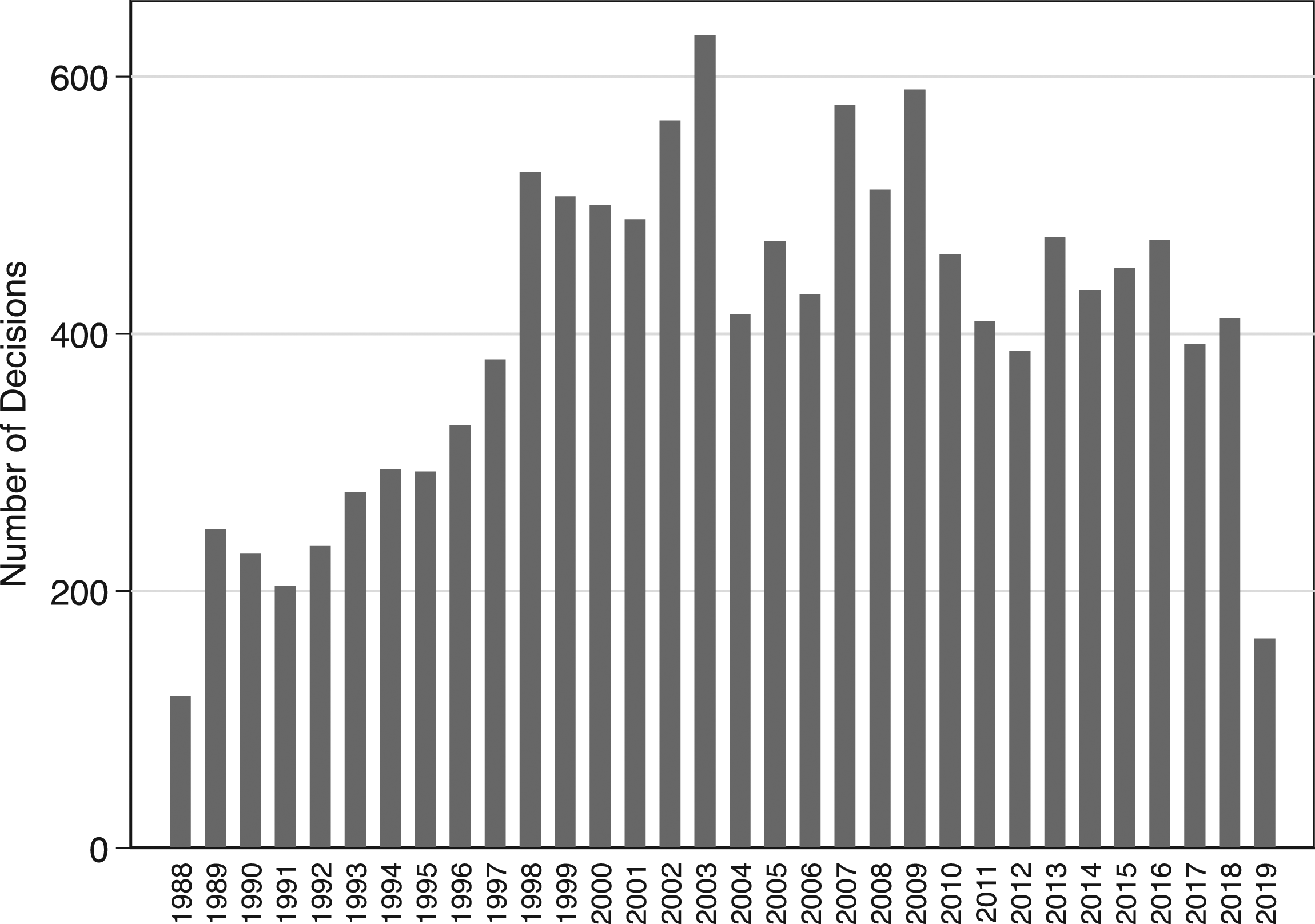
Each decision was hand coded by two coders for information required for this project. First, we coded each decision for the policy content using the Comparative Agendas Project coding scheme as adjusted to Israel (Cavari et al., 2022). Based on the major and minor issues, we matched each decision with the department the topic falls under its jurisdiction during the time the decision was made (see Appendix A). For instance, decisions on education were matched with the Ministry of Education and decisions on health to the Ministry of Health. This classification considered shifts of departments across ministries during the period under examination. Based on this classification, we identified the minister who was in office when the decision was made. This minister was defined as the one assigned with primary responsibility for the decision. In 243 decisions, there was no minister in office at the time of the decision, and therefore, we assigned no primary responsibility. These latter decisions are used in the descriptive statistics below but dropped from the statistical model (which uses co-responsibility as a dependent variable and therefore is coded as missing).
Second, based on the content of the decision, we identified whether the decision mentioned additional ministries responsible for the decision. These decisions are coded as decisions that assign co-responsibility. Based on the co-responsible ministry mentioned in the decision, we further identified the minister in office at the time the decision was made.
Number of Decisions by Ministry and Share of Co-Responsibility.
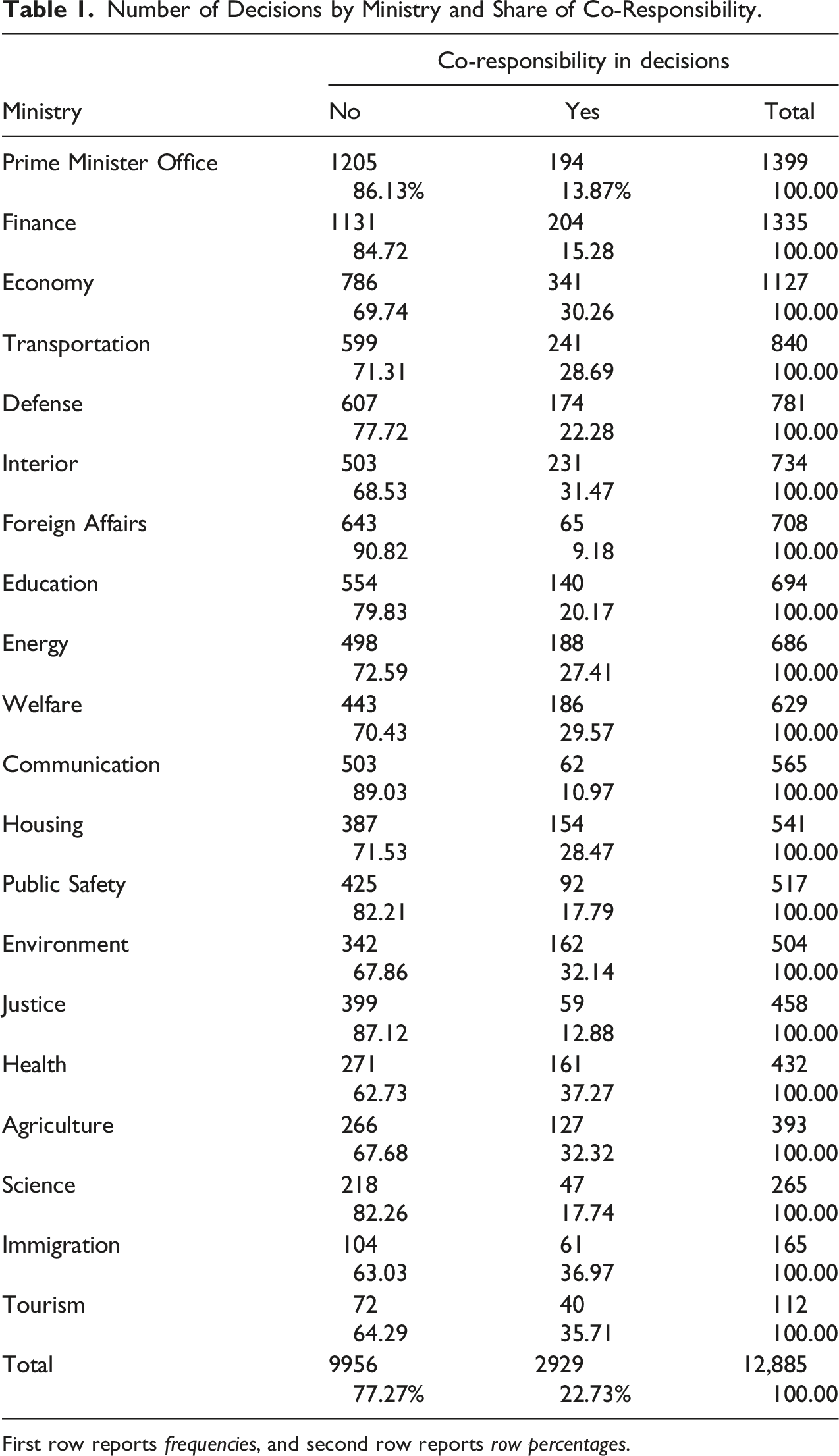
First row reports frequencies, and second row reports row percentages.
Columns 1 and 2 summarize the number and percentage of decisions that do not assign or that assign co-responsibility (respectively). On average, in 22.73% of the decisions (N = 2929), there was at least one co-responsible minister (the maximum number of co-responsible ministers in one decision was 18).
Figure 2 summarizes the share of decisions that assign co-responsibility in each year. While there is some variation, the overall pattern shows relative consistency. Every year, at least 16% of the decisions assign co-responsibility, and not more than 31%. The relatively high share of decisions with co-responsibility—21.82% per year—suggests that this practice is not marginal. The standard variation is 6.01, which means that the coefficient of variation is 0.28, or a 28% difference.
2
The relatively low variation, together with the lack of a clear trend, suggests that the tool is used systematically and does not reflect a haphazard assignment of responsibility or a trending use of the tool. This also corresponds to previous findings on other mechanisms suggesting that once the government introduces a mechanism it continues using it (Müller & Meyer., 2011). Percent of decisions assigning co-responsibility over time.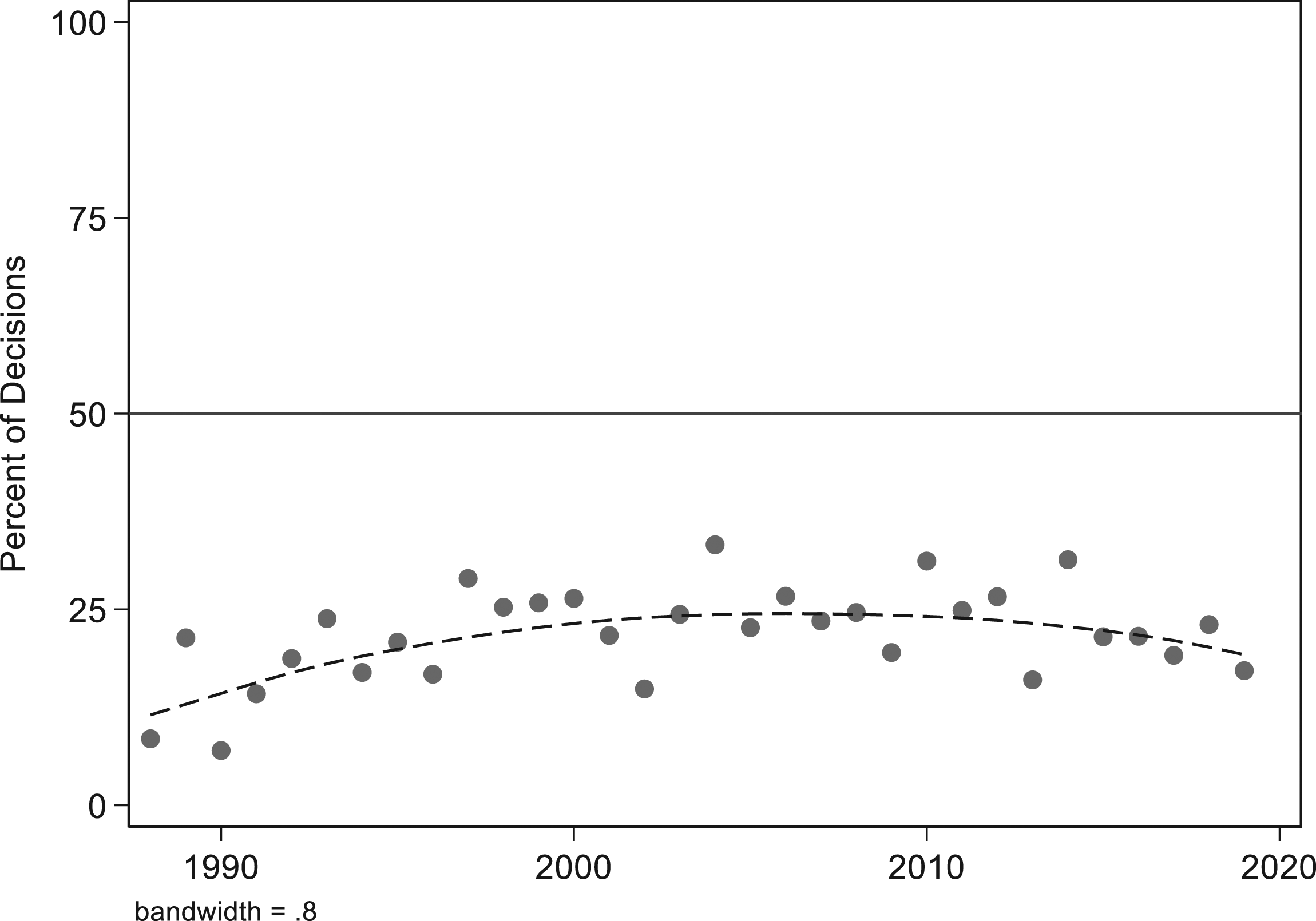
Column 2 in Table 1 reveals a strong variation among ministries in the share of decisions that assign co-responsibility. For all ministries, most decisions do not assign co-responsibility. The highest rate of co-responsibility is for the Ministry of Health (37.27%), followed by Immigration (36.97%), Tourism (35.71%), and Agriculture (32.32%). The lowest rate is for Foreign Affairs (9.18%), Communication (10.97%), Justice (12.88%), and the Prime Minister’s Office (13.37%). All other ministries range from 15 to 30%.
To assess the nature of these decisions, we examine characteristics of decisions that assign co-responsibility. First, we find that in 88% of the decisions that assign co-responsibility, the co-responsible ministers were from rival parties (N = 2951). This resembles other mechanisms, such as junior ministers or committee chairs who are assigned from rival parties. Second, of the decisions that appropriate funds (N = 1148), about half (51%) assign co-responsibility (compared to only 20% of decisions with no budget appropriations). Finally, 72% of decisions that introduce a complex policy (e.g., include several aspects such as crime prevention in the Arab sector and reducing school violence, N = 302) are assigned co-responsibility, compared to only 22% among all other decisions.
Adding to the coding that is based on the content of each decision, we collected information about each minister who was assigned responsibility for the decision—whether the primary responsible minister was a party leader, whether she was from the prime minister’s party, the seat share in the Knesset held by the party of the primary responsible minister, and whether the portfolio the primary minister is responsible for is the most salient portfolio to the minister’s party. The latter coding was based on a modification of Evans (2018), as explained in Appendix B. 3
Finally, we included a covariate for the ideological cohesiveness within the cabinet. Using the RILE scores of the Comparative Manifesto Project (Lehmann et al., 2022), we calculated the weighted average distances between the parties in the cabinet. 4
Models and Results
Our focus is on the determinants of assigning co-responsibility. The unit of analysis is an individual decision, and the outcome variable is a binary variable of whether the decision assigns co-responsibility or not. The data include all decisions from which we were able to identify a minister (N = 12,642). Our explanatory variables refer to factors affecting the perceived risk of policy drift of the primary responsible minister and the perceived risk of a conflict if co-responsibility is assigned.
Consistent with our hypotheses, we included the following variables for the perceived risk of policy drift and political costs of imposing co-responsibility. For drift, we include (1) whether the decision appropriates funds (binary), (2) whether the decision refers to a complex policy (binary), and (3) the saliency of the portfolio to the party (binary). For the costs of imposing co-responsibility, we include (4) whether the minister who is assigned primary responsibility is the leader of his party (binary), (5) whether the minister is from the prime minister’s party (binary), and (4) the ideological divergence of the cabinet (continuous).
We also include two control variables. First, the primary minister’s party seat share (continuous) because the party size might affect the ability of the party to avoid being monitored (Lipsmeyer & Pierce, 2011). Second, whether the decision was made during the period of direct election for the prime minister (a period lasting from 1996 to 2002) (binary). The direct election reform aimed at empowering the prime minister. A more powerful prime minister has more leeway over firing or reshuffling cabinet ministers, which might reduce the minister’s incentive to drift (Huber & Martinez-Gallardo, 2008; Indridason & Kam, 2008). Moreover, when the prime minister has more institutional powers, there are less internal-conflict management arenas used (Bergman et al., 2021).
Assessing the Determinants of Assigning Co-Responsibility.
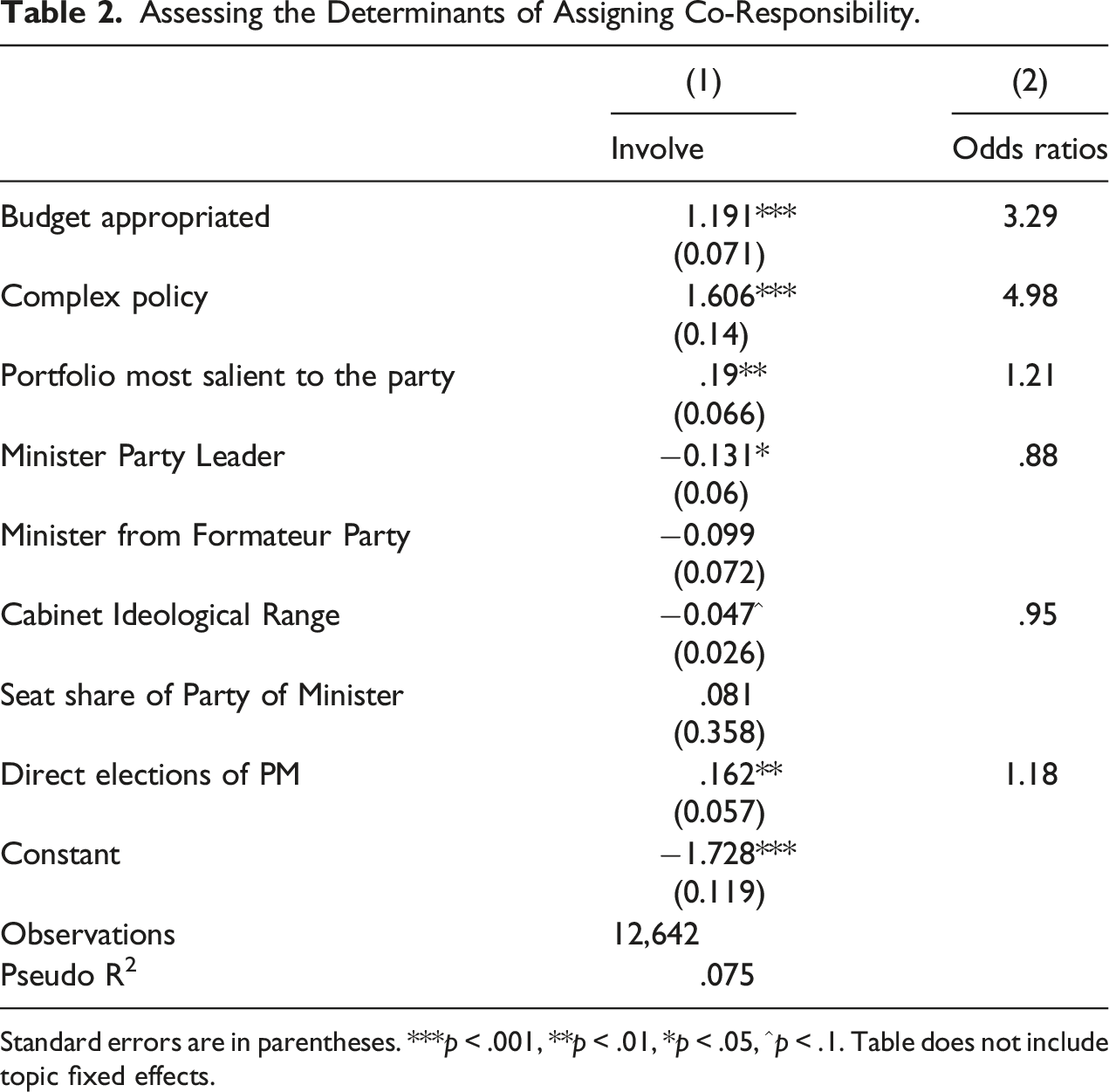
Standard errors are in parentheses. ***p < .001, **p < .01, *p < .05, ^ p < .1. Table does not include topic fixed effects.
The results support several of our expectations. Concurring with H1, decisions that involve budget appropriations are substantially more likely to be assigned co-responsibility. This suggests that coalition partners are aware of the possibility that ministers will appropriate funds to promote their own policy and electoral goals at the expense of the coalition and therefore are more inclined to monitor such decisions. 5
As expected (H2), co-responsibility is more likely to be assigned to complex policies in which the minister has more informational advantage over the other cabinet members and more opportunities to drift without being noticed. This effect is substantial. Calculating the odds ratios to account for the substantial effect, we find that complex decisions are 4.98 as likely as non-complex decisions to be assigned co-responsible ministers.
The findings also support our expectation that co-responsibility is more likely to be assigned to decisions that fall under the jurisdiction of ministries that are the most important to the primary responsible minister (H3). This suggests that coalition partners suspect that parties who are responsible for issues that are very important to them might feel more committed or that their hands are more tied to fulfilling their promises on these issues and promoting their policy goals when they have the responsibility on these issues (Alexiadou & Hoepfner, 2019). Therefore, they may have an incentive to drift and as such should be monitored and stopped if needed.
Our findings also support the expectation that coalition partners will assign less co-responsibility to ministers who have enough power to object it, but only for party leaders. We found that, as expected (H4), party leaders are less likely to be assigned co-responsibility. This finding suggests that the political capital and the walk-away power is more important than the risk of policy drift. Party leaders entering government have more incentive to drift from the coalition compromise than other ministers because they need to work especially hard to convince their supporters that they are working on their behalf and did not enter government for the spoils of the office (Martin & Vanberg, 2011). Despite that, they are less likely to be assigned a co-responsible minister than other members.
As for the ministers from the prime minister’s party (H5), we find no support for our expectations that these ministers will be less likely to be assigned co-responsibility. The coefficient sign is negative but insignificant. The data do not confirm that ministers from the prime minister’s party have more leverage than ministers from other parties when negotiating co-responsibility. It might also suggest that the prime minister does not have enough power to reduce the co-responsibility his ministers are subject to. An additional support for this can be found in our finding that during the period when the prime minister was elected directly and had more formal powers, co-responsibility was more likely (a positive coefficient sign and statistically significant result). Furthermore, we find no effect of the party’s size (seat share) on co-responsibility. This provides an indicator that the political strength of the minister’s party (in terms of its seats) has no effect on assigning co-responsibility.
Lastly, we also find limited support for our expectation that less ideologically cohesive governments are likely to avoid assigning co-responsibility (H6). The effect is very small and only at the 0.1 level. While we should be cautious in interpreting these results and, especially, for applying them to individual preferences, they suggest that parties that are closer ideologically may be willing to agree to have a co-responsible minister. This is mostly because these parties have less to lose since the policy compromise that might follow due to this assignment is likely to be relatively minor given the little divergence on preferences.
To further examine the more specific effect of ideology on the assignment of co-responsibility, we used additional data from the Comparative Manifesto Project (Lehmann et al., 2022) to test the effect of differences in issue-specific positions of parties on co-responsibility. Following Klüser (2022), we calculated the distance between the policy position of each party in each policy area to the overall average of all government parties for that area. This provides an issue-specific ideological distance measure, which we used in exchange of the more general ideological measure in our primary model. Because the data are limited to only three-quarters of decisions (not randomly distributed between ministries), we include this model in the Appendix. 6 Similarly to our findings regarding ideological cohesion, the results suggest that when there is a large distance between the parties, co-responsibility is less likely to be assigned. This further strengthens our argument that ideologically distant parties are less willing to compromise on co-responsibility (see model results and discussion of limited data in Appendix C).
Addressing Alternative Explanations
A possible critique of our suggested mechanism is that co-responsibility is not a tool for managing delegation costs, but rather it is assigned based on the complex nature of the policy that requires collaboration between several departments. In that case, ministers perhaps would like to have co-responsible ministers assigned in order to assist them in the policymaking task. The data does not support this argument. While a majority (72%) of decisions about a complex policy are assigned co-responsibility, these are only about a quarter (28%) of all decisions that are assigned co-responsibility. In other words, it is not the only (or even the main) reason this practice is employed.
Alternatively, co-responsibility may be better understood as a blame avoidance strategy to spread the blame across many actors (Hood, 2010; Weaver, 1986). There is reason to expect this because, in multiparty governments, the public punishes the most those with the agenda setting power, namely, the primary responsible minister, believing that those with the agenda setting power have the highest effect on the decision (Duch et al., 2015). In addition, in coalition governments, the responsibility (and therefore the blame) is disproportionately attributed to the prime minister’s party (Klüver & Spoon, 2016; Plescia et al., 2022). Taken together, individual ministers and ministers from the prime ministers’ party might have an interest in having a co-responsible minister assigned in order to spread the blame. If this is true, then co-responsibility is not forced on the ministers but is chosen by them.
For the blame sharing explanation to be valid, we should expect that co-responsibility will be shared across ministers from the same party of the minister and of rival parties. Our findings, however, demonstrate that in more than 87% of the decisions that are assigned co-responsibility, the co-responsibility is shared between ministers from rival parties. This resembles other mechanisms of managing delegation costs like appointing junior ministers (Lipsmeyer & Pierce, 2011) or committee chairs (Carroll & Cox, 2012), in which the monitoring actors are from the rival party of the monitored minister. Moreover, as explained above, we did not find a difference between junior partners and ministers from the prime minister’s party. These two suggest that blame avoidance cannot be seen as a sufficient explanation for co-responsibility.
Finally, co-responsibility can be seen as a mechanism for sharing credit. Namely, when a minister promotes a significant policy initiative, other ministers wish to take credit. This is important, because in multiparty governments, the public finds it difficult to attribute responsibility for the policy to a specific party and junior partners receive much less credit for their policymaking (Klüver & Spoon, 2020; Plescia et al., 2022).
This explanation is plausible, given our findings. First, our findings on the ideological divide suggest that an ideologically cohesive cabinet is more likely to assign co-responsibility. If there is little ideological divergence, parties will find it easier to claim credit for policies than when there is a significant divide. Second, our findings on decisions with budget appropriations suggest that when funds are appropriated, several ministers may want to take credit for benefiting the public. Lastly, our findings that party leaders are less likely to be assigned a co-responsible minister can also be explained by their reluctance to share credit with other parties. At the same time, the finding that when the party holds its most salient portfolio, it is more likely to have co-responsibility assigned cannot be explained by the wish to share credit, unless the party of the co-responsible minister also has strong preferences for the same portfolio. Furthermore, we can also expect that if the aim is credit sharing, then decisions introduced by junior partners will be less likely to have co-responsibility because junior partners, may find it hard to claim credit in a coalition government (Klüver & Spoon, 2020), will be more reluctant than ministers from the prime minister’s party to share their credit. However, our results did not find a significant difference between the two types of parties.
Conclusion
The way partners in coalition government manage delegation costs is key for understanding policymaking in coalition government. This paper contributes to this broad research by systematically assessing an intra-executive mechanism that coalition partners use during the government term—assigning co-responsibility in cabinet decisions. In doing so, this paper improves our understanding of policymaking in coalition government. Moreover, it contributes to a better understanding of decision-making in the cabinet, an arena often seen as a black box.
Based on the analysis of cabinet decisions in Israel, we show that co-responsibility in cabinet decisions is not a marginal practice. Rather, it is used broadly across ministries and regarding policies that are not necessarily such that require collaboration. Like other oversight mechanisms, the monitoring minister is from a different party than the primary responsible minister. These two findings suggest that co-responsibility in cabinet decisions is used for managing delegation costs.
Co-responsibility is employed when coalition partners believe that the primary responsible minister has an incentive to drift from the coalition compromise. Because co-responsibility allows flexibility, the decision on whether to assign co-responsibility or not is made based on the content and type of each decision. Decisions which appropriate funds or complex policy programs were found as more likely to be assigned co-responsibility. Decisions that fall under the jurisdiction of a ministry that is important to the minister’s party are also more likely to be assigned co-responsibility.
At the same time, coalition parties also assess the costs of imposing co-responsibility. This is because co-responsibility is a measure that reduces the minister’s autonomy and, therefore may generate a political conflict. When the primary responsible minister has enough political power, parties may avoid the conflict of assigning co-responsibility. This was found true for party leaders. When the primary responsible minister is in a government that is ideologically divergent, the conflict might lead to government termination because in such governments, coalition partners are less willing to compromise. Correspondingly, we found that ministers in less ideologically cohesive governments are less likely to have co-responsibility assigned.
This paper demonstrates that coalition partners consider both types of risks when assigning co-responsibility. However, it did not examine which considerations are more important and when. It is possible that for some issues or types of decisions, coalition partners will be more willing to risk conflict and assign co-responsibility despite the objections than in others.
Ministers have high autonomy when making policies in their departments. This autonomy narrows once they introduce the policy to the cabinet. This is not because of the need to report to the cabinet because cabinet ministers usually do not interfere in the affairs of other ministers. Rather, it is because they might be assigned a co-responsible minister with authority to interfere in their policymaking. By that, this research made a further step away from the ministerial government model.
The findings in this paper are based on an analysis of a single case. However, the practice of co-responsibility is not unique to Israel. For instance, Klüser and Breunig (2022) demonstrate how several ministries are assigned as co-responsible in government bills in several countries and call for further research on how government assigns responsibility among ministries. Since the findings in this research resemble other findings on mechanisms for managing delegation costs, it is logical to assume that at least some of the findings can be generalized to other countries with coalition governments, especially those in which there is coalition discipline on parliamentary affairs, a weak committee system, and some type of cabinet government. This is because in these systems, intra-executive mechanisms are more common. The use of co-responsibility might, however, be less frequent in countries where the cabinets are less central in the policymaking process or in less collegial cabinets with a dominant and powerful prime minister.
Moreover, the party system in Israel is less stable in terms of frequent party switching. If we find an effect of salient portfolios in such party system, then we are even more likely to find such effect in countries where the parties do not change so frequently and when they have a more stable constituency. Further research should examine to what extent this mechanism is used in different types of cabinets and systems.
Finally, several aspects remain unexplored. This paper suggests that co-responsibility is primary used for managing delegation costs, and therefore, in most cases, ministers would like to avoid co-responsibility. However, in some cases, ministers might want to have co-responsible ministers to be assigned. Further research should look more closely at specific policies in which co-responsibility is assigned to identify the conditions in which it might be desirable for the primary responsible minister. In addition, co-responsibility has two sides: the monitored and the monitoring ministers. This paper focused on the former. Studying which ministers interfere in other departments and what makes such interference more likely is equally important. Special focus should be on the prime minister and the minister of finance, two ministers who are the regulators of other departments. Lastly, this study does not examine what happens with the policy once a co-responsible minister is assigned, to what extent the co-responsible minister amends the policy, and under which conditions amendments take place. Exploring these aspects could significantly improve our understanding of policymaking in coalition governments, focusing on the actors and the policy made.
Footnotes
Acknowledgements
We thank our research assistants at the Israeli Comparative Agendas Project, especially Chen Mualem, for their work on data collection and CAP coding. We also thank the editors and the anonymous reviewers for their helpful comments and suggestions throughout the review process.
Declaration of Conflicting Interests
The author(s) declared no potential conflicts of interest with respect to the research, authorship, and/or publication of this article.
Funding
The author(s) disclosed receipt of the following financial support for the research, authorship, and/or publication of this article: This work was supported by the Israel Science Foundation (1271/2018).
