




Abstract
The party affiliation of cabinet ministers is a critical but neglected notion. While its application and theoretical centrality is indisputable in many research fields, explicit definitions are difficult to find, while operationalizations tend to rely on rudimentary categorizations. Departing from formulating a definition consistent with the party government model, we propose a flexible typology to categorize and rank variants of partisans both within and beyond consolidated parliamentary democracies. We show that the new approach can capture important unobserved dynamics well.
Party affiliation in the Cabinet
The party affiliation of cabinet members is a critical feature of contemporary democracies. Intrinsically related to pivotal frameworks such as the party government model (Katz 1986; Blondel and Cotta 2000), partisanship is also essential to other crucial government dimensions such as: coalition status, which is indicated by the number of parties with people in the cabinet (Riker 1962); legislative support, given by the parliamentary strength of ministers’ parties (Strøm 1990); ideology, which identifies the programmatic heterogeneity of parties presents in the cabinet (Axelrod 1972; Laver and Schofield 1990); cabinet boundaries, observed through changes in the partisan composition of executives (Müller and Strøm 2000); or minister profiles (Blondel 1985). The theoretical centrality of this concept is indisputable in numerous research agendas and is also present in any classification of cabinets (Lijphart 2013: 97). However, explicit definitions are hard to find. Empirical operationalizations tend to be restricted to dichotomous categorizations. In fact, the coding of partisanship has focused mostly on formal membership, a condition that is often assumed rather than empirically verified and which is of questionable justifiability when applied to more volatile non-parliamentary regimes (Camerlo and Coutinho 2019). In short, we are counting partisan ministers unreliably—based on widespread theoretical assumptions that are not discussed—and we are undercounting—ignoring nuanced positions in the conceptual space between strict partisanship and strict non-partisanship. Putting newcomers, defectors and heavyweights in the same bag—with their marked differences in terms of loyalties, competencies, and ambitions—undermines the validity of the concept and its ability to cover the theoretical implications with which it is associated adequately (Andeweg 2000: 125; Cotta 2000: 64). 1
A comparative strategy to classify and order levels of partisanship in government is proposed to overcome these challenges. After providing a sample of labels and definitions used regularly in the literature, the next section elaborates on the party government model to identify basic implicit assumptions of the partisanship notion and formulate the government partisan concept. In contrast to the standard approach, which focuses on formal membership in institutionalized political parties, the proposed definition points to an engaged, consolidated and hierarchic membership that is understood as a specific link between a supportive partisan organization and a responsible minister. The second section contains the bulk of our contribution. Noticing the limitation of the standard approach in dealing with internal variability, we set out a procedure for capturing types of government partisans. We begin by identifying a set of basic regular profiles that look at the structure of a standard political party. This set of profiles is then used as a guide for capturing less regular variants and is sensitive to institutional frameworks different from those of institutionalized parliamentary democracies. Finally, we integrate these elements into a flexible typology and suggest alternative measurement scales for ranking profiles. In the third section, we perform an exploratory analysis to test the applicability of the new typology compared to the standard dichotomous approach. We adopt the diverse-case comparative method (Gerring 2008) to select three governments with meaningful variations in the level of party institutionalization in different institutional settings: the Costa II government (2019–22) in Portugal as an example of highly institutionalized political parties in a semi-presidential system; the Fernández I government (2019–23) in Argentina as a case of low levels of party institutionalization in a presidential system; and the Conte II government (2019–21) in Italy, as a midpoint case with partisan organizations of different degrees of institutionalization in a parliamentary system. The findings stress how the greater sensitivity of the new approach reveals unobserved, peculiar and meaningful dynamics across different types of government. In the final section, we present our concluding remarks and suggestions for future research.
Government partisan
If party government is the dominant institutional form of modern democracy (Katz 1987: 2), then partisan is the dominant profile of modern democratic rulers. Professional politicians turn to political parties to run elections, gain access to public office, carry out policy-making roles and exercise leadership: they build and boost their careers through political parties. In turn, rulers are recruited mainly from among these party members or appointed by and responsible to partisan organizations. The empirical research on ministerial profiles has developed from that perspective. The distinction between politicians and civil servants proposed by Jean Blondel in one of these seminal works relies on the length of time ministers previously spent ‘in or around the corridors of a party’ (Blondel 1985: 14). This approach has been consolidated over time through the elaboration of complementary labels, such as: insiders (De Winter 1991); political representatives (Cotta 1991); or simply partisans (Real-Dato and Rodríguez Teruel 2016). The party government approach was also crucial for the identification of opposite profiles, such as: technocrats (Camp 1971; McDonnell and Valbruzzi 2014); technopols (Domínguez 1997); outsiders (Carreras 2012; Camerlo and Pérez-Liñán 2015) or non-partisans (Amorim Neto and Strøm 2006; Martínez-Gallardo and Schleiter 2014). However, regardless of the label proposed, party affiliation has been a basic common denominator in the identification of ministerial profiles (see a sample of labels and definitions in Appendix 1).
The widespread acceptance of the partisanship attribute has prevented a proper discussion of its conceptual definition. Taking its meaning for granted, scholars instead focused on the operational level and the selection of empirical indicators by looking at the presence or absence of formal membership. Despite few exceptions registering some internal variation—like low and high party ranks (Alexiadou 2015) or soft and strict partisans (Camerlo and Martínez-Gallardo 2018)—or the gradation provided by in-depth case studies (e.g. Dowding and Dumont 2009, 2015), the dichotomous operationalization distinguishing two extreme levels of partisanship has been dominant. While this practice might be justified when dealing with institutionalized party systems in parliamentary settings, where partisanship is highly associated with specific political trajectories, skills, and behaviours, it could be misleading when extrapolated to institutional arrangements with volatile political parties or which are marked by the emergence of new parties, where party affiliation can have multiple and less expected manifestations (Camerlo and Coutinho 2019). Additionally, moving from a binary categorization to more sensitive measures requires greater attention to the concept’s defining attributes, even for institutionalized settings.
To deal with those issues, we must pay greater attention to the attributes that define the concept. The party government approach provides a secure frame to do this while remaining consistent with the most widespread theoretical expectations. According to this approach, in a party government, ‘(1) Decisions are made by elected party officials or those under their control. (2a) Policy is decided within parties, which (2b) then act cohesively to enact it. (3a) Officials are recruited and (3b) held accountable through party’ (Katz 1987: 7). This perspective enables the identification of two assumptions that will be the building blocks in our definition. One is that partisans act on behalf of their parties. Government partisanship is a link between a partisan organization and a responsible individual (requirement 3b). This link can be seen as a principal-agent relationship, where the party (principal) delegates decision-making power to the partisan minister (agent). The agent is obliged to act on the principal’s behalf. The principal has the power to sanction or reward its agent (Fearon 1999: 55). Thus, a partisan minister is a delegated minister, a representative of a particular party who is empowered to speak and operate in its name within the cabinet (requirement 1 and 2a). A second assumption derived from the party government model is that the party supports its partisan ministers. This role exceeds the tasks of punishment and reward related to delegation, as it implies a permanent backing of their people in the cabinet (requirements 2a and 2b). The most telling example of this assumption concerns the endorsement that the members of a political party in parliament are expected to give bills proposed by ministers who are members of the same party.
These two elements—a responsible individual and a supportive organization—frame the notion of government partisanship as a specific kind of membership. This relationship extends beyond formal accreditation and includes at least four complementary assumptions.
The first concerns engagement. A government partisan is intended to be an active and explicit or public party member. The individual is expected to be effectively at the service of a certain party, and this commitment is declared openly and recognized by other political actors.
A second assumption concerns hierarchy. A cabinet member who acts on behalf of a party is supposed to be a high-ranking member of that organization. The widespread expectation gives the maximal illustration that the leader of the party that wins the elections will be the first candidate to lead the government, even if that candidacy had not been formally expressed during the elections (see also Cotta 2000: 69; Rose 1974: 382).
Hierarchy, in turn, presupposes a cursus honorum, which is a process of consolidation a partisan needs to go through before gaining access to high-ranking positions. This process implies a continuous and exclusive membership, i.e. time spent in the same party, which is necessary to acquire partisan skills and resources. In the short run, this assumption is expressed by the expectation that membership is meant to last at least until the end of the minister’s mandate.
The final complementary assumption concerns the organizational level. The government partisan notion rests on the presence of a party that can lead, assure and encourage party cohesion among its members: it is supposed to be a well-organized party (Andeweg 2000: 53; Cotta 2000: 58). While just the presence of an active and explicit membership can be considered a necessary condition for a link to be considered partisan, the other features contribute towards completing the maximum expression of a government partisan and, as such, they are critical components of the explanatory power of the concept (Goertz, 2006). For instance, the fact that the party affiliation of ministers is expected to be durable and exclusive, at least until the next election, represents a key element for the efficient functioning of the electoral accountability mechanism at the government level, allowing voters to decide whether to punish or reward ruling parties based on the performance of their members.
For an articulated embracing of the assumptions identified, we propose defining government partisanship as ‘a relationship between a responsible cabinet member and a supportive political party, given by an engaged, consolidated and hierarchical membership in a strong organization’, which can be formally expressed as

Classifying and measuring government partisans
Examples of partisan variants not well captured with a dichotomous categorization.
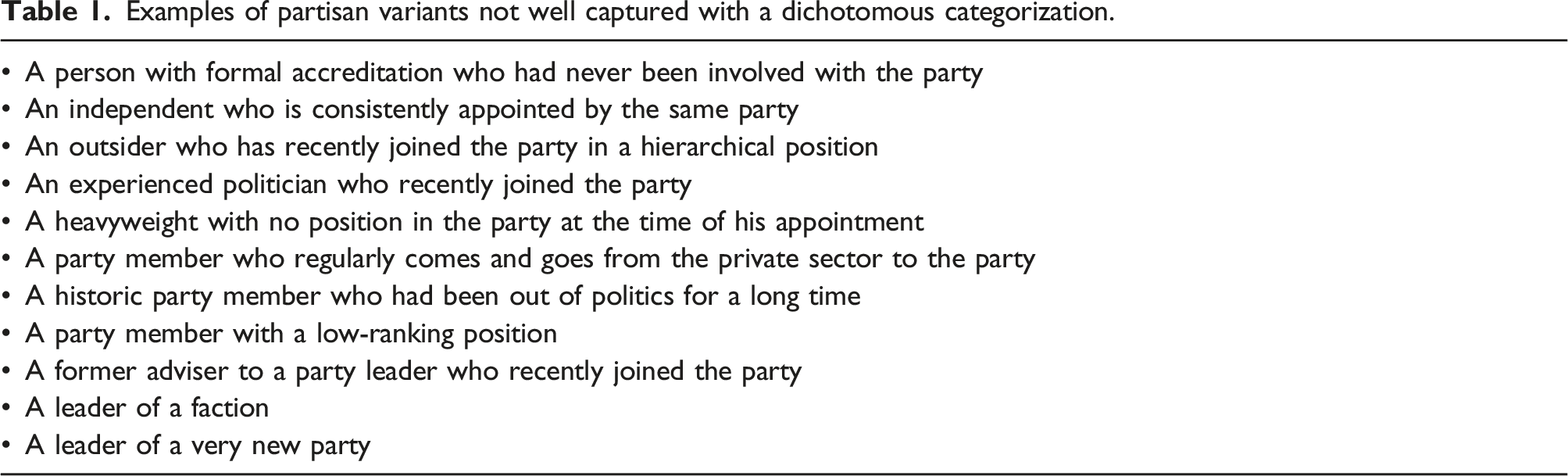
All these situations exhibit a certain level of partisanship: that is, they are not pure non-partisan, but for different reasons, they also do not fit perfectly with the image of the government partisan as depicted above.
Elemental variants and a benchmark classification
A departing point for systematically categorizing those variants of partisanship is provided by approaches that examine the internal structure of political parties, discerning, for example, between low and high-ranking members. We expand those options to create a set of categories that complete a stylized range of partisan positions. We arrive at those positions by considering the extreme expressions of the E attribute (‘fully not-engaged’ vs. ‘fully engaged’) and that of the C attribute (‘fully not-consolidated’ vs. ‘fully consolidated’). To capture the substantial difference between the party leader position and other high-ranking partisans, the H attribute is categorized into three options (low, high and highest). The integration of these categories leads to a classification that distinguishes individuals who have recently joined the party from those who exhibit a consolidated relationship with the party and those who have been able to climb the organizational hierarchy up to the central board or even the party leadership positions (Figure 1(a)). This preliminary classification is important for our purposes for the following reasons. First, it provides a framework consistent with the government partisan assumptions, allowing us to depict the individual-organizational link as engaged and eventually consolidated and hierarchical. Second, it integrates the gradation element, where the longer and the more hierarchical the engaged link is, the higher the chances that the partisan bond works as expected according to theoretical assumptions. This gradation also highlights the ‘sequentiality’ among the defining attributes: C (second attribute) requires the presence of E (first attribute); and H (third attribute) requires the presence of C (and E). Last, the classification can be used as a benchmark for dealing with other kinds of partisan profiles, including disaggregated and hybrid variants. Elemental variants of government partisan and a benchmark classification.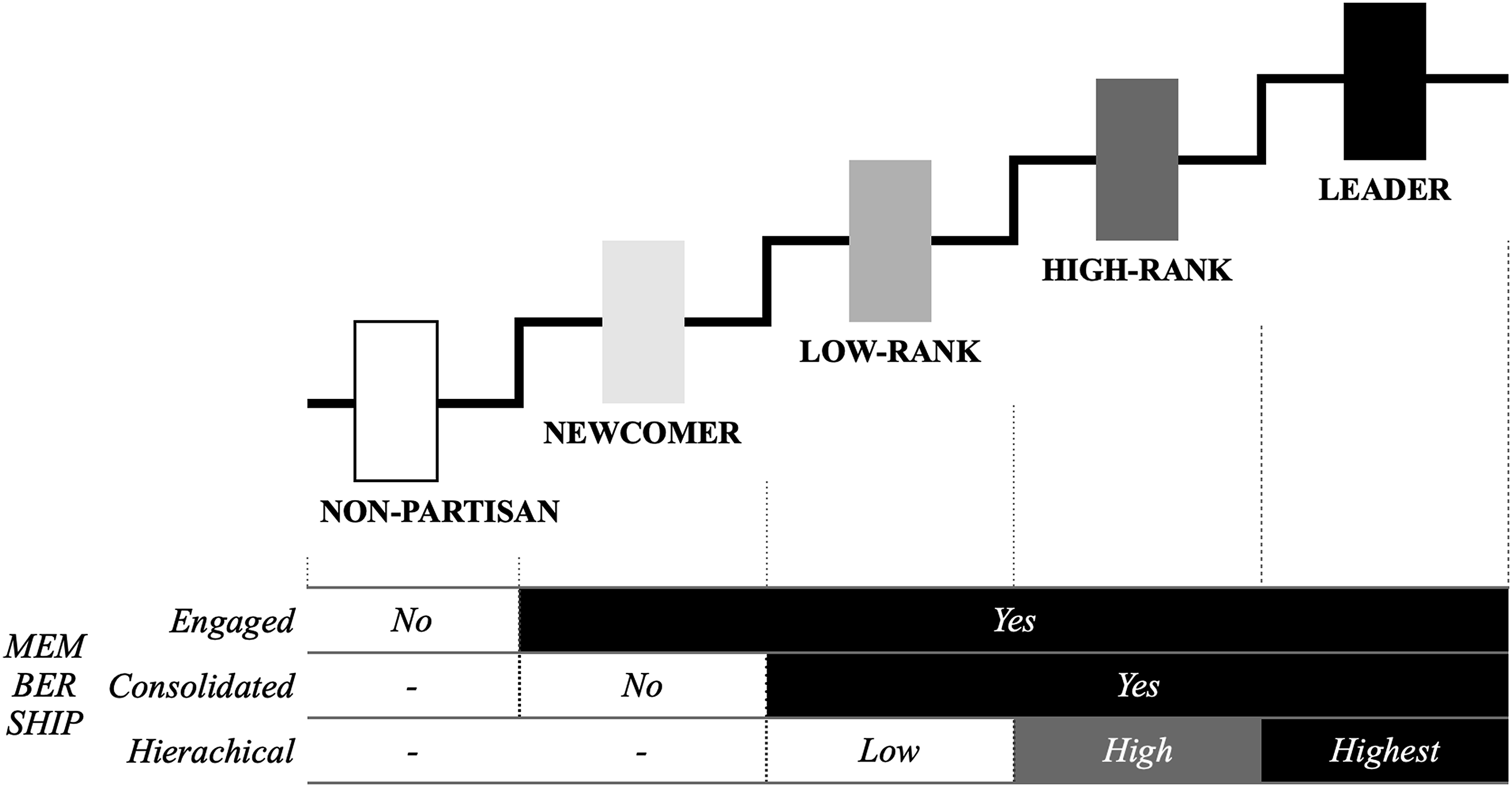
Disaggregated and hybrid variants
The benchmark classification provides a first set of variants but is also a tool for capturing other possible partisan expressions. Some of these alternatives may be disaggregations of the elemental variants. For instance, within the high-ranking subset, individuals holding prominent party positions could be differentiated from influential party individuals without party positions (Lindberg et al., 2022). Alternatively, it could be interesting to distinguish those high-ranking members with a substantial number of personal followers, such as faction leaders or leaders at the local level.
Other partisan subtypes may be close to the elemental variants but fail to meet some of their requirements. Let us discuss those that seem the most frequent in our inquiries. Situations in which individuals regularly occupy a public office on behalf of the same party without being official members of that party put into question the explicitness requirement of the engagement attribute. Membership engagement is active but unknown to other players for these ‘independents’ who work for a given party. Despite their commitment, these shadow partisans are not fully accountable to other politicians, the electorate or public opinion (Figure 2(a)). Situations in which new partisans come from another party call into question the exclusiveness requirement. While these defectors may have extensive partisan backgrounds, their link to the current party is new and reciprocal trust and loyalty are at an early stage (Figure 2(b)). Partisans who enter and leave party positions regularly, alternating, for example, with a profession in the private sphere, violate the continuity requirement. This variant resembles the discrete profile identified by Schlesinger (1966) (Figure 2(c)). There are situations of individuals with a prestigious position in the private sector who decide to enter politics. It is often the case that these individuals start directly from hierarchical positions. These fast-hierarchs violate the requirement of sequentiality in attribute acquisition (before achieving a high-ranking post, the partisan is expected to achieve a consolidated membership). In this case, loyalty to the current party has not proven reliable, and it may also collide with bonds developed in the previous private sector career (Figure 2(d)). Examples of frequent hybrid variants.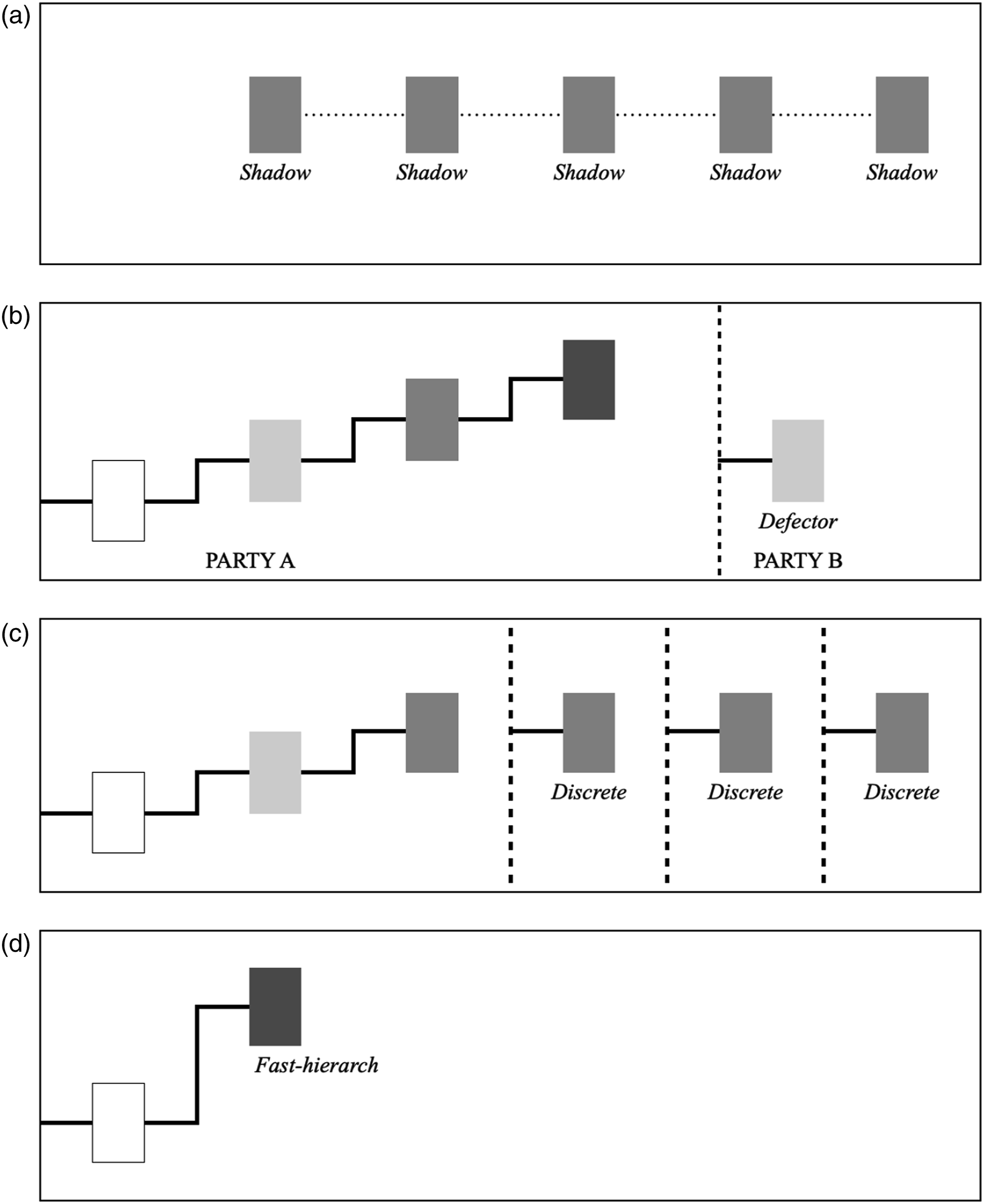
Partisan variants and the organizational level
The behaviours of single party members determine the hybrid subtypes discussed above; they are deviations from the benchmark classification that originates on the individual side of the partisan link. However, challenges to government partisan assumptions can also come from the organizational side, which is what happens when the party does not provide strong guarantees for sufficient support of their followers, as is the case with organizations that are either very new or are less institutionalized. New and volatile parties tend to have generic platforms, strategies and internal rules, making it difficult for individuals to follow party discipline. It may also be the case that the actual boundaries of the partisan organization are so indefinite, such as when these parties join numerous and different electoral coalitions or political fronts, that it becomes difficult to understand which organization an individual is a member of and to which partisan structure they are accountable. Our basic argument here is that being a leader (or any other partisan variant) within a consolidated party with established and understood procedures and organizational resources is not the same as being a leader in a new party or in a coalescence of smaller parties made up of multiple factions in dispute.
The practical typology: putting it all together
The practical typology.
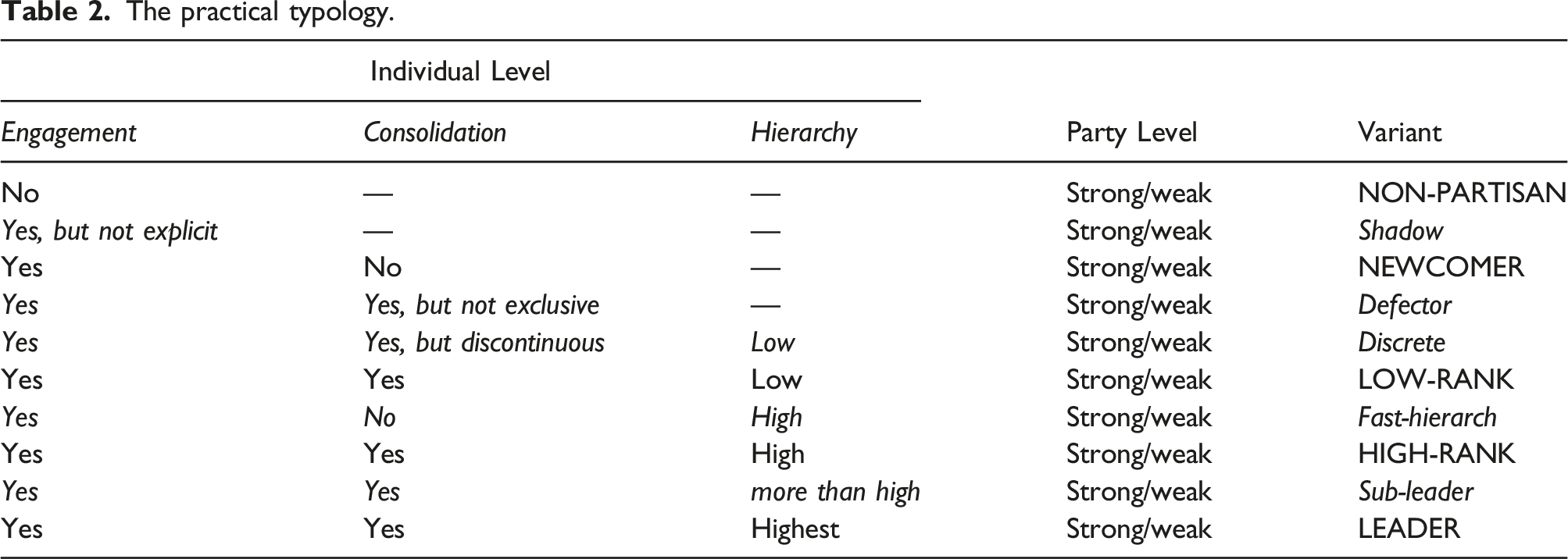
An active and explicit membership of a given partisan organization must have minimum partisanship. Individuals with no such membership are excluded from the set of partisans
An individual with an engaged but not consolidated position is formulated as
A partisan with a consolidated but non-hierarchical position is expressed as 
A partisan with a consolidated and hierarchical position is expressed as 
Finally, an individual who demonstrates evidence of all three individual attributes at their maximum levels
Partisanship is a gradual relationship. Nothing prevents ‘moral hazard’ behaviours, but it is more usual to expect full commitment from a person who was an active member for more than 15 years than from a recent arrival. As such, a low-ranking member can be regarded as being more partisan than a newcomer and less partisan than a high-ranking member. This is quite an intuitive property of the benchmark classification. When it comes to non-elemental positions, partisanship gradation becomes more difficult. Is a ‘defector’ more or less partisan than a ‘shadow’? Does a fast-hierarch rank higher or lower than a low-rank? The answers to these questions will ultimately be conditioned by the specific research question being asked and the peculiarities of the case being studied; however, once more, the benchmark classification provides a guiding framework. Hybrid variants are given by partisans who fail to meet – or who present inconsistencies in respect of –any of the defining attributes of government partisans. Thus, an individual with an active, but not explicit, membership partially fulfils the engagement (E) attribute and may be codified as
Recent partisans with a previously consolidated membership in another party call into question the exclusiveness feature of the consolidation (C) requirement, which may be codified as
Consolidated partisans who do not accomplish the continuous feature of consolidation (C) may be codified as
Recent partisans who enter directly into a high-ranking position may be coded as
Partisans, such as local or faction leaders, can be thought of as a kind of hierarch which are closer to the leader variant and can be coded as
For parsimony, the party level can be integrated as a complement to the individual variant, with a formulation such as: ‘leader [or any other variant] of a strong/non-strong party organization’ (see Appendix 2 for a quantitative solution).
Scales of measurement
The practical typology allows measurement of the government partisan concept in three main ways. The set of labelled variants provides a nominal measure. An expanded ordinal measure is given by those labelled variants ordered according to their level of partisanship. The construction of a smaller ordinal variable requires the identification of critical turning points. We suggest a trichotomous measure that takes the existence of an active membership as critical moments in distinguishing the set of non-partisans from the set of partisans and then the presence of a hierarchical consolidated membership that can distinguish between soft partisans and strict partisans. For a dichotomous measure, the latter of these thresholds would be more consistent with the notion of government partisan (Figure 3).
2
Standard approach versus practical approach.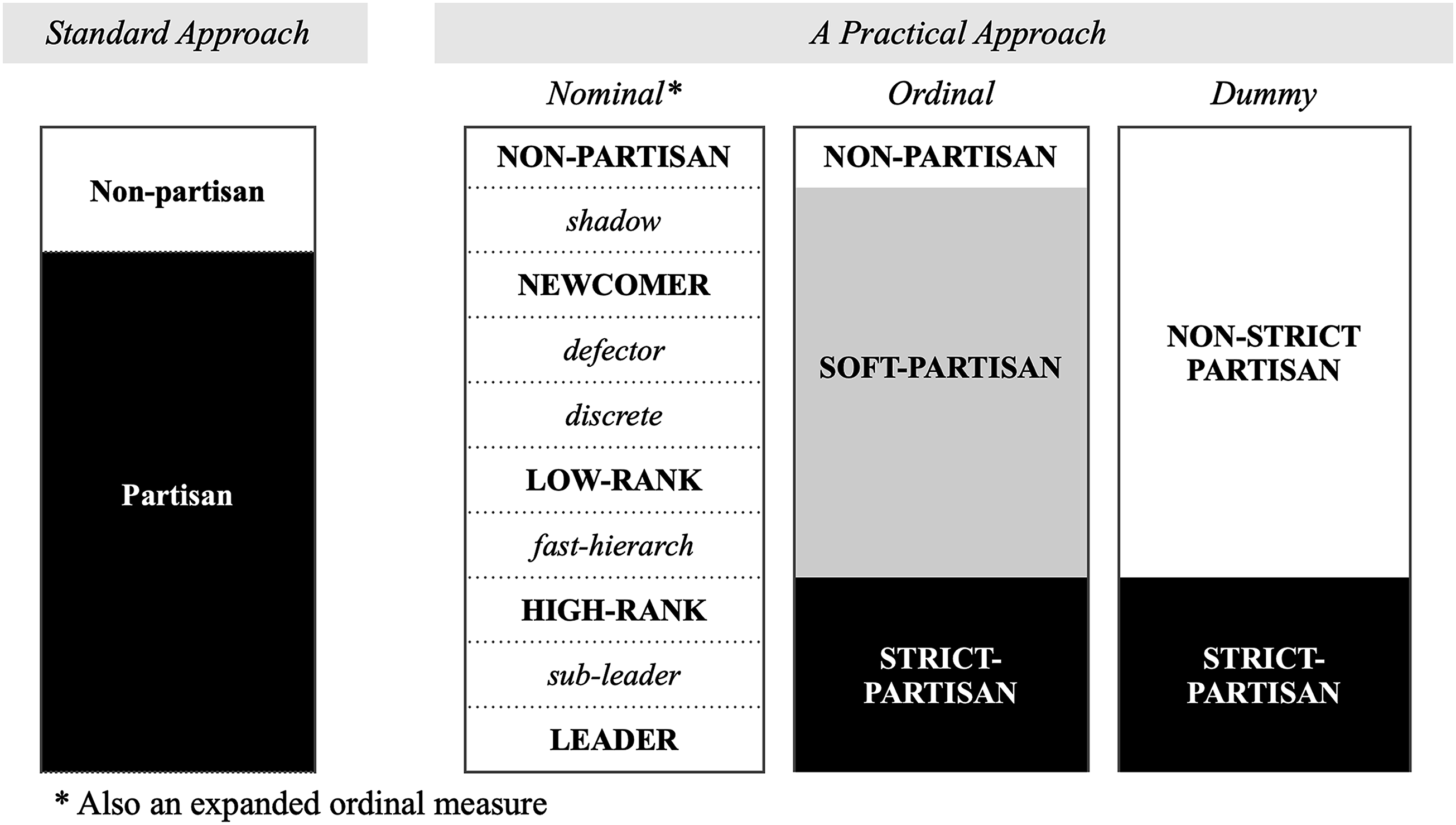
Operationalization
We propose the following operational criteria. Engagement (E) can be captured by any active partisan position or publicly held political positions on behalf of a given party. Consolidation (C) can be registered by looking at the continuous time spent in those positions. Assuming each electoral process constitutes a critical moment for the renewal of the bond between an individual and a party, we propose looking at the number of consecutive legislative elections run by the party while the individual held those positions without interruption. The suggested categorization is to consider one or no elections as non-consolidated membership, two or three elections as consolidating membership and more than three as consolidated membership. Hierarchy (H) can be given by the salience of the active position occupied at the moment of appointment or the real importance of the individual within the party. The intention here is to capture ‘big names’ and party ‘heavyweights’, even if they do not occupy important positions at the moment they are nominated. In contrast to hierarchs, the classification of party leaders is self-evident as it is determined by the formal position held at the time of appointment.
Exploratory application of the practical approach
In this section, we examine the validity and potentialities of the practical typology through an exploratory comparison with the standard dichotomous measure. The aim here is not to provide a systematic analysis but rather a preliminary examination of the applicability of the typology to ponder its empirical use and theoretical implications. To perform this analysis, we constructed a sample with all cabinet members from three governments of different institutional settings, each of which varying in the level of institutionalization of their respective ruling parties and who were all in office in February 2021. Scenario A is given by a semi-presidential government formed by the Portuguese Socialist Party, a historical and strongly institutionalized political party with a salient participation in the country’s political life since the transition to democracy in 1974. Scenario B represents the opposite situation, with an Argentine Peronist presidential government. Peronism, a key political actor since 1945, is a label that refers indistinctly to a party, a social movement and an ideology. Its internal organization is heterogenous and volatile, comprising several branches (factions, parties, social organizations) that may overlap over time and across regional levels. At the moment of observation, Kirchnerism had been the ruling branch of this political space since 2003. As an intermediate situation, scenario C focuses on Italy, which observes the Conte II parliamentary government. In a party system with important elements of volatility, this coalition government enjoyed the support of a centre-left traditional party that demonstrates a good level of party institutionalization (the Democratic Party) and a very new and weakly institutionalized populist party (the Five Star Movement). To control for internal generalization, scenario A and scenario B represent typical cases within their respective countries, Portugal and Argentina, while scenario C shares important features with the Italian executives formed during the 2010s. The three selected cases were in power during the same period to control for broader international factors.
For all three governments, we assessed the level of partisanship according to the standard approach, following secondary sources and distinguishing between partisan and non-partisan ministers. The intention was to replicate how local actors such as politicians, analysts and journalists conceive partisanship within their respective countries. To apply the practical typology, we relied on country experts who identified and ordered the partisan profiles by following a common codebook and responding to at least two rounds of consultations. The standard approach records 80% partisans against 20% non-partisans for the entire pool. In principle, this result is consistent with the party government model. Expecting a predominance of partisans for parliamentary democracies, the non-partisan ministers would then come from the presidential scenario B or the exceptional scenario A with its primacy of independents. However, both proportions decrease significantly with the practical approach, which shows an intermediate zone that is made up of 58% of the observations (Appendix 3). Let us examine the internal dynamics of partisanship within the three cases.
Scenario A: institutionalized political parties, semi-presidential system
The standard measure registers an important presence of non-partisans in the Portuguese scenario, A, corresponding to what the local literature has identified as a ‘primacy of independents’ situation (Pinto et al., 2018), an intriguing pattern for a consolidated Western democracy and a clear expression of the party government model (Figure 4(a)). Scenario A (Institutionalized party governments in a semi-presidential system).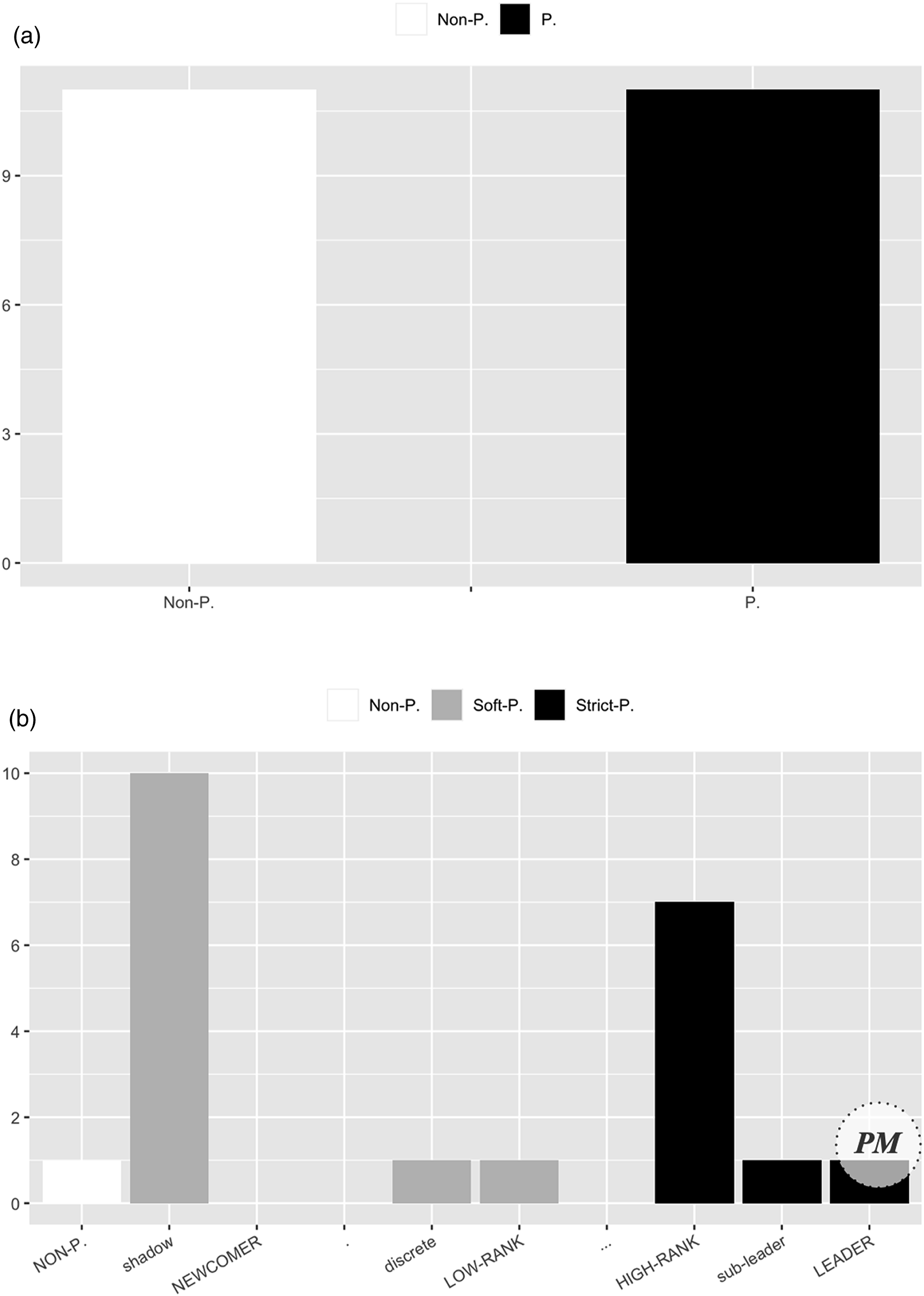
The picture that emerges from the practical typology is broadly consistent with the findings in the local literature, with a balanced presence of formal partisans and formal non-partisans, but which introduces at least two worthy nuances (Figure 4(b)). On the one hand, the internal distribution of the regular partisan variants (uppercase) shows consistency with the assumption that correlates the levels of partisanship and political salience: most of the partisans who arrived at the cabinet level were also individuals with a high degree of partisanship (black bars). Interestingly, there is almost no space for low-ranking partisans except for one case (a promising young politician?) and one discrete member. Additionally, the presence of one sub-leader, proposed by the codifier to capture a leader of an internal party branch, calls attention to a possible interesting dynamic within the cabinet (a potential prime ministerial challenger or a strong internal ally?).
On the other hand, the marginal presence of non-partisans is consistent with the party government approach but contradicts the local literature. An explanation for this discordance can be found in the grey zone of the practical typology. There, the shadow partisans – individuals with non-official accreditation but with an effective link to a specific party – are ministers the standard approach would have codified as independents because of the absence of formal membership. While the high presence of these ministers would still be a Portuguese peculiarity, the practical typology suggests independence is not the feature that distinguishes them.
A more qualitative examination based on biographical data complements this picture. The individual codified as leader was, as expected, the head of government. It was also a very typical party leader who achieved this position after a long party and political career (member of the party, local MP, national MP, cabinet minister; member of the party secretariat, chairman of the parliamentary bench, MEP and vice-president of the European Parliament, cabinet minister; mayor of the capital city, party leader and prime minister). The sub-leader was a senior partisan who, in addition to being a member of the party secretariat, is considered the representative of the left wing of the Socialist Party, a heavyweight within the internal party structure and a credible aspirant to the party leadership. Most of the high-ranking category consists of individuals with a long trajectory within the party, government and parliament who were part of the party’s national political commission or national secretariat at the time of their appointment. The only low-rank in this government was a former shadow minister. While he formally joined the party before the 2019 legislative elections, he had already served as a minister during the previous 4 years. He was also assistant to the secretary of state for natural resources (1995–97) and chief of staff to the deputy secretary of state for the environment (1997–99). At the moment of his appointment, the discrete partisan was known to be a formal member of the party, with a long and consolidated collaboration with the party in public and administrative positions, but with low active participation in either the party’s national bodies or political leadership and with periods out of politics.
The shadow partisans were all formally independent ministers with a long list of public positions held unofficially in the party’s name. Some had also been the head of the party’s electoral list in the 2015 and 2019 legislative elections. One of these cases was elected to the European Parliament (2014–19), while another was appointed by the government to serve on two working groups and as an adviser to the party several years ago. This group of independents also included the minister for health, appointed by the party to head the same ministry (2018–19) and as chairman of the health service’s central administration governing board (2016–17). The non-partisan, appointed to the Territorial Cohesion Ministry, was a technocrat from the public sector.
Scenario B: volatile political parties in a presidential system
The standard approach shows a greater number of partisan ministers for the low institutionalized Argentinean scenario B (Figure 5(a)), fitting the party government model better than scenario A, which is unexpected. Scenario B (Volatile party governments in a presidential system).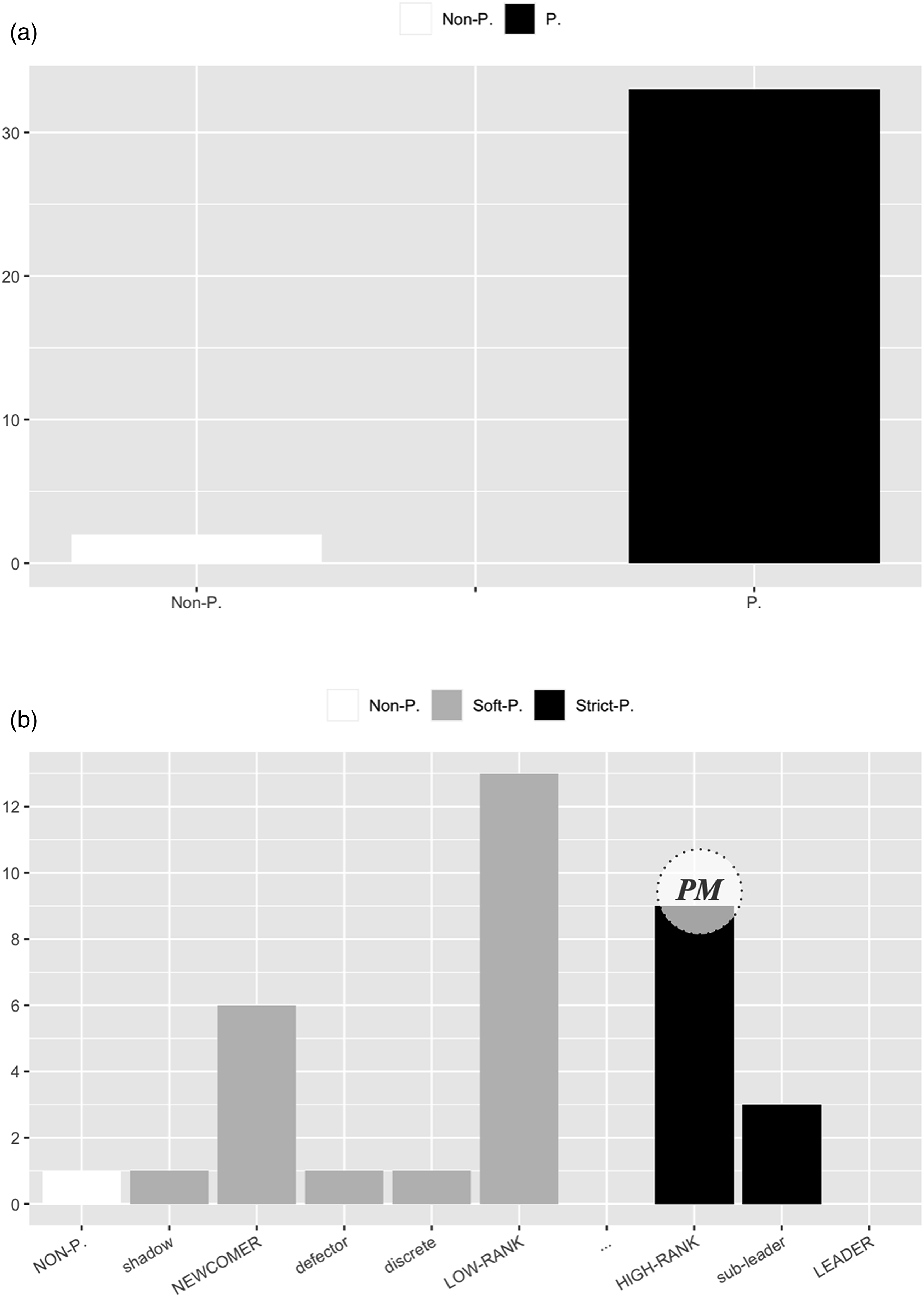
This predominance of partisans, accompanied by a marginal participation of non-partisans, is consistent with the results provided by the practical typology, in which most cases are classified as low-ranking or above. A disaggregated consideration of this typology allows for the introduction of two corrections. First, the internal composition of those partisans reveals a completely different picture compared to previous scenario A. Specifically, in scenario B there is a minor presence of high-ranking members, with few high-ranks and no party leader, and a majority of low-ranks along with newcomers. Hence, the party government model’s rank status assumption does not hold in this government. Second, the internal composition of the grey types is also substantially different from that of scenario A. Even if it presents a similar magnitude, it shows a uniform distribution of discrete, shadow and defector partisans. The cabinet seems to be much more open than the former institutionalized case.
A closer look at individual cases seems to confirm dynamics more consistent with what is expected in a volatile scenario. Formally, the head of government was a newcomer from an unknown political party (PARTE). In practice, he was a historical member of Peronism, with an important former role within the ruling branch of that space (Kirchnerism), but without leverage when he took office. The leader of the ruling branch of this Peronist government (former president Cristina Fernández de Kirchner) decided to stay out of the cabinet but remain in control of critical political positions. This is an unusual configuration in a Peronist government, but it is a good illustration of the salience of the personality component in the operation of this political space. The sub-leader was the governor of a small provincial state linked to the ruling branch as well as to the president and was, following a heavy defeat in mid-term elections, appointed Chief of Cabinet, apparently on the recommendation of the leader outside the cabinet. For that reason, unlike in scenario A, the alignment of this leader with the head of government cannot be taken for granted. The group of high-rankings was composed of historical Peronists who had held prominent political positions within Peronist governments and were influential figures in the Kirchner governments. This group also includes hierarchical members of relatively new (CAMPORA) and small (FR) Peronist branches, whose leaders occupied important positions within the legislature. In turn, individuals codified as low-ranks were also members of those partisan organizations with decreasing lengths and/or relevance of partisan experience and involvement, while the group of newcomers includes individuals who had a direct relationship with the president before they were appointed and who were later considered ‘Albertists’ by the media and other outside observers. Moving to the grey zone, the shadow partisan minister was an independent with a past of consistent collaboration with Peronist branches in public office, the defector was an experienced politician who came from another party, while the discrete case refers to a jurist with a consolidated private professional career who agrees from time to time to represent the party officially in senior political and elected positions. The unique non-partisan label was assigned to a technician with some academic training who had neither political nor managerial expertise and was appointed to the Ministry of Economy.
Scenario C: new party governments in a parliamentary system
Looking at the Conte II government in Italy, the standard approach stresses the absolute predominance of partisan ministers, which correlates perfectly with the long tradition of party government in Italy (Verzichelli and Cotta 2018). Applying the practical typology shows equilibrated participation of high-ranking and low-ranking partisans, and a particular location for the prime minister, providing partial support to the party government assumption according to which partisan ministers will be important partisans.
Using biographical data to take a closer look confirms the middle-ground position of the Italian case compared to the other two scenarios. Although the leaders of the respective coalition parties were in the cabinet, neither was the prime minister. The head of government was a shadow partisan who held the same position in the previous government without being linked formally to any partisan organization. However, he had been close to the senior party in the coalition since 2016 when, in preparation for the 2018 parliamentary elections, he helped write that part of the party’s election manifesto related to the reform of public administration and was named the future Public Administration Minister should the party win the election. The other shadow is a technocrat linked informally to the same party, which in 2018 identified him as a future Environment Minister in the event of victory at the polls. In fact, he was appointed minister in 2018 (Conte I) and took the same position in the Conte II government. The only sub-leader partisan was the leader of a small but important party faction. Despite his political significance, he was not appointed to a key portfolio but retained the position he had been appointed to in previous governments.
The six identified high-ranking members were either part of the national party executive or were big names who had occupied many positions in the name of their parties. The low-ranking partisans included politicians with a long history of national and local political militancy in their parties but who had never held hierarchical positions or emerged as big names within the party at the national level. The distribution of portfolios among these profiles shows a prevalence of salient positions among high-ranks, while only one low-rank partisan was appointed to an important ministry. It needs to be stressed, however, that this minister (a second line with strong experience in the European Parliament) was nominated to the crucial Economy and Finance portfolio. Most of the remaining low-ranking members and newcomers belonged to the Five Star Movement, a new and poorly institutionalized populist party that won the 2018 elections and became the largest party in parliament. None of these partisans was appointed to crucial portfolios. Finally, the only non-partisan is represented by a technocrat who came from the public sector and was appointed Interior Minister.
All in all, while the standard approach still registered the Conte II executive as very close to the party government model, the new typology can highlight the peculiar consequences of a party system that is showing evident signs of de-institutionalization linked to the emergence of new, strong and weakly institutionalized partisan organizations, such as the consistent presence of non-hierarchical partisans or the fact that a hybrid profile occupies the position of head of government (Figure 6). Scenario C (New party governments in a parliamentary system).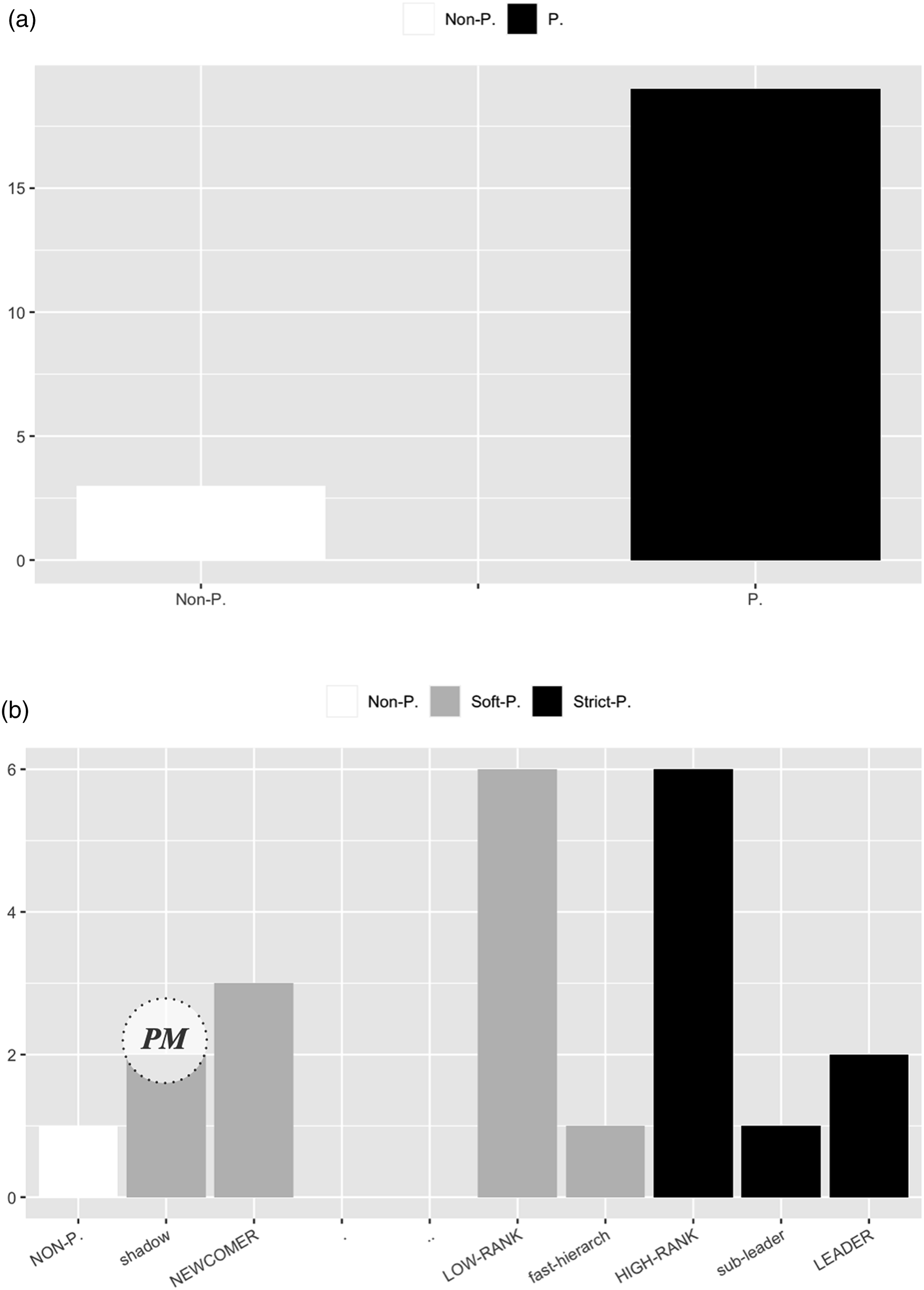
In summary, although both measures present a fairly similar picture in terms of the number of partisans, the practical typology allows us to grasp profiles with substantially divergent dynamics, giving us a more nuanced and, to some extent, counterintuitive picture of the expectations of the partisan governance model in a parliamentary system.
Conclusions
The study of cabinet partisanship has tended to focus on formal membership, classifying ministers as either partisans or non-partisans depending on whether they were official members of a political party. This strategy has been valid and fruitful for research on the profile of elites in established democracies under the dominance of the party government model. However, it has limitations in dealing with both the non-parliamentary setting and in capturing different degrees of partisanship in any institutional arrangement.
To advance on these two fronts, this paper proposes a definition of government partisan that integrates widespread theoretical assumptions, adjusts traditional operational procedures and suggests a typology that covers a comprehensive range of partisanship within the cabinet. We characterize this typology as ‘practical’ because it intends to go beyond formal arrangements and captures effective dynamics, because it is sensitive to concrete partisan variants within specific cases from a comparative frame and is open to measurement alternatives to ensure it better fits the research question at hand.
The exploratory application of this new measure to three different governments anticipates interesting implications for the comparative study of executive profiles. Consistency with the standard approach was registered at a basic level, as both measures counted partisans with similar results. Moving on from that common ground, the practical measure presents at least three advantages. First, it demonstrates an ability to dig down into the grey zone between and within partisans and non-partisans, opening an analytical space in which potentially interesting variants can be identified. That was the case of the Portuguese shadow partisans — ministers with no formal membership who consistently commit to the same political party. This peculiar profile could be crucial to solving the current contradiction between the broader party government expectations and the findings in the local literature. Second, the new measure can travel across parliamentary and presidential regimes. While both semi-presidential consolidated scenario A and presidential volatile scenario B presented high levels of partisan ministers, the internal composition of these partisans was substantially different. Specifically, the party government expectations concerning the presence of high-rank regular partisans were accomplished only under the first scenario. Third, the practical typology is sensitive to capturing local variants without losing its comparative capability or the flexibility to apply measurement criteria targeted at specific research questions. For example, a shadow minister (a non-member with consistent commitment) could be ranked higher than fast-hierarchs (neophytes in hierarchical positions) if the research focus is on loyalty but not in a study of electoral dynamics.
The practical typology offers a promising strategy that can move decisively beyond the dichotomous approach, opening a research agenda involving two analytical moments, including a descriptive stage for a systematic detection of partisan variants across time and political regimes and the configuration of common patterns and meaningful local specificities; and an explanatory stage for the reassessment and elaboration of theoretical models on the causes of government partisan and its implications over the functioning of contemporary democracies.
Supplemental Material
Supplemental Material - Government partisans: A practical typology
Supplemental Material for Government partisans: A practical typology by Marcelo Camerlo and Antonino Castaldo Larsen in Party Politics
Footnotes
Declaration of conflicting interests
The author(s) declared no potential conflicts of interest with respect to the research, authorship, and/or publication of this article.
Funding
The author(s) disclosed receipt of the following financial support for the research, authorship, and/or publication of this article: This work was supported by Foundation for Science and Technology (FCT) grant from CEECIND/03884/2017.

Supplemental Material
Supplemental material for this article is available online.
Notes
Author biographies
Marcelo Camerlo is Senior Research Fellow at the Institute of Social Sciences, University of Lisbon, coordinator of The Presidential Cabinets Project and of The South European Governments Project. He has published related research in Journal of Politics, Comparative Politics, and the Oxford Research Encyclopedia of Politics.
Antonino Castaldo is Postdoctoral Research Fellow at the Institute of Social Sciences, University of Lisbon. He has a PhD in Political Science from the University of Florence. He was Teaching and/or Research Assistant at the University of Science Po (Paris), University of Roma Tre, Luiss University, and University of Oxford.
References
Supplementary Material
Please find the following supplemental material available below.
For Open Access articles published under a Creative Commons License, all supplemental material carries the same license as the article it is associated with.
For non-Open Access articles published, all supplemental material carries a non-exclusive license, and permission requests for re-use of supplemental material or any part of supplemental material shall be sent directly to the copyright owner as specified in the copyright notice associated with the article.
