




Abstract
How does technological change affect social policy preferences across different institutional contexts? In this paper, we argue that individuals who perceive high levels of technology-related employment risks prefer passive policies like unemployment benefits over active measures like retraining in order to satisfy the need for immediate compensation in the case of job loss. At the same time, general support for passive (active) policy solutions to technological change should be significantly lower (higher) in countries where generous compensation schemes already exist. As the perception of technology-related employment risks increases, however, we expect that social policy preferences among high-risk individuals should converge across different welfare state contexts. We use novel data from a diverse set of 24 OECD countries that specifically measure preferred social policy solutions to technological change in a constrained choice scenario. Applying statistical methods that explicitly model the trade-off faced by individuals, we find evidence in line with our theoretical expectations.
Introduction
The institutional evolution of modern welfare states has always been driven by the forces of technological change. For instance, the negative side effects of the first Industrial Revolution at the turn of the 19th and 20th century formed the political impetus for the development of the first social insurance systems (Ansell & Lindvall, 2020). The shift from the industrial to the post-industrial knowledge society has been accompanied by the emergence of new social risks such as single parenthood, low skills, and long-term unemployment, which have contributed to the transformation and recalibration of traditional, transfer-heavy forms of social policy toward social investment policies that emphasize human capital formation (Bonoli, 2013; Hemerijck, 2018; Iversen & Soskice, 2015).
It is therefore not surprising that scholarly and public debates about the consequences of recent technological change for the economy, the society, and the welfare state are gaining momentum. Pessimistic perspectives in this debate fear mass unemployment, political polarization, and rising inequality (Ford, 2016). In contrast, technological optimists emphasize job creation and improving working conditions (Acemoglu & Restrepo, 2019; Brynjolfsson & McAfee, 2014). As we will explain in greater detail below, much of the existing scholarship focuses on the past and predicted future effects of technological change on labor market outcomes such as employment and wage levels. Only recently have scholars in comparative political economy started to examine the role of rapid technological change in the formation of social policy preferences (Dermont & Weisstanner, 2020; Gallego et al., 2022; Im, 2021; Jeffrey, 2021; Kurer & Häusermann, 2021; Sacchi et al., 2020; Thewissen & Rueda, 2019; Zhang, 2019).
Even though these studies provide important early insights, they have inherent limitations. In particular, extant research either works with survey data collected in individual countries (Gallego et al., 2022; Jeffrey, 2021; Zhang, 2019) or with existing cross-national surveys, mainly the European Social Survey (ESS, see Im, 2021; Sacchi et al., 2020; Thewissen & Rueda, 2019). While the results of the former are inevitably country-specific, the latter group of studies uses survey questions that are not specifically designed to measure technology-related social policy preferences. This study seeks to address both of these limitations.
Our empirical contribution goes beyond existing research in three significant respects. First, we use novel, internationally comparative survey data that were collected as part of the OECD’s Risks That Matter (RTM) survey. This survey includes a series of original questions designed by the authors of this paper that explicitly focus on technology-related social policy preferences. Second, we model these preferences in a constrained-budget environment, effectively forcing respondents to prioritize between different policy options. This provides more robust estimates of policy preferences compared to unconstrained and more conventionally worded survey items (Häusermann et al., 2019; Neimanns et al., 2018). In analyzing these data, we apply multivariate linear mixed models (MLMMs), which allow multiple response variables to be considered at the same time. Thus, we are able to assess how support for different policy solutions to technological change simultaneously responds to changes in the perception of technology-related risks. Finally, our paper—transcending the strong focus on micro-level associations in the extant work—examines whether the macro-level institutional context influences the association between perceived technological risk and policy preferences at the individual level.
Previewing our results, we show that individuals who perceive technological change as an imminent employment risk face a trade-off between the short-term gains from compensation and the long-term gains from skill investment. Given this trade-off, risk-perceiving individuals favor immediate over long-term gains, supporting compensatory measures relatively more than social investment policies. Moreover, we argue that the relationship between perceived technological risks and the corresponding support for different policy responses is strongly influenced by the institutional context. Individuals with low risk perceptions are significantly less likely to demand compensation in generous welfare states compared to similar individuals in residual welfare states. However, among individuals with high risk perceptions, we find a convergence of preferences in the sense that these individuals prioritize compensation over social investment as a policy response to technological change, regardless of the welfare state context.
While we do not examine whether and how policy-makers respond to these demands, we believe that the strong preference for short-term compensation among individuals perceiving themselves to be vulnerable to technology-related labor market risks may significantly impact the range of viable policy options in response to technological change. We therefore conclude this paper with a discussion of the political implications of our findings.
Technological Change and the Welfare State: A Short Review
As mentioned above, there is now a fairly well-developed literature on the impact of technological change on labor markets, focusing on its effects on wages and employment opportunities. Inspired by the pioneering work of Autor et al. (2003) on routine-biased technological change (RBTC), this research argues that the recent wave of technological change is likely to have a polarizing effect (often called the “hollowing-out-of-the-middle effect”) on labor markets. This is because both high-level jobs involving abstract analytical, creative, management, and communicative skills and low-level jobs, especially in personalized services, are relatively immune to automation pressures. Instead, occupations and jobs in the middle of the skills distribution are at high risk of automation if and when they can be broken down into routinizable tasks that can be performed by a software algorithm or a robot. The reason why many believe that the current wave of technological change is qualitatively different from previous waves is that the rapid development of advanced technologies not only threatens routine manual tasks, but also increasingly white collar middle-class jobs. Thus, the middle class increasingly comes “under pressure” to either upgrade their skill set or to face declining job prospects (OECD, 2019). The hollowing-out-of-the-middle hypothesis has been confirmed by a number of studies for both individual countries and OECD countries in general (Autor, 2015; Autor & Dorn, 2013; Goos & Manning, 2007; Goos et al., 2014; Graetz & Michaels, 2018; Michaels et al., 2014).
These studies look at the impact of past technological change on real labor market outcomes. Another approach is taken by a number of contributions that attempt to assess the future effects of technological change, which is inherently more uncertain. Studies in this field typically try to predict the automation risk of certain occupations with predictions of labor market effects ranging from significant to dramatic (Arntz et al., 2016; Frey & Osborne, 2017; Nedelkoska & Quintini, 2018). Other recent work focuses more on job creation, pointing out that the number of newly created jobs—at least in the long term—may exceed the number of jobs eliminated (Acemoglu & Restrepo, 2019; Arntz et al., 2018). Despite these differences, all studies basically agree that rapid technological change is likely to lead to large-scale adjustment and recalibration of labor markets in the short to medium term.
So far, only a few studies have examined the consequences of these developments for the welfare state in general (see Busemeyer et al. (2022) for a recent overview) and for social policy preferences in particular. In line with the work on labor market risks and the welfare state (Gingrich & Ansell, 2012; Rehm, 2009; Rehm et al., 2012), Thewissen and Rueda (2019) show that a high individual automation risk is positively associated with support for redistribution. Similar to our study, but looking at absolute rather than relative policy preferences, Kurer and Häusermann (2021) provide indicative evidence that automation risk is correlated with support for compensation policies, but less with social investment. Dermont and Weisstanner (2020), who as Thewissen and Rueda use data from the ESS, find no relationship between automation risk and support for the introduction of a universal basic income (UBI), which is often and prominently discussed as a potential solution to the challenges of technological change. Sacchi et al. (2020), in contrast, find some evidence that high-risk individuals are more likely to support minimum income schemes at least under certain conditions. Im (2021) identifies a positive association between automation risk at the individual level and support for active labor market policies (ALMP).
Finally, there is further research that employs country-specific data and uses experimental methods to simulate “automation shocks.” These studies mostly report only minor effects of automation on policy preferences (e.g., Zhang, 2019), although Jeffrey (2021) shows that rhetorically connecting the issue of technological change with fairness and inequality concerns does have a discernible impact on both perceived vulnerability as well as policy attitudes. Moreover, Gallego et al. (2022), using survey data from Spain, find that affected workers are more likely to demand protectionist regulatory policies aimed at slowing down the pace of technological change. Yet overall, the evidence for a meaningful effect of technological change on social policy preferences is mixed in terms of both magnitude and direction.
While these studies represent important advances, they suffer from a number of shortcomings and research gaps. Those relying on ESS data need to live with their limitations, particularly the fact that the ESS measures welfare state attitudes only broadly and not specifically in relation to preferred policy responses to technological change. Moreover, studies that use country-specific data inevitably cannot analyze the interactions between individual-level factors and country-level contexts. Even in the ESS-based studies, the focus is on exploring dynamics at the micro level rather than on how institutional contexts influence micro-level dynamics. In this paper, we address these shortcomings and gaps in the existing literature by using novel survey data specifically designed to measure policy preferences on automation and digitalization across a diverse set of countries.
In addition, our measurement approach takes budget constraints and individual trade-offs into account, forcing respondents to prioritize between different policy options. While this approach does not allow gauging the absolute level of support for each policy, measuring policy preferences in a constrained scenario is particularly useful for elucidating the relative policy priorities of individuals in trade-off situations. Various studies show that this leads to more robust estimates of policy preferences compared to unconstrained question scenarios (Bremer & Bürgisser, 2022; Busemeyer & Garritzmann, 2017; Häusermann et al., 2019; Neimanns et al., 2018; Philips et al., 2016). There are basically two different approaches to taking into account tight budgets and trade-offs: Either by weighing two different policy decisions against each other (e.g., increasing spending on policy A, while cutting back spending on policy B) or by forcing respondents to distribute a limited budget over specific policy areas. For this paper, we use the latter approach since this allows us to consider more than two policy options at the same time.
Theoretical Discussion
This paper has two core research questions. First, to what extent are subjective perceptions of technological risk related to preferred policy responses to automation and digitalization? Second, how does the institutional context of the welfare state affect these individual preferences?
With regard to the first question, previous work has shown that actual and perceived labor market risks are strongly linked to increased demand for social protection and redistribution via the welfare state (Anderson & Pontusson, 2007; Gingrich & Ansell, 2012; Rehm, 2009, 2016). Whether technological change represents a separate dimension of employment risk that differs from other sources of economic insecurity such as lack of skills (e.g., Iversen & Soskice, 2019) or globalization (e.g., Walter, 2017) is ultimately an empirical question, which we can only partly address in this paper due to certain limitations in the data, as we will explain in more detail below.
However, there are good reasons to believe that labor market risks specifically related to technological change are different from other sources of labor market insecurity. For one, technological change is a very immediate and tangible employment shock that results in individual workers either directly losing their job or a significant transformation of their workplace. Furthermore, the likelihood of being adversely affected by technological change depends more on the routine task intensity (RTI) of an occupation than on other factors like skills or trade exposure that shape, for example, the distribution patterns associated with globalization (see the cited literature above).
For now assuming a direct connection between technology-related labor market risks and social policy preferences, what is the actual content of these preferences? Based on previous research (Sacchi et al., 2020; Thewissen & Rueda, 2019), a first straightforward answer to this question is that individuals who perceive high levels of technological risk are more likely to demand social protection from the welfare state. This protection can take several forms. For instance, individuals with high perceived risk might simply ask for more generous public benefits in the event of unemployment, which would be the most direct form of social protection. Likewise, subjective perceptions of technology-related risk might lead to increased support for the establishment of UBI schemes. These schemes would be less targeted than unemployment benefits, but still redistributive and potentially less stigmatized (Martinelli, 2020). Moreover, high risk perceptions could result in more support for subsidies to firms and industries that are hit hardest by technological change. However, since it may not be entirely clear or politically uncontested how much a particular firm or industry is affected by technological change and whether workers or employers would benefit more from subsidies, this measure would also be less targeted than direct unemployment compensation.
All of these policy proposals refer to social transfer and compensatory types of public spending that are directed at compensating workers for technology-related losses of income and/or at slowing down the impact of technological change. A different approach is taken by proponents of the social investment welfare state model (Bonoli, 2013; Garritzmann et al., 2017; Hemerijck, 2018). This perspective emphasizes human capital formation throughout the life course to prevent the emergence of social risks like unemployment before they occur. Applied to the context of this paper, this implies that individuals with high-risk perceptions might demand further investments in education and training for the younger population as well as retraining opportunities for older workers. Especially as a long-term solution to technology-related occupational change, it may be more rational for an individual to demand additional training and education spending instead of social protection. This is also the reason why experts typically recommend these kinds of policies (Colin & Palier, 2015).
In an unconstrained budget setting, risk-perceiving workers might support both short-term compensation as well as long-term oriented social investment. But when forced to prioritize, as policy-makers also commonly are in the prevailing context of budgetary constraints (Adolph et al., 2020), how exactly will individuals weigh these different policy options? The existing literature suggests that exogenous economic shocks increase support for general welfare spending (e.g., Margalit, 2013), but little is known about what kind of social policies those most affected support. The few studies that exist on this issue (Han & Kwon, 2020; Marx, 2014; Neimanns et al., 2018) suggest that social investment measures are less likely to be favored than compensatory policies, in particular in situations of high economic insecurity.
We believe that this general logic also applies to rapid technological change for (at least) two reasons. First, only compensatory policies are able to minimize the expected income losses in the case of technology-related unemployment by satisfying the need for immediate cash transfers in the short term. Second, from the perspective of workers threatened by technological change, the problem is that the success of investment-oriented polices (for instance, the probability of re-employment or future income) is not certain. This may reinforce the general human tendency to prefer less valuable but certain options—that is, limited, but reliable passive compensation—over potentially more valuable but uncertain ones—that is, active labor market policies (cf. Kahneman & Tversky, 1979). Thus, even though recent research suggests that some of this uncertainty might be overcome with high levels of political trust (where high-trusting individuals are more likely to support social investment policies even in trade-off settings, see Garritzmann et al., 2021), we expect that individuals who perceive technological change as an imminent employment risk will generally prefer compensatory policies over social investment policies (Hypothesis 1). We presume that this will express itself particularly in calls for more generous unemployment benefits since subsidies are politically and socially controversial and therefore might not be readily available, and UBI schemes have not yet moved beyond the experimental stage in any country of the world (for a review, see Hasdell, 2020).
Next, we address our second core research question on the impact of the welfare state context. Following policy feedback theory (Béland & Schlager, 2019; Busemeyer et al., 2021; Kumlin & Stadelmann-Steffen, 2014), individual preferences on policy solutions to technological change should be strongly conditioned by the institutional environment, either reinforcing or undermining the existing status quo. As argued by Jacobs and Weaver (2015), self-undermining feedback effects are more likely in situations where the negative side effects of the status quo are clearly recognizable. Applied to the case of technology-related employment risks, this argument implies important differences between mature and residual welfare states. We focus here on the generosity of existing unemployment insurance schemes as the one aspect of the welfare state that we deem most relevant for technology-related social policy preferences, given that the risk of unemployment is arguably the most tangible negative side effect of technological change from a labor market perspective.
We base our argument on the idea of a certain hierarchy of social policy demands that broadly mirror the historical development of welfare states in advanced democracies (Bonoli, 2013; Hemerijck, 2018). According to this notion, basic forms of insurance against labor market risks and unemployment emerge before more mature welfare states start to expand social-investment-type policies such as ALMP and further training. Although the generosity of passive labor market policies such as unemployment insurance and the expansion of social investment like ALMP are empirically related, they nevertheless constitute separate dimensions of employment policies (Pignatti & Van Belle, 2021). Against this backdrop, we posit that individuals residing in residual welfare states with less generous unemployment insurance schemes should first and foremost prioritize compensation over social investment in order to achieve basic protection against loss of income in the event of job loss. In contrast, individuals in more generous, mature welfare states are more likely to prioritize social investment policies as a kind of “luxury good” since basic insurance needs are already met (Hypothesis 2a).
Yet, institutional contexts not only shape average levels of support for particular policies, but may also mediate the association between micro-level variables, especially the relationship between individual labor market risks and social policy preferences (cf. Gingrich & Ansell, 2012). The question thus arises how the impact of technology-related risk perceptions on policy attitudes varies across welfare states. Due to the lack of basic protection schemes, we expect that labor market uncertainties and the associated risk perceptions are likely to be higher—on average—in residual welfare states than in more generous welfare states. For this reason, we predict that perceiving technological risk should have a relatively larger effect on social policy preferences in the latter group of countries than in the former since in mature welfare states, automation and digitalization represent new sources of labor market risk in an environment that is comparatively low risk. Hence, as perceptions of technological risk increase, the risk of unemployment and the corresponding need for immediate income substitution should shift the focus of individuals in mature welfare states from long-term to short-term policy solutions, leading them to prioritize compensation over social investment.
Empirically, this means that rising perceptions of technological risk should be accompanied by greater increases in support for compensation and stronger declines in support for social investment in mature welfare states than in residual welfare states, where support for compensation relative to social investment is higher to begin with. We therefore expect that average differences in relative policy support across welfare state types should be most pronounced at lower levels of perceived technological risk, with individuals in residual welfare states being more likely to demand compensatory policies and individuals in mature welfare states being more likely to support social investment. However, among those who perceive higher levels of technology-related employment risks, we should find a considerable degree of convergence of social policy attitudes, reflecting the fact that risk-perceiving individuals generally prefer compensation to social investment policies, irrespective of the welfare state context (Hypothesis 2b).
Data
In this study, we draw on the most recent wave of the OECD RTM Survey from 2020. The survey covers 24,676 individuals in 24 countries. 1 Due to a collaboration with the OECD, we as authors of this paper were able to include a series of questions specifically designed to measure technology-related social policy preferences and risk perceptions. In the following, we introduce the main variables of interest and the controls used in the analysis. 2
Policy Preferences
Our preference variables are based on the following survey question that asks respondents about their preferred policy responses to technological change: Think of the following hypothetical scenario: Your government has decided to set up a special support fund to help with the challenges of digitalization and technological change. How would you distribute the funds across the different policy proposals below? The total needs to add up to 100.
1. Investing in university education and vocational training opportunities for young people.
2. Investing in re-training opportunities for working age people.
3. Making public benefits and services, such as unemployment benefits, more generous to provide a better safety net for workers facing possible job loss.
4. Providing a universal basic income that covers essential living costs to everyone, regardless of their financial situation.
5. Providing subsidies to firms in industries that are hardest hit by technological change, so as to avoid job loss.
Put differently, respondents have a budget of 100 funds, which they can freely distribute to five different policy responses to technological change: Education and training for the young, retraining for the working age population, public benefits and services, UBI, and subsidies to firms. In the dataset, each component is stored as a separate variable that collects the allocated funds to a specific policy proposal across individuals.
Needless to say, these policies are a non-exhaustive list of potential policy responses to technological change, which implies certain limitations on the conclusions we can draw. However, in selecting these policy areas, we picked examples of social policies most often discussed in academic and public debates on automation and digitalization (e.g., see Kurer & Häusermann, 2022). We also want to point out that our set of policies only refers to spending-related measures and not regulatory policies that, for instance, might be used to slow down the pace of technological change (Gallego et al., 2022). Yet, given the relative weight of welfare state expenditures in public budgets across OECD countries, we believe that our spending-centered approach offers valuable insights.
Moreover, the constrained-budget scenario of policy preferences has advantages and disadvantages. The major advantage is that it provides more robust measures of the relative priorities of citizens’ demands for different types of social policy. Better understanding these relative priorities and their implications for welfare state reform is particularly important in times of fiscal austerity and hard political choices (Bremer & Bürgisser, 2022; Häusermann et al., 2019; Neimanns et al., 2018). The downside of our constrained-budget approach is that it does not allow to assess absolute levels of support for different policies in the population. Hence, analyses of policy preferences in constrained scenarios can and should be complemented with analyses in unconstrained settings (as we do in the appendix to this paper).
Description of Dependent Variables.
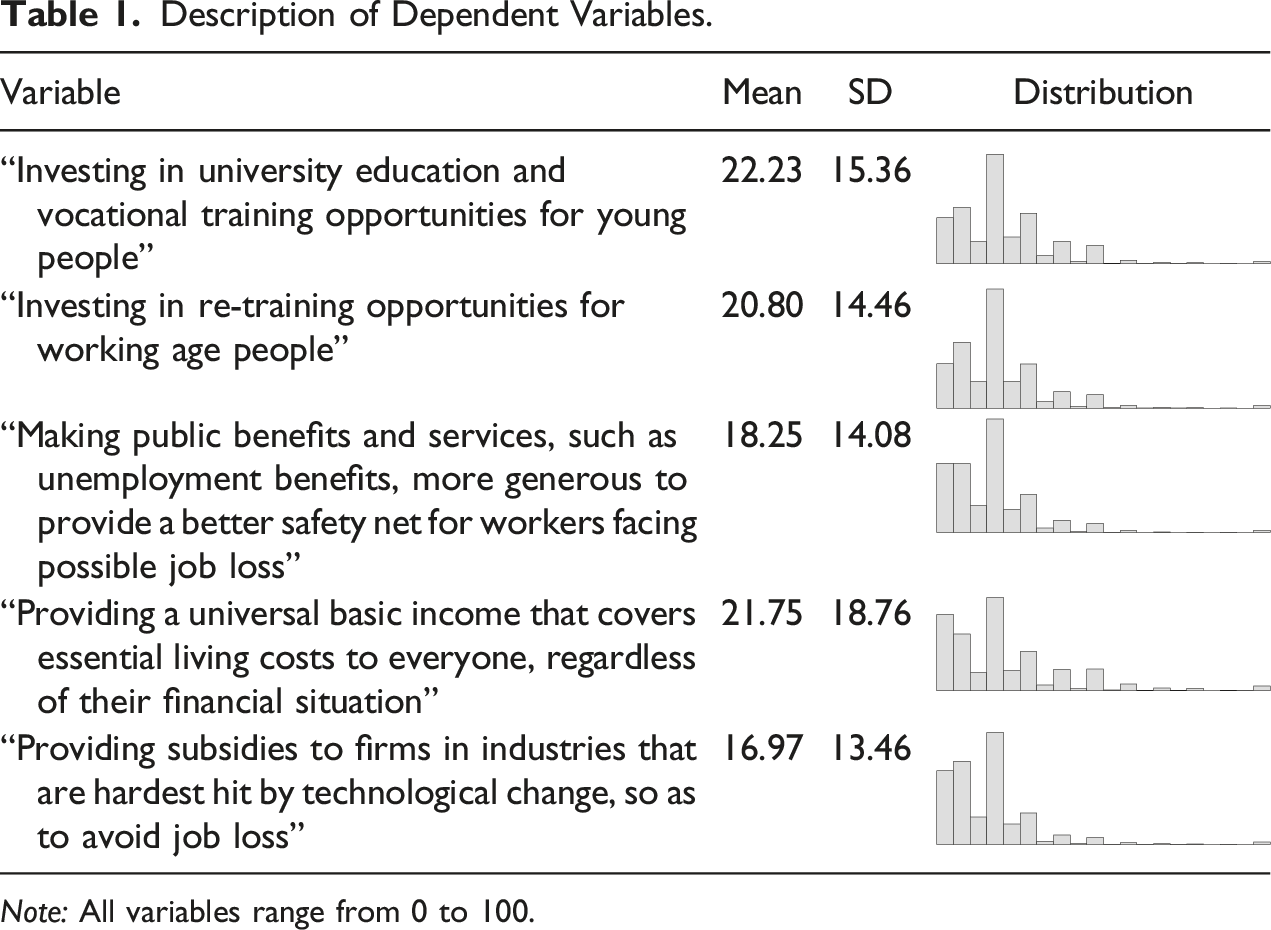
Note: All variables range from 0 to 100.
While these trends generally hold across countries, we also find some interesting country differences. In particular, Figure 1 shows that the funds allocated to public benefits and services are on average lower in some of the mature European welfare states like Austria, Belgium, France, and the Netherlands. In contrast, we find higher than average levels of support in emerging markets like Chile, Mexico, South Korea, and Turkey as well as in liberal welfare states like Canada and the United States.
3
Average funds allocated to public benefits and services across countries (dotted line indicates average of all countries).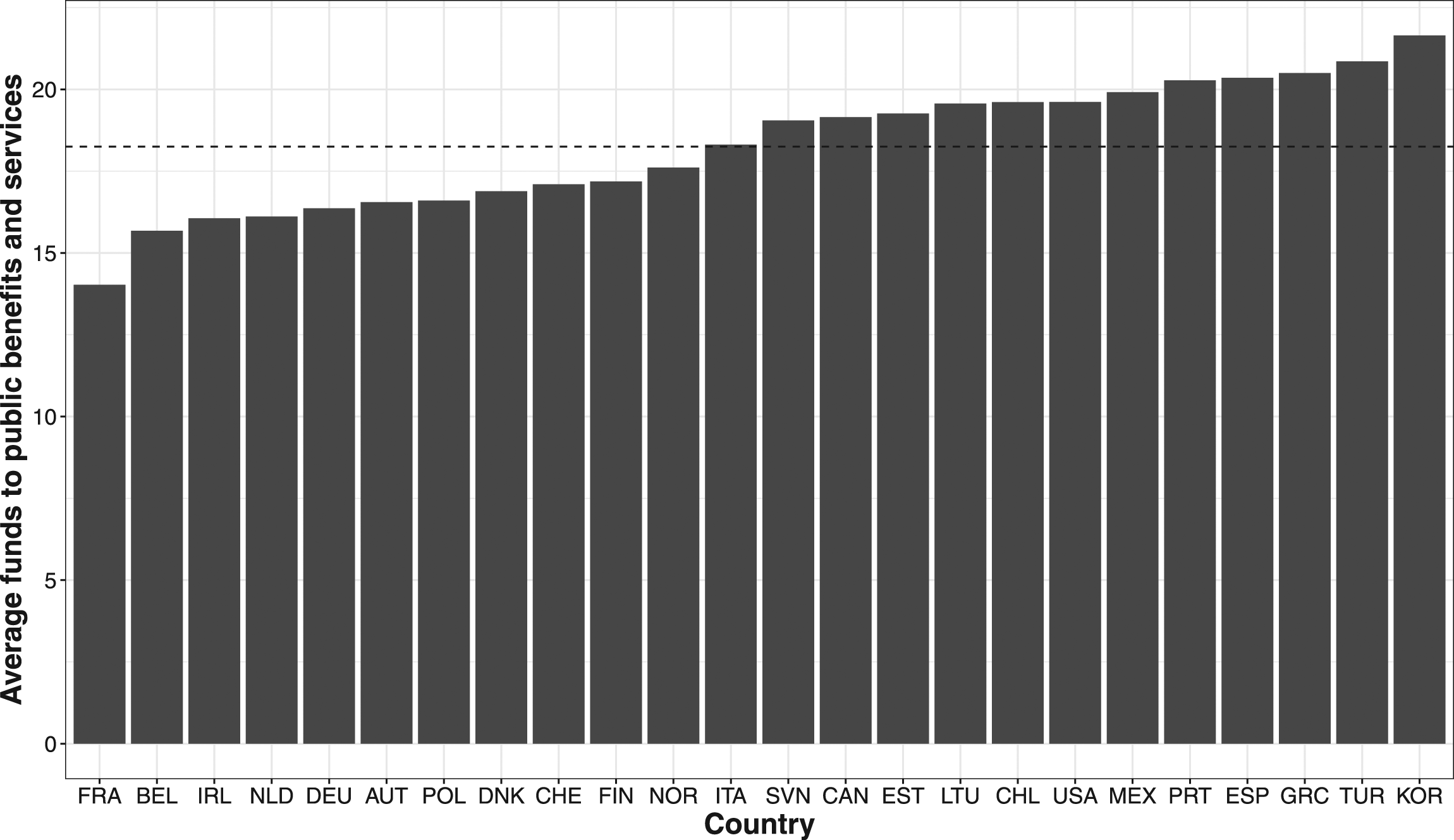
Technological Risk
To measure the subjective risk perception of losing one’s job to technology in the near future, we draw on the following three survey items: How likely do you think it is that the following will happen to your job (or job opportunities) over the next 5 years?
1. My job will be replaced by a robot, computer software, an algorithm, or artificial intelligence.
2. My job will be replaced by a person providing a similar service on an internet platform.
3. I will lose my job because I am not good enough with new technology or because I will be replaced by someone with better technological skills.
Respondents were asked whether they considered the three scenarios as very unlikely, unlikely, likely, or very likely. Figure 2 shows the percentage of respondents who think it is likely or very likely that their job will be automated, replaced by a person on an internet platform, or lost due to lack of technology skills in the next 5 years across different occupational groups. Certain occupational differences notwithstanding, it is remarkable how high the risk perceptions are across groups. Even in the group with the lowest risk perceptions (i.e., professionals like scientists, engineers, and doctors), more than every fourth respondent expects a job loss in the near future. We take this as strong evidence that the threat of technological change is perceived quite differently compared to other types of labor market risk, which tend to correlate stronger with occupational characteristics (see cited literature above, e.g., Rehm, 2009). Subjective technological risks across occupational groups (percent of respondents who think job loss is likely or very likely).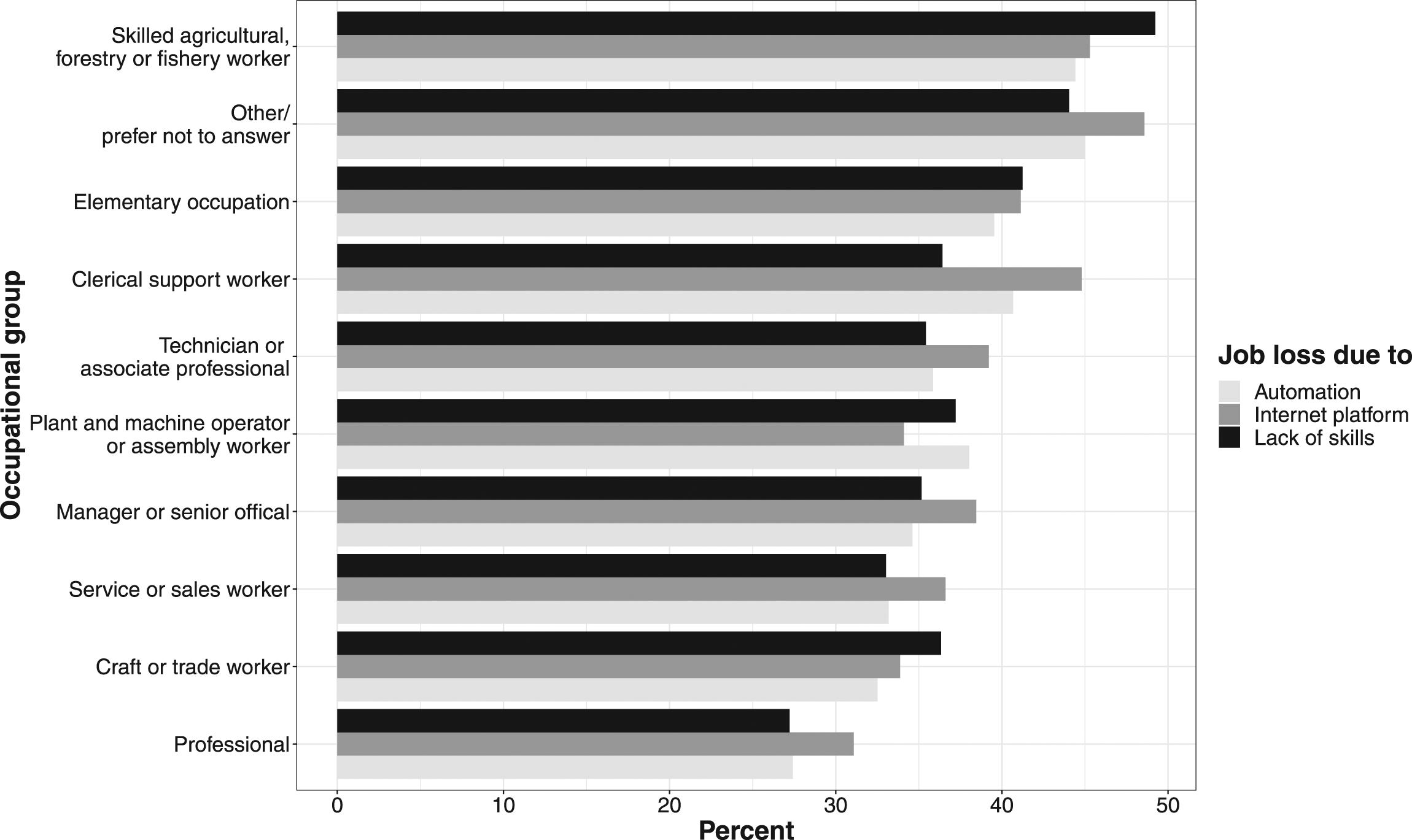
Applying a rotated principal component analysis, we use these three survey items to create an index of subjective technological risk that tries to capture whether an individual perceives technology as a threat to her job. The three survey items have a high degree of internal consistency (Cronbach’s alpha = .81). We base the index on the first component of the principal component analysis, which explains about 73% of the variation in the data.
4
Figure 3 depicts average values of our index of subjective technological risk across countries. We find that perceptions of risk are particularly low in European welfare states. In contrast, the highest mean values of subjective technological risk are in emerging markets like Chile, Turkey, Mexico, and Korea. Moreover, we find higher than average values of perceived risk in the liberal market economies of Canada and the United States, as well as in some European peripheral countries (Italy, Greece, and Poland). These descriptive findings suggest that the institutional context matters for risk perception, as individuals in more generous welfare states seem to be less concerned by the job implications of technological change. Average values of subjective technological risk across countries.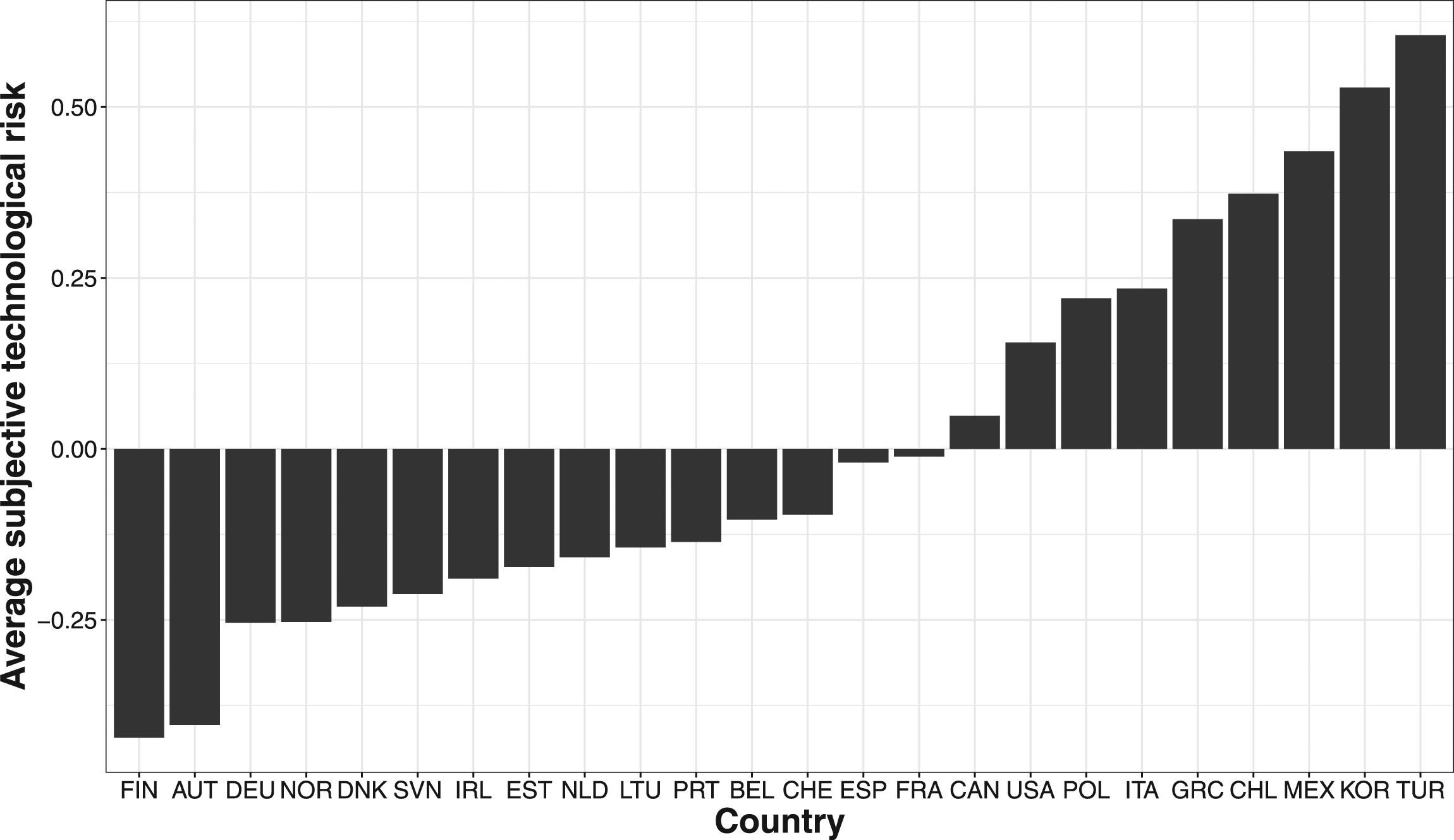
Institutional Context
To probe whether the impact of technological risk perceptions on policy preferences depends on the welfare state context, we include unemployment benefits to capture the existing level of compensation. We argue that while the institutional context affects overall support for different types of welfare policy among low-risk individuals, individuals perceiving high levels of risk will tend to demand more compensatory measures—especially unemployment benefits—irrespective of the existing level of compensation. We draw on data from the OECD that capture the proportion of previous in-work household income maintained after unemployment (including social assistance benefits). Calculations refer to a single person without children whose previous in-work earnings were 67% of the average wage. We consider income replacement rates after 12 (1 year) and 24 (2 years) months to allow for longer unemployment spells.
Figure 4 shows income replacement rates in unemployment after 1 year (bars) and 2 years (dots) for the countries in our sample (information on Chile and Mexico is not available). The average replacement rate across countries is about 49% after one year and 40% after 2 years, respectively. Unemployment benefits are particularly generous in some of the European welfare states like Belgium and Denmark, where roughly 80% of income is maintained 1 year after the job loss. However, in some of these European countries, the replacement rates drop significantly after 2 years in unemployment. For instance, the income maintained decreases from 70 to 26% in Switzerland and from 59 to 23% in Germany after the second jobless year. Thus, compared to the previous income in employment, longer periods without a job entail considerable income losses in most cases. Income replacement rates in unemployment after 1 year (bars) and 2 years (dots), 2019/2020 (latest year available).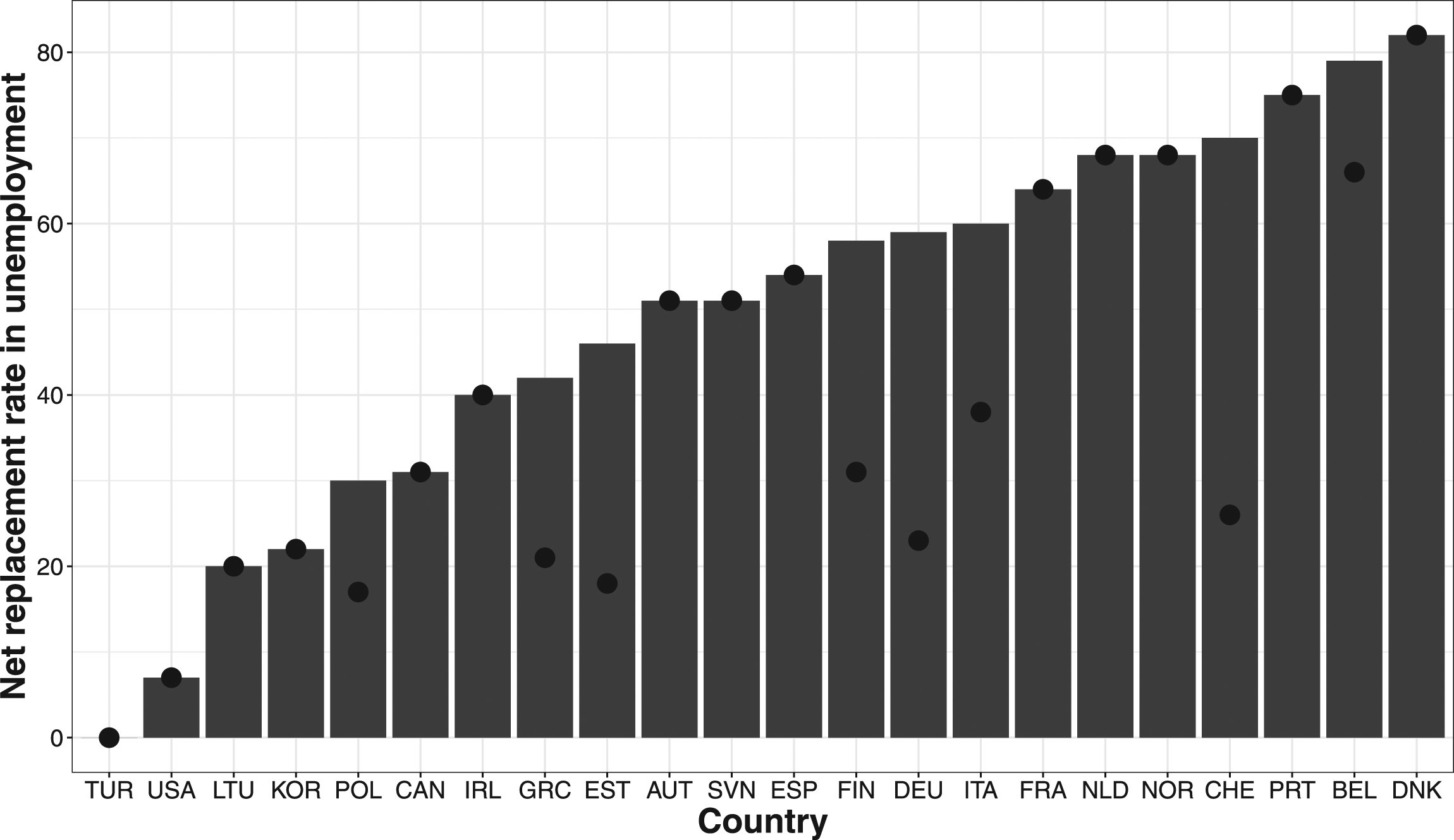
Control Variables
We use four additional items from the OECD RTM survey as control variables. First, we include a binary variable that captures whether an individual uses information and communication technologies like computers or laptops in her job most of the day. This variable aims to assess whether the policy preferences of constant technology users systematically differ from other individuals whose jobs rely less on technological devices. Second, we control for respondents’ age. Third, we add a binary indicator measuring whether an individual has received education at a university (tertiary education). Fourth, we consider the logged disposable annual income equalized for household size. 5
Modeling Strategy
Since the total amount of funds to be allocated is limited to 100, our survey question essentially imposes a budget constraint on respondents. This implies that when an individual decides to allocate more (less) funds to a particular policy proposal, there remain less (more) funds that she can distribute to other policy proposals. Put differently, respondents are forced to weigh the various policies against each other. Thus, the framing of the question captures the fact that individuals face a trade-off between different types of social policy.
To reflect this feature of the data in our analysis, the intuitive logic behind our modeling strategy is that we expand the dataset such that we treat each individual as a group that contains the individual-specific allocation of funds across the five policy proposals. This allows us to assess how the individual-specific funds of all five policy components—simultaneously—respond to changes in our explanatory variables. More specifically, we estimate MLMMs, which consider multiple dependent variables concurrently and also account for the nested structure of the data (individuals nested in countries).
The general regression equation is given by
The fixed effects (
We estimate the MLMMs in a Bayesian framework using the MCMCglmm package in R, which provides a natural syntax for multivariate responses (Hadfield, 2010). Beyond reasons of statistical philosophy, the Bayesian approach has two additional, practical advantages. First, it avoids the alleged anti-conservative bias in likelihood-based estimates of mixed models (e.g., Bryan & Jenkins, 2016; Stegmueller, 2013; but also see Elff et al., 2021). Second, the iterative process of Bayesian simulation facilitates the estimation of high complexity models like the proposed MLMM (Jackman, 2009). We assign weakly informative priors to the variance components. 6 Moreover, we center and scale all continuous variables by two times their SD in order to make the resulting coefficients comparable to the coefficients of the unscaled binary indicators (Gelman, 2008). 7
Results
Figure 5 presents standardized coefficients (posterior means) and 95% credible intervals from a Bayesian MLMM based on 20,000 Markov chain Monte Carlo iterations (of which the first 5000 are used as burn-in).
8
For each explanatory variable (labeled in bold, vertical font next to the brackets), we show one coefficient for each of the five policy proposals (i.e., our dependent variables): Education and vocational training opportunities for young people, retraining for working age people, benefits and services like unemployment compensation, UBI, and subsidies to firms. Thus, the figure shows how the individual budget allocations to all policies simultaneously respond to changes in the explanatory variables. Standardized coefficients with 95% credible intervals.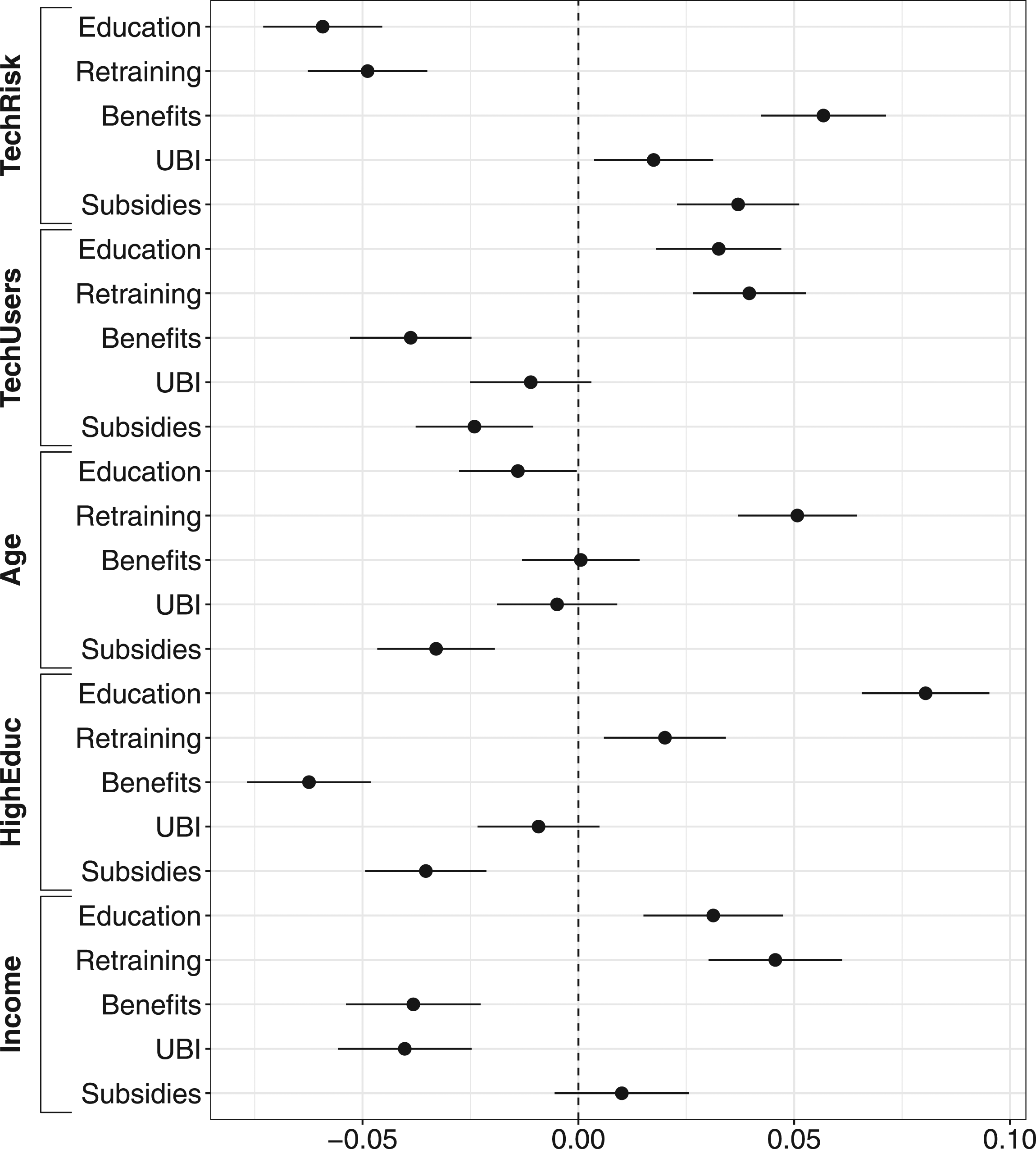
Technological risk (TechRisk) is the main variable of interest as defined in the Data section. The estimates show that the perceived risk of losing one’s job to technology has a very polarizing effect on the preferred allocation of funds. On the one hand, higher perceived risk is associated with less relative support for the funding of university education and vocational training opportunities for young people as well as retraining opportunities for working age people. On the other hand, high-risk individuals systematically favor more generous public benefits and services, subsidies to firms in industries most adversely affected by technological change, and the introduction of a UBI. In terms of magnitude, relative support for public benefits and services like unemployment compensation is the strongest among these three policy components. A one SD increase of perceived risk results in a .06 SD increase in relative support for more public benefits and services, which is about one additional fund on the original scale or a five percent increase from the mean value of funds allocated to public benefits and services. Simulating an increase from the lowest to the highest level of subjective technological risk increases the funding of public benefits and services by roughly three funds or 14% from the mean. This is about 1.5 times the size of the corresponding increase in the funds allocated to subsidies and about three times the size of an equivalent increase in the support for UBI. At the same time, the funding of education and (re-)training decreases by about the same amount as the simultaneous increase in funding of public benefits and services. Overall, these findings suggest that individuals who perceive technological change as an imminent employment risk tend to prefer compensatory policies over measures aimed at providing the skills necessary to succeed in the digital world. In particular, high-risk perceiving individuals support direct compensation in the form of unemployment benefits, which corroborates Hypothesis 1 from above.
The picture is reversed for those individuals who constantly use information and communication technologies in their current job (TechUsers), have tertiary educational attainment (HighEduc), and earn higher incomes. These individuals exhibit above average relative support for educational investments and retraining efforts, but tend to oppose compensatory policies, in particular increasing public benefits and services. More specifically, constant technology users favor retraining policies for the working age population, highly educated respondents strongly support education and training for the young, and high-income earners express a preference for both of these measures. Thus, there is evidence for a cleavage between the highly educated, high-income earning, technology-embracing part of the population—the so-called winners of technological change—on the one hand and those who fear the labor market implications of automation and digitalization—the so-called losers of technological change—on the other hand.
Looking at the last remaining control variable, the model shows that increasing age is associated with greater relative support for retraining opportunities and less relative support for firm subsidies. We also tested the potential non-linearity of age by adding its squared term (see Figure A5 in the appendix). The results demonstrate that the impact of age on support for retraining follows an inverse U-shape, with individuals approaching retirement becoming increasingly opposed to retraining measures. This aligns closely with existing empirical evidence suggesting that older workers tend to withdraw permanently from the labor market when faced with the need to upgrade their skills to new technology (see Battisti et al., 2017).
Our second hypothesis focuses on the potential effect of the institutional context. As a reminder, we expect that the existing degree of generosity in unemployment insurance schemes should influence overall levels of relative support for different types of social policy (Hypothesis 2a). We also expect that welfare state contexts should mediate the micro-level association between perceived tech-related employment risks and social policy preferences: Individuals who fear losing their job due to technological change in the near future are more likely to favor compensatory policies over social investment independent of the welfare state context, leading to a certain convergence of preferences for individuals with high-risk perceptions. In contrast, contextual effects are more likely to occur at lower levels of perceived risk (Hypothesis 2b).
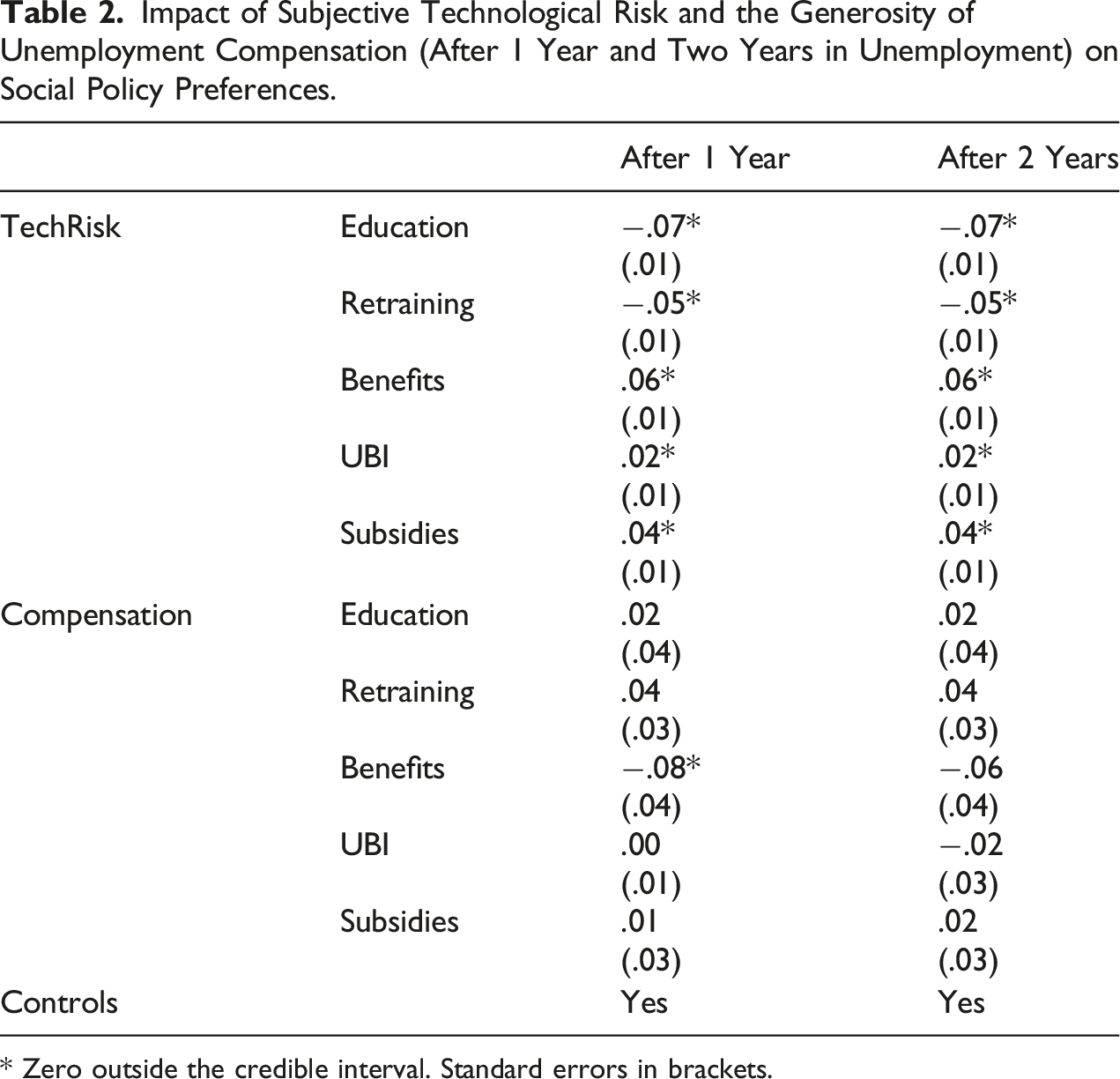
Impact of Subjective Technological Risk and the Generosity of Unemployment Compensation (After 1 Year and Two Years in Unemployment) on Social Policy Preferences.
* Zero outside the credible interval. Standard errors in brackets.
We find modest support for a self-undermining feedback effect in the sense that higher levels of unemployment generosity (after 1 year) are associated with lower individual-level relative support for public benefits and services, which is in line with Hypothesis 2a. This result confirms our previous descriptive analysis showing that unemployment benefits are particularly generous in European welfare states, where we also find on average lower levels of technological risk perceptions and lower support for policy responses based on direct compensation. In the case of long-term unemployment generosity (after 2 years), the sign of the coefficient points also in the expected direction but the estimate fails to reach statistical significance. Moreover, there are no significant associations with the other compensatory policies.
To test the mediating effect of the welfare state context on the relationship between subjective technological risk and social policy preferences, we interact the measures of unemployment generosity with our measure of risk perceptions. We expect that an increase in perceived technology-related employment insecurity should be associated with a greater increase in the relative support for compensation (and, in turn, a greater increase in the relative opposition to social investment) in mature welfare states than in residual welfare states, reflecting the fact that the former start from a lower base level of support for compensatory policies (and, in turn, a higher base level of support for social investment policies). We report the results in Table A3 in the appendix. The estimates indicate that rising subjective technological risk has a stronger positive impact on relative support for public benefits and services in countries with higher levels of unemployment compensation. In particular, for long-term unemployment compensation in the form of income replacement rates after 2 years, the interactive results suggest a similar pattern for relative support for UBI, but the opposite effect for relative support for retraining efforts, as expected by our Hypothesis 2b.
To make these interactive relationships more tangible, Figure 6 plots predicted average values of funds allocated to retraining, public benefits and services, and UBI (i.e., for those policy proposals for which we find statistically significant interaction effects) for different values of subjective technological risk conditional on low and high levels of unemployment compensation.
9
The results are in line with our previous interpretation. At low levels of subjective technological risk, there is a pronounced difference between residual (low unemployment benefits) and mature (high unemployment benefits) welfare states: Low-risk individuals in mature welfare state are more likely to support social investment in the form of retraining and significantly less likely to prioritize compensation policies compared to low-risk individuals in residual welfare states. Based on our simulation, at the lowest level of perceived technological risk individuals in residual welfare states allocate about 4 funds more to public benefits and services than individuals in residual welfare states, while at the same time distributing about 3 funds less to retraining. Effect of technological risk on support for retraining, public benefits and services, and UBI conditional on high and low unemployment compensation.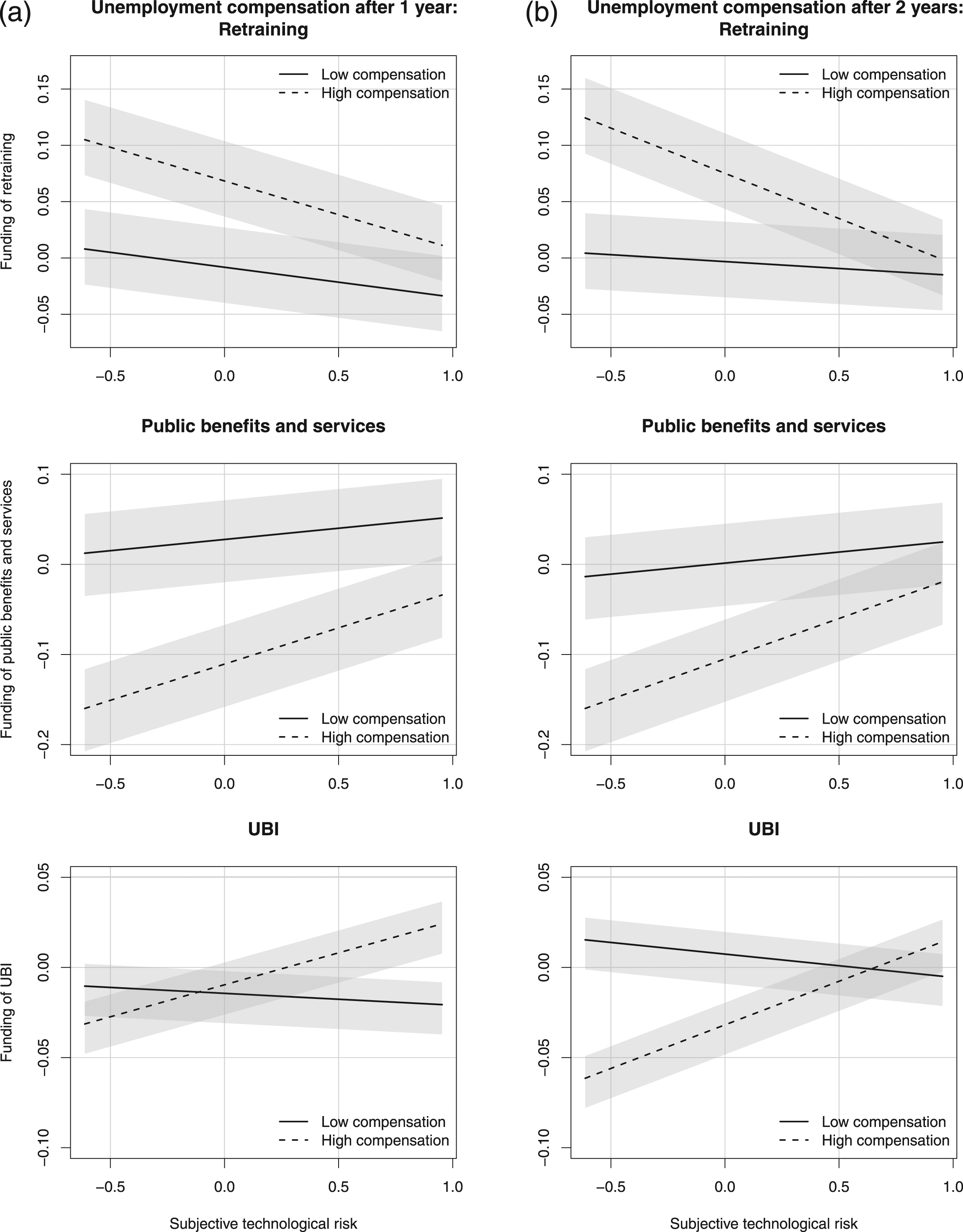
Yet as the perceived technological risk grows, the gap between more and less generous welfare state contexts increasingly disappears. This suggests that perceptions of individual risk trump the contextual effect of welfare state institutions. Thus, as stated by Hypothesis 2b, we find evidence for a considerable degree of convergence in social policy preferences for individuals with high risk perceptions who tend to prioritize compensation over social investment in both residual and more mature welfare states. Moreover, Figure 6 reveals no marked differences in this logic related to different measures of unemployment compensation. The only exception is the case of UBI, in which institutional differences are more pronounced when we focus on a longer time horizon in the form of unemployment generosity after 2 years. The corresponding graph suggests that—again based on the lowest observed level of subjective technological risk—residents in residual welfare states allocate on average two more funds to UBI than respondents from mature welfare states. However, as the perception of technology-related employment risks increases, the distribution of funds becomes essentially identical across welfare state contexts.
Sensitivity
We test the sensitivity of our results in several ways. As explained in the Data section, our index of subjective technological risk is based on three survey questions that ask respondents about the perceived likelihood of job loss due to different technology-related risks. In Figure 7, we compare the model results of our index to results based on each of these survey items. The estimates align very closely with each other. The only meaningful difference is that when we use the third survey item (“will lose job because of lack of skills”) instead of the overall index, the effect on relative support for UBI is no longer statistically significant. Comparing model results of subjective risk perceptions and RTI scores.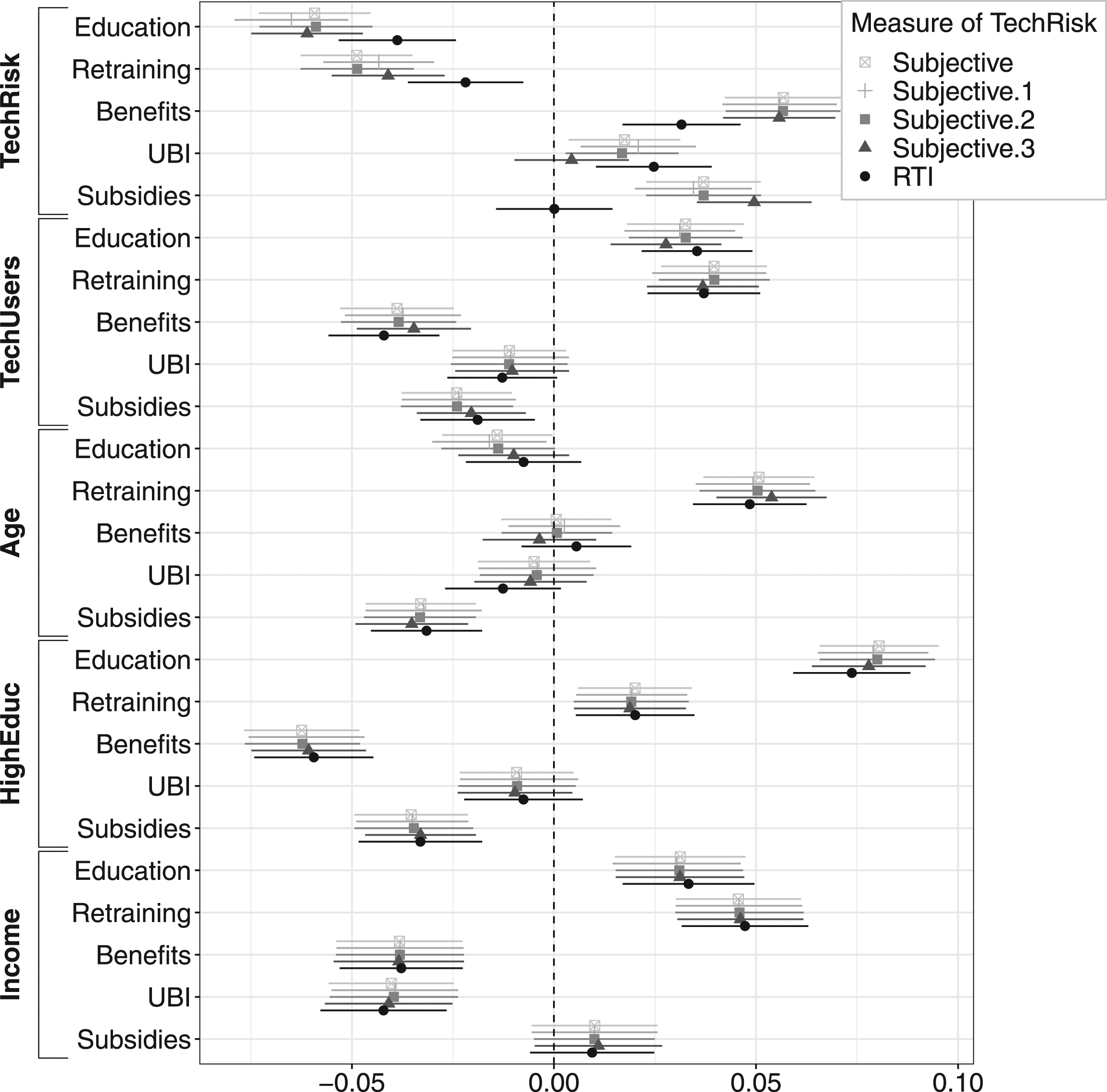
Moreover, our measure of subjective risk perceptions stands in contrast to much of the existing literature that employs more objective measures of automation risk such as the degree of RTI of an occupation (e.g., Goos et al., 2014; Thewissen & Rueda, 2019). Since the OECD RTM dataset only provides occupational information on one-digit ISCO-88 major groups, we are not able to replicate this approach in detail. To nevertheless test the sensitivity of our broad measure of technology-related risks to a RTI-based variable, we aggregate the RTI scores for occupations at the two-digit ISCO-88 level from Mahutga et al. (2018) to one-digit major groups and assign the resulting RTI scores to the respondents in our dataset.
Figure 7 shows that the RTI score approach does not produce substantially different estimates than our index of subjective technological risk perception (with the exception of the effect on subsidies, which is statistically insignificant when we use the RTI score). In both cases, higher technological risk is associated with lower relative support for funding of education and retraining, and more relative support for funding of benefits and services as well as UBI. The result that the effects of the RTI-score variable tend to be smaller than the effects of our subjective measure is not surprising (note, however, that effect on UBI becomes larger), as the rough classification of RTI scores along major occupational groups inevitably throws out a large amount of variation between individuals.
The appendix contains additional sensitivity tests. In Figure A6, we add dummies for each of the occupational groups listed in Figure 2. Our main results remain substantially unchanged. This is further evidence that our findings reflect genuine preference differences related to levels of subjective technological risk rather than differences between occupational groups. Moreover, Figure A7 shows that our findings are robust to including proxies for political ideology and general job insecurity. In Figure A8, we make use of the fact that the survey contains unconstrained versions of all but one of our dependent variables (subsidies to firms are not included). Respondents were asked whether they oppose or support the respective policies—independently from each other—as a response to digitalization and technological change. Analyzing these data, we find our previous results corroborated: Higher subjective technological risk is associated with more support for public benefits/services and UBI (i.e., compensation), and less support for education and retraining (i.e., social investment).
We also account for the possibility that the constrained nature of our dependent variables might lead to biased results due to the fact that the data are bounded and the correlation between the individual policy components is by definition negative. The corresponding compositional analysis (see Aitchison, 1986) in Table A2, however, suggests that this is not the case, lending further evidence to the robustness of our findings. In addition, Table A3 shows that the results of the interaction between subjective technological risk and welfare state context are robust to the inclusion of additional country-level variables. Controlling for income inequality, exposure to economic globalization, and trust in government at the macro level does not substantially change our main findings. Moreover, Table A4 tests and rejects the proposition that these interactive results depend on individual countries by excluding one country at the time. Finally, it might be argued that social investment policies as a response to technological change find stronger support in contexts that have experience with generous activation measures. We thus repeat our contextual analysis using active labor market policy spending as a percentage of GDP instead of unemployment compensation. The results in Table A5 closely resemble our previous findings. This suggests that it is indeed the overall generosity of the welfare state context that is decisive for social policy preferences on technological change, and not the relative importance of passive and active policies.
Conclusion
This paper has provided an in-depth analysis of social policy preferences on technological change by making use of novel and original data collected during the 2020 wave of the OECD’s RTM survey. Specifically, these data measure technology-related social policy preferences in a constrained budget environment to provide a reliable understanding of individual trade-offs between different types of social policy. Moreover, we apply statistical models that explicitly take these trade-offs into account. Our study reveals a number of important findings.
First, individuals who perceive their job to be strongly exposed to technological labor market risks are more likely to prefer compensatory policies like unemployment benefits to investment-oriented policies such as education and retraining, although the latter would arguably be more effective solutions to the challenges of technological change in the long run. Second, we provide evidence for policy feedback effects. Overall relative support for compensatory policies in response to automation and digitalization is higher in residual welfare states than in more generous welfare states, indicating the existence of a self-undermining feedback loop from existing policy to policy preferences. Yet, while we find significant differences in relative support for compensation and social investment policies for individuals with low risk perceptions, social policy preferences on technological change among individuals perceiving themselves to be at high risk tend to converge in ways that transcend different welfare state contexts.
These findings have significant political implications. Experts commonly recommend policy responses to automation and digitalization that focus on increasing investments in human capital formation, promoting science education, and basic research (Colin & Palier, 2015; McAfee & Brynjolfsson, 2016). While these measures may pay off in the longer term, our analysis shows that those most affected by technological change are more likely to seek direct forms of compensation through increased unemployment insurance and social transfers. Thus, this study provides an outlook on the possible contours of a future politics of the welfare state, in which a new political cleavage between the winners and losers of technological advancement might become central. Recent empirical work on this topic has already shown that those on the losing end of this divide may be more susceptible to the siren calls of right-wing populist parties (Anelli et al., 2019; Frey et al., 2018; Milner, 2021).
Against this backdrop, researchers should address the question of whether political elites perceive and, if so, how they cope with the dilemma between, on the one hand, promoting necessary social investments that deal with technological change from a long-term perspective and, on the other hand, strengthening compensatory policies in order to prevent significant sociopolitical disruptions in the short term. Another potentially fruitful avenue for research, which we could not address in this article, is to assess the relative impact that different sources of labor market risk like technological change, globalization, or other structural factors such as climate change and migration have on the formation of social policy preferences. Finally, our research design focused on spending policies. However, as mentioned earlier, the range of potential government responses to automation and digitalization also comprises other types of policy like regulation (Gallego et al., 2022). Additionally accounting for these policy solutions should yield a more complete picture of the political implications of technological change. We hope and plan to explore these topics in more detail in the future.
Supplemental Material
Supplemental Material - Dealing with Technological Change: Social Policy Preferences and Institutional Context
Supplemental Material for Dealing with Technological Change: Social Policy Preferences and Institutional Context by Marius Busemeyer and Tobias Tober in Comparative Political Studies
Footnotes
Acknowledgments
The authors thank Reto Bürgisser, Aina Gallego, Jane Gingrich, Alexander Kuo, Paul Marx, Thomas Kurer, the reviewers and editors at CPS, members of the Working Group on Comparative Political Economy at the University of Konstanz, and the participants at the SASE Annual Conference 2021 and the Max Planck Online Workshop in Comparative Political Economy for comments on earlier drafts.
Declaration of Conflicting Interests
The authors declared no potential conflicts of interest with respect to the research, authorship, and/or publication of this article.
Funding
The author(s) disclosed receipt of the following financial support for the research, authorship, and/or publication of this article: This research received financial support from Deutsche Forschungsgemeinschaft; EXC 2035/1.

Supplemental Material
Supplemental material for this article is available online
Notes
Author Biographies
References
Supplementary Material
Please find the following supplemental material available below.
For Open Access articles published under a Creative Commons License, all supplemental material carries the same license as the article it is associated with.
For non-Open Access articles published, all supplemental material carries a non-exclusive license, and permission requests for re-use of supplemental material or any part of supplemental material shall be sent directly to the copyright owner as specified in the copyright notice associated with the article.
