



Abstract
A number of studies suggest that the Europeanisation process is having a profound impact on national labour market policies. Nevertheless, rather little research has been devoted to the development of social assistance schemes across countries and over time. Relying on two new indicators, benefit levels and replacement rates, we examined the relationship between the Lisbon Strategy and changes in national social assistance benefits. We found no robust results for the first years of the Lisbon Strategy. However, after its re-launch in 2005, there was a positive association between the Lisbon Strategy and social assistance benefit levels. In addition to the Lisbon Strategy, domestic political, institutional and several economic factors were significantly associated with social assistance benefits.
Introduction
Europeanisation can be defined as the impact of European integration on member states (Radaelli 2002). More specifically, it refers to the impact on policies, polities and politics. In the field of social policy, the process of Europeanisation has been visible since the introduction of the Lisbon Strategy. After the Lisbon Summit in 2000, the fight against poverty and social exclusion has become one of the central tenets in the modernisation of the European social model (European Council 2000a). A number of studies show that the Europeanisation process has triggered or contributed to domestic labour market policy reforms (Armingeon 2007, Paetzold and Van Vliet 2014, Swank 2011, Van Vliet and Koster 2011). Nevertheless, relatively little research has been devoted to the relationship between the Lisbon Strategy and domestic social assistance policy reforms. This is remarkable as these benefit schemes play a central role in combating poverty and the pursuit of social inclusion. As the last-resort safety net, social assistance benefits are important instruments for providing social protection, which was emphasised by the Lisbon Council (European Council 2000a). Furthermore, since the European coordination of social policy is still based on legally non-binding means of governance, it is important to acquire insight into the domestic impact of the Lisbon Strategy.
In this study, our aim was to complement the existing literature by exploring the Europeanisation of national social assistance policies. However, it is difficult to assess the extent to which the Lisbon Strategy has contributed to domestic social assistance benefit reforms.
Assessing the impact of the European strategy might be over-determined due to its non-binding character (Zeitlin 2009). Hence, the aim of this study was to analyse changes in social assistance benefits after the launch of the Lisbon Strategy in 2000 and its re-launch in 2005, and to explain the cross-national variation in benefit policy changes, accounting for several political, economic and institutional factors.
We seek to make three contributions with this article. First, existing Europeanisation studies have focused on the Lisbon Strategy that was launched in 2000. In 2005, the governance structure was modified in order to increase its effectiveness and the strategy was then re-launched. This study accounts for this re-launch. Second, the empirical analysis is based on two new indicators for comparing the levels of social assistance benefits across countries and over time, namely, net benefit levels and net replacement rates (Wang and Van Vliet 2016b). Third, the analysis of the determinants of benefit levels in welfare state programmes such as unemployment benefits has been a central subject in the comparative political economy literature (e.g. Allan and Scruggs 2004, Korpi and Palme 2003). Nelson (2013a) and Van Vliet and Wang (2017) have examined the determinants of social assistance benefits. With regard to these two studies, the contribution of the current study is that it includes the role of EU coordination in the analysis.
Europeanisation of social assistance benefits
Social assistance benefits
Social assistance benefits are public transfers that are aimed at helping households obtain an adequate standard of living which employ a low-income criterion as the central entitlement condition (Adema 2006, Immervoll et al. 2015). Because this broad definition encompasses several low-income programmes, such as child supplements and tax credits, in addition to basic allowances, the terms ‘social assistance’ and ‘minimum income’ benefits are used interchangeably in this article. Depending on the specific structure of the welfare state, social assistance generally functions as a last-resort safety net. That is, eligibility for social assistance arises if eligibility for other transfers has been exhausted. Social assistance benefits have developed considerably over the past few decades (Van Mechelen and Marchal 2013). Nearly all OECD countries have minimum income schemes for households that do not have sufficient other resources to support themselves (Adema 2006). In addition, combating poverty and providing income protection have been central objectives of the European social policy coordination and integration processes (European Council 2000a). Since the 1990s, minimum income protection has been a recurrent theme of the EU governance in combating poverty and social exclusion (Vandenbroucke et al. 2013).
In the welfare state literature, the effectiveness and efficiency of low-income targeting in reducing income inequality and financial poverty have been extensively studied (Smeeding 2006). Recent studies show that in many European countries the levels of social assistance benefits are not adequate to lift households out of poverty (Figari et al. 2013, Hölsch and Kraus 2006, Marchal et al. 2014, Nelson 2010, Nelson 2013a, Van Mechelen and Marchal 2013, Wang and Van Vliet 2016a).
Lisbon Strategy 2000
In 1992, the European Council suggested that Member States should recognise ‘the basic right of a person to sufficient resources and social assistance to live in a manner compatible with human dignity’ under Recommendation 92/441/EEC (European Council, 1992). This recommendation set out common criteria to ensure adequate social assistance. Together with other recommendations, the 92/441/EEC Recommendation was an important step in the evolution of a European agenda against poverty and social exclusion (Anderson 2015).
A new impetus was given at the European Council of Lisbon in March 2000. On this occasion, the Lisbon Council incorporated social inclusion as something intrinsic to the overall strategy of the Union, setting an ambitious goal for the EU ‘to become the most competitive and dynamic knowledge-based economy in the world capable of sustainable economic growth with more and better jobs and greater social cohesion’ during the period 2000–2010 (European Council 2000b, p.2). As such, the Lisbon Strategy was a turning point in the discourse on the social dimension of the European integration process. Its ambition was to ensure that each citizen can count on basic rights and adequate resources (Ferrera et al. 2002). Later, in December 2000, the Nice European Council approved a set of objectives for the fight against poverty and social exclusion. In this respect, social assistance was considered as an essential safety net for the most vulnerable groups in society (European Council 2000a).
The Lisbon Strategy was based on an intergovernmental means of EU governance, the Open Method of Coordination (OMC). The OMC has been applied to several policy fields, such as employment and education. At the Lisbon summit, the European Council extended the OMC to cover a wide range of social policy areas, including social inclusion and the modernisation of social protection systems (Barcevičius et al. 2014). For the coordination of social policies, OMC Social Inclusion was created. Leaving the responsibility for social policy to policy-makers at national level, it proposes legally non-binding guidelines, national action plans, peer reviews, joint evaluation reports and recommendations (Ferrera et al. 2002). That is, member states agree on a set of non-binding common objectives, prepare national action plans on a regular basis to meet these objectives, the European Commission then evaluates these plans and publishes them in Joint Commission/Council reports, and social indicators are defined to allow for performance monitoring and frame convergence (Daly 2008). The social indicators encompass, among other things, financial poverty, income inequality and long-term unemployment. As such, the OMC intends to disseminate best practices and achieve greater convergence towards the Lisbon goals.
Lisbon Strategy 2005
Evaluations and case studies showed that the actual impact of the Lisbon Strategy was rather limited (Zeitlin et al. 2005). After five years, a mid-term evaluation of the Lisbon Strategy indicated that its outcome was rather disappointing (European Council 2005). An overly complex structure, multiple goals and actions, and an unclear division of responsibilities and tasks were responsible for the limited effectiveness of the Lisbon Strategy in its early years (European Commission 2010). In response to this critical evaluation, the Lisbon Strategy was re-launched by the Barroso Commission in 2005. First, a stronger EU framework was developed. In this revised strategy, the most important change was the procedural re-organisation into three main steps, namely, defining a series of European integrated guidelines, implementing these guidelines through national reform programmes, and monitoring the progress country by country (Borrás and Radaelli 2011). Following these changes, the roles of the Commission, the Council and the member states have been redefined and have become clearer (Barcevičius et al. 2014).
Second, compared with the broad ranging Lisbon Strategy 2000, the objectives of the Lisbon Strategy 2005 on social inclusion were narrowed: ‘Ensure the active social inclusion of all by promoting participation in the labour market and by fighting poverty and exclusion among the most marginalised people and groups, guarantee access for all to the basic resources, rights and social services needed for participation in society….’ (European Commission 2005).
Third, the OMCs in the fields of social inclusion, pensions and health and long-term care were streamlined and interdependent policy areas were integrated into a new Social OMC. The intention of this institutional change was that synergies could be generated and that complex challenges could be approached more effectively (Barcevičius et al. 2014).
Overall, the influence of the OMC can be defined either as substantive or as procedural, mainly through the mechanisms of peer pressure, mutual learning, socialisation, discursive diffusion, creative appropriation and external support (De la Porte and Pochet 2002, Hamel and Vanhercke 2009, Weishaupt 2014b). Substantive influence refers to shifts in actors’ positions or the weights they put on particular issues, or shifts in the legislated, administrative or organisational rules and practices. Procedural impact can be understood as the enhancement of horizontal coordination and integration between interdependent policy fields, enforcement of vertical coordination between levels of governance, rising involvement of non-state actors and subnational actors, and improvement in national steering and statistical capacities (Weishaupt 2014b).
Both substantive and procedural effects have been found in Belgium, France, Portugal, Spain and the United Kingdom. In Denmark and Germany, the OMC has had mainly substantive effects and in Italy mainly procedural effects have been found (Weishaupt 2014b). For instance, in Belgium, procedural influences included building statistical capacity, adopting national and subnational poverty targets, promoting both horizontal coordination in the Brussels region and vertical coordination by including non-governmental stakeholders. Substantively, the OMC exerted important leverage effects to justify raising the levels of minimum income benefits for the elderly poor (Vanhercke 2014). In Italy, the Social OMC contributed to the launch of a series of surveys and studies on homelessness and poverty conditions, which were aimed at developing adequate services for the most vulnerable people for social insertion (PPMI 2011: 120). In Denmark, the Social OMC has placed and maintained the issue of poverty on the political and public agendas and ideational and policy exchange percolated through to the development of homelessness strategies (De la Porte 2014).
Case studies of countries like Germany and Belgium show that the effects of the Social OMC have actually been more visible since 2005 (Weishaupt 2014a, Vanhercke 2014). After the re-launch of the Lisbon Strategy, governance instruments of the Social OMC, such as common objectives, monitoring based on common indicators, mutual learning process and reporting on progress, have been functioning more adequately (Barcevičius 2014). Therefore, in line with these observations, we hypothesised that the Lisbon Strategy has been positively associated with the developments of national social assistance benefit schemes and we expected the upward trend to be greater after 2005.
Hypotheses on domestic politics, institutions and socioeconomic developments
Domestic politics and institutions
Case studies show that the influence of the OMC varies across the member states, depending on a country’s domestic institutional and political situation (Weishaupt 2014b). In the comparative political economy literature on welfare states, partisan preferences are traditionally considered to play an important role in the explanation of policy reform. The general proposition is that left-wing parties are more in favour of generous social transfers than are right-wing parties (Allan and Scruggs 2004, Korpi and Palme 2003, Potrafke 2016, Swank 2013). In line with this literature, we expect left-wing parties to be positively associated with social assistance benefit levels. 1 Yet, Jessoula et al. (2014) recently argued that left- and right-wing preferences might differ from the general proposition. Left-wing parties may be more likely to support broader (occupational) social insurance programmes rather than social assistance benefits, and right-wing parties might support social assistance benefits over social insurance programmes, as a less expensive programme to help those harmed by market failures.
Similarly, trade unions are considered as important actors in welfare state reforms in the sense that they are strong defenders of social insurance programmes (Rueda 2007, Starke 2006). This also applies to the domestic impact of the OMC Social Inclusion when social partners are consulted in the policy-making processes (Jacobsson and Johansson 2009). Hence, we expect a positive association between the strength of trade unions and social assistance benefits. 2
Furthermore, political institutions are often considered as relevant factors in welfare state reforms. A proportional representation electoral system provides more institutional opportunities for parties with egalitarian policy goals to resist benefit cuts (Swank 2002). Therefore, it can be expected that proportional representation electoral systems are positively related to social assistance benefit levels.
Socioeconomic developments
In addition to Europeanisation and domestic political institutions, the comparative welfare state literature indicates that reforms may also be triggered or affected by a number of socio-economic developments. High levels of unemployment lead to higher expenditures on unemployment and social assistance benefits. The resulting budgetary pressure may trigger social assistance benefit reform. Thus, it can be expected that unemployment levels will be negatively associated with social assistance benefit levels (Brady and Lee 2014, Korpi and Palme 2003). Furthermore, GDP per capita is a frequently used variable in the welfare-state literature. According to Wagner’s law, more economically developed countries have more generous social protection systems (Meltzer and Richard 1983). Welfare state reforms may also be influenced by globalisation. There are two central hypotheses regarding the relationship between globalisation and welfare state reform. According to the efficiency hypothesis, governments implement efficiency-oriented reforms in order to offer attractive conditions for firms (Garret and Mitchell 2001). In contrast, the compensation hypothesis states that governments expand welfare states to compensate people who face increased economic risks as a result of globalisation (Rodrik 1998). In addition to the effects of globalisation, increased economic risks may also stem from structural changes on domestic labour markets (Iversen and Cusack 2000). Thus, we tested the hypothesis that deindustrialisation is positively related to social assistance benefits.
Data and methods
Dependent variable
The dependent variable of this study is the change of social assistance benefit levels. We relied on two indicators to measure these benefit levels (Wang and Van Vliet 2016b). First, we used the real net benefit level, which is a relatively straightforward measure of the generosity of social assistance benefits (Olaskoaga et al. 2013). Data on benefit levels were taken from the Social Assistance and Minimum Income Protection Interim Dataset (SaMiP, Nelson 2013b). 3 Net minimum income benefits are defined as the net income from a benefit package consisting of basic social assistance, child supplements, refundable tax credits and other benefits. 4 These benefit levels are expressed in US dollars, adjusted for Purchasing Power Parity (PPP, each year PPP for the United States is equal to 1) and inflation (CPI 2005=100), which enabled us to compare benefits across countries and over time. Data on PPPs were taken from the Penn World Table (Heston et al. 2012) and for the CPI we used data from the World Development Indicators (World Bank 2012). 5
As a second indicator, we used the net minimum income replacement rate to examine the generosity of social assistance benefits relative to the wages in a country. 6 This measure is defined as the ratio of the net benefit level to the net average production worker wage. The net average production worker wage refers to the in-work wage after deducting taxes. As such, this minimum income replacement rate is constructed in a similar way as, and thus is comparable to, unemployment benefit replacement rates (Allan and Scruggs 2004, Van Vliet and Caminada 2012).
For both the real benefit level and the replacement rate, we took the simple average of the indicators calculated for three household types: single persons, lone parents with two children, and households with two parents and two children. 7 In the sensitivity analyses, we tested our hypotheses for each family model separately.
Explanatory variables
To examine the development of national social assistance benefits since the Lisbon Strategy, we followed the approach used in empirical studies on the relationship between European coordination and national labour market policies, namely dummy variables (e.g. Armingeon 2007, Swank 2011). First, we included a variable that captures the effect of the Lisbon Strategy 2000. Specified as a dichotomous variable, it is scored 0 for EU countries for the years before 2000 and 1 for the years afterwards. As a second Europeanisation variable, we included a dichotomous variable that is scored 0 for the EU countries before 2005 and 1 afterwards (2005 – 2009) to assess the impact of the revised Lisbon Strategy. Hence, this dummy variable not only captures changes in the year directly after the re-launch, but also in later years. 8
To examine the role of domestic politics and trade unions in social assistance benefit reforms, we included the percentage of total cabinet posts held by left-wing parties and union density, respectively. Data for left-wing parties and union density were taken from the Comparative Political Data Set (Armingeon et al. 2012). To account for the variation in national electoral institutions, we included a dummy variable, scored 1 for a proportional representation system and 0 otherwise. Data were derived from the Dataset of Political Institutions (Beck et al. 2001).
To account for the constraining effect of unemployment on social policy budgets, we used unemployment rate data from the World Development Indicators Dataset (World Bank 2012). For GDP per capita, we relied on the Penn World Table (Heston et al. 2012). In addition, we used trade openness and capital openness measured as a percentage of GDP to control for the effects of economic openness of a country, relying on data from the World Development Indicators Dataset (World Bank 2012). Finally, Iversen and Cusack’s (2000) measure of deindustrialisation was constructed based on data from the OECD Labour Statistics (2015).
Method
Identifying the role of the Lisbon strategy in domestic policy-making is a methodological challenge. This relates to the more general issue in Europeanisation research of isolating the impact of European integration from national and global dynamics, which essentially comes down to the lack of a counterfactual (Haverland 2007). Following earlier studies, (Armingeon 2007, Paetzold and Van Vliet 2014, Swank 2011, Van Vliet and Koster 2011) our approach to this issue entails a comparative analysis based on pooled time-series-cross-sectional data. To control for global trends in social assistance benefits, a group of seven non-EU countries – Australia, Canada, Japan, New Zealand, Norway, Switzerland, the United States – are included, in addition to 14 EU countries: Austria, Belgium, Denmark, Finland, France, Germany, Ireland, Italy, Luxembourg, the Netherlands, Portugal, Spain, Sweden, the United Kingdom. Furthermore, as discussed above, a number of variables are included to control for domestic dynamics. The main advantage of this approach (for instance compared to a case-study design) is that it utilises considerable variation that stems from the large number of countries and years. In addition, it enables us to systematically control for domestic factors. This combination provides leverage for identifying any impact of the Lisbon Strategy. The main limitation of this approach (for instance compared to a case-study design) is that it does not rely on detailed information on policy processes.
The year 1990 was taken as the first data year because earlier data on social assistance benefits were not available. The analysis ends in 2009 because this is the last year of the Lisbon Strategy. Its successor, the Europe 2020 Strategy, was launched by the Commission in 2010. As this coincides with the peak of the economic crisis, it is not really possible to distinguish the impact of Europe 2020 on domestic social policy reform from the impact of the crisis. Therefore, Europe 2020 was not included in the analysis. Given the fact that Eastern European countries entered the EU in 2004 2007 and 2013, there is little or no time-variation in the Lisbon Strategy variables in these countries. Thus, Eastern European member states were not included in the analyses.
To analyse the data, the study employed an error correction model (ECM). This is a conventional estimator in comparative political economy studies on welfare state reform (e.g. Ansell and Gingrich 2013, Busemeyer 2009, Iversen and Cusack 2000, Swank 2011). Because an ECM can be used for stationary and integrated data alike, it is capable of overcoming issues of unit roots (De Boef and Keele 2008). Moreover, models relying on level variables only are said to be prone to high levels of autocorrelation, whereas ECMs proved to tone down this effect (Podestà 2006). Since an ECM stipulates that both the dependent and a number of the independent variables are measured as first differences, our model accounts for issues of stationarity and autocorrelation, two problems that often make pooled time-series cross-section regression complicated (Kittel and Winner 2005). In an ECM, first-differences of the dependent variable are regressed on the lagged level of the dependent variable and on both the first-differences and the lagged levels of the independent variables. Short-term transitory effects are captured by the first differenced variables and long-term structural effects are captured by the lagged levels (De Boef and Keele 2008). Our estimations took the following form:

Here, α refers to the intercept. Δ Yi,t stands for the changes in the dependent variable in country i and year t. 9 Yi,t-1 represents the lagged levels of the dependent variable. The first differences and lagged levels of the explanatory variables are expressed by ΔXi,t and Xi,t-1 respectively and εi,t is the error term. 10
Panel-corrected standard errors were used to correct for panel heteroscedasticity and contemporaneous spatial correlation (Beck and Katz 1995). The main regressions did not include fixed effects, as a dynamic model may generate inconsistent estimations in that case (Nickell 1981). However, fixed effects models are presented here as robustness checks.
Empirical results
Trends in the minimum income indicators
Table 1 presents the developments in the real levels of annual net minimum income benefits and of net minimum income replacement rates over the period 1990–2009. 11 The data show that the minimum income benefit levels vary substantially across countries. In 2009, the highest benefit levels could be observed in Luxembourg, followed by Japan, Denmark, Ireland and Italy. Portugal, Spain and the United States are the countries with the lowest benefit levels. Remarkably, between 1990 and 2005, the average benefits were higher in the non-EU OECD countries than in the EU countries. In 2009, however, benefit levels were on average higher in the EU countries than in the non-EU countries.
Real minimum income benefit levels and minimum income replacement rates, 1990-2009
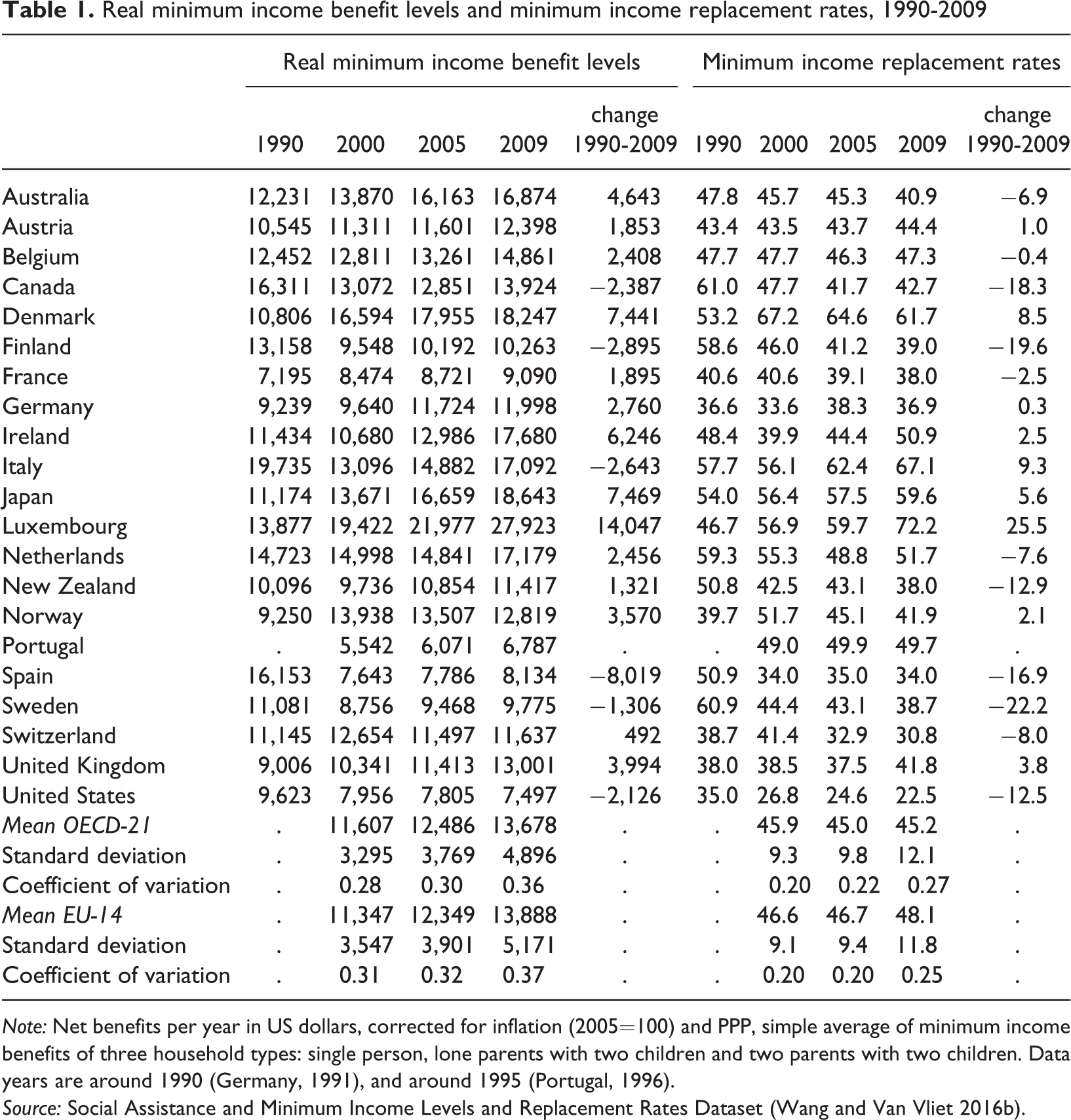
Note: Net benefits per year in US dollars, corrected for inflation (2005=100) and PPP, simple average of minimum income benefits of three household types: single person, lone parents with two children and two parents with two children. Data years are around 1990 (Germany, 1991), and around 1995 (Portugal, 1996).
Source: Social Assistance and Minimum Income Levels and Replacement Rates Dataset (Wang and Van Vliet 2016b).
The data show considerable variation over time. In most countries, benefit levels were raised in real terms between 1990 and 2009, implying that the increase in benefit levels exceeded that in consumer prices. The largest increases occurred in Luxembourg, Japan and Denmark. Meanwhile, there are also several countries where benefit levels were reduced in this period. The sharpest decrease can be observed in Spain, followed by Finland. Interestingly, for both country groups, the benefit levels on average decreased before 2000. However, after 2000 and especially after 2005, the benefit levels began to show substantial increases.
As is the case for benefit levels, the replacement rates vary considerably across countries. In 2009, Luxembourg and Italy had the highest replacement rates, while the United States had the lowest replacement rate. In most countries, replacement rates declined during the 1990s. In the EU countries, replacement rates rose in particular after 2005.
For most countries, the real benefit levels and the replacement rates showed parallel developments. However, in Australia, Belgium and the Netherlands, the benefit levels increased but replacement rates declined. In Italy, the benefit level was reduced, but the replacement rate increased between 1990 and 2009. Overall, the correlation between benefit level and replacement rate was 0.7.
Lastly, for both indicators, the standard deviation and the coefficient of variation increased both within and outside the EU. The diverging trend of minimum income benefit schemes is remarkable, as convergence has been found for many other welfare state programmes (Caminada et al. 2010).
Regression results
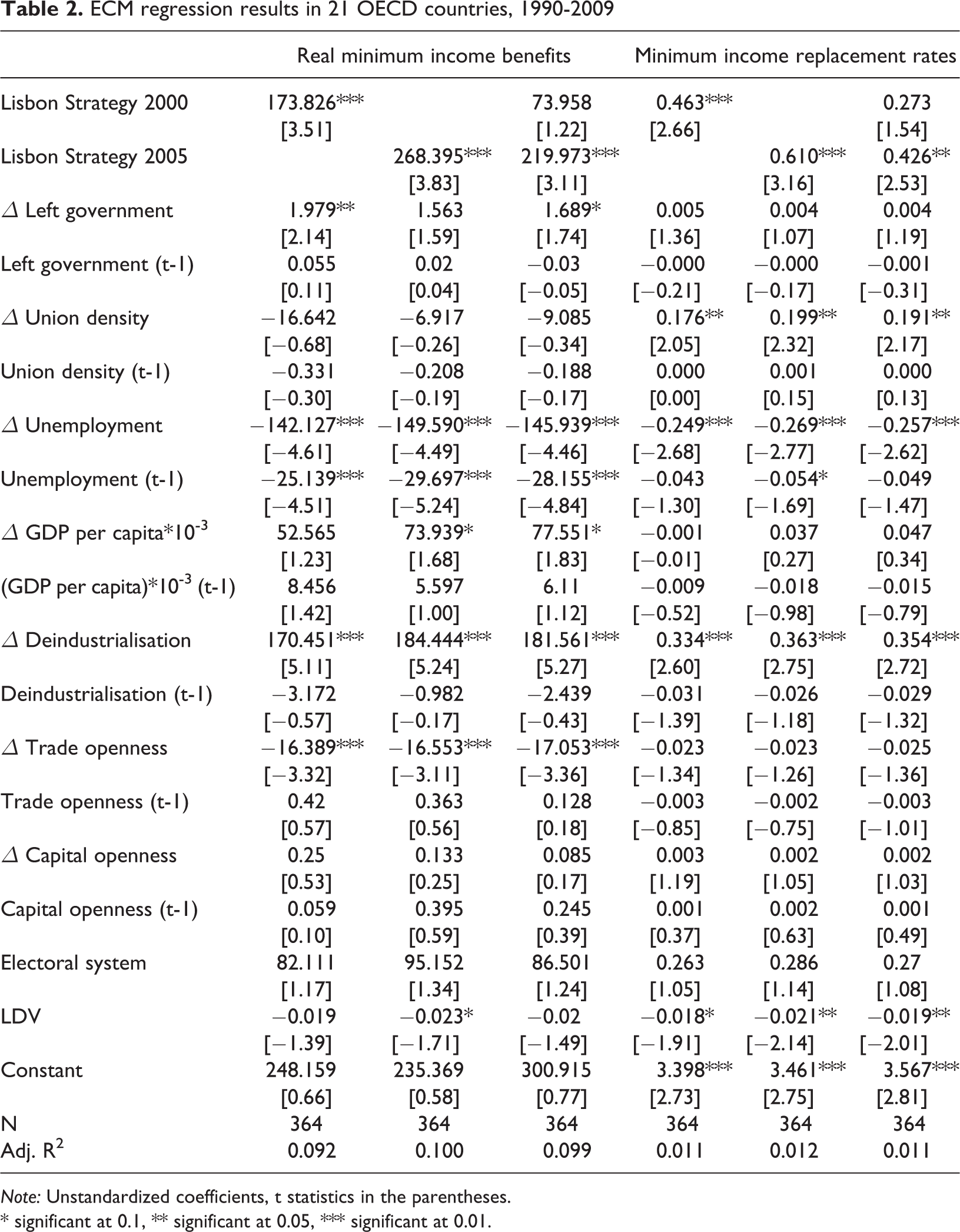
The results of the regressions are presented in Table 2. First and foremost, both the Lisbon Strategy 2000 and the revised Lisbon Strategy 2005 are positively and significantly related to real minimum income benefits and minimum income replacement rates. In line with our hypothesis, these results suggest that the Lisbon Strategy 2000 and 2005 contributed to positive developments of minimum income benefits.
ECM regression results in 21 OECD countries, 1990-2009
Note: Unstandardized coefficients, t statistics in the parentheses.
* significant at 0.1, ** significant at 0.05, *** significant at 0.01.
Regarding domestic politics, the results indicate that left-wing governments are positively and significantly associated with social assistance benefits in the short run. This result seems to suggest that the general hypothesis that left-wing parties have a preference for more generous welfare states also applies to social assistance benefits. However, this should be interpreted with caution, as the coefficients for replacement rates and for the long-run are positive but insignificant. The results for the role of trade unions are comparable in this respect. The positive and significant short-run coefficient for replacement rates suggests that trade unions act as defenders of social assistance, as they do for social insurance programmes. However, the evidence is weak, as the coefficients for the benefit levels and the long-run are insignificant. The results for the electoral system are also insignificant.
Turning to the socioeconomic variables, the effect of unemployment supports our hypothesis that rising unemployment has been followed by retrenchment of social assistance benefits. Interestingly, the coefficient for GDP per capita is strongly positive in the regressions for real minimum income benefits, but is insignificant in the estimations of the replacement rate. One possible explanation might be that although governments place more emphasis on social protection as income increases, average wages increase as well, resulting in insignificant effects. Furthermore, the results for deindustrialisation suggest that structural transformation of the labour market is associated with higher social assistance benefits, although significant coefficients can only be found for the short run. Finally, trade openness is negatively and significantly related to social assistance benefits, which provides support for the efficiency hypothesis. The results for capital openness are insignificant.
Sensitivity analyses
To examine the robustness of the results, we performed a number of sensitivity analyses. First of all, the error correction models presented above do not explicitly control for country and year fixed effects. To deal with the heterogeneity of the intercepts, we utilised fixed effect models. The estimated equation is expressed as follows:

Here, Yi,t is the level of the dependent variable, α refers to the intercept and Xi,t-1 denotes the lagged level of the explanatory variables. We used a country dummy μ and a year dummy λ to control for unobserved country- and year-specific effects. Furthermore, panel-corrected standard errors were applied to correct for panel heteroscedasticity and contemporaneous spatial correlation (Beck and Katz 1995). A Prais-Winsten transformation was applied to correct for autocorrelation.
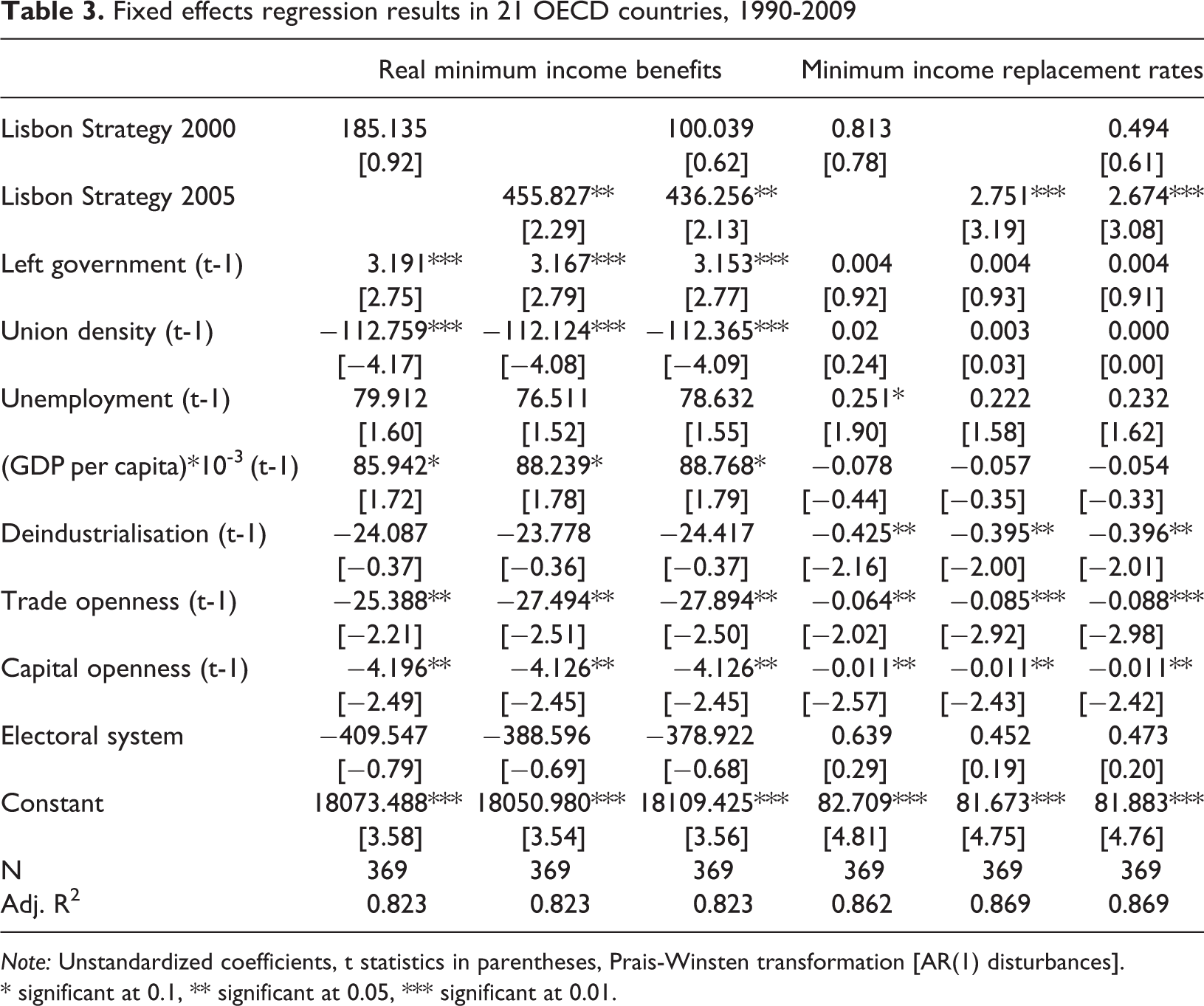
The results of the regressions are presented in Table 3. The coefficients for the Lisbon Strategy 2000 are not significant. The re-launch of the Lisbon Strategy in 2005, on the other hand, showed significantly positive coefficients. Taken together, these results indicate that we do not find robust effects for the Lisbon Strategy 2000, whereas we do find robust results for the Lisbon Strategy 2005.
Fixed effects regression results in 21 OECD countries, 1990-2009
Note: Unstandardized coefficients, t statistics in parentheses, Prais-Winsten transformation [AR(1) disturbances].
* significant at 0.1, ** significant at 0.05, *** significant at 0.01.
Furthermore, Table 3 shows that the results for left-wing parties and GDP per capita are robust. In line with the results presented above, trade and capital openness yield a negative effect. Lastly, the coefficients for union density, unemployment, deindustrialisation and the electoral system were not significant or even significant in the opposite direction, indicating that the results for these variables presented in Table 2 are not robust for the use of fixed effects.
Finally, a number of other sensitivity analyses, reported in the online appendix, show that the results are robust for the use of different household types, that the results are not driven by policy changes in single countries, or that the results are not affected by enlargement of the EU or the global financial crisis.
Conclusions
The literature on the Europeanisation of social protection has been mainly focused on labour market policies. In contrast, far less research has been devoted to the relationship between the Lisbon Strategy and developments of social assistance benefit schemes. In this study, we examined the determinants of variations in the development of social assistance benefits across 21 OECD countries over the period 1990-2009. The analysis focused, in particular, on the role of the Lisbon Strategy that was adopted by the European Council to combat poverty and social exclusion across Europe. The question is to what extent national policy changes can be ascribed to this strategy or, in other words, whether we can see a Europeanisation of social assistance benefits. To analyse this question, we used pooled time-series-cross-sectional regression analyses to examine the changes of social assistance benefits after the launch of Lisbon Strategy, taking into account a number of political, economic and institutional factors.
For the first years after the adoption of the Lisbon Strategy in 2000, our analysis does not show robust associations between the OMC Social Inclusion and national social assistance policy reforms. This result is in line with existing case-study evidence (e.g. Graziano and Jessoula 2011). Interestingly, for the years after the re-launch of the Lisbon Strategy in 2005, our analysis suggests that the OMC Social Inclusion has been positively associated with the development of social assistance benefits. This finding seems to indicate that the revision of the OMC Social Inclusion has increased its effectiveness, which is in line with the goal of the revision.
Although the results of our study are robust for different model specifications and two different indicators of social assistance benefits, we should note some important limitations of our analysis. First, benefit levels and replacement rates provide an indication of only one dimension of social assistance policies. Other institutional characteristics, such as the coverage rate, eligibility criteria, work requirements and benefit sanctions, are also relevant, but were not taken into account. Future research on welfare state indicators is required to quantify such policy dimensions. Second, an alternative explanation for our result for the re-launch of the Lisbon Strategy in 2005 could be that this effect (partly) reflects the impact of the Lisbon Strategy 2000, which needed a few years to become effective. With our approach, it is not possible to isolate these effects completely. Third, a more general limitation of our approach is that some institutional or socio-economic explanatory factors that could be relevant for understanding developments in social assistance benefits are difficult to capture in quantitative measures. This applies to the factors that were included in the analysis, but perhaps even more to the factors that were not included in the analysis, such as trends in social insurance and trends in deservingness or legitimacy regarding welfare state arrangements (Cantillon et al. 2015, 2018). Fourth, for some of our explanatory factors, the results are not similar for both indicators of social assistance benefits. Rather than only a measurement issue, this could also reflect differences in theoretical mechanisms. Analysing these differences was beyond the scope of this paper, but could be an interesting avenue for further research.
Lastly, a remaining question is how the interaction between EU coordination and national social policies will progress given recent European developments. With the adoption of the Europe 2020 Strategy and the European Semester, the coordination of social policies is being further developed (Bekker and Klosse 2013, Zeitlin and Vanhercke 2014). Acknowledging the limitations of this study, the results suggest that EU coordination can actually have an impact on domestic policy-making. This is a relevant insight for the institutional design of future European initiatives on social policy, as these initiatives will, in all likelihood, be based on legally non-binding means of governance. Building on existing work (e.g. Weishaupt 2014b), further research should be devoted to the question under which conditions specific governance instruments are more or less effective.
Supplemental material
Online_Appendix - Minimum income protection and EU coordination
Online_Appendix for Minimum income protection and EU coordination by Jinxian Wang, Olaf van Vliet, and Kees Goudswaard in European Journal of Social Security
Footnotes
Declaration of conflicting interests
The author(s) declared no potential conflicts of interest with respect to the research, authorship, and/or publication of this article.
Funding
The author(s) disclosed receipt of the following financial support for the research, authorship, and/or publication of this article: Financial support from Instituut Gak is gratefully acknowledged.
Supplemental material
Supplemental material for this article is available online.
Notes
References
Supplementary Material
Please find the following supplemental material available below.
For Open Access articles published under a Creative Commons License, all supplemental material carries the same license as the article it is associated with.
For non-Open Access articles published, all supplemental material carries a non-exclusive license, and permission requests for re-use of supplemental material or any part of supplemental material shall be sent directly to the copyright owner as specified in the copyright notice associated with the article.
