




Abstract
Do ethnic majorities and minorities have diverging preferences for fiscal capacity? Do these preferences converge during national emergencies such as interstate war? In this paper, we provide evidence from a natural experiment to demonstrate that politically salient minority-majority divisions undermine the development of fiscal capacity. In addition, we show that the pressure of interstate war is insufficient to supersede differences in support for the expansion of state’s capacity for taxation between majority and minority groups. More specifically, we employ a regression discontinuity design using a natural border that separates linguistic groups and municipality outcomes of a popular vote on the introduction of direct taxation at federal level in Switzerland during the First World War. The findings suggest that salient minority-majority divisions have a negative effect on the expansion of states’ capacity for taxation even during periods of interstate war.
Do salient minority-majority divisions undermine state capacity development? Can such divisions be overcome during national emergencies such as interstate war? A rich literature argues that ethnic minorities resist state building because they want to limit the state’s capacity to implement centralizing and standardizing policies (Hechter, 2000; Lipset & Rokkan, 1967/1990; Tilly, 1990). Similarly, several contributions find that ethnic diversity exerts a negative effect on state capacity development (Alesina et al., 1999; Habyarimana et al., 2007; Thies, 2007). However, there are also important dissenting voices, which argue that this relationship is correlational rather than causal (Baldwin & Huber, 2010; Kustov & Pardelli, 2018; Wimmer, 2016).
This paper examines the effect of minority-majority divisions on popular support for fiscal capacity development, which denotes the state’s ability to mobilize financial resources from society. Fiscal capacity is strongly related to the broader concept of state capacity, which refers to the state’s ability to “implement official goals, especially over the actual or potential opposition of powerful social groups or in the face of recalcitrant socioeconomic circumstances” (Skocpol, 1985, 9). Fiscal capacity thus provides the necessary financial resources to pursue state capacity development (Hopkins, 2009; Rogers & Weller, 2014).
There is also a rich literature focusing on fiscal capacity development specifically. This literature emphasizes the important role of periods of interstate war (e.g., Besley & Persson, 2009; Haffert, 2019; Kiser & Linton, 2001; Levi, 1988; Mann, 1986; Morgan & Prasad, 2009; Tilly, 1975). One reason for this relationship is the “rally around the flag” effect (Hetherington & Nelson, 2003), which describes how emergency situations such as interstate war increase solidarity among the population and make voters rally in support of their national leaders (Dryzek & Goodin, 1986; Rehm, 2016; Scheve & Stasavage, 2016; Stein, 1976; Walter & Emmenegger, 2022a).
But what happens to minority-majority divisions during national emergencies? More specifically, does interstate war help overcome the negative effect of salient minority-majority divisions on fiscal capacity development? Herbst (1990, 2000) famously argues that it is precisely the lack of interstate war that has prevented African countries from overcoming competing ethnic affiliations, developing a common national identity, and building a strong state. However, other research suggests that interstate war has a positive effect on fiscal capacity only in presence of a comparatively homogeneous population (Centeno, 2002; Taylor & Botea, 2008). Finally, ethnic divisions and fiscal capacity are both influenced by earlier political processes, including histories of war (Besley & Persson, 2009; Bleaney & Dimico, 2016; Gennaioli & Voth, 2015; Wimmer, 2016), which suggests that the relationship between minority-majority divisions, interstate war, and fiscal capacity development is at least partly endogenous.
This paper uses a regression discontinuity design to examine the effect of a politically salient minority-majority division on fiscal capacity development during the First World War. We explore ethnic divisions in popular support for two direct democratic proposals in Switzerland. The first proposal, in June 1915, concerned the introduction of a one-time tax on wealth and income. This tax was based on the federal state’s war-time emergency powers, specifically earmarked to pay for mobilization costs, and not meant to have a long-term effect on fiscal capacity. In contrast, the second proposal, in June 1918, aimed to introduce—for the first time—a permanent tax on wealth and income at federal level. By giving the federal state the constitutional right to tax wealth and income, the 1918 proposal would have significantly expanded fiscal capacity. Both direct democratic votes took place against the background of a massive mobilization effort in Switzerland. This is also true for the 1918 vote. In June 1918, after the German Spring Offensive, German troops were within 40 km of Paris. The Allied Forces’ Hundred Days Offensive, which practically ended the war, started only in August 1918 (Snyder, 2009). Hence, in June 1918, Swiss voters did not know that one of the most devastating wars in human history was about to end.
We argue that mass political behavior in these two direct democratic votes provides us with a unique opportunity to examine revealed public preferences for taxation and fiscal capacity development during wartime. Put differently, we can investigate processes that in other cases are hidden from plain sight. To overcome endogeneity issues, we exploit variation in elevation, which is a strong and exogenous predictor of linguistic diversity (Michalopoulos, 2012). Examining citizens’ voting behavior at a significant discontinuity that separates the minority French speakers from the majority German speakers within the same political-administrative unit, we show that the linguistic minority displayed similarly high levels of support for the emergency war tax to pay for the mobilization costs. However, the linguistic minority showed considerably less support for the proposal to expand fiscal capacity permanently. These findings suggest that while interstate war engenders a “rally around the flag” effect that also includes ethnic minorities, this effect is limited to emergency measures and does not necessarily extend to attempts to permanently expand fiscal capacity.
This paper is structured as follows. The next two sections review the literature on ethnic minorities, interstate war, and fiscal capacity development. After the discussion of the research design, we present our empirical findings. The concluding section discusses to what extent our findings can be generalized to other cases.
Ethnic Minorities and State Building
State building is contentious, especially for ethnic minorities (Besley & Persson, 2014; Savoia & Sen, 2015). Following Wimmer (2008, 973), we define “ethnicity as a subjectively felt sense of belonging based on the belief in shared culture and common ancestry.” These beliefs may be rooted in shared practices and symbols or myths of a common historical origin. Although ethnic identities are social constructions and thus subject to political processes, they are often associated with characteristics that are difficult to change (e.g., common language) and are therefore rather stable over time. Moreover, these identities matter to people, as they create bonds within groups and provide important information shortcuts that help people navigate a complex world (Smith, 2004).
State building can endanger these identities. State building is often associated with centralization and standardization processes that can threaten minority groups’ identities and specific needs. The French case is a prominent example of such processes. Following the French Revolution, the new leaders pursued a policy of linguistic uniformity with the goal to remove regional dialects and minority languages (Flaherty, 1987; Weber, 1976). Before the revolution, only a small minority was able to speak French (Hobsbawm, 1990, 80). By the end of the 19th century, the French language “had become so generalized that ethnic minority languages — and ethnic minorities as such — had become juridically nonexistent” (Safran, 1992, 400).
Hence, in case of state building, the centralized state typically adopts political roles that were previously assigned to local or religious communities, resulting in a “conflict between the central nation-building culture and the increasing resistance of the ethnically, linguistically, or religiously distinct subject populations in the provinces and the peripheries” (Lipset & Rokkan, 1967/1990, 101). In their attempt to make their territories legible, states engage in processes of mapping, standardizing, and rationalizing, which has important consequences for peripheral minorities, because their local identities and specific needs are rarely taken into consideration. The development of a standard, official language for the entire territory is a case in point (Scott, 1999; Zimmer, 2003). Similarly, the development of a national identity requires an education system that conveys standardized knowledge and a common language, whereas in decentralized and religiously divided countries, education is often controlled by religious authorities (Ansell & Lindvall, 2013; Gellner, 1983).
Minorities might have good reasons to oppose state building (Hechter, 2000; Lipset & Rokkan, 1967/1990). The literature has repeatedly highlighted how states rely on coercive and oppressive measures against minorities. These range from the prohibition of local culture (e.g., language and religion) to mass expulsion and genocide (Barkey, 2008; Fitzpatrick, 2015; Fox, 2020; Polian, 2004). For instance, in the French case, linguistic minorities were associated with pockets of resistance and thus deliberately targeted (Flaherty, 1987). Other measures are not intended to harm minorities but are the unintended (negative) consequences of ambitious state building projects (Scott, 1999). In any case, minorities, if able to organize (Hechter & Okamoto, 2001), might want to limit the state’s capacity to implement homogenizing policies.
This includes opposition to the expansion of the state’s fiscal capacity, which provides the necessary resources to pursue broader centralization and standardization processes. For instance, Tilly (1986, 1990) has highlighted how tax revolts were a constant source of unrest in the states’ more peripheral regions, whereas Hechter (2000) shows how the timing of resistance movements is related to state building activities. More generally, a rich literature suggests that ethnic divisions have a negative effect on public good provision and fiscal capacity development (Alesina et al., 1999; Habyarimana et al., 2007; Herbst, 2000; Hopkins, 2009; Lassen, 2007; Thies, 2007).
However, other studies have cast doubt on the negative effect of ethnic diversity on public good provision and fiscal capacity development. For instance, some accounts argue that ethnic divisions are endogenous to processes of state building, as both ethnic divisions and low fiscal capacity may be legacies of weakly developed state capacity inherited from the past (Bleaney & Dimico, 2016; Wimmer, 2016). Similarly, recent contributions have highlighted that ethnic divisions and class cleavages often overlap, making it difficult to identify the causal effect of ethnic diversity (Baldwin & Huber, 2010; Kustov & Pardelli, 2018).
Despite these critical voices, we expect, based on the existing literature, that minorities do not want to strengthen a centralized state that potentially shows little concern for their local needs and specificities. We argue that these popular preferences, including of minority groups, are important for the legislation and implementation of tax policies (Campbell, 1993). Depending on political conditions, preferences are transmitted in numerous ways, ranging from participation in direct democratic votes, voting for fiscal-conservative candidates in elections, inciting protest, and tax evasion. Although we are far from arguing that popular preferences are the only thing that matters for state building processes, there is good reason to explore the extent to which the population, including minority groups, supports fiscal capacity development. Consequently, we hypothesize that popular support for fiscal capacity development is lower among ethnic minorities than among the majority group.
Ethnic Minorities and Interstate War
What happens to minority-majority divisions in times of national emergencies such as interstate war? Military conflicts impose a heavy burden on society. Soldiers must be mobilized, infrastructure needs to be developed, war-time economies build up, and victims compensated. For all these activities, governments need to mobilize additional resources and develop administrative capacity (Dincecco, 2011; Gennaioli & Voth, 2015; Karaman & Pamuk, 2013). Interstate war is thus often associated with increases in fiscal capacity (for recent reviews of this literature, see Emmenegger & Walter, 2021; Goenaga & von Hagen-Jamar, 2018).
While the impact of interstate war on fiscal capacity may operate through multiple channels, several contributions stress how interstate war affects fiscal capacity through changes in popular preferences (Dryzek & Goodin, 1986; Feldman & Slemrod, 2009; Hertel-Fernandez & Martin, 2018; Rehm, 2016; Scheve & Stasavage, 2016; Walter & Emmenegger, 2022a). Most notably, military conflicts can change the social contract between the government and its people, in which a common good (e.g., external defense) is exchanged for investments in the state’s extractive capacity (Besley & Persson, 2009; Levi, 1988; North & Weingast, 1989; Timmons, 2005). For these reasons, interstate wars are often identified as a major determinant of fiscal capacity development (Castles, 1998; Kiser & Linton, 2001; Morgan & Prasad, 2009; Scheve & Stasavage, 2016). This is because the shared emergency experience creates “pervasive uncertainty” (Dryzek & Goodin, 1986, 10) within society, which nurtures solidarity and a sense of national unity (Herbst, 1990; Rehm, 2016; Walter & Emmenegger, 2022a). Such developments are sometimes subsumed under the “rally around the flag” effect, which describes how international and sharply focused events make voters rally in support of their national political leaders because national emergencies such as interstate war can influence social identities and make individuals develop stronger connections to the nation-state (Hetherington & Nelson, 2003).
However, do ethnic minorities also “rally around the flag”? Put differently, do national emergencies such as interstate wars neutralize the negative effect of ethnic divisions on fiscal capacity development? Herbst (1990, 2000) famously argues that the lack of interstate war has prevented African countries from overcoming competing ethnic affiliations and developing a common national identity. Fighting wars, Herbst (1990, 122) writes, “may be the only way whereby it is possible to have people pay more taxes and at the same time feel more closely associated with their state.” However, noting the absence of interstate wars in the Global South—unlike in Europe during the state building period—Herbst (1990, 119) concludes that state building in times of peace is likely to be unsuccessful and these states “will therefore remain permanently weak.” Hence, the absence of war has not only prevented many non-European states from developing a tight administrative grid and centralized tax systems but also from developing collective identities that supersede more particularistic loyalties (see Gibler et al., 2012; Stein, 1976).
Despite the rich literature on ethnic divisions, interstate war, and state capacity, only few studies have addressed the effect of ethnic divisions on fiscal capacity development during interstate wars. An exception is Taylor and Botea (2008) who argue that military pressure leads to fiscal capacity only in the context of ethnic cohesion. In contrast, these pressures have no comparable effect in the presence of numerous ethnic divisions. Similarly, echoing the social contract literature but emphasizing the continued relevance of societal divisions, Centeno (2002) argues that the capacity of states to extract resources from society is linked to the population’s willingness to accept these burdens. Such willingness is likely to be greater in case of a comparatively homogeneous population. Finally, in a quantitative analysis, Thies (2007) finds that ethnic divisions have a negative effect on the tax ratio, whereas long-term, militarized competitions between pairs of states have a positive effect. However, his analysis cannot show whether salient minority-majority divisions are overcome during national emergencies, as the two effects might be produced by variation in different cases.
There is considerably more research on the effect of ethnic civil wars on fiscal capacity development. However, while interstate war tends to generate common interests across groups in society, civil wars entail deep conflicting interests across groups and are thus expected to have a negative effect on fiscal capacity development (Besley & Persson, 2008). Hence, if ethnic divisions turn into violent conflict, they are likely to reduce fiscal capacity development (Centeno, 2002; Dincecco, 2011; Thies, 2005). The empirical evidence, however, is surprisingly mixed, as several other studies have found significant, positive effects of civil war on fiscal capacity development (Frizell, 2021; Kisangani & Pickering, 2014; Thies, 2007). The reason is that the central government and the population under its control might still need to invest in fiscal capacity to overcome the domestic challenge.
Thus, the relationship between ethnic divisions, interstate war, and fiscal capacity development is complex. For instance, there is considerable disagreement in the literature over the sequence between interstate war, state building, and the homogenization of the population (Besley & Persson, 2009; Bleaney & Dimico, 2016; Wimmer, 2016). Similarly, Gennaioli and Voth (2015) argue that as military success is a function of financial resources, ethnically fragmented states are at a disadvantage vis-à-vis homogeneous ones in terms of resource extraction, which is why they are more likely to disappear. Such studies point to important questions about the direction of causality (e.g., Wimmer, 2016) and selection effects (e.g. Gennaioli & Voth, 2015), which is why experimental research designs are needed to examine the relationship between ethnic divisions, interstate war, and fiscal capacity development (Bauer et al., 2016; Berwick & Christia, 2018).
In sum, the literature suggests that minority-majority divisions have a negative effect on fiscal capacity development. However, important concerns about causality remain. Furthermore, a rich literature argues that interstate war makes people “rally around the flag” and willing to pay more taxes. Yet, there is little empirical work on the question whether this is also true for ethnic minorities. This paper adds to these important questions. We take advantage of a salient minority-majority division and two popular votes on tax reform during the First World War to examine whether support for fiscal capacity development is lower among ethnic minorities and whether national emergencies make this negative effect disappear.
Research Design
In this section, we first introduce the two direct democratic votes, the 1915 vote on the emergency war tax and the 1918 vote on the introduction of a permanent direct tax at federal level in Switzerland. Both votes took place in the context of the First World War, but they differ regarding their implications for fiscal capacity. These two votes allow us to explore whether and in what cases minority-majority divisions can be overcome during national emergencies. Moreover, by focusing on a country whose state building did not take place through linguistic or confessional unification processes and which, at federal level, has several institutions in place to protect minority rights, we explore a least-likely case for minority-majority divisions to undermine fiscal capacity development in national emergency situations.
Subsequently, we discuss our case of a minority-majority division, the so-called “Jura Question” within the canton of Bern. As we explain below, this case offers several advantages. We attempt to overcome endogeneity issues by exploiting variation in elevation as an exogenous predictor of linguistic diversity, while the analysis is restricted to the same political-administrative unit. Moreover, the linguistic division does not coincide with differences in subnational tax competencies, which allows us to rule out the possibility that Jurassians might have simply opposed fiscal capacity development at federal level to defend their subnational tax prerogatives.
Finally, we discuss the validity of our research design.
The 1915 and 1918 Votes on Direct Taxes in Switzerland
Fiscal capacity is a widely used indicator of the state’s ability to penetrate society and extract resources (Skocpol, 1985). In this perspective, the state is conceptualized as a coercive organization that can be distinguished from households and kinship groups by some degree of bureaucratic organization (Vu, 2010). This is particularly true for direct taxes (Rogers & Weller, 2014). Societies characterized by low levels of state penetration typically rely on the indirect taxation of sales of specific goods (e.g., alcohol) and transactions, most notably at points of entry or passage that are easy to control. With the emergence of the cash economy and investments in the state’s administrative grid, states could use direct—and often progressive—taxes on income and wealth to extract from their subjects’ revenue that was more closely tied to their actual capacity to pay (Ardant, 1975; Scott, 1999). The introduction of a (permanent) tax at federal level is thus a watershed moment in the development of state capacity and strongly extended the state’s reach into local communities (Peters, 1991). 1
Before the First World War, Switzerland was a laggard in terms of fiscal capacity (Emmenegger et al., 2021). Among the countries covered by Aidt and Jensen (2009, 162), Switzerland was the last one to introduce a permanent income tax at federal level and the last one to reach a revenue yield of 5% of GDP. 2
The First World War, however, created massive revenue needs for the federal state, which is solely responsible for funding military spending. Switzerland’s average annual mobilization costs for the war period (1914–1918) were more than twice as high as regular total federal government revenue in the immediate pre-war period. At the same time, the conflict removed extraction options because of the decline in international trade (Emmenegger & Walter, 2022). With the war entry of Italy in April 1915, Switzerland was surrounded by belligerent countries. Before the conflict, trade taxes had contributed more than 80% of federal government revenue, but revenue from trade taxation collapsed from 85 million Swiss francs in 1913 to 44 million in 1918 (Geyer, 1934, 15–19).
In this context, the federal state had little choice but to resort to direct taxes (i.e., taxes directly imposed on persons or organizations). Yet, at the time, direct taxation was the sole prerogative of cantons. Hence, to impose direct taxes, the federal state needed either war-time emergency powers (for temporary direct taxes) or a constitutional revision (for permanent direct taxes).
In 1915, based on its war-time emergency powers, the federal government requested the introduction of a one-time “war tax” on wealth and income. In this period of national emergency, the war tax found broad support among all political groups, which described it as a “sign of unity of the Swiss people” (Linder et al., 2010, 119), a “patriotic duty” (Mani, 1928, 10), and a “sacrifice on the altar of the fatherland in gratitude for the preservation of Switzerland from the horrors of war” (Meierhans, 1921, 66). In the subsequent popular vote, the voters did not disappoint, as a record-high 94.3% supported the one-time war tax in June 1915 (Linder et al., 2010, 118).
However, the additional revenue generated by the war tax soon proved to be insufficient. Already in October 1916, the federal government assembled all major parties to discuss further measures. Yet, no agreement could be found. In this context, the Social Democratic Party launched a popular initiative demanding the introduction of a permanent direct tax at federal level (Meierhans, 1921, 120). Given the popular support for the one-time war tax in the 1915 vote, they proposed a permanent direct tax that was deliberately designed along the same lines. Therefore, in June 1918, the Swiss were called to vote on a constitutional article demanding the introduction of a permanent direct tax at federal level. If supported at the ballot box, this direct and progressive tax would have become a reality. Yet this time, only 45.9% of the voters supported the proposal (Linder et al., 2010, 121–122).
Instead, the federal government suggested the repetition of the war tax. Importantly, this second war tax was again deliberately designed to be temporary, linking its duration to the revenue needed to cover the war mobilization cost (Geyer, 1934, 72–76). In the direct democratic vote, which took place in May 1919, and thus after the end of the First World War, 65.1% of the voters supported the second temporary war tax (Linder et al., 2010, 125–126). This strong support for the second war tax shows that at this point, almost 5 years after the beginning of the First World War, the population was still willing to pay for the mobilization costs.
At first sight, these developments seem surprising. The vote on the introduction of a permanent direct tax at federal level took place during a national emergency. In June 1918, the First World War was still ongoing. The important Hundred Days Offensive that essentially heralded the end of the conflict would start only 2 months later. As mentioned, the literature has repeatedly identified such contexts as critical junctures in the development of modern tax states. The effect of mass warfare, however, goes beyond financial needs, as such events change state-society relationships, help develop collective identities, and enhance solidarity. Such “rally around the flag” effects (Hetherington & Nelson, 2003) certainly fueled popular support for the one-time war tax in 1915 and its repetition in 1919. Moreover, the sense of national emergency was certainly palpable in Switzerland. Completely surrounded by belligerent countries, Switzerland engaged in mass mobilization. In 1914, 238,000 Swiss citizens were called to arms, serving on average between 500 and 600 days (Senn, 2019). Put differently, in 1914 alone, Switzerland mobilized approximately 13% of its entire male population. Regarding the costs of the mobilization effort, Switzerland spent about 29% of its GDP (Geyer, 1934, 18–19). There can be no doubt that the situation was considered a national emergency.
Yet, there is a crucial difference between the three votes. The 1915 and 1919 war taxes were temporary measures, based on the government’s war-time emergency powers, earmarked to pay for the mobilization costs, and to be collected by the cantonal tax authorities. Hence, the 1915 and 1919 war taxes were not meant to have any long-term consequences for the state’s ability to mobilize financial resources from society. In particular, the 1915 vote on the one-time war tax is a perfect case to observe a “rally around the flag” effect that also includes ethnic minorities because the vote took place during a military conflict (unlike the 1919 vote), but the tax was not meant to have any consequences for fiscal capacity outside the war effort. 3
In contrast, the 1918 vote on the introduction of a permanent direct tax aimed to increase the federal state’s fiscal capacity by giving the central state—for the first time—the constitutional right to collect direct taxes. Put differently, the 1918 direct tax would have given the federal authorities additional means to implement homogenizing and standardizing policies in the post-war period. Consequently, the 1918 vote activated the political conflict between the German-speaking majority and the linguistic minorities in Switzerland. At the time of the vote, roughly 70% of all Swiss were German speakers, whereas the majority of the remaining Swiss were French speakers. French speakers reside in Western Switzerland, constituting the large majority in the cantons Fribourg, Geneva, Neuchâtel, Valais, Vaud, and the minority in the Northern, Jurassian part within the predominantly German-speaking canton of Bern (see the left panel in Figure A1 in the appendix).
Switzerland is often considered the paradigmatic case of political integration because state building did not take place through linguistic or confessional unification processes (Deutsch, 1976)—in stark contrast to cultural nations such as France with their focus on homogenization (Weber, 1976). Instead, Switzerland’s national identity and its political self-image as a “nation of will” (rather than common ethnicity) are the result of political institutions of power-sharing, most notably extensive federalism with the autonomous position of cantons (Linder & Mueller, 2021; Zimmer, 2003). Hence, great attention is paid to protect minorities’ autonomy and their identities.
However, unlike the 1915 tax proposal, which had no long-term consequences for fiscal capacity, the 1918 tax proposal had the potential to unsettle this equilibrium because the proposal intended to give the federal state the right to impose direct taxes on all residents permanently—a right previously reserved to cantons. At federal level, the German-speaking majority was politically dominant. The proposal was thus considered an attack on cantonal autonomy and by implication on the self-determination of linguistic minorities in a crucially important area (Linder et al., 2010, 121). As a result, commentators in the French-speaking part of Switzerland called the proposal “the death of the cantons” (Boeschenstein, 1981, 105).
Indeed, in the 1918 vote, the permanent tax proposal won popular majorities only in predominantly German-speaking cantons (see the right panel in Figure A1 in the appendix). Overall, the bivariate correlation between the share of French speakers in a municipality and its yes-share in the 1918 vote is −0.45. In contrast, in the 1915 vote on the one-time, emergency tax, overall support was considerably higher (94.3%), whereas the difference between the language groups was much smaller (the bivariate correlation between the share of French speakers in a municipality and its yes-share in the 1915 vote is only −0.13).
In this paper, we use the 1915 (temporary tax) and 1918 votes (permanent tax) and the French-German language divide to identify the effect of minority-majority divisions on fiscal capacity development. This allows us to explore minority-majority divisions in popular support for fiscal capacity development in a meaningful context. The fact that Switzerland kept most of its democratic processes intact offers the unique possibility to examine popular preferences in a national emergency. Moreover, voters were asked a straight yes/no question. There is thus no risk of complications due to package deals or interdependencies between different elements of a reform, which would make its effects difficult to appraise. Similarly, the vote was not embedded in a long series of negotiations shaped by incumbency/opposition dynamics, as is often the case in roll-call votes. Furthermore, our focus on within-country variation helps to reduce the number of unobservable and unquantifiable historical differences because all units were similarly affected by broader trends (Pepinsky, 2019), thus reducing the risk of omitted variable bias. Despite providing a more homogeneous sample, we have nonetheless sufficient observations, as we work with municipalities as the units of analysis.
However, regressing yes-shares at municipality level on population shares of ethnic-linguistic minorities could generate biased estimates if regions in the, for instance, French-speaking part of Switzerland differ along other observed or unobserved dimensions from the German-speaking part. 4 Previous research has attempted to solve such problems by employing spatial regression discontinuity designs (RDD). Spatial RDDs are widely applied by using the distance of administrative units from jurisdictional borders where only units on one side of the border are treated. In the Swiss case, scholars have relied on cantonal borders to identify the causal effect of religious minorities on economic development and political behavior (Basten & Betz, 2013; Spater & Tranvik, 2019). However, these designs are based on assumptions that might not be satisfied. A problem of spatial RDDs is that jurisdictional borders are not drawn completely at random. Therefore, pre-treatment covariates can differ on both sides of the border, making it difficult to disentangle the effect of the treatment from other features of administrative units (Keele & Titiunik, 2015). In addition, individuals with specific pre-existing preferences that are correlated with the treatment can sort on both sides of the border (McCauley & Posner, 2015). This is particularly problematic for within-country studies where jurisdictional borders do not constitute barriers to the movement of people.
To mitigate these problems, our spatial RDD takes advantage of the Jura Mountains within the canton of Bern as a natural border that separates the German-speaking and French-speaking population with limited possibilities of cross-border migration. Michalopoulos (2012) shows that variation in elevation is a strong predictor of linguistic diversity. Within Switzerland, the language border and the Jura Mountains as a natural border coincide only within the canton of Bern. Moreover, as we show below, population movements for political reasons were limited during the period of investigation. We therefore use the minority-majority division within the canton of Bern as an example of the broader French-German division in Switzerland. The focus on a within-canton linguistic border has the further advantage that it allows to separate the influence of minority-majority divisions from canton-specific institutional factors.
Are our findings, based on the so-called “Jura Question,” representative for the linguistic division in Switzerland? A counterargument could be that our findings are based on specific idiosyncrasies of the case and are therefore not generalizable to the minority-majority division at national level, as there might be reasons for Jurassians to be particularly opposed to fiscal capacity development at federal level. To hold water, such an argument must assume that the influence of Switzerland’s French-speaking minority is lower at federal level than the influence of the French-speaking Jurassians within the otherwise German-speaking canton of Bern. However, federal-level political institutions such as the Council of States or minority representation in the Federal Council gave linguistic minorities a considerable amount of influence on policy-making at federal level, while the canton of Bern did not have any legislative body for regional representation. Hence, whereas it might have been rational for Switzerland’s linguistic minorities to defend their cantons’ sole right to direct taxation (to preserve their autonomy within the predominantly French-speaking cantons), the Jurassians—as a minority within a canton—had in fact reasons to prefer the transfer of tax competencies to the federal level (Gehring, 2021). The “Jura Question” therefore allows us to separate the role of linguistic identity considerations from “mere” federalism in driving voting behavior.
In the following, we provide contextual information on the salience of the minority-majority division within the canton of Bern (the “Jura Question”). Subsequently, we demonstrate that municipalities along the natural border are strikingly similar along different geographical, socioeconomic, and demographic dimensions except in terms of elevation and language. 5
The Jura Question
The Vienna Congress of 1815 gave Switzerland its modern-day borders—including its cantonal borders. At the Congress, the canton of Bern was awarded the French-speaking territory of an ancient clerical principality formerly governed by an autocratic ruler, the Bishop of Basel who, following the reformation, had resided from 1528 onward in the Jura region. Surrounded by the Kingdom of France and the Swiss Confederacy, the clerical principality had for centuries remained formally independent (Lehmann, 2016). 6
Clearly, this was not a love match. The Jura region was primarily French speaking and religiously divided in an otherwise exclusively German-speaking and vigorously Protestant canton (Mayer, 1968). According to the 1920 historical census, the share of German speakers in the Jura was 18.7%, whereas it was 95.2% in the rest of Bern.
7
Geographically, the Jura area was separated from Bern by the Jura Mountains, abruptly dividing the German-speaking lowlands from the French-speaking highlands by approximately 450 m altitude (see Figure 1 below). Moreover, the area was difficult to cross, which is why travelers often took a detour, although a new road had been created in 1856 and a train connection already established in 1874. Nevertheless, this geographical separation encouraged a feeling of distinctiveness (Jenkins, 1986). RDD plots for elevation, the share of the French-speaking population, and support for direct taxation in the Canton of Bern (1915 and 1918).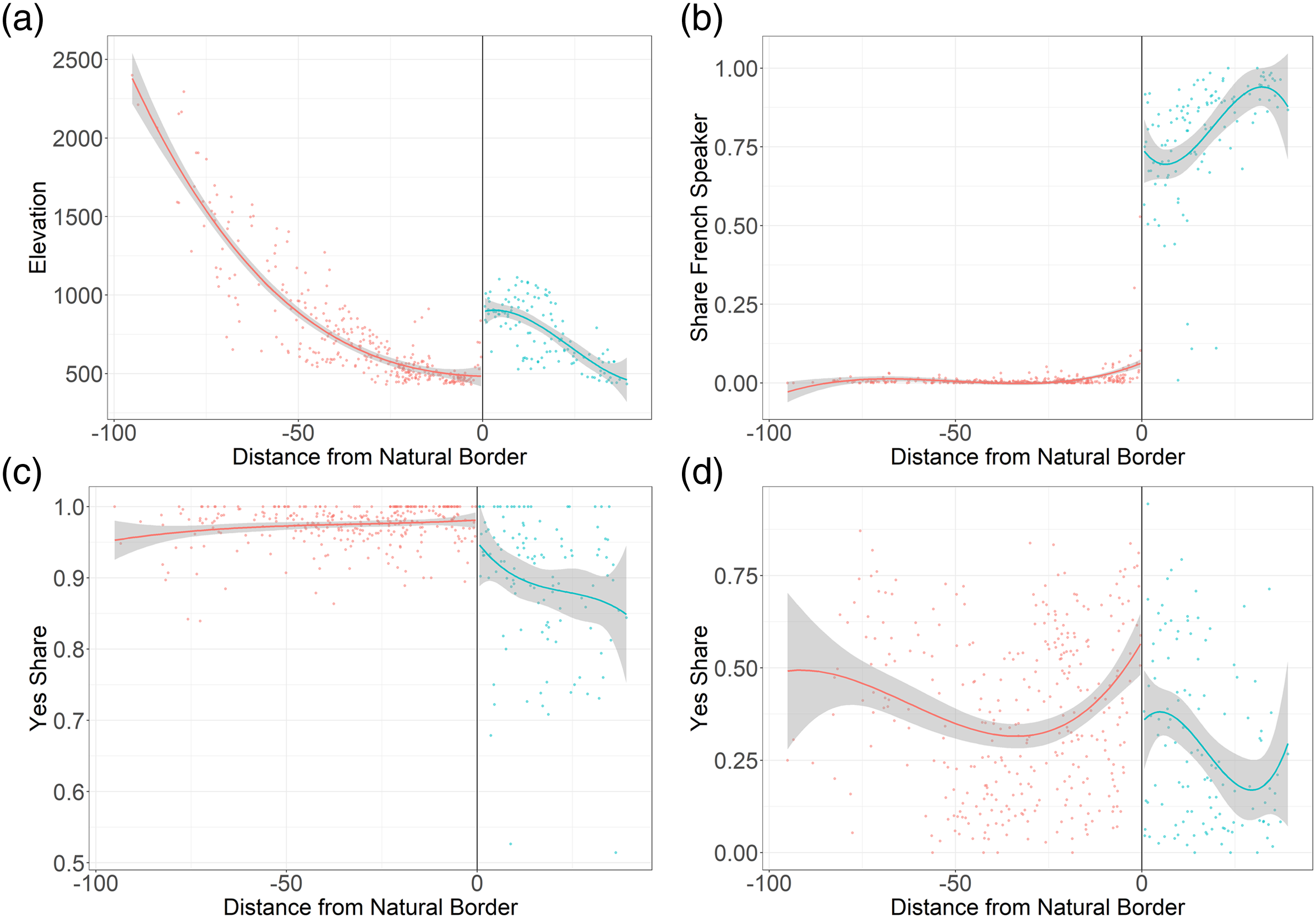
The articulation of the minority-majority division has a long history. Already in 1830, the term “Jura Question” was used to describe concerns of the French-speaking minority about threats to their identity. For instance, in 1815, Bern “refused to grant demands by Jurassian delegates for recognition of the French language as an official language” (Mayer, 1968, 723). Although recognition was eventually granted in 1831, it signaled to the Jurassians that they would have to fight for their cultural identity. Similarly, in 1815, Bern had promised to protect the Catholic faith in the Jura, but in subsequent decades, the Catholic church was repeatedly subject to anticlerical measures, leading to several rebellions (Mayer, 1968, 725).
The language question became a sensitive issue again at the turn of the century. Thanks to the booming watchmaking industry, the region had been at the forefront of industrialization, both north and south of the Jura Mountains. Industrialization brought French-speaking Jurassians to the lowlands but also German-speaking workers to the newly established factories in the Jura. Due to these migratory movements, the proportion of German speakers in the Jura grew from 14.1% in 1860% to 21.3% in 1888 (according to the historical census). Concerns about a “germanization” were rapidly growing, especially at the beginning of the 20th century, although the share of German speakers had in fact been declining since the 1890s. By 1920, the share of German speakers in the Jura area was down to 18.7%. In the 20th century, “the French language regained ground to the point of the almost complete elimination of German” (Chiffelle, 2005, 8).
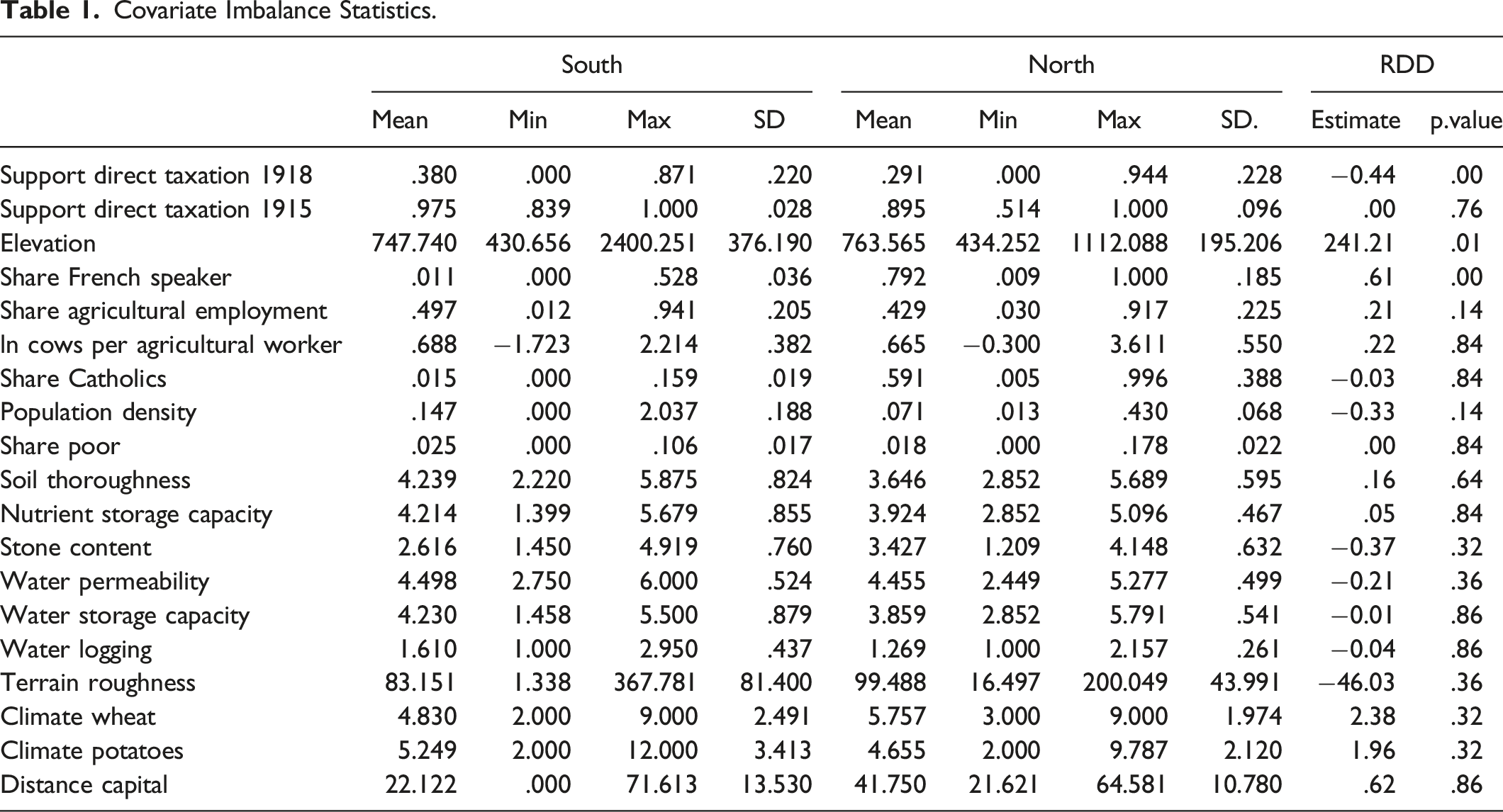
Covariate Imbalance Statistics.
The language question was clearly the main driving force behind the creation of the separatist movement in the early 20th century, which demanded more autonomy for the Jura region within Switzerland (Chiffelle, 2005; Hauser, 1997; Mayer, 1968; Voutat, 1992). Volmert (2008, 402) argues that “the separatist movement in the 1910s was clearly nationalist […] and articulated a conception of ethno-linguistic peoplehood as the rationale for Jurassian independence.” In the 1910s, the language question ultimately led to the creation of separatist organizations such as the Comité pour la Création d’un Canton du Jura, later called Comité Séparatiste du Jura (Volmert, 2008, 402), providing an organizational infrastructure for the division’s politicization.
The role of language and cultural autonomy was also visible in the demands of the Jurassian separatist movement. In 1947, the Comité de Moutier requested “educational autonomy for the Jura, suppression of the German-language schools in the region, expansion of teaching in French at Berne University, educational facilities in French for children of Jurassian civil servants living in the capital city, complete equality of French and German in the cantonal constitution, decentralization of the cantonal civil service, a constitutional guarantee of the customary two Jurassian seats on the executive council, and above all recognition of the Jurassian claim that the Canton of Berne is composed of two distinct peoples” (Mayer, 1968, 732–733). Other groups went further, even demanding an independent canton of Jura. Clearly, religious differences mattered too (Volmert, 2008). However, given that religion was also a divisive issue within the Jura, separatists typically emphasized a historical (the people of the former clerical principality) or a linguistic (their common language) understanding of peoplehood (Chiffelle, 2005; Hauser, 1997; Voutat, 1992). 9
Such linguistic identity considerations were also repeatedly articulated in the context of the 1918 vote on the introduction of a permanent direct tax at federal level. In the run-up to the 1915 vote on the emergency war tax, calls for patriotism in this dire hour had prevailed. In contrast, commentators in the French-speaking press considered the 1918 proposal to be an act of centralization and called it the “death of cantons” (e.g., Le Jura, May 21, 1918; La Tribune de Genève, May 31, 1918; La Liberté, June 1, 1918). They repeatedly linked this development to dictatorship (e.g., Le Jura, May 21, 1918; La Tribune de Genève, May 28, 1918), whereas cantonal autonomy was portrayed as the guarantor of independence, liberty, and democracy (e.g., Le Jura, May 10, 1918; La Tribune de Genève, May 28, 1918). Le Jura (May 21, 1918) argued that the proposal’s centralizing effects would violate “all the most sacred customs of freedom and independence.” La Liberté (May 29, 1918) also explained why the Jurassians, as a minority within a canton, should oppose permanent direct taxes at federal level. The passage is worth quoting, because it shows that for the opponents, the vote was about more than simply protecting cantonal tax privileges: The Jura wanted to become Swiss because of the federative institutions of the Confederation. Before becoming part of it, the ancient clerical principality liked the alliance of cantons with the flaming banners because the historical entities were respected there. The fate did not want the wishes of the Jurassians to be granted [i.e., the Jurassians did not receive their own canton, the authors], but there is in our north-western marches a people who, because they remain faithful to their hereditary dream, will bring the help of their voices to the defense of the object of their affection and their desires: the federative institutions. They will vote ‘no’ on Sunday.
In short, we argue that the “Jura Question” is representative of a larger minority-majority division within Switzerland. Like other French-speaking Swiss, the Jurassians were concerned about the loss of their ethnic identity. However, unlike other French-speaking Swiss, the Jurassians themselves had no cantonal autonomy (and related subnational tax privileges), which they could have defended. Hence, among the French-speaking Swiss, the Jurassians are a least-likely case for opposition to fiscal capacity development at federal level.
Validity of the Research Design
Qualitative accounts of the “Jura Question” provide ample evidence on the linguistic division and suggest that cross-border migration movements were primarily economic—and not political—in nature. In the following, we forward quantitative evidence that supports our qualitative account by showing that the natural border, that is, the Jura Mountains, separates linguistic groups. 10 In contrast, our covariate imbalance tests demonstrate that municipalities close to the border do not differ along other dimensions, which suggests that incentives for geographical sorting are limited.
In Figure 1, we provide quantitative evidence for the discontinuity using third degree polynomials and 95% confidence intervals. On the upper left-hand side, the plot shows the distribution of elevation with negative (positive) values on the x-axis displaying the municipalities’ distance South (North) of the Jura Mountains. The elevation is decreasing from the Alpine South of Bern throughout the canton before sharply increasing at the natural border, then decreasing again. On the upper right-hand side, the plot shows that the natural border also coincides with the separation of the German and French-speaking population. Lastly, the two lower plots explore the discontinuities in support for direct taxation using the municipality-level yes-shares of the popular votes in 1915 (bottom left) and in 1918 (bottom right). Figure 1 shows that in the 1918 vote, support drops significantly north of the border in the French-speaking part. In contrast, the discontinuity is much weaker in the 1915 vote (see also Figure 2). Geographical distribution of support for direct taxation in the Canton of Bern (1915 and 1918).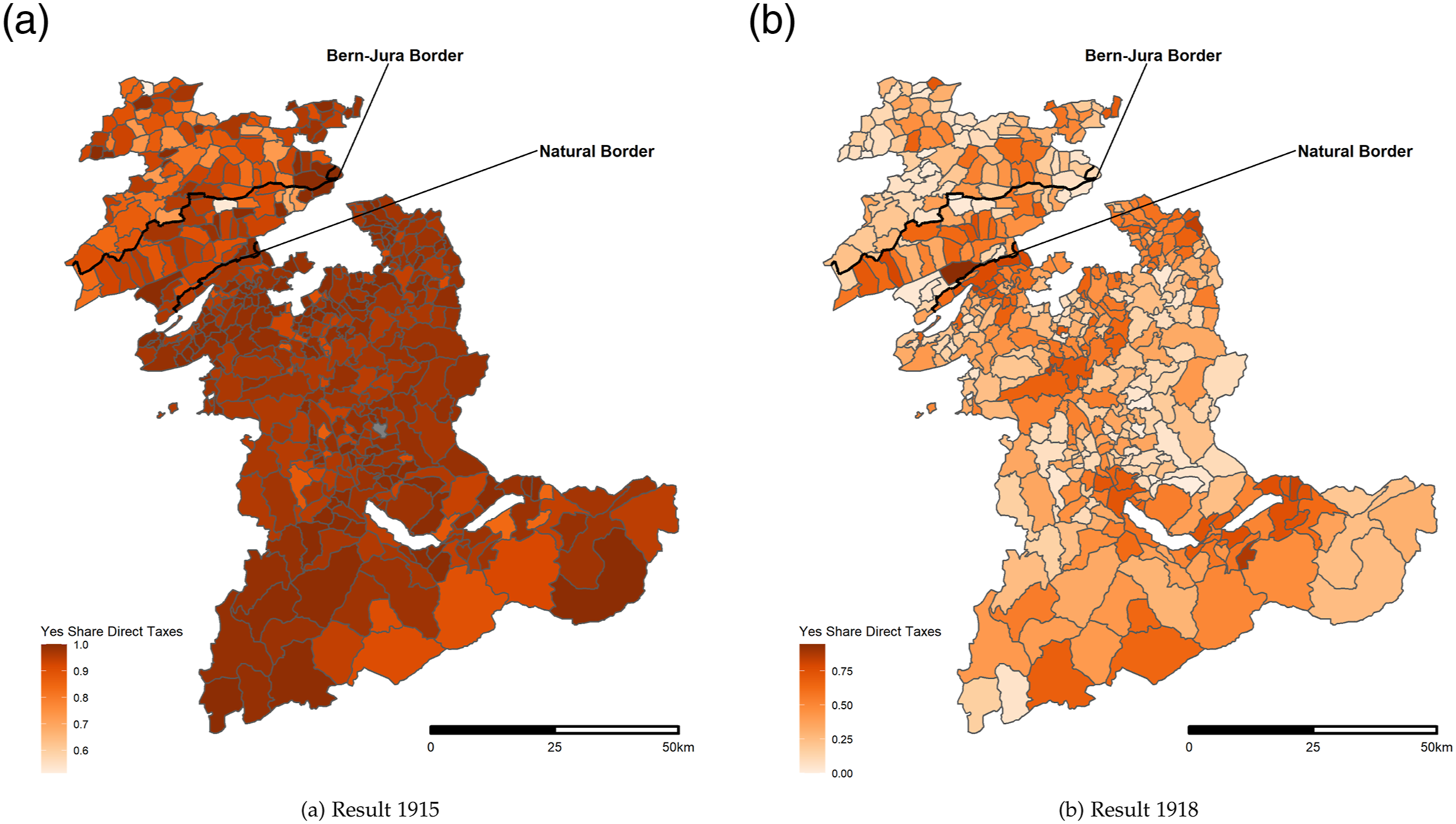
In contrast, covariate imbalance tests suggest that municipalities close to the border do not differ along other dimensions. Additional imbalances would indicate that municipalities are not identical (except for the main variable of interest), which could result in the problem of compound treatments (Keele & Titiunik, 2015). Moreover, multiple differences related to socioeconomic development would provide incentives for households to sort at the border. For instance, several contributions in economic history have shown that regional differences in economic development were a main driver of internal migration movements (e.g., Boyer & Hatton, 1997; Enflo et al., 2014; Rosés & Sánchez-Alonso, 2004).
To test the validity of our design, we investigate whether municipalities along the border differ. For this, we have collected data on the economic development and demographic composition of municipalities, soil quality, climate, and other geographical features from numerous sources (see Table A1 in the appendix). In Table 1, we provide summary statistics for municipalities south and north of the natural border. In addition, the last two columns display the RDD estimates using a local linear estimator and p-values, adjusted for multiple comparisons (de la Cuesta & Imai, 2016, 377), for all variables. The results suggest that, close to the natural border, municipalities do not differ in terms of geographic, economic, and demographic characteristics except elevation and language (and support for direct taxation in 1918 but not in 1915). Thus, covariate imbalances do not appear to be a problem in our design.
Unfortunately, there is no municipality-level data on election outcomes available. However, in the last national election before the 1918 vote, in 1917 (using a majoritarian electoral system and multi-member districts), the French-speaking voters just north of the Jura Mountains (district 11 “Bern-Südjura,” three seats) elected two Social Democrats and one Liberal. In the German-speaking electoral district just south of the Jura Mountains (district 10 “Bern-Seeland,” five seats), the Liberals won four out of five available seats, with the fifth one going to the Social Democrats. 11 Given that the Social Democrats had launched the popular initiative to introduce a permanent direct tax at federal level, it seems highly unlikely that party preferences can explain lower levels of support for state capacity development among the French-speaking minority.
Results
Figure 3 displays our main results, with the 1915 vote on the left and the 1918 vote on the right. For both plots, the y-axis displays the point estimates along with the 95% confidence intervals for our RDD estimates, whereas the x-axis shows the bandwidths measured in kilometers distance from the natural border. We employ a sharp RDD as well as a fuzzy RDD using the share of French speakers to further account for the possibility of sorting around the threshold.
12
Lastly, the line plots below display the number of observations used in the individual estimations. Ethnic minority and support for direct taxation. Optimal bandwidth displayed in gray.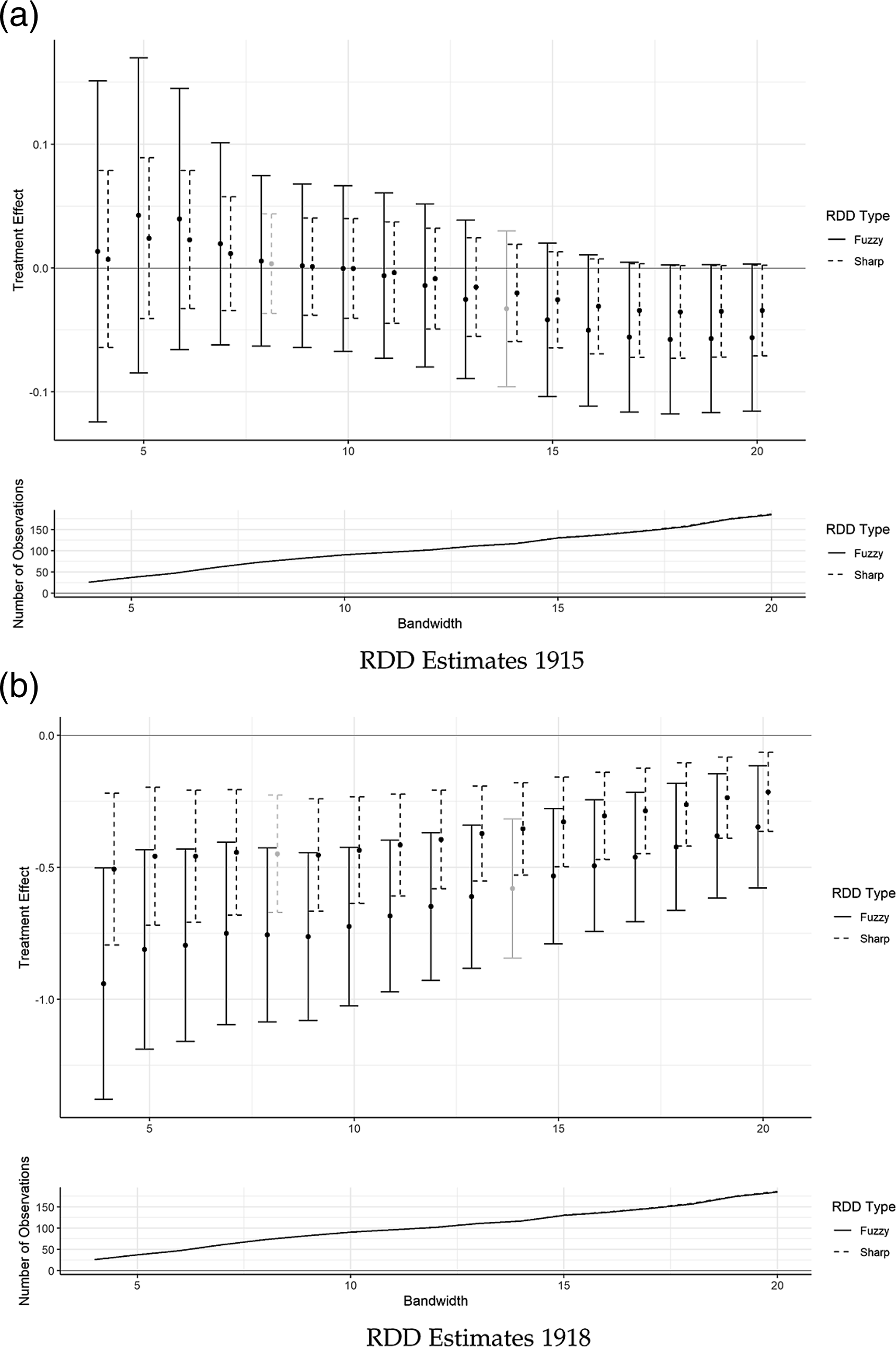
The estimations for the 1915 vote show no significant effect of ethnic-linguistic minorities on support for the one-time emergency war tax (left panel in Figure 3). In contrast, in the case of the 1918 vote on a permanent direct tax at federal level, we find that the effect of ethnic-linguistic minorities on support for direct taxation is substantial (right panel in Figure 3). The point estimates for the sharp RDD show that the yes-share decreases by 52%, while the fuzzy RDD results display a decrease of more than 80%. The difference between the point estimates of the sharp and the fuzzy RDD suggest that a possible sorting of language groups around the border biases the coefficient downward. However, the coefficients are not significantly different.
Hence, Figure 3 suggests a statistically significant and substantially important effect of minority-majority divisions on fiscal capacity development (the 1918 vote). But is the negative effect in case of the 1918 vote robust? Several robustness tests suggest that it is.
In a first step, we add the variables introduced in Table 1 as controls. Figure A2 in the appendix shows that we obtain point and uncertainty estimates that are similar. 13 Moreover, for the 1918 vote, we obtain similar results as in Figure 3 with local linear estimates and estimates with second-order polynomials as well as different coverage error rate optimal bandwidth estimators (see Figure A3 in the appendix). Finally, OLS regressions with cluster-robust standard errors (with cantons as clusters) using data from all municipalities in Switzerland show that the share of non-German speakers has a strong negative effect on support for the introduction of a permanent direct tax at federal level in 1918 but no effect on support for the introduction of an emergency, one-time war tax in 1915 (see Table A3 in the appendix).
As an additional robustness check, we use today’s border between the Canton of Bern and the Canton of Jura as a placebo test (see Figure 2 for a map of the canton of Bern before the secession).
14
In 1978, the Northern, primarily Catholic part of the Jura region seceded from Bern with many Jurassian municipalities holding popular votes to determine whether they wanted to join the new Canton of Jura or stay with the Canton of Bern. Thus, it could be argued that the division over the 1918 vote on the introduction of permanent direct taxation at federal level might not be driven by identities along linguistic lines but other regional identities, most notably religion. Figure 4 displays the results. The figure shows that the point estimate is close to zero with switching signs across bandwidths. Furthermore, the estimate is not significant at conventional levels for most bandwidths. Therefore, the results increase our confidence that the findings are due to different preferences of linguistic groups and not other kinds of regional heterogeneity. Distance from the today’s Bern-Jura border. Optimal bandwidth displayed in gray.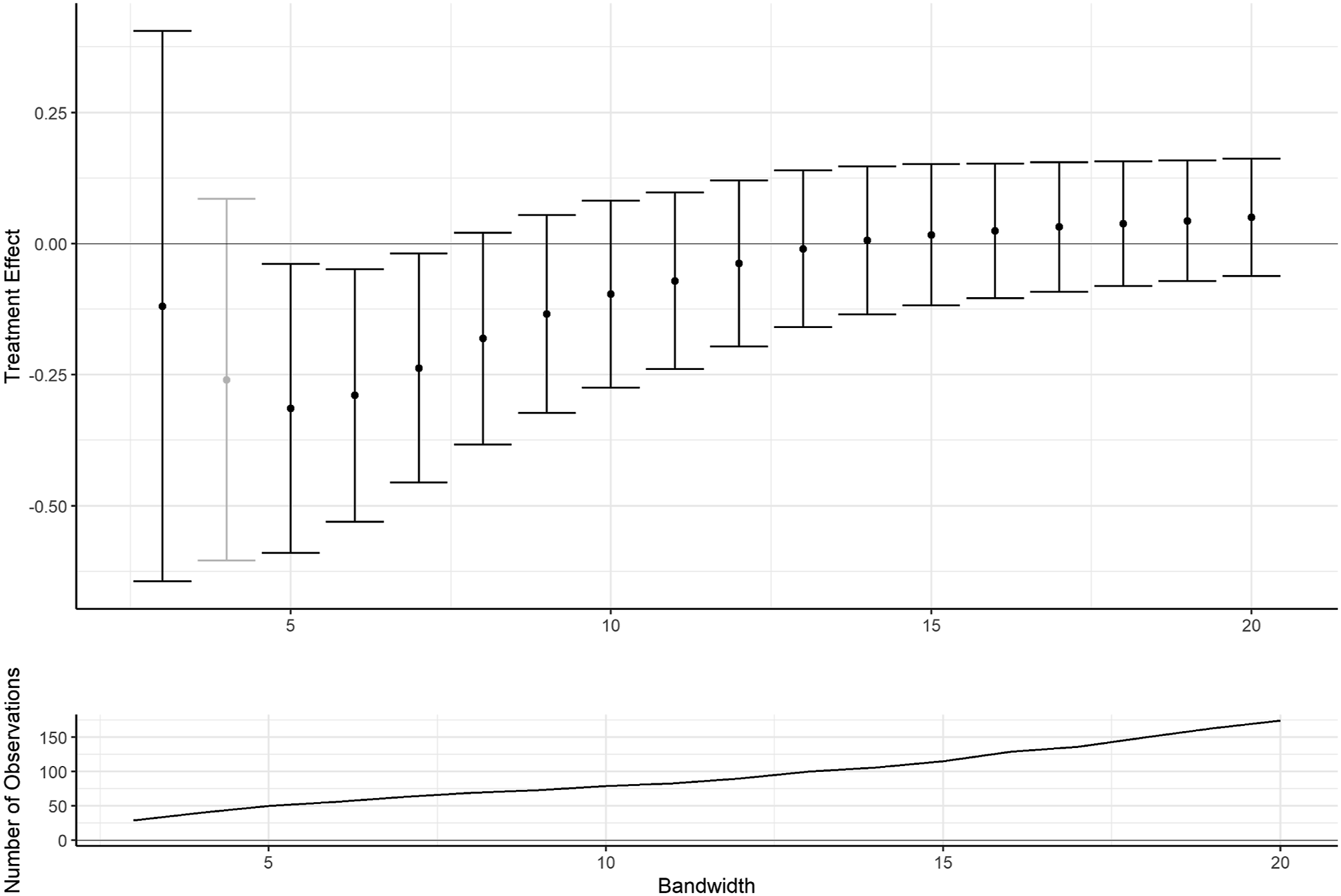
Finally, we employ alternative cutoffs as placebo tests. In doing so, we subset our data by including only municipalities north or south of the border, respectively, and then use the mean as well as the 25% and 75% quantiles of the distance from the natural border as cut-offs. However, none of the estimates reaches conventional levels of statistical significance (see Figure A4 in the appendix). Overall, there is thus strong evidence that our results are robust to different model specifications. 15
Conclusion
Do salient minority-majority divisions undermine fiscal capacity development? Can such divisions be overcome during national emergencies? We contribute to this debate by exploiting a unique setting where Swiss voters were allowed to decide on the introduction of a one-time emergency direct tax (1915) and a permanent direct tax (1918) during the First World War.
The empirical evidence suggests that national emergencies such as interstate war have the potential to engender a “rally around the flag” effect that also includes ethnic minorities. However, this effect is limited to emergency measures and does not necessarily extend to attempts to permanently expand fiscal capacity. Having no long-term effect on fiscal capacity, the temporary emergency tax found overwhelming support in all corners of the country. Clearly, Swiss citizens, including ethnic minorities, were willing to pay for mass mobilization.
However, the moment attention turned to fiscal capacity development, the minority-majority division came back to the surface. We have found that support for the permanent direct tax was substantially lower among the French-speaking minority than among the German-speaking majority. Hence, despite the mobilization of a significant part of the population, widespread calls for national unity, growing revenue needs, opposition of the French-speaking minority to fiscal capacity development remained significant. These results suggest that minority-majority divisions have the potential to limit fiscal capacity development even in periods of interstate war.
To increase the confidence that our results are causal, we have employed a natural experiment within the same political-administrative unit (Dunning, 2012). Our findings are based on a spatial RDD, which might produce spurious results if groups with specific political preferences sort at the border. While this is a concern for all spatial RDDs, we tackle this problem in several ways. First, we use a natural physical border as demarcation, which we argue, in line with previous research, impedes migration movements, and supports the development and persistence of ethno-linguistic diversity. Second, we show that municipalities close to the border do not differ in terms geography, economic development, or other socio-demographic features and thus provide no incentive for sorting. Finally, as a further robustness test, we use a fuzzy RDD to account for the presence of German speakers in the Jura. By employing these measures to mitigate the impact of geographical sorting, we argue that our contribution improves on the current literature in which scholars have increasingly called for more experimental approaches (Bauer et al., 2016; Berwick & Christia, 2018). 16
Can our results be generalized to other minority-majority divisions and other national emergencies? We believe that they can. Our analysis has focused on the First World War, which is often considered the founding period of the modern tax state because of mass mobilization and the ensuing costs (Morgan & Prasad, 2009; Scheve & Stasavage, 2016). Nevertheless, minority-majority divisions did not disappear. It is not clear why the result should be any different in case of other interstate wars—in the past and today. Moreover, the link between national emergencies other than interstate war and fiscal capacity development is not equally straightforward because other national emergencies are not necessarily as resource intensive as interstate war and are unlikely to have the same effect on developing a common national identity (Herbst, 1990). Hence, if minority-majority divisions cannot be overcome during interstate wars, and in particular the First World War, it is unlikely that other national emergencies will be able to do so. 17
Finally, Switzerland is a least-likely case for ethnic divisions to undermine fiscal capacity development. In Switzerland, state building did not take place through linguistic or confessional unification processes. Instead, Switzerland’s political self-image as a “nation of will” has led to the creation of political institutions that aim to protect the autonomy of minorities and ensure their fair political representation (Linder & Mueller, 2021). At the time of the 1918 vote, three of the seven members of Switzerland’s Federal Council represented linguistic minorities. Nevertheless, the French-speaking minority remained concerned about the possibility of strengthening the central state. We should therefore expect similar negative effects on fiscal capacity development in countries that emphasize cultural homogenization or do not have comparable political institutions to protect minorities.
Our analysis has focused on a minority-majority division based on language in a comparatively heterogeneous country. Future research should explore to what extent divisions based on religion, race, or other aspects of ethnicity have similar effects as the ones observed here. Moreover, the effect of minority-majority divisions might be a function of the heterogeneity of countries. For instance, critical readers might be inclined to argue that ethno-linguistic divisions are of lesser importance in heterogeneous countries such as Switzerland. However, such concerns would speak against finding an effect in the case examined here. In any case, minority-majority divisions are likely to vary, including in their politicization. Future research might be able to identify the conditions that make such divisions have a negative effect on fiscal capacity development.
Supplemental Material
Supplemental Material - Ethnic Minorities, Interstate War, and Popular Support for Fiscal Capacity Development
Supplemental Material for Ethnic Minorities, Interstate War, and Popular Support for Fiscal Capacity Development by André Walter and Patrick Emmenegger in Comparative Political Studies
Footnotes
Declaration of Conflicting Interests
The author(s) declared no potential conflicts of interest with respect to the research, authorship, and/or publication of this article.
Funding
The author(s) disclosed receipt of the following financial support for the research, authorship, and/or publication of this article: This research is being generously supported by the Swiss National Science Foundation (grant #:100017_184969).
Author’s Note
We thank Carles Boix, Simon Hug, Victoria Tin-bor Hui, Olivier Jacques, Anna Persson, Jan Teorell, and the three anonymous reviewers for helpful comments. Earlier versions of this paper were presented at the University of Geneva’s Political Science Seminar, the 2022 ECPR Joint Sessions in Edinburgh, and the 2022 DVPW Political Economy Conference in Berlin. We thank all participants for their feedback. All remaining errors are the authors’ responsibility. Replication materials and code can be found at  .
.
Supplemental Material
Supplemental material for this article is available online.
Notes
Author Biographies
References
Supplementary Material
Please find the following supplemental material available below.
For Open Access articles published under a Creative Commons License, all supplemental material carries the same license as the article it is associated with.
For non-Open Access articles published, all supplemental material carries a non-exclusive license, and permission requests for re-use of supplemental material or any part of supplemental material shall be sent directly to the copyright owner as specified in the copyright notice associated with the article.
