




Abstract
The first mover advantage is a critical factor for the productivity of firms that enter new markets. Surprisingly, however, the importance of timing is rarely explored in studies of interest groups and their influence on new policy agendas. In this article, we therefore develop a theory of first mover advantages in lobbying. We argue that especially more resourceful and more highly affected organizations should be able to benefit from early lobbying. Using granular survey data on the timing of lobby efforts by interest groups on Covid-19 related policies in 10 European democracies, we test this novel theory. Our results show that timing is an important predictor of lobbying influence, but that interest groups which are hardly affected by a new policy cannot benefit from early mover advantages in the same way as affected organizations. Moreover, we give evidence for differences in first mover advantages depending on organizational staff resources.
Introduction
In the past two decades, lobbying scholars have contributed to the study of political influence by analyzing which strategic choices allow interest groups and firms to shape government decisions in line with their preferences. As a result, a wealth of important studies identifies various conditions underlying lobbying success, for instance, related to the choice of lobbying a particular venue, lobbying alone or as part of a coalition, or by employing a set of specific tactics (cf. Baumgartner et al., 2009; Binderkrantz & Pedersen, 2019; Dür et al., 2015; Heaney & Lorenz, 2013; Holyoke, 2009; Klüver, 2013; Leech, 2010; Lowery, 2013; Rasmussen et al., 2018). However, the temporal dimension related to lobbying strategies, that is the extent to which the timing of lobbying efforts matters for influence, has remained largely unexplored.
This is surprising given that practitioners tend to stress the importance of timing in their work. As a lobbyist with 20 years of experience in European Union (EU) lobbying declared: “a lobbyist instinctively knows timing is everything. Too often, lobbyists step [too late into] the process. Whatever you say, however useful, will simply be ignored. What you are putting forward has not been delivered at the right time” (McLoughlin, 2018). To address this gap in existing research, this article develops and tests a theory of first mover advantages in lobbying in order to shed light on the association between early lobbying and its influence over new policies.
To do so, we build on the literature on firm profitability, market concentration, and organizational survival (Lieberman & Montgomery, 1988; Suarez & Lanzolla, 2007), which explains why firms which enter a market early, have considerable advantages over firms entering the same market later. Building on these insights, we argue that similar effects apply to interest groups that try to influence the political process. We here rely on a behavioral definition of interest groups, which includes all organizations which use lobbying strategies to pursue a political interest, but do not seek office (cf. Beyers et al., 2009; Baroni et al., 2014). This includes a variety of group types, including NGOs, labor unions, professional organizations, think tanks, business associations, and also individual firms, in as far as they actively seek policy influence. 1
Building on mechanisms that explain first mover advantages in the competition for market shares, we argue that lobbying at an early stage of a policy’s life course should lead to a higher impact on policymaking compared to lobbying at later stages. Yet, just as for firms entering a market, we expect certain limitations to first mover advantages in lobbying, as well. In particular, we expect the first mover advantage to be more pronounced for interest groups with higher stakes in a new policy compared to others, as well as for organizations that have more resources at their disposal to capitalize on their head start vis-à-vis other organizations.
We test these expectations based on a new dataset from an extensive elite survey on the political activities of interest groups in the context of the Covid-19 pandemic across 10 European democracies (Austria, Denmark, France, Germany, Italy, Ireland, the Netherlands, Sweden, United Kingdom, and the EU level). The pandemic can be seen as a global and cross-sectoral focusing event (Birkland & Warnement, 2016; Kingdon, 1995), which has generated demands for new and multi-domain policies in the realm of health and safety, the movement of goods and people, and economic compensation for the disruptions caused by the spread of the disease. Based on survey data from over 1400 organizational leaders, we measure an organization’s perceived impact on these Covid-19-related policy measures and link this to information about the timing of the same organization’s lobbying activity on such policies. By focusing on new and broadly salient policy agendas related to Covid-19, our study has the rare ability to assess the relationship between timing and lobbying influence on new policies across many sectors and political systems. That is because there arguably exists a time zero for Covid-policy in early 2020, which allows us to analyze the timing of lobbying on policies, on which organizations have not lobbied before. At the same time, our results are likely to travel to other non-crisis circumstances, where new issues arise on the political agenda for various reasons, such as technological advances, scandals, (unintended) effects of existing policies etc., and entail new windows of opportunity for lobbying.
Our article contributes to several important debates in the study of lobbying influence on policymaking (e.g., Baumgartner et al., 2009; Binderkrantz & Pedersen, 2019; Dür et al., 2015; Kalla & Broockman, 2016; Klüver, 2012; McKay, 2012). Specifically, it adds timing as an additional important dimension of the strategic considerations that lobbyists face, complementing the extensively studied dimensions of venue-shopping (Holyoke, 2003; Beyers and Kerremans, 2012), lobbying in coalitions (Heaney & Lorenz, 2013; Holyoke, 2009; Junk, 2019; Mahoney & Baumgartner, 2015), and using inside and outside tactics (De Bruycker & Beyers, 2019; Junk & Rasmussen, 2019).
In what follows, we, therefore, formulate a new theory of the timing mechanism for lobbying influence. Subsequently, we discuss why the Covid-19 pandemic is an appropriate case to test this theory, and present our extensive data collection efforts. In the empirical section, we find strong support for the impact of timing on lobbying influence, but also show that this is moderated by the affectedness of an organization’s interest by a new policy issue. Moreover, the effect of timing seems to vary depending on organizational resources, tentatively suggesting that less resourceful organizations might benefit more from early lobbying than more resourceful actors. Based on these findings, we conclude that timing should get a much more central role in the literature on lobbying influence. We end with a discussion of the most important implications of our analysis and suggest avenues for future research.
Timing and Lobbying Influence
While rarely explicitly measured, the timing of lobbying has arguably been an implicit concern in many studies of interest groups. For instance, one of the controversies between pluralists and economic perspectives of lobbying relates to the ease with which organizations can mobilize political discontent to influence public policy (Baumgartner & Leech, 1998; Olson, 1965; Rasmussen & Gross, 2015). 2 An underlying assumption in these perspectives is that swifter political action is beneficial for interest group influence over government decision-making. However, whether this is a valid assumption has hardly been tested empirically (cf. Hanegraaff et al., 2020; Holyoke, 2017).
A second important strand of scholarship links the timing of lobbying to the stages of the policy cycle (see Pedersen et al., 2014; Coen et al., 2021). Building on Lasswell’s (1956) early work on stages in the policy-making process, scholars often assume that organizations which lobby during the agenda setting stage are more impactful than groups which lobby at later stages of the policy cycle, such as during decision-making or implementation (Lowery, 2013; Pedersen et al., 2014). An underlying assumption is that in the agenda setting phase, groups are better able to frame the policy debate to their advantage. As Schattschneider famously declared, ‘the definition of the alternatives is the supreme instrument of power’ (1975: 66). In this view, timing (in the phases of the policy cycle) should be among the most important strategic considerations for the political influence interest groups.
This view is consistent with the literature on legislative politics, which highlights that interest groups tend to seek participation in committees rather than at the floor stage of the legislative process because the former entails more impact on agenda-setting (Marshall, 2015; Shepsle & Weingast, 1994). Similarly, this view also resonates well with studies on venue shopping in lobbying, which already point towards the association between lobbying in agenda-setting institutions and lobbying success. In doing so, scholars, hint at the importance of the timing of lobbying as a strategic consideration (Binderkrantz & Pedersen, 2019; Holyoke, 2003; Pedersen et al., 2014; You, 2017). Still, the direct effect of timing on lobbying influence remains relatively unexplored.
We find exceptions in Sutton (1984) and Georgiou (2004) who account for timing in corporate lobbying directed towards government agencies. Based on examples of lobbying on accounting setting standards, Sutton illustrates how advocates have to choose the timing of their activity, and that it might be wiser to choose to lobby ‘while the views of the decision-makers are crystallizing’ (Sutton, 1984: 88), that is, during the early stages of the policy cycle. Georgiou explores the effect of timing in the policy process more systematically, but does not find evidence of a significant timing effect in the case of corporate lobbying targeting accounting standards setting bodies.
In short, while an interest in timing is implicit in key discussions of lobbying strategies and influence, the question of whether earlier lobbying on new policies leads to more lobbying influence has not really been answered. In our reading of the state-of-the-art literature, there is hardly any concrete theory-building regarding the importance of timing for lobbying, let alone evidence linking timing to lobby influence. In our view, this is likely to be due to the vast complexity of such analyses. For instance, one may argue that the perspective of the policy cycle fails to take the interconnectedness of different policy actions into account, curtailing the investigation of the impact of timing to a micro-level analysis of single and discrete legislative proposals (Howlett et al., 2015). 3 In this view, there is no single policy cycle but rather many, parallel policy cycles involving overlapping issues and stakeholders. An interest group’s success with lobbying early on one policy might here be endogenous to its mobilization on another, yet related, issue. In other words, early lobbying might be less important if an organization is already part of the policy subsystem of actors involved in discussing courses of government action on a recognized problem.
Indeed, the collection of empirical evidence able to account for such complexity is a major challenge. This is perhaps why the study of the role of timing in lobbying influence remains largely unexplored. With the outbreak of the Covid-19 pandemic, the empirical conditions which allow to collect such evidence are met: First, the outbreak of the pandemic represents a system-wide event, which has affected the entire interest group community allowing us to observe processes otherwise involving only a handful of groups. Second, the outbreak of the pandemic can be seen as a time zero, after which lobbying on a set of new Covid-19 related policies became pertinent. 4
We exploit this unusual case to focus the research agenda on the important topic of timing in lobbying processes. At the same time, despite the uniqueness of our case, several studies document that lobbying after the outbreak of Covid-19 shared remarkable similarities with lobbying in non-crisis circumstances (cf. Bonafont & Iborra, 2021; Eady & Rasmussen, 2021; Junk et al., 2021). As Fraussen et al. (2020) argue, the tendencies in lobbying in relation to the Covid-19 pandemic ‘also characterize policymaking in normal times’ and are therefore likely to have implications for lobbying beyond the Covid-19 case.
In the next sections, we formulate our theory on the role of timing in lobbying, which we will test in this context. Given that the extant literature, to date, lacks theoretical clarity on why, how and when, the timing of lobbying matters, we instead draw on theories of early market entry to formulate a theory of first mover advantages that applies to interest groups that lobby to exert policy influence.
First Mover Advantages in the Market and the Political Arena
To build our new theory of first mover advantages in lobbying, we draw on the rich literature on firm profitability, market access and survival. Early market access is one of the many strategies commercial firms can pursue to try increase profits, secure a competitive advantage or a dominant market position vis-á-vis other firms. The benefits associated with a firm’s early market access are generally understood as ‘first mover advantages’, and their study has gained a central position, both in theory development and empirical testing. Such studies show that when a new product is developed and enters commercial markets, those firms which bring the product to the market first, or follow rapidly thereafter, tend to secure a larger market share over time, are more profitable, and survive longer than organizations entering the same market later on (Lieberman & Montgomery, 1988; Agarwal & Gort, 2001).
More specifically, this literature suggests three main reasons why early-mover firms have an advantage over firms that enter a market later. First, early movers gain a technological edge by entering a market early, meaning they have more time to master the technologies underlying the products which they bring to the market (Lieberman & Montgomery, 1988). Second, by entering a market first, firms can monopolize key resources, such as raw materials, employees, contracts with suppliers, and occupy key locations, giving them competitive advantages over late movers (Mueller, 1997). Third, early movers have the advantage of building a customer base, engaging in practices of co-creation, which helps customers to become used to and loyal to the brand (Galvagno & Dalli, 2014). Combined, these factors lead first movers to have considerable benefits at the expense of firms, which enter the market later.
Although clearly different, market entry and lobbying are partly comparable in this theoretical framework. When seeking to influence public policy, interest groups, just like firms operating in the market, face many strategic choices, including the question of timing the lobbying effort, which we compare to a firm’s timing of market entry. We argue that early lobbying on public policy by interest groups, like early market entry for firms, is likely to entail some similar advantages.
Obviously, ‘early’ and ‘late’ mean different things in the language of firms that seek market shares and interest groups seeking policy influence. Nevertheless, we see a number of similarities. For profit-seeking firms, an ‘early’ move is relative to the moment of opening the new target market to address or create an unmet demand among customers. In contrast, a late entry applies when the market is close to having reached saturation. For influence-seeking interest groups, ‘early’ lobbying is relative to the moment in which a policy problem arises 5 and creates demand for information and resources to inform potential government action. Public policy scholars have called this the moment in which the problem stream is “ripe” (Birkland & Warnement, 2016; Howlett et al., 2015; Kingdon, 1995). At this point, there is a limited window for interest groups to provide political support and offer policy solutions before participation reaches saturation. As a consequence, the concepts of moving ‘early’ or ‘late’ in the market and political arena both have in common that they can be defined relative to the length of the opening of a window of opportunity - for market entry or political access. Hence, in order to capitalize on an advantage, like profit-seeking firms, influence-seeking interest groups should prefer to move earlier than competitors rather than later once an issue – such as Covid-19 – enters the political agenda.
Although the ultimate aim of activities (profit maximization versus influence on political decision-making), as well as underlying exchange relationships (with customers or policymakers) vary in the two situations, there are arguably considerable similarities in the way success is achieved. First, interest groups – just like firms seeking market entry – rely on information asymmetries with competitors to reach their goals (i.e., sway political decision-makers). Second, interest groups – just like firms – seek to occupy critical resources helping them to gain access and influence, for which they compete with other actors. Third, interest groups – just like firms – can benefit from building trust, loyalties and other positive path-dependencies with constituents, as well as policymakers. Of course, these dynamics are not identical in the arenas of market entry and policy influence. In the following, we therefore formulate a theory of first mover advantages in the realm of lobbying and link it to existing studies of influence over public policy.
A Theory of Timing in Lobbying (I): Why First Movers can Exert More Political Influence
Inspired by the aforementioned firm literature, we identify three types of mechanisms, which should lead first-mover interest groups to have an advantage in lobbying compared to organizations, which start to lobby later on. First, early movers should have a sustained information edge over lobbying competitors, since they have more time to acquire and systematize information related to the new topic(s) of concern. Early mobilization on a policy issue might, for example, allow organizations to survey constituents and stakeholders, to do in-house research and/or acquire external input, write policy reports, or influence the media debate on the topic. Importantly, extant lobbying research underlines that information is a key resource for lobbying (cf. Austen-Smith & Wright, 1992; Hall & Deardorff, 2006; Klüver, 2012; La Pira, 2008). Both resource exchange perspectives on political access (Bouwen, 2004; Dür & Mateo, 2016), as well as newer empirical studies on lobbying success, highlight the important role of different types of information in exchanges with policymakers (cf. Flöthe, 2019b). Relatedly, a second group of studies stresses the importance of framing the policy debate (Baumgartner & Mahoney, 2008; Boräng & Naurin, 2015; Pedersen et al., 2014; Junk & Rasmussen, 2019). Early lobbying can allow interest groups to dominate discussions and frame an issue to their advantage, either explicitly linking their organization’s interests and competences to the issue (cf. Daviter, 2011), or more subtly highlighting the strategically most beneficial frames (cf. Boräng & Naurin, 2015). Put differently, organizations which lobby first have more opportunities to influence how issues are debated. This can arguably lead first-movers to have a negotiation advantage over other participants, by setting a so-called anchor of initial standards, values or information (Furnham & Boo, 2011), which is likely to affect the decisions of policymakers and involvement of other interest groups. In all these respects, we argue that timing will be key: More time to acquire information, affect the policy debate, as well as strategize about its framing should lead to better use of information and expertise by interest groups which, all things equal, should increase their chances to influence public policy.
Second, to be among the first to lobby on a new (set of) policy issue(s) may allow an interest group to gain comparative advantages over competitors, including preempting them from gaining equal or equally meaningful access to political institutions. Like competition between firms in the market, lobbying competition for policy can have characteristics of a zero-sum game (cf. Becker, 1983). In the case of interest groups, this holds, for instance, once the ‘carrying capacity’ of access has been reached, i.e., once the available time of (relevant) policymakers to interact with interest groups has been exhausted (Hanegraaff et al., 2020; Lowery & Gray, 2004). This means that if a certain number of organized interests has gained access, it is likely that other organizations cannot gain (relevant) access anymore. By definition, early movers seek access once competition is still low, while competition has increased severely for organizations which start lobbying later on. The risk of gaining no, or less meaningful access (such as with lower ranked officials), is therefore higher for organizations which start to lobby later. This expectation is consistent with findings in organizational ecology studies, which argue that the level of competition is a key source of variation in interest group access and influence (Baumgartner et al., 2009; Hanegraaff et al., 2020; Holyoke, 2017).
Third and relatedly, lobbyists that mobilize on a new policy issue early have time to win the trust, loyalties and support of other actors. In addition to competitive forces, there are many collaborative dynamics in lobbying (Holyoke, 2009). Early movers can, for example, position themselves as the main representatives of a cause, lobby camp, or more or less formal coalitions (cf. Junk, 2019; Klüver, 2013; Lorenz, 2020). Interest groups that start to lobby early are likely to be able to set the agenda in such collaborative efforts with other likeminded organizations, who might jump on the bandwagon later. Moreover, first movers are more likely to become natural coalition leaders (cf. Heaney & Leifeld, 2018) and we expect this to provide clear advantages to early movers in terms of influence on public policy: Followers, who weigh up the costs of lobbying alone against those of joining forces with active actors (Hojnacki, 1997; Mahoney, 2008), can be expected to adjust their positions to coalition leaders, who have conveyed their message to different audiences already. Moreover, coalition leaders have more opportunities to subtlety favor their own interests in contacts with policymakers, which should help them to gain more influence over policy outcomes. In short, we see several reasons for expecting first movers to enjoy advantages in the realm of lobbying, as hypothesis H1 summarizes.
A Theory of Timing in Lobbying (II): Conditional Effects
While we expect a first mover position to provide clear benefits to interest groups seeking influence on public policy, the theoretical mechanisms we suggest may also entail that some groups are likely to profit more from an early move than others. The decision to lobby early may in fact not be equally successful for all interest groups seeking to influence the new policy. In theories of market entry, a first mover advantage is, in fact, not considered a universal trait, either. These theories expect some first movers to be more effective than others (Sandberg, 2001), given important factors at the supply and demand-side of market entry. As demand factors, this literature highlights how a stronger match between a product and an unmet demand from customers leads to higher chances of success for early movers (Suarez & Lanzolla, 2007). As for supply factors, it shows that a firm’s resources affect whether it can benefit from first mover advantages, because developing, testing and marketing a successful new product has high initial costs, especially for early movers (Suarez & Lanzolla, 2007). 6 We expect similar conditional effects due to variation at the supply- and demand-side of lobbying for interest groups that seek policy influence.
We start with the demand side. While firms trying to enter a market depend on the demand by customers for a product, lobbyists depend on the demand of policymakers for their policy-relevant input. This is a central argument in the literature on interest groups and public policy, where the importance of the demand-side of lobbying plays a central role, be in theories on information provision, exchange relationships or population ecology (e.g., Austen-Smith & Wright, 1992; Gray et al., 2005; Leech et al., 2005). From an exchange perspective on lobbying, interest groups will only be able to enter exchanges with policymakers if they can offer relevant exchange goods (Bouwen, 2004), such as member support, knowledge and expertise, or legitimacy. We argue that, when a new policy problem arises and different solutions are proposed (Kingdon, 1995), policymakers have incentives to demand input from organizations that are affected by the policy problem.
Affected groups are often named ‘stakeholders’, and consulting them can be beneficial for policymakers for input legitimacy-related reasons, as well as easing implementation of the resulting policies. Moreover, an actual responsiveness to groups that are highly affected by a problem might lead to higher output legitimacy and satisfaction of core constituents. For these reasons, we expect policymakers to take a gatekeeping role and differentiate between early movers that are more or less affected by the new policy issue(s). This expectation is grounded on a relatively benign, pluralist view of lobbying (cf. Truman, 1951) applied to interest groups’ access to policymakers (Rasmussen & Gross, 2015): Organizations lobby in response to policy “disturbances”, and policymakers will prioritize affected stakeholders to other early-moving organizations, such as rent-seekers, who lobby out of political opportunism or particularism. Based on this reasoning, we suggest the following conditional hypothesis:
Regarding supply side factors, we expect organizational resources to be an important moderator of whether interest groups can actually benefit from being early movers. Critical assumptions underlying our theory are that interest groups are able to provide relevant information and expertise to policymakers, get competitive access and act as potential coalition leaders. However, an early mover that is not equipped with adequate organizational resources is unlikely to be able to take these roles effectively. An organization that is able to move early, but unable to gather and present information-rich input on an issue, for example, is unlikely to convince and impact policymakers and other stakeholders (cf. Baumgartner et al., 2009; Mahoney, 2008). As Flöthe (2019b) highlights, resourceful groups are better equipped to produce expertise which is more relevant to policymakers. Similarly, joining and leading coalitions has cooperation and maintenance costs (Hojnacki, 1997; Mahoney, 2008), which might mean that resourceful groups are better equipped to use cooperation to their advantage. Put differently, low organizational resources might severely limit the extent to which the potential advantages of early lobbying can be harnessed. We therefore expect resourceful organizations to be able to capitalize more on the advantages associated with lobbying early than less resourceful groups. Hypothesis 3 summarizes this expectation.
Research Design
To assess the influence of interest groups on policy outcomes we focus on lobbying influence during the Covid-19 pandemic. After evidence of the exponential growth of Covid-19 infections outside of China, the World Health Organization declared Covid-19 a pandemic in March 2020. In response to this, European governments pledged to take several new policy actions aimed at blocking the spread of the virus, with a combination of policies concerning health and safety for public spaces, public bodies and private enterprises, the restriction of people’s movement and creation of economic support packages to counter the negative effects of the former measures. All of these can be seen as interconnected new policies that only entered the political agenda in early 2020.
Case Selection and Sampling Procedures
Focusing on lobbying after the outbreak of Covid-19 provides an excellent setting to address our particular research question: how important is timing for lobbying influence when a ‘window of opportunity’ opens? The new, highly salient set of policy problems connected to the pandemic hit the population of interest groups globally and relatively surprisingly and gave all types of organizations strong incentives to lobby on these issues. For example, with the introduction of lockdown measures in Europe, trade unions, patient groups, business associations and firms sought to lobby on the introduction of regulations on facemasks, remote working and essential services. Similarly, associations of businesses, professionals and firms considered themselves as key stakeholders in the formulation of rescue packages. Some sectors, such as the tourism and commerce sector, were particularly vocal around international travel regulations and restrictions of movement. This high and diverse level of lobbying activity on Covid-19-related issues allows us to analyze – across organization types and sectors - how mobilizing on these Covid-related policies earlier on is related to lobbying influence on these policies.
At the same time, we can limit some of the endogeneity that normally comes with studying influence and timing of lobbying. In normal circumstances, an interest group that is generally influential in policymaking might be less concerned about lobbying early if it expects that it will get a voice in the process anyway. The pandemic and its far-reaching policy responses, however, have provoked severe uncertainty among interest groups, who were not sure to which extent they would get a voice in government decisions. Similar circumstances of uncertainty can be described for policymakers, who had to make tough choices over crisis management policies with relatively little time and information (Fraussen et al., 2020). This situation provides a unique possibility to isolate the impact of timing.
Furthermore, by focusing exclusively on the Covid-19-related policy agenda, we can keep (much) issue variation constant (cf. Mahoney, 2007; Rasmussen et al., 2018; Beyers et al., 2018). A disadvantage related to this choice is, obviously, that we cannot generalize our empirical findings to a vast variety of cases, considering we have selected a salient issue with a large scope – and an unprecedented crisis. At the same time, however, despite the crisis circumstances and emergency policy-making powers in place in many countries, recent scholarship indicates that patterns of interest groups’ political activities are broadly comparable and surprisingly similar (with, of course, some differences) to non-crisis situations (Bonafont & Iborra, 2021; Eady & Rasmussen, 2021; Fraussen et al., 2020; Junk et al., 2021). This preliminary evidence can be seen as encouraging for the generalizability of our study, as it suggests that, while exceptional, the pandemic has not radically changed positions (Bonafont & Iborra, 2021), biases (Eady & Rasmussen, 2021) and access (Junk et al., 2021) in lobbying. With this in mind, we use this case to provide the first empirical test of our novel theory of first mover advantages in lobbying, which we hope future research will apply and expand to a more diverse set of political issues.
To gather a rich novel data set on the timing of lobbying activities for our study, we conducted an online survey across active interest groups in ten polities in Europe (Austria, Denmark, France, Germany, Italy, Ireland, the Netherlands, Sweden, United Kingdom, and at the EU-level). These countries were selected foremost based on the availability of comparable lists of interest group populations (see Supplemental Appendix A for details). At the same time, however, the selected set of countries includes a good mix of different types of welfare states, types of interest mediation systems, political institutions, severity of the global pandemic, as well as robustness of government responses to the crisis. The survey, therefore, provides a good indication of interest groups’ political activities and perceived influence across (Western) democratic states more broadly. In addition, all polities underwent the first outbreak of the Coronavirus around the same period (with some differences in the timing and severity of lockdown measures, which we take into account in our analysis).
The survey was conducted among a sample of over 7000 interest groups, including large firms, in these ten democracies. The groups to receive the survey were selected as stratified samples from existing overviews of the populations of politically active organizations in the respective polity. This was done by drawing either on lobbying registers (e.g., Ireland and the EU), or overviews compiled by other researchers (e.g., Denmark, Sweden). The stratified samples were drawn to ensure the inclusion of (a) similar total samples across countries, and (b) similar shares of different types of organizations in each polity. Supplemental Appendix A summarizes our sampling frame and the sampling considerations for each polity in detail.
Survey Implementation and Response Rates
The survey was in the field from early June to mid-July 2020. It was conducted in the respective country language and in English for the EU, and addressed specifically to the employee in charge of public affairs, communications or political work, where possible.
In our pooled sample, our response rate lies at 20.4%. However, response rates vary considerably between countries, as Supplemental Table C1 in the Appendix summarizes. This variation is a common pattern in interest group surveys (e.g., Binderkrantz & Rasmussen, 2015; Dür & Mateo, 2016; Junk, 2019; Klüver, 2013). The Nordic countries (Denmark and Sweden) in our survey attain high response rates (in our case: ca. 42% and 35%, respectively), the Netherland and Ireland score somewhat lower (at ca. 27% and 23%), followed by Germany, Austria, the EU survey (attracting a response rate of ca. 15% or above). In Italy, France, and the UK low response rates of between 12.5% (Italy) and 7% (UK), which lowers our overall response rate. We include these countries in the analyses (with fixed effects for countries), yet we also show that our findings hold in robustness checks when excluding these low-response countries (see: Supplemental Table E4 in Appendix E).
As Supplemental Appendix C, Supplemental Table C2, shows, we do not see a strong bias regarding organization type in the responses, as ca. 36% of responses are from business organizations and firms, 33% from professional organizations and labor unions, and 31% from public interest and ideational groups. To address other potential forms of non-response bias, Supplemental Tables C3 and C4 in the Appendix show the distribution of responses across (1) lobbying staff resources and (2) perceived affectedness by this crisis. It shows that our sample includes organizations with low (ca. 34% of the observations), medium (ca. 43%) and high (ca. 23%) staff resources for lobbying, as well as organizations across all different levels of affectedness (between ca. 7% and 36% of observations in each of the five categories). We conclude based on such descriptive analyses, that our data includes the necessary variation to address the patterns we set out to study, that is, how timing affects lobbying influence on public policy (H1) and how lobbying resources and affectedness impact this relationship (H2-H3). Importantly, as we show in Supplemental Figures D2–D4 in Appendix D, there is considerable variation in timing across both levels of affectedness and resources, so it is not the case that only highly affected and/or resourceful groups lobbied early.
In the next sections, we present the operationalization of our variables. A summary of them can be found in Supplemental Appendix D, Supplemental Table D1. Moreover, Supplemental Table D2 shows pairwise correlations between our independent and control variables, and gives no reasons for concern about multicollinearity between distinct variables (no pairwise correlation exceeds ± 0.28). 7
Operationalization of the Dependent Variable
Our dependent variable is an organization’s perceived influence on Coronavirus-related policies (that is health and safety regulations, restrictions on people’s movement and creation of economic support packages). We measure this by asking respondents to indicate their organization’s level of impact on political decisions related to the Coronavirus crisis on a scale from 0 to 10. 8 We find that, on average, interest groups and firms that lobbied these policies perceive themselves as moderately influential (4.2 points). The distribution is slightly skewed with 32% of the surveyed organizations perceiving their influence to be very low (0–2 points) and 13% perceiving their influence as very high (8–10) (Appendix, Supplemental Figure D1). We also know from other survey items that surveyed interest groups were on average politically active on Covid-19 issues ‘several times a month’ (Appendix, Supplemental Table D3). The most frequently lobbied Covid-19 issue was the introduction and extension of economic rescue packages, followed by the introduction of health and safety measures and the easing of lockdown restrictions (Appendix, Supplemental Table D3). Given the high salience of the pandemic and these issues, we are confident that our respondents can meaningfully rate their organization’s perceived influence on these items.
Notably, measures of perceived influence or success are commonly used in interest groups scholarship (e.g., Binderkrantz & Rasmussen, 2015; Furlong & Kerwin, 2005; Heaney, 2014; McKay, 2012). For our purpose, this subjective measure of influence from the perspective of organizations themselves is a useful measure, because it can take the multiple channels of influence into account (cf. Dür, 2008), rather than prioritizing some arenas (e.g., legislative acts), which would only capture a subset of outcomes for which timing might matter. 9 Importantly, while scarce, the few studies which rely on both preference attainment and self-perceived influence on similar issues conclude that there is no major difference when using either of the measures (De Bruycker & Beyers, 2019; Mahoney, 2008; Stevens & De Bruycker, 2020). This is critical as it means that the self-estimation of influence may be subject to some noise, but is a valid proxy for the actual influence of organizations exerted through many channels of lobbying (e.g., the executive, the legislature, the media, the bureaucracy), which groups themselves are likely to be aware of and capable of evaluating.
Operationalization of Independent Variable and Moderators
To assess evidence in support of our main hypothesis, we operationalize the strategic choice of lobbying early (H1) based on two survey questions that asked respondents when their organization’s political activities started to target Covid-19 related policies. We clarified in the survey that this includes the above policies related to health and safety measures, economic rescue packages, or easing of existing restrictions related to the pandemic. Specifically, we asked respondents to indicate the starting month (March, April, May) of their political activity, as well as the precise week (week 1–4) of the month in which their organization’s activities started to target Coronavirus-related policies. Based on this, we construct a variable that ranges from 1 “First mover” (corresponding to the first week of March) to 5 “Late mover” (corresponding to movers starting their activities in April and May), with roughly equal numbers of observations in each category (see Supplemental Figures D2–D4 in Appendix D).
Given we are interested in the importance of the timing of lobbying on these policies, we exclude all organizations from the analysis that answered that they had “no activity on Coronavirus-related policies” (ca. 400 groups in the sample). In the main analyses, we treat this variable capturing lobbying in different weeks/months of this crisis as a reasonable proxy for the continuous effect of time on lobbying influence. However, we also show results in Appendix E Supplemental Table E5, where we treat the variable as categorical. 10
To test our first conditional hypothesis (H2), we measure an organization’s level of affectedness on the basis of a survey question asking respondents to rate the extent to which the interests of their organization were ‘more or less affected by the Coronavirus crisis, compared to other stakeholders’ in the respective polity. In the survey, we used a five-point Likert scale ranging from 1 (much less affected) to 5 (much more affected). For the analysis, we grouped this into three categories: less affected, equally affected, and more affected, with comparable numbers of observations in each category. 11
For our second conditional hypothesis (H3), we measure lobbying resources as the number of full-time staff working in public affairs in the organization (cf. Mahoney, 2008). This approach is preferred to a direct measure of lobbying budgets for two reasons. First, lobbying budgets of public interest groups and associations are not easily comparable to those of firms because the latter often provides a combination of communication, marketing, and public affairs. It is hard to disentangle what budget is designated for actual lobbying efforts. Second, questions concerning (lobbying) budgets tend to discourage responses because they are more sensitive and cognitively demanding compared to questions regarding staff size. Therefore, we opted to ask about staff size, a common practice in (European) lobbying research (e.g. see: Flöthe, 2019a; Junk, 2020; Mahoney, 2008) and assume that lobbying staff size is a fair proxy of overall lobbying resources employed by an organization. 12
Importantly, full-time public affairs staff is a useful proxy that comes closest to measuring the mechanism we addressed in the theory section: Organizations with higher staff capacities for their political work can provide costly informational resources to policymakers and invest time in convincing and leading allies, for instance.
To measure these policy-related staff resources, respondents were asked to place their organization in one of five categories, based on how many full-time staff members ‘focus on political work, such as advocacy or public relations’. For the analysis, we grouped these into three categories: low (<1), medium (1–4) and high (≥5) lobbying staff resources. As Supplemental Table C3 in the Appendix shows, we have between 23 and 43 percent of observations in each of these categories.
It is insightful to enquire how our moderator variables organizational resources and affectedness are related to timing. It is likely, one may argue, that more resourceful and affected interest groups lobby earlier compared to less resourceful and affected groups. In Supplemental Appendix G, we show that this is, indeed, the case (Supplemental Table G1): both variables are significant predictors of timing as a dependent variable. 13 Still, in Supplemental Appendix D, Supplemental Figures D3 and D4, we also show that, despite the significant association between these variables, timing varies considerably at all levels of affectedness and resources. For example: 31.6 per cent of less affected organizations are still first or second movers compared to 31.9 per cent that are last movers. With this variation in mind, our empirical strategy should allow us to disentangle the mechanisms of timing accounting for these factors.
Operationalization of Controls
In addition, we include three key control variables, which we expect to be related to both the timing of lobbying and perceived influence. First, we control for organization type to distinguish between economic and social groups, which we expect to vary in the degree of second order mobilization problems they face, i.e., the focus of our paper (De Bruycker et al., 2019; Rasmussen & Gross, 2015). Moreover, both economic and non-economic groups vary in terms of their insider and outsider status in politics which in turn may affect the ability to lobby first (Dür and Matteo, 2016). Economic organizations include business associations, firms, professional organizations and unions, and think tanks working on economic issues. The category of Non-Economic organizations contains cause-centered groups, NGOs, citizen associations, and think tanks active on social issues. The classification of organization type is based on the respondent’s answer to two survey questions to characterize the organization and its main (social or economic) focus. Second, we control for whether the organization enjoyed an insider status before the pandemic by taking previous political ties to policymakers into account. For this, we rely on the level of lobbying access before the Coronavirus crisis in form of “contact with politicians at any level of government”. We use this information as a dummy variable, distinguishing organizations that had ‘no or rare access’ (0) from those that had ‘at least monthly access’ (1) to politicians. 14 Third, we control for an organization’s age in three intervals (<21 years, 21> years<50, >50 years), as this might affect the ease of mobilization and existing relationships to policymakers. Finally, we include fixed effects for country, hereby considering that the influence of interest groups may vary across countries.
Empirical Analysis: First Mover Advantages in Lobbying on Covid-19-Related Policies
OLS regressions explaining organizations’ perceived influence on Coronavirus-related policies; with fixed effects for country and clustered standard errors for 13 different sectors.
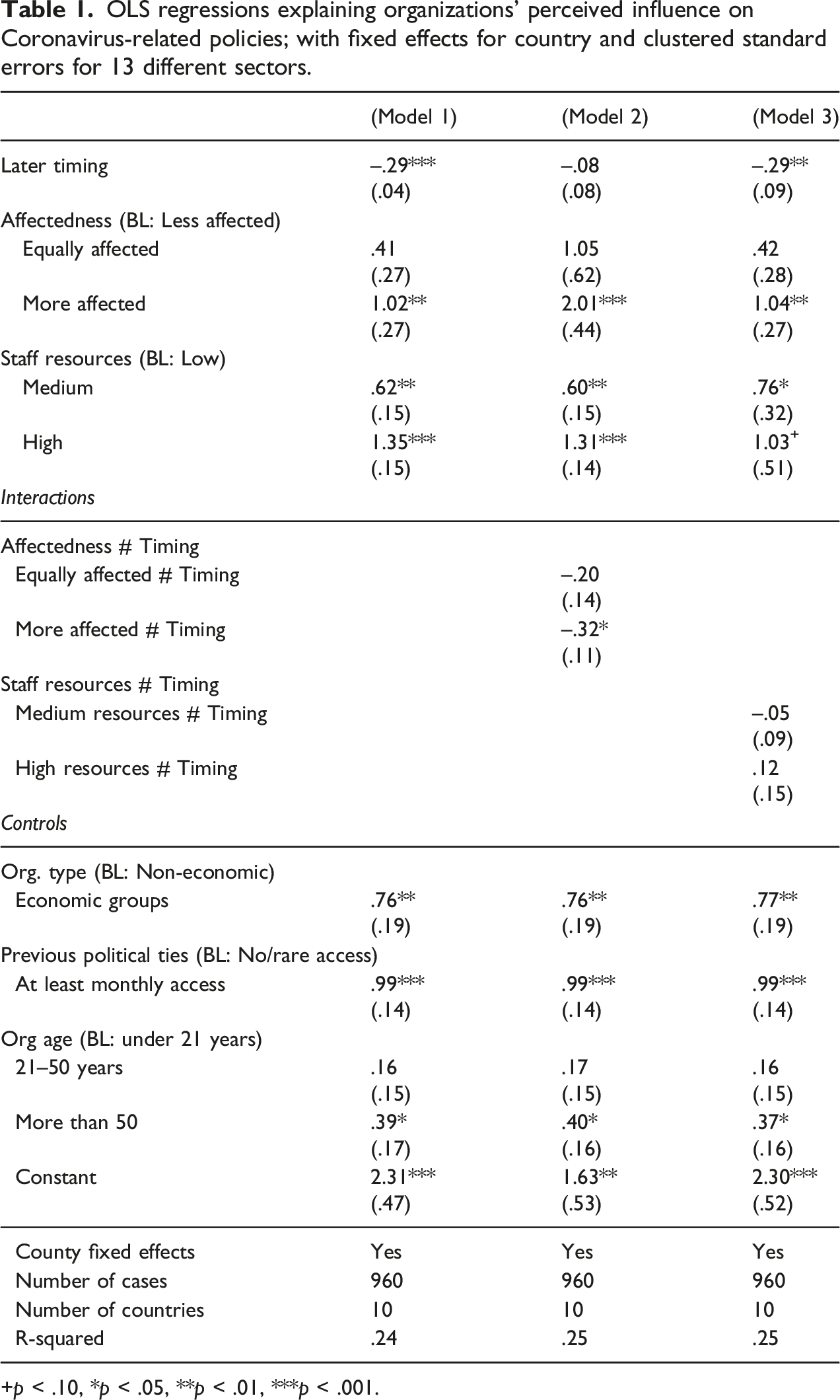
+p < .10, *p < .05, **p < .01, ***p < .001.
All models include country fixed effects. Coefficients are omitted to limited table length, but reported in Supplemental Table E1 in Appendix E.
We discuss the main effect first: do first movers in lobbying have an advantage over latecomers? Model 1 documents that this is clearly the case. There is a substantial and significant (p < .001) relationship between the timing of political activity and the influence these organizations have on political outcomes, according to their own evaluation. Based on Model 1, organizations which lobbied in the first week of March have a predicted self-assessed influence of 4.8 points on a scale of up to 10, all else being equal. This falls to 3.9 for organizations lobbying in the fourth week of March, and down to 3.6 for organizations starting to lobby only in April or May. Put differently, when holding an organization’s affectedness, lobbying resources, type of organization, age and previous insider status constant, we see that organizations lobbying later consistently rate their perceived influence lower, with differences in timing making up for ca. 1.2 points on a scale from 0 to 10. This gives clear support for the main assertion of our paper as formulated by hypothesis 1: Timing clearly appears to matter for lobbying.
This result is robust to different model specifications that take possible unobserved country-specific contextual factors into account. To account further for variation in policies between countries, Supplemental Tables E6 and E7 in the Appendix show the results for groups of countries for which lockdown measures were introduced around the same time (IRE, FR, ITA, GER, AUT, DK) 17 and for the group of countries, which instead had a relatively late (and looser) lockdown (SE, UK, NL). The two groups of countries can be also understood in terms of strictness of lockdown measures, with the first group taking a tougher approach compared to the latter for the months of March to May (Hale et al., 2021). The fact that our results on the main effect of timing replicate within subsets of our data (p < .001 and p < .1, respectively) provides further evidence that the significant effect of early lobbying on lobbying influence is unlikely to be driven by contextual factors that our timing variable captures.
Furthermore, our results also show that timing does not matter equally for all types of organizations. In Models 2 and 3, we test two important conditional effects to see whether the strategic choice to lobby first is more beneficial for some groups than others. First, we hypothesized that the level of affectedness by a new (set of) policy problem(s) should matter for benefiting from moving first (H2), given that we expect policymakers to respond quite differently to more and less affected first movers. In general, we see in Models 1–3 that highly affected organizations by the pandemic have significantly higher perceived influence on Covid-related policies than less affected groups (p < .01 or below). Model 2, however, adds clear evidence for an interaction with timing: There is a significant negative interaction effect for more affected organizations (p = .01). For interest groups that are equally affected as an average stakeholder in the polity (compared to less affected) the interaction effect is not significant (p = .169). The constituent term of timing becomes insignificant. What this suggests is that organizations that are not or hardly affected by (Covid-related) policies do not benefit from moving early on these issues. To make this concrete: supermarkets – which were hardly affected by the crisis – do not profit as much from lobbying early compared to organizations representing hairdressers or restaurant owners. We plot these relationships in Figure 1, which displays the predicted relationship between a first (or later) mover position and lobbying influence for two groups: those with lower and higher affectedness by the pandemic. Predictions of the Level of Lobbying Influence for Early to Late Movers by Level of Affectedness (based on Model 2), with 95% CIs. Note: Predictions for average affected organizations are not shown to ease interpretation.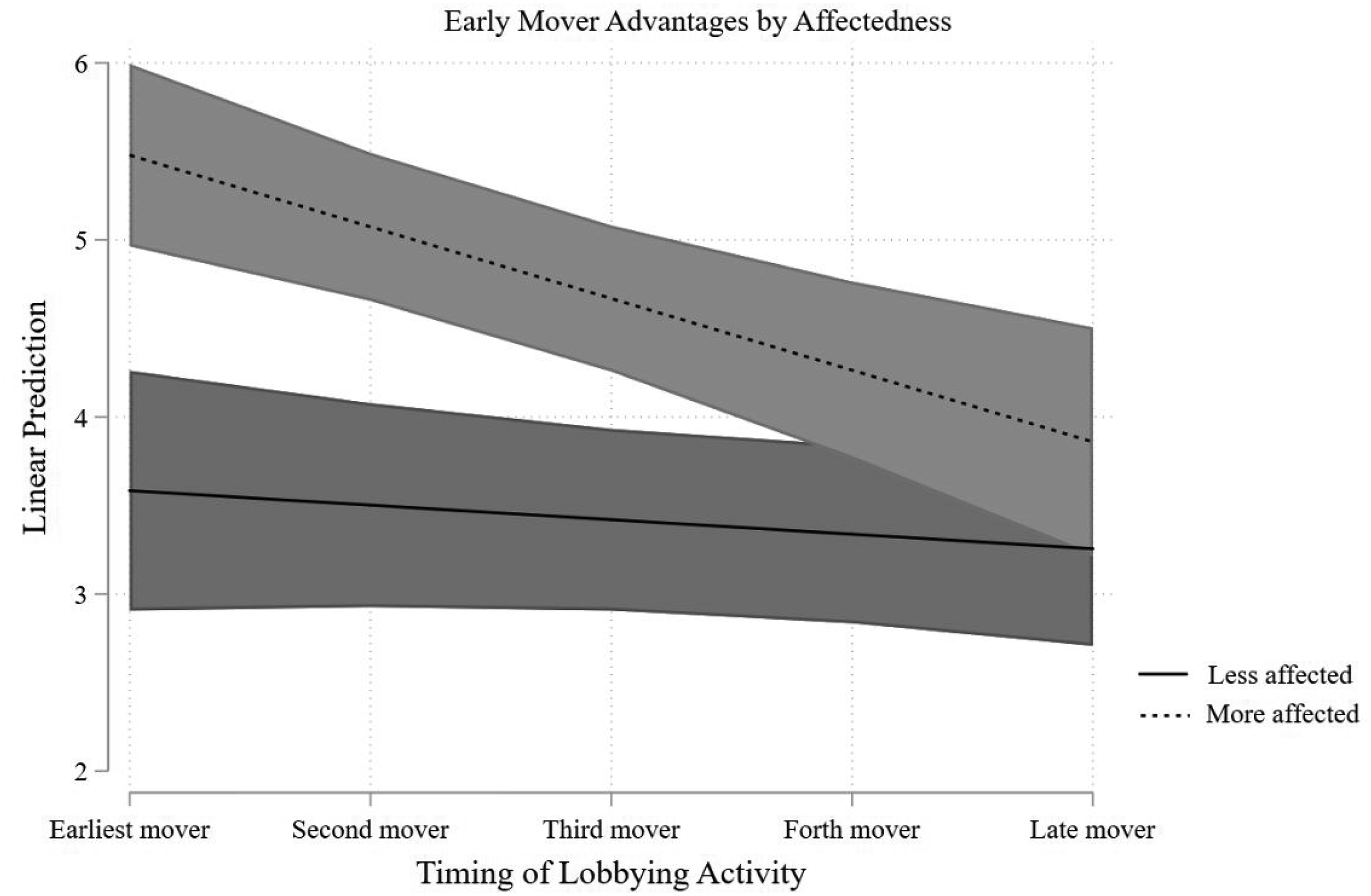
Figure 1 supports our interpretation of the interaction: We see that the predicted lobbying influence for less affected groups at different levels of timing (early to late movers) is basically a flat line: For groups that are less affected, moving early does not seem to matter. In contrast, organizations which are highly affected by, in our case, the Coronavirus crisis, profit from lobbying early. Put differently, for highly affected organizations, the first mover advantage translates into a significantly higher perceived lobbying influence (based on Model 2) compared to highly affected late movers. 18
Moreover, the effect of timing for affected organizations is quite substantial, considering that for highly affected latecomers there is no difference between more or less affected groups. This is a clear indication that a first mover advantage in lobbying is conditional on the interests at stake. This provides strong support for hypothesis H2, where the demand of policymakers filters out organizations that ‘only’ move swiftly, for instance for rent-seeking purposes, but are not really affected by the policy issue. Additionally, we observe that highly affected groups lose out if they move late, in the sense that they lose the advantage stemming from their higher stakes in the policy issue and become indistinguishable from less affected organizations in terms of perceived lobbying influence.
Second, we hypothesized that the resources groups have at their disposal matter for how much they can profit from the decision of moving first (H3). Regarding staff size, Models 1 and 2 consistently show, that higher lobbying staff resources are associated with higher perceived lobbying influence on Covid-19 related policies (p < .01 or below). Looking at Model 3 to see whether resources interact with timing, no significant interaction effect is evident, and the constituent term of the timing of the lobbying activity remains significant and unchanged (p = .008). To shed more light on the potential effect of lobbying staff resources on the relationship between timing and influence, we plot the predicted levels of lobbying influence for early and late movers at different levels of resources in Figure 2. Predictions of the Level of Lobbying Influence for Early to Late Movers by Level of Resources (based on Model 3), with 95% CIs.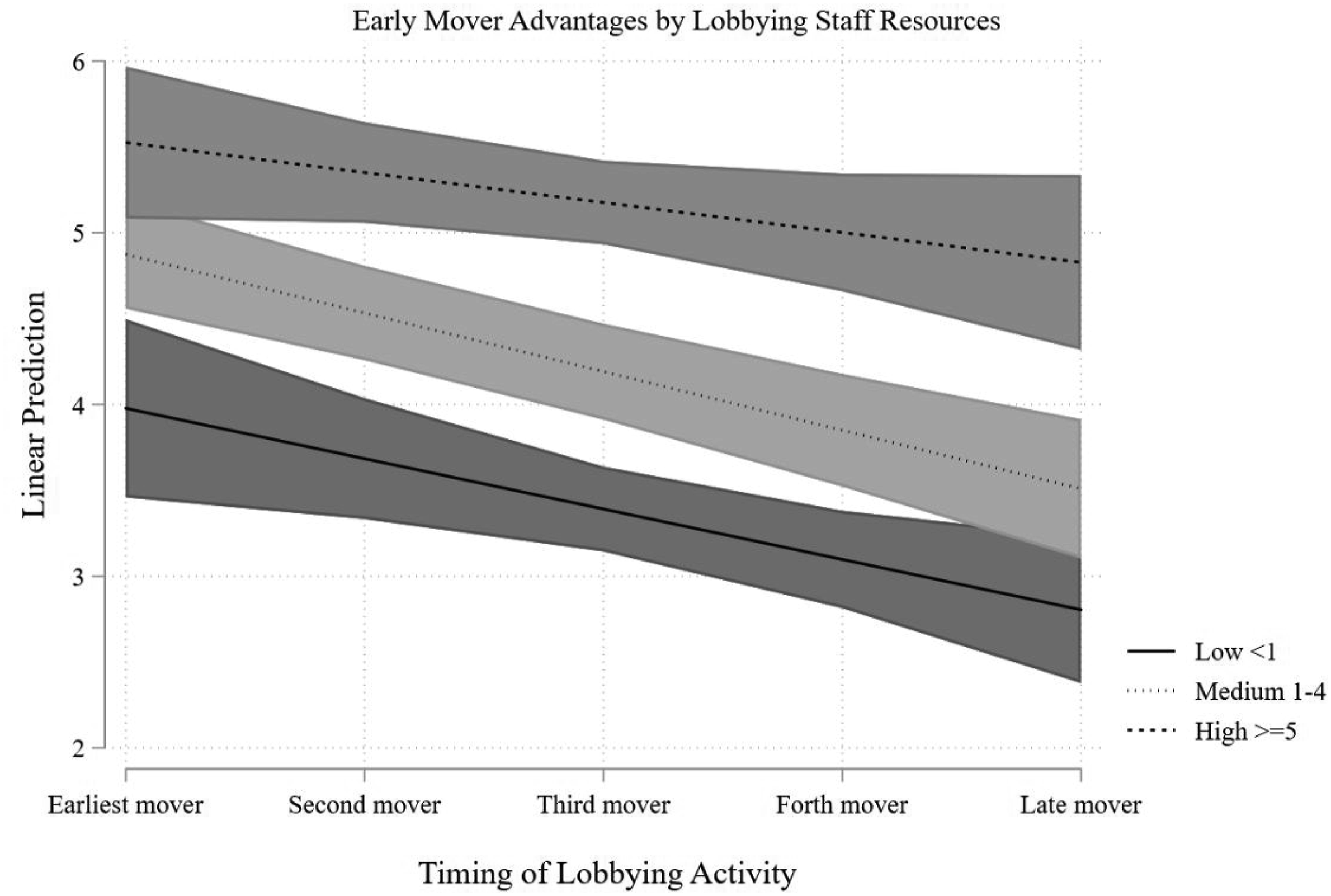
Interestingly, this gives tentative evidence that groups with high resources seem to profit less from early lobbying compared to groups with lower resources: the slope of the curve is less steep for highly resourceful organizations, for which there is no significant difference between predicted lobbying influence as the first or last mover. In contrast, for both organizations with the lowest and with medium staff resources there are significant differences between the predicted influence of early and late movers. This tentatively suggests, contrary to our expectation, that for those with high lobbying staff resources timing actually matters less than for less resourceful groups.
A potential explanation for this pattern might be that those with sufficient staff resources to lobby can secure meaningful access and influence no matter when they lobby. For less resourceful groups, however, moving earlier might pay off more, presumably compensating for having fewer organizational resources. While more resourceful groups generally have higher predicted lobbying influence (p < .01 in models 1 and 2), less resourceful groups can seemingly catch up some of the gap by moving early. In fact, the difference between interest groups with high and medium resources becomes insignificant for the earliest movers but the curves clearly diverge significantly for late movers. 19 Although tentative, this is a potentially consequential finding namely that moving early has the potential to be a ‘weapon of the weak’ as less resourceful organizations seem to benefit more from lobbying early than more resourceful organizations. This challenges the classic link between organizational resources and the ability to overcome collective action by adding an intermediate factor: timing. This appears to be a way for resource deprived organizations to (somewhat) compensate for their lack of influence vis-à-vis resourceful organizations.
Finally, the control variables identify interesting additional findings. Economic organizations reach significantly higher perceived influence on Coronavirus policies compared to non-economic groups (p < .01). Second, groups which enjoyed an insider status (i.e., more frequent access to policymakers) before the Coronavirus crisis also enjoy more influence on Coronavirus-related policies compared to organizations which gained less access before the pandemic (p < .001). Organizational age also matters for political influence, as organizations in existence for over 50 years have significantly higher perceived influence than organizations that have been in existence or 20 years or less (p < .05). Finally, there is noteworthy variation across countries, as we document in Supplemental Appendix E, Supplemental Table E1.
Conclusion: First Come, Best Served?
In this article, we explored whether what works for firms seeking early market entry, also works for interest groups seeking influence on public policy. We treated timing of political action as a strategic component of an interest group’s political activity and associated it to competitive, framing and negotiation advantages that ultimately translate into a higher capacity to influence policy outputs. Our analyses clearly show that first mover advantages hold for the Covid-19 related policies we studied across 10 polities in Europe: all else being equal, organizations lobbying earlier have significantly higher perceived influence on these policies than late movers.
However, we also found evidence of conditional effects of timing. Our results show very clearly that active interest groups that are highly affected by the new (set of) policy problem(s) profit more from a first mover advantage than less affected organizations. Moreover, we find that resourceful organizations are associated with high lobbying influence irrespective of the timing of their activity. However, we also provide tentative evidence that resource-poor organizations can benefit from moving early and narrow the influence gap between them and more resourceful groups.
Our findings contribute to several important debates and raise crucial questions for further research on lobbying and public policy. In line with the state-of-the art literature, we acknowledge the importance of organization-level and issue-level factors for lobbying influence, as well as the potential importance of political ties and active competition (e.g. Dür et al., 2015; Heaney, 2014; Klüver, 2013; Leech, 2010; Lorenz, 2020; Lowery, 2013). However, we add a focus on a temporal dimension to these dynamics. We hope that future studies of lobbying influence – as well as of access, or inside and outside strategies - can build on our theory of first mover advantages in lobbying.
Additional avenues for future research here also relate to our case. The Coronavirus pandemic is, in many ways, an exceptional situation with system-wide impact on the interest group system, and high incentives for all types of organizations to mobilize on public policy. Lobbying does, however, often happen in issue niches, which receive much less public and media attention, with evident consequences for the likelihood of success of an organization’s influence attempt. Future studies should assess what parts of our theory and findings can travel to such issues. We expect that moving late or early may lead to different kinds of advantages in different circumstances, especially for actors that seek to protect the status quo.
Moreover, our study focused on issues that suddenly came to the policy agenda – like an exogenous shock. However, timing is also likely to matter when interest groups act as agenda setters themselves. While our discussions of the strategic position early movers can take may still be relevant (e.g., on framing, policy brokerage etc.), a theory of timing in agenda setting should arguably also take into account competition for attention with other issues.
Finally, it is important to underline the normative implications of our findings. Since we show that first movers have a clear advantage in lobbying, this raises another potential pathway of bias in interest group systems. Organizations which face higher second order mobilization and collective action problems cannot always act as swiftly, which might be a key hindrance for the political influence of outsider groups. To address such bias, efforts of policymakers should focus on actively pulling such groups into the policy process at an early stage. On a positive note, our findings show that decision makers in Europe during the pandemic have been good at distinguishing between early movers that are more or less affected by the crisis. This documents forces at the demand-side that moderate the mere power of being the first in line in lobbying. We hope that future research will build on our study to explore these demand- and supply-mechanism further.
Supplemental Material
Supplemental Material - Is There a First Mover Advantage in Lobbying? A Comparative Analysis of How the Timing of Mobilization Affects the Influence of Interest Groups in 10 Polities
Supplemental Material for Is There a First Mover Advantage in Lobbying? A Comparative Analysis of How the Timing of Mobilization Affects the Influence of Interest Groups in 10 Polities by Michele Crepaz, Marcel Hanegraaff, and Wiebke Marie Junk in Comparative Political Studies
Footnotes
Declaration of Conflicting Interests
The author(s) declared no potential conflicts of interest with respect to the research, authorship, and/or publication of this article.
Funding
The author(s) received no financial support for the research, authorship, and/or publication of this article.

Supplemental Material
Supplemental material for this article is available online.
Notes
Author Biographies
References
Supplementary Material
Please find the following supplemental material available below.
For Open Access articles published under a Creative Commons License, all supplemental material carries the same license as the article it is associated with.
For non-Open Access articles published, all supplemental material carries a non-exclusive license, and permission requests for re-use of supplemental material or any part of supplemental material shall be sent directly to the copyright owner as specified in the copyright notice associated with the article.
