



Abstract
Civil-military relations are characterized by a fundamental dilemma. To lower coup risk, leaders frequently empower the military, which satisfies the armed forces with the status quo and enables them to fight against threats challenging the civilian leadership. Simultaneously, a too powerful military itself constitutes a potential threat that is capable of overthrowing the government. Our research adds to this debate by examining the impact of mechanization, that is, the degree to which militaries rely on armored vehicles relative to manpower, on coup risk. We discuss several (opposing) mechanisms before developing the theoretical expectation that higher levels of mechanization should lower the likelihood of a coup due to the increased costs of coup execution. Empirical evidence strongly supports this claim and, thus, contributes to our understanding of the emergence of coups as an essential breakdown of civil-military relations, while adding to the debate surrounding the many trade-offs leaders face when coup-proofing their regimes.
Introduction
Well into the 21st century, coups are still a persistent feature of political dynamics in many parts of the world. In this decade alone, the military have overthrown governments in Egypt (2013), Zimbabwe (2017), Sudan (2019, 2021), Mali (2020, 2021), and Myanmar (2021); and attempted (but failed) to do so in Burundi (2015), Burkina Faso (2015), Turkey (2016), Niger (2021), or Guinea-Bissau (2022), among others. These episodes underscore that a country’s armed forces are still a central political actor and, importantly, a potential threat to incumbent governments and internal stability. Yet, the number of coups has markedly declined over the last few decades. 1 Scholars have related this decrease in coup incidence to global and political transformations such as an increased international opposition to coups as well as the emergence of multiparty politics and regular elections in non-democracies (e.g., Shannon et al., 2015; Bove & Rivera, 2015; Woo & Conrad, 2019).
Little attention, though, has been paid to other changes having directly to do with the force structure of military forces. To this end, we focus on mechanization—that is, the extent to which militaries rely on tanks and armored vehicles relative to manpower (Caverley & Sechser, 2017; Sechser & Saunders, 2010)—and contend that it likely is a crucial factor that helps explaining the dynamics in the global incidence of coups. We discuss several (opposing) mechanisms before developing the main argument suggesting that mechanization increases the costs of coordination failures during a coup, thereby deterring potential plotters. Despite substantial cross-national variation, modern national armies have undergone thorough structural transformation. This process, importantly, has been mainly driven by strategic factors relating to diffusion, countries’ threat environment, or recent battlefield experiences, but not by institutional influences (Sechser & Saunders, 2010). As Lyall and Wilson (2009: 75) explain: “[m]echanization was not a one-time shock, however. Rather, the lessons learned by the Great Powers in World War I were codified in World War II and then gradually diffused throughout the international system during the Cold War. In particular, the practice of modeling client states’ militaries in their patrons’ image ensured that the modern system was emulated throughout Africa, Latin America, Asia, and the Middle East.” Likewise, Sechser and Saunders (2010: 506) aver that “we can understand the broader global trend toward mechanization partly as a self-reinforcing spiral consistent with the classic logic of the security dilemma.”
The cornerstone of civil-military relations is the so-called guardianship dilemma: the reliance on armed forces for protection against external and internal threats situates the military in a pivotal position they can use to take over power (Besley & Robinson, 2010; Svolik, 2013; McMahon & Slantchev, 2015). The dilemma thus entails that a stronger military should pose a bigger threat to the state. In Feaver’s (1999: 214) words, the “civil-military problematique is a simple paradox: the very institution created to protect the polity is given sufficient power to become a threat to the polity.” Or, as Besley and Robinson (2010: 661) put it, “a strong army generates benefits, but the stronger it is, the easier it is for it to mount a coup and control the state.” 2 Our research examines the practical implications of this dilemma and, under some circumstances, challenges the notion that more powerful militaries represent a bigger threat to incumbent governments. To do so, we focus on one characteristic of military organizations critically shaping their force structure and, hence, their fighting and operational power: mechanization. Specifically, we explore the impact of mechanization levels on the risk of coups d’état to assess whether force structure does in fact make the military more threatening to incumbent governments or not.
Tanks and armored vehicles entering the capital and taking control of strategic buildings have become iconic images of many modern coups. For example, in Zimbabwe in 2017, convoys of armored vehicles entered Harare and seized the state broadcaster, the airport, and blocked roads to the main government buildings. Similarly, during the 2016 coup in Turkey, dozens of tanks and armored vehicles moved into position in Ankara and Istanbul. Similar images are given for the 1973 coup in Chile that brought Pinochet to power and the 1967 coup in Greece. These episodes suggest that more mechanized forces may give rise to coup attempts because they increase the capacity of the military to establish dominance and seize government. Interestingly, however, mechanization has been found to undermine the military’s ability to confront domestic insurgencies. Lyall and Wilson (2009) report that higher levels of mechanization reduce governments’ ability to prevail in civil conflict, while Caverley and Sechser (2017) show that mechanization is associated with longer civil wars. Providing soldiers with such technology may have dampened their ability to confront internal insurgencies; but has it given them a higher ability to stage coups?
We present arguments relating mechanization to an increased material and operational capacity of the armed forces and, hence, a higher risk of coups; ultimately, though, we posit that more mechanized armies are less likely to attempt a coup. This claim is based on two key mechanisms. The first draws on Huntington’s (1991: 252) suggestion that providing the military with “toys” (i.e., tanks, vehicles, and weaponry) helps keeping them content with the status quo and, therefore, relates mechanization to reduced incentives for staging coups. As this argument can be challenged on several grounds, we also outline a second mechanism that focuses on execution costs and coordination failures. Concretely, mechanization increases the cost estimations of potential inter-unit, fratricidal conflict resulting from failed coordination, which might deter officers and soldiers from attempting and joining an intervention in the first place. Using an updated global time-series cross-section data set on mechanization and coups d’état spanning four decades (1979–2019), we find support for the expectation that more mechanized forces are linked to a lower likelihood of coups.
The article makes several contributions relevant to policymakers and the academic literature. First, we further our understanding of how coups emerge by shedding light on a previously unaccounted factor critically associated with the force structure of militaries. The degree of mechanization describes and characterizes many of the world’s existing military organizations, but has not been connected to civil-military relations and the outbreak of coups before. Existing studies have focused on other organizational aspects such as counterbalancing, ethnic stacking, or professionalism (e.g., Powell, 2012; Böhmelt & Pilster, 2015; Harkness 2016; Böhmelt et al., 2019). Second, existing data on mechanization are limited to 2001. Using the instructions in Sechser and Saunders (2010; see also Caverley & Sechser, 2017), we coded new data on mechanization levels of all military organizations in the world until 2019. Third, some existing arguments suggest that more powerful armies are more capable of irregularly replacing incumbent governments. While we do not necessarily question the tenet that mechanization strengthens the military, we show that more powerful militaries do not necessarily represent a bigger threat to incumbent governments. Fourth, and derived from the last point, there may be implications for the literature on military involvement in politics falling short of an outright attempt to seize power—and, thus, our work informs processes in all countries in the world, including consolidated democracies (see Bove et al., 2020). For example, it is plausible that the military’s influence on civilian governments increases with mechanization. Finally, this research speaks to the debate surrounding the many trade-offs associated with coup-proofing (e.g., Roessler, 2011). For example, dividing the military into a series of sub-units, that is, counterbalancing, may lower coup risk, but has a detrimental impact on their effectiveness (Pilster & Böhmelt, 2011). Considering research demonstrating that mechanization decreases militaries’ counterinsurgency effectiveness (e.g., Lyall & Wilson, 2009; Sechser & Saunders, 2010; Caverley & Sechser, 2017), our work stressing that mechanization lowers the probability of military coups underlines that governments investing in mechanization may shift the risk from coups to insurgencies.
Mechanization and Coups: Theoretical Arguments
The consensus in the literature is that irregular attempts by the military to overthrow the government are influenced by military actors’ incentives and opportunities, which in turn shape the expected utility of plotting a coup (e.g., Thyne, 2010; Powell, 2012). Several contextual and structural variables have been argued to influence these two factors. For instance, there is work focusing on governments’ legitimacy, instability, ethnic rivalries, or military grievances (e.g., Londregan & Poole, 1990; Leon, 2014; Harkness 2016; Houle, 2016; Bell & Sudduth, 2017; Houle & Bodea, 2017; Johnson & Thyne, 2018). Others have analyzed structural and organizational factors shaping the military’s ability to stage a coup (e.g., Belkin & Schofer, 2003; Powell, 2012; Böhmelt & Pilster, 2015; Albrecht & Eibl, 2018; De Bruin, 2018).
Somewhat surprisingly, and despite its seemingly central role, military organization, technology, and strength remain largely unexplored. Typically, relying on data from the Correlates of War, scholars have operationalized military capacity as military personnel per capita or military spending (Hendrix, 2010). These two common indicators of military strength have several limitations. At the theoretical level, size and spending variables are frequently interpreted as proxies for factors different from capacity. For example, Powell (2012) sees military size as an item for cohesion and argues that larger militaries hinder coordination and recruitment for a coup. Interestingly, both variables (size and spending) have been found to reduce the risk of coup attempts (e.g., Powell, 2012; Leon, 2014). At the empirical level, taking mechanization into consideration casts doubt on the appropriateness of employing military size or spending as measures of capacity. On one hand, mechanization makes it possible to boost military power while decreasing manpower and, hence, size (Lyall & Wilson, 2009). On the other hand, larger military expenditures do not necessarily entail better soldier quality or military capacity, since money can simply be used to fund salaries and allowances, not combat equipment or training.
Mechanization is arguably the material dimension of military organization most directly associated with fighting capacity. Per the guardianship dilemma (e.g., Besley & Robinson, 2010; Svolik, 2013; McMahon & Slantchev, 2015), a first argument might thus suggest that more mechanization induces a higher coup risk as the estimated likelihood that a coup will succeed is raised. Contrary to this view, there are arguments highlighting that mechanization affects other critical considerations of plotters, namely, their incentives as well as the costs of execution and failed coordination. Eventually, to derive our hypotheses, we examine how mechanization relates to the three explanations of coup dynamics suggested by Singh (2014): coups as battles, coups as elections, and coups as coordination games. This framework allows us to theoretically scrutinize different competing arguments about how mechanization might influence military’s calculations and, hence, the likelihood of coups.
Mechanization, Military Power, and Prospects of Success
According to one view, coups can simply be seen as internal military operations designed to capture the state, which, in the event of facing resistance, are approached as a strict military confrontation. According to Luttwak (1979: 146), “the active phase of a coup is like a military operation.” Singh (2014: 17) concludes consistently, “[i]f attempts are best understood as battles, then the goal of the challenger is to establish clear military dominance,” which is a “task that is made easier by having more men with more powerful weapons” (Singh, 2014: 16). In this context, mechanization, entailing precisely more powerful weapons and increased military power, might help establish such dominance if rebels have access to such equipment. As a result, the enhanced mobility and protection as well as the higher material and technical capabilities associated with more mechanization play a decisive role in plotters’ initial decision to stage a coup by increasing the estimated probability of success and reducing the potential personal costs ‒ and, hence, increase the expected utility of intervening in the planning stage. Much like Collier, Hoeffler, and Rohner’s (2009) claims concerning the onset of civil war, it might be mostly feasibility what matters and triggers coups as well, with military feasibility, in this case, boosted by higher mechanization.
During military battles, tactical movements to capture enemy positions become central. Mechanized units, with the mobility and protection they provide as well as the overwhelming firepower they carry, might be better equipped to take on the operational steps necessary to effectively overthrow a government (Luttwak, 1979; Ferguson, 1987). According to Luttwak (1979: 138), coup execution requires “the application of force at the right place [...] by striking at the organization heart of the whole state.” As highlighted above, popular images of coups typically feature tanks and other armored vehicles on the streets and outside government buildings. This suggests that mechanization can be useful in providing challengers with the relative strength to attain the operational goals of an internal intervention, namely, asserting control over the presidential palace, the parliament, headquarters of the armed forces, radio and TV stations, and the airport (Luttwak, 1979: 122, 157).
On one hand, armed forces with mechanized infantry and armor, thus benefitting from enhanced protection and mobility, could make it easier for troops to safely move from their bases and reach strategic sites in the capital. Protection helps reducing the potential personal costs of participating in a military operation, while improved mobility makes it possible for coup-makers to create an element of surprise. This allows for the opportunity to neutralize enemy forces and, by creating confusion, to hinder their ability to organize and occupy defensive positions to repel the attack. On the other hand, the overwhelming firepower that armored convoys typically carry facilitates tactical operations: it dissuades opponents from taking coordinated action against the attempt and it provides coup stagers with the strength to neutralize and defeat loyal forces protecting governmental buildings and mounting resistance to the attempt. Furthermore, once key buildings have been reached, armored vehicles could allow for a more effective takeover, subsequent control, and then hinder the potential mobilization and taking of positions by pro-government forces. For instance, during the 1973 Chilean coup, tanks shelled the La Moneda palace after Salvador Allende refused to surrender and the President’s guard (Grupo de Amigos Personales) opened fire on the rebels. In the 1967 Greek coup d’état, the army’s tanks occupied ministries and vital infrastructure in the capital (Kassimeris, 2006). The coup was bloodless as no actor had the means to oppose the military’s mechanized forces. Likewise, Thai coup-plotters used armored units in 2006 to occupy strategic buildings in Bangkok (Hewison, 2008: 199).
Thus, force mechanization may increase the tools that officers have at their disposal to stage a coup. These arguments yield the theoretical expectation that higher mechanization increases coup risk.
Mechanization, Corporate Interests, and Incentives for Intervention
A second set of arguments suggests military mechanization should actually lower the probability of observing a coup by influencing the military’s disposition to intervene. This claim hinges on two distinct mechanisms, a direct and an indirect one. The direct mechanism is related to the interpretation of coups as elections (Singh, 2014: 17–21), which sees attempts as driven by officers’ incentives or preferences and, in particular, by the military’s dissatisfaction with the incumbent government or its policies. This approach points to a negative impact of mechanization on the military’s willingness to move against the government.
Military interventions in domestic politics often seek to protect institutional interests and address existing grievances (e.g., Thompson, 1973). Nordlinger (1977: 78) famously posited that “the great majority of coups are partly, primarily, or entirely motivated by the defense or enactment of the military’s corporate interests.” Such interests can include wages, but also hardware: “soldiers should be reasonably well paid, well treated, and well equipped to help encourage and sustain their political subservience” (Slater et al., 2014: 368). Similarly, Geddes (1999: 126) argues that military officers care about generous funds that guarantee access to “state-of-the-art weapons,” while Huntington (1991: 252) more explicitly advocates this perspective when suggesting that democratizers, to curb and professionalize the military, should: “[g]ive them toys. That is, provide them with new and fancy tanks, planes, armored cars, artillery, and sophisticated electronic equipment […]. New equipment will make them happy and keep them busy trying to learn how to operate it.” This logic sees mechanization simply as spoils aimed at buying (or rewarding) the loyalty of the military and assumes that technology, weaponry, and equipment are a crucial component of the military’s corporate interests. More mechanization would provide the military with the means to perform its institutional role (i.e., protecting the state) and gain social prestige. Besides, the procurement of this equipment, often involving arms imports, may induce opportunities for corruption (Gupta et al., 2001). Acquisition decisions are typically made by top defense elites and involve a large degree of secrecy and poor oversight (Ouédraogo, 2014). Commercial activities may facilitate the extraction of bribes and kickbacks, which increase the private benefits of officers and their content with the status quo. Accordingly, higher levels of mechanization, viewed as a co-optation tool, would reduce the motivations to attempt a coup. 3
A second, indirect mechanism contends that mechanization may reduce incentives for intervening, because it exerts a positive influence on military professionalism. Professionalism is often seen as entailing militaries that are more politically neutral and, hence, reluctant to intervene in politics (Huntington, 1959: 71–78). By bolstering professionalism, mechanization would then indirectly reduce coup risk. Nordlinger (1977), for example, considers expertise in the administration of violence as one of the three dimensions of military professionalism. 4 Force mechanization requires a higher level of specialization and of technical as well as tactical training to acquire the skills necessary to operate advanced equipment and carry out combined arms operations. The more soldiers train in separate locations, the more they isolate from political affairs and socialize with the military identity as well as the fundamental traits of the military profession (Janowitz, 1960; Finer, 1962; Moore, 2009). In line with Huntington’s (1959) paradigm of objective civilian control, force mechanization thus creates a more professionalized military, which operates in its own professional sphere and is disconnected from politics, making them less likely to challenge civilian supremacy.
Although relevant for understanding the potential impact of mechanization on coup risk, incentive-based approaches suffer from several shortcomings. First, the incentive-based logic does not address the guardianship dilemma due to inherent commitment problems for both sides: giving the military toys still boosts their material capacities, making it less credible that they can commit not to intervene after having upgraded their power (Wang, 1998). 5 They might become (temporarily) satisfied with the status quo, but also more capable and threatening. Second, relatedly, studies of the impact of military expenditures cannot separate the effect of spending on wages and allowances from the purchase of hardware. Budgetary allocations include a number of items, which existing data do not allow distinguishing. 6 The dilemma above might be addressed if military spending reduces the disposition to plan a coup, but does not actually increase the power of the army. 7 Henk and Rupiya (2001), for example, note that an overwhelming proportion of defense spending in Sub-Saharan countries actually goes to salaries and personnel allowances (see also Powell, 2014; Powell et al., 2018). Yet, Huntington and other scholars seem to place the same weight to payments and equipment in the military’s utility function. Mechanization is linked to the military’s fighting capabilities, but not soldiers’ living conditions, which arguably makes them less important in shaping their motivations.
The mechanisms relating mechanization to professionalism and, in turn, to lower coup risk are incomplete too. As pointed out above, mechanization may lead to increased corruption via arms procurements, which undermines professionalism (Ouédraogo, 2014). In addition, professionalism is not incompatible with coup incidence. Some scholars suggest that military professionalism in fact drives officers to intervene in politics (Finer, 1962). 8 Indeed, some dimensions of professionalism such as the presence of military academies for the training of officers have been recently shown to be positively associated with coup occurrence (Böhmelt et al., 2019).
Mechanization, Execution Costs, and Coordination
Next to co-optation, we suggest another mechanism through which mechanization might reduce coup risk. This approach considers the expected costs of coup execution caused by potential intra-military confrontation and violence (De Bruin, 2019). The underlying argument draws on perspectives that see coups as coordination games in which expectations of others’ behavior and the consequences of their joint actions for the military play the critical role (Geddes, 1999; Singh, 2014; Little, 2017). 9 Central to this mechanism are not so much the military’s combat capacity or grievances, but the expectations that shape its ability for collective action. In particular, a primary concern in coup plotters’ calculations pertains to the costs of executing a putsch and to avoiding bloodshed due to inter-factional, fratricidal confrontation within the military (Finer, 1962; Stepan, 1971; Luttwak, 1979; Casper & Tyson, 2014; Singh, 2014; De Bruin, 2019). According to Geddes’ (1999: 126), “the worst possible outcome for the military as an institution is civil war in which one part of the armed forces fights another.” Or, as Singh (2014: 23) puts it, “the leaders of both sides take the possibility of a civil war seriously and are constrained by the desire to avoid it.”
Coordination games like the ones involved in a coup exhibit multiple equilibria: one where a coup occurs and one where it does not. Singh (2014: 23) emphasizes here that “the main reason for restraint and coordination during a coup attempt is to avoid escalation into fratricidal conflict.” A first possibility is thus that access to mechanized equipment may spur coups as it allows coup stagers to “make a fact” and credibly present the overthrow as a fait-accompli (Singh, 2014). Under such a scenario, the view of the overwhelming fire power of armored convoys stationed around key targets in the capital would shape the expectations of other military factions and deter them from taking action against the attempt to avoid intense fighting between mechanized forces and escalation into civil war.
However, as an alternative, we suggest that mechanization makes it more likely that coordination leads to coups being less likely to occur. The “making a fact” argument rests on coup plotters’ capacity to credibly signal durable control and, thus, manipulate the beliefs of other military actors. We claim that mechanization actually undermines that scenario making officers more likely to refrain from staging a coup in the first place. In other words, under such circumstances, not staging a coup is more likely to become the risk-dominant outcome, that is, “the outcome that is chosen because it is safer in the event of a failure to coordinate” (Singh, 2014: 32). Mechanization makes such failure costlier for several reasons. First, in coups where actors often have opposing preferences and secrecy at the planning stage is necessary to avoid detection and denunciation, there is much uncertainty about other players’ preferences and actions. As De Bruin (2019: 799) stresses, “[t]he need to plan in secret makes it difficult for coup plotters to estimate the depth of their support within the military and security forces at the outset of a coup.” With ex-ante knowledge of ample support, plotters could expect that making a fact is feasible and would effectively dissuade other (smaller) factions from resisting. Yet, uncertainty impedes coup planners to estimate whether they will manage to mobilize sufficient forces and, in turn, increases risk aversion among those considering a first move especially when miscalculation can result in very costly outcomes. With higher mechanization, as we discuss below, those costs are expectedly higher and, hence, concerns about a coordination failure intensify.
Second, mechanization increases the estimated institutional, material, and human costs of intra-military conflict and, hence, the costs of a failure to coordinate. Several operational factors and limitations linked to mechanization contribute to increase the probability of bloodshed. This raises the expected execution costs of a coup. 10 On one hand, higher levels of mechanization increase the material destruction and casualties caused by direct conventional fighting during a coup attempt if loyal and opposing mechanized factions end up fighting for control over the capital. 11 The 2016 Turkish coup attempt, both sides suffered numerous casualties and material destruction was extensive as armored units clashed in several urban locations. In the 1990 Afghanistan coup, General Tanai’s 15th tank brigade confronted the armored units of the Sarandoi paramilitary police force and heavy fighting ensued in the capital. 12 On the other hand, in addition to the direct costs associated with direct confrontation of armored units, the logistics of operations led by mechanized units in urban contexts also affects coup plotters’ ability to capture symbolic targets and the risk that costly confrontation ensues. These features add uncertainty to the outcome of a coup-attempt, undermining the first-mover advantage of plotters and their ability to make a fact conveying credible information about control and success. 13 Mechanized units have operational advantages for conventional land warfare, but not for operations taking place in urban contexts.
Armored vehicles’ movements are more easily detectable, which reveals to loyal security forces the intentions and location of rebels. With the involvement of armored units, perpetrators may undermine the element of surprise that is crucial to any coup attempt and to “making a fact” (Ferguson, 1987: 108; Singh, 2014). Furthermore, armored parts of the military are normally stationed outside capital cities, as tank units require spacious facilities to store their equipment and carry out military exercise. 14 In the event of a coup, then, they would have to move from their bases to the capital and risk being detected, blocked, and confronted.
Therefore, despite their enhanced mobility, capturing strategic positions involves covering larger distances and operating in complex and densely populated urban centers, which allows loyal military units and even civilians to establish defensive positions and, in turn, weakens rebels’ ability to seize key targets. 15 Large mechanized columns can be blocked more easily from entering specific areas and find it more difficult to maneuver in urban environments than infantry units. Crossing defensive lines (and other obstacles) by force would entail causing more fatalities among military personnel (and possibly civilians), a violence likely to signal weakness on the rebel side rather than power. 16 Consider again the case of Turkey: pro-AKP forces became alarmed of the coup attempt due to the presence of armored vehicles in key parts of Istanbul and were rapidly able to organize resistance. Esen and Gumuscu (2017: 64) note that many tanks of the Turkish coup forces were unable to even leave their military bases as civilians were blocking the gates. The perpetrators of the 1991 coup in the USSR faced a similar problem: anti-government tank columns advanced and took positions to attack the parliament and main government offices, but soon found themselves being confronted by civilians who erected barricades (Dunlop, 1993: 228). The rising probability of a bloody fight led challengers to renounce their goals. 17
Lastly, mechanization influences officers’ information and expectations about the likelihood and intensity of the violence that may potentially ensue. Information about the number of armored vehicles different units have is commonly known, especially among senior officers. Consequently, more accurate expectations can be formed not about other military members’ views, but about the relative military strength of potential rival factions and, hence, the credibility of challengers’ claims and the costs associated stemming from potential confrontation. The technical specialization that mechanization requires reinforces this. As Quinlivan (1999: 152–153) claims, “improving the technical skills of regular military officers increases not only their ability to deal with foreign regular armies, but also their sense of the military risks involved in a coup attempt.” He consequently observes that “understanding these risks in turn renders them less likely to attempt a coup” (Quinlivan, 1999: 153). Under these conditions, manipulating the beliefs of other military actors to make the victory of a coup attempt seem inevitable becomes more difficult.
In sum, with increased costs of potential conflict, better information about the anticipated costs and risks of an intervention, and uncertainty about other officers’ intentions and success prospects, mechanization undermines potential plotters’ ability to convince the rest of the military that their victory is a fait accompli. As a result, not launching a coup becomes the safest course of action. 18 These arguments lead us to formulate a second hypothesis that leads to a different empirical expectation: higher mechanization lowers coup risk.
Research Design
The theoretical argumentation led to the proposition of two, opposing expectations. To examine their validity, the empirical analysis is based on an updated global time-series cross-section data set on mechanization and coups d’état, which has the country-year as the unit of observation and covers the time period 1979–2019. 19
Our main explanatory variable is the level of mechanization of a country’s ground combat forces. To measure this, we use the number of armored vehicles per 100 ground combat soldiers as introduced in Sechser and Saunders (2010). The original mechanization-rate index is coded for 153 countries 20 using data on the number of motorized armored vehicles (including amphibious vehicles) and ground combat troops (army, naval infantry, and marines) from the Military Balance (International Institute for Strategic Studies, 2019). Sechser and Saunders (2010: 491) limit their data collection to odd-numbered years in 1979–2001 as “national mechanization rates tend to exhibit only gradual changes from year to year.” Following their instructions, we compiled our own data and updated the mechanization-rate index for all odd-numbered years until 2019 using recent versions of the Military Balance. 21 We thus extend the temporal reach of the mechanization-rate index from 22 to 40 years, almost doubling it. To test the influence of mechanization on coup attempts, we interpolate its even-numbered years as the average of the mechanization rates in the preceding and succeeding country-years. In line with previous studies (Caverley & Sechser, 2017; Sechser & Saunders, 2010), we also log-transform this variable. Our main independent variable, Mechanization, is thus the logged, interpolated number of armored vehicles per 100 ground combat soldiers. 22
Interestingly, mechanization trends vary across countries. Western states including France, Canada, or Italy as well as significant world powers such as India, Israel, and Saudi Arabia are in the process of de-mechanizing their armed forces after significant mechanization efforts in late 1990s and early 2000s. This de-mechanization trend observed in countries with a strong international presence can be potentially explained by the decreased threat of interstate warfare since the end of the Cold War and the increased importance of counter-insurgency capabilities (e.g., the case of French operations in West Africa). Similarly, the armed forces of Eastern European states like Russia, Ukraine, and Belarus experienced substantial de-mechanization following the collapse of the USSR, but their militaries have been increasingly re-mechanized post-2017. Conversely, wealthy medium-sized states like Norway, Sweden, Taiwan, United Arab Emirates, and Australia, but also Greece and Pakistan have increased their force mechanization efforts. This trend can be attributed to the interest of medium-sized states to address regional security challenges and threats from (larger) neighboring states. Finally, the armed forces of the US, the UK, and China have significantly expanded their mechanized capabilities since 2017, which is likely linked to rising tensions at the global level involving these actors.
As this discussion suggests, mechanization levels generally rose over time, but this process is not uniform across countries. Previous conflict experience and the threat environment are core drivers of mechanization (Caverley, 2014; Sechser & Saunders, 2010). Wealthier countries can and do mechanize more (Gartzke, 2001; Sechser & Saunders, 2010). Existing research also suggests that regime type affects mechanization, as democracies should be casualty averse and, hence, invest in mechanization. And Gartzke (2001) shows that more populous countries invest in larger armies instead of equipment, pointing towards lower mechanization levels. Finally, countries’ wealth does not automatically correspond to their military expenditures, meaning that higher total military expenditure should also be a non-negligible driver of mechanization.
Our dependent variable, Coup Attempt, is a binary item based on Powell and Thyne (2010: 252), which defines coups as “illegal and overt attempts by the military or other elites within the state apparatus to unseat the sitting executive.” The outcome variable takes the value 1 if a country-year experienced at least one coup attempt in a given year and 0 otherwise. Our data set includes 6153 country-years and 155 of these experienced at least one coup attempt (2.52%). Figure 1 allows for an initial, albeit descriptive, inspection of the relationship between Mechanization and coup attempts. Coups are more likely to occur in countries with lower mechanization rates as indicated by lower median and 75th percentile values of Mechanization. To test this relationship more systematically, we use logistic regression models, as our dependent variable is dichotomous, and account for temporal dependence in the probability of coup attempts using cubic polynomials of time since the last putsch (see Carter & Signorino, 2010). In addition, we cluster standard errors at the country level to account for intragroup dependencies. Mechanization and Coup Attempts. Note: Grey areas represent probability density, spikes denote adjacent values, boxes indicate interquartile ranges, and white dots give the medians.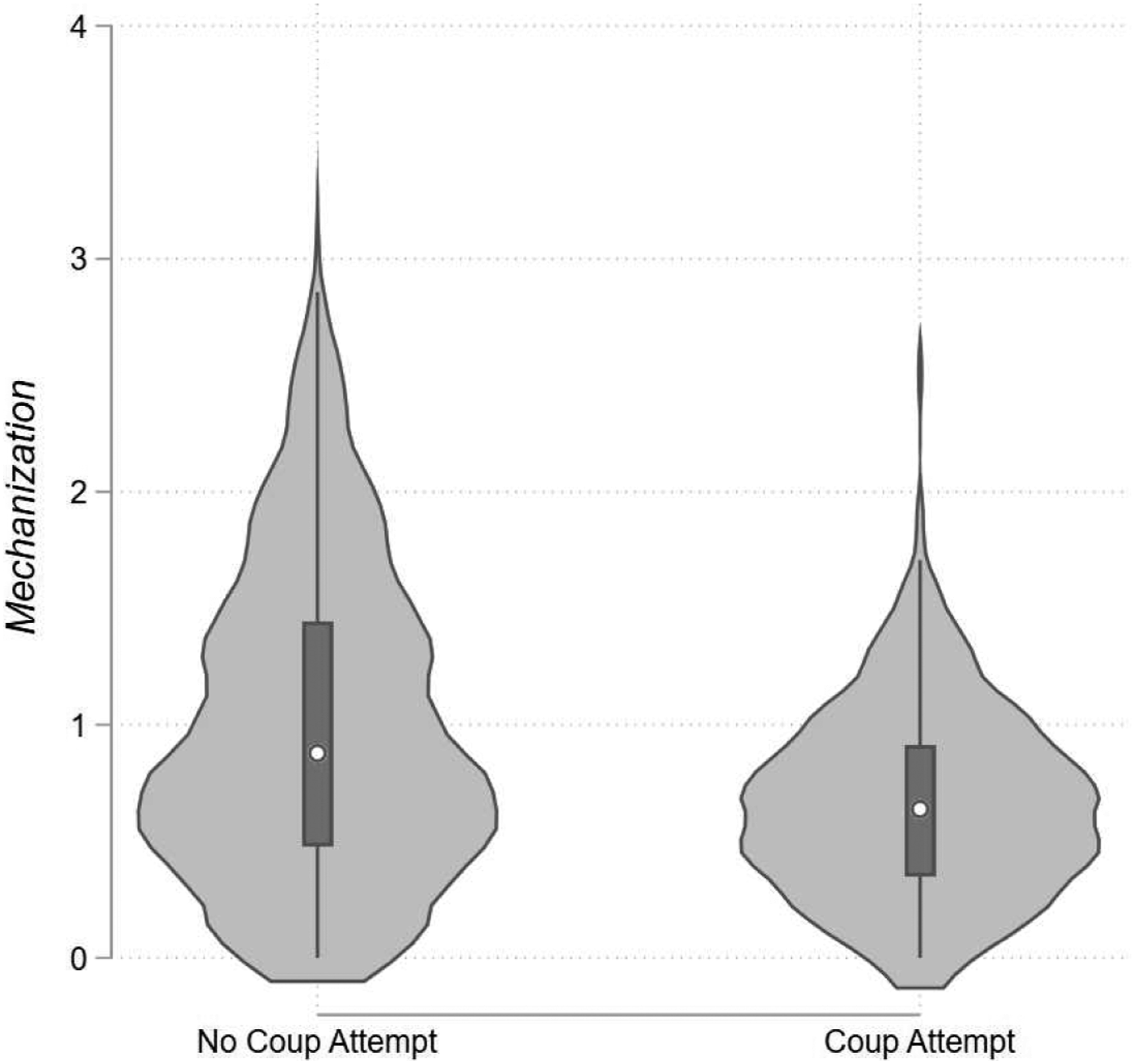
In light of the discussion above, we include a number of alternative determinants driving the degree of mechanization of the armed forces and of coup attempts (Caverley, 2014; Gartzke, 2001; Sechser & Saunders, 2010). At the same time, we attempt to avoid controls that may induce post-treatment bias, that is, whose values are the result of a country’s military being more or less mechanized. 23 First, higher military expenditures have been argued to “buy loyalty” and, accordingly, may decrease the probability of coups, but they likely also shape mechanization levels. We control for logged military expenditures, as well as the year-to-year change in military spending using data from SIPRI (2019). Importantly, doing so also provides us with some leverage to distinguish between the incentive and coordination-based mechanisms linking mechanization to lower coup risk.
We also control for regime type by including democracy and autocracy dummies, which are based on the Polity IV data set (Marshall et al., 2019). We use the cut-off points of −6 and +6 to define autocracies (−10 to −7 on the polity2 score), anocracies (−6 to +6), and full democracies (+7 to +10). Previous studies find that regime type influences coups (e.g., Bell, 2016; Powell et al., 2018) and it also affects mechanization levels: democracies are likely to be more casualty averse and, hence, invest in mechanization. Similarly, economic conditions and population size drive in how far states can and want to invest in mechanization (Gartzke, 2001) and may affect the popular support for regime overthrow (Londregan & Poole, 1990). We thus control for the logged GDP per capita, as well as for the yearly change in it, and for logged population size, taking this information from the World Bank Development Indicators. 24
Finally, coups may be triggered by previous political instability and existing research shows that interstate and domestic conflict have the potential to affect coup risk (Arbatli & Arbatli, 2016; Johnson & Thyne, 2018; Roessler, 2011) as well as mechanization (Sechser & Saunders, 2010). Our models then consider indicators for the incidence of both violent inter- and intrastate conflict as well as non-violent campaigns in the previous year, using dichotomous variables from the Uppsala Data Program (Gleditsch et al., 2002) and NAVCO (Chenoweth & Lewis, 2013), respectively. We return to the domestic and international threat environment when discussing our robustness checks below.
Results
The Relationship between Mechanization and Coup Attempts.
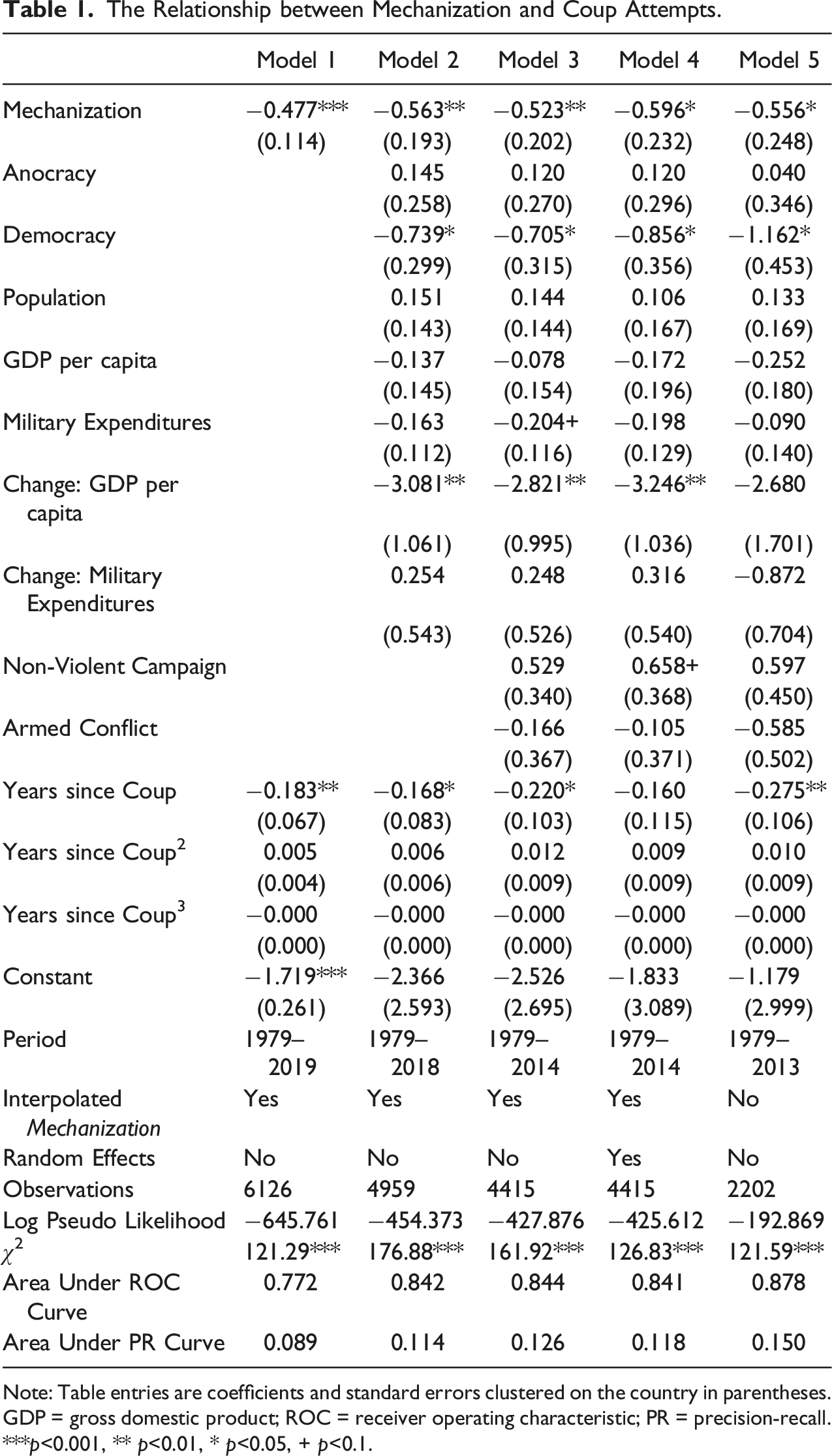
Note: Table entries are coefficients and standard errors clustered on the country in parentheses. GDP = gross domestic product; ROC = receiver operating characteristic; PR = precision-recall.
***p<0.001, ** p<0.01, * p<0.05, + p<0.1.
To supplement this first interpretation, we show the substantive effect of Mechanization in Figure 2, where the predicted probability of a coup attempt is plotted over the range of mechanization levels. Moving the variable from 0 to the third quartile (about 1.4) is associated with a 1.7%-point decrease in the probability of coup occurrence (from 3.5% to 1.8%). Shifting Mechanization to its maximum leads to a further decrease in coup probability of 1.2%. This total effect of 2.9%-points may appear small, but recall that coups are rare events and we only observe an attempt in 2.52% of the observations in our sample. The effect further compares favorably to other known predictors of coup attempts, such as regime type, defense expenditures, or military academies, which have been found to have similarly sized effects (see Böhmelt et al., 2019; Powell, 2012). We return to this issue in the Appendix. Mechanization and the Probability of a Coup Attempt. Note: Graph shows average marginal effect of Mechanization on the probability of a coup based on Model 3; black line gives point estimates, while grey dashed lines represent 95% confidence intervals; rug plot at the bottom illustrates the distribution of Mechanization; average marginal effect of 0 represented by dotted horizontal line.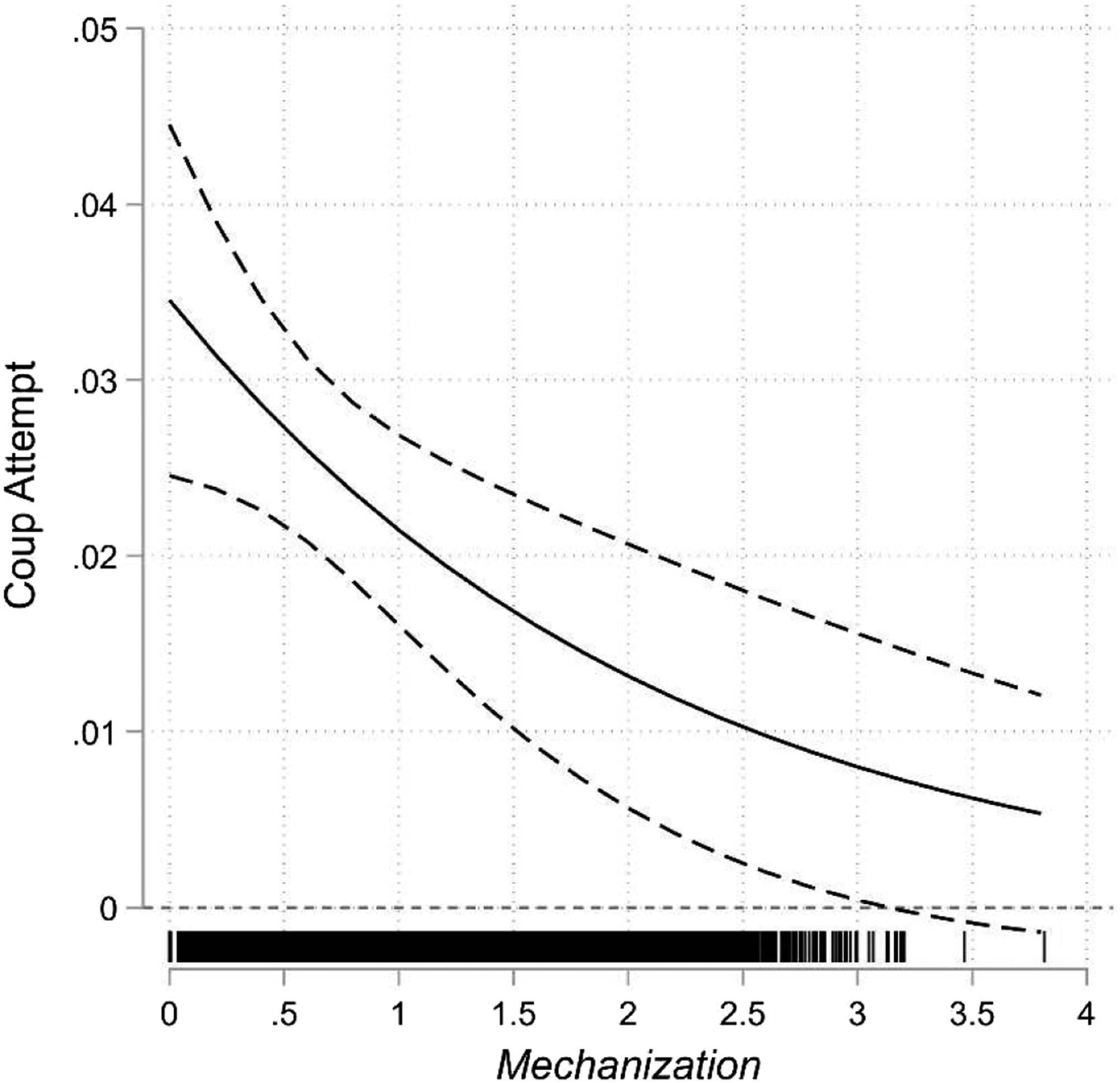
Mechanization thus has a negative effect, which is both statistically und substantively significant. Our results support the argument leading to the second theoretical expectation that more mechanized militaries are less likely to stage coup attempts. This is the case while controlling for military spending, indicating that higher levels of mechanization decrease coup risk even when accounting for the budgetary resources being spent on the military. In other words, coup-risk dwindles as mechanization increases while holding military spending constant. This suggests that mechanization does not just represent a higher number of “toys” for the armed forces, but decreases coup risk by making anticipated costs higher and, hence, and cooperation failures costlier.
Mechanization and Forecasting Coup Attempts.
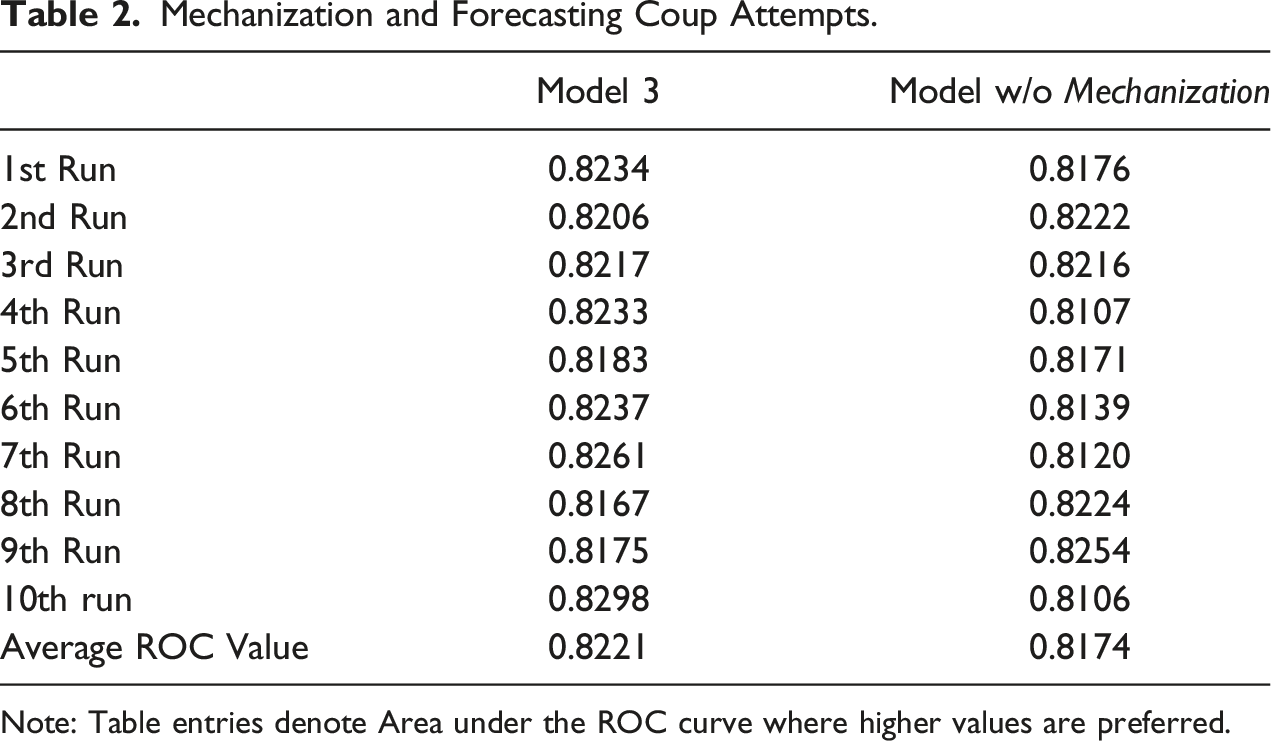
Note: Table entries denote Area under the ROC curve where higher values are preferred.
To further assess the robustness of our main result, we conduct a number of robustness tests, which we summarize here and report at length in the appendix. First, we do not log-transform Mechanization. Second, next to dropping interpolated values of mechanization as done for Model 5 above, we also omit potential outliers at the top of the mechanization distribution and examine whether our results are driven by countries such as the US, which combine high mechanization with very low coup risk. Third, we employ penalized maximum-likelihood regression, since coups are characterized by a rare-events data generating process. Fourth, we also estimate a two-stage selection model, which jointly analyzes coup attempts and coup outcomes. Interestingly, we find that mechanization does not affect the likelihood of coup success. 26 Fifth, we further take into account institutional coup-proofing (Pilster & Böhmelt, 2011), as coup-proofing can decrease coup-risk (Böhmelt & Pilster, 2015; De Bruin, 2018). Sixth, we control for total military personnel (logged) and total military spending divided by military personnel. While both items are partially included in Mechanization (due to the personnel component) and, thus, liable to post-treatment bias, this robustness check also shows that the estimated effect of Mechanization does not change in substance. The impact of Mechanization is thus not driven by more spending per soldier (as the incentive-based argument suggests) or by less personnel. Seventh, we include the Banks (Banks & Wilson, 2016) conflict index, which accounts for assassinations, purges of governmental officials, guerrilla activity, protests, riots, and strikes instead of the variables on armed conflict and non-violent campaigns (see Powell, 2012). Eighth, next to examining an interaction effect of Mechanization with regime type (in particular, democracies), we also disaggregate coups by the rank of the perpetrators (Albrecht & Eibl, 2018). Ninth, we control for the possibility that governments concentrate mechanized equipment in pro-government units or in units closer to the capital. Tenth, we include arms imports as an additional control because they are often necessary for mechanization but also associated with more inefficient militaries, we control for economic inequality as it drives mechanization (Caverley, 2014) as well as coup attempts (Svolik, 2013), we add alliance membership as a control, and we account for global trends in mechanization levels and coup propensity.
Along these lines, we also further investigate whether our results are driven by mechanization picking up on organizational or cultural attributes that affect putsch activity: as French and British colonial origins affect how post-colonial militaries are organized (Asal et al., 2017; Mehrl & Choulis, 2021), we control for a country’s main colonial ruler. And to ensure that the armed forces professionalism or culture do not influence our main effect, we control for several proxies of these nonmaterial phenomena. We further ensure that the domestic and international threat environment, which affects the military’s threat orientation, does not drive our results. Some studies find that international conflict reduces coup risk (Arbatli & Arbatli, 2016; Piplani & Talmadge, 2016) and mechanization often occurs in response to international threats. At the same time, mechanization is associated with the outcome and duration of civil conflicts (Lyall & Wilson, 2009; Caverley & Sechser, 2017; Sechser & Saunders, 2010), while civil conflicts may also influence coup risk (Bell & Sudduth, 2017; Eibl et al., 2021). We begin by separately controlling for contemporaneous interstate and civil conflict. Next, we control for different lags of these two variables. Focusing on civil conflict, we then follow Eibl et al. (2019) by distinguishing regional from center-seeking rebellions and accounting not only for their incidence but also duration and time elapsed since termination, while still controlling for interstate conflict occurrence. We also control for militarized interstate disputes instead of interstate conflict, distinguish between being the target and initiator of them, and account for their duration (Piplani & Talmadge, 2016). Because “chronic” regime threats, especially territorial disputes, may matter just as much as acute armed conflict (Florea, 2018; Kim, 2018), we report specifications where we control for interstate rivalries as well as being the challenger or target of territorial claims, the duration of these, and their salience. Finally, we address endogeneity concerns about the relationship between mechanization and coup risk by estimating a simultaneous equations model, thus explicitly allowing an effect in in both directions. The substantive result that increased mechanization is associated with a reduced probability of coup attempts holds across all additional specifications.
Conclusion
How is a country’s degree of military mechanization related to coup attempts? While previous work has seemingly overlooked this crucial factor, anecdotal evidence and some qualitative accounts may suggest that mechanization increases coup risk via, among other mechanisms, its enhancing impact on military power. Contrary to this view, we show that the level of mechanization is a significant and substantively important predictor of coup attempts: the higher mechanization in a country’s armed forces, the lower coup risk. This conclusion is based on a quantitative analysis of updated data on all countries until 2019, prediction and forecasting techniques, as well as a series of robustness checks reported in the Appendix. Our research supports the view that mechanization is likely linked to the mechanisms of expected execution costs and coordination: the former increase in light of a higher degree of mechanization, the latter becomes more difficult in a more mechanized military organization.
Our research is relevant and important for the scholarly literature on civil-military relations. First, we add to our understanding of how coup attempts develop. Mechanization is a key aspect of any military organization. It was thus far unclear where and how it may influence coup risk, but our study is one of the first in theoretically and empirically establishing a link to civil-military relations. Second, by updating the mechanization data in Sechser and Saunders (2010; see also Caverley & Sechser, 2017), future work can rely on these new data to investigate other questions related to mechanization. Third, the logic of the guardianship dilemma and anecdotal evidence suggest that more powerful armies may be more capable (and, hence, likely) to overthrow the government; and mechanization is a factor boosting military strength. By demonstrating that more powerful militaries may not always represent a bigger threat to the incumbent, we challenge these established views. Derived from this, there are important implications for the wider debate on the trade-offs associated with coup-proofing. Mechanization actually lowers coup risk according to our research, while it also decreases militaries’ counterinsurgency effectiveness (Lyall & Wilson, 2009; Sechser & Saunders, 2010; Caverley & Sechser, 2017). Hence, investing in mechanization means that governments shift risk from coups to insurgencies.
Several interesting avenues for further research emerge from our work. We outline three of them. First, our focus lies on coups, but there may be consequences for the general involvement of the military in politics short of governmental overthrows (see Bove et al., 2020). It would be an effort worth making to examine how mechanization relates to other aspects of a country’s civil-military relations. Second, we concentrate on the mechanization of ground-combat forces as, in most cases, these troops are ultimately the ones executing a coup. However, examining the mechanization of naval (see Böhmelt et al., 2017) and perhaps even air forces could also be interesting in order to explore more thoroughly latent coup dynamics. Third, our research shows, in line with earlier findings, that coup-proofing efforts (and mechanization may be one of them) may produce negative, second-order consequences. Mechanization illustrates this nicely: it is helpful to lower coup risk, but may have detrimental consequences for a state’s counterinsurgency capabilities. Against this background, assessing in an all-encompassing study the various trade-offs of diverse coup-proofing strategies seems like an important avenue for future work—as this would not only shed light on the determinants of different coup-proofing strategies, but also on how coups as well as coup outcomes emerge.
Supplemental Material
Supplemental Material - How Mechanization Shapes Coups
Supplemental Material for How Mechanization Shapes Coups by Ioannis Choulis, Marius Mehrl, Abel Escribà-Folch, and Tobias Böhmelt in Comparative Political Studies.
Footnotes
Declaration of Conflicting Interests
The author(s) declared no potential conflicts of interest with respect to the research, authorship, and/or publication of this article.
Funding
The author(s) received no financial support for the research, authorship, and/or publication of this article.
Supplementary Material

Notes
Author Biographies
References
Supplementary Material
Please find the following supplemental material available below.
For Open Access articles published under a Creative Commons License, all supplemental material carries the same license as the article it is associated with.
For non-Open Access articles published, all supplemental material carries a non-exclusive license, and permission requests for re-use of supplemental material or any part of supplemental material shall be sent directly to the copyright owner as specified in the copyright notice associated with the article.
