



Abstract
While scholars of clientelism have long recognized that party organization characteristics influence the capacity of parties to pursue clientelism, the consequences of clientelism for party organization remain underexplored. This article examines how clientelism influences one salient aspect of party organization in Central and Eastern Europe (CEE), internal democracy, arguing that in parties pursuing clientelism, selection processes are less competitive, and leader domination over party bodies is necessary, as is limiting the influence of rank-and-file members on organizational and policy issues. Longitudinal analyses corroborate the hypothesized negative relationship for a sample of CEE parties and for a larger sample of parties outside the region. While single-shot and relational clientelism are both negatively associated with intra-party democracy, the latter has a stronger impact. The statistical analyses are complemented by a qualitative account of how clientelism and weak intra-party democracy fit in with the CEE parties’ origin, ideological orientation, and broader organisational strategies.
Introduction
The academic understanding of intra-party democracy has improved impressively in the past decade as better theoretical models have been formulated and wide-ranging empirical infrastructures have emerged (Bolin et al., 2017; Cross & Katz, 2013; Lindberg et al., 2022; Scarrow et al., 2022). However, despite such positive developments this literature remains Western-centric and oblivious to how parties’ non-programmatic linkage and mobilization strategies influence the dispersion and wielding of power within parties in most democracies around the world.
Clientelism is without doubt the most pervasive non-programmatic mobilization strategy outside the core advanced post-industrial democracies (Mares & Young, 2016; Yildirim & Kitschelt, 2020). There is a broad scholarly consensus that clientelism implies a non-programmatic targeted distribution of goods, services, benefits or other favors that is conditional on the recipients’ political behavior (Mares & Young, 2018; Stokes et al., 2013). This article theorizes the ways in which clientelism is likely to shape intra-party decision-making regarding personnel and policies, the parties’ organizational structures as well as the opportunities they offer to members to vote and deliberate on all these aspects. The article presents empirical evidence drawn from a series of longitudinal analyses of parties in Central and Eastern Europe (CEE) which validates the association between the two processes. Clientelism has a strong negative impact on intra-party democracy in CEE, which is robust to alternative measures of both phenomena and to considering different forms of clientelism. Although it could be argued that attitudinal and organizational legacies from Communism make CEE parties more prone to both clientelism and low levels of democracy through a translation of practices or cultural schemata inherited from the previous regime (Kotkin & Beissinger, 2014), additional analyses show the negative association is present when examining a broader sample of parties outside the region. While the relationship is stronger in electoral democracies compared to liberal democracies, the latter are not immune to the phenomenon discussed here.
Internal party democracy is usually defined in terms of inclusiveness of members in decision making, the degree of openness in elections for party office and selection of candidates for public office, and the extent to which the leader shares power with more inclusive party organs (von dem Berge & Poguntke, 2017, p. 140). Moreover, intra-party democracy entails the routinization of intra-party conflict and a modicum of rule of law to arbitrate disputes between party bodies or sanction violations of members’ rights. Building on this conceptualization, my argument is threefold. First, in a clientelist party, the leader needs to have the means to control the careers of members to be able to reward and promote the most efficient brokers and fight the agency loss that is always lurking when such mobilization is used (Camp, 2017). The leader also needs to be able to dominate other party bodies, shape intra-party resource allocation, and have the last say on important policy and organizational issues. The latter cannot be left at the mercy of the judgment of ordinary members who are not privy to clientelist transactions or strategies that might involve breaking the letter or the spirit of the law. Admittedly, the emphasis put on the party leader in the argument above corresponds to a single patron pyramid. Some clientelist parties lack a hegemonic leader and would be closer to the model of competing pyramids (Hale, 2014), in which a limited number of patrons with parallel clientelist networks compete for power within the party. However, this competition would not breed more inclusiveness for rank-and-file members or even mid-level elites regarding any of the organizational or policy decisions that matter. Rather, such parties would be dominated by the preferences and wishes of the main patrons, and party members and cadres would attempt to orient themselves opportunistically.
Second, clientelism is damaging for intra-party democracy because it inevitably leads to replicating within the party the same kind of patron-client relations practiced with voters. The ability to capture public resources, to expand the network of clients or bring private donations that maintain machine politics becomes a prime selection criterion for nomination to most party or public offices (Pappas, 2009). This model of party career advancement leads either to the displacement and exit of committed policy-oriented politicians or to their conversion into patrons. An exacerbation of transactional politics is also visible when such parties introduce primaries for selecting their candidates (Charron & Schwenk, 2022; Ichino & Nathan, 2013; Stokes et al., 2013).
Finally, it is reasonable to expect a peculiar type of behavior from brokers or party members motivated by clientelism: that they would display little or no interest in deliberation, arguing their preferred policy positions, supporting party institutions that would impose open or meritocratic advancement in the party, or the routinization of intra-party conflict. Such members would first and foremost be interested in maintaining privileged access to the boss and the perpetuation of a model of intra-party career promotion in which successful voter mobilization is rewarded with more resources for clientelism, a model that could ensure they would, one day, become themselves a boss (Auerbach & Thachil, 2018, p. 779).
These arguments are developed further in the next section, drawing on the literature which has examined the broader organizational effects of clientelism. I discuss three channels through which clientelism affects intra-party democracy and assess how different varieties of clientelism might influence them. The third section justifies the research design: the case selection, data and variable operationalization. I then present the main findings of the multivariate analyses and contextualise them by discussing what types of parties in the region have been affected by these processes and how they fit in with their origin, ideological orientation, and broader organisational strategies. A series of further analyses illustrate that the relationship holds also for parties outside CEE and co-varies as expected with the quality of democracy. The conclusion discusses the relevance and main implications of the findings for both sets of literature and presents several directions for further research.
Theoretical Framework
Fewer topics in mainstream political science have experienced such remarkable and fast progress as the research on intra-party democracy. Is this due to its increased normative and practical relevance? Democratic aid practitioners from the Council of Europe’s Venice Commission to USAID have been convinced for a long time that intra-party democracy is crucial for the ability of parties to fulfil their roles and for the quality of democracy (Cross & Katz, 2013). Nevertheless, the renewed academic interest in the topic has coincided with moves by several prominent Western and Southern European parties towards democratizing candidate or leadership selection. The increase in intra-party democracy supposedly brought about by these party reforms has been framed by politicians as way to fight against citizen disaffection, alienation, and the loss of party members (Cross & Katz, 2013; Gauja, 2013; Rosenbluth & Shapiro, 2018; Young, 2013).
We now have compelling theoretical models that distinguish between assembly-based, plebiscitary (Bolin et al., 2017) and deliberative intra-party democracy (Invernizzi-Accetti & Wolkenstein, 2017; Wolkenstein, 2018). Contrary to earlier skepticism expressed by scholars (Cross & Katz, 2013), recent work has shown that intra-party democracy can be operationalized and measured in a scientific manner that allows meaningful comparisons across parties. This was facilitated by the expansion of suitable data infrastructures. The Political Party Database project (Scarrow et al., 2022) has collected and coded party statutes and real-life party event data for parties in 52 countries. Such efforts have been complemented by valuable expert survey data including relevant questions regarding intra-party democracy which have been collected recently and allow both cross-sectional (Meijers and Zaslove 2020, 2021) and longitudinal analyses (V-Party; Lindberg et al., 2022).
Despite these remarkable developments the current understanding of intra-party democracy rests on an implicit and hence unquestioned assumption that the ways in which parties mobilize voters are inconsequential for intra-party power distribution and for the shape and functioning of organizational structures. In the rare cases when linkage mechanisms are mentioned this literature only acknowledges programmatic appeals, or the role of leaders’ charisma, while remaining blind to the existence of clientelism (Cross & Katz, 2013; Bolin et al., 2017; von dem Berge & Poguntke, 2017; Wolkenstein, 2018).
Scholars of clientelism have long recognized that party organization characteristics influence the capacity of parties to pursue clientelist strategies, and to monitor and enforce such exchanges (Kitschelt & Wilkinson, 2007, pp. 8–10). Thus, parties with denser organisations are better able to build and maintain clientelist networks in between elections (Auerbach, 2016; Corstange, 2018), they efficiently use party members as ‘agents providing continuity to clientelist relations’ and can also co-opt local notables to expand their reach (Yildirim & Kitschelt, 2020). Moreover, stronger party organizations can afford to diversify their appeal to different types of voters by building distinct networks with different types of brokers (Daby, 2021, p. 219). In stark contrast, Hicken (2011) emphasized, in a highly cited review, the lack of scholarship on how clientelism shapes party organization and called upon researchers to explore it. More than a decade later, it is safe to say the effects of clientelism on party organization have still not been explored in a systematic manner. Some scholars claim patronage is sometime used as a means ‘to shore up party organizations by providing salaries for committed party workers’ (Hopkin, 2006). Other researchers note the organization building work done by brokers (Stokes et al., 2013) or how informal party organizations are created as a byproduct of setting up clientelist networks. The latter include economic brokers or local public sector employees in rural areas where the party is organizationally weak or absent (Mares & Young, 2019, p. 214). Hicken’s call would nevertheless benefit from an in-depth analysis of the relationship between clientelism and intra-party democracy.
An optimist could argue that clientelism can foster intra-party competition and, in the long run, the democratization of internal party politics by giving leverage to factions or local party barons and by turning otherwise leader-dominated intra-party decision-making into a fragmented set of transactions. In the following sections I illustrate why such hopes are naïve and misguided by evaluating the relationships between clientelism and three party-organizational dimensions and by situating them in the broader context of varieties of clientelism.
Clientelism and Intra-party Decision-Making on Personnel
A party organization that is efficient at pursuing clientelist strategies implies tight control by the party leaders over the party careers of the members – to be able to reward and promote the most efficient partisan brokers (Yildirim & Kitschelt, 2020). Writing about the emergence and consolidation of the Greek Panhellenic Socialist Movement (PASOK) under the rule of Andreas Papandreou, Pappas (2009, p. 330) observed that ‘[b]y controlling the candidate selection process, the party leader also controlled the entire party patronage network. In this sense, patronage, rather than causing party decentralization and intra-party factionalism, appears to have been an extremely centralized and electorally effective process.’ This tight control of central leaders has clear consequences for intra-party democracy: it practically amounts to leaving very little, if any, room for ordinary members or even mid-level elites to decide who gets nominated for public office or who gets promoted in the party. Even if there are regional leaders or sub-patrons who have their own resources for clientelism and are not dependent on the central leadership, the outcome would be the same because of the logic that prioritizes clientelist effectiveness described above: the exclusion of regular members from candidate selection and party career advancement decisions.
A democratic candidate selection process would be at least periodically competitive, free of interferences, and fair for all the aspirants running for nomination (Rahat, 2013, p. 143). Clientelism affects the inclusiveness of candidate selection both in terms of process and outcomes, limiting not only the pool of aspirants but also who can be selected. With respect to the latter, the accumulating evidence is that selection will favor candidates who possess their own resources to conduct clientelism or have been already working as brokers for the party (Arriola et al., 2022; Berenschot, 2018; Herron & Sjoberg, 2016). The need to control the outcome of candidate selection implies limiting the fairness of the selection process and necessarily reducing its competitiveness.
Moreover, when clientelism is pervasive as a vote mobilization strategy, it will also affect the ways in which intra-party democratization unfolds – even the nominally most democratic intra-party processes are hijacked. This is demonstrated by primaries to select parliamentary candidates in Ghanian parties, in which the amount of clientelist spending is a major factor determining the nominee: such events fuel ‘patronage-rather than policy-centered competition’ (Ichino & Nathan, 2013, p. 430). Similarly, high levels of vote-buying have also been reported for the primaries held by Argentinian (Scherlis, 2008; Stokes et al., 2013, pp. 122–3) and Mexican parties (Ascencio, 2021).
H.1: In parties that practice clientelism candidate selection is less inclusive and competitive.
Clientelism and Intra-party Decision-Making on Policies
Brokers and party elites involved in clientelism are generally depicted in the literature as rent-and office-seekers, and hence it is reasonable to expect a very limited appetite on their side for spending time on debating the virtues and flaws of policy options. When the main motivation for joining a party is personal enrichment or access to a patronage job, the idea that intra-party democracy in either its procedural, ‘members’ rights model’ or in the deliberative version (Invernizzi-Accetti & Wolkenstein, 2017) would empower members to fight for their policy preferences appears meaningless. Such political actors would be reluctant to dissent or challenge the party leadership for fear of losing the material benefits that clientelism ensures.
Furthermore, the pursuit of clientelism also often leads to the marginalization within the party of politicians who are policy-oriented, as well as of other ideologically motivated cadres and activists who ‘have a preference for the development of internally democratic collective party structures through which to influence the party policy output’ (Pappas, 2009, p. 326). Such structures are both costly to establish, requiring time to deliberate and compromise over goals and procedures, and might weaken the grip of the party leader and their network of patrons over the party. As clientelist practices expand and become the key factor in politicians’ career advancement, they lead either to the displacement and exit of committed policy-oriented politicians or to their conversion into patrons (Pappas, 2009, pp. 323–324; 328; Scherlis, 2008, p. 590).
Nevertheless, it is now clear that clientelist and programmatic strategies are not mutually exclusive: parties can use them as substitutes for different categories of voters (Hagopian, 2009) or can use one type of strategy to signal positions on the other. Mares and Young (2019) have shown that both positive inducements and coercive strategies are used effectively by elected politicians in Hungary and Romania to signal social policy preferences to voters.
Clientelist parties also make policy concessions or fully tailor certain policies to the needs of corporate donors, and then use donations for clientelist exchanges (Gherghina & Volintiru, 2017; Williams, 2000). If policies are used to signal to clientelist constituencies or to attract corporate donations that in turn further particularistic exchanges, then allowing broad participation of rank-and-file party members in decisions that could potentially revert these policy directions is risky.
Some scholars have argued that patronage, a form of clientelism, is sometimes used to strengthen the party’s control over policy implementation when in government (Hopkin, 2006; Kopecký & Spirova, 2011; Meyer-Sahling & Veen, 2012). However, this scenario is perfectly compatible with maintaining minimal involvement of members of clientelist parties in decisions regarding policy formulation and policy change.
H.2: In parties that practice clientelism members do not influence policy positions.
Clientelism and Party Organizational Structures
A party machine that is efficient at clientelism implies a hierarchical party organization (Hopkin, 2006; Yildirim & Kitschelt, 2020) and a clear subordination relation between the party leader and the brokers who are selected and trained to pursue clientelist exchanges and to monitor and make sure voters keep their part of the bargain. Such brokers are selected to do as they are told, which implies above all that loyalty and deference are encouraged and internal debate or dissent are not welcome. Writing about the highly clientelist Turkish political parties of the 1990s, Rubin (2002, p. 3) noted that ‘obedience rather than competition governed the parties’ political culture’.
Both formal models and empirical evidence suggest that effective careerist brokers which have better career opportunities elsewhere and are certain their clients would follow them do not hesitate to switch to a different party (Camp, 2017; Stokes et al., 2013). This threat makes it crucial for party leaders dependent on clientelism to dominate their party and control not only career advancement but also resource allocation. The latter is needed both to monitor brokers and reward them with employment or other inducements, and to maintain the flow of resources and services that allow brokers to bring and preserve votes.
Party leaders who rely on brokers need to invest time and other resources in keeping their current network of brokers loyal, which means not only that resources are diverted from expanding the reach of the machine (Camp, 2017), but also that this control requires centralization of power to decide on the allocation of intra-party resources. How party leaders deal with the agency loss that reliance on brokers is likely to produce is one of the central topics in the research on clientelism. In several Latin American countries, party leaders have put in place extensive mechanisms for monitoring brokers (Stokes et al., 2013, p. 91) to ensure that they do not hoard or pocket resource, spend money on core voters inefficiently or fail to mobilize their followers at election time.
Intra-party democracy entails routinization of intra-party conflict and a modicum of rule of law to arbitrate disputes between party bodies or sanction violations of members’ rights. However, the incentives to pervert the free and fair selection of candidates shared by both party leaders dependent on clientelist mobilization and careerist brokers are mirrored by common preferences with respect to this aspect of the party organizational architecture. Thus, in clientelist parties there is an intrinsic incentive to prevent the establishment or obstruct the proper functioning of impartial party courts in dealing with complaints about party leadership decisions or internal party elections (Bolleyer et al., 2017).
Moreover, in clientelist parties, leaders act as focal points around which other party elites, brokers and clients coordinate their expectations regarding future party prospects, advancement opportunities and the likelihood that punishment would be applied for those disobeying the leader’s wishes or attempting to build a parallel network (Hale, 2014). This degree of power concentration and personalization appears incompatible with autonomous party bodies.
The way in which clientelism is performed on the ground can also have a deleterious impact on local party organizations when it involves governing parties informally co-opting mayors from other parties or independent mayors, who usually cannot publicly change their party affiliation for instrumental reasons (Mares & Young, 2019). These politicians become de facto important party actors and are involved in taking decisions relevant for the local party organization, although they are not bound by the party’s bylaws and are not accountable to ordinary local party members.
H.3: In parties that practice clientelism party leaders concentrate power at the expense of party bodies and members’ rights.
Varieties of Clientelism and Intra-party Democracy
An important distinction is made in the literature between the old and the new clientelism, which is directly relevant for our discussion about how clientelism affects intra-party democracy. Hopkin (2006) argues that ‘old clientelism’ was based on local notables who mediated between voters and parties, having their own political legitimacy and maintaining significant autonomy. The attachment of clients was considerably stronger, enabling notables to switch to different parties. This type of organization would, as a result, be plagued by ‘factionalism and weak leadership authority’. On the contrary, brokers in the new clientelism are much more dependent on parties for the resources and the distribution of favors needed to maintain their following. Their autonomy is restricted as their initiatives need to be authorized by upper tiers of the party hierarchy: ‘The new clientelism is consistent with internal party cohesion and formalized chains of command.’ (Hopkin, 2006, p. 409).
Yildirim and Kitschelt (2020, pp. 23–24) argue that only relational clientelism, which includes durable exchanges in the form of patronage, conditional distribution of public works, social benefits, or favours in applying regulations and procedures, will favour the development of hierarchical and centralized party organizations. Single-shot, vote-buying clientelism would more be likely associated with decentralized organizations that rely considerably more on external brokers. The authors do not test these expectations, but the current article will do so.
While it is important to acknowledge that clientelist parties might rely not only on positive inducements but also on negative inducements such as violence, administrative obstruction, exclusion from benefits or lay-offs (Mares & Young, 2016), this article does not explore this distinction further because of the lack of appropriate data to compare the role of each category of inducements on intra-party democracy.
What Kind of Relationship?
While the core arguments discussed above concentrate on how clientelism influences intra-party democracy, I acknowledge that the research design employed cannot settle questions related to causality and its direction, and it cannot rule out the existence of a reciprocal relationship between these two variables. We know that some measures of increasing intra-party democracy in clientelist parties, such as introducing primaries, do not necessarily result in these organisations discarding clientelist practices. Nevertheless, it is plausible to believe that the extent to which a party is able to pursue clientelism would be reduced if limits were put on the discretion of the party leader in allocating resources, or the candidate selection process would become more meritocratic, and brokers could not be rewarded anymore.
Conversely, an argument could be made that in newer democracies members of more internally democratic parties could collectively choose to pursue clientelist appeals as the safest way to ensure immediate survival in a highly volatile political space, in which there is limited information about the policy preferences of citizens and the weigh they assign to them in their voting decisions. Vice versa, a party dominated by a policy-seeking leader or elite could impose top-down a programmatic appeal strategy.
It is also important to recognise the potential endogenous nature of clientelism and low levels of intra-party democracy to a party’s origin and initial organizational resources and choices. Thus, the clientelist route could be chosen by the founding party leader with the acquiescence of other party elites as the best strategy to maximise votes and maintain their control over the party. They would act in such a manner because of two main reasons. First, choosing to develop a programmatic appeal implies a time-consuming ideological clarification process than can result in exposing divisions within the party that hurt its electoral appeal or lead to factionalism. Second, the route of formalizing party rules and procedures and giving autonomy to intra-party institutions would not only constrain the power of the leader but would create alternative focal points that could result in a loss of control over the party in the long run.
Research Design
Case Selection
The Central and Eastern European (CEE) states that have joined the European Union since 2004 present a diverse set of cases with respect to their democratic consolidation (Cianetti et al., 2018; Roberts, 2009; Vachudova, 2005), the extent to which their parties engage in clientelism (Innes, 2014; Kopecký & Spirova, 2011; Mares & Young, 2018, 2019; Mares et al., 2018; Meyer-Sahling & Veen, 2012; Spáč, 2021) and the strength of party organizations (Casal Bértoa & Enyedi, 2021; Gherghina, 2014; Haughton & Deegan-Krause, 2020). The latter factor, especially the low density of party organizations on the ground, has been considered an impediment in pursuing clientelism, at least in the first post-communist decade, with some observers arguing that ‘even if post-communist political parties wanted to develop clientelist networks (and certainly had incentive to do so, given their precarious electoral and material position), they had neither the time nor the personnel to do so’ (Grzymala-Busse, 2007, p. 40).
The diversity in the extent to which parties in the region have pursued clientelist strategies and have developed or not internal democracy is even more remarkable considering attitudinal and organisational Communist legacies. The allegedly prevalent distrust of political parties and the ‘ghetto’ political culture imply most citizen would seek to avoid politics (Pop-Eleches & Tucker, 2017; Wittenberg, 2015), while the exception would be represented by those motivated by the prospect of personal enrichment. Equally salient, the former regimes had put in place large patron-client networks permeating society, distributing resources based on personal acquaintance and applying sanctions to defecting clients, while competition was limited to ‘rival subpatron networks’ efforts to acquire spoils, curry favor with the party leader, and work to position themselves for the succession, not usually actual opposition to the sitting party leader.’ (Hale, 2014, p. 52). The degree to which these practices have been translated in post-communist party politics or have played only in some organisations the role of antecedents that shape and limit how individual party elites and party members behave, as cultural schemata or parameter setting types of legacies (Kotkin & Beissinger, 2014), remains unclear.
Unlike parties in other regions of the world, parties in CEE have experienced in a relatively short period of time significant changes in the levels of public resources available for clientelism, following the privatizations of the first decade after communism, the public sector reforms prior to their EU accession, the differential impact of the economic crises of the late 2000s, and, not least, the new opportunities opened up by EU cohesion and structural funds (Cruz & Keefer, 2015; Grzymala-Busse, 2008; Papp, 2019; Yildirim and Kitschelt 2020).
CEE parties and political systems more broadly also vary greatly with respect to the presence of single-patron pyramids and competing pyramids (Sata & Karolewski, 2020, pp. 211–213), and the extent to which the ‘single machine’ assumption holds (Giugăl and Costinescu, 2020; Kitschelt, 2011; Mares & Young, 2019). This cross-sectional and longitudinal diversity makes Central and Eastern European parties a very suitable sample for an exploratory analysis like this one (Seawright & Gerring, 2008).
Studies that focus exclusively on intra-party democracy in CEE are extremely rare. The most extensive of these has analysed 14 parties from three countries (von dem Berge & Obert, 2018). Similarly, parties from 10 CEE countries were included in the comparative cross-sectional study of Bohmelt et al. (2022), while the research of Bolin et al. (2017) included parties from three CEE countries (Czechia, Hungary and Poland). This article is the first longitudinal study of intra-party democracy in the region, covering a much wider sample of parties than the above-mentioned research.
Data and Variables
I use the Varieties of Party Identity and Organisation (V-Party) dataset (Lindberg et al., 2022) as the main data source to empirically evaluate the relationship between clientelism and intra-party democracy. Only those observations (i.e., party-year cases) that were based on the ratings of four or more country experts were included in the analyses, in line with the advice of the dataset creators. This results in a dataset of 405 observations: 154 parties observed over multiple elections in 10 CEE countries from 1990 to 2019. 1 In a second series of analyses I draw on data for 413 parties from 52 democracies outside CEE covered in the V-Party dataset post-1989, to examine whether the relationship holds outside the post-communist space or it is mainly a regional peculiarity.
The dependent variable captures two aspects of intra-party democracy: the inclusiveness of candidate selection and the extent to which the party is dominated by its leader and personalized. Selection inclusiveness was measured with the question: ‘Which of the following options best describes the process by which the party decides on candidates for the national legislative elections?’. Experts could choose their answers from a 5-point scale ranging from 0 ‘the party leader unilaterally decides on which candidates will run for the party in national legislative elections’ to 4 ‘all registered voters decide on which candidates will run for the party in national legislative elections in primaries/caucuses’. The measure for party personalization relies on the question ‘To what extent is this party a vehicle for the personal will and priorities of one individual leader?’, with answers ranging between 0 ‘the party is not focused on the personal will and priorities of one individual leader’ and 4 ‘the party is solely focused on the personal will and priorities of one individual party leader’ (Lindberg et al., 2022, pp. 34–45).
As shown by Düpont and colleagues’ (2022) exploratory factor analysis of the six V-Party items that capture party organizational attributes 2 , these two variables discussed above capture a distinct dimension. They label this dimension intra-party power concentration, but I argue it can be considered a good proxy for overall levels of intra-party democracy. Like Düpont et al. (2022) and Bohmelt et al. (2022), I combine the two variables in a simple, non-weighted additive index that allows for the partial substitutability among components. Hence the composite measure of intra-party democracy takes the mean value of the two scores after the personalization scale has been reversed: higher scores indicate higher levels of intra-party democracy.
The key independent variable that measures the range of clientelist efforts used by the party is based on the following item: ‘To what extent do the party and its candidates provide targeted and excludable (clientelistic) goods and benefits – such as consumer goods, cash or preferential access to government services – in an effort to keep and gain votes?’ (Lindberg et al., 2022, p. 31). Experts could choose their response on a 5-point scale ranging from 0 ‘not at all’ to 4 ‘As its main effort’. The question also included a clarification statement which is in line with the consensus in the literature on what should and should not be considered clientelism. 3
Beyond the clientelism score and various types of fixed effects, the regression models below include five control variables. The first is the parties’ left-right position, as previous analyses found that left-leaning parties exhibit on average higher levels of assembly-based intra-party democracy (Bolin et al., 2017, p. 174). In the CEE context scholars have argued that ideological orientation influences organizational strategy, in the sense that right-wing parties embrace simpler structures and are characterized by a more personalized style of leadership than left-wing parties (Enyedi & Linek, 2008). In addition, I control for the extent to which the party adopted a non-centrist position on the left right-scale relative to the party system mean. Previous research has shown that in the post-communist space taking up more extreme positions is associated with less voter uncertainty about the party’s ideology and governing intentions and better electoral fortunes (Ezrow et al., 2014). Such a programmatic strategy might also influence levels of intra-party democracy.
It is also important to control for a potential confounding factor: Communist successor parties, were, at least at the beginning of the transition period, more likely to engage in clientelism 4 and to have lower levels of intra-party democracy. As Yildirim and Kitschelt (2020, p. 27) argue: ‘communists built party machines that involved authoritarian clientelistic exchange [that] can be redeployed… under democratic competition’. At the same time scholars have observed that Communist organizational legacies negatively impacted levels of intra-party democracy in CEE countries: ‘Communist successor parties, while suitably Social democratised for transnational membership, sometimes encountered problems in opening up to pluralist debate owing to residual party culture’ (Pridham, 2014, p. 45).
I control for the parties’ levels of populism, which has been associated with a large negative impact on intra-party democracy (Bohmelt et al., 2022). Controlling for this ideological aspect is relevant in the CEE context, given the long-standing presence and relative success of both radical and centrist populist parties (Stanley, 2017). Last but not least, previous literature has shown that on average larger parties are more likely to display more oligarchical tendencies than smaller parties (Bolin et al., 2017), and hence I include a control for the party’s seat share.
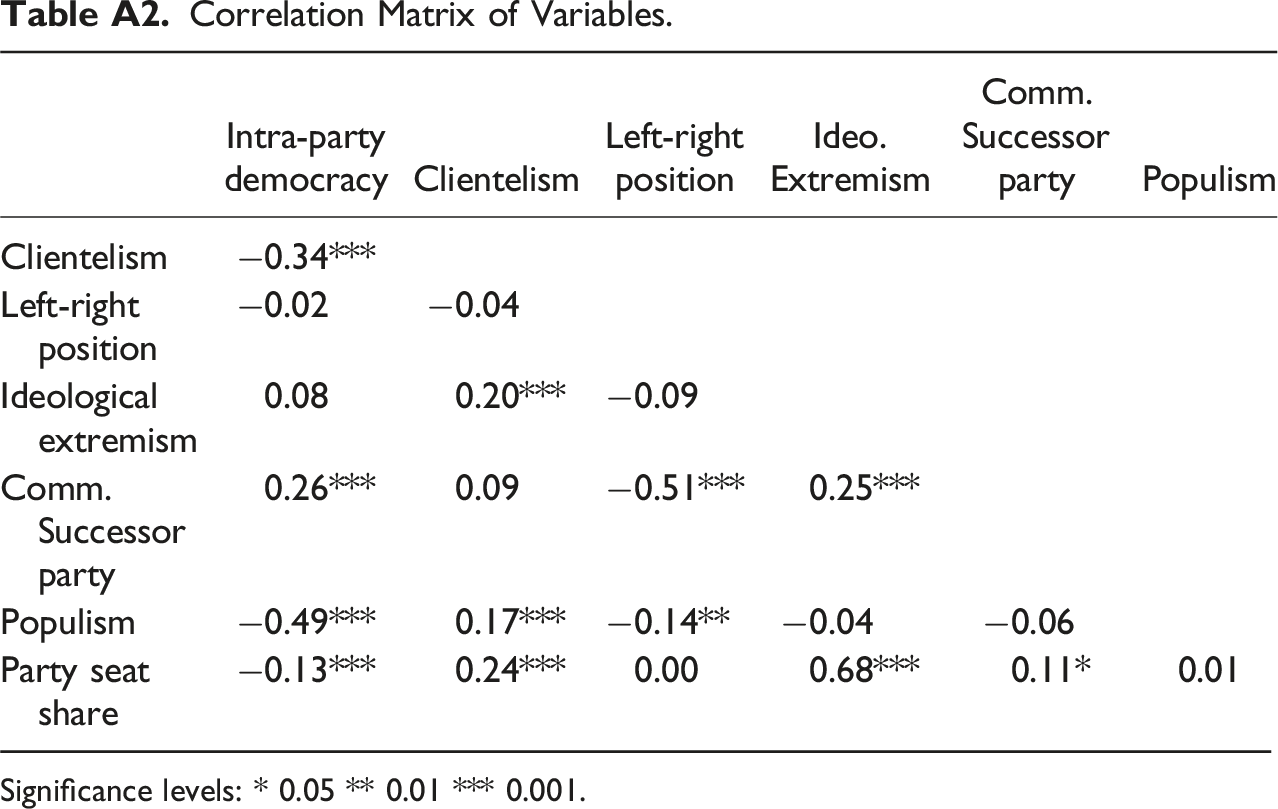
The left-right position, the populism score and the party seat share were retrieved from the V-Party dataset (Lindberg et al., 2022), while the coding of Communist successor party dummy was based on Ishyiama (1999) and Tzelgov (2011). To facilitate the interpretation of results, the dependent variable and the independent and control variables were standardized using a 0-1 scale. For a summary of descriptive statistics of the dependent, independent and control variables see Table A1 in the Appendix. Table A2 provides the correlation matrix for all these variables.
Results
Clientelism and Intra-party Democracy in CEE.
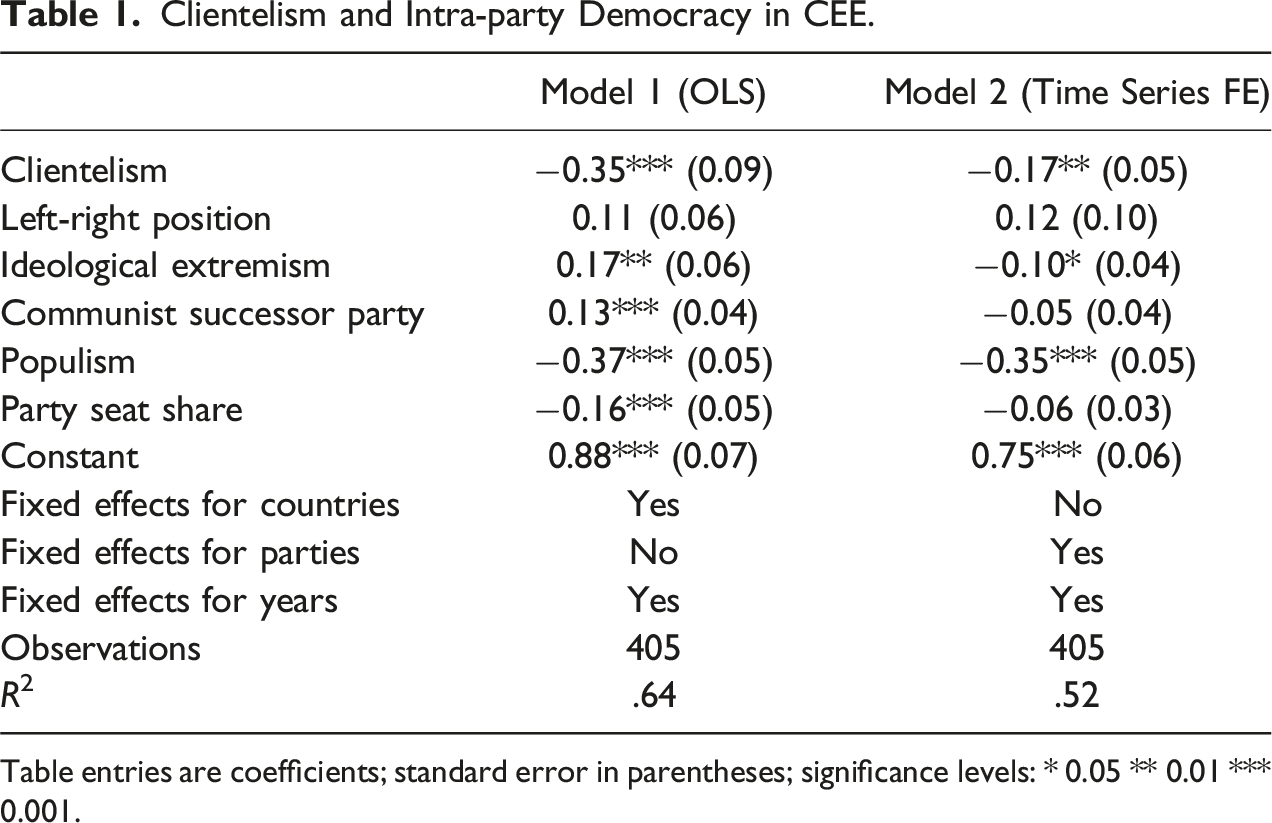
Table entries are coefficients; standard error in parentheses; significance levels: * 0.05 ** 0.01 *** 0.001.
Figure 1 below plots the substantive effect of our independent variable based on Model 1 in Table 1. It illustrates that when parties do not engage in clientelism, the level of intra-party democracy is remarkably high, at approximately 0.72. However, for those parties in the sample with the highest levels of clientelism, the predicted value of our dependent variable is considerably lower, at around 0.36. Substantive effect of clientelism.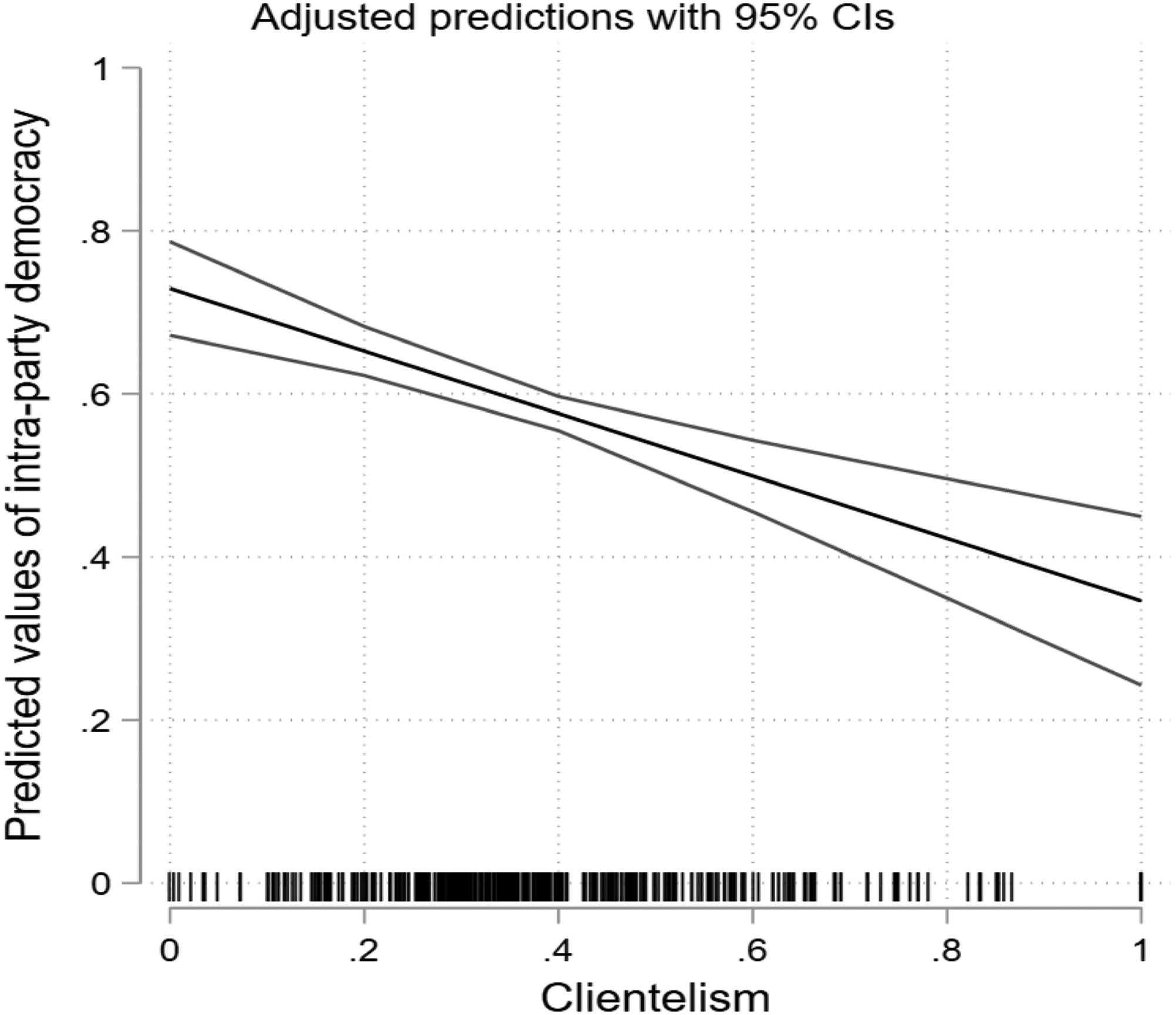
What Types of CEE Parties are More Prone to Both Clientelism and Low Internal Democracy?
In Central and Eastern Europe, the association between clientelism and low levels of intra-party democracy is visible across political parties that display different ideological orientations and intensity of programmatic appeals, and it can be linked either to the origin of these parties or the organisational strategies adopted later on.
A first category of parties in which both features are present has received a lot of attention from the academic community, but for a different reason, as the main drivers of democratic backsliding. Thus, in mainstream parties turned populist radical right, such as Fidesz and Law and Justice (PiS), there is no room for members to publicly disagree with or criticise the party leadership, the leaders unilaterally decide on key policy and strategic decisions which are then just ratified by party bodies, and they do not hesitate to use sanctions or marginalise politicians or entire branches which are out of favour (Metz & Várnagy, 2021; Pytlas, 2021). For Fidesz, the decline of party democracy has happened in parallel to the ideological transformation of the party and the adoption of clientelist practices. Thus, the party has mutated from a liberal, movement party with a collective leadership, and which applied participatory democracy in decision making (1988–1993) to a highly personalized, clientelistic party with a national conservative and then radical right appeal (Enyedi & Róna, 2018; Metz & Várnagy, 2021; Van Biezen, 2003).
A similar decline in intra-party democracy happening at the same time with an increased reliance on clientelism has been observed for the Slovenian Democratic Party (SDS), another mainstream centre right party turned populist radical right, and which has then pursued an executive aggrandizement strategy (Krašovec & Johannsen, 2016).
It is worth noting that for both Fidesz and Law and Justice, clientelism has not only been a strategy for vote-seeking (Mares & Young, 2019; Markowski, 2019) and strengthening the loyalty of party members and activists, but it has also played a key role in their systematic efforts to organise, nurture and coordinate civil society groups which amplify their messages, contribute to the ideological hegemony of their discourse and enable the mobilisation of citizens for contentious and electoral politics (Bernhard, 2020; Ekiert et al., 2017; Greskovits, 2020; Ślarzyński, 2022). 5
A second category of parties in which the symbiosis between clientelism and low levels of party democracy has been visible are Communist successor parties which have inherited and maintained an organisational legacy in both respects from patrimonial Communism (Karasimeonov, 2005; Kitschelt, 2002; Mares et al., 2018; Spirova, 2012). A key example is that of the Romanian Social Democrats (PSD) which have been dominated by their central leaders who have used their prime-ministerial and governmental positions to consolidate clientelistic and patronal networks (Chiruta, 2023; Gallagher, 2015). Rare attempts to give members more say, such as through primaries, have been quickly aborted (Gherghina & Spáč, 2016).
The reinforcing dynamic between a highly centralised and oligarchic organisation and the effective pursuit of clientelism has also been a marker of some ethnic parties mobilising a by and large captive constituency, such as the Movement for Right and Freedoms (DPS), representing ethnic Turks in Bulgaria (Ganev, 2006; Gherghina & Bankov, 2023), and this tendency has also been visible in the Democratic Alliance of Hungarians in Romania (UDMR) (Kopecký & Spirova, 2019). The propensity of ethnic parties in the region to rely on selective benefits could be perceived as a natural inclination, given that ethnic minority groups have often been discriminated against or found themselves a disadvantageous position when it comes to the distribution of resources, but on the long run clientelism has had a pernicious effect on the representation of minority preferences (Kopecký & Spirova, 2019).
Intra-party democracy has been extremely weak in entrepreneurial parties launched as vehicles for the political ambitions of businessmen and media moguls such as the Czech Action of Dissatisfied Citizens (ANO), the Polish Palikot’s Movement, the Romanian Conservative Party (PC), or the Slovak Ordinary People and Independent Personalities (OĽaNO) (Chiru & Gherghina, 2014; Hloušek, 2015; Rybář & Spáč, 2020). In their case the centralisation and absence of internal deliberation is a natural consequence of the heavy reliance on the resources of the founding leader, the selection of key cadres from the leader’s employees and the outsourcing of campaigning, recruitment and other functions that could empower party elites (Kopeček, 2016). Their organisational weakness or a focus of anti-corruption as the main electoral appeal has generally prevented these parties from pursuing clientelism with the partial exception of the PC in Romania.
Last but not least, it is worth acknowledging that a vibrant internal democracy is not totally absent from CEE, and the exceptions have often defined themselves as bottom-up, movement parties built in opposition to the clientelist practices and patronal networks dominating established parties. Such new parties have been able to institutionalise remarkable levels of plebiscitary intra-party democracy, drawing on digital tools to enable members to participate in internal deliberation and decision making on candidate and leadership selection, and on policy development. They include the Czech Pirates Party, the Hungarian Politics Can Be Different (LMP), and the Save Romanian Union (USR) (Chiru et al., 2024; Dragoman, 2021; Naxera, 2023; Pink & Folvarčný, 2020; Oross & Tap, 2023).
Further Analyses and Robustness Checks
Clientelism and Intra-party Democracy: Broader Sample Without CEE Parties.
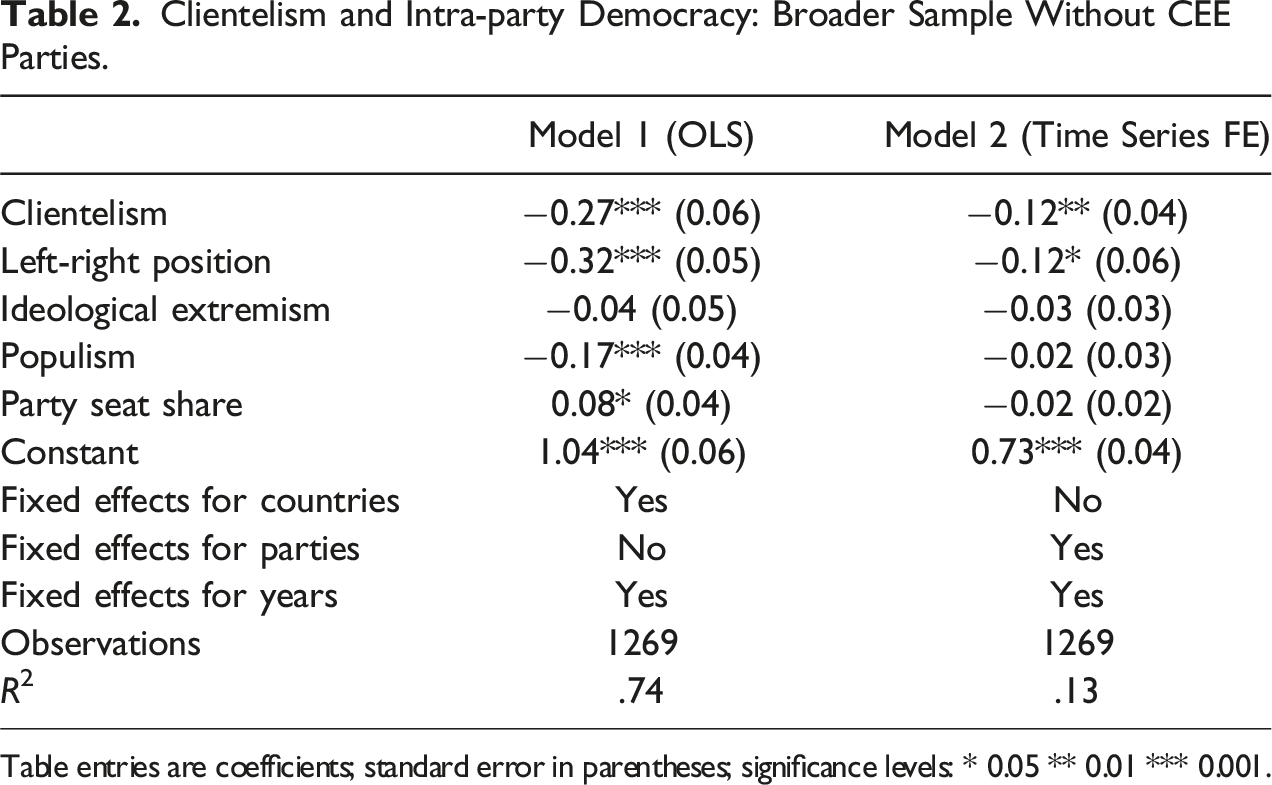
Table entries are coefficients; standard error in parentheses; significance levels: * 0.05 ** 0.01 *** 0.001.
Clientelism and Intra-party Democracy – Electoral versus Liberal Democracies.
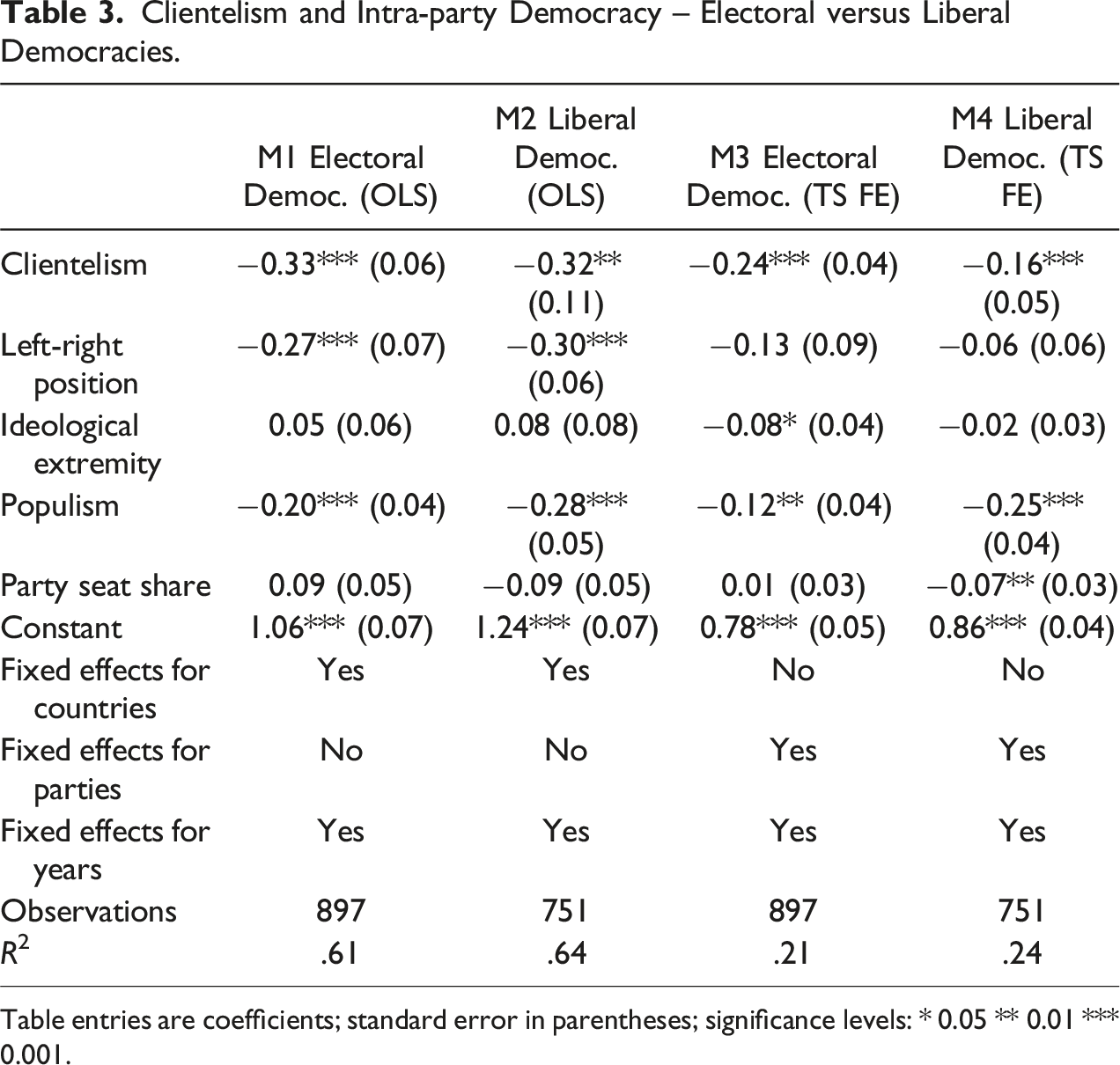
Table entries are coefficients; standard error in parentheses; significance levels: * 0.05 ** 0.01 *** 0.001.
The relationship between clientelism and intra-party democracy is present in both liberal and electoral democracies, although it appears somewhat stronger in electoral democracies. The latter finding is rather intuitive, given that in more democratic countries voters are both more likely to react negatively to clientelism and expect more democratic practices within parties, and the parties themselves usually adapt to their environment (Harmel & Janda, 1994). Nevertheless, the fact that consolidated democracies are not immune to the phenomenon discussed here raises questions with respect to the institutional structures or societal norms that would need to be in place to discourage political actors from engaging in such practices.
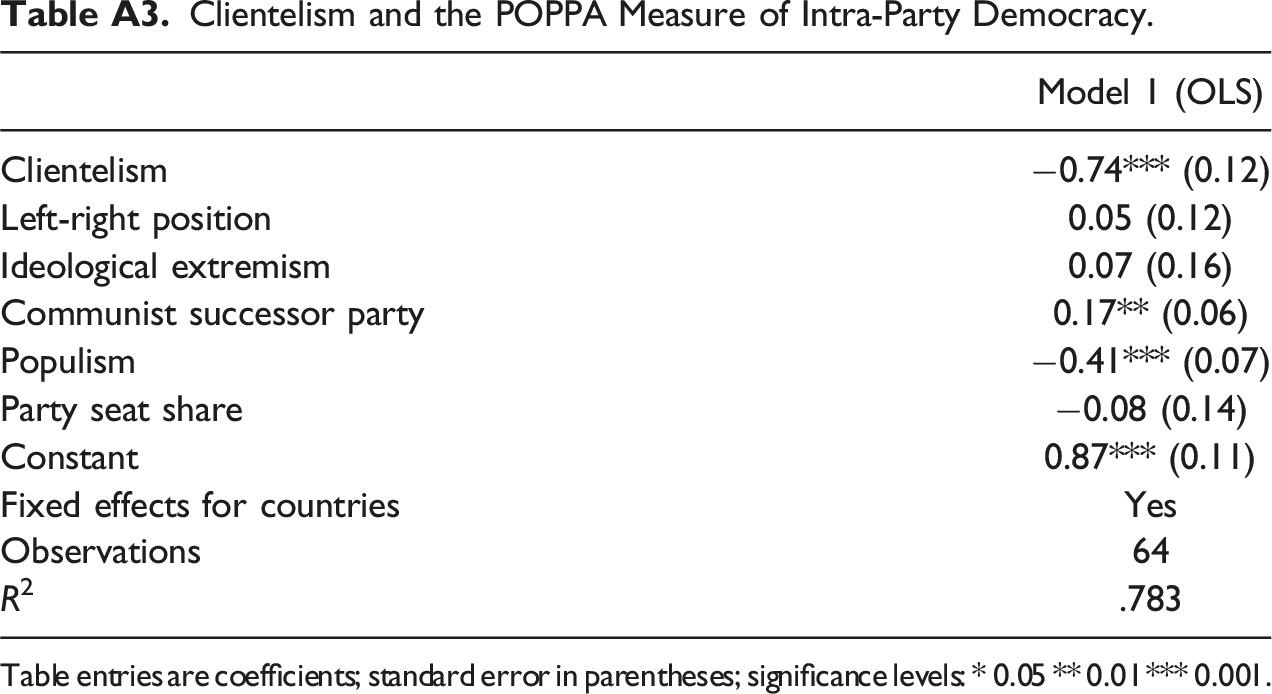
A first robustness check was to analyze whether the main result is robust to a more direct expert assessment of intra-party democracy. For this purpose, I matched the V-Party data with the ‘Populism and Political Parties Expert Survey’ (POPPA; Meijers & Zaslove, 2021). This is a cross-sectional survey that covered parties in 28 European countries, including 10 CEE states, in which experts were asked to evaluate parties represented in parliaments in 2017 or 2018. 7 The item relevant for us asked experts to rate intra-party democracy on a 11-point scale with the endpoints labelled as ‘no intra-party democracy at all’ and ‘very high levels of intra-party democracy, following the prompt: ‘some political parties practice more intra-party democracy than others (i.e., party members play a role in decision making, there is room for internal debate, decision-making is inclusive of various factions and organizational layers within the party)’. Table A3 in the Appendix reports the results of the OLS model with this alternative dependent variable. The relationship between clientelism and intra-party democracy is negative and statistically significant, while the magnitude of the effect appears even larger.
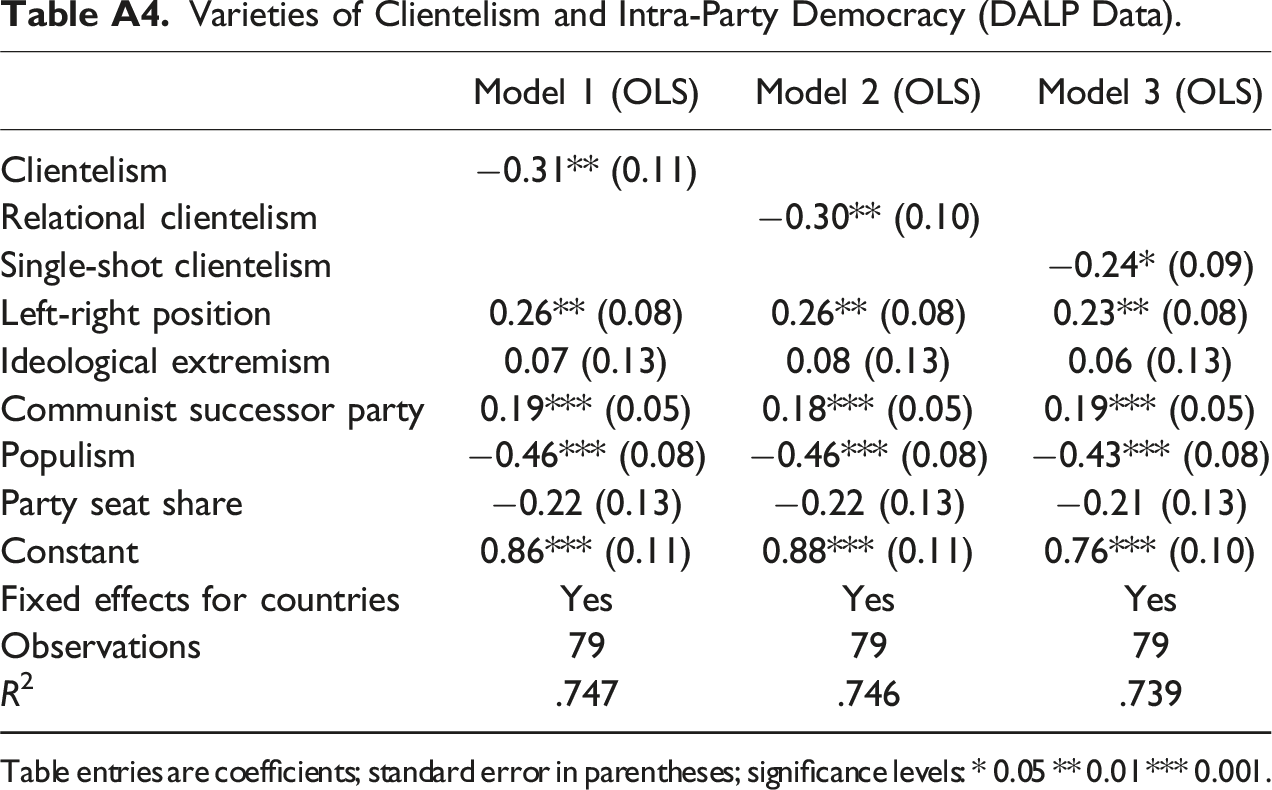
A second series of robustness checks included replicating the analyses with a different measure of clientelism and assessing whether different types of clientelism influence intra-party democracy to a different extent. To do this I matched the V-Party data with the cross-sectional expert survey, ‘Democratic Accountability and Linkages Project’ (DALP - Kitschelt, 2013). Once again, the matching was made with the observation closest in time to the year of the survey (2009). Model 1 in Table A4 shows the results of the aggregate level of clientelism, combining both relational and single-shot clientelism (Yildirim & Kitschelt, 2020). The effect is very similar in magnitude and direction to that reported in Table 1. Models 2 and 3 illustrate that both relational clientelism, which includes repeated usage of patronage, conditional distribution of public works, social benefits or favours in applying regulations, and single-shot clientelism (i.e., vote-buying) are damaging for intra-party democracy. The effect of the latter is somewhat more diluted.
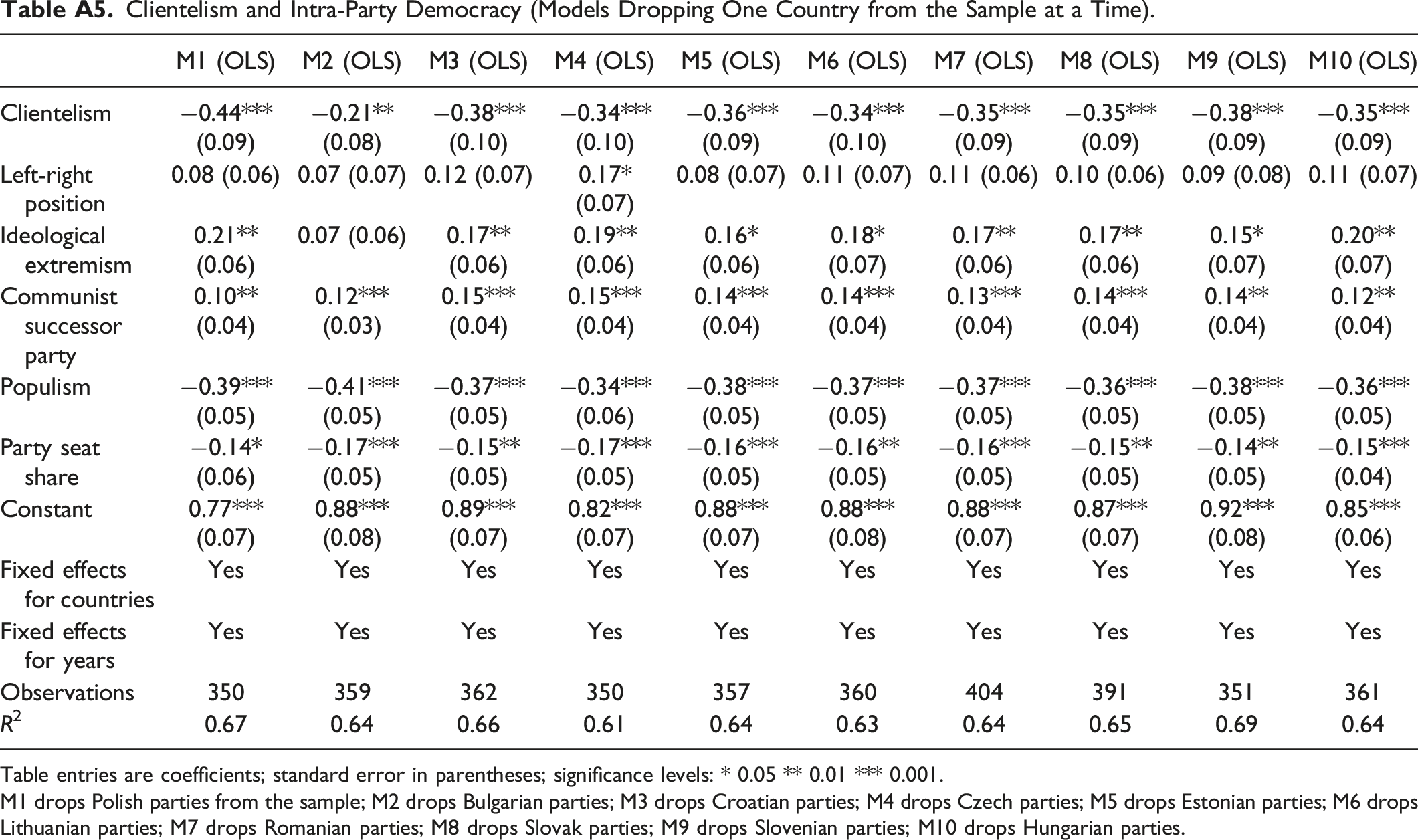
Finally, the results presented in Model 1 of Table 1 above are also robust to dropping all the parties from one country at a time from the sample, as shown in Table A5. Neither the magnitude of the negative effect of clientelism on intra-party democracy nor the model fit vary substantially across the 10 different regressions.
Conclusion
This article has presented a series of novel arguments about how clientelist mobilization strategies undermine political parties’ decision-making inclusiveness regarding personnel and policies and limit the checks on leaders’ power. It has also illustrated empirically the strong negative relationship between clientelism and intra-party democracy in Central and Eastern Europe and beyond, drawing on the V-Party data infrastructure. While the negative relationship holds for both relational clientelism and single-shot clientelism, the latter seems to have a weaker impact on intra-party democracy, in line with previous intuitions from the literature.
The findings have implications for our understanding of intra-party democracy and clientelism. With respect to the former, it illustrates the risk of ignoring the organizational shaping roles of non-programmatic mobilization strategies. While the clientelism scholarship has emphasized that clientelist exchanges and the struggles between party leaders and brokers spill over into intra-party resource allocation decisions and career advancement patterns of party members, much of the existing literature seems to imagine intra-party democracy functioning in an aseptic environment, isolated from such transactions. Similarly, this literature recognizes the importance of members’ and party elites’ policy, office, and vote-seeking ambitions – but not how the deliberative and members’ rights models of intra-party democracy are affected when the party is populated by rent-seeking actors.
The study’s findings should also be of practical relevance, especially for democratic aid practitioners and scholars entertaining the idea that parties could reconnect with voters and members by democratizing their candidate or leadership selection contests without properly considering the political context in which parties operate and the type of linkages they rely on. Such wishful thinking ignores the evidence emanating from clientelist parties implementing primaries: they end up replicating within the party the same kind of patron-client relations practiced with voters.
The literature on clientelism has become obsessed with understanding if and how party leaders monitor brokers and prevent agency loss (Hicken & Nathan, 2020). This article has provided evidence that the organizational consequences of parties practicing clientelism go beyond the obvious ones when reflecting on commitment and monitoring issues, even in contexts where the extensiveness of the party organisations and their institutionalization vary hugely.
The findings also have implications for the burgeoning literature on democratic backsliding (Binev, 2023; Chiru & Wunsch, 2023; Cianetti et al., 2018; Haggard & Kaufman, 2021), which has ignored the fact that virtually all protagonists of democratic erosion episodes in the region (e.g., Fidesz, PiS, SDS, PSD, DPS) display the combination of low intra-party democracy and reliance, at least in part, on clientelism to mobilise supporters and civil society organisations. The clientelist and patronal logic documented by the article explains why would-be autocrats have met no internal resistance to their attacks on democratic institutions and provides a new angle to understand the mobilisation of uncivil society (Greskovits, 2020).
Further research could explore whether electoral institutions mediate the relationship revealed by the article. Thus, the ownership of clientelistic networks might vary depending on the focus of electoral laws, affecting in turn levels of intra-party centralization: with party-centred electoral rules, the party is the likely owner of the networks, and maintaining a reputation for delivering the promised benefits would often require centralized distribution of resources (Lyne, 2007). Conversely, when intra-party choice is granted to voters, legislators can develop their own clientelistic networks and bases of intra-party power.
Similarly, a case study approach could be adopted to develop expectations about how exactly intra-party procedures and clientelist networks form and interact when these party organizations are first established. This could also explore the extent to which levels of intra-party democracy and clientelist practices are endogenous to the nature of the actors founding the party. Some European historical examples, both on the left, such as PASOK in Greece (Pappas, 2009), and on the right, such as The People’s Alliance, the predecessor of the Spanish People’s Party, (Van Biezen, 2003, p. 101) indicate that the potential for intra-party democracy is severely limited in parties in which clientelist networks and personal ties with the party leader play a key role in the establishment of territorial branches.
Last but not least, this research also raises the question whether previous findings regarding how levels of intra-party democracy influence programmatic responsiveness strategies and programmatic change patterns translate directly, apply differently or not at all to clientelist parties. Previous research has shown that democratic party organizations respond policy-wise to their supporters (Lehrer, 2012) and are generally less likely to change their programmatic positions (Marini, 2023). By contrast more hierarchical and undemocratic organizations appear to respond mainly to the mean voter position (Schumacher et al., 2013) and shift more often their policy positions. Future research could investigate the extent to which the latter findings also apply to clientelist parties by virtue of their lower levels of intra-party democracy.
Footnotes
Acknowledgments
The author is grateful to Sergiu Gherghina, Zsolt Enyedi, Melis Laebens, Holly Bickerton and three anonymous reviewers for their constructive comments on various iterations of this project. The author gratefully acknowledges the support received through a grant of the Romanian Ministry of Education and Research, CNCS - UEFISCDI, project number PN-III-P4-ID-PCE-2021-233, within PNCDI III.
Declaration of Conflicting Interests
The author declared no potential conflicts of interest with respect to the research, authorship, and/or publication of this article.
Funding
The author disclosed receipt of the following financial support for the research, authorship, and/or publication of this article: The work on this paper was supported by a grant of the Romanian Ministry of Education and Research, CNCS - UEFISCDI, project number PN-III-P4-ID-PCE-2021-233, within PNCDI III, hosted at Median Research Centre.

Notes
Appendix
Descriptive Statistics. Correlation Matrix of Variables. Significance levels: * 0.05 ** 0.01 *** 0.001. Clientelism and the POPPA Measure of Intra-Party Democracy. Table entries are coefficients; standard error in parentheses; significance levels: * 0.05 ** 0.01 *** 0.001. Varieties of Clientelism and Intra-Party Democracy (DALP Data). Table entries are coefficients; standard error in parentheses; significance levels: * 0.05 ** 0.01 *** 0.001. Clientelism and Intra-Party Democracy (Models Dropping One Country from the Sample at a Time). Table entries are coefficients; standard error in parentheses; significance levels: * 0.05 ** 0.01 *** 0.001. M1 drops Polish parties from the sample; M2 drops Bulgarian parties; M3 drops Croatian parties; M4 drops Czech parties; M5 drops Estonian parties; M6 drops Lithuanian parties; M7 drops Romanian parties; M8 drops Slovak parties; M9 drops Slovenian parties; M10 drops Hungarian parties.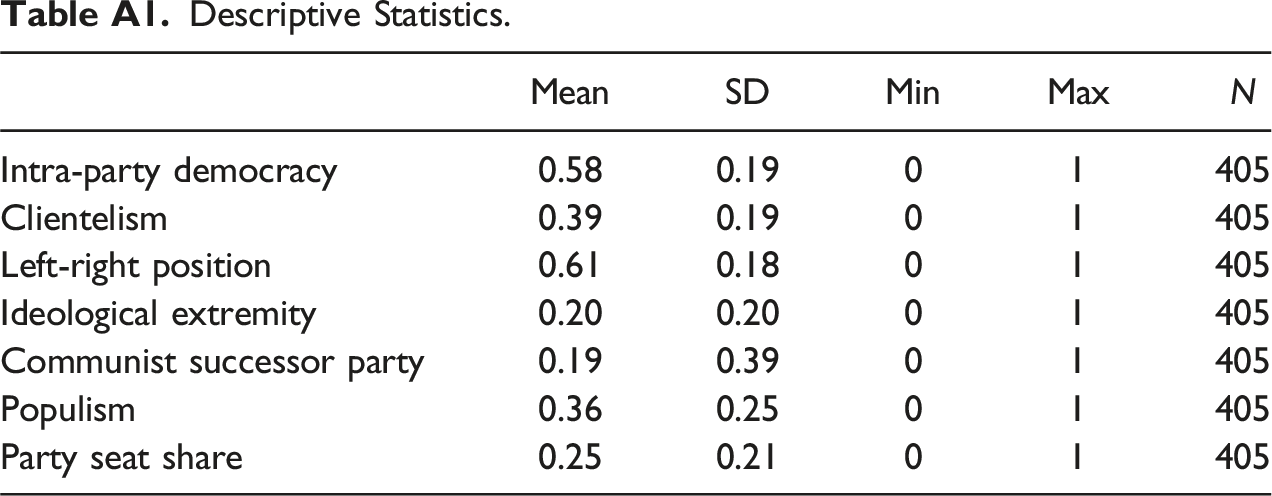
Mean
SD
Min
Max
N
Intra-party democracy
0.58
0.19
0
1
405
Clientelism
0.39
0.19
0
1
405
Left-right position
0.61
0.18
0
1
405
Ideological extremity
0.20
0.20
0
1
405
Communist successor party
0.19
0.39
0
1
405
Populism
0.36
0.25
0
1
405
Party seat share
0.25
0.21
0
1
405
Intra-party democracy
Clientelism
Left-right position
Ideo. Extremism
Comm. Successor party
Populism
Clientelism
−0.34***
Left-right position
−0.02
−0.04
Ideological extremism
0.08
0.20***
−0.09
Comm. Successor party
0.26***
0.09
−0.51***
0.25***
Populism
−0.49***
0.17***
−0.14**
−0.04
−0.06
Party seat share
−0.13***
0.24***
0.00
0.68***
0.11*
0.01
Model 1 (OLS)
Clientelism
−0.74*** (0.12)
Left-right position
0.05 (0.12)
Ideological extremism
0.07 (0.16)
Communist successor party
0.17** (0.06)
Populism
−0.41*** (0.07)
Party seat share
−0.08 (0.14)
Constant
0.87*** (0.11)
Fixed effects for countries
Yes
Observations
64
R
2
.783
Model 1 (OLS)
Model 2 (OLS)
Model 3 (OLS)
Clientelism
−0.31** (0.11)
Relational clientelism
−0.30** (0.10)
Single-shot clientelism
−0.24* (0.09)
Left-right position
0.26** (0.08)
0.26** (0.08)
0.23** (0.08)
Ideological extremism
0.07 (0.13)
0.08 (0.13)
0.06 (0.13)
Communist successor party
0.19*** (0.05)
0.18*** (0.05)
0.19*** (0.05)
Populism
−0.46*** (0.08)
−0.46*** (0.08)
−0.43*** (0.08)
Party seat share
−0.22 (0.13)
−0.22 (0.13)
−0.21 (0.13)
Constant
0.86*** (0.11)
0.88*** (0.11)
0.76*** (0.10)
Fixed effects for countries
Yes
Yes
Yes
Observations
79
79
79
R
2
.747
.746
.739
M1 (OLS)
M2 (OLS)
M3 (OLS)
M4 (OLS)
M5 (OLS)
M6 (OLS)
M7 (OLS)
M8 (OLS)
M9 (OLS)
M10 (OLS)
Clientelism
−0.44*** (0.09)
−0.21** (0.08)
−0.38*** (0.10)
−0.34*** (0.10)
−0.36*** (0.09)
−0.34*** (0.10)
−0.35*** (0.09)
−0.35*** (0.09)
−0.38*** (0.09)
−0.35*** (0.09)
Left-right position
0.08 (0.06)
0.07 (0.07)
0.12 (0.07)
0.17* (0.07)
0.08 (0.07)
0.11 (0.07)
0.11 (0.06)
0.10 (0.06)
0.09 (0.08)
0.11 (0.07)
Ideological extremism
0.21** (0.06)
0.07 (0.06)
0.17** (0.06)
0.19** (0.06)
0.16* (0.06)
0.18* (0.07)
0.17** (0.06)
0.17** (0.06)
0.15* (0.07)
0.20** (0.07)
Communist successor party
0.10** (0.04)
0.12*** (0.03)
0.15*** (0.04)
0.15*** (0.04)
0.14*** (0.04)
0.14*** (0.04)
0.13*** (0.04)
0.14*** (0.04)
0.14** (0.04)
0.12** (0.04)
Populism
−0.39*** (0.05)
−0.41*** (0.05)
−0.37*** (0.05)
−0.34*** (0.06)
−0.38*** (0.05)
−0.37*** (0.05)
−0.37*** (0.05)
−0.36*** (0.05)
−0.38*** (0.05)
−0.36*** (0.05)
Party seat share
−0.14* (0.06)
−0.17*** (0.05)
−0.15** (0.05)
−0.17*** (0.05)
−0.16*** (0.05)
−0.16** (0.05)
−0.16*** (0.05)
−0.15** (0.05)
−0.14** (0.05)
−0.15*** (0.04)
Constant
0.77*** (0.07)
0.88*** (0.08)
0.89*** (0.07)
0.82*** (0.07)
0.88*** (0.07)
0.88*** (0.08)
0.88*** (0.07)
0.87*** (0.07)
0.92*** (0.08)
0.85*** (0.06)
Fixed effects for countries
Yes
Yes
Yes
Yes
Yes
Yes
Yes
Yes
Yes
Yes
Fixed effects for years
Yes
Yes
Yes
Yes
Yes
Yes
Yes
Yes
Yes
Yes
Observations
350
359
362
350
357
360
404
391
351
361
R
2
0.67
0.64
0.66
0.61
0.64
0.63
0.64
0.65
0.69
0.64