



Abstract
Winners and losers of elections have different stakes in protecting democratic institutions. We provide new evidence for the effects of partisanship and economic performance on support for checks and balances and acceptance of their infringement. Using survey data from 26 European countries, we show that voters who feel close to a political party that lost the elections support checks and balances significantly more than other citizens. We also find that higher satisfaction with the economy is associated with lower support for checks and balances. Our experiment in Ukraine shows that supporters and opponents of the governing party have divergent evaluations of a reform potentially infringing on the independence of the judiciary. Those in opposition find such reforms less acceptable and justified. Again, we find that improved economic performance leads to higher acceptance of judicial reform. Our results confirm that citizens’ support for checks and balances is contingent and volatile.
Introduction
Democracy is vulnerable to voters electing leaders with authoritarian tendencies. While some democracies might be more vulnerable than others (Svolik, 2013; Monsiváis-Carrillo, 2020), no country is immune to this threat. Globally, over the last century horizontal checks on power, such as independent courts, executive restraint, and legislative oversight, have been increasingly undermined (Lührman et al., 2020). Illiberal political actors can assent to power in countries with very different political systems and democratic traditions. Donald Trump in the US, Jair Bolsanaro in Brazil, Fidesz in Hungary and Law and Justice in Poland are just a few examples illustrating that majorities can elect leaders who strive to get rid of counter-majoritarian checks, restrict civic rights, and harm vulnerable minorities (Bor et al., 2021). Citizens’ response to the breaches of democratic rules is therefore critical to the survival of democracy. But do citizens care enough about democratic checks to stop the backsliding? And what can motivate citizens to stand up for democracy?
Democratic elections produce winners and losers, and democracies function properly when losers accept unfavorable electoral results. While losers’ consent is crucial for peaceful power transition in democracies, it does not prevent leaders from usurping power once in office. It is the dissent of the losers as a reaction to dismantling checks and balances that might be essential to democracies’ survival. As election outcomes create an enduring gap between losers and winners in their satisfaction with democracy (Anderson et al., 2005, 184; Loveless, 2020; Hansen et al., 2019), we can expect that the response of the losers and winners to the violation of checks and balance will differ too.
Existing studies suggest that citizens “whose favored candidate won the previous election tend to be less tolerant of civil rights, free speech and opposition political rights” and are “more willing to let the president bypass other branches of government” (Singer, 2018, p. 1756). Strong economic performance can also increase acceptance of attacks on vertical and horizontal accountability mechanisms, at least in the context of Latin American polities (Singer, 2018). But recent evidence hints that even in established democracies, such as the US, support for democracy might be rather thin and that voters are willing to “trade-off democratic principles for … political ideology, partisan loyalty, and policy preferences” (Graham & Svolik, 2020, p. 393). Similarly, Berliner (2020) finds that in the US support for democratic procedures depends on the strength of the voter’s party allegiance (see also Carey et al., 2020).
These results are important and highly suggestive of the relevance of political tribalism (Clark et al., 2019) for the willingness to defend democratic accountability mechanisms. However, the evidence in Singer (2018) comes from observational surveys of political attitudes, which cannot eliminate the possibility that the preferences of voters against various mechanisms for horizontal and vertical accountability are causally prior to their party choice. Graham and Svolik (2020) present experimental evidence from a candidate-choice experiment, which however is confined to the case of the US: a political system characterized by a very high degree of party polarization, which might be an important moderating variable of the effect of party support on support for democratic checks and balances (Engst & Gschwend, 2020).
In this article, we bring in new observational and experimental evidence that significantly extends the empirical scope of this growing literature, and we refine the theoretical argument about how being on the winning or losing side of elections and polarization affect the willingness to stand up for democracy. Theoretically we link with the studies of Anderson et al. (2005), Singer (2018), and Svolik (2019 and 2020). First, we build on the well-established finding that (across different regions and institutional contexts) there is a gap between losers and winners of elections in their satisfaction with democracy and its performance in general (Anderson et al., 2005, p. 33–49). As recent evidence suggests asymmetric effects of losing and winning elections (Hansen et al., 2019), we specify this theory further by differentiating the effects of electoral outcomes on the various components of democracy. In particular, we build on the argument that the winners are less supportive of the constraints on the executive power (Singer, 2018), and, in addition, we shift the focus back to the individuals on the losing side of elections. The losers of elections are the most vulnerable to potential abuses of power and therefore should be most vigilant of the breaches of checks and balances. Second, we probe further the role of trade-offs in shaping citizens’ attitudes toward checks and balances (Svolik, 2020) and propose that the attitudes toward checks and balances are not independent from the economic performance of governments.
Empirically, first we test whether party supporters whose favored party lost the latest elections are more likely to support horizontal checks and balances (including support for the freedoms of the opposition and the media to critisize the government and the power of the courts to limit government actions) in 26 European countries based on data from the European Social Survey (2012). We find the hypothesized effects only for party supporters who identify with the party in addition to having voted for it. Then we report a pre-registered vignette experiment conducted on a representative sample in Ukraine that shows that people are more likely to oppose government attacks on judicial independence when they have been told that the party in government is one they opposed at the elections. In addition, the experiment demonstrates that people are more willing to put up with such attacks on judicial independence when they have been told that the economy is improving under the offending government, irrespective of whether they supported it or not at the elections. 1
These results contribute to existing knowledge in a number of ways. First, we show that the relationship between governing party support and tolerance of attacks on horizontal and vertical democratic accountability mechanisms extends beyond the context of new democracies in Latin America (Singer, 2018; Svolik, 2020), Africa (Moehler, 2009; Bartels & Kramon, 2020), Asia (Fossati et al., 2021), and the US. Second, we demonstrate experimentally that the relationship is likely causal rather than purely correlational and that it is driven by trade-offs between checks and balances and political tribalism. Third, we suggest that policy performance (as reflected in the state of the economy) can be a powerful reason to accept attacks on democratic checks and balances. Finally, we show that which specific checks and balances citizens support depends on whether they are on the winning or losing side of elections and how closely they feel to the party they voted on.
Support for Democratic Checks and Balances, Partisanship and Policy Performance
Citizens’ Commitment to Democratic Institutions
Democracy is less likely to survive an assault from anti-democratic leaders when citizens do not value and support this form of government (Claassen, 2020). However, commitment to basic democratic values, at least as expressed in public opinion surveys, is typically rather high even in new, unconsolidated democracies, and non-democratic regimes. Hence, varying levels of expressed support for basic democratic values are not enough to account for processes of democratic reversal and backsliding across the world. While expressed support for democratic values and preference for democracy as a system of government remain high and rather stable over time (Voeten, 2016), instances of democratic backsliding are increasingly common, even in old, consolidated democracies (Kaufman & Haggard, 2019).
Some explanations of democratization focusing on the role of political culture and values in regime change suggest that these patterns result from focusing on the wrong attitude measures. Public opinion surveys merely show that citizens express abstract support for democracy, “pay lip service to democracy,” rather than indicate “how deeply democracy has taken root in a given country” (Inglehart, 2003, p. 51). A statement that one values democracy can be simply a result of social desirability and the interviewer effect (Schedler & Sarsfield, 2007, p. 638–639).
Unlike support for democratic values, a particular set of self-expression values, such as tolerance, political activism, and emphasis on freedom of speech, correlates highly with actual levels of democracy (Inglehart, 2003). However, it is not exactly clear what explains the correlation and whether these values are more stable across societies and within individuals than expressed support for democracy in general. One line of research shows that moral judgments (like some of the self-expression measures) are not a result of stable individual dispositions, but can be altered depending on self-interest in a given situation (DeScioli et al., 2014).
Even in the oldest democracies believed to have societies with high levels of self-expression values and devoted to procedures of democracy, citizens’ support for democracy does not seem to run deep. New experimental studies show that despite formal commitment to democratic values, US citizens are willing to make trade-offs that result in votes for candidates who violate democratic principles (Graham & Svolik, 2020). Moreover, even when citizens say they value democracy, they often mean no more than elections. Support for the system of democratic checks and balances, including separation of powers and independent institutions, the rights of opposition parties and the media to criticize the government, and other mechanisms of accountability, such as transparency (Berliner, 2020) is lower and much more vulnerable to external influences. Importantly, citizens often express commitment to democracy in general and elections in particular but, at the same time, weak support for non-majoritarian institutions and accountability mechanisms (Singer, 2018).
In this article, we focus on the role of public support for specific democratic checks and balances in sustaining democracy. In particular, we look at support for the rights of the opposition and the media to criticize the government and for the power of the courts to limit government action. The freedoms of the opposition and the media to scrutinize government actions are crucial for democratic accountability. They are important not only for good governance, but for making sure that incumbents do not rig the rules of the political game in their favor. An independent judiciary is a cornerstone of the separation of power system making sure that the executive and the legislature cannot govern unchecked. Judicial oversight is a crucial mechanism for horizontal accountability (Lührman et al., 2020). The autonomy of the courts is necessary to guarantee the rule of law, to safeguard the (political) rights and liberties of the people and to uphold the fairness of political processes, including elections. Independent courts can impose significant constraints on the actions of parliamentary majorities, cabinet governments, and presidents, which makes them a common target of attacks by elected politicians with authoritarian ambitions. It is therefore imperative to understand what drives the willingness of citizens to protect or trade off the freedoms of the opposition and the media and the independence of courts.
The Role of Political Tribalism: Partisanship and Strength of Party Identification
Partisanship and political polarization have been identified as two of the major reasons behind the “democratic hypocrisy” in the US (Graham & Svolik, 2020; McCoy et al., 2020). The hypocrisy entails that public commitment to democracy coexists with willingness to support politicians who would violate basic tenets of democratic rule. These studies suggest that support for democratic procedures is contextual and depends on the voter’s party identification and the strength of this identification (see also Berliner, 2020). But why would citizens who value democracy allow their representatives to undermine it?
Our departure point is the assumption that winners and losers of elections have different stakes in keeping the executives in check. If a party supported by a citizen wins an election, this citizen is more likely to feel represented by and satisfied with the team in charge (cf. Blais et al., 2017). Thus, citizens on the winning side of elections have no clear incentives to constrain the power of the executives as they act in their partisan interest (Singer, 2018). Moreover, these citizens are more likely to attribute benign intentions to the executive’s actions, including reforms (Clark et al., 2019). As a result, citizens whose party governs are more likely to trade off democratic principles for having their team in charge of resource distribution. The results of recent experimental studies with US citizens align with this assumption and show that voters of the Democratic and Republican parties alike support policies limiting checks on power more when their party is in charge (McCoy et al., 2020; Graham & Svolik, 2020).
Conversely, losers of elections are more vulnerable to ill-treatment by political leadership (Bor & Laustsen, 2021). Protecting checks and balances is of crucial importance for those in opposition because their chance of winning power will decrease if the system is skewed in favor of the current rulers. Their interests might also be harmed more if the incumbents expand their powers. Therefore, the stakes are higher for the opposition, and the opposition should be most vigilant to prevent the systemic changes that result in fewer constraints on the power of current authorities. This means that losers have a double role: they have to accept the unfavorable result of elections (Anderson et al., 2005), but they are also more likely to protect the system of democratic checks and balances, albeit not necessarily for democracy’s sake. Although losers’ consent, that is, acceptance of unfavorable electoral results, has been shown to be important for the functioning of democracy, there is less research focusing on losers in relation to reforms that can infringe on checks and balances. A panel survey experiment with Hungarian participants showed that voters in opposition to the Fidesz party incumbents were significantly more negative about electoral reform when the reform was attributed to Fidesz party (Ahlquist, et al., 2018). This study indicates that the losers are more vigilant to (rather than the winners more supportive of) systemic reforms.
Following from these theoretical assumptions and from the available empirical evidence, we can expect that citizens’ attitudes toward checks and balances follow a partisan logic and depend on who is in power. Therefore, we expect that citizens supporting the winning parties will assign less importance to democratic checks and balances constraining the power of the government than citizens supporting the losing parties (H1).
Polarization of voters and the political system as a whole might be amplifying these effects of partisanship (Svolik, 2020; McCoy et al., 2020; Engst & Gschwend, 2020). Partisanship can be conceptualized in two ways: as a stable, long-term, affective attitude, which entails psychological identification, structures a number of attitudes and strongly affects electoral behavior or as a transient affiliation that can shift from one election to the next (Dalton, 2016; Hurwitz, 1984, p. 708). In the contemporary multiparty democracies in Europe, both types of partisans coexist—those who strongly identify with the party and consistently support it at elections and those who vote but do not feel particularly close to any one party in the political system (Berglund et al., 2006). The winner-loser effects have been shown to be greatest for “optimal” winners (who supported their ideologically closest party, Singh, 2014) and those who voted with more confidence (Van der Meer & Steenvoorden, 2018). Therefore, we expect the effects of partisanship on support for democratic checks and balances to be stronger for party supporters (who identify with a party, in addition to having voted for it) than for mere party voters (who have voted for a party but do not identify with it) (H1a).
While partisans identifying with their parties have an incentive to either constrain or expand the power of the authorities, the voters who do not identify with any party might be less prone to accept changes to the democratic rules of the game (provided they value democracy). This could mean that less polarized democracies, with fewer people identifying with opposing parties, are more resistant to the usurpation of executive power. In such cases, stability of democratic institutions should be less dependent on who wins elections.
Probing further the causal nature of the relation between partisanship and support for checks and balances, we focus on the scenario when the system of checks and balances is being reformed by the ruling government. First, we focus on winners’ consent and hypothesize that citizens are more likely to support and trust incumbents that reform the system of democratic checks and balances when these reforms are implemented by a government party they support (H2a). Similar expectations apply to finding the reforms themselves justified and acceptable (H2b) and for the intention to vote for this party in the future (H2c). The intention to vote is another measure that captures whether citizens are willing to ignore dismantling of checks and balances and continue voting for politicians of their preferred party. The flip side of this argument is that it is losers’ dissent that matters, and, accordingly, we hypothesize that citizens are less likely to support and trust incumbents that infringe on democratic checks and balances when these reforms are implemented by a party in government that they oppose (H3a). Again, we test the same effect for finding the reforms changing the checks and balances justified and acceptable (H3b) and for vote intention (H3c).
Policy Performance
The effect of partisanship fueled by political polarization is not the full explanation of the volatility of support for democratic checks and balances. Another potential trade-off that citizens are making is between defending democratic principles and the policy performance of the government, for example, in terms of the economy, corruption, or any other policy outcome that they value (Singer, 2018; Svolik, 2020).
The argument about sacrificing democracy for policy gains (economic or otherwise) is used most often in the context of non-democratic regimes. Arguably, citizens in authoritarian regimes trade some of their rights and freedoms for good economic performance (Feldmann & Mazepus, 2018). Therefore, citizens’ responses to government actions depend on the outcomes delivered by this government. But the argument could extend to consolidated democracies as well. Citizens would be willing to tolerate dismantling checks and balances as long as the government delivers economic benefits. People value democracy, but they might value a growing economy, less crime, or cleaner environment even more.
In general, such effects would speak in favor of the model that emphasizes the importance citizens assign to policy results delivered by authorities (Popkin, 1991, p. 99), rather than the procedures through which these results are achieved (Tyler, 2000). In particular, in the context of support for political authorities, voters attribute economic outcomes, such as unemployment rates, inflation, or energy prices to the incumbents (Popkin, 1991, p. 99–100). There is growing evidence that citizens’ support for decision-making procedures such as referenda flips depending on their chance of achieving a favorable outcome (Werner, 2020). Moreover, perceived fairness of democratic procedures for decision-making has either negligible effect on the evaluation of adopted policies (Ladam, 2019) or might be context-specific and pertinent under particular conditions (e.g., government crisis response, see Mazepus & van Leeuwen, 2020).
The impact of policy performance, however, is difficult to disentangle from other variables at play. In non-democratic systems, it is difficult to estimate the impact of the fear of coercion relative to potential economic benefits on expressed support for authorities and their decisions. In democracies with developed political party systems, it can be difficult to determine what has the primary impact: the fact that incumbents perform well economically in general or the fact that incumbents deliver economic benefits exclusively to their voters (Haselswerdt, 2020). In the latter case, expressing a partisanship position could also be seen as signaling the right for receiving (economic) benefits from the party a voter is loyal to.
Accordingly, we hypothesize that satisfaction with the economy is associated with less importance assigned to democratic checks and balances constraining the power of the executive branch (H4). Furthermore, we hypothesize that citizens are more likely to support and trust governments that infringe on constitutional rules about checks and balances when the government’s economic performance is perceived as better than that of the previous one (H4a). We test the same effect for finding the reforms changing the checks and balances justified and acceptable (H4b) and for vote intention (H4c). We hypothesize the effects of partisanship and economic performance to be independent from each other and additive: that is, we see no theoretical reason to expect an interaction, in which the effect of economic performance differs depending on whether a person has supported the incumbent government or not.
Overview of the Empirical Research Strategy
We test empirically these hypotheses using a combination of observational and experimental methods. The observational study is based on data from Wave 6 of the European Social Survey (2012), which features an extended module on attitudes toward democracy. 2 Analyzing this data, we test whether losers and winners of elections express different levels of support for several democratic checks and balances, as well as the effect of perceived economic performance of the government. This study covers 26 countries with varying degrees of political polarization and experience with democracy—from the old, established, consensual democracies in the Netherlands and Sweden to younger democracies with more polarized party systems in Spain and Greece, to the young democracies in Hungary and Poland. This observational study extends significantly the empirical scope of existing work (Singer, 2018; Moehler, 2009). Yet, as these studies, our analysis is potentially vulnerable to voters having pre-existing lack of support for checks and balances, to which parties respond and which gives them the winning edge at elections. Therefore, we complement the observational study with an experiment.
The experiment is conducted on a representative sample in Ukraine and asks people whether they will support, trust, and vote for a government that reforms the courts and endangers their independence and whether they find such reform justified and acceptable given that they have either (a) supported or (b) opposed the party currently in government and given that the economy is either improving or not under this government. This experiment was pre-registered and was preceded by a pilot (which was also pre-registered) run on a convenience sample in the Netherlands. We report the results of the pilot in the Supplementary Material.
The country selection for the representative experiment makes for a hard case to find the hypothesized effects of partisanship, because Ukraine is a relatively young, unconsolidated democracy, with a highly polarized political system, unstable and personalistic political parties and weak party identification (Chaisty & Whitefield, 2018; Fedorenko et al., 2016). The effects of partisanship and perceived economic performance are, in principle, more likely to be found in unconsolidated democracies. However, the lack of a stable party system that engenders strong, long-lasting party identification in Ukraine makes it less likely to find an effect of partisanship in particular, which makes our experimental study a rather strong test bed for the hypotheses.
Empirical Analyses
Study I. Winners, losers, and attitudes toward democratic checks and balances in Europe
In this study, we analyze individual-level data from a total of 48,563 respondents to the European Social Survey Wave 6 (2012), which provides representative samples of “all persons aged 15 and over resident within private households in each country, regardless of their nationality, citizenship, or language” for 26 countries in Europe.
We use an ordered categorical variable to measure the elections status of citizens. The variable distinguishes between (1) citizens who identify with (feel close to) 3 and voted at the latest national election for a political party that was in government at the time of survey data collection (“supporter winner”); 4 (2) citizens who voted for such a “winning” party but do not identify with (feel close to) it (“voter winner”); (3) citizens who did not vote at the elections (“non-voter”); (4) citizens who voted for a party that was not in government at the time of the survey but do not identify with (feel close to) a party (“voter loser”); and (5) citizens who identify with (feel close) to and voted for such a “losing” party (“supporter loser”). We use these different categories of voters to account for potential voter polarization effects and differentiate between party supporters (identifiers or “loyalists,” cf. Berglund et al., 2006) who feel close to and voted for a party, party voters with transient party support (i.e., those who do not feel close to a party they voted for), and non-voters.
To measure perceptions of policy (economic) performance, we use the question “On the whole how satisfied are you with the present state of the economy in [country]?” (answers are on a scale from 0 to 10).
In terms of outcome variables, we focus on three different aspects of horizontal and diagonal democratic accountability: 5 the freedom of (a) opposition parties and (b) the media to criticize the government 6 , and (c) the ability of courts to stop the government acting beyond its authority. 7 As a comparison, we also analyze how much importance respondents assign to the quintessential majoritarian aspect of democracy: free and fair national elections. 8
To examine the effects of party support and economic performance on the importance assigned to these four aspects of democracy, we use multilevel linear regression with random intercepts and slopes at the country level for the explanatory variables of interest. The models also include as covariates several demographic variables: sex, age, and education level and employment status. These demographic characteristics were found to be linked with political behavior (for discussion, see Solt, 2008, 52). In addition, the models control for position on the political left-right scale 9 and a measure of the extremity of this position.
Figure 1 shows the estimated regression coefficients and 95% confidence intervals for the effects of satisfaction with the economy, supporting a winning party (voting for and feeling close to it) and not voting on the four outcome variables of interest. The baseline for the latter two effects is supporting a losing party (voting for and feeling close to it). The estimates come from 8 separate regression models (the full results are reported in Supplemental Table A2 and A3). Coefficients and 95% confidence intervals for the effects of being satisfied with the economy (black diamonds and dotted lines) versus not being satisfied and of supporting winning parties (blue dots and dashed lines) or not voting (red triangles and solid lines) versus supporting losing parties on four aspects of democracy.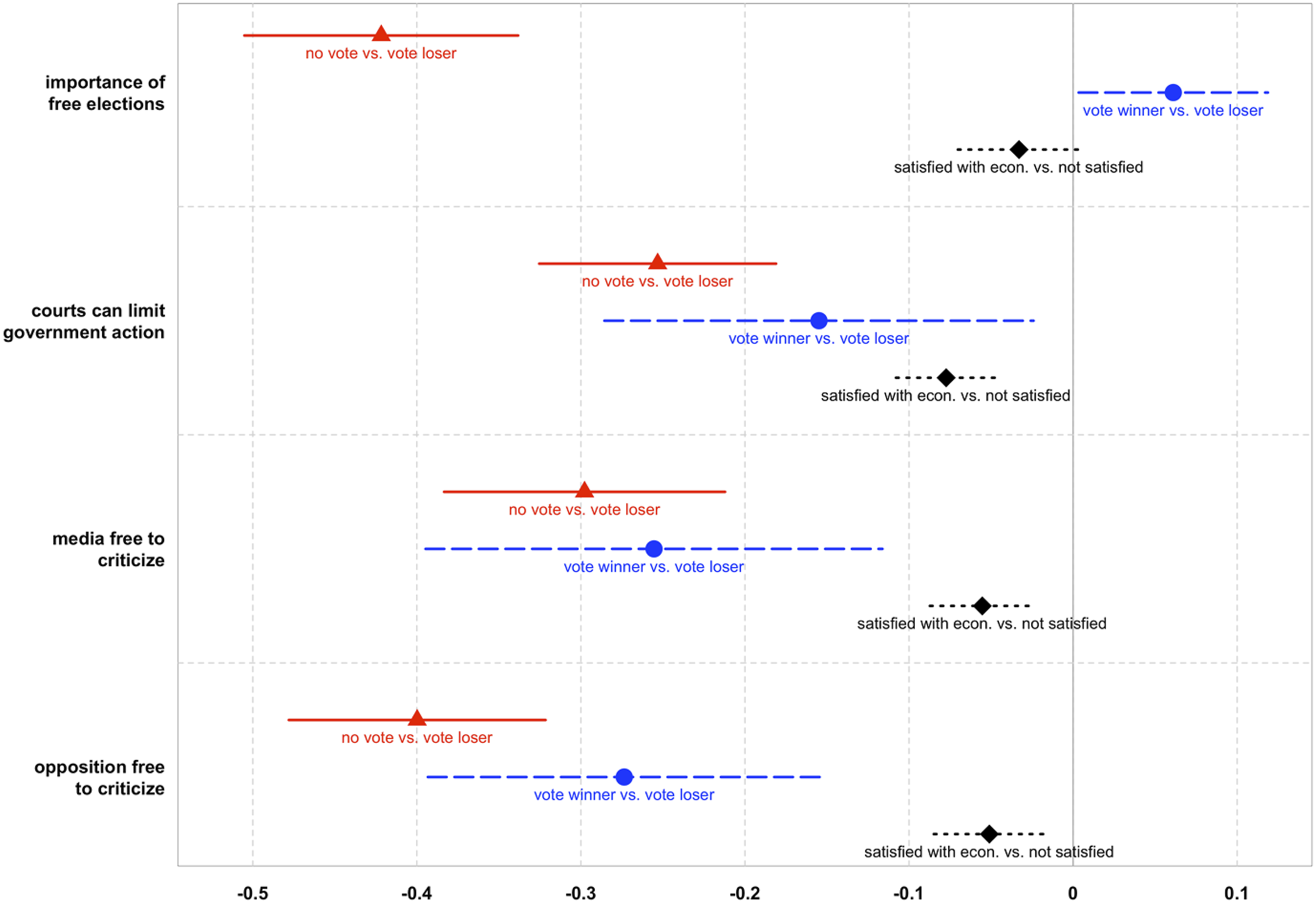
Our analysis shows that supporters of winning parties assign significantly less importance to all three democratic checks and balances constraining the power of the government than supporters of losing parties. Yet, they assign significantly more importance to free and fair elections. In fact, when we examine all groups (party supporters, party voters, and non-voters), we find that it is supporters of losing parties in particular that have consistently different attitudes than the rest and assign the most importance to democratic checks and balances constraining the government (all contrasts between the different categories of the election status variable are reported in supplemental tables A2a-c). Voters of losing parties who do not identify with these parties do not consistently differ from non-voters, voters of the winning parties, and the supporters of winning parties in terms of how important they think democratic checks and balances are (see Supplemental Table A2).
Being satisfied with the state of the economy has significant negative effects on importance of democratic checks and balances, net of the effects of partisanship, demographic variables including occupation and indicators of the state of the economy (see Supplemental Table A2 for details).
These average effects mask a lot of heterogeneity between the different countries in the sample. Figure 2 shows the estimates for each country of the effect of supporting a winning party on support for the freedom of the media to criticize the government. We can see that despite the significant average effect, in a few cases, the estimated country-specific effect overlaps with zero, while in others (Spain, Germany, and Ukraine), it is even significantly greater than the average effect. Country-specific effects of supporting a winning party compared to supporting a losing party on the perceived importance of the media to criticize the government. For old democracies coefficients are represented by (blue) diamonds and the 95% confidence intervals by solid lines; for new democracies and Russia, by (red) dots and dot-dashed lines. The solid gray horizontal line indicates the average effect in the entire sample.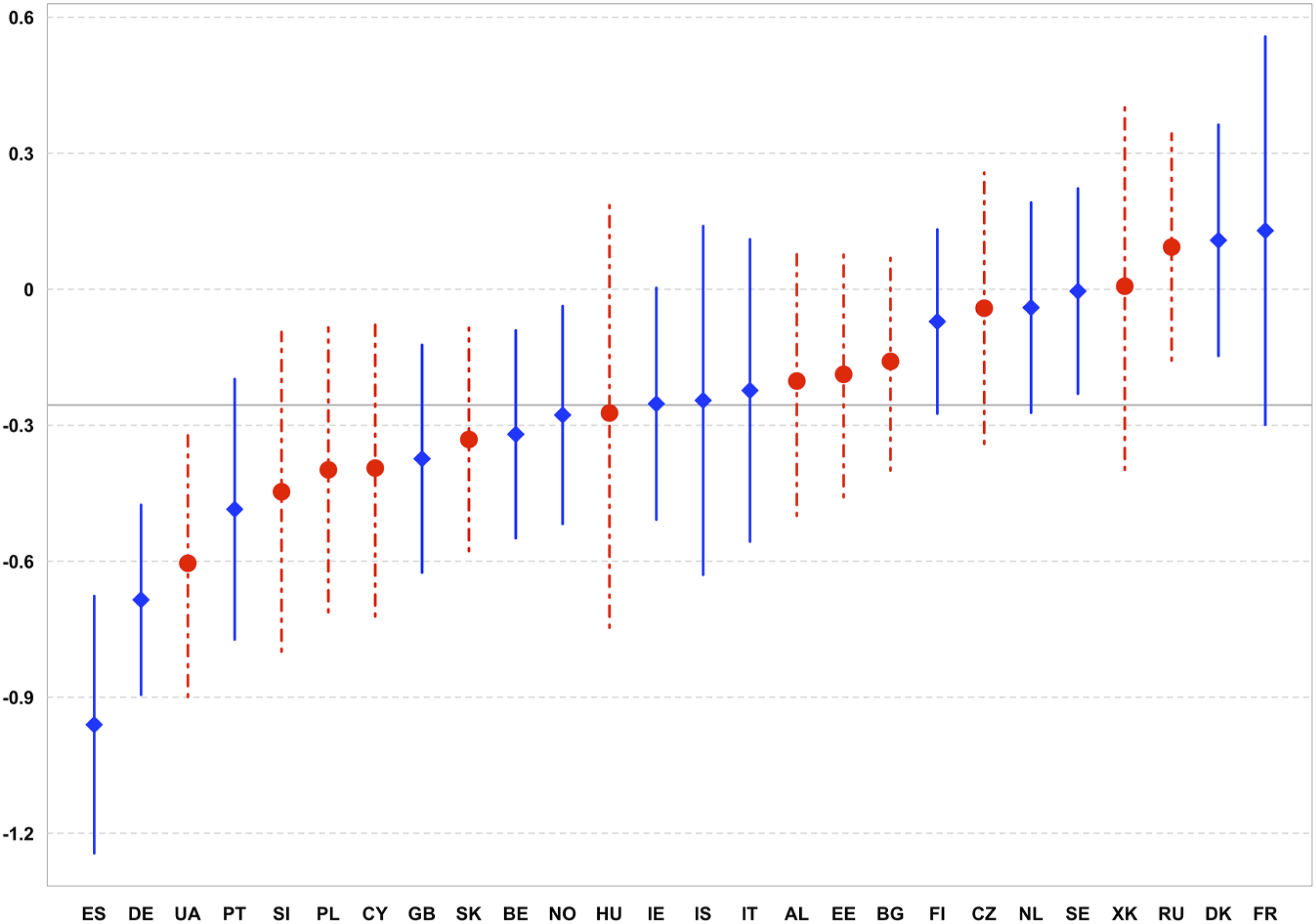
We explored three possible factors that could potentially account for the country heterogeneity in the estimated effects of party support: new versus old democracies, the polarization of society, as measured by the Digital Society Project (Mechkova et al., 2020), and time elapsed between the last election and the survey. To do so, we added interactions between these country-level variables and party support to the models presented above. 10 We find no evidence that the effects are systematically bigger or smaller in new versus old democracies (details are reported in Supplemental Table A4; see also Figure 1) or that polarization moderates the effects (Supplemental Table A5). With more time elapsed since the last elections, supporters of losing parties increased their level of support for all four aspects of democracy.
In sum, the survey data provide evidence in favor of the hypothesis that supporters of “losing” parties that do not make it into government find democratic checks and balances more important than others (H1). As expected, they did not find the majoritarian aspects of democracy more important. We found that checks and balances were especially important to the citizens who strongly identified with the losing party: respondents who felt close to the party that lost elections had the highest levels of support for constraints on the power of the executives. However, respondents who voted for the losing party but did not feel close to it, found checks and balances less important. By comparison, respondents who felt close to the party that won and those who only voted for the winning party expressed similar lower levels of supports for these constraints. Thus, our findings partially supported the hypothesis about the effects of partisanship (H1a). Namely, we found that the strength of party identity had an impact among the losers of elections but not among the winners. In addition, we found that there is significant variation both within countries and between countries as well, but the cross-country variation is not related to experience with democracy or polarization at the country level. Moreover, as more time passes since the election, the gap between supporters of losing parties and the rest of the citizens with respect to support for democratic checks and balances might grow larger. Finally, we found that satisfaction with the economy decreases importance of democratic checks and balances (H4).
The observational nature of the data on which these results are based does not allow us to infer causal effects from the associations we find. For example, it could be that low support of voters for democratic checks and balances is causally prior to their party choice: a majority of voters might hold such views, to which some parties respond, and they end up victorious in the elections. In this case, the associations reported above will overestimate the effect of having voted for the wining party on attitudes toward democracy. But it could also be the effects are underestimated: most parties in government in Europe have moderate political ideologies, while some parties in opposition endorse anti-systemic and anti-democratic ideas. So the group of supporters of parties who did not win at the elections includes citizens with such principled anti-systemic and anti-democratic views as well. This would mask any effect of having lost the election that works to increase support for democratic checks and balances among the subset of losing party supporters who are in principle in favor of democracy. Therefore, to establish the causal nature behind the associations that we, and much of the existing literature, find in public opinion surveys, we turn to experimental methods. In the experimental studies, we focus on the effects on the independence of courts rather than the rights of the media and the opposition.
Study II. Party support, economic performance, and the willingness to defend independent courts in Ukraine
The experimental study we report employs a hypothetical vignette. The vignette is a short story about a government that comes to power as a result of free and fair elections and that implements reforms of the judicial branch of the government, and the appointment of judges in particular. 11 Importantly, although the government is openly changing the rules of the game, it does not explicitly state that in doing so it wants to violate democratic rules. Instead, it provides a possibly valid justification for this reform, namely, that the current judges have been installed by the previous regime.
Our vignette uses a different approach than the one typically used in conjoint designs where experimenters vary the positions of political actors on policies and on different aspects of the system of checks and balances (for example, whether elected officials should follow the decisions of courts) (cf. Carey et al., 2020). We chose for this narrative because in contemporary political discourse it is rather uncommon for politicians to openly admit that they want to undermine democracy or to justify reforms dismantling democratic checks and balances in terms of these reforms violating democratic principles. To the contrary, even leaders with non-democratic intentions justify their reforms by referring to the need to increase the level of democracy or by casting doubt about the legitimacy and proper use of existing democratic procedures (e.g., BBC News, 2020).
Using this vignette, we test the causal impact of party support and economic performance on our outcome variables. The content of the vignettes was manipulated between-subjects in a factorial design. Each participant read one of six vignettes that specified the level of party support (“party support,” “neutral,” or “party oppose”) and the level of economic performance (“neutral economic performance,” or “improved economic performance”). When it comes to party support, in the neutral condition, the participant read that “one of the political parties in your country” wins the majority at a fully competitive and fair election and gets to form the government. In the party support condition, the participant read that “the political party that you support” wins, and in the opposition condition, the participant read that “the political party that you oppose” wins the elections. When it comes to economics performance, in the improved performance condition, participants read that under this government “the levels of income of most citizens increased by comparison to the levels achieved by the previous government,” while the neutral condition participants read that the levels of income remained the same. The full text of the vignettes is available in the Supplementary Material.
The outcome variables are measured with the following questions: (a) “To what extent would you support this government?” (b) “To what extent would you trust this government?”, (c) “To what extent do you think the decision to reform the appointment of judges is justified?” and (d) “To what extent do you think the decision to reform the appointment of judges is acceptable?”, and (e) “How likely is it that you would vote for this party in the next election?”. All responses are measured on 7-point Likert scales. 12
This study is based on a representative online sample of the population in Ukraine. 13 The sample was collected by the local agency Info Sapiens in June 2020. The sample is representative of the population between 18 and 55 years of age living in urban settlements with more than 50,000 residents. The survey was administered in Russian and Ukrainian. We obtained N = 577 valid responses. The sample is 53% female (51% after adjusting with the weights) and the average age is M = 37.5 (36.9 weighted) (SD = 8). All participants passed the manipulation check (“According to the text you just read, which party won the election?”), and answered correctly the comprehension check question asking about the reform (According to the test you just read, which reform needs a constitutional change?). These results assure us that the participants of our study noticed in which party support condition they were and that they picked up the information that the government was reforming the appointment of judges. There was a significant difference between the mean answers to the manipulation check regarding economic performance of the government presented in the vignette (“In the text you just read, how successful was the government at raising the level of income of citizens?”, measured on a scale from 1 to 7). Participants in the neutral condition evaluated the economic performance as less successful (M = 2.1) than participants in the better performance condition (M = 5.7). This difference was statistically significant, t (563) = −34.72, p < .001. Thus, we can be confident that our manipulation of economic performance was received as intended.
Results
Respondents in our sample expressed high support for checks and balances. They agreed that it is important that “courts treat everyone the same” (M = 6.67, weighted mean (WM) = 6.59, SD = 0.91), “opposition parties are free to criticize the government” (M = 5.08, WM = 5.03, SD = 1.81) and “the media are free to criticize the government” (M = 6.15, WM = 6.12, SD = 1.26). 14 This high pronounced level of support for democratic checks and balances, and impartial courts in particular, makes us confident that the reform of judiciary can be perceived by citizens of Ukraine as an important issue, increasing the external validity of our vignette. Moreover, the high level of support for the impartiality of courts offers a possibility to conduct a hard test of the effects of partisanship and economic performance. Citizens for whom courts are very important are less likely to trade them off.
Figure 3 shows the estimated coefficients and 95% confidence intervals for the effects of the party support and economic performance manipulations on five dependent variables: to what extent the reform of the appointment of judges is considered justified, approval of the reform of the appointment of judges, support of the government introducing the reform, and trust in the government. The effects of support for the winning party and of opposition toward the winning party are compared to the neutral condition, where participants did not know whether a party that won was the one they supported or opposed (“a party won elections”). The effect of improved economic performance is compared to neutral performance of the economy (the party and economic conditions are entered additively, there is no evidence for an interaction). The linear regression models from which these coefficients are pulled include the age and sex of the participant as covariates. For each of the five dependent variables on the vertical axis, the (black) horizontal dotted lines and diamonds show the 95% confidence intervals and regression coefficients for the main effect of economic performance (i.e., the difference between the “economy improved” condition compared to the “stable economy” condition). The (red) triangles and horizontal solid lines show the difference between the “supported winning party” and the neutral control condition (i.e., having no information about whether you supported or opposed the winning party). The (blue) dots and horizontal dashed lines show the difference between the “opposed winning party” and the neutral control condition.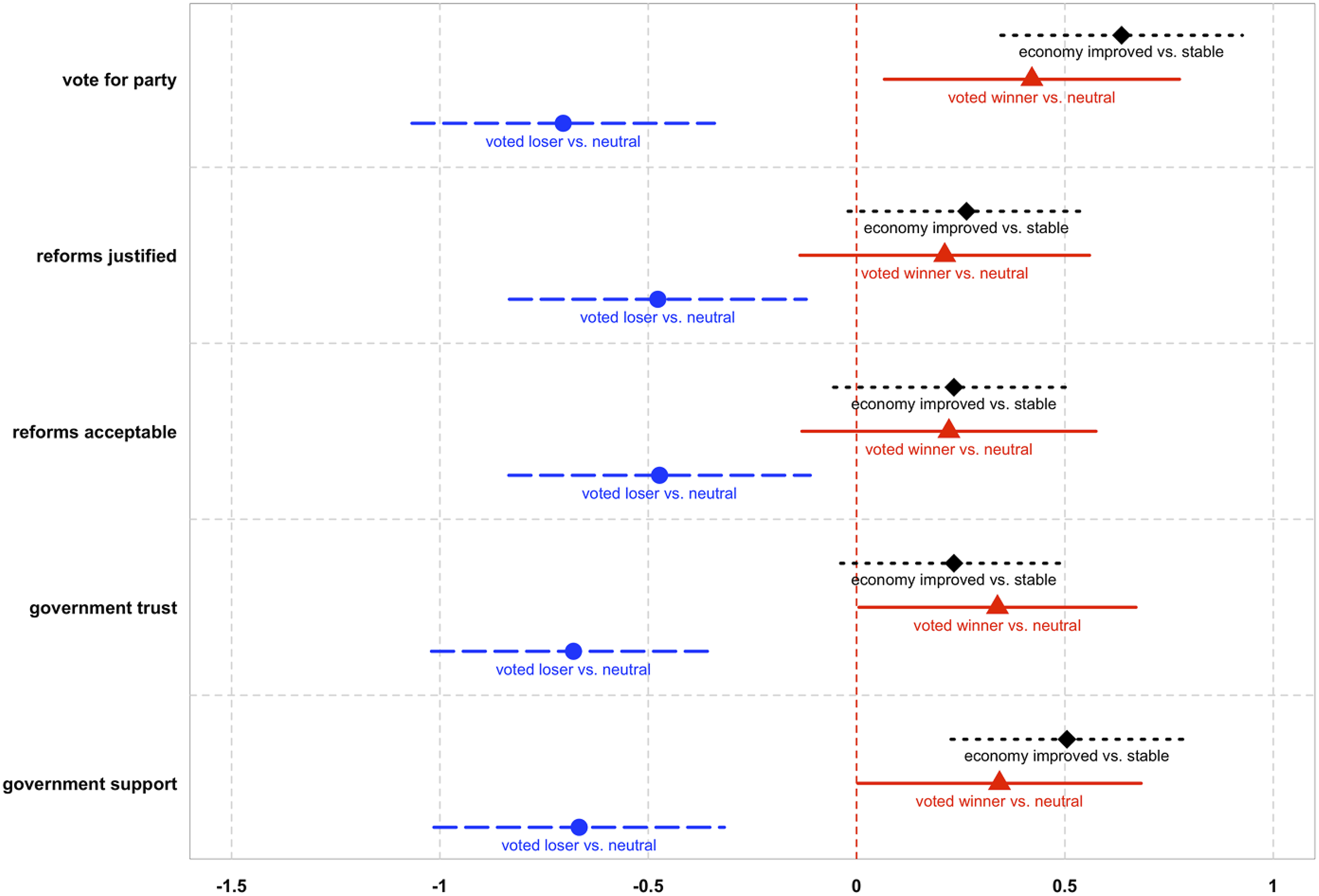
The figure shows that having opposed the party that is in government leads to significantly lower levels of support and trust in the government, lower intention to vote for this party in the future, and lower levels of finding the reforms acceptable and justifiable by comparison with not having the information about which party won the election. Conversely, the effects of support of the party that won the election on the evaluations of the reform and of the government are positive but not significantly different from the effects of not having the information about whether the party that won was one you supported or opposed.
Improving the economy has positive effects by comparison with keeping the economy at the same level as under the previous government. However, only the effects of the improved economy on vote intention, government support, and acceptance of the reform are significant at the 0.95 level.
Our design cannot exclude the possibility that participants in the party support condition would have expressed support and trust in the government at an even higher level, if the government had not introduced the reform of the appointment of judges. Given that the effect of party support is not statistically different from the neutral party for four out of five outcomes (vote intention is the exception), it is possible that some of the potential original support resulting from partisanship was lost because of the reform of appointment of judges. This could be explained, for example, by a dislike of the reform of checks and balances or by possible reputation-management concerns by respondents (“I express lower support, because it is not socially desirable to support such a reform”).
Notably, in absolute terms, the acceptance of the reform was on average rather high (around 4.8 on a 7-point scale), showing that in principle a reform of the appointment of judges was not evaluated too negatively. Moreover, we observed that participants in the “oppose” condition were not only less likely to vote for the governing party in the next elections, but also evaluated the reform of checks and balances more negatively than the participants in the “support” condition, indicating that partisanship drives the evaluations of reforms involving checks and balances.
In terms of substantive size, the effect of being in the opposition condition is between half and one point on a seven-point scale, which makes for about half a SD change in all the outcome variables. The effects of being in improved economy condition are smaller in size, even when statistically significant. To aid the interpretation of the results, Figure 4 shows the distribution of data for an index outcome variable averaging the responses to all five dependent variable questions in each experimental condition (for “party opposed,” “neutral party,” and “party supported” conditions across “stable economic performance” and “improved economic performance”). By using this index, we reduced the noise in our measurement, which helps to illustrate the clear pattern in the direction of effects. Distribution of data per experimental condition. Half-violin plots (showing the smoothed density) with rainclouds (showing the data points) and boxplots (showing the medians and the first and third quartiles).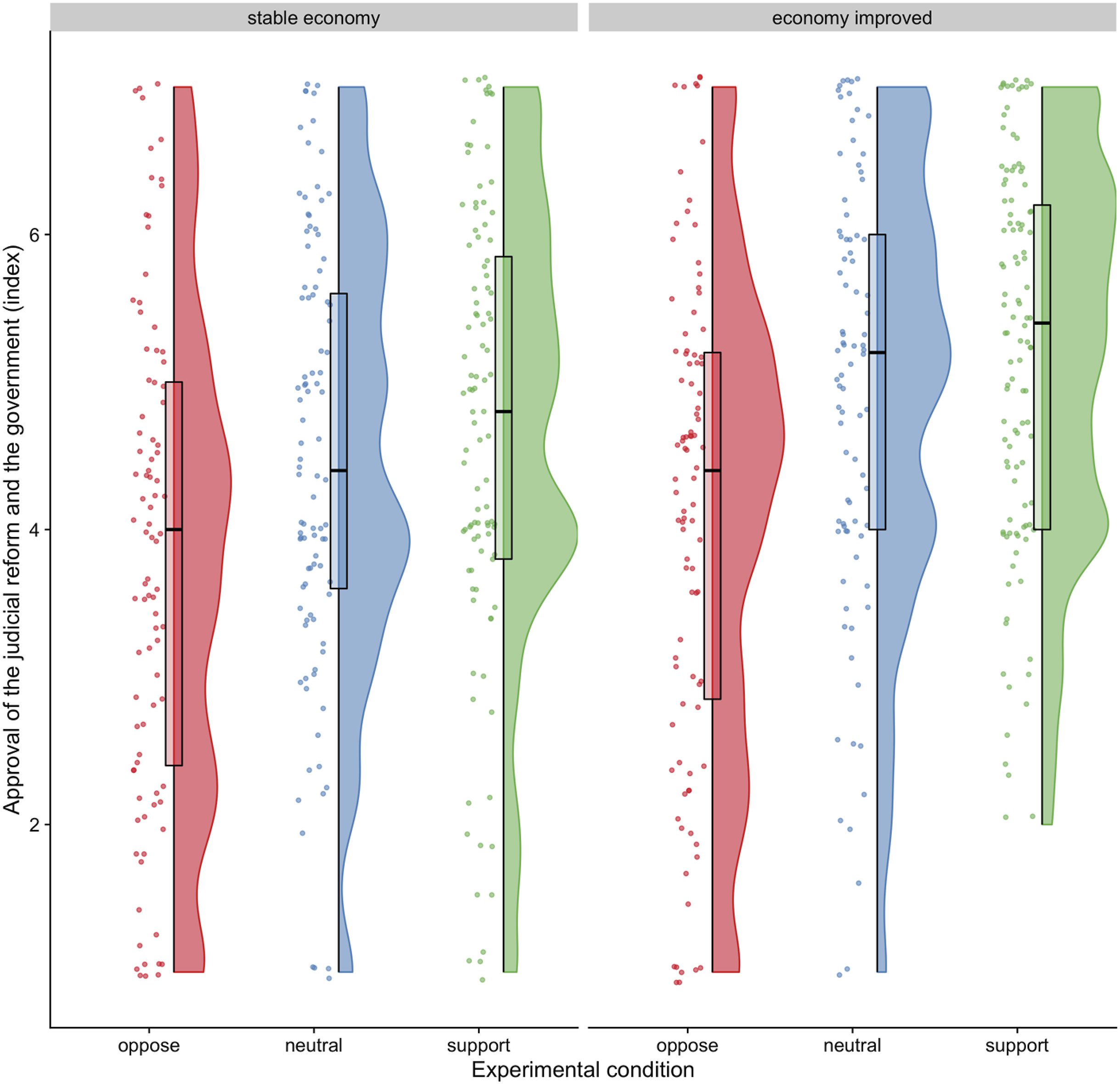
To sum up, we find evidence that citizens are less likely to express the intention to vote for the party in charge when reforms of checks and balances are implemented by a party they oppose rather than when the reforms are implemented by an unspecified party. They are also less likely to trust and support this government and to find the reform justified and acceptable. Thus, our results support H3a-c. We find no clear evidence that citizens are more likely to express the intention to vote for the party in charge when the reforms of checks and balances are implemented by a party they support than when they are implemented by an unspecified party. They are also not more likely to trust and support this government and to find the reform justified and acceptable. They are, however, more likely to express an intention to vote for this party. Hence, our results do not support H2a-b, but do support H2c. Similarly to the results from the analysis of the survey data, the differences we detect are between the losers (opponents of the party in charge) and the rest (supporters and those who did not get a signal about which party rules). Finally, we do find that when the economy is improving under this government, citizens express more support for the government and are more likely to vote for it (support for H4c and partially H4a). Improved economic performance leads also to higher acceptance of reforms of checks and balances, but not to evaluating the reforms as more justified (partial support for H4b).
Conclusion
Authoritarian leaders can garner support of large sections of populations and, once elected, use their power to change the rules of the game. Importantly, one of the crucial steps in authoritarian handbook is getting rid of checks and balances on the executive power, often with tacit support or lack of explicit objection on the side of the majority of voters (Singer, 2018; Mazepus et al., 2016). Our studies show that it is mostly the supporters of opposition parties that can be relied upon to stand up for democratic checks and balances, such as the rights of the media and the opposition and an independent judiciary.
This article shows that the effect of partisanship on support for democratic checks and balances occurs even in Europe, in addition to the well-documented cases of Latin American countries (Singer, 2018; Svolik, 2020), African countries (Moehler, 2009), and the US (Graham & Svolik, 2020; Berliner, 2020; McCoy et al., 2020). In this respect, it is worth emphasizing once again that the analysis of observational survey data revealed substantial cross-country heterogeneity in the effects of partisanship. However, this heterogeneity was not related to the age of democracy or polarization at the political system level, and alternative explanations need to be tested in future studies.
The strength of party identity at the individual level was associated with higher support for checks and balances by the losers of elections. Interestingly, with more time elapsed since the last elections, supporters of losing parties found all four aspects of democracy more important. This observation seems to align with the finding that the loser-winner gap persists over time (Anderson et al., 2005, p. 188) and might expand in situations where particular groups find themselves repetitively on the losing side of elections.
Our experimental study shows that people who have been cued that reforms of the judiciary that potentially infringe on the independence of courts are done by parties they opposed at the elections are more negative about these reforms and the governments that introduce them. By contrast, people who have been cued that these reforms are pushed by parties they supported at the elections find such reforms more acceptable. Similarly, when the economy is perceived as improving under a government, people are more likely to put up with attacks on judicial independence, at least in the case of Ukraine.
We conducted a relatively strong test for the effect of partisanship on support for breaches of checks and balances. First, we studied this issue in Ukraine, where the party system is unstable and personalized (Chaisty & Whitefield 2020). Second, we focused on a rather “difficult” topic as judicial independence enjoys (in public opinion surveys) higher support than other mechanisms of democratic accountability, such as support for the freedoms of opposition and the media. It is therefore significant that we find the expected effects even in this difficult context. If weak cues about party support can work in this setting, it is likely that they will be stronger outside of the experimental setting and in systems with more stable parties and stronger party identities.
Further work could probe the generalizability of our experimental results to different polities and address several limitations. First, although the survey analysis and experiment indicate that the supporters of the losing parties differ from other citizens in terms of the importance they assign to constraints on the executive power and rights of opposition (in line with Ahlquist, et al., 2018), our studies do not offer conclusive evidence that the gap emerges because of their increased vigilance. More evidence is needed to rule out that the gap emerges because supporters of the winning parties care less about democratic checks and balances. Future studies could probe this idea further and focus on detecting differences in vigilance to violations of checks by winners and losers. Second, our experiment presented only one scenario that involved potential infringement of the independence of judges. This research could be expanded to other infringements on democratic checks and balances and further comparisons to other government reforms. Finally, future experimental designs could investigate whether the supporters of the winning party punish their governments for introducing reforms that infringe on checks and balances by withdrawing some of the initial support for them. This would address the lack of significant difference between the supporters of the winning party and the neutral condition (no party cue) in our design.
Nevertheless, the implications of our results can be far-reaching. Without functioning checks and balances on executive power, citizens are not protected from the abuse of office by political authorities (Acemoglu, Robinson & Tvorik, 2013). Elected authoritarian leaders can (and do) challenge constraints on their executive power in various ways: they can undermine the authority of courts, change constitutions to expand own competences, reform electoral systems, ignore and demean oppositional voices, and limit the freedom of media (Mazepus et al., 2016). While there can be no impartial treatment of citizens without independent courts and limits on the powers of the executive branch, large sectors of societies are not particularly preoccupied by their paralysis by incumbents (Acemoglu, Robinson & Tvorik, 2013). It is worrying that voters across very different political systems are willing to trade-off democratic checks and balances for partisanship and economic performance. The losers of elections, however, are more likely to monitor the violations of checks and balances most vigilantly and oppose the executive power grab for partisan reasons. Therefore, they might be the ones who would ultimately stand up for democracy.
Supplemental Material
sj-pdf-1-cps-10.1177_00104140211060285 – Supplemental Material for Standing up for Democracy? Explaining Citizens’ Support for Democratic Checks and Balances
Supplemental Material, sj-pdf-1-cps-10.1177_00104140211060285 for Standing up for Democracy? Explaining Citizens’ Support for Democratic Checks and Balances by Honorata Mazepus and Dimiter Toshkov in Comparative Political Studies
Footnotes
Acknowledgments
We thank Ramon van der Does, the anonymous reviewers, and the editors for valuable comments.
Declaration of Conflicting Interests
The author(s) declared no potential conflicts of interest with respect to the research, authorship, and/or publication of this article.
Funding
The author(s) disclosed receipt of the following financial support for the research, authorship, and/or publication of this article: This research has been supported with a grant from Leiden University Fund/Gratama (grant number 1270408004) for Honorata Mazepus.

Supplemental Material
Supplemental material for this article is available online.
Notes
References
Supplementary Material
Please find the following supplemental material available below.
For Open Access articles published under a Creative Commons License, all supplemental material carries the same license as the article it is associated with.
For non-Open Access articles published, all supplemental material carries a non-exclusive license, and permission requests for re-use of supplemental material or any part of supplemental material shall be sent directly to the copyright owner as specified in the copyright notice associated with the article.
