




Abstract
Do politicians perceive scandals differently when they implicate members of their own party rather than another party? We address this question using a between-subject survey experiment, whereby we randomly assign UK local councillors (N = 2133) to vignettes describing a major national-level scandal in their own party versus another party. Our results show that local politicians perceive a significantly larger impact of this national scandal on the national party image when it concerns their own party (relative to another party). When evaluating the same scandal’s impact on the local party image, no similar effect is observed. This suggests that local politicians tone down the local impact of a national scandal more when thinking about their own party. We suggest this derives from a form of motivated reasoning whereby politicians selectively focus on information allowing a more negative view of direct electoral opponents. These findings arise independent of the type of scandal under consideration.
Introduction
Scandals triggered by politicians’ inappropriate, unethical or illegal behaviour can invoke responses from voters (De Vries and Solaz, 2017; Vivyan et al., 2012) as well as the involved politicians (Cavalcanti et al., 2018; Ferraz and Finan, 2008). Previous studies largely leave aside the assessment of such events by a third group of actors: politicians not involved in the scandal (for a recent exception, Daniele et al., 2020). Yet, large-scale scandals generally implicate only a fraction of politicians, and may cause or exacerbate internal divisions within parties (Kam, 2009; Plescia et al., 2020). This raises important questions about how politicians ‘on the sidelines’ of a scandal – including, for instance, colleagues and party leaders (Asquer et al., 2020) – perceive the impact of such events, and whether these perceptions are affected by politicians’ partisan affiliation. In this article, we address this research gap by asking: Do politicians perceive a scandal differently when it implicates members of their own party rather than another party? Answering this question allows further insight into whether politicians’ partisan ties induce party-motivated reasoning in favour of their in-group (Taber and Lodge, 2006), as well as how politicians’ electoral self-interest may moderate this process. Politicians’ perceptions of scandals also have broader relevance since they might trigger actions that impact intra-party stability by intensifying internal divisions (Kam, 2009; Plescia et al., 2020).
Our analysis starts from the observation that parties play a key role in the life of politicians. They act as gatekeepers to elected office (Gallagher and Marsh, 1988) and determine who is promoted to positions of power (Dowding and Dumont, 2008). Additionally, a party’s name and/or symbols provide a low-cost heuristic to voters during elections (Conroy-Krutz et al., 2016; Kam, 2005). This latter aspect, however, can come with an important downside when a scandal hits a party. The party name and insignia may then bring up negative associations to voters, which imposes electoral costs upon all politicians within the party (Asquer et al., 2020; Daniele et al., 2020; Desposato and Scheiner, 2008; Lupu, 2014). This, we argue, has implications for the way politicians perceive scandals occurring in different parties. A scandal in my own party reflects poorly on me, and taints me with some ‘guilt by association’ (Goffman, 1963; Kvåle and Murdoch, 2020). Politicians may therefore perceive a scandal within their own party as more injurious to the party’s image. Alternatively, politicians’ loyalty to their own party may trigger motivated reasoning (Taber and Lodge, 2006), which could cause politicians to view scandals in their own party as less injurious to the party’s image. The balance of these opposing effects is not a prior clear and lies at the heart of our empirical investigation. Yet, we posit that this balance is affected by whether or not politicians evaluate the impact of a scandal in relation to their own electoral arena. Given a closer geographic proximity to my own voters, political activities and personal networks, thinking about a scandal in relation to my own electoral arena makes it very personal and direct. This increases the incentive to engage in motivated reasoning (Lodge and Taber, 2013; Taber and Lodge, 2006), and leads to a prediction that scandals’ injurious effect on my own party’s image is moderated when considering my own electoral arena (i.e. effectively considering its impact upon oneself or one’s direct political opponents).
To assess these theoretical propositions, we set up a survey experiment with UK local Councillors (N = 2133; fielded in October/November 2018). Specifically, we randomly allocated respondents to vignettes describing a hypothetical scandal involving national politicians in their own party or another party (between-subject design). We subsequently measured respondents’ perception of the impact of this scandal on the involved party’s image at the national level (where the scandal occurred) as well as the local level (where respondents are politically active). Our main results confirm that politicians interpret scandals through party-coloured lenses. Scandals in politicians’ own party on average trigger a larger perceived negative impact on the party image relative to scandals in other parties. This arises independent of scandal type. Furthermore, we find that this own-party bias in the perception of a scandal lessens when examining politicians’ own level of government. This is consistent with the idea that politicians’ assessment of a scandal’s (negative) impact is moderated by considerations related to their electoral self-interest.
Our study offers four contributions to the literature. First, we are the first experimental study dealing with the role of parties for politicians’ (rather than voters’) perception of scandals. Recent work addresses similar questions using observational data (e.g., Daniele et al., 2020). Yet, experimental evidence allows stronger causal inferences with respect to this largely overlooked issue within research on scandals. Second, studying how politicians perceive scandals involving fellow partisans bears relevance to research on intra-party dynamics. Previous findings suggest that scandals may exacerbate internal party divisions (Plescia et al., 2020), and can be exploited to oust irksome colleagues or gain control over the party organization (Kam, 2009). We posit that such effects are more likely to arise when politicians on the sidelines of a scandal perceive their peers’ behaviour to be more damaging to the party image.
Third, our findings stress how partisanship may bias politicians’ perceptions of specific situations. Norris and Lovenduski (2004), among others, have argued that individuals’ partisan ties lead to ‘selective perceptions’ (Lodge and Taber, 2013). Bækgaard et al. (2019) illustrate that this holds for politicians as well as for voters. However, to the best of our knowledge, we are the first to show that politicians’ re-election motivation may play a moderating role for this influence of partisanship. Politicians’ (electoral) self-interest thus can mitigate the impact of parties on politicians in modern politics. This not only shines a new light on the relevance of political parties (Snyder and Ting, 2002), but also raises new questions about when and why the balance between party- and self-interest tilts one way or the other.
Finally, our analysis leaves aside politicians’ likely actions following a scandal (e.g., exploiting the situation to accuse opponents or win favour within the party). We argue that analysing politicians’ perceptions is important in itself, as these represent a key driver behind their actions and decision-making. Psychological research establishes a direct connection between perceptions, decisions and actions (e.g., Fazio, 1990) and views individuals’ perceptions as an important link in the decision-making chain (Oliveira et al., 2009). Perceptions thus become an important subject of analysis because they ‘define which rules, duties and obligations are relevant as well as the type of utilitarian interests at stake’ (Herrmann and Shannon, 2001: 625; Kelley and Mirer, 1974). Hence, showing that politicians’ perceptions of scandals are affected by their partisan ties provides evidence on the first step in a causal chain towards the decision-making of politicians – the later stages of which require further analysis to yield additional insights into mechanisms behind political outcomes.
Theoretical background and hypotheses
When receiving new information, people engage in cognitive processes for ‘accessing, constructing and evaluating beliefs’ (Kunda, 1990: 480). The theory of motivated reasoning maintains that motivation plays an important part in guiding these cognitive processes, which can bias information processing in favour of some arguments rather than others (Bækgaard et al., 2019; Kunda, 1990; Taber and Lodge, 2006). Such ‘reliance on a biased set of cognitive processes’ (Kunda, 1990: 480) has been documented in a vast academic literature spanning numerous fields and settings. In political science, several scholars argue that partisanship presents a key determinant for ‘the direction of bias in motivated reasoning’ (Blais et al., 2016; Slothuus and De Vreese, 2010: 633). Such partisan motivated reasoning arises when individuals are motivated to ‘perceive real world conditions in a manner that credits their own party’ (Bisgaard, 2015: 849). People interpret information ‘through the lens of their party commitment’ (Bolsen et al., 2014: 235), and overvaluing elements favourable to their party while devaluing contrary indications (Bolsen et al., 2014; Slothuus and De Vreese, 2010; Taber and Lodge, 2006). By thus seeking out (dismissing) information that confirms (contradicts) their predispositions, partisan motivated reasoning allows people to form and maintain beliefs consistent with their party identification.
In the literature studying the electoral implications of scandals (for a review, De Vries and Solaz, 2017), the role of partisan motivated reasoning is discussed as a moderating factor. Voters’ partisan motivated reasoning is expected to reduce their propensity to punish corrupt co-partisan politicians. Extant literature testing this hypothesis using field, lab and survey experiments finds that partisanship indeed often moderates voters’ propensity to judge and/or punish corrupt or scandal-marred politicians (Agerberg, 2020; Anduiza et al., 2013; Klašnja and Tucker, 2013; Solaz et al., 2019). While this confirms similar results from observational studies (Anderson and Tverdova, 2003; Chang and Kerr, 2017; Eggers, 2014), such findings are not universal. Konstantinidis and Xezonakis (2013), Winters and Weitz-Shapiro (2013) and Chauchard et al. (2019) find little to no effect of partisanship on assessments of corruptive practices in survey experiments in Greece, Brazil and India, respectively.
Clearly, political parties matter not only to voters. They play a central role also for politicians. One reason is that political parties generally hold a firm grip on who runs under the party banner during elections (Asquer et al., 2020; Gallagher and Marsh, 1988). Moreover, politicians rely on the party hierarchy to advance their political career and obtain positions of power (Dowding and Dumont, 2008). Such career and patronage concerns benefit in-group attachment by creating an ‘informal exchange relationship in which a patron offers benefits in return for the (…) allegiance of a client’ (Chang and Kerr, 2017: 70). Extensive research furthermore indicates that the vast majority of politicians in established democracies rarely switch between parties (Fiva et al., 2021; O’Brien and Shomer, 2013). This reflects a high level of in-group loyalty, which is an important precondition for partisan motivated reasoning.
From a theoretical perspective, the impact of (partisan) motivated reasoning on politicians’ scandal perceptions is ambiguous ex ante. On the one hand, the importance of parties to politicians might make them particularly prone to motivated reasoning benefiting their political in-group. In our setting, this could become reflected in a belief that one’s own party is better able to handle any fall-out from a scandal (compared to other parties). Politicians may also think that supporters from their party are less scandal averse than supporters of other parties (at least when it comes to scandals in their preferred party; Agerberg, 2020; Anduiza et al., 2013; Klašnja and Tucker, 2013; Solaz et al., 2019), or that accusations against their own party are less likely to be true, important or effective. Each of these mechanisms would lead politicians to perceive a scandal as less injurious to the party image when the scandal relates to their own party. 1
On the other hand, politicians’ motivated reasoning may also lead them to perceive the impact of scandals within their own party more negatively. This is due to two reasons. First, politicians may realize that a scandal in their own party impacts upon their own electoral prospects. Any reduction in a party brand’s electoral value (Desposato and Scheiner, 2008; Lupu, 2014) as well as its ethical and non-policy reputation (Asquer et al., 2020) can indeed cause voters to punish other politicians running under the damaged party label. That is, if my co-partisans do something wrong, this makes me look bad too. Such electoral considerations can be expected to take centre-stage in the (directional) goals guiding the cognitive processes underlying politicians’ motivated reasoning. Second, politicians may not only interpret scandals that effectively occurred through party-coloured lenses, but also the probability of such events prior to their occurrence. The reason is that in-group attachment affects individuals’ priors and beliefs about how people of that group are likely to behave, what type of opinions they hold, and so on (Dancey and Sheagley, 2013). Motivated reasoning thus may lead politicians to view their own party as less prone to scandals, while over-estimating the likelihood that other parties’ members violate legal, ethical or normative boundaries. This is important because expectancy violation theory (Smith et al., 2005) argues that individuals’ reactions to bad outcomes are more negative when they expected something good rather than something bad. Relative to politicians’ prior beliefs, a scandal in one’s own (‘clean’) party would appear particularly unexpected and damaging, whereas it has a smaller marginal impact for another (‘bad’) party.
These opposing predictions can be summarized as follows.
A scandal’s damage to the party image is unlikely to remain contained at the level of government where the scandal occurs. In effect, the impact of scandals often spills over across levels of government, particularly for highly salient scandals that grab public (and media) attention (Asquer et al., 2020; Chang et al., 2010). This highlights that, for instance, a scandal at the national may be a cause for concern for all co-partisans, regardless of their level of government. Research on coattail effects suggests that such spillovers mostly occur in a top-down fashion (Campbell and Sumners, 1990; Mondak and McCurley, 1994): i.e. a national scandal imposing negative electoral implications at the local level. Nonetheless, we argue that the geographic proximity of local politicians to their voters may counteract such top-down spillovers of a national scandal due to a ‘friends-and-neighbourhoods’ effect. According to this framework, politicians receive disproportionate support near their residence and/or birthplace (Fiva and Halse, 2016; Meredith, 2013) due to local canvassing, campaigning and networks (Johnston et al., 2016). Such a ‘friends-and-neighbourhoods’ effect may lead politicians to perceive a national scandal as less injurious when thinking about their own local electoral arena. Specifically, it may lead them to (selectively) downgrade any local electoral threat of the national scandal to themselves, in comparison to their direct electoral opponents. This argument leads to our second hypothesis.
Experimental design and data
Experiment
Figure 1 illustrates our experimental design. We randomly assigned respondents to one of six treatment groups, which were divided into two segments. In the first segment, respondents were asked to imagine the occurrence of a major scandal involving politicians from their own party. In the second segment, the scandal involved politicians from a different party. For both segments, we developed three vignettes varying in the type of scandal: i.e. a generic scandal (our ‘baseline’ treatment), a financial scandal, and a moral scandal. These scandal types are commonly differentiated in the literature (Sarmiento-Mirwaldt et al., 2014), and are most frequently observed in reality (Basinger, 2012). We introduce this variation in scandal types for two reasons. First, it addresses that our baseline treatment provides no control over the scandal(s) respondents have in mind while answering the survey. The treatments with specific scandals guide respondents’ thoughts and allow more control. Second, varying the scandal types provides an opportunity to verify robustness of our results across scandal types.
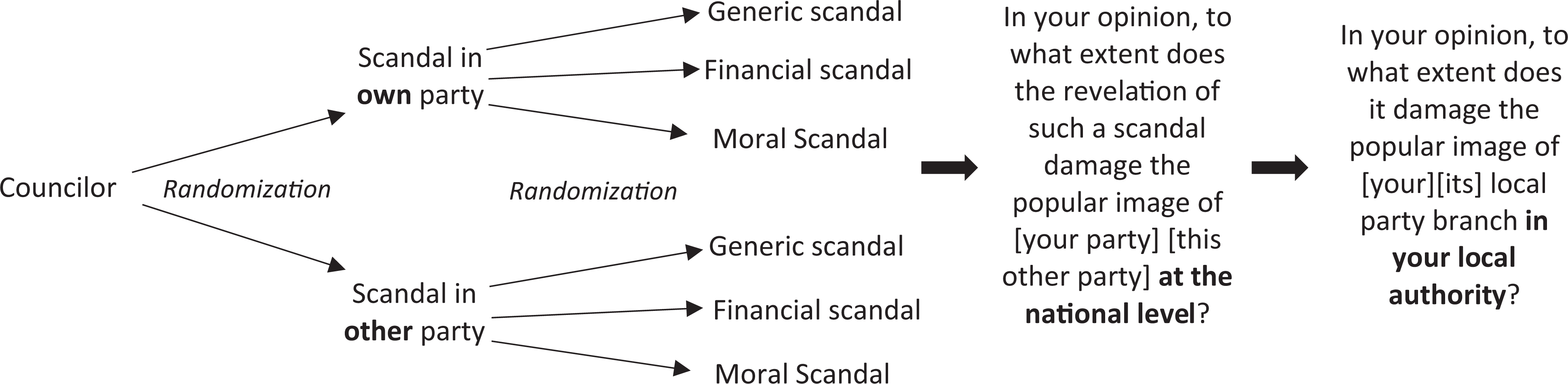
Experimental design. Note: Respondents were randomly allocated to the own/other party treatment (with equal probability) and to treatments differing in scandal type (with equal probability). They first saw the vignette relevant to their treatment, and subsequently were asked two questions about the impact of this national-level scandal on a party’s image at the national and local government level (in that order).
The vignettes for the baseline treatment were phrased as follows: The last few years have witnessed several scandals, which raised questions about the ethics and integrity of the politicians involved. Imagine that a major scandal breaks out in the year before the local authority elections, which involves several national politicians from [your party] [another party active in your local authority].
Observe that we deliberately abstain from mentioning party names in our vignette since this may trigger party-specific effects. Even so, our examples might invoke certain parties linked more closely to a specific scandal. We consider this a minor concern as members of both main parties were involved in the parliamentary expenses and #Metoo scandals. Nonetheless, we acknowledge that there is a trade-off here. One might worry that our respondents internalized the treatment more when referring to their own party, while paying less attention in the (less precise) ‘other’ party treatment. It is a priori unclear whether including/avoiding party names is superior, and future research should specify in- and out-group treatments with specific party names to assess this trade-off directly.
After these vignettes, we asked respondents for their perception of how this scandal influences the image of the affected party at the national as well as the local level. The former was phrased as: ‘In your opinion, to what extent does the revelation of such a scandal damage the popular image of [your party] [this other party]
Setting and data
The survey was fielded in October/November 2018 among UK local Councillors. The local level of government in the UK is complex due to its varying arrangements within and across the four regions (i.e. England, Northern Ireland, Scotland, Wales). Nonetheless, local councillors always face direct election for their position, and local governments’ functions and powers generally include economic, social and environmental policies as well as council tax collection. A more restricted set of functions exist in Northern Ireland. Most important for our purpose, the vast majority of local councillors is member of – and stands in local elections for – a party also active at the national level of government (91.6% of our respondents). This creates partisan connections between politicians across government levels, and allows analysing how local politicians perceive and interpret a national-level scandal in their own party versus another party.
We invited all 20,391 UK local Councillors with publicly available email addresses (provided by Commercial Evaluations Ltd.) to participate in our survey. As 223 email addresses proved inactive and 460 individuals held multiple offices, we effectively contacted 19,708 individual Councillors. The survey was online between 11 October 2018 and 30 November 2018, with three reminders sent in roughly 2-week intervals. We received 2118 complete responses, 1207 incomplete answers and 880 individuals ‘opted out’. Hence, response rate is 21.3% when including any form of response, and 10.8% when counting only complete responses. The bottom panel of Table 1 provides summary statistics of respondents’ background characteristics. These indicate that 71% are male, 65% have at least some university education, and 28% hold an executive position in the local council (such as (deputy) mayor, or (deputy) leader of the council). The average age is just under 60 years, and on average respondents are in their third term in office. Using information from the 2013 Census of Local Authority Councillors and the population of contacted councillors, we find that our sample is broadly representative in terms of age (i.e. mean as well as distribution), gender, terms in office as well as region. Respondents are skewed towards Labour and LibDem councillors and away from Conservative councillors (details in Table B.3 in Online Appendix). 3 Given our focus on the role of partisanship, throughout the analysis we exclude politicians identifying as ‘Independent’ or failing to report a party affiliation (6% of respondents).
Summary statistics.
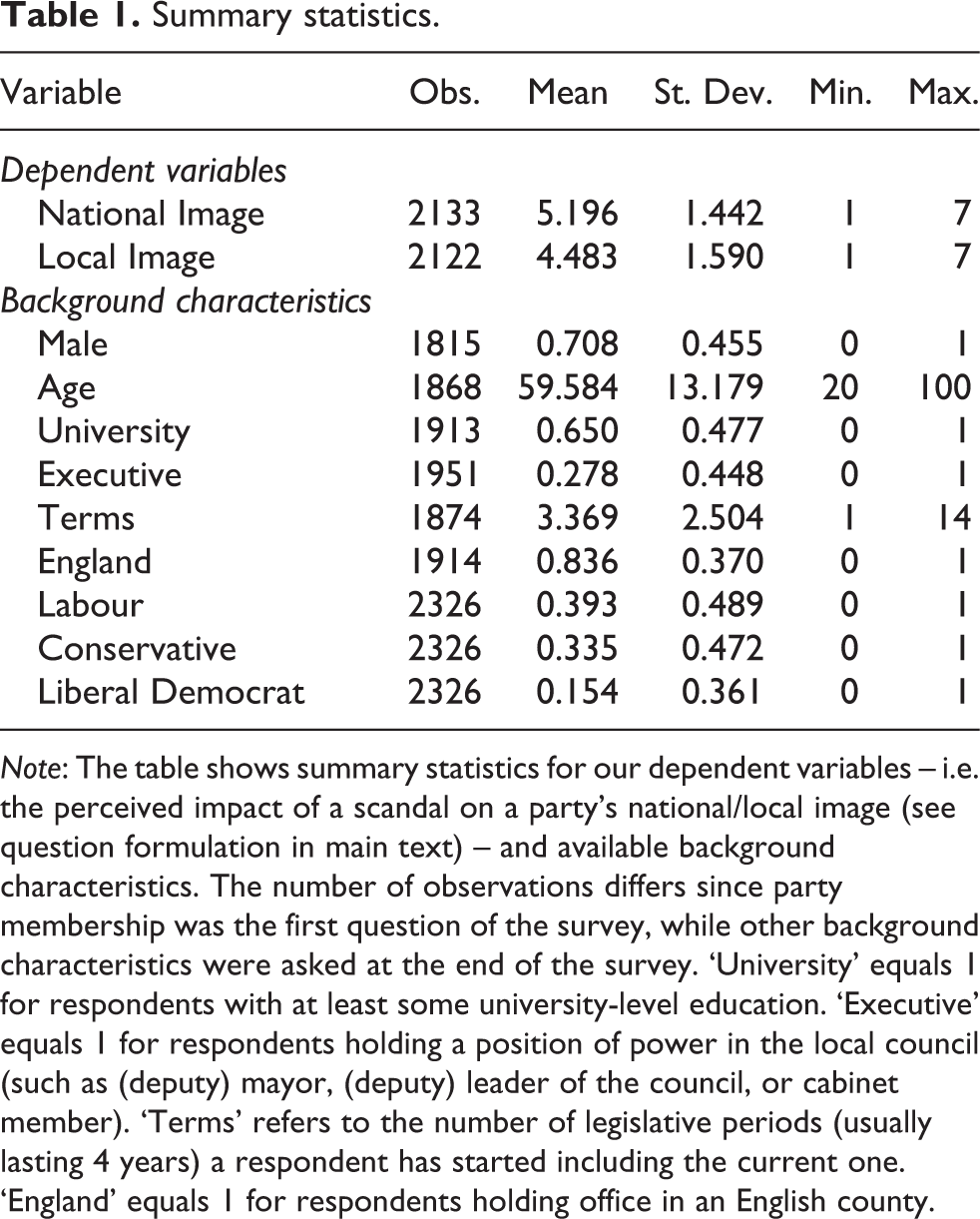
Note: The table shows summary statistics for our dependent variables – i.e. the perceived impact of a scandal on a party’s national/local image (see question formulation in main text) – and available background characteristics. The number of observations differs since party membership was the first question of the survey, while other background characteristics were asked at the end of the survey. ‘University’ equals 1 for respondents with at least some university-level education. ‘Executive’ equals 1 for respondents holding a position of power in the local council (such as (deputy) mayor, (deputy) leader of the council, or cabinet member). ‘Terms’ refers to the number of legislative periods (usually lasting 4 years) a respondent has started including the current one. ‘England’ equals 1 for respondents holding office in an English county.
The top panel of Table 1 shows that the mean value for our dependent variables – which measure politicians’ perception of the scandal’s impact on the image of the affected party (see above) – is above the midpoint of the scale for both the national and local party image question. This indicates that UK local councillors feel the revelation of a national-level scandal would be damaging to the popular image of the involved party at the national level (5.2 on a 7-point scale) as well as the local level (4.5 on a 7-point scale). Naturally, the impact is perceived to be substantially and statistically significantly larger at the national level – where the scandal arises. Yet, considerable spillover effects are felt to exist for the local branch of the involved party, even though there is no suggestion that any local politicians are implicated.
Clearly, responses to survey questions on sensitive or controversial topics (such as scandals) may reflect socially desirable answers. Self-reported measures obtained from politicians may also be ‘suspect given the electoral self-interest embodied in [their] claims’ (Lovenduski and Norris, 2003: 86). Yet, it is not clear whether self-serving politicians would declare higher concerns about a scandal in their own party (e.g., to signal personal rectitude), or rather downplay own-party scandals (e.g., to divert attention). Moreover, random allocation of our treatments should make it equally likely that respondents with high/low levels of susceptibility to social desirability end up in our various treatment groups.
The validity of our research design requires random assignment of respondents to treatments. We assess this by estimating logit models with binary dependent variables for our various treatments (i.e. scandal in own/other party, and scandals of distinct types), and using all background characteristics listed in Table 1 as explanatory variables. The Likelihood-Ratio-tests from these regressions indicate that respondents’ observable characteristics are jointly insignificant at conventional levels (Table B.1 in Online Appendix). Still, these results also highlight that university-educated respondents were somewhat less likely to receive the own-party treatment and older respondents somewhat more likely to receive the financial scandal treatment (Table B.2 in Online Appendix confirms this using Kruskal-Wallis equality-of-populations rank tests). We therefore engage in a series of robustness checks using respondents’ background characteristics to account for any slight imbalances across treatments.
Empirical approach and findings
Our baseline regression model is given by (subscript i for respondents):

The dependent variable
Table 2 summarizes the main results. In Panel I, columns 1–3 assess the perceived impact of a national-level scandal on the party image at the national level, while columns 4–6 assess the perceived impact at the local level. Columns 1 and 4 include the full sample. Columns 2 and 5 cover the sample for which all control variables are available. Columns 3 and 6 introduce the full set of control variables. In Panel II, all regressions include a full set of control variables and we separate the results by the various scandal types. Columns 1 and 4 focus on a generic scandal, columns 2 and 5 on a financial scandal and columns 3 and 6 on a moral scandal. While Table 2 presents ordered logit coefficients, Tables A.1 and A.2 in the Online Appendix present OLS results and Figures A.1 and A.2 in the Online Appendix contain histograms plotting respondents’ raw answers. These allow observing the direction and size of any distributional shifts due to our treatments, and help interpret effect sizes. 5
Effect of national scandal on own vs. other party image.
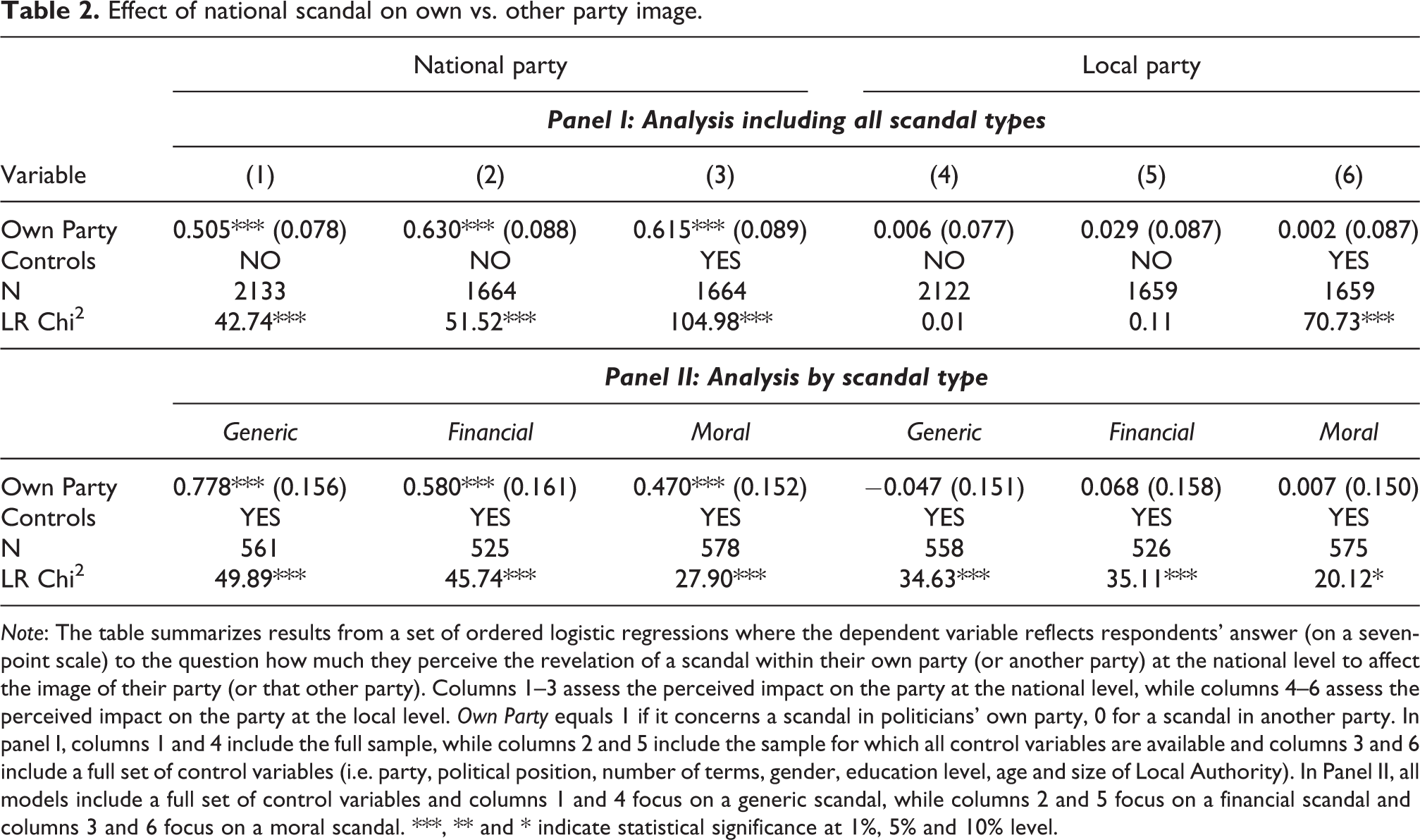
Note: The table summarizes results from a set of ordered logistic regressions where the dependent variable reflects respondents’ answer (on a seven-point scale) to the question how much they perceive the revelation of a scandal within their own party (or another party) at the national level to affect the image of their party (or that other party). Columns 1–3 assess the perceived impact on the party at the national level, while columns 4–6 assess the perceived impact on the party at the local level. Own Party equals 1 if it concerns a scandal in politicians’ own party, 0 for a scandal in another party. In panel I, columns 1 and 4 include the full sample, while columns 2 and 5 include the sample for which all control variables are available and columns 3 and 6 include a full set of control variables (i.e. party, political position, number of terms, gender, education level, age and size of Local Authority). In Panel II, all models include a full set of control variables and columns 1 and 4 focus on a generic scandal, while columns 2 and 5 focus on a financial scandal and columns 3 and 6 focus on a moral scandal. ***, ** and * indicate statistical significance at 1%, 5% and 10% level.
All but one of the point estimates for parameter
Panel II of Table 2 shows that the same pattern is replicated across all three scandal types. That is, when evaluating a scandal’s impact on the national party image (columns 1–3), there is always a statistically significant shift towards higher perceived impacts for politicians’ own party. The effect sizes here suggest shifts in the response distribution equal to 0.5, 0.35 and 0.25 for the generic, financial and moral scandals, respectively. No statistically significant differences are observed between scandals in one’s own or another party when politicians are asked about a national-level scandal’s impact on the local party image (columns 4–6).
Table 3 looks at the latter result in more detail by analysing the extent to which respondents think that the scandal has a stronger impact on national party brands compared to local party brands. This direct assessment of the local versus national consequences of a national-level scandal requires a slight reformulation of our regression model:

Effect of national scandal on national vs. local party image.
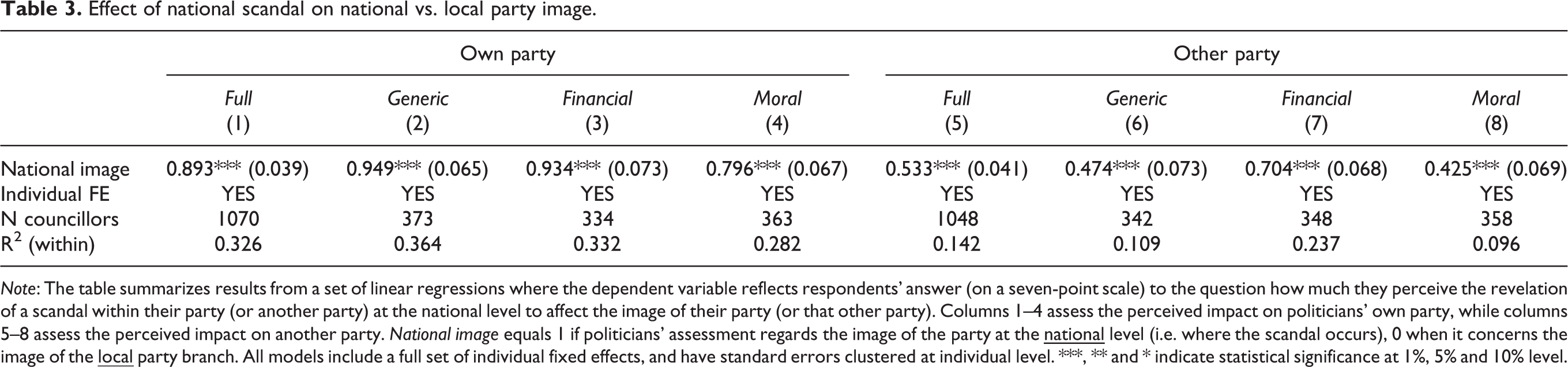
Note: The table summarizes results from a set of linear regressions where the dependent variable reflects respondents’ answer (on a seven-point scale) to the question how much they perceive the revelation of a scandal within their party (or another party) at the national level to affect the image of their party (or that other party). Columns 1–4 assess the perceived impact on politicians’ own party, while columns 5–8 assess the perceived impact on another party. National image equals 1 if politicians’ assessment regards the image of the party at the
The dependent variable is defined as before. The variable of interest now is
The results indicate that politicians, unsurprisingly, perceive the impact of a scandal to be more severe at the level of government where the scandal actually takes place. Yet, crucially, this national-versus-local shift in the mass of the response distribution is much larger when politicians are asked about their own party (approximately 0.8–0.95 on the 7-point scale) rather than another party (circa 0.4–0.7 on the 7-point scale). This indicates that local politicians tone down the local impact of a national scandal to a substantially larger extent for their own party. Difference-in-means t-tests (Table A.3 in Online Appendix) and regression models extended with an interaction between
Conclusion
This article provides the first experimental analysis of how politicians perceive the impact of scandals involving their peers. Our results allow three main conclusions. First, we show that local politicians on average perceive a more injurious impact of national-level scandals on the national party image when it concerns their own party compared to another party. Second, we find that this own-party bias weakens when evaluating the impact of a scandal at the level of one’s own (local) electoral arena. We argue that this may reflect a form of motivated reasoning whereby politicians selectively stress the persistence of their local electoral support (reflective of a friends-and-neighbourhoods effect) – thus taking a relatively more negative view of the effect of scandals on their direct electoral opponents. Third, we show that all observed average treatment effects are independent of the type of scandal (i.e. generic, financial or moral).
Although our experimental design allows a clean assessment of how politicians perceive the impact of scandals involving their peers, like all research designs it comes with limitations. These lead to a number of avenues for further research. First, our vignettes present a hypothetical scenario and provide only limited information about the scandal. More detailed information – such as whether the scandal involves an abuse of power or the political position(s) of those involved – may enrich the inferences drawn. Second, we study scandals at the national level and their spillovers at the local level. Future research should analyse whether local scandals likewise impact higher-level governments, and to what extent such top-down and bottom-up spillover effects have diverging strengths. Closely related, it would be interesting to study the effect of scandals on politicians in different jurisdictions at the same level of government (i.e. horizontal rather than vertical spillovers). Third, our analysis only evaluates politicians’ initial perceptions of the described scandal. While we view these initial perceptions as important, further analysis is required to assess what happens when bad news accumulates over time (Thesen et al., 2019). Finally, we focus on politicians’ perceptions of scandals, and do not assess their actual responses. Key follow-up questions thus may include whether and when politicians pursue defensive (e.g., formulate excuses or justifications) or offensive (e.g., accusing other politicians of misconduct) strategies in response to scandals, or how politicians readjust their position towards their party when it becomes embroiled in a scandal (e.g., public defence or criticism, defections or even party switching). This would also allow assessing whether and how perceptions link to actions (e.g., Herrmann and Shannon, 2001; Kelley and Mirer, 1974), which deserves in-depth scrutiny in future work.
Supplemental material
Supplemental Material, sj-docx-1-ppq-10.1177_1354068821998024 - Partisan bias in politicians’ perception of scandals
Supplemental Material, sj-docx-1-ppq-10.1177_1354068821998024 for Partisan bias in politicians’ perception of scandals by Nanna Lauritz Schönhage and Benny Geys in Party Politics
Footnotes
Authors’ note
The project received positive advice from the Ethical Committee for Social Sciences and Humanities at Vrije Universiteit Brussel on 29 October 2018 (reference number ECHW_161).
Acknowledgements
The authors are grateful to FWO Vlaanderen for financial support, to Mike Hickman (Managing Director of Commercial Evaluations Ltd.) for assistance with the survey, and to all respondents for their time and input. All interpretations naturally remain our own. We gratefully acknowledge comments and suggestions from the editor, two anonymous referees, Gianmarco Daniele, Sergio Galetta, Simon Galle, and Joshua Holm.
Declaration of conflicting interests
The author(s) declared no potential conflicts of interest with respect to the research, authorship, and/or publication of this article.
Funding
The author(s) disclosed receipt of the following financial support for the research, authorship, and/or publication of this article: This work was supported by FWO Vlaanderen (Grant G000218N).

Supplemental material
Supplemental material for this article is available online.
Notes
References
Supplementary Material
Please find the following supplemental material available below.
For Open Access articles published under a Creative Commons License, all supplemental material carries the same license as the article it is associated with.
For non-Open Access articles published, all supplemental material carries a non-exclusive license, and permission requests for re-use of supplemental material or any part of supplemental material shall be sent directly to the copyright owner as specified in the copyright notice associated with the article.
