



Abstract
This study examines the effects of Ottoman imperial rule on long-run development in Europe. Using a novel geographical dataset that tracks territorial changes at the sub-national level over 600 years, we identify a negative effect of Ottoman rule on modern economic performance. Contemporary survey data provides strong support for a causal mechanism involving reduced human capital accumulation. This insight is confirmed by a regression discontinuity analysis using historical data from Romania. We uncover large causal effects of Ottoman rule on literacy rates from the 19th century, which persisted throughout the 20th century. We argue that the late adoption of the printing press in the empire was an important determinant of low human capital accumulation and illustrate this using data on the spread of the printing press.
Introduction
The long-run effects of historical imperial rule on economic development are still controversial. On the one hand, an influential body of scholarship (Acemoǧlu et al., 2001; Dell, 2010; Lee & Schultz, 2012) suggests that certain forms of imperial rule were particularly detrimental, even if the extent of this phenomenon and the causal mechanisms underlying it are still elusive. On the other hand, an emerging stream of work (Becker et al., 2016; Gökmen et al., 2017; Wahl, 2017) identifies some positive effects of imperial rule on long-run development. We contribute to this debate by considering an imperial experience that is important but relatively little understood, that of Ottoman rule in Europe. Our article pursues two objectives: first, to estimate the effects of Ottoman exposure on long-run development by going beyond broad cross-country comparisons, and second, to tackle the difficult issue of the mechanisms underlying long-run effects.
An important component of our identification strategy is exploiting the extensive within-country and over-time variation in imperial rule in Eastern Europe. We have coded for the first time to our knowledge, all historical border changes in central and Eastern Europe between 1326 and 1922 at the level of the NUTS-3 sub-national level.
1
This allows us to calculate the number of years that different regions have been ruled by the Ottoman Empire. This measure is substantially more accurate than the sources used by previous scholarship (Nüssli, 2002). The map in Figure 1 illustrates the number of years different regions have been ruled by the Ottoman Empire. This ranges from less than 100 years in regions in Hungary, Slovakia, and Ukraine to more than 600 years in central and eastern Anatolia and the eastern Balkans. The Ottoman Empire and modern-day borders. Sources: See supplemental appendix.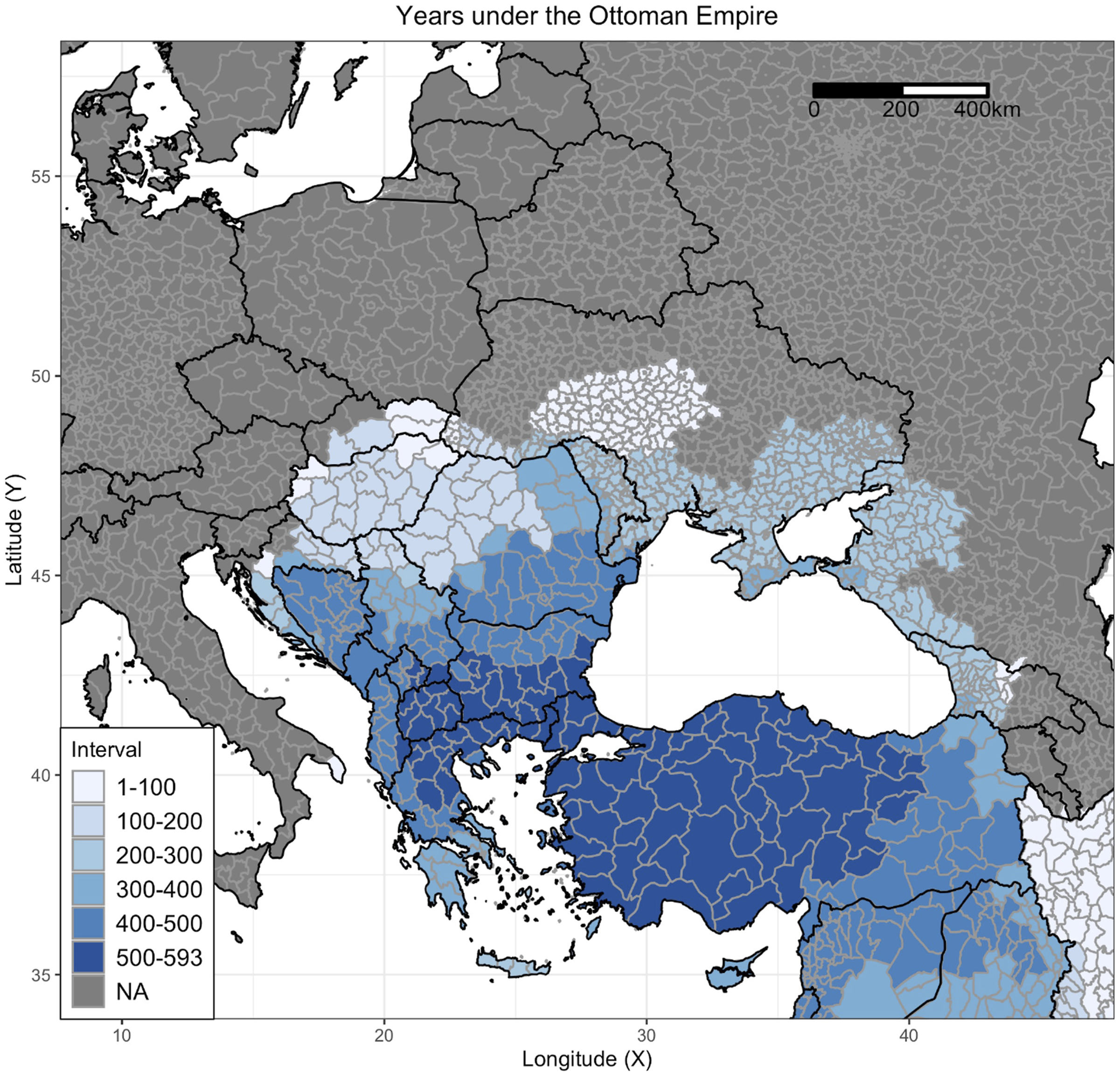
Using this variation in exposure to Ottoman rule, we show that longer Ottoman rule predicts lower economic output and less private sector development. This effect is identified in the presence of country fixed effects and a battery of geographical controls, and is magnified by more recent exposure. The effect is also robust to controlling for the extent of commercial activity at the onset of Ottoman expansion. Overall, we estimate that going from low to relatively high exposure to Ottoman governance caused income differences comparable in size to both the within- and the between-country standard deviation of this measure, pointing to the substantive importance of the findings.
A significant challenge to claims of long-run effects is the difficulty of identifying plausible transmission channels. Ottoman exposure entailed a variety of factors, including particular political institutions, specific policies associated with those institutions, as well as the emergence of certain cultural features. We use several historical sources, including fine-grained educational data, and individual and regional-level contemporary data to evaluate the evidence for several plausible mechanisms. We find robust evidence for a human capital channel, which is also supported by the qualitative historical accounts. Individuals in regions with a long Ottoman experience have lower educational achievement, as did their parents, and grew up in households with lower access to education. Regions in Europe under the Ottoman Empire show less innovative activity, and this variable mediates the effects of the empire itself on output.
We also explore the causal relationship between Ottoman exposure and historical education using a regression discontinuity design in Romania. Comparing regions close to the border between Ottoman and non-Ottoman areas allows us to estimate the causal effect of Ottoman rule against a counterfactual given by Hungarian and later Habsburg governance. Using county-level educational data from the 19th and early 20th centuries, we estimate literacy rates to have been several times higher in the non-Ottoman regions. These significant differences, while attenuated by the Communist experience, persisted throughout the 20th century, and are correlated with development today.
We argue that an important explanation for educational under-provision under the Ottomans was the delayed adoption and limited spread of the printing press, which hindered the mass production and consumption of knowledge (Atiyeh, 1995; Clogg, 1979; Hanioǧlu, 2008; Rubin, 2017). Erginbaş (2008, p. 59) shows that the printing press was introduced to Muslims in the Ottoman Empire 2 around 1726 by Mehmed Said Efendi with the assistance of İbrahim Müteferrika (Müge Göcek, 1987, p. 80). This, however, did not lead to a surge in the number of printed books in the 18th and 19th centuries. Our regional-level analysis shows that Ottoman imperial rule predicts later emergence of the printing press across South-Eastern Europe, a factor that is well documented to explain the development of mass literacy (Atiyeh, 1995; Dittmar, 2011; Cagé & Rueda, 2016).
We also find limited evidence for a causal channel involving institutional quality, which previous scholarship has identified as being negatively connected to Ottoman rule (Becker et al., 2016; Dimitrova-Grajzl, 2007; Grosjean, 2011b), and no evidence for a cultural and attitudinal channel.
Our findings are directly related to quantitative analyses focused on long-run persistence in Eastern Europe—including Becker et al. (2016, 2020); Charnysh (2019); Vogler (2019). This literature has not yet fully investigated the effects of the Ottoman Empire—one of the most important imperial powers in the region—on economic development. Grosjean (2011b) focuses on a distinctive Ottoman institution—the prohibition of interest lending—to examine its effects on contemporary financial development. While we agree with this and we were broadly able to replicate Grosjean’s findings, they are unable to explain the long-term effects on populations in Europe, which were unaffected by the prohibition of interest lending. We go beyond this by examining the effect on development itself, and distinguish among several plausible mechanisms. Dimitrova-Grajzl (2007) also investigates the legacies of the Ottoman Empire, using country-level data to show that Ottoman exposure predicts lower institutional quality. We corroborate Dimitrova’s conclusions by analyzing richer, sub-national data and providing causally identified estimates.
Much of the literature on the long-run effects of political institutions examined non-European settings. Notable recent examples include Lange et al. (2006); Lee and Schultz (2012); Guardado (2018); Dasgupta (2018). Our findings indicate that similar long-run effects can also be identified within a different historical context in Europe and therefore are neither spurious nor specific to the context of sea-based European empires.
Our findings are also related to the literature connecting the historical accumulation of human capital to long-run development. This literature argues that empires have at times promoted human capital accumulation in their colonies or annexed territories for further rent extraction, as in the case of Dutch Indonesia (Dell & Olken, 2020) or to support their war efforts, as in Japanese Korea and Taiwan (Kohli, 2004). Similarly, representatives of historical empires such as religious missionaries contributed to local education in an effort to spread Christianity and to solidify imperial legitimacy in the region. This is the case of Spanish Jesuits in Mexico (Waldinger, 2017), Protestant missionaries in Africa (Gallego & Woodberry, 2010), Asia, Latin America, Oceania (Woodberry, 2012), and India (Lankina & Getachew, 2012). Specific historical imperial experiences can also motivate individuals to invest in human capital. This is the case of Poles with a family history of forced migration, who are significantly more educated today than other Poles (Becker et al., 2020). Our paper offers strong evidence for the relevance of the human capital channel in mediating the effects of historical institutions on present-day economic outcomes.
Historical Background and Hypotheses
There is some agreement in the historical literature (especially among proponents of the Ottoman decline thesis 3 ) that the institutions of the Ottoman Empire that emerged after the 1500s were not conducive to economic development (Lewis, 1958; Pamuk, 2001). Scholars mention the methods of bureaucratic recruitment, training, and promotion that emerged after this era, often relying on the sale of offices, as a cause of the decline. These factors acted in tandem with inflation, the growing cost of government and warfare, and the farming of taxes (İnalcık, 1973).
While the argument linking these factors to economic performance is persuasive, it is unclear whether and how this effect persisted, given that these factors ceased to act at least one century ago. To evaluate the effect of Ottoman rule on long-run development, the following section examines the distinctive features of the empire’s approach to knowledge production and transmission. Specifically, we focus on the delayed development of mass education and knowledge sharing through printing. Several alternative channels of transmission are also discussed in the empirical section.
Human Capital in the Ottoman Empire
Human capital accumulation is directly relevant for economic growth. The literature on imperial rule and human capital suggests that the elites’ incentive structure determines their attitudes toward mass education. In some instances, the possibility of economic gains gives elites incentives to opt for the adoption of policies that promote mass education (Dell & Olken, 2020; Kohli, 2004). The historical evidence, however, suggests the converse for the Ottoman territories and also that late efforts toward reversing early policies were not enough to mitigate their legacies.
Somel (1997) shows that in the Balkans, the Ottoman educational system was characterized by its limited extent and its lack of focus on economically relevant skills until the second part of the 19th century. Christians in the Balkans generally only had access to whatever limited education was provided by churches. Muslims had access to a similarly limited education, provided in religious schools funded by local elites, rather than by the state. For Muslims, education was largely a tool for nation-building, emphasizing the Turkish language and religion, rather than practical skills. Somel (1997) argues that starting with the 17th century, the system declined into corruption, with many teachers being illiterate and appointed in exchange for bribes. Education at the secondary and tertiary levels was absent throughout most of the Balkans, with some small exceptions in the Romanian principalities (Drace-Francis, 2005).
The contribution of poor education to Ottoman decline became apparent to the imperial administration in the 19th century. During the Tanzimat period of the mid-19th century, efforts to set up secondary schools with a more applied curriculum took place throughout the Balkans. Somel argues that the lack of literate teachers in the territories made it impossible for written regulations to turn into reality. Schools, which often had only one or two teachers, found it difficult to teach 15 separate subjects, including mathematics, economics, or biology. Consequently, illiteracy rates in the former parts of the empire were very high at the beginning of the 20th century: in Bulgaria, 73.6% in 1900 and in Greece 59.7% in 1907 (UNESCO, 1953).
Human Capital and the Printing Press
A distinctive factor that interacted with the strategic choices made by the imperial administration and local elites in generating this poor outcome was the very limited spread of the printing press in the empire. The absence of printing increased the costs of gaining literacy for both students and their teachers, and prevented the advancement of knowledge outside of the limited provision in schools. Somel (1997, p. 445), for example, argues that the absence of books appropriate for the secondary level prevented teachers from teaching their curriculum, while the printing of textbooks in Albanian was a key step in extending literacy among the Albanian community.
Historians consider the introduction of the printing press in 1452 in Germany, as one of the most important events in history (Braudel, 1979; Gilmore, 1952; Roberts, 1996). It subsequently altered the way people learned and shared knowledge and contributed to the spread of literacy (Dittmar, 2011; Eisenstein, 1993; 2013; Mokyr, 2005). Politically, the printing press changed the power dynamic over authorship, distribution of knowledge, and construction of knowledge itself, becoming the “the most radical transformation in the conditions of intellectual life in the history of western civilization” (Gilmore, 1952, p. 186). It removed power from scholar-priests and led to the democratization of knowledge. For example, the mass literacy campaigns of the German Protestant reformers created a “significant population of readers that could take advantage of the pictures and texts that the printing press made available to them” (Tyner, 1998, p. 19).
Grendler (1990) argues that the availability of cheap textbooks was a key prerequisite for the spread of literacy in Renaissance Europe (Füssel, 2005; Nicholas, 2003). In the 15th century, it became expected that the children of the bourgeoisie would attend school (Bolgar, 1962), but the availability of printed books also provided opportunities for the masses. The printing press fostered the development of numerical skills, which were valuable in commerce. With time, these basic skills turned into more general business practices and the adoption of innovations in bookkeeping and accounting (Dittmar, 2011, p. 1134). According to Dittmar (2011), starting with the 1480s, European presses produced a stream of “commercial arithmetics” and printed mathematics textbooks, which were designed for students preparing for careers in business. Such textbooks were crucial in transmitting quantitative skills and guidance on business practice (Goldthwaite, 1972; Hoock, 2008).
The importance of the printing press for human capital is also articulated by İbrahim Müteferrika, who is associated with the emergence of the printing press 4 for Muslims in the Ottoman Empire (Pektaş, 2015). In his essay, The utility of printing (transliterated in Kut and Türe (1996, pp. 34–35)) for Sultan Ahmed III, aimed to reduce the opposition to the printing press in the Ottoman Empire, he lists some of its benefits: 1) printing is a means for preventing the destruction of rare books through “renewal and restoration” (Murphy, 1995, p. 289); 2) printing creates more reliable books without any mistakes, flaws, or errors; and 3) both “rich and poor can obtain books and acquire a proper education” (Murphy, 1995, p. 290). The latter occurs according to Müteferrika, through a lowering of prices of books, which would allow people in the countryside to buy them and hence, would reduce ignorance (Erginbaş, 2008, p. 68). Müteferrika’s arguments did not however spark a “sustained, society-wide remediation from manuscript to print production” (Schwartz, 2017, p. 1).
The timing of the adoption of the printing press is also important for subsequent outcomes. Dittmar (2011) emphasizes that European cities where the printing press was established between 1450 and 1500 had an advantage over cities that adopted the press later. This advantage consists of the development of valuable commercial skills which, prior to the advent of mass schooling, were only achievable through the consumption of books. Places where the printing press was adopted also became important cultural and economic locations, attracting booksellers, universities, and students (Dittmar, 2011).
A simple empirical exercise using data on the location of printing presses, literacy, and university education confirms these insights: there is a high positive correlation between the adoption of the printing press between 1400 and 1699 and university education, at the regional level.
5
In addition, proximity to a city with a printing press in the 16th and 17th centuries in Romania is positively and significantly associated with subsequent literacy rates in 1930s (see Figure 2). This result echoes previous empirical findings on the positive effects of the introduction of the printing press on literacy in the context of sub-Saharan Africa (Cagé & Rueda, 2016). Distance to historical printing presses and literacy in 1930 in Romania.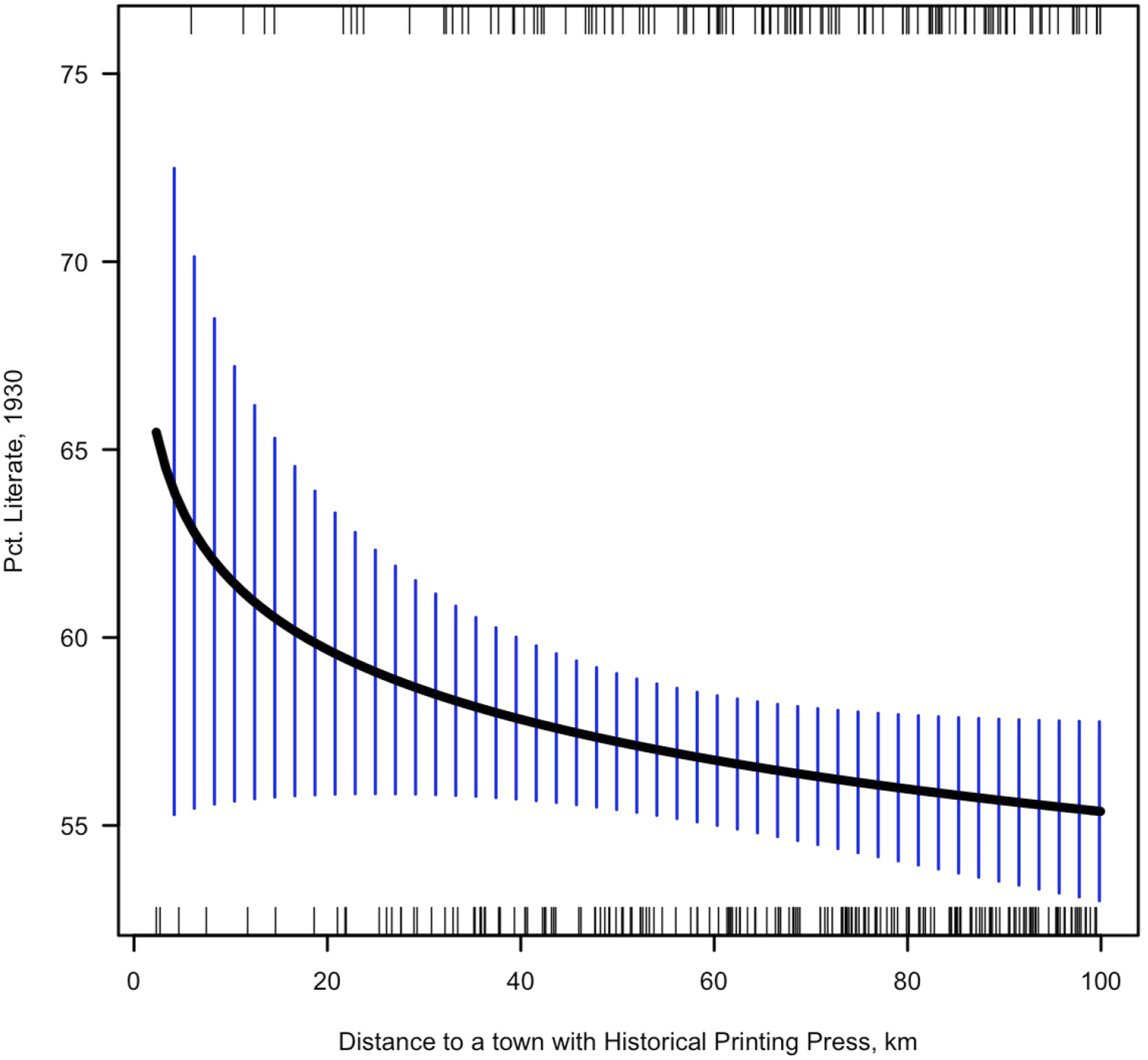
Beyond literacy, Dittmar (2011) contends that cities where printing presses were established in the 1400s grew 60% more than otherwise similar cities. Along the same lines, Baten and van Zanden (2008) find a significant association between simulated national-level wages and observed differences in aggregate book production in Europe.
The Printing Press in the Ottoman Empire
In this subsection, we present a summary of the main historiographical accounts of the emergence and spread of printing press in the Ottoman Empire. A more detailed discussion is found in section 8 of the supplemental appendix. The Ottomans were first introduced to the printing press by the Spanish Jews who were expelled from Spain in 1492 (Müge Göcek, 1987; Schwartz, 2017). Despite its early introduction, printing “did not find the favourable environment for it to flourish” (Pektaş, 2015, p. 29). The reason for the slow spread of the printing press is subject to contention among historians.
Many historians provide top-down explanations for the slow spread. First, some mention outright prohibition on the press in the 1400s and early 1500s (Finkel, 2005; Lewis, 2002). Modern historians however question whether this prohibition ever existed, given that official documents to indicate it cannot be located. 6 Second, some scholars mention an Ottoman awareness of the “seditious effects of printed books” on state security including the potential for revolts and religious campaigns of conversion (Müge Göcek, 1987, p. 113). This is why the Ottoman authorities might have taken measures against the press. Third, other historians mention socio-political interests within government circles in the Ottoman Empire, specifically the opposition of Ottoman scribes or calligraphers, whose very job depended on the manual copying of manuscripts, the palace correspondence, financial accounts, and land tenure documents (Clogg, 1979; Danişmend, 1947).
Pektaş (2015, p. 10) also discusses some structural factors that motivated the higher echelons of the Ottoman bureaucracy to oppose the printing press: the fact that Ottoman scribes of formal bureaucratic documents encoded their writing in highly specialized ways such that the characters, methods of writing, and formal variations determined the “communicative, cultural and political status of documents” in addition to ensuring their authenticity. As such, there were also important technological constraints of the printing press in the early stages of its emergence that made it an unattractive option for the Ottoman bureaucrats.
There is therefore no consensus on the causes of the late society-wide adoption of the printing press in the Ottoman Empire. Irrespective its root causes, Hanioǧlu (2008, p. 38) estimates that the late and limited adoption of the printing press resulted in the publication of only 142 books between 1726 and 1838 in the Ottoman Empire. This is a very small number compared to the 30,000 different books that had already been published in the West by 1500 (McLuhan, 1962, p. 207). The substantially lower density of printing presses in the Ottoman Empire as of 1700 is also visible in Figure 3. The spread of the printing press. Sources: (Magocsi, 2002, p. 17).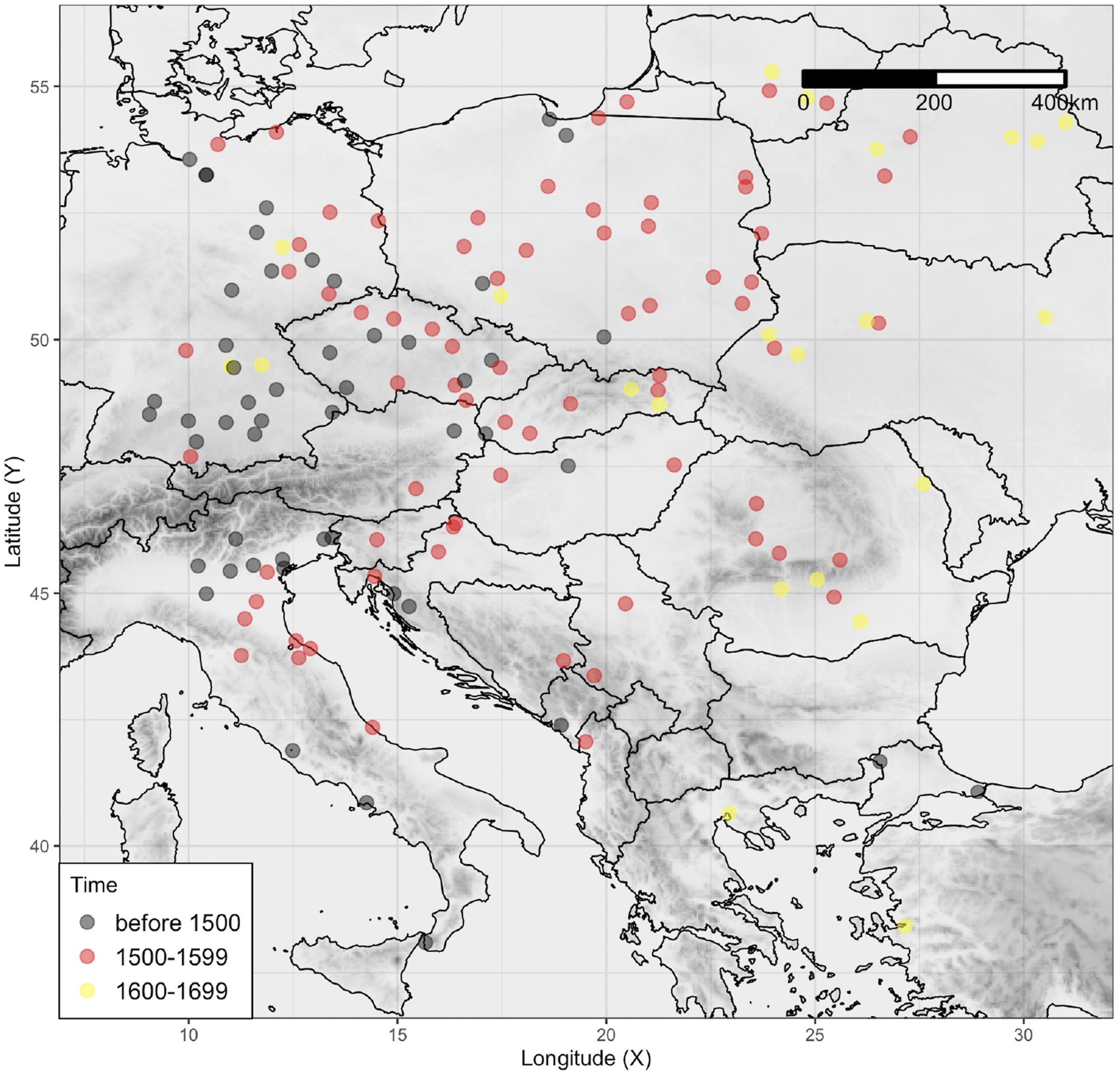
All these accounts point to the hypothesis that the delayed accumulation of human capital in the empire was one of the reasons for subsequent development outcomes. The hypothesis can be tested using historical and contemporary indicators of human capital accumulation at the individual and aggregate level, along with several alternative mechanisms.
Results on Development Outcomes
To obtain a sub-national measure of exposure to imperial rule, we assembled a novel historical GIS dataset tracing the spatial reach of all relevant empires and states in the period 1322–1918 across Eastern Europe (see section 2 in the supplemental appendix for sources). To our knowledge, this is the first dataset recording every boundary change in the region throughout this period. This approach is much more fine-grained than the country averages proposed by Dimitrova-Grajzl (2007) or the region averages employed by Grosjean (2011a) based on Nüssli (2002), which only reveal border changes at the turn of century. The models we present are estimated on a sample of 465 NUTS-3 regions in the 14 European countries which have a history of Ottoman conquest (see section 2 in the supplemental appendix) and also have NUTS-level data available. Eleven of the 14 countries have had enough exposure to the Ottoman treatment to matter significantly for the results—they are Albania, Bulgaria, Cyprus, Greece, Croatia, Hungary, Montenegro, Macedonia, Romania, Serbia, and Slovakia. Additionally, regions in Italy, Spain, and Poland have had some exposure to Ottoman conquest and are included, but the amount of variation in this exposure is too small to make a meaningful difference to the results.
Main Independent Variable
The main independent variable, measuring the intensity of exposure to imperial influence is calculated for each NUTS-3 region as the proportion between the total number of years in the Ottoman Empire and the total number of years of observation for the entire dataset. We code a NUTS-3 region as being part of the empire in any given year if more than 50% of its territory was in the empire. This imperial rule variable shows significant within-country variation, emphasizing the point that exposure was often a regional rather than modern-day national experience. For example, this proportion varies between 0.01 and 0.23 (1 and 137 years) in Hungary, or between 0.10 and 0.79 (60 and 471 years) in Romania. 7 In the full sample, the mean level for the proportion Ottoman variable is 0.24 (SD = 0.33), but in the 11 countries in which there is enough variation to contribute to the results meaningfully, the mean is 0.49 (SD = 0.31). To investigate whether the timing of conquest matters, we also calculated for each NUTS-3 region the average year when it was part of the empire.
Dependent Variables
Our main outcome of interest is economic development, measured as the regional GDP/capita in 2016 in Euros. This variable shows significant within-country variation—for example, between 9,862 and 32,032 Euros in Greece, or between 4,952 and 23,616 Euros in Hungary. We also use the number of firms per capita and the number of firms of appreciable size (more than 10 employees) per capita, as indicators for private sector development. Additionally, we use European trade mark applications per capita as indicators of output-relevant human capital. All these variables are measured at the NUTS-3 level.
Controls
We employ a series of controls to provide convincing causal estimates for the relationship of interest. Our identification strategy relies, among other considerations, on adjusting for the uneven potential for development of the regions due to natural factors and geographic location. The first two geographical controls are the average yearly temperature and precipitation (Centre for Environmental Data Analysis, 2021). The impact of rainfall on the potential for development should be obvious, and several regions in the Balkans do have unusually low precipitation levels. The effect of mountainous terrain on the potential for conflict and under-development is also well known. We therefore include controls for elevation and terrain slope. To further control for how geographic location could matter for development, we include the coordinates for the NUTS-3 region centroids on the right-hand side.
Land productivity has been shown to be conducive to economic development (Galor & Özak, 2016). To eliminate the possibility that differences in agricultural potential might be driving differences in development, we control for suitability of land for the cultivation of wheat. This is the crop that was used historically for animal feed and human consumption in Eastern Europe. We created NUTS-level measures of agro-climatically attainable yield for rain-fed wheat from FAO-GAEZ and include them among the controls. To control for ease of participation in trade, we also included controls for the distance between the centroid of the region and large rivers, as well as distance from the sea.
Another important component of our identification strategy is accounting for historical differences in development at the beginning of the Ottoman conquest. While the outcome variable of GDP/capita would have been uniformly very low by modern standards (see, for example, the rough estimates in Maddison (2009)), there might still have been some differences in exposure to commercial activity that we need to account for. We use the density of trade routes across given regions in the incipient stage of Ottoman expansion in Europe, by geo-coding the data from Magocsi (2002, p. 11). We calculated historical trade route density at a NUTS-3 region level and included it as a control but also as a predictor for Ottoman conquest.
The basic model being estimated is

We considered the possibility that our results might be affected by spatial autocorrelation in the residuals, as suggested by Kelly (2019). Following the method used by Dray et al. (2006) and Rozenas et al. (2018), we first conduct Moran’s I tests for spatial autocorrelation and then we include Moran eigenvectors and synthetic covariates capturing residual autocorrelation on the right-hand side. The results presented in the body are substantively unaffected by their inclusion (see section 3 in the supplemental appendix). To further mitigate the existence of spatial patterns within our data, we always include latitude and longitude on the right-hand side, use fixed effects to examine within-country variation, and cluster the standard error at the country level, which allows for arbitrary correlation of the residuals within a country. In section 9 of the supplemental appendix, we also include a variable that captures distance from Istanbul and distance from Vienna, which leaves the main effects of interest unaffected, and Conley (1999) standard errors (see section 3 in the supplemental appendix), with the same result.
Results
Ottoman exposure and development outcomes.
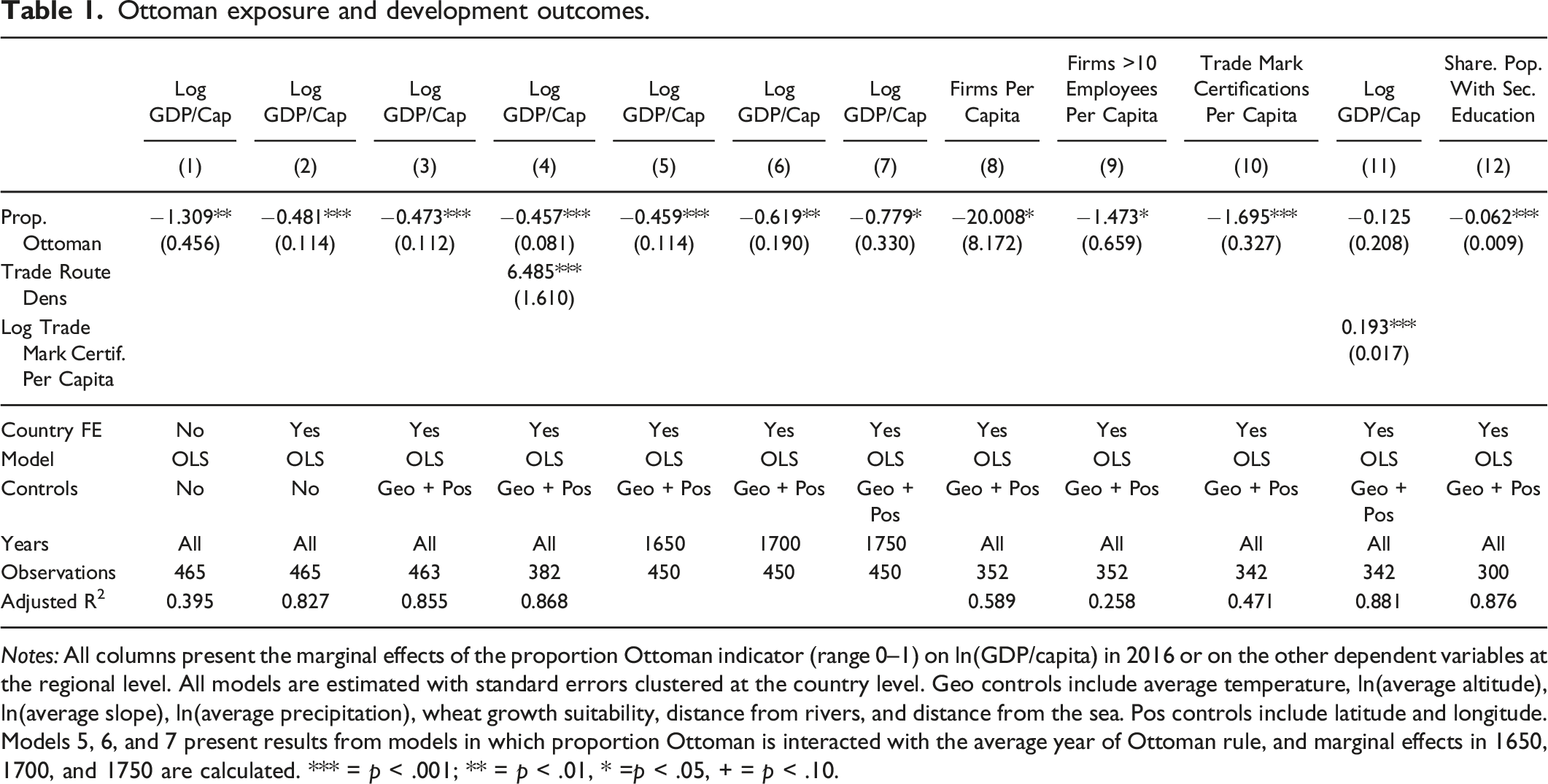
Notes: All columns present the marginal effects of the proportion Ottoman indicator (range 0–1) on ln(GDP/capita) in 2016 or on the other dependent variables at the regional level. All models are estimated with standard errors clustered at the country level. Geo controls include average temperature, ln(average altitude), ln(average slope), ln(average precipitation), wheat growth suitability, distance from rivers, and distance from the sea. Pos controls include latitude and longitude. Models 5, 6, and 7 present results from models in which proportion Ottoman is interacted with the average year of Ottoman rule, and marginal effects in 1650, 1700, and 1750 are calculated. *** = p < .001; ** = p < .01, * =p < .05, + = p < .10.
Model 3 introduces the full set of geographical and position controls, and again shows that Ottoman rule has a negative effect of similar magnitude on modern economic development. Model 4 introduces the control for the density of trade routes in 1450 (note the smaller sample size in this model). As expected, regions with historically dense trade route networks have higher contemporary GDP/capita. Historical trade route density is however unrelated to Ottoman conquests (p-value of 0.20 in a bivariate regression) and controlling for it has no effect on the relationship between Ottoman exposure and contemporary development.
Models 5 to 7 of Table 1 present results in which the Prop. Ottoman variable is interacted with the year of exposure to Ottoman governance. For each model, “year” refers to the average year of exposure in which the marginal effect is calculated. The results indicate that, as the average year of exposure moves from 1650 to 1750, representing the 10th and the 99th percentile of the sample, the marginal effect of exposure increases, which is what would be expected if the effects of exposure were genuine.
To further check the robustness of our findings, we use two other measures of private sector economic development available at the regional data—the number of firms per 100,000 inhabitants and the number of firms with more than 10 employees. We use these (logged) measures as dependent variables in models 8 and 9 in Table 1. 8 The results, using the same set of controls, suggest a pattern of reduced private sector development in regions with substantial Ottoman exposure.
Mechanisms

Ottoman exposure and educational outcomes.
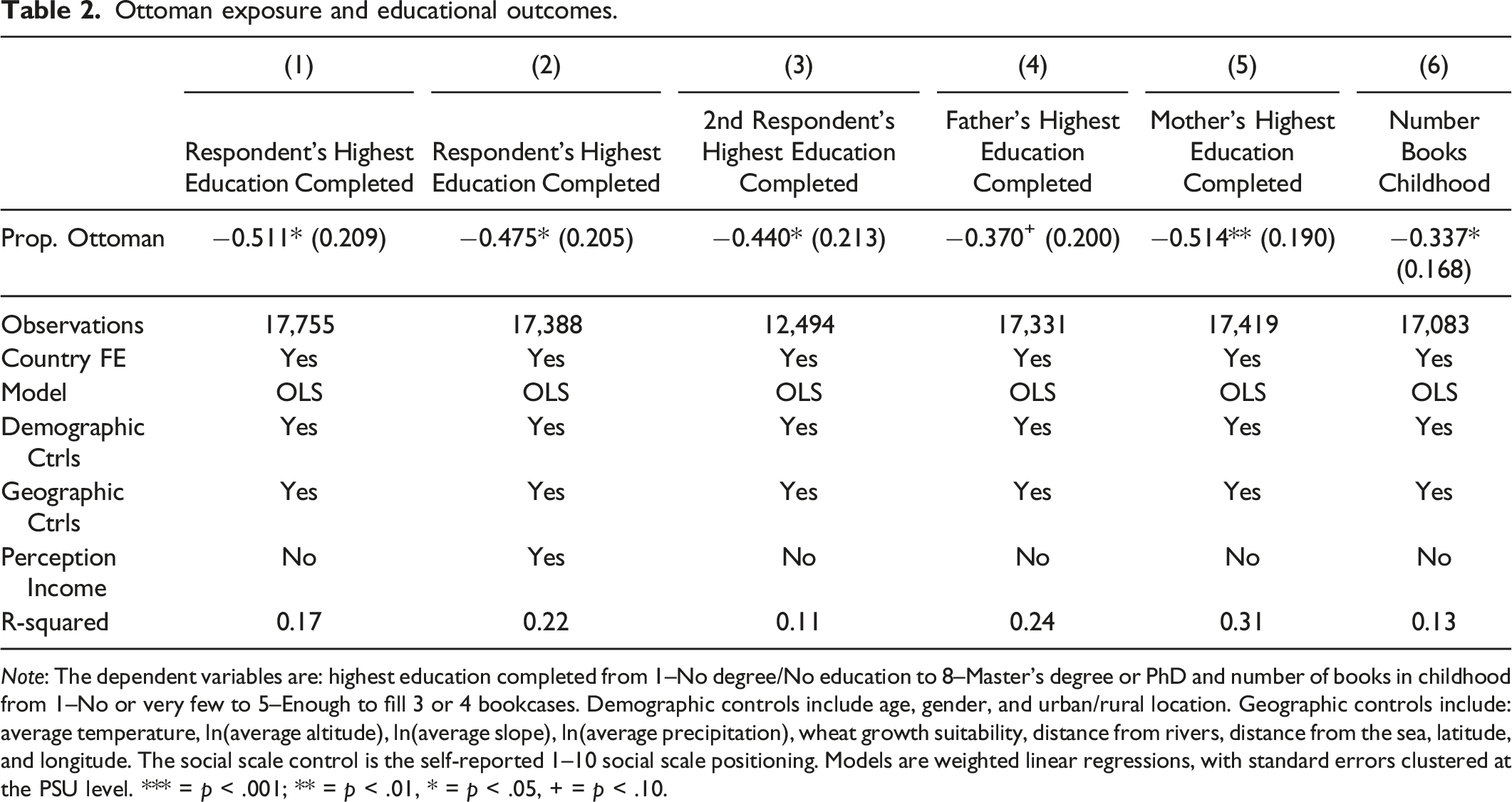
Note: The dependent variables are: highest education completed from 1–No degree/No education to 8–Master’s degree or PhD and number of books in childhood from 1–No or very few to 5–Enough to fill 3 or 4 bookcases. Demographic controls include age, gender, and urban/rural location. Geographic controls include: average temperature, ln(average altitude), ln(average slope), ln(average precipitation), wheat growth suitability, distance from rivers, distance from the sea, latitude, and longitude. The social scale control is the self-reported 1–10 social scale positioning. Models are weighted linear regressions, with standard errors clustered at the PSU level. *** = p < .001; ** = p < .01, * = p < .05, + = p < .10.
Results in Table 2 refer to educational outcomes, conditional on exposure to the Ottoman Empire. Models 1–5 use an eight-point educational achievement scale as a dependent variable, 10 with a mean of 4.13 and standard deviation of 1.71. A half-point variation in the exposure measure predicts an approximately 0.25 lower average on the educational achievement measure in model 1, which includes the full set of controls and country fixed effects. Results are similar for the secondary respondent in the household (model 3) and for the father and mother of the household respondent (models 4 and 5). Finally, model 6 tests the effect of Ottoman exposure on the number of books the respondent says (s)he had in the household while growing up (ordinal variable, mean 2.27, SD = 1.16). Even with the inevitable noise in this variable, a clear negative effect emerges. These results show that Ottoman exposure is predictive of less human capital accumulation, and point to the possibility of it being an important causal channel.
The results for the individual-level data from LITS are also reflected in aggregate educational measures from Eurostat collected in 2001. 11 We repeated the geo-coding process for the 2001 NUTS-3 regions to establish the number of years of Ottoman exposure and constructed an indicator of regional educational achievement, defined as the proportion of the population who achieved secondary or tertiary education. 12 Column 12 in Table 1 shows that Ottoman exposure predicts a negative effect on this educational achievement measure: a half-point increase in the independent variable predicts approximately a 0.03 lower proportion of individuals with secondary education.
To further illustrate the human capital mechanism, we also used the number of European trade mark certifications per 100,000 population at a region level, which capture the extent of novel and creative economic activity, an immediate reflection of higher human capital levels. Model 10 in Table 1 estimates the effect of Ottoman exposure on the (logged) trademarks indicator (mean = 3.96, SD = 1.09). The results indicate a strong negative effect on this measure of human capital. This variable can be shown to mediate the connection between Ottoman exposure and levels of GDP/cap. In model 11, we use it as a control, which breaks the connection between Ottoman rule and the development variable, as we would expect if human capital lies on the causal path between the two.
Ottoman exposure and contemporaneous educational outcomes.
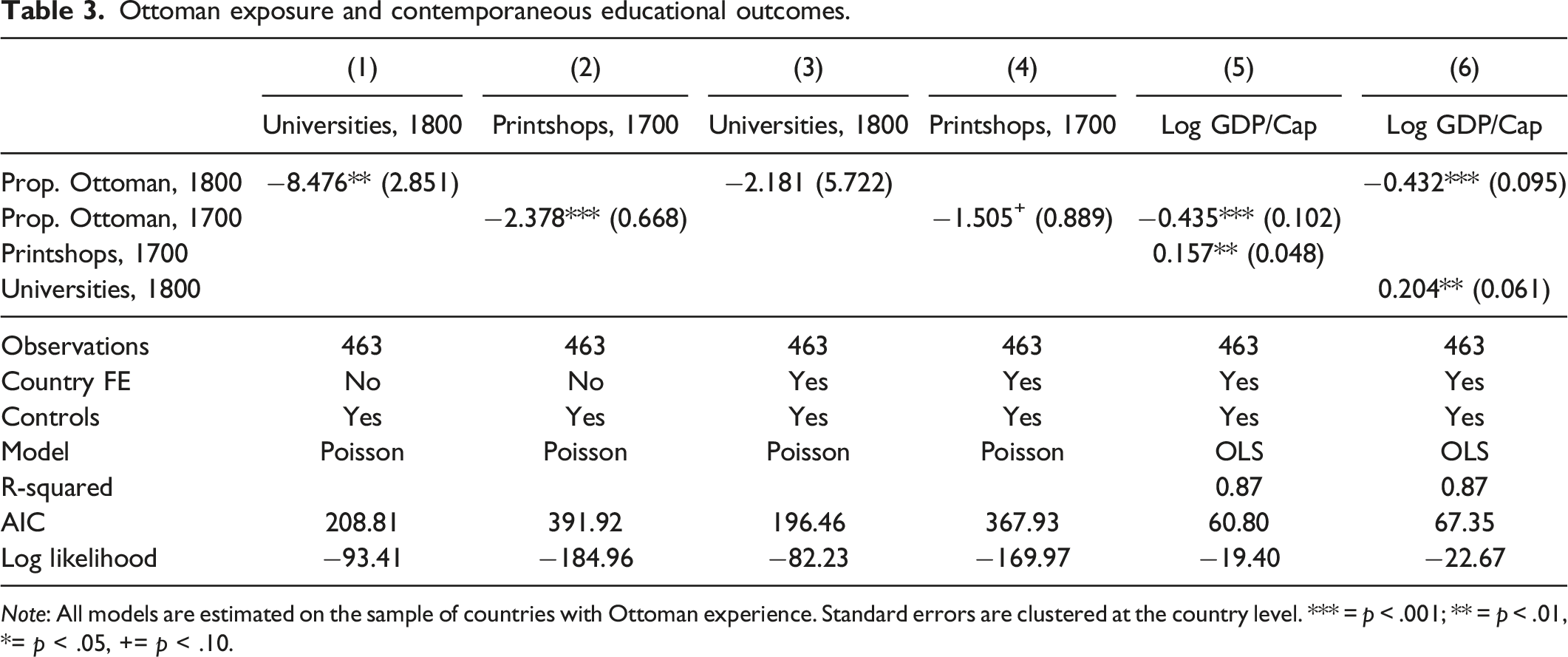
Note: All models are estimated on the sample of countries with Ottoman experience. Standard errors are clustered at the country level. *** = p < .001; ** = p < .01, *= p < .05, += p < .10.
Models 5 and 6 in Table 3 show that these historical measures are strongly predictive of contemporary development outcomes. At the same time, while their inclusion reduces the magnitude of the coefficient on the Ottoman variable from 0.47 (Table 1, model 3) to around 0.43, they cannot explain the entirety of the effect of the Ottoman exposure indicator, which remains a significant predictor. This is likely because the two measures only capture a limited amount of variation in human capital—the vast majority of NUTS regions do not feature a university or a printing press in our data. These results, however, do lend further support to the claim that Ottoman exposure did affect contemporaneous outcomes that were relevant for human capital accumulation, which will be pursued in more detail using the Romanian data in the section Regression Discontinuity Estimates from Romania.
Alternative Mechanisms
If the hypothesis that Ottoman institutions were inimical to economic development (Lewis, 1958; Pamuk, 2001) is to be accepted, then it is worth testing the extent to which modern-day institutions still reflect an Ottoman heritage. Dimitrova-Grajzl (2007), for example argues that Ottoman exposure affected country-level institutional quality. The decline in institutional quality is also discussed in the historiographical literature, according to which the 18th and 19th centuries were characterized by methods of elite recruitment and promotion which resulted in principal-agent problems where the population at the bottom of the social hierarchy was exploited and over-taxed (Lewis, 1958; İnalcık, 1973; Pamuk, 2001).
Ottoman Exposure and corruption perception outcomes.
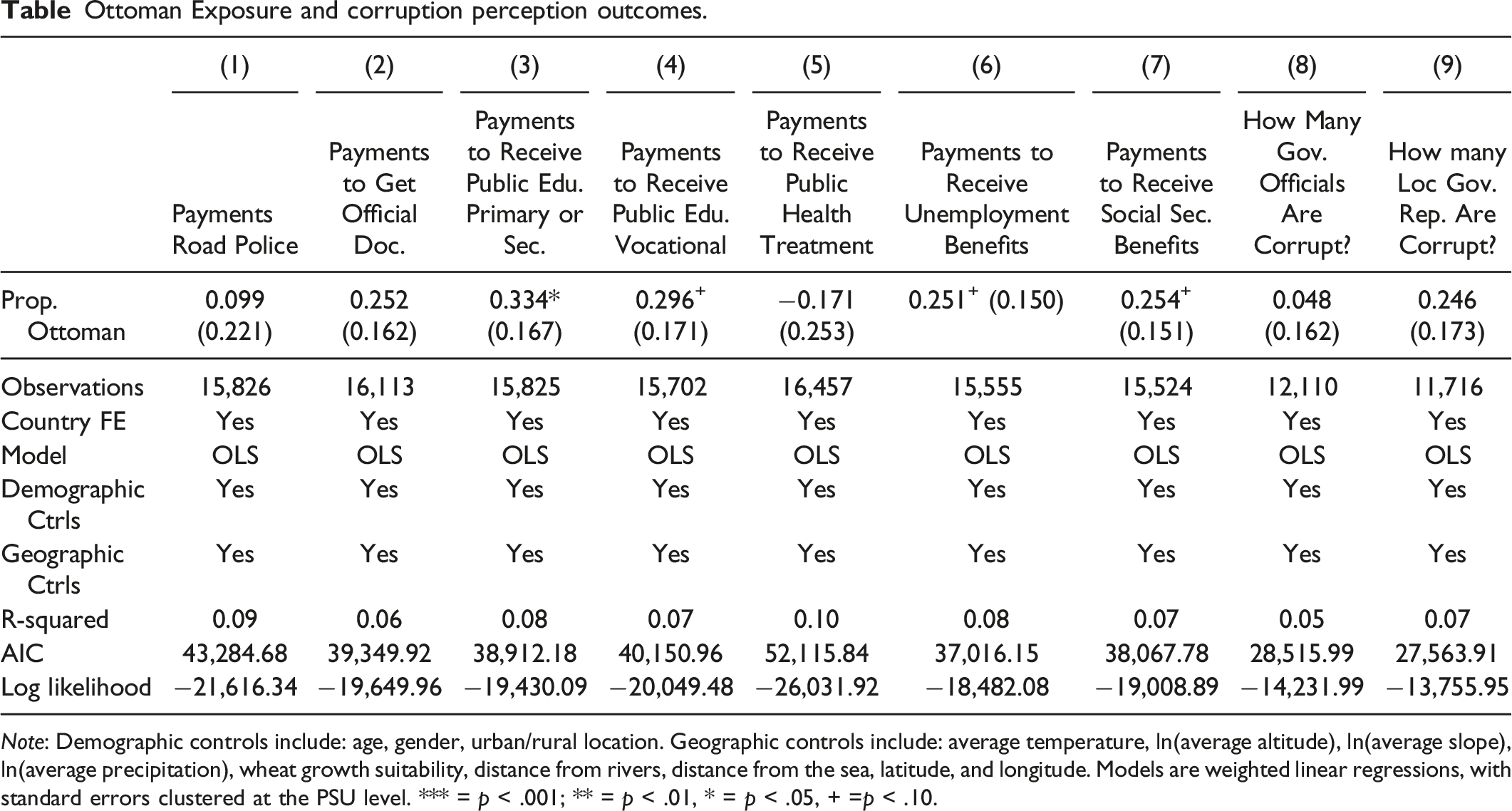
Note: Demographic controls include: age, gender, urban/rural location. Geographic controls include: average temperature, ln(average altitude), ln(average slope), ln(average precipitation), wheat growth suitability, distance from rivers, distance from the sea, latitude, and longitude. Models are weighted linear regressions, with standard errors clustered at the PSU level. *** = p < .001; ** = p < .01, * = p < .05, + =p < .10.
Ottoman exposure and cultural and attitudinal outcomes.
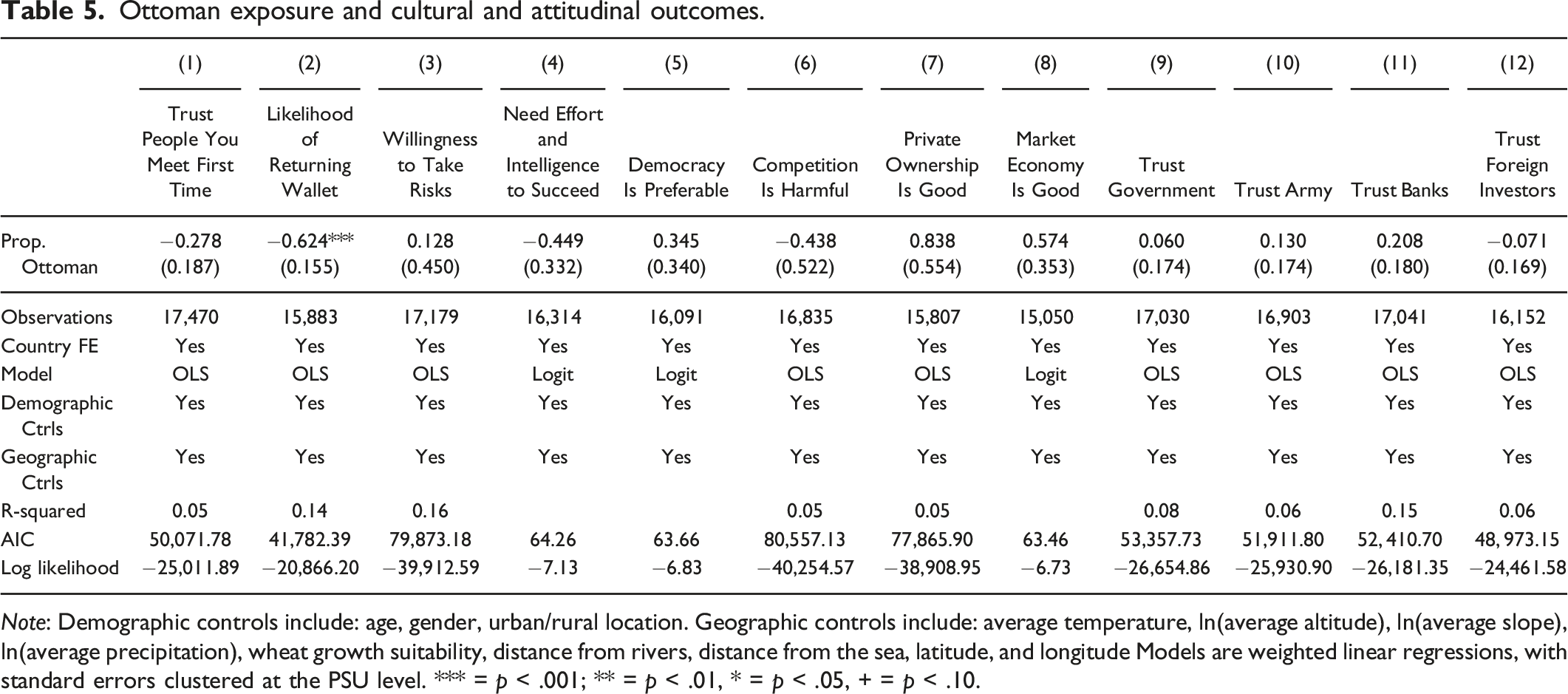
Note: Demographic controls include: age, gender, urban/rural location. Geographic controls include: average temperature, ln(average altitude), ln(average slope), ln(average precipitation), wheat growth suitability, distance from rivers, distance from the sea, latitude, and longitude Models are weighted linear regressions, with standard errors clustered at the PSU level. *** = p < .001; ** = p < .01, * = p < .05, + = p < .10.
A second alternative mechanism is the transmission of attitudes and norms. This is relevant as governance practices in the empire might have led to “a social life of fragmentation and isolation, and a culture of distrust” (Putnam et al., 1993, p. 136), which would again be a plausible mechanism for the transmission of long-run effects. Table 5 presents results on cultural and social capital variables, as well as on institutional trust variables. Only one out of eight indicators, capturing honesty, is negatively associated with Ottoman exposure. There is no systematic effect on interpersonal trust, risk acceptance, or perceptions on the importance of effort versus luck. Ottoman exposure is not connected to a higher preference for democracy, a higher preference for economic competition, or more support for a market economy (and the coefficients, while non-significant, point in the opposite direction of the anti-development hypothesis). The results on institutional satisfaction and trust in the last four models also do not indicate clear systematic effects of Ottoman exposure on trust in formal political institutions, casting doubt on an institutional trust causal channel.
Overall therefore, these survey results suggest strong support for the human capital mechanism, weak support for an institutional quality channel, and no reliable support for a cultural-attitudinal channel.
Regression Discontinuity Estimates from Romania
To further explore the evidence for the human capital channel, we also utilize a geographic regression discontinuity framework (GRD), in which we compare Ottoman to non-Ottoman regions in Romania. This exercise seeks to identify the relative effect of Ottoman rule on historical educational outcomes, against a counterfactual of Hungarian and later Habsburg rule in the non-Ottoman territory. The average treatment effects uncovered here are specific to this comparison, but given the wide reach of the Habsburg Empire in Eastern Europe, they cannot be seen as marginal or unrepresentative. The GRD approach trades off some of the external validity of the full sample models for increased internal validity of the causal estimates.
A number of studies have used GRD designs to examine the effect of history on the present: specifically, legacies of colonial institutions (Guardado, 2018; Lee & Schultz, 2012) or historical state-building and state capacity (Becker et al., 2016; Ferwada & Miller, 2014; Mattingly, 2017; Vogler, 2019). As already shown in Figure 1, the entire territory of Romania was part of the Ottoman Empire at some point, with Transylvania receiving however a reduced exposure. Therefore, any results deriving from the discontinuity framework are attenuated downward. Transylvania was part of the Habsburg Empire between 1711 and 1918, while the southern and eastern part of the Romania were Ottoman dependencies between 1462 (Wallachia)/1473 (Moldavia) and 1867, when they became independent. Figure 4 displays the territory controlled by the Habsburg and the Ottoman Empires—the regions that we compare in the analysis. The Ottoman and Habsburg Empires and modern-day Romania.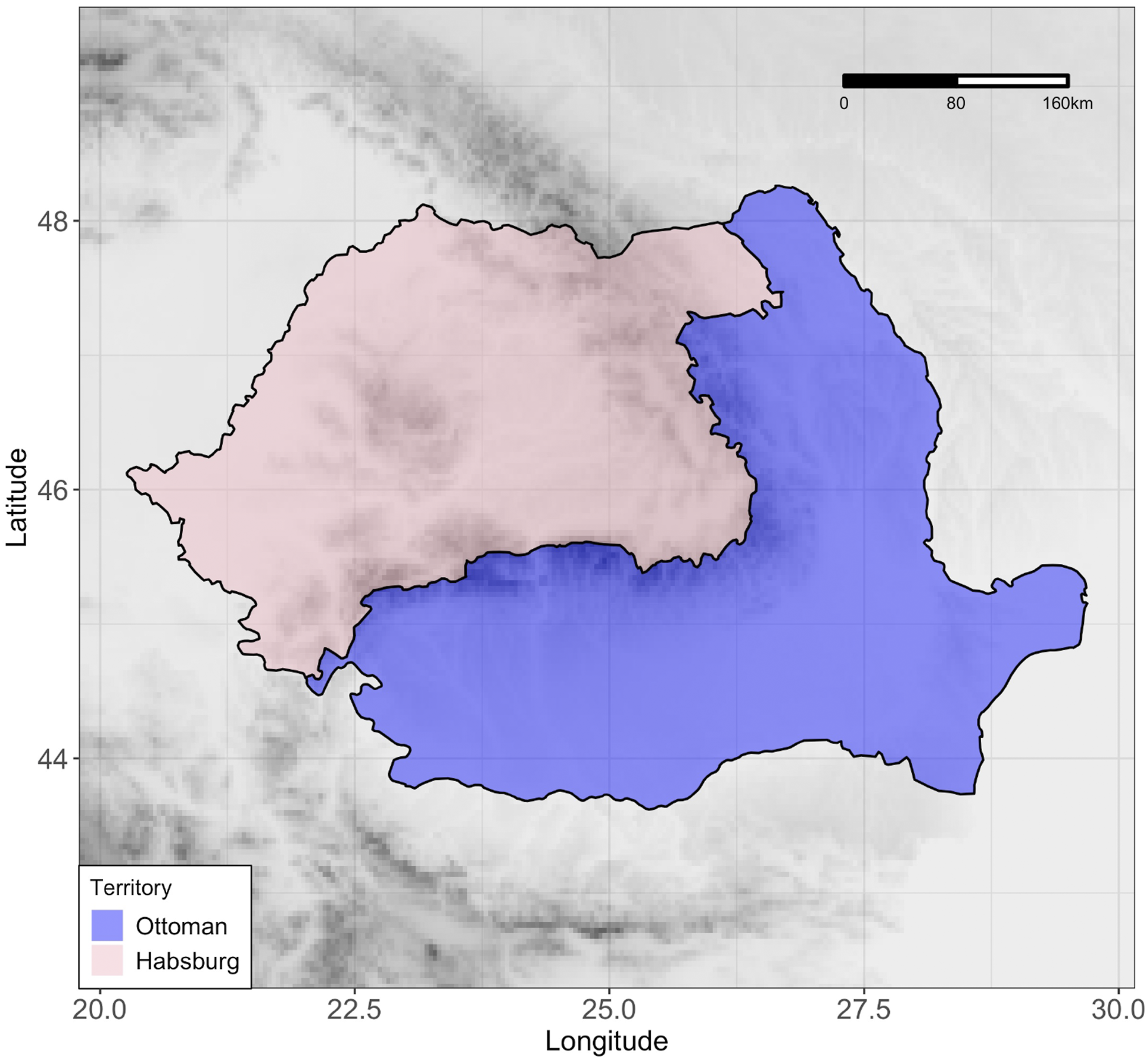
GRD assumptions and formal tests
The quasi-randomness of the border placement is crucial in order for a GRD design to be valid. We argue that the border placement primarily reflected military considerations and was not motivated by social, economic, or institutional characteristics of the separated areas. To show that there were no economic differences prior to the placement of the border, we use density of trade routes, based on maps by Magocsi (2002, p. 17). The results in section 5 of the https://journals.sagepub.com/doi/suppl/10.1177/00104140211060283 do not indicate any significant differences between the two areas. This suggests that at least from an economic point of view the borders were placed quasi-randomly and most likely, had a military geo-strategic rationale (Ingrao, 2000; Hochedlinger, 2003). A few other studies support the notion of the quasi-randomness of the border (Becker et al., 2016; Vogler, 2019).
The second key identifying assumption for a GRD is that relevant factors besides treatment vary smoothly at the boundary (Keele & Titiunik, 2015, p. 130). This assumption is needed for observations located just across the Habsburg side of the boundary to be appropriate counterfactuals for observations located just across the Ottoman part. In section 5 of the supplemental appendix, we formally test for differences in elevation, slope, annual average precipitation, annual average temperature, wheat suitability, and distance to the sea and to large rivers using the main specification. On average, these geographic factors are balanced with some slight differences in precipitation below 40 km, temperature after 90 km, and distance to the sea after 85 km.
An additional assumption is no selective sorting across the treatment threshold. This would be violated if different types of people moved from the Ottoman side into the Habsburg side (into Transylvania), leading to a larger indirect effect on literacy. Results based on the percentage of migrants in 1930 render little plausibility to such a possibility (see section 5 of the supplemental appendix). An important consideration is whether ethnically, the populations on the two sides are comparable. The results presented in section 5 suggest that there is a slight imbalance in ethnicity, with the Habsburg side having more Hungarians, more Germans, and fewer Romanians. We deal with this imbalance by using genetic matching and covariate balancing propensity score matching (CBPS).
The boundary between the Ottoman and Habsburg regions forms a multi-dimensional discontinuity in longitude-latitude space, and regressions take the form

We evaluate the effect of the Ottoman Empire on educational outcomes in 1880, 1910, 1930, 1948, 1977, and in the supplemental appendix, in 1992 and 2002. For that purpose, we digitized historical census data from Transylvania (which was part of Austria–Hungary until 1918), as well as from Wallachia and Moldova (which were Ottoman satellite sates until 1867, and then formed Romania). The unit of analysis varies for the different years. 15
We present results for four different specifications in Figure 5: (1) simple dummy indicator for Ottoman rule (first row); (2) dummy indicator, geographic coordinates of district centroids, and border fixed effects (second row); (3) dummy indicator, distance to the border, and border fixed effects (third row); and (4) dummy indicator, geographic coordinates of district centroids, distance to the border, and border fixed effects (fourth row). The samples analyzed consist of districts whose centroids are between 30 km and 120 km from the Ottoman–Habsburg border in sequential increments of 1 km. The thick lines in each figure indicate the difference in estimates for a given bandwidth using 95% confidence intervals while the thin lines indicate 90% confidence intervals. In interpreting the results, a strict focus on districts within a very tight bandwidth of the Ottoman–Habsburg border has the limitation that the precision of the estimates is lower given small sample sizes.
16
On the other hand, as one moves very far away from the Ottoman–Habsburg border, districts may start to differ from one another for unobserved reasons. The estimates are therefore perhaps most convincing in a middle-range bandwidth from the boundary cutoff. The optimal bandwidth indicated by the Imbens and Kalyanaraman (2012) ranges from 107 km for the 1880 census and goes up to 193 km for the 1930 census. The effect of the treatment at the optimal bandwidth is marked in the bottom-right corner of every graph and it varies from −10 to −15 percentage points difference in literacy rates. Percentage literate.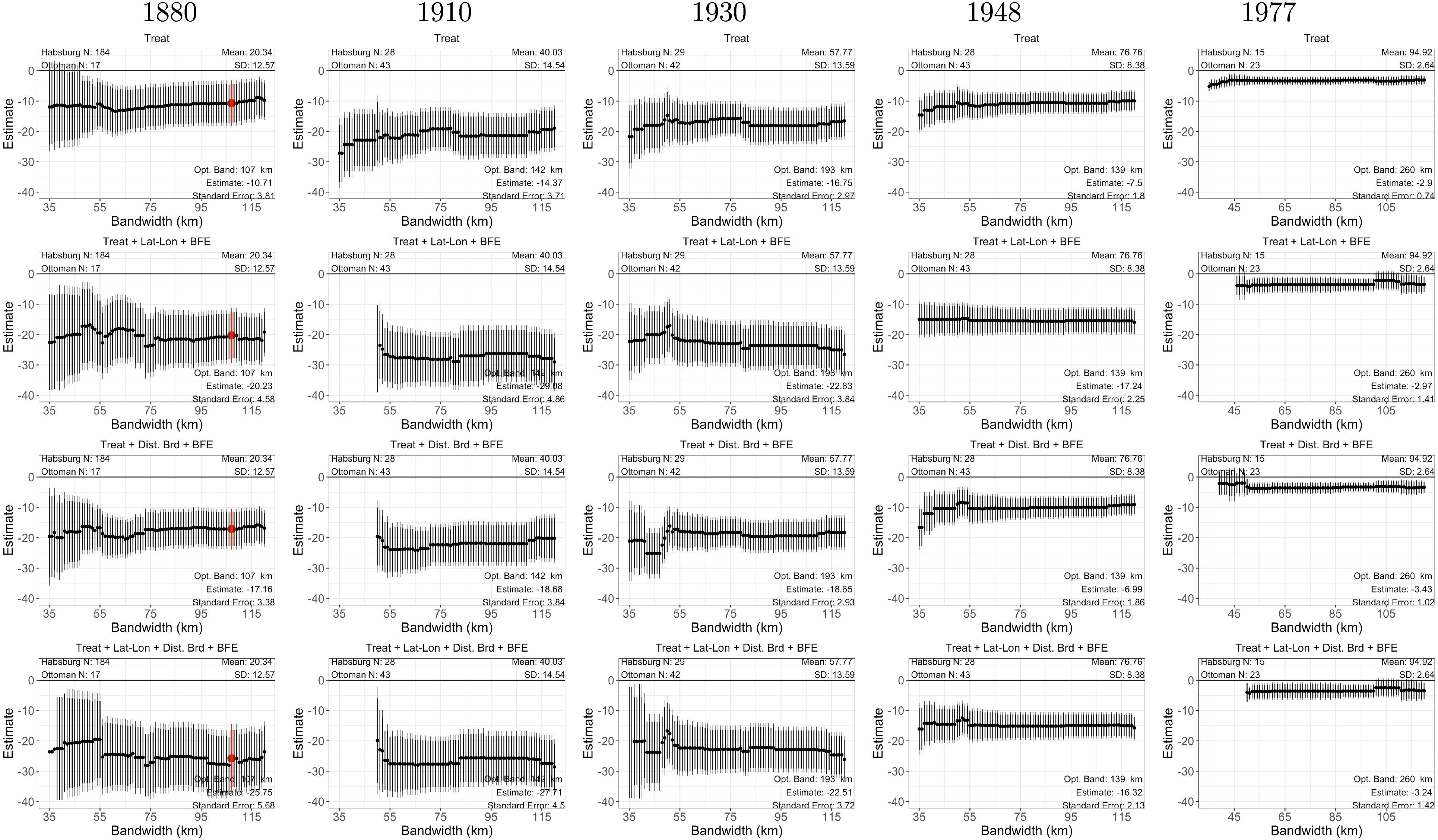
The results in Figure 5 indicate a difference of about 20 percentage points in literacy rates between the Ottoman side and the Habsburg side that reduces over time. The average literacy in the Transylvanian municipalities was 17%, 34.12%, 67.47%, 81.12%, and 96.67% in 1880, 1910, 1930, 1948, and 1977, and 11.5%, 34.13%, 51.45%, 73.24%, and 93.78% in the Ottoman provinces, respectively, in the same years.
An important question given the history of the region is the role of communism in reducing educational disparities in Romania and elsewhere. One of the key objectives of communist regimes was improving access to education, together with using it to promote communist ideology and to erase inequalities between the former bourgeoisie and the peasant and working classes (Doboş, 2000). Policies to reverse regional inequalities are however notably absent from the objectives of important legislation such as Decree no. 145 of 1948 or the education legislation in 1978. We discuss the policies adopted by the communist government in greater detail in section 6 of the supplemental appendix.
These educational policies improved national-level literacy figures over time, but did not eliminate regional disparities. At the start of communism in 1948, the difference in literacy rates between the two regions was about 15%. To evaluate the evolution of these disparities during communism, we collected census data from IPUMS (2021). In 1977, even if average literacy rates reached almost 95%, the difference in literacy rates between Ottoman and non-Ottoman regions was still 4%, as indicated by the fifth column in Figure 5 (note that because of the limited number of observations, results are slightly noisy in close proximity to the border). Toward the end of the communist era, literacy in the entire country converged toward 100%, so this basic indicator becomes less useful in identifying differences in human capital accumulation. Results in supplemental Figure A.12 in the supplemental appendix still indicate a statistically significant difference of about 1% between the two regions in 1992, which disappears in 2002. Differences however are still visible in educational attainment at particular levels: the percentage of people with less than primary school education 17 is about 10% higher in 1992 and about 5% higher in 2002 in the Ottoman regions.
The fact that communism did not manage to completely eliminate regional inequalities in the full sample or in Romania taken separately is also apparent in the 2001 Eurostat education data, which is collected 11 years after the end of the communist era. Model 12 in Table 1 shows that significant differences still persisted between regions with more or less Ottoman exposure in the full sample. A bivariate regression indicates that the proportion Ottoman indicator behaves similarly in the Romanian sample (coefficient = −0.05, p-value = 0.01). Overall, the results from both the Romanian and the full sample suggest that while communism may have been successful in increasing the general level of education, it was unable to erase pre-existing regional inequalities. One reason may be the lack of policies targeting these inequalities. The fact that educational differences are observable throughout the communist era, as well as in the 2001 suggests that they are not a result of the post-1990 transition period, and thus, we can connect the contemporary results to historical developments with increased confidence.
To address the potential weaknesses of having fewer observations closer to the border and the imbalance in ethnicity, we utilize the genetic matching procedure proposed by Diamond and Sekhon (2013) and CBPS matching, proposed by Imai and Ratkovic (2014). Genetic matching isolates two groups of observations that have a comparable distribution of covariates, but that differ in terms of the treatment. By doing so, it effectively addresses the possibility of between-group imbalances in secondary characteristics (covariates). Similarly, CBPS models treatment assignment while optimizing the covariate balance. It exploits the dual characteristics of the propensity score as a covariate balancing score and the conditional probability of treatment assignment. The covariates that we use in order to achieve balance are the ones that were slightly unbalanced in the covariate balance analysis: average annual temperature, precipitation, proximity to the sea, percent Hungarians, Romanians, and Germans in 1930. 18 As a final check, we also restrict the sample to districts that have fewer than 5% Hungarians and fewer than 2% Germans.
RD effect on 1930 literacy.
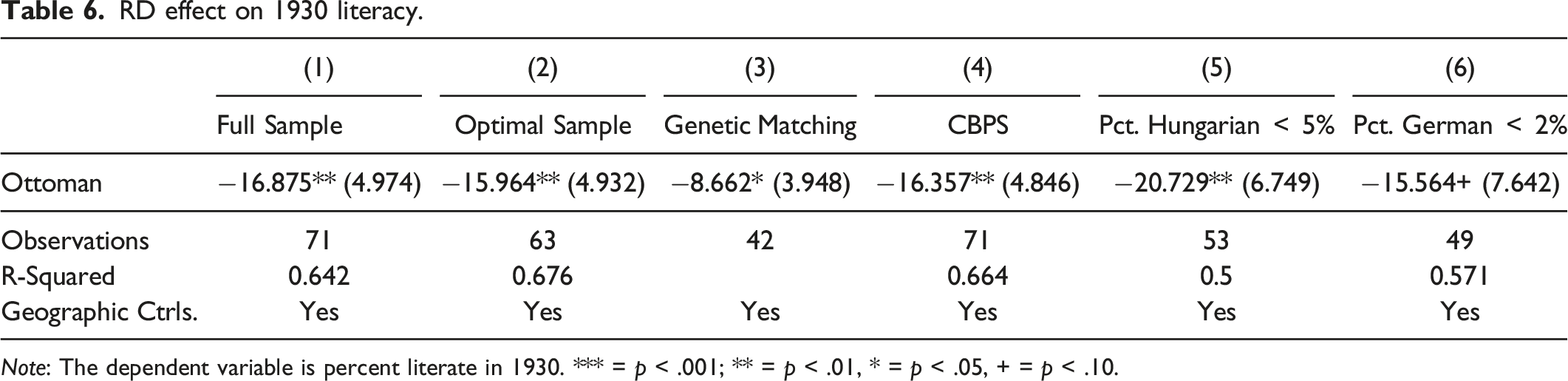
Note: The dependent variable is percent literate in 1930. *** = p < .001; ** = p < .01, * = p < .05, + = p < .10.
In order to provide further evidence for whether the results can be interpreted as a genuine effect of the Ottoman rule as opposed to a continuous difference in the North-South dimension or in remoteness from Istanbul/Vienna, we create “placebo” borders at 10-km intervals from the actual Ottoman–Habsburg border and then re-estimated the local linear regression tests. This approach is similar to that used by Lee and Schultz (2012). It is meant to ascertain if running any line that has the same shape as the line that divided the Ottoman from the Habsburg Empire in a north-south direction would generate a similar effect. The results presented in the Placebo Tests section in the supplemental appendix suggest that similar results could only be obtained if one moves the border up or down by 50 km. Note that the height of one county is at the very minimum about 60 km. This re-enforces the idea of the localized nature of the discontinuity in literacy rates in the middle of the country, which coincides with the border between the two empires.
We also investigated the alternative channels discussed in the Mechanisms section (institutional quality, social capital and/or cultural factors) in the context of this GRD exercise. In the absence of historical measures, we examine differences in perceptions about corruption and social trust in the 2016 LITS data. Results in supplemental table A.6 do not indicate any differences between the two regions in the prevalence of seven types of unofficial payments. There is only a significant difference regarding the perception of how many government officials are corrupt, but no difference on the perception of the number of local officials who are corrupt. There are also no clear patterns in terms of social capital and cultural attitudes, as indicated in supplemental table A.7: the extent to which people trust others when they meet them for the first time, the likelihood of having a wallet returned, the willingness to take risk, and so on.
Conclusions
This study makes two contributions to our understanding of the long-run effects of political institutions. First, we showed that the existence of long-run imperial effects, most often identified in the context of sea-based European empires, is matched by similar effects in the case of a land-based empire in Europe. This lends support to the hypothesis that long-run effects from imperial political institutions to current development outcomes do exist in general, rather than being spurious or incidental to particular settings.
Second, we provide evidence for a causal channel related to human capital accumulation for these effects. The support for the human capital channel comes from (1) contemporary survey data on educational achievement and access to learning resources; (2) from contemporary aggregate data on educational achievement and on human capital intensive economic activity; (3) from historical data on universities and the spread of the printing press; and (4) from educational data from Romania over almost a century and a half. By contrast, several alternative channels receive limited or no support.
We argued that a key component of this channel in the Ottoman case was the delay in the widespread adoption of the printing press. The connection between the printing press and mass literacy has already been documented by Eisenstein (1993, 2013), Mokyr (2005), Dittmar (2011), Cagé and Rueda (2016). These accounts and our historical evidence point toward the printing press being a necessary but not sufficient condition for the development of mass literacy. When combined with the limited investment in the provision of mass education, the late adoption of the printing press helps explain the lower level of human capital accumulation in the empire.
Our findings indicate that human capital may play an important role in explaining the long-run effects of political institutions in other settings as well, thus tackling one of the key challenges to the argument for such effects. While the evidence we provide is strongly supportive of an important role for human capital as a transmission mechanism, there is still substantial progress to be made in understanding the interactions between this mechanism and its alternatives, in the Ottoman case and in others.
Supplemental Material
Supplemental Material - Imperial Rule and Long-Run Development: Evidence on the Role of Human Capital in Ottoman Europe
Supplemental Material for Imperial Rule and Long-Run Development: Evidence on the Role of Human Capital in Ottoman Europe by Bogdan G. Popescu and Mircea Popa in Comparative Political Studies
Footnotes
Acknowledgements
The authors are grateful to Gloria Gennaro, Melissa Lee, Kerim Kavakli, Jan Pierskalla, Shanker Satyanath, and Tamas Vonyo for comments on various iterations of this project. The authors gratefully acknowledge the support of the Dondena Center for Research on Social Dynamics and Public Policy at Bocconi University.

Declaration of Conflicting Interests
The authors declared no potential conflicts of interest with respect to the research, authorship, and/or publication of this article.
Funding
The authors received no financial support for the research, authorship, and/or publication of this article.
Supplemental Material
Supplemental material for this article is available online.
Notes
References
Supplementary Material
Please find the following supplemental material available below.
For Open Access articles published under a Creative Commons License, all supplemental material carries the same license as the article it is associated with.
For non-Open Access articles published, all supplemental material carries a non-exclusive license, and permission requests for re-use of supplemental material or any part of supplemental material shall be sent directly to the copyright owner as specified in the copyright notice associated with the article.
