





Abstract
Historical legacies, particularly imperial tutelage and religion, have featured prominently in recent scholarship on political regime variations in post-communist settings, challenging earlier temporally proximate explanations. The overlap between tutelage, geography, and religion has complicated the uncovering of the spatially uneven effects of the various legacies. The author addresses this challenge by conducting sub-national analysis of religious influences within one imperial domain, Russia. In particular, the paper traces how European settlement in imperial Russia has had a bearing on human development in the imperial periphery. The causal mechanism that the paper proposes to account for this influence is the Western communities’ impact on literacy, which is in turn linked in the analysis to the Western Christian, particularly Protestant, roots, of settler populations. The author makes this case by constructing an original dataset based on sub-national data from the hitherto underutilised first imperial census of 1897.
Introduction
Does religion matter in accounting for spatially uneven patterns of human capital development in Russia? Religion has featured prominently in the debates on the legacy underpinnings of democratic variations in various settings (Bollen & Jackman, 1985; Huntington, 1996; Landes, 1998; Welzel, Inglehart & Klingemann, 2003). However, the substantial overlap between religion and imperial or, in the case of former colonies, colonial, tutelage has complicated the making of sound inferences about the weight of the specifically religious imprint on human capital variations, as opposed to that of the institutional legacies of imperial or colonial tutelage (Fish, 1998). For instance, Christian nations that formed part of the Austro-Hungarian Empire are also largely Protestant or Catholic while those formerly part of the Russian or Ottoman Empires have large Eastern Orthodox and Muslim populations.
One possibility of addressing this dilemma is by conducting sub-national analysis employing the territorial domains of one imperial power as observations. Not only does such an analysis allow to hold imperial tutelage constant, but to also explore the effects of other potentially significant domestic variables in a more systematic way. As a successor to the Russian Empire covering most of its territorial landmass, Russia presents a good laboratory for refining our knowledge of how these respective variables might matter for human capital. However, these a dearth of scholarship on this topic. One apparent reason for this omission is that the predominant “centre-centred” (Snyder, 2001) national-level analyses have forced a Huntingtonian master narrative upon the discipline conceptualising Russia's Christian religious tradition largely in terms of its belongingness to Eastern Orthodoxy (Fish, 1998; Huntington, 1996; Pop-Eleches, 2007; Welzel et al., 2003). As a result, potentially important factors in long-term human capital development have remained understudied.
I address this omission by tracing how European settlement in imperial Russia has had a bearing on human development in the imperial periphery. The key causal mechanism that I propose to account for this long-term influence of Western populations is the settlers’ impact on literacy, which is in turn linked in my analysis to the Western Christian, particularly Protestant, roots, of settler populations. The paper is part of a wider project to study the impact of historical legacies on present-day human capital in territorially large states like India and Russia. Assessing the impact of imperial legacies on post-communist spatial developmental variations is beyond the scope of this paper however uncovering factors influencing human capital variations in the imperial periphery will hopefully constitute building blocks for a more systematic exploration of how these factors may shape present-day spatial developmental variations.
For this study, I constructed an original dataset based on data from the hitherto underutilised first imperial census of 1897. The paper is structured as follows. First, I discuss the literature on historical legacies in formerly communist states and Russian regions. This is followed by an excurse into the history of European settlement and its impacts on human capital development through literacy in Russian provinces. I then present results of statistical analysis. Concluding observations follow.
Theorising legacies
Historical legacies have featured prominently in recent analyses of post-communist developmental variations (Hanson, 1995; Kopstein, 2003; Pop-Eleches, 2007). Legacy approaches have been advocated over those prioritising more temporally proximate causal pathways to markets, development, and democracy because the latter have arguably failed to account for substantial variations in developmental trajectories of Central and East European states. Scholars have critiqued modernisation theories for their failure to explore how industrial growth itself may be linked to historical-cultural contexts (Kitschelt, Mansfedova, Markowski, & Toka, 1999). At the same time, they argued that twentieth century regime legacies of communism, fascism, or authoritarianism could be linked to historically-conditioned forms of institutions and state-society relations that are likely to endure (Hanson, 1995, p. 313; Bunce, 1999, p. 785; Kopstein, 2003).
Recent legacy scholarship has overwhelmingly focused on Central European states however. Thomas Remington is one of the few scholars of Russian regions who have sought to systematically incorporate pre-communist developmental effects into his analysis of Russian regional developmental variations (Remington, 2010). He has employed 1926 literacy figures as a proxy for pre-communist development in his statistical analysis of political and economic regime variations in Russia's regions and found that it positively correlates with both urbanisation and democracy in the 1990s (Remington, 2009). He suggests that the 1926 census figure is in turn reflective of pre-revolutionary social development legacies before industrialisation, collectivisation, and urbanisation drives of the Stalin and post-Stalin periods. The study therefore hints at the potentially important mechanism of past legacies of human capital and literacy in particular however, it stops short of extending the causality further to explore factors which account for variations in pre-communist human capital development.
Two other recent studies, albeit not specifically concerned with Russia, have more closely examined the educational component of pre-communist historical legacies. Schooling features as a key explanatory variable in Peisakhin's study of sub-national democratic orientations in formerly Russian and Hapsburg territories of present-day Ukraine however rather than focussing on the human capital component of the
Likewise, in their cross-national study of post-communist regime trajectories Darden and Grzymala-Busse suggest that pre-communist nationalist curriculum content in the more literate imperial peripheries accounts for variations in the willingness of East European nations to dislodge communist parties (Darden & Grzymala-Busse, 2006). An intriguing question however is what accounts for such stark variations in levels of schooling and specifically literacy before communism. Neither study systematically addresses this question, though Darden and Grzymala-Busse note the importance of variations in levels of socio-economic development among the least literate nomadic societies in Central Asia and their more literate Slavic counterparts and those in more developed Central European provinces. They therefore fall back on the modernisation argument in locating the roots of literacy in the variable levels of modernisation of imperial peripheries.
Given the well-known cultural differences between Central Asian Muslim or Animist, Slavic-Orthodox, and Western Christian societies, this reference to the stark literacy variations among the above societies begs the question of the extent to which modernisation may be itself a product of cultural factors that may need to be disentangled from other variables. Modernisation may shape political value orientations however culture, largely conditioned by the variable religious traditions, may be also endogenous to modernisation. Indeed, in the Darden and Grzymala-Busse study, among the top pre-communist literacy achievers with the highest share of non-communist party vote—Slovenia, Slovakia, Czech Republic, Hungary, Poland, Western Ukraine, Latvia, Lithuania, Estonia, Georgia, and Armenia—all but the latter two have been historically exposed to the Latin Church or the Protestant tradition.
Scholars from Montesquieu, to Weber, to Putnam, and Huntington have highlighted the importance for democratic development of the denominational nuances governing the relationships among Church and state and affecting citizen value and political authority orientations (Huntington, 1996; Montesquieu, 1949; Putnam, 1993; Weber, Baehr, & Wells, 2002). Likewise, religion has been one of the major paradigms employed in post-communist democratisation studies. According to one school of thought, having a pre-communist tradition of a mediated, ritual-based religion rather than that based on minimal ritual and direct relation to God has arguably put a stamp on political cultural pre-dispositions in various parts of communist and post-communist Europe (Jowitt, 1992). The second key strand of theorising on religion regards the Church as a transmitter of a legal tradition. Thus, states like Poland, Czechoslovakia, and Hungary with a history of association with Roman law through the Latin Church have been juxtaposed to Bulgaria and Romania, with their ties to Byzantium and the Greek Church and comparatively late development of codification of law (Elster, Offe, & Preuss, 1998). These distinct patterns of deference to political authority and rule of law, as Elster et al. argue, may simply have “hibernated” during the communist episode, only to resurface again to “determine the future of post-communist societies” (Elster et al., 1998, p. 36).
These two strands of theorising therefore privilege the attitudinal and the institutional dimensions of a religious tradition. I here propose a complimentary causal mechanism, which focuses on the religious dimension of literacy, specifically on the role of Western Christian tradition in the spread of literacy in Russia's imperial periphery. It is well known that the development of literacy has been central to the Protestant tradition due to the importance of Bible reading in the vernaculars for all believers. Scholars have also demonstrated how Protestant Christianity in turn spurred intense inter-denominational competition and gradual inter-Church convergence in the provision of mass education, as opposed to that available solely to the higher elite or clergy (Bayly, 1989; Berger, 1969; Frykenberg, 2003; Zhuk, 2004). Thus, in contexts where the Protestant Church had become an important provider of schooling for disadvantaged groups, the Catholic Church has also shown a greater willingness to sponsor education as a means to attract or retain adherents (Trejo, 2009; Woodberry, 2004).
By contrast, Eastern Christian traditions, not exposed to conversionary Protestant Christianity, as well as such other religions as Islam, discouraged the development of mass literacy. Many Eastern Christian Churches to the present day continue to rely on such archaic languages as Church Slavonic or Aramaic in liturgy. The Islamic tradition encouraged the development of reading skills for rote memorisation of the Koran, but not writing. Thus, in colonial India, census takers reported problems in distinguishing among literate and illiterate populations because many Indian Muslims could read, but not write (Hutton, 1933). Religious traditions also affected literacy levels by gender: while in the Protestant tradition, both boys and girls were expected to be literate to go through Confirmation, in Islam, women were discouraged from learning, hence the continuing wide gaps in literacy and access to higher education among men and women in traditionally Islamic societies (Fish, 2002).
Assessing the effects of pre-communist literacy on long-term human capital and democratic effects in Russian regions is beyond the scope of this study. However, mapping and explaining spatial variations in pre-communist human capital development will hopefully be a first step in linking imperial-era variations to present-day disparities in Russia's regional development. Yet, how do we begin to uncover the literacy effects of the various religious traditions given the noted overlap among the religious, institutional, social, and economic legacies in post-communist settings (Elster et al., 1998; Fish, 1999; Pop-Eleches, 2007; Welzel et al., 2003)? Over a decade ago Fish thus formulated the methodological challenge of disentangling these various effects: “Cultural traditions and imperial tutelage legacies may hold some promise as explanations,” however “given the overlap between religious tradition, geographical location, and the history of imperial tutelage, it is
Russia could help us more conclusively assess the relative weight of the legacies of religion in human capital development because of the more “random” distribution of an important source of the diffusion of western Christian influence on the imperial periphery, namely 18th-early 20th century European colonies stretching as far East as Siberia. A large share of the populations, roughly two thirds, in these colonies were Protestants, but there were also sizeable communities, close to a quarter of all settlers, belonging to the Catholic faith (Stricker, 1994). The key driving force behind migration were the consequences of religious wars plaguing Europe in the 16th–17th centuries. These largely rural populations in some parts of the Russian periphery formed sizeable populations or enjoyed numerical predominance. The mark that they have left on the socio-economic landscape of hitherto sparsely populated imperial peripheries has been only recently systematically documented in imperial historiography (Cherkazyanova, 1999; Dahlmann, 1996; Eisfeld, 1992; Fleischhauer, 1986; German, 1992; Kabuzan, 2003; Keim, 2006; Long, 1988; Neutatz, 1994; Pleve, 1998; Popkova, 2007; Schippan & Striegnitz, 1992; Shramkova, 2007; Stricker, 1994; Vesnina, 1995; Wiebe, 2007; Zhuk, 2004); political science scholarship of post-communist national and sub-national political and developmental variations has neglected this topic.
While the settlement of these communities was “random” in the sense of a disassociation between empire, geography, and dominant religion, the intentionality of the choice of specific location of settlement within the Russian empire ought to be also considered. In a recent volume on “natural experiments” in history, Diamond and Robinson flagged the methodological challenge of establishing cause and effect in “perturbed” societies experiencing externally-driven or exogenous change (Diamond & Robinson, 2010). “A question invariably arising in any comparative study that compares perturbed societies or sites with nonperturbed ones concerns the perturbers’ ‘selection’ of which particular sites to perturb,” they write (Diamond & Robinson, 2010, p. 262). Thus, European settlers in neo-Europes may have been more driven to “patch selection” in areas already hospitable from climatic or resource point of view; and Napoleonic armies may have well chosen to invade areas in Europe already more developed, which could plausibly account for the better institutional legacies in the invaded areas (Diamond & Robinson, 2010). In the Russian case, we know from historical scholarship on the newly acquired frontier territories that the settlers did not choose where to settle: they were allocated land by imperial fiat in climatically harsh, undeveloped, and otherwise inhospitable areas. In such areas previous attempts at development by encouraging Russian or indigenous animistic or Muslim inhabitants to cultivate land there had not been very successful (Koch, 1977). What makes this analysis interesting is that settler colonies were often adjacent to, or interspersed with, Russian or non-Russian Asian minorities. Statistics on literacy and other development indicators for the various communities allow us to take stock of the effects of these pre-existing conditions. In the next section, I provide an historical overview of the origin and human capital effects of these communities in Russia's imperial peripheries. I then back this discussion with statistical analysis.
European settlement in Russia and its impact on literacy
European mini-colonies had long been a feature of urban life in Russia however until the mid-18th century they had been largely limited to the north-West and West reaches of the Empire. On the imperial frontier mass European settlement, particularly from Germanic lands, occurred by imperial fiat in the mid-18th century at the invitation of Catherine the Great, a German Princess. It continued in subsequent waves of colonisation until the early 20th century. By the time of the Russian Revolution in 1917, there were some 10,000 settlements in fifty-three regions, and their population exceeded 3.5 million (Zhuk, 2004). On Russia's present-day territory, the first settlements appeared in the 1760s on the Middle Volga; by the time of the first imperial 1897 census the settlers constituted 22.48 percent of the region's population (390,864).
While Lutherans formed a sizeable proportion of the German Protestant communities
1
Germans constituted 40 percent of all Protestants in Russia, while the remaining 60 percent were largely composed of Latvians and Estonians (Kappeler, 1994). The deep roots of this movement were evident well into the Soviet period when clandestine Brotherhood prayer meetings persisted as an expression of spiritual independence and strength.
These colonies contributed to the proliferation of what Bunce conceptualises as “multiple peripheries” characteristic of empires that often suffer from weak institutional penetration and internal uniformity (Bunce, 2005). Such peripheries vary not just by predominant ethnicity, religion, and levels of economic development, but also “rights, responsibilities, identities, and institutions” (Bunce, 2005, p. 416). The settlers’ “pragmatic protection” (Zhuk, 2004, p. 41) was at the outset a matter of policy—there was a substantial degree of imperial toleration of settler self-government, freedom of religion, and education. The colonists had the status of peasants, which differed from that of both serfs and state peasants. The colonists had the right to choose their own self-governing authorities on an annual basis, and this right was stipulated in a special charter (Kabuzan, 2003; Neutatz, 1994; Pleve, 1998).
The colonies became known in particular for their institutions of mass schooling, which were highly advanced in the context of the largely illiterate Russian provincial rural settings. On the southern and eastern frontier, as early as the third quarter of the 18th century, it was the European settler who set up the first public schools. Religion was the driving force for the literacy project. The settlers were keen to set up a school with each congregation which was funded publicly by the settlers themselves (Kahle, 1994; Keim, 2006; Koch, 1977). The settlers’ average literacy rates were substantially higher than those of other rural residents. In the early Saratov German colonies, the average male and female literacy rates were 70 and 56 percent, respectively. The Russians’ overall average in Saratov was 25 percent (Shaydurov, 2005). Table 1 presents literacy and religion statistics for the
Literacy and religion in pre-communist regions (
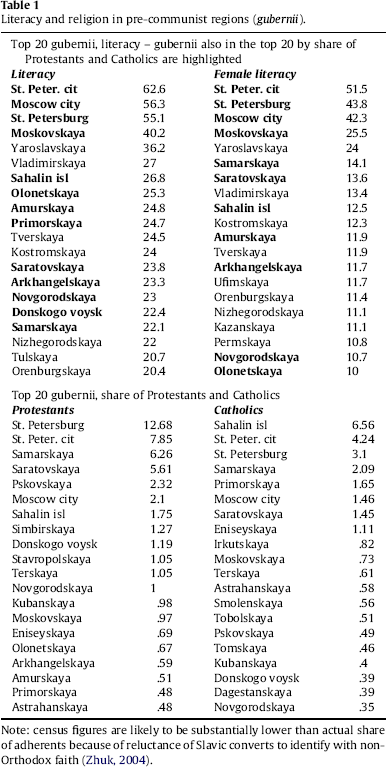
Note: census figures are likely to be substantially lower than actual share of adherents because of reluctance of Slavic converts to identify with non-Orthodox faith (Zhuk, 2004).
Both the Catholic and Protestant communities maintained similar institutions of mass schooling linked to the Church and providing literacy and numeracy skills to boys and girls of pre-Confirmation ages. Some German scholars have documented the poorer quality of Catholic schools as compared to those of Protestants in neighbouring Protestant villages. They attributed these variations however to the Catholics’ reliance on priests from Poland and the Baltic lands, often dispatched to the “wilderness” because of misdemeanours or incompetence. The latter, who usually did not speak fluent German, were less partial to quality instruction in the German villages as compared to German Lutheran or Mennonite priests. A contributing factor to this variation was that generally, the quality of the Lutheran or Reformed clergy tended to be higher than that of Catholics because of the expectation of their deeper involvement in parish affairs (Stricker, 1994). Still, both the Catholic and Protestant schools stood out in the sea of Orthodox illiteracy (Kahle, 1994).
The role of the settlers’ clergy in the maintenance of the school systems found no parallels in Russian villages. The Orthodox Church was not institutionally associated with primary education provision in the same way that it had been in post-Reformation Europe (Kahle, 1994). Unlike in Europe, the Baltic lands, Poland and parts of Ukraine, where the school systems had come to be linked to the Church, the concept of public schooling was unknown in Russia until the 19th century when the government finally decided to set up basic public education (Luchterhandt, 1994). In Europe, the Reformation accorded a special role to the Church in promoting literacy in the vernaculars. By contrast, the Orthodox Church tradition was that of “restricted literacy” whose practical utility was confined to reading the scriptures and religious texts or performing service in Church Slavonic. It is not by chance that the historian Brook's fascinating book
The colonists influenced the spread of literacy among Russians both directly through introducing their Russian labourers to the rudiments of reading and numeracy, and indirectly, through encouraging conversion to Protestant Christianity. Russian labourers preferred the better paying German to Russian employers (Brandenburg, 1974; Brandes, 1994; Neutatz, 1994; Shaydurov, 2005; Zhuk, 2004). Mennonite employers were also known to provide labourers with housing, schools, and places of worship (Brandes, 1994). After the serfs were emancipated, there was greater contact with Russian peasants. Many Russian peasants worked as labourers on German and Dutch farms, and their numbers increased when they migrated to the south and Siberia in search of employment. There are records of conversion to Protestant Christianity as a result of such contact with European households (Nesdoly, 1986; Zhuk, 2004). During the first decades of European settlement, active proselytising among Russian peasants was uncommon. This changed during the mid-19 century Protestant revival, when such conversionary movements as Stundism, Millenarianism, and Separatism germinated in the periphery, often in clandestine settings (Zhuk, 2004). The settlers, more exposed to European religious and intellectual currents, became transmitters of the new teachings to the local populations despite surveillance and obstruction by the authorities (Tuchtenhagen, 1994; Zhuk, 2004). The Mennonites in particular, on grounds of religious conscience flouted the imperial ban on proselytising among Russian Orthodox populations.
3
This explains the staggering growth of Mennonite communities in Russia – by 1914, a fifth, or nearly 100,000, of all Mennonites in the world resided in Russia (Brandenburg, 1974).
The settlers are also associated with the development of more advanced forms of learning. As in the American mid-West, which became host to similar waves of German migration from Europe in the 18–19 centuries (Turner, 1962), German settlers are associated with the establishment and development of superb higher educational institutions (Smirnova, 2006). Saratov, the centre of Volga German colonies, acquired nation-wide reputation as a centre of progressive education on a par with Moscow and St. Petersburg (Popkova, 2007). Settler schooling during the earlier phase of settlement was largely at the primary level, was focused on preparing the children for Confirmation, and was limited to settler pupils. In 1869, the colonists-controlled Kamyshin District
The settlers had been also leaders in girls’ schooling, thereby contributing to the social uplift of women. As late as in 1894, when progressive
Finally, European populations also contributed to the development of schooling through their involvement on the
There remained however substantial regional variations in
The imperial period part of the analysis is based on an author-constructed dataset with data from the first Imperial Census of 1897 (Troynitskiy, 1905). After excluding imperial administrative territories that do not form part of the current territory of the Russian Federation, the dataset for Russia has forty-six observations corresponding to the forty-six
The variable of population share of those residing outside of the region in which they were born (“outsiders”) is also included. This variable enables us to control for the legacies of serfdom in the
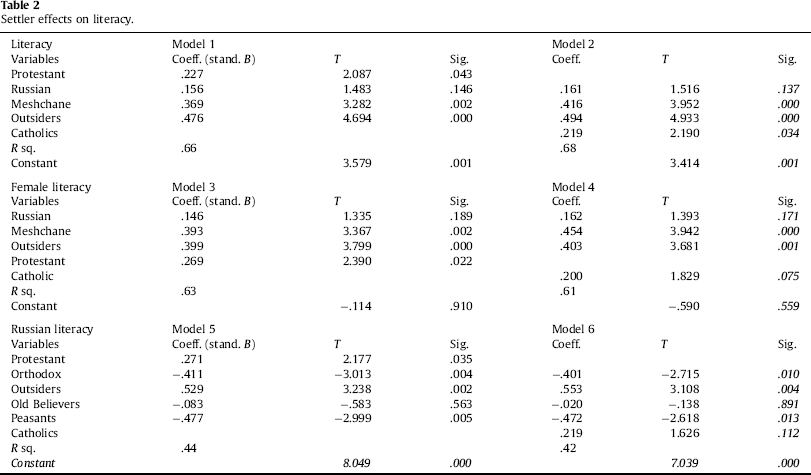
Ordinary Least Square (OLS) regression analysis was conducted testing several models. In Model 1, overall population literacy is postulated to be a function of the agrarian-urban structure, as well as of specifically cultural variables of Protestant and ethnically Russian populations. The variable of population share of those residing outside of the region in which they were born (“outsiders”) is also included. There is a positive and high statistical correlation between share of Protestants and Catholics due to the territorial overlap in the settlement of these mostly European communities. These two variables therefore could not be included at the same time.
The results are presented in Table 2. Model 1 shows that, as expected, Protestants have a positive and statistically significant effect on literacy, as do “outsiders” and
Settler effects on literacy.
Settler effects on literacy.
Next, in Models 5 and 6, I explore the effects of diffusion of literacy from amongst settler populations to ethnic Russians. In this model I also include the variable of Old Believers to ascertain the extent to which literacy was more prevalent among dissident religious Russian communities. Because of the high correlation between
The analysis shows how European settlers in the imperial periphery, while politically marginal, were instrumental in building human capital through mass literacy. Furthermore, rather than being limited to settlers themselves, there was also diffusion of grammar and numeracy as well as more formal schooling to non-European Orthodox Russian and other populations. The settlers were also instrumental in establishing the institutional foundations for the inter-temporal transmission and development of education through their
Contrary to the initial hypothesis about the significance of the Protestant literacy tradition, only slight variations are observed between the Protestant and Catholic imprints on literacy. These results correspond to classic theorising in the sociology of religion and recent empirical findings on the homogenising education effects of inter-denominational competition in post-Reformation Western and non-Western settings experiencing conversionary Protestant Christianity (Berger, 1969; Trejo, 2009; Woodberry, 2004). Protestants are however associated with somewhat higher levels of female literacy and literacy among Russians in this study.
The paucity of religion data complicates the making of assessments about the legacy of European settlement in present-day Russian regions. Because of massive Stalin-era population resettlement, ideally we would want to employ data on religious composition in the regions during the late communist and post-communist periods. These data could be useful for exploring the inter-generational transmission of the values and practice of educational attainment characteristic of settler populations despite the overall sovietised context; our evidence however is limited to anecdotal or case study accounts of communities in specific regions. The last communist census of 1989 did not have a question on religion due to official communist policy. Plans to incorporate a question on religious affiliation into the 2002 census had been abandoned ostensibly because of the separation of Church and state in Russia, but by some accounts due to sustained lobbying by the Russian Orthodox Church (Heleniak, 2006). The Church is concerned about the growing number of Russians converting to Western Christian denominations or more openly associating themselves with the Church of their ancestors, as is apparently the case with those Russian Germans who remain in the country. A study by the Keston Institute has sought to catalogue the history and current practice of the various Christian Churches in Russian regions. One interesting finding of the study is that the Evangelical and Catholic Churches originally established by the German settlers in the Middle Volga and Siberian regions are increasingly attracting ethnic Russian believers from amongst the regional intelligentsias; in fact, the majority of parishes of these Churches are often comprised of ethnic Russians (Burdo & Filatov, 2009). Unfortunately, in what is likely a reflection of the methodological and political challenges of this undertaking in the present-day Russian political context, no systematic data on the numerical strength of the various religious communities had been gathered. Surveys on religious adherence have been conducted by other scholars in isolated regions like Tula, Voronezh, Krasnodar, and Nizhny Novgorod, which revealed that up to 3.5 percent of regional populations belong to non-Orthodox Christian Churches (Lunkin, 2008). According to another survey commissioned by the Presidential Plenipotentiary in the Volga District, Sergey Kirienko, in some regions of the district 15–32 percent of the population identified themselves as adherents of Western Christian Churches.
4
Some scholars have also sought to estimate the regional share of Muslim populations by employing data on ethnicity (Heleniak, 2006).