




Abstract
Economists have long argued that central banks ran by technocrats have greater independence from the government. But in many countries, politically experienced central bankers are at the helm, including even highly independent central banks. To explain the level of central bank independence awarded, we develop a formal model where nominating politicians screen central bankers for their political ambitions. We show how screening and reelection efforts by the nominating politician changes the level of autonomy associated with different types of candidates. We predict that technocrats are associated with higher levels of independence than nominees with political experience, but as the appointing politician faces tougher reelection, candidates with political experience are associated with higher independence as well. We test our theory using new data from 29 post-communist countries between 1990 and 2012. We find evidence that the reelection strategy of the nominating politician is an important predictor of the level of central bank independence.
Introduction
Economists have long argued that central bank independence (CBI) protects citizens from opportunistic governments. They believe that appointing a politically independent, technocratic central banker can shield the economy from expectations driven inflation. Puzzling, however, is that while the level of CBI is increasing globally (Garriga, 2016), we continue to see even highly independent central banks helmed by central bank governors (CBGs) with political experience. What explains the co-occurrence of rising CBI and politically experienced central bankers? What role do the electoral strategies of the appointing politician play in how much policy independence is delegated?
According to the standard delegation story, the government gives up monetary policy autonomy to independent experts with inflation aversion (Barro & Gordon, 1983; Bodea & Higashijima, 2017; Rogoff, 1985) so as to credibly commit to low inflation. 1 Research suggests that delegation works best in democracies (Bearce and Hallerberg, 2011; Bodea and Higashijima, 2017; Broz, 2002). But even in non-democracies, handing over monetary authority to bureaucratic experts, or technocrats, can help save the economy from economic cycles, especially if power is shared with elites through dominant parties (Bodea et al., 2017). With its focus on credibility, previous explanations ignore the possibility that central bankers themselves may have ambitions for elected office and consequently, those individuals appointing central bankers have incentives to screen central bank candidates for their electoral ambitions as well as for their policy preferences. For example, we observe a number of cases where the heads of even highly independent central banks have political careers. In the Czech Republic, the first governor of the newly independent central bank, Josef Tošovský, also served as the country’s prime minister in 1998, subsequently going back to head the central bank until 2000. Later, CBG Jiří Rusnok acted as the country’s prime minister from 2013 to 2014 (Petříček, 2016). Furthermore, at times, central bank appointments to candidates with political backgrounds coincide with increases, not drops, in policy autonomy. For example, in Ukraine in 2010, CBG Volodymyr Stelkmakh was pressured to resign to make way for Serhiy Arbuzov and formal central bank independence rose rather than declined, despite Arbuzov’s political background. Arbuzov had unsuccessfully ran for the Donetsk Regional Council prior to his appointment. After being CBG, Arbuzov went on to have a prominent political career, serving as vice–prime minister and then prime minister (BBC Monitoring: International Reports, 2011; Dpa International, 2010).
We consider how the reelection efforts of the politician with appointment powers to the central bank affects the level of policy independence the central bank has. First, we show how the level of policy independence a politician awards depends on how easy or hard it is for the appointing politician to identify a candidate’s electoral threat level. When the appointer is relatively uncertain about the political ambitions of the CBG, the nominating politician commits resources to deter any politically minded CBG candidates from disguising their political ambitions. Consequentially, candidates whose biography shows no inclination toward holding political office are more likely to be awarded greater levels of independence than those with past political experience. Second, as the appointing politician becomes more electorally insecure, it becomes less efficient for her to commit resources to deterring politically interested CBG candidates, as additional effort spent on screening candidates will not increase her chance of winning the election relative to other reelection tactics. Thus, under these conditions, the nominating politician expends relatively less effort on screening CBG candidates for their political aspirations and consequently awards similar levels of policy independence to candidates irrespective of whether they held political office before or not.
Our mechanism is analogous to traditional labor market screening models. Consider a situation where an employer does not know a job seeker’s true ability and would like to screen out candidates of low ability. The pool of candidates that the prospective employer faces, however, can vary. If the unemployment rate is relatively high, resulting in a wealth of candidates from which to choose, it is efficient for the employer to spend resources on sorting out candidates of low quality. Alternatively, if all job candidates are expected to be of low quality, or the labor market is competitive, it is less efficient for the employer to invest in screening candidates. One consequence is that even low-ability candidates may get higher wages. In parallel, when all CBG candidates are politically ambitious or if the appointing politician is electorally vulnerable, screening no longer “pays,” and even politically ambitious CBG candidates are awarded relatively higher levels of policy autonomy as well.
Our main empirical expectation is that under conditions of electoral competition, CBGs with political experience are awarded higher levels of policy autonomy than the same candidates would be if the nominating politician was more electorally secure. We test our argument using original data from 29 post-communist countries between 1990 and 2012. As noted by Bodea (2013), the post-communist countries not only represent an empirical domain where economic and political changes occurred simultaneously, they also are a setting where political identities and ambitions are particularly opaque. Because of the dominance of the communist party prior to 1989, the “true” ideologies and intentions of individuals can be particularly difficult to parse, making screening especially challenging. As the main dependent variable, we measure monetary policy autonomy in a number of ways, including rules allowing independent policy-making and formal restrictions on lending to the government (Garriga, 2016). We find that when CBGs with political experience are appointed, their central banks can lend to governments more easily and are less policy-independent. However, as elections facing the appointer become more competitive, any gap in policy independence and lending limitations narrows for those governors that have political experience compared to those without. This finding is consistent with our argument that nominating officials can appoint technocrats to deter politically minded CBGs, but their willingness to do so decreases as their own electoral insecurity rises.
Our findings offer an explanation for the puzzle of why we observe both central banks that are highly independent yet are also staffed with politically experienced CBGs. We show that any policy independence penalty that politically experienced CBGs receive on account of their political background attenuates as the nominating politician becomes more electorally vulnerable. Our theory highlights a new mechanism in the politics of CBI, demonstrating how technocratic appointments may be compromised because of the electoral strategies of incumbents. Our theory aligns with a growing literature showing the opportunistic use of bureaucratic institutions by political elites and the prevalence of inter-elite politics, especially in countries transitioning to democracy (Alesina & Tabellini, 2007; Gandhi & Lust-Okar, 2009; Svolik, 2009). We also expand the existing work on technocrats in office (Alexiadou & Gunaydin, 2019; Camerlo & Pérez-Liñán, 2015; McDonnell & Valbruzzi, 2014; Wratil & Pastorella, 2018) and we build on this literature by proposing a dynamic of political competition between a principal and an agent. Finally, we also contribute to growing evidence suggesting that politicians elected in competitive races have to work harder to win support (Malik, 2019; Ward & John, 1999).
The Political Origins of CBI
Previous explanations for CBI usually center on domestic factors, such as policy preferences and partisanship; the role of democracy and democratic institutions; the overcoming of political business cycles (see Alesina et al., 1997; Barro & Gordon, 1983; Bearce & Hallerberg, 2011; Chang, 2003; Kydland & Prescott, 1977); or the role of international organizations, private capital markets, and pressures for reforms by internationally linked epistemic communities (Giesenow & Haan, 2019; Gray, 2009; Johnson, 2016; Maxfield, 1998; Santiso, 2013). Even in non-democracies, Shih (2008), shows how Chinese party cadres are willing to hand over monetary policy to an elite faction that does not want to expand the monetary base and trigger short-term growth, but they do so only when the economy performs poorly. 2
Even if governments prefer to control the money supply, there are economic and political benefits of monetary delegation. Besides reducing expectations-driven inflation, delegation of monetary policy to an autonomous central bank can help stabilize coalitions with diverse policy preferences (Crowe, 2008); restrain deficit spending (Bodea & Higashijima, 2017); and reduce information asymmetries among legislators, coalition partners, and government officials, which can in turn quel domestic conflicts between factions or rivals (Bernhard, 1998; Treisman, 2000).
In addition to these institutional accounts, scholars also highlight the personal attributes and individual backgrounds of central bankers. In Kaplan (2017), left-leaning parties use the educational background of central bankers to infer their policy preferences; left governments only appoint mainstream economists when the economy is doing poorly. In Johnson (2016), appointers use information about careers in international organizations (IOs) to determine preferences. Actors with IO experience are expected to hold loyalties to global epistemic communities, skewing their preferences toward their international peer group. Similarly, in Adolph (2013), central bankers’ future career aspirations can affect their present policy preferences, with those interested in a future career in finance demonstrating more inflation aversion.
While the aforementioned literature finds that candidates are likely screened for their policy preferences or expertise, research overlooks whether or when candidates are screened for political ambitions and no previous research examines how incentives to deter politically minded CBGs may affect the level of policy independence awarded. But CBGs often have multiple career tracks, including holding both elected and appointed office.3,4
According to the biographies of CBGs in post-communist countries, which is the sample of countries we focus on, between 1990 and 2012, 40% of central bankers acted as politicians before taking the helm of the country’s central bank. In our sample, CBGs have held important political posts including president, prime minister, and minister of finance, among others. Figure 1 shows both the increase in CBI and also variation in the proportion of technocrats (operationalized as having had vocational experience exclusively outside of government) versus politicians (operationalized as vocational experience inside of government, excluding in the central bank) appointed as CBGs in post-communist countries since transition. While the share of central bankers with political experience has stayed relatively constant over time, CBI has risen, and at a faster pace for those CBGs with political experience. These two trends—the relatively constant share of technocrats and the increase in the level of CBI awarded to CBGs with political experience—suggests dynamics beyond the standard delegation story. We offer a theoretical model that shows that the electoral vulnerability facing the appointing politician is one explanation of these trends.
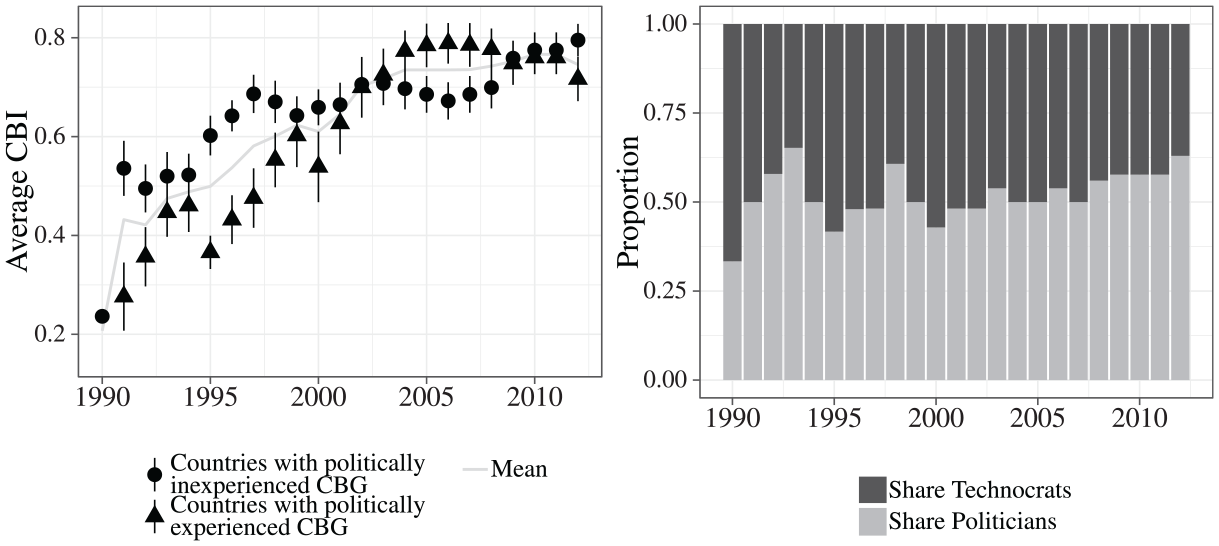
CBI and political appointments: authors’ calculations from sample data of 27 postcommunist countries 1990–2012.
Theory
This section presents a formal model illustrating our argument. We present a simple, two-actor screening model where a principal—in this case, a politician with appointment powers to the central bank—has imperfect information about a possible CBG’s political ambition. 5 We present our argument in three steps. First, we consider a situation where the nominating politician, whom we call the “leader,” needs to appoint a CBG. At the same time, she wants to ensure her own reelection and also wants to give up as little policy independence to the nominee as possible. Assuming the leader is assessing a single candidate for the job, she needs to decide both the optimal level of policy autonomy to award to the candidate as well as sufficiently invest in her reelection strategy against a potential political rival. To simplify the model, we assume that the leader only considers a single candidate and any selection criteria besides the political ambitions of the candidate occurred previously. 6 We also assume that the candidate’s political ambitions are less well known to the leader than they are to the candidate. While the leader can observe information about the candidate’s past career to infer political ambition, the leader remains only imperfectly informed. The key question that the leader then asks is how to both ensure her reelection and also limit the amount of policy autonomy given to the candidate.
Secondly, we show how the leader (she) can prevent the candidate (he) from misreporting his true type by making discriminating offers. More specifically, the leader presents the candidate with a menu of appointment offers with a different set of policy autonomy, d and reelection efforts, e, committed to different realizations of the candidate’s type. In equilibrium, the leader makes discriminating offers in order to induce the candidate to reveal his true type. Intuitively, the leader lays out different combinations of reelection efforts and policy autonomy which target the different types of candidates. By promising greater policy independence to those more interested in policy, the leader can deter those types that are politically ambitious from misreporting. In equilibrium, each type accepts a different offer from the leader, and, holding all else constant, policy independence is lower for those with political ambitions.
Thirdly, while the candidate’s true political ambitions are unknown, his previous career path is observable. Therefore, we compare the leader’s offer to the candidate when she observes prior political experience and when she does not. Since politically experienced candidates are also more likely to be interested in electoral politics, the leader wants to grant less autonomy. Conversely, however, the leader has less incentive to invest resources on separating types as the candidate becomes either more electorally motivated or as the election becomes more competitive. This is because any information gained is marginally less efficient. For example, where it becomes more certain that the candidate is politically motivated, it pays marginally less to acquire such information. Similarly, as the election becomes more fierce, spending resources on information gathering at the expense of other tools to secure the election is more costly. As either the electoral arena becomes more competitive or the exogenous pool of possible candidates becomes, on average, more electorally threatening, the level of autonomy awarded to candidates with political experience increases, holding all else constant, as the appointer commits less resources to blocking their entry.
More generally, given a situation where a principal selects an agent but does not know an agent’s true ability or motives, the principal would like to identify candidates by providing incentives to report the truth. The pool of candidates that the prospective principal faces, however, can vary. If the pool of candidates the principal has to select from is relatively uncertain, it pays for the principal to spend resources, offering discriminating offers so as to tell the different types of candidates apart. Alternatively, if all candidates are expected to be of one type, or if competition is fierce, it is less efficient for the principal to do so as any additional information she may receive is marginally more expensive. Applied to our setup, when the nominating politician is electorally vulnerable or as the candidate pool becomes more electorally threatening, screening candidates becomes relatively less efficient and consequently, CBGs with political experience are given higher levels of autonomy then they would get if the nominating politician was more electorally secure.
The Model
Formally, consider a situation where a nominating politician or leader, (
Equation 1 shows the candidate’s payoff. K’s utility increases in the expected office valuation and the expected valuation of policy influence if he accepts the appointment. If he rejects,

Similarly, the leader’s payoff is given in Equation 2.

Like
Game sequence
Figure 2 depicts the game sequence. Unsure of the candidate’s political ambition, the leader’s choice depends on a costless message, sent by the candidate, about his type. First, the leader chooses a message space,
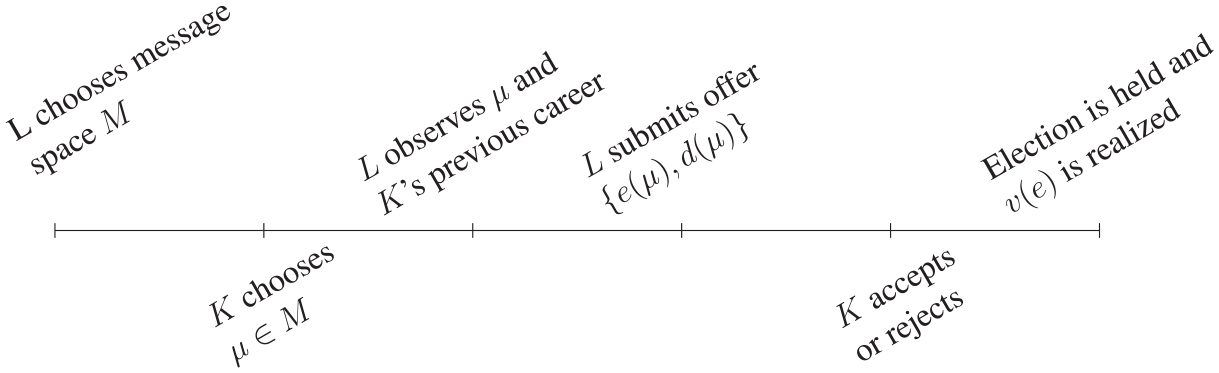
Model sequence.
Equilibrium
A key concern of the leader is that both technocrats and contenders may benefit from misreporting their type. If the leader makes a one-size-fits-all offer, both types of candidates may have an incentive to try to extract more concessions from the leader.
15
Following the revelation principle (Myerson, 1979), we focus on characterizing a truth-telling mechanism, that is, an offer menu that depends on the true type of candidate


These constraints are important for uncovering the equilibrium outcome given the cases of reported types shown in the next section.
Case 1: Candidate says he is a Technocrat
We first establish


In conjunction with the truth telling constraint listed above,

Two implications follow from Equation 3. First, if an offer is acceptable to a technocrat, it will also be acceptable to a contender. Second, a technocrat always receives exactly his reservation utility in the form of some combination of effort and policy independence. 16
Case 2: Candidate says he is a Contender
Next, we consider the leader’s equilibrium offer if the candidate reports that he is a contender. Intuitively,
First, we find that the leader grants more autonomy to a candidate reporting to be a technocrat than to a candidate reporting to be a contender. 17 As effort is increasing in autonomy, nominees who are technocrats also face more reelection efforts devoted by the leader. Second, any additional effort exerted toward a technocrat is increasing in the leader’s prior belief that the nominee is a contender. 18
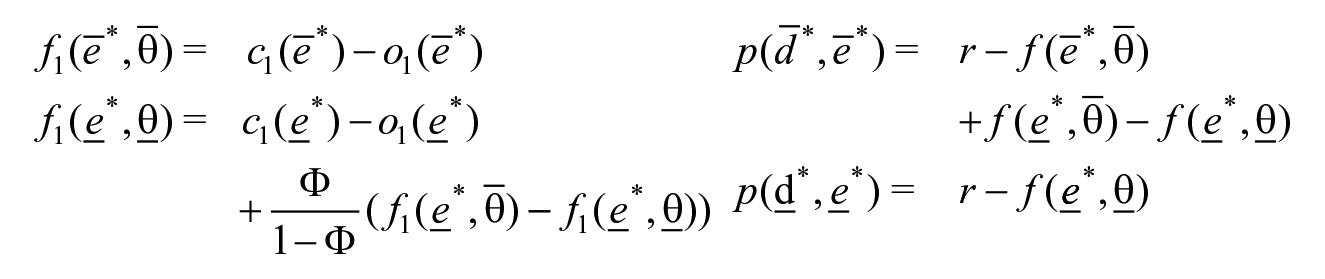
Importantly, while the leader cannot observe the true political ambitions of the candidate, she can observe his prior career-path. One important question, therefore, centers on how information about the nominee’s prior experience affects the relationships above.

The intuition behind Proposition 2 is shown by examining the composition of the equilibrium level of policy autonomy. Consider the equilibrium autonomy choice from Proposition (1):

The key reason why the leader makes discriminating offers based on types is that the contender can extract more policy autonomy from the leader if he exploits his information advantage. In order to protect against this, the leader tries to minimize the amount of autonomy granted by extending discriminating offers. The leader exerts more reelection effort against the technocrat in order to make it less attractive for a contender to misreport. However, the leader needs to compensate the technocrat to ensure that he accepts the appointment, and in doing so, offers the technocrat greater policy autonomy. Intuitively, this means that the technocrat is awarded more policy autonomy as a function of the leader wanting to deter contenders and that this relationship holds independently of any personal characteristics that the technocrat may have—such as his policy preferences, ability, or expertise—and depends only on the technocrat being more interested in policy than holding elected office. In other words, technocrats are awarded greater policy autonomy so as to dissuade contenders from participating in the first place.
Second, prior observable information about the candidate changes how much the leader needs to discriminate in her offers. The leader adjusts her discriminating offers so as to minimize any information rent that the candidate may enjoy. As long as the leader’s own reelection value is sufficiently high, the leader will grant less autonomy to candidates with a previous political career. As above, this implies a negative relationship between candidates with political experience and policy independence.
Finally, we ask how the above relationship changes when the leader faces greater threats to her reelection. Here we find that:

Proposition 1 implies that as the leader becomes more certain that she faces a contender, she expends more effort toward reelection against a technocrat than she would under conditions of perfect information. Intuitively, the leader provides more incentives for the contender to tell the truth by making it more costly for him to pretend to be a technocrat. This implies there is an additional “autonomy premium” awarded to the technocrat as a consequence of imperfect information and irrespective of the candidate’s other qualities. The intuition for Propositions 2 and 3 is similar. If the information provided by a past political career and subsequently the effort expended toward reelection effectively reduces the contender’s information rent, the leader grants less autonomy to a candidate with a past political career. Yet, working in the opposite direction, the leader will limit paying this “autonomy premium” as her reelection becomes more contested: the more vulnerable the leader is, the less it makes sense for her to deter contenders by rewarding technocrats.
Political experience and electoral vulnerability
This section graphically illustrates the main results from above using specific functional forms. 19 We show how the level of autonomy offered to the candidates changes as: (1) whether or not the leader observes past political experience or not and (2) whether the leader’s reelection vulnerability increases or decreases.
First, given our assumptions, the leader always offers less autonomy to the nominee after having observed that he has previous political experience. As shown in Figure 3, what this means in terms of our model is that
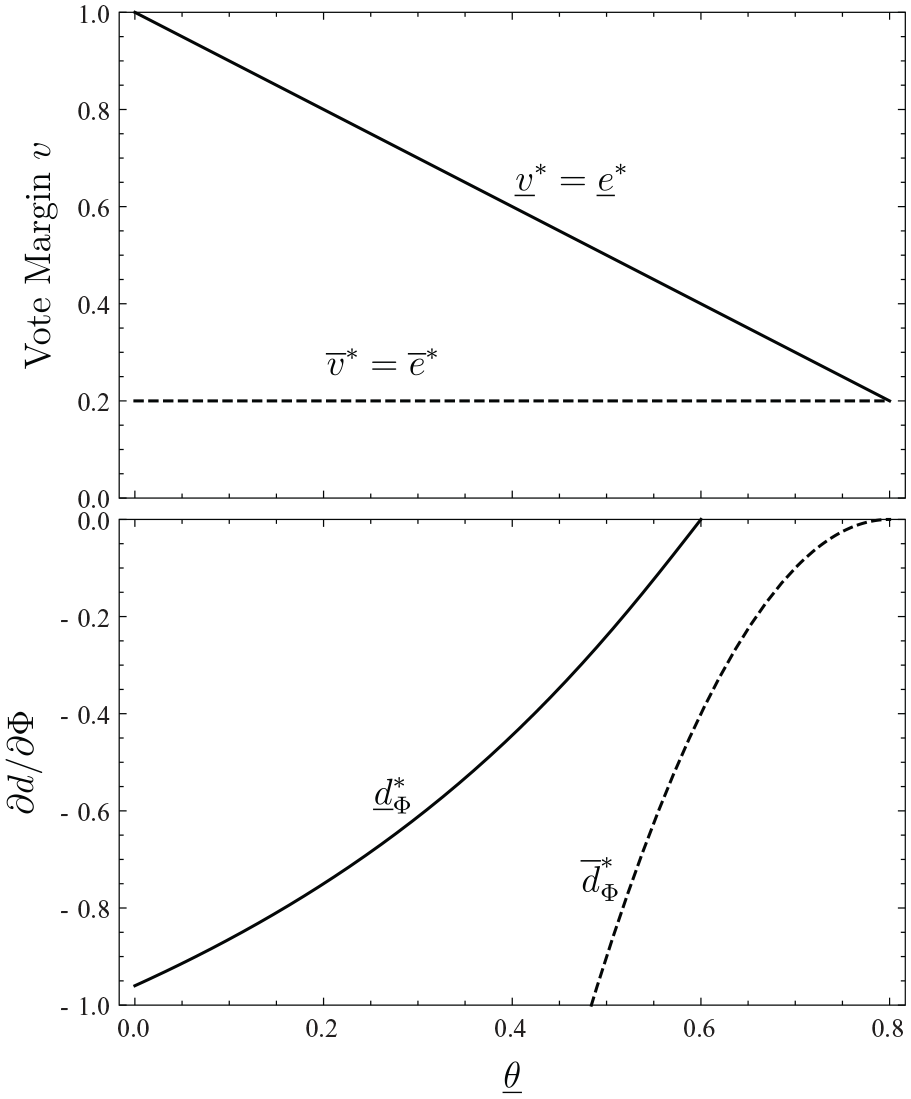
The effect of political experience on delegated autonomy.
Second, the penalty for having a political career decreases as the leader faces greater electoral competition. As noted in Proposition (3), this attenuation effect is conditional on how any additional information influences the contender’s information advantage. For example, if the electoral arena is becoming more competitive because the pool of candidates begins to pose a more serious electoral threat to the leader, even politically experienced candidates will receive higher offers of policy autonomy from the leader. 20
Empirical implications of the model
Our theory predicts a negative relationship between political experience and policy independence from the government. Such a relationship is consistent with prior research, but we suggest a new mechanism for why this may be the case. According to previous theories, technocrats are awarded greater policy autonomy either because their presumed policy biases for lower inflation help the government credibly commit to low inflation, or because political parties in competitive elections want to tie the hands of future governments, preventing them from using monetary policy. According to these theories, independent central banks co-occur with the appointment of technocrats in politically competitive environments.
Here, our theory shows that in environments of low electoral competition, politicians with appointment rights to the central bank can offer technocratic appointments greater policy autonomy so as to secure the leader’s own political power. In other words, when a leader grants technocrats greater policy autonomy, the leader establishes entry barriers to the central bank which secures her hold on power. This entry barrier works to block possible political challengers from entering political life either through elected or appointed office. In sum, technocratic appointees can be used by those already in power as a strategy to secure their own political survival. Importantly, however, we also find that the leader will be less able to pursue the above political market–blocking strategy when the political arena is more competitive. This brings us to our first empirical prediction:
H1 Imperfect Information: As the nominating politician’s electoral insecurity increases, the level of policy independence awarded to CBGs with political experience increases as well.
To assess whether our mechanism is truly at work, we also want to evaluate the perfect information story. In the perfect information story, technocrats get greater policy independence because their expertise allows them to conduct better monetary policy (as opposed to politicians, who have similar qualifications as the leader). Furthermore, the nominating official is more likely to appeal to outside expertise when political insecurity is higher. This is because she wants to tie the hands of any opposition party from using monetary policy opportunistically in the future. In order to evaluate whether the data supports this explanation instead of our theory, we also test the following hypothesis:
H2 Perfect Information: As the nominating politician’s electoral insecurity increases, the level of policy independence awarded to CBGs with policy expertise increases as well.
Data and Methodology
Post-communist countries represent an excellent sample to test the expected relationship among central bankers’ backgrounds, electoral competition, and central bank autonomy. First, despite varying levels of wealth and economic conditions, all countries faced a need to undertake economic and political reforms—including reforming their central banks—at around the same time (Frye, 2010). Second, the reform trajectories vary significantly over time and across countries (see also Johnson, 2016). Some countries, such as Azerbaijan, Kazakhstan, Hungary, and Romania reformed their banks in three stages, increasing their independence at each step, however. countries such as Belarus and Macedonia also rolled back their central banks’ level of independence. Also important is that political competition varies. In Eastern Europe, the line between authoritarian and democratic rule is often tenuous, as recent incidents in Hungary and Poland show. Finally, some CBGs have political experience while others do not. Even in authoritarian regimes, there are several examples of CBGs with political experience. The first president of post-Kuchma Ukraine was a former CBG, Viktor Yushchenko. The Republic of Georgia’s current CB governor, Koba Gvenetadze, was a deputy state minister and deputy minister of finance before assuming his post at the CB. Tolkunbek Abdygulov of Kyrgyzstan served a stint as deputy prime minister after being a central bank governor. Outside of Central Asia, György Matolcsy, the current central bank governor in backsliding Hungary, was a member of parliament as well as a minister of the economy on two separate occasions.
We contribute a new dataset on monetary policy independence and biographical information of CBG career experience across time in 29 post-communist countries, between 1990 and 2012. 21 This new dataset incorporates measures of central bank autonomy based on monetary policy independence and constraints on government borrowing (Garriga, 2016). It also includes newly compiled biographical information on all CBG appointments for those countries that were either Soviet republics, members of the Warsaw Pact, or held very close ties to the Soviet Union, such as Mongolia. To stay consistent with previous literature, we follow the coding efforts of Hallerberg and Wehner (2020), who also code biographical information for political actors (CBGs, Prime Ministers, Presidents, and Finance Ministers), although these authors consider the biographies of actors in OECD countries only. We code whether the individual has ever held a political post in any post-communist government or legislature. In our dataset, being politically experienced in the early 1990s means that an individual held a position in the transition government/legislature, not in the communist regime. 22 Finally, we gathered important information about which nominating politician is eligible to make central bank appointments.
Policy Autonomy
Our main dependent variable is policy autonomy. The aggregate CBI index commonly used in the literature is an average of four dimensions of de jure CBI including personnel, policy objectives, policy tools, and limitations on lending to the government. In the composite measure, these dimensions are weighted according to the judgment of the initial authors (Cukierman, 1992). Rather than use the composite index, we consider those components most related to policy autonomy. First, we use the component “policy independence” in country
Career Experience
Our key explanatory variable is whether the appointed CBG has political experience or not. We define political experience as having had a career as a party official, running in an election, holding political office via direct or indirect election, or holding an appointed office in one of the branches of the government after 1990 or the first year of independence; this variable is coded
We also code whether the appointed CBG’s two significant vocational experiences involved working in an international organization. As above, IO experience holds the value of
To measure policy ability or expertise, we also code whether or not an individual holds a PhD in Economics. This variable also represents a large share of those people in our sample (57 out of 162, or 35%).
Electoral Competition facing the Appointer
We focus on electoral contests where the politician has the appointment rights to the central bank. To determine this, we collected information from central bank laws, directories, websites, and secondary sources to determine who gets to draft the initial nominee list for the central bank. Interestingly, we find significant variation in who gets to draft the initial list of nominees across central banks in our sample. In 153 country-year cases, parliament makes the initial appointment; in 393 country-year cases, the president makes initial appointment; and in 43 country-year cases, the prime minister. We drop 23 country-year cases in which the initial appointing office is done by a non-elected official. These country-year cases include Georgia, where the suggestion for the CBG comes directly from the central bank board. We also drop all cases where the central bank law is not reformed and the country retains Soviet-era central bank governors.
We measure electoral competition facing the nominating official two ways. First, we proxy electoral competition using the margin of victory that the political candidate wins in the election. For legislative elections, we measure competition with seat margins, or the difference in the number of seats won by the first and second most successful parties. 26 We then transform the variable, taking 1- seatmargin such that electoral competition is higher when the seat margin is smaller, and electoral competition is lower when the seat margin is larger. When the president rather than the legislature determines the CBG appointment, we use the difference in the number of votes between the first and second candidate in the first round of the presidential elections. As above, we transform this variable 1- votemargin, such that a smaller vote margin is associated with higher competition and a larger vote margin with lower competition. 27 The underlying data are from Coppedge et al. (2017), which aggregates election data from Europe and Asia (Nohlen & Stöver, 2010; Nohlen et al., 2001).
As a second indicator of political competition that might be more illuminating in the more autocratic countries in our dataset, we also measure the level of popular mobilization against the government before the election. This comes from the British Broadcasting Corporation’s Summary of World Broadcasts coded in the Cline Center Historical Phoenix Event Dataset (Althaus et al., 2017; Beaulieu, 2014). More specifically, we count the reported number of active protests, postures of force, coercion, breakdown of negotiations, assaults, and physical fights targeting government institutions or officials in a given year. For those years where the nominating official faced an election, we included only those protest events that happened before the election.
Other Variables
We also include a number of other variables to account for possible confounding factors. To measure the level of financial development or trust in the central bank, we include a measure of contract-intensive money (CIM). CIM reflects the proportion of money that is held in the official banking sector, derived from a measure of the money supply (M2) (Clague et al., 1999). One interpretation is that CIM proxies the security of property rights (in this case, financial assets).
Previous literature finds that political institutions are essential to the proper functioning of CBI in democracies. As such, we also include a measure of checks and balances from the Database of Political Institutions (Beck et al., 2001). As in Keefer and Stasavage (2003), we expect the level of checks to be positively associated with higher levels of policy autonomy. 28
The degree of urbanization may affect the level of prices and also the demand for independent economic institutions. Therefore, we include the share of the population living in urban areas, urban population, from the World Bank’s World Development Indicators (WDI). Like the above measures, we also expect this variable to be positively associated with higher levels of autonomy.
We include a measure of the country’s growth rate from the WDI, which we expect matters for both the level of policy autonomy as well as for the competitiveness of the election, gdp per capita growth. 29
Finally, there is an obvious upward trend in the composite CBI index over time. We include a time count variable. This variable starts at the beginning of our sample (1990) and goes up incrementally by 1 unit until the end of our sample (2012) (Marsh & Mikhaylov, 2012) so as to account for this trend. 30
Model Specification
We estimate three models, each increasing in structure: a pooled model (1), a country fixed-effects model (2) and a country fixed-effects model with an assumed AR(1) process (3). 31 Model (2), for example, is specified as: 32

Empirical Results
We present the results from our model specifications (1-3) using a coefficients’ plot for ease of interpretation. As expected, we find a negative independent relationship between political experience and policy autonomy, measured either by policy independence or limits on government lending. This implies that CBGs with political backgrounds get lower levels of autonomy than those CBGs without political experience. Our other main variable, electoral competition, measured either by vote and/or seat margin or number of protests, demonstrates little independent effect, either statistically or substantively (Figure 4).
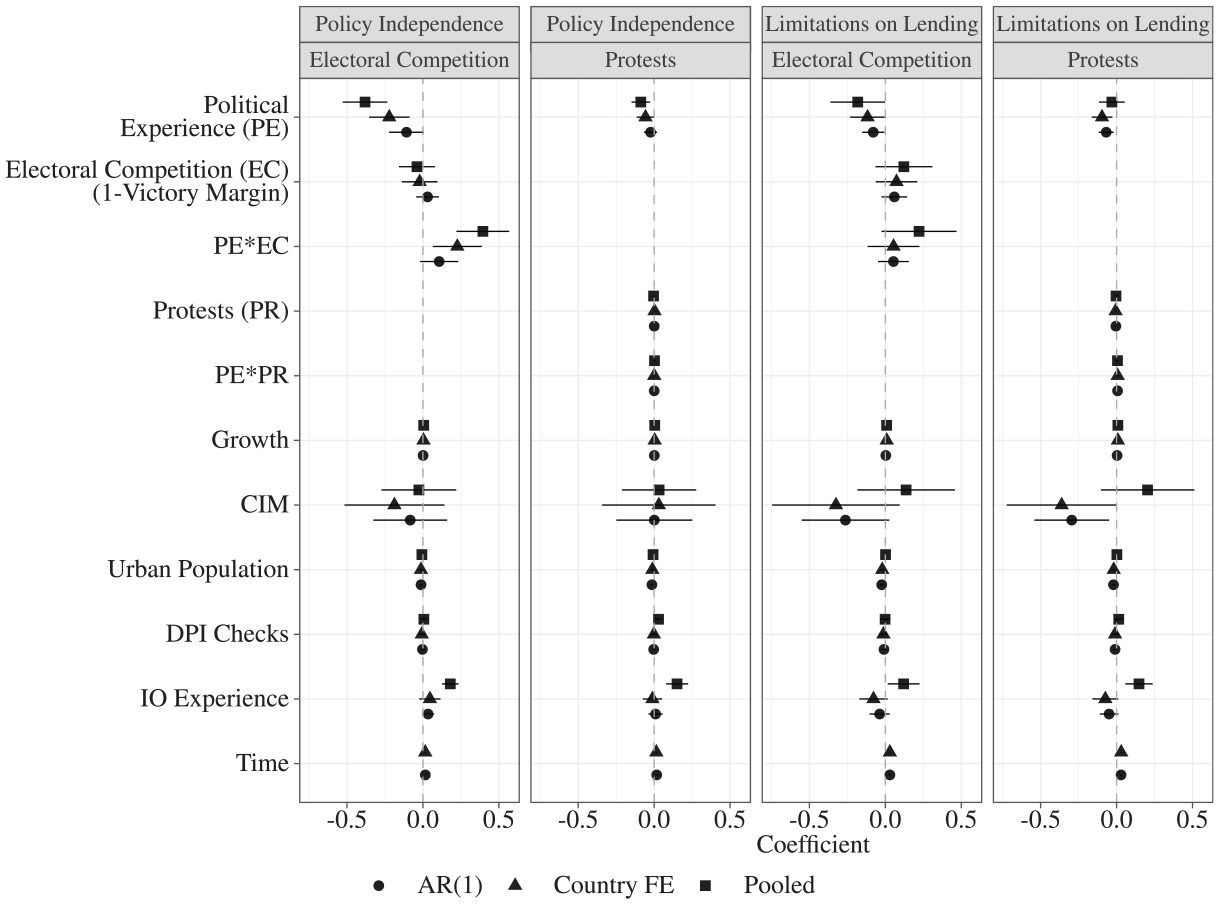
Effects of political experience and electoral competition on lending limitations and policy independence.
Rather than only consider the independent effects, our hypotheses consider the interaction between political experience and the strength of political competition facing the nominating politician. As reported in Figure 5, which shows the marginal effects, we find that CBGs with political experience are associated with higher levels of policy independence as political competition for the appointer’s post increases. When we operationalize policy autonomy as limitations on lending to the government, this positive effect is less pronounced. Interestingly, however, we find the converse pattern when we measure electoral competition using protests against the government. Here we find that CBGs with political experience are only weakly positively associated with policy independence, but the positive relationship is much stronger for limitations on government lending then for policy independence.
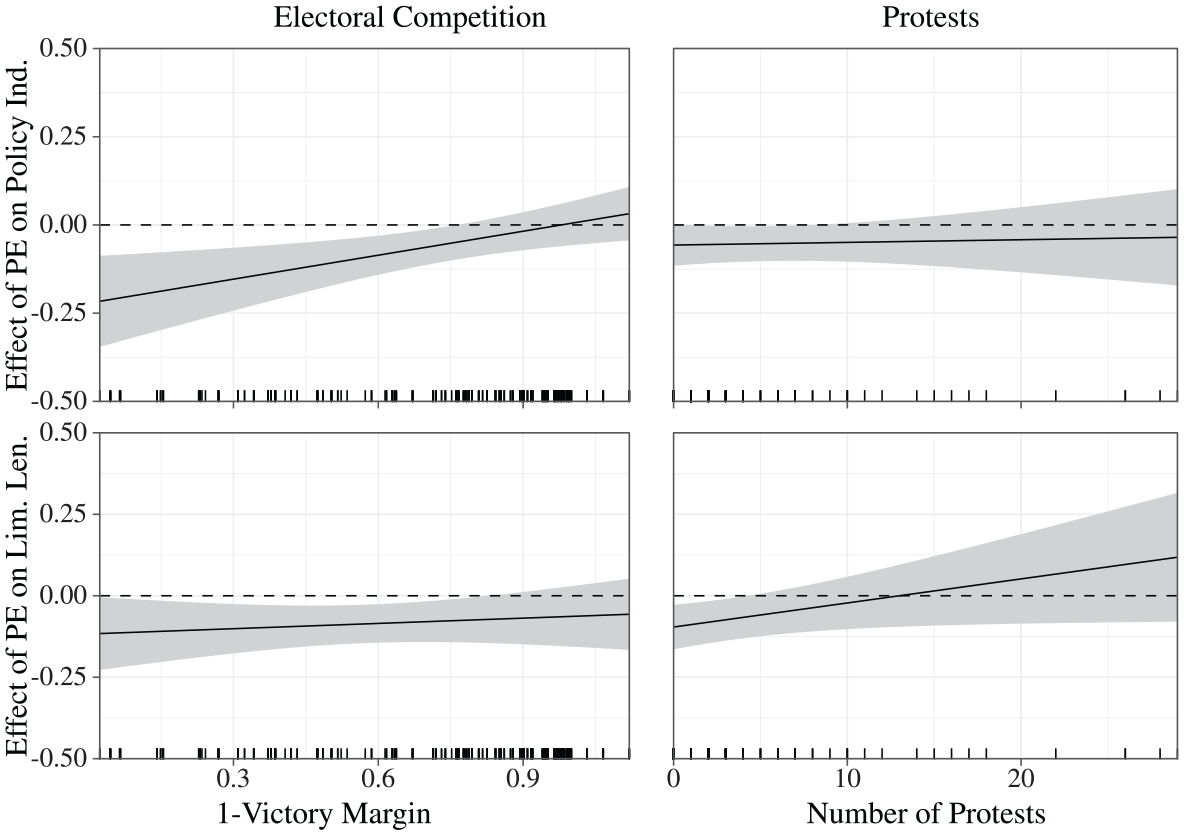
Marginal effects of political experience on lending limitations and policy independence.
In terms of our other variables, Figure 5, shows that GDP growth is positively associated with policy autonomy across all models, although its effects are not large. The CIM measure is positively associated with autonomy until we account for the observed increasing trend in central bank independence over time. The time trend likely picks up an increase in the credibility of central banks over time. Our urban population variable is also not substantively important; neither is the democracy variable DPI checks. 33 Similarly, another possible explanation is that career experience in international organizations (IOs) rather than electoral threats matters for policy independence (Johnson, 2016). While we find a positive relationship between IO experience and policy independence in the pooled model, the effects are less clear once we account for country and time trends. Furthermore, our interaction is robust even when we include whether someone has worked in an IO, suggesting that political rather than IO vocational experience matters for policy independence. 34
While the above results suggests some support for our theory, we also test the perfect information case as it could be that the above positive relationship also holds for experts as well. To do this, we replace CBG political experience with those CBGs with Economics PhDs. We then investigate whether we observe a similar upward slope as electoral competition rises. Recall that in contrast to the predictions made by our theory, according to the perfect information case, technocrats will receive higher levels of policy independence because they are experts and have an advantage at conducting monetary policy (as opposed to politicians, who have the same qualifications as the leader) and that we expect this premium to increase as electoral competition increases.
We present the results from our same model specifications (1-3) as before. Interestingly, we find little evidence of an independent relationship between having an economics PhD and the level of policy autonomy. Similarly, our measures of electoral competition are not related to policy autonomy in any independent way, as above (Figure 6).
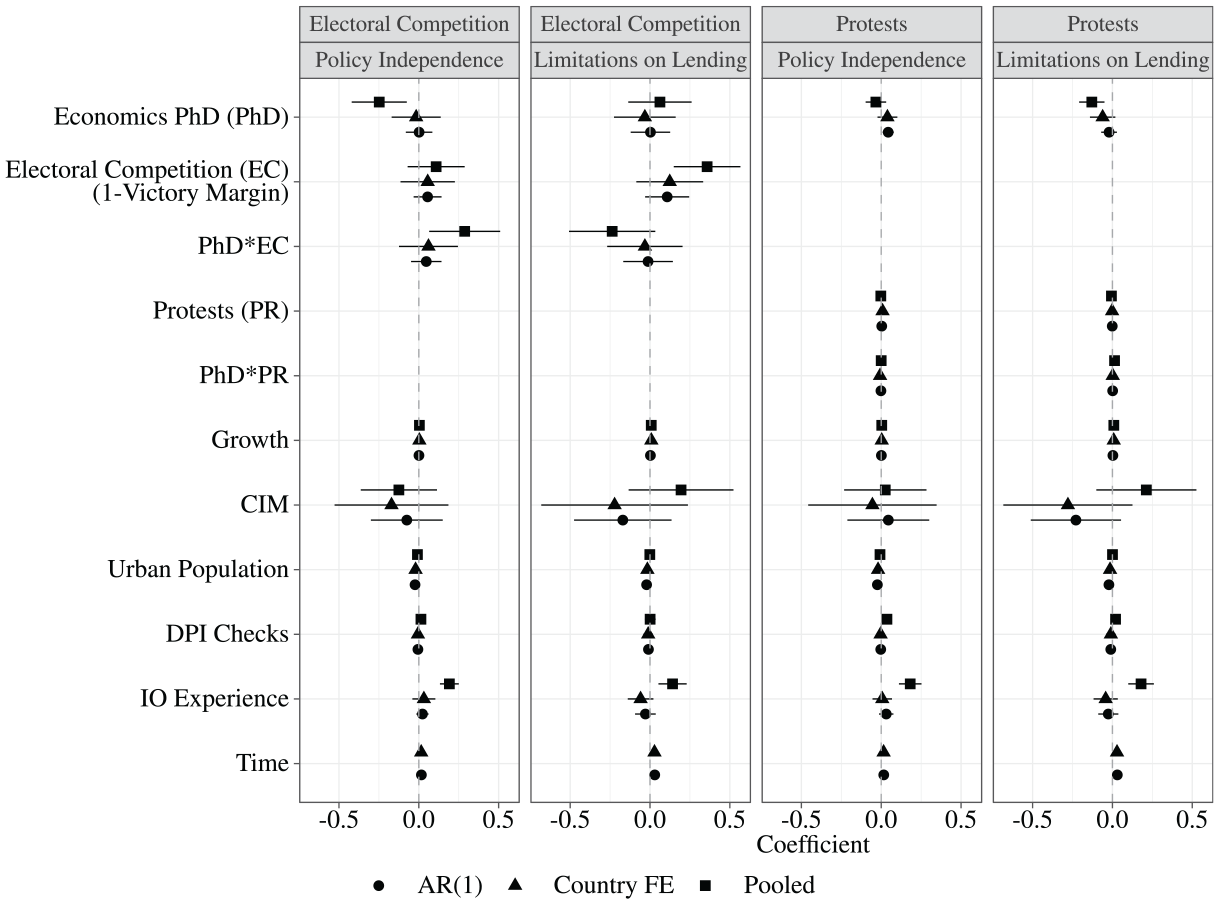
Effects of an economics PhD and electoral competition on lending limitations and policy independence.
Our variable of interest is the interaction between expertise (proxied by having a PhD in economics) and the strength of political competition facing the nominating official. As shown in Figure 7, we find that CBGs with more expertise do not get higher levels of policy autonomy as political competition for the appointer’s post increases. Interestingly, and unlike the political experience results reported above, we find null results irrespective of whether we measure electoral competition by vote/seat margin or by the number of protests, or whether we consider policy independence or limitations on government lending.
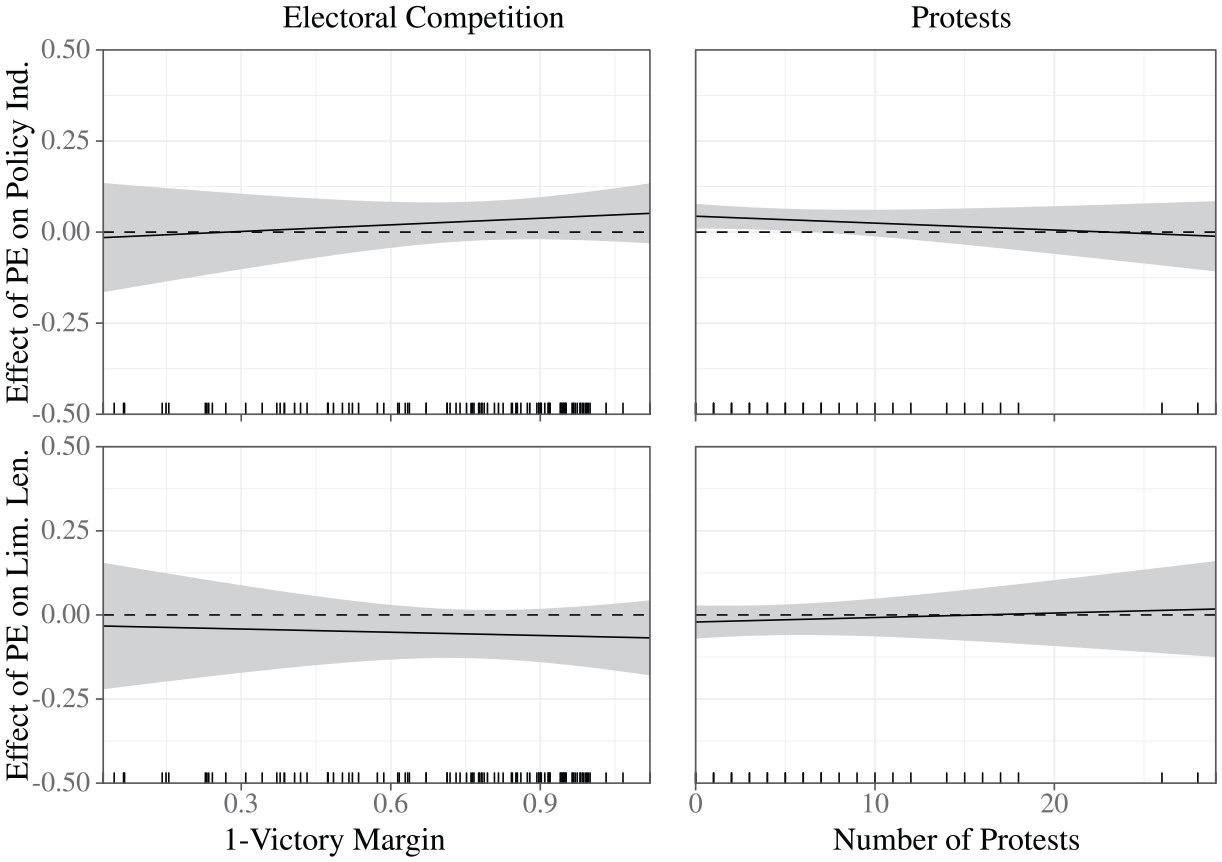
Marginal effect of the CB governor holding an economics PhD on CBI.
In summary, we find that candidates with political experience are associated with higher levels of policy autonomy as electoral competition facing the appointing politician rises. Furthermore, we find no evidence of such a relationship for those CBG with expertise, as measured by having a PhD in economics. This, coupled with the fact that we examine elections only for those nominating officials that directly hold appointment powers for the CBG, points to the role of information screening in delegating policy independence to the central bank.
Alternative Explanations
We now consider possible alternative explanations. Rather than be associated with screening, appointments to the central bank may serve other functions. First, they may be a reward for party service, for example, as pre-retirement placements. If this were true, political experience would not indicate the future political ambitions of a candidate, but would still be positively correlated with appointments, which might confound our interpretation. Second, the political leader might use the CBG post to co-opt strong electoral challengers. Political leaders may offer a position with considerable power (i.e., higher policy autonomy) under conditions of strong electoral competition. As above, such an argument might also confound our interpretation. Common to these explanations, however, is an expectation about the sequence of political experience and holding the central bank governorship. According to these arguments, the candidate gains political experience before he becomes CBGs. It then follows that we would observe the same positive interaction as above, but for only those CBGs with previous, not subsequent, political experience.
To test this, we distinguish between candidates with political experience before and after they became CBG. We then re-run the analyses on a sub-sample of CBG with political experience after they hold the CBG post. As shown in Figure 8, we find a similar positive relationship between political competition and levels of autonomy awarded to the CBG even in this subsample. This lends further support to our argument that politicians with appointment powers to the central bank have incentives to appoint technocratic candidates to deter politically motivated candidates, however, their ability to do so is conditioned by the level of political competition they face: as political competition increases, it becomes less beneficial for the nominator to invest in deterring politically minded candidates and is more likely to award even politically ambitious candidates similar levels of autonomy.
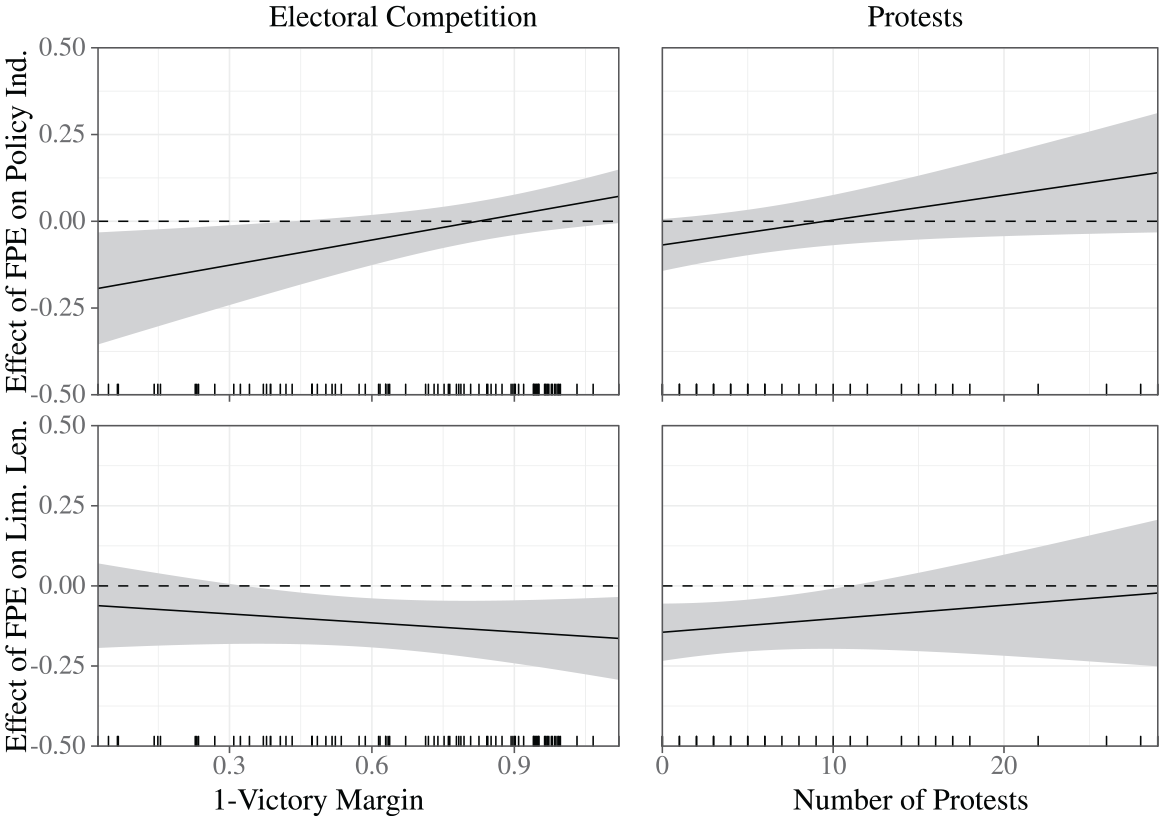
Marginal effect of future political experience on CBI.
Conclusion
What conditions determine the level of policy independence delegated to a country’s central bank? Our theory demonstrates that politicians who are responsible for nominating central banks governors (CBGs) may use technocratic appointments to dissuade politically motivated central bank candidates. We show that the success in doing so, however, crucially depends on the expected closeness of the electoral race faced by the appointer. As either the overall quality of challengers increases or as elections become more competitive, the appointer’s willingness to use discriminating offers to deter politically minded central bankers lessens. Our model finds evidence of a previously unexplored relationship between central bank appointments and policy independence, one that is conditioned by the level of electoral competition facing the nominating politician. We find that the level of independence granted to candidates with political backgrounds increases as electoral victories narrow. Another contribution is the development of a new and important dataset that looks at the career experience of CBGs outside of the OECD.
While our argument focuses on those conditions that determine autonomy given to CBGs as a consequence of election concerns facing the appointer, outstanding questions remain. Future research might explore the economic consequences of the increasing number of CBGs with political experience, asking whether political CBGs influence inflation, asset prices, or growth rates. Similarly, while some suggest that unelected bureaucrats need be more accountable to voters, it is worth investigating whether or not those countries with more politically experienced officials are indeed more accountable to citizens. One alternative and more pessimistic argument, which our evidence suggests, is that with an increase in political competition, the marginal efficiency of investing resources to keep politically minded candidates out of independent arms of the government declines for those politicians appointing them. Our argument, therefore, points to challenges in bureaucratic development. On the one hand, new countries must select and promote a new generation of political leaders in order to effectively manage the country. On the other hand, the coupling of independent agencies staffed with actors with strong political motivations may bring to the forefront inter-elite conflict.
The role of partisanship is also worth further investigation: in intra-elite bargaining such as what we see here, a shared partisan identity may promote trust between the CBG and the appointer, who might then be more generous with the level of autonomy. In our sample of CBGs, many governors—particularly those without political careers—simply do not reveal their partisan identity, and others self-identify as independents. Furthermore, in Eastern Europe, Ibenskas and Sikk (2017) argue that while there has been some development to the party system, the strength of membership organizations remains weak, which makes assigning parties—especially to candidates who may have an interest in hiding their partisan affiliation—particularly difficult. Future research considering the ways in which partisanship, or lack thereof, contributes to these dynamics would make a fruitful contribution to the literature.
For now, our paper contributes a deeper understanding of the interaction between strategies aimed at electoral survival and those aimed at delegation. While previous research has centered on the need for nominating officials to signal to investors, the domestic public, and opposition parties that they are credibly committing to a low-inflation policy, our findings point out that elites also make calculations about their political survival. More broadly, our theory shows that principals can attempt to modify the levels of an agency’s policy independence, depending on the learned career ambitions of the agency director, rather than the other way around. Additionally it also shows that the principal’s ability to do so is constrained by her hold on power (or not). Our paper, therefore, paints a more nuanced picture of the calculations that politicians make when handing over power.
Supplemental Material
BaergGrayWillischAppendix_Final – for Opportunistic, not Optimal Delegation: The Political Origins of Central Bank Independence
BaergGrayWillischAppendix_Final for Opportunistic, not Optimal Delegation: The Political Origins of Central Bank Independence by Nicole Rae Baerg, Julia Gray and Jakob Willisch in Comparative Political Studies
Research Data
BaergGrayWillisch_Final – for Opportunistic, not Optimal Delegation: The Political Origins of Central Bank Independence
BaergGrayWillisch_Final for Opportunistic, not Optimal Delegation: The Political Origins of Central Bank Independence by Nicole Rae Baerg, Julia Gray and Jakob Willisch in Comparative Political Studies
Footnotes
Acknowledgements
The authors would like to thank Meredith Wilf, Jana Gritterson, Lucy Goodhart, Nikolay Marinov, Ora John Reuter, Bill Clark, Cristina Bodea, James Ashley Morrison, Cheryl Schonhardt-Bailey, and Adam Dean for discussion. We espeically thank Cristina Bodea for reading multiple drafts of this paper and Cristina Bodea, Raymond Hicks, and Carolina Garriga for sharing their data with us. Research assistance was graciously supplied by Alexandra Klochko, Anastasiia Shukhova, Olga Sokolova, and Elisa Wirsching.
Declaration of Conflicting Interests
The authors declared no potential conflicts of interest with respect to the research, authorship, and/or publication of this article.
Funding
The authors disclosed receipt of the following financial support for the research, authorship, and/or publication of this article: Research funding was supported by the University of Mannheim, SFB 884 Political Economy of reforms C4 project and the Graduate School of Economic and Social Science.

Notes
Author Biographies
References
Supplementary Material
Please find the following supplemental material available below.
For Open Access articles published under a Creative Commons License, all supplemental material carries the same license as the article it is associated with.
For non-Open Access articles published, all supplemental material carries a non-exclusive license, and permission requests for re-use of supplemental material or any part of supplemental material shall be sent directly to the copyright owner as specified in the copyright notice associated with the article.
