




Abstract
Why do contemporary states fortify their borders? Modern military advancements have made such fortifications obsolete for security, yet scholars have offered no satisfactory alternative theory. I propose a theory of fortifications with economic motivations using a game-theoretic model where states compete to extract wealth over a shared population around a border. Such competition generates inefficiency and states have the option to construct fortifications to disrupt competition. Fortifications contain the wealth of citizens inside the state to be taxed and enforce efficient monopolies of extraction. States hence fortify when such profits outweigh short-term expenses. The models suggest that we should expect fortifications between territories of unequal economic capacities as richer states have more to lose from inefficient competition, complementing existing empirical results.
Introduction
Why do modern states fortify their borders? Border fortifications refer to artificial physical obstruction between the territories of two states, such as walls and heavy fencing. Globalization scholars are sceptical of the relevance of borders and their walls in the contemporary world (see for example Jacobson, 1966; Ohmae, 1990). Border fortifications have also been deemed obsolete for security purposes due to the advancement of military technology. Yet, according to data collected by Carter and Poast (2017), 28 borders have been newly fortified since the year 2000. This represents over 40% of the 62 borders fortified since the year 1800. This recent growth in fortification rates is therefore counter-intuitive and presents a puzzle: why are fortifications still being built?
While empirical approaches have begun to study why states choose to fortify their borders, there are still gaps in the literature’s theoretical basis. I offer a theoretical foundation by arguing that states use border fortifications to achieve border stability – the ability to regulate what enters and exits the state – which in turn secures the economic fruits of the border regions. This theory builds on existing work on economic motivations for fortifications (Carter and Poast, 2017; Rosière and Jones, 2012). Such works were in turn built upon the idea that stable border regions are more economically productive than unstable border regions (Gavrilis, 2008; Schultz, 2010; Simmons, 2005). While border regions can be stable through mutual non-interference (Acharya and Lee, 2018), the persistence of contentious borderlands across the world suggests that such an outcome cannot be guaranteed. This paper demonstrates that border fortifications offer states an opportunity for recourse to border fortifications when stability fails to emerge by other means.
Recognizing that fortifications form part of the broader processes of border management (Gavrilis, 2008), I present a game that embeds states’ choices of border fortifications within the broader context of border politics. The border region between two states is represented on a single-dimension continuum. Along this space lives a mass of potential citizens. The states must compete with each other in providing services to this population and the state that offers such services at the lower price (i.e., lower tax rates and more lax regulations) creates greater advantages for the economic enterprises of their citizens. This results in competition between the two states and competitive pricing inevitably drives down the long-term economic profits of both states. This foundational framework of the model takes inspiration from the work of Acharya and Lee (2018); the model then diverges significantly by allowing the states to fortify their borders. The construction of fortifications restricts the movements of persons and goods. As a result, citizens become unable to benefit from conditions offered by the government across the wall, preventing wealth from escaping across the border. States now have a monopoly over the citizens on their side of the fortifications and are able to maximally extract taxes and productivity from local enterprises for long-term economic gain. In other words, fortifications enforce border stability and this stability is profitable for the states. The trade-off however is that the construction of border fortifications has significant upfront costs and states face the strategic choice of spending significant immediate investment on fortification construction to secure long-term profits.
Altogether, the results of the model allow us to form expectations over the economic conditions that produce border fortifications. States of equal economic capacities are unlikely to fortify their borders. This is because two low capacity states have no reason to fortify as they cannot significantly profit from a more stable market, and two high capacity states are dissuaded either by existing cooperation – which is more likely to emerge between wealthy neighbours – or by a free rider problem – as both states have the capacity to shoulder construction costs. By contrast, borders between two states of varying capacities are more likely to see fortifications. The wealthier state in this scenario is incentivized to act as they know their poorer neighbour will never do so for them. This implies that border fortifications are more common where there is economic inequality between the two territories and capacity disparities between the two governments.
Such a theoretical contribution aligns with the empirical findings of Carter and Poast (2017), the key preceding work. They argue that ‘the economic incentives of the populations on both sides of the border are key to understanding border stability’ (Carter and Poast, 2017: 244) yet were only able to tests these patterns in the aggregate using national-level economic variables. Thus, I advance existing theories by designing a model that explicitly highlights unique aspects of borderland economies and gives the appropriate empirical expectations. Through this, I hope to elucidate economic mechanisms behind border policy choice with greater sophistication than what has come before (Carter and Poast, 2017; Hassner and Wittenberg, 2015; Rosière and Jones, 2012).
Economic motivations for fortifications
Governance in the borderlands
Sceptics are likely correct that developments in technology have diminished the relevance of land borders. They are now much less significant for defence and travel, but borderlands themselves remain economically important. In this paper, I focus on the economic significance of borders for states and their citizens. I borrow the framework for this from Acharya and Lee (2018), where ‘governance’ is used as shorthand for the economic relationship between state and citizens. This relationship is characterized as extractive: the state extorts rents from citizens in exchange for an escape from the state of nature. This characterization follows from a long tradition in political thought that considers states as ‘stationary bandits’ that attempt to maximize revenue (Levi, 1988; Olson, 2000).
As I do not intend to make an explicitly historical argument nor appeal to the state of nature in this paper, it is necessary to affirm that this framework remains similar to the substantive reality in contemporary borderlands. The modern state governs by offering citizens some combination of welfare, security and infrastructure. In return for governance, the state extracts a ‘price’ (later
The competition for governance
For states with land borders, a complicating factor in this economic relationship is the inescapable physical presence of the neighbouring state. So long as this outside option exists, citizens will always be asking themselves, ‘Under which state do I want to live?’ Thus, to win rents from these citizens, the state needs to present competitive offers of governance through price
What specifically does the state adjust to make themselves more appealing to citizens? The game I offer in this paper does not make specific further assumptions on what this transaction looks like. It might resemble Guatemalan markets attracting Mexican farmers looking to escape competition from United States imports (Galemba, 2012, 2018). It might look like the fewer restrictions on the trade of livestock in Bangladesh attracting smuggling from neighbouring India (Sur, 2020, 2021). It might also resemble how high paying jobs in Saudi Arabia attract Yemeni labourers, particularly prior to 1990 (Thiollet, 2011).
All of these different sweeteners that a state might offer are formally equivalent. Upon acceptance, they are costly for the state to provide and are a boon for citizens to receive. Differences between them might only be a matter of magnitude and distinguishing between them is beyond the scope of this paper. I thus ‘black box’ any further details about this compensation package and remain agnostic as to what the crucial ingredient of the package on offer that finally persuades the citizen is.
The model assumes that states provide governance of the same quality or value (later
Providing governance is costly to states. This cost (later
Border stability and fortifications
This competition for providing governance is how my models endogenously capture border instability. There are several ways in which border stability can be understood. The more typical approach by Simmons (2005), Carter (2010) and others focuses on clarity of territorial jurisdictions. Such an approach emphasizes ‘disputes over location’ as the source of border instability.
For the purposes of this paper, I prefer to follow the definition used by authors such as Rudolph (2003) or Carter and Poast (2017) where border instability is instead defined as persistence of significant movement of persons and goods across the border unwanted by the states. Such a definition appeals more to concerns over the function of the border and is more appropriate given this paper’s focus on economic factors. From this perspective, this concept might also be termed ‘border permeability’ or ‘border porousness,’ but I will continue to refer to it as border stability for continuity with previous scholarship.
The competition for governance perfectly captures this functional understanding of instability. A porous border is clearly unwanted as the competition for governance forces the home state to offer its services at a cheaper price, reducing their profits. Approaching border instability as the failure rate of filtration reflects how, in reality, a porous border exposes a state to labour and goods originating from the neighbouring state. If the citizens of the state employ labour or purchase goods from the other side, then wealth leaks out of the state as the economic contribution of these enterprises flows across the border. This can be exacerbated by how payments in exchange for labour or goods can more easily avoid taxes, tariffs and other regulations when borders are unstable.
To avoid these losses, the home state must ensure that local labour and goods remain attractive. Welfare arrangements that reduce wages for locals or subsidies for domestic production are example options. Such policies, in the formal construction of my model, mean that the state must price their governance competitively and this results in a loss of profit. States thus prefer the border to be stable to avoid these losses and this endogenously captured preference for border stability is one of the strengths of the presented approach.
I will note here that, in the model, economic losses from border instability directly result from the loss of contributions from citizens in the border region specifically. While labourers, migrants and traders that successfully cross the border may not necessarily stay in border regions, I argue that for modelling purposes it is still appropriate to consider that the bulk of their impact is on the borderland. Consider, for example, how Hispanic communities of Mexican origin in the United States tend to be concentrated in states closer to the border. I therefore hope the reader considers this an acceptable simplification.
One option that states have to enforce border stability is by constructing fortifications. Fortifications enforce stability because they make accessing alternative options difficult. In practical terms, fortifications reduce the leakage of state wealth by filtering the people and goods that can flow across the border. The extensive fortifications built on the Saudi Arabia–Yemen border, for example, make it more difficult for Yemeni labourers to find employment across the border (Al-Awlaqi et al., 2019; Thiollet, 2011). When citizens can no longer easily access labour and goods from the other state, they are forced to commit their contributions to the home state. The games in this paper model the equivalent of this phenomenon: fortifications stop states from offering services across the border. This is captured by an increase in costs to provide services beyond the wall. Through this mechanism, a state can thus choose to fortify in order to unilaterally stop the competition for governance and enforce border stability. This choice comes with a cost (later
Objectives, limitations and scope conditions
The objective of my models is to isolate the possibility that states may be solidifying their borders in response to leakages of wealth. These incentives thus focus on the economic choices of the two neighbouring states and their citizenry. Borders and the economy interact in numerous other ways and it is neither feasible nor illustrative to attempt a model of all relevant economic processes. Other prominent economic actors in border regions such as arms smugglers and drug cartels are not represented in my models.
Less direct economic consequences of border policies may also not be appropriately captured at this stage. For example, Peters (2015, 2020) argues that the loss of foreign labour can lead corporations to move their factories overseas. Such a relationship is a potential downstream effect that states might also weigh when deciding border policy. I leave these more advanced complications for further research and reiterate my focus on the basic relationship between states and citizens.
The primary case of interest for my models then are states that are capable of extracting significant economic value from their borderland populations. The models in Acharya and Lee (2018), where my models begin and depart from, explicitly focus on the experience of a modernizing Europe. They argue that economic expansion in Europe proliferated lands that were profitable to govern, in turn creating competition between states over territory. I believe that similar circumstances can be applied to ever increasing parts of the world. As global populations proliferate, more and more land is now occupied by civilization. This in turn can create territory that is profitable to govern beyond the traditional interiors of the state towards the periphery to create the tensions over border politics described in this paper. This increase in economically valuable territory over time, through the processes in my model, may then provide some of the explanation for the growth in fortified borders noted in the opening passages. While I am unaware of direct empirical results of this pattern in populations, I do formally demonstrate in an extension that the assumptions of my model are congruent with this expectation that borderland areas will become increasingly occupied.
Finally, as the states captured in my games are funded by the contributions of their citizens, the model is not suitable to be applied to states that have a significant amount of other forms of income that would be throttled by fortifications. Smaller European states whose economies are significantly dependent on cross-border tourism are prominent examples of such exceptions. States heavily reliant on trades across land borders may also be outside of the models’ scope given that Carter and Poast (2020) find that border walls have a depressive effect on formal trade, though notably other research does find that secure borders instead help facilitate legitimate cross-border flows (see Schultz, 2015 for a review) and render the significance of this complication muddy.
Importantly, I note that states with other forms of income that would not be affected by fortifications (such as the oil reserves of Saudi Arabia) are still captured by my models even if they are not explicitly included. This is because such exogenous economic endowments should largely be constants regardless of border policy choices and can thus be largely excluded from the model design without affecting key patterns.
The Fortification Game
Basic structure of the game
Consider two neighbouring states,
When there have never been any fortifications constructed, one of the two states is activated and given the choice of Fortify or Not Fortify at the start of the period. States alternate this activation, with State
Following the decision on fortifications, both states simultaneously have the opportunity to offer governance to as many individuals
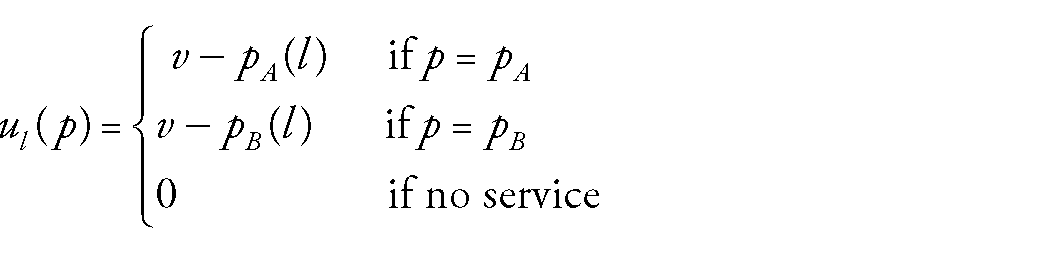
After services are accepted, pay-offs are realized for every player and the game repeats. The infinite repetition reflects the reality of border management as a perpetual and continuous process where decisions made may have long-term consequences. From a formal standpoint, the repeated play design allows for randomizing mixed strategy equilibria that form an important part of the results.
Consequences of fortification
Once a state has ever chosen Fortify in the history of play, the resulting sub-game is referred to as Fortified. The sub-game is referred to as Unfortified otherwise. When the game is Unfortified, the cost to provide governance
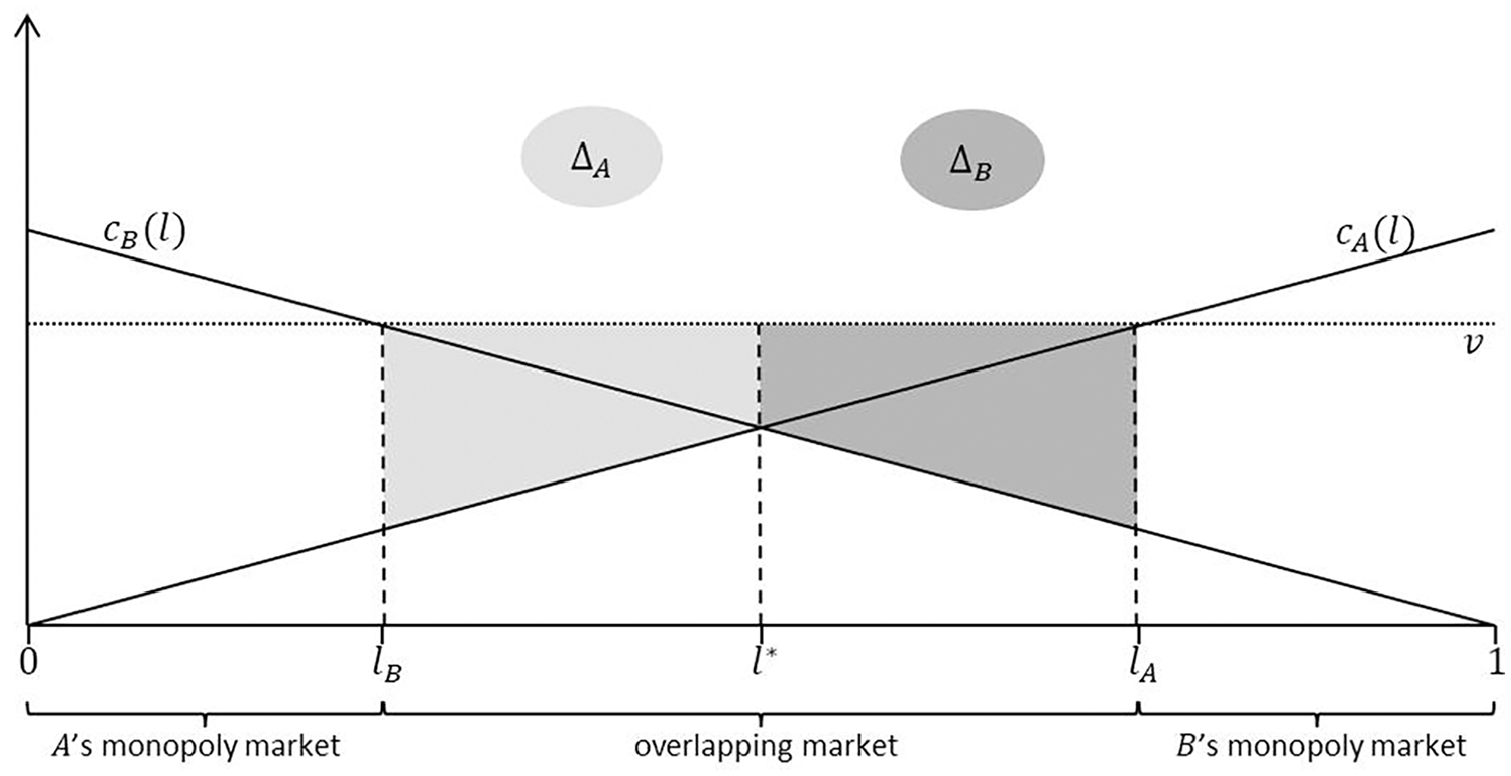
Parameters in the Unfortified sub-game.
To help define the remaining portions of the game, I first partition the game space
The state that is activated to fortify can choose any location in

and

The altered cost functions
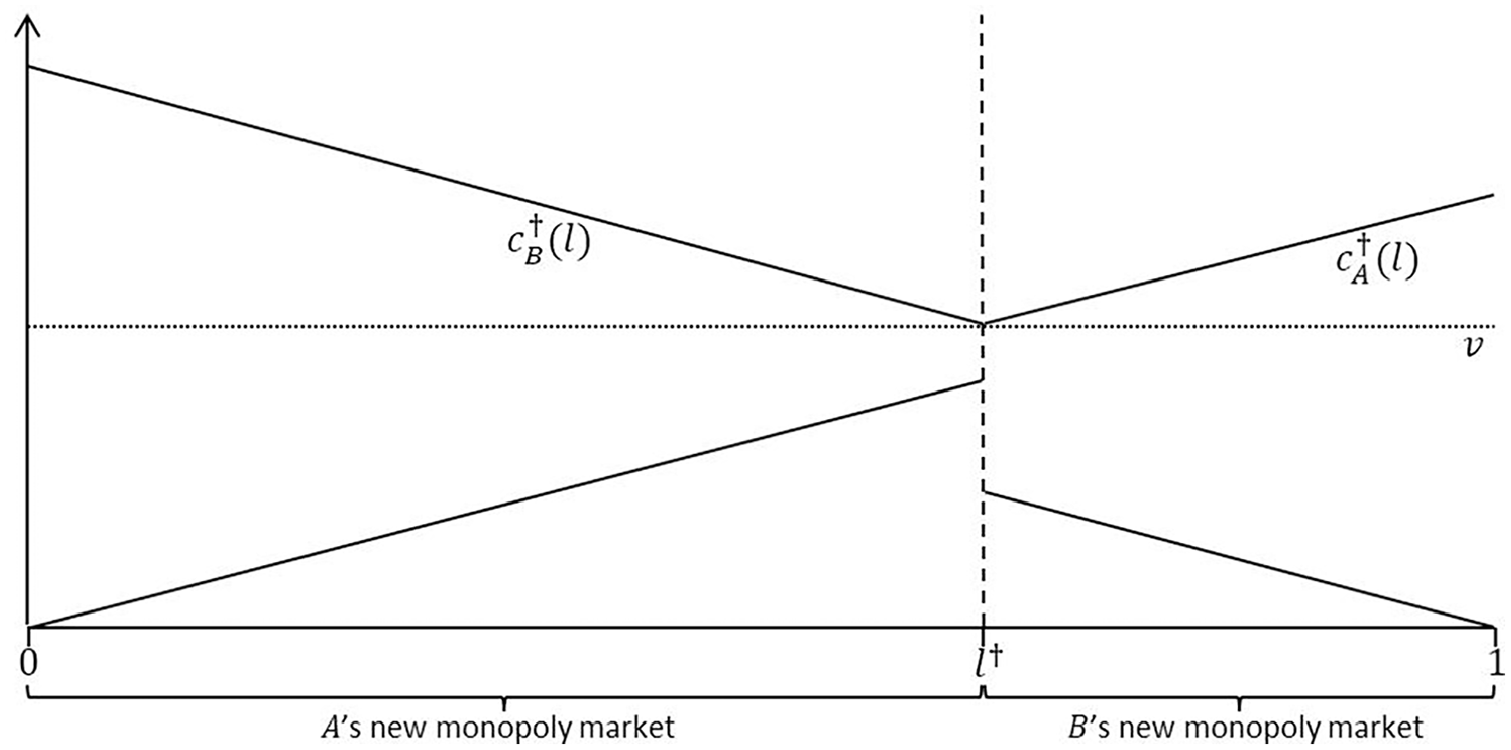
Parameters in the Fortified sub-game.
Fortifications once built are permanent. The permanence is an important substantive element of the model and differentiates fortifications from more temporary forms of border enforcement activities. Formally, the game captures this by only allowing the activation to fortify in the Unfortified sub-game and not the Fortified sub-game.
Choosing to fortify incurs the fortifying state a one-time immediate cost of
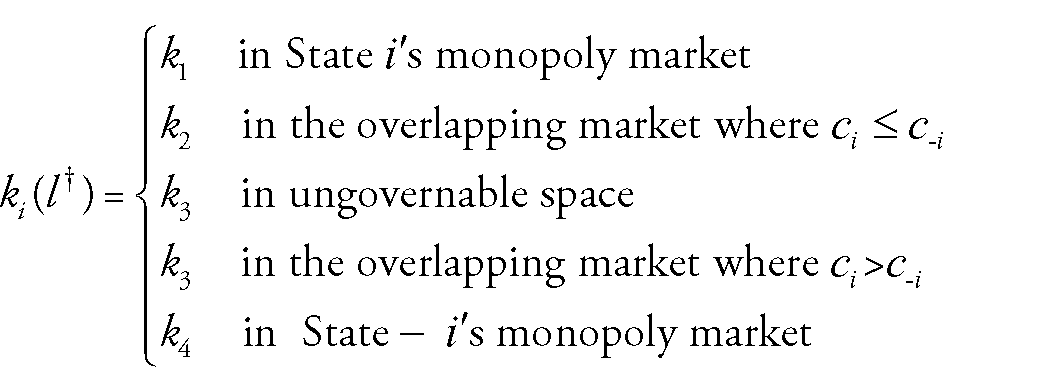
where
Summary and simplifications
In summary, the order of play is:
Set
Increase
States simultaneously offer prices
Individuals
Pay-offs are realized. If Not Fortify was chosen, the game repeats from Step 1. If Fortify was chosen, the game advances to Step 6.
States simultaneously offer prices
Individuals
Pay-offs are realized. The game repeats from Step 6.
This streamlined description of the game clarifies the two sub-games: Steps 2 through to 5 represent the Unfortified sub-game while Steps 6 through to 8 is the Fortified sub-game. Each sub-game results in a stage game that is then infinitely repeated with the additional possibility of moving from Unfortified to Fortified sub-games at most once in the entire history. When the game is in motion, as made clearer in later results, the choices in Steps 3 and 4 (and 6 and 7) become largely mechanical and depend only on whether the game is Fortified or Unfortified. Thus, the main strategic choice of the game occurs in Step 2: where State
To focus results, some simplifications are made. (1) Define on
An index of symbols is provided in the Online Appendix for ease of reference.
Strategies in equilibrium
Monopoly market strategies
Consider first the monopoly markets. Here, states are able to charge the highest price
Overlapping market strategies
It is in the overlapping market that the behaviour of states become interesting. To distinguish between different behaviours, this subsection formally defines stable and unstable borders. From existing definitions in the literature (Carter and Poast, 2017; Rudolph, 2003), stable borders are those without significant unwanted flows of goods and persons. If offers of governance are interpreted to involve such unwanted flows, then stable borders in this game would be an outcome where states do not offer governance services (or at least not viable offers) into the territory of their neighbour. As a result, when borders are stable, the game space
• State
• State
• Individuals accept the offer they receive (if any).
Should
Complementarily, unstable borders are those where states do make governance offers into the territory of other states. That is, states compete over the governance of territory by attempting to underprice each other. Both states offer
• Both states offer price
• Both states offer price
• Both states do not offer services to each other’s monopoly market, and
• Individuals accept the services of the nearest state.
The result of unstable borders is that governance changes hands at
With these definitions established, I quickly resolve a niche and straightforward case. When two territories are separated by ungovernable space, fortifications are never built. This is because there already exists two separate monopoly markets with no overlapping markets for fortifications to resolve. Thus,
• All players always play the SBSP where
• When activated to fortify, states always choose to Not Fortify.
Proof for all main propositions are in the Online Appendices.
All remaining results in this paper focus on cases where Proposition 1 does not apply and stability is not guaranteed by ungoverned space. Formally, this is when
Where to fortify
Having deduced the strategies in Steps 2 and 3, consider now the choice in Step 1: whether or not the activated state fortifies. There are two separate components of this choice, whether or not to Fortify and the specific location of the fortification
The post-fortification profits of each choice is straightforward. Following fortification, both states have a monopoly and can charge price
The ultimate decision on fortifications of course requires a comparison between these post-fortification utilities and the appropriate equilibrium utilities of not fortifying. Let
Fortifying to achieve stability
When (and when not) to fortify
In the Unfortified sub-game, the stage game equilibrium is for each state to price their services competitively. My main results focus on equilibria where this stage game equilibrium is also the equilibrium choice in the repeated game. That is, players always play the UBSP in the Unfortified sub-game. In this subsection, the optimal pure strategy choice of fortifications is determined, given: (a) the stated assumption over Unfortified sub-game strategies; and (b) that all players play stationary strategies.
Fortifications serve as an opportunity to escape the inefficiency of border instability. However, when making this choice, the appropriate utility comparison is not simply between existing instability and potential stability. The activated state must also consider that, if they let the opportunity slip, what potential futures await when the other state is activated.
Consider the following scenario: should State
Whether or not State
Optimizing across different tiers of fortifications is straightforward. A state prefers paying for more expensive fortifications when the increase in profits from the larger monopoly market outweighs the increase in construction costs. For example, State
Note that, by the nature of infinitely repeated games, should it not be rational for a state to Fortify for a particular price in a particular period
The following strategy thus represents the optimal choice of fortifications in reaction to the other state’s choices given that states play the UBSP in the Unfortified sub-game:
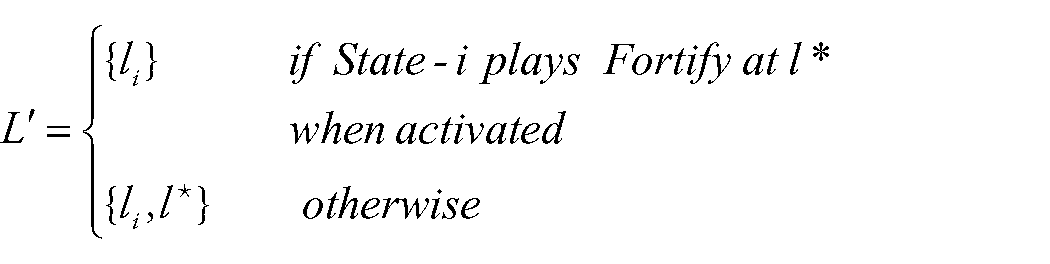
The strategies defined above come together in an equilibrium where one state plays their most preferred fortification choice and the other state reacts to this choice with a contingency-based strategy, as follows
• In the Fortified sub-game, players play the SBSP where
• In the Unfortified sub-game, players play the UBSP,
• State
• State
In the above equilibrium, one of the states, State
Empirical implications
What does the above result to the fortification game reveal about expectations over border fortifications? There are two particular aspects that I have discussed: what makes a border more likely to be fortified and, if such fortifications were to be built, what types of states are more likely to fortify. To best unravel these expectations, I scrutinize the condition that determines whether or not fortifications are constructed at all. This being the decision of State

From these comparative statics, we should expect to see fortification projects where they bring greater economic benefits, relative to the cost of investment, for at least one of the two neighbouring states. Applying this condition to both states suggests that we should not expect to see fortifications at a border where neither state are able to significantly benefit from added stability. Substantively, this might suggest that the border region on both sides is relatively undeveloped and therefore would not be able to produce significant wealth for the state even with monopoly extraction. Alternatively, if the cost for providing governance
By contrast, we should expect fortifications between a wealthy State
In summary, the main equilibrium analysed here provides expectations for two scenarios. When both states are of low economic capacity, we should not expect fortifications. When the two states are of varying economic capacity, then the state of higher capacity should be expected to construct fortifications. What remains is to study the expectations over fortifications between two states of high economic capacity. Currently, the equilibrium in Proposition 2 allows for either state to be the builder in such a scenario and it remains unclear what expectations should be. To find a clearer answer, I turn in the next section to a mixed strategy free-riding outcome.
Fortifications between wealthy states
Free-riding on fortifications
I here study two states of relatively equal but significant wealth and focus on a mixed strategy equilibrium. Such an equilibrium indicates free-riding: both states want the benefits of stability brought by fortifications but would prefer that the other state pay the cost of construction. Thus, although fortifications are wanted by both states, they may not actually be built as each state awaits the other to build the fortifications instead. Allowing for this mixed strategy equilibrium is the main reason the game is designed to be infinitely repeated.
To solve for a mixed strategy equilibrium, we must assume that the two states most prefer the same fortification location
• In the Fortified sub-game, players play the SBSP where
• In the Unfortified sub-game, players play the UBSP, and
• When activated, both states play Fortify at
Empirical implications
Studying the mixed strategy equilibrium gives expectations over fortifications between two states of high economic capacity. The possibility of a free-riding outcome suggests that states of equally high capacity are less likely to be separated by fortifications. This is further supplemented by analysing the equilibrium choice of
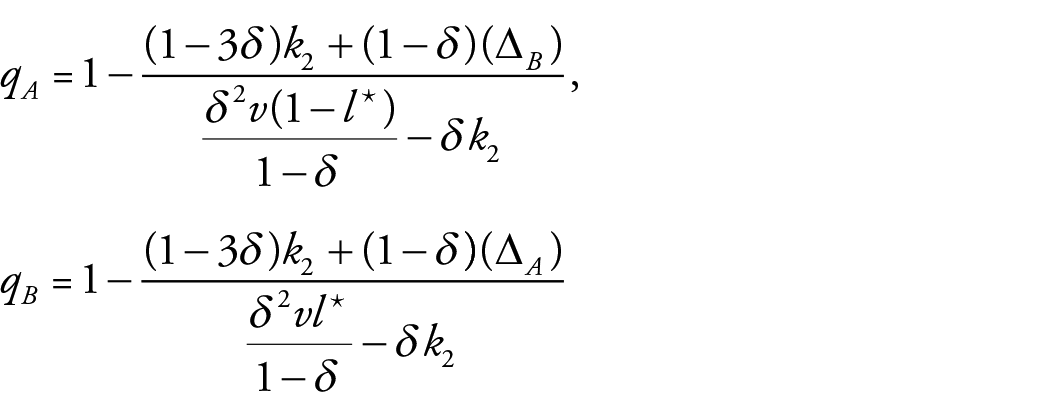
Although the expressions above are unwieldy, the effect of most parameters are clear, especially under the restriction
The
These comparative statics suggest that the wealthier the states, the less likely fortifications become. When state capacity grows, their ability to extract wealth from a larger market
While such an expectation is congruent with patterns in reality – fortifications are rare between two highly developed states – the model provides an unintuitive motivation for this outcome. We would not normally presume that two wealthy states are waiting on each other to build fortifications. This may be because many wealthy neighbouring states, such as Canada and the United States or various members of the European Union, have a history of cooperation and thus pursuing a policy of more stringent border controls runs counter to their established relationship. The following subsection studies cooperative agreements between neighbouring states and finds that when such cooperation is accounted for, fortifications are indeed less likely to emerge between amicable neighbours.
Returning to mutual restraint
Acharya and Lee (2018) have described how border stability can be achieved without fortifications. They show how a cartel-like agreement where the states choose mutual non-interference allows both states to cooperatively exploit the population for economic gain. I expand on these results by demonstrating how stability by mutual restraint is still possible in the Fortification Game, with the caveat that it is now vulnerable to aggressive fortification. This aggressive fortification is in reference to the use of fortifications to unilaterally acquire territory that was previously under the monopoly extraction of the other state. That is, states may choose to pay price
Stability by mutual restraint takes after a grim trigger-style solution, where the fruits of cooperation (border stability and
• In the Fortified sub-game, players play the SBSP where
• In the Unfortified sub-game, so long as the history has always been the SBSP, players play the SBSP and, when activated, both states play Fortify at
• In the Unfortified sub-game, if the history has ever departed from the SBSP, players play as described in Proposition 2.
This result demonstrates that even existing stability is not necessarily a deterrent to fortifications. Even if two efficient monopolies of extraction exist without the need for fortifications, states may still be tempted to use fortifications to secure an even larger monopoly.
However, pre-existing stability does indeed make fortifications less profitable. The threshold for temptation to manifest into construction in Proposition 6 is more difficult to achieve than the threshold in Proposition 2. As a result, we should indeed expect fortifications to be less common between states that can form the cartel of extraction described by Acharya and Lee (2018, 2023). As such cartels require both states to find mutual restraint to be profitable, they are exclusively available to states with high and reasonably equal wealth. This is because the grim trigger-style enforcement is only credible between wealthy neighbours; if one state is significantly more capable, then they may find it worth their while to renege for a large short-term profit and enduring a smaller long-term punishment. See Proposition 2 of Acharya and Lee (2018) for further discussion.
Proposition 6 is therefore further support to suggest that states of equally high economic capacity are less likely to fortify their shared border. Collectively, the analysis of the Fortification Game produces the following conclusions. Border fortifications are most likely between two states of unequal economies. This is because the state of a higher capacity has no reason to restrain themselves from pressing their advantage and constructing fortifications. Conversely, we are less likely to see fortifications between two states of more equal economies. This is because two low capacity states do not greatly benefit from fortifications and two high capacity states may be either paralysed by a free-rider problem or be discouraged by existing cooperation. Overall, this provides us with the expectation that border fortifications become more likely as inter-state inequality grows.
Robustness to migration
In this extension, I consider whether the Fortification Game is robust to a more nuanced incorporation of migration and human mobility. In the main model, the citizen may nominally be a player in the game but they are largely mechanical in their interaction with the states. Their choices in the main model are simply summarized as: (a) choosing the cheapest offer of governance services; and (b) choosing the services of the nearest state when indifferent.
Taking an abstraction of the Fortification Games, (one of) the citizens now has the choice of moving to a different location on
Let citizens now have the opportunity to choose a 2-tuple
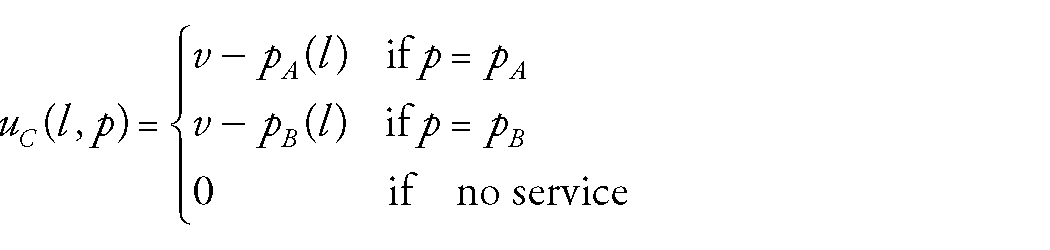
In addition to this, maintain the tie-breaking assumption that, when indifferent, the citizen chooses the services of the nearest state. Assume also that the citizen chooses not to migrate if indifferent between all locations and services. This latter assumption is intuitive of course as a cost of migration can easily be motivated as an argument for staying put when no strictly better economic options are available.
With this new specification the citizen is slightly more nuanced. In addition to choosing the cheapest service, they also choose the location with the cheapest service. Such a choice allows us to study if a citizen would choose to strategically relocate in search of better economic circumstances (some anecdotal accounts of such behaviours can be seen in Sahlins (1989)). Consider the perspective of a single citizen in
Take the SBSP that develops from either the construction of fortifications or the adoption of mutual restraint. Under the presumed stable borders, each and every single location
Finally, consider the UBSP. In this equilibrium, states compete over providing services to citizens. Both states offer a price of service equal to the higher of the two costs of providing services to a particular
This demonstrates how the unstable borders captured in the Fortification Games indeed conforms to the earlier definition. Some citizens will be enticed to migrate across the border and such migration is unwanted by one of the states as they lead to a loss in their governance market. This extension thus suggests an empirical expectation where border regions that are unstable will attract significant migration. This provides some support for my earlier assertion that borderlands are becoming increasingly relevant for state economies that motivated the main model of this paper, though this is of course no substitute for an empirical description of this phenomenon that can be the object of further research.
Conclusion
This paper further develops our understanding of why contemporary states choose to fortify borders. It relies on economic explanations for this phenomenon, specifically highlighting that fortifications serve as an instrument to maximize the economic value (from taxes and market productivity) that a state can extract from its border region citizenry. Fortifications satisfy this purpose through their ability to act as a filter and limit the flow of goods and persons across the border. When such flows are stopped, the populace has no choice but to turn to the local authorities for various governance services which they exchange for taxes and engaging in local markets. Thus, the extraction of this economic value can, at the very least, form part of why contemporary states fortify their borders.
The models above provide some further implications on when we should expect the construction of fortifications. Two important factors are instability and inequality. While there are ways that states may achieve border stability by methods such as mutual restraint and non-interference (Acharya and Lee, 2018, 2023), pilfering is tempting and thus mutual restraint is not always possible. Fortifications serve as a costly tool for recourse to establish border stability where it fails to emerge without enforcement. Furthermore, we should also expect fortifications to be more likely across borders that separate regions of unequal prosperity. This is because pairs of border regions that are more economically equal are more likely to achieve stability through mutual restraint (as the temptation to pilfer is reduced). Furthermore, even when borders are initially unstable, economically equal border regions may be less likely to fortify due to the possibility of a free-rider problem where neither state wishes to unilaterally take on the costs of a fortification project in the hopes that the other state does so instead. This relationship between economic inequality and the likeliness of fortifications tangentially echoes the empirical findings of Carter and Poast (2017).
Invoking an economic story provides a satisfying explanation for the correlation between the advancement of time and the uptick in fortifications. One way in which contemporary states diverge from earlier entities is by their bilateral economic relationships with their neighbours over their land borders. The global proliferation in population means that more and more land is now occupied by civilization. Populated areas are valuable to states due to their economic productivity, consumption and taxability. For many states, this now means that their border regions become ever more relevant to their economic interests as potential sources of revenue now extend all the way to the frontier. States must engage with their neighbours in managing the populace in their shared border regions in order to claim their share of spoils from such economic activity. Thus as the economic value of securing border regions increases, so too does the attractiveness of constructing fortifications to clearly separate one’s territory from the neighbours.
Understanding these economic motivations is important as the political discourse around borders and their integrity across the world continues to be xenophobic and exclusionary. We must recognize that such rhetoric may be, at least partially, hiding an attempt to extract wealth from the population for profit. From this perspective, the pursuit of border fortifications may actually be an economic policy that occasionally wears a populist mask. The outcome of such a thought process may be a re-orientation of how we think about borders and their integrity. The modern state may be securing their borders, not in an attempt to curb any outside threats, but rather in the pursuit of keeping their own wealth fenced inside.
Footnotes
Acknowledgements
I am indebted to Randall L. Calvert, David B. Carter, Justin Fox, Keith E. Schnakenberg, Margit Tavits, audiences and fellow graduate students during my time at Washington University in St. Louis, and the editor and two anonymous reviewers for their invaluable input at various stages of producing this paper.
Replication data

Conflict of interests
The author has no conflicts of interest to declare.
Funding
The author received no financial support for the research, authorship, and/or publication of this article.
AFIQ BIN OSLAN, b. 1995, PhD in Political Science (Washington University in St. Louis); Senior Research Fellow, Max Planck Institute for Tax Law and Public Finance (2023–present). Political economist with interests including border policy, environmentalism and game theory.