



Abstract
This article investigates a widespread yet understudied trend in EU politics: the shift of legislative decision making from public inclusive to informal secluded arenas and the subsequent adoption of legislation as “early agreements.” Since its introduction in 1999, “fast-track legislation” has increased dramatically, accounting for 72% of codecision files in the Sixth European Parliament. Drawing from functionalist institutionalism, distributive bargaining theory, and sociological institutionalism, this article explains under what conditions informal decision making is likely to occur. The authors test their hypotheses on an original data set of all 797 codecision files negotiated between mid-1999 and mid-2009. Their analysis suggests that fast-track legislation is systematically related to the number of participants, legislative workload, and complexity. These findings back a functionalist argument, emphasizing the transaction costs of intraorganizational coordination and information gathering. However, redistributive and salient acts are regularly decided informally, and the Council presidency’s priorities have no significant effect on fast-track legislation. Hence, the authors cannot confirm explanations based on issue properties or actors’ privileged institutional positions. Finally, they find a strong effect for the time fast-track legislation has been used, suggesting socialization into interorganizational norms of cooperation.
Keywords
This article investigates a widespread yet understudied trend in European Union (EU) politics: the shift of legislative decision making from public inclusive to restricted secluded arenas and the resulting “informalization” of the political process. Informalization is particularly prominent in the codecision procedure—“ordinary legislative procedure” post-Lisbon—and it is puzzling scholars and practitioners alike. Indeed, since the possibility to conclude codecision at first reading was introduced in 1999, an ever-increasing percentage of legislation has been adopted “early” by the two colegislators, the European Parliament (EP) and the Council of the European Union. Such “early conclusion” accounted for 72% in the 2004–2009 parliamentary term.
This increase in early conclusion has two repercussions. First, to agree a file early, a legislative compromise must be reached prior to the EP’s first reading. This compromise is negotiated informally by a restricted and secluded group of representatives from EP, Council, and European Commission. Second, the procedure is “fast-tracked,” as legislation is adopted after one rather than three possible readings. This trend toward informal decision making and fast-tracked legislation is particularly puzzling when assessed against the backdrop of EU institutional reform. Over the past two decades, Parliament has been promoted to a genuine colegislator, not least to address the EU’s “democratic deficit” through a more open and inclusive legislative process. Yet the transformation of codecision has refuted both the concerns and expectations raised when the procedure was introduced in 1993. Contrary to concerns about its complexity, codecision has proved highly efficient in terms of legislative output; contrary to expectations of greater accountability, inclusiveness, and transparency, the routine use of fast-track legislation has led to seclusion from the electorate and rank-and-file parliamentarians.
Our article attempts to explain this puzzling trend in supranational politics by addressing a question that is relevant beyond the study of EU legislation: Under what conditions will decision making be shifted from formal inclusive to informal secluded arenas?
This question is warranted for two reasons. First, the sheer volume of first reading agreements, increasing from 22% of codecision acts adopted in 1999 to 86% in 2009, begs for empirical investigation, theoretical explanation, and normative evaluation. At the same time, we know little about how fast-tracked legislation is agreed, under which conditions it occurs, and what the political and democratic consequences are. There is extensive scholarly debate about the legislative influence of, and the distribution of power between, the EU’s colegislators (see, e.g., Kreppel, 1999; Tsebelis & Garrett, 2000), but only one contribution has studied legislative influence under informal procedures (Häge & Kaeding, 2007). More generally, although practitioners have discussed fast-track legislation and its challenges (Shackleton, 2000; Shackleton & Raunio, 2003), few academic studies have analyzed how the formal rule change plays out in the legislative praxis. Two notable exceptions are Farrell and Héritier’s (2004) study on intraorganizational relations and institutional reform in Council and Parliament and Rasmussen’s (2011) explanation of early conclusion from 1999 to 2004.
Second, the recourse to fast-track legislation exemplifies a wider trend toward secluded policy making, national as well as supranational, that combines informalization with new forms of openness and inclusion and challenges traditional democratic patterns in Europe (Bedock, Mair, & Wilson, 2011). On one hand, political decision makers are “sealed off” from their wider constituencies and elected representatives; on the other hand, decision making is opened up through direct democratic procedures, transparency, and civil society involvement. Similarly, scholars of international relations have noted a new trend toward informalization (Daase, 2009). This trend is not only visible in states’ informal cooperation and agreement inside international organizations, such as the United Nations Security Council or the African Group in the World Trade Organization. What is more, decisions previously taken within formal organizations are increasingly shifted outside; two prominent examples are informal pre–decision making in the G8 and the Proliferation Security Initiative (Daase, 2009, p. 294, pp. 300-301). Although our article’s empirical focus is exclusively on EU legislation, our theoretical framework is developed so as to address these wider trends and to explain why decision makers systematically choose informal over formal arenas.
The article proceeds in the following steps. The first part conceptualizes informal decision making. The second part introduces the informal politics of codecision. The third part develops three explanations of informal decision making: a functionalist argument stressing efficiency, a distributive bargaining argument emphasizing institutional power, and a sociological argument suggesting socialization into interorganizational cooperation. We test our hypotheses on an original data set, based on the full population of the 797 codecision files concluded between mid-1999 (when fast-track legislation was introduced) and mid-2009 (when the last parliamentary term ended). The fourth part discusses the data set, operationalization, and measurement. The fifth part submits the hypotheses to a statistical test. Our findings suggest that the decision to “go informal” is systematically related to the number of negotiation participants, legislative workload, complexity, and the time informal rules have been used. However, we find no link between fast-track legislation and policy type, issue saliency, and the priorities of the Council presidency. The article concludes by discussing the wider implications of our findings.
Formal and Informal Decision Making
Our conceptual definition begins with three caveats. First, our article focuses on informal and secluded processes played out as a part of, rather than outside of, a formal institutional framework. More specifically, we look at instances where formal rules of cooperation leave informal spaces that decision makers can—but need not—choose to fill. In spite of its interest in informalization, the article is thus squarely placed within the study of “formal politics,” as “the Government and the process of governing narrowly conceived” (Hay, 2002, p. 70). 1 Second, the analysis is confined to decision making as that stage in a political process during which actors, operating under set institutional constraints, choose binding outcomes or identify preferred options. Our definition is, accordingly, too restricted to encompass mere consultation (e.g., of interest groups) or interaction outside the framework set by formal institutions (e.g., clientelism and corruption); it also differs from informal governance as “the operation of networks of individual and collective, private and public actors” (Christiansen, Føllesdal, & Piattoni, 2003, p. 7). Third, we do not claim that informal decision making is novel or normatively problematic per se. Choosing to use informal spaces may be not only legitimate but also expected from decision makers, and it is difficult to imagine a system doing altogether without informal politics when applying its formal rules.
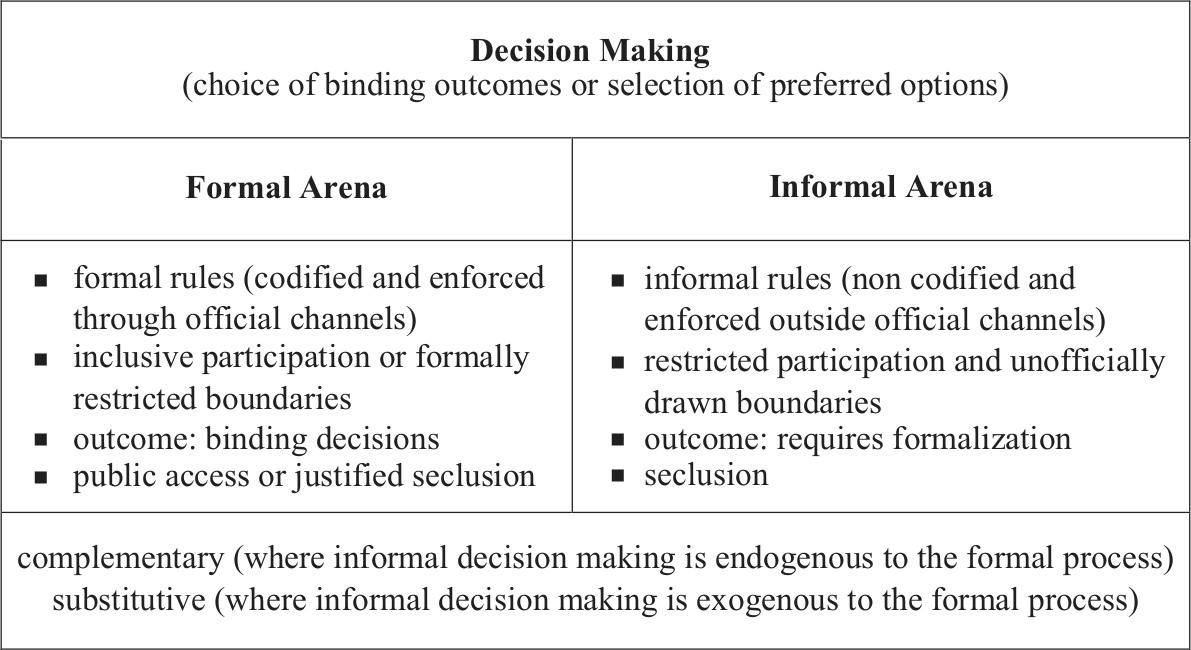
In this article, we assume that decision makers have a degree of choice over whether and to what extent they “go informal,” and we try to explain their choice. In so doing, we delimit the informal arena from its formal variant along four dimensions: (a) nature and status of rules, (b) boundaries of participation, (c) scope and outcomes, and (d) access (see Figure 1).
Formal and informal decision making.
First, informal and formal arenas differ with regard to the nature and status of rules. According to the standard definition, institutions are man-made rules and procedures that “define and limit the choices of individuals” (North, 1990, p. 4). Rules more specifically are prescriptions “used by a set of participants to order repetitive, interdependent relationships”; they specify what is “requested, prohibited, or permitted” (Ostrom, 1986, p. 5). Prescriptions in the informal arena differ from those in the formal arena with regard to comprehensiveness, codification, and enforceability. Formal decision arenas are structured by a configuration of codified rules, specifying the positions, boundaries, scope, authority, and aggregation of an “action situation” (Ostrom, 1986, p. 19). Informal decision arenas, by contrast, are structured by noncodified rules and one or more dimensions of an action situation can be underspecified or not covered (Helmke & Levitsky, 2004; Knight, 1992; Lauth, 2000). Enforcement also works differently. Formal rules can be enforced by a third party; informal rules are “created, communicated and enforced outside the officially sanctioned channels” (Helmke & Levitsky, 2004, p. 727). Hence, opportunities and constraints for action differ in the informal arena. On one hand, decision makers face fewer codified and enforceable constraints on how they are required, prohibited, or permitted to act; on the other hand, constraints on what their actions can affect are tighter, since enabling rules, too, will be noncodified and nonenforceable by a third party (Ostrom, 1986, p. 17).
Second, informal and formal arenas differ with regard to their boundaries of participation, in particular inclusiveness, codification, and public knowledge. Membership in the formal arena is either inclusive or formally restricted. The formal political process includes all legitimate decision makers (or allows for inclusion even if actors choose not to partake), or it involves a formally restricted subset of actors. No matter whether membership is inclusive or restricted, it is publicly known who participates (or is allowed to participate). By contrast, participation in the informal arena is both restricted and noncodified; the process involves a limited group of actors, and the boundaries of membership are neither formally drawn nor publicly known.
Third, informal and formal arenas differ with regard to their scope of action, defined as “the set of outcomes that may be affected” (Ostrom, 1986, p. 19). When acting in the informal arena, decision makers produce intermediate rather than final outcomes. Thus, in functioning democracies—and contrary to dysfunctional systems—the two arenas are asymmetrically dependent. Final and binding decisions can emanate from the formal process only, and any agreement reached informally must be legitimized through formalization. Yet even under such conditions, the informal arena can significantly constrain how much is left to be decided and justified in the formal arena.
Fourth, informal and formal arenas differ with regard to public access. Such differences pertain to the physical or virtual access to deliberation, negotiation, and documentation and to whether access restrictions must be publicly justified. In the formal process, decision makers will generally meet in public; in the informal process, decision makers will generally be sealed off. Yet even where the formal arena is secluded, documentation about the decision process will be available or the restricted access to negotiation or documentation will be justified. By contrast, the informal decision arena can be systematically secluded, and access can be denied without public justification.
The Informal Politics of Codecision
Understanding informal decision making and explaining why it occurs has become imperative for anyone who studies the process and outcome of EU legislation. Under codecision, informalization and seclusion are corollaries of the dramatic increase in legislation agreed at first or early second reading.
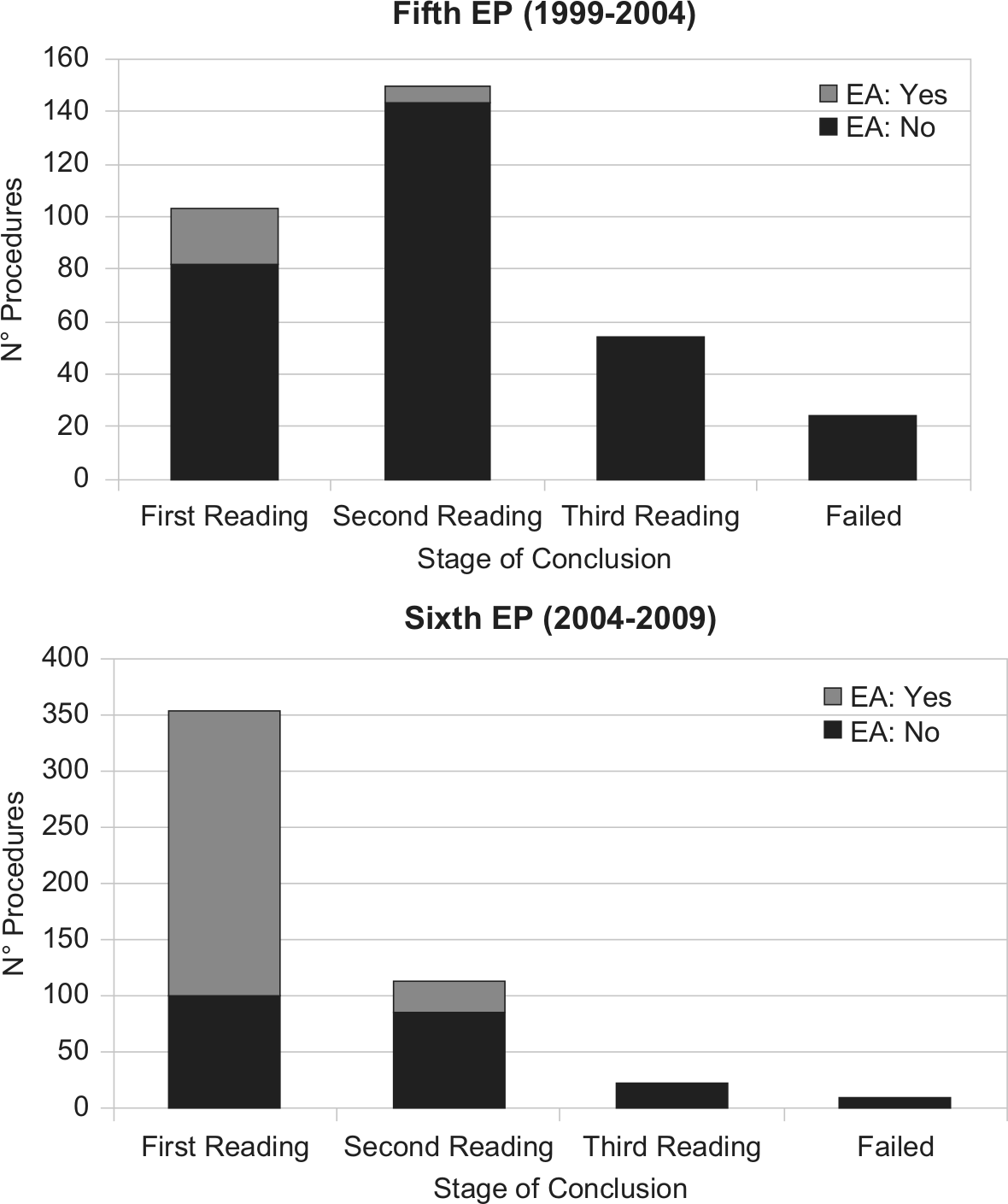
Our article explains this striking trend by analyzing the use of “early agreements” (EAs) through an original data set of all 797 codecision acts concluded between mid-1999 and mid-2009 (see Figure 2). To qualify as an EA, an act must meet two conditions: (a) it is fast-tracked, that is, concluded at either first or early second reading; (b) it is based on an informal compromise between the colegislators.
Early Agreements and early conclusion (1999–2009).
This analytical focus is justified for the following reasons. The stage of conclusion is a necessary but insufficient indicator of how an agreement was reached. It is necessary because only acts concluded at first or early second reading hinge on a systematic shift of decision making into the informal arena. The mechanism behind an early first reading agreement is the following: After the Commission has tabled its legislative proposal, representatives of Parliament, Council, and Commission enter into informal negotiations, known as “trilogues.” These negotiations take place before the EP issues its formal opinion and before the Council adopts its common position, which are the first two steps in the formal process. If Council and Parliament reach an informal compromise, the EP includes the Council’s propositions in its own first reading amendments, adopted by simple majority. Subsequently, the Council accepts the Commission proposal as amended by Parliament. The procedure is closed, and the act adopted accordingly. An early second reading agreement is possible when the EP, at its second reading, adopts—rather than amends—the Council’s common position, based on the prior incorporation of amendments suggested by Parliament. At this stage, the informal compromise is reached after the EP holds its first reading and before the Council adopts its common position.
However, the stage of conclusion alone is an insufficient indicator of informalization. First and early second reading deals, by definition, require rubber-stamping. Rubber-stamping can be the upshot of an informally negotiated compromise, but it can also result from the absence of legislative conflict. Given our driving interest—the choice of informal decision making rather than the stage of conclusion per se—we therefore focus only on those fast-tracked files that result from informal compromise on a contested act. These acts are ideally suited proxies for decision makers’ choice to “go informal” and examples of informal decision making as conceptualized above.
Under codecision, informalization is in line with—and in application of—the Treaty. Informal decision making thus plays out within the EU’s formal legislative process, from which it is distinct along all four dimensions introduced above: A restricted, noncodified set of decision makers operates in a secluded setting, social interaction is structured by informal rather than codified and enforceable rules, and informal compromise must be legitimized through the formal process.
Legislative compromise is reached in trilogues. In contrast to the parliamentary plenary and Council meetings, trilogues are limited; in contrast to EP committees, membership is not officially defined or publicly known. When EAs became possible—and trilogues necessary—interinstitutional agreements and intraorganizational guidelines merely talked about “appropriate contacts” (European Parliament, Council, & Commission, 1999), and membership in the informal negotiation arena was to be decided ad hoc (European Parliament, 2004).
Furthermore, the rules structuring informal interaction differ in nature and status from formal rules. The decision situation is not clearly defined, and participants and positions in trilogues are underspecified and flexible, as are communication channels and available information. Furthermore, the informal “rules of engagement” (Shackleton, 2000) are created and enforced outside official channels. Where such rules are written, they are very general—such as the 1999 and 2007 interinstitutional Joint Declaration on Practical Arrangements for the Codecision Procedure—or have limited binding force—such as the EP’s internal guidelines on how to colegislate. In 2009, a Code of Conduct for Negotiating Codecision Files became part of the EP’s codified Rules of Procedure; previously, behavioral constraints stemmed only from the need to reach intraorganizational consensus and to formalize informal compromise.
Indeed, decision makers can reach agreement in trilogues, yet any such agreement is intermediate until formalized by the EP’s plenary and a ministerial Council. At the same time, rubber-stamping is a pre-condition for early conclusion. Under codecision, the informal compromise therefore constrains formal decision making to a significant extent. Formally, Members of the European Parliament (MEPs) continue to have the right to table amendments to the informal compromise, both in committee and plenary; de facto, however, they face considerable political pressure not to challenge an informal deal (Rasmussen & Shackleton, 2005).
Finally, trilogues are both informal and secluded. Access is highly restrictive, for members of the public and for MEPs who are not party to the parliamentary negotiation team. Information on the decision process is limited to feedback given by trilogue members to their respective committees, and documentation on the decision process is not publicly available. Trilogues are thus both inaccessible and intransparent, and their seclusion has been neither justified publicly nor decided formally.
The increase in early conclusion has been widely noticed in the Brussels policy community (for example see European Parliament, 2009) but has drawn little academic attention. There are, however, four notable exceptions: Farrell and Héritier’s studies of fast-track legislation (Farrell & Héritier, 2003) and intraorganizational power shifts (Farrell & Héritier, 2004), Häge and Kaeding’s (2007) analysis of the EP’s legislative influence in trilogues, and Rasmussen’s (2011) explanation of first reading deals in the Fifth EP. Our article builds on, yet goes beyond, these studies. First, the period analyzed is more comprehensive; our data set runs from 1999 to 2009 and covers the two completed parliamentary terms during which fast-track legislation was used. Second, our dependent variable is both wider and more specific; it comprises early second reading agreements (in addition to first reading deals), but it includes only those acts that were negotiated informally (rather than all procedures concluded early). Third, by addressing the wider question of why decision makers “go informal,” we aim to contribute to the study of informalization and seclusion beyond the confines of EU legislative politics.
To give a better sense of the scope and extent of informal politics under codecision, we next present a descriptive statistical overview of EAs since 1999. The next section follows up on this account by theorizing the reasons for informal decision making.
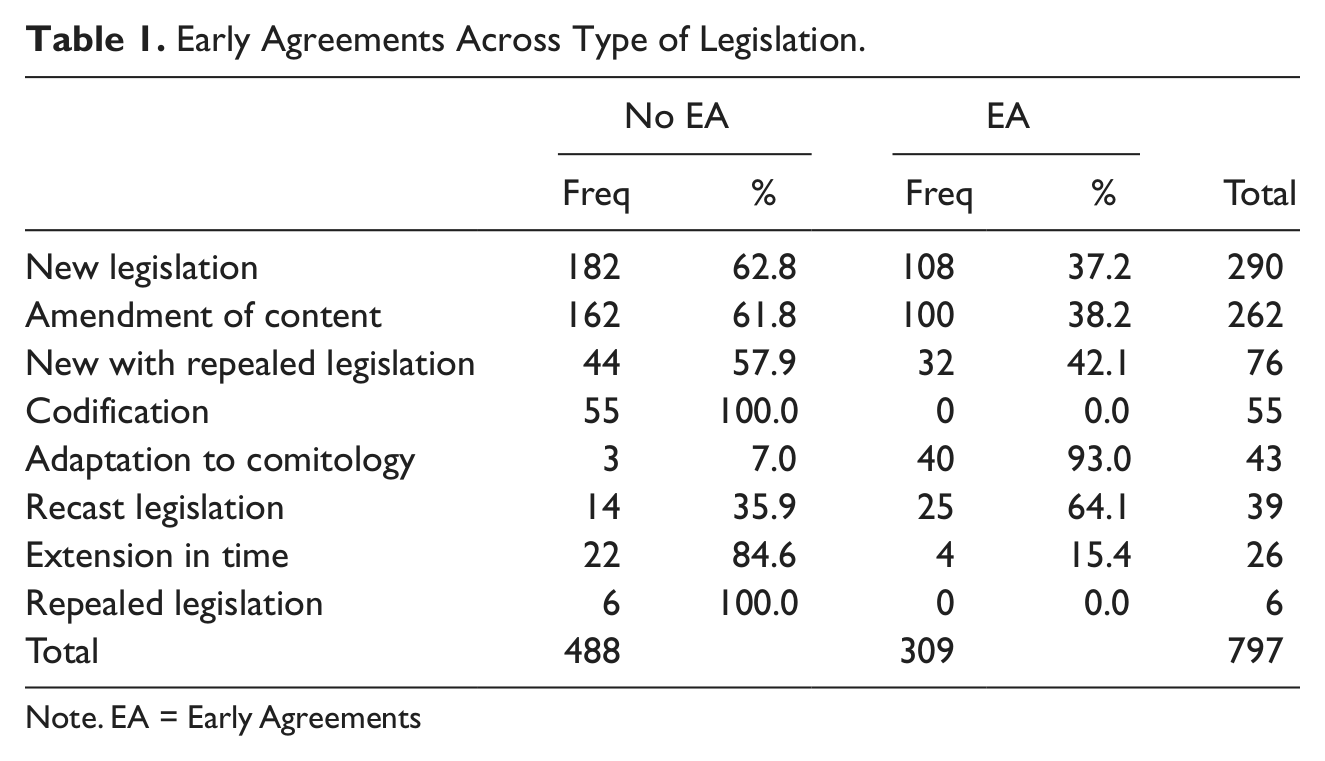
Table 1 shows the number and percentage of EAs per type of legislation. The use of EAs varies significantly—from 93% and 64% for procedures adapting legislation to the regulatory procedure with scrutiny and for recast legislation, to 15% for procedures extending the operation of existing legislation. EAs are not used for repeal and codification. The former can be explained by lacking contestation; the latter by the legislative trajectory: Codification replaces existing legislation without substantive change, and negotiation is delegated to the colegislators’ legal services.
Early Agreements Across Type of Legislation.
Note. EA = Early Agreements
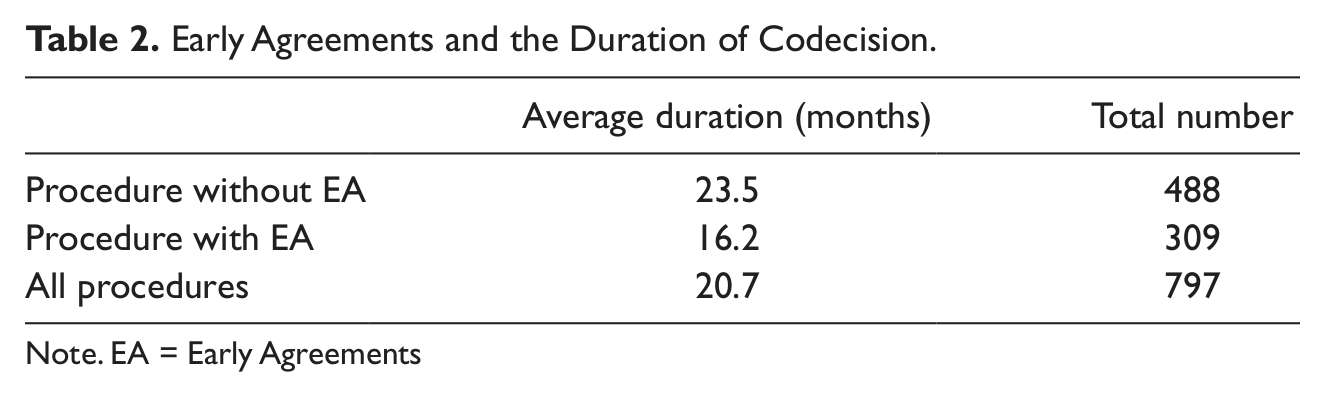
Differences also pertain to the duration of procedures. The average duration of all 797 codecision procedures—from tabling of proposal to publication of final act—is almost 21 months. As Table 2 shows, the average duration of “formal procedures” is 23.5 months; although the time limits specified in the Treaty do not apply prior to first reading, the average duration of “informal procedures” is slightly more than 16 months.
Early Agreements and the Duration of Codecision.
Note. EA = Early Agreements
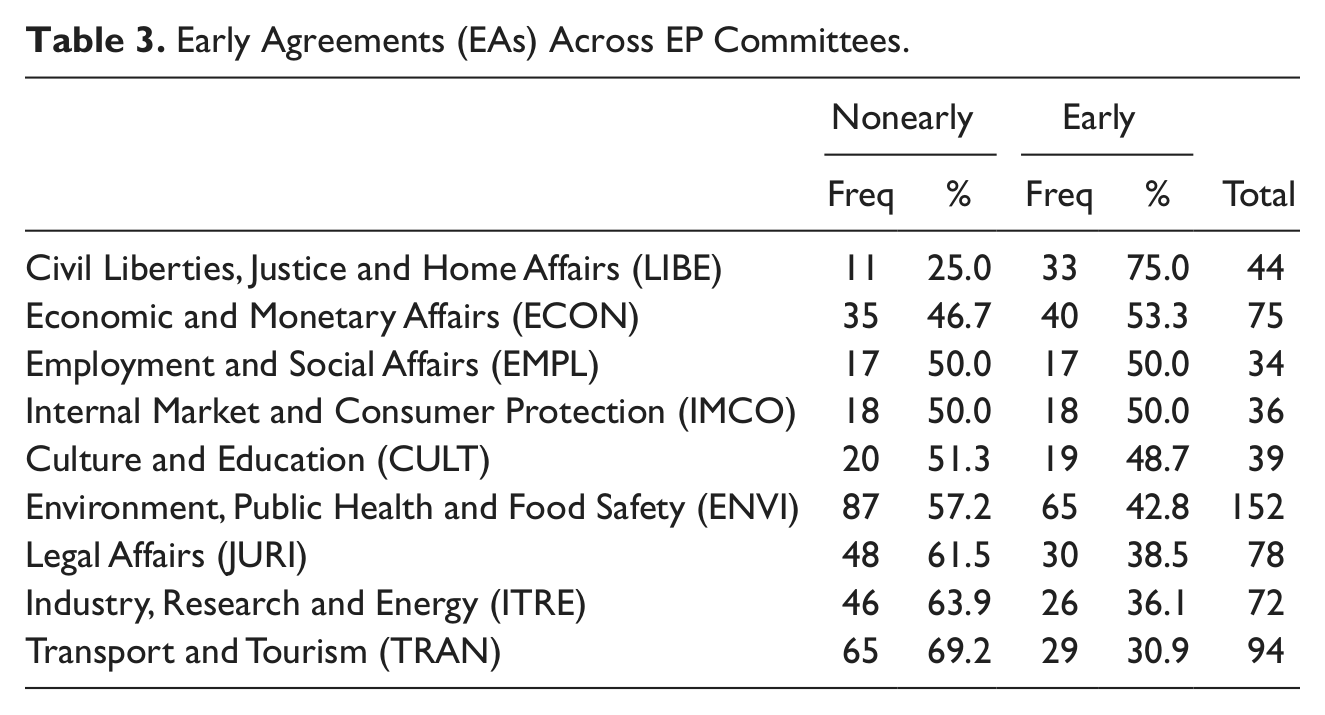
EAs also vary across EP committees. Table 3 lists the number and percentage of EAs for committees that have dealt with more than 25 codecision procedures. 2 Although the Committee on Civil Liberties, Justice and Home Affairs (LIBE) concluded 75% of its procedures early, the Committees on Economic and Monetary Affairs (ECON), Employment and Social Affairs (EMPL), Internal Market and Consumer Protection (IMCO), and Culture and Education (CULT) adopted about half of their acts as EAs. With 43% and 39%, respectively, EAs are less common in the Committees on the Environment, Public Health and Food Safety (ENVI) and Legal Affairs (JURI), and they are used least in the Committees on Industry, Research and Energy (ITRE) and Transport and Tourism (TRAN), with 36% and 31%, respectively.
Early Agreements (EAs) Across EP Committees.
Theorizing the Use of Early Agreements
To answer the question why actors “go informal” under codecision, we develop three theoretical arguments: a functionalist argument stressing efficiency gains, a distributive bargaining argument emphasizing gains of institutional power, and a sociological argument suggesting socialization into interorganizational norms of cooperation.
The first two arguments are drawn from rational choice institutionalism and assume boundedly rational actors, utility maximization, and transaction costs. Both the functionalist and the power-based bargaining approach also conceptualize rules as incomplete contracts. Given uncertainty about the world and future contingencies, and given informational asymmetries about others’ actions and intentions, actors are concerned about the long-term distributional consequences of their choices (Koremenos, 2005; Lake & Powell, 1999). Actors therefore hesitate to commit to detailed contracts, fully specifying all responsibilities and obligations and anticipating every possible contingency (Cooley & Spruyt, 2007, p. 8). Instead, they prefer rules as incomplete contracts. These can be adjusted to external circumstances when they are applied (Héritier, 1999) and allow actors to correct distributional asymmetries ensuing from their initial agreement (Cooley & Spruyt, 2007, p. 9; Koremenos, 2005).
To explain the transformation of incomplete institutional rules over time, the functionalist perspective argues that extant rules are adjusted to save transaction costs of information, negotiation, and monitoring. Faced with a collective action problem, actors calculate the expected benefits of a rule change and subtract the transaction costs of negotiating the change. If this cost–benefit calculation is positive, actors will agree on a specific rule change, which is—on balance—considered beneficial for all.
Where actors’ preferences are diverse, the transaction costs of negotiation are likely to increase with the number of participants. In EU decision making, widening membership through enlargement will therefore augment the costs of information gathering and bargaining, and new member states will add to the costs of negotiating legislation under codecision (Hertz & Leuffen, 2011; Rasmussen, 2011, p. 52). For the colegislators, transaction costs of accommodating more diverse policy preferences arise in particular from the need to coordinate internal positions within their respective organizations. Yet specific institutional conditions may help actors to save such transaction costs and thus influence their decision to “go informal.” The adoption of an EA requires only a simple majority of votes in Parliament. This decision rule, therefore, helps Parliament to save the increasing costs of internal coordination.
We therefore submit,
Hypothesis 1 (H1): The likelihood of EA will increase if the overall number of participants in the negotiating organizations increases.
Transaction costs rise not only with the number of participants but also with the number and complexity of legislative files (also see Rasmussen, 2011, p. 52). A high workload pushes the costs of information gathering up. If legislative dossiers, in addition, involve uncertainty about substantive cause-and-effect relations—as is the case with complex and regulatory-technical issues—their negotiation requires special expertise as well as considerable time and effort. At the same time, the distributive implications of complex and regulatory-technical dossiers are less obvious, and such files are less likely to attract public interest and trigger political conflict. Hence, where the transaction costs of a heavy legislative agenda and issue complexity combine with the absence of broad political controversy, legislators will move into the informal arena where they can save transaction costs and take decisions more speedily.
We therefore expect,
Hypothesis 2 (H2): The likelihood of EA will increase if the overall number of legislative files under negotiation increases.
Hypothesis 3 (H3): An EA is more likely where the legislative issue is complex and regulatory-technical.
As a corollary, we expect the opposite where legislative issues are likely to raise public interest and political opposition. Such issues will not be decided informally because EP and Council constituencies will demand broad and public legislative debate. We expect such demands to be particularly pronounced where issues are salient or redistributive. Where issues are salient, interest and opposition derive from a dossier’s relation to sovereignty or from its strong symbolic relevance; where issues are redistributive, interest and opposition derive from the fact that some social groups bear costs to the benefit of others (also see Rasmussen, 2011, p. 52).
We therefore propose,
Hypothesis 4 (H4): An EA is less likely where a legislative issue is salient.
Hypothesis 5 (H5): An EA is less likely where a legislative issue is redistributive.
The functionalist explanation of institutional outcomes has been criticized for being too automatic (Héritier, 2007; Knight, 1992; Mattli, 1999). In our case, it claims that the transaction costs of widening membership, legislative workload, and regulatory complexity lead to changed decision making, that is, to fast-track legislation. Actors’ unequal power—derived from institutional structures at t1 when an adjustment of incomplete contracts is negotiated—is not taken into account.
Power-based distributive bargaining theory focuses on precisely this aspect. The theory assumes that actors are competence maximizers; while seeking to increase the efficiency of an institutional rule, they also try to maximize institutional power and, thus, influence over policy outcomes (Héritier, 2007). Although a changed rule increases overall benefits by enabling cooperation, these benefits may not be distributed evenly. Actors will, accordingly, press for the use of those procedures that increase their benefits, and the final rule is the outcome of a bargaining process (Knight, 1992, p. 27). In explaining the outcome of this process, power takes center stage. The actor’s (ex ante defined) power is reflected in her or his availability of fallback options where bargaining fails (Knight, 1992, pp. 41-42) and in an actor’s time horizon or preference intensity. Moreover, if an actor has a residual right to specify the terms of the incomplete contract at t2, she or he will have more power in shaping the outcome of the implicit negotiations (Cooley & Spruyt, 2007).
Under the EU’s codecision procedure, some actors will, therefore, have a strong interest in using EAs, because—under the extant institutional rule— “going informal” increases their influence. Holding the rotating Council presidency is such an institutional rule.
Established in 1957, the presidency initially had few responsibilities. Over time, however, it has obtained important functions in the management of the Council’s legislative agenda, mediation, and brokerage between member states as well as external representation (Tallberg, 2006). The growing fragmentation of Council decision making and the Commission’s declining capacity to define the agenda further increased the need for coordination, and in the 1980s presidencies began to define priorities for their terms in the chair (Tallberg, 2006). When codecision was introduced, the presidency became the most important interlocutor with Parliament. Joint decision making, thus, further empowered the presidency as the actor negotiating in the interorganizational arena and controlling information flows (Farrell & Héritier, 2004). The rotation principle—ensuring that all member states get their turn in the chair—allows for this temporary concentration of power. In short, the 6-month Council presidency is an opportunity for, and an incentive to, shape decisions and realize policy preferences by way of fast-track legislation (Farrell & Héritier, 2003, 2004).
We therefore submit,
Hypothesis 6 (H6): An EA is more likely where the legislative file is an ex ante defined priority of the Council presidency.
Our third theoretical explanation of informal decision making derives from sociological institutionalism. This approach allows us to explain the steep rise in fast-track legislation over time, following decision makers’ initial choice of informal rules—be this to save the transaction costs of coordination, to gain policy influence, or to foster a constructive negotiation climate. Sociological institutionalism assumes that actors are firmly anchored in an organizational and social context (Johnston, 2001); it is this context with its specific expectations of appropriate behavior that defines their available choice repertoire (March & Olsen, 1989, 1998). To explain why actors consider a particular set of decision rules as their most appropriate choice, sociological institutionalists turn to the mechanism of socialization, defined as the “process of inducting actors into the norms and rules of a given community” (Checkel, 2005, p. 804; Johnston, 2001, pp. 494-506).
In international negotiation, repeated and time-demanding interaction in small, secluded settings has been shown to foster socialization into cooperative and constructive behavior (Checkel, 2001). Trilogues in fast-track legislation are such settings. Under codecision—introduced amid institutional competition between Parliament and Council—negotiation in trilogues can therefore facilitate cooperation between the two colegislators, by creating “mutual confidence, and positive trust spirals” and by augmenting “skills at political compromise” (March & Olsen, 1998, p. 960). Once decision making has been successfully shifted into such an arena, and once decision makers have become socialized into using the rules of interorganizational cooperation, “going informal” will be considered as the appropriate choice. If the sociological explanation holds, we should, therefore, see fast-track legislation increase with the length of time informal rules have been used (also see Rasmussen, 2011, p. 51); in contrast to the functionalist argument suggested above, this expectation should hold across negotiations, independent of issue properties, policy area, and saliency.
We therefore submit,
Hypothesis 7 (H7): The likelihood of EA increases with the time codecision has been in use, independent of policy area, issue saliency, and institutional preferences.
Research Design
Our data set contains all codecision procedures concluded in the Fifth and Sixth EP. Fast-track legislation has been formally possible since the entry into force of the Amsterdam Treaty in 1999, and this year is our starting point. Based on the EP’s Legislative Observatory, we included all codecision procedures completed between July 20, 1999, and July 17, 2009, which results in 797 procedures.
Our analysis seeks to explain the likelihood of EA under codecision. As detailed above, an EA meets two conditions: (a) it is concluded at first or early second reading and (b) it results from informal compromise between the colegislators. These conditions were identified as follows. First, we singled out all first and second reading agreements. Second, we searched the procedural files of these dossiers for evidence of informal compromise (also see Yordanova, 2010, chap. 6). Third, we selected those dossiers concluded early that resulted from informal compromise. Informal compromise prior to first reading is indicated by formulations such as “[t]he amendments are the result of a compromise between Parliament and Council . . .,” “[i]n accordance with the compromise reached at first reading . . .,” and “[f]ollowing a first reading agreement with the European Parliament, the Council adopted this Regulation.” Before second reading, formulations include “[t]he common position . . . reflects the compromise text agreed by all three institutions . . .” or “[t]he common position is the result of intense inter-institutional negotiations. . . .” Only where we found such evidence for files concluded at first or early second reading did we code them positively as EAs. Of the 797 procedures in our data set, 309 procedures were EAs, 275 of which were concluded at first and 34 at early second reading stage.
Our statistical models include the following explanatory variables.
H1 is tested with the variable enlargement. This dichotomous variable takes the value 0 if the codecision file was concluded before May 1, 2004, and the value 1 if it was concluded thereafter (also see Best & Settembri, 2008, p. 186). In spite of the EU’s enlargement to two new member states in 2007, we focused on 2004 for two reasons. Theoretically, H1 derives from a functionalist argument, linking increased transaction costs to an increased number of negotiation participants. The 2004 “big bang” enlargement from the EU-15 to the EU-25 was an exceptionally steep increase and is therefore uniquely suited to test H1. Furthermore, this choice follows established scholarship on postaccession decision making, which treats 2004 as the defining increase in group size (see Bailer, Hertz, & Leuffen, 2009, for an overview).
H2 is tested with the proxy variable workload presidency, defined as the number of ongoing procedures during each Council presidency (also see Rasmussen, 2011, p. 52).
To test H3 and H5, we created three variables. First, two variables capture complexity. The continuous variable recitals measures the number of recitals in the Commission’s legislative proposal. Committee opinion measures the number of EP committees consulted on the dossier. 3 Second, to capture regulatory-technical and redistributive files, we identified the procedure’s policy type. 4 Based on the Commission proposal, we classified a procedure as regulatory-technical if it has no redistributive consequences; requires member states to provide information, coordinate, or harmonize legislation; or makes recommendations. We created a dummy variable for this category. For H5, we constructed two additional dummies to capture files with a redistributive element. If the Commission proposal mentions no funds but if obligations affect a particular group, the file was coded “regulatory, redistributive”; if the proposal mentions funds that are offered to a particular group, the file was coded as “redistributive.” Third, we created two interaction variables between complexity and regulatory-technical policy type. 5
The effect of H4 is tested with the variable media. We used LexisNexis Academic to calculate the average number of times a file was mentioned in the relevant English-, French-, German-, and Italian-language print media (see Table 4). 6 Keywords for the search were the file’s official title or its “public nickname” (e.g., “Services Directive”).
Operationalization of Explanatory and Control Variables.
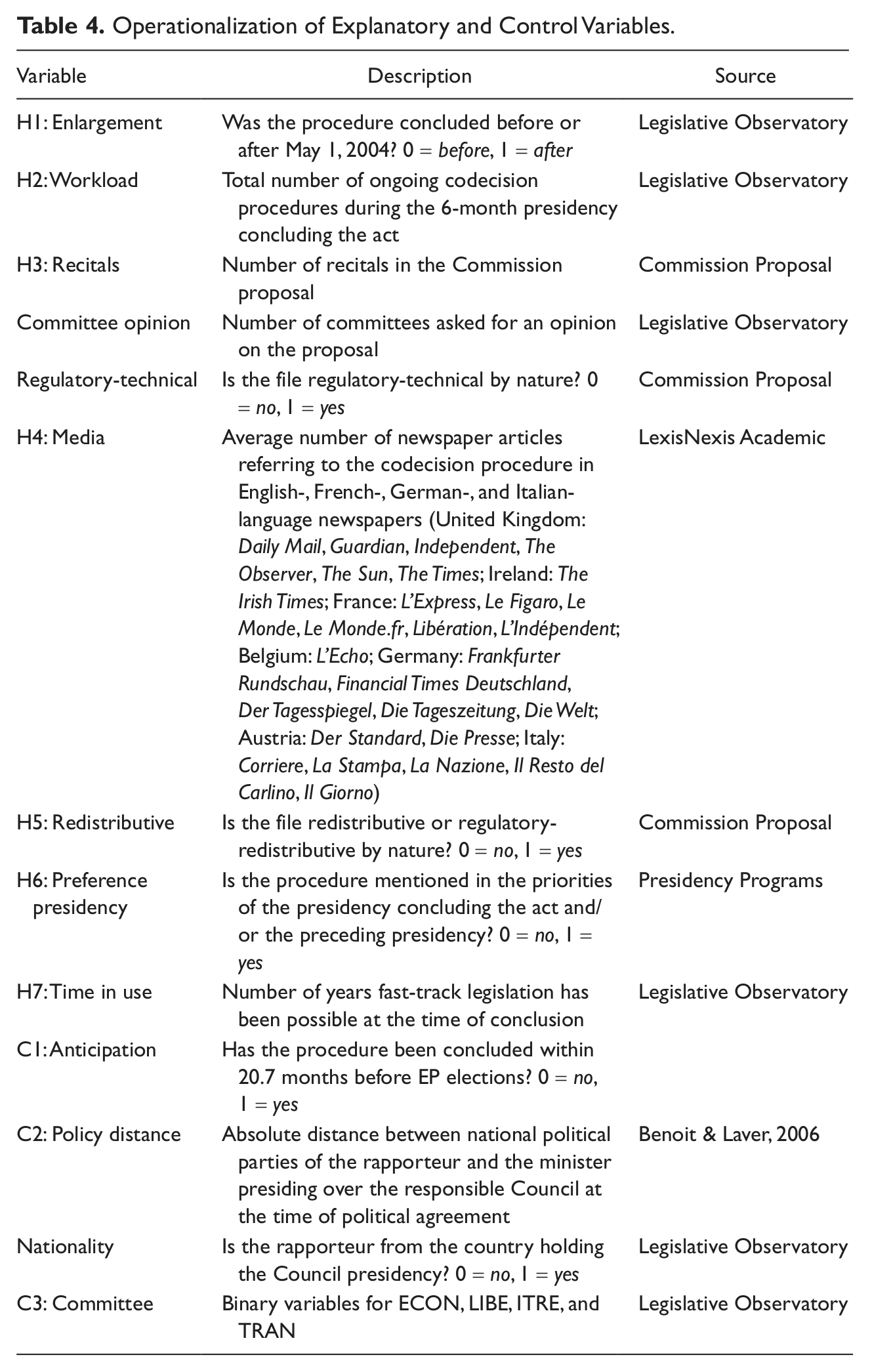
H6 is assessed with the variable preference presidency. To code this variable, we searched for an explicit mention of—or an unambiguous reference to—the legislative file in the program of the Council presidency concluding the legislation. Yet as negotiating an EA can take longer than one presidency’s term, our search also included the legislative priorities of the preceding presidency. Our dichotomous measure takes the value 1 where the legislative file falls within the remit of one or both programs; otherwise, it is coded as 0.
Finally, H7 is tested with the variable time in use. This continuous variable ranges from 1 to 10 and indicates the number of years fast-track legislation has been formally possible (also see Rasmussen, 2011, p. 51).
In addition to our explanatory variables, our models include three control variables.
Anticipation was included in view of the anticipation effect found prior to EU enlargement (Leuffen & Hertz, 2010). We identified two moments of key importance for the colegislators: the EP elections of 2004—resulting in a new and enlarged Parliament—and of 2009. As we expect anticipation to set in before each event, we took a procedure’s average duration as our anticipation period. 7 This variable takes the value 1 for all procedures concluded in the 20.7 months before the two EP elections. We expect a particularly strong anticipation effect prior to the 2004 EP elections, which coincide with potential anticipation of enlargement (Leuffen & Hertz, 2010, p. 67).
Furthermore, two measures capture the proximity of Council and EP negotiators. First, policy distance was introduced as fast-track legislation depends on “the level of mutual trust, political understanding, etc. between . . . key negotiators, which might be higher if they come from the same party family” (Rasmussen, 2011, p. 51). We singled out the EP’s rapporteur and the national minister presiding over the responsible Council as key negotiators. Using expert survey data (Benoit & Laver, 2006), we constructed a proxy variable for the absolute distance between the policy positions held by the political parties of these two actors, and we expect increasing policy distance to decrease the likelihood of EA. Second, negotiations will be facilitated where key actors share a “linguistic and cultural background” (Rasmussen, 2011, p. 51). We therefore expect EA to be more likely where negotiators come from the same country. The dummy variable nationality takes the value 1 if the rapporteur is from the country holding the presidency at the time of political agreement; otherwise it is coded 0.
Finally, in the light of the descriptive statistics presented in Table 3, we constructed binary variables for the EP’s ECON, LIBE, ITRE, and TRAN committees. Table 3 showed these four committees as “extreme” cases: the former two fast-track files frequently, the latter two do so rarely. Including this control allows us to gauge whether a “committee effect” occurs when other explanatory factors are held constant.
Results and Analysis
As our dependent variable is dichotomous, we use binary logistic regression to test our hypotheses. This technique predicts the probability of concluding codecision by EA given specific values on the explanatory variables. Because the relationship between dependent and independent variables is nonlinear, we report odds ratios (eβ) besides the B coefficients. Odds ratios provide a more intuitive interpretation: for a unit change in xi, the odds of y = 1 change by a factor of eβ, holding all other variables constant. Odds ratios with values between 0 and 1 point to a decreasing likelihood of EA; odds ratios greater than 1 indicate increasing likelihood.
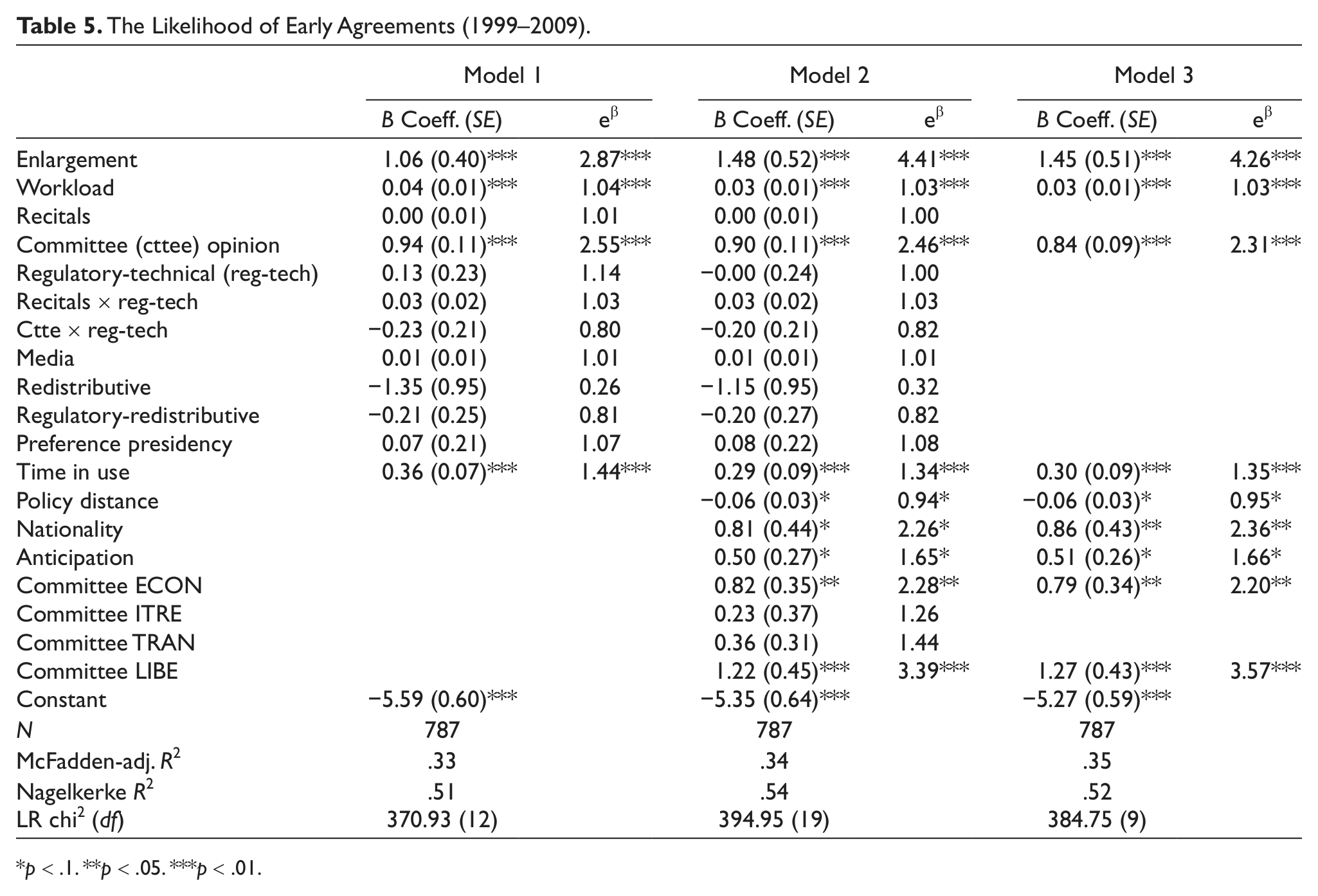
We estimated three models. H1 to H7 are tested in Model 1. Model 2 adds the controls anticipation, policy distance, nationality and the committee dummies. Model 3 is a reduced model; it includes only those variables found to be significant (p < .1) in Model 2.
Table 5 reports the estimates for our models. 8 In a nutshell, we find support for the impact of EU enlargement, legislative workload, complexity measured by the number of consulted committees, and the time fast-track legislation has been in use. Supporting evidence is also found for the effect of our control variables policy distance, nationality, and anticipation as well as for a “committee effect.”
The Likelihood of Early Agreements (1999–2009).
p < .1. **p < .05. ***p < .01.
Turning to the logit models, the McFadden-adjusted R2 statistic—which is sensitive to the number of predictors—ranges between .33 (Model 1) and .35 (Model 3), and the Nagelkerke R2 ranges between .51 and .54. Overall, their values are fairly satisfactory. The most efficient model is Model 3, with a low number of explanatory variables and the highest McFadden-adjusted R2.
In what follows, we discuss our findings in more detail.
H1 expected the likelihood of EA to increase with the number of negotiators. The EU’s 2004 enlargement resulted in a particularly steep such increase, and it has a positive and significant effect, robust to different model specifications. Hence, legislative files concluded after May 1, 2004, are significantly more likely to be concluded as EAs.
H2 expected the likelihood of EA to increase with the number of negotiated files and, thus, with legislative workload. In all three models, the effect is positive and very significant. More specifically, every extra procedure during a presidency increases the likelihood of EA by a factor of about 1.03. This result is in line with Rasmussen’s (2011, p. 56) study of the relationship between workload and early conclusion.
Hence, the analysis corroborates H1 and H2 and backs our functionalist argument. Where actors are faced with increased transaction costs of internal coordination and information gathering—because they need to accommodate growing heterogeneity postenlargement, and because a packed legislative agenda puts pressure on resources—they will adjust extant incomplete rules so as to save costs. Fast-track legislation offers an opportunity to regain efficiency by reducing the number of interlocutors in the informal arena and by capitalizing on the simple majority rule in Parliament.
H3 expected EAs to be particularly likely for complex and regulatory-technical issues. Based on two variables capturing complexity and one dummy for regulatory-technical files, two interaction terms tested the hypothesis. Neither of the interactions has a significant effect. Hence, H3 is disconfirmed. However, one of the two variables measuring complexity—the number of committees asked for their opinion on the Commission proposal—has a positive and significant effect. That is, every additional EP committee consulted increases the likelihood of an EA with a factor 2.31 (Model 3). Thus, although a file’s regulatory-technical nature does not make EA more likely, issue complexity seems to play a role. This finding lends further support to our functionalist argument stressing efficiency gains: Consulting EP committees indicates a need for, and an investment in, coordination, information, and expertise, with the ensuing costs pushing decision makers into the informal arena. This finding is also in line with Rasmussen’s (2011, p. 58) results. In her study, however, committee opinion measured political salience, and her expectations were disconfirmed accordingly.
H4 expected EAs to be less likely where the legislative issue is salient. Given our focus on public interest and political opposition, this hypothesis was tested by measuring attention in the English-, French-, German-, and Italian-language media. Our analysis does not support this hypothesis: files with a lot of media attention are similarly likely to be passed as EAs as are those that attract little attention.
H5 expected EAs to be less likely for redistributive and for regulatory-redistributive issues. To test this hypothesis, we used two dummy variables for all files with an element of redistribution. However, our analysis disconfirms H5, as both redistributive and nonredistributive legislation is routinely adopted early.
The tests of H1 to H5 thus back a functionalist argument based on efficiency gains: Transaction costs are a strong incentive for actors to “go informal.” Yet although this argument is well suited to explain the causal effects of enlargement, workload, and complexity, it is less effective in accounting for the role played by policy area and issue saliency. H3 to H5 expected decision makers to choose informal procedures only for regulatory-technical dossiers. However, given that even redistributive and salient legislation is routinely adopted early, our explanation does not hold: Conflicting interests, political opposition, and public attention do not translate into demands for open and formal legislative debate and controversy, and, accordingly, do not prevent decisions from being shifted into the informal secluded arena.
H6 expected EA to be more likely where the legislative file is an ex ante defined agenda priority of the Council presidency. This hypothesis is not confirmed in the analysis. When a piece of legislation is mentioned in the program of the concluding or preceding presidency, its likelihood to be adopted early is moderately positive but not statistically significant. Our power-based distributive bargaining argument is therefore not backed by empirical evidence; either Council presidencies do not choose fast-track legislation as a means to promote their policy priorities or their institutional position—albeit privileged—does not allow them to succeed when attempting to do so. 9
H7, which expected the likelihood of EA to increase with time independently of issue properties, is corroborated. The effect of the time in use variable is in the expected direction, strong, and robust to different model specifications. In Model 1, a unit change in time—that is, each additional year during which the Amsterdam Treaty has been in force—increases the likelihood of EA by a factor of 1.44 (p < .01). This finding is in line with Rasmussen’s (2011, p. 55) study of the 1999–2004 period. Controlling for the proximity of key negotiators, anticipation and committee effect (Models 2 and 3), time in use still has a strong and significant effect. To determine whether the collinear relationship between enlargement and time in use is problematic, we conducted several diagnostics. Standard tests based on the variance inflation factor confirm that the two variables are associated but that collinearity is not severe. We also estimated Model 3 without enlargement. As expected, the B coefficient for time in use increased, indicating that the omitted variable captures part of its effect. However, with the exception of anticipation, whose coefficient decreases and falls outside conventional levels of significance, the estimates are remarkably stable.
This finding supports our sociological institutionalist argument. Where informal norms of cooperation become engrained, and where decision makers are socialized into these norms, actors will choose to “go informal,” independent of issue properties. Over time, informal decision making thus becomes the appropriate choice, allowing colegislators to capitalize on increasingly cooperative interorganizational relations in the informal arena. However, our results also pose a challenge for the sociological argument: Even in 2009, a significant number of codecision files continues to be decided formally, and follow-up qualitative research needs to uncover why decision makers, socialized into informal rule sets, choose not to fast-track those pieces of legislation.
We expected our first control variable, anticipation, to have a positive and significant effect prior to the 2004 and 2009 EP elections and the 2004 enlargement. Indeed, during the 20 months preceding the “expected shock” (Leuffen & Hertz, 2010, p. 57), the likelihood of EA increases by a 1.65 factor (p < .1) in Models 2 and 3.
Policy distance between the EP’s rapporteur and the national minister in the Council has a modest effect. The B coefficient is small, and the change in the odds of Y = 1 is limited. Still, the coefficient is negative and significant in Models 2 and 3: as the ideological distance between rapporteur and minister increases, the chance for agreement in trilogue decreases. This effect, albeit small, underlines the importance of party politics in codecision: The likelihood of an EA increases where the key negotiators’ policy preferences approximate, and this typically happens when rapporteur and minister belong to the same famille spirituelle.
Nationality, our second control capturing negotiators’ proximity, has a strong and significant effect in the expected direction. When the EP’s rapporteur comes from the country holding the presidency, the likelihood of EA increases by a factor 2.26 in Model 2 and by a factor 2.36 in Model 3. In combination, the proximity of key negotiators—who represent their organizations in informal trilogues—adds an important explanatory factor.
Finally, we find strong first evidence of a “committee effect.” Ceteris paribus, a codecision dossier dealt with by ECON and, especially, LIBE is significantly more likely to be agreed early. In contrast, if a legislative file is assigned to ITRE or TRAN, no effect can be appreciated. Figure 3 shows the effect of time in use and LIBE, based on the estimates of Model 3. This important finding calls for systematic theoretical reflection on why decision makers in certain EP committees are so much more prone to “go informal.” Follow-up research should analyze whether variation can be explained by more general differences between parliamentary committees, such as type, size, and jurisdiction (Mattson & Strøm, 1995) or assignment and preference heterogeneity (Yordanova, 2009); or whether explanations need to draw on factors specific to codecision, such as interaction between committee and rapporteur, relations between committee and Council formation, or a committee’s experience in colegislation. 10
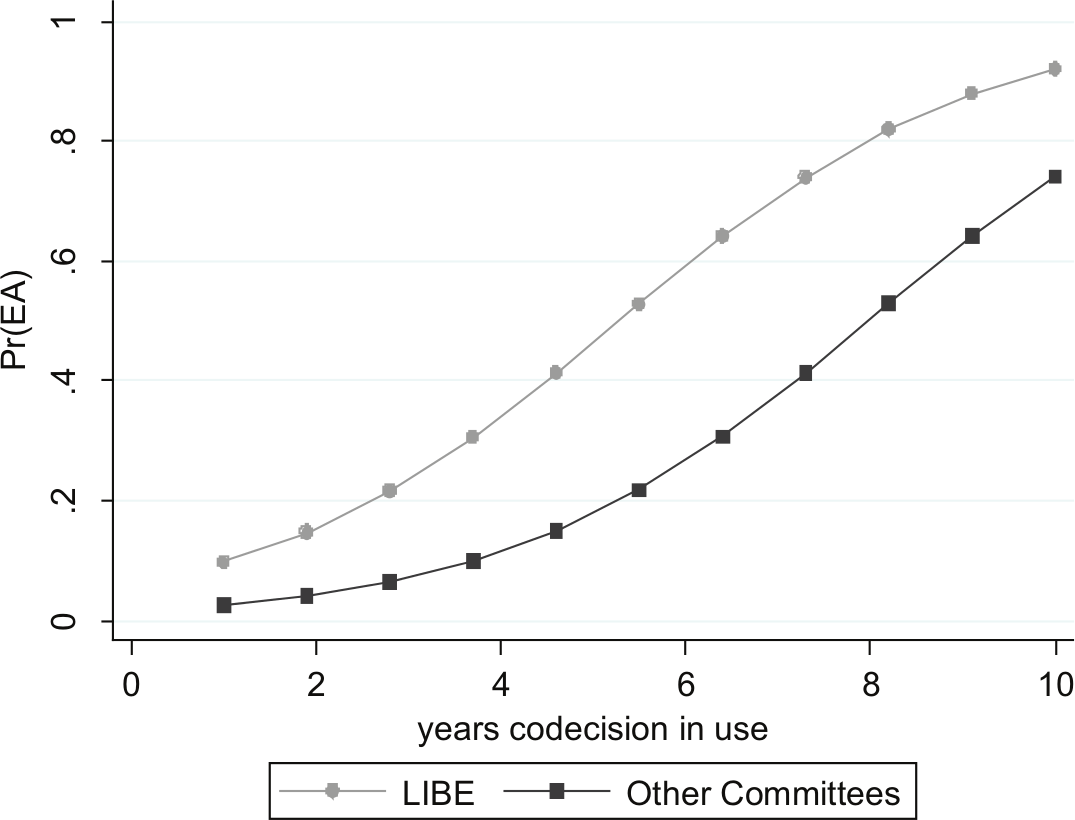
Impact of time in use and LIBE committee on Early Agreements (EAs)
Conclusion
Our study introduced and explained a puzzling and understudied trend in EU politics: informal and secluded legislation in the Fifth and Sixth EP. Fast-track legislation displays all characteristics of informal decision making: A restricted, noncodified set of actors operates in a secluded setting; negotiation is structured by informal rather than codified, specific, and enforceable rules; and any pre-agreement must be formalized. The informal politics of codecision, is, therefore, an ideal test case for scholars with a wider interest in the dynamics and causes of informalization and seclusion.
By introducing the mechanisms behind fast-track legislation and by presenting the scope and spread of EAs across types of legislation, our article responds to a pertinent question raised by EU scholars, policy makers, and civil society alike: Are first and early second reading deals struck only on noncontroversial and technical legislation, or are they also used for salient and redistributive files? Even based on our restricted definition of EAs—factoring out all noncontested procedures—the figures demonstrate a dramatic informalization of decision making since 1999. Fast-track legislation therefore matters qualitatively as well as quantitatively.
More specifically, our analysis of codecision between mid-1999 and mid-2009 suggests that informalization is systematically related to EU enlargement, legislative workload, complexity, and the time fast-track legislation has been in use. Evidence also points to the relevance of political and national proximity of key negotiators and to a strong “committee effect.” Yet we find no link between the choice to “go informal” and policy type, issue saliency, or the Council presidency’s priorities.
Our findings therefore strongly support a functionalist argument based on efficiency gains; fast-track legislation can reduce the transaction costs of internal coordination (where participants and workload increase) and of information gathering (where a file is complex). The analysis also corroborates a sociological institutionalist argument suggesting socialization into informal norms of cooperation; the longer EAs have been used, the more informal decision making becomes the appropriate choice. However, there is no supporting evidence for an argument drawn from distributive bargaining theory; in spite of its privileged institutional position, the Council presidency cannot use fast-track legislation for policy gains. Furthermore, as even salient and redistributive acts are regularly passed as EAs, an explanation based on the absence of public interest and political opposition carries little weight. This could be for one of two reasons: Either actors in Council and Parliament do not encounter significant internal opposition where “going informal” undercuts broad controversy and open debate, or decision makers move a file into the informal arena precisely to avoid publicity and opposition. Neither of these reasons would be good news for the democratic credentials of fast-track legislation: The first would suggest that public debate is systematically undercut, the second would imply that informalization occurs because—rather than in spite—of contestation.
In sum, our article makes an empirical, a theoretical, and a normative contribution to the study of EU legislative politics and informal decision making more generally. Empirically, we analyze the spaces left by the formal rules of codecision and demonstrate the extent and scope of informalization and seclusion; theoretically, we develop an analytical framework that can explain why decision makers do or do not choose to use these informal spaces; and normatively, our systematic evidence on the type of legislation that is agreed early puts the democratic evaluation—and criticism—of fast-track legislation onto firmer empirical ground.
Footnotes
Acknowledgements
The authors would like to thank Nicola Chelotti and Lukas Obholzer for their research assistance, Caroline Inson and Saari Tuija for their help with the OEIL data set, and André Bächtiger, Harry Bauer, and Pierpaolo Settembri for their constructive comments on earlier versions of this article. Many thanks also go to the participants of the 2009 European University Institute workshop “The Legislators of Europe,” the 2010 American Political Science Association panel “Informal Governance in International Organizations,” and the 2010 University Association for Contemporary European Studies panel “The Changing Nature of EU Decision-Making under Codecision”; to audiences at the Hertie School of Governance in Berlin and the University of Exeter; and to James Caporaso and two anonymous referees for their helpful feedback and suggestions.
Declaration of Conflicting Interests
The author(s) declared no potential conflicts of interest with respect to the authorship and/or publication of this article.
Funding
The author(s) disclosed receipt of the following financial support for the research, authorship, and/or publication of this article: Research for this article has been generously supported by the European University Institute and by the UK’s Economic and Social Research Council (Grant RES-000-22-3661).